Summer School: HUB Architecture Edition

On this, the last day of summer, I thought we’d look back at the Center’s second-annual Architecture Elective for the Horizons-Upward Bound Summer Component. It was a real highlight of my summer!

A grant from the Society for Architecture Historians enabled Nina Blomfield, the Center’s Collection Fellow, and me to co-teach the six-week elective. Each Monday and Wednesday morning from June 28 to August 2, we met in Gordon Hall of Science at Cranbrook with fifteen enthusiastic HUB students, grades 9 through 12. While we started most mornings in the classroom with our textbook or a slideshow of images, the real excitement came on class trips.

I mean, what better way to learn about excellent architecture than to study the buildings of Cranbrook?
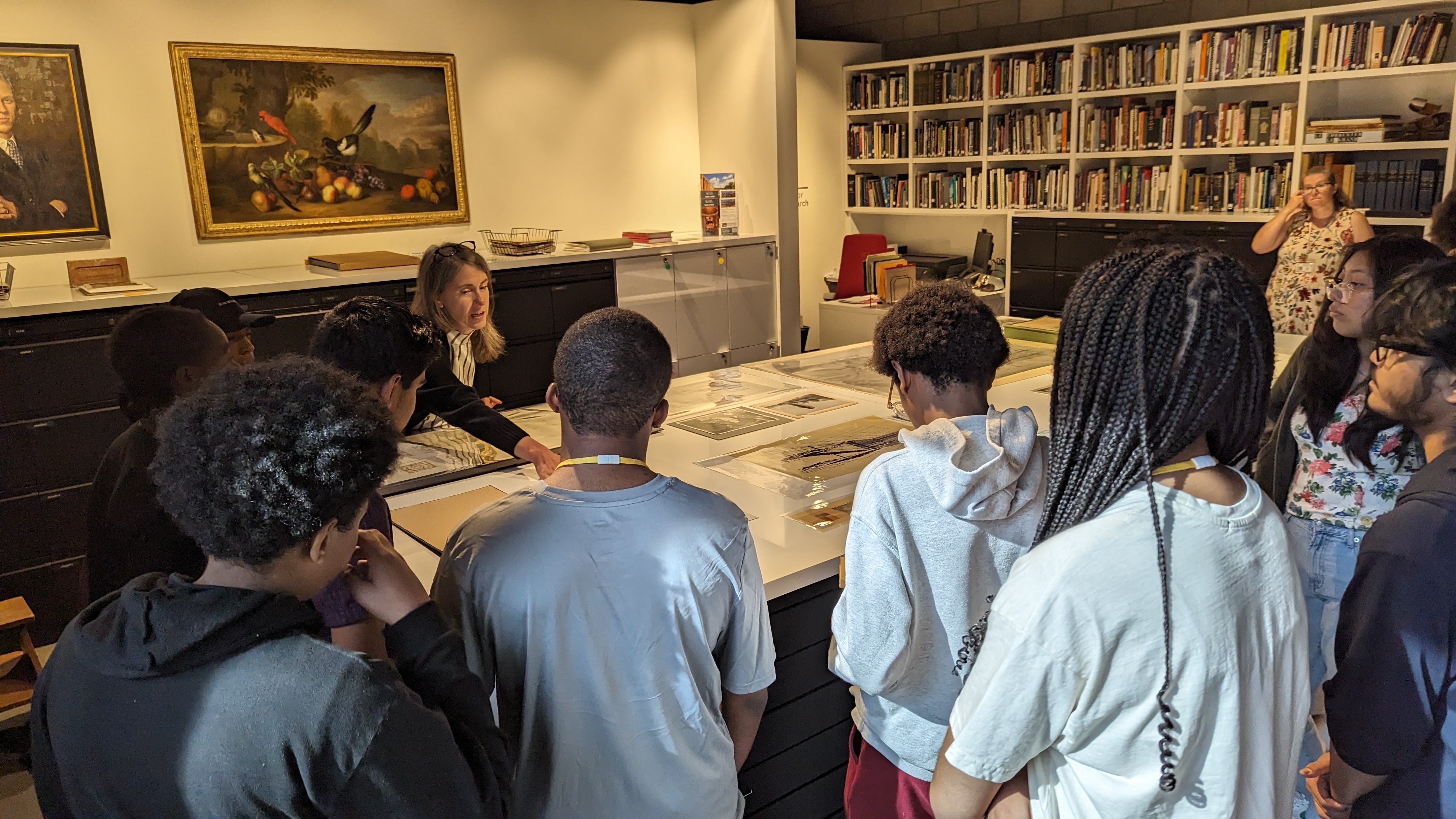
Head Archivist Deborah Rice showing our HUB students architectural treasures from Cranbrook Archives. Nina Blomfield, photographer.

To orient ourselves, we started with a morning spent in Cranbrook Archives, studying original sketches, renderings, blueprints, photographs, and even fundraising literature about Cranbrook’s many architectural treasures. We saw the great diversity of how our buildings were imagined, represented, and constructed, and how an architect moves from a loose, gestural sketch to formal construction documents that communicate complex structural systems.

Then, we spent a class period each at Cranbrook House, Saarinen House, and the Frank Lloyd Wright-designed Smith House. In each location, students carried their sketchbooks and made notes and drawings about the architecture. I was especially impressed at the students’ analytical skills. In fact, while I usually love talking about the nitty-gritty specifics of Saarinen House, I found myself sitting much more quietly, asking students questions about what they noticed, liked, or disliked in each room. Listening to their observations and conversation helped me see each space anew.

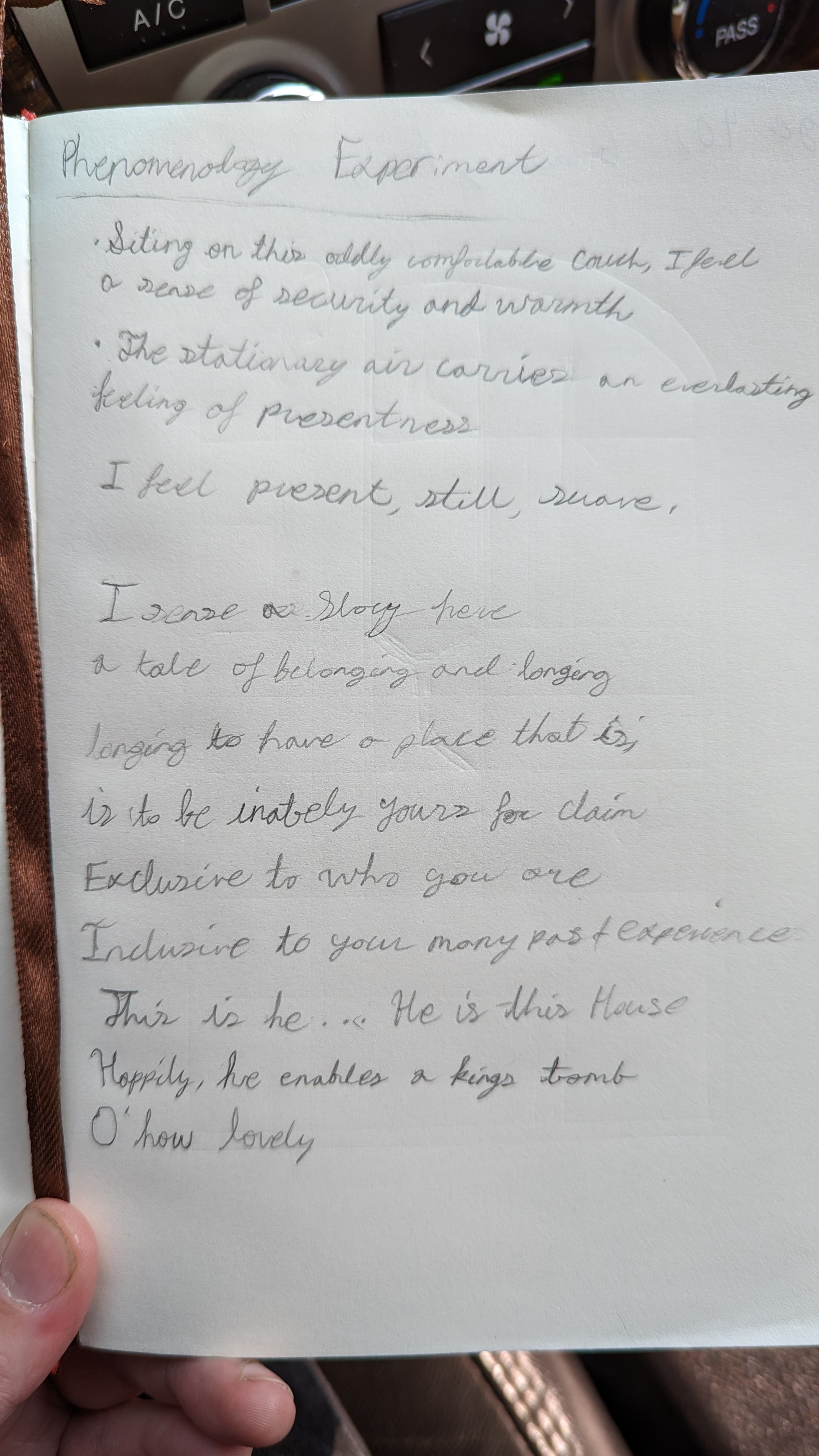
At Smith House, Nina led a phenomenology exercise, where, instead of telling the students the story of Frank Lloyd Wright and the Smiths, she simply asked each student to find a spot in the house to sit in quietly. Then, they wrote or sketched what they observed and sensed. Having such a tactile experience with the architecture and nature proved to be more memorable than a conventional tour.

Continue reading

Clare in the Kitchen: Summer Research at Smith House

Have you ever wondered what it would be like to cook in a kitchen designed by Frank Lloyd Wright? As the summer intern for the Center, I got a taste of the experience. 

Clare in the Smith House workspace, August 2023. Photograph by Nina Blomfield.

My name is Clare Catallo and I am a 2020 graduate of Cranbrook Schools and a rising senior at Kalamazoo College. I am a history major and I am hoping to have a career in museum curation. As a Schools student, I had the opportunity to tour Cranbrook House, Saarinen House, and Smith House and learn about the designers and art movements that are intertwined with the legacy of the campus. It sparked my interest in design history and material culture, and I am very grateful to have spent the past two summers interning with the Center. 

Last year, I helped clean the exterior of the Frank Lloyd Wright-designed Smith House, inventory the books in Melvyn and Sara Smith’s collection, and do genealogical research. This summer, I have been researching the histories of household objects and conducting object photography at Smith House, as well as assisting with the Cranbrook Horizons-Upward Bound Architecture elective course. In August, I assisted the Center team with preparations for “At Home with the Smiths,” an immersive evening program held at the Frank Lloyd Wright-designed Smith House. Preparing for this event has brought my two summers here together as we work to emulate Melvyn and Sara Smith’s 1970s house parties.

Cookbooks from Melvyn and Sara Smith’s collection. Photograph by Nina Blomfield.

The cookbooks found at Smith House provide a glimpse into the family’s lifestyle and the home cooking trends of the 1960s and 1970s. Many of the Smiths’ cookbooks present an image of a modern, working woman who has more to do with her time than spend hours in the kitchen. World War II had made families rearrange their menus and ideas about food, due to rationing and shortages which continued even through to the postwar years. Menus became less formal, and fewer families had maids to cook for them.

These national trends align with Frank Lloyd Wright’s kitchen design, meant to function as a utilitarian, servantless workspace. Combined with the growing numbers of women in the workplace in the 1960s and 1970s, the demand for quick and easy recipes rose. This trend is reflected in the Smiths’ cookbooks like the excellently-titled Dinner Against the Clock (Quick, Sumptuous Meals With the Look and Taste of Infinite Leisure), and The Keep it Short and Simple Cookbook, the latter of which is dedicated to “every homemaker,” whether “housewife, career girl, or bachelor”. These recipes use few ingredients, many of which are ready-made, require a small number of utensils, and demand little time. 

Continue reading

Gravity, Dignity, and Softness: The Voice of the Pipe Organ

In addition to working as an Associate Archivist at Cranbrook, I am also a fledgling volunteer docent at Christ Church Cranbrook. Recently, I gave a tour of the Chancel to test my skills with my teachers. As I prepared, I found there was very little written about the history of the pipe organ at the church. So, where to turn for more information? Cranbrook Archives, of course.

In August of 1925, George Booth and Oscar Murray (of Bertram G. Goodhue Associates, the church architect), started in earnest to finalize their thoughts and feelings about the choice of organ for the church. While the organ itself was installed in January 1928, plans for its ducts and conduits had to be decided early, before the concrete floors were poured.

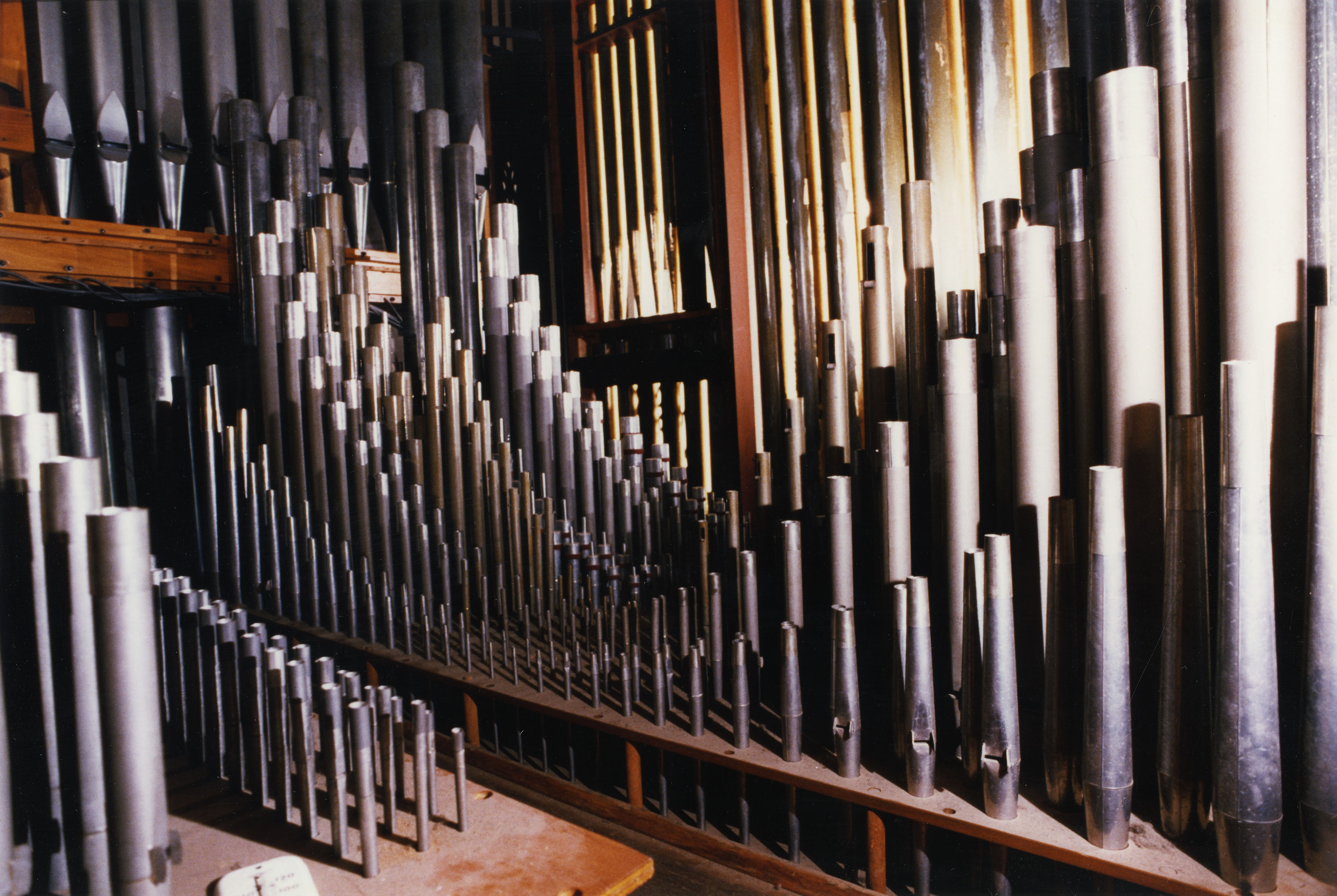
Christ Church Cranbrook organ pipes prior to the 1997 restoration. Jack Kausch, photographer. Courtesy of Cranbrook Archives.

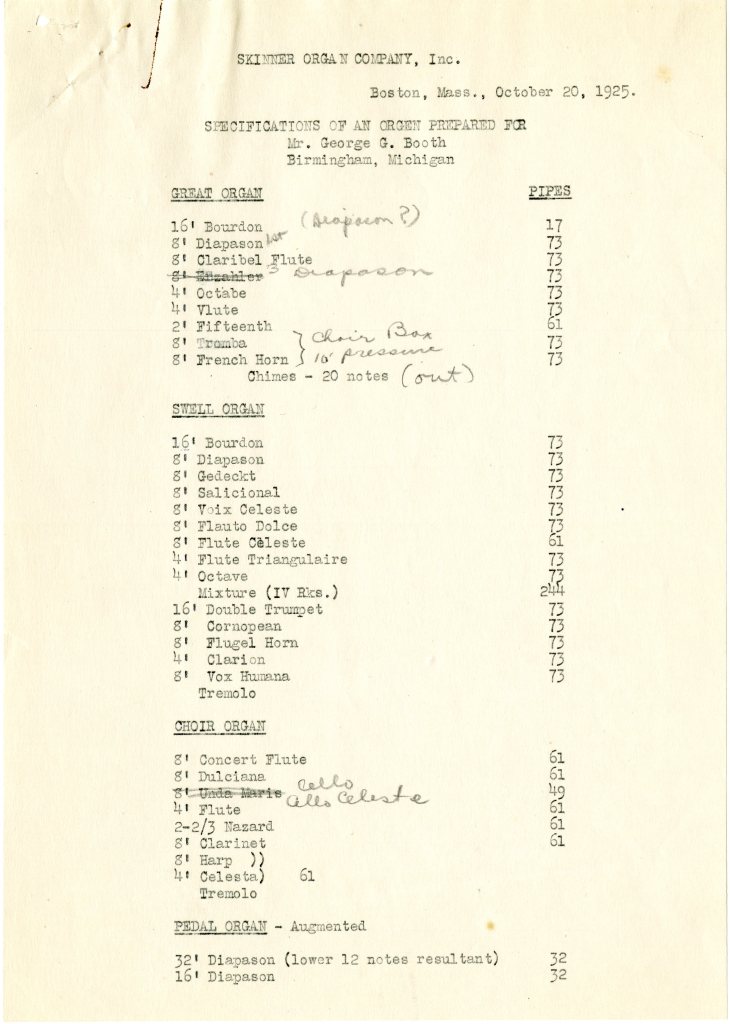
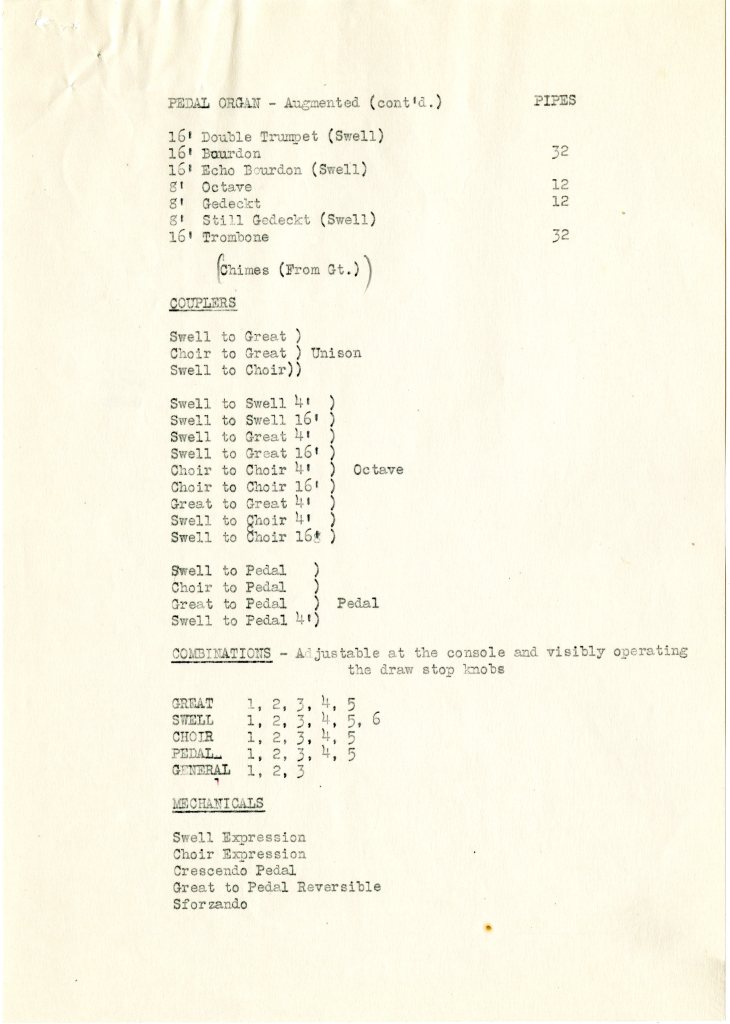
The correspondence suggests that the E.M. Skinner Organ Company was the only company considered. The Boston-based firm was considered America’s finest and most technologically advanced organ builder. Skinner’s specifications for the organ, console, and bench were submitted in October 1925.

George Booth inquired of his colleague Cyril Player to provide comments on the specifications, and Player begins his commentary saying,

“I think I would emphasize gently to them that you want gravity, dignity and softness—the three prime essentials of any church organ, large or small… [gravity] is secured by an adequate and properly-balanced pedal department; dignity by volume of foundation tone in the basic divisions of the instrument; and softness and refinement by skillful voicing with a copious wind stream at a moderate pressure.”

Cyril Player to George G. Booth, November 1925

In passing along the comments to Murray, Booth remarks that, “the desired qualities, viz; gravity, dignity and softness; seems to me peculiarly to express my own feelings and desire.”

William Zeuch of Skinner Organ Company revised the specifications following some of Player’s suggestions, while some revisions were the suggestion of Henry Willis, the great English organ builder who was a consultant to the firm. The contract for the organ (including the Great, Swell, Choir, and Pedal pipe divisions) was duly signed in December 1925 and work proceeded.

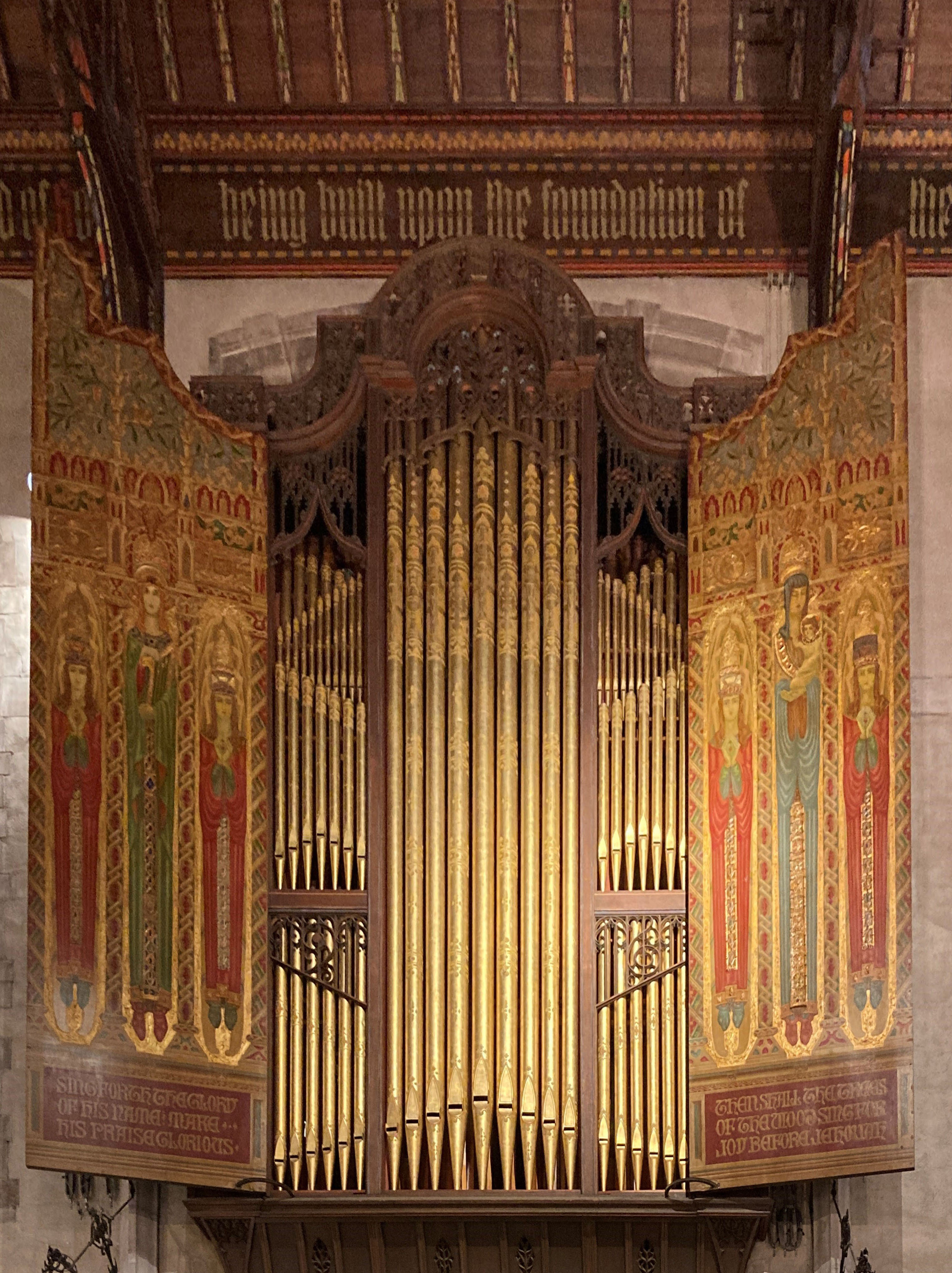
At the same time, a separate contract was made with Alfred Floegel to decorate the organ case doors. Booth wished to confine the oak finish to the exterior of the doors while having the rest richly decorated with color. Booth imagined the opening of the organ doors to represent the opening of the mind. He also envisioned the organ case to read as a triptych (a picture or altarpiece on three hinged panels) when open.  

Organ case doors, woodwork by Irving and Casson, decoration by Alfred Floegel. Gift of James Scripps Booth. Laura MacNewman, photographer.

In July 1927, work on the organ console began. The console is where the organist sits to play the instrument, distinguished by its multiple hand keyboards (called manuals), pedalboard, and other controls. Rev. Dr. Marquis requested a change from a 3-manual (Great, Swell, and Choir pipe divisions) to a 4-manual, by adding the Solo division. Zeuch responded positively as it was not too late to build a 4-manual console; however, having already instructed the architect to reduce the dimensions of the organ chamber, which had been too large and would have interfered with the proper effect of the sound in the church, the architect would now need to find space for the Solo division. Room was found above the Sacristy.

Continue reading

Photo Friday: Smith House and the 1960 Plymouth Suburban

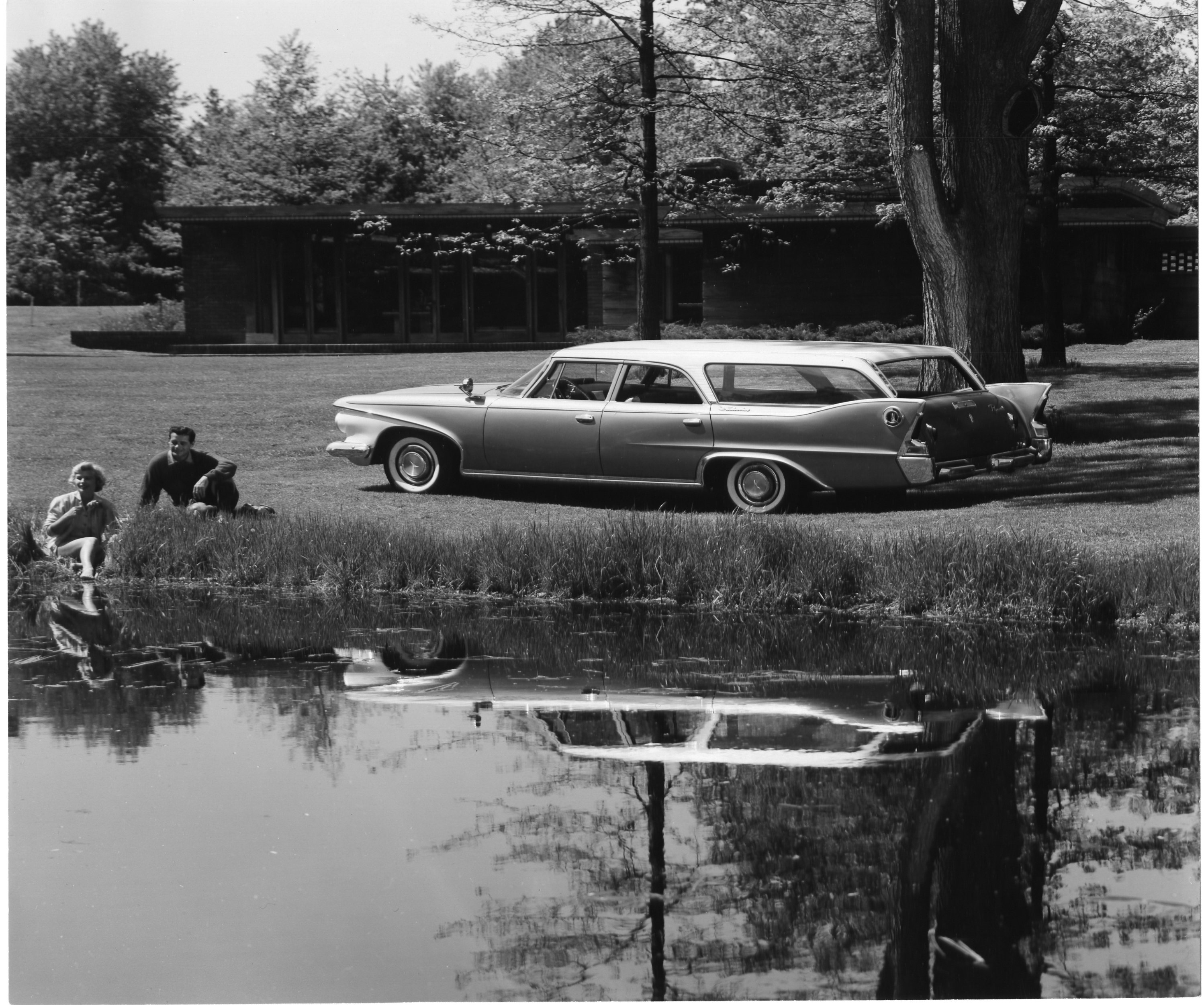
Oakland County is decked out in checkered flags this Friday for the annual Woodward Dream Cruise. As the crowds gather in their folding chairs and thousands of classic cars roar past my windows, I’m reminded of a much more serene image from automotive history: the 1960 Plymouth Suburban stretched out on the manicured lawn of the Frank Lloyd Wright Smith House.

1960 Plymouth Suburban, on location at the Frank Lloyd Wright Smith House. Smith Papers, Cranbrook Archives.

In 1959, Chrysler was developing promotional materials for the 1960 Plymouth. Seeking a sleek, modern backdrop for the long lines of the Suburban station wagon, Chrysler’s Public Relations Department contacted Melvyn and Sara Smith about staging a photoshoot at their Frank Lloyd Wright-designed home in Bloomfield Hills. The resulting photographs show the 18-ft long Suburban, not parked in the pea-gravel driveway or the distinctive cantilevered carport, but pulled to the back of the house where it could be reflected in the natural setting of the Smith’s newly expanded pond.

1960 Plymouth Suburban, on location at the Frank Lloyd Wright Smith House. Smith Papers, Cranbrook Archives.

The long, low horizon line of Frank Lloyd Wright’s Usonian architecture, with its stacking roof planes, seems a great fit for the station wagon’s extended style lines and characteristic fins. In a second image, two casually-dressed models (check out those long socks and walking shorts!) lounge in rattan Tropi-Cal armchairs on the living room patio. Designed by Danny Ho Fong, the Tropi-Cal armchairs were recently identified through the diligent research of the Center’s Summer intern Clare Catallo.

Continue reading

One For the Books: The Ward Just Papers

Wonderful news for literary researchers and enthusiasts: the Ward Swift Just Papers have grown substantially in size and completeness! The new collection now more fully represents Just’s remarkable and multidimensional career in both news and creative writing, thanks to a recent substantial donation from the Just Family.

Head Archivist Deborah Rice and I are partial to the undated portrait of Just in a beret, likely while living in Paris. To your health!

The correspondence series of Just’s papers, alone, has increased tenfold. Some highlights include the young writer’s letters home to his family from Cranbrook School and Trinity College, as well as letters with many friends, fellow writers, and literary editors.

We also now have letters, reporter’s notes, images and clippings from the year and a half (December 1965-1967) when Ward Just, age 30-32, covered the American War in Vietnam for The Washington Post. Before his death in 2019, Just told Cranbrook Archives that the addition of these papers would be of special interest to scholars of the Vietnam War. They also give a much fuller story of these formative years in Just’s life and career.

Continue reading

What Can a Tea Kettle Teach Us? A Tale of Two Cranbrooks

The Center has made a new film! As part of our recent gala fundraiser, A House Party at Two Cranbrooks, we worked with Elkhorn Entertainment & Media to produce a short documentary about the Booth family’s connections between England and Michigan. Today, we are excited to share the film with the wider world! Watch the film below, or here.

A Tale of Two Cranbrooks

Now that you’ve seen the new documentary, I thought I’d invite you “behind-the-scenes” into how A Tale of Two Cranbrooks came together.

Cinematographer Josh Samson and producer Vince Chavez film the Booth-made tea kettle in Cranbrook House. April 6, 2023. Photograph by Nina Blomfield.

As with all Center projects, I started work on the film in Cranbrook Archives. The Booth family records are extensive, and with our archivists Deborah Rice and Laura MacNewman, I spent several afternoons consulting documents (letters, photographs, manuscripts, scrapbooks, etc.) assembled by many generations of Booths to learn the family story. Henry Wood Booth’s handwritten The Annals of Cranbrook were especially helpful.

Detail of a postcard of Cranbrook, Kent with handwritten notes by Henry Wood Booth, from The Annals of Cranbrook manuscript, 1914. Cranbrook Archives.

Then, through the support of Bobbi and Stephen Polk and Ryan Polk, I travelled to England! I visited Cranbrook, Kent, spending time at Cranbrook Museum and Archives and at Cranbrook School. (You can watch a walking history tour I did in Cranbrook, Kent, here and learn more about the Booth family and my trip to England in my virtual lecture, Uncovering Cranbrook: Two Pilgrimages to Kentish Cranbrook.)

Continue reading

Celebrating and Preserving Cranbrook’s History: My Senior May Experience

My three weeks at the Center for Collections and Research have been an exhaustive tour of all the activities and responsibilities of maintaining Cranbrook’s history. From getting ready for the annual House Party, scanning historical documents, and cleaning the Smith House in preparation for summer, being a member of this community requires one to wear many hats to preserve its history.

Scrubbing the Frank Lloyd Wright Smith House in Bloomfield Township. Photo by Leslie Mio.

During my first week with the Center, I entered into the great anticipation of the annual House Party fundraiser. With this year’s theme involving Cranbrook’s influences from England, many of my projects involved making Cranbrook House a better fit for this theme. As favors for the guests, I assembled nearly 300 pastry boxes to fill with scones and other iconic English treats like tea and marmalade.

My collection of pastry boxes from my week at Cranbrook House. Photo by Grace Quinn.

Following the party, I helped scan many folders of documents from the Archives on George G. Booth and his involvement with the Detroit Arts and Crafts Society and with renowned architect Albert Kahn. Although I knew very little about the Arts and Crafts movements, I came to a much stronger understanding of how the Booths focused much of their wealth and influence on buying and displaying handcrafted goods.

These were not just shows of wealth but were a way of honoring the artisans who built this campus and saying, without words, that a quality place like this will withstand much more than inhuman, mass-produced art and furniture. Even though this notion is not new, rising technological advances seem to only make cheapness and speed priorities in design, rather than beauty or emotional value. The art of patience and supporting artists is a refreshing notion compared to the on-demand nature of online shopping and rampant consumerism.

While scanning documents from the George G. Booth Papers was my main Archives project, I also got to work with architectural drawings of Glen Paulsen from the 1950s. Photo by Deborah Rice.

When reflecting on what I had learned during this internship, I realized that before this I had never given much thought to how this campus came to fruition. I knew that some famous architects built it, but as I scanned archival documents and helped maintain Cranbrook’s houses, I can now fully realize the cultural influence Cranbrook has had in Detroit’s history.

Cranbrook’s inspiration stretches across borders and countries; it has a prominent space in contemporary architecture and in the earlier Arts and Crafts Movement. Cranbrook’s exercises in art and design are on display to inspire others to emphasize detail, quality, and creative talent in designing schools and creating diverse communities.

—Grace Quinn, Cranbrook Kingswood Upper School 2023

Editor’s Note: The Senior May Project is a school-sponsored activity that encourages Cranbrook Kingswood Upper School seniors to acquire work experience in a field they are considering as a college major, a potential profession, and/or as a personal interest.

Grace’s efforts in making A House Party at Two Cranbrooks a success, her can-do attitude, and her flexibility in tackling projects large and small were much appreciated by the Center staff. We wish her luck as she heads to the Rochester Institute of Technology’s College of Art and Design in the fall!

A Century Ago: Travel to France with Messrs. Booth and Swanson

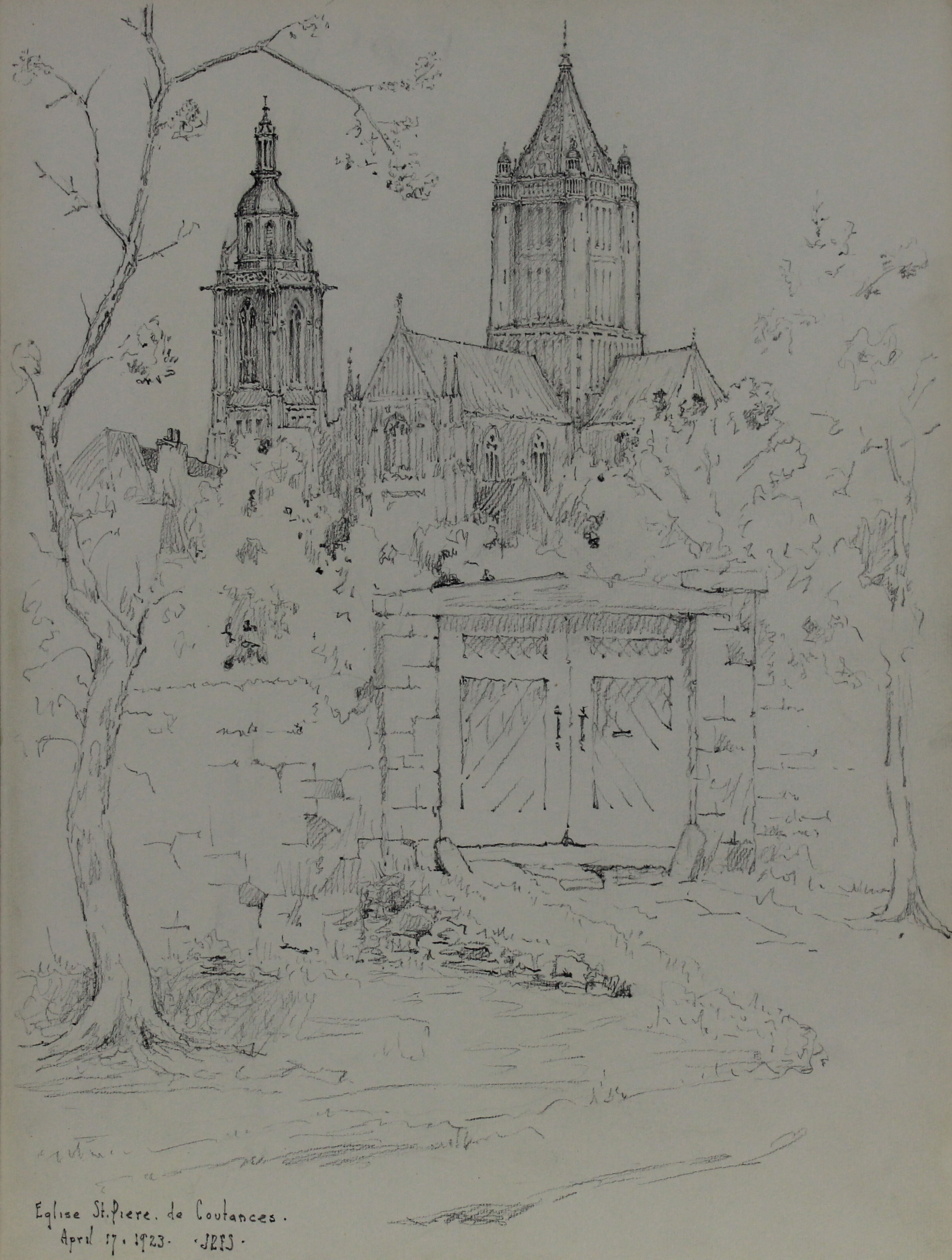
May 30, 2023, marks one hundred years since Henry S. Booth and J. Robert F. Swanson returned home from ten months of travel in Europe. Midway through their architecture studies at the University of Michigan, the friends and classmates set off on August 1, 1922 for a “Grand Tour” through Norway, Finland, Sweden, Denmark, Germany, Tunisia, Italy, France, and England to study and sketch European architecture.

In today’s post, I want to share moments from their journey through France, which is so beautifully documented by Henry’s letters and photographs, and by both of their sketches.

Eglise St. Pierre de Coutances, April 29, 1923, J. Robert F. Swanson. Courtesy of Cranbrook Art Museum.

Arriving in France in March 1923, Harry and Bob journeyed through Nice to Cannes, then through Lyon to the city of Bourges. Henry describes the scenery en route:

…mountains on the right and the “Cote d’Azure” on the other, flowers overhanging balustraded walls, old olives and tall but easily climbed palms, rocks and breaking waves, and then always the bluest of skies and sea to match, and dazzling sunlight–quite warm and ‘drowsy’.

At Bourges, they headed for the Cathedral, which they visited several times: at night by the light of gas lamps; in the afternoon sunlight; at dusk with a handful of worshippers on their knees; and then later that evening filled with the faithful.

Cathédrale St. Etiénne de Bourges, March 1923. Henry Scripps Booth, photographer. Courtesy of Cranbrook Archives.

It was an inspiring sight—the nave packed, and both the inner and outer aisles (for there are two) on the north side filled also, and not a few on the other side of the church. The light was dim all during the sermon, and when that was over, a quantity of candles were lighted almost instantaneously about the “Host,” and all the electric candles down the nave came on, so that suddenly this great cathedral was changed from a imaginative forrest in the night, to a great cathedral church ablaze with the lights associated with a feast.

But I thought more of other things than of the architecture that night. The preacher talked too fast for me to understand his French, but I knew what he should have been saying even if he wasn’t…, I looked at the great number of long black vails [sic] everywhere, noticed the lack of men of middle age, and saw many young fellows who are now “heads” of their father’s family standing by their veiled mother’s side.”

They stopped in Tours before taking in the Chateaux of the Loire: from Loche to Langais, Ussé, Villandry and Azey.

Continue reading

Spring Cleaning 2023

Each year, the Center staff does spring cleaning around the Cranbrook Community’s campus.

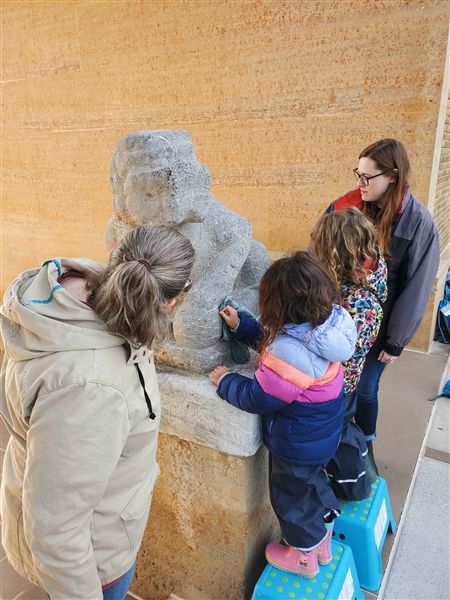
To kick off our spring cleaning this year, in collaboration with Meghan Morrow from Cranbrook Art Museum, Brookside’s Vlasic Early Childhood Center Pre K, JK, and multi-age classes helped us “awaken” the outdoor sculptures, covered for the winter, with a good-morning song. They helped remove the covers, check for any new cracks, and wipe and polish the sculptures.

Friends from the ECC help polish Marshall M. Fredericks’ The Thinker . . .
. . . and the Chinese Lion at Cranbrook Art Museum. Both images are courtesy Cranbrook Schools.

We then needed to get the fountains and sculptures ready for our House Party fundraiser on May 20 (sorry, already sold out). Utilizing Graffiti Solutions’ “Elephant Snot,” we worked with Cranbrook House and Gardens Auxiliary volunteers to clean the Fountain on West Terrace and Mario Korbel’s Harmony.

Cranbrook House and Gardens Auxiliary volunteers Helen Maiman, Bruce Kasl, Cheryl Becker, and Joyce Harding assist me in cleaning the Fountain on West Terrace at Cranbrook House. Auxiliary volunteer Nancy Kulish, photographer.
Joyce and I giving Harmony her spring mani-pedi. Nina Blomfield, photographer.
Nina gives Harmony a quick rinse. Leslie Mio, photographer.

Below are the results. This was just one day after the cleaning, and, typically, the sculptures look better and better as the weeks go on.

Look for an upcoming post about our ECC friends working with the Elephant Snot to clean more stonework in the garden!

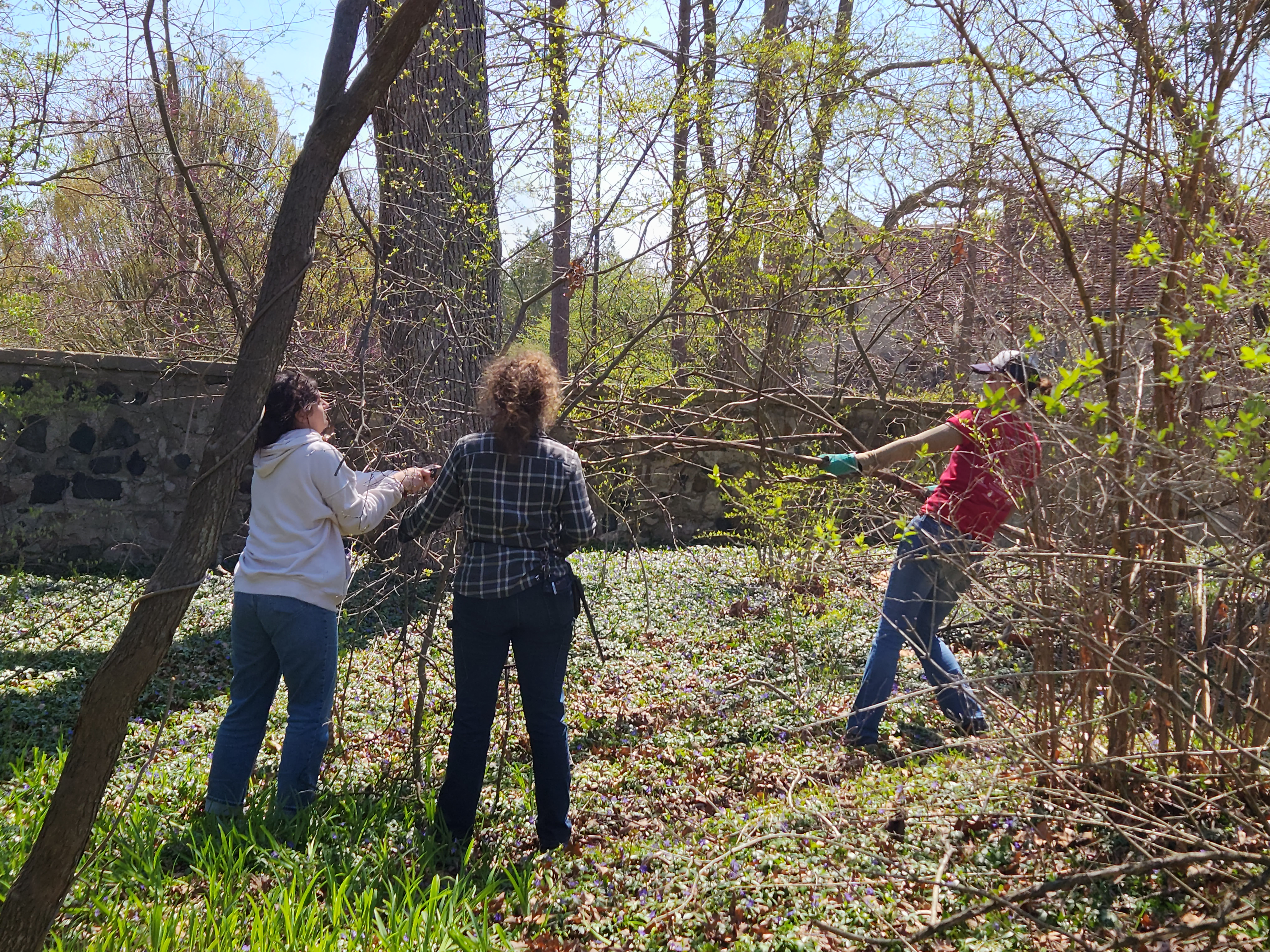
The spring also means a new season of work in the Japanese Garden. Pulling vines, before the poison ivy blooms, was a fun, end-of-the-day task for our volunteers this week.

Volunteers Lindsay Shimon and Melinda Krajniak assist Master Gardener Emily Fronckowiak with invasive vines around the Japanese Garden. Leslie Mio, photographer.

Interested in becoming a Cranbrook Japanese Garden Volunteer Gardener? We would love to hear from you!

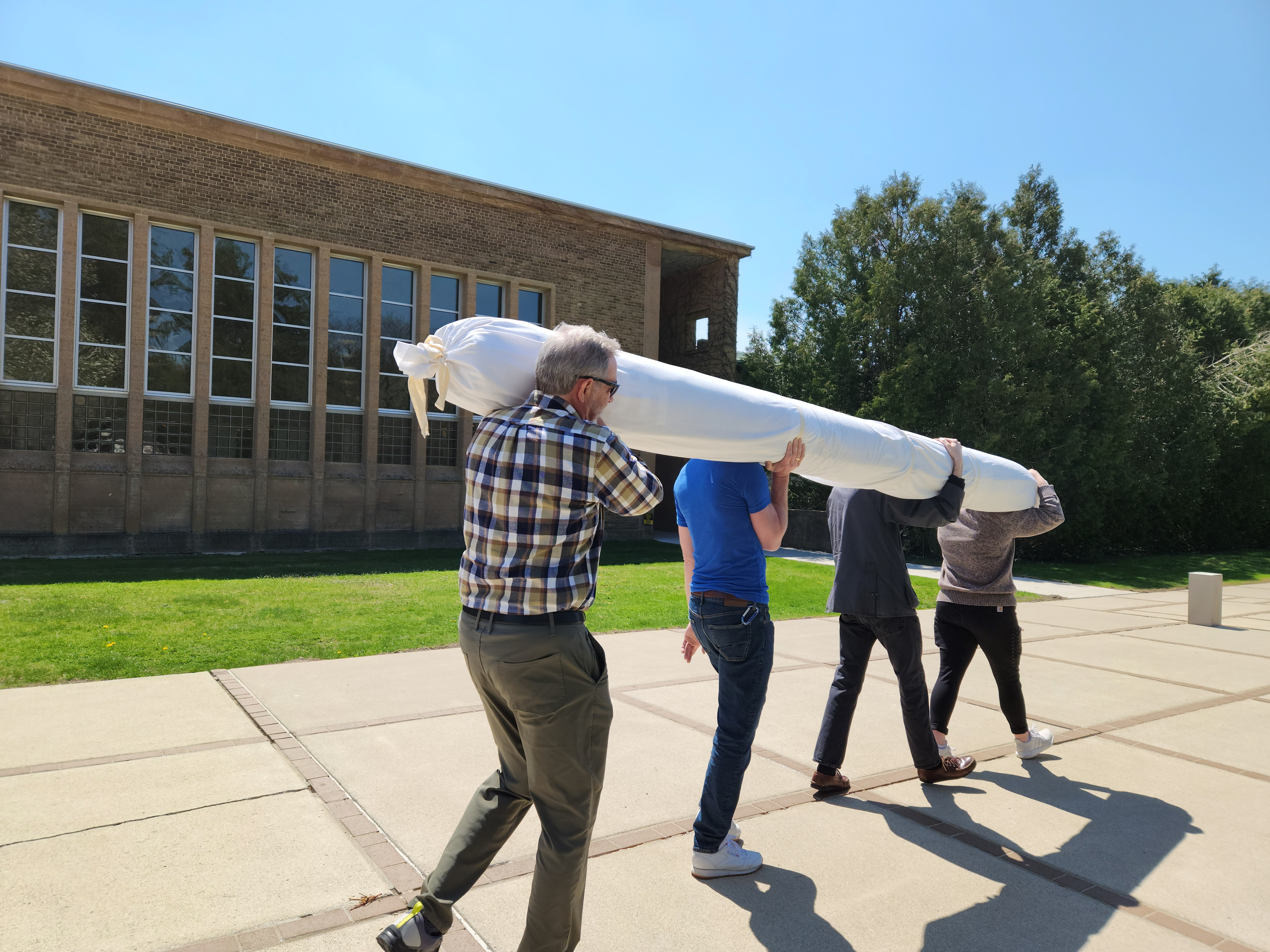
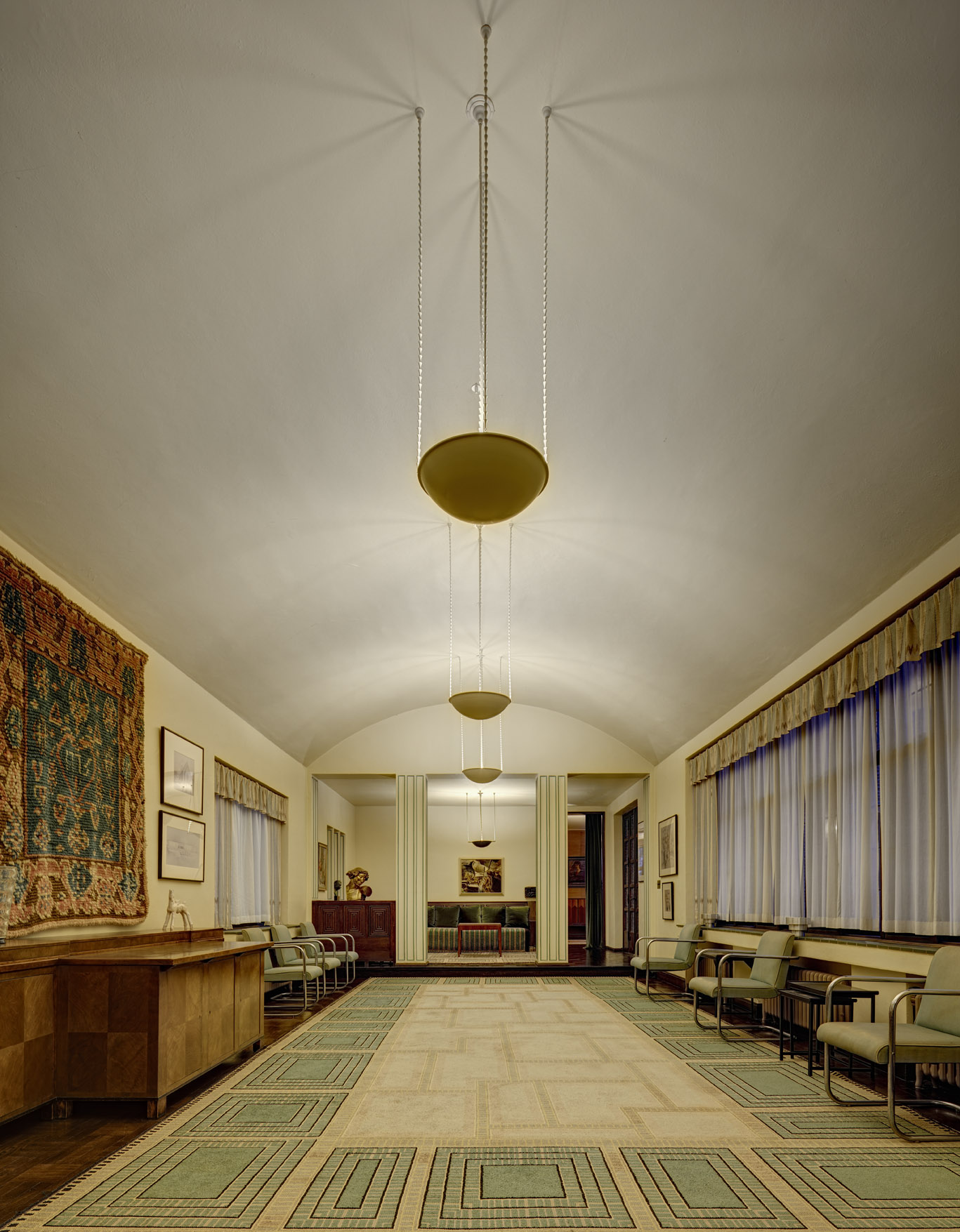
Not to be outdone, Saarinen House wanted to be part of spring cleaning as well. On location in the Art Museum vault for a photoshoot this past winter, the Saarinen House Studio rug was carried back to the house and reinstalled. As Greg Wittkopp, Center Director, said, “The room does look less Gesamtkunstwerk-ish without it.”

“I’m ready for my close-up, Mr. [Haefner].”
The Saarinen House Studio rug gets the star treatment from photographer James Haefner as Center volunteer Jessica Majeski looks on. Kevin Adkisson, photographer.
Center staff and volunteers move the Studio rug back to Saarinen House. Leslie Mio, photographer.
Gesamtkunstwerk!
James Haefner, photographer.

The best part about our spring cleaning is showing off the results. Come see Harmony in the Cranbrook House gardens on a warm day.

The Center’s 2023 Tour season is also beginning. In addition to our Saarinen House and Smith House tours, new tours have been added:

Japanese Garden Tours – Center staff-guided tours of the Japanese Garden have been added to the public tour calendar on one Sunday a month at 1:30pm, May through October.

Three Visions of Home tours – Join Cranbrook Center for Collections and Research as we take you inside three remarkable homes from across the twentieth century. There’s no tour quite like it, with a look into the distinct visions for American life from three internationally significant architects: Albert Kahn, Eliel Saarinen, and Frank Lloyd Wright. Your expert guide will take you through the architecture and innovations of each home, while also sharing the stories of the families who built and lived in these special places.

We hope to see you on campus this season!

Leslie Mio, Associate Registrar, Cranbrook Center for Collections and Resarch

From Birdhouses to Wildflowers: Cranbrook Institute of Science Bulletins

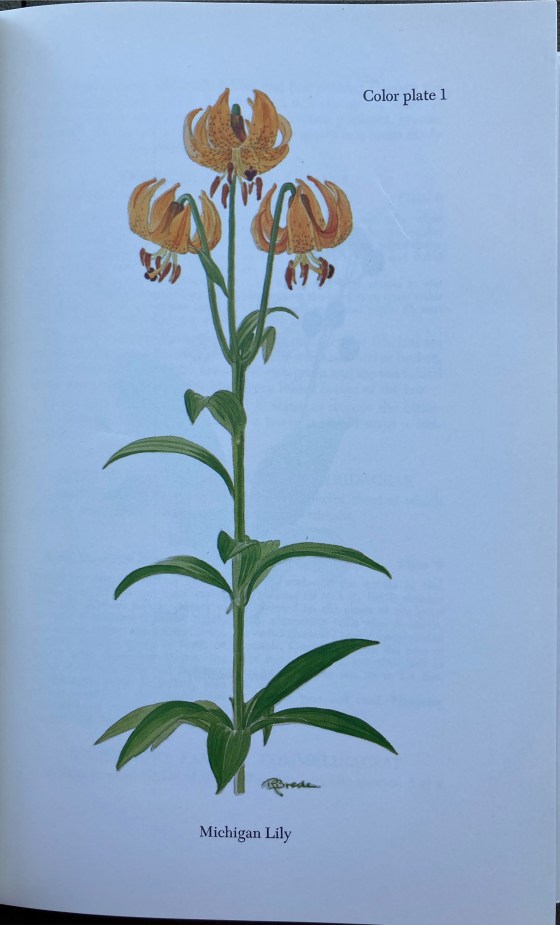
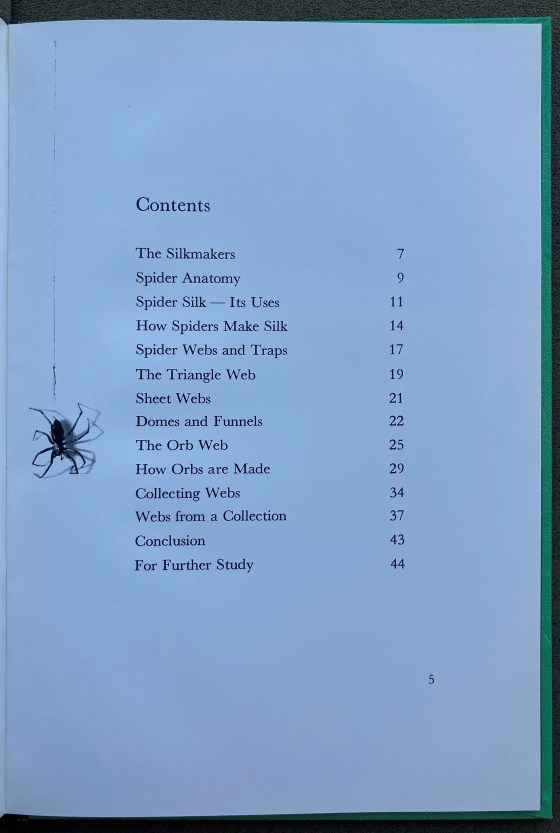
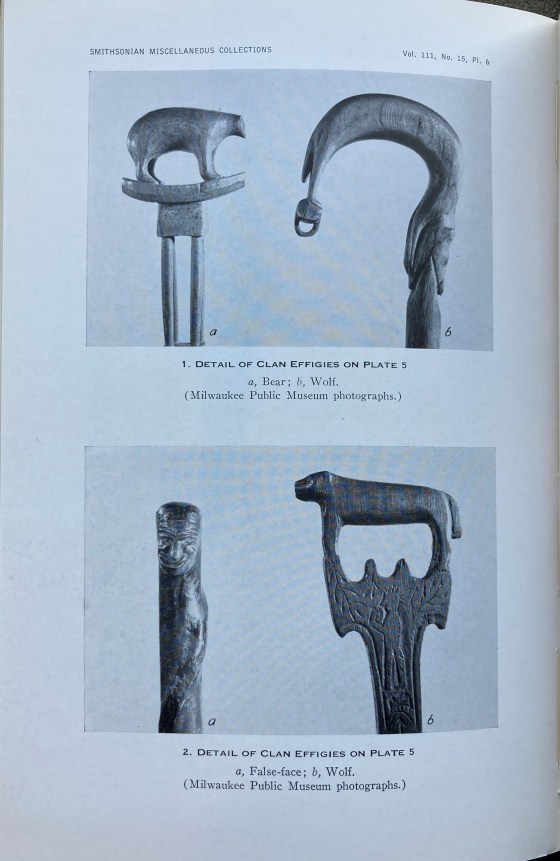
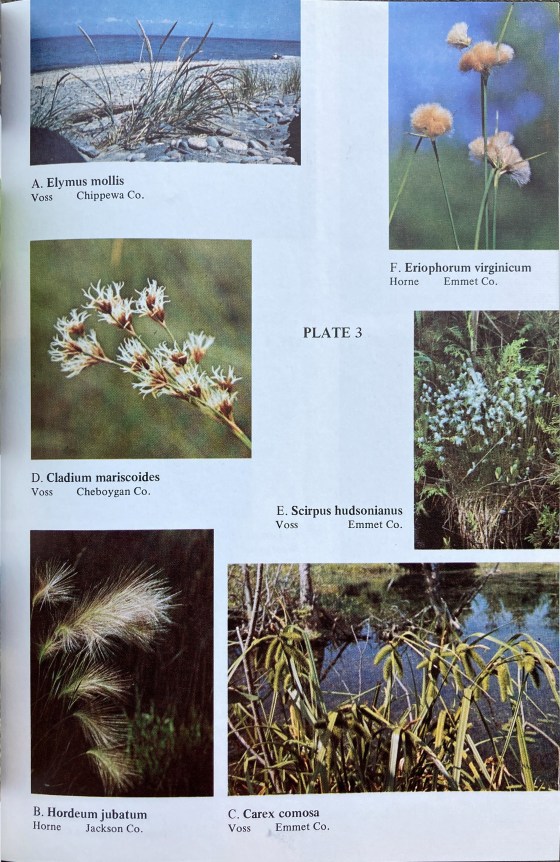
We recently reorganized materials in the Archives Reading Room to provide easier access to Cranbrook Publications and encourage greater use of these informative resources. The first series available for ready reference are the Cranbrook Institute of Science (CIS) Bulletins, which are arranged in the full series of 64 issues. The Bulletins are periodically published works of original scientific research, which was part of the mission of the early Institute.

Newly shelved Cranbrook Institute of Science Bulletins. Photograpy by Laura MacNewman.

Initially established in 1930, the Institute’s stated purpose was, “to add to and strengthen the educational and cultural facilities within the State of Michigan.” It was established as a separate Cranbrook institution on February 10, 1932. An aim set for the staff was not only to supplement the facilities of the several Cranbrook Schools, but to engage in original research and publication, “to add to the sum total of human knowledge.” The CIS originally comprised nine divisions of scientific fields and administration: Astronomy, Geology, Botany, Entomology, Aquatic Biology, Mammology, Anthropology, Education, and Preparation, and the Bulletins reflect these fields of inquiry.

The Bulletins range in size, from pamphlets to hard cover books, and are published ad hoc according to the completion of research projects. The incredible diversity and particularity of topics make it exceedingly difficult to select which to highlight for your interest. Thus, I have tried to pick across the divisions of research to deliver to you an array of examples, not only works of scientific distinction but of artistic beauty and thoughtfulness in their presentation.

This series of periodicals, published between 1931 and 1999, focus predominantly on Michigan with some studies further afield. They are of unequivocal research value to students and scientists with an interest in the natural world, including its flora and fauna, lakes and fish, archaeological history, and geological development, as well as human geography and cultural history.

The CIS Bulletins are available for research in our public Reading Room. If you are curious to learn more and to explore their contributions to scientific knowledge, come and see! All are welcome to explore and study our collections by appointment Monday to Friday, 9am to 4 pm.

Laura MacNewman, Associate Archivist, Cranbrook Center for Collections and Research

Create a website or blog at WordPress.com