The Heartbeat of the Nation

In August 1989, Cranbrook became a National Historic Landmark. America’s highest designation for a place of outstanding historical significance, it was no small feat for Cranbrook to become Michigan’s twenty-second National Historic Landmark (there are only forty-two today). So, what exactly is a National Historic Landmark, and how did we become one?

National Register of Historic Places plaque on the Kingswood Campus. Photographs by Kevin Adkisson, Cranbrook Center for Collections and Research.

Statutory provision for historic preservation began in America in 1906 with the Antiquities Act, which was further developed by the Historic Sites Act of 1935. Administered by the Department of the Interior, this Act was enacted to document and protect sites of national significance. In 1960, the National Park Service began administering the survey data from the Historic Sites Act, and the National Historic Landmark designation was introduced.

The National Historic Preservation Act of 1966 expanded the 1935 Act to local and state sites. This created the National Register of Historic Places, which began to identify, evaluate, and protect America’s historic resources. Many thousands of buildings have since been added to the National Register. In June of 1972, Cranbrook’s application was prepared by an Assistant Historian at the Michigan Department of State in Lansing, and the nomination was based on Cranbrook’s significance as a complete district of educational and architectural structures.

National Register of Historic Places plaque at Brookside.

To be eligible for designation on the National Register (a step below the National Historic Landmark status), the nominated site must have in its architecture, archeology, engineering, or culture integrity of location, design, setting, materials, workmanship, feeling, and association.
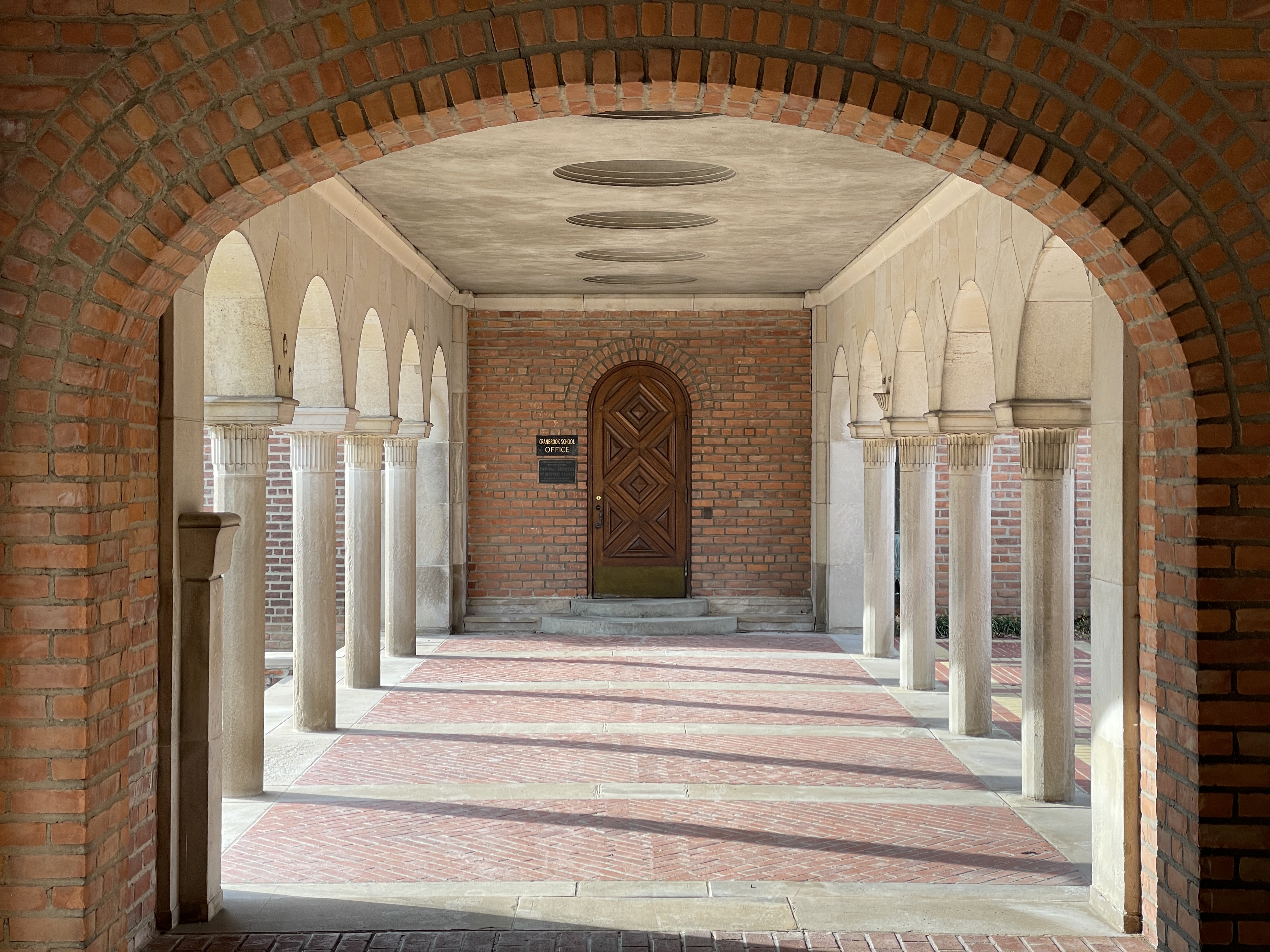
National Register of Historic Places plaque at Cranbrook School.

In addition, sites on the National Register must meet one of four criteria: be associated with events in the lives of significant persons; embody distinctive characteristics of a type, period, or method of construction; represent work of a master and high artistic values; or have or be likely to yield information important to prehistory or history. Once these criteria are evaluated and met, the site may be listed.

National Register of Historic Places plaque at Cranbrook Institute of Science.

Cranbrook was added to the National Register in March 1973, and it was at this point seven National Historic Landmark signs were ordered to be placed at each of the original Cranbrook Institutions and on Cranbrook House. (Christ Church Cranbrook was included in the designation, even though it would formally split off as a separate entity later in 1973 with the formation of Cranbrook Educational Community.) In writing to inform us of the designation, Samuel Milstein at the Department of Natural Resources eloquently wrote that:

“The State of Michigan is very proud of the fact that the property is qualified for this designation. The National Register records the story of the Nation, and is a list of distinction identifying those properties by which present and future generations can sense the heartbeat of the United States.”

Letter from Samuel A. Milstein to Cranbrook Institutions, March 30, 1973. National Register for Historic Places Records.
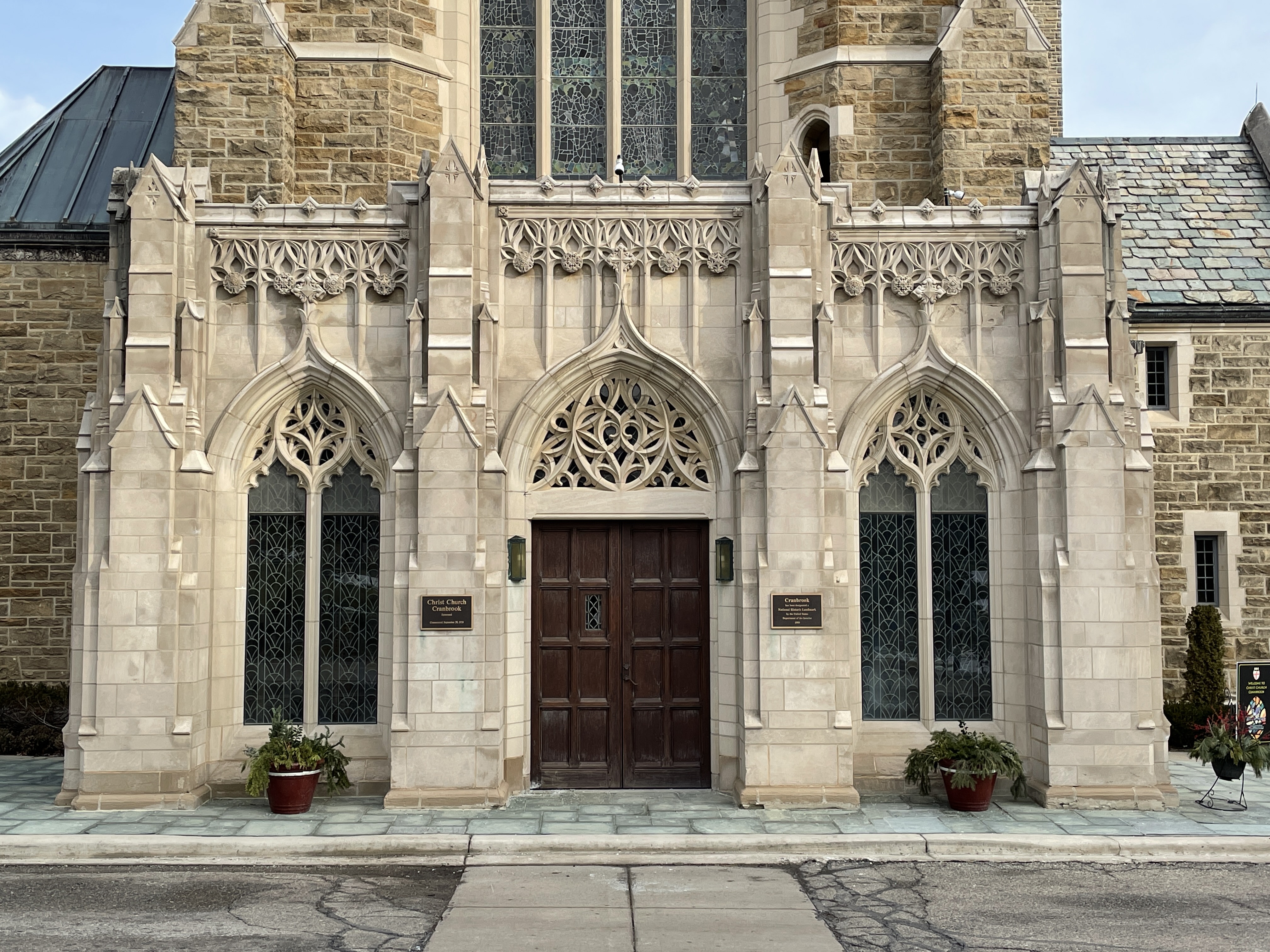
Non-official National Historic Landmark plaque at Christ Church Cranbrook, on right. The official plaque was changed at some point.

This language echoes that of George Booth in speaking to Cranbrook School in 1928, in which he emphasizes the importance of finding the treasure at your feet, the building up of an ethos of service from the local to the national to the global:

“If we feel our first loyalty to our State and are determined in every way we can to enrich it; if we never fail to see that we must give; if we are resolved to strive only for that which is worth while, then will our State have a place in the Nation, of which we will all be proud. The stronger and more glorious each of the States may be, the stronger and more glorious the Nation; and hence, the better and finer our opportunity for service to the world.”

Address by George Booth given on “Founders’ Day” at Cranbrook School for Boys, October 26, 1928. Cranbrook Archives.

But of course, our story doesn’t end with the National Register. In June 1987, the Chief Historian of the National Park Service (NPS) wrote to Cranbrook’s president, Dr. Lillian Bauder, to inform her that they were studying the property to determine its potential as a National Historic Landmark. Only 3% of sites on the National Register of Historic Places receive the higher honor of becoming National Historic Landmarks.

National Register of Historic Places plaque at Cranbrook Academy of Art.

The designation process follows three steps: study, including a visit to the property; review by the NPS Advisory Board; and a decision of designation by the Secretary of the Interior. The study was completed in February 1989 and the Advisory Board made its recommendation to Secretary Manuel Lujan in May. Cranbrook was designated a National Historic Landmark in August 1989.

The Cranbrook House sign was swapped from a National Register of Historic Places sign to a National Historic Landmark sign, encompassing all of the Cranbrook district.
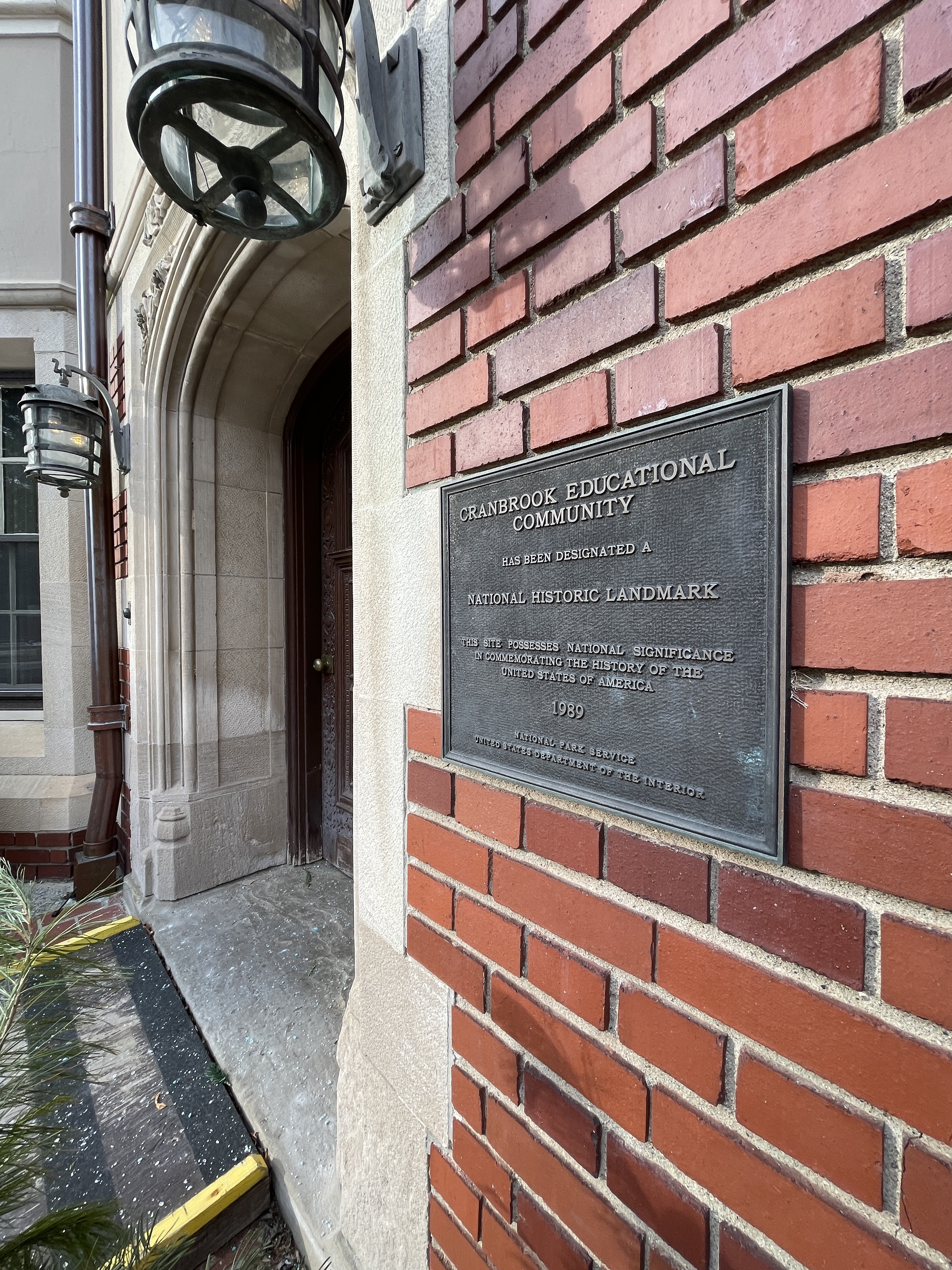
National Historic Landmark plaque for the entire Cranbrook Educational Community next to the front door of Cranbrook House.

The work of the Center for Collections and Research is embedded in the obligations of historic preservation in caring for and maintaining the community’s history, but also in articulating its meaning and value. Our mission nicely parallels the goals of the National Historic Landmark program. Even without such recognition, all who visit Cranbrook know it is a special place—but sometimes it is nice to have a plaque say so, too.

Laura MacNewman, Associate Archivist, Cranbrook Center for Collections and Research

Twelfth Night, Sixty Years Ago

With the holidays upon us and the observance of annual traditions in high gear it seems fitting to look back at one of Cranbrook’s most storied and festive occasions. Starting in 1950, every year at the beginning of December preparations would begin for the annual Twelfth Night Gala at Cranbrook House. Held on January 6th, the event was originally conceived as a small costume party in the 1920s by Cranbrook Founders’ son, Henry Scripps Booth. It eventually became an official Cranbrook gathering, with Henry at the helm.

The aim of Twelfth Night, as Henry stated, was “to recognize the contribution each employee and board member makes to Cranbrook by bringing them all together as participants in an enjoyable, annual, and ‘classless’ social event.” It was, in essence, a staff holiday party, but its magnificence was a far cry from the typical.

Joseph R. Scott Jr. practicing “piper’s piping” in Cranbrook House basement for the 1966 performance. Harvey Croze, photographer. Courtesy of Cranbrook Archives.

Not sure exactly what Twelfth Night signifies?  Perhaps you know the classic carol Twelve Days of Christmas: “On the first day of Christmas, my true love gave to me ….” A medieval English observance, Twelfth Night, as defined by the Oxford English Dictionary, denotes “the twelfth and last day of Christmas festivities”—twelve days after Christmas, or January 6th. The Shakespeare play of the same name is thought to have been created as entertainment for a Twelfth Night celebration.

Inspired by his English heritage and impressed with a performance of the play at the Detroit Opera House when he was twelve years old, Henry Booth created a sixty-year tradition for Cranbrook staff, faculty, and supporters that revived the holiday’s twin themes of celebratory food and pageantry.

In Cranbrook Archives, the Twelfth Night Records meticulously document the planning and execution of the gala as it took place at Cranbrook House, through programs, scripts, invitations, guest lists, receipts, budgets, meeting minutes, photographs and more. These items bring the party alive–and what a party it was!  

Eggnog in the Oak Room, 1967: (left to right) Helen Hays, Warren Hays, Chet Hard, Anita Hard, and Don Hays. Harvey Croze, photographer. Courtesy of Cranbrook Archives.

Choosing the decade of the 1960s to epitomize the revelry of the long-standing event, I give you the opening lines from the 1960 program, spoken by Cranbrook School Headmaster Harry Hoey:

We’ve all found a welcome in this mellow house
Including, we trust, some young shivering mouse
The wassail is heady
The fellowship’s steady
The mummers are ready
So gay may this gala be in Cranbrook House
On with the tom foolery!

Continue reading

The Monreale Fountain in the Quadrangle

In the center of the Quadrangle at Cranbrook School is a replica of a fountain which stands in the southwestern corner of the cloister of Duomo Monreale in Palermo, Sicily. Completed in 1182, the cathedral unites Arabic, Byzantine, and Norman architectural and cultural influences and is famed for its mosaics.

The inspiration for the fountain’s long-treasured presence on the Cranbrook campus dates back to 1922, when Henry Scripps Booth first saw the original in the cathedral cloister. This was a site that Henry seems to have particularly wanted to see while on a ten-month architectural study tour of Scandinavia, Germany, Switzerland, Italy, Great Britain, and France, with his friend, J. Robert F. Swanson.

View of the Duomo Monreale, December 1922. Henry Scripps Booth, photographer. Cranbrook Archives.

Writing to his father, Cranbrook founder George G. Booth, on December 26, 1922, he describes the cathedral thus:

“Mosaic everywhere — luminous gold, and dull colors — with intricate geometric patterns in abundance and fine but rather arcaic [sic] representations of Biblical stories roofed over with a richly decorated trussed ceiling. The cloister in the cathedral’s shade is that delightful one with such delicate columns in pairs, decorated by mosaics, that is illustrated so frequently.”

View of the Duomo Monreale, December 1922. Henry Scripps Booth, photographer. Cranbrook Archives.

Henry laments that there isn’t time enough to study the monuments as closely as he would like, to measure them and draw them up, for if they did, they would end up knowing only one thing well but miss out on so many others. His letter includes this sketch of the fountain:

Letter from Henry Scripps Booth to George Gough Booth, December 24-26, 1922. Cranbrook Archives.

Several years later, George is in Naples, Italy, at one of his favored workshops, the Chiurazzi Foundry. On March 2, 1927, George wrote to Henry to tell him of numerous purchases he made at the foundry, all to be gifts to the new Cranbrook School for Boys. While the specific uses of the items might be determined later, as was characteristic of George he had a tentative plan for all of them. The most important was the replica of the Monreale fountain. Here, we can see George’s sketch of the replica fountain, showing its dimensions:

Continue reading

The Power of Knowledge

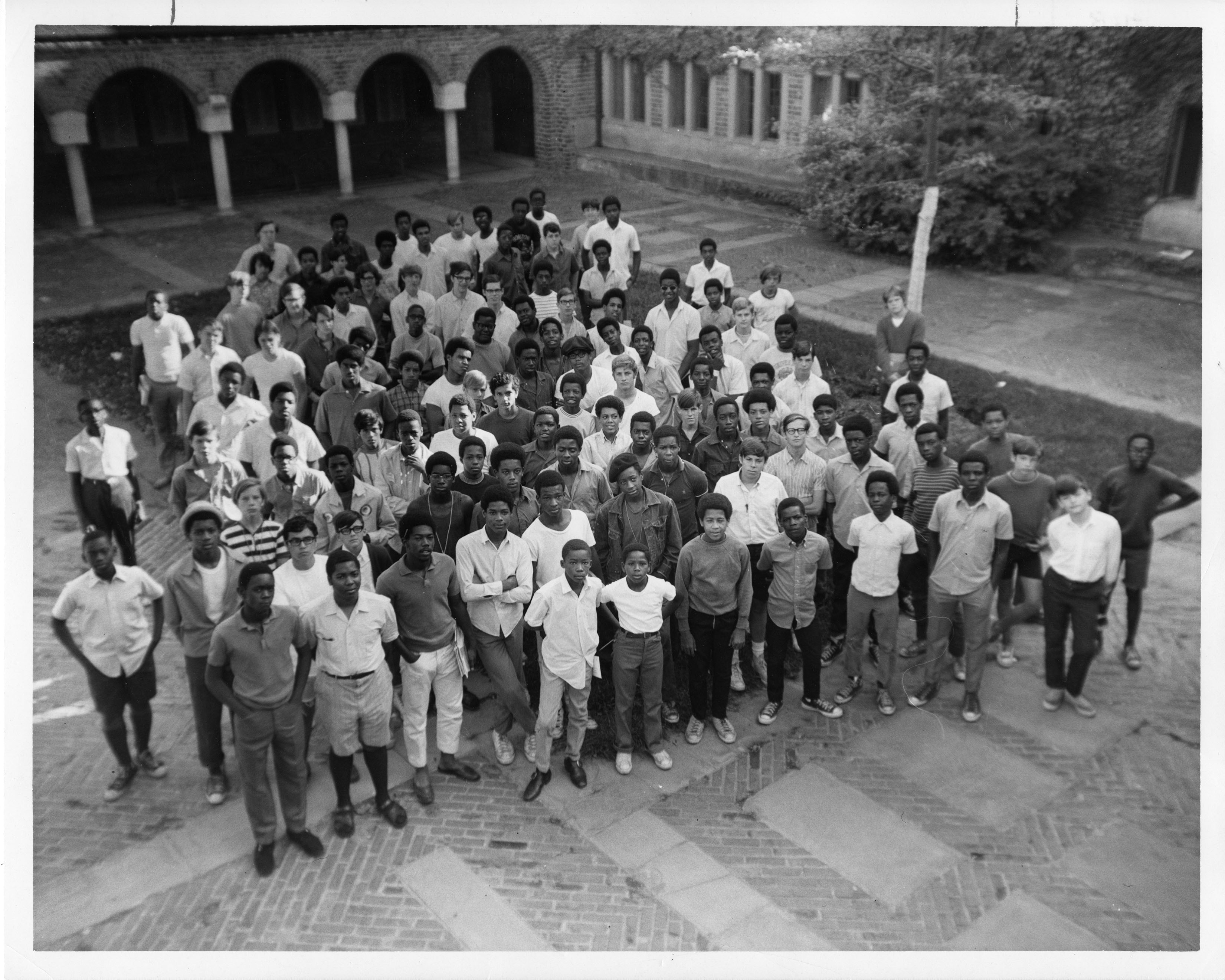
In commemoration of this significant day, Juneteenth, I thought we’d look back at one of many compelling stories in Cranbrook’s history. In the summer of 1970, Horizons-Upward Bound (HUB) offered four new electives that reflected the experimental nature of a project in its sixth year of operation. These electives allowed for innovation and creative thought around topics of particular relevancy to HUB students, investigating issues that still resonate fifty years later.

1969 HUB student photo used on the inside cover of the 1970-1971 annual report. Courtesy of Cranbrook Archives.

Black Creative Writing, taught by Highland Park Community College English instructor Stephen D. Chennault, involved readings, examinations of concepts, and self-directed writing. Students surveyed a Langston Hughes edited short story collection and works by the Black Arts Movement poet, Don L. Lee (later known as Haki Madhubuti). They also explored Black awareness, the role of the Black professional writer, and created skits centered on Black life, in what Chennault describes as a “careful observation of their niche in today’s America.”

The Black Contributions course was co-taught by Wayne State University interns, Ervin Brinker and Fred Massey, and grew out of the Black History course of the two previous summers. Refocused with a more contemporary slant, students studied organizations such as the Black Panther Party, the Student Non-Violent Coordination Committee, and the Southern Christian Leadership Conference. Reporting on the course, Brinker and Massey observed that “both instructors and students were sensitized to the realization that solutions to racial problems are imbedded in institutional living patterns of long standing, protected by mazes of barrier that must be recognized and understood if they are to be nullified.”

George W. Crockett Jr., 1968. Courtesy of Walter P. Reuther Library.

Law was team taught by Detroit attorney Michael Brady and University of Wisconsin law student Norman Prance. Half of class time focused on criminal law, which included examination of Yale Sociology Professor Albert J. Reiss’ 1967 study of police brutality and discussion of the Wayne County Juvenile Court. The subject culminated in a field trip to the Detroit Recorders Courtroom of Judge George Crockett Jr., a civil rights advocate known for confronting the practice of race-based sentencing.

Ben Snyder and Horizons scholarship students, 1968. Courtesy of Cranbrook Archives.

In the course, Power, developed by HUB founder and director Ben M. Snyder, students explored the idea of power through a combination of contemporary theory and current realities. Stemming from two works: Adolf Berle’s 1969 Power and Nathan Wright’s 1968 Black Power and Urban Unrest, the course addressed complicated regional situations, such as the redistricting of Detroit schools. When replying to a question regarding the value of the course to his future, one student remarked, “As long as I am more aware of the American way of working power, it should make me more alert.”

Cover illustration by David McMurray for The HUB 101 Literary Magazine, 4 (Summer 1970). Courtesy of Cranbrook Archives.

A tradition since 1967, the Literary Magazine, a sampling of writing and art produced by HUB students, is perhaps the most important summation of the student experience. Against the backdrop of the civil rights movement, national Vietnam War protests, and the beginnings of an economic downturn that would hit the Detroit metro area hard, the Summer 1970 issue reflects powerful emotions. It’s clear to see that these four thought-provoking electives left a profound effect on students’ views of American society and their role in it. With titles like Discrimination, Revolution, Black Power, Choice of Colors, The Man, The Militant, and Pride, the poignancy of their voices is striking and remarkably germane to events, both then and today.

Deborah Rice, Head Archivist, Cranbrook Archives Cranbrook Center for Collections and Research
Clean as a Whistle

In the past, we have discussed how we cover our stone sculptures on campus to protect them in the winter. But what about the many bronze sculptures? Europe and the Bull? Persephone? The Centaurs?

These pieces are more robust and able to withstand what winter throws at them, but they still need some love each year.

Each spring since 1987, the Community has brought in Venus Bronze Works to recondition the bronzes across the campus. Venus Bronze Works is a member of the American Institute for Conservation of Historic and Artistic Works, which means all the cleaning they do is in accordance with AIC’s Code of Ethics and Guidelines for Practice.

All sculptures are inspected and cleaned by dusting them off with compressed air or wet down and washed with a mild detergent, sponges, soft bristle brushes, and fine cotton pads.

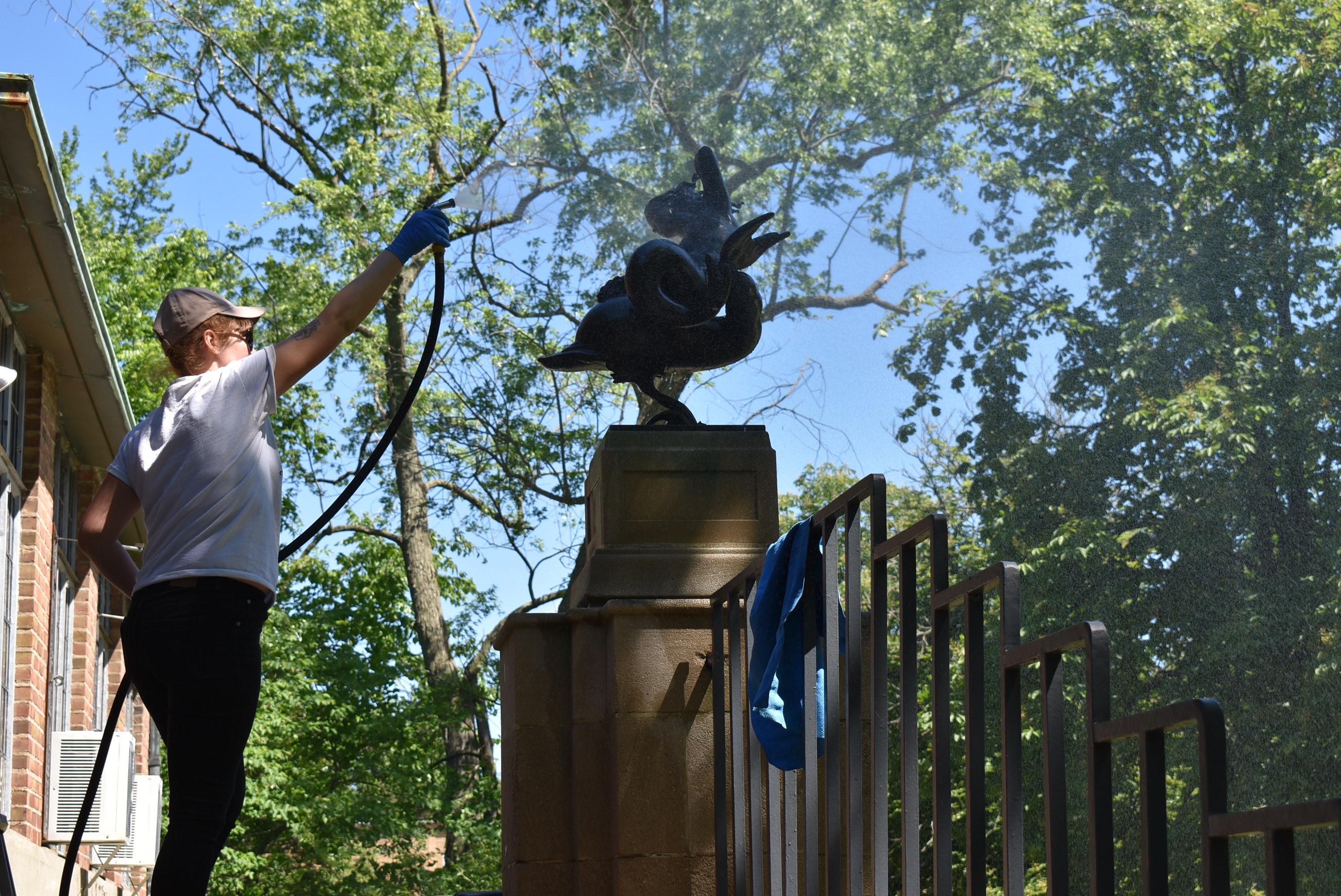
Terra Gillis of Venus Bronze Works gives Carl Milles’s Sunglitter (also know as Naiad and Dolphin, CAM 2002.1) a quick shower, 2020. Photo by Kevin Adkisson.
Harlow Toland of Venus Bronze Works gives one of Carl Milles’s Running Deer (CAM 1934.30) a good scrub, 2020. Photo by Kevin Adkisson.

When the works are dried, one or two thin coats of wax are applied and the sculptures are buffed. This wax can be applied directly from the container or applied to a hot surface (by heating the sculpture with a propane-fed torch).

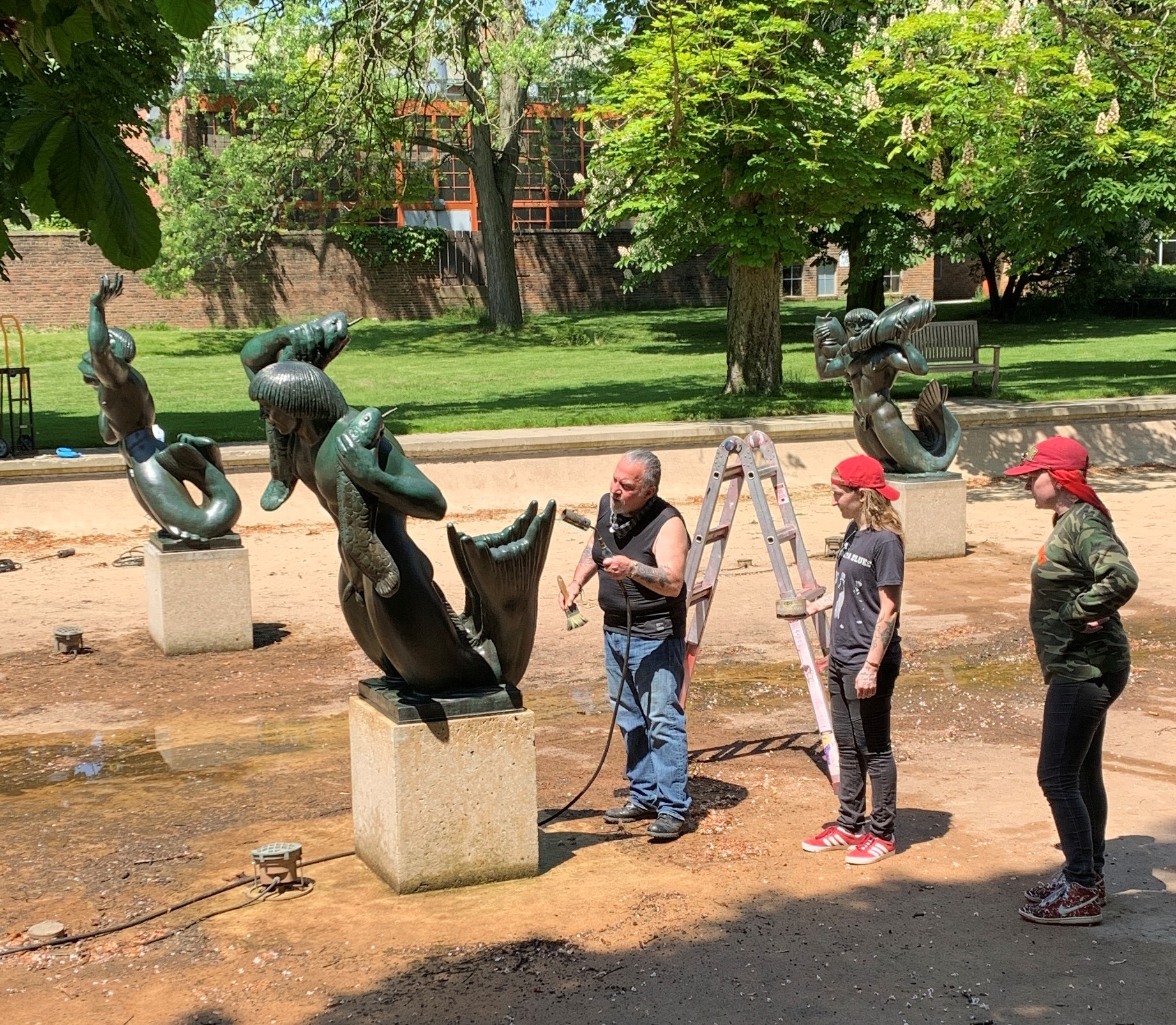
Giorgio Gikas, founder of Venus Bronze Works, holds the torch while his assistants Harlow Toland and Sara Myefski help prepare Triton with Fishes in the Triton Pools at Cranbrook Art Museum to receive a hot wax treatment, 2020. Photo by Kevin Adkisson.

This wax acts as a barrier to the air and humidity on the bronze surface and prevents damaging oxidization or corrosion from developing. When deciding how each individual work is cleaned, we look back to the artist’s intent for each sculpture (was it meant to be patinated green? dark bronze? polished? gilded?) and treat it accordingly.

Venus Bronze Works cleans and waxes all the Milles sculptures at the Cranbrook Art Museum and Cranbrook Academy of Art and the Cranbrook Institute of Science. They also work on such sculptures as Brookside’s Birds in Flight; Kingswood’s Dancing Girls and Diana; Cranbrook House and Gardens’ Fortuna delle Tartaruga (Turtle Fountain); and Cranbrook School’s athletic sculptures. Check out a recent Instagram post about the athletic sculptures below:

We are excited to start welcoming visitors back to our campus this summer, so you can all see the beautiful sculpture in their freshened-up glory.

Leslie S. Mio, Associate Registrar, Cranbrook Center for Collections and Research

What’s in a Brick?

There are many beautiful bricks around Cranbrook’s campus. From the Roman brick details at Cranbrook School, the buckskin “Cranbrook brick” at the Academy and Institute of Science, or the beautiful green and gold bricks of Kingswood, Eliel Saarinen was a master of the ancient building material.

The richness of this legacy made architects Tod Williams and Billie Tsien extremely diligent in specifying materials for their own addition to campus, the Williams Natatorium. Completed in 1999 and sited within the heavily wooded area adjacent to the Saarinen-designed Keppel Gymnasium, the 26,000-square-foot swimming facility features very few details that are not custom made. This includes the bricks.

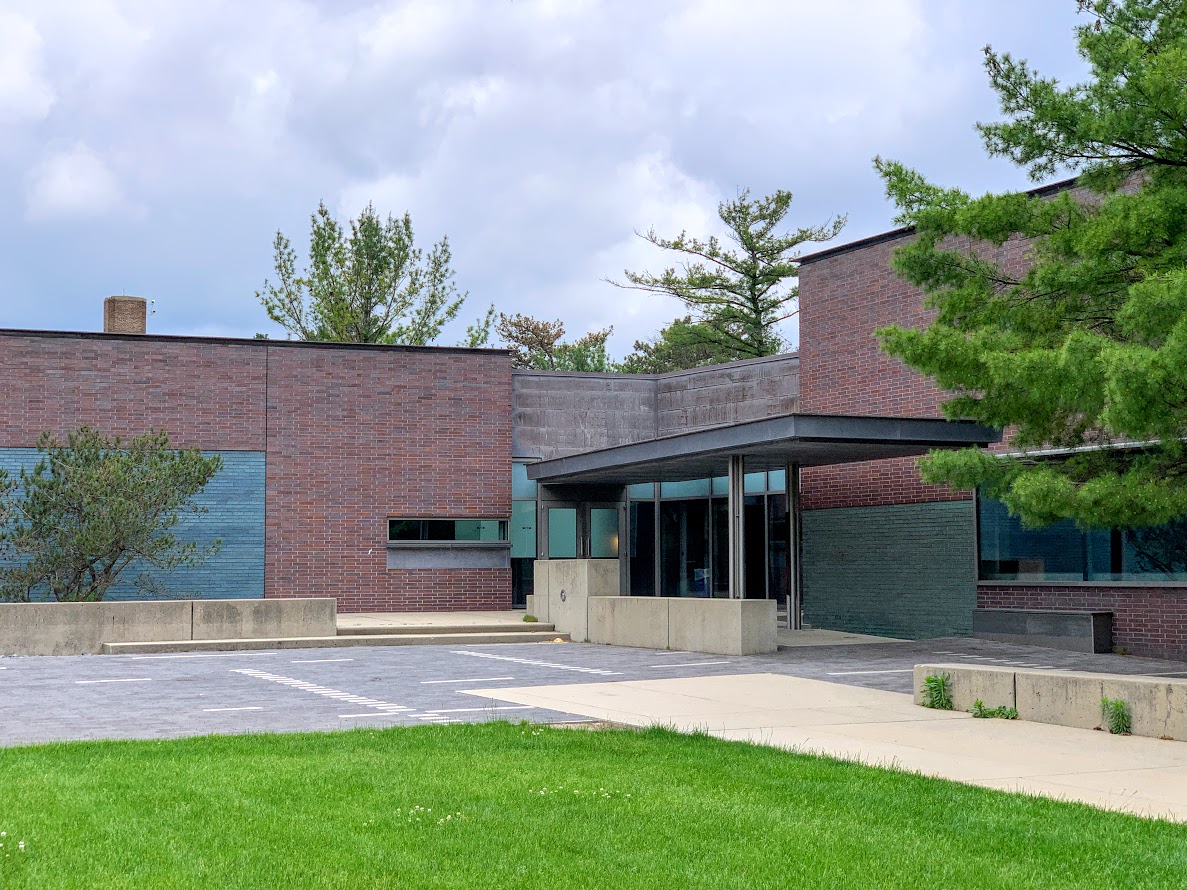
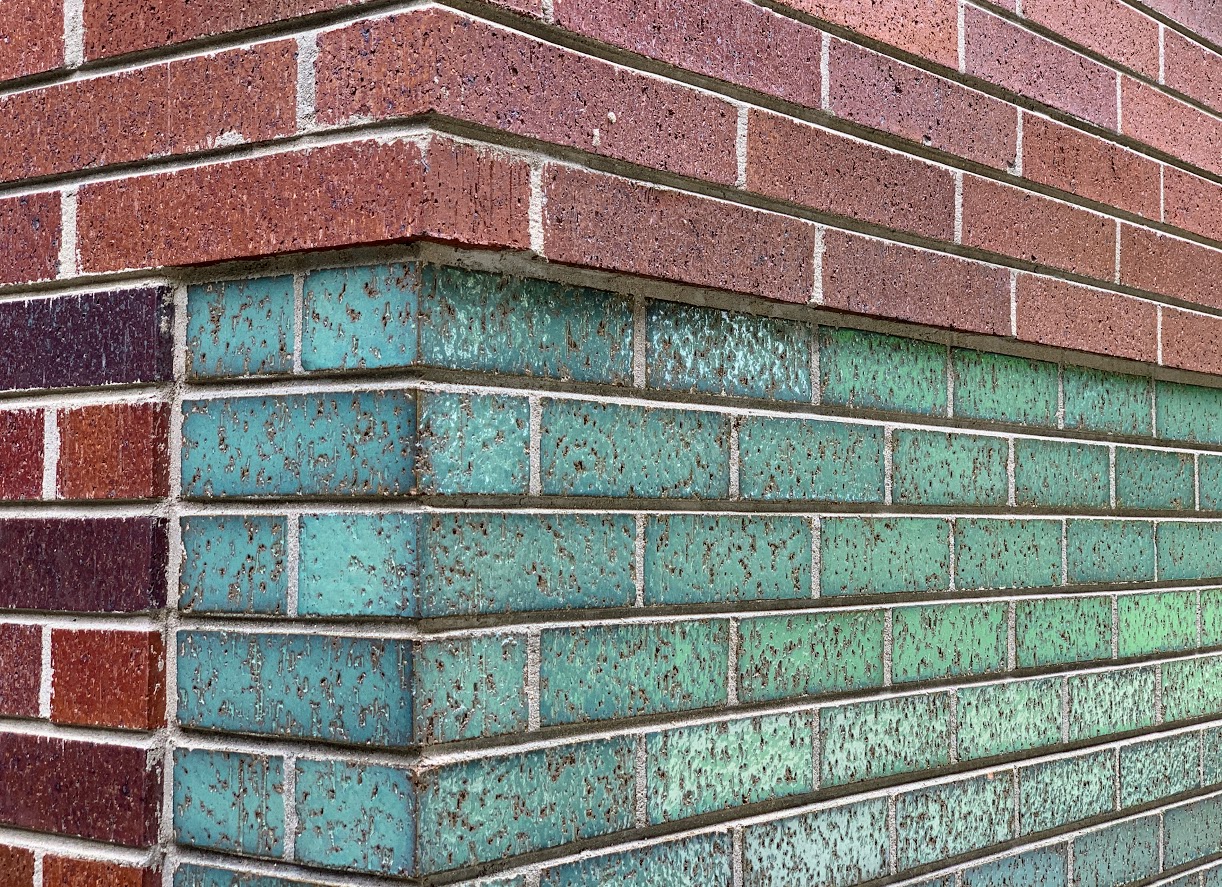
The entrance to the Cranbrook Natatorium, showcasing purple Norman brick, glazed blue and green brick, concrete, and lead-coated copper. Courtesy Cranbrook Center for Collections and Research.

The architects wanted glazed bricks (a material famously used by Eero Saarinen at the General Motors Technical Center), but they couldn’t find any product available on the market that meet their needs. Project architect Martin Finio told Construction Association of Michigan Magazine (Fall 2000) that:

Typical glazing tends to resemble a painted surface. The glaze becomes the object of interest. The brick behind it could be anything. What we were interested in was trying to find a way of glazing brick in such a way that you can feel the body of the brick through it.

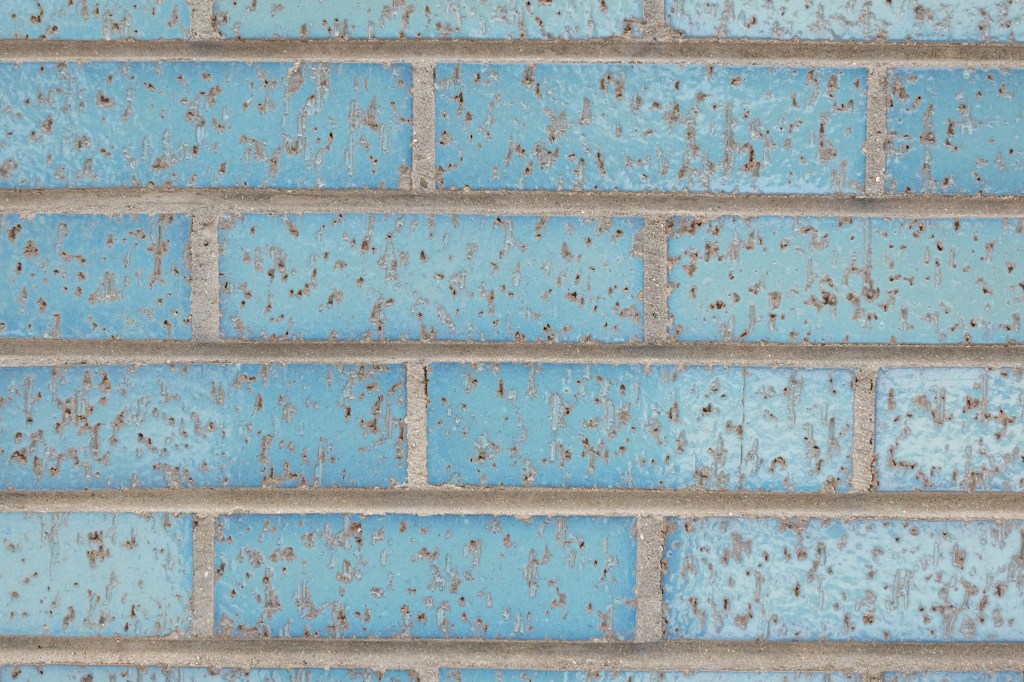
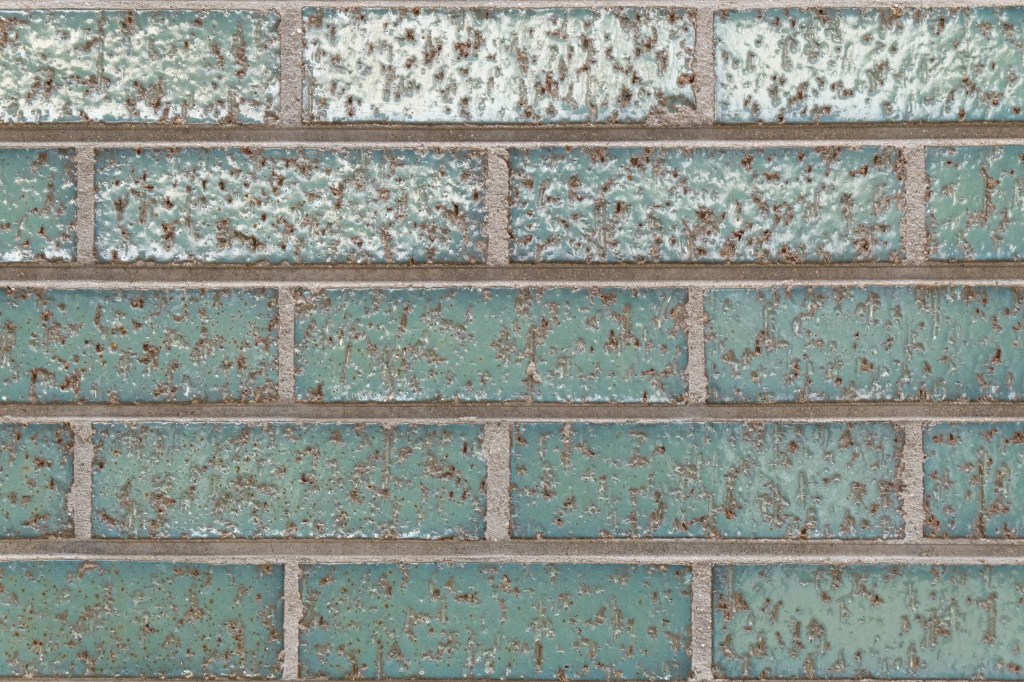
The architects turned to Endicott Clay of Fairbury, Nebraska to help craft custom glazed brick, with a base of ironspot brick the company already produced. In ironspot bricks, manganese in the clay creates dark spots when fired. The goal for Cranbrook was to have these spots remain visible behind the glaze.

After receiving dozens of sample test glazed bricks that weren’t what the architects wanted, Martin Finio, Billie Tsien, and project manager Gary Scheuren traveled to Nebraska to learn more about the process and to work on getting the Natatorium bricks just right. When they arrived, Tsien saw a stack of samples Endicott Clay had deemed failures, rejected, and never sent to the architects in New York. Within the trash pile was the exact finish the architects wanted. Endicott Clay simply reverse engineered the once-rejected bricks and made enough mottled blue and green glazed bricks for the building.

Beyond the colors’ ties to water and earth (appropriate for a pool in the woods), the specific shade of blue and green have special Cranbrook associations. The blue is the famed “Grotell blue” of Cranbrook’s longtime Head of Ceramics, Maija Grotell, while the green relates to the lovely shades of aqua used by Pipsan Saarinen Swanson inside Kingswood and that building’s great patinated copper roof.

The Norman bricks above the green glazed bricks. Notice the raked horizontal mortar lines. Cranbrook Center for Collections and Research.

Alongside the glazed bricks, the architects specified manganese ironspot Norman bricks in deep purple. Norman bricks are longer than standard bricks and enhance the horizontality of the building. Using a tradition made famous by Frank Lloyd Wright and also used by Eliel Saarinen at Cranbrook, the horizontal mortar is raked and the vertical mortar is flush, casting the horizontal joints in shadow and increasing the sense of compression across the façade.

This hinge joint of blue glazed and purple Norman bricks terminates the east-west axis running from George Booth’s office in Cranbrook House, past the Art Museum and Orpheus fountain, and to the Natatorium. Daniel Smith, photographer. Cranbrook Center for Collections and Research.

Other materials used on the exterior of the Natatorium include cast in place concrete (sandblasted to give it a warmer feel and richer texture), warm toned ground-faced concrete block (custom made in Grand Blanc), Honduran mahogany, Mexican river rock, and Pietra Cardosa Italian slate.

—Kevin Adkisson, Curatorial Associate, Cranbrook Center for Collections and Research
Cranbrook, Way Back

When we consider historical records, even digital ones, our thoughts do not usually extend to websites. Yet, just like student newsletters or exhibition catalogs, Cranbrook’s website is a compendium of institutional information regarding the people, places, and things that make it unique.  As we ourselves shift evermore towards online existences, one focus of the Archives has been on how to ensure Cranbrook’s virtual legacy.

I’m sure everyone is familiar with the expression, “What goes on the internet, stays on the internet,” or some variation thereof. Cranbrook is no exception. Fortunately, there is the Internet Archive. A non-profit American digital library, it has been saving public websites since 1996. And, courtesy of its web archives, the Wayback Machine, Cranbrook’s evolving web presence has been captured over time from its beginnings in the mid to late 1990s to today. [Interesting aside: through the Internet Archives backup protocol, Cranbrook is a part of the Bibliotheca Alexandrina, the current incarnation of the famed ancient Library of Alexandria!]

Screen Shot 2020-05-21 at 3.15.30 PM

Cranbrook home page as it looked in 1997. Courtesy of the Internet Archive.

One of the quickest ways to get a snapshot of what was going on at Cranbrook in the last twenty-three years is through its website.  Get lost in Cranbrook 1997 by clicking on the above homepage image and navigating through the still active links.

How about exploring Cranbrook 2007?

Screen Shot 2020-05-21 at 2.35.49 PM

Cranbrook home page as it looked in 2007. Courtesy of the Internet Archive.

There are only 1,450 more site captures to delve into, if you’ve got the time! While the interactive websites of Cranbrook’s past can be accessed in this way, it is important to note that the information and files used in their creation form part of the over two million items at the Archives. For example, the main homepage image from the 1997 website, the Woodward Entrance Feature, can be found in the Archives’ Architecture Slide Collection.

S.22.268

View of the entrance feature from Woodward Avenue at sunset, 1996. Dan Hoffman, designer. Balthazar Korab, photographer. Copyright Balthazar Korab/Cranbrook Archives.

As increasingly digital files become the only documentation of Cranbrook activities or events, its websites are more integral to understanding the context of these records. The Archives continues to expand its digital capabilities to keep pace. In the near future, we hope to provide our own copies of Cranbrook’s various websites (with keyword search capability), side by side with the digital records from which they were created.

CCCR logo_horiz_color_no text_transparent background-1

Deborah Rice, Head Archivist, Cranbrook Archives Cranbrook Center for Collections and Research

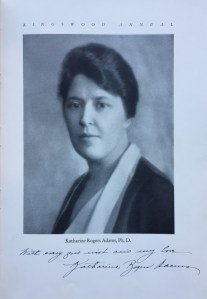
Katharine Rogers Adams, Kingswood School Headmistress 1931-1934

Katharine Rogers Adams was the Headmistress of Kingswood School from March 1931 through June 1934. The Announcement of Kingswood School brochure of 1931 tells us that she was born and educated in Philadelphia and later graduated from Wellesley College in Massachusetts. She taught in the high schools of New York and Connecticut for seven years and was awarded Master of Arts and Doctor of Philosophy at Cornell University. From 1926 until 1931, she was a professor of history and dean of the faculties of Mills College, California. In March 1931, she was selected as Headmistress of Kingswood School, following the resignation of Miss Gladys Adams Turnbach in December 1930.

1980-01 31-15

Katharine Rogers Adams Kingswood School Annual, 1932 1980-01 31:15 Copyright Cranbrook Archives, Cranbrook Center for Collections and Research.

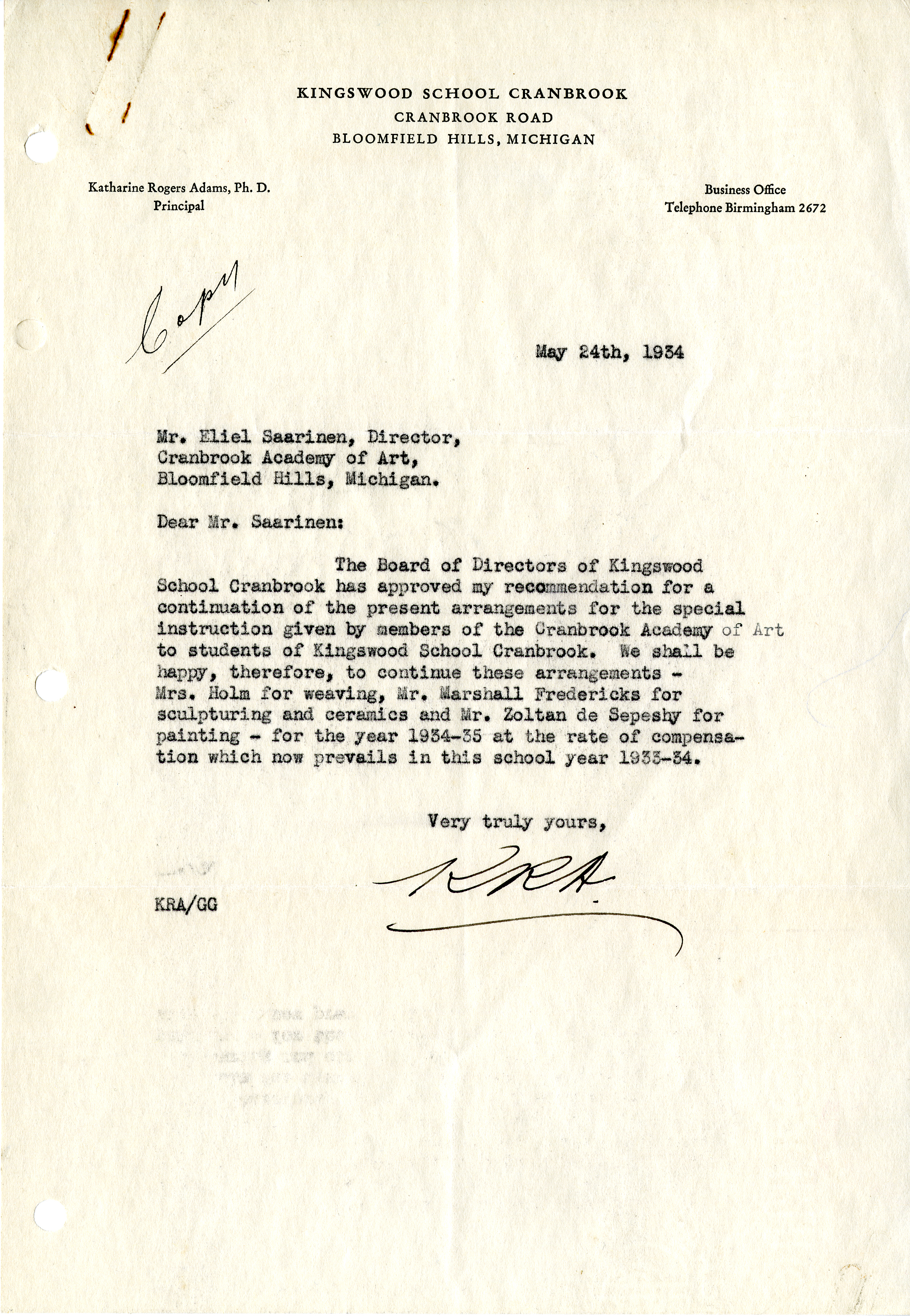
Despite the financial crisis of the Depression during Adams’ Principalship, she was successful in leading the school through the financial challenges of those early years, as well as championing its extensive library and establishing traditions such as the Christmas play, Honors’ Day, and yearbooks (see Clark, 2006, pp.57-58). From delving into the records to find out more about Adams, the story that engaged me was her involvement in the development of fine arts education. Faculty of the Cranbrook Academy of Art were employed to provide art education, with Maja Andersson-Wirde teaching Arts and Crafts in 1932-1933, and during the 1933-1934 academic year, students began to be taught painting by Zoltan Sepeshy, sculpture and drawing by Marshall M. Fredericks, and weaving by Lilian Holm.

1980-01 13-3.jpg

Letter from Katharine Rogers Adams to Eliel Saarinen, May 24, 1934
Kingswood School Records (1980-01, 13:3)
Copyright Cranbrook Archives, Cranbrook Center for Collections and Research.

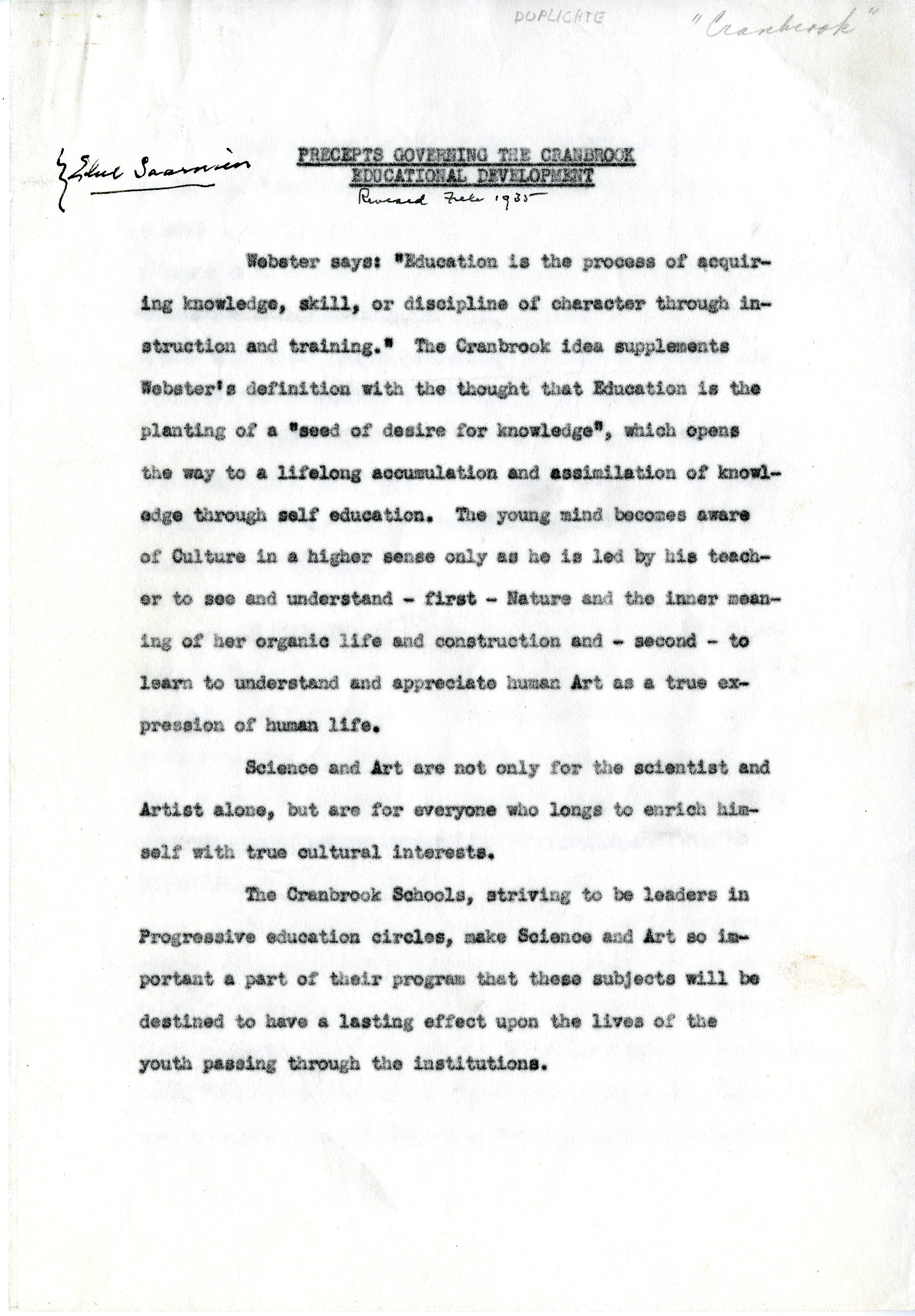
The discussion of art and science in education flourishes during Adams’ three years as Kingswood Headmistress and continues thereafter, with many drafts of statements to articulate the Cranbrook approach—the image below shows one version as edited by Eliel Saarinen in 1934. If the art of language is to clearly achieve understanding or to generate inspiration for thought, through words, I found this much accomplished in the following statement within a letter from Saarinen to the Cranbrook Foundation:

“To begin with this must be stated: the problem of “art” is to create new values, contrary to the problem of “science” which is the discovery of existing values” (Eliel Saarinen, Letter to the Cranbrook Foundation, Sept. 25, 1935).

1981-01 19-33.jpg

Precepts Governing the Cranbrook Educational Development, Eliel Saarinen, 1934
George Gough Booth Papers, (1981-01, 19:33)
Copyright Cranbrook Archives, Cranbrook Center for Collections and Research.

The founders’ wish for students to develop an appreciation of art, and a knowledge of its history, toward the betterment of human life, is embraced by Adams, who was also well-accomplished in the art of language. In her address, ‘Many Mansions,’ at the first graduation ceremony for Kingswood School held on June 13, 1932, she speaks of another form of architecture—a mansion of character that houses an independent mind and an active soul inspired by learning and beauty and courage:

“Do we ever stop to think, to realize that we are builders, whether of this or of that? That every mental and physical action of ours is building? We would build well, you say, but to build we must have power, and to have power we must have knowledge, and in the words of Dante—‘knowledge comes of learning, well retained.’”

Adams’ address is scattered with poetry and literature, including that of Alan Seeger, Robert Browning, and Oliver Wendell Holmes, Sr., as well as recollections of others from Lord Balfour to Leonardo da Vinci. But Adams is in harmony with the thoughts of George Gough Booth, that the words or stories of others are helpful insofar as they stimulate you to be “your own very best self” (see ‘Notes for an address not used’, late 1930s. George Gough Booth Papers, 1981-01, 1:20). Thus, she advises her graduands:

“Seek the one truth to your problem; there can be but one truth as there is but one sun. But build your mansion with many windows, the sun will shine through all.”

1981-01 22-9

Diploma Day Address, ‘Many Mansions,’ by KRA, Ph. D., Principal, on the occasion of the first graduation exercises Kingswood School Cranbrook, June 13, 1932, Kingswood School Records (1980-01 22:9) Copyright Cranbrook Archives, Cranbrook Center for Collections and Research.

1981-01 22-9 (2)

Although in February of 1934, Adams initially sought and gained an extended summer leave for rest and repose, she resigned on May 23, 1934, at her physician’s recommendation.

– Laura MacNewman, Associate Archivist

Sources:

Elizabeth C. Clark. (2006). Beside a Lake—A History of Kingswood School Cranbrook. Cranbrook Press. pp.57-58

George Gough Booth Papers, (1981-01, 19:33)

Kingswood School Records (1980-01, 1:2-3, 6; 12:4; 13:3; 15:2; 22:9; 24:8; 31:15)

Saarinen/Slade House

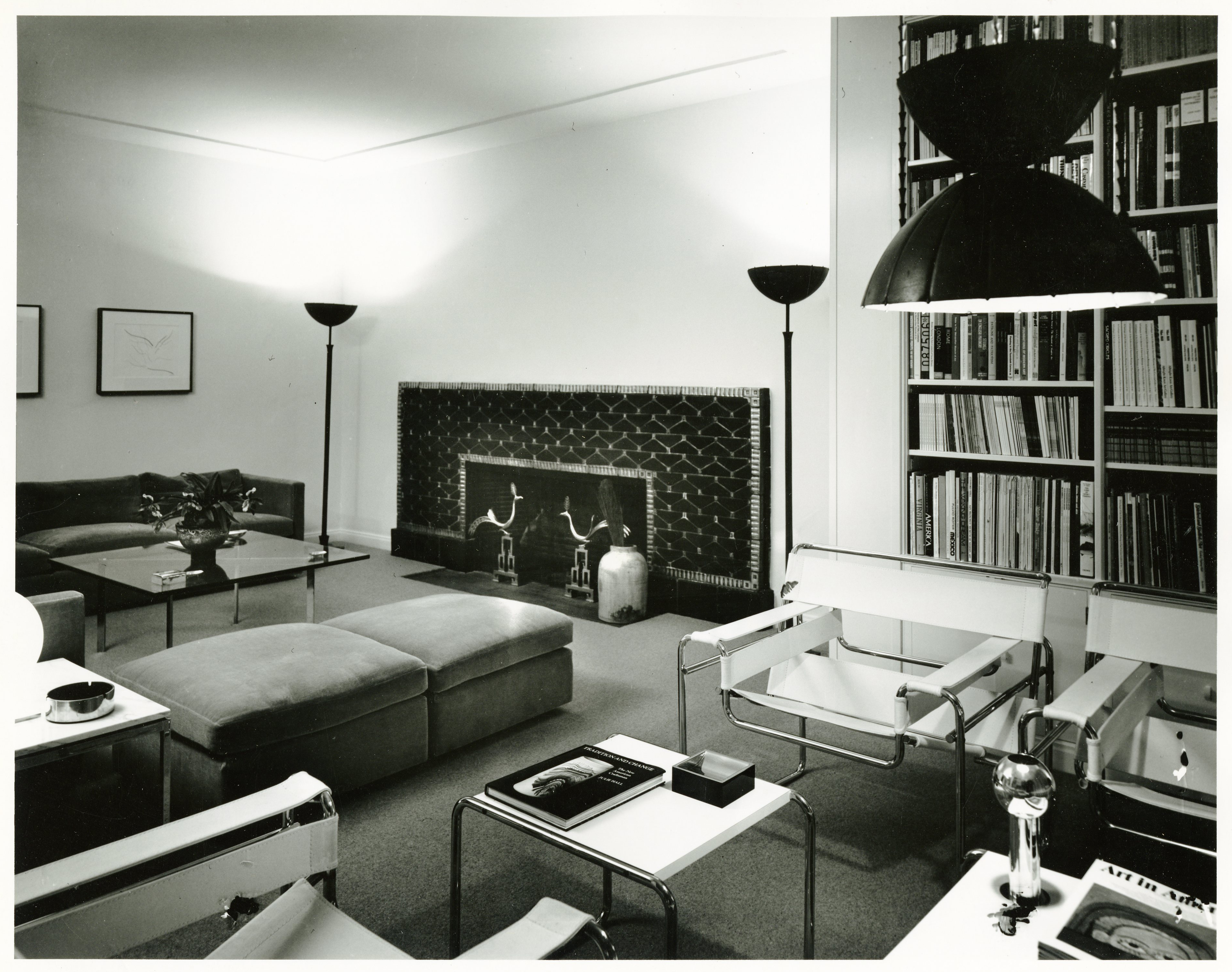
When incoming Academy President Roy Slade arrived at Cranbrook in July 1977, the President’s House (known, off and on, as Saarinen House) was in need of a refresher. Three other families had lived in and changed the aesthetic of the house following Eliel Saarinen’s death in 1950, and the house was a far cry from Saarinen’s design intent. Slade worked with designers Jean Faulkner and Carl Magnusson (then Director of Graphics and Showroom Design at Knoll) to rework the house into something befitting the new President of the Academy.

SH Living_Norman McGrath_American Society of Magazine Photographers_78-02-8

Saarinen House, February 8, 1978. Norman McGrath, photographer. Courtesy of Cranbrook Archives.

The original Saarinen-designed furniture had been spread throughout the campus and Museum, and in the redesign much of it was returned for use in the house. But instead of restoring rooms to their 1930s appearance (that would happen a decade or so later), the house was kept as a blend of old and new. “Gibraltar Ash” off-white wool wall-to-wall carpeting by Jack Lenor Larsen stretched between the foyer, living room, dining room, and library, making the main room of the house feel like one continuous open space. Furnishings and art pieces by Cranbrook (and Cranbrook-adjacent) artists and designers from many decades–not just the 1930s–were blended together into a comfortable, deliberately eclectic look. The 1977 interiors of the house were featured in local papers and even included, with text by Paul Goldberger, in Living Well: The New York Times Book of Home Design and Decoration (1981).

It’s interesting in these photos by Jack Kausch how well the space works, but how alien Saarinen’s furniture seems to be! Particularly in the dining room–the holly wood table and brass fixture are decontextualized by the foreign whiteness of the walls, ceiling, and floor. The next restoration, completed in 1994, brought back Saarinen’s rich color scheme and variety of materials–including the gilded ceiling.

If you’d like to learn more about the later lives of Saarinen House, Roy Slade’s tenure as President of the Academy, and other fascinating Cranbrook Academy of Art stories, come out to visit my exhibition, Saarinen House: Presidents/Residents, 1946-1994, opening later this month.

The exhibition features archival material and works by each former resident: painter Zoltan Sepeshy, who directed the Academy from 1946 to 1966 and moved into the house in late 1951 following the death of Eliel Saarinen; architect Glen Paulsen, who led the Academy from 1966 to 1970 and expanded Cranbrook’s campus with late-Modern additions; Wallace Mitchell, a Detroit native whose career at Cranbrook developed from student to painting instructor, then director of the Art Museum and finally president; and painter and educator Roy Slade, who led the Academy and its Museum from 1977 to 1994. Slade initiated the restoration of Saarinen House in the late 1970s and encouraged and supported Greg Wittkopp (then a curator at the Art Museum) in the transformation of this early modern, Art Deco design treasure into a public house museum in 1994.

The free Opening Reception will take place Sunday, April 29, 2018, from 1pm-5pm (in conjunction with Open Studios) and the exhibition will be included on all tours of Saarinen House through November. Learn more on our website.

– Kevin Adkisson, Collections Fellow, Cranbrook Center for Collections and Research


Eagle Scout Project in Smith House

This past March, the Center for Collections and Research was honored to host Kevin Wilburn, a Life Scout going for the rank advancement of Eagle Scout, as he performed his required service project.

https://www.scouting.org/programs/boy-scouts/advancement-and-awards/eagle

Eagle Scout badge from scouting.org

The mission of the Boy Scouts of America is to prepare young people to make ethical and moral choices over their lifetimes by instilling in them the values of the Scout Oath and Scout Law. The ranks of the Boy Scouts are Tenderfoot, Second Class, First Class, Star, Life, and Eagle. To receive the highest achievement rank in the Boy Scouts of America, a Life Scout must not only earn twenty-one merit badges but also perform an extensive service project. He must plan, develop, and give leadership to others in a service project helpful to any religious institution, any school, or his community.

Kevin’s project was to work with the book collection in the Frank Lloyd Wright-designed Melvyn Maxwell and Sara Stein Smith House. It was especially great having Kevin work with the house, as Robert Smith, the only son of Melvyn and Sara, also achieved the rank of Eagle Scout in his youth (the Smith House collection contains his Eagle Scout uniform).

When Cranbrook acquired the Smith House late last year, we also acquired the extensive library amassed by the Smiths. The collection of more than 900 works ranges from books on Frank Lloyd Wright to Art in America and other periodicals, to yearbooks and popular fiction.

EagleScoutProject_Mar2018 (KevinWilburn) (2)

Kevin and his team working on the Smith House book collection.

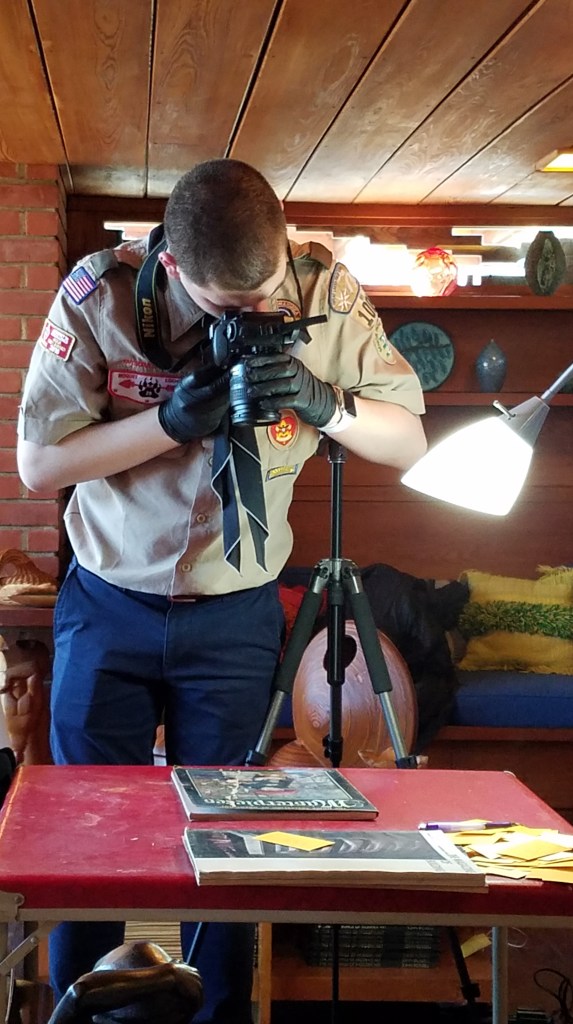
On the day of the project, Kevin and his team of scouts and parent volunteers did an inventory of the books in the Living Room and the Study. They utilized a computer program which allowed them to gather all pertinent information about the books by simply searching the Library of Congress Control Number (LCCN) or the International Standard Book Number (ISBN). They also took images of the books as well as any inscriptions found within. What they ended up with, after just one day working in only two rooms in the house, was a database of 658 individual titles. (Knowing how many more books are in the other rooms, maybe there are more than 900 books in the house…)

I recently asked Kevin his thoughts on the project over email:

LM: First off, what does becoming an Eagle Scout mean to you?

KW: I’ve been in Scouts for 11 years now there were times that I questioned my continuation in Scouts. However, on the cusp of this final accomplishment, I don’t regret staying on the path. It has been a lot of commitment and there is no substitution for the hard work required, but as a scout, I have had opportunities so few people get to have—just like doing this project. It is special to be part of the small group of Scouts that accomplish the Eagle Rank. I think the Scout program and achieving Eagle has made me a better person.

LM: Can you give me your overall impression of the Smith House?

KW: To me, I struggle with the words to describe the Smith House. It is truly a one-of-a-kind home and the attention to detail is absolutely marvelous. Whether it’s the striking color of the red tidewater cypress wood that forms the walls or the glistening flat skylights that illuminate the tight, yet airy library, this home is Usonian Style in its truest form. Additionally, there is such a great story to the Smith’s and how the house came to be that makes it even more special than the physical aspects.

LM: What motivated you to take on this project?

KW: The driving force behind this entire project was the fact that I was assisting in the preservation of a Wright-designed home. I’ve always had an appreciation for his work and have a personal interest in helping the preservation of his work. I never expected that I would have such a unique opportunity to combine my passion and interest so directly on my Eagle project—it was a truly special project. I really appreciate the opportunity Cranbrook provided me.

EagleScoutProject_Mar2018 (KevinWilburn) (1)

Kevin photographing one of the 658 titles cataloged during the one-day project.

LM: What was the hardest thing about the project?

KW: We had very unique requirements compared to many projects that are often construction based, so going into it I knew that getting people started on the cataloging process would be difficult and it probably took an hour for volunteers to get into a rhythm. It was also physically demanding, in some cases sitting or standing for hours at a time—luckily we were able to rotate some positions to help people with fatigue. In the end, the hardest part was it was a very long 10 hour day typing in book details into our cataloging software and photographing the books.

LM: What was your favorite part of the project?

KW: Planning to pursue architecture as a career, I’ve always been interested in Frank Lloyd Wright; so, my favorite part was to be able to do a project in one of his Usonian homes. It was also exciting during the cataloging process to see some of the personal connections of the Smiths with Wright.

LM: Any final thoughts?

KW: I want to thank Cranbrook Center for Collections and Research, Leslie Mio, Associate Registrar, for supporting the project, and Lynette Mayman, Program Presenter, for being on-site during the project. I also want to thank the members of Troop 1005 that came out to support this effort. Finally, I want to thank Collectorz.com for donating the Book Collector software used to catalog the collection.

EagleScoutProject_Mar2018 (KevinWilburn) (4)

Kevin (fourth from the right) and some of his team of volunteers on the back patio of Smith House.

The Center for Collections and Research wishes Kevin the best of luck in achieving his Eagle Rank and would like to thank him and his team for the hours of work on this project.

Leslie Mio, Associate Registrar

Create a website or blog at WordPress.com