July 5th, 2025, marks one hundred years since the groundbreaking for Christ Church Cranbrook. As we mark this milestone in Cranbrook’s history, I believe it is important to reflect on George Gough Booth’s long discernment of this generous gift to the community.
From the beginning, there were always places of worship at Cranbrook. The story that leads us through these spaces to the establishment of Christ Church Cranbrook is especially meaningful to me.
Rev. Dr. S. S. Marquis, D.D. with the first spade of earth, July 5, 1925. Courtesy of Cranbrook Archives, Cranbrook Center for Collections and Research.
After George and Ellen Booth purchased ‘The Farm’ in January 1904, his father, Henry Wood Booth, was the first family member to live on the country estate. The elder Booth stayed for the month of May with Frank Brose, the farmer, and his family. On May 15, 1904, the first worship service at Cranbrook took place under a tent, on the site upon which the Altar of Atonement now sits, with Henry as lay preacher. He continued in this ministry, also offering Sunday School, at the same spot until 1909. This was the first act of service offered to the Bloomfield Hills community at Cranbrook.
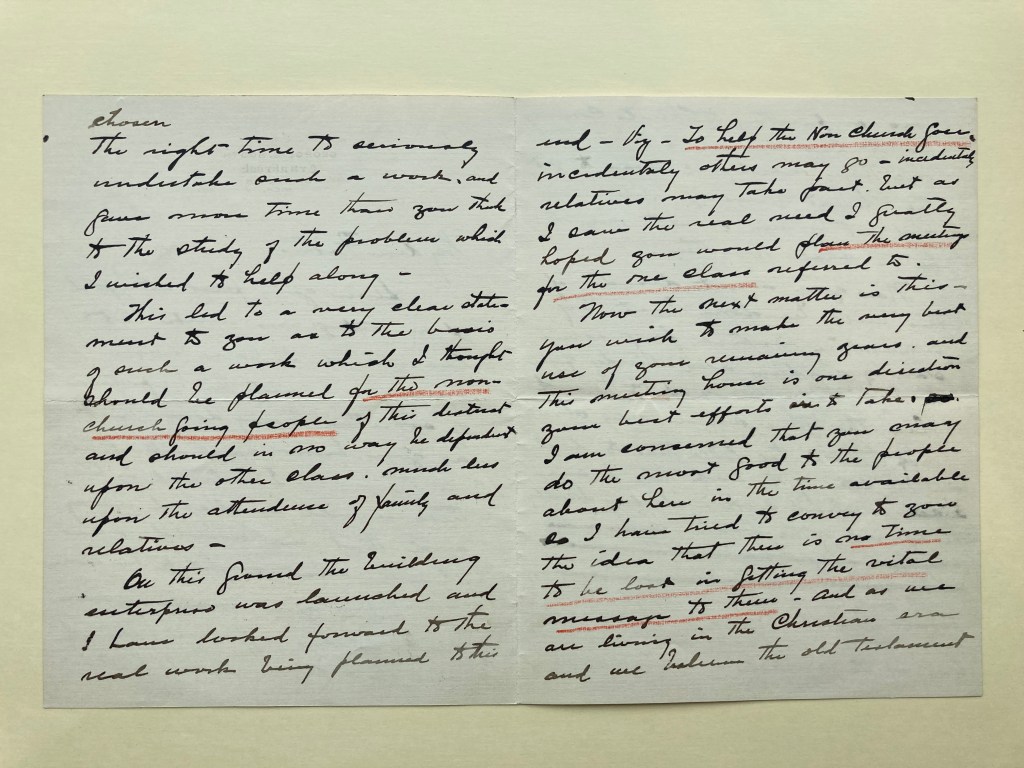
Letter from George Gough Booth to Henry Wood Booth, August 24, 1918. Courtesy of Cranbrook Archives, Cranbrook Center for Collections and Research.
In 1914, George and Ellen considered building a chapel at the site on which the Kingswood flagpole now sits, but the project was rejected, most likely due to the outbreak of World War I. As the war ended, a permanent place of worship and Sunday School was established with the building of the Meeting House.
The letter, above, preserves the dignity with which George writes of the Meeting House “building enterprise” to honor and give freedom to his father’s calling to share the Christ message with the non-church goers in the district. From this letter, we can learn and understand why George built the Meeting House for worship and Bible study through his father’s ministry.
Decoration of the Meeting House by Katherine McEwen, 1918. Laura MacNewman, photographer.
In the letter from George to his father, we also learn that he is prudent in observing the religious character of Bloomfield residents. During the years in which the Meeting House was used for religious services (1918-1926), Mr. Booth would reflect on the visiting clergy and service attendees (both of which came from diverse denominations), from which he would eventually discern the denomination of “Cranbrook church.”
Any chance you have a trip planned to Europe this summer? If so, your itinerary really must include Stockholm. Not only is it a beautiful city—one of my favorites—but it also was home to one of Cranbrook’s most celebrated artists, Carl Milles. Long before he took up residence at Cranbrook, the Swedish sculptor started to plan and build his home and studio, Millesgården. Built high on a cliff overlooking Stockholm’s harbor, Millesgården now is a magical museum and sculpture park and the site of this year’s summer-long birthday party, The Sculptor Carl Milles at 150. Yes, if Carl Milles had lived to be the world’s oldest man, he would have turned 150 this Monday, June 23.
Carl Milles working in his Cranbrook Academy of Art studio, circa 1950. Margueritte Kimball, photographer. Courtesy of Cranbrook Archives.
While anyone taking the time to read this blog no doubt has an image in mind of one of Milles’s works at Cranbrook (there are no fewer than 45 outdoors on our campus and another 52 in the Art Museum or other buildings), my guess is that the story of the twenty years he spent working in America are a little foggy (unless, of course, you attended our 2021 virtual fundraiser, A Global House Party at Cranbrook and Millesgården, and watched the film, Carl Milles: Beauty in Bronze, we produced for the occasion). As a refresher course, or even a primer, I thought I would take you on a journey, one that starts in America and ends, twenty-two years later, back in Sweden (and Italy, as the case may be).
Milles arrived in the United States for the first time in October 1929. With the stated purpose of attending the opening of his second group exhibition in New York City, he took advantage of the trip to sell work to collectors, negotiate a commission in Chicago for his Diana Fountain, present the concept for the monumental doors he would create for the Pennsylvania State Capitol, and meet with Tage Palm, the President of the Chicago-based Swedish Arts and Crafts Company who would become his business manager. Most important for this next chapter of his career, he also traveled by train to Michigan where he met with George Booth who asked him to teach at the art school he was building north of Detroit, Cranbrook Academy of Art.
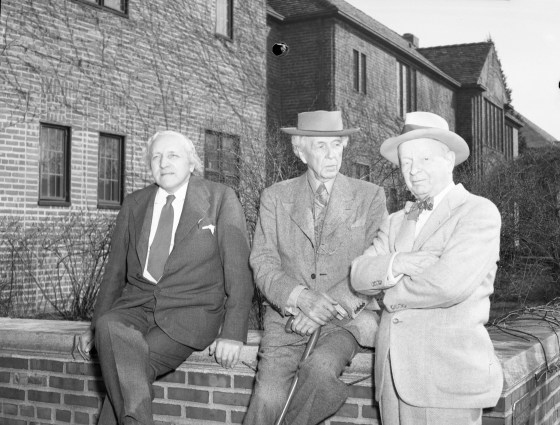
Carl Milles, Frank Lloyd Wright, and Eliel Saarinen (l to r) outside Saarinen House, March 1945. Harvey Croze, photographer. Courtesy of Cranbrook Archives.
George Booth and his wife Ellen Scripps Booth, as most Cranbrook Kitchen Sink blog readers know, were wealthy newspaper publishers and philanthropists. Although their flagship paper, the Detroit News, was based in Detroit, their home was in the countryside of Bloomfield Hills. By the late 1920s, they had begun to work with the Finnish architect Eliel Saarinen to transform their private estate into an educational community that eventually included an Episcopal church, boys and girls schools, an art academy and museum, and an institute of science (and, even later, a center for collections and research). Although the archival record is a little murky, Saarinen and Milles were at least acquaintances long before the sculptor met with his future patron at Cranbrook.
As Milles contemplated moving to Cranbrook to direct the Academy’s Sculpture Department, there was one small problem: he had no desire to teach. Two years and many conversations later, Booth and Milles came to an agreement: the sculptor would not need to “teach” but simply “mentor” students in his studio. (Not a bad deal!)
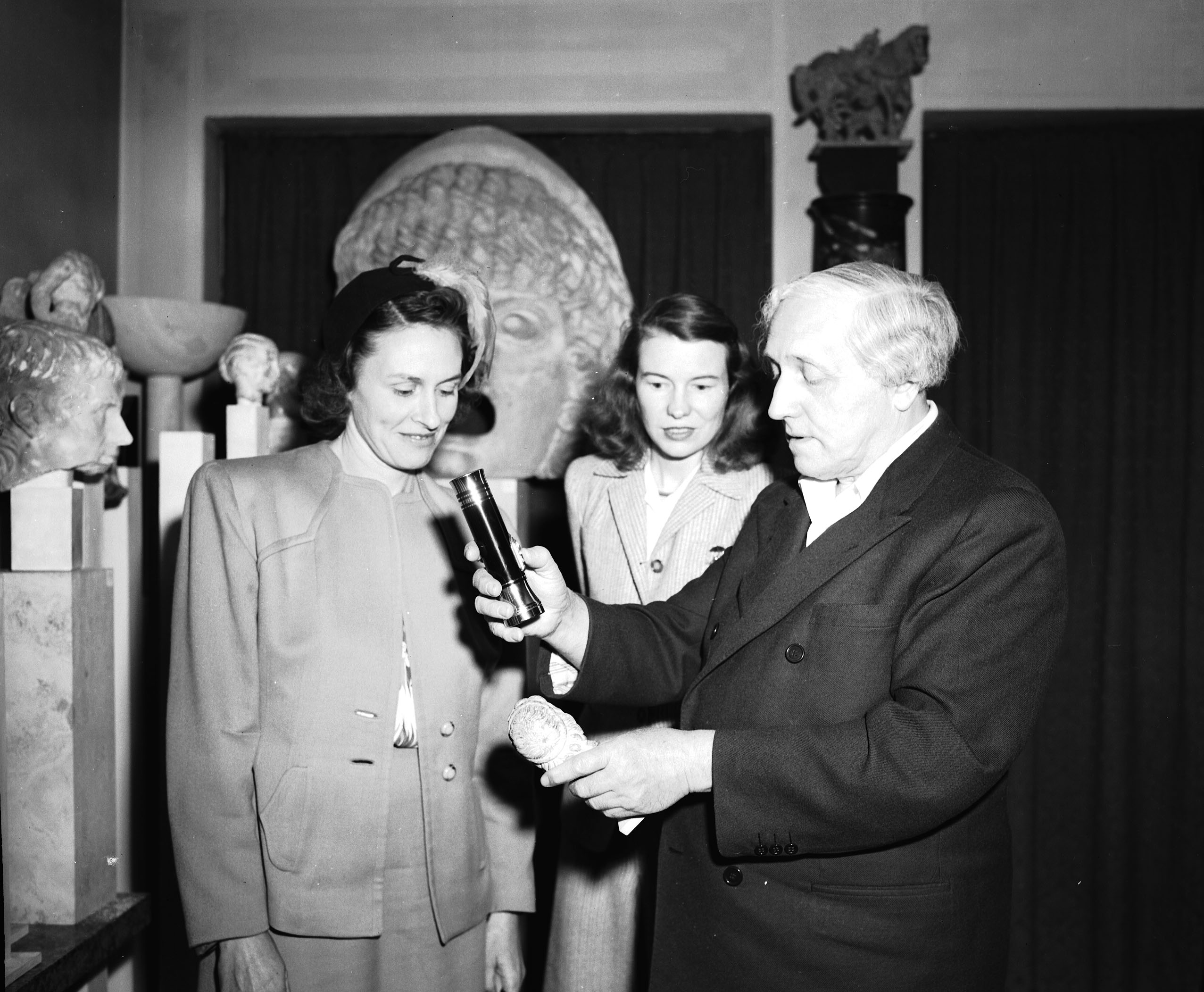
Carl Milles discusses details of a sculpture during an open house, 10 May 1947. Courtesy of Cranbrook Archives.
In January 1931, Carl and his wife Olga Milles arrived at Cranbrook where they lived for the next twenty years. Their home, where they displayed Milles’s collection of ancient sculpture, was designed by Saarinen, as were his three studios—including the grand thirty-foot-tall studio Milles used for his largest commissions such as the Orpheus Fountain for the National Concert Hall in Stockholm.

Carl Milles in his studio at Cranbrook Academy of Art, sculpting the figure of Orpheus for the Orpheus Fountain, 1934. Richard G. Askew, photographer. Courtesy of Cranbrook Archives.
But Milles was not satisfied. He wanted to be surrounded by his sculpture just as he was at Millesgården. The four works Booth had acquired—including the only work Milles made at Cranbrook for Cranbrook, the playful Jonah Fountain—were not enough. In 1934, in the middle of the Great Depression, Booth agreed to pay Milles a princely sum—$120,000 and change—for sixty-three of his sculptures. This purchase not only included most of the works that had been part of a traveling exhibition that opened in St. Louis in 1931, but also casts of the eight figures from the Orpheus Fountain and his monumental Europa and the Bull from the fountain in Halmstad.
Milles’s Triton Pools, looking north towards Europa and the Bull, and beyond that, the future site of Cranbrook Art Museum, circa 1934. Richard G. Askew, photographer. Courtesy of Cranbrook Archives.
The decision, one that would come to define Cranbrook’s campus, was supported by Milles’s fellow Scandinavian and friend Eliel Saarinen, who Booth had named the President of Cranbrook Academy of Art in 1932. Indeed, there was a feeling of mutual respect between the architect and the sculptor, with Saarinen realizing that Milles’s work would enhance the buildings and Milles realizing that Saarinen’s architecture provided the perfect context.
Each May, the Center is honored to host outstanding seniors from Cranbrook Kingswood Upper School for a three-week immersive internship.
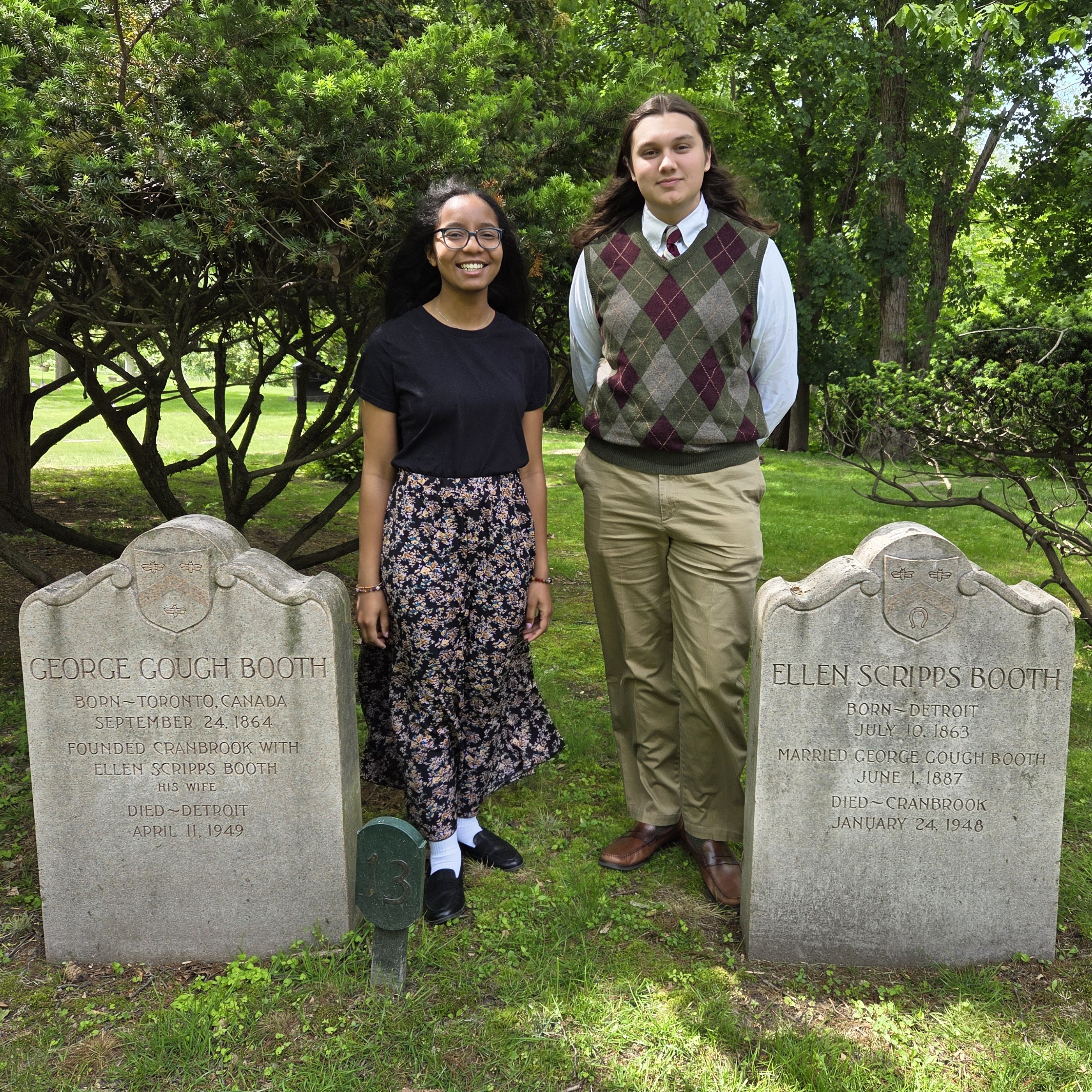
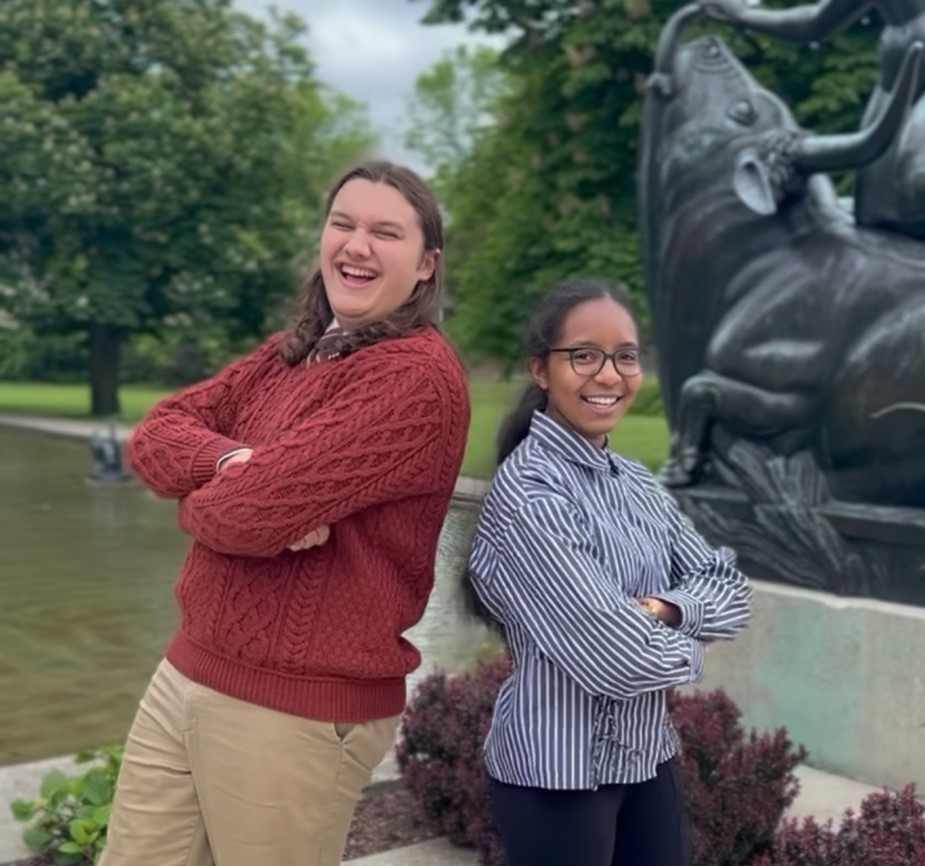
Kamilah Moore and Joel Kwiatkowski, 2025 Senior May interns, visit George and Ellen Booth at Greenwood Cemetery, Birmingham. Photography by Leslie Mio.
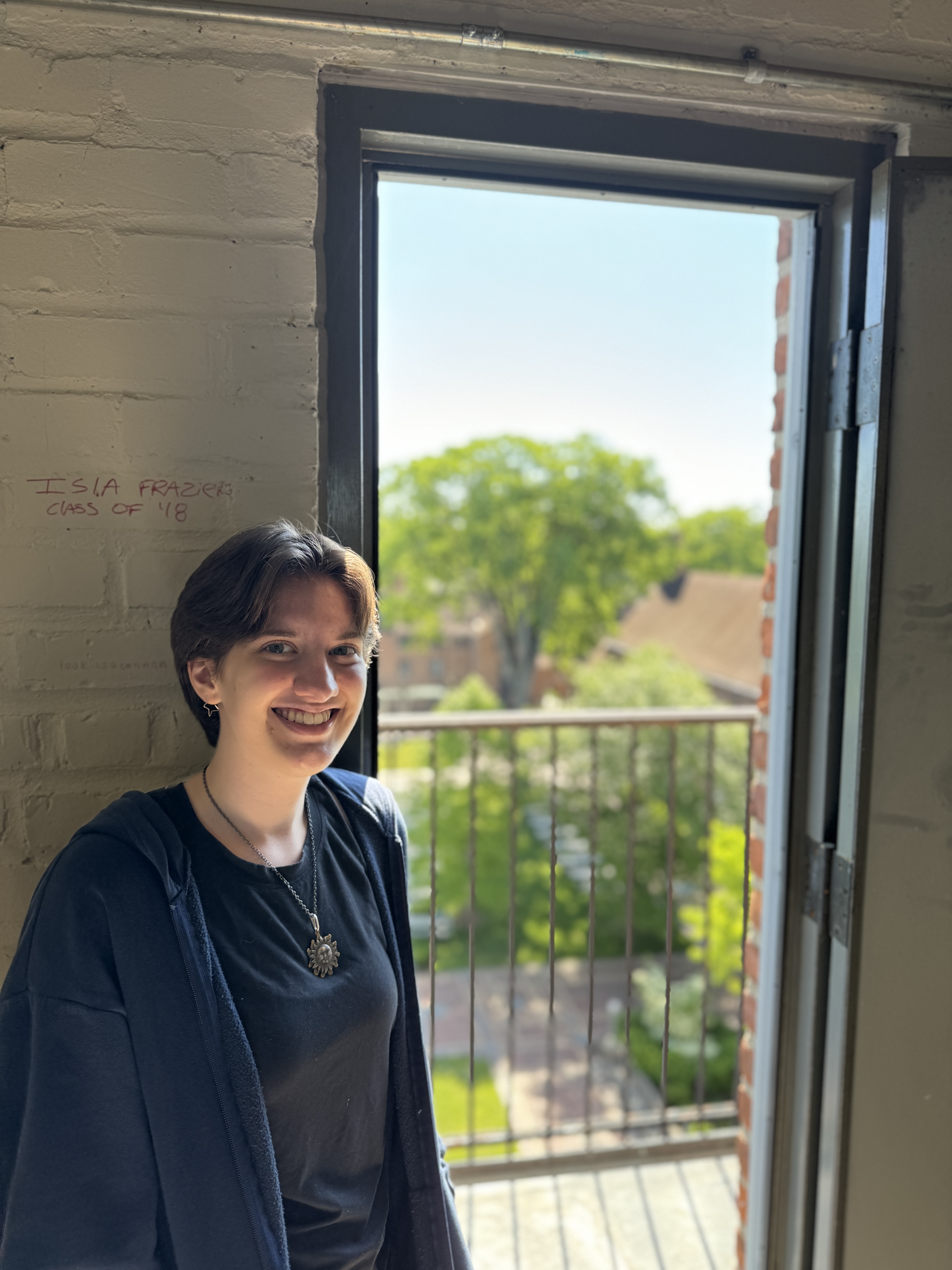
This year two seniors, Kamilah Moore and Joel Kwiatkowski, worked with the Center and Archives staff, including writing blogs! Hear from Joel today and look out for Kamilah’s post next week.
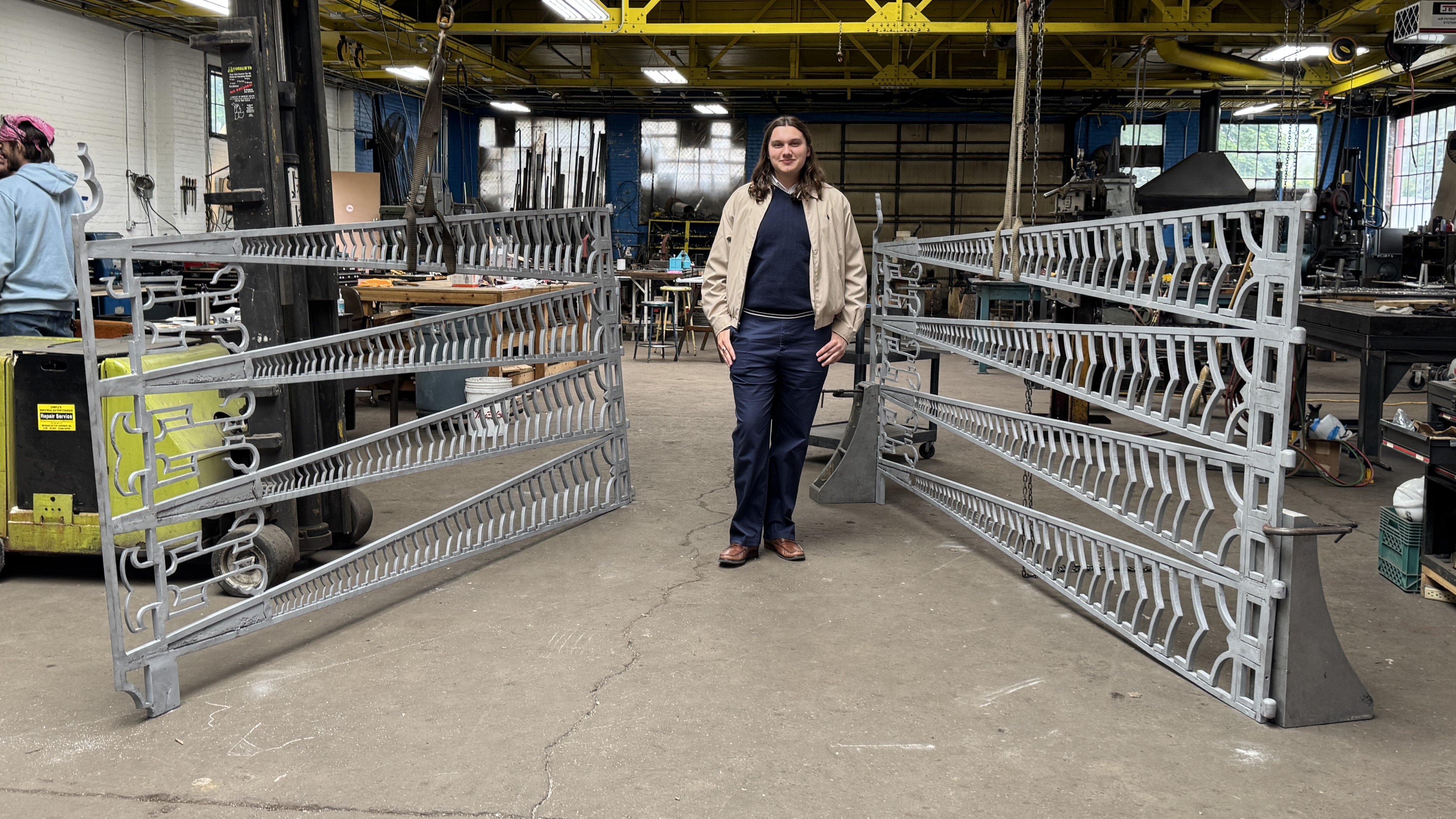
Checking in on the Eliel Saarinen-designed Kingswood main gate at Smith Shop in Highland Park, May 2025. Photography by Kevin Adkisson.
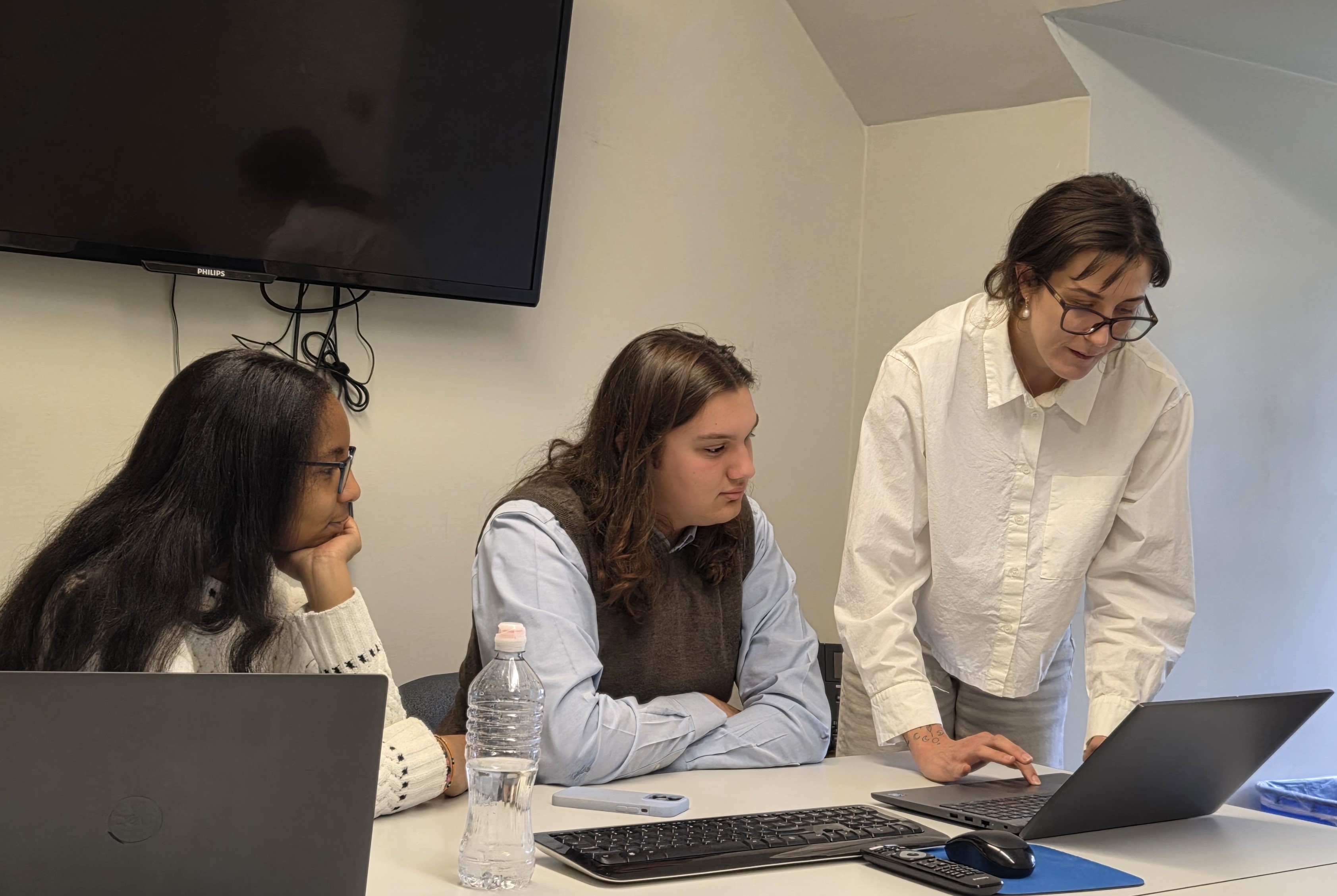
Cranbrook Center for Collections and Research is a name that invokes the image of some grand museum or hall, with many sterile prep rooms and rows upon rows of file cabinets. Now don’t get me wrong, there are plenty of file cabinets, but the Annex is far from grand. Instead, the rather humble staff apartment-turned-offices are befitting the lovely people there.
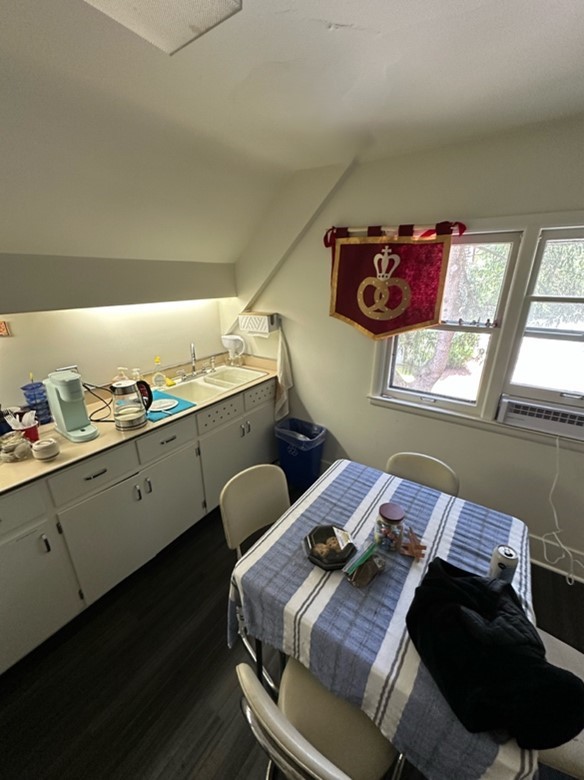
The Center’s Annex, next door to Cranbrook House, is situated above the House & Garden Auxiliary offices, up a set of winding stairs that require me to duck in a few places. But up there you will find a quaint little kitchen (complete with a toaster oven and healthy snack collection), a few offices, and closets and cabinets dotted with curiosities.
The quaint kitchenette of the Annex, compete with decommissioned Cranbrook Institute of Science Library chairs, May 2025. Photography by the Author.
It was this atmosphere, over many chatty lunches, that I got to know Leslie Mio, the Associate Registrar, and Mariam Hale, the 2023-2025 Center Collections Fellow. It was a pleasure to find two individuals who cared so greatly for history and conservation, and we bonded over our shared love of museums and particular historical eras.
But, let it be known that work at the collections isn’t all comfortable work behind a desk or searching a filing cabinet. This illusion, if I ever had it, was quickly broken on my first full day of the internship. Our task? Moving five solid wood cabinets from the rooms of retirement-age nuns across the building to be used to store Cranbrook’s lacy dresses and costumes.
Briarbank, a neighboring estate to Booth’s land, was converted into a place for sisters to stay once they needed a bit more care later in life. But, at some point, the demand for a place such as that ran dry, and Cranbrook bought the campus. And now, in that spirit, I was near horizontal in my penny loafers, shoving a giant wardrobe into place across some very tasteful carpet.
Mariam and I defy the friction of decades old carpet, May 2025. Photography by Leslie Mio.
In the coming days, the purpose of these heavy cabinets would be realized, as we began the true overarching theme of my time at the Center: moving a seemingly infinite number of objects from the hot attic of Cranbrook House to the comparatively “less hot” and climate-controlled storage area at Briarbank. Paintings, prints, textiles, rugs, hats, and racks of clothing and costumes were deftly maneuvered through the halls and offices of Cranbrook House (or, alternatively, very carefully down the narrowest, steepest, stairwell known to mankind).
Each day packing and moving Cultural Properties in the attic was sure to bring new surprises. Everything from a fur hat belonging to George Booth to paper parasols, or entire handwoven rugs the size of a small house. While these days meant a bit of manual labor, they never ceased to bring me joy, as the wonderful folk of the Center doled out tidbits of Cranbrook’s story connected to each unearthed gem.
The fabulous hat in a box marked “G.G.B.” — the box is possibly a later acquisition by Henry S. Booth — May 2025. Photography by the Author.
Now those familiar with the Center may be wondering: “Now wait just a minute. Where is my favorite curator? Where is the delightful presence of the steward of Saarinen House?” Well, fear not good reader, for while Kevin may not have been at every boxing and unboxing, Kevin joined Kamilah and me on many excursions outside the Samuel-Yellin-forged gates of Cranbrook. For those unacquainted, Kevin Adkisson is Curator of the Center, the veritable fountain of all knowledge concerning Cranbrook, and legend in his own time among students.
My first trip with Kevin came when we were tasked with heading to Detroit to give a tour of Holy Redeemer Church to a group of 8th graders from the Catholic school next door. I thought that getting middle schoolers excited about Corinthian columns would be impossible, but Kevin’s energy and skill made it look easy.
Kevin and I had fun teaching Holy Redeemer 8th graders about architecture. Photography by Holy Redeemer.
Afterword, we headed to visit the master ironworkers at Smith Shop, where the Eliel Saarinen-designed Kingswood main gate is being repaired and restored. I stood back and observed while Kevin, Cranbrook Capital Projects Director Jean-Claude Azar, and Amy Weiks and Gabriel Craig (co-owners of Smith Shop) debated the ins and outs of the gate’s making and breaking.
I enjoy a tour of the facilities of Smith Shop with Cranbrook Capital Projects Director Jean-Claude Azar and Smith Shop co-owner Gabriel Craig in Highland Park, May 2025. Photography by Kevin Adkisson.
Across my three week Senior May, I also took trips to the paint store to debate shades of grey, the frame shop to mount an object, Ken Katz’s painting conservation studio, and even Birmingham’s historic cemetery. On each of these trips, I gained insight into the multifaceted work of the Center for Collections and Research, including care and handling, teaching, conservation, and cataloging.
I cannot fully capture in a blog what a delight it was to be in the presence of such knowledgeable individuals. For every question about Cranbrook’s history, each member of staff was sure to add in their own expertise, citing obscure letters and photographs, adding a beautiful familiarity to their responses and giving color to the story of Cranbrook.
Of course, I would be remiss to leave out some of the other folks who make the Center function, like Greg, Jody, Amy, and Jess. These are the people who drive the work, managing, fundraising, and promoting the vision of Collections and ensuring the continued progress of the Center’s goals.
Even interns have meetings, Kamilah and I sat in on one of the Center’s weekly staff meetings. Photography by Kevin Adkisson.
On my last day, I had the privilege of working with Jess Webster, Development Coordinator, who also helps run the Center’s social media. With Kamilah, I researched, drafted, workshopped, and delivered a script for an Instagram Reel commemorating the 150th birthday of Carl Milles., During my time working out ideas for the video (and even this blog), I gained a new appreciation for the way in which Cranbrook is viewed from the outside.
Kamilah and I workshopping our reel for Carl Milles’s 150th birthday with Jess, May 2025. Photography by Leslie Mio.
For me, as a student at Cranbrook, my view is that of someone on the inside, who has the privilege to walk by art on campus each and every day (admittedly at times without a second thought). But getting to see the behind-the-scenes of Cranbrook’s beautiful historic campus has given me an appreciation that feels wholly unique amongst my peers.
If you’ve read this blog, I urge you to take a moment to appreciate all that goes on caring for a 100-plus-year-old campus to live on to this day and serve its many students and visitors. From calls, texts, emails, and meetings, the Center is busy planning, filing, caring, and protecting the legacy of Cranbrook. The work is never done.
Yet despite the challenges, the Center rises to the task, willing to give their all to something they passionately care for. It would be hard not to be inspired.
Kamilah and I make a video for Carl Milles’s 150th birthday, May 2025. Photography by Jessica Webster.
This internship has truly been a dream-come-true, and I am grateful to Mariam, Leslie, and Kevin for their warm welcome and tutelage.
– Joel Kwiatkowski, Cranbrook Kingswood Upper School Class of 2025 and Cranbrook Center for Collections and Research 2025 Senior May
Editor’s Note: The Senior May Project is a school-sponsored activity that encourages Cranbrook Kingswood Upper School seniors to acquire work experience in a field they are considering as a college major, a potential profession, and/or as a personal interest.
Joel Kwiatkowski graduated from Cranbrook in June 2025 and will be attending the University of California San Diego in the fall to pursue a degree in Molecular and Cellular Biology. Joel first came to Cranbrook Schools in sixth grade, and has since gained a passion for the institution’s rich history of influential artists and personalities.
What would you want for your 75th birthday? If you were painter Robert Hopkin, it would be an artists’ club named in your honor. The Hopkin Club, formed in 1907, had no rules, officers, or dues. The members wanted to get together occasionally, to talk about art or host artists visiting Detroit. Hopkin passed away in 1909, but the club continued. In 1913, The Hopkin Club established by-laws and was renamed the Scarab Club–the name it continues under today.
Scarab Club Room. Photography courtesy of Scarab Club.
But who was the man the club was originally named after?
Robert Hopkin was a maritime/marine artist born in Glasgow, Scotland, in 1832. He learned to paint and draw from his father. The family emigrated to Detroit in 1842. His grandfather was a sea captain which drew Hopkin to work on the wharves in Detroit and inspired his art. Though chiefly known as a painter of marine scenes and seascapes, Hopkin made frequent trips throughout the American west from 1860 to 1885, painting murals for public buildings and drop curtains and scenery for theaters, including the Tabor Grand Opera House in Denver.
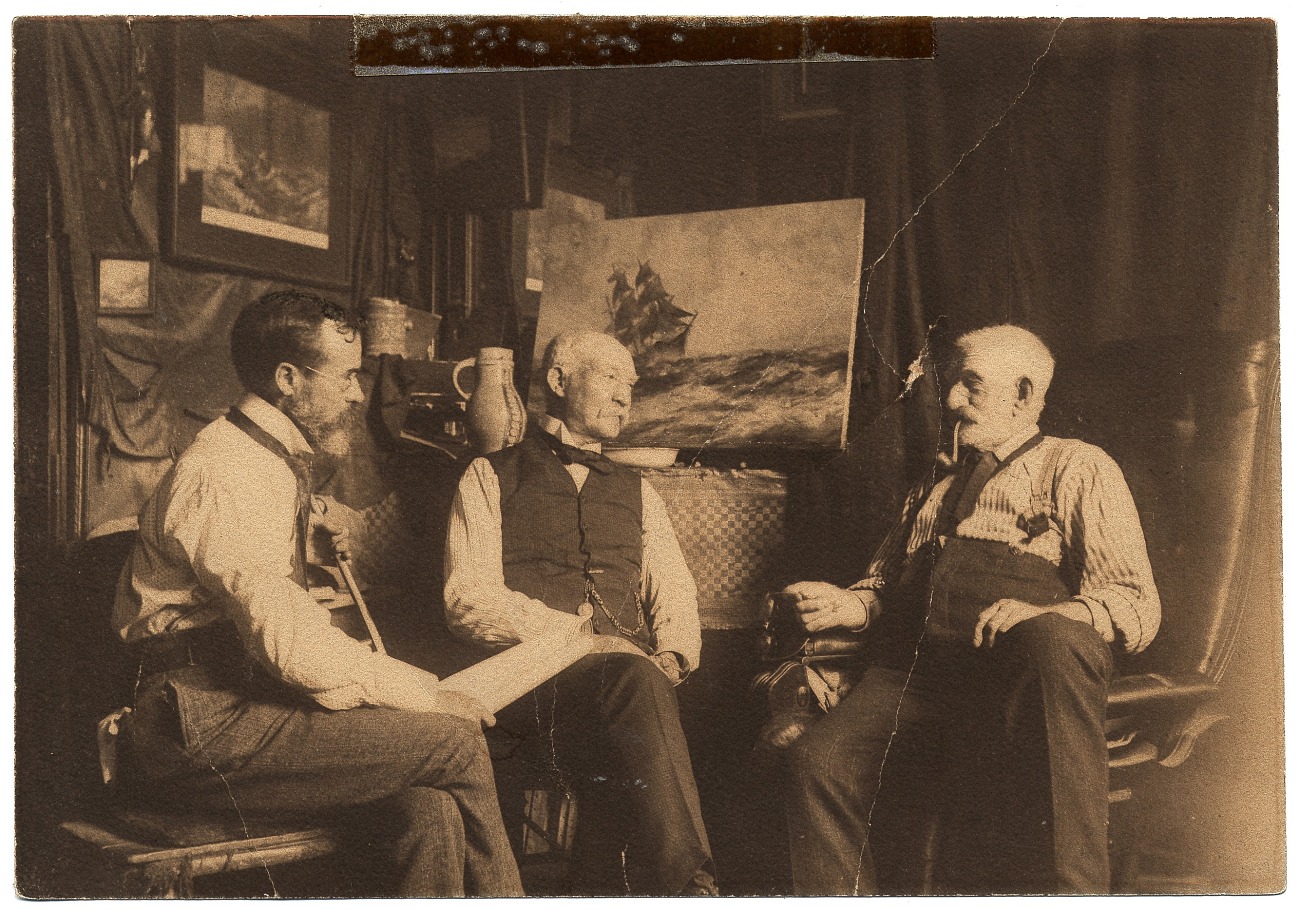
Robert Hopkin (right) and others in studio, ca. 1900. William H. Thomson papers, 1912-1950. Archives of American Art, Smithsonian Institution
In the latter half of the 19th century, Hopkins was considered the dean of Detroit artists; he decorated the interior (as well as the stage curtain) for the original Detroit Opera House (1868), painted murals in Detroit’s Fort Street Presbyterian and Ste. Anne’s churches, as well as the Cotton Exchange in New Orleans (1883). By April 1900, the Detroit Free Press wrote, “Many of the art lovers of this city possess one or more of [Hopkin’s] splendid marines, and they have been reproduced and published until everyone is familiar with his work.”
When Mr. Robert Hopkin’s Collection of Paintings opened at the Detroit Museum of Art in May 1901, “There was a large attendance of art-loving Detroiters” (Detroit Free Press, May 16, 1901).
Robert Hopkin (Scottish American, 1832 – 1909), Marine,Oil on Canvas. Cranbrook Center for Collections and Research.
George and Ellen Booth were no exception. Art lovers with many Detroit-based and self-taught artists in their growing collection, the first inventory of Cranbrook House in 1914 lists two Hopkin “Marine” paintings. The Booths gifted the larger of the two paintings to their daughter Grace Ellen Booth and her husband Harold L. Wallace. The painting returned to Cranbrook House about 1955, when Grace Booth Wallace’s collection was donated to the Cranbrook Foundation.
Cranbrook House Living Room, circa 1909, with Marine visible on the left. Cranbrook Archives, Cranbrook Center for Collections and Research.
The Detroit Historical Society has a copy of the Souvenir Catalogue of Mr. Robert Hopkin’s Collection of Paintings in its collection. The 85 exhibited paintings are listed, with several black and white images of them. “Price List” is written on the cover, and notes have been made indicating which have been sold and who purchased them. (Sadly, the name “Booth” does not appear.)
Another art-loving Detroiter was Merton E. Farr president of the American Shipbuilding Company and owner of a number of freighters on the Great Lakes. His daughter, Carolyn, married George and Ellen Booth’s youngest son, Henry.
The Hopkin painting in the Thornlea collection. Cranbrook Center for Collections and Research.
In 1927, Farr gifted the couple a Hopkin “Marine.” The painting hung in Thornlea, home to Harry and Carol Booth, from 1927.
The painting’s official title is not noted. The Thornlea painting is interchangeably referred to as Homeward Bound, Schooner on a Stormy Sea, Sailing Ship at Sea, and Marine. However, the 1901 Hopkin exhibition catalog does not list any paintings with those titles.
– Leslie Mio, Associate Registrar, Cranbrook Center for Collections and Research
The belated arrival of winter weather this year has allowed us all to enjoy the grounds of Cranbrook House far later into the year than is usually possible. However, the time has finally come to shroud our exterior sculptures and fountains in protective tarps for the season. This process is an annual reminder to our staff – and to the Brookside students who come to sing the statues to sleep – of just how numerous and varied the outdoor art collection at the house is. One part of the gardens is particularly rich in art and history: the north staircase.
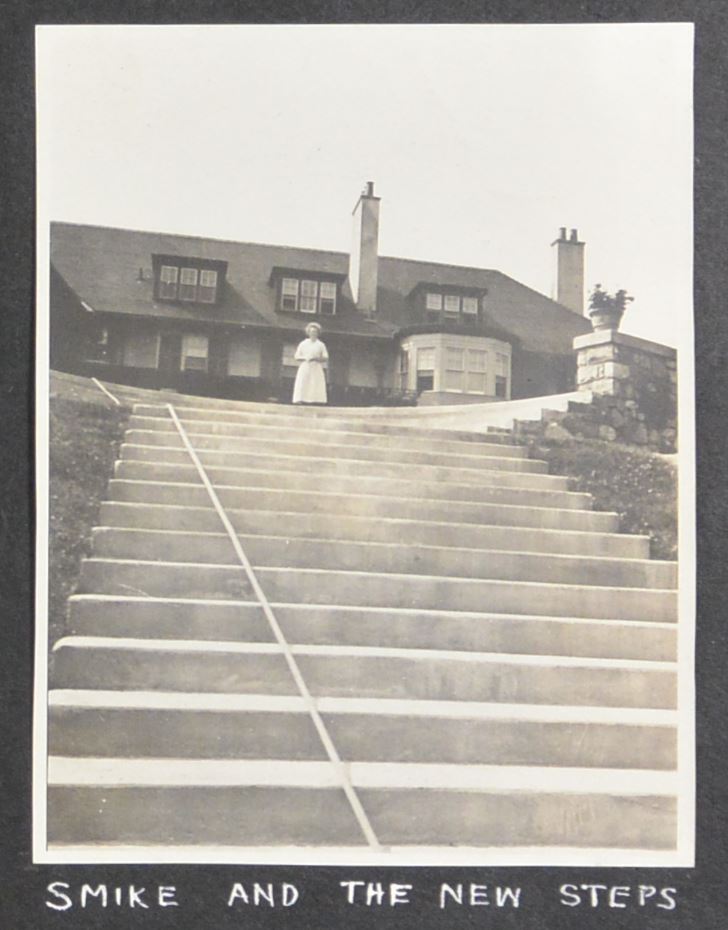
Florence Booth standing at the top of the new stairs connecting the upper and lower terraces at Cranbrook House, Summer 1921. From The Pleasures of Life, vol. 4, by Henry Scripps Booth. Courtesy Cranbrook Archives.
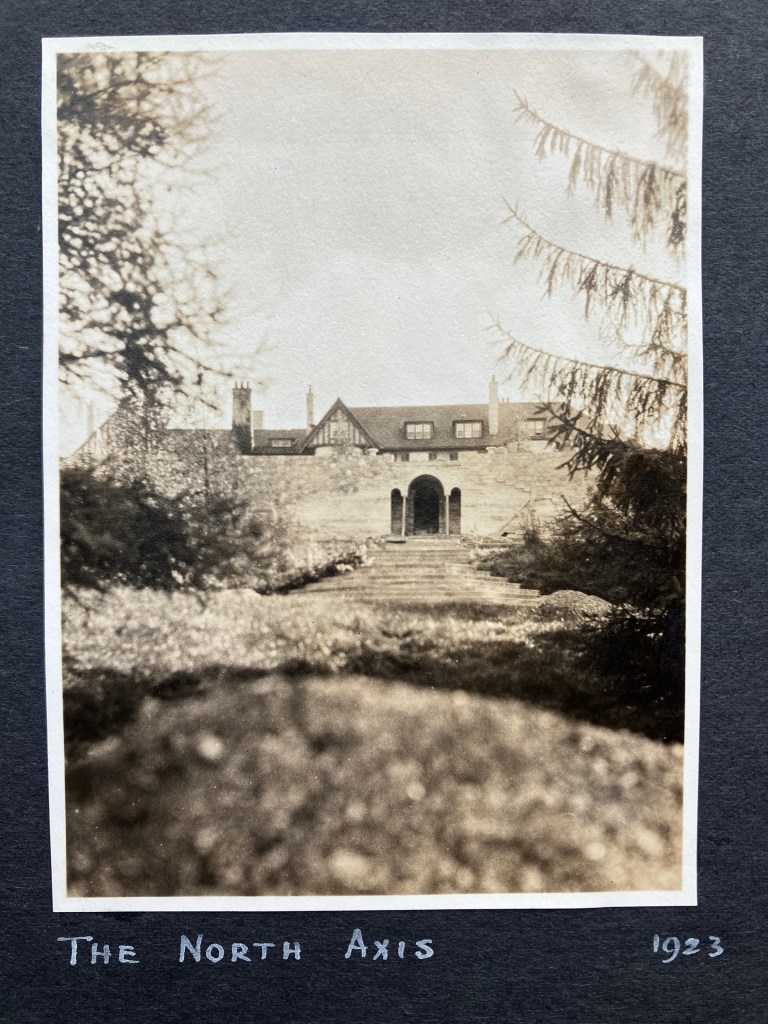
Stretching from the lakeside path at its base to the uppermost lawn outside Cranbrook House’s North Porch at its apex, the eighty concrete steps are lined with artworks, transforming the stairs into an open-air museum gallery. The stairs themselves were first built in the summer of 1921, as part of a spur-of-the-moment project to improve the view from the North Porch undertaken by James and Henry Scripps Booth. As their grandfather, Henry Wood Booth, recalled,
After ten years of sitting on the north porch and looking at a blank terrace wall, and talking about creating a vista through it, James and Henry got busy one May day with sledge hammers, and beside raising many blisters, razed about ten feet of wall the first day. Immediately a view of the lake came into being, and plans were made for a stairway down the hill.
Whether or not James and Henry had permission to make this change is contested; their grandfather’s account frames it as a collective impulse, while Henry remembers being disciplined for their impetuous action:
After construction of the curved steps, masons started building a series of flights which headed for a large wild cherry tree almost on axis along side rue Gagnier. According to one account, James and I were required to cut that tree down as a penalty for our reputed vandalism. While neither of us had a guilty conscience, we went to work sawing very hard wood and eventually (a full day later, I believe) the tree fell.
The concrete staircase was poured in July of 1921. The hillside around the new staircase was improved with new trees and paths under the oversight of O. C. Simonds, the landscape architect responsible for much of the re-foresting of the estate. After these changes, Henry Wood Booth noted with satisfaction that “[t]his hill, which for so many years had been an object of regret, was at last to be something really fine.”
Aeriel view of Cranbrook House and grounds, showing the new staircase at center right, circa 1921. From The Pleasures of Life, vol. 4, assembled by Henry Scripps Booth. Courtesy Cranbrook archives.
Further improvements were still in store, in the form of a dozen sculptural embellishments.
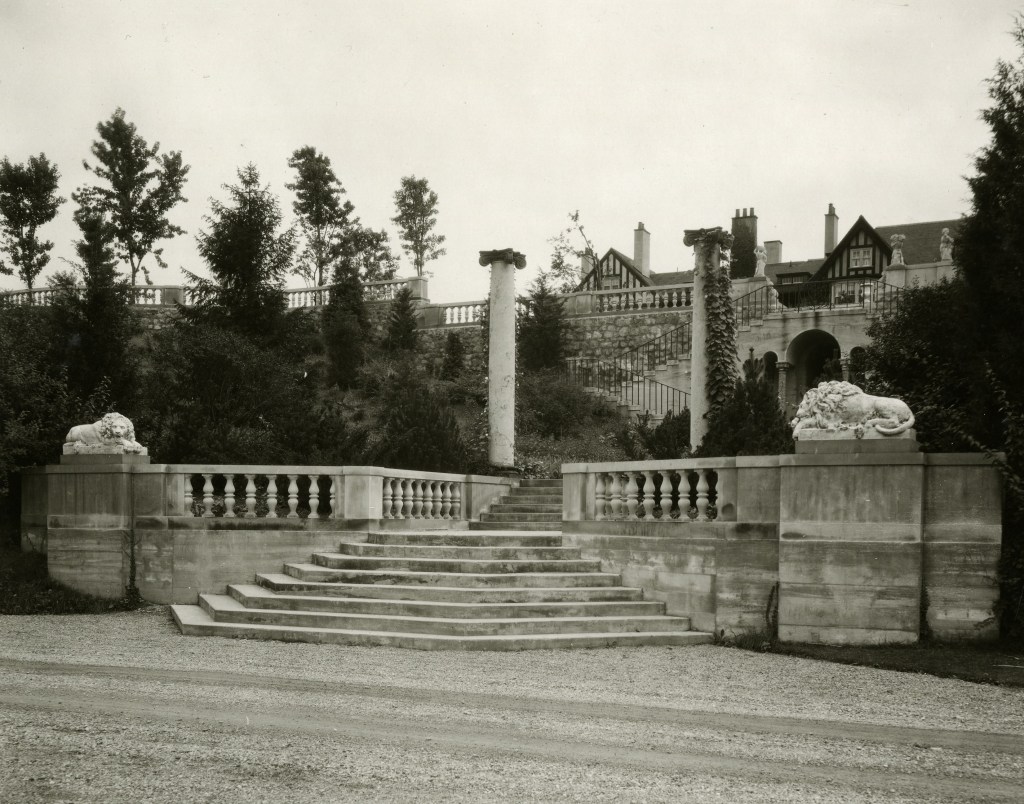
Walkers along the lakeside path today are met by two stone lions on pedestals flanking the base of the stairs. Carved from travertine and purchased by George Booth from the Galleria Sangiorgi in Rome in 1924, the lions are copies of works by the Italian neoclassical sculptor Antonio Canova, best known for his Cupid and Psyche, now in the Louvre, Paris. Canova sculpted the original lions in 1774 for the tomb of Pope Clement XIII in St Peter’s Basilica, in Rome. On Pope Clement’s tomb, the lions, one sleeping, one waking, face one another, symbolizing the confrontation of life and the long sleep of death. Here at Cranbrook, the lions face out toward the lake, one on guard, one enjoying a nap in the shade of the hill.
Stairway to Lower Terrace at Cranbrook House and Gardens, circa 1924. Photograph by George W. Hance. Courtesy Cranbrook Archives.
Although George Booth’s letters home from Italy in 1924 do not say as much, he and Ellen probably saw the original lions in the Vatican on their visit to Rome in 1922. In the intervening year, George Booth had considered buying copies of the Canova lions in cast stone, a form of concrete, from an American garden sculpture company, Howard Studios.
Just a few steps up, the stairway is flanked by concrete columns, topped with red stone Corinthian capitals. Their origins have not yet been traced, but George Booth purchased many marble capitals in Italy, most of them Roman or early medieval, for the Cranbrook Academy of Art. It would have been characteristic for the Booths to have retained a few Italian finds to ornament Cranbrook House as well.
The construction of the fountain niche and surrounding stairs, 1923. From The Pleasures of Life, vol. 7, assembled by Henry Scripps Booth. Courtesy Cranbrook archives.
From the lower landing of the staircase, its centerpiece is already visible – a fountain niche, added in 1923, requiring considerable reconstruction of this section of the stairs. At the back of the niche, now forming the fountain cascade, are a few of the original 1921 stairs.
The niche houses Mario Korbel’s Dawn, a near life-size female figure holding an apple. The symbolism of the figure is ambiguous. The apple may refer to Eve, the “dawn” of womanhood. It may also associate the figure with the goddess Aphrodite, who was awarded a golden apple as the prize in a divine beauty contest, and is associated with the planet Venus, sometimes called the morning star.
The staircase niche, photographed in 2016.
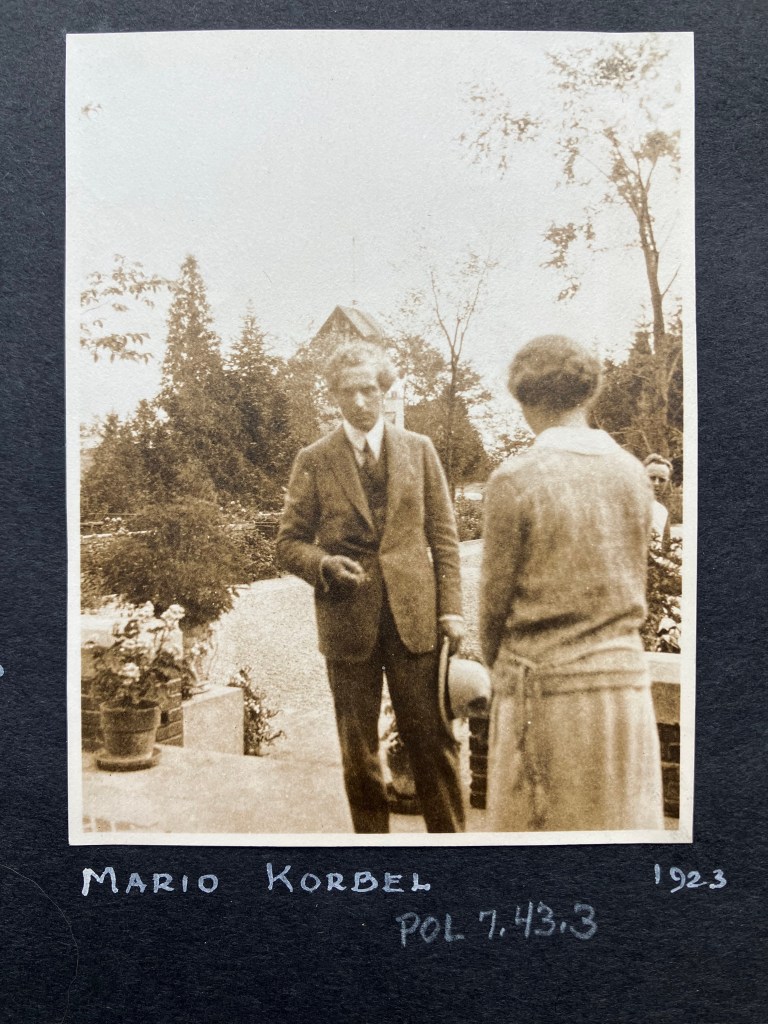
Korbel visited the grounds in 1923 and contributed ideas to the design of the niche for his sculpture. Cranbrook once also boasted a figurine version of Dawn, offered to George Booth by Korbel during the planning process for the full-size version, until it was stolen in 1926. George Booth did his best to soften the blow when informing Korbel of the loss, framing the theft as a compliment to the artist’s skill:
…you may feel flattered to learn that only a few nights ago some expert burglars after rifling the safe at the Cranbrook Office, ran off with your small figure of “Dawn”, taking along with her a supply of rugs and other articles so as to surround her with suitable luxury.
The Booths’ small Dawn was never recovered.
Mario Korbel in the gardens at Cranbrook House in 1923. From The Pleasures of Life, vol. 7, assembled by Henry Scripps Booth. Courtesy Cranbrook archives.
The newly completed niche, 1923. From The Pleasures of Life, vol. 7, assembled by Henry Scripps Booth. Courtesy Cranbrook archives.
The columns that flank Dawn’s niche are the work of an unknown Italian artist, and probably purchased by George Booth in the early or mid 1920s. Their design is based on twelfth-century examples from the Benedictine cloister at Monreale Cathedral, in Sicily. The courtyard fountain at Cranbrook School is a replica of a fountain from the same cathedral complex. First spotted by Henry Scripps Booth in 1922, George Booth later ordered a replica fountain from the Chiurazzi Foundry, who also carved the Canova lions at the base of the stairs. As evidenced by the blend of geometric, botanical, and animal ornament on this pair of columns, the architecture of medieval Sicily blended classical, Gothic, and Islamic influences, a reflection of the cultural diversity of the Norman Kingdom of Sicily. Their stylistic syncretism aptly complements the polysemy of Korbel’s figure of Dawn-Eve-Aphrodite.
The columns are not wrapped in the wintertime, allowing visitors to enjoy this feature of the staircase year-round.
The topmost landing of the stairs is ornamented with a curling iron railing, quite possibly designed by George Booth and executed at the Cranbrook metalsmithing workshop. To either side of the landing stand four cast stone cherubs, replacements for the original quartet of cherubic representations of the four seasons, which fell to pieces within fifty years of their purchase. One was already missing a head by 1949. The originals were purchased in Italy in 1924. Their replacements were donated by the Cranbrook House and Gardens Auxiliary in 1974.
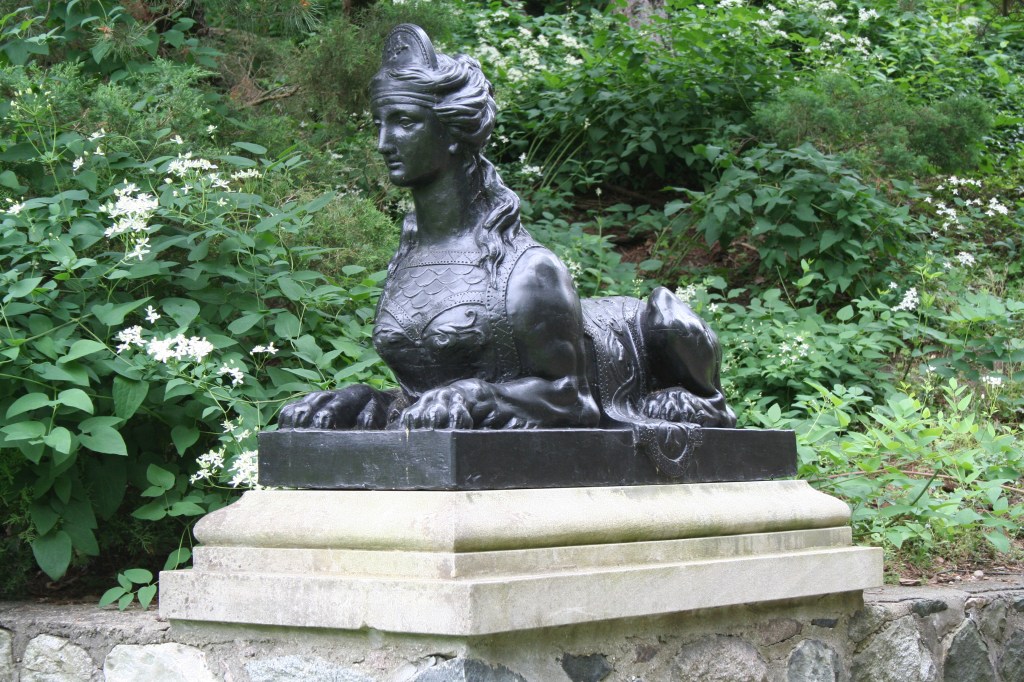
One of two bronze sphinxes by John Cheere, photographed on the north terrace of Cranbrook House in 2016.
Although the original cherub statues brought an end to the staircase’s parade of sculptures in George and Ellen Booth’s day, Henry Scripps Booth added a final flourish to the ascent in 1963. Two sphinxes, cast bronze copies of sculptures by the English artist John Cheere, bought at auction in England, keep watchful guard over the middle north terrace from either side of the wide upper stair. These bronzes, like so many other features of the staircase, are copies of European artworks. In this case, the eighteenth-century originals were created for Chiswick House, the Greater London home of Earls of Burlington, a Palladian style villa renowned for its refined neoclassical air.
As we set forth into the darkest season of the year, with all the familiar sculpted denizens of the gardens hidden beneath their winter coats, the grounds might start to feel a little lonely. Recalling the history of their making, from the reshaping of the hillsides to the final placing of statuary in their niches or atop their pedestals, can re-animate the familiar byways of Cranbrook, even on the coldest and greyest days. The Booths’ tribulations – a statuette stolen, others shattered by cold – remind us of the evolving nature of even a historic and well-preserved garden, and of the many winters that have passed over these grounds and left them largely unharmed.
The north terraces at Cranbrook House, photographed in January 2024.
The north staircase, a project begun in 1921 and completed more than forty years later, is still “something really fine,” with or without its sculptures and fountain. And the view from the top, which inspired the project, is even finer in winter, when frosty, leafless branches part to reveal a sparkling view of the frozen surface of Kingswood Lake and the snowy hills beyond.
— Mariam Hale, 2023-2025 Collections Fellow, Cranbrook Center for Collections and Research
Friday, September 27, 2024, is Homecoming at Cranbrook Kingswood Upper School. The game will be held in the Thompson Oval, to the east of The Football Game by David Evans.
The Football Game by David Evans. Thompson Oval, Cranbrook Kingswood Upper School – Cranbrook Campus.
Sculptor David Evans (1895-1959) was hired by the Cranbrook Foundation (through George Booth) as Professor of Sculpture and Life Drawing at the Academy of Art for 1929-1930. During that time, Booth commissioned him to create this bas relief for the football field at Cranbrook School for Boys. It is not just a bunch of nameless faces on the relief; it actually features members of the first football squad at Cranbrook School for Boys.
The 1930 Football Team, from The Brook, 1931 (Cranbrook School’s yearbook). Courtesy Cranbrook Archives.
Cranbrook School Football Sweater, circa 1930. Photographed by P.D. Rearick, 2019. Cranbrook Center for Collections and Research | Cultural Properties Collection, Archives.
During the 1930 football season, thirteen boys posed for Evans.
Members of the 1930 Cranbrook Football Team featured on The Football Game. Photos taken from 1931 and 1932 copies of The Brook. Courtesy Cranbrook Archives
The bas relief is in its original location – mounted above the steps leading to Alumni Court and overlooking Thompson Oval. If you are on campus for Homecoming, pose for a photo in your CKU green and blue with the 1930 football squad.
– Leslie Mio, Associate Registrar, Cranbrook Center for Collections and Research
Ed. Note: The Football Game was recently cleaned and waxed by our friends at McKay Lodge Conservation Laboratory. They also touched up other Upper School favorites: Hermes, Discus Thrower, The Wrestlers, Running Dogs, Masque Art, Diana, Dancing Girls, and Aim High.
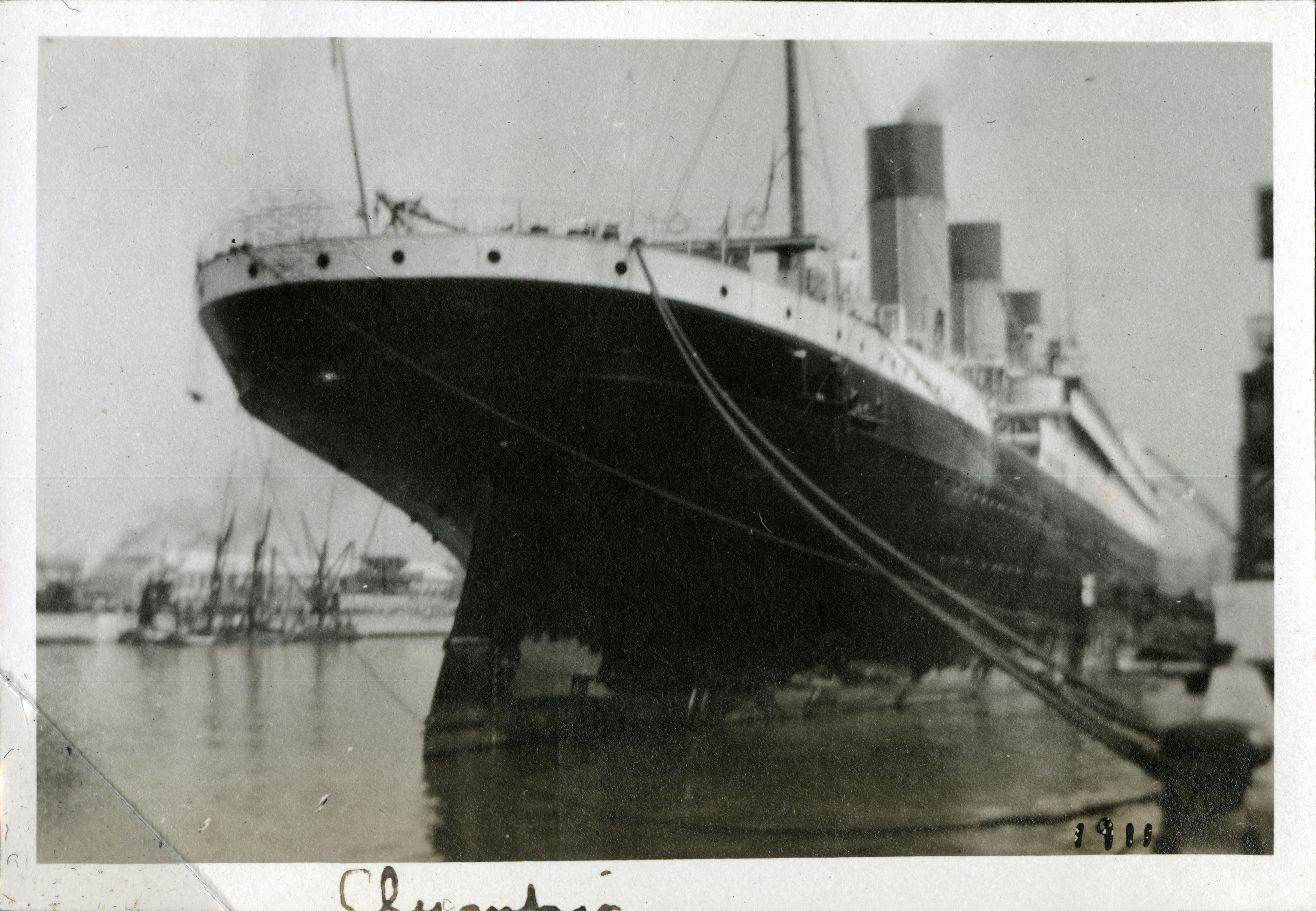
Some years ago, former Cranbrook Archivist, Robbie Terman, posted a short blog post on one of the Titanic’s sister ships, RMS Olympic. In recent years, Cranbrook Archives has responded to numerous requests for images of the Olympic which are preserved in the first volume of Harry Scripps Booth’s Pleasures of Life albums.
View of RMS Olympic before its first eastward crossing, June 28, 1911. [POL1.14.5]. Courtesy of Cranbrook Archives, Cranbrook Center for Collections and Research.
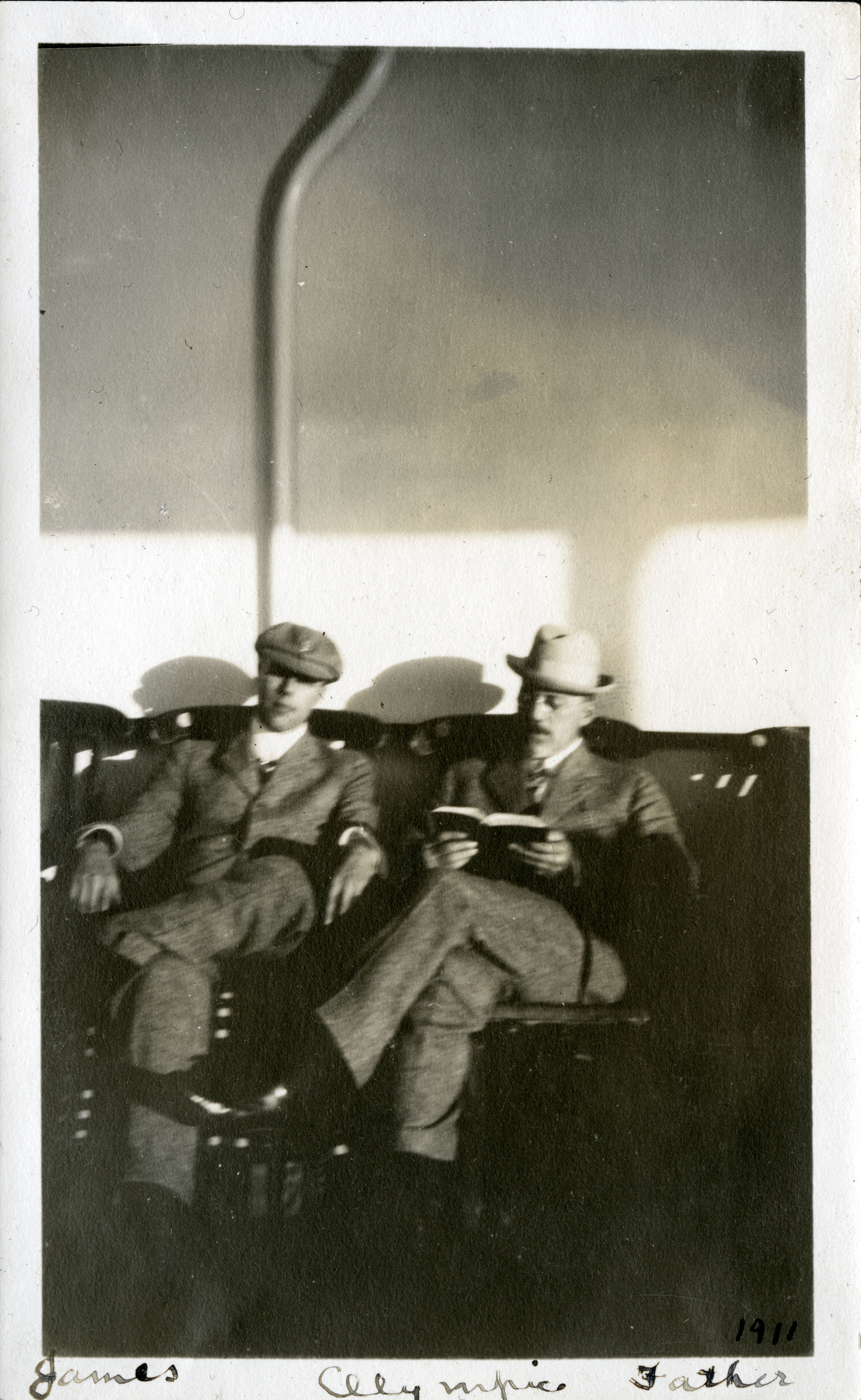
On June 28, 1911, the Booth family took the first eastward crossing of RMS Olympic from New York to Southampton, England. The family at that time was George and Ellen Booth; James Scripps and Jean McLaughlin Booth who had married the previous year; Grace, Warren, Henry, and Florence. They were joined by their Grand Rapids cousin, Esther Booth.
As I come from a maritime nation, these requests are particularly intriguing to me. I have wondered what other archives we have at Cranbrook to tell the story of transatlantic crossing and explain some of the images. George Gough Booth kept a record of the expenses in planning for the trip. These records tell us that he booked the steamship tickets with the Christian Leidich Travel Bureau in Detroit and he purchased Motor Union badges for himself and James.
James Scripps Booth and George Gough Booth on the RMS Olympic, July 1911.[POL1.10.2] Courtesy of Cranbrook Archives, Cranbrook Center for Collections and Research.
As Henry recalls in his memoir after listing the family members who sailed,
“That wasn’t enough. Parks, the chauffeur, went; also The Pierce-Arrow, a 7-passenger touring car, and a Lozier Briarcliff, which accommodated four plus one in an airy seat on the left running board, designed for the chauffeur when the “master” took the wheel. That seat was a thrill for the young at heart.”
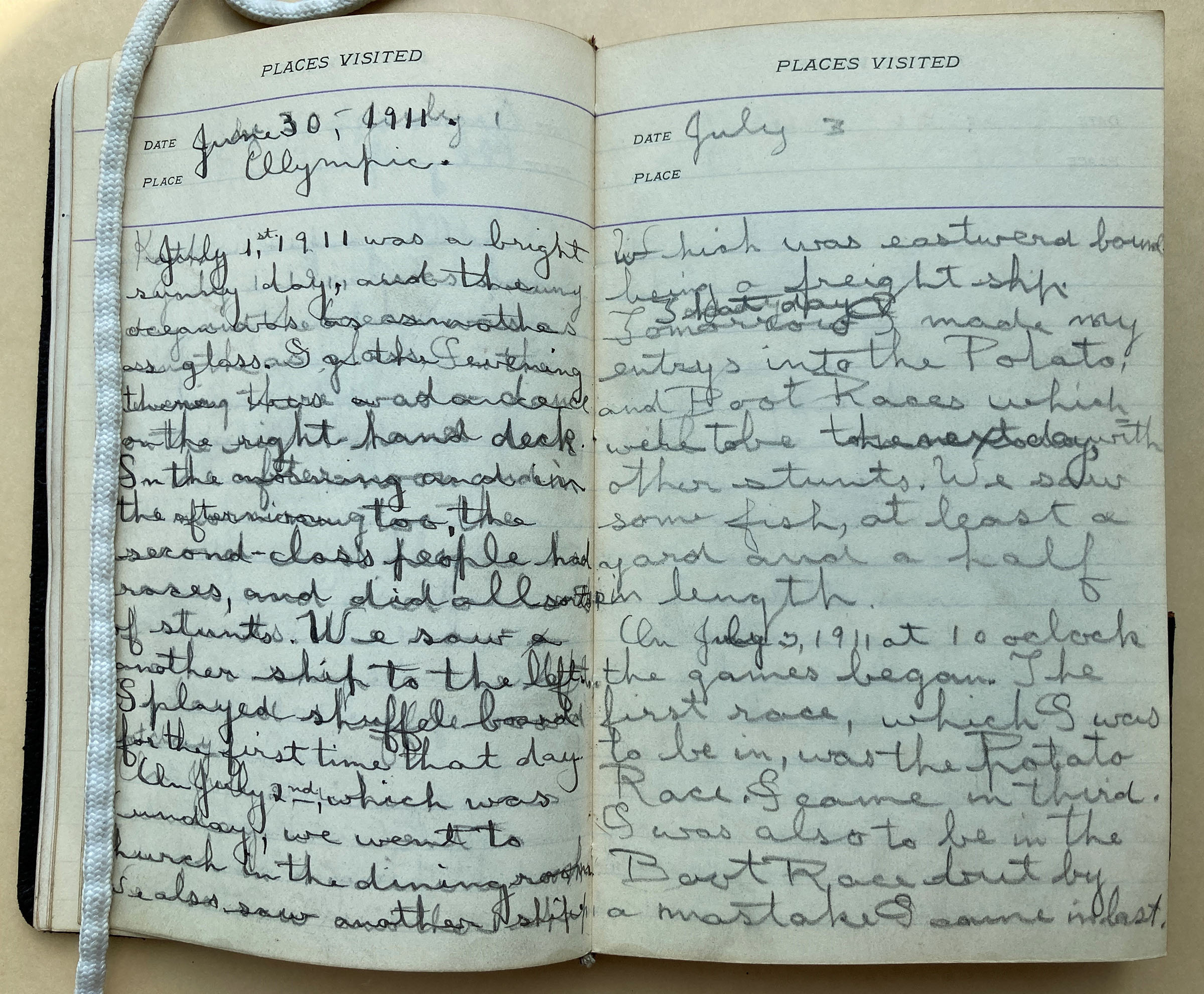
Then I came upon something quite wonderful—Henry’s journal of the sea crossing! He began the trip when he was just 14 years old, celebrating his 15th birthday in August during the vacation. As I read the entries, the images in the Pleasures of Life came alive. Here follows some moments from the journey in Henry’s words.
“Stayed at the Plaza. Esther’s trunk was lost. We found it later. On June 28, we went abord [sic] the great ship, “Olympic.” Henry Scripps Booth, June 27, 1911
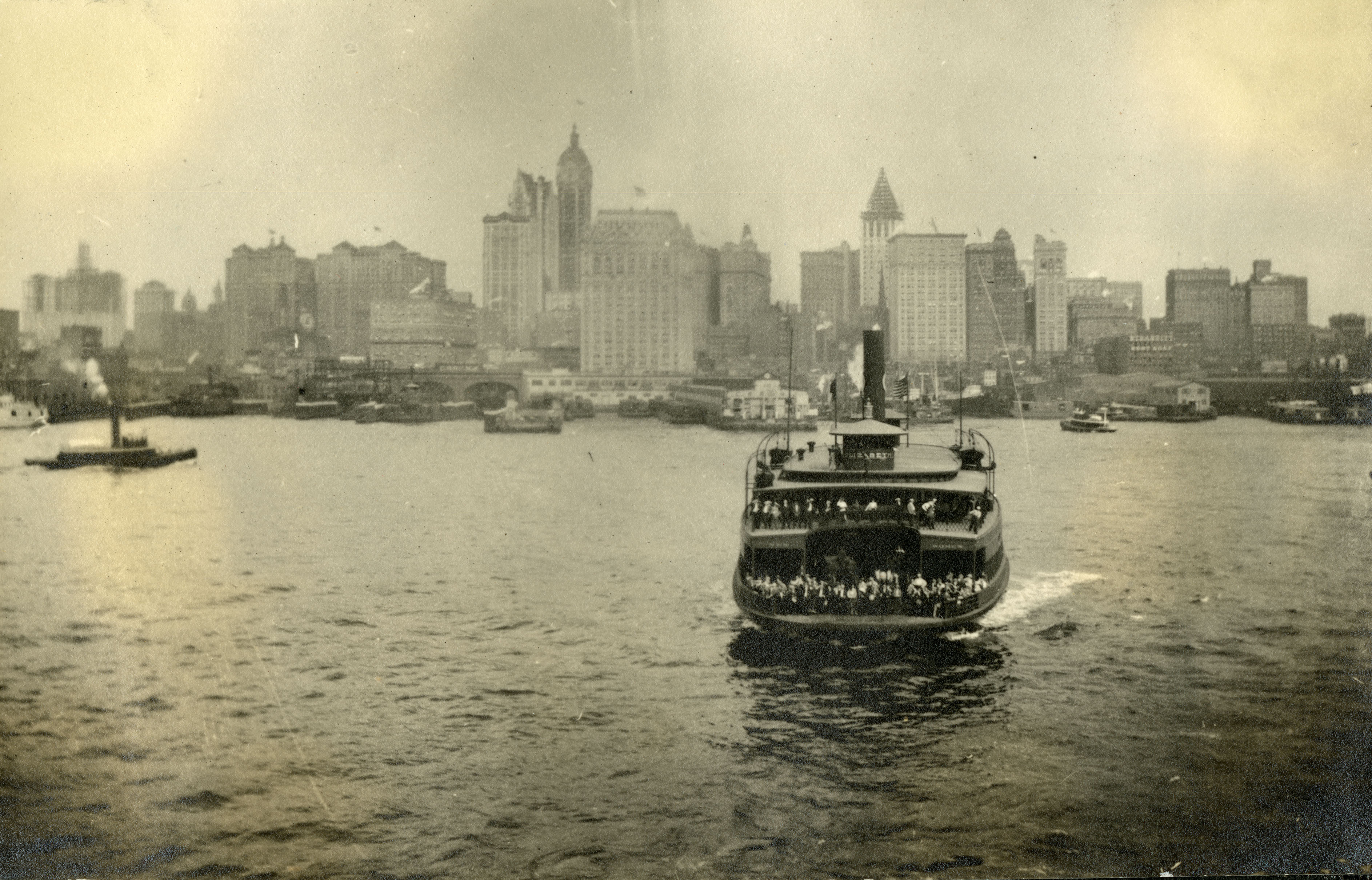
Leaving New York, June 28, 1911. Courtesy of Cranbrook Archives, Cranbrook Center for Collections and Research.
“On June 28, we went abord [sic] the great ship, “Olympic”. The Olympic is a fine ship. Florence was sick first night and day. It was somewhat rough on June 29th. I met a new friend but did not remember his name. In the morning, I could hardly stand, because of the new sensation. I was somewhat sick, but ate lots and I felt fine.” Henry Scripps Booth, June 28, 1911
“On June 30th the Campania was in view. I got acquainted with two girls, Constance Peabody and Katherine somebody.” Henry Scripps Booth, June 30th, 1911
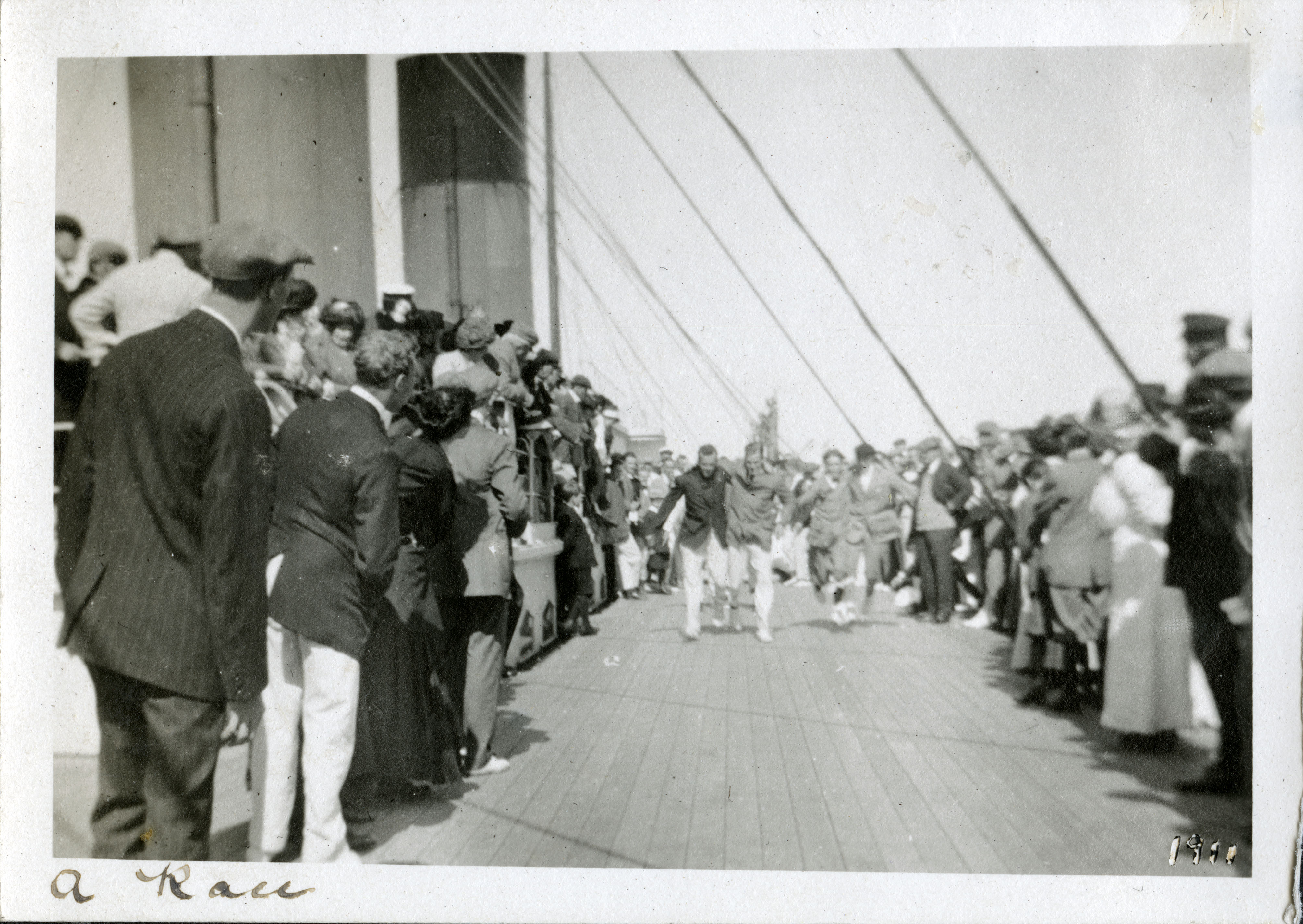
A race aboard the RMS Olympic on its first eastward crossing from New York to Southampton, July 1911. [POL1.11.4]. Courtesy of Cranbrook Archives, Cranbrook Center for Collections and Research.
“July 1st, 1911, was a bright sunny day, and the ocean was as smooth as glass. In the evening, there was a dance on the right hand deck. In the morning and in the afternoon too, the second-class people had races, and did all sorts of stunts. We saw another ship to the left. I played shuffleboard for the first time that day. On July 2nd, which was Sunday, we went to church in the dining room. We also saw another ship [July 3] which was eastwerd [sic] bound being a freight ship.” Henry Scripps Booth, July 1, 1911
A race aboard the RMS Olympic on its first eastward crossing from New York to Southampton, July 1911. [POL1.12.5]. Courtesy of Cranbrook Archives, Cranbrook Center for Collections and Research.
“Tomorrow That day, I made my entrys [sic] into the Potato and Boot Races which were to be the next day with other stunts. We saw some fish, at least a yard and a half in length.
On July 3, 1911, at 10 o’clock the games began. The first race, which I was to be in, was the Potato Race. I came in third. I was also to be in the Boot Race but by a mistake, I came in last.
After other races came the Standing Broad Jump in which James sliped [sic].” Henry Scripps Booth, July 3, 1911
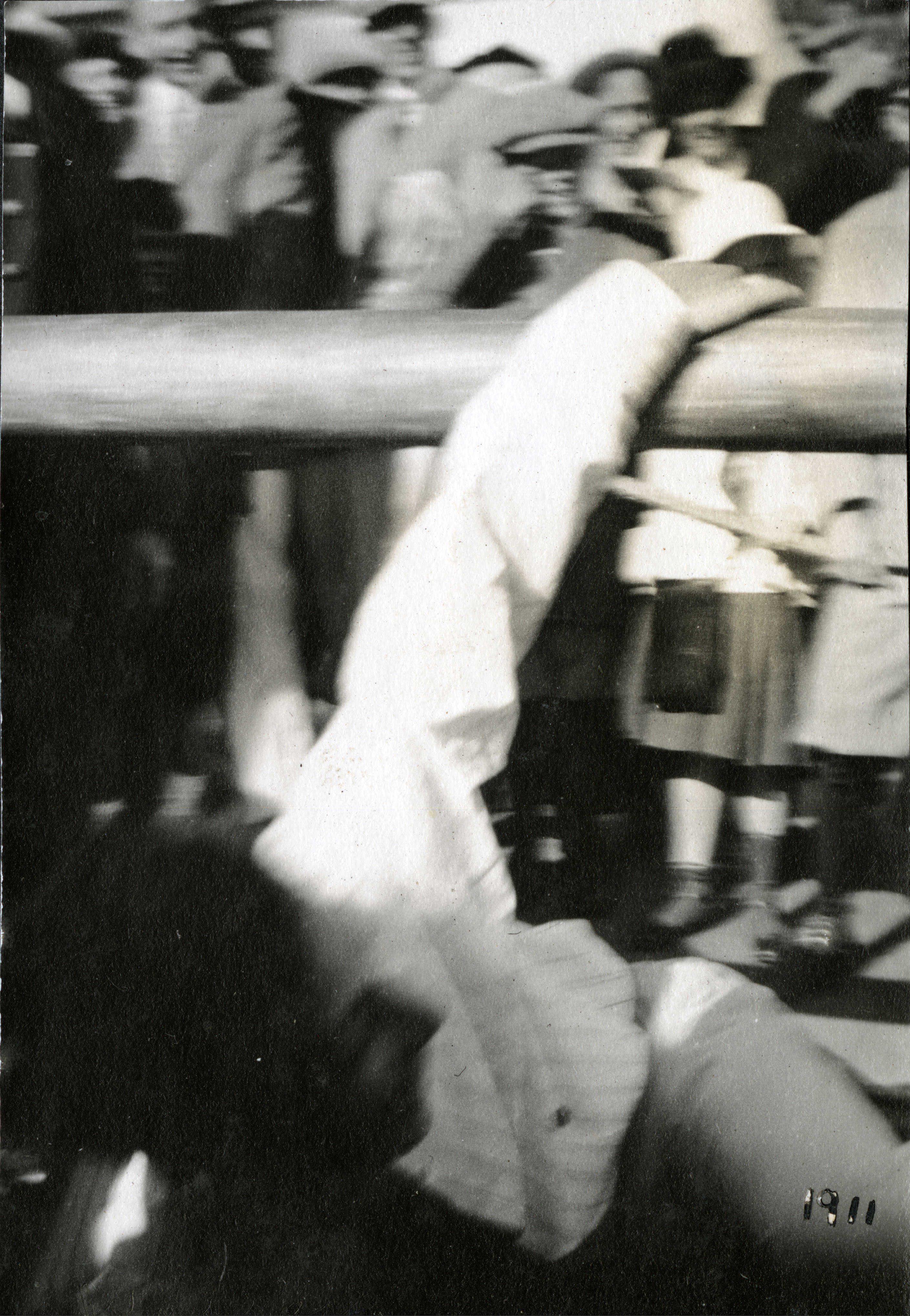
Warren Scripps Booth during a Spar Pillow Fight aboard the Steamship RMS Olympic, July 1911. [POL1.12.4]. Courtesy of Cranbrook Archives, Cranbrook Center for Collections and Research.
“James and Warren were both in the Spar Pillow Fight. In Warren’s case both fell off the bar at first but Warren was nocked [sic] off a second time. Warren did not win. James stayed on a number of times but was forced to give up. After dinner in the Reception Room the prizes were awarded. Also a dance on deck was given.” Henry Scripps Booth, July 3, 1911
Disembarking the RMS Olympic, July 5, 1911. [POL1.14.1]. Courtesy of Cranbrook Archives, Cranbrook Center for Collections and Research.
“Breakfast was served in the usual manner. After breakfast in the hall on the Sun Deck the band played the national cirs. Every body stood up. In the afternoon, at 4 o’clock we entered Plymouth Harbor. The mailtender got the mail and other boats got passengers off to land. We then started across the channel.” Henry Scripps Booth, July 4, 1911
“After getting off the steamer and having the officers make sure that we had no cigars or liquors with us, we took a cab to the hotel.” Henry Scripps Booth, July 5, 1911
Unloading the cars in France, August 1911. Courtesy of Cranbrook Archives, Cranbrook Center for Collections and Research.
As always, it is a great delight to share with scholars, colleagues, and those who are simply curious, these stories from the Archives. What is preserved in Cranbrook Archives help us to understand and enjoy not just Cranbrook, but any number of historic events from new perspectives.
There are more stories to tell about the family’s sojourn through England and France in 1911, which are both heartwarming and educational. But those tales must wait for another blog post–or for you to schedule a visit and come into the Archives Reading Room!
— Laura MacNewman, Associate Archivist, Cranbrook Archives, Cranbrook Center for Collections and Research
In recent years, new residential development along the small strip of Cranbrook Road between Lone Pine Road and Woodward Avenue has given Cranbrook a few new neighbors. One of Cranbrook’s first neighbors on the street, however, dates back one hundred years!
As George and Ellen Booth began developing their country estate in the mid-1920s into what we know today as Cranbrook Educational Community, a new house was completed just north of what would soon become Kingswood School for Girls.
Picture of Stonelea from an ad in Afterglow: A Country Life Magazine, August-September 1925.
Ralph Stone, president of the Detroit Trust Company, with which George Booth did business, purchased this land around 1923. He quickly commissioned Albert Kahn to design a country residence for the site, which Stone named “Stonelea.” This was just a few years after Kahn had completed additions to Cranbrook House.
Residence for Mr. Ralph Stone. Albert Kahn Architect. November 17, 1923. Courtesy of Cranbrook Archives.
The close neighbors shared some correspondence regarding their properties that provides a glimpse of both men’s personalities, and highlights their shared affability and elegance of prose. Their letters, part of the George Gough Booth Papers, begin a year before Ralph Stone and his wife Mary would finalize construction of their home in 1925. It seems they could not wait to spend a summer of leisure in Bloomfield Hills, away from the hustle and bustle of Detroit. The Stones sought to rent the Booth’s Brookside Cottage–an impossibility due to occupancy by Booth family members.
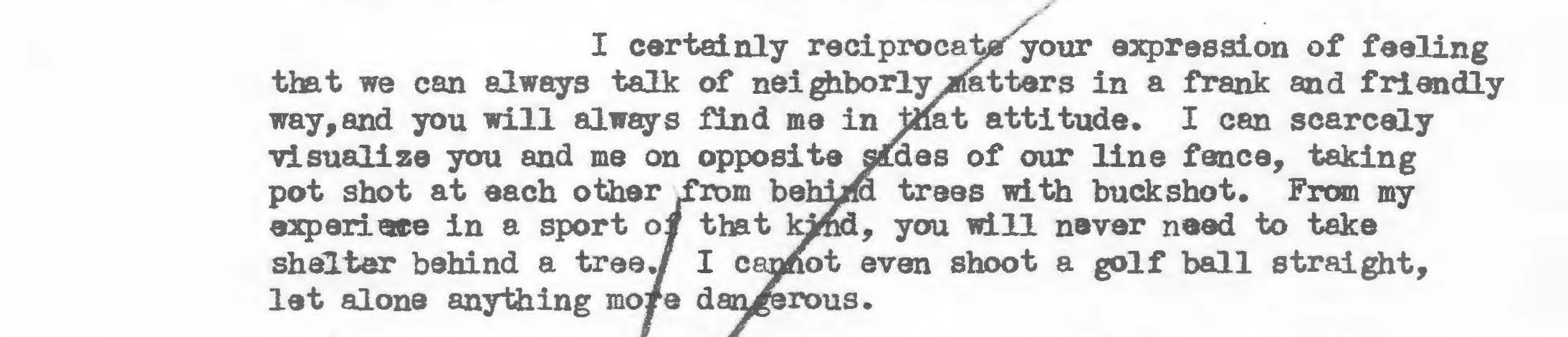
But perhaps the most interesting exchange takes place in 1926 when Ralph writes regarding the shocking lack of water needed to preserve his lawn and garden in a green state in the middle of July (not a problem in 2024!). He proposes to pump water from Cranbrook, but George’s reply a week later masterfully circumnavigates the issue:
Opening lines of the George Booth letter, August 2, 1926. Courtesy of Cranbrook Archives.
In Ralph’s reply he acquiesces with good humor:
Second paragraph of the Ralph Stone letter, August 3, 1926. Courtesy of Cranbrook Archives.
The sentiments expressed in these letters appear genuine as their families remained on neighborly terms. George and Ellen were occasional guests at Stonelea for dinner parties until the Stones sold their property in 1931.
In fact, Ralph Stone proved to be much more than just a friendly neighbor of George Booth, continuing his connection to Cranbrook long after he had moved from the area. He was an early and steadfast supporter of Cranbrook, serving on various boards for over twenty-five years as a Cranbrook School Trustee (1928-1951), Kingswood School Trustee (1930-1951), Brookside School Trustee (1945-1951), Academy of Art Trustee (1941-1946), and Foundation Trustee (1940-1952).
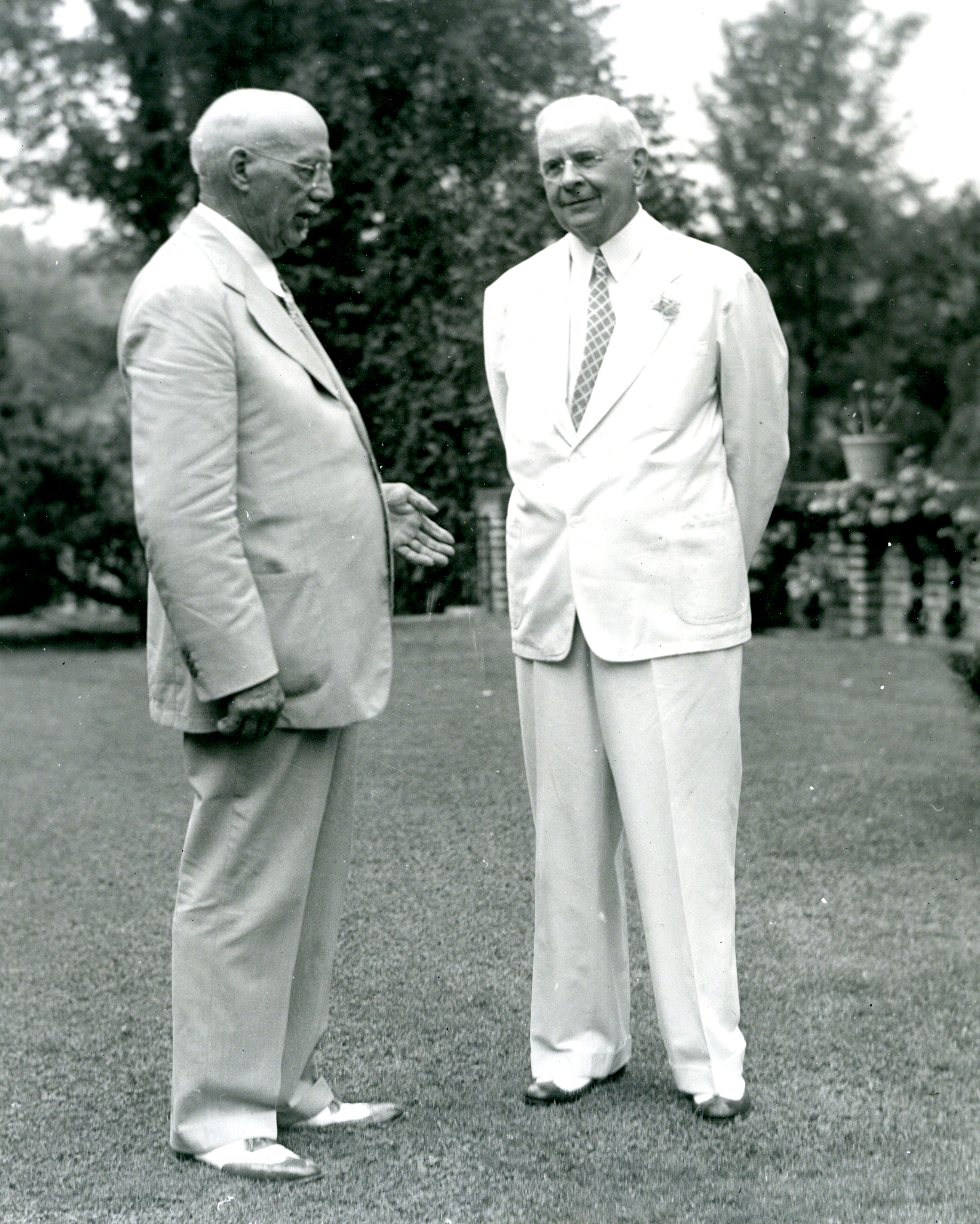
George Gough Booth and Ralph Stone attend the 80th birthday party of Ellen Scripps Booth at Cranbrook House, 1943. Courtesy of Cranbrook Archives.
Today, Stonelea is no longer just a neighbor: the property was acquired by Cranbrook Educational Community in 2003. In the coming years, Stonelea will become the future home of Cranbrook Center for Collections and Research!
Each May, the Center is honored to host an outstanding senior from Cranbrook Kingswood Upper School for a three-week immersive internship.
The Center’s 2024 “Senior May” Sav Hayward writes about their time working with the Center team.
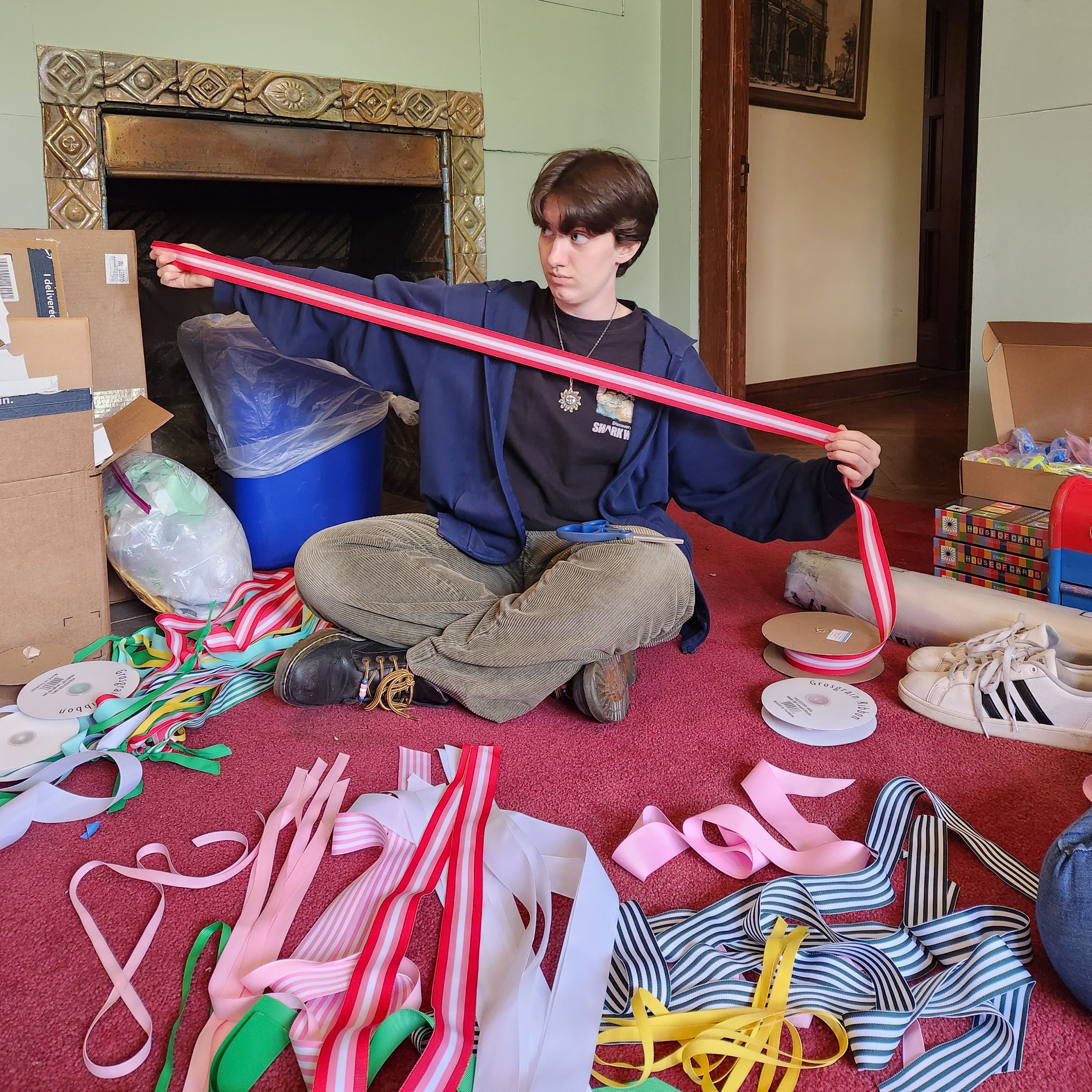
I hit the ground at my Senior May running. The very first day, I had to help prepare for the Center’s annual House Party gala. This year it was held at Thornlea House which needed a lot of TLC before the event on Saturday. During my first week, I worked all over the house to help prepare it. Things like vacuuming (Ed. note: No one, in the history of the universe, was as excited as Sav about vacuuming), wiping windows, sorting cupboards, cutting ribbons, crafting decorations, and going to Cranbrook Archives to help move items from the collection for displays. Once everything was completed the final product was extremely satisfying, and I heard many wonderful things about the night. I had to decline my invitation to the House Party in favor of my Senior Prom.
Cutting ribbon to create bunting for the House Party. Photograph by Leslie Mio, May 2024.
The following two weeks, I never had the same task twice in a row. Some of my favorite days consisted of working in the Archives with Deborah Rice and Laura MacNewman, helping around in the Annex offices with the Center’s Registrar, Leslie Mio, and going on random little trips.
In the Archives, I helped organize and re-box some items we got out for the House Party. There was a very relaxed environment there, and it was cool seeing all the documentation Cranbrook has about our history.
The following day I helped Kevin and Leslie take the painting A Hunter of Taos by Oscar Edmund Berninghaus from the Cranbrook Kingswood Middle School for Boys and drive it to a conservation studio in Detroit. When we were finishing our visit, the conservator, Ken Katz, told us to go upstairs and check out the exhibit being set up at the Metropolitan Museum of Design Detroit (MM-O-DD). There we met some cool people, including the Founder/Executive BOD President Leslie Ann Pilling and Chuck Duquet of Collected Detroit, who took us downstairs and showed us artwork stored there.
Standing around looking at the framing studio. Photograph by Kevin Adkisson, May 2024.
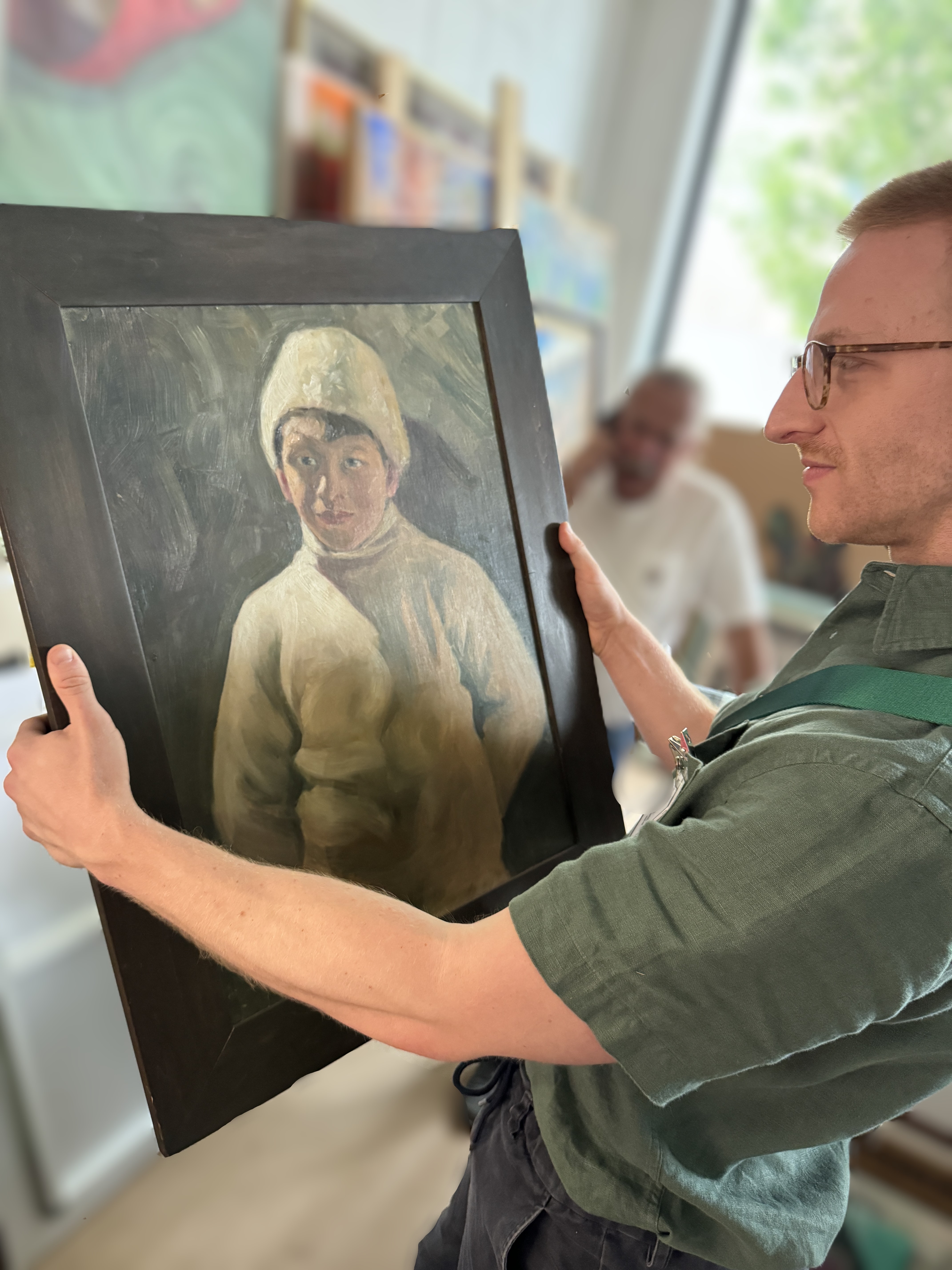
While looking around I saw pieces by many Cranbrook Artists, including some that had been loaned to Cranbrook Art Museum’s recent exhibition LeRoy Foster: Solo Show. I also saw an amazing painting of Eero Saarinen as a boy, painted in Finland by his father (and architect of Cranbrook) Eliel Saarinen.
Kevin admires Eliel Saarinen’s painting of his son Eero at Collected Detroit. Photograph by Leslie Mio, May 2024.
Ever since I started going to Cranbrook, I have dreamed of going up into the old astronomy tower at Hoey Hall. I was able to achieve this dream thanks to Kevin. He was working with photographer James Haefner to document the tower after some recent cleaning. Luckily, I was invited to join Kevin and see how the entire photshoot process worked. I helped do some tasks, like dusting, carrying equipment cases, and bringing water up to the ridiculously hot rooms.
Standing next to the upper door in the Cranbrook Campus tower. Photograph by Kevin Adkisson, May 2024.
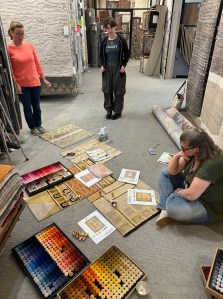
On the last day of Senior May, I joined Leslie and Kevin on a trip to Hagopian World of Rugs in Birmingham. We met with architect Erinn Rooks of Cranbrook Capital Projects to pick out colors for a reproduction rug. Suzanne Hagopian, Executive Vice President, brought out a test sample made a while back to see if the colors matched the original and if it was what we were looking for.
When we looked at the sample, we realized that the colors were lacking, so we all sat around and debated over small tufts of colorful yarn samples. What was nice was that these color samples were neatly lined up in multiple boxes. After a while, we finally decided on more vibrant colors compared to the sample, but this was to help make the carpet pop. Ed. note: Sav’s knowledge of color theory and use of technology to compare color tones greatly assisted in this project.
Erinn, Leslie, and I examine carpet and color samples. Photograph by Kevin Adkisson, May 2024.
Kevin and I take a “magic carpet ride” while looking at yarn samples. Photograph by Leslie Mio, May 2024.
I will always remember this Senior May and how fun it was. The people I met during this time are amazing and I will miss seeing them every day. While some of my classmates went off campus for their Senior May, doing mine on Cranbrook’s entire campus felt like I was a part of one large family. I have never felt more connected to Cranbrook, its history, and its legacy.
– Sav Hayward, Cranbrook Kingswood Upper School Class of 2024 and Cranbrook Center for Collections and Research 2024 Senior May
Editor’s Note: Sav Hayward is a member of the CKU Class of 2024 and a proud resident of Lansing, Michigan. In Fall 2024, Sav will continue their education at the College for Creative Studies in Detroit, where they will study Interior Design. CCS is the modern iteration of the Detroit Society of Arts and Crafts, co-founded by George G. Booth in 1906. Sav is hoping to land a paper route for the Detroit News to complete the Booth trifecta.
Another day, another lunch break. The Center feeds its Senior Mays well – Sav was treated to lunches at some of the staff’s favorite local eats, including Panera, 29º 41º Mediterranean Street Food, Green Dot Stables, and Paris Baguette Café (pictured here on their last day with us). Photograph by Kevin Adkisson, May 2024.
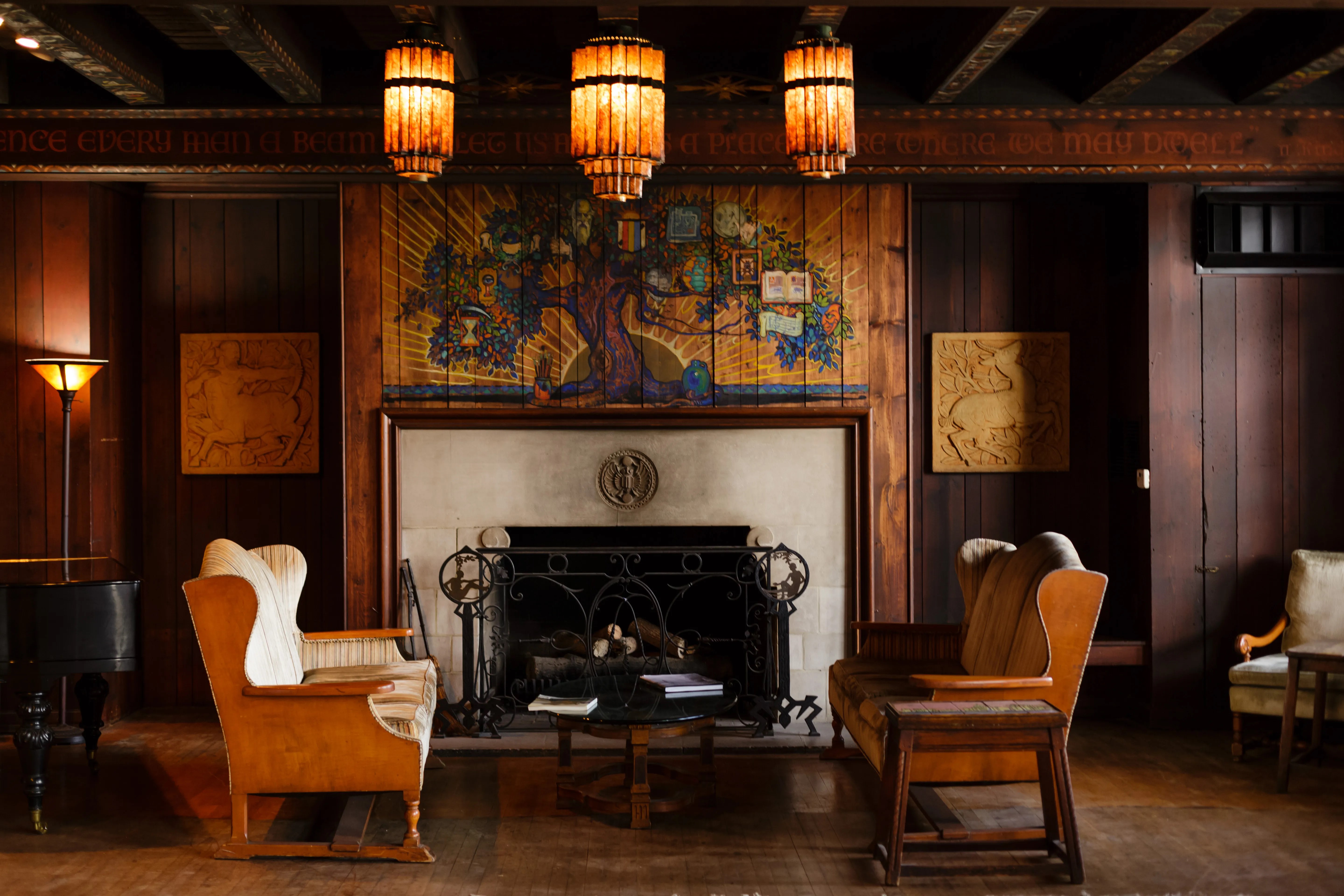
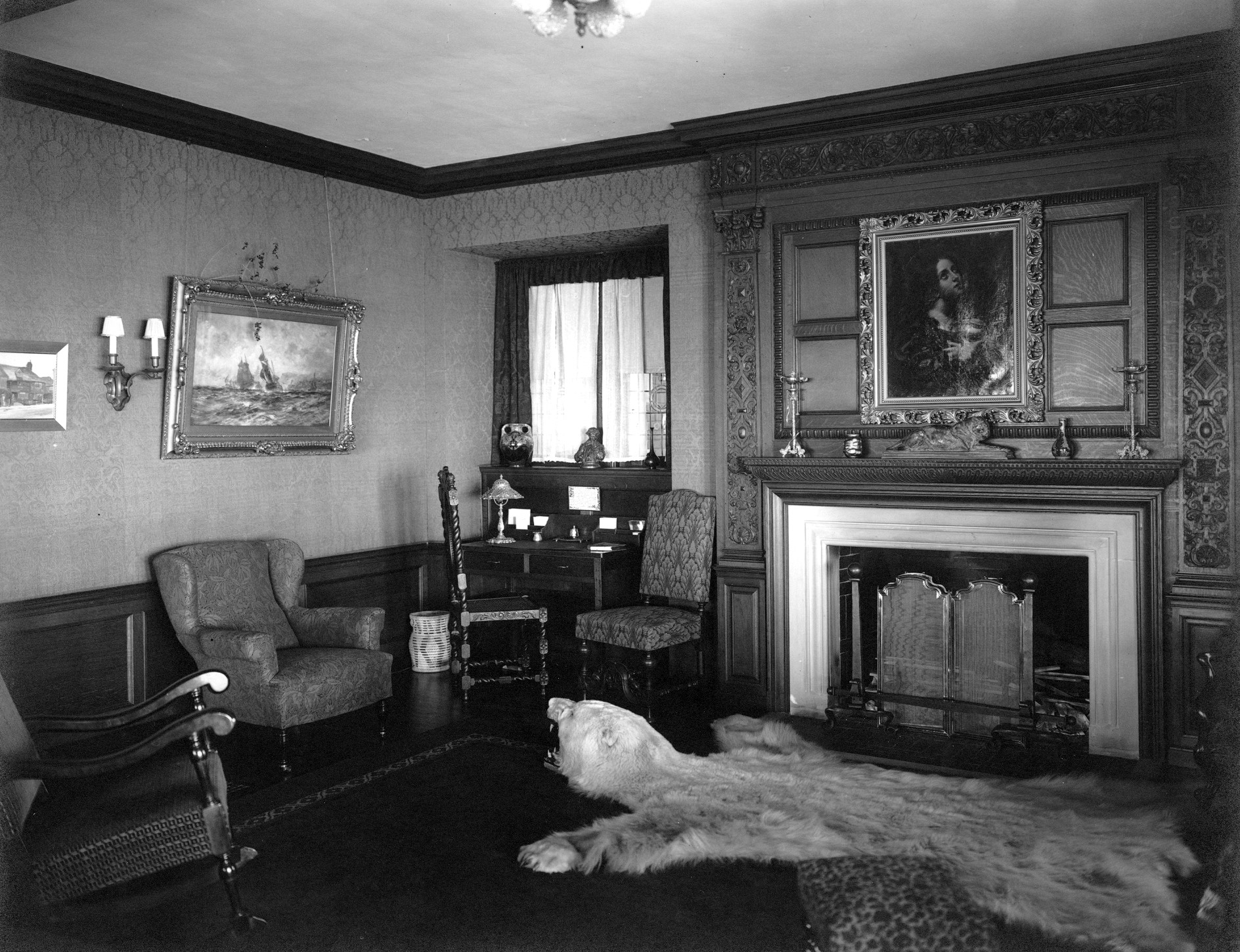
From 1908 to 1919, the room we now call the Old Country Office was George Booth’s personal workspace in Cranbrook House, where he carried on managing his newspapers and met with the many farm employees, contractors, and artists involved in the operation and transformation of the estate. A side door leads directly into the entry vestibule, allowing outdoor workmen to come inside without tracking mud onto the hall carpeting.
George Booth’s tastes shaped the whole of Cranbrook House, but here in his own office we see a concentrated expression of his personal preferences in interior design. Yet, because it was also the space where George interacted with employees and colleagues, the office speaks not only to what George liked, but also to how he wished to be perceived.
George Booth’s office, photographed in 1910. Cranbrook Archives.
The office’s dark tones and simple, solid materials reflect the serious and businesslike side of George’s personality. The exposed timbers, wood paneling, and prominent fireplace all demonstrate George’s enthusiasm for historic English homes, and his pride in his own English heritage. Its furnishings – books, prints, and statuary – speak to his desire, despite his working-class background and his position as a newspaper manager, to be seen primarily as a sophisticated art lover.
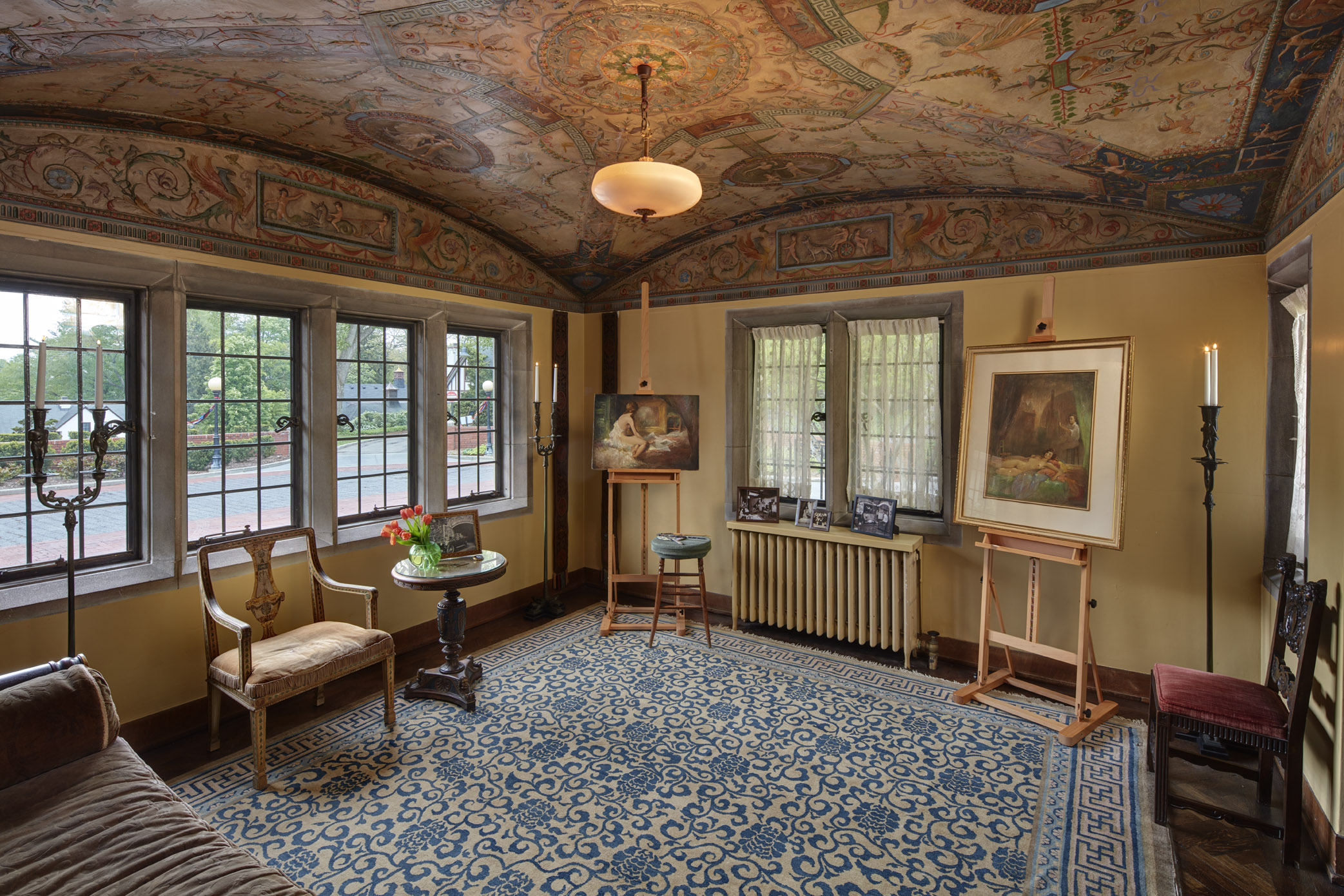
How different an impression of George’s personality we might form from the exuberant colors and rich textures of the Still Room! That space, wholly set aside for private relaxation, with its rainbow ceiling, walls hung with gold fabric, and violet velvet sofa (sadly faded now), reveals George’s inner aesthete. Yet both rooms, the luxurious Still Room and the somber office, tell us something about his character – specifically, how highly he valued the arts.
The Still Room at Cranbrook House, Summer 2023. Photograph by Jim Haefner.
In England in the 19th-century, a new school of thought about domestic design arose, which argued that the houses we live in do not just shelter us – they also shape us, emotionally, morally, and intellectually. Having a beautiful home with well-made furnishings could elevate the spirit, encourage thoughtfulness. Collectively, a community that dwelt surrounded by art would be a better society than one that lived without it. This ideal was embraced by the Arts and Crafts movement from its early days, and taken up by the Booths.
The mantelpiece in George’s Old Country Office, Cranbrook House. Photograph by Daniel Smith, CAA Architecture ’21.
George Booth once wrote, “A life without beauty is only half lived.” In his office, we can see how important it was to him to always be within reach of some great work of art or craftsmanship, even in the most ordinary moments of daily life. This same principle shaped the greater Cranbrook campus, for the benefit of all its community members.
— Mariam Hale, 2023-2025 Collections Fellow, Cranbrook Center for Collections and Research

























 Cranbrook Kitchen Sink