A Donkey for Christmas: Brighty Comes to Cranbrook

George G. Booth’s “Old Country Office” at Cranbrook House. Photograph by Kevin Adkisson.

Every year at Christmas, the Center for Collections and Research decorates George Booth’s office in Cranbrook House with a special display. This year, our Christmas display is all about Brighty of the Grand Canyon, a movie produced by Stephen Booth, a grandson of Cranbrook’s cofounders. Brighty was a real donkey who inspired first a children’s novel, then a feature film.

In the late 1800s, there were hundreds of half-wild donkeys in the Grand Canyon, brought there by prospectors and then lost or abandoned. Brighty was one of them. 

Photograph by Kevin Adkisson.

Brighty lived in the Grand Canyon from 1892 to 1922. In the winter, he roamed the warm depths of the canyon. A sociable animal, he liked the company of prospectors, hunters, and hikers, but if anyone loaded a heavy pack on his back he would soon make his escape. Every summer, he returned to the North Rim to stay with the McKee family who rented cabins to tourists. He would carry water, give children rides, and visit each cabin in turn for attention and treats—his favorite food was flapjacks and honey.

In 1953, the author Marguerite Henry learned about Brighty, and immediately decided to base her next novel on him. In search of more stories about the adventurous donkey, she travelled to the Grand Canyon herself, where she interviewed locals who had known him, hiked in the canyon, and even sampled the creek water and tasted the plants that Brighty would have eaten! She adopted her own donkey, Jiggs, to learn from him how the real Brighty might have behaved. In Brighty of the Grand Canyon, a free-spirited donkey helps solve a murder mystery and protects his human friends from a dangerous bandit.
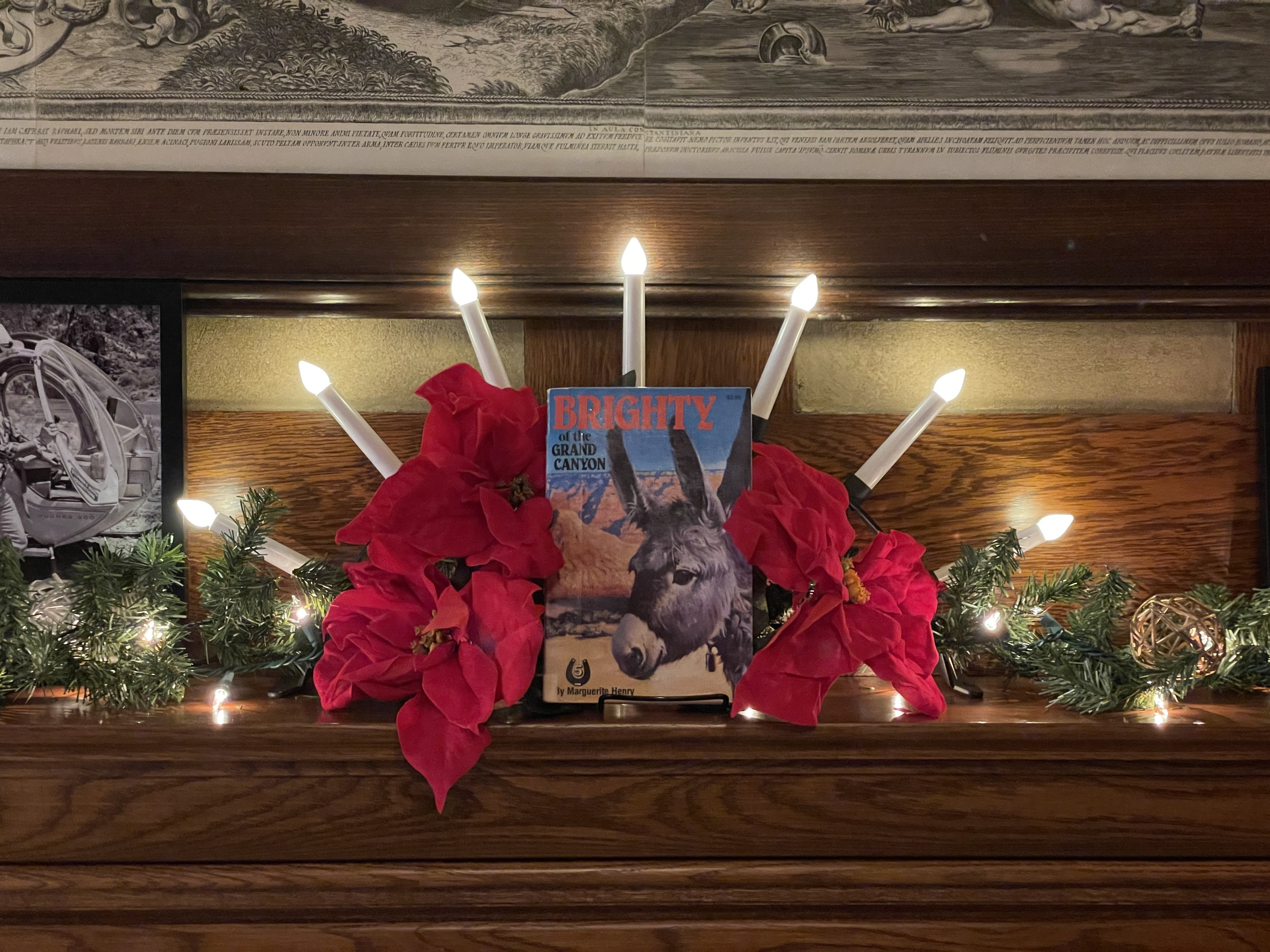
This is the 1963 edition of the novel, the same year that the Booths bought a copy to read on their family road trip. Photograph by Kevin Adkisson.

Stephen Booth and his wife Betty bought a copy of the book to read to their children, Douglas, Charles, and George. They all loved the story, especially Stephen, who had his own film production company, and decided to make a movie about Brighty. 

Filming began in 1965, with Marguerite Henry’s own pet donkey, Jiggs, starring as Brighty. Filmed on location at the Grand Canyon and in the Dixie National Forest in Utah, the actors and crew spent weeks living in the canyon. A tiny helicopter and an airplane with a camera mounted on the front were used for aerial shots, and for flying special visitors, like Stephen’s parents, Henry and Carolyn Booth, down into the canyon. 

Norman Foster, the film’s director, reviews the script with Jiggs the Donkey. Stephen Farr Booth Papers, Cranbrook Archives

The movie premiered on November 22, 1966, just down the road in Birmingham, doubling as a fundraiser for Kingswood School for Girls. As the star of the movie, Jiggs himself came along to the premiere. Afterward, he participated in the Festival of Gifts at Christ Church Cranbrook, an annual Christmas tradition that began in 1928 and continues today. 

From left to right: Betty Booth, Stephen Booth, Marguerite Henry, and Jiggs greet children at the film’s premiere. Stephen Farr Booth Papers, Cranbrook Archives.

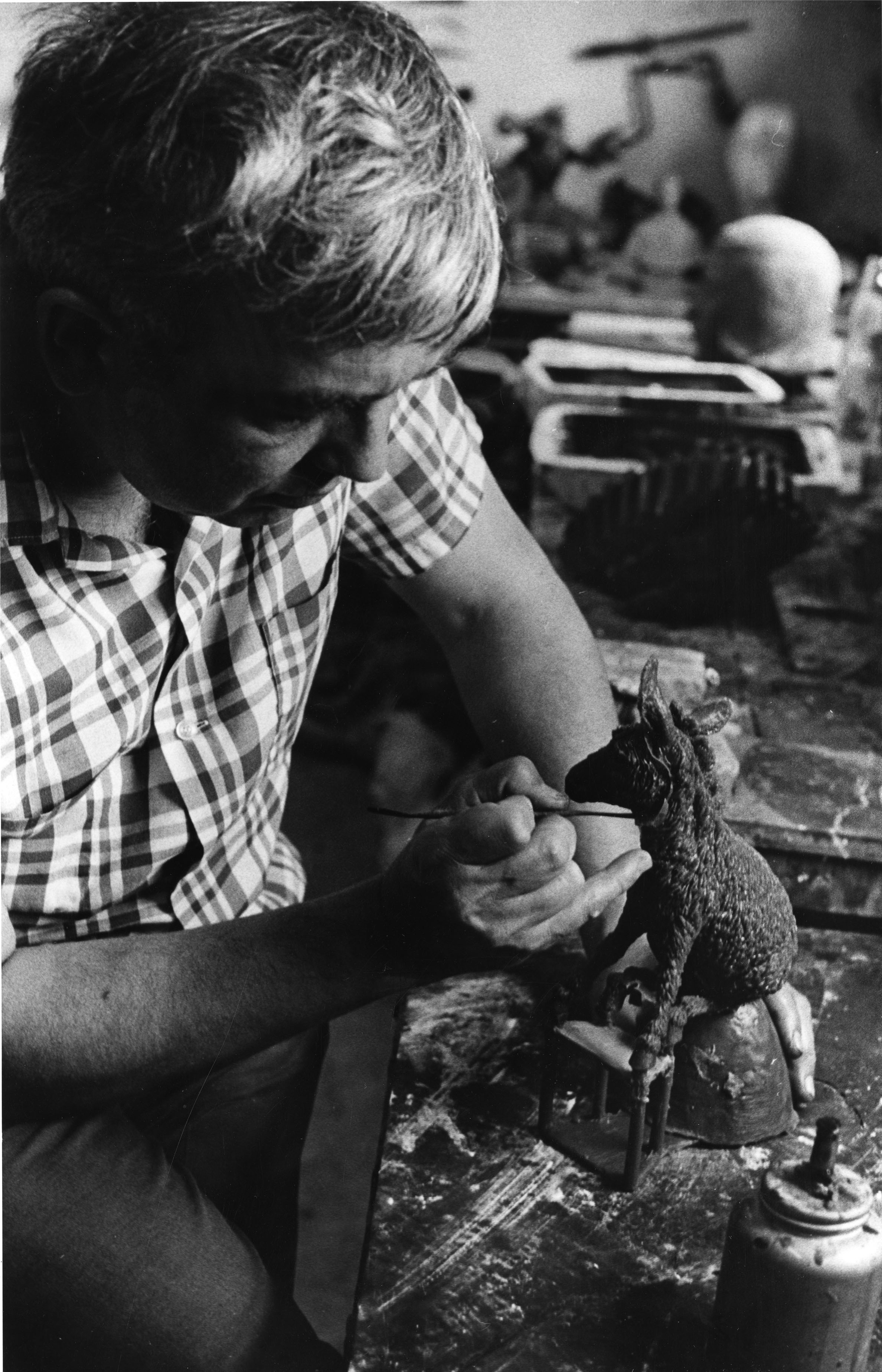
While Brighty was visiting Bloomfield Hills, he also posed for a series of sculptures by Peter Jepsen. They were modelled here at Cranbrook, on the second floor of Thornlea Studio. We still have one of the sixty Brighty figurines that Stephen Booth had made to give as presents to people who had helped in the making of the movie. Our Brighty was given to Stephen’s parents, Henry and Carolyn, to thank them for their support.

Photograph by Kevin Adkisson.
Peter Jepsen at work on Brighty in Thornlea Studio. Stephen Farr Booth Papers, Cranbrook Archives.

Stephen also commissioned Jepsen to make a life-size sculpture of Brighty. In 1968, Stephen gave that version to the Park Rangers at the Grand Canyon as a Christmas present. You can still see Jepsen’s Brighty at the visitor’s lodge on the North Rim of the Canyon, close to where the real Brighty spent his summers, more than a hundred years ago.

Peter Jepsen poses with his sculpture at the lodge on the North Rim of the Grand Canyon. Stephen Farr Booth Papers, Cranbrook Archives.

Mariam Hale, Collections Fellow, Cranbrook Center for Collections and Research

Ed. Note (July 17, 2025): It appears the Dragon Bravo wildfire has severly damaged the original Brighty statue at the the lodge on the North Rim of the Grand Canyon. https://www.facebook.com/share/p/1CDkSfoutX/

Please know that the Cranbrook Center for Collections and Research will do everything it can to support efforts to restore or replace Brighty,
Gravity, Dignity, and Softness: The Voice of the Pipe Organ

In addition to working as an Associate Archivist at Cranbrook, I am also a fledgling volunteer docent at Christ Church Cranbrook. Recently, I gave a tour of the Chancel to test my skills with my teachers. As I prepared, I found there was very little written about the history of the pipe organ at the church. So, where to turn for more information? Cranbrook Archives, of course.

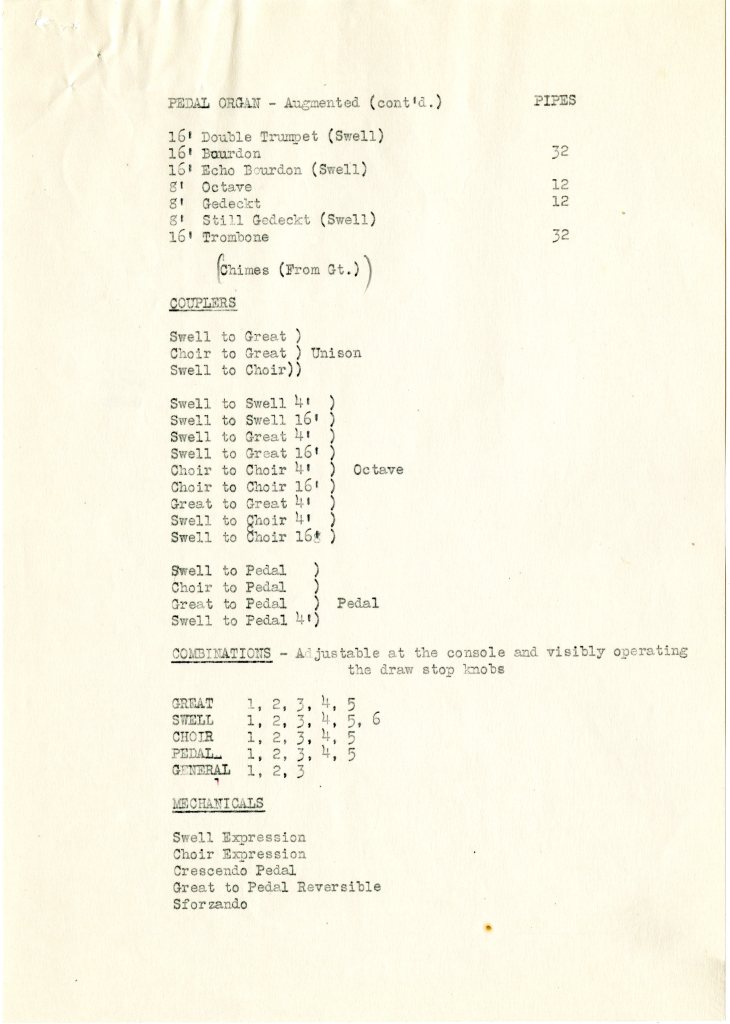
In August of 1925, George Booth and Oscar Murray (of Bertram G. Goodhue Associates, the church architect), started in earnest to finalize their thoughts and feelings about the choice of organ for the church. While the organ itself was installed in January 1928, plans for its ducts and conduits had to be decided early, before the concrete floors were poured.

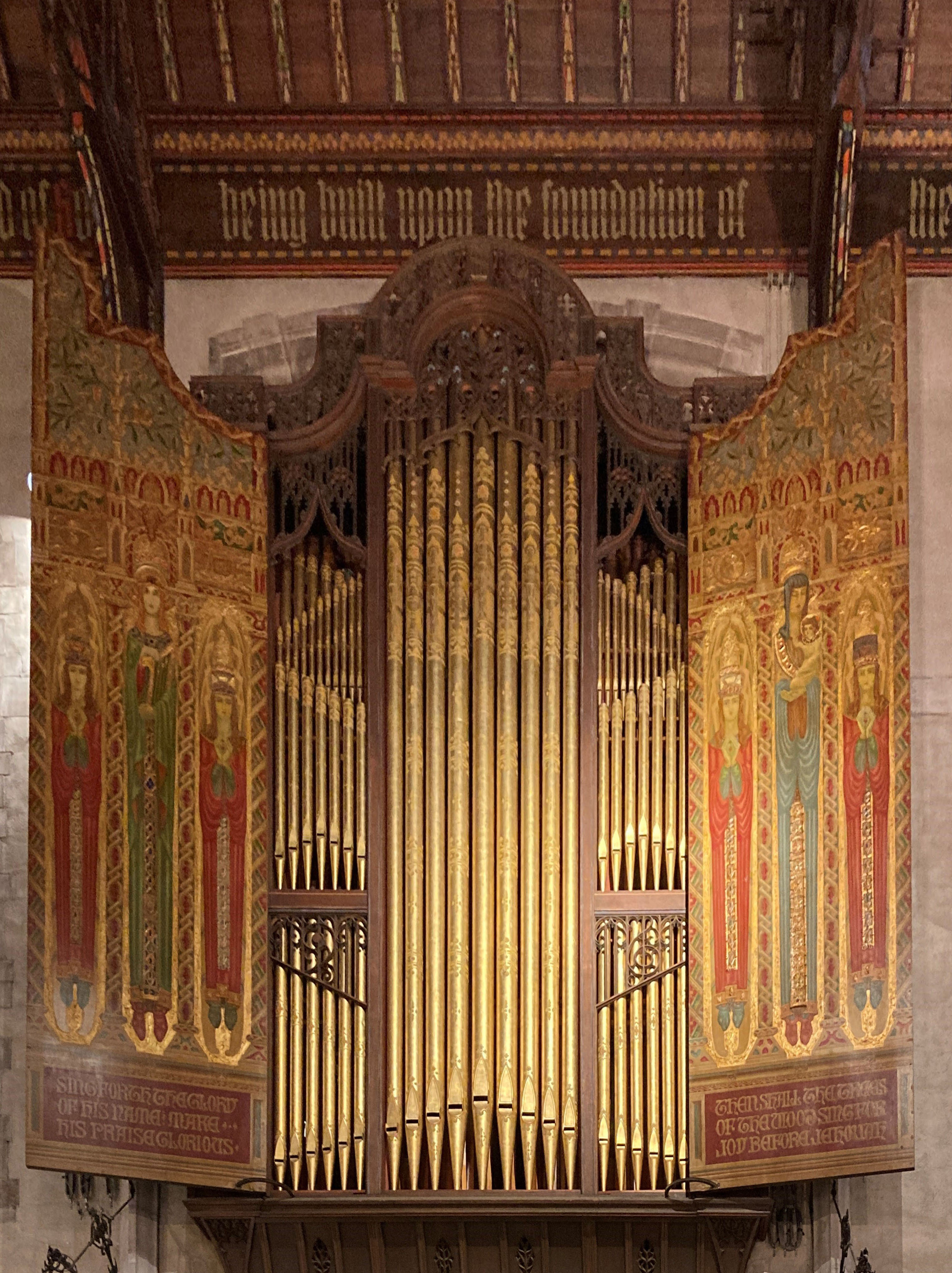
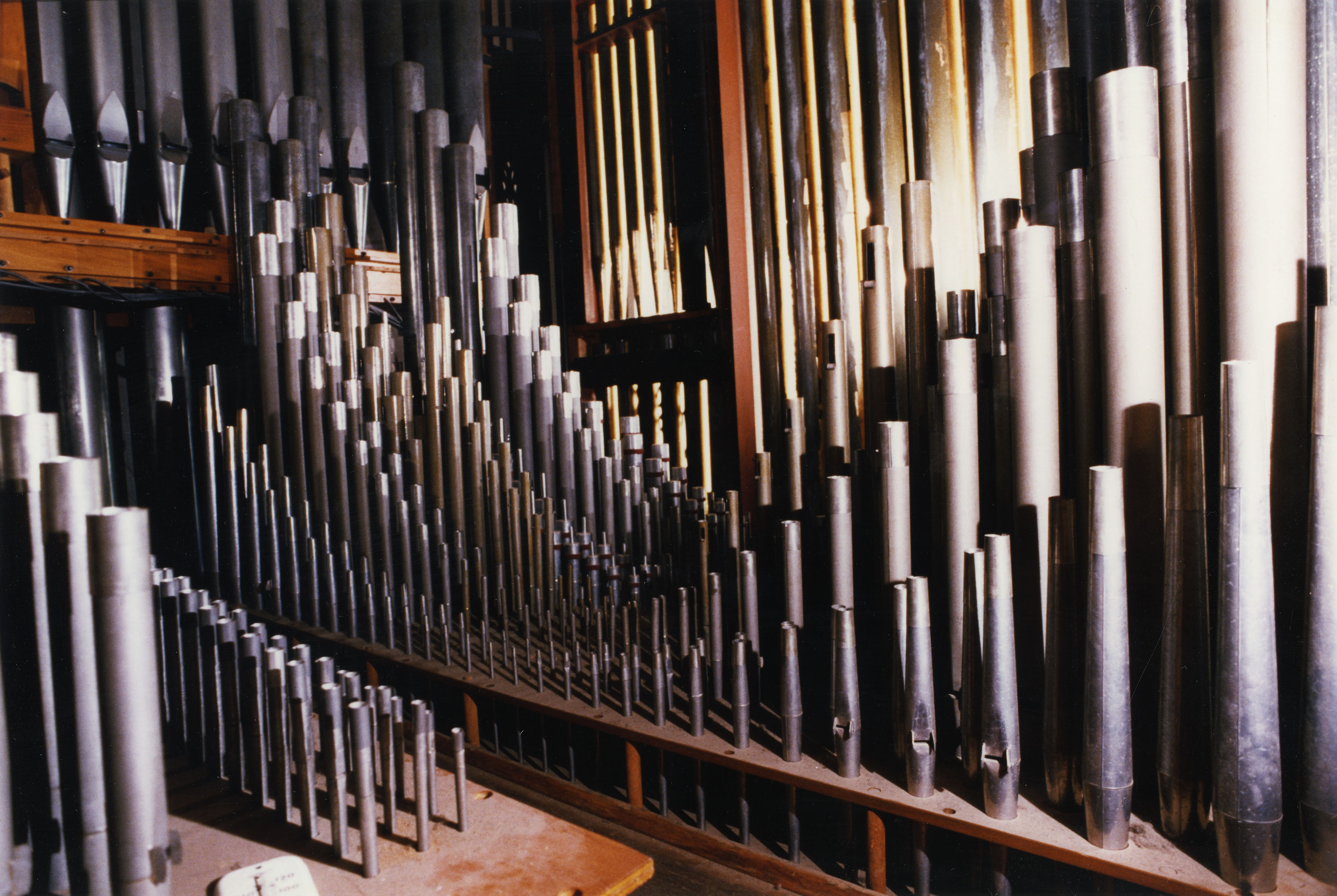
Christ Church Cranbrook organ pipes prior to the 1997 restoration. Jack Kausch, photographer. Courtesy of Cranbrook Archives.

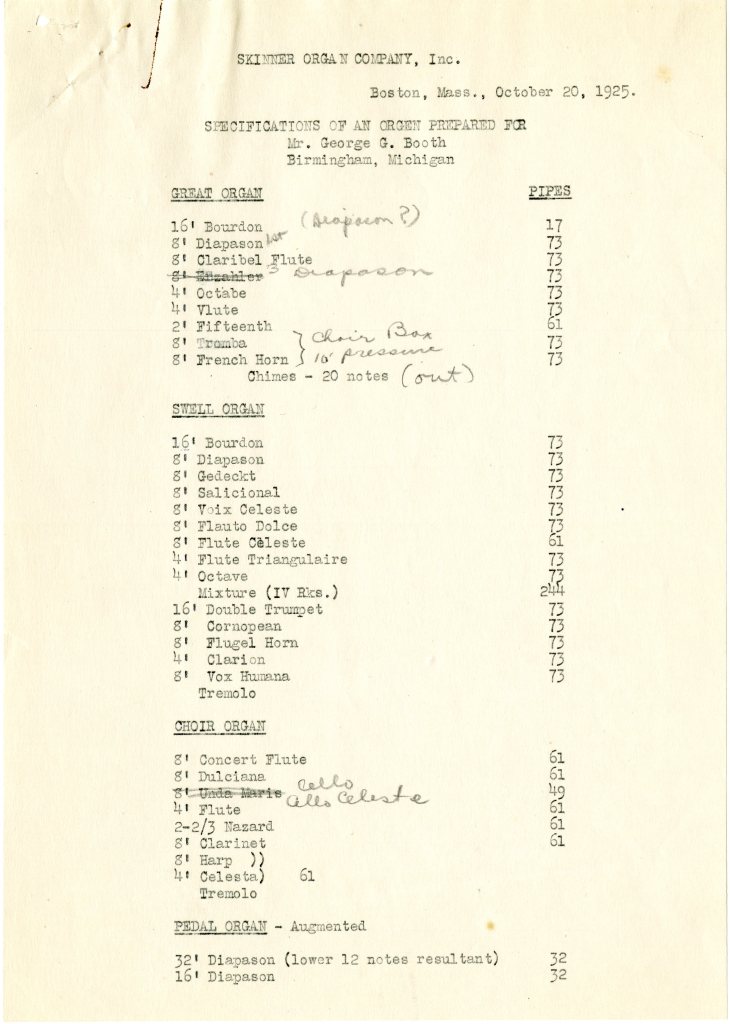
The correspondence suggests that the E.M. Skinner Organ Company was the only company considered. The Boston-based firm was considered America’s finest and most technologically advanced organ builder. Skinner’s specifications for the organ, console, and bench were submitted in October 1925.

George Booth inquired of his colleague Cyril Player to provide comments on the specifications, and Player begins his commentary saying,

“I think I would emphasize gently to them that you want gravity, dignity and softness—the three prime essentials of any church organ, large or small… [gravity] is secured by an adequate and properly-balanced pedal department; dignity by volume of foundation tone in the basic divisions of the instrument; and softness and refinement by skillful voicing with a copious wind stream at a moderate pressure.”

Cyril Player to George G. Booth, November 1925

In passing along the comments to Murray, Booth remarks that, “the desired qualities, viz; gravity, dignity and softness; seems to me peculiarly to express my own feelings and desire.”

William Zeuch of Skinner Organ Company revised the specifications following some of Player’s suggestions, while some revisions were the suggestion of Henry Willis, the great English organ builder who was a consultant to the firm. The contract for the organ (including the Great, Swell, Choir, and Pedal pipe divisions) was duly signed in December 1925 and work proceeded.

At the same time, a separate contract was made with Alfred Floegel to decorate the organ case doors. Booth wished to confine the oak finish to the exterior of the doors while having the rest richly decorated with color. Booth imagined the opening of the organ doors to represent the opening of the mind. He also envisioned the organ case to read as a triptych (a picture or altarpiece on three hinged panels) when open.  

Organ case doors, woodwork by Irving and Casson, decoration by Alfred Floegel. Gift of James Scripps Booth. Laura MacNewman, photographer.

In July 1927, work on the organ console began. The console is where the organist sits to play the instrument, distinguished by its multiple hand keyboards (called manuals), pedalboard, and other controls. Rev. Dr. Marquis requested a change from a 3-manual (Great, Swell, and Choir pipe divisions) to a 4-manual, by adding the Solo division. Zeuch responded positively as it was not too late to build a 4-manual console; however, having already instructed the architect to reduce the dimensions of the organ chamber, which had been too large and would have interfered with the proper effect of the sound in the church, the architect would now need to find space for the Solo division. Room was found above the Sacristy.

Continue reading

What Can a Tea Kettle Teach Us? A Tale of Two Cranbrooks

The Center has made a new film! As part of our recent gala fundraiser, A House Party at Two Cranbrooks, we worked with Elkhorn Entertainment & Media to produce a short documentary about the Booth family’s connections between England and Michigan. Today, we are excited to share the film with the wider world! Watch the film below, or here.

A Tale of Two Cranbrooks

Now that you’ve seen the new documentary, I thought I’d invite you “behind-the-scenes” into how A Tale of Two Cranbrooks came together.

Cinematographer Josh Samson and producer Vince Chavez film the Booth-made tea kettle in Cranbrook House. April 6, 2023. Photograph by Nina Blomfield.

As with all Center projects, I started work on the film in Cranbrook Archives. The Booth family records are extensive, and with our archivists Deborah Rice and Laura MacNewman, I spent several afternoons consulting documents (letters, photographs, manuscripts, scrapbooks, etc.) assembled by many generations of Booths to learn the family story. Henry Wood Booth’s handwritten The Annals of Cranbrook were especially helpful.

Detail of a postcard of Cranbrook, Kent with handwritten notes by Henry Wood Booth, from The Annals of Cranbrook manuscript, 1914. Cranbrook Archives.

Then, through the support of Bobbi and Stephen Polk and Ryan Polk, I travelled to England! I visited Cranbrook, Kent, spending time at Cranbrook Museum and Archives and at Cranbrook School. (You can watch a walking history tour I did in Cranbrook, Kent, here and learn more about the Booth family and my trip to England in my virtual lecture, Uncovering Cranbrook: Two Pilgrimages to Kentish Cranbrook.)

Continue reading

Celebrating and Preserving Cranbrook’s History: My Senior May Experience

My three weeks at the Center for Collections and Research have been an exhaustive tour of all the activities and responsibilities of maintaining Cranbrook’s history. From getting ready for the annual House Party, scanning historical documents, and cleaning the Smith House in preparation for summer, being a member of this community requires one to wear many hats to preserve its history.

Scrubbing the Frank Lloyd Wright Smith House in Bloomfield Township. Photo by Leslie Mio.

During my first week with the Center, I entered into the great anticipation of the annual House Party fundraiser. With this year’s theme involving Cranbrook’s influences from England, many of my projects involved making Cranbrook House a better fit for this theme. As favors for the guests, I assembled nearly 300 pastry boxes to fill with scones and other iconic English treats like tea and marmalade.

My collection of pastry boxes from my week at Cranbrook House. Photo by Grace Quinn.

Following the party, I helped scan many folders of documents from the Archives on George G. Booth and his involvement with the Detroit Arts and Crafts Society and with renowned architect Albert Kahn. Although I knew very little about the Arts and Crafts movements, I came to a much stronger understanding of how the Booths focused much of their wealth and influence on buying and displaying handcrafted goods.

These were not just shows of wealth but were a way of honoring the artisans who built this campus and saying, without words, that a quality place like this will withstand much more than inhuman, mass-produced art and furniture. Even though this notion is not new, rising technological advances seem to only make cheapness and speed priorities in design, rather than beauty or emotional value. The art of patience and supporting artists is a refreshing notion compared to the on-demand nature of online shopping and rampant consumerism.

While scanning documents from the George G. Booth Papers was my main Archives project, I also got to work with architectural drawings of Glen Paulsen from the 1950s. Photo by Deborah Rice.

When reflecting on what I had learned during this internship, I realized that before this I had never given much thought to how this campus came to fruition. I knew that some famous architects built it, but as I scanned archival documents and helped maintain Cranbrook’s houses, I can now fully realize the cultural influence Cranbrook has had in Detroit’s history.

Cranbrook’s inspiration stretches across borders and countries; it has a prominent space in contemporary architecture and in the earlier Arts and Crafts Movement. Cranbrook’s exercises in art and design are on display to inspire others to emphasize detail, quality, and creative talent in designing schools and creating diverse communities.

—Grace Quinn, Cranbrook Kingswood Upper School 2023

Editor’s Note: The Senior May Project is a school-sponsored activity that encourages Cranbrook Kingswood Upper School seniors to acquire work experience in a field they are considering as a college major, a potential profession, and/or as a personal interest.

Grace’s efforts in making A House Party at Two Cranbrooks a success, her can-do attitude, and her flexibility in tackling projects large and small were much appreciated by the Center staff. We wish her luck as she heads to the Rochester Institute of Technology’s College of Art and Design in the fall!

Finding Olmsted at Cranbrook

George G. Booth didn’t just commission renowned architects in building Cranbrook, he also engaged well-respected landscape designers. Architecture and nature were equally considered. Booth’s own 1904 topographical map demonstrates his grandiose vision for reshaping what was then farmland. It is not surprising, therefore, that Cranbrook has a connection to the American “father of landscape architecture,” Frederick Law Olmsted.

Leading up to and following the Center’s most recent Bauder lectureExperiencing Olmsted: The Enduring Legacy of Frederick Law Olmsted’s North American Landscapes, Olmsted-related materials in the Archives were revisited and new associations were made.

It was Frederick Law Olmsted’s successor firm, the Olmsted Brothers, led by his sons, that worked on the landscape of Christ Church Cranbrook from 1926-1928. Simultaneous to the construction of the church by the architecture firm Bertram G. Goodhue Associates, the Olmsteds created plans for the surrounding land between Lone Pine, Cranbrook, and Church Roads.

Artistic rendering of Christ Church Cranbrook Rectory, 1924. Bertram G. Goodhue Associates. Courtesy of Cranbrook Archives.

A few pieces of correspondence in the George Gough Booth Papers shed light on the close relationship between Booth, the chief architect Oscar H. Murray, and the Olmsted Brothers. But there are many more letters from Job 7754 (aka Christ Church Cranbrook)  in the Frederick Law Olmsted Papers and Olmsted Associates Records held by the Manuscript Division of the Library of Congress in Washington, D.C., all of which can be read online.

Letter from Oscar H. Murray to George G. Booth relating a response from Olmsted Brothers, December 7, 1927. Courtesy of Cranbrook Archives.

The Archives also holds two reproductions of Olmsted Brothers plans: the second and the tenth drawing revisions submitted in 1927 and 1928, respectively. In these, plants are clearly numbered, but the Archives does not hold the accompanying keys. At the suggestion of Bauder lecturer, Charles Birnbaum, President, CEO, and Founder of The Cultural Landscape Foundation in Washington, D.C., I reached out to the Frederick Law Olmsted National Historic Site in Brookline, Massachusetts. They graciously shared scanned copies of both planting plans, for our reference.

Christ Church Cranbrook Planting Plan, March 11, 1927, revised October 1927. Blueprint for Revised Plan Number 2. Olmsted Brothers. Courtesy of Cranbrook Archives.

We now know, for example, that the large evergreens that George Booth mentions in a letter to Oscar Murray likely refer to the Austrian Pine (10 and 82), Douglas Fir (83), and White Pine (90) enumerated in a November 4, 1927 plant list for Plan No. 2. And, we can see where on the blueprint those trees were proposed to be planted!

Excerpt from page two of George Booth’s letter to Oscar Murray, November 23, 1927. Courtesy of Cranbrook Archives.

Many more discoveries are sure to come, now that we have a more complete picture of the original landscape design for Christ Church Cranbrook. I know that next time I drive or walk by the church, I will be taking a closer look at the vegetation.

Deborah Rice, Head Archivist, Cranbrook Center for Collections and Research

Editor’s note: To view the five drawings in the Olmsted Archives at Brookline, including originals of  the Cranbrook copies, and eight scrapbook pages that include Goodhue Associates renderings, visit their Flickr albums.

The Art of Simplicity: Bonawit’s Grisaille

The clerestory windows designed by G. Owen Bonawit in the nave of Christ Church seem to be one of the least described elements of the church’s artwork. The work was negotiated and subcontracted through architect Oscar H. Murray at Bertram Grosvenor Goodhue Associates rather than commissioned directly through George G. Booth. Consequently, there are few documentary vestiges of the artist’s process in our records.

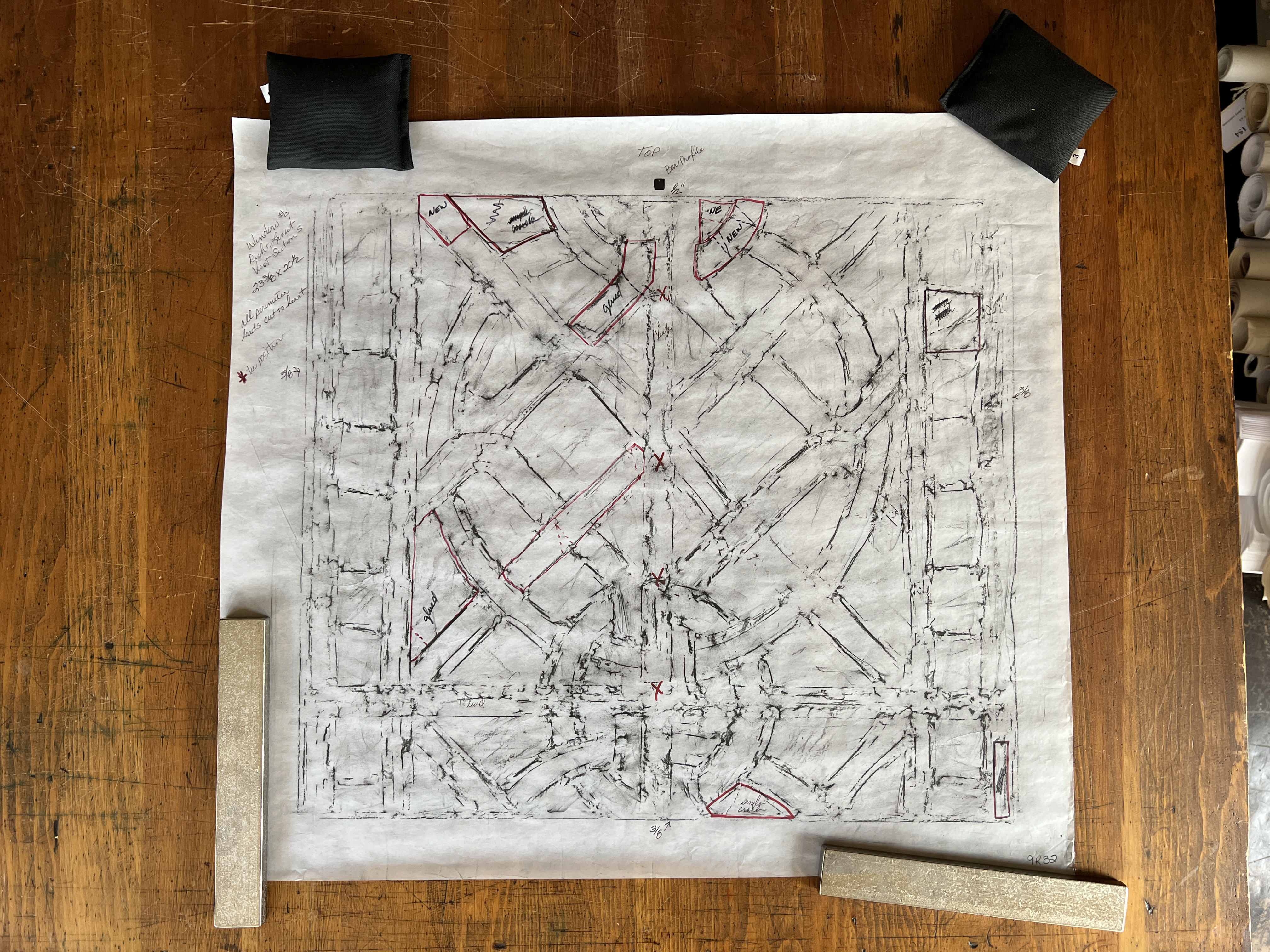
The windows can be studied through other materials held by the Archives, including architectural drawings, photographs, and the records of a window restoration project which commenced in 1993. In 1995, the Thompson Art Glass company made rubbings of the window for the purposes of identifying their care and preservation needs.

There are seventeen grisaille clerestory windows in the nave and chancel at Christ Church, which were analyzed as part of this stained-glass restoration project. They are made of clear antique glass upon which minute floral detail is painted and accentuated by the addition of small amounts of colored glass. In the chancel, there are two lancets and tracery of nine panels supported by T-bars including one ventilator panel. In the nave, they are comprised of three lancets and tracery with eight panels, with ventilator panels making up the bottom row.

Detail from Architectural drawing of Christ Church Cranbrook, North Elevation. April 30, 1925. Drawn by J.E.M./Oscar H. Murray, Bertram Grosvenor Goodhue Architects. [AD.10.33]. Courtesy of Cranbrook Archives.

Grisaille, literally meaning ‘to grey,’ is a type of stained glass that is mostly monochromatic, with a silver or grey tone being painted onto the finished glass. The purpose of the plainness of grisaille is twofold: they let more light into the space both literally and metaphorically in that they were intended to limit distraction from meditation.

The grisaille stained glass style is thought to have originated in French Cistercian abbeys after a prohibition on colored glass issued by St. Bernard of Clairvaux in 1134 in accordance with their charism of simplicity. St. Bernard, the master of paradox, also banned the use of figurative decoration according to the First Commandment of no graven images. Under his guidance, the Cistercians seek the face of God, a theological anomaly that produces an exquisite spiritual discipline and religious practice through which the monk contemplates holiness by virtue of continually recognizing the poverty of their thoughts and feelings when weighed down by seeking to satisfy worldly desire. The style often employs natural or geometric patterns, much like a labyrinth.

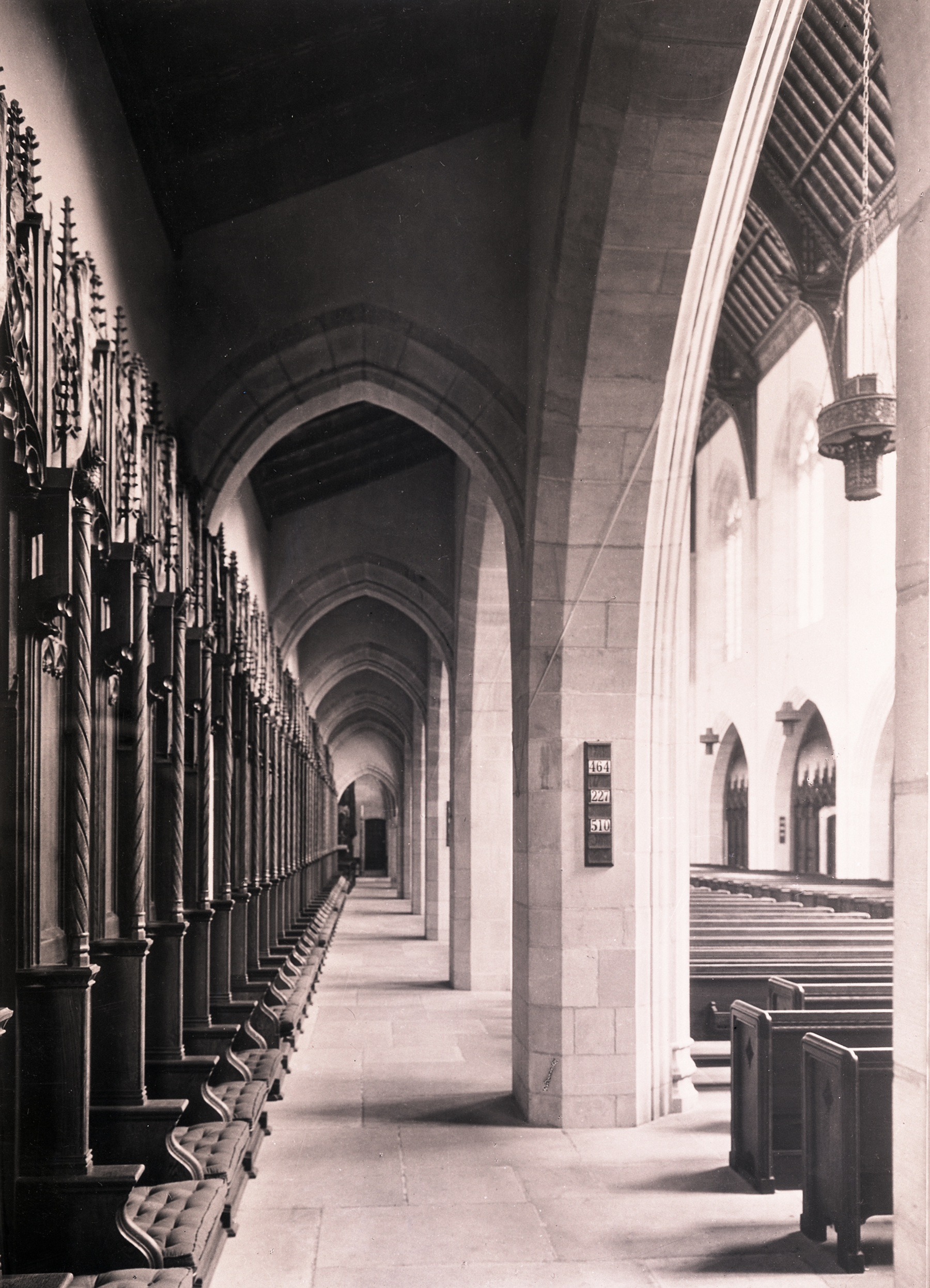
The windows can best be observed by sitting in the aisle stalls of the nave, which are in themselves an unusual feature otherwise only found in Oxford college chapels. The walls of the nave were originally intended to display memorials and artwork, but the latter idea was revised due to the objection that it would bring a museum feel to a house of worship.

Aisle stalls in left side of sanctuary. June 23, 1946. Photographer, Harvey Croze. Courtesy of Cranbrook Archives.

Added in 1930, the aisle stalls offer a fine perspective from which to observe the grisaille, and Bonawit’s elegant craftmanship brings with it a history of monastic inspired light. Since a life without beauty is only half lived, the artistic eclecticism of Christ Church offers all those who enter the opportunity to embrace the other half both in its resplendency and in its simplicity.

Laura MacNewman, Associate Archivist, Cranbrook Center for Collections and Research

Cranbrook’s Great Books (Part II)

In Part I of this post, we explored Cranbrook’s love of the book, from its origins with founders George and Ellen Booth, to the existing special collections at the Archives and Academy of Art. I invite you now to learn of the many rare, valuable, and historical tomes whose existence may be unknown to most or simply overlooked in collections at the Schools, Institute of Science, and two historic homes cared for by the Center for Collections and Research: Saarinen House and Smith House.

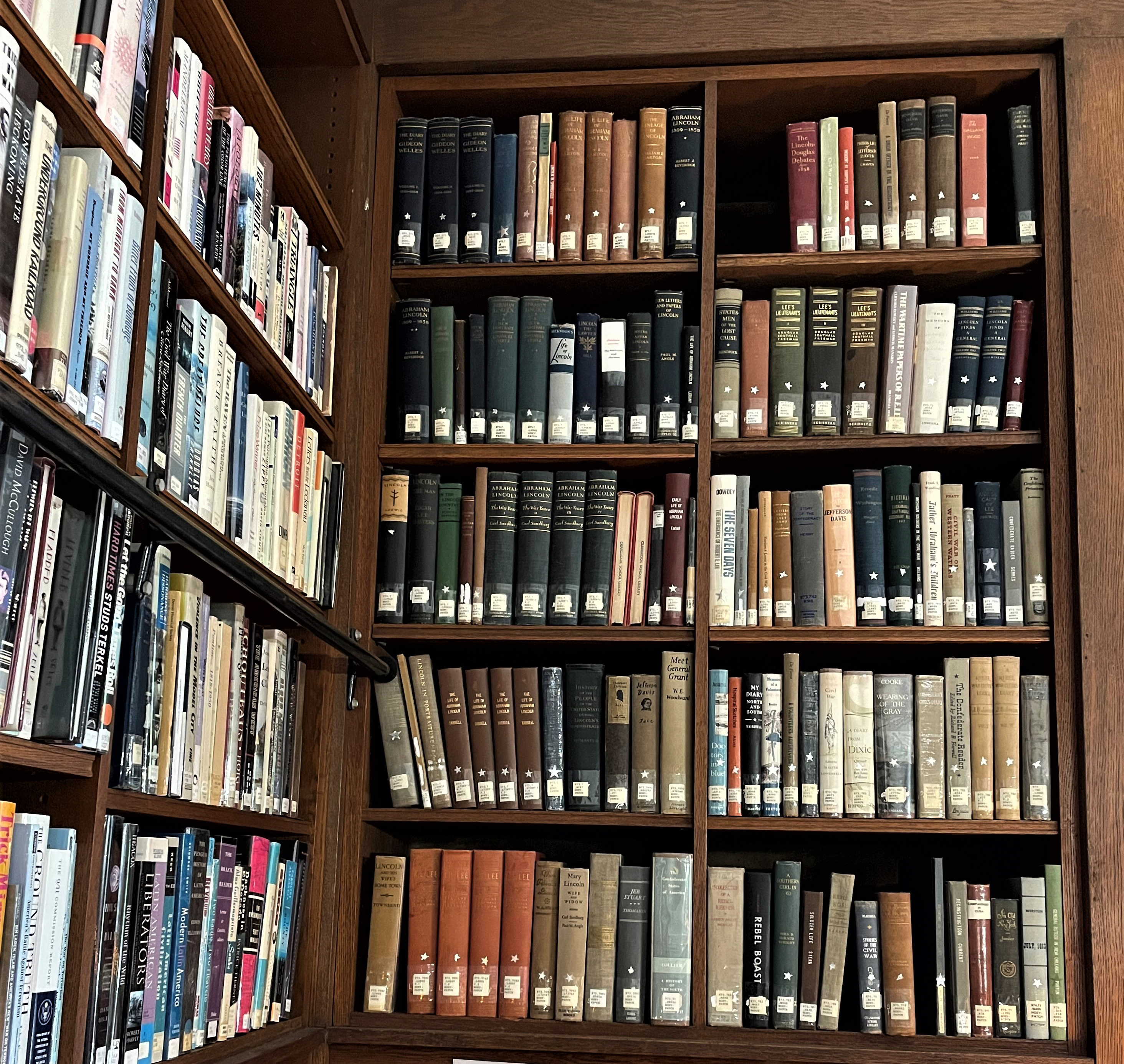
Hoey Patch Collection at the Cranbrook School Library. Courtesy of Kate Covintree, Cranbrook Kingswood Upper Schools.

Like the Academy of Art, although not at all on the same scale, books from George and Ellen’s Cranbrook House Library were dispersed to the Cranbrook Schools Libraries, now comprised of five separate spaces. Following the Booth’s example, Cranbrook School Headmaster Harry D. Hoey (1950-1964) and Latin teacher George Patch (1928-1944, Emeritus 1944-1950) donated 120 books from their personal libraries to the School’s library in the 1950s, forming one of several special collections. Known as the Hoey Patch Collection, all of the volumes focus on an aspect of Abraham Lincoln or the American Civil War.

He Knew Lincoln, a fictionalized account written by Ida Tarbell, a progressive journalist, and published in 1907. The book’s custodial history is documented with correspondence from the author, written directly on the inside of the book. Courtesy of Kate Covintree, Cranbrook Kingswood Upper Schools.

Highlights include a First edition of The Life of Abraham Lincoln, the first full-scale biography of the President. Written by newspaper editor J.G. Holland, it was published shortly after Lincoln’s assassination in 1865. Also included is a first edition, two-volume set of the Personal Memoirs of U.S. Grant. Ulysses S. Grant penned his autobiography shortly before his death in 1885 as a means of financial support for his family. It was published with the support of his friend Mark Twain by the Charles L. Webster Company (owned by Twain’s nephew).

Continue reading

“The Warning Came at About 10 P.M.” The Birth of George Booth

September 24 is the birthday of Cranbrook’s co-founder George Gough Booth. Trying to decide how best to commemorate his 157th birthday, I landed on the idea of sharing the story of the day he came into the world.

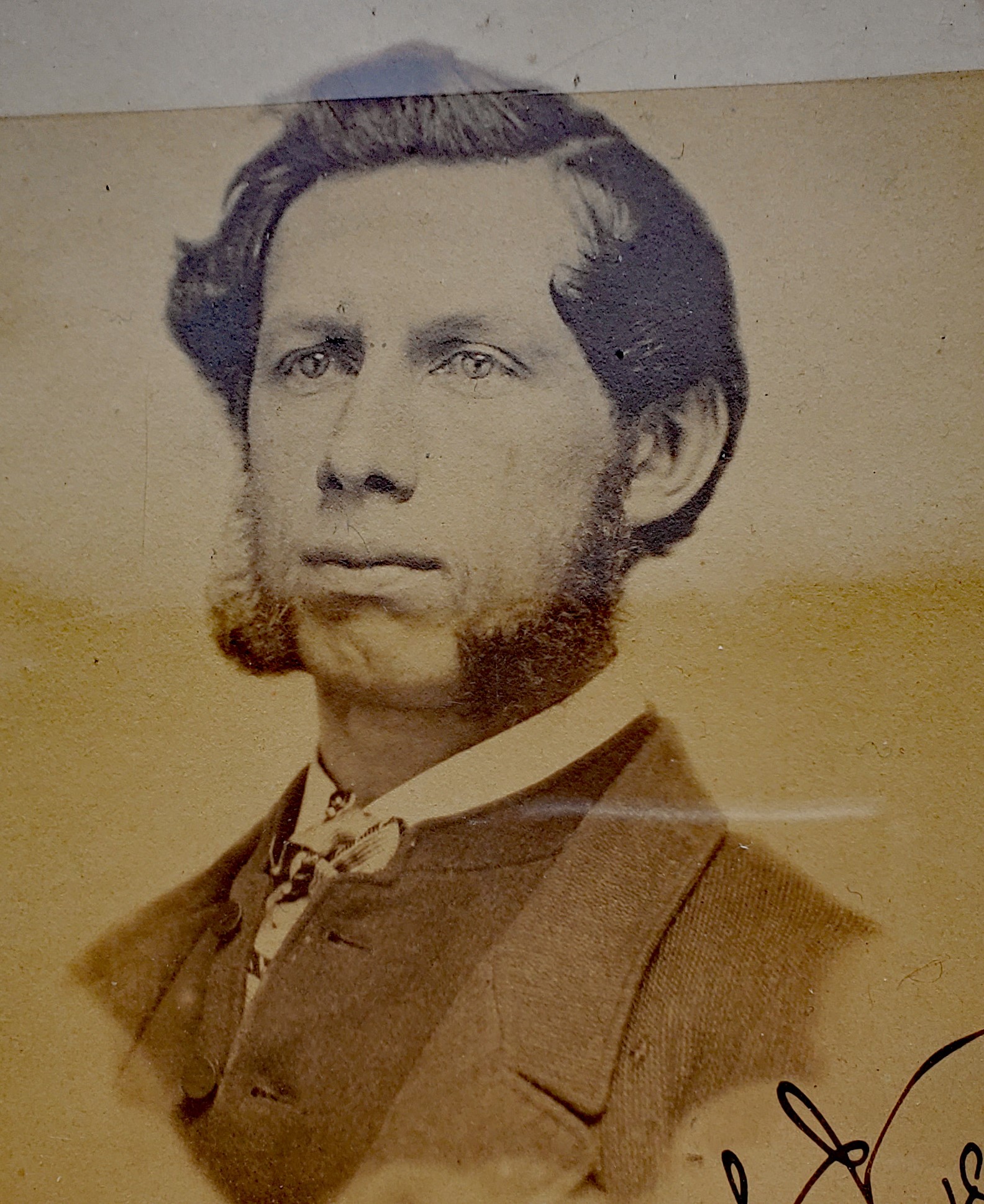
Portrait of George when he was around twelve years old. Photographer W. E. Lindop, Elgin Gallery, St. Thomas, Ontario. Courtesy of Cranbrook Archives, Cranbrook Center for Collections and Research.

In 1864, Henry Wood Booth and Clara Louise Irene Gagnier Booth were living in Canada. Clara had already given birth to three children: Charles, Alice, and Grace. Baby Grace had, unfortunately, died at seven months. Clara would go on to have six more children—Edmund, Theodora, Adelaide, Ralph, Roland, and Bertha—for a total of nine children to live past infancy.

Clara Louise Irene Gagnier Booth in 1857. Courtesy of Cranbrook Archives, Cranbrook Center for Collections and Research.
Henry Wood Booth in 1862. Courtesy of Cranbrook Archives, Cranbrook Center for Collections and Research.

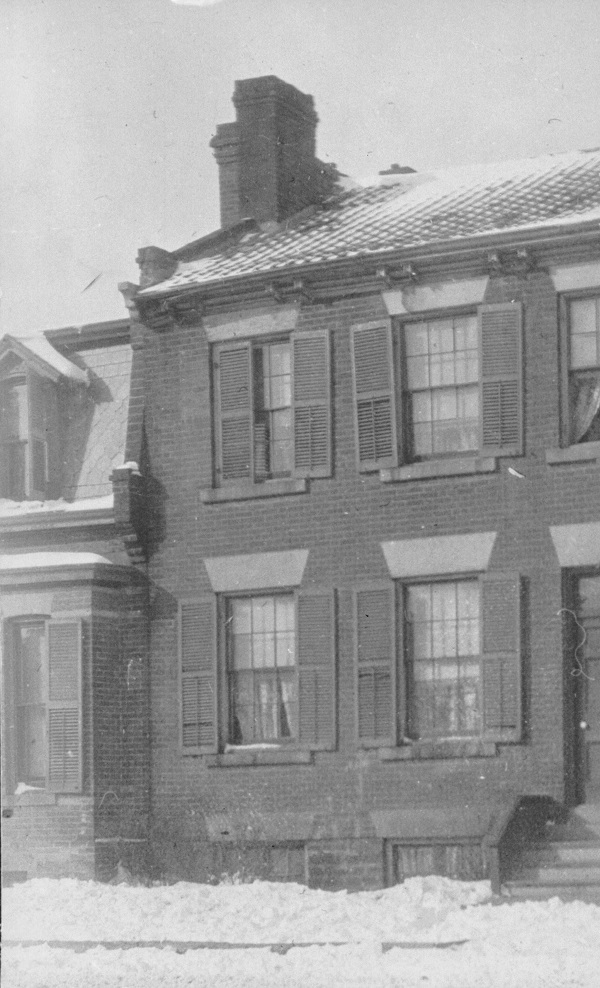
George Gough Booth arrived on September 24, 1864, at 8 Magill (now McGill) Street in Toronto, Ontario, Canada. Henry Wood Booth recalled that George was, “Born in the house at the East end of row on the South side of Magill St. about the middle of the block from Younge St. at 11.30 p.m. on Saturday, Sept. 24, 1864.”

The terrace house at No. 8 Magill Street, the birthplace of George G. Booth in Toronto, Ontario, Canada, as it looked in 1902. Courtesy of Cranbrook Archives, Cranbrook Center for Collections and Research

In a missive written much later about the night of George’s birth, Henry recalled “the time when, on opening the front door, I heard your sonorous voice for the first time, while your grandmother, coming down the stairs, assured me ‘it’s a fine boy.’”

But why was Henry out so late on the night George was born? Shouldn’t he have been home with Clara?

Henry Wood Booth’s recollection of the birth of George Gough Booth in 1864. George Gough Booth (1864-1949) Papers (1981-01), Box 1 Folder 1, Cranbrook Archives.

Distraught during Clara’s labor—”The warning came at about 10 p.m.” Henry recalled—the father-to-be was ushered out of the house to get help. His first stop was the home of Mrs. Cavie, across Magill Street, “who was in bed but promised to ‘dress and go over at once,’ which she did.” Henry then ran to Mother Gagnier’s house. She lived a mile away. “She also promised to go at once, and did.”

His final stop was the home of Dr. James Ross, who lived almost three miles away. Dr. Ross, however, took his time, dressing while a nervous Henry waited. He regretted waiting for the doctor, “I should have hurried home and told them there that the doctor was coming.”

George, “being a lively one,” commented Henry, “and his mother equal to the task,” had already made his entrance into the world, with the assistance of the experienced Grandmother Gagnier, before the doctor and Henry had reached the house.

George Gough got his first name from his great-grandfather as well as his uncle, both named George Booth. Gough came from two sources. Henry’s grandmother Elizabeth Dann Gough Booth had been a member of the influential Gough family back in England, and Henry’s father’s name was Henry Gough Booth.

In addition, Henry and Clara enjoyed the work of the famous temperance orator John Gough. Henry had once heard Gough lecture in 1849, where Henry signed “the pledge” to stop drinking, and became a champion of temperance. The Booths sought to dedicate George to “the sacred cause of temperance” and thought the strong middle name would help.

George Gough Booth did maintain a temperate life, so Henry and Clara’s goal was achieved.

Another thing Henry and Clara passed on to their son George: a tradition of honoring the family ancestry through names:

  • George’s second son’s name was Warren, his wife Ellen Scripps Booth’s middle name
  • His first daughter was named Grace Ellen, after his sister who died in infancy and his wife
  • His youngest son was named Henry after his father, grandfather, and a long line of Henrys before him
  • His youngest daughter Florence’s middle name was Louise, his mother’s middle name
  • All three of his sons’ middle names were Scripps, his wife’s maiden name
Ellen Scripps Booth and George Gough Booth with their children on their 50th wedding anniversary in 1937. The Booths are, from front row, from left: James Scripps, Henry Scripps, Warren Scripps. Second row from left: Ellen Scripps, George Gough, Grace Ellen, Florence Louise. Courtesy of Cranbrook Archives, Cranbrook Center for Collections and Research

And George and Ellen’s home, estate, and community they founded was, of course, named for the town in Kent, England, where Henry Wood Booth was born: Cranbrook.

And with that, I’d like to wish a very Happy Birthday, Mr. Booth!

Leslie S. Mio, Associate Registrar, Cranbrook Center for Collections and Research

Continue reading

A World of Opportunity: Ellen Scripps Booth Memorial Scholarships

In preparation for the Center’s upcoming seminar, featuring research on weaver Nelly Sethna, I became curious about an Academy of Art scholarship established in honor of Cranbrook founder, Ellen Scripps Booth.

Sethna had been a recipient of this financial award, which had allowed her to study abroad (Sethna was a citizen of India) at Cranbrook for one year, 1958-1959. Though it was Sethna’s artistic ability, not financial need, that earned her the award, she would never have made it to Cranbrook without this assistance, as indicated in letters to Weaving Department Head, Marianne Strengell.

Nelly H. Sethna, circa 1958. Courtesy of Cranbrook Archives.

Sethna’s subsequent successful career in textile design demonstrated the value of providing assistance for artists to attend the Academy. I wondered how many other similar stories there were in the Archives. I did not need to look past the first decade of memorial scholarship awardees to find plenty.

While the scholarship was granted to deserving artists in metalsmithing, painting, ceramics, and weaving in the ten years between 1951-1961, it was two fellow weavers of Sethna’s that caught my eye. They, too, had proven themselves worthy of distinction through their artistic accomplishments, but they, too, had financial needs that would have prohibited their attending the Academy otherwise.

Dixie Roto Magazine article featuring Katherine Choy, Sept. 14, 1952. Copyright The Times-Picayune, New Orleans States. Courtesy of Cranbrook Archives.

The first recipient of the scholarship was Katherine P. Choy, a Chinese expatriate and graduate of Mills College in Oakland, California. Choy came to Cranbrook in 1951 to study ceramics for one year as a non-degree student. She would spend near equal time in both the ceramics and weaving departments, under the dual tutelage of Maija Grotell and Marianne Strengell.

Upon leaving Cranbrook, she would enjoy success in both fields, first heading up the legendary Newcomb College Ceramics Department at Tulane University and later joining the design team at Isabel Scott Fabrics in New York. With fellow artist Henry Okamoto, Choy also founded The Clay Art Center in Port Chester, New York, which still exists today. Choy’s ceramics can be found in the collections of the Cooper-Hewitt Smithsonian Design Museum, the Museum of Arts and Design in New York, as well as the New Orleans Museum of Art.

Tsuneko Yokota, circa 1955. Courtesy of Cranbrook Archives.

Another scholarship winner, and weaver, in the first decade of the award was Tsuneko Yokota (Fujimoto), for the academic year 1957-1958. A graduate of the Design Department at Tama College of Fine Arts in Tokyo, Yokota distinguished herself in fabric dying, winning several awards and a scholarship for an additional year at Tama as an honor graduate. At the suggestion of one of her instructors, and with a recommendation from Marianne Strengell, who knew her instructor, Yokota came to Cranbrook to further her studies in weaving and textile design. Unlike Sethna and Choy, though, Yokota stayed an additional year at the Academy and earned her MFA in Weaving.

By all accounts, Yokota lived up to Strengell’s confidence that she, “will most certainly have ample chance and desire to spread our particular brand of education and design in Japan,” working with celebrated modernist interior designers like Isamu Kenmochi.

Cranbrook Academy of Art scholarship announcement, 1960. Courtesy of Cranbrook Archives.

The Ellen Scripps Booth Memorial Scholarship was established in 1951 along with the George Gough Booth and Eliel Saarinen Memorial Scholarships by the Academy of Art Board of Trustees. Academy faculty, under the leadership of Director Zoltan Sepeshy, recommended these scholarships be granted based on unusual merit of work submitted rather than financial need. Academy administrative documents indicate that the Ellen Scripps Booth Scholarship Fund had wide support from not only Academy faculty and staff, but also many at the Foundation, Press, Central Committee, and House. Scholarship award amounts varied somewhat from year to year, (in 1953 they were evenly split between two awardees), but the scholarship continued to be granted until at least 1965. While these named scholarships are no longer awarded (and I was unable to deduce exactly why or when they stopped), scholarships and financial aid for talented students are still vital to the success of the Academy and its artists.

—Deborah Rice, Head Archivist, Cranbrook Center for Collections and Research

Editor’s Notes: On Tuesday, June 22 the Center broadcasts live from Cranbrook and India for scholar Vishal Khandelwal’s examination, using materials from Cranbrook Archives, of a fascinating connection between mid-century textile design in the United States and India, as seen through the work of Nelly Sethna. Register here for this illuminating virtual event. 

Along with Nelly Sethna (1958-59), find early scholarship winners, such as Paul R. Evans (1952-53) and Howard William Kottler (1956-57) featured in Cranbrook Art Musuem’s new exhibit and companion publication, With Eyes Opened. Find details and purchase advance tickets to the exhibit on the Museum’s website.

Read a recent exciting announcement about new scholarship and financial opportunities for students on the Academy’s website.

She Walks in Beauty: The Life and Work of Helen Plumb

Helen Plumb, co-founder of the Detroit Society of Arts and Crafts (DSAC) and its secretary from 1906 to 1928, was dedicated to the arts and crafts ideal of public service—encouraging an appreciation for beauty in everyday life and in the community. Surprisingly little is known of Plumb, but some evidence can be found in a few of the Archives’ collections.

During her tenure as DSAC secretary, Plumb saw the society through three distinct phases, each coinciding with a different physical location. The School of Design was established during the society’s first five years, when it was based at the Knowlson Building on Farmer Street (1906-1911). For the next five years, they were based at Witherell Street, during which time the society encouraged the production of theatrical masques, including the Masque of Arcadia, written by Alexandrine McEwen, and the Cranbrook Masque in 1916. The society moved to its third and final location at 47 Watson Street in October 1916. From then until 1922, they created the Little Theatre and expanded into Folk Handicraft and Lamp Departments. Once flourishing, by 1922 these programs were fading, causing Plumb to perceive a new era for the society and her future role in it.

Helen Plumb, secretary of the Detroit Society of Arts and Crafts (1906-1928). Courtesy of Cranbrook Archives.

In a letter to George Booth in 1922, Plumb alludes to a choice between two paths: either “to go forward in a much larger, showier way, or to move into a closer, more restricted field,” which she felt would entail abandoning DSAC’s public and civic work. In this letter, she makes it very clear that if the second route were chosen, she would have no part in it. Her vision for the society’s future was to nurture more international connections, following the success of the Exhibition of British Arts and Crafts Assembled by the Detroit Society of Arts and Crafts in 1920.

A miniature portrait of Helen Plumb of the Society of Arts & Crafts, Detroit, on ivory, by Alexandrine McEwen (1876 – 1955), in same outfit as above. Cultural Properties Collection, Founders Collection.

Plumb’s correspondence with Booth was always very professional and business-focused with a modest sprinkling of personal comment. Then, in October of 1924, she writes candidly, “I have not many friends in all that word means, and still fewer confidants. It so happens that you are one of those two or three who shares my deepest one.” Plumb is variously described as a tireless worker, but here she shares how much she has struggled with chronic health problems and that her vitality has diminished such that it has, “become a life and death struggle” for her to keep going at all. There is a chance that she will finally be well, but she is unable to negotiate a path to it with the society’s board and she is no longer able to endure as is. It is in this impasse that she turns to Booth to advise the best course.

Letter from Helen Plumb to George G. Booth, October 16, 1924. Courtesy of Cranbrook Archives.
Continue reading

Create a website or blog at WordPress.com