It’s a New Collection!

The Archives to Launch Our Poster Collection Online!

Over the coming summer, Cranbrook Archives will release a brand new collection into its online digital database! While building our digital archive is a perpetual process, we are working steadily to upload images and manuscripts so that you, our remote users, can browse and search through our collections no matter where you live. This summer we will be celebrating a new addition: the Cranbrook Poster Collection!

Over the past eight months, my colleague, Laura MacNewman, and I collaborated to upload this collection for online access. The posters date back to the early 1900s with topics covering the scope of the entire Cranbrook Educational Community, emphasizing exhibitions from the Academy of Art and the Institute of Science, and theatrical performances from Cranbrook Kingswood Schools, St. Dunstan’s Guild, and the Summer Theatre.

Cranbrook Institute of Science poster, n.d. Courtesy Cranbrook Archives.

Cranbrook Institute of Science poster, n.d. Courtesy Cranbrook Archives.

We created nineteen different series for the Poster Collection based on locations or departments on campus. We identified nearly 500 unique posters in our collection, and each one was given a distinct identifying number. Once the unique identifiers were established, we merged all the various poster inventories  into one master inventory spreadsheet, and arranged them in chronological order by series.

The next step was sorting through the physical posters folder by folder in order to take a reference photograph of each one for the database, record their dimensions, and describe them  in the master inventory spreadsheet. This was the longest stage of the process, lasting several weeks. After the data was entered into the spreadsheet, we renamed the individual images to match the posters’ unique identifiers in order to match the photograph.
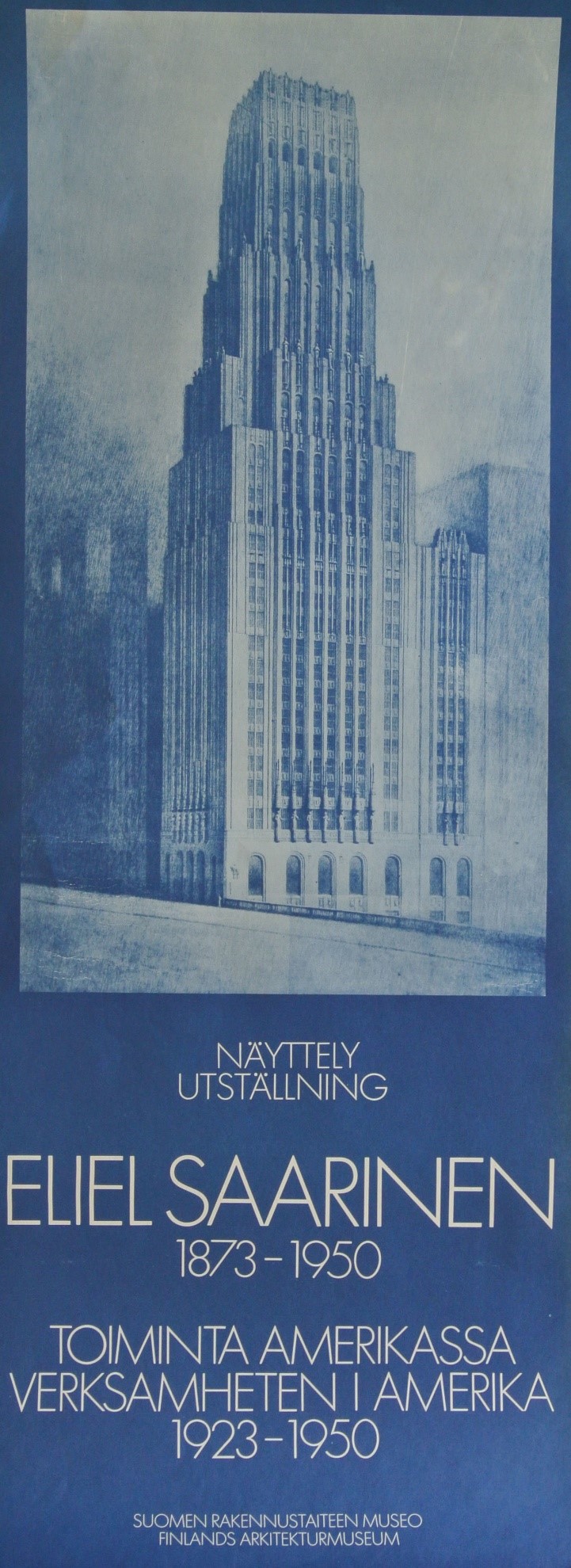
Exhibition poster, 1973. Courtesy Cranbrook Archives.

Exhibition poster, 1973. Courtesy Cranbrook Archives.

While every step has been a learning process, my favorite part was working in Thornlea Studio and physically handling the poster collection for measurements and photographs. Laura and I were able to take a previously unorganized collection and make it discoverable online, which was rewarding and gave me a sense of accomplishment. I loved the huge diversity of the posters, too. Not only were they historically valuable, they were also aesthetically stunning. I can’t wait for the collection to be released for everyone to enjoy!

Danae Dracht, Archives Assistant

Editor’s Note: Thank you Danae and Laura for your hard work on this project! Congratulations also to Danae who recently graduated from Wayne State University’s School of Library Science! We wish you all the best as you embark on the next journey of your archival career.
First Impressions; or Pride and Appreciation

As the newest staff member at the Cranbrook Center for Collections and Research, I am on a HUGE learning curve.  I knew, taking this position, that Cranbrook had a deep and rich history, and a long association with famous artists, designers, and architects.  However, my first days here were spent touring campus, witnessing just what those associations created.

My first impressions of the cultural properties I will be working with are “Wow! What?! Cool.”  I hope in the coming months to be able to share some of those moments on the Kitchen Sink, but here are my first three:

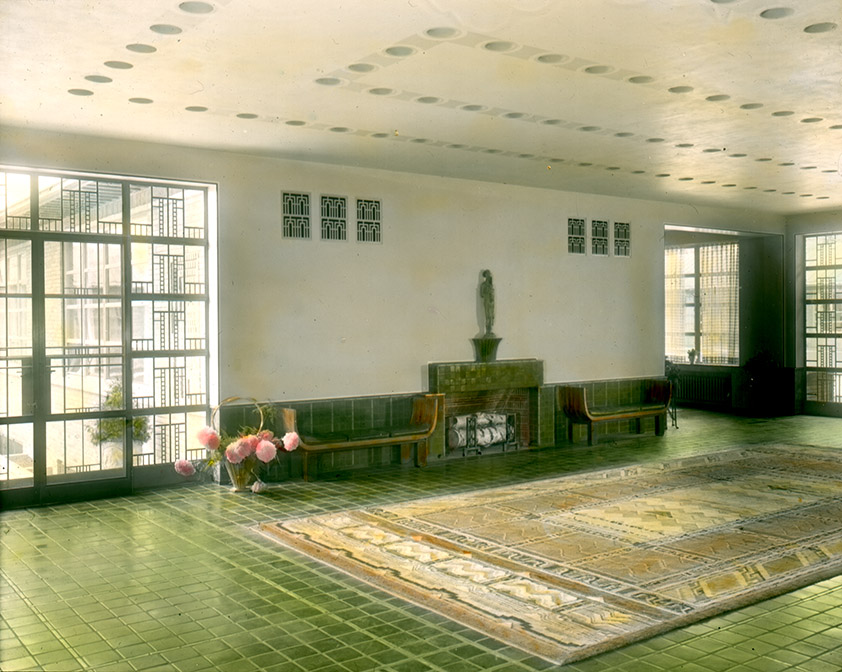
Wow: Green Lobby, Kingswood School.

Kingswood School Green Lobby, photographer George W. Hance, 1932. Cranbrook Archives.

Kingswood School Green Lobby, photographer George W. Hance, 1932. Cranbrook Archives.

What: The 319-acre campus was designated a National Historic Landmark on June 29, 1989 for its significant architecture and design – 319-acres full of cultural properties!

Cool: Thornlea – and I get to explore all the rooms.

Leslie S. Mio, Assistant Registrar, Cranbrook Center for Collections and Research

Happy Earth Day!

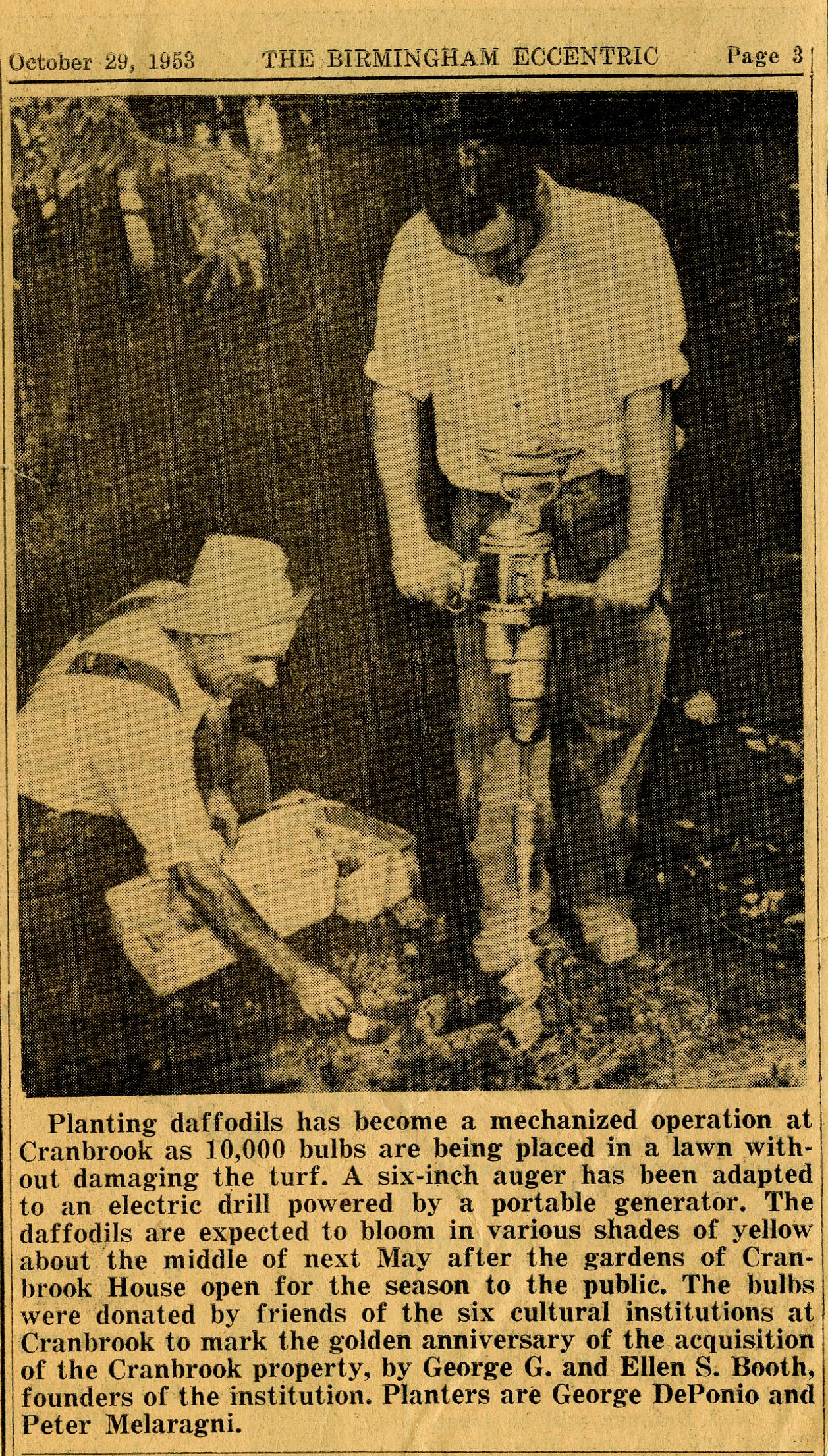
Even though Cranbrook experienced a few snow flurries today, the campus daffodils are also in bloom. It reminds me of what was known as “Daffodil Hill.” In 1953, in anticipation of Cranbrook’s Golden Jubilee celebration (the 50th anniversary of the year the Booths purchased the original 175 acres), Henry Scripps Booth led an effort to raise funds to plant daffodils at Cranbrook House.

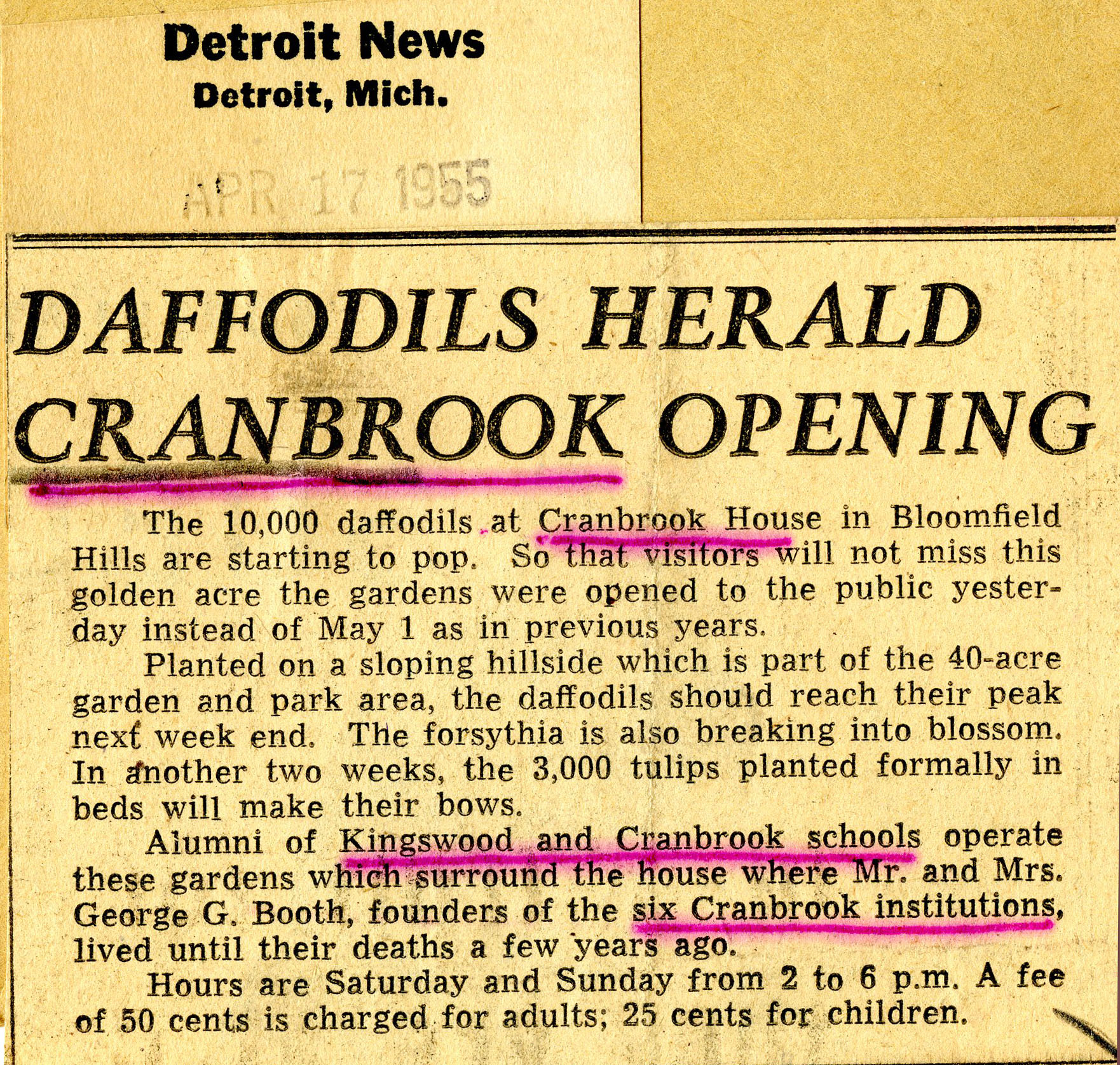
The Cranbrook Foundation Daffodil Fund was established and enough money was raised to plant 10,000 daffodils in the fall. By 1955, visitors were flocking to the campus just to see them.

Birmingham Eccentric newsclipping, 1953

News clipping, The Birmingham Eccentric, 1953. Cranbrook Archives.

Detroit News, 1955

News clipping, The Detroit News, 1955. Cranbrook Archives.

Middle School girls planting daffodils for Earth Day, 1990

Middle School girls planting daffodils for Earth Day, 1990. Cranbrook Archives.

Daffodil Hill, 1985

Originally known as “Golden Glade,” the area soon became known as Daffodil Hill, Spring 1985. Ralph Mize, photographer. Cranbrook Archives.

Leslie S. Edwards, Head Archivist

Anne Morrow Lindbergh: The Cranbrook Connection

The Archives has in its collection photographs of a sculpture modeled by Anne Morrow Lindbergh. How did Lindbergh come to study at Cranbrook? In April 1942, Charles Lindbergh, at the invitation of Henry Ford, came to metro-Detroit as a technical consultant to assist with retrofitting the Willow Run plant from auto manufacturing to bomber production. In July, the Lindberghs moved to Bloomfield Hills and signed a one-year lease for a furnished home then owned by Kathleen Belknap. Originally known as “Stonelea,” the home, designed by Albert Kahn in 1923, is located at the corner of Cranbrook Road and Woodward Avenue and is now known as Lyon House. The Lindberghs were quickly welcomed to the neighborhood by Carolyn Farr Booth (wife of Henry Scripps Booth). During the summer of 1943, Anne enrolled at the Cranbrook Academy of Art where she studied modeling and sculpture with sculptor Janet DeCoux, and art history with Ernst Scheyer. Since Charles was away much of the time, Anne asked Janet and her partner, Eliza Miller, to move in with her to help raise her four children. Thus began a friendship among the three women that lasted until the end of Mrs. Lindbergh’s life. (Approximately fifty letters, 1944-1952, from Anne Morrow Lindbergh to DeCoux can be found in the Janet De Coux Papers at the Smithsonian’s Archives of American Art.)

Anne Morrow Lindbergh

Anne Morrow Lindbergh, 1943. Cranbrook Archives.

At the Academy, Anne was treated not as the wife of a celebrity or even as a grieving mother, but as any other student. In her diaries (published in “War Within and Without”) Anne wrote of the freedom she experienced at Cranbrook “where people take me on faith.” Work in the studio, exhibitions at the Art Museum, and parties with music and conversation about art, books, and writing allowed Anne the freedom to “give my true self as I have never done in a group of people before.” She developed social courage and friendships with Janet and Eliza, Carl and Olga Milles, Ernst Scheyer, and neighbors like Kate Thompson Bromley. Her work as a sculptor taught her to see the world through a different lens – she learned how to sketch the human figure and transpose her ideas into her sculpture and it both surprised and excited her that she could actually see beauty in a sculpture, especially one made of her own hands. She was inspired by the natural beauty of Cranbrook, cross-country skiing on the grounds, and writing in her brown trailer in the woods. (Anne wrote her novella “The Steep Ascent” while at Cranbrook.) She relished the time with her children, and often walked them down the hill to Brookside School. Dinners with the Saarinens were exhilarating where they talked of “cities of the future.”

AnneLindbergh021

Anne Morrow Lindbergh picnicking at the Greek Theatre at Cranbrook, Jun 1944. Copyright The Detroit News.

In August 1943, Kathleen Belknap decided to sell the home, then known as Belwood, and the Lindberghs moved into a home at 411 Goodhue Road, behind Christ Church Cranbrook, for the next year. The two years spent at Cranbrook forever changed Anne spiritually. She discovered self-confidence, and that people liked her for who she was. After the Lindberghs returned to the east coast in 1944, Anne missed her Cranbrook friends and the life she had discovered here and wrote that she felt “only half alive since I left Cranbrook.” The Lindbergh family continued to return to the Detroit area to visit Charles’ mother Evangeline at her Grosse Pointe residence until she passed away in 1954. In January 1974, at the request of the Class of 1974, Kingswood School headmaster Wilfred Hemmer invited Anne to be the school’s forty-fourth commencement speaker.

Leslie S. Edwards, Head Archivist

The Case of the Bogdani

The other night I saw the most interesting show on PBS called “Fake or Forgery.” An investigative journalist and two noted art sleuths joined forces with cutting edge scientists to discover the truth behind a painting the owner thought to be a Degas. They thoroughly searched the provenance of the painting, and used scientific methods like X-ray fluorescence (XRF) to determine if the pigments used in the painting were compatible with Degas’ known palette. It made me think of the many works of art across the Cranbrook campus that could benefit from in-depth scientific research like this. And, it prompted me to relay the story of a discovery the archives staff made several years ago.

The painting we fondly refer to as “The Bogdani” was originally purchased by George Booth for Kingswood School for Girls, where it hung in the Domestic Science Dining Room. Purportedly painted by noted Hungarian Jakob Bogdani (1658-1724), the still life was found in a storage room badly in need of cleaning and restoration.

The painting was conserved by Ken Katz of Conservation & Museum Services in Detroit. During the several months of conservation, we were able to visit the studio in order to see the work in process, and the results were amazing.

during

During conservation.

As I looked closely at the work, my heart almost stopped beating. Bogdani’s signature was gone, and in its place was another name! My first thought was how hard I had lobbied to get the painting conserved and now it was a forgery!  However, after doing additional research, I discovered that the artist, Tobias Stranover (1684-1731) was actually Bogdani’s son-in-law and former student. Phew! Although this meant the still life was painted around 1810 instead of 1790, at least we still had an original painted by an artist who, with his father-in-law, provided the finest exotic bird and animal paintings in England. The painting currently hangs in the reading room of Cranbrook Archives.

Before conservation.

Before conservation.

after

After conservation, details in the painting can be seen can be seen more clearly, and the brilliance of the colors pop.


Leslie S. Edwards, Head Archivist


Photo Friday: Spectacular Strikeouts

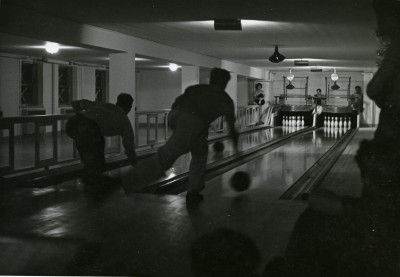
bowling alley_ CAA_1

Academy of Art students bowling. Courtesy Cranbrook Archives.

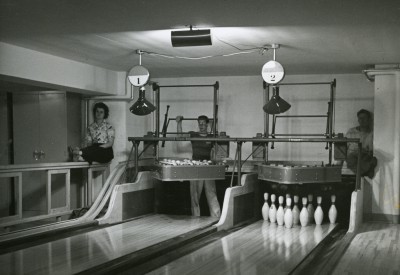
Academy of Art students waiting to reset pins. Courtesy Cranbrook Archives.

Today’s photos show Academy of Art students having some fun bowling! Bowling was popular on Cranbrook’s campus with alleys in both Cranbrook School for Boys and Kingswood School for Girls.  Kingswood School, which had the earliest alleys on campus, still uses their bowling alleys as part of the physical education curriculum.

The Academy of Art bowling lanes were located in the basement of the Art Museum and were for Academy of Art student and faculty use.  These lanes  did not have  mechanical pinsetters and therefore had to be manually set. In 1944 the lanes were removed from the Art Museum to allow for more storage for artworks, and relocated to the lower level of the Academic Building at Cranbrook School (now called Hoey Hall) under the study hall.

Stefanie Kae Dlugosz, Collections Fellow, Center for Collections and Research

Photo Friday: Wartime Conservation, Kingswood-Style

Kingswood students Blenda Isbey, Irene Bard, and Nollie Campbell collect waste fat after their Home Economics class at Kingswood School, 1944. Harvey Croze, Cranbrook Archives.

During World War II, students at the Cranbrook and Kingswood Schools became increasingly involved in homefront activities. Here, Kingswood students Blenda Isbey, Irene Bard, and Nollie Campbell collect waste fat after they’ve finished their Home Economics class. Fat could be used to make soap, in great demand because of wartime rations, but was also consolidated for use in explosives.

Poster advocating the re-use of waste fats in explosives. Henry Koerner, Printed by the Office of War Information, 1943. National Archives.

Poster advocating the re-use of waste fats in explosives. Henry Koerner, Printed by the Office of War Information, 1943. National Archives.

Shoshana Resnikoff, Collections Fellow

Create a website or blog at WordPress.com