The Annex, the Attic, and My Senior May Adventures

Each May, the Center is honored to host outstanding seniors from Cranbrook Kingswood Upper School for a three-week immersive internship.
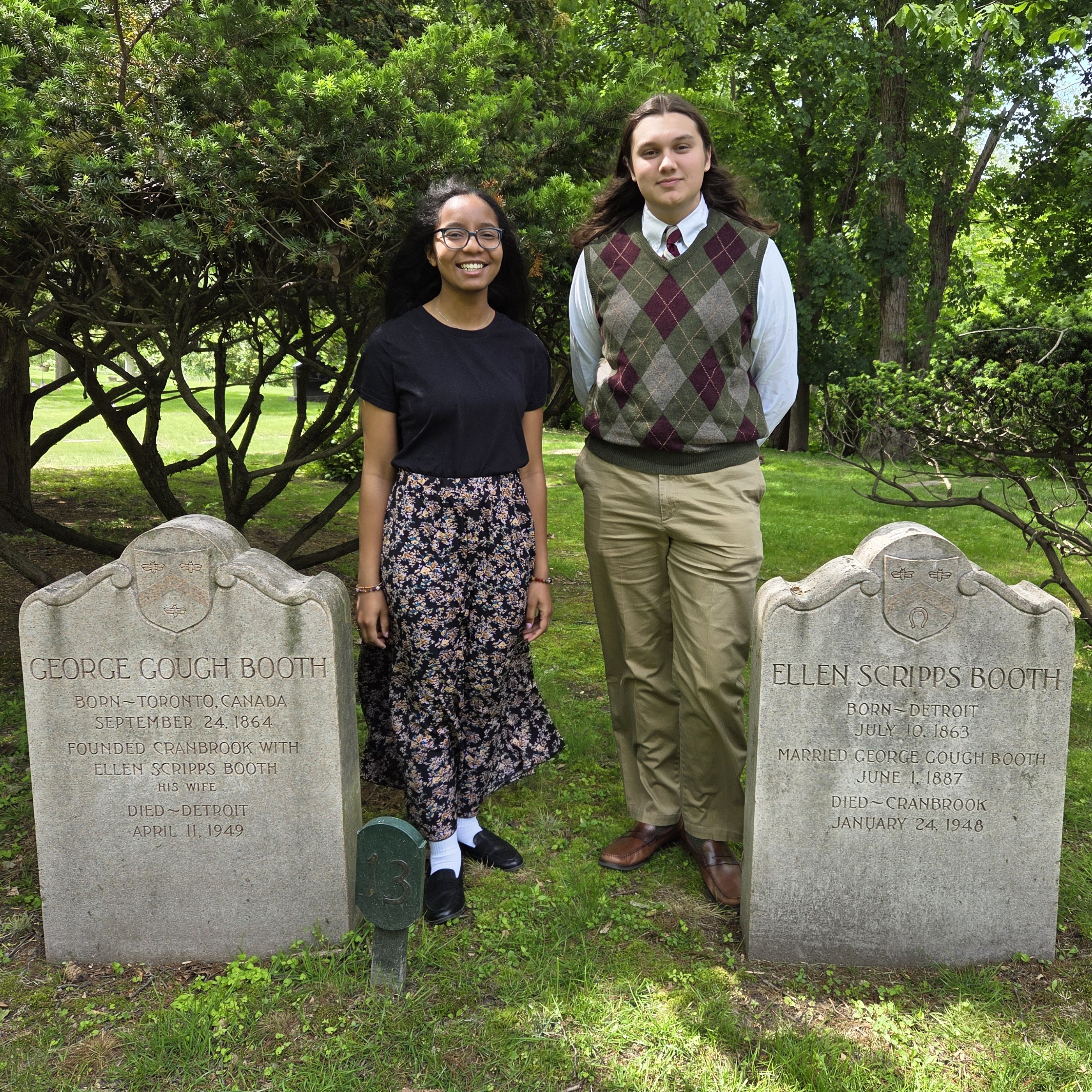
Kamilah Moore and Joel Kwiatkowski, 2025 Senior May interns, visit George and Ellen Booth at Greenwood Cemetery, Birmingham. Photography by Leslie Mio.

This year two seniors, Kamilah Moore and Joel Kwiatkowski, worked with the Center and Archives staff, including writing blogs! Hear from Joel today and look out for Kamilah’s post next week.
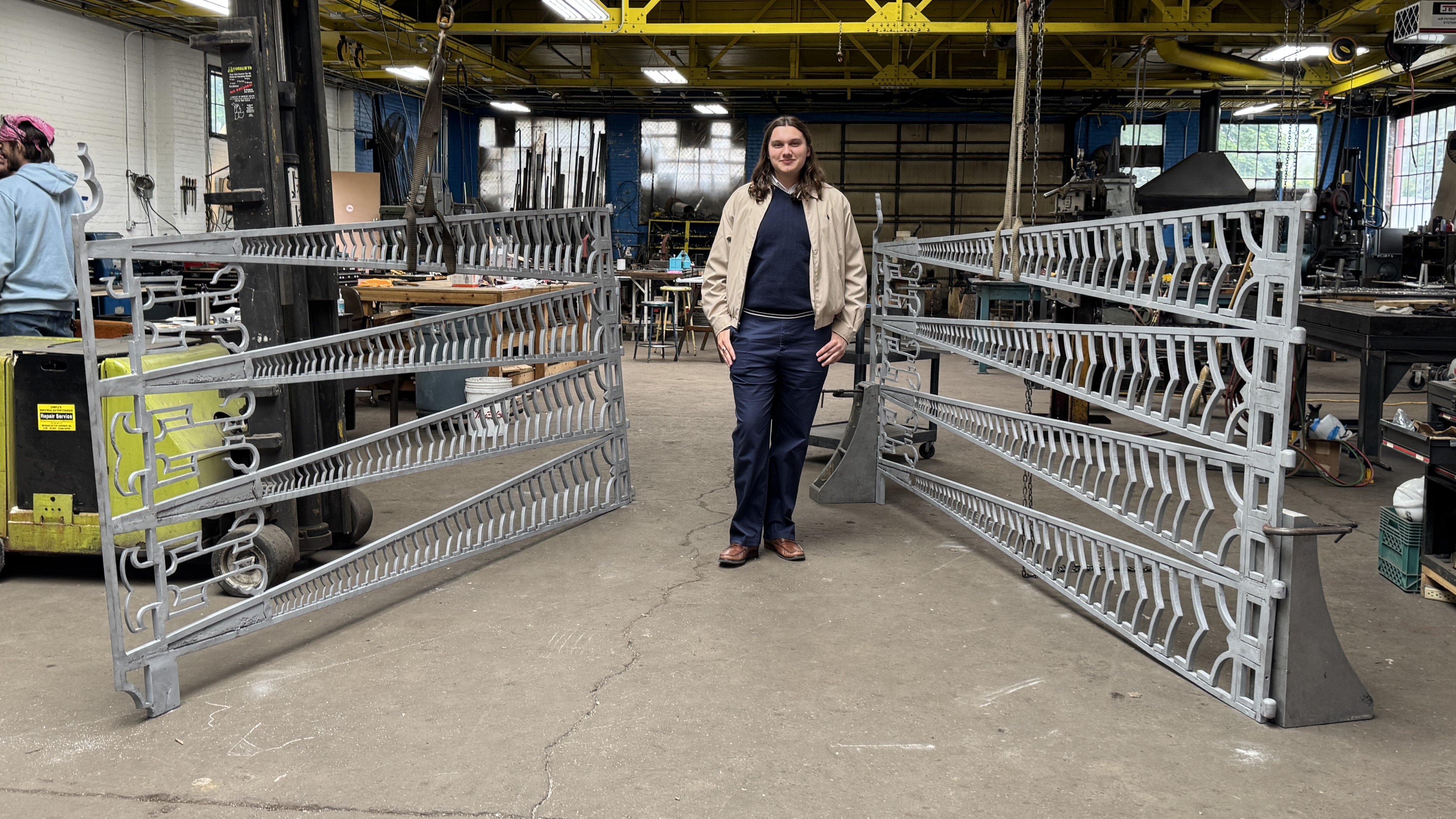
Checking in on the Eliel Saarinen-designed Kingswood main gate at Smith Shop in Highland Park, May 2025. Photography by Kevin Adkisson.

Cranbrook Center for Collections and Research is a name that invokes the image of some grand museum or hall, with many sterile prep rooms and rows upon rows of file cabinets. Now don’t get me wrong, there are plenty of file cabinets, but the Annex is far from grand. Instead, the rather humble staff apartment-turned-offices are befitting the lovely people there.

The Center’s Annex, next door to Cranbrook House, is situated above the House & Garden Auxiliary offices, up a set of winding stairs that require me to duck in a few places. But up there you will find a quaint little kitchen (complete with a toaster oven and healthy snack collection), a few offices, and closets and cabinets dotted with curiosities.
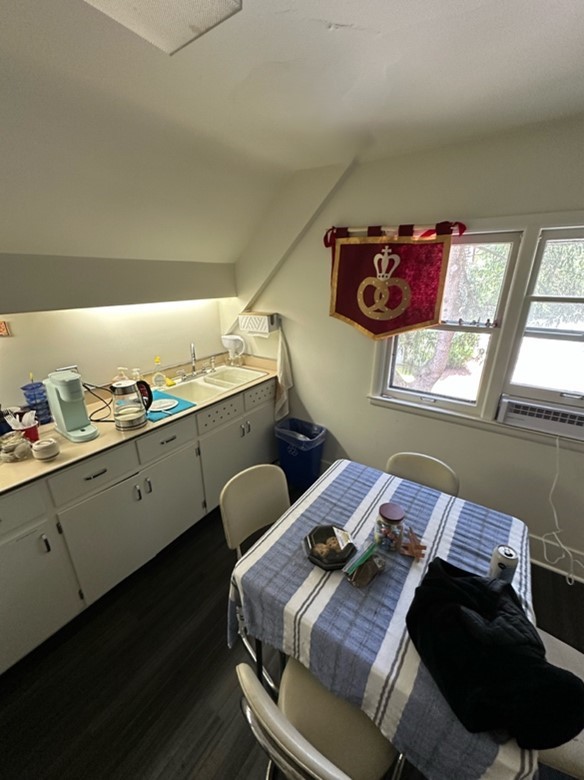
The quaint kitchenette of the Annex, compete with decommissioned Cranbrook Institute of Science Library chairs, May 2025. Photography by the Author.

It was this atmosphere, over many chatty lunches, that I got to know Leslie Mio, the Associate Registrar, and Mariam Hale, the 2023-2025 Center Collections Fellow. It was a pleasure to find two individuals who cared so greatly for history and conservation, and we bonded over our shared love of museums and particular historical eras.

But, let it be known that work at the collections isn’t all comfortable work behind a desk or searching a filing cabinet. This illusion, if I ever had it, was quickly broken on my first full day of the internship. Our task? Moving five solid wood cabinets from the rooms of retirement-age nuns across the building to be used to store Cranbrook’s lacy dresses and costumes.

Briarbank, a neighboring estate to Booth’s land, was converted into a place for sisters to stay once they needed a bit more care later in life. But, at some point, the demand for a place such as that ran dry, and Cranbrook bought the campus. And now, in that spirit, I was near horizontal in my penny loafers, shoving a giant wardrobe into place across some very tasteful carpet.

Mariam and I defy the friction of decades old carpet, May 2025. Photography by Leslie Mio.

In the coming days, the purpose of these heavy cabinets would be realized, as we began the true overarching theme of my time at the Center: moving a seemingly infinite number of objects from the hot attic of Cranbrook House to the comparatively “less hot” and climate-controlled storage area at Briarbank. Paintings, prints, textiles, rugs, hats, and racks of clothing and costumes were deftly maneuvered through the halls and offices of Cranbrook House (or, alternatively, very carefully down the narrowest, steepest, stairwell known to mankind).

Each day packing and moving Cultural Properties in the attic was sure to bring new surprises. Everything from a fur hat belonging to George Booth to paper parasols, or entire handwoven rugs the size of a small house. While these days meant a bit of manual labor, they never ceased to bring me joy, as the wonderful folk of the Center doled out tidbits of Cranbrook’s story connected to each unearthed gem.

The fabulous hat in a box marked “G.G.B.” — the box is possibly a later acquisition by Henry S. Booth — May 2025. Photography by the Author.

Now those familiar with the Center may be wondering: “Now wait just a minute. Where is my favorite curator? Where is the delightful presence of the steward of Saarinen House?” Well, fear not good reader, for while Kevin may not have been at every boxing and unboxing, Kevin joined Kamilah and me on many excursions outside the Samuel-Yellin-forged gates of Cranbrook. For those unacquainted, Kevin Adkisson is Curator of the Center, the veritable fountain of all knowledge concerning Cranbrook, and legend in his own time among students.

My first trip with Kevin came when we were tasked with heading to Detroit to give a tour of Holy Redeemer Church to a group of 8th graders from the Catholic school next door. I thought that getting middle schoolers excited about Corinthian columns would be impossible, but Kevin’s energy and skill made it look easy.

Kevin and I had fun teaching Holy Redeemer 8th graders about architecture. Photography by Holy Redeemer.

Afterword, we headed to visit the master ironworkers at Smith Shop, where the Eliel Saarinen-designed Kingswood main gate is being repaired and restored. I stood back and observed while Kevin, Cranbrook Capital Projects Director Jean-Claude Azar, and Amy Weiks and Gabriel Craig (co-owners of Smith Shop) debated the ins and outs of the gate’s making and breaking.
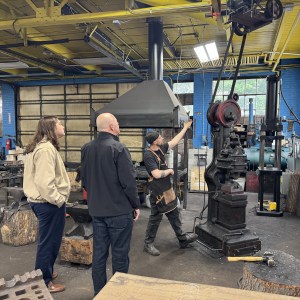
I enjoy a tour of the facilities of Smith Shop with Cranbrook Capital Projects Director Jean-Claude Azar and Smith Shop co-owner Gabriel Craig in Highland Park, May 2025. Photography by Kevin Adkisson.

Across my three week Senior May, I also took trips to the paint store to debate shades of grey, the frame shop to mount an object, Ken Katz’s painting conservation studio, and even Birmingham’s historic cemetery. On each of these trips, I gained insight into the multifaceted work of the Center for Collections and Research, including care and handling, teaching, conservation, and cataloging.

I cannot fully capture in a blog what a delight it was to be in the presence of such knowledgeable individuals. For every question about Cranbrook’s history, each member of staff was sure to add in their own expertise, citing obscure letters and photographs, adding a beautiful familiarity to their responses and giving color to the story of Cranbrook.

Of course, I would be remiss to leave out some of the other folks who make the Center function, like Greg, Jody, Amy, and Jess. These are the people who drive the work, managing, fundraising, and promoting the vision of Collections and ensuring the continued progress of the Center’s goals.

Even interns have meetings, Kamilah and I sat in on one of the Center’s weekly staff meetings. Photography by Kevin Adkisson.

On my last day, I had the privilege of working with Jess Webster, Development Coordinator, who also helps run the Center’s social media. With Kamilah, I researched, drafted, workshopped, and delivered a script for an Instagram Reel commemorating the 150th birthday of Carl Milles., During my time working out ideas for the video (and even this blog), I gained a new appreciation for the way in which Cranbrook is viewed from the outside.
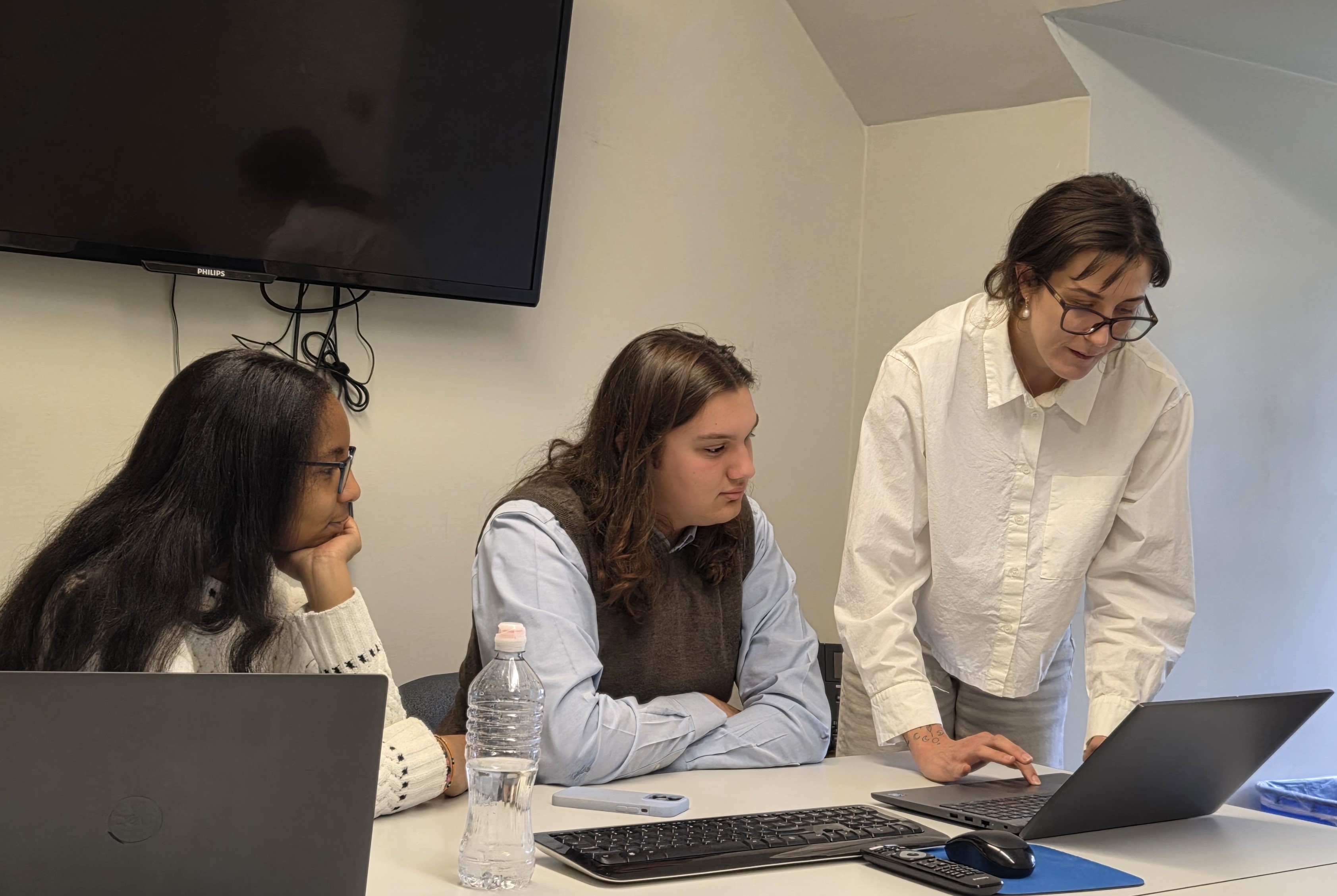
Kamilah and I workshopping our reel for Carl Milles’s 150th birthday with Jess, May 2025. Photography by Leslie Mio.

For me, as a student at Cranbrook, my view is that of someone on the inside, who has the privilege to walk by art on campus each and every day (admittedly at times without a second thought). But getting to see the behind-the-scenes of Cranbrook’s beautiful historic campus has given me an appreciation that feels wholly unique amongst my peers.

If you’ve read this blog, I urge you to take a moment to appreciate all that goes on caring for a 100-plus-year-old campus to live on to this day and serve its many students and visitors. From calls, texts, emails, and meetings, the Center is busy planning, filing, caring, and protecting the legacy of Cranbrook. The work is never done.

Yet despite the challenges, the Center rises to the task, willing to give their all to something they passionately care for. It would be hard not to be inspired.

Kamilah and I make a video for Carl Milles’s 150th birthday, May 2025. Photography by Jessica Webster.

This internship has truly been a dream-come-true, and I am grateful to Mariam, Leslie, and Kevin for their warm welcome and tutelage.

Joel Kwiatkowski, Cranbrook Kingswood Upper School Class of 2025 and Cranbrook Center for Collections and Research 2025 Senior May

Editor’s NoteThe Senior May Project is a school-sponsored activity that encourages Cranbrook Kingswood Upper School seniors to acquire work experience in a field they are considering as a college major, a potential profession, and/or as a personal interest.

Joel Kwiatkowski graduated from Cranbrook in June 2025 and will be attending the University of California San Diego in the fall to pursue a degree in Molecular and Cellular Biology. Joel first came to Cranbrook Schools in sixth grade, and has since gained a passion for the institution’s rich history of influential artists and personalities. 
Go Towers! Go Fountains! Go Quads!

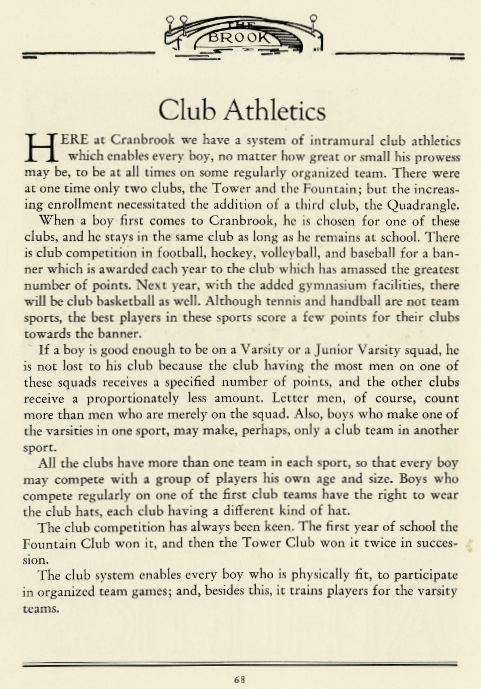
In addition to Varity and Junior Varsity sports, students at Cranbrook School for Boys also participated in Club Athletics.

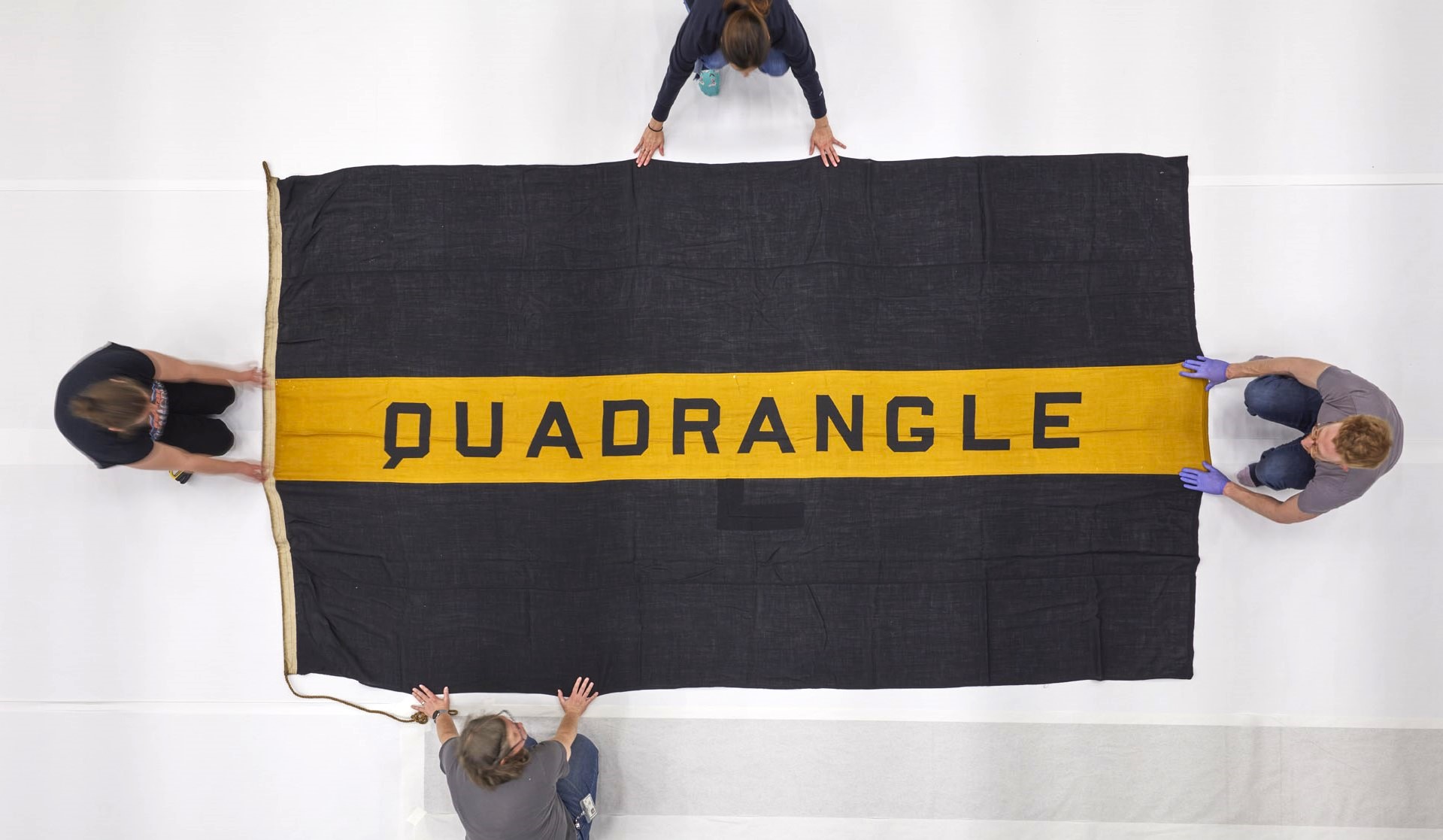
Nina Blomfield (left), Jessica Majeske (top), Kevin Adkisson (right), and Leslie Mio (bottom) setting the flag in place for photography in the Cranbrook Collections Wing, March 10, 2023. Photograph by James Haefner, Cranbrook Center for Collections and Research.

In the 1932 The Brook (the school’s yearbook), it states: “The fact that inevitably there has to be a large proportion of the student body left over from varsity teams has fostered the club system. By dividing the whole school up into the three factions of Fountains, Towers, and Quadrangles . . . every student is able to take an active part in athletics and thus enjoy competitive games.”

Page on Club Athletics from The Brook, 1931. Courtesy Cranbrook Archives.

And, each of the three factions had a flag! Here are the flags of the clubs, stored alongside other Cranbrook School Cultural Properties.

The flags are very large, over 13 feet long and 7½ feet high. Pretty heavy to wave around! These wonderful photographs were made by James Haefner when we photographed all our Studio Loja Saarinen rugs.

The club system did not last very long at Cranbrook School for Boys. Looking at the copies of The Brook, it seems to have been gone by the 1940s. Perhaps some spirited students from Cranbrook Kingswood Upper School might revive the faction system? If so, we are ready to help with your flags!

Leslie Mio, Associate Registrar, Cranbrook Center for Collections and Research

Gravity, Dignity, and Softness: The Voice of the Pipe Organ

In addition to working as an Associate Archivist at Cranbrook, I am also a fledgling volunteer docent at Christ Church Cranbrook. Recently, I gave a tour of the Chancel to test my skills with my teachers. As I prepared, I found there was very little written about the history of the pipe organ at the church. So, where to turn for more information? Cranbrook Archives, of course.

In August of 1925, George Booth and Oscar Murray (of Bertram G. Goodhue Associates, the church architect), started in earnest to finalize their thoughts and feelings about the choice of organ for the church. While the organ itself was installed in January 1928, plans for its ducts and conduits had to be decided early, before the concrete floors were poured.

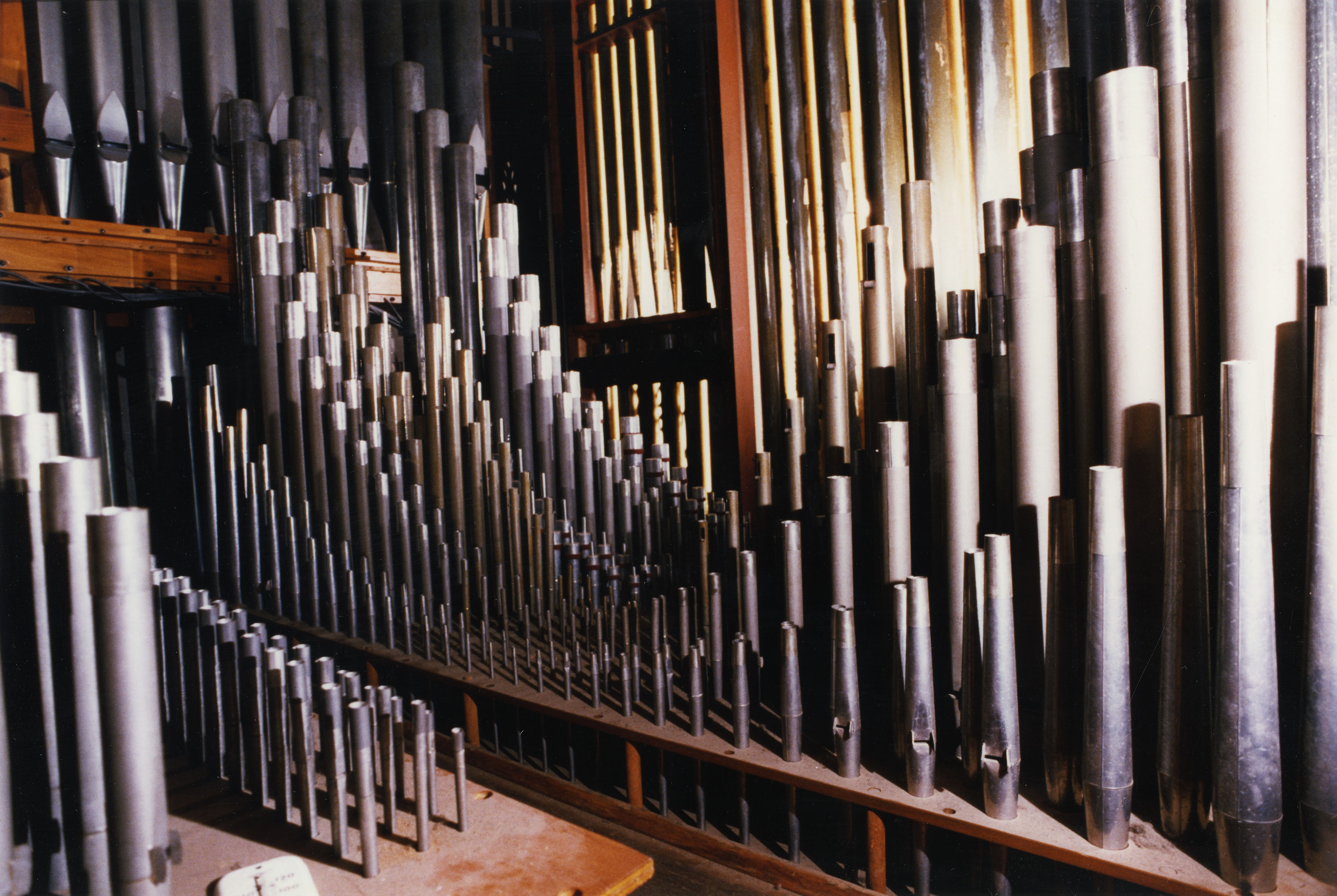
Christ Church Cranbrook organ pipes prior to the 1997 restoration. Jack Kausch, photographer. Courtesy of Cranbrook Archives.

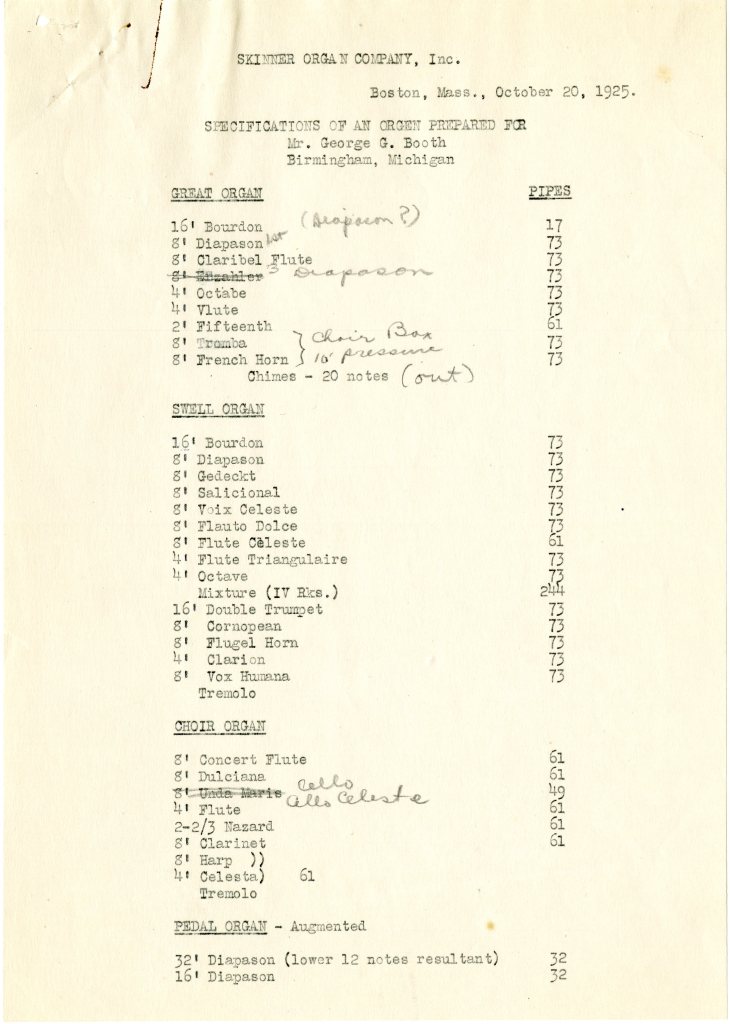
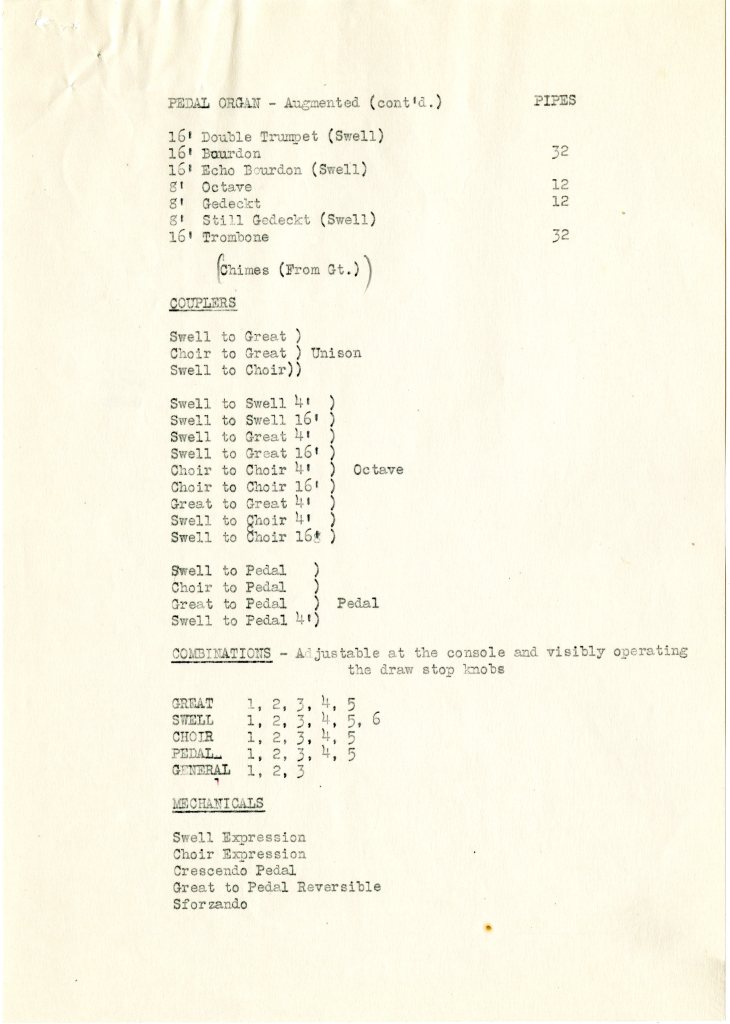
The correspondence suggests that the E.M. Skinner Organ Company was the only company considered. The Boston-based firm was considered America’s finest and most technologically advanced organ builder. Skinner’s specifications for the organ, console, and bench were submitted in October 1925.

George Booth inquired of his colleague Cyril Player to provide comments on the specifications, and Player begins his commentary saying,

“I think I would emphasize gently to them that you want gravity, dignity and softness—the three prime essentials of any church organ, large or small… [gravity] is secured by an adequate and properly-balanced pedal department; dignity by volume of foundation tone in the basic divisions of the instrument; and softness and refinement by skillful voicing with a copious wind stream at a moderate pressure.”

Cyril Player to George G. Booth, November 1925

In passing along the comments to Murray, Booth remarks that, “the desired qualities, viz; gravity, dignity and softness; seems to me peculiarly to express my own feelings and desire.”

William Zeuch of Skinner Organ Company revised the specifications following some of Player’s suggestions, while some revisions were the suggestion of Henry Willis, the great English organ builder who was a consultant to the firm. The contract for the organ (including the Great, Swell, Choir, and Pedal pipe divisions) was duly signed in December 1925 and work proceeded.

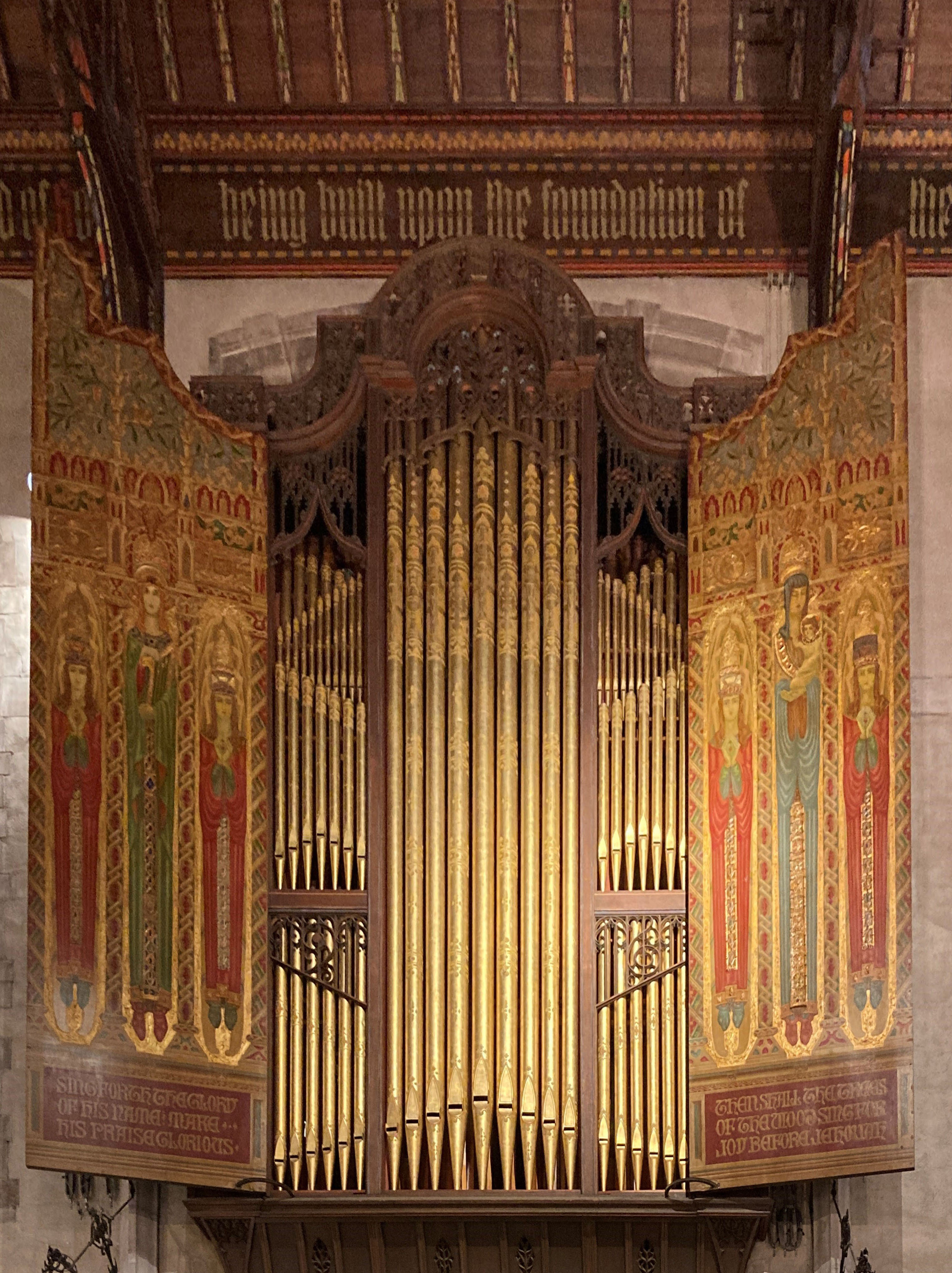
At the same time, a separate contract was made with Alfred Floegel to decorate the organ case doors. Booth wished to confine the oak finish to the exterior of the doors while having the rest richly decorated with color. Booth imagined the opening of the organ doors to represent the opening of the mind. He also envisioned the organ case to read as a triptych (a picture or altarpiece on three hinged panels) when open.  

Organ case doors, woodwork by Irving and Casson, decoration by Alfred Floegel. Gift of James Scripps Booth. Laura MacNewman, photographer.

In July 1927, work on the organ console began. The console is where the organist sits to play the instrument, distinguished by its multiple hand keyboards (called manuals), pedalboard, and other controls. Rev. Dr. Marquis requested a change from a 3-manual (Great, Swell, and Choir pipe divisions) to a 4-manual, by adding the Solo division. Zeuch responded positively as it was not too late to build a 4-manual console; however, having already instructed the architect to reduce the dimensions of the organ chamber, which had been too large and would have interfered with the proper effect of the sound in the church, the architect would now need to find space for the Solo division. Room was found above the Sacristy.

Continue reading

The Art of Simplicity: Bonawit’s Grisaille

The clerestory windows designed by G. Owen Bonawit in the nave of Christ Church seem to be one of the least described elements of the church’s artwork. The work was negotiated and subcontracted through architect Oscar H. Murray at Bertram Grosvenor Goodhue Associates rather than commissioned directly through George G. Booth. Consequently, there are few documentary vestiges of the artist’s process in our records.

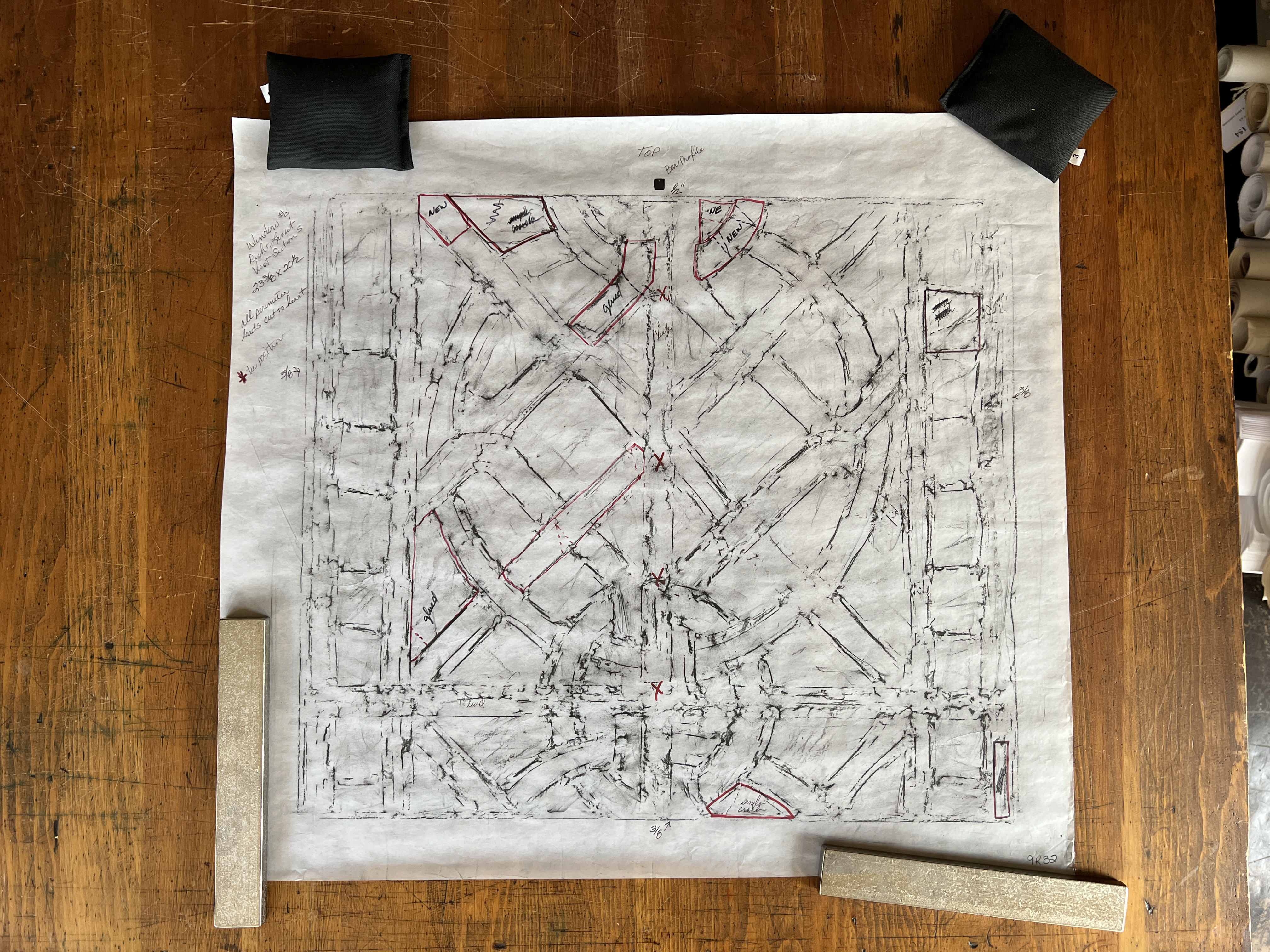
The windows can be studied through other materials held by the Archives, including architectural drawings, photographs, and the records of a window restoration project which commenced in 1993. In 1995, the Thompson Art Glass company made rubbings of the window for the purposes of identifying their care and preservation needs.

There are seventeen grisaille clerestory windows in the nave and chancel at Christ Church, which were analyzed as part of this stained-glass restoration project. They are made of clear antique glass upon which minute floral detail is painted and accentuated by the addition of small amounts of colored glass. In the chancel, there are two lancets and tracery of nine panels supported by T-bars including one ventilator panel. In the nave, they are comprised of three lancets and tracery with eight panels, with ventilator panels making up the bottom row.

Detail from Architectural drawing of Christ Church Cranbrook, North Elevation. April 30, 1925. Drawn by J.E.M./Oscar H. Murray, Bertram Grosvenor Goodhue Architects. [AD.10.33]. Courtesy of Cranbrook Archives.

Grisaille, literally meaning ‘to grey,’ is a type of stained glass that is mostly monochromatic, with a silver or grey tone being painted onto the finished glass. The purpose of the plainness of grisaille is twofold: they let more light into the space both literally and metaphorically in that they were intended to limit distraction from meditation.

The grisaille stained glass style is thought to have originated in French Cistercian abbeys after a prohibition on colored glass issued by St. Bernard of Clairvaux in 1134 in accordance with their charism of simplicity. St. Bernard, the master of paradox, also banned the use of figurative decoration according to the First Commandment of no graven images. Under his guidance, the Cistercians seek the face of God, a theological anomaly that produces an exquisite spiritual discipline and religious practice through which the monk contemplates holiness by virtue of continually recognizing the poverty of their thoughts and feelings when weighed down by seeking to satisfy worldly desire. The style often employs natural or geometric patterns, much like a labyrinth.

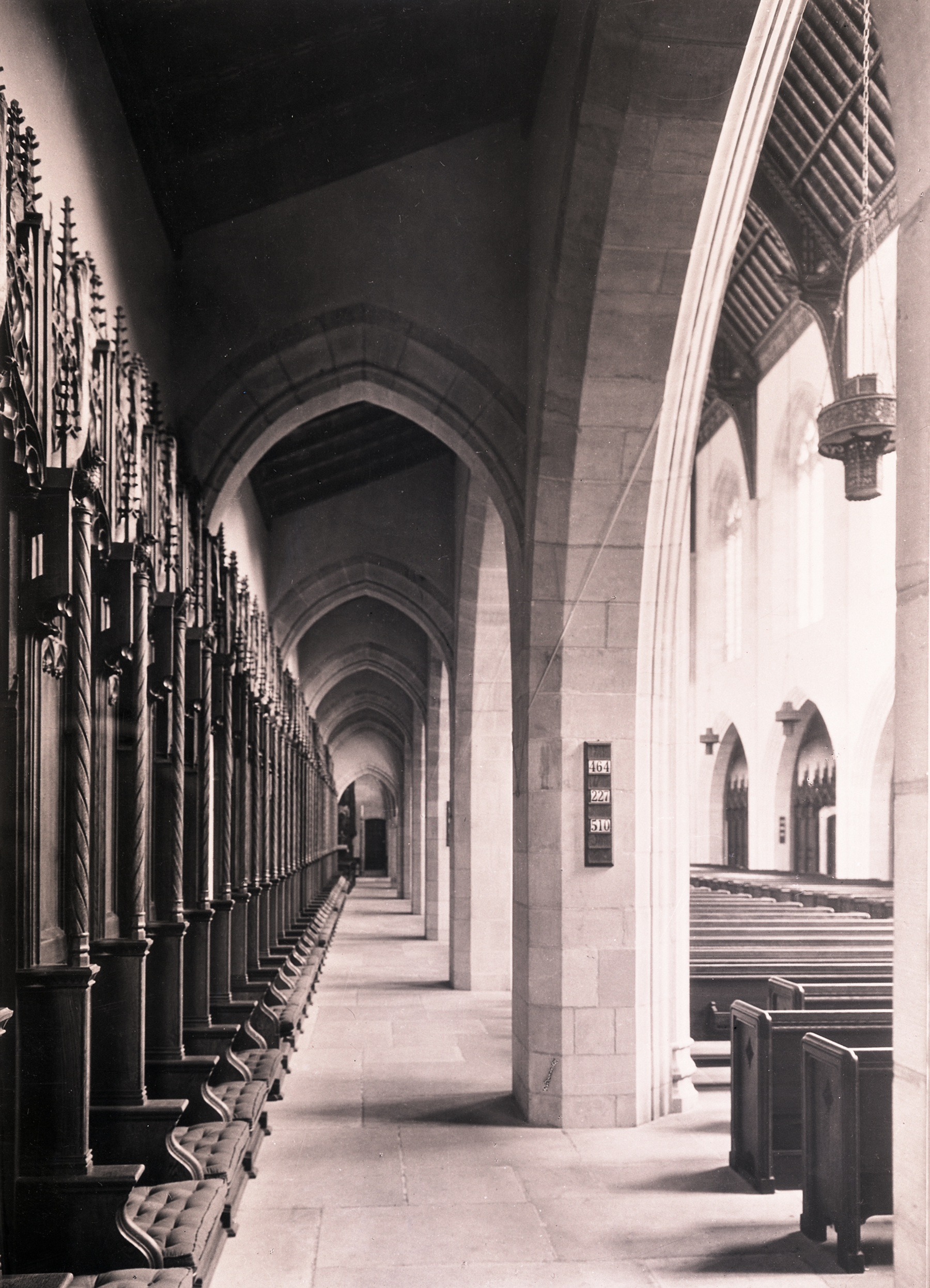
The windows can best be observed by sitting in the aisle stalls of the nave, which are in themselves an unusual feature otherwise only found in Oxford college chapels. The walls of the nave were originally intended to display memorials and artwork, but the latter idea was revised due to the objection that it would bring a museum feel to a house of worship.

Aisle stalls in left side of sanctuary. June 23, 1946. Photographer, Harvey Croze. Courtesy of Cranbrook Archives.

Added in 1930, the aisle stalls offer a fine perspective from which to observe the grisaille, and Bonawit’s elegant craftmanship brings with it a history of monastic inspired light. Since a life without beauty is only half lived, the artistic eclecticism of Christ Church offers all those who enter the opportunity to embrace the other half both in its resplendency and in its simplicity.

Laura MacNewman, Associate Archivist, Cranbrook Center for Collections and Research

The Heartbeat of the Nation

In August 1989, Cranbrook became a National Historic Landmark. America’s highest designation for a place of outstanding historical significance, it was no small feat for Cranbrook to become Michigan’s twenty-second National Historic Landmark (there are only forty-two today). So, what exactly is a National Historic Landmark, and how did we become one?

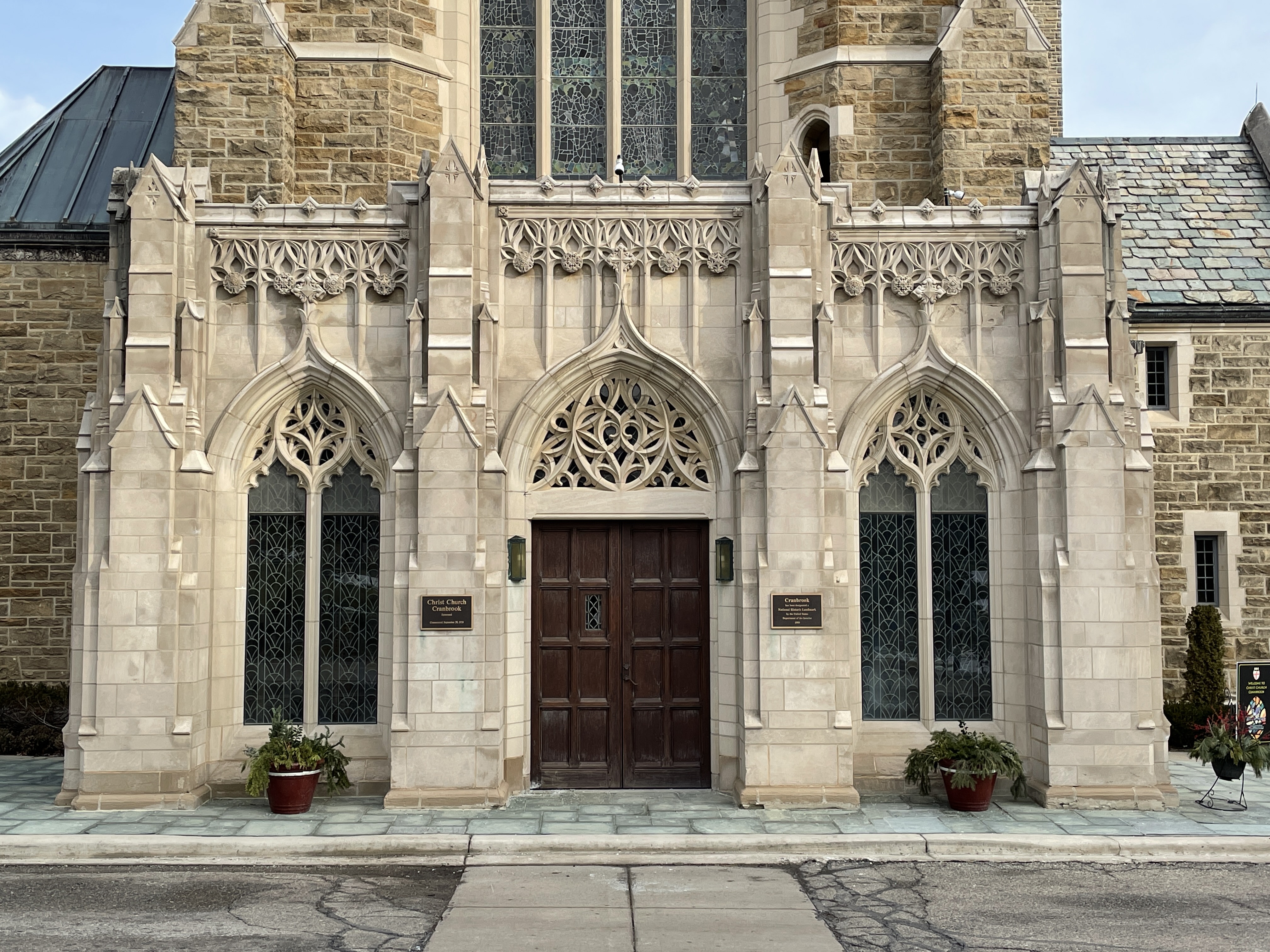
National Register of Historic Places plaque on the Kingswood Campus. Photographs by Kevin Adkisson, Cranbrook Center for Collections and Research.

Statutory provision for historic preservation began in America in 1906 with the Antiquities Act, which was further developed by the Historic Sites Act of 1935. Administered by the Department of the Interior, this Act was enacted to document and protect sites of national significance. In 1960, the National Park Service began administering the survey data from the Historic Sites Act, and the National Historic Landmark designation was introduced.

The National Historic Preservation Act of 1966 expanded the 1935 Act to local and state sites. This created the National Register of Historic Places, which began to identify, evaluate, and protect America’s historic resources. Many thousands of buildings have since been added to the National Register. In June of 1972, Cranbrook’s application was prepared by an Assistant Historian at the Michigan Department of State in Lansing, and the nomination was based on Cranbrook’s significance as a complete district of educational and architectural structures.

National Register of Historic Places plaque at Brookside.

To be eligible for designation on the National Register (a step below the National Historic Landmark status), the nominated site must have in its architecture, archeology, engineering, or culture integrity of location, design, setting, materials, workmanship, feeling, and association.

National Register of Historic Places plaque at Cranbrook School.

In addition, sites on the National Register must meet one of four criteria: be associated with events in the lives of significant persons; embody distinctive characteristics of a type, period, or method of construction; represent work of a master and high artistic values; or have or be likely to yield information important to prehistory or history. Once these criteria are evaluated and met, the site may be listed.

National Register of Historic Places plaque at Cranbrook Institute of Science.

Cranbrook was added to the National Register in March 1973, and it was at this point seven National Historic Landmark signs were ordered to be placed at each of the original Cranbrook Institutions and on Cranbrook House. (Christ Church Cranbrook was included in the designation, even though it would formally split off as a separate entity later in 1973 with the formation of Cranbrook Educational Community.) In writing to inform us of the designation, Samuel Milstein at the Department of Natural Resources eloquently wrote that:

“The State of Michigan is very proud of the fact that the property is qualified for this designation. The National Register records the story of the Nation, and is a list of distinction identifying those properties by which present and future generations can sense the heartbeat of the United States.”

Letter from Samuel A. Milstein to Cranbrook Institutions, March 30, 1973. National Register for Historic Places Records.
Non-official National Historic Landmark plaque at Christ Church Cranbrook, on right. The official plaque was changed at some point.

This language echoes that of George Booth in speaking to Cranbrook School in 1928, in which he emphasizes the importance of finding the treasure at your feet, the building up of an ethos of service from the local to the national to the global:

“If we feel our first loyalty to our State and are determined in every way we can to enrich it; if we never fail to see that we must give; if we are resolved to strive only for that which is worth while, then will our State have a place in the Nation, of which we will all be proud. The stronger and more glorious each of the States may be, the stronger and more glorious the Nation; and hence, the better and finer our opportunity for service to the world.”

Address by George Booth given on “Founders’ Day” at Cranbrook School for Boys, October 26, 1928. Cranbrook Archives.

But of course, our story doesn’t end with the National Register. In June 1987, the Chief Historian of the National Park Service (NPS) wrote to Cranbrook’s president, Dr. Lillian Bauder, to inform her that they were studying the property to determine its potential as a National Historic Landmark. Only 3% of sites on the National Register of Historic Places receive the higher honor of becoming National Historic Landmarks.

National Register of Historic Places plaque at Cranbrook Academy of Art.

The designation process follows three steps: study, including a visit to the property; review by the NPS Advisory Board; and a decision of designation by the Secretary of the Interior. The study was completed in February 1989 and the Advisory Board made its recommendation to Secretary Manuel Lujan in May. Cranbrook was designated a National Historic Landmark in August 1989.

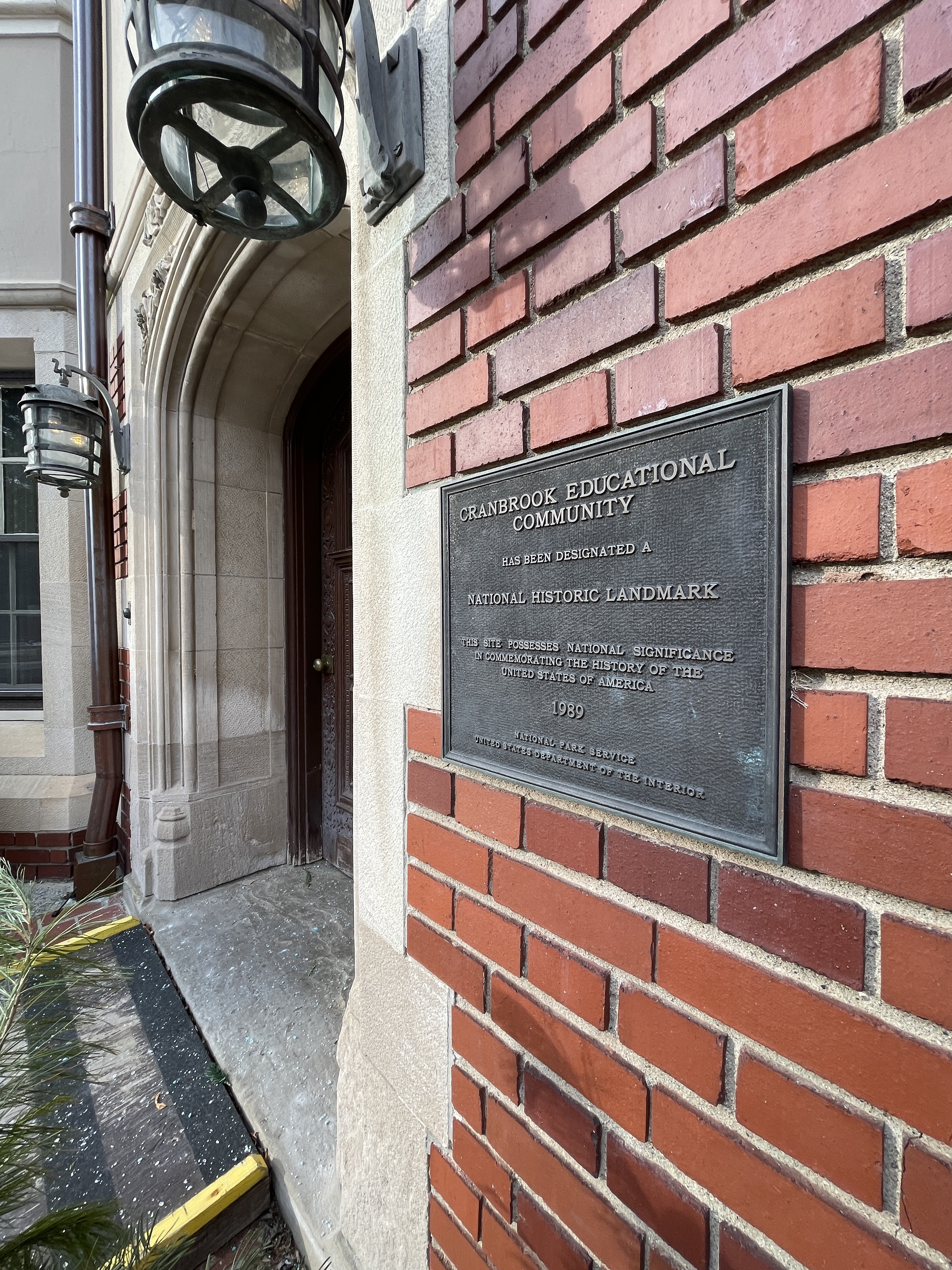
The Cranbrook House sign was swapped from a National Register of Historic Places sign to a National Historic Landmark sign, encompassing all of the Cranbrook district.

National Historic Landmark plaque for the entire Cranbrook Educational Community next to the front door of Cranbrook House.

The work of the Center for Collections and Research is embedded in the obligations of historic preservation in caring for and maintaining the community’s history, but also in articulating its meaning and value. Our mission nicely parallels the goals of the National Historic Landmark program. Even without such recognition, all who visit Cranbrook know it is a special place—but sometimes it is nice to have a plaque say so, too.

Laura MacNewman, Associate Archivist, Cranbrook Center for Collections and Research

Tool of the Trade

Light, temperature, and humidity can all harm a museum’s objects and artifacts. In a previous blog, I talked about what damage light can do and how we are combating that at the Frank Lloyd Wright Smith House. The battle for consistent temperature and humidity in the house is another issue.

Frank Lloyd Wright Smith House, 2012. Photo by James Haefner.

In October 2018, we had a Conservation Assessment done at Smith House by ICA – Art Conservation. According to ICA,

Temperature can affect a collection in . . . significant ways. Elevated temperatures have the capacity to increase the rate of deterioration . . . [and] temperature affects relative humidity.

Relative humidity is the ratio of the amount of water vapor in a particular volume of air relative to the maximum amount of water vapor this same volume of air can hold at the same temperature.

As relative humidity fluctuates, the environment and the materials within it will seek equilibrium with one another . . . Within a museum or historic structure, the collection objects and building materials will act like a sponge to these fluctuations, which can cause irreversible mechanical damage.

In the museum community, it is recommended that the relative humidity be kept as stable as possible and the temperature as low as practicable. A relative humidity (RH) range between 55% to 35% is thought to be best for general conditions. However, it is the stability of the relative humidity that is more significant than the actual value. Temperatures below 72˚F and above 32˚F are considered acceptable when the relative humidity is controlled.

So, what was the Center to do? Equipment for monitoring (data loggers) was purchased. We started regular environmental monitoring throughout Smith House. Logs were created to record the environment ranges for temperature and relative humidity for the spaces.

Data loggers are devices equipped with sensors and a microprocessor to monitor and record data such as temperature and relative humidity. We chose Lascar’s EL-USB-2. This standalone data logger measures more than 16,000 readings and features a USB drive so data can be downloaded directly to a computer.

Data logger used to monitor temperature and humidity in Smith House.

However, it is not always practical to carry a laptop around Smith House to download the data or remove the data loggers to download on my office PC. Instead, I use the EL-DataPad. It allows the configuration and download of temperature and humidity data loggers on the spot.

Data pad with attached data logger.

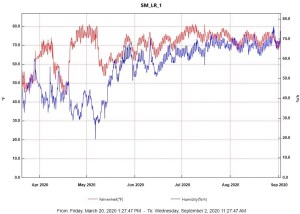
In the Smith House, the temperature and humidity is recorded every 30 minutes. I log this data and graph it, to see trends or issues in the house.

Graph of Smith House Living Room temperature and humidity readings from March to September 2020.

How will this documentation help conservation of objects in Smith House? The data will be useful for establishing achievable set points and ranges for the house environment. It will also be helpful for writing grants to help fund equipment or materials for further environmental management.

Leslie S. Mio, Associate Registrar, Cranbrook Center for Collections and Research

Clean as a Whistle

In the past, we have discussed how we cover our stone sculptures on campus to protect them in the winter. But what about the many bronze sculptures? Europe and the Bull? Persephone? The Centaurs?

These pieces are more robust and able to withstand what winter throws at them, but they still need some love each year.

Each spring since 1987, the Community has brought in Venus Bronze Works to recondition the bronzes across the campus. Venus Bronze Works is a member of the American Institute for Conservation of Historic and Artistic Works, which means all the cleaning they do is in accordance with AIC’s Code of Ethics and Guidelines for Practice.

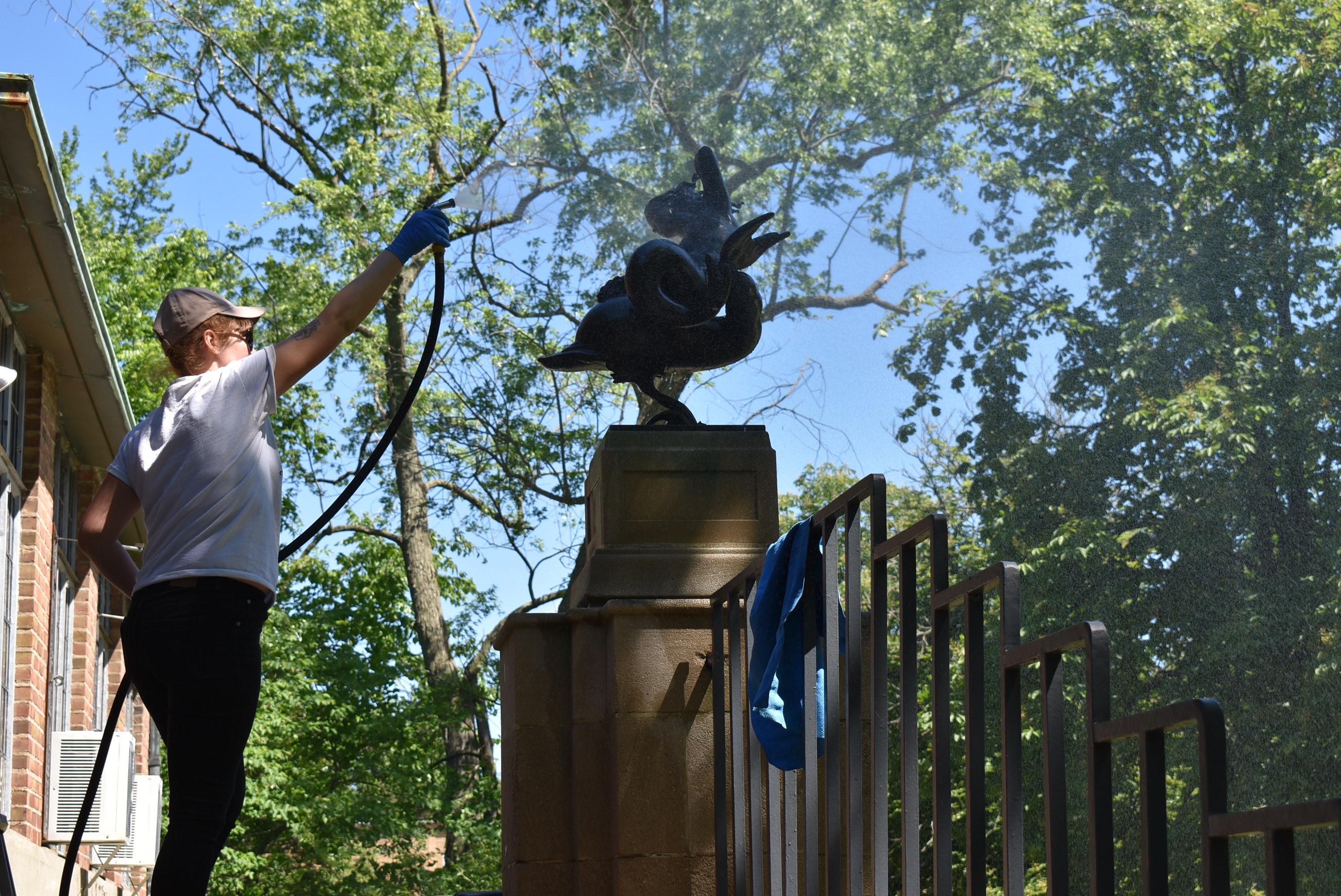
All sculptures are inspected and cleaned by dusting them off with compressed air or wet down and washed with a mild detergent, sponges, soft bristle brushes, and fine cotton pads.

Terra Gillis of Venus Bronze Works gives Carl Milles’s Sunglitter (also know as Naiad and Dolphin, CAM 2002.1) a quick shower, 2020. Photo by Kevin Adkisson.
Harlow Toland of Venus Bronze Works gives one of Carl Milles’s Running Deer (CAM 1934.30) a good scrub, 2020. Photo by Kevin Adkisson.

When the works are dried, one or two thin coats of wax are applied and the sculptures are buffed. This wax can be applied directly from the container or applied to a hot surface (by heating the sculpture with a propane-fed torch).

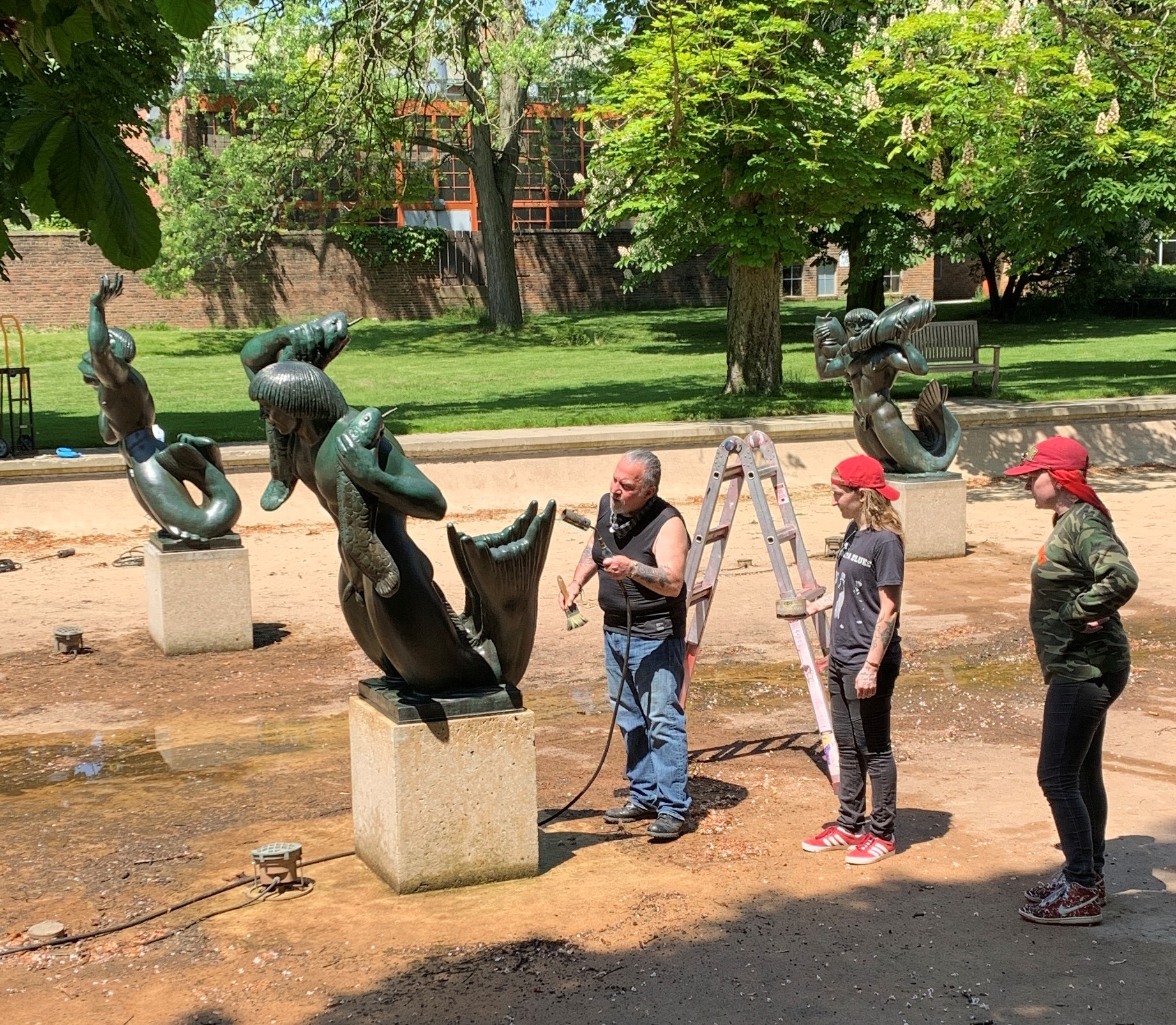
Giorgio Gikas, founder of Venus Bronze Works, holds the torch while his assistants Harlow Toland and Sara Myefski help prepare Triton with Fishes in the Triton Pools at Cranbrook Art Museum to receive a hot wax treatment, 2020. Photo by Kevin Adkisson.

This wax acts as a barrier to the air and humidity on the bronze surface and prevents damaging oxidization or corrosion from developing. When deciding how each individual work is cleaned, we look back to the artist’s intent for each sculpture (was it meant to be patinated green? dark bronze? polished? gilded?) and treat it accordingly.

Venus Bronze Works cleans and waxes all the Milles sculptures at the Cranbrook Art Museum and Cranbrook Academy of Art and the Cranbrook Institute of Science. They also work on such sculptures as Brookside’s Birds in Flight; Kingswood’s Dancing Girls and Diana; Cranbrook House and Gardens’ Fortuna delle Tartaruga (Turtle Fountain); and Cranbrook School’s athletic sculptures. Check out a recent Instagram post about the athletic sculptures below:

We are excited to start welcoming visitors back to our campus this summer, so you can all see the beautiful sculpture in their freshened-up glory.

Leslie S. Mio, Associate Registrar, Cranbrook Center for Collections and Research

To Protect and (Pre)serve

Our guest blogger this week is Kate Nummer, a Graduate Student in Eastern Michigan University’s Historic Preservation Program. She will receive her Master of Science in Historic Preservation in December 2019.

s200_kate.nummer


Late in the spring, I was a part of the Eastern Michigan University Historic Preservation Field School hosted at Cranbrook (read about the amazing week here). That week I discovered what a magical place Cranbrook is, and was inspired to ask Cranbrook Center for Collections and Research Associate Registrar, Leslie Mio, about doing my graduate final project here. The Center agreed to have me, so after three years of working hard on my Masters, I’m finishing up here at Cranbrook. I have worked closely with Leslie two days a week since August, mainly focusing on the Smith House and “other duties as assigned.”


The Smith House is a beautiful Usonian Frank Lloyd Wright house (1950) that was owned by Melvyn Smith and his wife Sara. Cranbrook acquired the house by donation in 2017. The main project I have been working on is numbering objects and updating The Museum System (TMS, Cranbrook’s digital database of objects) as we go along. This has been a monumental job: not only did Cranbrook acquire the house in 2017, but also everything that was in it – over 1,800 objects!


Numbering a jar in Smith House. Photo by author.

Numbering a jar in Smith House. Photo by author.

Numbering objects isn’t for everyone, it is a slow and repetitive task. But, it gives me a chance to look over the object, confirm that the location is recorded correctly in TMS, make any additional notes about its appearance, and even appreciate the object itself.

Here I am working in the kitchen of Smith House. Photo by author.

My final report for my degree won’t just be about numbering, but about collection management. This is considered the development, storage, preservation, and organization of collections and cultural heritage. I am consulting resources like MRM5: Museum Registration Methods by Rebecca Buck, and Things Great and Small by John E. Simmons, and applying information gleaned to what Leslie and I are doing in Smith House.


Other duties I have had since August: helping prepare a disaster kit for Smith House, so objects and people remain safe in the event of a disaster (especially since it’s off the main campus); meeting with conservators who are helping to restore furniture in the house;  helping prepare for the Center’s fundraiser “A House Party at Cranbrook”; rolling textiles for better storage; and helping move and process new donations.


I say, “other duties as assigned” because one thing I’ve learned in my semester at Cranbrook: the work of a registrar is never boring. We may have our main plan mapped out, but sometimes you must go with the flow.


Kate Nummer, Eastern Michigan University Historic Preservation Program 2019

A Sculpture So Nice They Named it Twice

One of my many duties here at the Center for Collections and Research is to maintain the sculptures on the campus. This can mean finding conservators to repair works, contractors to clean them, or, in some cases, clean them myself. Recently, I was working on a sculpture in the gardens at Cranbrook House. I had seen the sculpture before but wondered about its backstory. Turns out it was a tale of two names.

The sculpture is Mario Korbel’s statue Atalanta, the Greek goddess of the hunt, travel, and adventure. It was commissioned by George Gough Booth in 1927 for one of the gardens at Cranbrook House, part of a series of work Korbel completed for the Booth house and gardens — including Dawn and Harmony in the gardens and Andante and Nocturne in the house.

Letter from Mario Korbel to George G. Booth, referencing both his works Atalanta and Andante. George Gough Booth Papers, Cranbrook Archives.

July 12, 1927 letter from Mario Korbel to George G. Booth, referencing both his works Atalanta and Andante. George Gough Booth Papers, Cranbrook Archives.

Booth, admiring the beauty of the clear, white marble of Atalanta, transferred the work into the collection of the Art Museum. It was part of the original art museum exhibition in 1930.

CISB509L.jpg

Atalanta (left) in the first Art Museum exhibition in 1930. Courtesy Cranbrook Archives.

Later, Booth wrote: “We have finally concluded that the figure will make a very important and striking center art element in connection with the new School for Girls at Cranbrook.” When the Kingswood dormitory was built, the sculpture was transferred to Kingswood and installed on the terrace.

Atalanta.jpg

Atalanta (right) adorns the terrace at the Kingswood School for Girls dormitory in this undated photo. Courtesy Cranbrook Archives.

In 1969, the sculpture was vandalized and smashed into many pieces (no one was ever implicated in the crime–or at least, their name isn’t in my file!). Those pieces were put back together, but when Atalanta was finally repaired, she was not as pristine. Henry Scripps Booth decided to rename her Ecolo. He also wrote a verse to explain the new name:

Ecolo, Goddess of Earth 

Who is this sweet maid who stoops protectively to save the earth from man’s pernicious tread? 

It is the blithe spirit of Ecology by whom all life and natural things are fed.

CEC472 (2).jpg

Ecolo in her new home in the Herb Garden at Cranbrook House.

Ecolo, or the sculpture-formerly-known-as-Atalanta, now greets visitors in the Herb Garden at Cranbrook House.

– Leslie S. Mio, Associate Registrar

Minks in the Rainforest

The week of May 19, the Center for Collections and Research hosted the Eastern Michigan University Historic Preservation Program as they conducted their annual Field School. The EMU Historic Preservation Program is among the largest graduate programs in Historic Preservation in the United States, and this was their third year working at Cranbrook.

Two groups worked on documenting the exterior and landscape of Lyon House.

Lyon House Site Plan with Landscape Features, documented May 19-24, 2019 by Eastern Michigan University Historic Preservation students.

Lyon House Site Plan with Landscape Features, documented May 19-24, 2019 by Eastern Michigan University Historic Preservation students.

The third group once again tackled Tower Cottage. The cottage started its life as a simple Tudor Revival cottage that was designed by Albert Kahn, who also designed Cranbrook House. Built in 1908, it mimics the style and design of Cranbrook House. The cottage itself has seen many changes but over time it has retained its original character and style. Tower Cottage, along with Cranbrook House, is among the original structures belonging to the Booth family.

Tower Cottage circa 1915 with water tower behind.

Tower Cottage circa 1915 with water tower behind. Courtesy Cranbrook Archives.

Long unoccupied, the building’s historic window sashes required rehabilitation, painting, and replacement of missing pieces. The students restored a number of windows and worked on a paint analysis of Tower Cottage with Ron Koenig of Building Arts Conservation.

Ron Koenig of Building Arts Conservation discusses paint sampling with the EMU students.

Ron Koenig of Building Arts Conservation discusses paint sampling with the EMU students. Photo Desai Wang, CKU ’19.

What they discovered was far more colorful than the simple brown paint that adorns the house now. Koenig took various samples of the trim, stucco, and window sashes. He did preliminary examinations on site, looking through a special magnifying glass to see where best to sample.

Desai Wang, CKU '19, the Center's Senior May student, looking at the sample on the window sash.

Desai Wang, CKU ’19, the Center’s Senior May student, looking at a sample on a window sash of Tower Cottage.

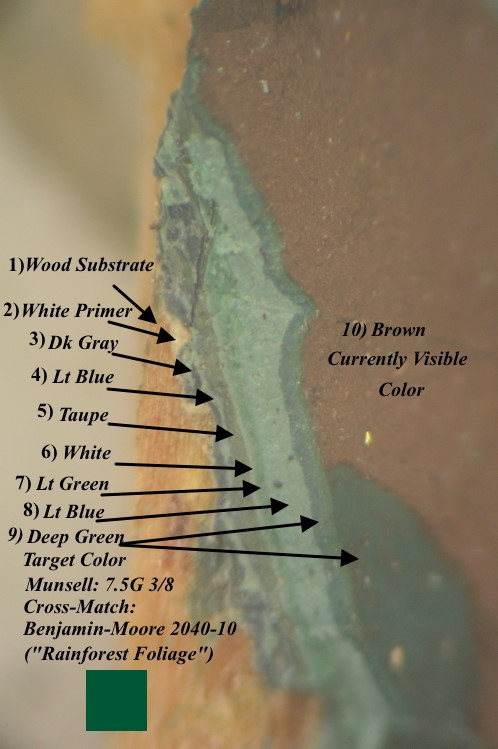
In his workshop, Koenig used a microscope to see the various layers (or campaigns) of paint. From this microscopic sample, he was able to determine the color of paint used on the house in the 1920s  – the era when the additions to the house were completed by architects J. Robert F. Swanson and Henry Scripps Booth.

Microphoto of the color campaigns of the Tower Cottage sashes, South Elevation. Courtesy Building Arts & Conservation.

Microphoto of the color campaigns of the Tower Cottage window sashes, south elevation. Courtesy Building Arts & Conservation.

Koenig matched the sample to a color on the Munsell color system (a system to visually identify and match color using a scientific approach) and from the Munsell color to a Benjamin Moore paint color. Our colors were Mink (#2112-10) for the trim and Rainforest Foliage (#2040-10) for the window sashes. The secret to historic paint colors is that while a company such as Benjamin Moore, founded in 1883, may change a color’s name, the reference number stays the same. If you know the identification number of a paint that you had in 1949, you could find the same color in the catalog today.

We couldn’t keep this great color combination to ourselves. We decided to paint a sample of it on some of the windows at Tower Cottage.

Rainforest Foliage green sashes and Mink brown trim at Tower Cottage, June 2019.

Rainforest Foliage green sashes and Mink brown trim at Tower Cottage, June 2019.

20190606_145203

Close-up of the green sashes and brown trim on Tower Cottage, June 2019.

Next year, should our friends form EMU return for their field school, the rest of the cottage’s trim and windows can be painted with its historic colors.

Leslie S. Mio, Associate Registrar

Create a website or blog at WordPress.com