Hidden in Plain Sight at Brookside

BS1_2017_det

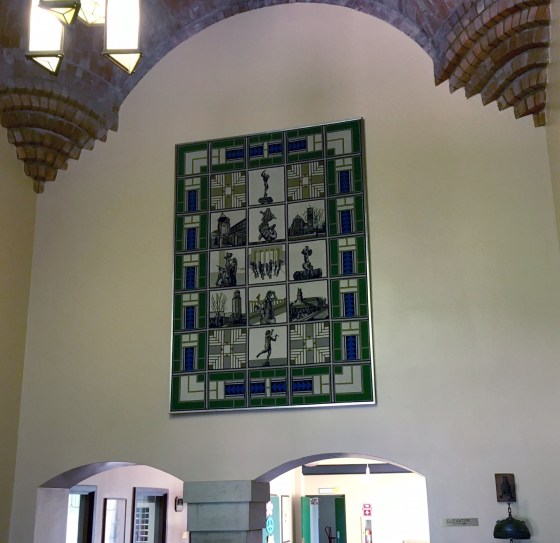
The Cranbrook 50th Anniversary Rug (BS 1), 1973. Cultural Properties Collection, Brookside School.

In honor of the Cranbrook Kingswood Alumni Association’s Reunion Weekend, I thought I would share the story behind The Cranbrook 50th Anniversary Rug.

In 1973, New York designer Rhoda Sablow (1926-2013) was commissioned to design a rug for the Cranbrook 50th Anniversary Auction. The idea for the rug came from Mrs. Arthur Kiendl, wife of the first President of the Cranbrook Educational Community.

The border and geometric squares are reminiscent of Eliel Saarinen’s designs and surround depictions of various Cranbrook buildings and sculptures. The buildings are Christ Church, Kingswood, Cranbrook School, and Brookside. The sculptures are Orpheus, Jonah and the Whale, Europa and the Bull, Orpheus Fountain, Triton with Shell, Siren with Fishes, and Diana.

The rug was needlepointed by Cranbrook Schools parents: Mrs. Iain Anderson, Mrs. Richard Darragh, Mrs. Micheal Davis, Mrs. Fritz Fiesselmann, Mrs. Walter Flannery, Mrs. Robert Flint, Mrs. Mounir Guindi, Mrs. Wilfred Hemmer, Mrs. Charles Himelhoch, Mrs. James Holmes, Mrs. Lee Iacocca, Mrs. Arthur Kiendl, Mrs. George Kilbourne, Mrs. Jamse Lowell, Mrs. James May, Mrs. David Mott, Mrs. John McCue,  Mrs. Richard Pearce, Mrs. Donald Pendray, Mrs. J. Pierson Smith, Mrs. Edwin Spence, Mrs. Wright Tisdale, and Mrs. James Williams.

ESB and Elizabeth Wallace 1919file HSB15.27.1

Ellen Scripps Booth with granddaughter Elizabeth Wallace at Cranbrook House, circa 1919. Copyright Cranbrook Archives.

Elizabeth Wallace McLean bought the needlepoint rug at an auction during the three-day celebration of the founding of Cranbrook schools. Mrs. McLean, the granddaughter of Cranbrook founders George and Ellen Booth, immediately donated the tapestry back to the school in honor of its golden anniversary. Elizabeth was in the original class of seven who attended Brookside School, so it is appropriate that the rug now hangs inside the main entrance of Brookside.

– Leslie S. Mio, Associate Registrar, Cranbrook Center for Collections and Research


BS1_2017

The Cranbrook 50th Anniversary Rug (BS 1), 1973, on display in the Brookside Main Entrance. Cultural Properties Collection, Brookside School.

Indiana Jones and the Search for the Pergola Picture: My Senior May Experience

Growing up so close to the Henry Ford Museum, or watching my family’s favorite go-to movie, Raiders of the Lost Ark, I knew that I was interested in history from an early age. Yet, I never stopped to think about Cranbrook’s own fascinating and world-renowned past. To me, this community was just “home”, and the only history I thought of was of my family’s connection with the school. Nevertheless, for my Senior May project, I wanted to learn more about the inter-workings of the educational community as a whole. With this in mind, I chose to intern at the Cranbrook Center for Collections and Research and the Archives for my last senior assignment.

Elizabeth Fairman, CKU ’17

The purpose of Cranbrook’s Senior May project is to give soon-to-be Upper School graduates a taste of a “real world” job for the month of May in their field of interest.  Initially, I assumed I would be either in Art Museum storage moving art pieces or doing research on the computer every day, but I could not have been more wrong.

Over the course of my three weeks, I had behind-the-scenes tours of Cranbrook’s many historic landmarks, firsthand looks at restorations, handling and moving donated art pieces, and countless hours of both digital and primary source research. I met many people who are tasked with adding to and preserving this living historical landmark, no small task given the expansive campus. My perspective of the community, initially as the place of my education and a source of livelihood for my family, was altered, and I began to see it as an operational historical site.

In short, I had a very full, albeit whirlwind experience of almost everything that being an archivist or registrar entails.

Organizing original Kingswood School silverware in Heaven.

My favorite experiences were the tours of campus. Although I have attended this school for 14 years, very rarely did my classes study the history of Cranbrook or take field trips to different buildings on campus besides Cranbrook Institute of Science. In fact, I had only visited Saarinen House and Thornlea once before Senior May, just three weeks before I am set to graduate. My supervisor, Mrs. Mio, added another element of the visits, a look at them through the eyes of a registrar who is tasked with upkeep and restoration of historic sites. Through tasks such as cataloging Booth dinner plates at Cranbrook House, identifying historic bookbinding tools used at the Academy of Art, and even checking mouse traps at Thornlea, I developed a deeper appreciation for the amount of work it takes to showcase the history of this community, as well as a chance to see rooms or storage out of the public’s eye.

Clothing collection at Cranbrook House storage.

Another aspect I enjoyed was the research itself, like searching through “the stacks”, where many of the important archival files are kept. It is a place where you can find both important and unexpected things. For instance, one afternoon while searching for photos and records of the Cranbrook House Pergola for Ms. Edwards, I came across security reports from the 1960’s detailing the dangers of “hippie types” on campus. I was also able to piece together more of the history of Cranbrook firsthand through organizing and filing other primary sources created by prominent figures in the Community’s past.

Elizabeth Fairman, CKU ’17

Editor’s Note: Elizabeth Fairman is a “lifer” at Cranbrook, having attended school here since Kindergarten. In addition to that, her father Andy is the upper school baseball coach and physical education teacher at Brookside School. Both of Elizabeth’s grandmothers (Sue Tower and Marilyn Sutton) taught school at Brookside for many years. We thank Elizabeth for her exemplary work ethic and positive attitude and wish her the best of luck in her new adventure at Bates College in Maine.

Portrait of the Vettraino family children. From left: Dominick, Sam, John, Concetta (Connie), Rose, Annette.

Portrait of the Vettraino family children. From left: Dominick, Sam, John, Concetta (Connie), Rose, Annette.

Cranbrook Archives is excited to announce a new online collection of material that highlights the contributions of the Vettraino family at Cranbrook. The collection includes a sampling of photographs and documents of the family, as well as other Italian immigrants who worked on campus clearing the land and building roads and stone walls; maintaining the landscape; and working in the Cranbrook Fire and Police Departments.

Michael (Mike) Vettraino came to Cranbrook in 1905 to work with one of George Booth’s first landscape architects, H.J. Corfield. Mike served Cranbrook for more than 50 years and received the Founders Medal in 1955. For more than 110 years, his children and grandchildren have continued to honor his legacy, serving the Cranbrook community not only as grounds-keepers, but in many other areas of the campus. We are pleased to be able to share their amazing legacy.

Cranbrook Archives Staff

Pergola Restored!

On June 18, 2014, a treacherous storm passed through Bloomfield Hills with wind gusts of up to thirty-nine miles per hour.  At some point during the storm, a tree snapped and fell directly onto the Cranbrook House Pergola*, causing significant damage.  Much of the original redwood trellis was crushed and two of the column capitals were severely damaged. One of the columns was knocked completely off the wall.  In addition, the concrete slab and columns had been deteriorating over time due to water infiltration. Cranbrook was left with an unusable space, directly adjacent to the Sunken Garden.p1

Reconstruction of the pergola began two years later on June 6th, 2016.  The goal was to preserve as much original historic material as possible, while replacing anything that was beyond repair.

p2

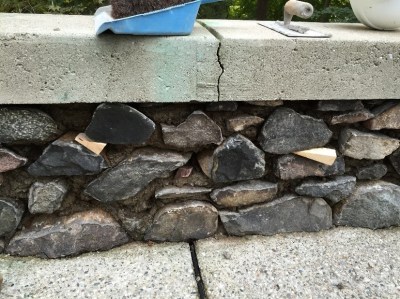
The first step in the restoration process was to re-tuck point all the mortar in the stone walls which had deteriorated over time. All the mortar in the joints between each stone had to be chipped out and cleaned before the new mortar could be installed.  In various instances when mortar was removed, the stones would become loose.  In efforts to hold the stones in place, wood wedges would be inserted to temporarily hold rocks in place. In addition to improving the appearance, the new tuck pointed mortar provided renewed support for the walls, allowing us to remove the floor slab.

p3

Next, the crew removed the existing wood beam (to be reused) and began to systematically demolish the concrete wall caps and columns.  The northwest column, base and capital were left in place throughout the project as they were structurally sound.  However, the other three columns had to be demolished and rebuilt. Much of the concrete on the inside of the columns was so deteriorated that portions of it could be removed by hand.

p4

Demolition continued with removing the concrete slab which served as both the ceiling for a garden storage area and the floor for the pergola. Demolition of the slab was challenging because the stone walls were built on top of it, as opposed to the slab being poured abutting the walls.  The contractor had to leave notches of the slab in place to provide support and prevent the walls from collapsing. Each notch was then very carefully removed and temporary shoring was installed to prevent a cave in.

Next, the crew formed the ceiling/floor and installed rebar so the new structural slab would be much stronger than the original. When pouring the concrete, the crew had to be meticulous to ensure it was evenly placed under all the stone walls and through the cage of rebar.

p6.jpg

Once the slab was poured, the crew started building the column forms. Each column’s entasis, or taper, toward the top was achieved by building a wooden barrel that narrowed towards the top.  The concrete was then cast directly into the barrel. This process was very similar to how the columns were originally constructed.

As mentioned earlier, one of the beams was salvageable in its entirety. However, the other beam had to be rebuilt with about fifty percent new wood bolted to the older beam. Like the original construction, we used redwood. The contractor replaced all the purlins (or cross beams) with new redwood, using one of the original purlins to recreate the decorative pattern on each end.

After a few finishing touches, the new (and improved) Cranbrook House Pergola was completed. Many thanks to the crew involved in this restoration project, and come check it out for yourself soon!

* Cranbrook Archives was able to determine that the original pergola was intact as early as 1919.

View from Cranbrook House looking down “Hedge Alley” towards the pergola, ca 1925. Courtesy Cranbrook Archives.

Ryan Pfeifer, Project Manager II, Cranbrook Capital Projects

Special thanks to Elizabeth Fairman (CKU ’17) for research assistance.

Dessert with Décor in Mind

Back in the winter of 1941-1942, the fashion editor of The Milwaukee Journal, Aileen Ryan, visited Loja and Eliel Saarinen here at Cranbrook. She published an article about her day at the Academy and dinner in the Saarinens’ remarkable home on January 18, 1942: “Furnish Home According to Principles of Architecture” (The Milwaukee Journal, section 7, p. 9).

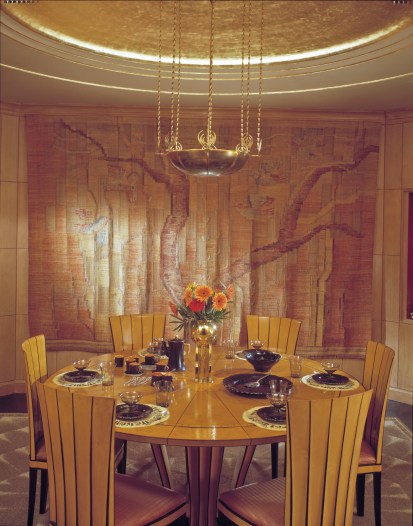
Plate 53

Dining Room set for a tea, c. 1994, Copyright Cranbrook Art Museum and Balthazar Korab

Ryan vividly describes the ceremonial nature of dinner in the dining room of the house, how hospitality, art, architecture, and food intersect in a totally beautiful and complete way. She writes:

“The dining room is at the left of the entrance and gleams a golden welcome to guests. Light is reflected from a gilded dome ceiling back to the top of the round table made of rays of harewood inlaid with ebony in a way that suggests the sun. Places are set on circular doilies of yellow linen block with black figures which the Saarinens’ son, Eero, made when he was a child. On these are black plates, on these folded yellow napkins and on top of these yellow cups and saucers. Each guest unpiles his cup to get his napkin as the plump brass coffee pot is brought around. It’s delicious coffee and amber enough as it streams from the slender spout to fit into the color scheme.

“Mr. Saarinen looks vastly amused when he tells us the chairs, with their Spanish comb look and sunny as the table itself, are made of Hollywood. He has designed them as he has the other furniture in the house, and they are dramatic. The walls of this golden room, seeming sunny on a gray and snowy day, are of waxed California pine. One of them is nearly covered with a Finnish tapestry made by Greta Skogster in soft terra cotta tones. The ombre [sic] shaded carpet is creamy white and brown.”

She ends the description of dinner:

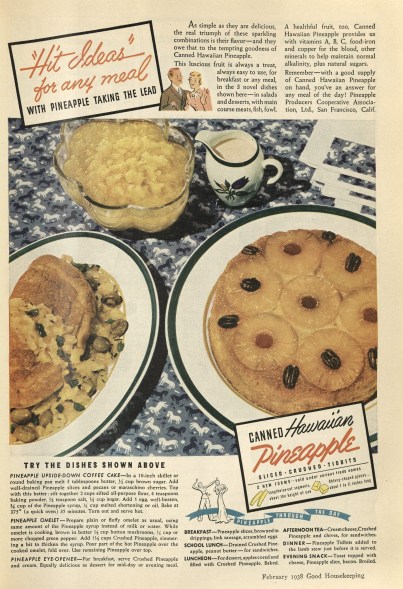
“A pineapple upside down cake is part of the edible harmony, but Mrs. Saarinen refuses to admit she serves food to carry out the architectural scheme.”

Last weekend we reopened Saarinen House for tours, and many of the items Ryan describes are again on view in the house (the yellow place mats, the black dishes, the golden coffee pot, etc). And on Friday night, as part of our first Finnish Friday, we even brought back pineapple upside down cake! Sweet and Savory Bakery in Oxford, Michigan, generously donated plenty of pineapple upside down cake for guests to enjoy. Without Loja’s recipe but trying to be historically accurate, we used a recipe found in Good Housekeeping in February 1938.

Good Housekeeping Feb 1938 p 167

“Hit ideas for any meal with pineapple taking the lead,” Advertisement in Good Housekeeping, February 1938, Courtesy of the Winterthur Library.

Since this weekend is Mother’s Day, and, for many of us, our mothers are especially connected with memories of food and cooking, I wanted to talk a bit more about food in the Saarinen home. Bob Swanson, Loja’s oldest grandson, told me a few weeks ago that Loja was an excellent cook. He remembers her serving lots of ham and lutfisk at the holidays. As great of a cook as Mormor (Swedish for grandma) was, Bob recalled that most meals were prepared by the housekeeper and served in the kitchen dining area (not on tour). That dining area had plain chairs and a rectangular table with a black Formica top—not quite the drama of the main dining room.

His own mom, Pipsan Saarinen Swanson, was also a great cook. Bob remembers her making wonderful and inventive wartime meals—specifically liver and onions, lamb shanks, and calves brains. Pipsan, whose dresses are currently on display in Saarinen House, was (unknowingly) living journalist Aileen Ryan’s own wartime interests: “rations, passions and fashions.”

Bob laughed when I asked him if he remembered Loja serving pineapple upside down cake to match the décor. He didn’t recall her serving it to him, but said it was just her humor to do something like that. He also remembered how much Loja loved pies, particularly peach pie and pineapple pie–both pies that would coordinate with the décor!

For more Saarinen family stories, come join us for a Saarinen Home tour: Fridays and Saturdays at 2:00pm and Sundays at 1:00pm and 3:00pm. To try out our interpretation of a period Pineapple Upside Down Cake (served in the Saarinen House courtyard outside the dining room) join us for an upcoming Finnish Friday (May 19th, June 9th,  and June 23rd). In addition to admission to Cranbrook Art Museum and an open-house in both Saarinen House and the Archives Reading Room, we’ll also have period board games, Saarinen family films, a pianist at the family designed piano, and a cash bar for your enjoyment!

-Kevin Adkisson*, Collections Fellow, Cranbrook Center for Collections and Research
*My mother, for the record, is also an amazing cook.

Immigrant Stories in the Archives

In the recent issue of the Archives of American Art Journal (Spring 2017), Daniel Harkett’s compelling essay about citizenship papers found in manuscript collections in the Archives of American Art really spoke to me. He wrote “for the many people in the American art world who fought to become US citizens, the donation of naturalization papers to the Archives surely represented an affirmation. Those documents say, “See, I belong here” – in this country, and in the histories the Archives can be used to tell. At the same time they speak of journeys taken, sometimes across vast geographical and cultural distances.”

This essay brought to my mind the many documents we have in our collections relative to immigration and citizenship. Take, for example, the citizenship papers of Cranbrook’s founder, George Booth, who on April 21, 1887 forever renounced allegiance to Queen Victoria and became an American citizen. The document itself, as Harkett pointed out, “marks of a document being carried in a pocket, unfolded, shown, scrutinized, refolded, and put away.” Tattered and torn, and held together with hardened scotch tape, it tells the story of an American citizen who was often asked to prove his citizenship by virtue of this document.

From the George Gough Booth Papers.

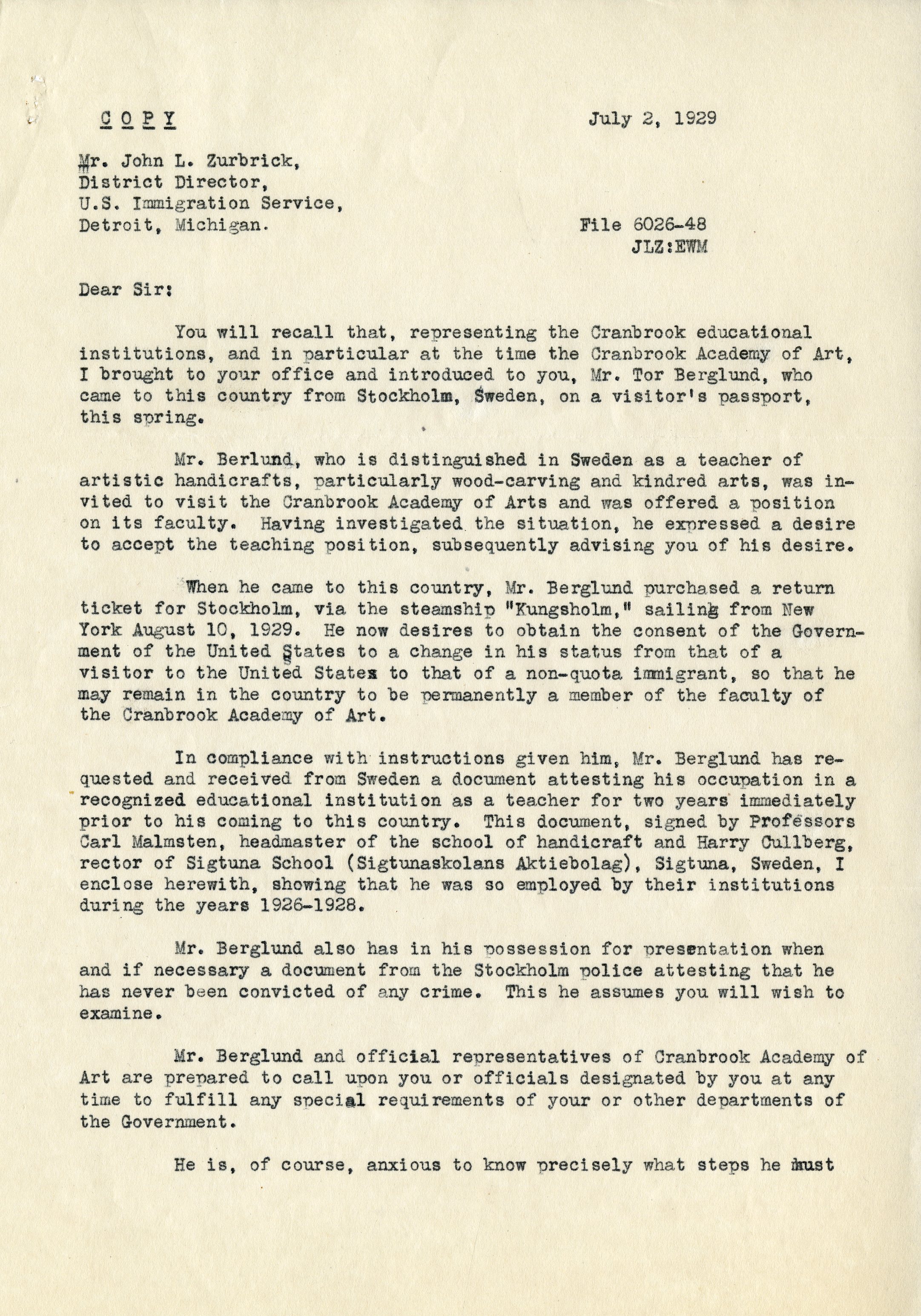
In addition to naturalization papers in our archives, we have other pertinent documents that help tell the immigration story of Cranbrook staff and faculty. The letter below speaks to the lengthy process by which the Cranbrook Foundation sought to assist Swedish cabinetmaker Tor Berglund with changing his immigration status from visitor to that of a “non-quota immigrant.” According to immigration laws at the time, Berglund was required to submit proof that he had been employed as a teacher for the two years prior to his employment at Cranbrook. Unfortunately he was denied, as he had worked for the cabinetmaker Carl Malmsten, not as a teacher, but as a cabinetmaker. Ultimately Berglund traveled to the U.S. Embassy in Windsor, Canada where he received a passport that allowed him to further his stay at Cranbrook.

From the Cranbrook Foundation Records.

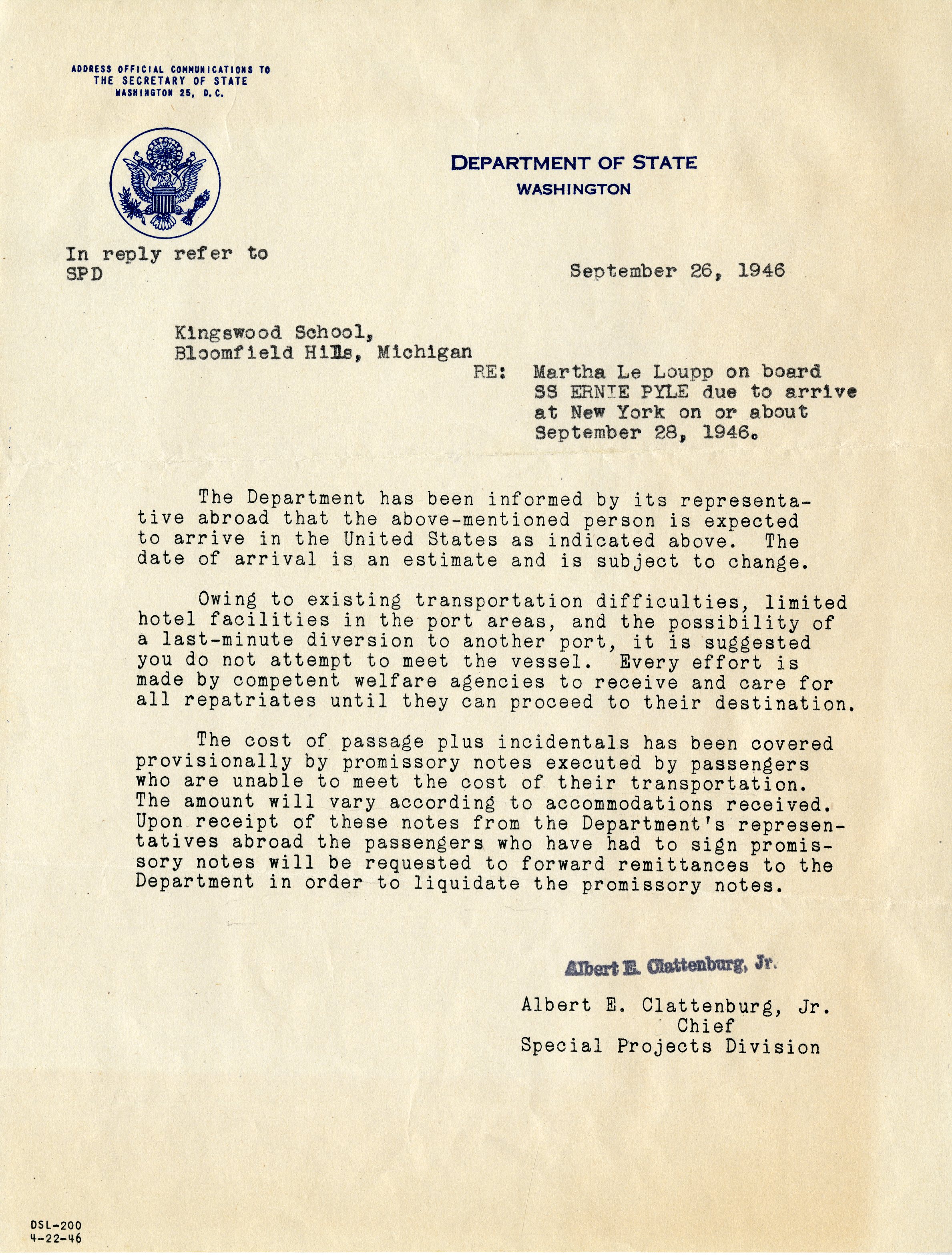
The third document relates to Kingswood School’s French teacher, Marthe Le Loupp. She had returned home to France for the summer months of 1946. Even though World War II was over, securing travel back to the United States was difficult at best. This letter from the State Department shows that the administration of Kingswood School had inquired about Le Loupp’s safe passage back to the U.S.

From the Kingswood School Records.

Genealogists and family historians are widely considered the biggest users of immigration records, including ship passenger lists, in tracing their family history. But historians and scholars also use these records to study a broad range of immigration themes and archives across the country hold countless immigration records in their collections or are devoted exclusively to immigration topics. Cranbrook’s immigrants have their own stories to tell, which can be discovered through documents in our own collections. As Harkett remarked, these documents “speak of journeys taken, sometimes across vast geographical and cultural distances.”

Leslie S. Edwards, Head Archivist

The Elves and the Saarinen Home

Cranbrook Center for Collections and Research “elves,” with help from the Cranbrook Archives and Cranbrook Art Museum, have worked their magic to bring out treasures designed for this summer’s reinvigorated and expanded tours of the landmark Saarinen House. This three-month installation entitled Saarinen Home: Living and Working with Cranbrook’s First Family of Design, expands on the life and work of the remarkable Saarinen family, displaying items used in their home, at Cranbrook, and for projects around the country.

SaarienHomeBlog1

Selecting sliver, glass, and ceramic items for the exhibition.

The exhibition kicks off with an Open House from 1-4pm this Sunday, April 30th, during the Art Academy’s OPEN(STUDIOS). It will also be open for four nights of special programming – “Finnish Fridays” – the first of which is May 5th. Normal tours of the exhibit are Friday, Saturday, and Sunday, May through July. For all the details, check out the Cranbrook Center for Collections and Research website.

SaarinenHomeBlog3

Preparing the space to display weavings by Studio Loja Saarinen.

Leslie Mio, Assistant Registrar

Thank You, Volunteers!

April is National Volunteer Appreciation month and Cranbrook Archives is incredibly grateful for the wonderful group of volunteers who donate their time to help make the Archives shine. From college students to retirees to Cranbrook school parents, our volunteers offer a wide array of skills and knowledge.

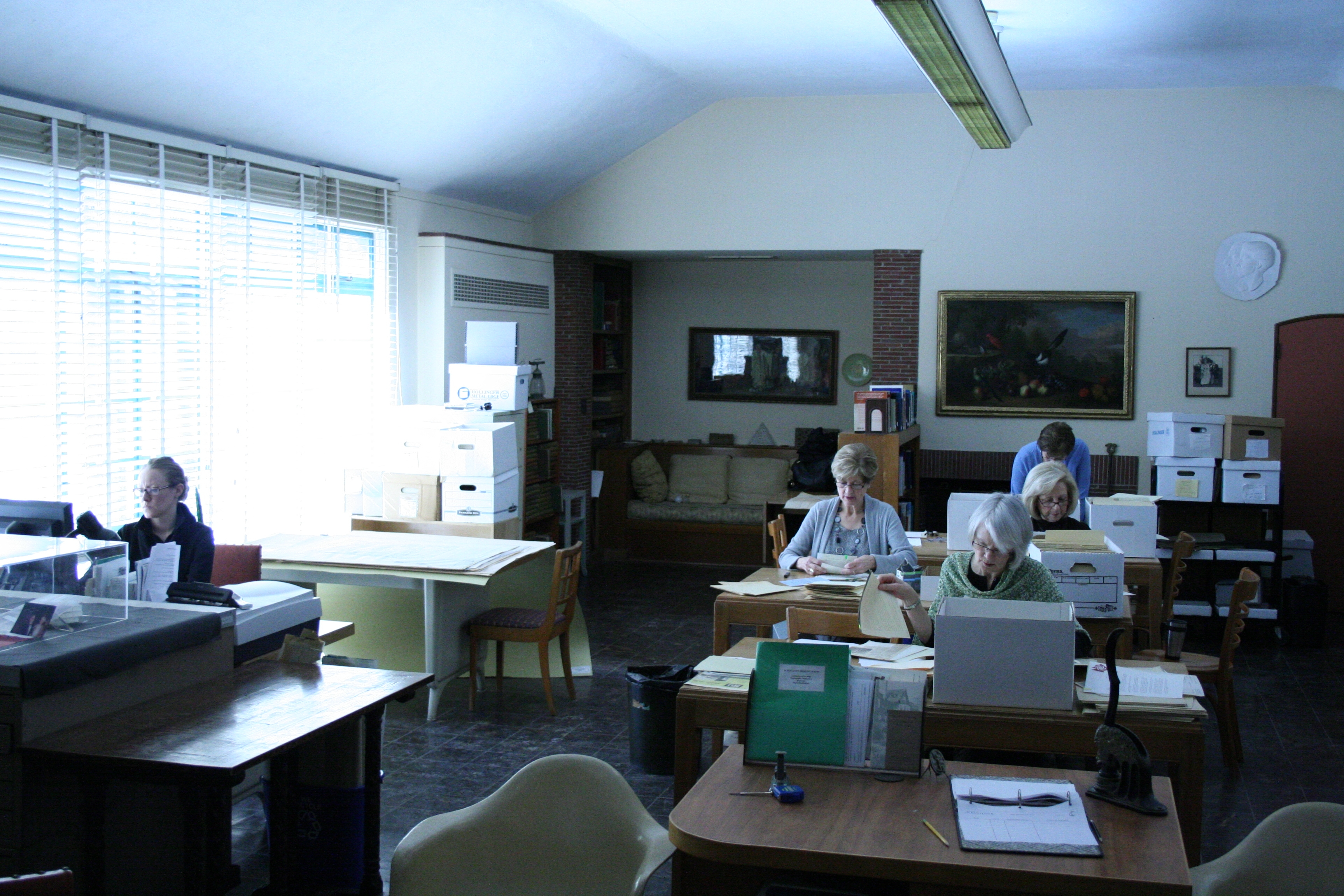
Volunteers in the Archives reading room, Mar 2011.

Archives volunteers work on a variety of projects, including sorting slides, indexing scrapbooks, and identifying photographs. Although some projects are short- term, we have several members of our core team who have worked with us for years (including one person who has donated her time for more than 20 years!) We are forever grateful to all of our amazing volunteers- their contributions help us grow our collections and preserve Cranbrook’s rich history.

Working on a slide project, Aug 2016.

Thank you to all of our volunteers – we could not do our work without you!

Cranbrook Archives Staff

Asheville, North Carolina: Then and Now

My daughter’s spring break was last week, so she and I took our friend Susan up on her invitation to visit her in Asheville, North Carolina. We decided to take a road trip and check out college campuses on the way. Let me just say that the University of Cincinnati has the largest (and most stunning) classics library in the country, and perhaps even in the world.

As I was planning for the trip, I remembered that Henry Scripps Booth went to boarding school in Asheville from 1913-1918. So before I left, I perused his photo albums for relevant photographs and devised a plan to do a “then and now” blog post. I took copies of photos from Henry’s 1916 photograph album which contained images of Asheville School. So, while my daughter was sitting in on the college class “Roman Comedy” at the University North Carolina Asheville (UNCA), I ventured out to find Asheville School. Nestled back away from a main road in the foothills of the Blue Ridge Mountains, Asheville School is home to approximately 285 students in grades 9-12. Historic buildings are sited on a 300-acre campus and it is easy to see the similarities between this school and Cranbrook School for Boys. While changes have been made to the campus over the years, much of it remains as it was when Henry attended school there.

Another place in Henry’s album that I was able to locate (with the help of my friend) was what is now known as Trinity Episcopal Church on Church Street in downtown Asheville.

Henry returned to visit Asheville at least once after he graduated, and visited the Biltmore Estate in 1931. The photos below show how the landscape around the main house has been altered to better accommodate over one million visitors annually.

As some of you may know, last year Asheville celebrated the 100 year anniversary of the infamous flood of 1916.

DSC_0428

“Street to the Station”, 1916.

While Henry was there at the time of the flood, and took numerous photos of the ravaged Biltmore Village, I was unable to locate this exact street. Local archivists at Asheville School and the UNCA’s Special Collections and University Archives were also baffled, so if anyone knows the location of this image, please let us know!

It never ceases to amaze me how far and wide Cranbrook’s reach is, and how well our collections document it.

Leslie S. Edwards, Head Archivist

Carl Milles, Just Like Us

Today I was preparing some materials for an upcoming visit from the staff of Millesgarden – the Swedish home of sculptor Carl Milles. As I gathered supplies for the visit, I was reminded of a fun picture I saw recently of Milles who served as Cranbrook’s sculptor in residence from 1931 to 1951.

Carl and Olga Milles at Carl’s 70th birthday celebration, Jun 1945. Photographer, Harvey Croze.

The picture is from Milles’ 70th birthday party, held in the Kingswood School Dining Hall. Milles seems to have been telling a joke and the photographer captured him mid-laugh. US Weekly, a bit of a “rag” magazine, has a section where they picture celebrities living “Just like Us.” Pictures of George Clooney buying batteries at the hardware store or Octavia Spencer waiting in line at Starbucks, living just like real people do. I thought of this Milles photo in much the same way; Carl Milles makes jokes at dinner, just like us!

Leslie Mio, Assistant Registrar

Create a website or blog at WordPress.com