Photo Friday Part 2: Bud West Caption Contest Winner!

Apparently, my brain was already celebrating the fourth of July, because I posted Photo Friday on Wednesday (for no other reason than I thought Wednesday was Friday.  By the way, who else thinks today is Saturday?).  So, this week we’re going to  have TWO Photo Fridays.  Remember a few weeks back, when we held a caption contest for this fabulous photo of Clifford “Bud” West?
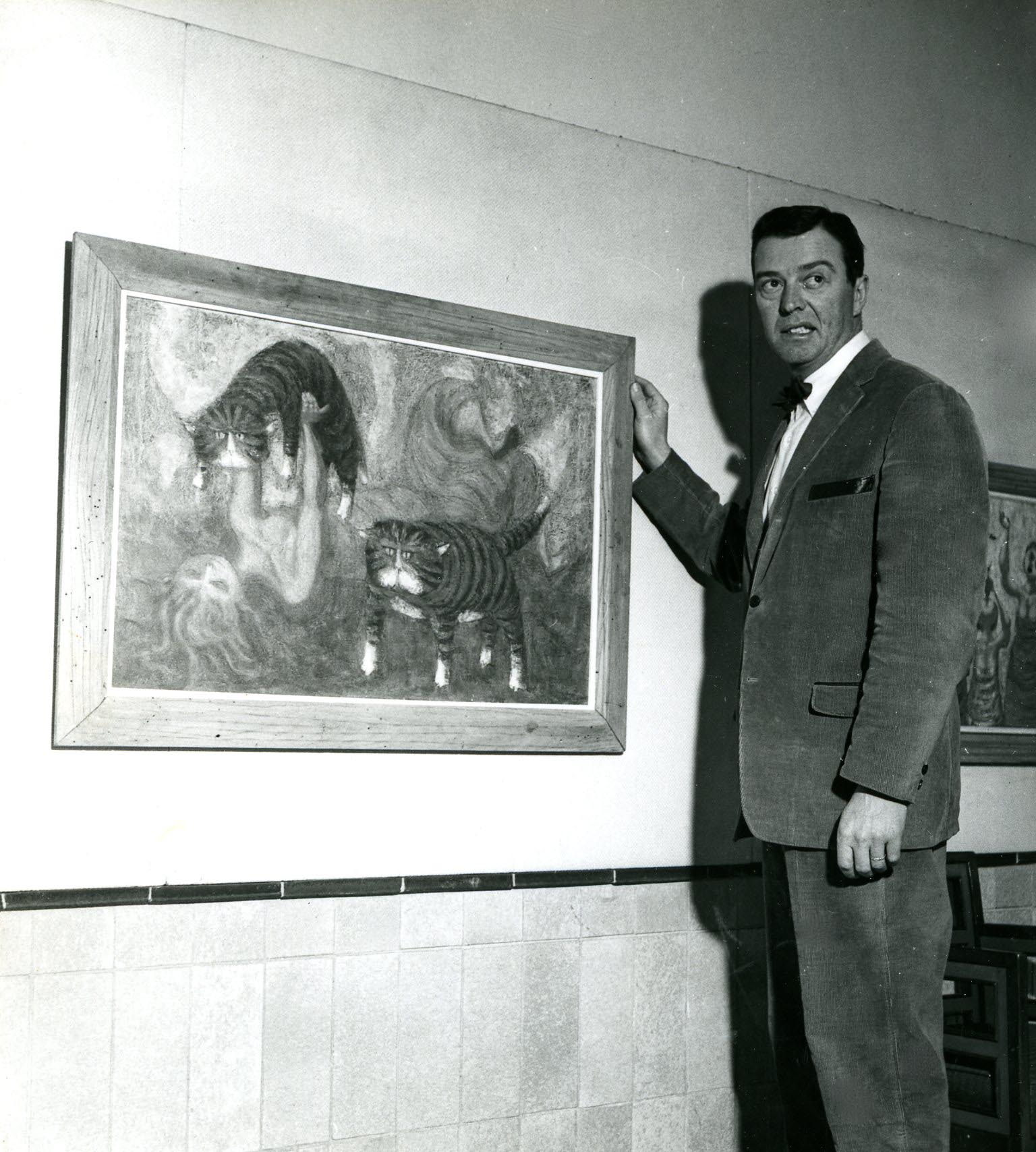
Our question was simple: what is Bud West thinking?  We had some great answers, but we’ve got to give the win to West’s son, Justin, who said, “What do the cats represent?  Heck, sometimes cats are just cats!”  We swear – only a hint of nepotism was involved in the decision.  Thanks to all who entered, and congrats, Justin!  And a special thanks to my colleagues, who never bothered to mention on Wednesday that I was confused about which day it was.

Photo Friday: Design of Radio Cabinets

In the early days at Cranbrook Academy of Art, students were encouraged to submit entries to a myriad of design and architecture competitions.  Sponsored by museums, magazines, colleges and industry, competitions were a way for fledgling designers to make a name for themselves.  Winning entries could catapult a designer or architect into the national arena.  In 1939, the “Design of Radio Cabinets” was sponsored by the Radio and Television Department of the General Electric Company through Interior Design and Decoration.  Designs were submitted in two categories: a table model and a console model.  The only design requirement was that a “dial or tuning control treatment” be incorporated in the design.

Entry for "Design of Radio Cabinets" competition.

Entry for “Design of Radio Cabinets” competition, 1939. Cranbrook Archives.

This entry was submitted by the team of Edward Elliott and Ted Luderowski, both architecture students studying under Eliel Saarinen.

Cranbrook and the Car, Part 3: Suzanne Vanderbilt

If AMC’s long-running television show Mad Men has taught us anything, it is that it is hard being a woman in a man’s world.  And while Peggy Olsen’s struggle to be taken seriously as an advertising professional in the 1960s is fictional, many talented, driven, and creative women found themselves fighting a similar battle in their own professions in the 1960s and 1970s.

Suzanne Vanderbilt was one such woman, and her work as a designer at General Motors is highlighted in A Driving Force: Cranbrook and the Car, now open in the lower galleries of the Cranbrook Art Museum.  A Cranbrook Academy of Art graduate, Vanderbilt was an active member of the “Damsels of Design,” the young women hired by Harley Earl to work on the interiors of vehicles for General Motors in the 1950s and 1960s.

1998-02 Vanderbilt in car, c1950s (2)

Suzanne Vanderbilt in her Corvette, mid 1950s. Suzanne Vanderbilt Papers, Cranbrook Archives.

Though the assembling of these women into a charming and attractive group of “damsels” was a PR ploy, the fact remains that these women designers did real work for GM, re-thinking car interiors at the exact moment that the auto industry began recognizing women as significant consumers of their products.  Women have historically made the majority of household purchasing decisions, and as cars increasingly became associated with domestic American life it became clear that women would have a greater role in buying them.  Recognizing this trend, GM acknowledged that its design, engineering, and marketing of cars would have to shift.  And who better to understand the female consumer than women themselves?

Continue reading

Photo Friday: Cranbrook in Bloom

As a part of Cranbrook Archives architectural slide collection*, this image shows Cranbrook House’s sunken garden in full bloom in 2003.  If you’re in the area, be sure to stop by the gardens this summer – with new patterns and plants, they are in full bloom and open for visitors!

The sunken garden at Cranbrook House in full bloom, 2003.  Balthazar Korab, Cranbrook Archives.

The sunken garden at Cranbrook House in full bloom, 2003. Balthazar Korab, Cranbrook Archives.

*If the colors of the photo appear slightly off to you, don’t worry – that’s just because we scanned the image directly from the slide, which has a different coloration than a digital photograph would.  We considered correcting it, but we enjoy seeing the indication of historic photographic processes and we figured you would too!

Photo Friday: Come as a Song Party

It has been a crazy few weeks at the Cranbrook Center for Collections and Research  – we mounted our two exhibitions at the Cranbrook Art Museum and helped CAM celebrate the opening of the summer museum season with the blockbuster Michigan Modern show.   What that means now is that we’ve all got celebratory parties and vacation on the brain, and what better way to celebrate a museum success than with evidence of the parties of the past?

"Come as a Song" party, 1942.  Cranbrook Archives.

“Come as a Song” party, 1942. Cranbrook Archives.

This photo, taken in March of 1942, captures Harry Bertoia (far right) and Brigitta Valentiner (middle) with an unidentified student (left, and conveniently marked by a Joker card costume).   These three costumed young people are attending the “Come as a Song” party, one of the many themed get-togethers hosted at the Academy in the mid-century period.

Harry Bertoia, of course, went on to become a sculptor and furniture designer.  Two years after this photo was taken, Harry and Brigitta Valentiner, dressed here as a young maid, married.  A Detroit native and a published author, Valentiner was the daughter of Wilhelm Valentiner, the Detroit Institute of Art’s legendary director from 1924 to 1945.

A Cranbrook Proposal

Cranbrook Academy of Art stationary has witnessed some very interesting correspondences,  but we’ve yet to see anything more adorable than this: Charles Eames’ 1941 marriage proposal to Ray Kaiser, delivered on CAA letterhead.  Charles and Ray met at Cranbrook, of course, and moved from Michigan to Los Angeles after their marriage.  We can’t take credit for the object or the article about it – that goes to the Library of Congress and Maria Popova at brainpickings.org respectively.  Still, there is something lovely about seeing a bit of Cranbrook play a role in this legendary design – and romantic – partnership.

Charles Eames' marriage proposal to Ray Kaiser, via Cranbrook Academy of Art stationary.  1941.  Library of Congress, via Brainpickings

Charles Eames’ marriage proposal to Ray Kaiser, by way of Cranbrook Academy of Art stationary. 1941. Library of Congress, via Brain Pickings

Continue reading

From the Archives: Teaching and Exhibiting Painting at Cranbrook, 1930-1970

Image

From the Archives: Teaching and Exhibiting Painting at Cranbrook, 1930-1970, photograph courtesy of Justine Tobiasz.

With the opening of the summer exhibition season at the Cranbrook Art Museum, the campus is filled with opportunities to learn about art, design, and history.  This also marks the first of a regular series of exhibitions that explore the unplumbed depths of Cranbrook’s archival holdings.  From the Archives: Teaching and Exhibiting Painting at Cranbrook, 1930-1970 highlights the efforts of Cranbrook teachers and curators and explores the work they did promoting painting at Cranbrook at the mid-century mark.  Curated by Head Archivist Leslie S. Edwards, the show uncovers untold accounts about the moments and figures that populate Cranbrook’s storied painting history.   From the Archives: Teaching and Exhibiting Painting at Cranbrook, 1930-1970 will be on view in the Cranbrook Art Museum from June 14 to September 29, 2013, so be sure to check it out!

[Ed. note: if you missed the Archives exhibition in person, don’t worry – it lives forever on the internet! Check out the Archives online exhibition, From the Archives: Teaching and Exhibiting Painting at Cranbrook, 1930-1970.]

From an Intern’s Eyes: Old Drama and Timeless Art

In the second week of May, I began my first day at the Cranbrook Archives for my Senior May Project, a program ran by the Cranbrook Upper School to send anxious fourth quarter seniors off campus for internships and adventures.  And now, after two weeks of dealing with numerous dusty, yellowed papers (and one suspicious wooden box featuring some dead bugs and cobwebs) my initial excitement only grew.

One of my first projects here was to research the tenure of past Academy of Art faculty and staff members between the years of 1932-1976, and to make a comprehensive spreadsheet on the matter. That project led me to read through old faculty files comprised of payroll information (“how did people survive on $200 a month!” I thought to myself), retirement records, old correspondence­—I even came across the first telegram I had ever seen. I wondered, from time to time: “Did the secretary who typed this letter up ever think that a teenaged intern from China would one day behold this work and marvel at its antiquity?”

The first telegram I've ever seen.  1943, Cranbrook Archives.

The first telegram I’ve ever seen. 1943, Cranbrook Art Museum Exhibition Records, Cranbrook Archives.

Continue reading

Kitchen Sink Caption Contest: What is Bud West Thinking?

Welcome to the first ever Kitchen Sink caption contest!  This historic photograph features Bud West, a Cranbrook Academy of Art graduate and painting instructor at Kingswood, viewing an exhibition of David Berger’s work mounted at Kingswood in 1957.   As historians, we would never dare to presume what he’s thinking – which just means that we need you to do it for us!  Leave us your entries in the comments, and the winning caption (chosen by an extraordinarily scientific system of “whatever makes us laugh the most”) might just make it into a future Photo Friday post!*

And if you’re interested in painting at Cranbrook in the mid-century period, be sure to visit Cranbrook Art Museum to see the upcoming exhibition What to Paint and Why: Modern Painters at Cranbrook, 1936-1974Curated by Chad Alligood, the art museum’s 2012-2013 Jeanne and Ralph Graham Collections Fellow, the exhibition opens June 14.

Bud West

* Be sure to include a name (real or fake) that we can use to identify your entry!

Photo Friday: Cranbrook Soda Fountain

Students at the Cranbrook School Soda Fountain, May 1955.

Students at the Cranbrook School Soda Fountain, May 1955.  Historic Photograph Collection, Cranbrook Archives.

We were all set to write something pithy and charming about boarding school life and 1950s Cranbrook, but let’s be serious: it’s Friday, and we all wish there was still a soda fountain on campus.  Who wants to build one?

P.S. stop by the Cranbrook Archives reading room sometime if you want to see one of those original Cranbrook School pennants still in action!

Create a website or blog at WordPress.com