History Detective: Light Fixture Edition

Did you ever watch the show History Detectives on PBS? I loved the show; it is all about uncovering the story of an object.

As Associate Registrar for the Center, I am working with our Director Gregory Wittkopp and our Associate Curator Kevin Adkisson on an ambitious project. We are reviewing all fourteen of our cultural properties collections (over 9,000 objects), reviewing the data already on file and adding as much additional information about each object as we can. How do we do this, when the people who created, collected, or purchased the objects are no longer here? It requires being something of a history detective!

The collection we are currently working on is the Cultural Properties Collection at Thornlea. Thornlea was the home of George and Ellen Booth’s youngest son, Henry Scripps Booth, and his wife, Carolyn Farr Booth, from 1926 to 1988. It is filled with antiques, artwork, furnishings, and personal objects. In Cranbrook Archives, there are multiple helpful records about the home’s collections: insurance inventories, an index card file of objects created and maintained by Henry, and receipts for items purchased.

Light fixture over front door at Thornlea.

The one object I wanted to feature today is the unique light fixture over the front door to Thornlea. This custom and distinctive iron and glass fixture is important to the architectural character of the house, but I knew next to nothing about it. It appeared in early images of the house, so I knew it had been a part of the house from the earliest years, perhaps since the house was built.

Henry Scripps Booth peaks out the front door of Thornlea, circa 1935. Courtesy Cranbrook Archives.

To learn more about the fixture, I first looked at the insurance inventories and Henry’s index card file. Nothing there.

Next, I looked at the receipts under “Electrical” in the Henry Scripps and Carolyn Farr Booth Papers in Archives. Eureka!

Continue reading

Photographer Jack Kausch and Cranbrook

In many of the posts we put up on Facebook or on the Kitchen Sink, the credit line “Photographer Jack Kausch” appears. Since he took so many iconic images of Cranbrook’s people and places in the second half of the twentieth century, I’d like to introduce you to Jack Kausch himself.

Jack Kausch at work developing photographs while at Cranbrook School, The Brook 1947. Courtesy Cranbrook Archives, Cranbrook Center for Collections and Research.

John William (Jack) Kausch was born in 1929, in Queens, New York. His family moved to Detroit shortly after he was born. Jack’s interest in photography began at age eight, when his mother gave him a camera and dark room set. He earned a scholarship to attend Cranbrook School for Boys, graduating in 1947. While a student at Cranbrook, he became a photographer for The Crane student newspaper and The Brook yearbook.

Jack Kausch’s Senior entry in The Brook, 1947. Courtesy Cranbrook Archives, Cranbrook Center for Collections and Research.

Jack went on to attend the University of Michigan. The Korean War interrupted his studies, and he joined the Air National Guard. Stationed on a base in New England, he serviced radar equipment and handled the base’s photography lab. When the war ended, the G.I. bill enabled him to return to the University of Michigan. He helped his mother run a construction firm while he attended night school, earning a bachelor’s degree in Physics in 1956.

In September 1957, Jack married Elizabeth (Betsy) Drake. He then took a job with General Motors Photographic in 1960, where he worked for the next seventeen years. During this time, he returned to the University of Michigan to earn a Master’s in Business Administration. He opened Jack Kausch Photography in 1976 in Birmingham, Michigan. It was around this time he returned to Cranbrook to again take photographs for various Cranbrook publications and events.

Shortly after his death in 2002, Jack was posthumously awarded the 2001-2002 Birmingham Bloomfield Cultural Arts Award’s Lifetime Achievement Award. In 2009, an exhibit about his life and work, Jack Kausch, A Photographer’s Retrospective, was presented by the Birmingham Museum.

I thought I would share some of my favorite Kausch photographs of Cranbrook’s people and places:

Continue reading

Winter at Cranbrook

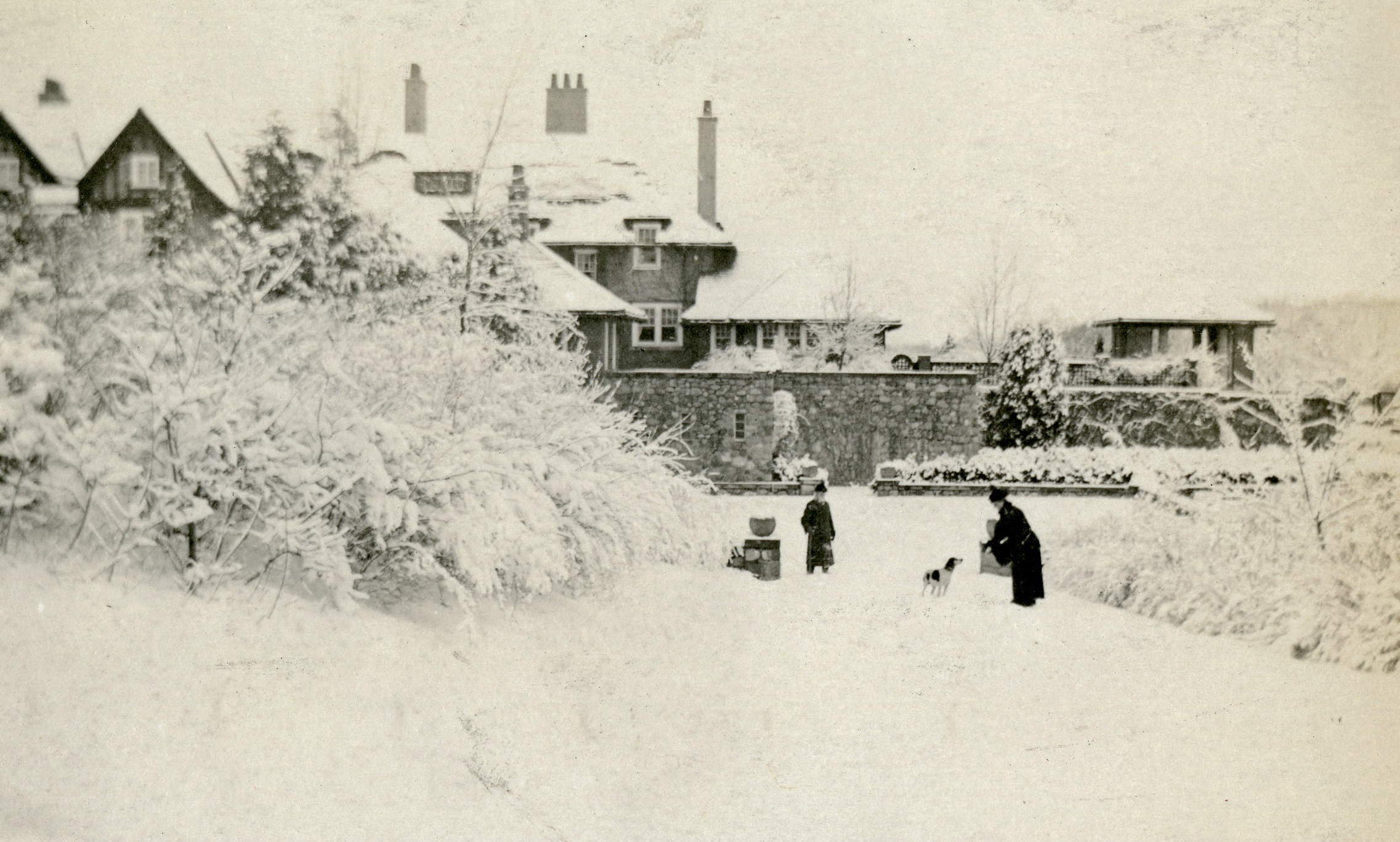
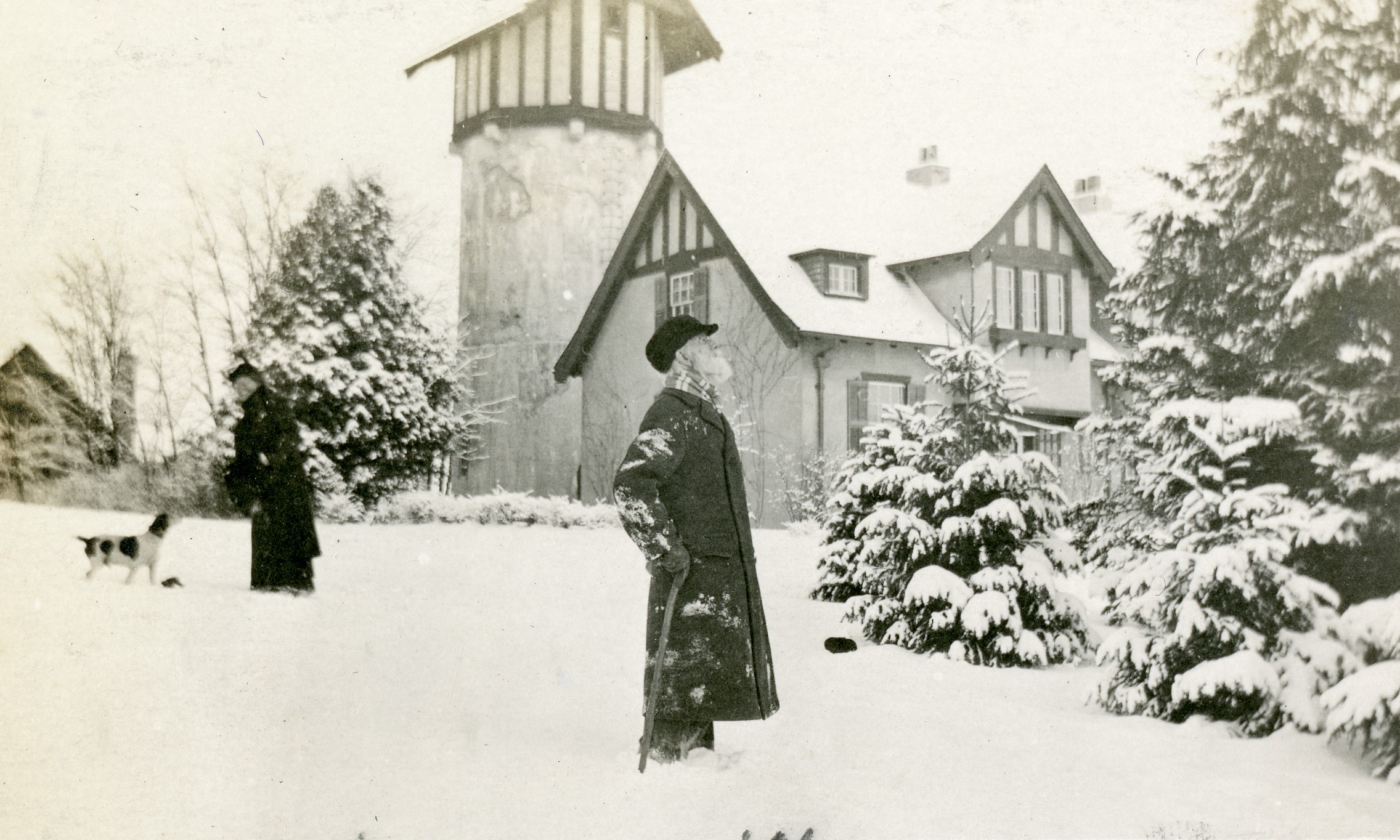
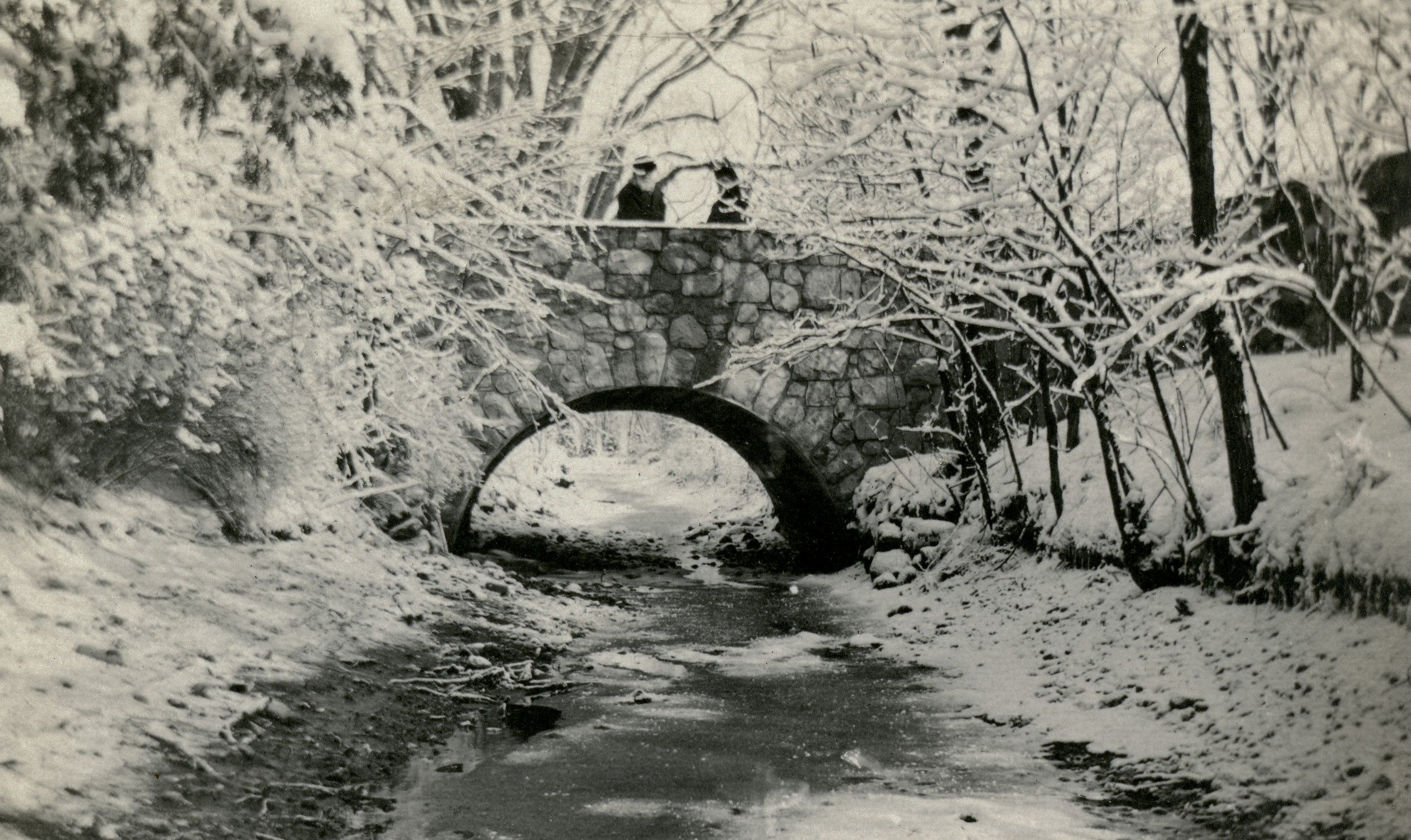
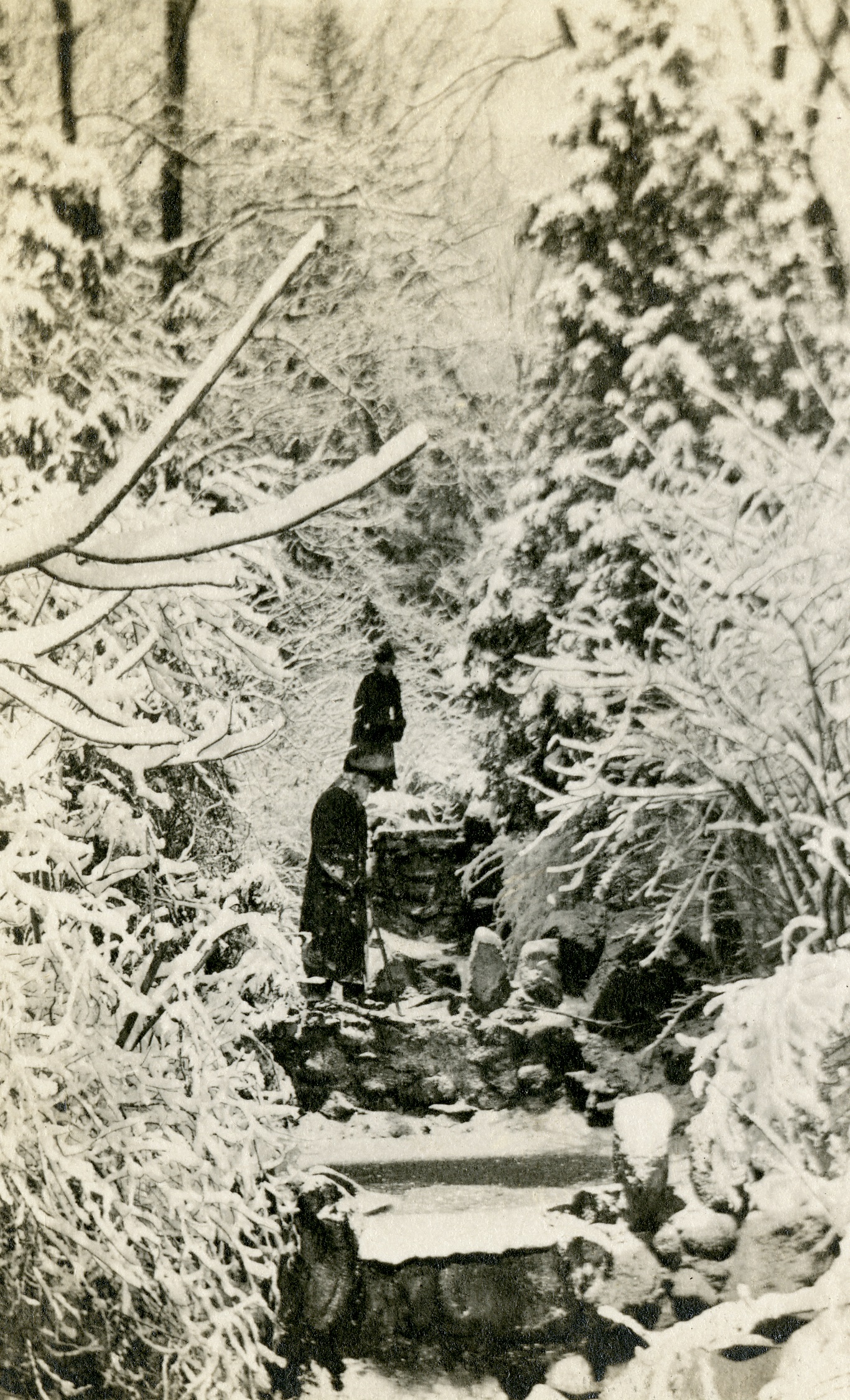
As we start a new year, I thought I would share some winter scenes at Cranbrook from 105 years ago. In the Winter of 1916, Henry Wood Booth and his daughter Alice Booth Miller took a stroll around the grounds of a snow-covered Cranbrook Estate. The journey was documented in pictures now in the Estate Albums in Cranbrook Archives.

Henry Wood Booth and Alice Booth Miller on the trail between the Cottage and Cranbrook House, March 1916.
Henry Wood Booth and Alice Booth Miller on the road to the Service Court, just above the Sunken Garden, at Cranbrook House, March 1916.
Henry Wood Booth and Alice Booth Miller beside Tower Cottage (then known as the Summer Cottage and water tower), March 1916.
Henry Wood Booth and Alice Booth Miller on the arched bridge over the Mill Race, March 1916.
Henry Wood Booth and Alice Booth Miller at the Cascades (now the site of the Morris Mill), March 1916.

Best wishes for a happy and healthy New Year from your friends at Cranbrook Center for Collections and Research!

Leslie S. Mio, Associate Registrar, Cranbrook Center for Collections and Research

Thornlea’s “Guardian Angel”

I would like to introduce you to the “guardian angel” of Thornlea, the home of Henry Scripps Booth and Carolyn Farr Booth. She is a flying winged spirit guardian, sometimes called a cradle guardian or spiritchaser, made in Bali, Indonesia.

Spirit guardian in the entrance hall of Thornlea House.

Spirit guardians have been used in Balinese temples and homes to ward off evil spirits for centuries. Typically, they are hung in a high location, looking down towards a door or window. 

Thornlea’s “Guardian Angel” flies high above visitors to the home, 2019. Photo by PD Rearick, CAA ‘10

Thornlea’s guardian hangs high above the entrance hall to the house, gazing down on all who enter. The guardian is in the form of Dewi Sri, who, in Balinese mythology, is the goddess of rice, fertility, a successful harvest, and family prosperity and harmony.  

Archival records point to Henry Scripps Booth purchasing the guardian in San Francisco, not in Bali, between 1978 and 1988 (Ed. note: per HSB’s grandson Charlie’s recollections in the comments below, the guardian was bought about 1984). 

In June 2020, our Associate Curator Kevin Adkisson took visitors on a virtual tour of Thornlea House. Here is a clip featuring Dewi Sri:

Cranbrook Center for Collections and Research’s Facebook Live at Five: Tour Thornlea House, June 17, 2020,

The next time you visit Thornlea, make sure to look up and say “om swastiastu” to Dewi Sri and ask her for prosperity and harmony for your family!

Leslie S. Mio, Associate Registrar, Cranbrook Center for Collections and Research

“Crime, it seems, sometimes does pay”

Actor Edward G. Robinson is often remembered for playing gangsters and wise guys, or, my person favorite role, as Dathan in Cecil B. DeMille’s epic film The Ten Commandments (1956). What most people do not know is that Robinson was an art collector.

Edward G. Robinson as a gangster in Little Caesar (1931). Unknown author, Public domain, via Wikimedia Commons.

That is not exactly true. According to Robinson, at the time of the exhibition Forty Paintings from the Edward G. Robinson Collection at the Museum of Modern Art in 1953, “I am not a collector. I’m just an innocent bystander who has been taken over by a collection . . . I am just a lover of paintings. I do what I do for the sheer joy of it!”

Robinson continues, “If I hadn’t become a movie gangster, it is highly probable that not one of my paintings would have had the chance to collect me. Here is a paradox: Turn killer and you have the means to satisfy your thirst for beauty . . . Crime, it seems, sometimes does pay.”

Edward G. Robinson’s home. View of living room, October 3, 1944. Dorothy Liebes papers, circa 1850-1973. Archives of American Art, Smithsonian Institution.

Unfortunately, in February 1957, Robison was forced to sell his art collection as part of the divorce settlement with his first wife Gladys Lloyd Cassell Robinson. Immediately after, he began to collect again. This second collection would be even bigger than the first.

Unlike film moguls or actors who pay experts to place a couple of easily recognizable masterpieces above their fireplaces, Robinson selected his artworks himself. He bought on instinct and impulse, guided by what he loved. As he said, “You don’t collect paintings – they collect you.”

You may say, this is all very interesting, but what is the Cranbrook connection?

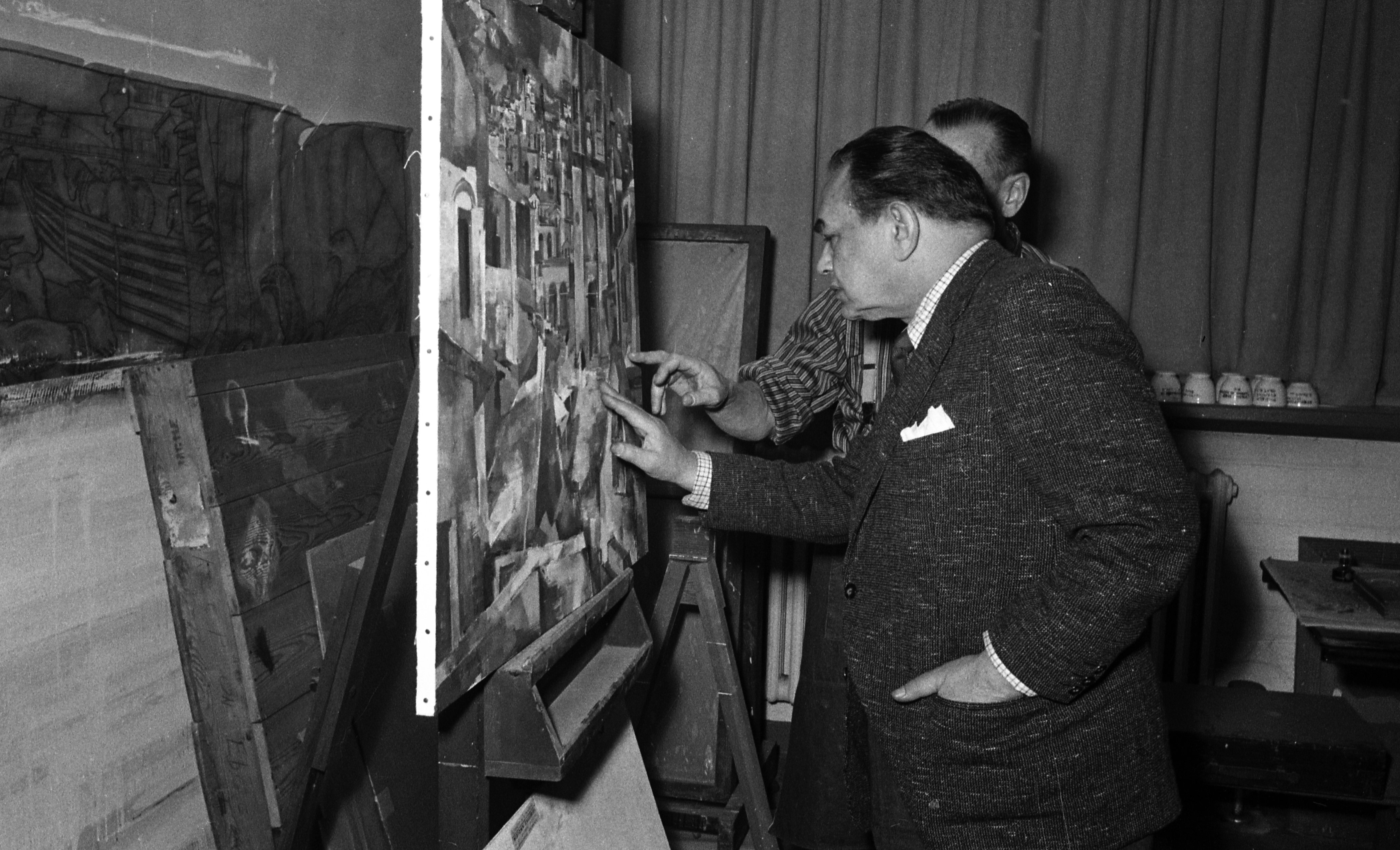
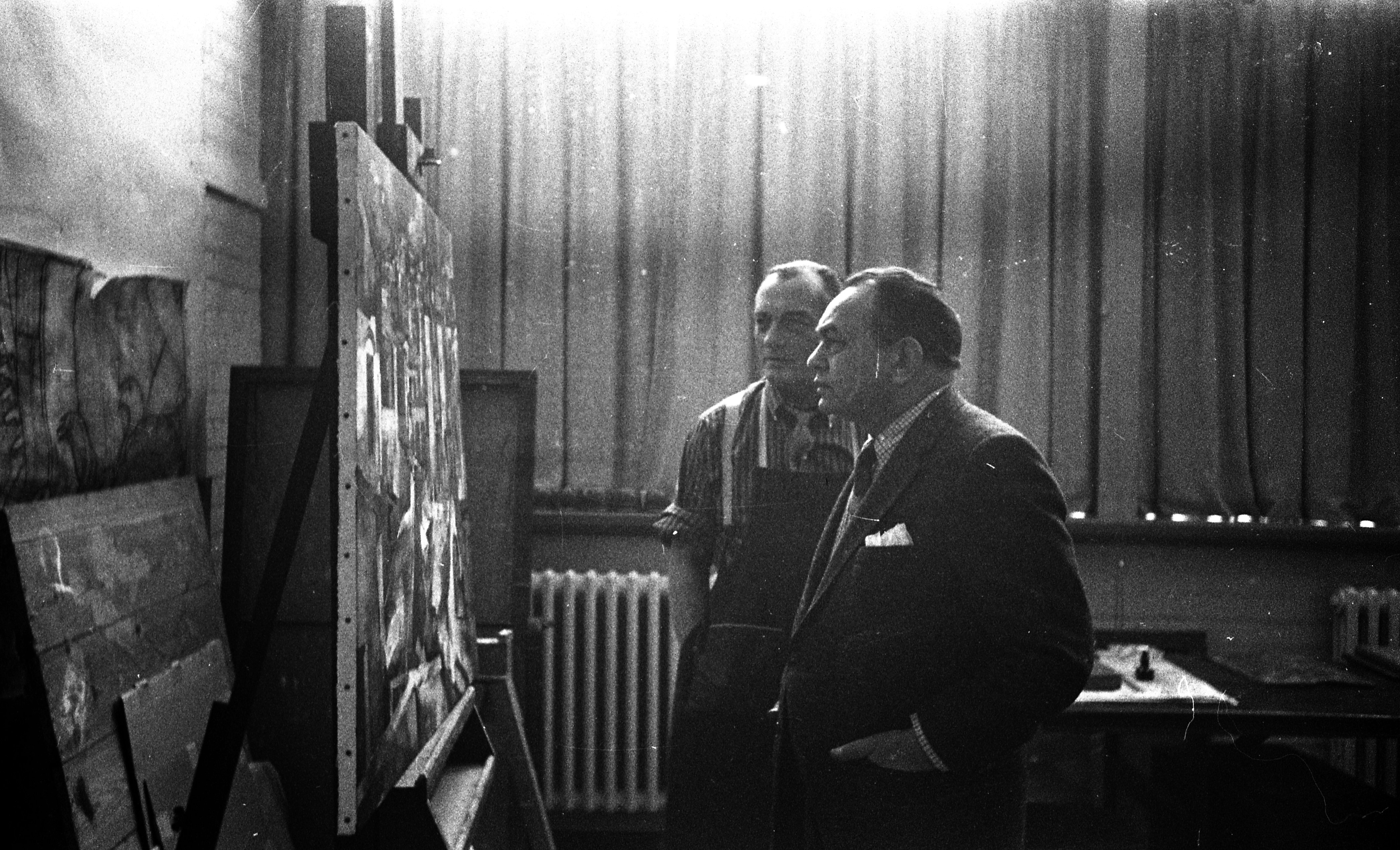
In December 1957, Robinson was in a play “Middle of the Night” at Cass Theatre in Detroit. According to the Sunday, December 15, 1957, Detroit Free Press, “A distinguished art lover, Edward G. Robinson, the actor, dropped in at Cranbrook Academy of Art Tuesday to chat with an old friend, Zolton (sic) Sepeshy, director of the Academy.”

Cranbrook Archives holds the “proof” of this visit, by way of wonderful images from our campus photographer, Harvey Croze.

I did some digging, and Robinson’s personal archives at Boston University have no mention of Cranbrook or Sepeshy. I also could not confirm if Robinson had any of Sepeshy’s art in his collection; none appear in the 1953 exhibition or in the coffee table book about his second collection, Edward G. Robinson’s World of Art (1971).

I imagine it was simply his love of art that brought Robinson out to Cranbrook in 1957, the same reason so many of us are drawn to campus today.

Leslie S. Mio, Associate Registrar, Cranbrook Center for Collections and Research

Magical Oven: The Frigidaire Flair

As part of its efforts to maintain safe distancing during classes, Cranbrook Schools has spread out all over campus. This includes the use of the Edison House, former home of visiting scholars to Cranbrook Institute of Science.

The history of Edison House and a look at some of its unique features have been explored already (see earlier Kitchen Sink blogs Edison House a Modern Icon and Photo Friday: Modern inside and Out). But one particular object in the house has a special Cranbrook, and a magical, connection.

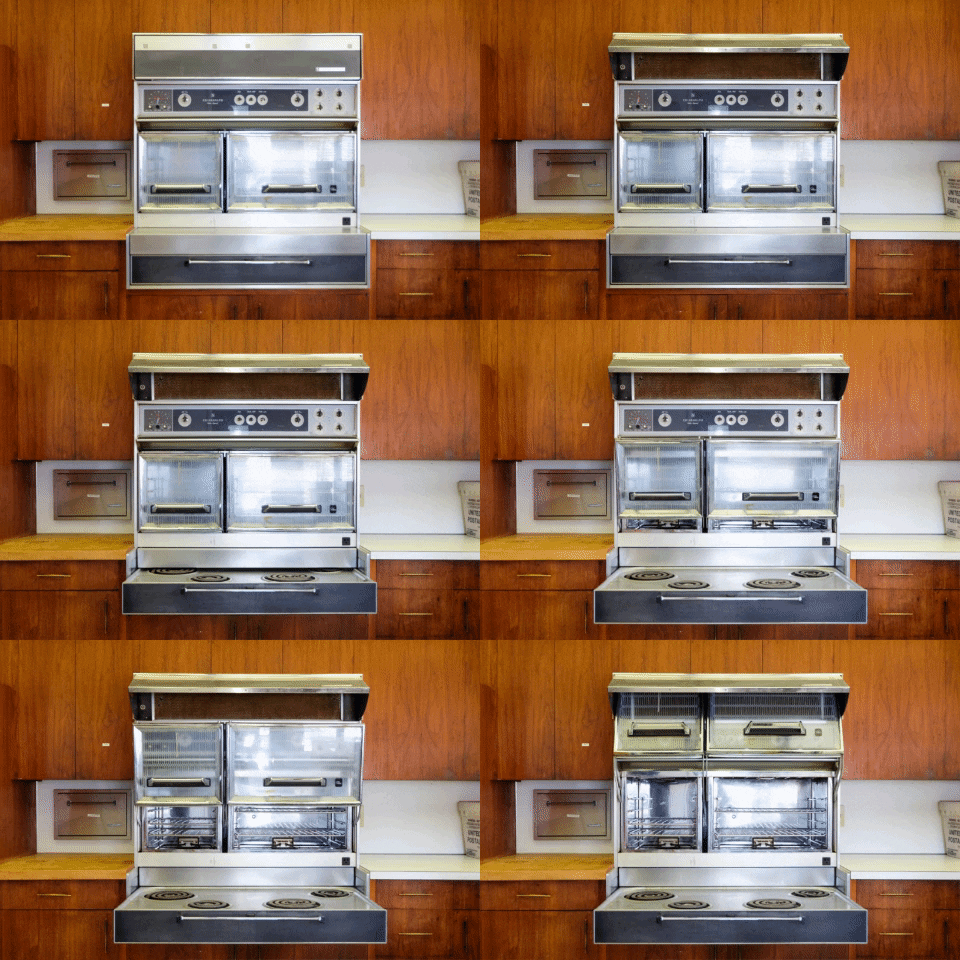
1965 Frigidaire Imperial Flair oven installed in Edison House. Photos by Daniel Smith, CAA ’22.

In the Edison House kitchen is installed a 1965 model Frigidaire Imperial Flair range and oven in Honey Beige. Frigidaire was owned by General Motors when the Flair was introduced to the market in 1962. An electric range, the Flair has burners that roll in and out much like a drawer, hidden from view when not in use. The double ovens sit right at counter height, and the oven doors lift up instead of swinging out. As a Frigidaire advisement in Cranbrook Archives proudly pronounced, “Flair has every automatic feature you’ve ever wanted!”

Ideas for Living, 1960
An image from “Ideas for Living,” 1960. Copyright General Motors. Courtesy Cranbrook Archives.

First, the Cranbrook connection: Many aspects of the oven, including the mechanics of the lifting oven doors, were designed by M. Jayne van Alstyne. Van Alstyne, whose papers are held in Cranbrook Archives, studied ceramics at Cranbrook Academy of Art in 1941 and 1942 before going on to study industrial design at Pratt Institute and Alfred University in New York. From 1955 to 1969, she worked for General Motors, first with GM Frigidaire and later as one of Harley Earl’s “Damsels of Design” in the automotive division.

As Studio Head for GM Frigidaire, she led the research and development of appliances and oversaw product exhibitions, including the “Ideas for Living” show where the Flair debuted in 1960. Her signature oven and range (as well as many other modern electric appliances detailed in the dedication booklet) was installed at Edison House in 1966.

Kitchen in Edison House, “Cranbrook’s New Idea Home,” May 1966. Harvey Croze, photographer. Copyright Cranbrook Archives.

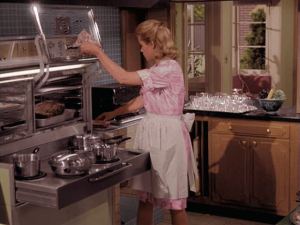
Second, the magical connection: From 1964 to 1972, Actress Elizabeth Montgomery starred in the television sitcom, Bewitched. It told the story of Samantha, a witch, who marries a mortal, Darrin Stephens (Dick York). Samantha agrees to live the life of an ordinary housewife. Of course, things don’t go as planned and hilarity ensues. In their kitchen, the Stephens had a Frigidaire Flair, which appeared in a number of episodes.

Actress Elizabeth Montgomery on the set of Bewitched with her Frigidaire Flair. Photo Courtesy of Grace Kelly, Kitchen Designs by Ken Kelly, Inc.

Anyone who sees the Flair in Edison House will agree it is a marvel of design. While they won’t be whipping up lunch on the appliance, I hope the kids taking classes in the house will take a moment appreciate it. As Frigidaire promised in 1962, the Flair is “The happiest thing that ever happened to cooking… OR YOU!”

Leslie S. Mio, Associate Registrar, Cranbrook Center for Collections and Research

Tool of the Trade

Light, temperature, and humidity can all harm a museum’s objects and artifacts. In a previous blog, I talked about what damage light can do and how we are combating that at the Frank Lloyd Wright Smith House. The battle for consistent temperature and humidity in the house is another issue.

Frank Lloyd Wright Smith House, 2012. Photo by James Haefner.

In October 2018, we had a Conservation Assessment done at Smith House by ICA – Art Conservation. According to ICA,

Temperature can affect a collection in . . . significant ways. Elevated temperatures have the capacity to increase the rate of deterioration . . . [and] temperature affects relative humidity.

Relative humidity is the ratio of the amount of water vapor in a particular volume of air relative to the maximum amount of water vapor this same volume of air can hold at the same temperature.

As relative humidity fluctuates, the environment and the materials within it will seek equilibrium with one another . . . Within a museum or historic structure, the collection objects and building materials will act like a sponge to these fluctuations, which can cause irreversible mechanical damage.

In the museum community, it is recommended that the relative humidity be kept as stable as possible and the temperature as low as practicable. A relative humidity (RH) range between 55% to 35% is thought to be best for general conditions. However, it is the stability of the relative humidity that is more significant than the actual value. Temperatures below 72˚F and above 32˚F are considered acceptable when the relative humidity is controlled.

So, what was the Center to do? Equipment for monitoring (data loggers) was purchased. We started regular environmental monitoring throughout Smith House. Logs were created to record the environment ranges for temperature and relative humidity for the spaces.

Data loggers are devices equipped with sensors and a microprocessor to monitor and record data such as temperature and relative humidity. We chose Lascar’s EL-USB-2. This standalone data logger measures more than 16,000 readings and features a USB drive so data can be downloaded directly to a computer.

Data logger used to monitor temperature and humidity in Smith House.

However, it is not always practical to carry a laptop around Smith House to download the data or remove the data loggers to download on my office PC. Instead, I use the EL-DataPad. It allows the configuration and download of temperature and humidity data loggers on the spot.

Data pad with attached data logger.

In the Smith House, the temperature and humidity is recorded every 30 minutes. I log this data and graph it, to see trends or issues in the house.

Graph of Smith House Living Room temperature and humidity readings from March to September 2020.

How will this documentation help conservation of objects in Smith House? The data will be useful for establishing achievable set points and ranges for the house environment. It will also be helpful for writing grants to help fund equipment or materials for further environmental management.

Leslie S. Mio, Associate Registrar, Cranbrook Center for Collections and Research

The Smiths and World War II

World War II caused global upheaval and change. Closer to home, two schoolteachers from Detroit—Melvyn and Sara Smith—and their dream of building a home designed by Frank Lloyd Wright would have to wait for war.

On December 7, 1941, the Japanese bombed Pearl Harbor. Sara Smith recalled her husband’s concern: “One day he confessed to [me] that in addition to his worries about the catastrophe the country was facing, he felt if there was a war, that also would be the end of his Frank Lloyd Wright house.”

Melvyn Maxwell Smith’s draft card, 1942. Source: Ancestry.com. U.S. WWII Draft Cards Young Men, 1940-1947 [database on-line]. Lehi, UT, USA: Ancestry.com Operations, Inc., 2011.

In February 1942, Melvyn Maxwell Smith was drafted into the U.S. Armed Forces. “Smithy thought about being a conscientious objector because he didn’t believe in wars,” recalled Sara, “but the more he thought about it, the more he decided he would have to go. ‘We want peace and I’m going to do what I can to help,’ he told me.” The thought of Smithy going off to war weighed heavily on Sara. They had only been married a short time, and now they were being separated.

Smithy was sent off to training, first at Fort Custer near Battle Creek, Michigan, then Sheppard Field in Wichita Falls, Texas, and finally Atlantic City, New Jersey. The Smiths could only see each other during school vacations (Sara was still teaching) or holidays, provided Smithy was not shipped off to the front.

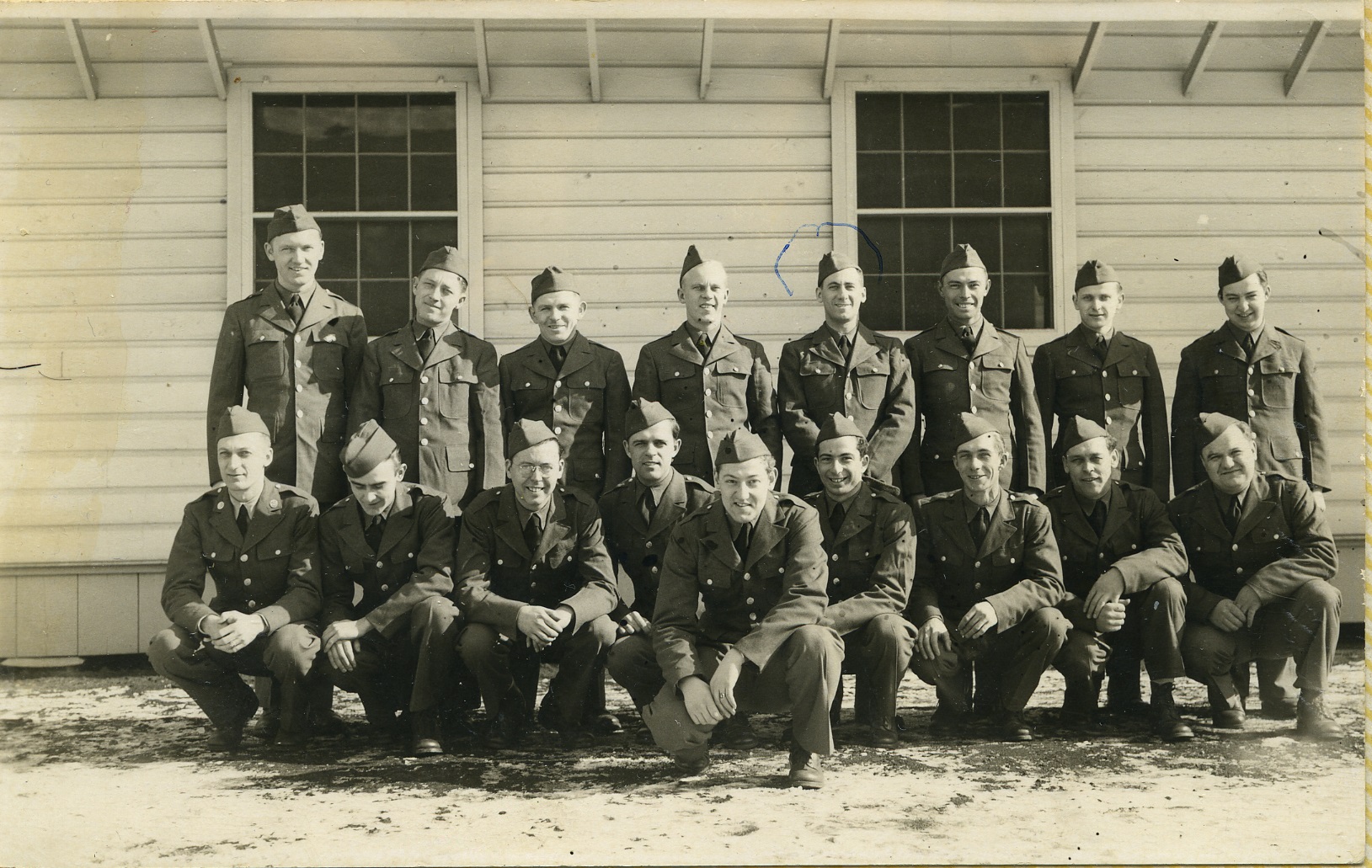
Melvyn (circled in back row) and other officers, circa 1943. Courtney of Smith Family Papers, Cranbrook Archives.

In Atlantic City, Smithy was offered the opportunity to train as a Warrant Officer in the Army Air Corps. He would be sticking around Atlantic City for a while and, with an officer’s salary, Sara could finally join him. At Christmas 1942, “[Sara] boarded the night train to Atlantic City and her new life.”

Sara and Melvyn Smith in Atlantic City, 1942. Courtney of Smith Family Papers, Cranbrook Archives.

After Atlantic City, the Smiths were relocated to Goldsborough, North Carolina. Sara and Smithy lived in a studio apartment in an Army project. Sara enjoyed living there, commiserating with all the other Army wives. Since they were all typically newly married and removed from their families, the wives helped each other. “The women, on their own during the days, supported each other by sharing supplies and tips and small and large acts of kindness.”

Warrant Officer Melvyn Maxwell Smith. Courtney of Smith Family Papers, Cranbrook Archives.

It was in Goldsborough that Sara became pregnant with her son Bobby. When she was seven months pregnant, Smithy was transferred to Gulfport, Mississippi. Sara was sure this would mean Smithy would be shipped to the front. Smithy worried too, so he asked Sara to return to Detroit and her family for the birth of their baby, instead of following him to Mississippi. While Sara was in Detroit awaiting the birth of Bobby, Smithy was again transferred, this time to Biloxi, Mississippi, for which the Smiths were happy. It meant not being overseas.

Continue reading

I Heard the Bells

What you might think at first look is simply a bell tower at Christ Church Cranbrook is actually much, much more. The tower holds a carillon, a musical instrument consisting of cast bronze bells in fixed suspension, tuned in half steps (chromatic order). It is played from a clavier (keyboard) containing wooden leavers and pedals wired to clappers.

South view of Christ Church Cranbrook, 1932. Photo by Max Habrecht. Courtesy of Cranbrook Archives, Cranbrook Center for Collections and Research.

The Christ Church Cranbrook carillon is known as the “Booth-Wallace Carillon” as the instrument was a gift to the church from Grace Booth Wallace, her husband Harold Lindsey Wallace, and their five children, Elizabeth, Ellen, Richard, Shirley, and Catherine. It originally consisted of forty-six bells made by the Taylor Bell Foundry in Loughborough, England.

The largest bell (bourdon) is 6,700 pounds, five-feet eight-inches in diameter, and rings a low B-flat. The carillon was later expanded in 1978 with smaller treble bells to its current total of fifty bells, or four complete octaves. The carillon is in concert pitch, meaning it sounds the notes implied by the keyboard arrangement. To play the large instrument, the clavier is struck with fists and feet. The carillon requires physical exertion as the clappers can weigh several hundred pounds–however, the instrument is balanced for ease of use.

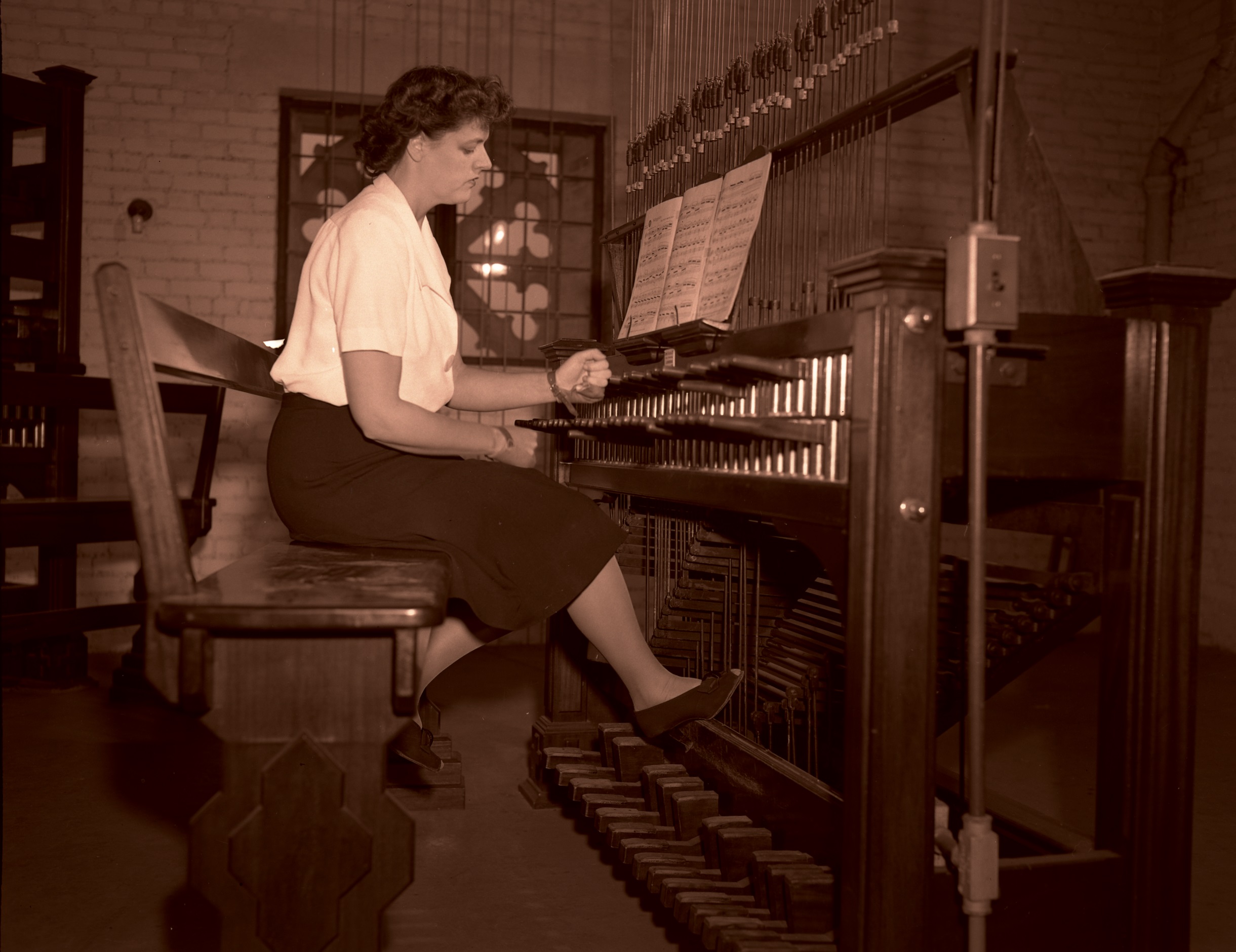
Nellie Beveridge at the clavier of the Booth-Wallace Carillon in May 1946. Note the use of her fists to play the instrument. Beveridge also served as nurse and companion to George and Ellen Booth. Courtesy of Cranbrook Archives, Cranbrook Center for Collections and Research.

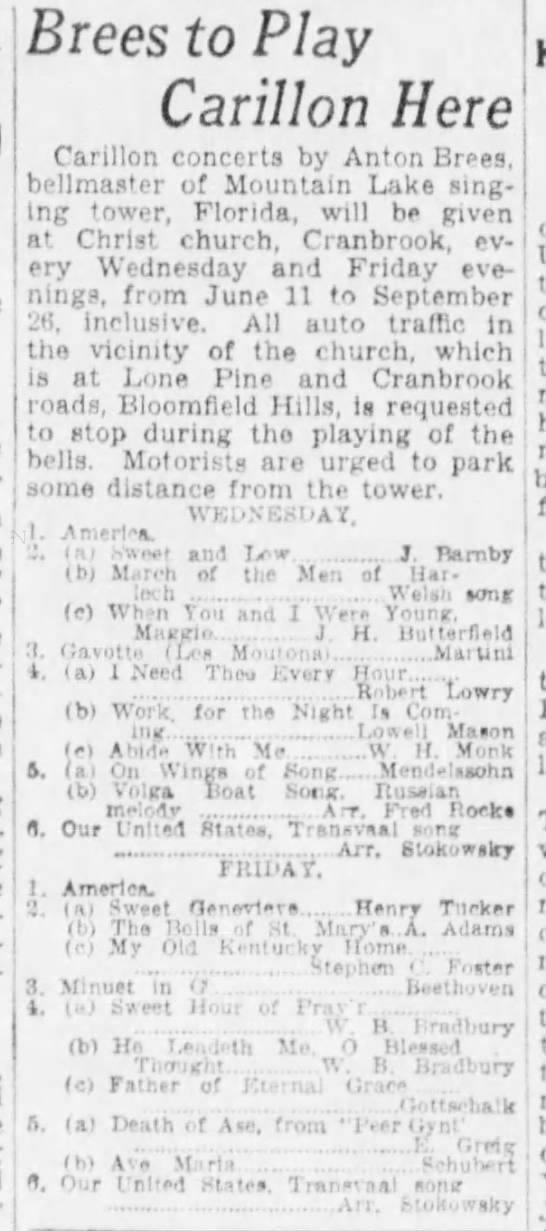
The Booth-Wallace Carillon was dedicated on Sunday, September 30, 1928. The first carillonneur to play the instrument was Anton Brees, at the time one of the world’s leading carillonneurs and famously the carillonneur of the Singing Tower at Bok Tower Gardens in Lake Wales, Florida. He would return to Christ Church for several summers to play, beginning what is now called the Summer Carillon Series.

Article from the June 8, 1930 the Detroit Free Press regarding Brees and the Christ Church Summer Carillon Series.

The 2020 Summer Carillon Series at Christ Church Cranbrook has already begun. You can listen to the July 5th concert below and go to the church’s Facebook page to learn more about future concerts.

Christ Church Cranbrook has had a number of carillonneurs or carillonists throughout its history.

Carillonist Beverly Buchanan preparing the instrument to play, February 1970. Courtesy of Cranbrook Archives, Cranbrook Center for Collections and Research.

Beverley B. Buchanan played the carillon at Christ Church from 1964-1988. Beverly was a graduate of the University of Michigan, School of Music where she majored in organ and carillon. She was a long time member of the American Guild of Organists and the Guild of Carillonneurs in North America. She concertized on the carillon throughout North America, Europe, and Australia.

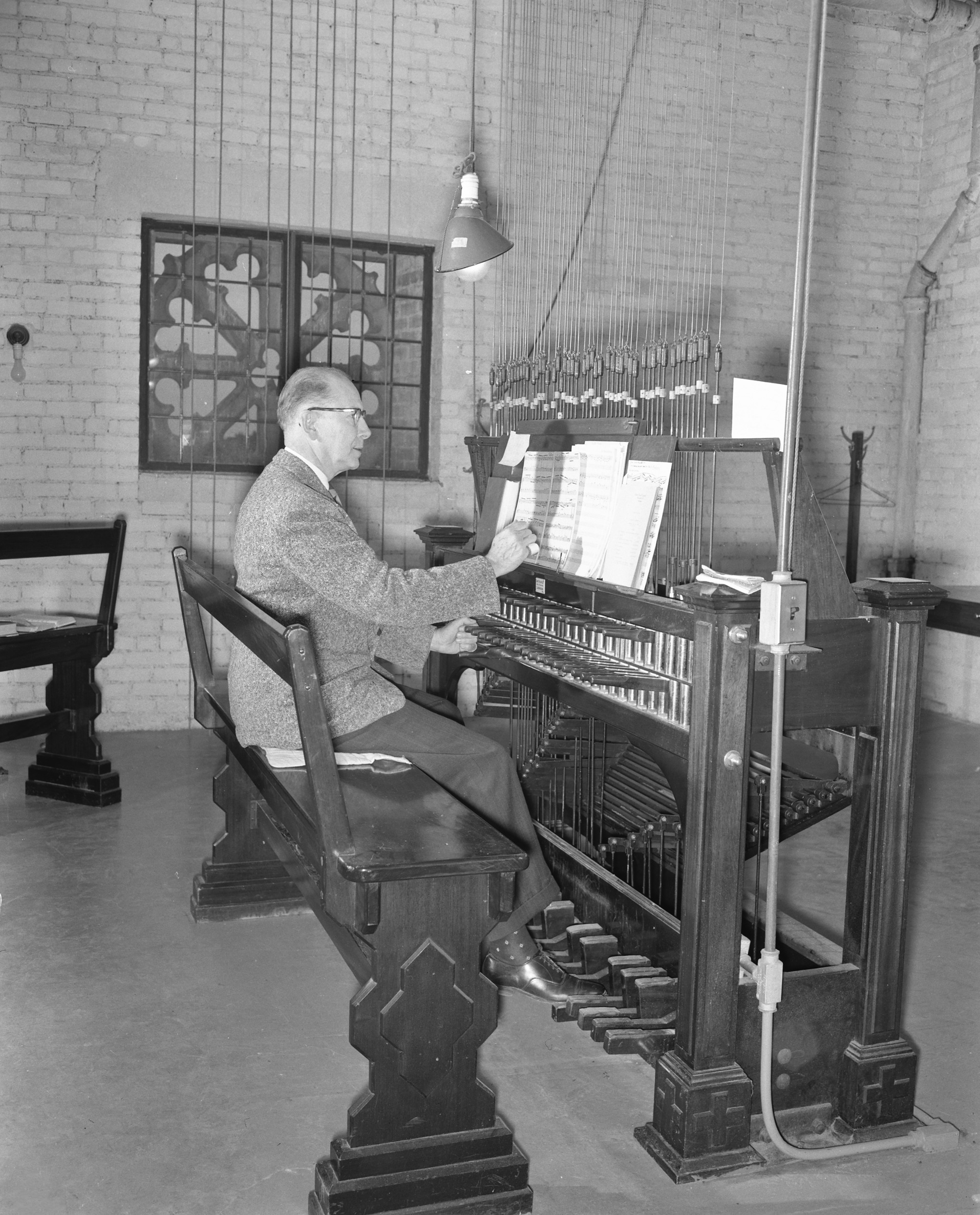
Dr. Maurice Garabrant playing the carillon, September 1956. Courtesy of Cranbrook Archives, Cranbrook Center for Collections and Research.

Other carillonneurs of Christ Church include Dr. Maurice Garabrant (1949-1959), Dr. Don Cook (1988-1991), and Dr. Phillip Burgess (1991-mid 1990s). The current carillonist at Christ Church is Jenny L. King, who has been at Christ Church since the mid-1990s..

We hope that you will be able to enjoy more of the Christ Church Cranbrook Booth-Wallace Carillon this summer, whether in person or online. I think sitting on the wide lawn in front of the church enjoying a concert sounds like the perfect socially distant activity! For the complete program for the Summer Carillon Series, click here.

Leslie S. Mio, Associate Registrar, Cranbrook Center for Collections and Research

Clean as a Whistle

In the past, we have discussed how we cover our stone sculptures on campus to protect them in the winter. But what about the many bronze sculptures? Europe and the Bull? Persephone? The Centaurs?

These pieces are more robust and able to withstand what winter throws at them, but they still need some love each year.

Each spring since 1987, the Community has brought in Venus Bronze Works to recondition the bronzes across the campus. Venus Bronze Works is a member of the American Institute for Conservation of Historic and Artistic Works, which means all the cleaning they do is in accordance with AIC’s Code of Ethics and Guidelines for Practice.

All sculptures are inspected and cleaned by dusting them off with compressed air or wet down and washed with a mild detergent, sponges, soft bristle brushes, and fine cotton pads.

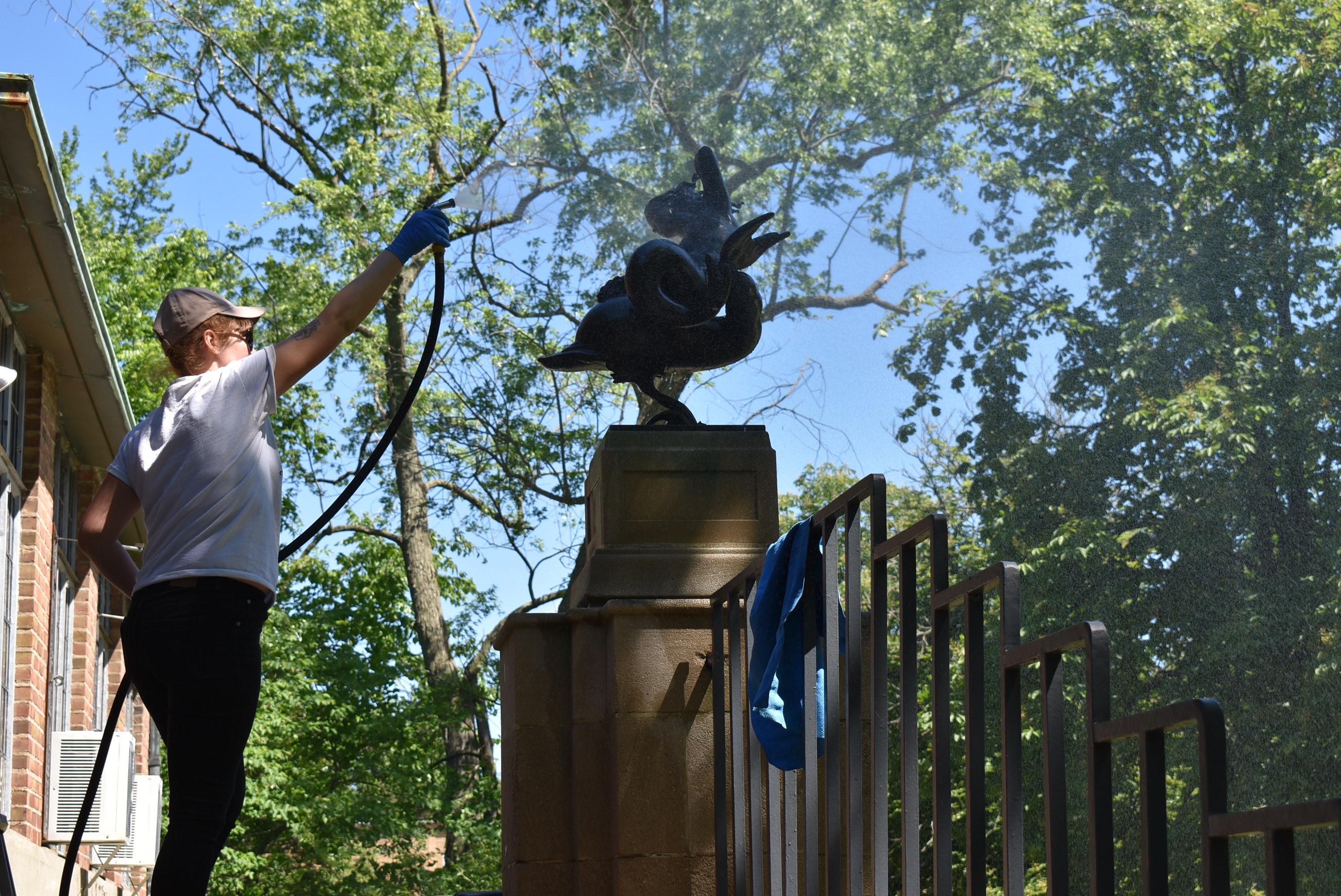
Terra Gillis of Venus Bronze Works gives Carl Milles’s Sunglitter (also know as Naiad and Dolphin, CAM 2002.1) a quick shower, 2020. Photo by Kevin Adkisson.
Harlow Toland of Venus Bronze Works gives one of Carl Milles’s Running Deer (CAM 1934.30) a good scrub, 2020. Photo by Kevin Adkisson.

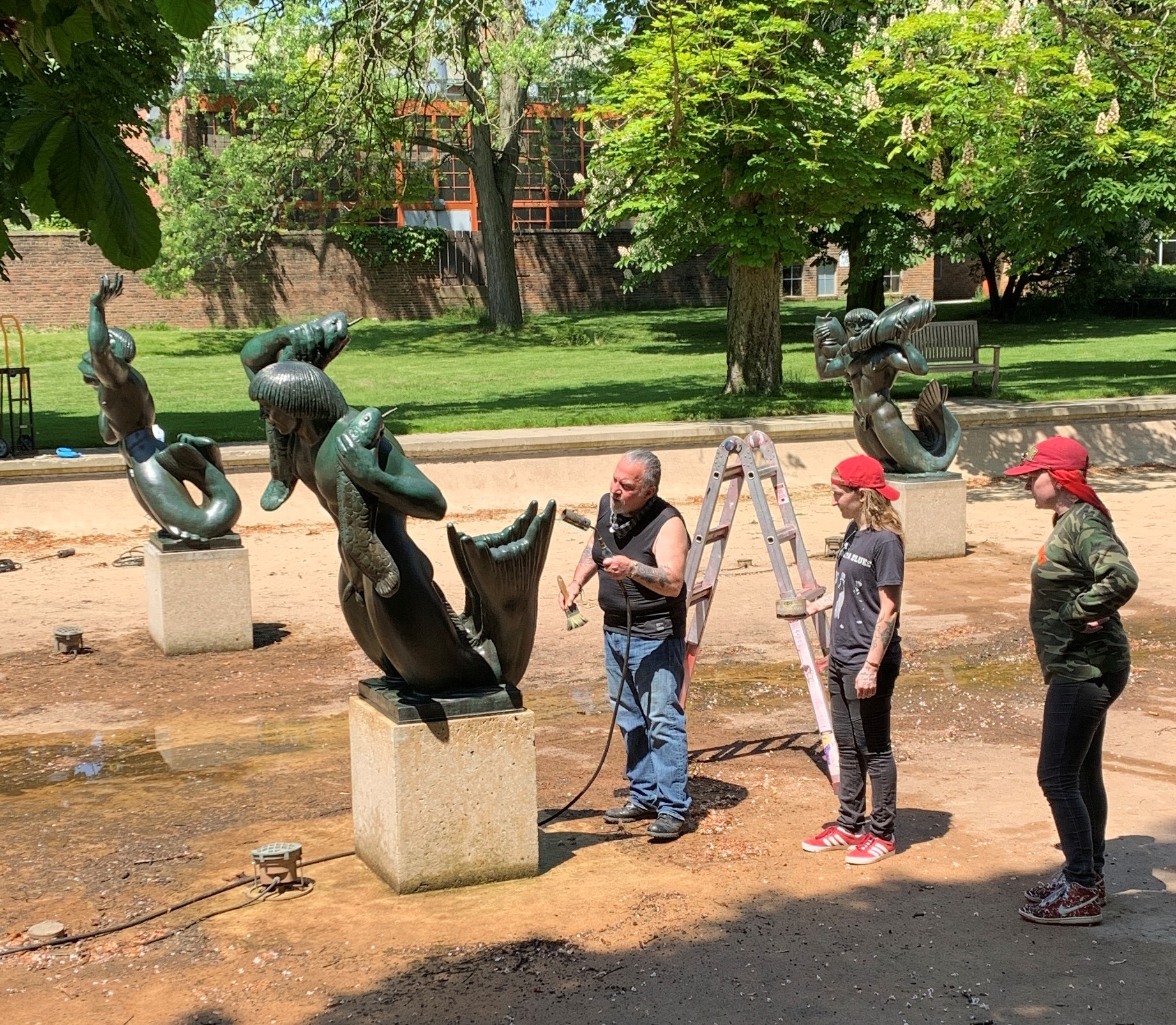
When the works are dried, one or two thin coats of wax are applied and the sculptures are buffed. This wax can be applied directly from the container or applied to a hot surface (by heating the sculpture with a propane-fed torch).

Giorgio Gikas, founder of Venus Bronze Works, holds the torch while his assistants Harlow Toland and Sara Myefski help prepare Triton with Fishes in the Triton Pools at Cranbrook Art Museum to receive a hot wax treatment, 2020. Photo by Kevin Adkisson.

This wax acts as a barrier to the air and humidity on the bronze surface and prevents damaging oxidization or corrosion from developing. When deciding how each individual work is cleaned, we look back to the artist’s intent for each sculpture (was it meant to be patinated green? dark bronze? polished? gilded?) and treat it accordingly.

Venus Bronze Works cleans and waxes all the Milles sculptures at the Cranbrook Art Museum and Cranbrook Academy of Art and the Cranbrook Institute of Science. They also work on such sculptures as Brookside’s Birds in Flight; Kingswood’s Dancing Girls and Diana; Cranbrook House and Gardens’ Fortuna delle Tartaruga (Turtle Fountain); and Cranbrook School’s athletic sculptures. Check out a recent Instagram post about the athletic sculptures below:

We are excited to start welcoming visitors back to our campus this summer, so you can all see the beautiful sculpture in their freshened-up glory.

Leslie S. Mio, Associate Registrar, Cranbrook Center for Collections and Research

Create a website or blog at WordPress.com