Christ Church Cranbrook Baptistry

To the north of the narthex at Christ Church Cranbrook stands the Baptistry, where infants are christened with the pouring of water over the head.

Holy Baptism is full initiation by water and the Holy Spirit into Christ’s Body the Church. – The Book of Common Prayer

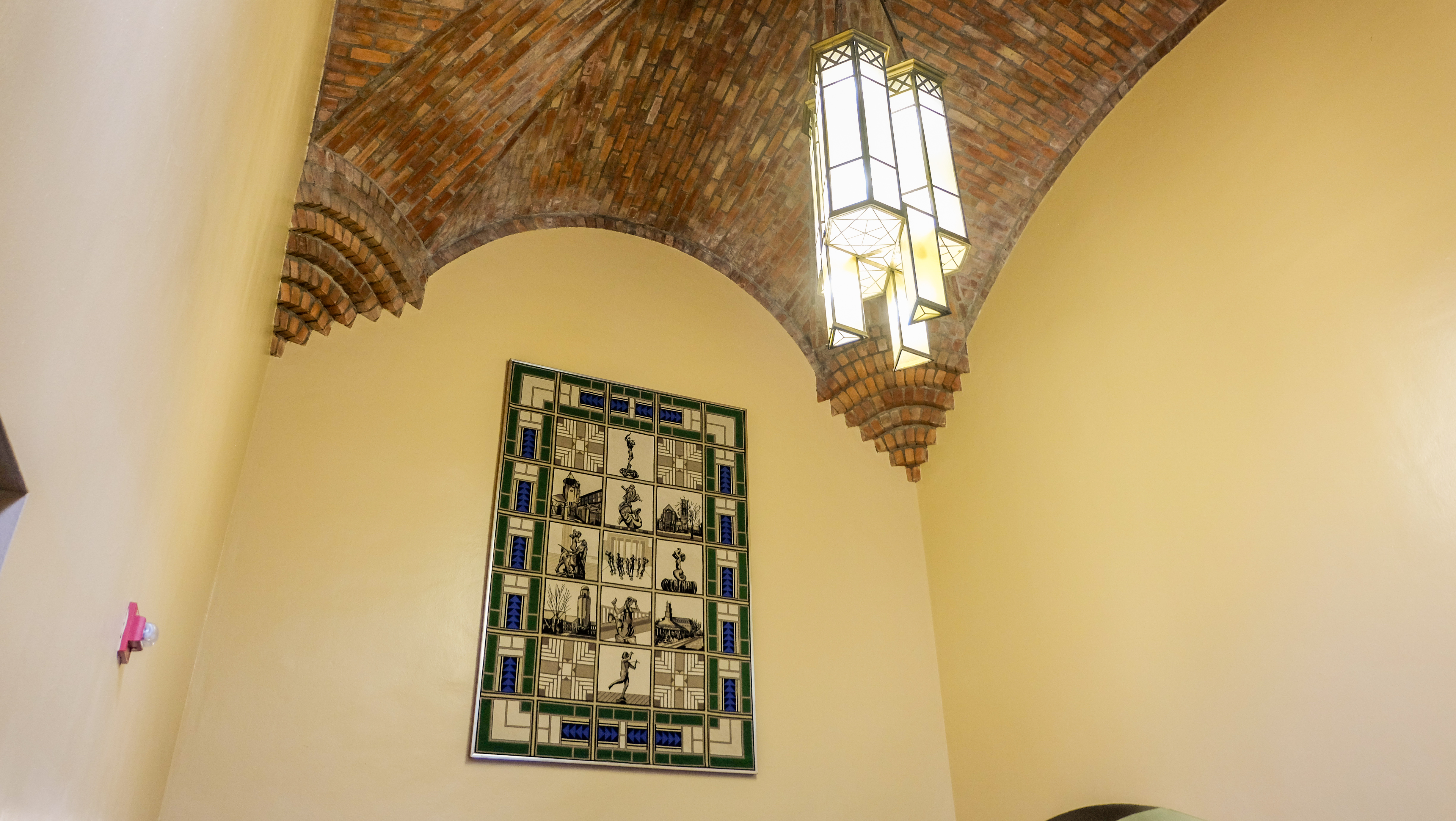
The whole Baptistry is a work of art, featuring an ornate wooden screen topped by the Lamb of God, a baptismal font with an ornate cloisonné cover that sits upon an exquisitely carved base, and a beautiful mosaic ceiling.
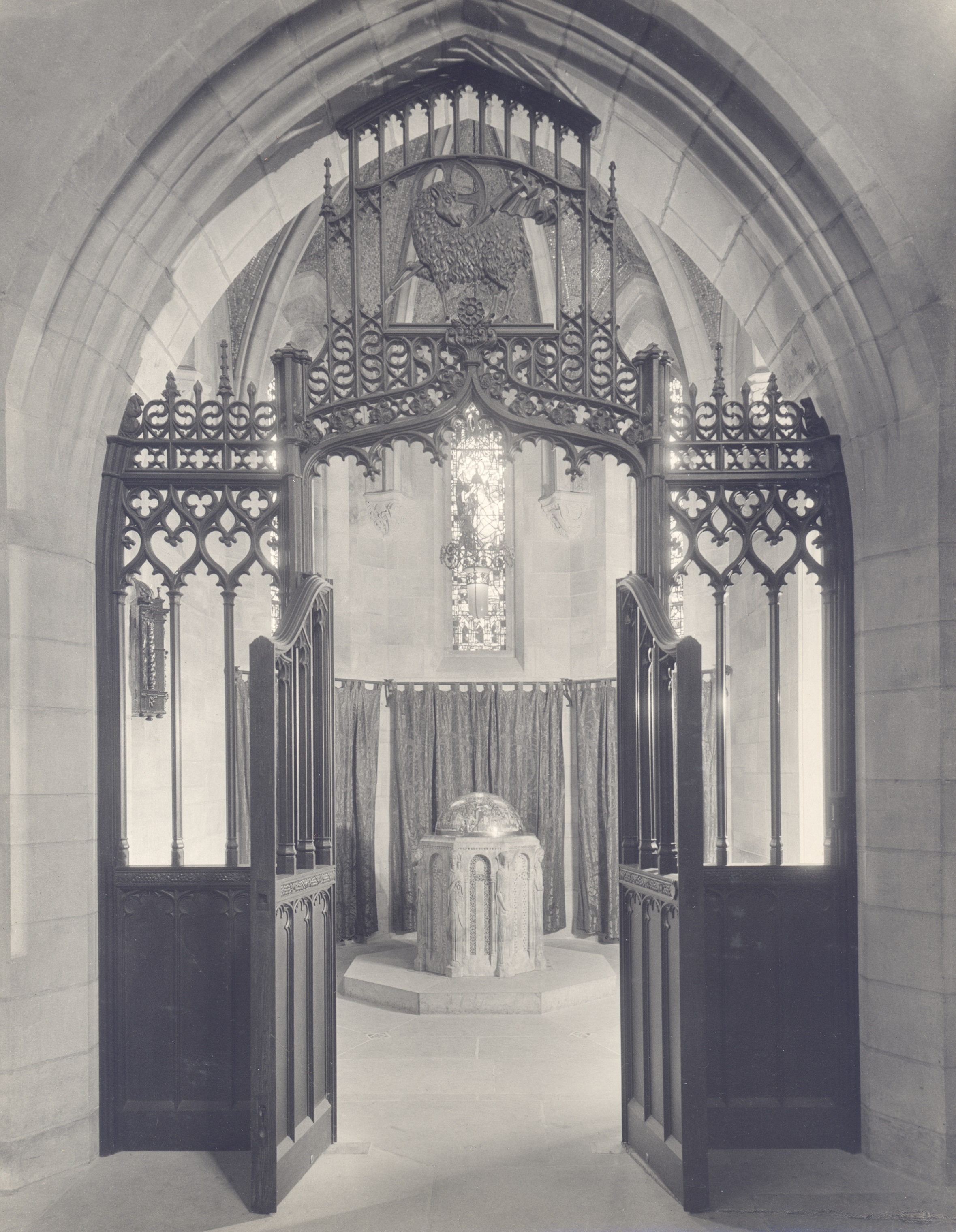
1992-16 Christ Church Baptistry

Christ Church Cranbrook, Baptismal Font, 1928. Peter A. Nyholm, photographer. Courtesy of Cranbrook Archives, Oscar H. Murray Photograph Collection.

Today, I want to focus on the ceiling by Mary Chase Perry Stratton and her Pewabic Pottery.

As George G. Booth was constructing Christ Church, he looked for the best craftspeople. In a 1926 letter to Bertram Grosvenor Goodhue Associates, architects of the church, Booth states, “I should be pleased if we are able to have a piece of Pewabic work in the Church and have thought the most suitable location would be the vault of the Baptistry”

After a seven-year rift with his old friend Mary Chase Perry Stratton over not allowing her creative license on projects at Cranbrook House, Booth offered an olive branch by giving Stratton the artistic freedom to create the Baptistry ceiling in 1926. This included the mosaic’s material and size, and how to incorporate the symbols of the seven gifts of the Holy Spirit into the work.
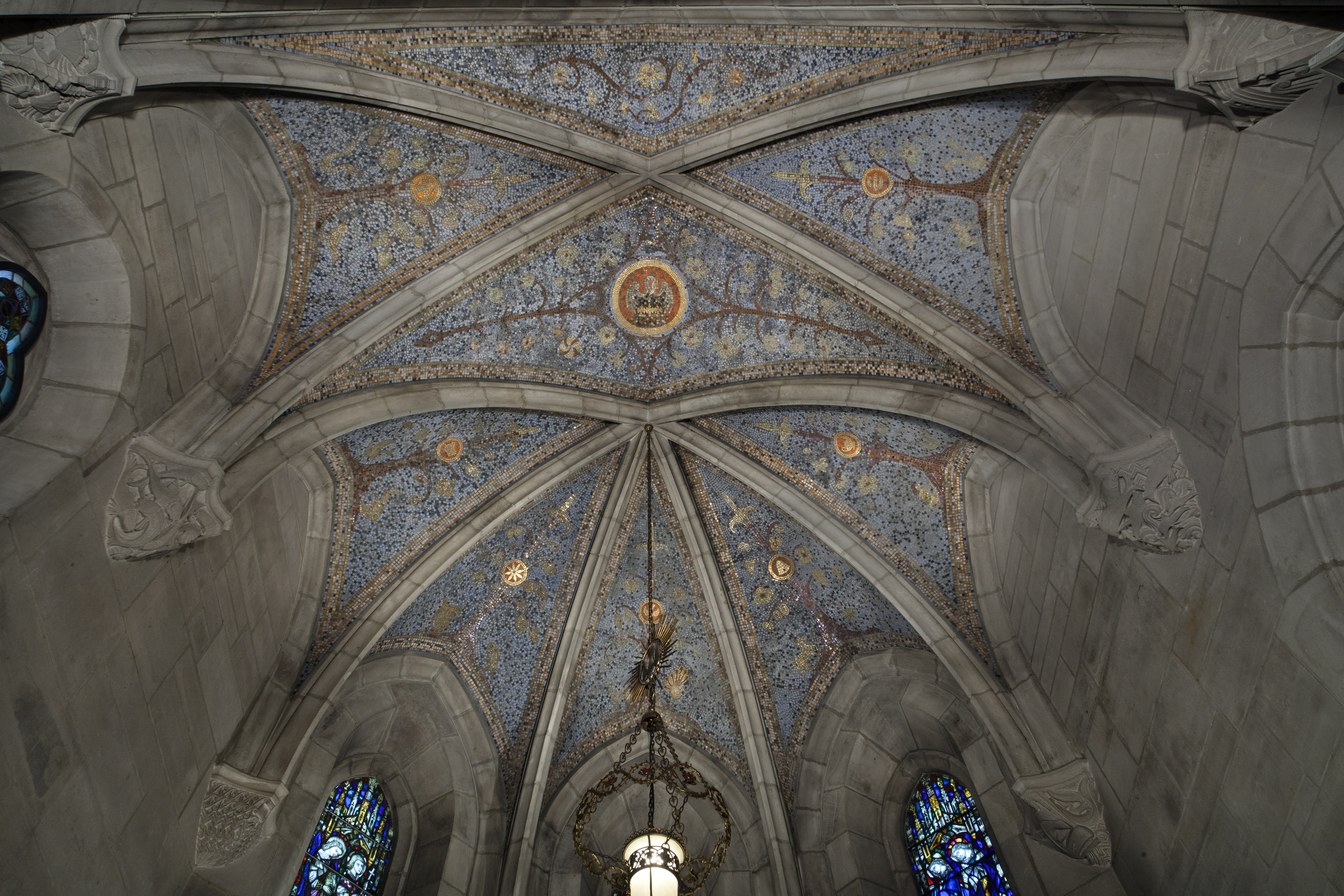
Baptistry ceiling

Christ Church Cranbrook, Baptistry Ceiling, 2015. P.D. Rearick, photographer. Copyright Cranbrook Center for Collections and Research.

The gifts of the Holy Spirit, which the initiant receives at baptism, are represented as follows: Wisdom is a Beehive (also a favorite symbol of the Booth family), Understanding is a Lamp, Counsel is the Star, Fortitude is an Oak, Piety is a Cross, Knowledge is a Book, and Godly Fear (Peace) is a Dove.

Baptistry ceiling 3

Christ Church Cranbrook, detail of Baptistry Ceiling, 2015. P.D. Rearick, photographer. Copyright Cranbrook Center for Collections and Research.

As former Cranbrook Center Collections Fellow Stephanie Kae Dlugosz-Acton wrote in the publication from her exhibition, Simple Forms, Stunning Glazes: “These symbols are centered on treetops resembling fleurs-de-lis. At the base of each of these saplings, a sea of blue tiles of varying shades surround two different animals, usually one mammal and one bird. All of the small tesserae tiles have the signature iridescence of Pewabic and create a glittering effect that shifts as one moves through the intimate and reverent space.”

Baptistry ceiling 2

Christ Church Cranbrook, detail of Baptistry Ceiling, 2015. P.D. Rearick, photographer. Copyright Cranbrook Center for Collections and Research.

What a wonderful gift to all families who share a Christening in this Baptistry, and to all the visitors to Christ Church Cranbrook.

Leslie S. Mio, Associate Registrar

Cranbrook’s Crazy Clubs

Most high schools have a lot of clubs in order to foster the interests of their students. Since opening in 1927, Cranbrook School for Boys has had its fair share of extracurricular activities. There has been a Biology Club, a Pre-Med Club, and a club for the boys that had earned their Varsity letter (called the “C” Club). But, there have also been some clubs that were not so traditional.

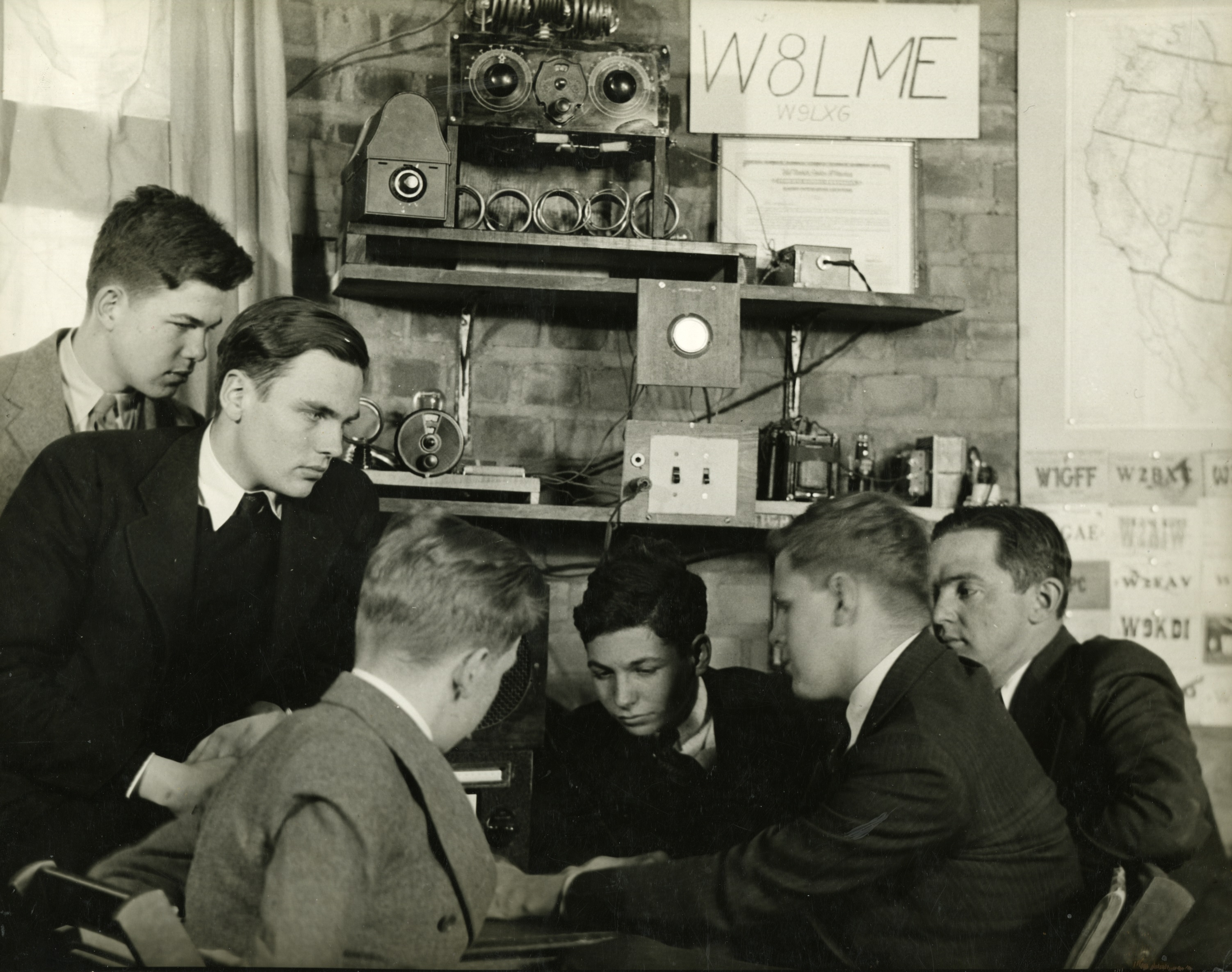
Amateur radio, also known as ham radio, was quite popular at one time. The boys at Cranbrook started their own Radio Club with the help of Science teacher William Schultz, Jr.

Boys sit around a ham radio.

Radio Club members listening to the radio, July 1935. You can see the station’s call sign on the wall: W8LME. Photograph by Harvey Croze. Courtesy Cranbrook Archives.

Then there was the Model Club, which was for boys who enjoyed making models, judging from the picture, mostly of airplanes.

A group of boys standing behind a table of model airplanes

The Model Club, 1952. From left: Faculty Advisor Richard Gregg, David Higbie, Don Young, David Morris, President Richard Gielow, Adams McHenry, Don Hart, Pete Dawkins, Dahmen Brown, Jerry Phillips. Photograph by Harvey Croze. Courtesy Cranbrook Archives.

A Drama Club is not an unusual thing to have at a school, but Cranbrook’s club has an interesting name: Ergasterion Club. Ergasterion is the Greek name for the workshop of craftsman.

Group of boys sitting on a stage.

The Ergasterion “Erg” Club is Cranbrook School’s dramatic society, April 1960. First row, left to right: Louis Beer, Templin Licklider, Jr.; second row: Rick Strong, Bill MacLachlan, Henry Weil, Mike Hilder, Phil Weisenbarger, Richard Foster; third row: Gregg Carr, Boris Nicoloff, Bill Thompson, George Roth, Mitchell Grayson. Photograph by Harvey Croze. Courtesy Cranbrook Archives.

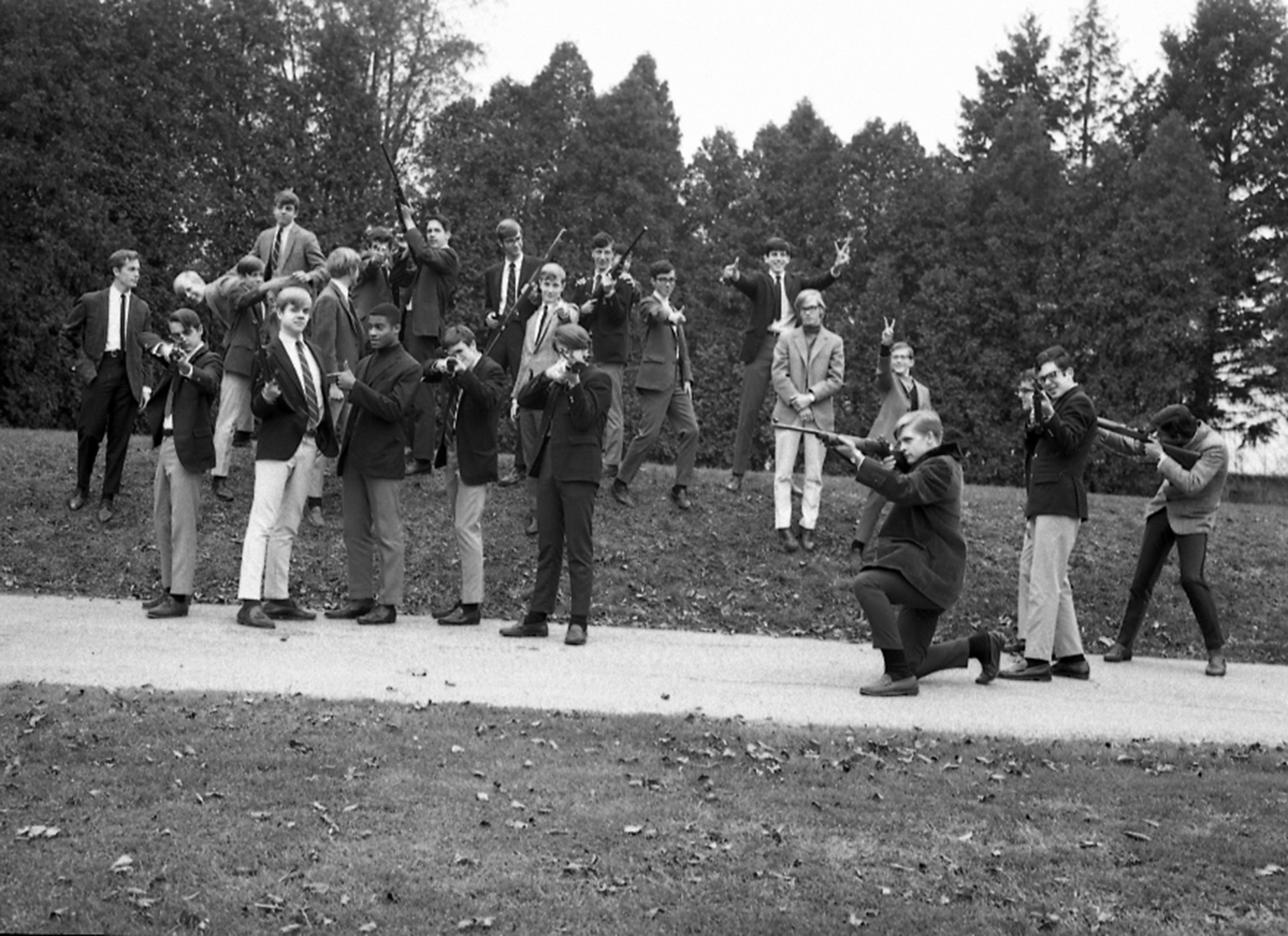
I guess a Rifle Club is not that unusual either, but their yearbook photo was just too great not to share!

A group of boys posing with rifles on a hill

Cranbrook Rifle Club, November 1968. Photograph by Harvey Croze. Courtesy Cranbrook Archives.

In the great state of Michigan, we have a lot of lakes. That is what must have inspired the creation of the SCUBA Club.

Group of boys in SCUBA gear standing in a fountain. of

Cranbrook School SCUBA Club, 1968. From left Thomas O’Hara 69′, Robert O’Hara 70′, Edward Soudeck (language instructor), Thomas Strickland 70′, Marlin Atkinson 70′, Donald Rosiello 70′, and Richard Genthe 70′. Photograph by Harvey Croze. Courtesy Cranbrook Archives.

Today, Cranbrook Schools (co-ed since 1984) continues to have a wide variety of extracurriculars; just ask the members of “The Beyond Earth Club (Space Club)” or the Namtenga Club.

– Leslie Mio, Associate Registrar

Carter for President

Recently, I discovered a few objects that had belonged to Melvyn or Sara Smith, the builders of our Frank Lloyd Wright Smith House. They were from 1976 — the year of the United States Bicentennial and a presidential election.

I discovered that the Smiths were supporters of soon-to-be President Jimmy Carter. Since we just had our presidential primary here in Michigan, I thought they were appropriate to share. 

So, why were the Smiths such big supporters of Carter? They were supporters of the Democratic Party in general.

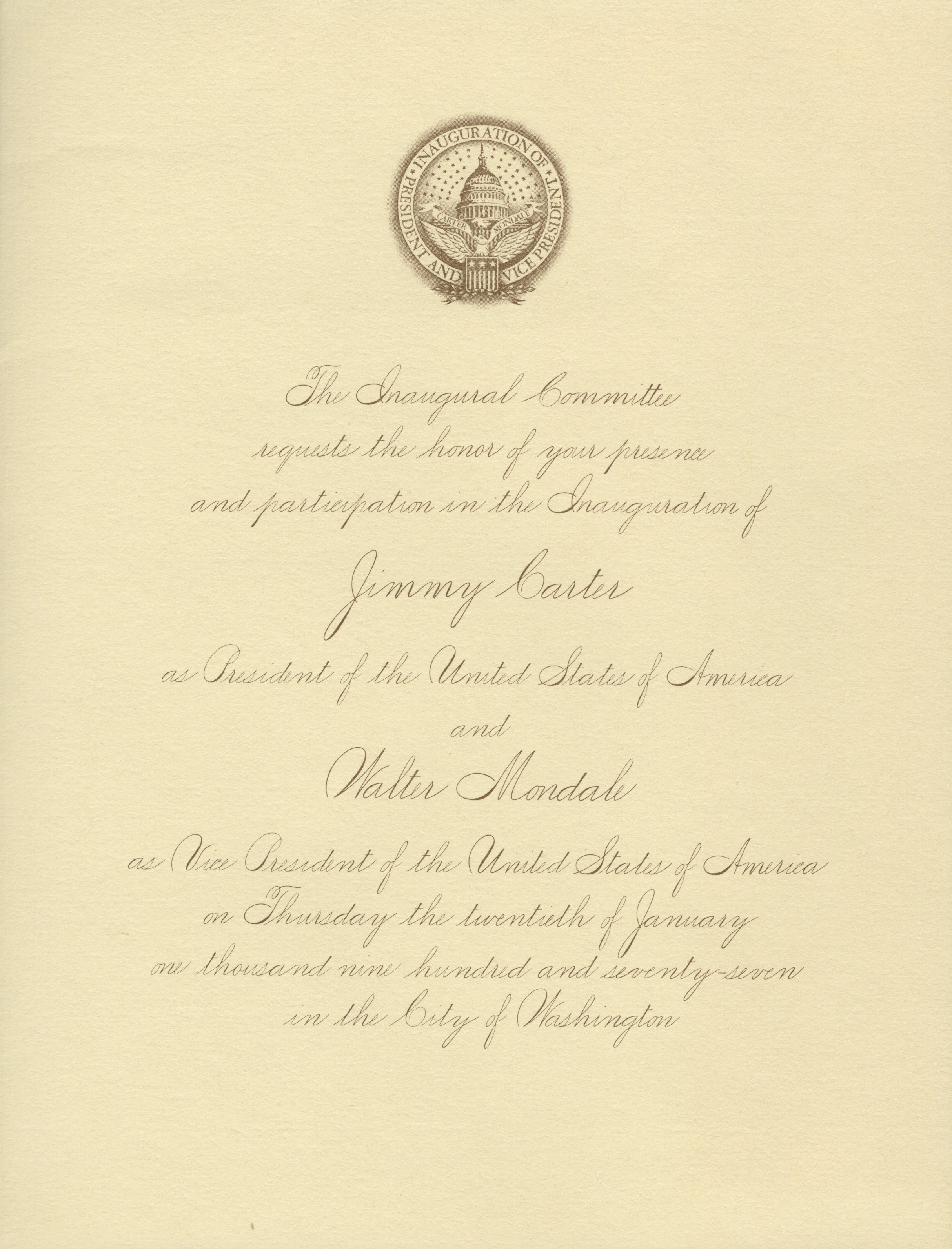
Their son Robert Smith was the National Director of Youth Affairs for the Democratic Party in the 1970s. Melvyn and Sara held fundraisers at their home for Democratic candidates. Melvyn was a member of The President’s Club of the Democratic Party. And the Smiths attended the Inauguration of Jimmy Carter in 1977.

Melvyn and Sara Smith's invitation to the Inauguration of President Jimmy Carter and Walter Mondale, January 20, 1977. Melvyn Maxwell and Sara Evelyn Smith Papers, Cranbrook Archives.

Melvyn and Sara Smith’s invitation to the Inauguration of President Jimmy Carter and Vice President Walter Mondale, January 20, 1977. Melvyn Maxwell and Sara Evelyn Smith Papers, Cranbrook Archives.

Leslie S. Mio, Associate Registrar

Alger Munt: Cranbrook’s English Gardener

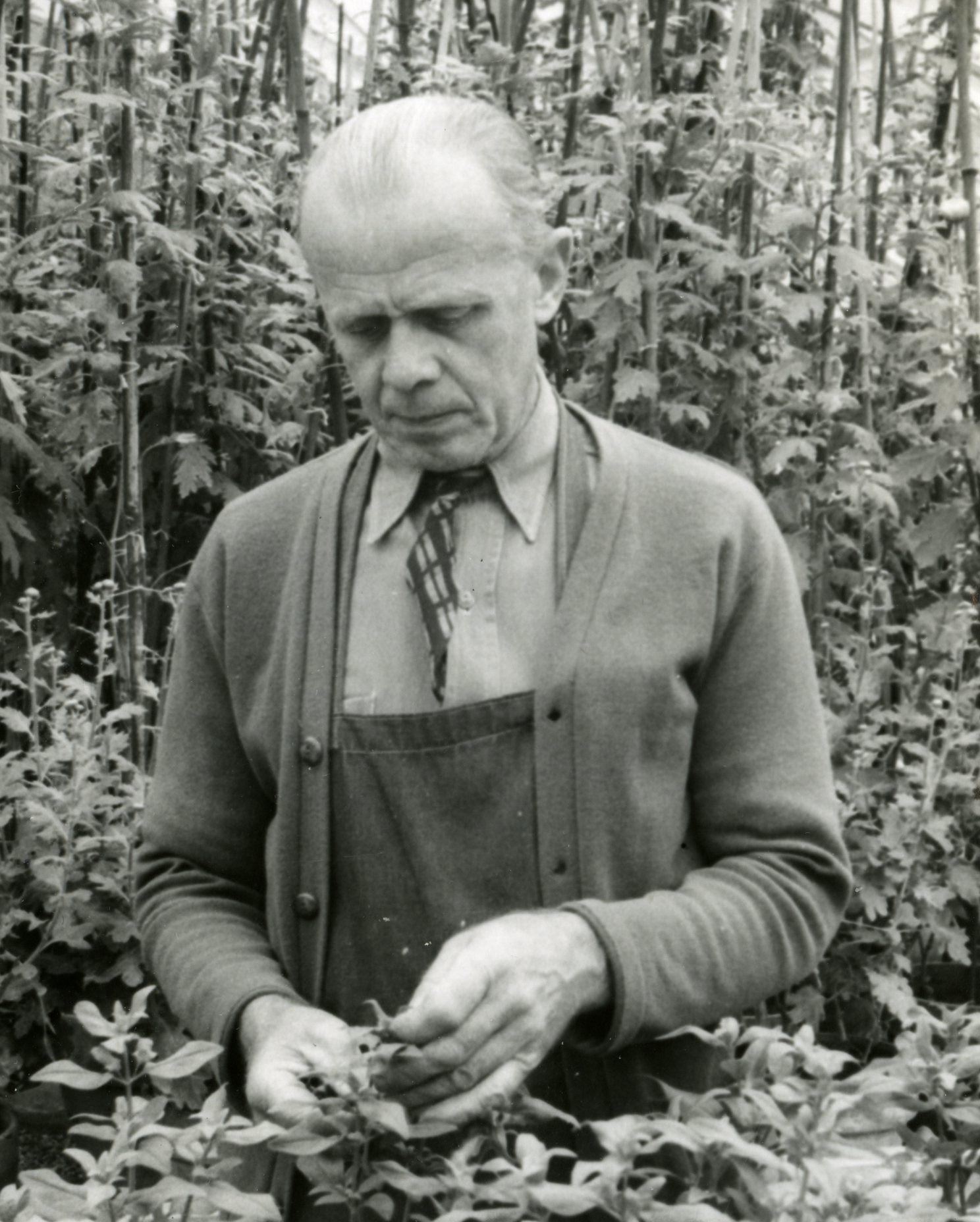
When sifting through images to post on the Center’s Facebook page, I often come across an image of someone and wonder, “How did this person end up at Cranbrook?” This week, that “someone” is Alger Munt.

Alger Munt working in the greenhouse at Cranbrook, October 1950.

Alger Munt working in the greenhouse at Cranbrook, October 1950. Photo by Harvey Croze. Courtesy Cranbrook Archives.

Algernon George Munt (“Alger”) was born in St. Albans, Hertfordshire, England in 1894. From the age of 14, he worked as a gardener on estates near his hometown. When he was 18, he started work manufacturing straw hats in one of the area factories. Soon, his country called and he joined the army, serving in the Royal Field Artillery during World War I. After the war, he did not return to the factory but resumed gardening instead.

Munt came to America in 1921 to work for his uncle William Munt in St. Clair, Michigan, in the commercial greenhouse business. He would work for his uncle for eight years. In 1926, Munt briefly returned to England to marry Grace Barker Skinner (1898-1981) of Ware, Southampton, Hampshire, England.

Munt soon tired of the greenhouse business and came to the Birmingham-Bloomfield area to become a gardener on a private estate. Based on census information and Munt’s oral history account in Cranbrook Archives, the “private estate” was Strandcrest, the estate of lumberman Carl A. Strand, which boasted 14.3 acres, fruit trees, and a caretaker’s residence.

It was in 1936 that Munt came to work at Cranbrook. He was a gardener at Cranbrook from 1936 to 1941. From October 1941 to December 1942, Munt worked at Spindletop Hall in Lexington, Kentucky.

George G. Booth had told Munt in 1941 that he didn’t want him to go but that anytime he wanted to make a change—if things did not work out in Kentucky—get in contact with him. When Spindletop Hall had to switch to economy/war-mode in 1942, Munt took Mr. Booth up on his offer and returned to Cranbrook as a gardener and part-time chauffeur. His wife Grace worked as a laundress for the Booths.

Alger and Grace Munt

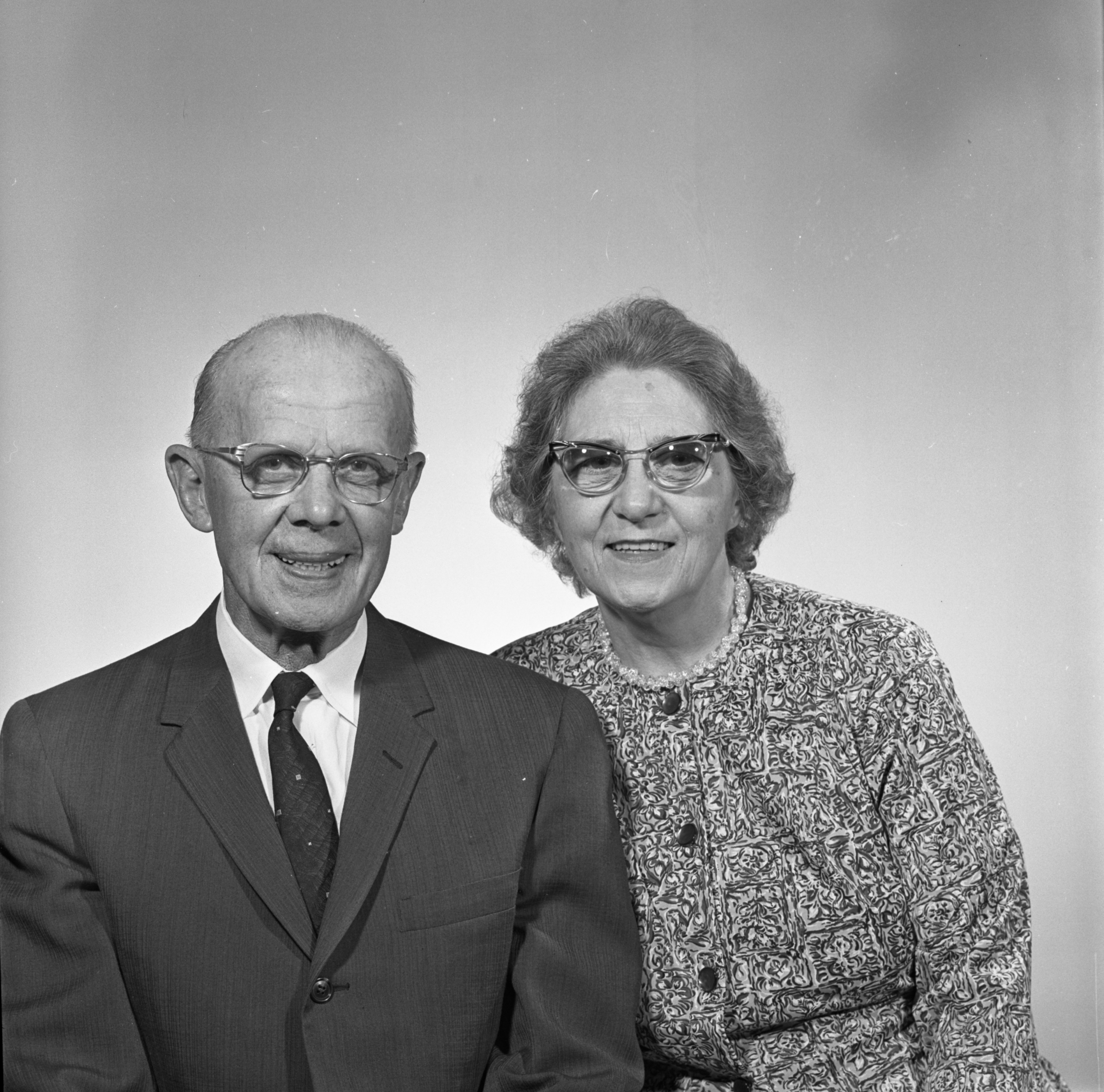
Alger and Grace Munt, circa 1965. Courtesy Cranbrook Archives.

By the 1950s, Munt was the Superintendent of the Greenhouse and Grounds at Cranbrook, and his wife was working as a maid in the dormitories at Cranbrook Academy of Art.

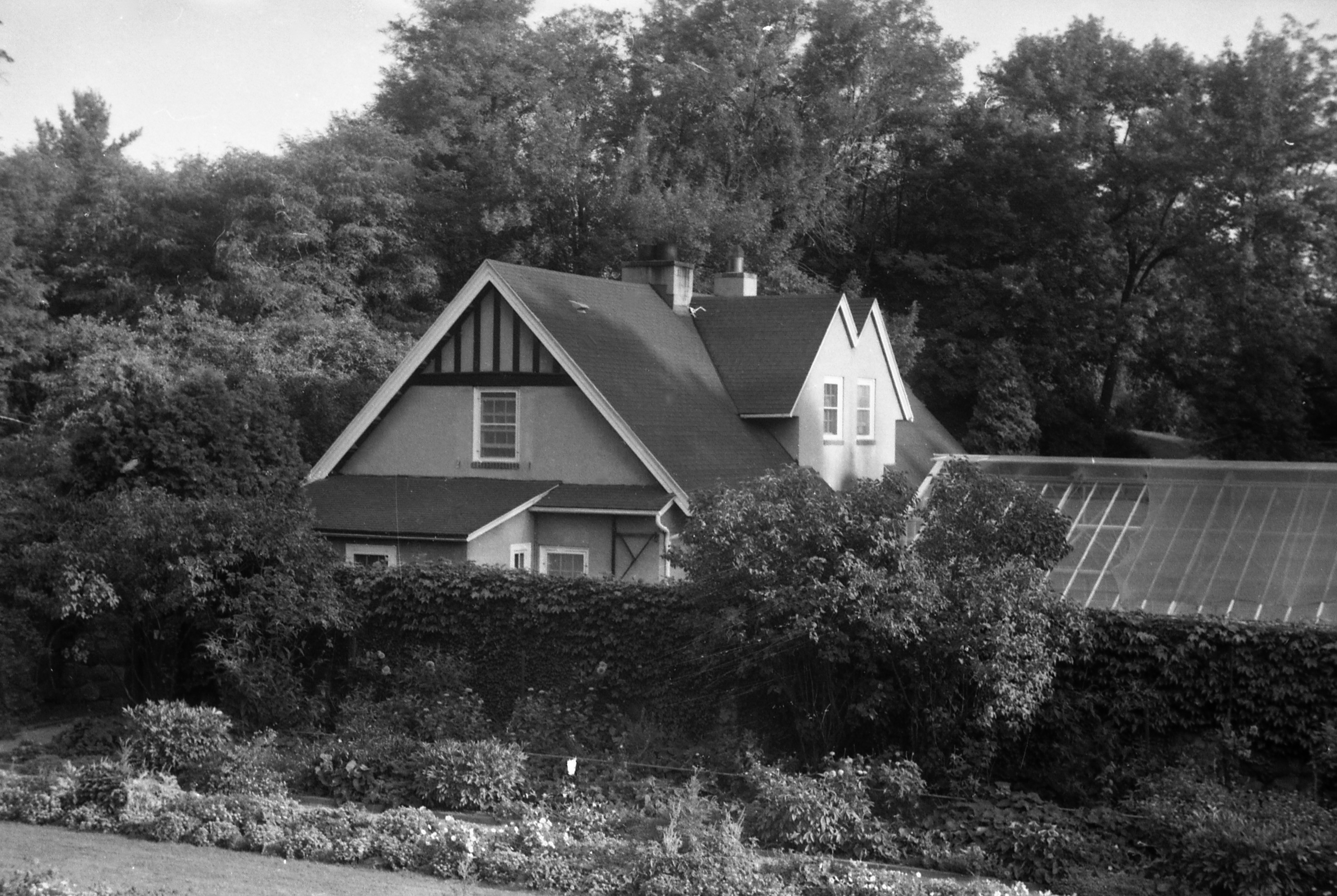
Twin Cottage on the estate

The Munts lived in Twin Cottage on the estate, pictured here in 1957, when they returned to Cranbrook in 1942 until their retirement in 1966. Photo by Harvey Croze. Courtesy Cranbrook Archives.

The Munts retired from Cranbrook in August 1966 and they moved back to England, intending to settle in Cornwall. Unfortunately, Munt died suddenly in November 1966, just short of his 72nd birthday.

Leslie S. Mio, Associate Registrar


Leapin’ Lena! A Kingswood Kangaroo?

In the collection of the Cranbrook Archives, we have a number of objects related to Kingswood School for Girls. These include uniforms, pennants, and one curious kangaroo tagged “Leapin’ Lena.”

Lena 2.jpg

In the Alumni Relations Office for many years, the kangaroo was never the official mascot for Kingswood School Cranbrook (KSC). It was likely part of a popular craze in the 1950s and 1960s, when Collegiate Manufacturing Company, which started out manufacturing school pennants, was promoting stuffed animals as school “mascots” or “personality pets.”

Advertisement for Collegiate Manufacturing Company's College Pets

Advertisement for Collegiate Manufacturing Company’s “Personality Pets.” Source: Kagavi.com

Because she’s in mint condition with her tag still on, perhaps our Lena was a sample from one of the many salesmen Collegiate Manufacturing employed?

Most likely just an alliterative name — think “Mickey Mouse” or “Lois Lane” — the name “Leapin’ Lena” could also come from a number of sources. “Leapin’ Lena” has been used as a nickname for a car; a fictional B-52 bomber in the 1944 movie The Purple Heart; a kangaroo in a Rex the Wonder Dog comic in 1952; and a 1954 Cold War hero pigeon.

I like to think our Leapin’ Lena name came from Rex the Wonder Dog, where the character was part of a story line called “The Saga of Leapin’ Lena.” Lena was a kangaroo from an old vaudeville act, that also happened to foil crime.

A page from Rex the Wonder Dog, Volume 1, #5, "The Saga of Leapin' Lena"

A page from Rex the Wonder Dog, Volume 1, #5, “The Saga of Leapin’ Lena.” Source: vlcomic.com

I really don’t know how this model marsupial got to the Alumni Relations Office, who then gave it to Archives; nor am I familiar with other Kingswood kangaroo mascots (only Kitty Kingswood). Do you know more about our Leapin’ Lena or other Kingswood kangaroos?

Leslie Mio, Associate Registrar

What’s My Number?

We typically write blogs about what projects we are working on – a research question, an exciting piece of furniture – but I wanted to let you in on something a little more pedestrian:

One of the regular projects I work on is numbering and labeling the Cultural Properties. Each object gets a unique number to identify and differentiate it from other cultural properties.

Me at work, numbering silverware.

Me at work, numbering silverware. Photo by Desai Wang, CKU ’19

The numbering system is done in two different ways here at Cranbrook. All collections have a prefix set of letters that lets us know what collection it is in. For example, there is a Brookside School Collection with the prefix “BS,” as well as collections for each of the three historic houses we oversee. Next, there is either a number to match an inventory of the collection or the year the object was created or acquired.

The Brookside Lobby Fixture designed by Henry Scripps Booth and created by Leonard Electric is numbered BS 1929.1. It was created in 1929 for use in the school.

The Brookside Lobby Fixture designed by Henry Scripps Booth and created by Leonard Electric is numbered BS 1929.1. It was created in 1929 for use in the school. I haven’t been able to put the number on it yet! Photo by Daniel Smith, CAA ’21

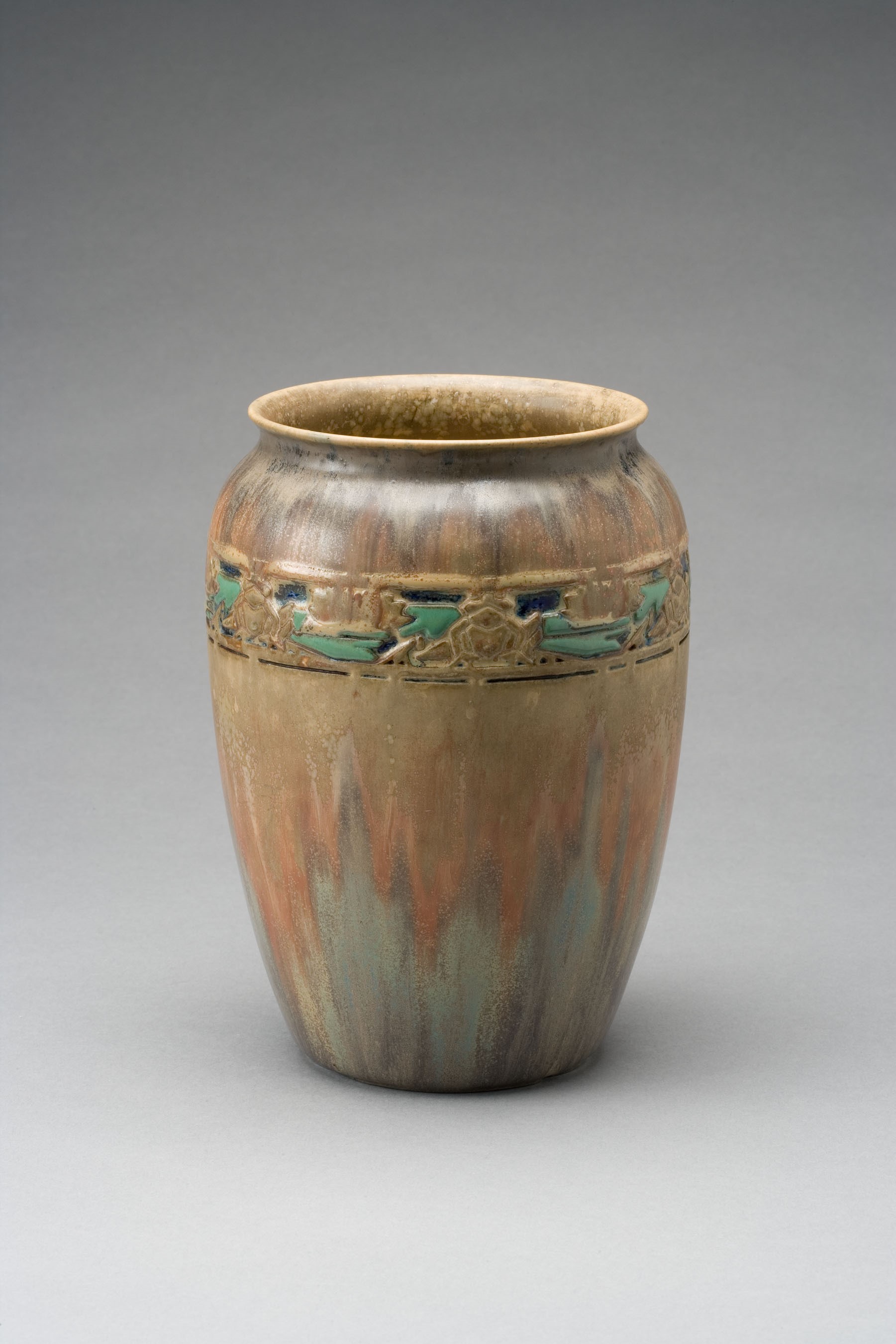
The Frog and Lily Pad Vase by Adelaide Alsop Robineau in the Founders Collection is number CEC 16. It was the 16th item cataloged in a 1975 inventory of the house.

The Frog and Lily Pad Vase by Adelaide Alsop Robineau in the Founders Collection is numbered “CEC 16.” It was the 16th item cataloged in a 1975 inventory of the house. Photo by R. H. Hensleigh

Once we have numbers assigned to the object, we need to physically apply them to the object. Putting a number directly on an object is the most secure way. There are a number of techniques used to apply labels to the objects.

We currently use a method of spreading on a thin layer of special clear adhesive (B-72) to the object, putting down a number written or printed on acid-free paper, and then covering that paper with another coat of the clear adhesive. Printing the numbers on a printer allows you to control the size of the numbers (typically 7-point font) and also ensures they are legible.

20191022_141908

A number applied to an object. This is from the Smith House collection, which the CEC acquired in 2017.

20191022_142725

B-72, one of the tools of the trade.

There are all sorts of exceptions to the above rule: You can’t number plastics this way – the solvent in the B-72 would melt the plastic. To number them, we tie on a tag made of Tyvek using Teflon tape (also known as plumber’s tape).

Cotton twill "tape" used ti number textiles.

Cotton twill “tape” used to number textiles.

And what about textiles? For that, we write the number on cotton twill “tape” with archival ink and sew the tags onto the objects.

Chapter 5E of Museum Registration Methods – what is referred to as the “Registrar’s Bible” — is all about marking objects, best practices, and recommended materials. When in doubt, I start there.

Leslie Mio, Associate Registrar

There’s Always a Detroit Connection

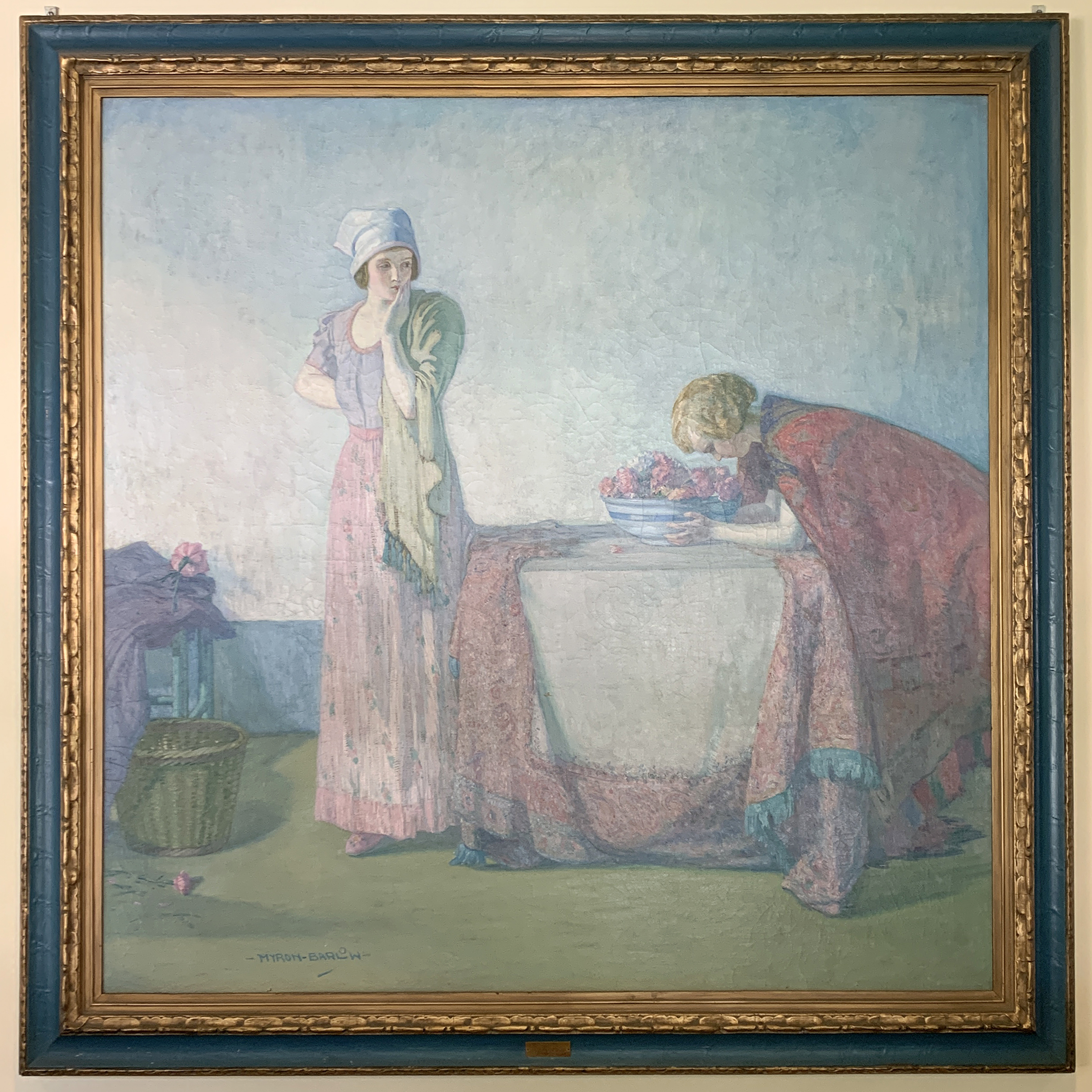
In the main hallway of Kingswood and in the living room of Thornlea, there are paintings by artist Myron G. Barlow (1873-1937). I love the look of these paintings and began to wonder about the artist. I’ve come to learn he was an internationally known Detroit-raised painter. As with all things Cranbrook, it seems, there is always a Detroit connection.

Two Women with a Bowl of Flowers on a Table, circa 1912 by Myron G. Barlow

Two Women with a Bowl of Flowers on a Table, circa 1912 by Myron G. Barlow.

The Kingswood painting Two Women with a Bowl of Flowers on a Table depicts two peasant girls, one standing and one bending over a bowl of flowers. It was donated to Kingswood around 1970 by Herbert Sott in memory of his wife Mignon Ginsburg Sott, who was Kingswood Class of 1943.

Young Girl Braiding Her Hair, circa 1912 by Myron G. Barlow

Young Girl Braiding Her Hair, circa 1912 by Myron G. Barlow

The other painting, Young Girl Braiding Her Hair, is of a girl looking in a mirror braiding her hair. It was purchased by James Scripps Booth from the artist in 1912. James attended the Ecole des Beaux-Arts in Paris and in 1911 had studied under Barlow; James’ painting “Onion Gatherer, Cote d’Azure” depicts Barlow’s cottage studio. James gave Young Girl Braiding Her Hair to his parents George and Ellen Booth. It originally hung in Cranbrook House’s main staircase. George and Ellen gifted the painting to Henry and Carolyn Booth, who hung it in their home, Thornlea.

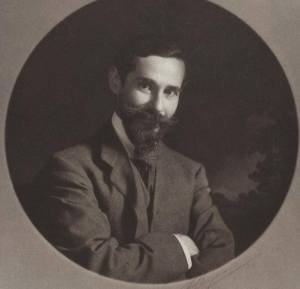
Myron Barlow (1873-1937). Son of Adolph and Fanny Barlow who were members of Temple Beth El. Courtesy Temple Beth El Facebook page.

Myron G. Barlow (1873-1937), son of Adolph and Fanny Barlow who were members of Temple Beth-El in Detroit. Courtesy Temple Beth El.

Myron G. Barlow was born in Ionia, Michigan in 1873 and raised in Detroit. As a teenager, he trained at the Detroit Museum School, where he studied under Joseph Gies, and then at the Art Institute of Chicago. He began his career as a newspaper artist. He eventually traveled to Paris and enrolled in the Ecole des Beaux-Arts where studied under Jean-Leon Gerome.

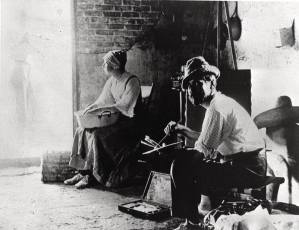
While copying paintings in the Rijksmuseum in Amsterdam, Barlow discovered Johannes Vermeer. As stated in William H. Gerdts’ Masterworks of American Impressionism from the Pfeil Collection, “Like Vermeer, one of Barlow’s favorite artistic themes became the depiction of figures, often female and usually set in an interior; frequently isolated and motionless, surrounded by a dream-like atmosphere rendered in a single, dominant tonality, often blue.”

Barlow in his studio after 1900. Courtesy of Nancy Brett (Barlow's great-niece) on Temple Beth-El Facebook page.

Barlow in his studio after 1900. Courtesy of Nancy Brett (Barlow’s great-niece) via Temple Beth-El.

Around 1900, Barlow moved to the French village of Trepied. There he transformed a peasant’s house into his studio. He would, however, make frequent trips back to Detroit and kept a home there as well.

He served as the Chairman of the Scarab Club around 1918. According to his Detroit News obituary, “Among his major achievements in Detroit are six large murals which he painted for the main auditorium of Temple Beth-El, which were completed in 1925.”

In 1907, he was the only American elected to the Societe Nationale des Beaux-Arts and in 1932 was made a Knight of the Legion of Honor by the French Government. He was recognized for his work with gold medals at the St. Louis and Panama Pacific Exhibition, and by having his works purchased by many international museums, including the Musée Quentovic in France, Pennsylvania Academy of Fine Arts, and the Detroit Institute of Arts. The Detroit Club and the private collection of Baron Edmond de Rothschild also included works by Barlow.

In May 1937, he left Detroit with the intention of selling his studio in France and returning to the city for the remainder of his life. Unfortunately, he died in his home in Trepied that fall.

– Leslie S. Mio, Associate Registrar

High Island Mystery

In the Cranbrook Archives Digital Collections, there are images labeled “Cranbrook Institute of Science: House of David Colony. ” I always wondered what they were all about and finally investigated. It all starts with a little island four miles west of Beaver Island in Lake Michigan: High Island.

According to the Michigan Department of Natural Resources, “[High] island has an array of Michigan shoreline features and associated ecosystems that support a number of rare, threatened and endangered plant and bird species.” These include the endangered piping plover and the tern.

Robert T. Hatt (Cranbrook Institute of Science Director), Josselyn Van Tyne (University of Michigan / Cranbrook Institute of Science Trustee), and Ralph E. Morrill (University of Michigan) were on High Island on June 23, 1938, conducting bird and animal surveys. While there, they encountered the remnants of a once-thriving settlement. Hatt must have found it curious because he captured these images:

In a nutshell, High Island was home to a timber-cutting and potato farm operation run in 1912-1927 by the House of David, a religious sect based in Benton Harbor, Michigan. High Island was also home to several families of Odawa fishermen. Since 1940, the island has been uninhabited.

I checked Robert T. Hatt’s “Island life: a study of the land vertebrates of the islands of eastern Lake Michigan” (Bulletin No. 27, Cranbrook Institute of Science, 1948) which details the extensive study of the animals and birds of the island, but also remarks on the island’s history:

High Island is said to have been settled by the Mormons at the time Strang’s colony flourished on adjacent Beaver Island. More recently (1912-1928), the House of David . . . established a colony . . . here and developed the agricultural and forest resources. Most of the dwelling date from this period. At the time of our visit there were three Indian families in residence, and the men operated a commercial fishing boat. A Roman Catholic chapel was on the island and was in good condition, with the alter decorated . . .

Another interesting, and unexpected, find in Cranbrook Archives!

Leslie S. Mio, Associate Registrar

Note: The House of David has a storied history, one better written by others:

Michigan ’s Siberia: The House of David on High Island” by Clare E. Adkin Jr.

The Last Days of the House of David” by Adam Langer

The House of David by Christopher Siriano

A Sculpture So Nice They Named it Twice

One of my many duties here at the Center for Collections and Research is to maintain the sculptures on the campus. This can mean finding conservators to repair works, contractors to clean them, or, in some cases, clean them myself. Recently, I was working on a sculpture in the gardens at Cranbrook House. I had seen the sculpture before but wondered about its backstory. Turns out it was a tale of two names.

The sculpture is Mario Korbel’s statue Atalanta, the Greek goddess of the hunt, travel, and adventure. It was commissioned by George Gough Booth in 1927 for one of the gardens at Cranbrook House, part of a series of work Korbel completed for the Booth house and gardens — including Dawn and Harmony in the gardens and Andante and Nocturne in the house.

Letter from Mario Korbel to George G. Booth, referencing both his works Atalanta and Andante. George Gough Booth Papers, Cranbrook Archives.

July 12, 1927 letter from Mario Korbel to George G. Booth, referencing both his works Atalanta and Andante. George Gough Booth Papers, Cranbrook Archives.

Booth, admiring the beauty of the clear, white marble of Atalanta, transferred the work into the collection of the Art Museum. It was part of the original art museum exhibition in 1930.

CISB509L.jpg

Atalanta (left) in the first Art Museum exhibition in 1930. Courtesy Cranbrook Archives.

Later, Booth wrote: “We have finally concluded that the figure will make a very important and striking center art element in connection with the new School for Girls at Cranbrook.” When the Kingswood dormitory was built, the sculpture was transferred to Kingswood and installed on the terrace.

Atalanta.jpg

Atalanta (right) adorns the terrace at the Kingswood School for Girls dormitory in this undated photo. Courtesy Cranbrook Archives.

In 1969, the sculpture was vandalized and smashed into many pieces (no one was ever implicated in the crime–or at least, their name isn’t in my file!). Those pieces were put back together, but when Atalanta was finally repaired, she was not as pristine. Henry Scripps Booth decided to rename her Ecolo. He also wrote a verse to explain the new name:

Ecolo, Goddess of Earth 

Who is this sweet maid who stoops protectively to save the earth from man’s pernicious tread? 

It is the blithe spirit of Ecology by whom all life and natural things are fed.

CEC472 (2).jpg

Ecolo in her new home in the Herb Garden at Cranbrook House.

Ecolo, or the sculpture-formerly-known-as-Atalanta, now greets visitors in the Herb Garden at Cranbrook House.

– Leslie S. Mio, Associate Registrar

Minks in the Rainforest

The week of May 19, the Center for Collections and Research hosted the Eastern Michigan University Historic Preservation Program as they conducted their annual Field School. The EMU Historic Preservation Program is among the largest graduate programs in Historic Preservation in the United States, and this was their third year working at Cranbrook.

Two groups worked on documenting the exterior and landscape of Lyon House.

Lyon House Site Plan with Landscape Features, documented May 19-24, 2019 by Eastern Michigan University Historic Preservation students.

Lyon House Site Plan with Landscape Features, documented May 19-24, 2019 by Eastern Michigan University Historic Preservation students.

The third group once again tackled Tower Cottage. The cottage started its life as a simple Tudor Revival cottage that was designed by Albert Kahn, who also designed Cranbrook House. Built in 1908, it mimics the style and design of Cranbrook House. The cottage itself has seen many changes but over time it has retained its original character and style. Tower Cottage, along with Cranbrook House, is among the original structures belonging to the Booth family.

Tower Cottage circa 1915 with water tower behind.

Tower Cottage circa 1915 with water tower behind. Courtesy Cranbrook Archives.

Long unoccupied, the building’s historic window sashes required rehabilitation, painting, and replacement of missing pieces. The students restored a number of windows and worked on a paint analysis of Tower Cottage with Ron Koenig of Building Arts Conservation.

Ron Koenig of Building Arts Conservation discusses paint sampling with the EMU students.

Ron Koenig of Building Arts Conservation discusses paint sampling with the EMU students. Photo Desai Wang, CKU ’19.

What they discovered was far more colorful than the simple brown paint that adorns the house now. Koenig took various samples of the trim, stucco, and window sashes. He did preliminary examinations on site, looking through a special magnifying glass to see where best to sample.

Desai Wang, CKU '19, the Center's Senior May student, looking at the sample on the window sash.

Desai Wang, CKU ’19, the Center’s Senior May student, looking at a sample on a window sash of Tower Cottage.

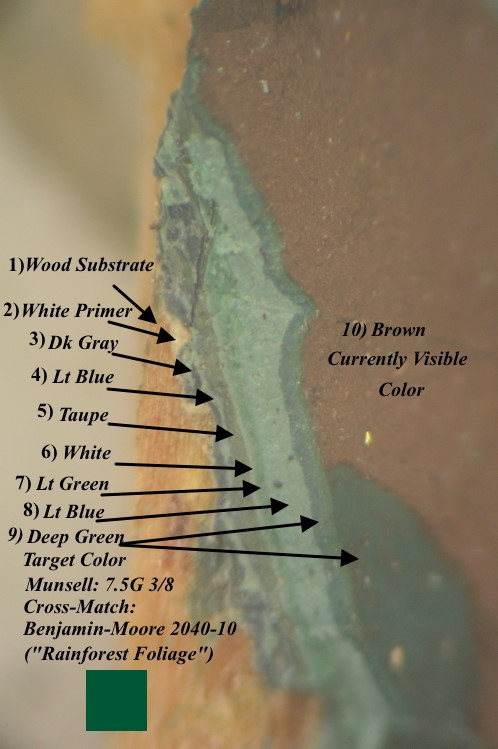
In his workshop, Koenig used a microscope to see the various layers (or campaigns) of paint. From this microscopic sample, he was able to determine the color of paint used on the house in the 1920s  – the era when the additions to the house were completed by architects J. Robert F. Swanson and Henry Scripps Booth.

Microphoto of the color campaigns of the Tower Cottage sashes, South Elevation. Courtesy Building Arts & Conservation.

Microphoto of the color campaigns of the Tower Cottage window sashes, south elevation. Courtesy Building Arts & Conservation.

Koenig matched the sample to a color on the Munsell color system (a system to visually identify and match color using a scientific approach) and from the Munsell color to a Benjamin Moore paint color. Our colors were Mink (#2112-10) for the trim and Rainforest Foliage (#2040-10) for the window sashes. The secret to historic paint colors is that while a company such as Benjamin Moore, founded in 1883, may change a color’s name, the reference number stays the same. If you know the identification number of a paint that you had in 1949, you could find the same color in the catalog today.

We couldn’t keep this great color combination to ourselves. We decided to paint a sample of it on some of the windows at Tower Cottage.

Rainforest Foliage green sashes and Mink brown trim at Tower Cottage, June 2019.

Rainforest Foliage green sashes and Mink brown trim at Tower Cottage, June 2019.

20190606_145203

Close-up of the green sashes and brown trim on Tower Cottage, June 2019.

Next year, should our friends form EMU return for their field school, the rest of the cottage’s trim and windows can be painted with its historic colors.

Leslie S. Mio, Associate Registrar

Create a website or blog at WordPress.com