The Annex, the Attic, and My Senior May Adventures

Each May, the Center is honored to host outstanding seniors from Cranbrook Kingswood Upper School for a three-week immersive internship.
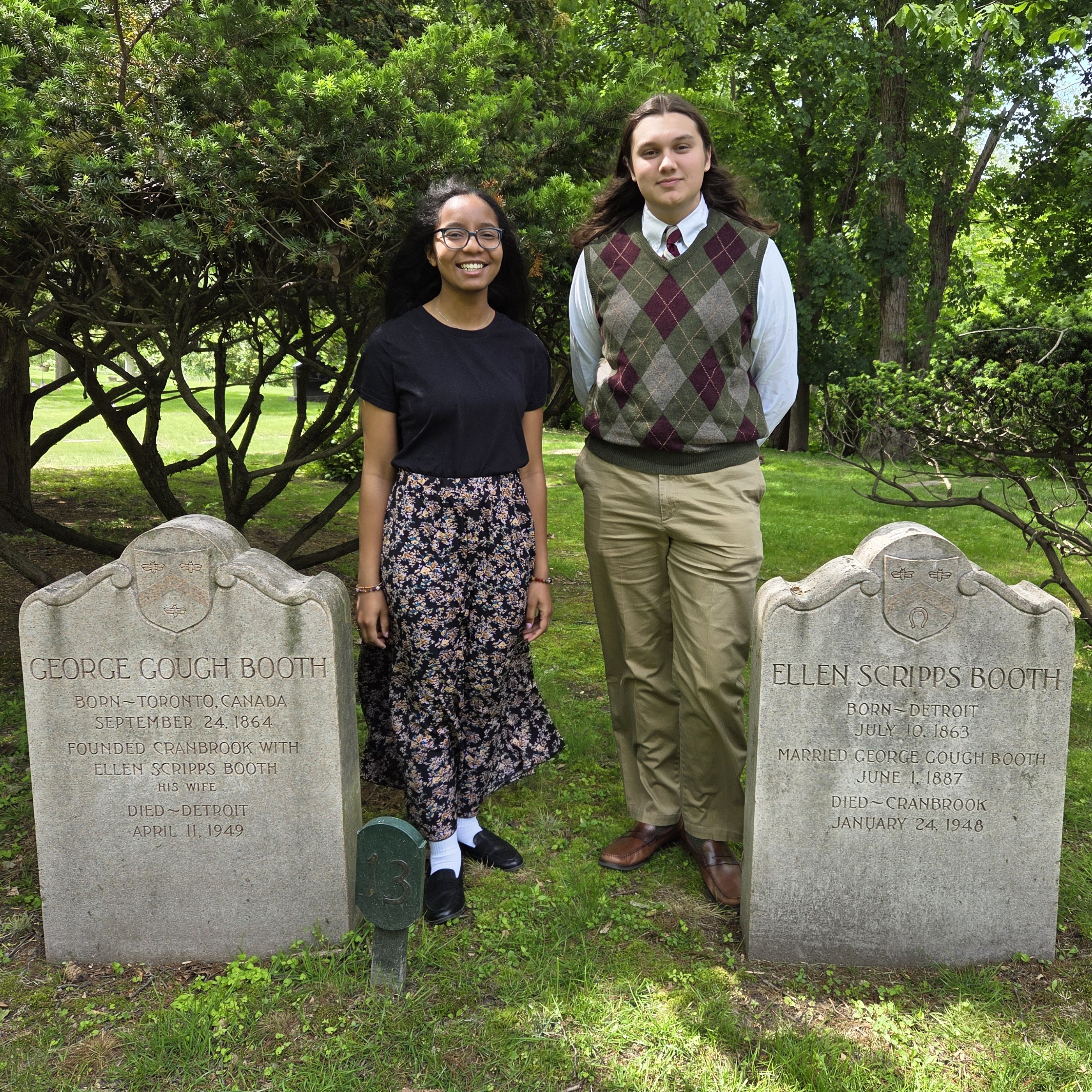
Kamilah Moore and Joel Kwiatkowski, 2025 Senior May interns, visit George and Ellen Booth at Greenwood Cemetery, Birmingham. Photography by Leslie Mio.

This year two seniors, Kamilah Moore and Joel Kwiatkowski, worked with the Center and Archives staff, including writing blogs! Hear from Joel today and look out for Kamilah’s post next week.
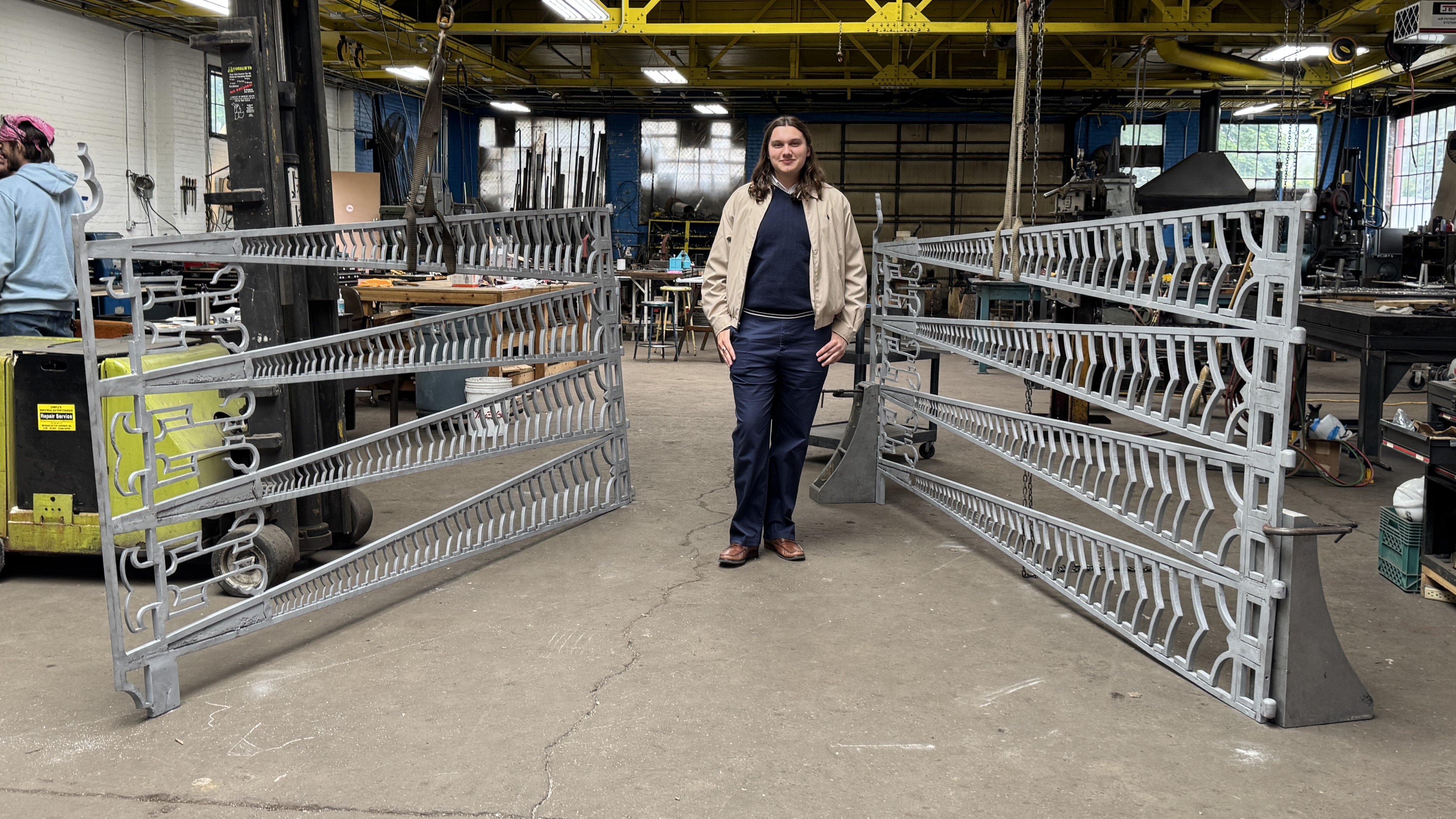
Checking in on the Eliel Saarinen-designed Kingswood main gate at Smith Shop in Highland Park, May 2025. Photography by Kevin Adkisson.

Cranbrook Center for Collections and Research is a name that invokes the image of some grand museum or hall, with many sterile prep rooms and rows upon rows of file cabinets. Now don’t get me wrong, there are plenty of file cabinets, but the Annex is far from grand. Instead, the rather humble staff apartment-turned-offices are befitting the lovely people there.

The Center’s Annex, next door to Cranbrook House, is situated above the House & Garden Auxiliary offices, up a set of winding stairs that require me to duck in a few places. But up there you will find a quaint little kitchen (complete with a toaster oven and healthy snack collection), a few offices, and closets and cabinets dotted with curiosities.
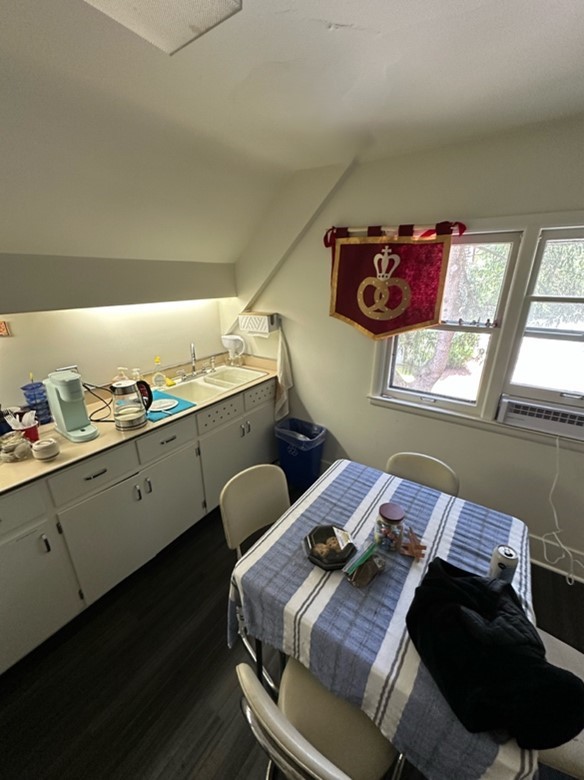
The quaint kitchenette of the Annex, compete with decommissioned Cranbrook Institute of Science Library chairs, May 2025. Photography by the Author.

It was this atmosphere, over many chatty lunches, that I got to know Leslie Mio, the Associate Registrar, and Mariam Hale, the 2023-2025 Center Collections Fellow. It was a pleasure to find two individuals who cared so greatly for history and conservation, and we bonded over our shared love of museums and particular historical eras.

But, let it be known that work at the collections isn’t all comfortable work behind a desk or searching a filing cabinet. This illusion, if I ever had it, was quickly broken on my first full day of the internship. Our task? Moving five solid wood cabinets from the rooms of retirement-age nuns across the building to be used to store Cranbrook’s lacy dresses and costumes.

Briarbank, a neighboring estate to Booth’s land, was converted into a place for sisters to stay once they needed a bit more care later in life. But, at some point, the demand for a place such as that ran dry, and Cranbrook bought the campus. And now, in that spirit, I was near horizontal in my penny loafers, shoving a giant wardrobe into place across some very tasteful carpet.

Mariam and I defy the friction of decades old carpet, May 2025. Photography by Leslie Mio.

In the coming days, the purpose of these heavy cabinets would be realized, as we began the true overarching theme of my time at the Center: moving a seemingly infinite number of objects from the hot attic of Cranbrook House to the comparatively “less hot” and climate-controlled storage area at Briarbank. Paintings, prints, textiles, rugs, hats, and racks of clothing and costumes were deftly maneuvered through the halls and offices of Cranbrook House (or, alternatively, very carefully down the narrowest, steepest, stairwell known to mankind).

Each day packing and moving Cultural Properties in the attic was sure to bring new surprises. Everything from a fur hat belonging to George Booth to paper parasols, or entire handwoven rugs the size of a small house. While these days meant a bit of manual labor, they never ceased to bring me joy, as the wonderful folk of the Center doled out tidbits of Cranbrook’s story connected to each unearthed gem.

The fabulous hat in a box marked “G.G.B.” — the box is possibly a later acquisition by Henry S. Booth — May 2025. Photography by the Author.

Now those familiar with the Center may be wondering: “Now wait just a minute. Where is my favorite curator? Where is the delightful presence of the steward of Saarinen House?” Well, fear not good reader, for while Kevin may not have been at every boxing and unboxing, Kevin joined Kamilah and me on many excursions outside the Samuel-Yellin-forged gates of Cranbrook. For those unacquainted, Kevin Adkisson is Curator of the Center, the veritable fountain of all knowledge concerning Cranbrook, and legend in his own time among students.

My first trip with Kevin came when we were tasked with heading to Detroit to give a tour of Holy Redeemer Church to a group of 8th graders from the Catholic school next door. I thought that getting middle schoolers excited about Corinthian columns would be impossible, but Kevin’s energy and skill made it look easy.

Kevin and I had fun teaching Holy Redeemer 8th graders about architecture. Photography by Holy Redeemer.

Afterword, we headed to visit the master ironworkers at Smith Shop, where the Eliel Saarinen-designed Kingswood main gate is being repaired and restored. I stood back and observed while Kevin, Cranbrook Capital Projects Director Jean-Claude Azar, and Amy Weiks and Gabriel Craig (co-owners of Smith Shop) debated the ins and outs of the gate’s making and breaking.
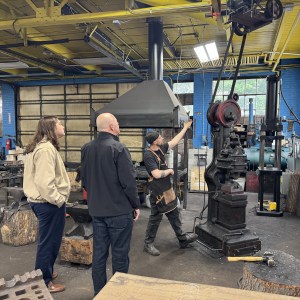
I enjoy a tour of the facilities of Smith Shop with Cranbrook Capital Projects Director Jean-Claude Azar and Smith Shop co-owner Gabriel Craig in Highland Park, May 2025. Photography by Kevin Adkisson.

Across my three week Senior May, I also took trips to the paint store to debate shades of grey, the frame shop to mount an object, Ken Katz’s painting conservation studio, and even Birmingham’s historic cemetery. On each of these trips, I gained insight into the multifaceted work of the Center for Collections and Research, including care and handling, teaching, conservation, and cataloging.

I cannot fully capture in a blog what a delight it was to be in the presence of such knowledgeable individuals. For every question about Cranbrook’s history, each member of staff was sure to add in their own expertise, citing obscure letters and photographs, adding a beautiful familiarity to their responses and giving color to the story of Cranbrook.

Of course, I would be remiss to leave out some of the other folks who make the Center function, like Greg, Jody, Amy, and Jess. These are the people who drive the work, managing, fundraising, and promoting the vision of Collections and ensuring the continued progress of the Center’s goals.

Even interns have meetings, Kamilah and I sat in on one of the Center’s weekly staff meetings. Photography by Kevin Adkisson.

On my last day, I had the privilege of working with Jess Webster, Development Coordinator, who also helps run the Center’s social media. With Kamilah, I researched, drafted, workshopped, and delivered a script for an Instagram Reel commemorating the 150th birthday of Carl Milles., During my time working out ideas for the video (and even this blog), I gained a new appreciation for the way in which Cranbrook is viewed from the outside.
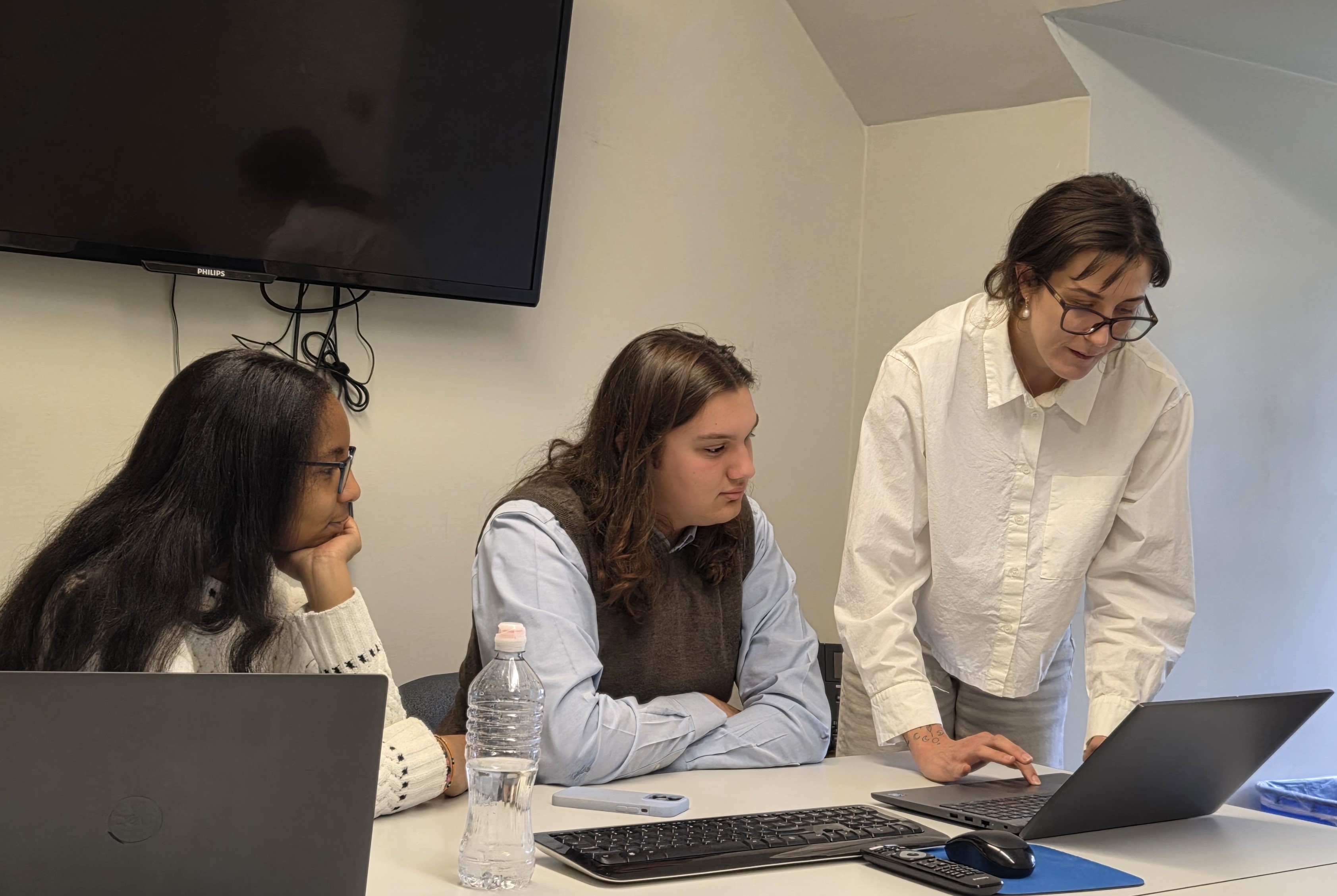
Kamilah and I workshopping our reel for Carl Milles’s 150th birthday with Jess, May 2025. Photography by Leslie Mio.

For me, as a student at Cranbrook, my view is that of someone on the inside, who has the privilege to walk by art on campus each and every day (admittedly at times without a second thought). But getting to see the behind-the-scenes of Cranbrook’s beautiful historic campus has given me an appreciation that feels wholly unique amongst my peers.

If you’ve read this blog, I urge you to take a moment to appreciate all that goes on caring for a 100-plus-year-old campus to live on to this day and serve its many students and visitors. From calls, texts, emails, and meetings, the Center is busy planning, filing, caring, and protecting the legacy of Cranbrook. The work is never done.

Yet despite the challenges, the Center rises to the task, willing to give their all to something they passionately care for. It would be hard not to be inspired.

Kamilah and I make a video for Carl Milles’s 150th birthday, May 2025. Photography by Jessica Webster.

This internship has truly been a dream-come-true, and I am grateful to Mariam, Leslie, and Kevin for their warm welcome and tutelage.

Joel Kwiatkowski, Cranbrook Kingswood Upper School Class of 2025 and Cranbrook Center for Collections and Research 2025 Senior May

Editor’s NoteThe Senior May Project is a school-sponsored activity that encourages Cranbrook Kingswood Upper School seniors to acquire work experience in a field they are considering as a college major, a potential profession, and/or as a personal interest.

Joel Kwiatkowski graduated from Cranbrook in June 2025 and will be attending the University of California San Diego in the fall to pursue a degree in Molecular and Cellular Biology. Joel first came to Cranbrook Schools in sixth grade, and has since gained a passion for the institution’s rich history of influential artists and personalities. 

Particular Architects, Elusive Materials: Headaches in Green and Red

I recently found myself at Joann Fabrics five minutes before the store closed, desperately selecting supplies for a project that was, of course, best completed that night. My delay was self-inflicted, but it got me thinking about times when much larger projects have been strained by access to supplies.
Specifically, both Eliel Saarinen and Frank Lloyd Wright created buildings with strong creative vision. Their architecture demanded specific, and sometimes hard to source, materials. Let’s look at two examples and decide if the headaches my favorite architects caused their suppliers and contractors/builders were worth the final product!

Example 1: Eliel Saarinen and Pewabic Pottery Tiles

Eliel Saarinen, Kingswood School for Girls Main Entrance Lobby (Green Lobby) plan, section, elevation, and reflected ceiling plan, c. 1930-1931. Ink, colored pencil, and pencil on tracing paper. Approx. 28½ inches x53 inches. Cranbrook Art Museum 1982.35. Photography by P.D. Rearick, Courtesy Cranbrook Center for Collections and Research.
When Eliel Saarinen specified thousands of hand-molded, hand-glazed, and hand-fired Pewabic Pottery tiles for use at Kingswood School for Girls, his contractor pushed back. Pewabic was less a tile factory than an artists’ workshop. As supplier of Kingswood’s industrially produced tile for bathrooms and basements, a concerned Mr. Burt of the Detroit Mantel and Tile Company wrote to the contractor, Charles Wermuth & Son:

We are doubtful as to [Pewabic Pottery] being able to manufacture the amount of tile as selected for this job. We raised this question during the course of selections but [Pewabic cofounder and artist] Mrs. Stratton advises that she will be able to produce this tile without any hold-up. We have advised her that any hold-up or delays caused from her material will be charged back to her.
We are writing you this letter merely as a protection against delays beyond our control.

Cranbrook Architectural Office, Box 26 Folder 11. Cranbrook Archives.

Saarinen wasn’t wrong to select Pewabic Pottery for Kingswood—it’s stunning and perfect in every way—but Burt wasn’t wrong about issues of production. It does appear that delays in the tile making caused delays in construction, raising blood pressure on both ends of Woodward Avenue.

As the first day of classes at Kingswood drew nearer, truck drivers from Cranbrook made near-daily trips to the pottery for small batches of tiles. I imagine the kiln-fresh mini-masterpieces still warm to the touch!

Did the delay in tile delivery keep Kingswood from opening on time? No. An outbreak of polio in metro Detroit meant all schools were closed by state health officials. But Wermuth used the extra time to finish the building—all Pewabic tiles were well-set and grouted for classes to begin September 21, 1931.

Eliel Saarinen and Mary Chase Perry Stratton’s 1931 masterpiece, the Green Lobby Stair. The headache of contractor Charles Wermuth and Son was worth the stress. Photography by James Haefner, 2018. Courtesy Cranbrook Center for Collections and Research.

Example 2: Frank Lloyd Wright and “The Wood Eternal”

In February 1949, Melvyn Maxwell Smith was ready to start building his long-awaited dream: a wood and brick Usonian house designed by Frank Lloyd Wright. With enough money squirreled away to begin construction, Smithy was ready to order materials. Including 14,000 linear feet of clear, old-growth, 16’ x 1’ x 2” boards of Tidewater Red Cypress wood.

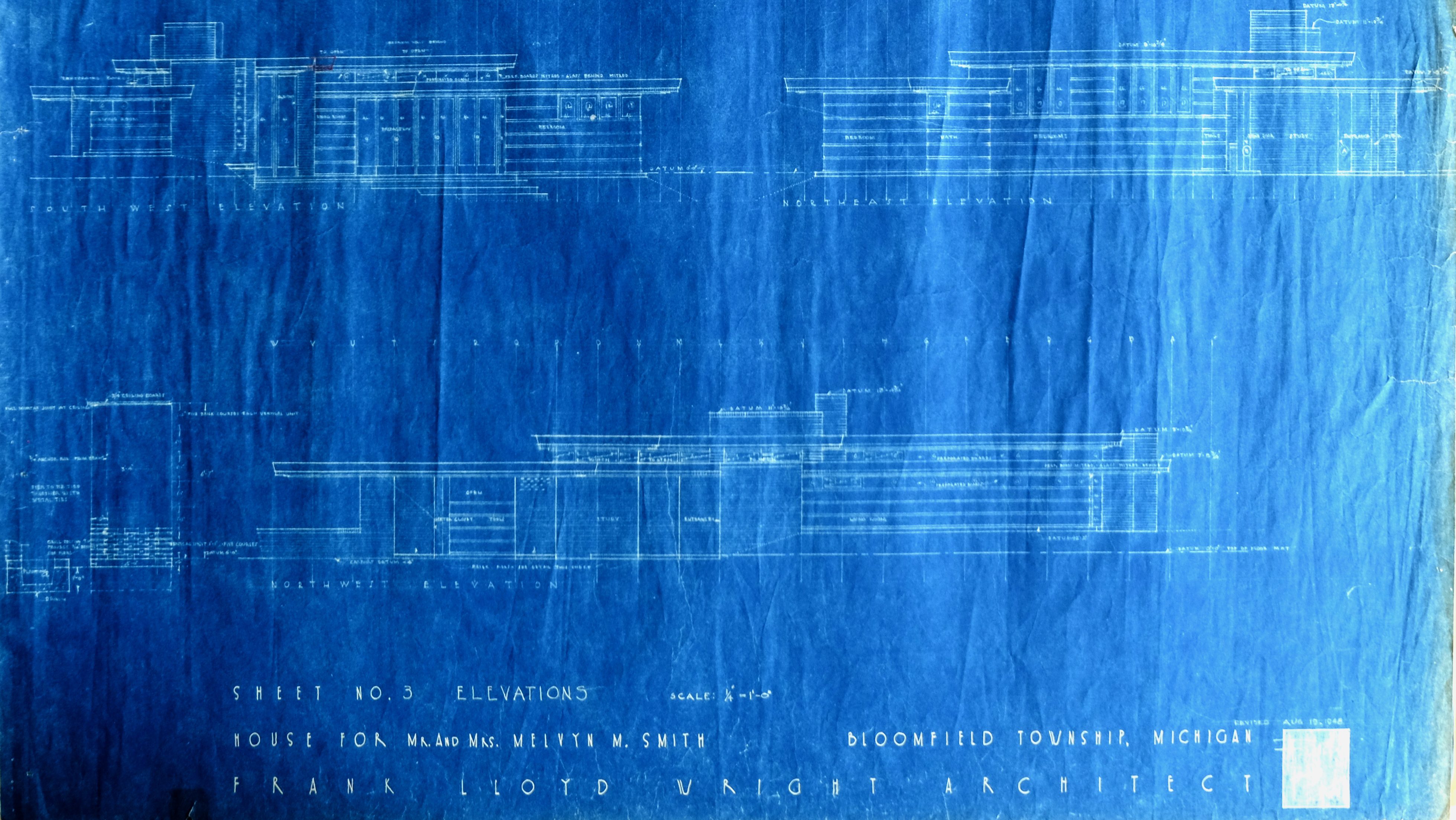
Frank Lloyd Wright, detail of House for Mr. and Mrs. Melvyn M. Smith elevation, August 1948. Blueprint. Courtesy Cranbrook Archives.

Wright had built in Cypress since at least 1914, with his first all-Cypress design, the Wiley House, coming off the drafting board in 1932. The iconic Usonian houses of the 30s and 40s are mostly built of this swamp-grown, super strong, rot-resistant golden wood.

Cypress proved to be perfect for Wright’s organic architecture. And by 1949, Cypress was incredibly hard to find.

Smithy wrote to many different lumberyards with his needed material list. Those closest to the swamps where Cypress grows—lumberyards in South Carolina and Louisiana—were unable to furnish the volume of wood needed. Lumber yards in the Midwest simply stated they did not carry Cypress. Chicago-based Hilgard Lumber Company wrote, “We duly received your inquiry…on a carload of Tidewater Red Cypress (clear grade) but clear grade in this species is extremely scarce.”

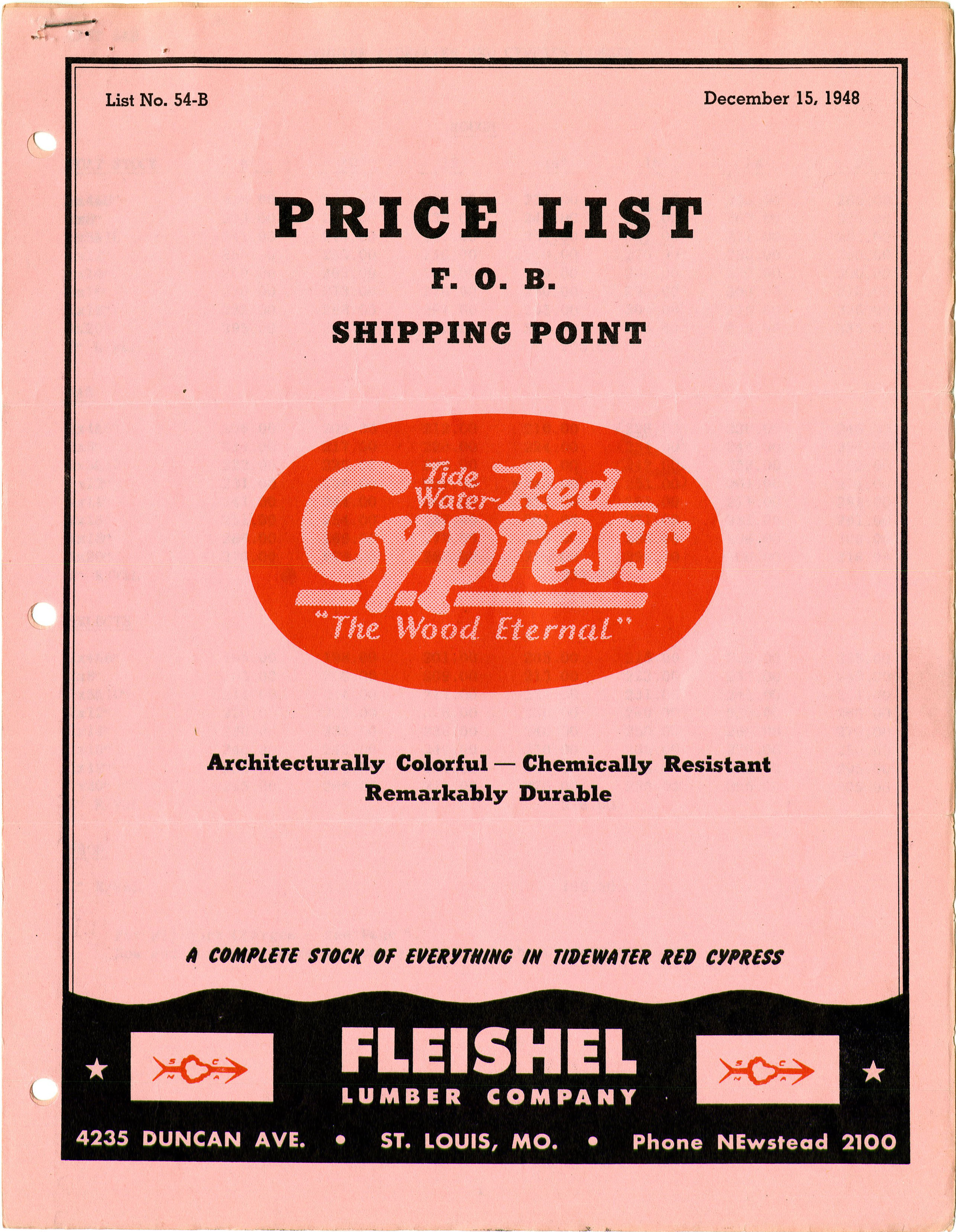
In February 1949, Fleishel Lumber Company of St. Louis (who had been forwarded Smithy’s large request) agreed to fulfill the order. Smithy simply needed to let the yard know when he wanted the wood delivered. Or at least, that was the idea.

Every month, Smith wrote, called, or telegrammed Fleishel, asking for his order. And every month, the lumber yard replied: we don’t have it all, but we have some. As time ticked by and Smithy’s house waited to take shape, Fleishel offered up concessions. Instead of kiln dried, would Smithy accept natural dried Cypress? No. Recycled or swamp-preserved? No. Smaller boards, but more boards? No.

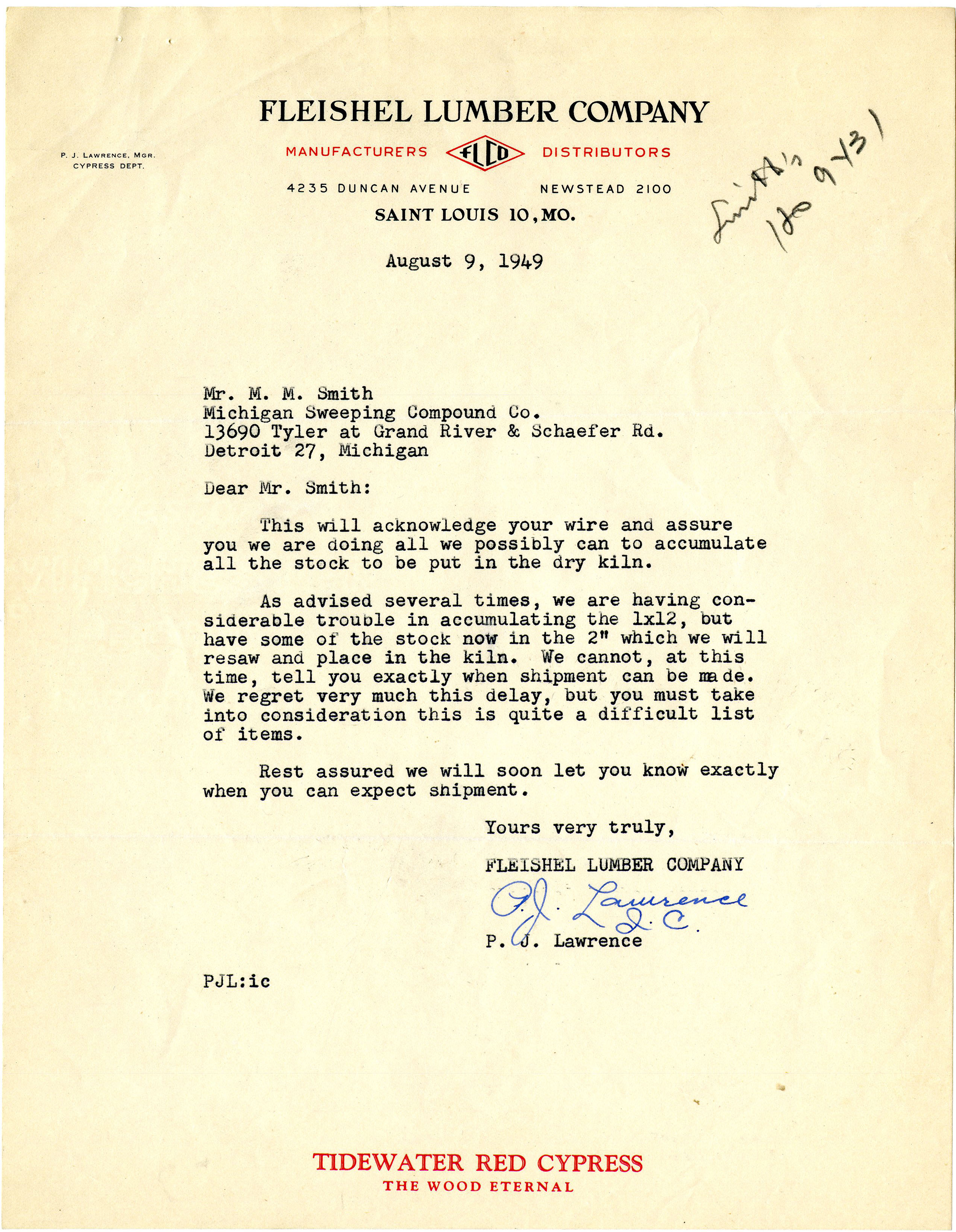
Smithy needed what Wright specified: long, wide boards. By August 9, 1949, things were looking up, even if Fleishel’s salesman sounds a bit annoyed:

…We are doing all we possibly can to accumulate all the stock to be put in the dry kiln.

As advised several times, we are having considerable trouble in accumulating the 1×12…We cannot, at this time, tell you exactly when shipment can be made. We regret very much this delay, but you must take into consideration this is quite a difficult list of items.

Smithy’s goal of having the lumber on hand during the Summer holiday, when he could be on-site every day, did not happen. His first day teaching his Cody High English class that year? September 5.

Finally, on September 23, 1949, Fleishel Lumber packed a railroad car full of 14,000 linear feet of clear, kiln-dried Cypress and sent it toward Bloomfield Hills. Just seven months and a few days after it was ordered.

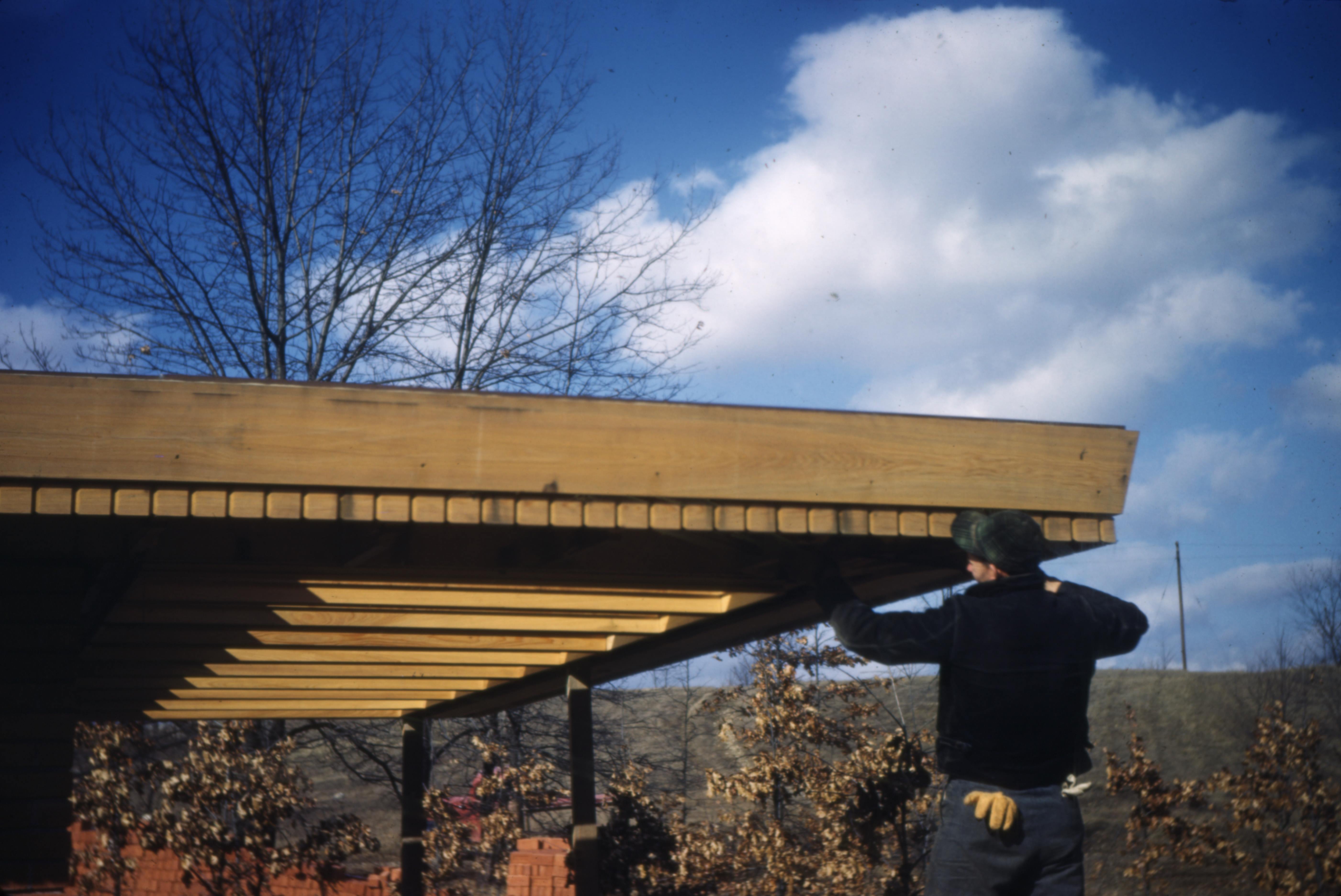
Work continues on Cypress boards of Smith House, winter 1949-1950. Courtesy Cranbrook Archives.

About seven months later, Melvyn and Sara Smith had a Cypress house! When it was completed in May 1950, the Smith House became Frank Lloyd Wright’s last entirely Cypress-built project.

Tidewater Red Cypress with Detroit Common Brick defines the Frank Lloyd Wright-designed Smith House, 1950. Courtesy Cranbrook Archives.

So, did being particular about materials pay off for Mr. Wright and Mr. Saarinen? I think the Smiths and thousands of Cranbrook students would agree: absolutely.

Kevin Adkisson, Curator, Cranbrook Center for Collections and Research

Note: Oh, and if you want old-growth Cypress today? The current owner of the Frank Lloyd Wright Willey House, Steve Sikora, described the purchasing of Cypress wood in the 2010s as operating among “an assortment of hucksters, charlatans, and petty criminals, or in industry parlance, ‘wood brokers.’” Head on over to The Whirling Arrow blog to read a lot more about Cypress and Wright!

Muster the Peacocks!

While researching the step-backed Peacock Andirons at Saarinen House last spring, I enthusiastically mustered a muster of peacocks from across Cranbrook’s campus with the generous help of my colleagues.

“Muster” is the official label for a group of peacocks.

Unlike a gaggle of geese, a muster of peacocks lacks both onomatopoeia and alliteration and implies a level of formality and regimental order in direct conflict with the species’ behavior! That is…judging by the peacocks I’ve witnessed at historic homes and castles throughout Europe, including a visit to Scone Castle in Scotland where an earlier visitor captured these free-spirited troops. Whether iridescent blue or albino, their graceful necks and distinctive crests rise to magnificence when tail feathers are splayed to attract a peahen mate or intimidate predators.

Throughout the ages, blue aka Indian peafowl have symbolized beauty and prosperity and served as sources of artistic inspiration. A favored theme at Cranbrook, the peacock’s dramatic curvilinear lines are represented at each institution across the campus.

One can discover…

WORKS IN METAL:

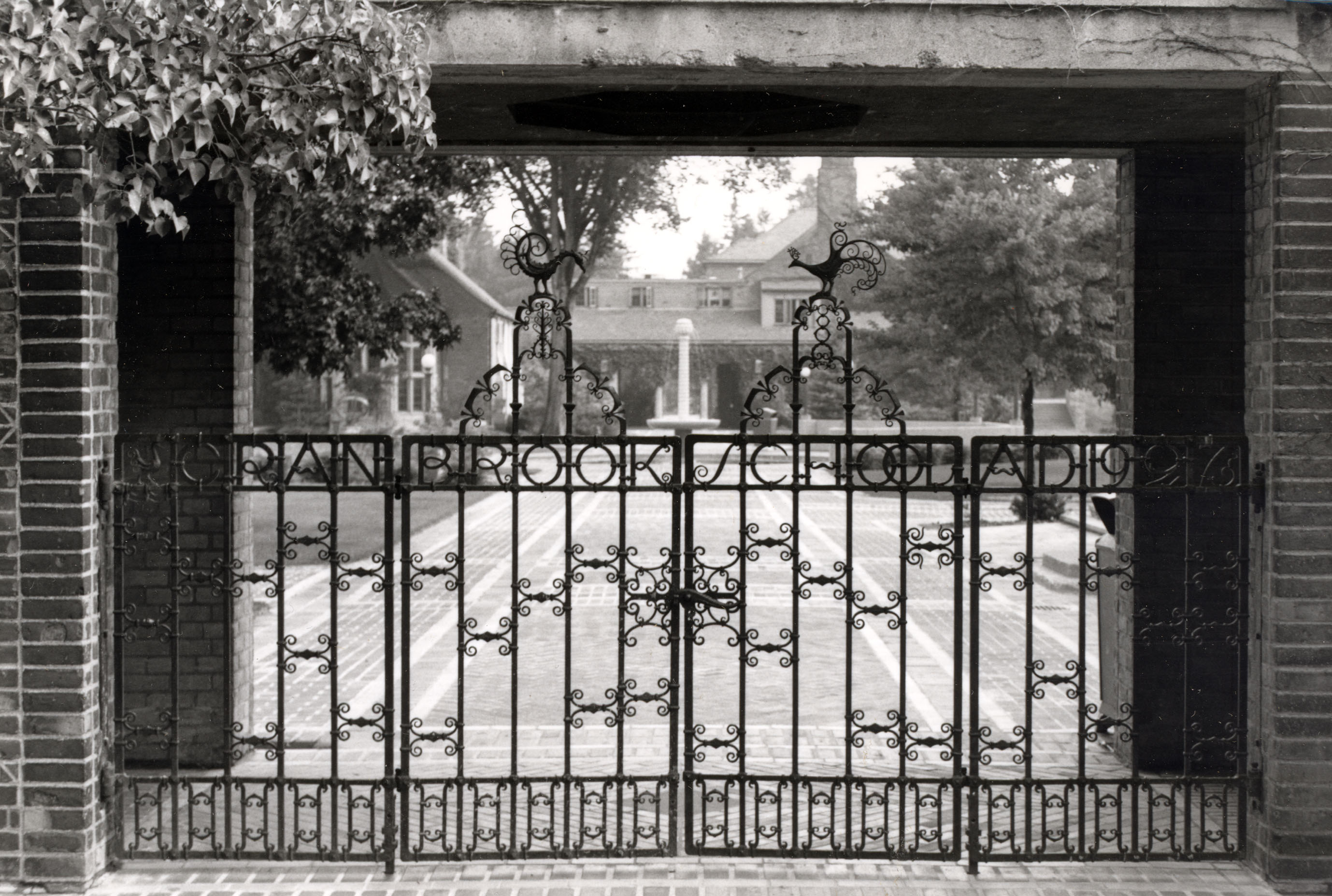
The famed Peacock Gates designed by Finnish-American architect Eliel Saarinen and fabricated in wrought and cast iron by Oscar Bruno Bach, 1927, marking the former Lone Pine Road entrance to Cranbrook School for Boys:

Peacock Gates at Cranbrook School circa 1980. Jeffrey Welch, photographer. Courtesy Cranbrook Archives.

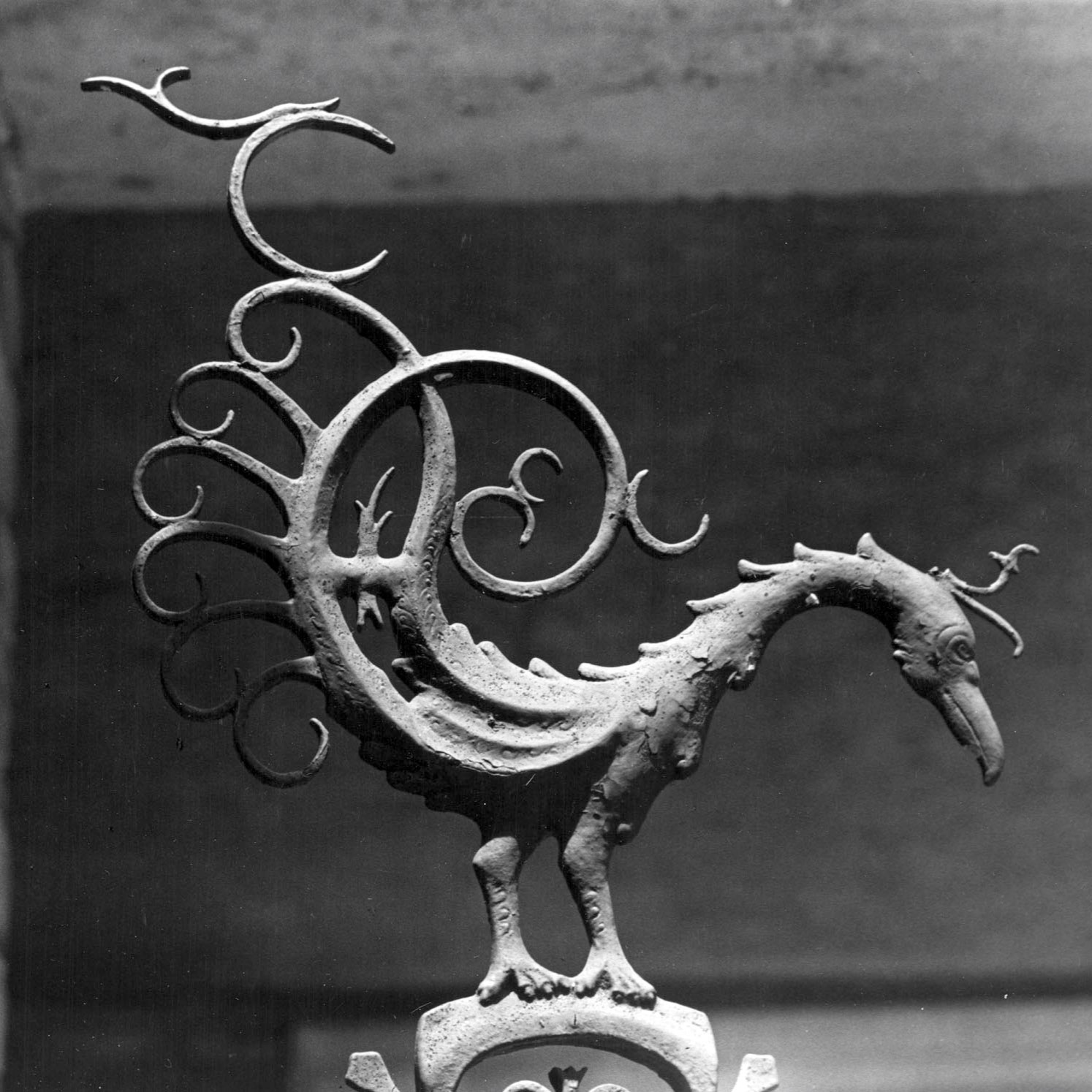
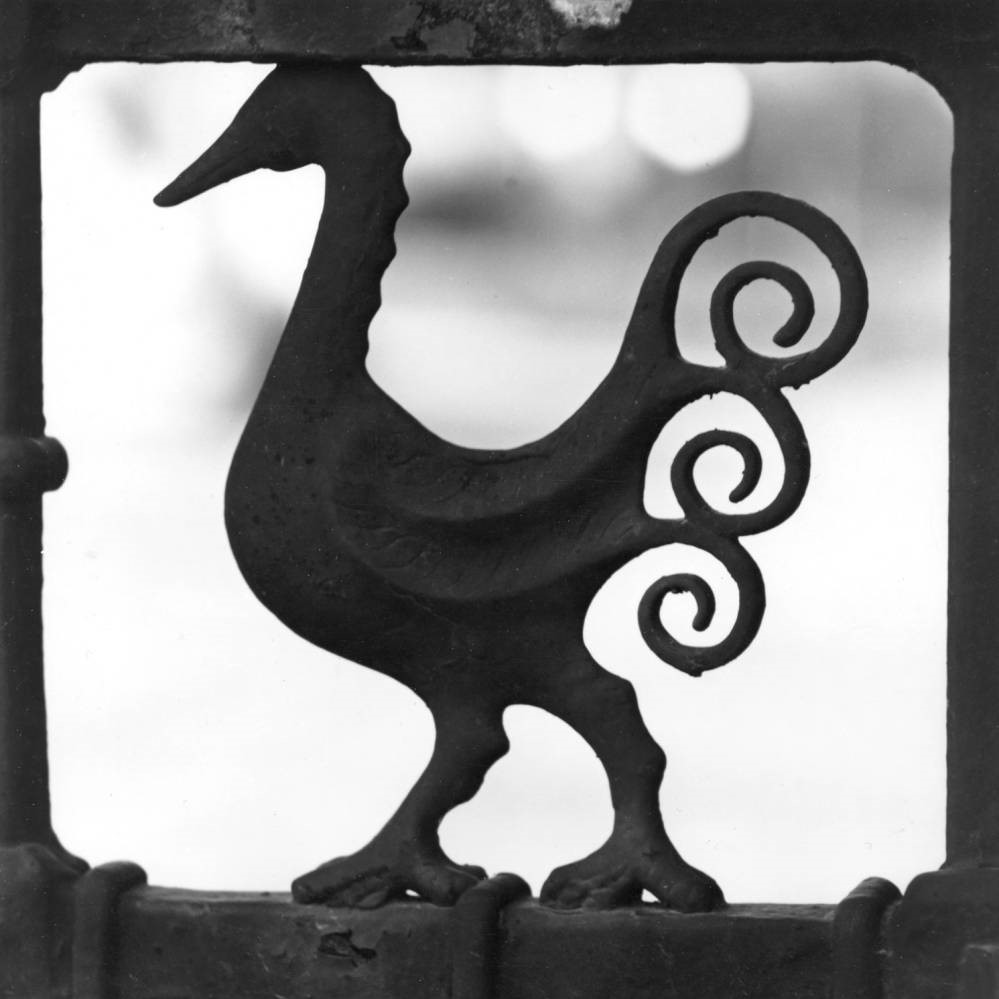
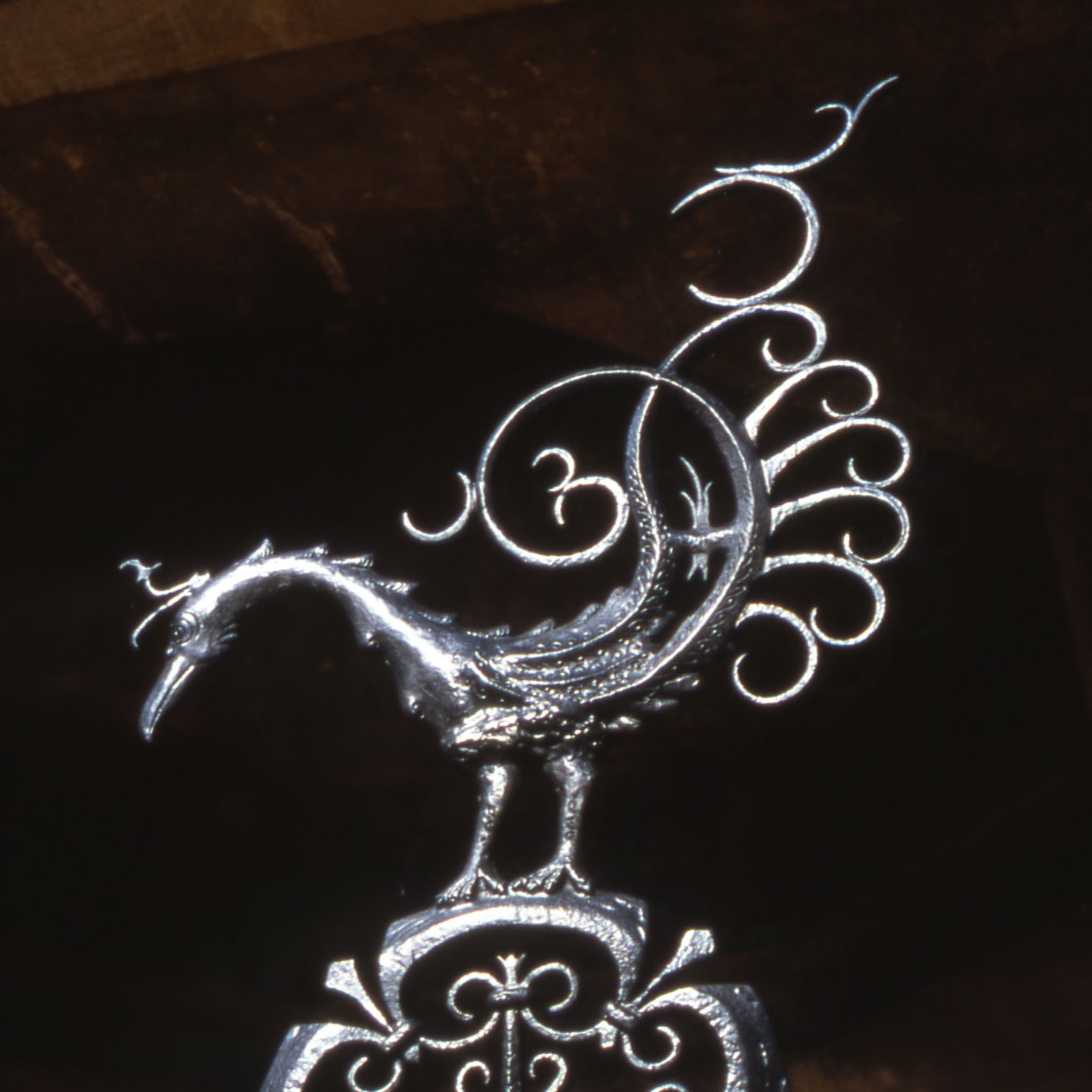
Details of the peacocks in cast iron:

Detail of Cranbrook School Peacock Gate, circa 1935. Courtesy Cranbrook Archives.
Detail of Cranbrook School Peacock Gate, 2001. Balthazar Korab, photographer. Copyright Balthazar Korab | Cranbrook Archives.

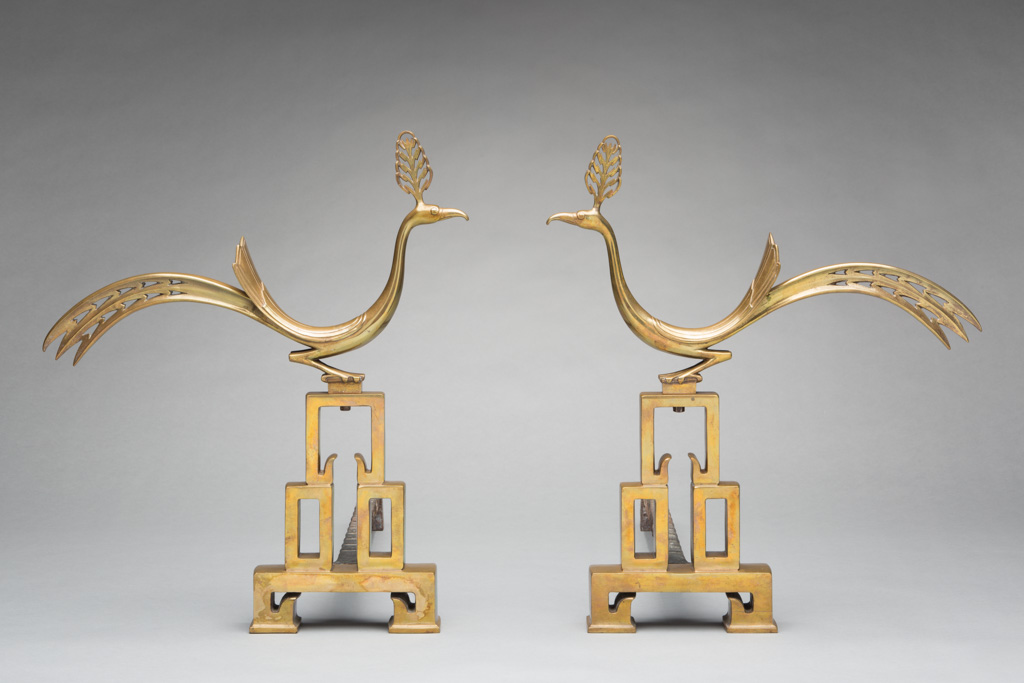
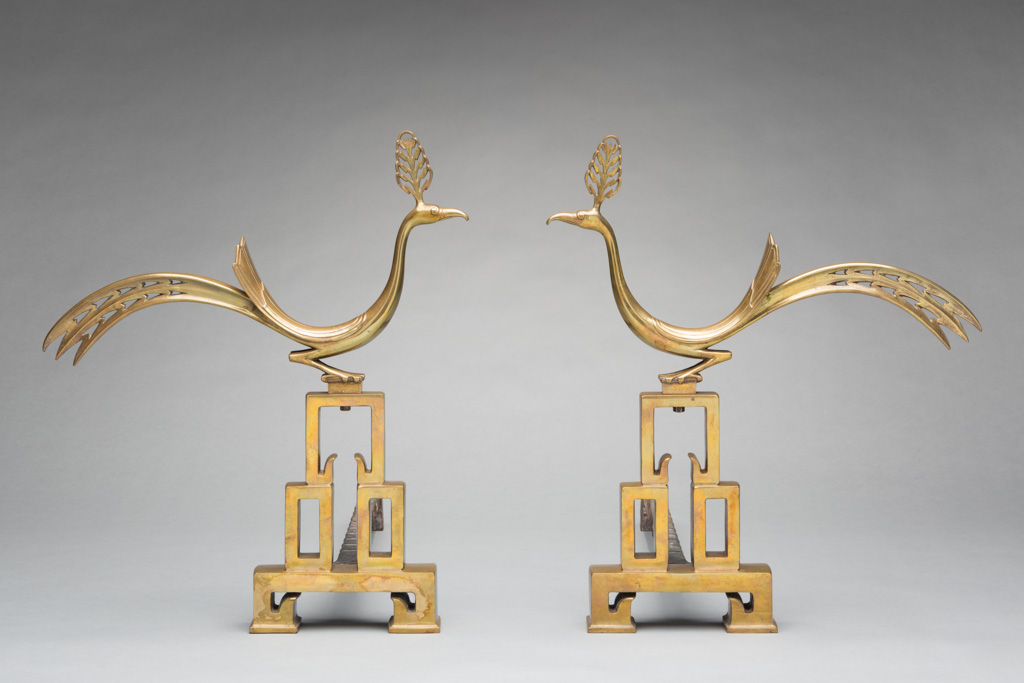
Eliel Saarinen’s cast bronze Peacock Andirons, 1928-29, on view at Saarinen House. Collection of Cranbrook Art Museum. Produced by Sterling Bronze Company, New York, between 1928 and 1929, these cast bronze andirons were paid for by the Cranbrook Foundation and entered in the 1928-1930 Arts & Crafts Building ledger on pages 40-41—Date: 1-7-30; No.: 515; Name: Sterling Bronze Co; Remarks: 1 pair/ Andirons for Saarinen Res[idence]; Amount: $152.50 (the equivalent of $2,704 in 2024):

Robert Hensleigh, photographer. Courtesy Cranbrook Art Museum.
Continue reading

Leap Day

Every four years, we add an extra day to the calendar to catch up to Earth’s revolutions around the Sun. For most of us, it is just February 29th, an extra day in the week. For leaplings, it is a day to celebrate their true birthday.

Different cultures have different customs associated with February 29th, known as Leap Day. In some cultures, it is also known as Bachelor’s Day or Ladies’ Privilege, because that is the day that women can propose to men.

In Finland, leap-year day proposals are considered good luck. If, however, the gentleman says “no,” he is required to give the woman enough fabric to make a skirt.

According to Medium.com, “The tradition reflects the Finnish spirit of equality and a shared sense of humor within romantic relationships. It challenges gender norms in a playful manner, encouraging women to take the lead in expressing their feelings and creating a shared memory that will be cherished for years to come.”

“While leap-year day may be just one day every four years, the tradition of women proposing adds a touch of magic and unpredictability to Finnish love stories. It’s a celebration of love, luck, and the joy of shared laughter, reminding couples that romance can be both traditional and delightfully unexpected in the heart of Finland.”

Something else unexpected is an elopement, a sudden and secret ceremony involving a flight from home without parental approval. One of Cranbrook’s “Finnish love stories” involved one such elopement.

Shortly after she turned 21, Eva-Lisa “Pipsan” Saarinen eloped to Toledo, Ohio with Jons Robert Ferdinand “Bob” Swanson, one of Eliel’s architecture students. They were married on May 8, 1926. According to Pipsan Saarinen researcher Alison Kowalski, “The young couple eloped because Eliel and/or Loja objected to the match, probably in part because Bob was of a lower socio-economic status than the Saarinens. According to Henry Scripps Booth, a close friend of Bob and Pipsan, Loja felt Bob was using Pipsan to get close to Eliel.”

Eliel, Bob, Bobby, and Pipsan aboard the MS Gripsholm, 1929. Courtesy Cranbrook Archives.

Bob struggled to support himself and Pipsan at the beginning of their marriage. Perhaps she proposed, and he didn’t have enough money to cover the cost of skirt fabric for such a fashionable lady.

Watercolor dress design by Pipsan Saarinen Swanson, circa 1933. Collection Cranbrook Art Museum.

More likely, they were truly in love. They were married from 1926 until Pipsan passed away in 1979.

—Leslie Mio, Associate Registrar, Cranbrook Center for Collections and Research

Time to Study! (History, that is)

As college students across the country buckle down to study for final exams and finish writing end-of-semester papers, there will be one school where that’s not happening: Cranbrook Academy of Art. Instead, our Academy students are busy making in their studios, and frantically producing work for their semi-regular critiques with Artists-in-Residence. This follows the model set up here by founding president Eliel Saarinen, who famously rejected what he called the “non-creative-school-book-learned-art-teacher” in favor of a method he called “self-education under good leadership.”

While the Academy’s extremely self-directed, studio-based education is proudly traced back to our founding, Cranbrook did, in fact, once offer formal courses in the history of art. These quarterly courses—taught by museum curators, visiting professors, and artists—utilized both slide shows and actual paintings.

Museum Director Albert Christ-Janer teaching his “Survey of the Arts” history class for Cranbrook Academy of Art students, 1945. Christ-Janer arrived at Cranbrook in June of 1945 and left for the University of Chicago in September 1947. Harvey Croze, photographer. Courtesy Cranbrook Archives.

Here, we see Museum Director Albert Christ-Janer lecturing in the then-new Cranbrook Academy of Art Museum and Library. The classroom is simple, just folding chairs and an illuminated blackboard set up in the lower-level galleries. In front of the students hangs Doris Lee’s Fisherman’s Wife. I admire Christ-Janers books, and imagine it would’ve been very exciting to attend one of his lectures.

Christ-Janer discussing Fisherman’s Wife by Doris Lee (CAM 1945.27). Lee painted the scene of Key West, Florida while she was a visiting artist at Michigan State in 1945. It was purchased by the Cranbrook Foundation that same year. Harvey Croze, photographer. Courtesy Cranbrook Archives.

In the Academy’s 1945 Course Catalog, Christ-Janer is listed as “Instructor in the Survey of the Arts.” By the 1970s, then President Wallace Mitchell stopped offering anything like a history of art course at the Academy in favor of a history/theory seminar called the Humanities Forum. This evolved into the Critical Studies program today—the only required lecture/seminar for Academy students, but which is, as always, ungraded.

I’d note that Christ-Janer is teaching in a full suit and tie—a sight rarer at the Academy today than a history of art course!

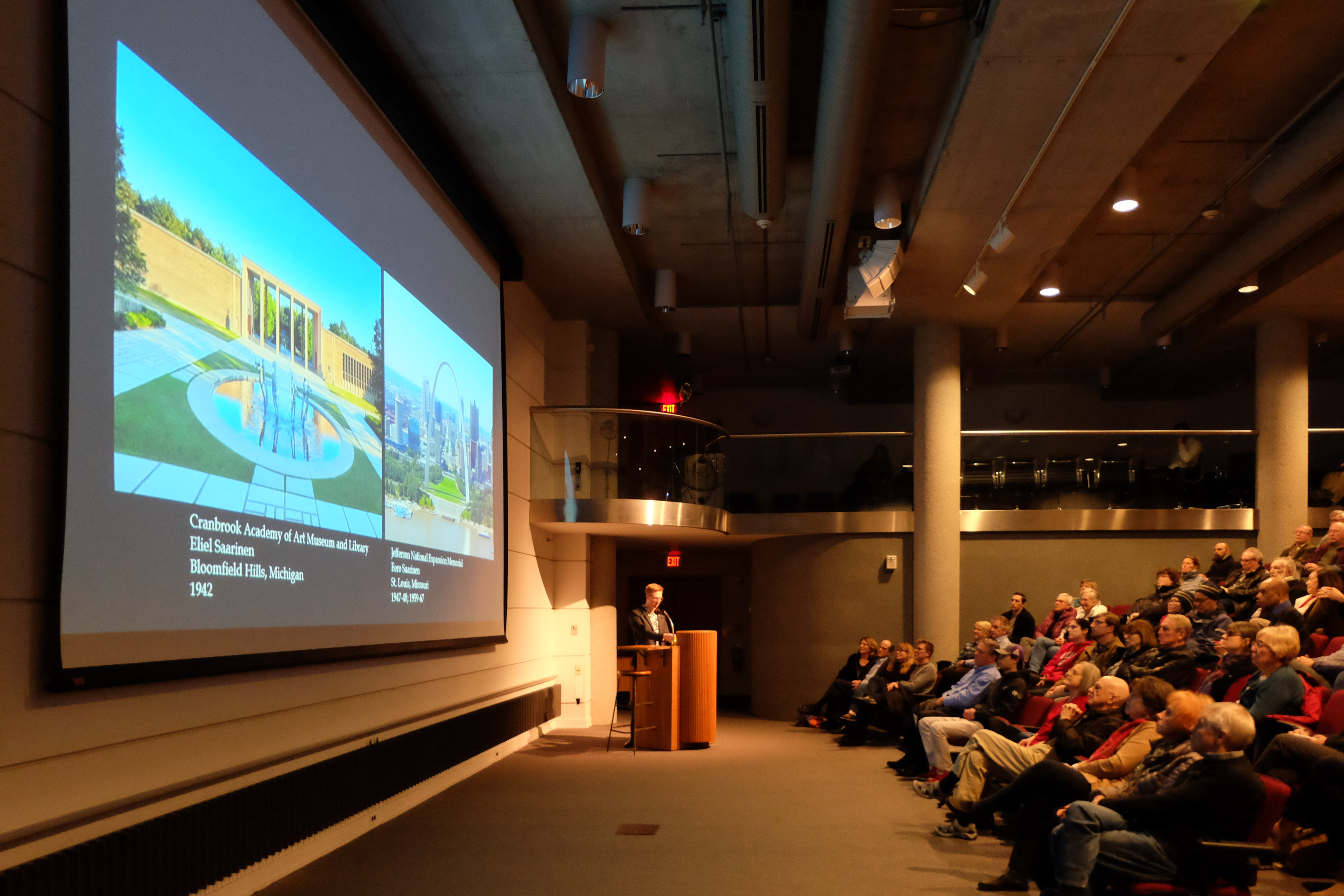
Even though the Academy no longer offers a History of Art course in its curriculum, I like to think that the Center’s History of American Architecture lecture series continues the tradition of art history at Cranbrook. For the past six years, I’ve taught architecture history to interested Academy and Cranbrook Schools students, and open to members of the public.

Kevin Adkisson teaching History of American Architecture: Cranbrook in Context, March 3, 2020. Photography by Daniel Smith, CAA 2021, Courtesy Cranbrook Center for Collections and Research.

Starting on February 6, 2024, the History of American Architecture lecture series returns. This year’s subject is “Detroit and the World,” and we are offering two ways to attend the lecture: virtually, at noon or 6:30pm EST, or in person at Cranbrook Art Museum’s de Salle Auditorium at 6:30pm. We launched the website and ticket sales on Wednesday, and I encourage you to read more about each week’s topic and consider signing up over on our website. There’s so much great Detroit architecture, and I am excited to share it with you in lectures this winter!

In his unpublished 1950 manuscript, The Story of Cranbrook, Eliel Saarinen wrote of Cranbrook students as “the pupil is like an empty sack to be filled during the school year.” I hope you’ll join me in February as we fill ourselves up with knowledge!

Kevin Adkisson, Curator, Cranbrook Center for Collections and Research

Image: The Greater Penobscot Building by Wirt Rowland of Smith, Hinchman & Grylls, Detroit, Michigan, 1928;  Photography by James Haefner, Courtesy James Haefner.    

HISTORY OF AMERICAN ARCHITECTURE

DETROIT AND THE WORLD

This installment will focus on the architecture of Detroit, studying the buildings, designers, and policymakers that shaped the city’s dramatic transformations from the late nineteenth century to today, and how Detroiters have influenced the course of architecture around the globe. 

Step-back with a Peacock

From the moment I entered Saarinen House twenty-seven years ago to give my first public tour, to my upcoming presentation for the Kingswood Middle School for Girls Explore Cranbrook students, I remain . . . simply enthralled. No more so than by the vibrant Peacock Andirons gracing the living room hearth.

Eliel Saarinen’s cast bronze Peacock Andirons, 1928-29. Each 21-1/4” W x 22-3/8” H x 27-1/4” D. Collection of Cranbrook Art Museum, CAM1985.2 a-b. Robert Hensleigh, photographer.

Designed by Finnish-American architect Eliel Saarinen and produced by Sterling Bronze Company, New York between 1928 and 1929, these cast bronze andirons were paid for by the Cranbrook Foundation and entered in the 1928-1930 Arts & Crafts Building ledger on pages 40-41 (third line from the bottom)—Date: 1-7-30; No.: 515; Name: Sterling Bronze Co; Remarks: 1 pair/ Andirons for Saarinen Res[idence]; Amount: $152.50 (the equivalent of $2,631.50 in 2023).

Arts & Crafts Building ledger, 1928-30. Laura MacNewman, photographer, 2023. Cranbrook Archives.

The pair of birds are fabulous. Ready and alert, they face each other, ankles bent, balanced upon splayed toes.

Continue reading

Cranbrook’s Great Books (Part II)

In Part I of this post, we explored Cranbrook’s love of the book, from its origins with founders George and Ellen Booth, to the existing special collections at the Archives and Academy of Art. I invite you now to learn of the many rare, valuable, and historical tomes whose existence may be unknown to most or simply overlooked in collections at the Schools, Institute of Science, and two historic homes cared for by the Center for Collections and Research: Saarinen House and Smith House.

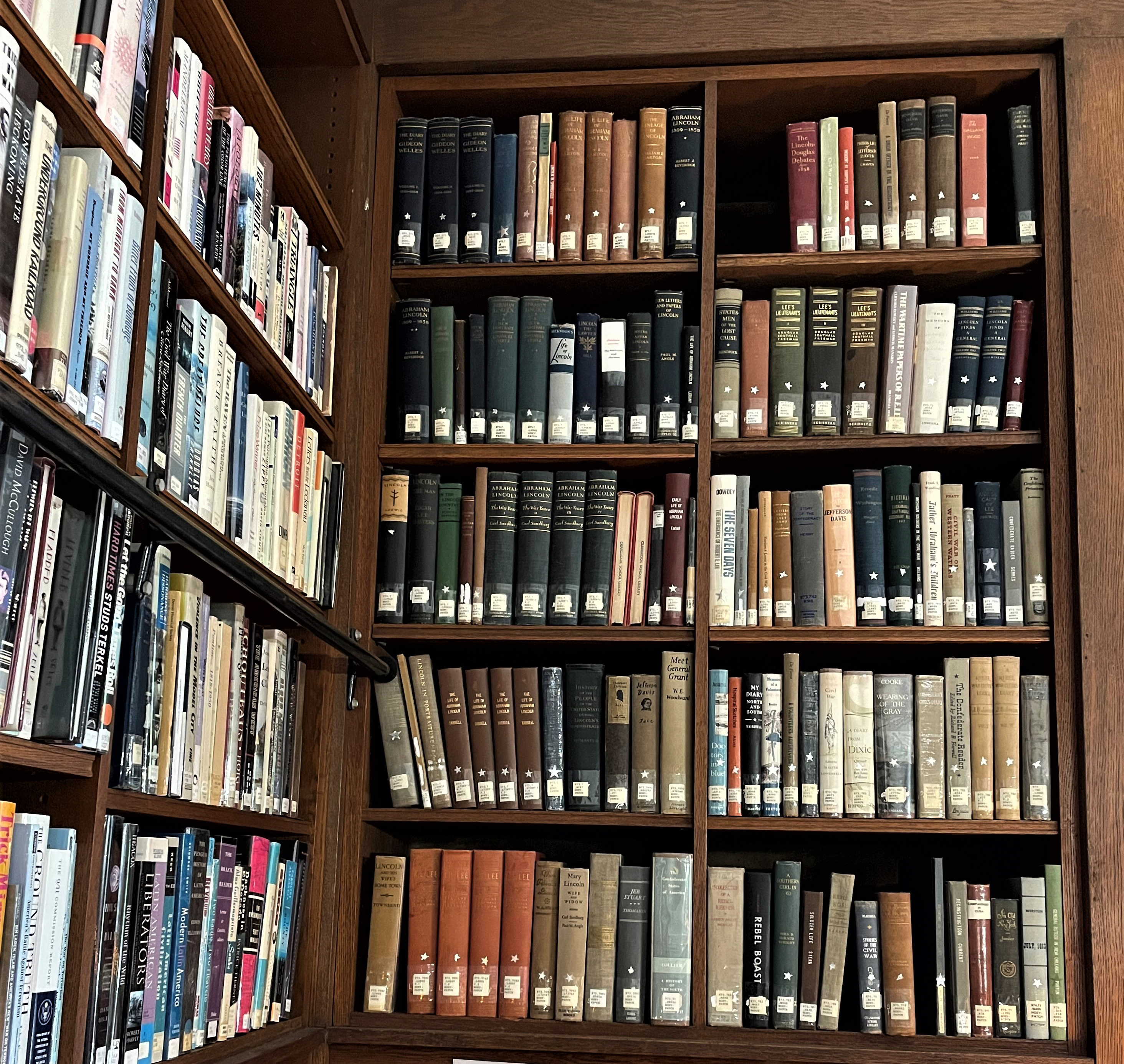
Hoey Patch Collection at the Cranbrook School Library. Courtesy of Kate Covintree, Cranbrook Kingswood Upper Schools.

Like the Academy of Art, although not at all on the same scale, books from George and Ellen’s Cranbrook House Library were dispersed to the Cranbrook Schools Libraries, now comprised of five separate spaces. Following the Booth’s example, Cranbrook School Headmaster Harry D. Hoey (1950-1964) and Latin teacher George Patch (1928-1944, Emeritus 1944-1950) donated 120 books from their personal libraries to the School’s library in the 1950s, forming one of several special collections. Known as the Hoey Patch Collection, all of the volumes focus on an aspect of Abraham Lincoln or the American Civil War.

He Knew Lincoln, a fictionalized account written by Ida Tarbell, a progressive journalist, and published in 1907. The book’s custodial history is documented with correspondence from the author, written directly on the inside of the book. Courtesy of Kate Covintree, Cranbrook Kingswood Upper Schools.

Highlights include a First edition of The Life of Abraham Lincoln, the first full-scale biography of the President. Written by newspaper editor J.G. Holland, it was published shortly after Lincoln’s assassination in 1865. Also included is a first edition, two-volume set of the Personal Memoirs of U.S. Grant. Ulysses S. Grant penned his autobiography shortly before his death in 1885 as a means of financial support for his family. It was published with the support of his friend Mark Twain by the Charles L. Webster Company (owned by Twain’s nephew).

Continue reading

Material Honesty in Saarinen’s Structures

Eliel Saarinen wasn’t much for philosophizing about his work. Cranbrook’s principal architect demonstrated his beliefs about architecture through the bricks and stones of his buildings, rather than through academic lectures or theoretical treatise.

When I give tours of campus, I often highlight the fact that in Saarinen’s buildings, a brick wall is a structural brick wall, and a stone column is a structural stone column. If that sounds obvious, well, it’s because architects are excellent at deception.

Bricks and Mankato Kasota stone pilasters at Cranbrook Art Museum. Photograph by Daniel Smith CAA Architecture 2021. Courtesy Cranbrook Center.

In the 1920s and 1930s (and straight through to today), it was much cheaper to build a wall of concrete block or wood and then cover it in a façade of brick, or to design a reinforced concrete column and then wrap it in thin stone veneer. Solid brick walls and true stone columns are more expensive and more limiting to the designer (you can build taller, wider, and cheaper in steel and concrete). Regardless of a building’s style, by the early 20th century most of our country’s institutional buildings were constructed of modern materials and wrapped in traditional ones.

This habit of facadism (a focus on the material appearance without regard to the structural reality) was abhorrent to devotees of modernism. In International Style modern architecture, then, architects simply did away with brick walls and stone columns—materials used in construction for millennia—in favor of concrete, glass, and steel. The structure and the appearance of the architecture were one in the same.

But at Cranbrook, with its deep roots in the Arts and Crafts Movement, Saarinen went the other direction. True stone and brick construction was integral to our founding ethos, and to Saarinen’s designs.

Detail of brickwork on the dormitories of Cranbrook School for Boys (Cranbrook Campus, Cranbrook Kingswood Upper School). Photograph by Kevin Adkisson, Courtesy Cranbrook Center.

While many of Saarinen’s contemporaries were dealing with so-called ‘dishonest’ forms of architecture (steel and concrete frames clad in traditional styles rooted in masonry construction), Saarinen avoided the problem of ‘dishonesty’ by building modern buildings traditionally. Saarinen did use concrete vaults and floor slabs, as well as steel trusses, but he connected these to brick load bearing walls and stone columns.

Adding to the unusual fact that Cranbrook’s brick walls and brick vaults are structural, the beauty of Saarinen’s brickwork stands out. He achieved a special blend of true engineering and true artistry. This combination of beauty and utility was key to the Arts and Crafts Movement, and to the form-following-function ethos of Saarinen’s modernism.

More simply, the brickwork of Cranbrook is a visual delight.

Patterned brick and Mankato Kasota stone bench at Kingswood School for Girls (Kingswood Campus, Cranbrook Kingswood Upper School). Photograph by James Haefner, Courtesy Cranbrook Center.

In Edward Ford’s The Details of Modern Architecture (1996), the architecture historian and professor writes that:

“Few Modernists were less interested in industrialization and standardization than Eliel Saarinen, and it is more than ironic that fate was eventually to place him at its heart, Detroit, and that he was to spend the second half of his career…at Cranbrook, fifteen miles from Highland Park and twenty miles from River Rouge, designing schools for the children of auto executives.”

Basket-woven brick barrel vault in the Arts and Crafts Courtyard, Cranbrook Academy of Art. Photograph by James Haefner, Courtesy Cranbrook Center.

There is much more to say about Saarinen’s brickwork, and bricks at Cranbrook more broadly. On October 25, 2021, I invite you to join me for the Center’s next Uncovering Cranbrook virtual lecture: The Bricks of Cranbrook: Humble Material, Monumental Design. I’ll discuss the history of bricks, where our bricks came from and what makes them unique, and, most importantly, revel in the beauty of the billions of bricks on this campus. And, after the lecture, join me on campus for a special behind-the-scenes brick themed tour!

Kevin Adkisson, Curator, Cranbrook Center for Collections and Research

Collection Highlight: Walter Hickey Papers

Cranbrook Archives is pleased to announce a new collection available for research. An intriguing collection, it comprises the personal and professional papers, photographs, realia, and architectural drawings of Walter Preston Hickey, a student of Eliel Saarinen. Yet, while traces of key life events and relationships—birth, parentage, education, marriage, friends, and employers—can be found in the collection, Hickey’s life after Cranbrook remains largely a mystery.

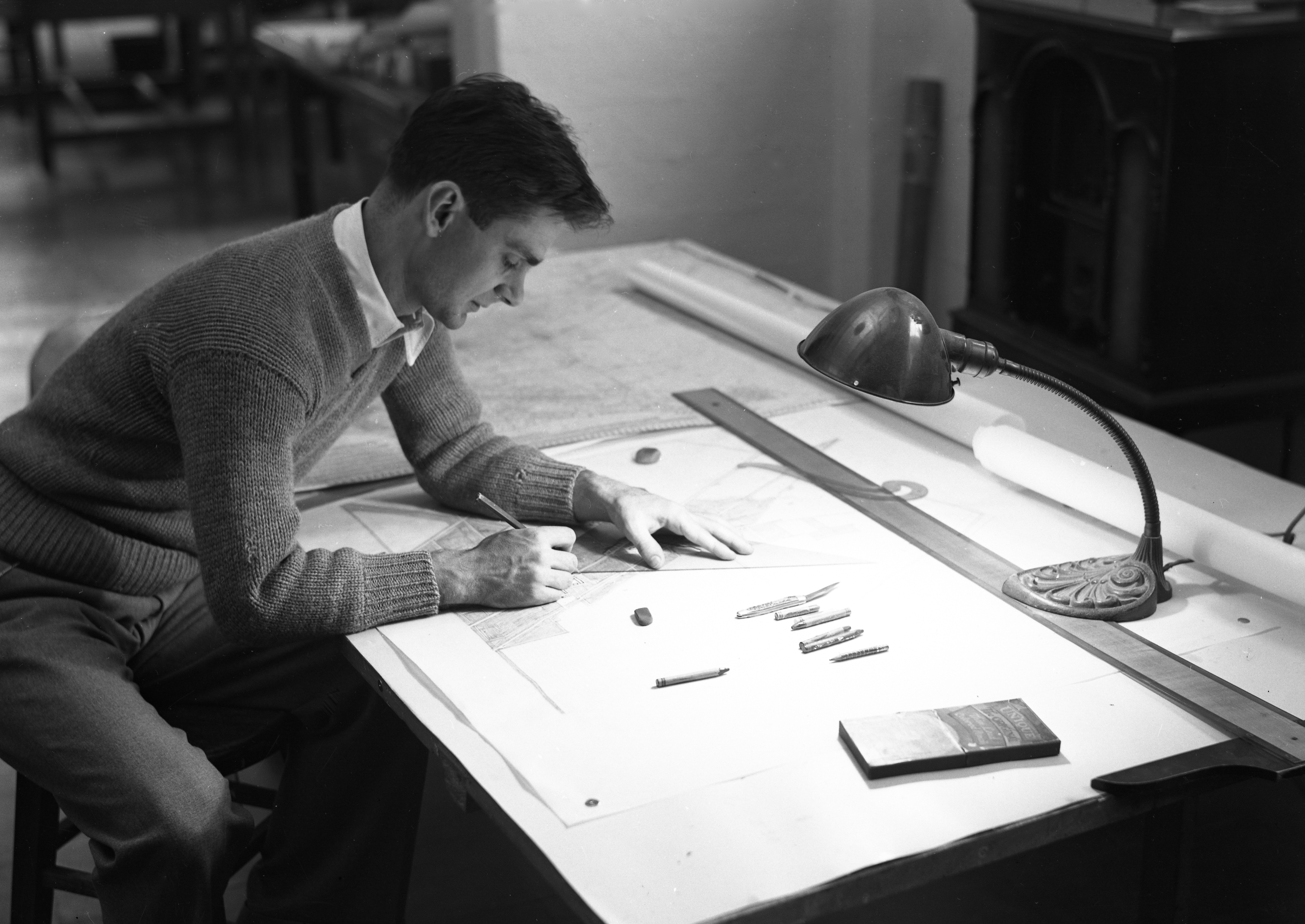
Walter Hickey working in the Architecture Studio, 1935. Courtesy of Cranbrook Archives, Cranbrook Center for Collections and Research.

A native of Detroit, Hickey attended the University of Michigan School of Architecture (1926-1930), during which time he worked with architects Albert Kahn (1928) and Thomas Tanner, as well as being one of the first staff members of the Cranbrook Architectural Office.

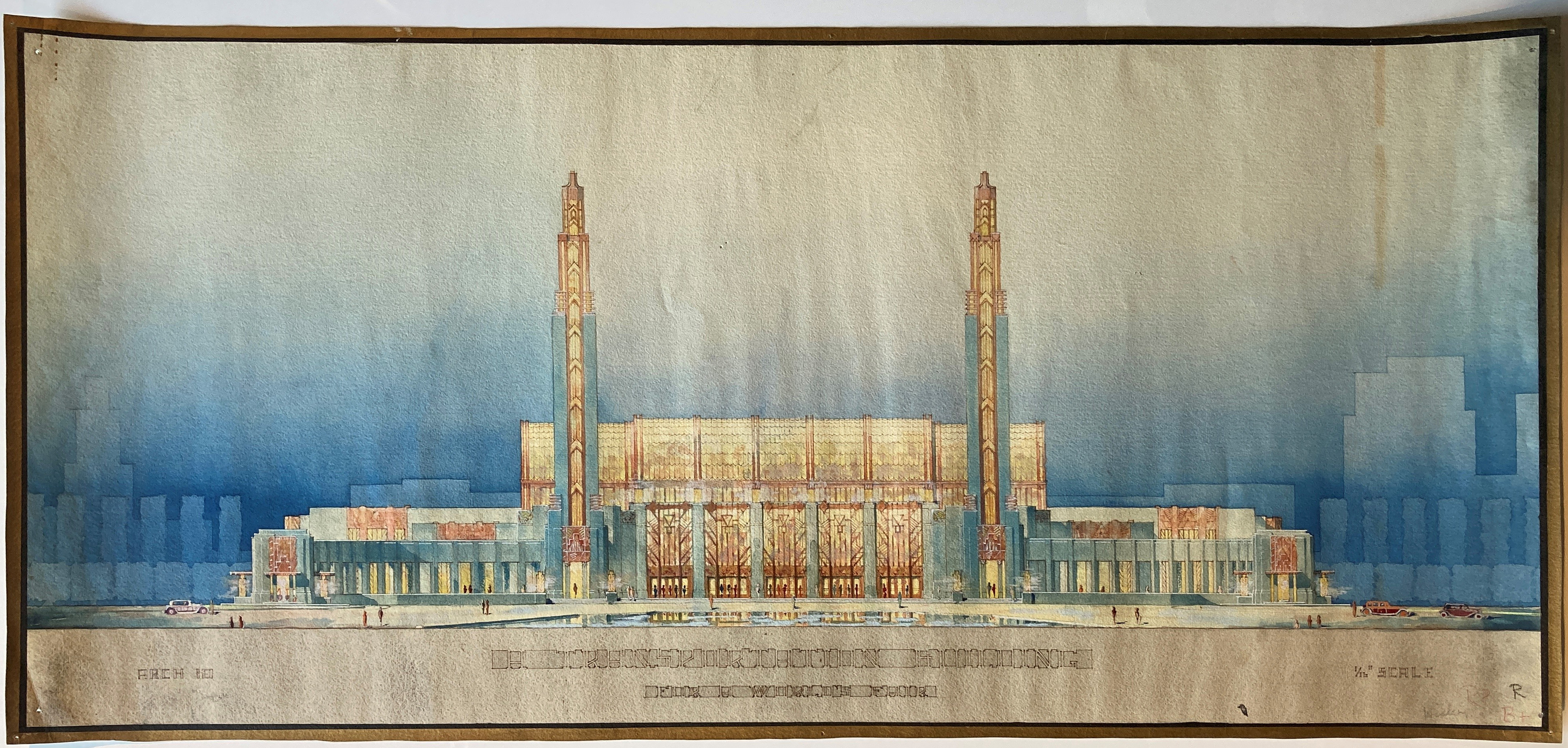
A Transportation Building for a World’s Fair, circa 1926-1930. A University of Michigan Class Project by Walter Hickey. Courtesy of Cranbrook Archives, Cranbrook Center for Collections and Research.

He applied to study architectural design with instruction in city planning at Cranbrook Academy of Art, starting in September of 1932. He became especially interested in highway traffic control, which formed the topic of his 1935 thesis on the Waterfront Development for the City of Detroit. Hickey submitted designs to various Academy competitions and won a $10 prize from Loja Saarinen for design No. 13 in the Cranbrook Academy of Art Rug Competition in 1934.

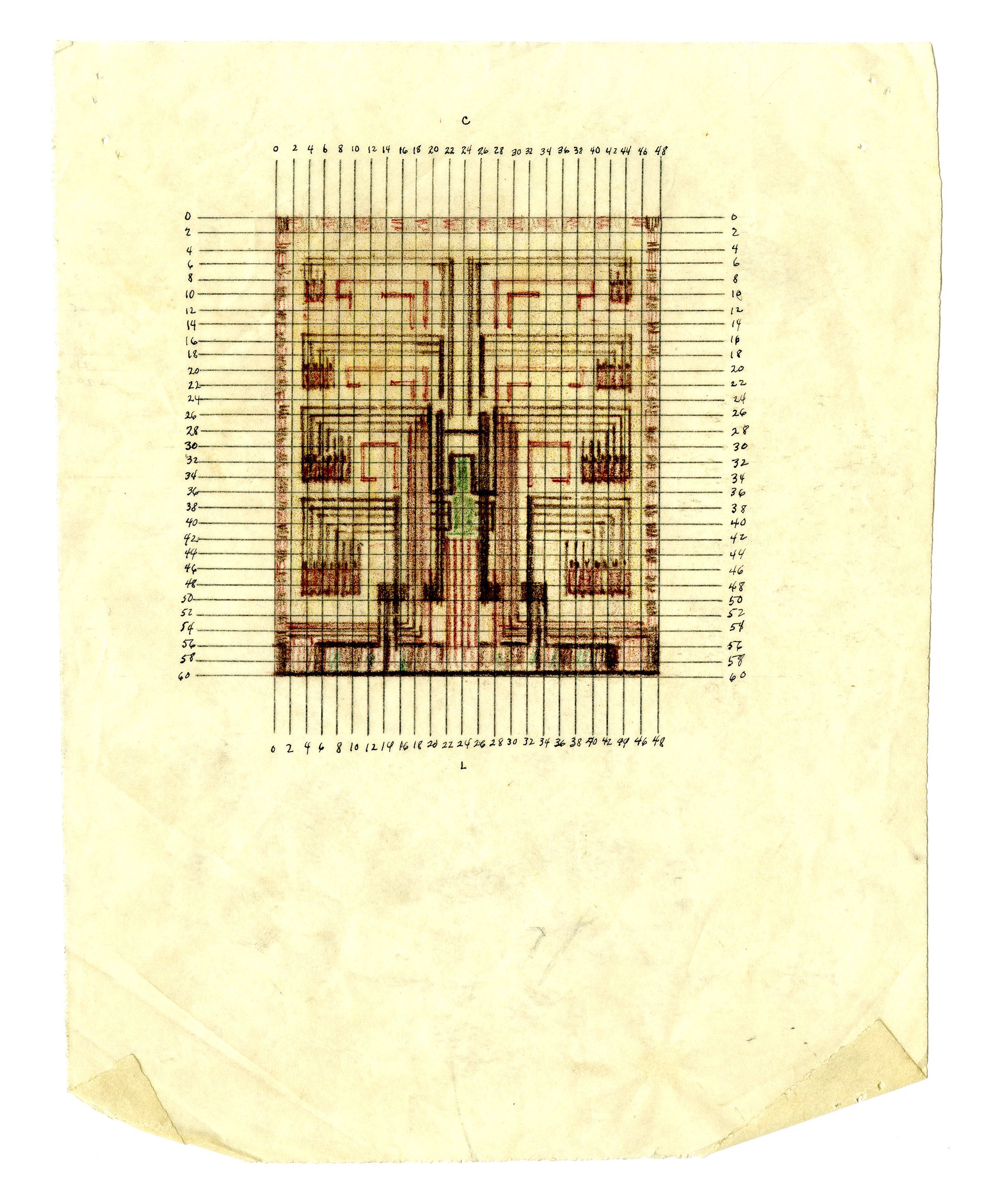
Drawing by Walter Hickey, undated. Courtesy of Cranbrook Archives, Cranbrook Center for Collections and Research.

After leaving Cranbrook, Hickey worked for various architecture firms, including Smith, Hinchman, and Grylls, and Clair W. Ditchy. After a short time with the Federal Housing Administration, he returned to work with Eliel and Eero Saarinen on the Kleinhans Music Hall project. He also completed private architectural designs for residences, including work on Ralph Rapson’s Hoey vacation home, Longshadows, in Metamora, MI. Around this time, he went to work at the General Motors Technical Center and continued to live in Birmingham, Michigan. And here is where his story ends in the collection.

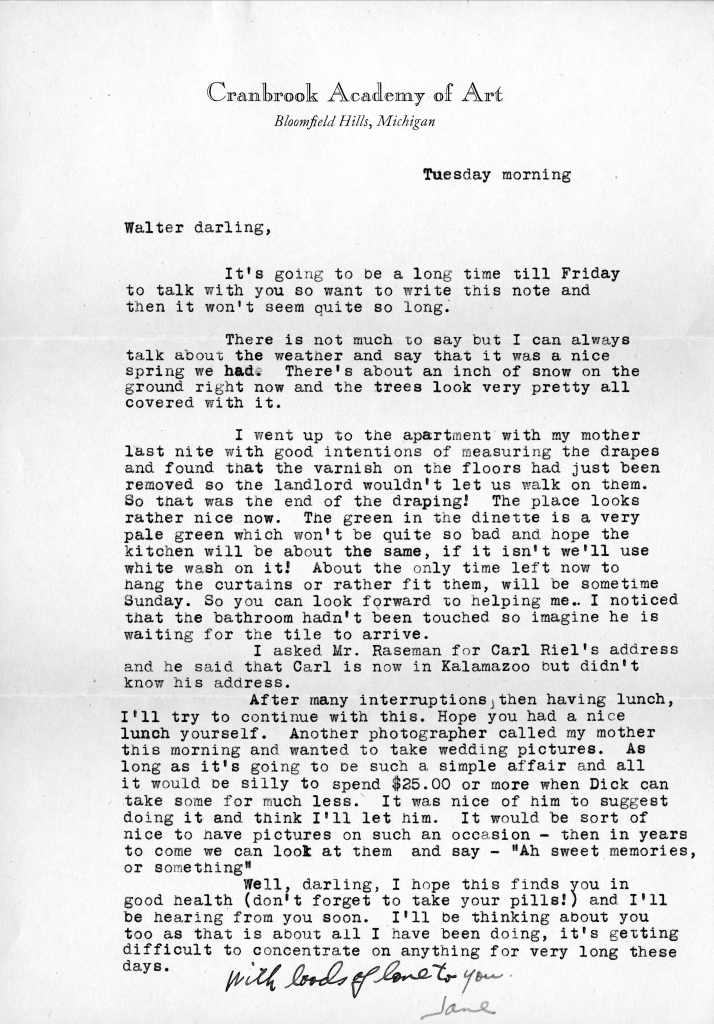
Jane Viola Shepherd. Courtesy of Cranbrook Archives, Cranbrook Center for Collections and Research.

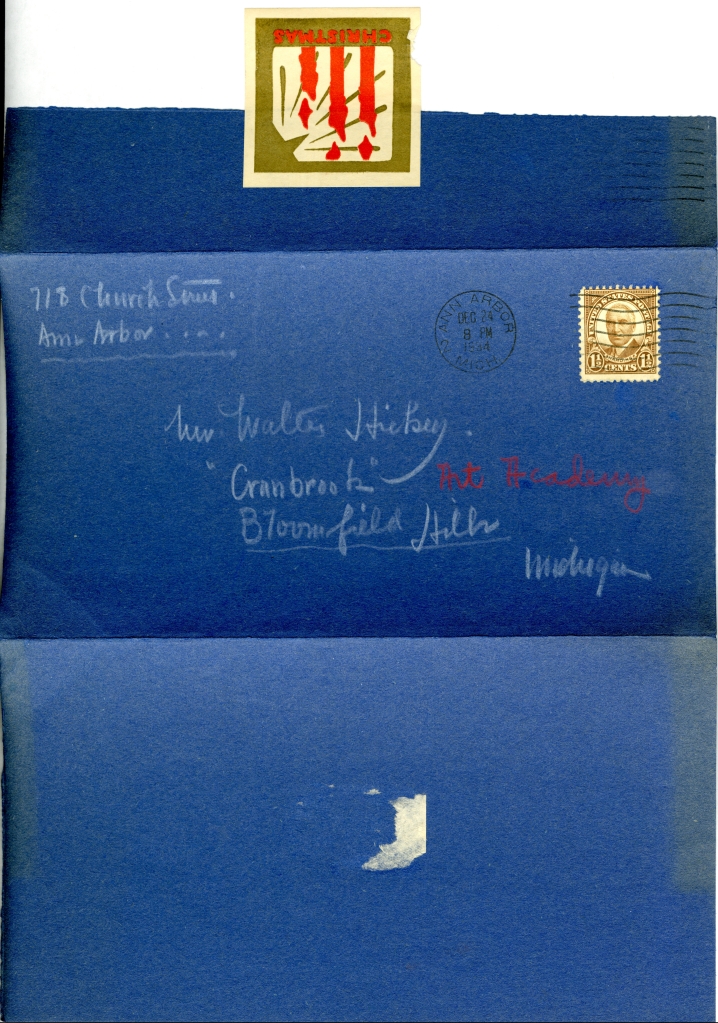
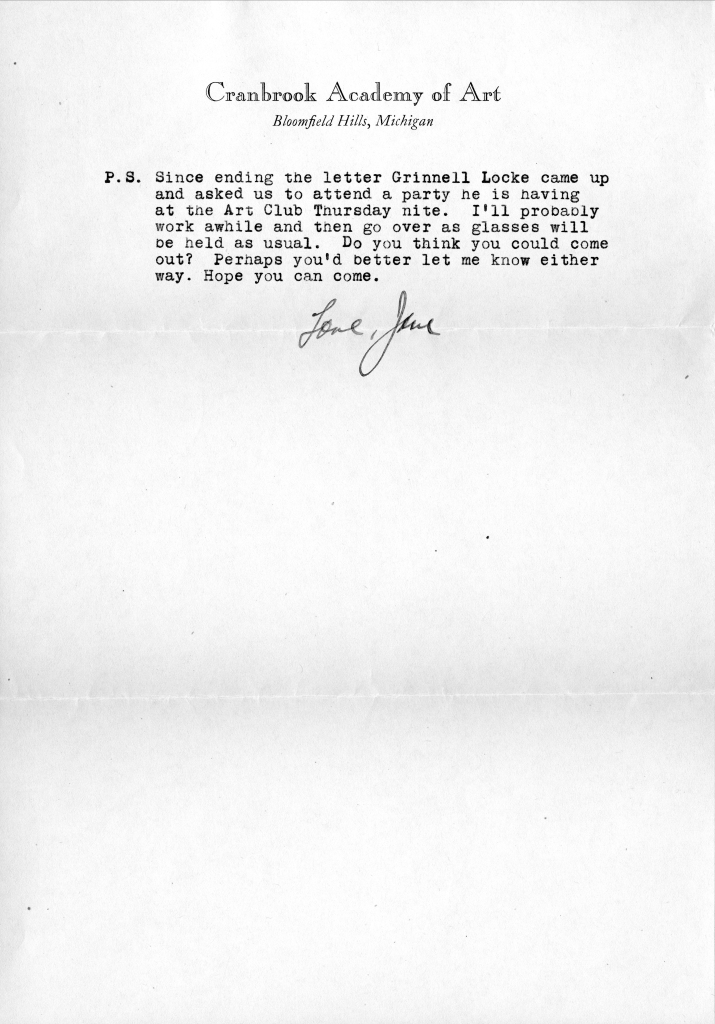
Although this is a very small collection, the diversity of content is rewarding for its ability to convey snapshots of his life in individual and unique items. It includes Christmas cards, such as one from “the Lorches” (Emil Lorch was the President of the University of Michigan Architecture School), a few letters from friends, and something of a typed love letter (on Cranbrook Academy of Art letterhead!) from Zoltan Sepeshy’s Secretary Jane Viola Shepherd to whom he was married on April 22, 1937.

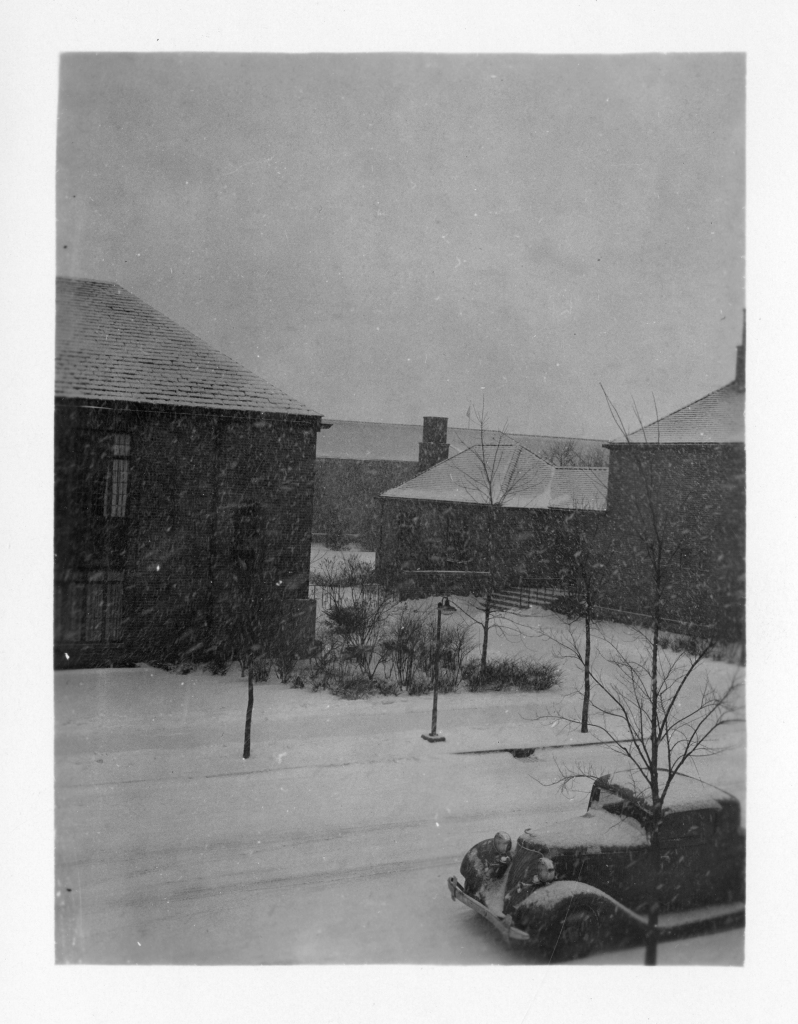
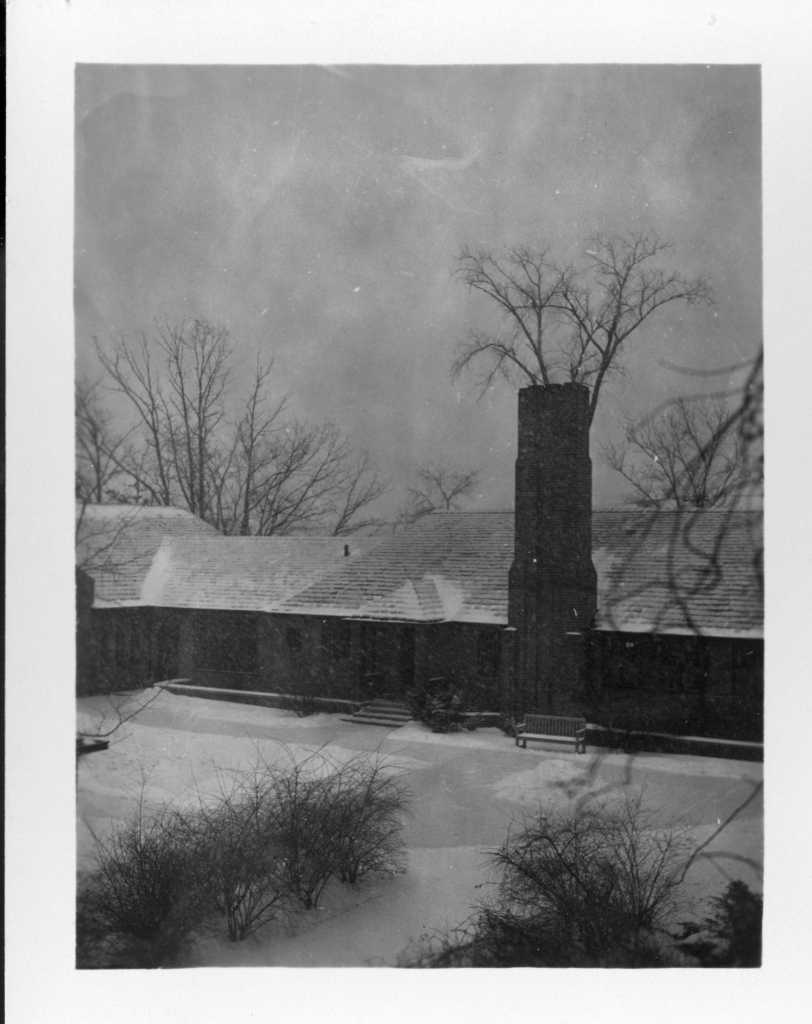
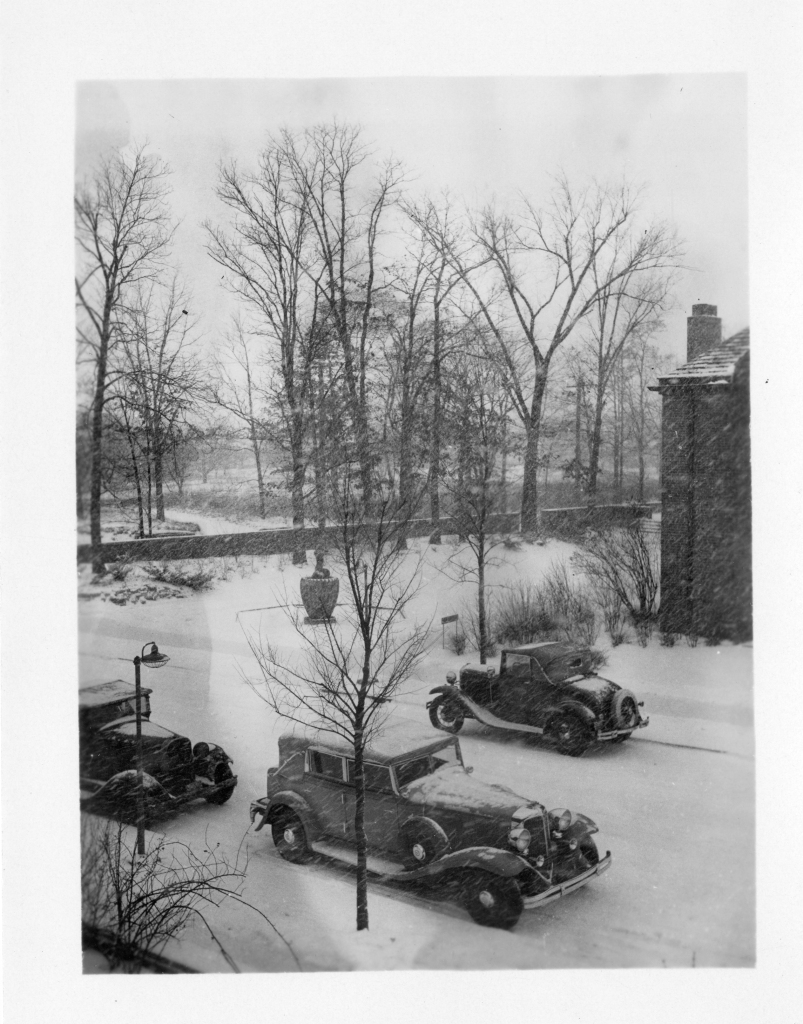
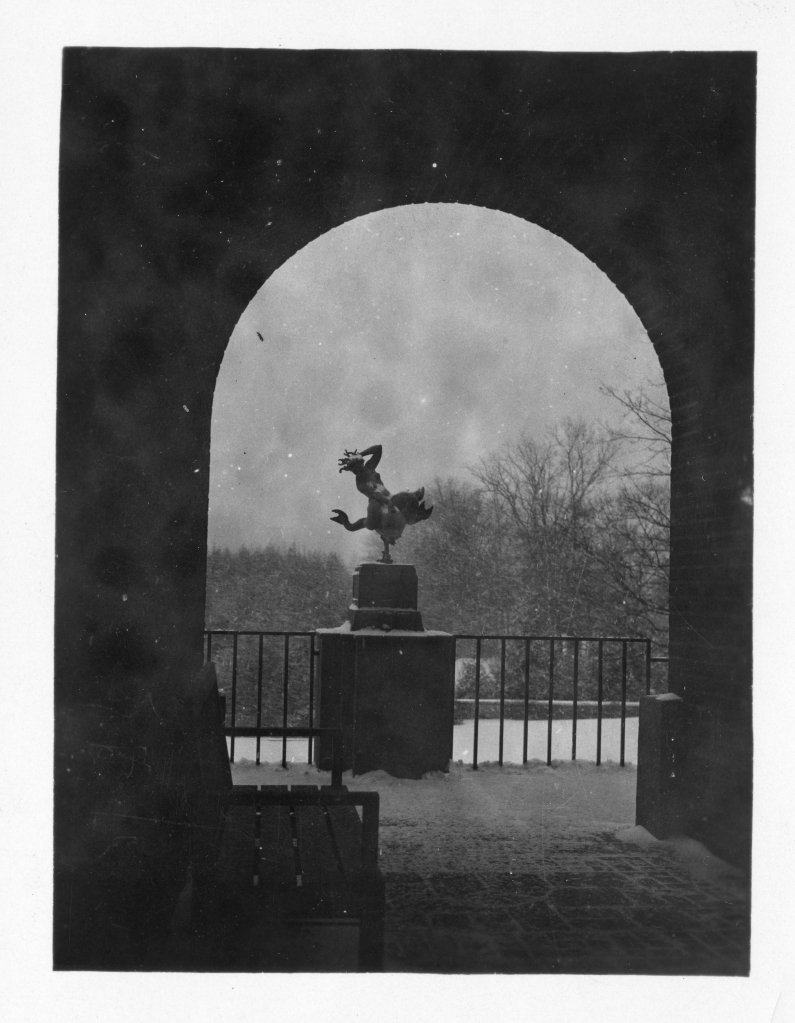
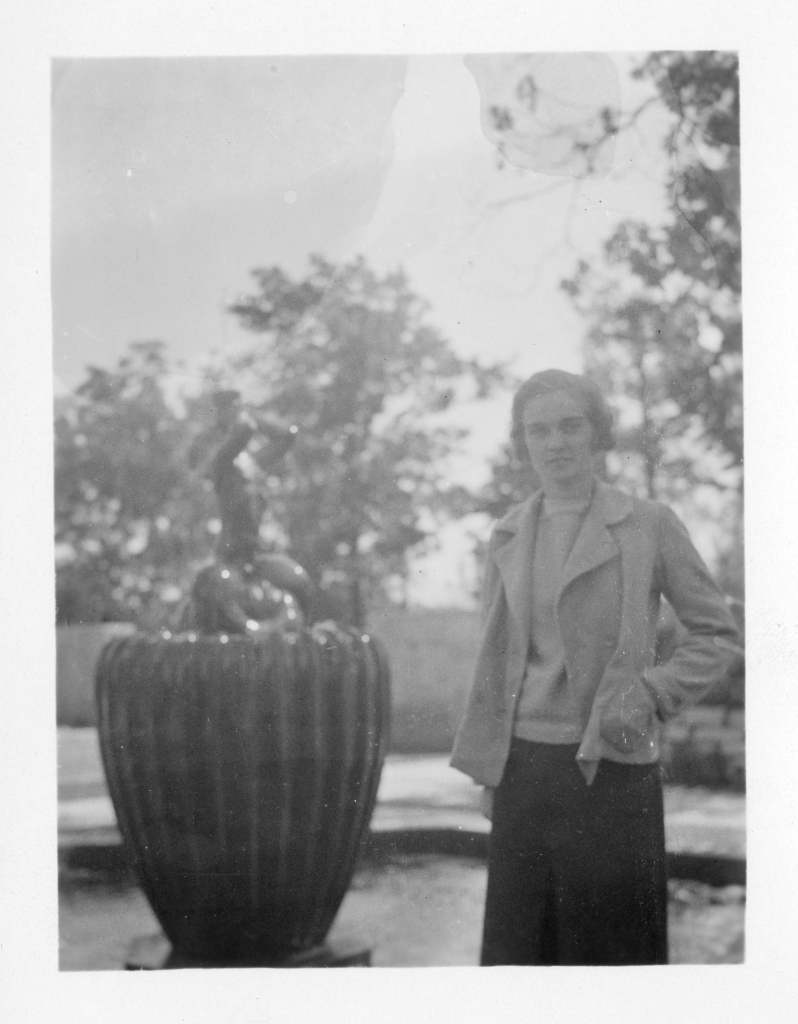
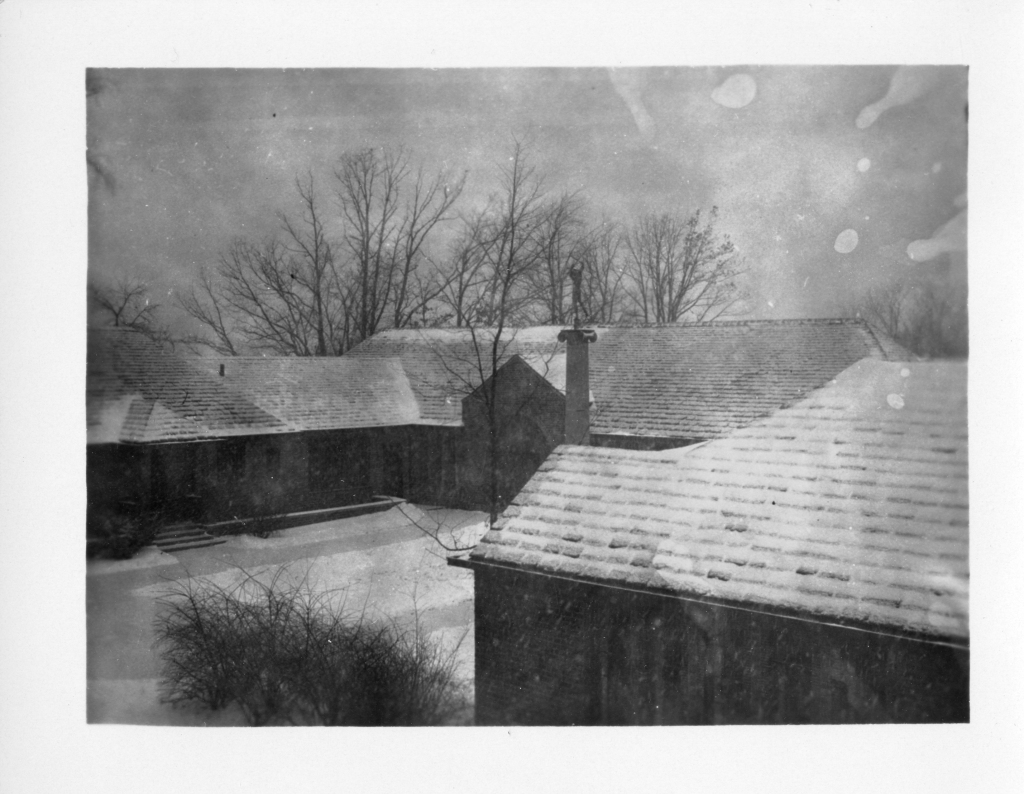
A small series of photographs hold moments of his life and some of the people with whom he shared it, including his father, eminent roentgenologist (radiography) Dr. Preston Hickey; his wife, Jane; his teacher, Eliel; and his fellow Academy students. A series of snowy scenes of Cranbrook campus beautifully capture the quietness of falling snow with hints of sunlight upon the architecture and sculptures that were then in their infancy and are now historic.

The Walter Hickey Papers give insight into a short period in Hickey’s life and the Cranbrook of his time. It also gives us a lovely look into a life that was surely shaped by his experience at Cranbrook, but one that remains yet to be fully discovered.

Laura MacNewman, Associate Archivist, Cranbrook Center for Collections and Research

Out of the Ordinary: Cranbrook and the Chair

Last week, I was happy to welcome a small group tour into the reading room to view archival materials about chairs. After the tour request appeared in my inbox, I learned a lot about chairs in a short time and found a new appreciation for this commonplace object. 

As I searched and gathered materials for the display, I began to see how imagination and inspiration can transform an ordinary thing from complete obscurity to one of curiosity and sometimes great celebrity.  

Florence Knoll in Eero Saarinen’s Grasshopper Chair in the Dallas Original Showroom, 1950. Courtesy of Cranbrook Archives

The chair has been creatively reinvented time and again according to the social context of its use, the cultural meaning imbued in it, or the inspiration from which its design sprang. Just think throne, pew, sofa, deck chair, chaise-lounge, and so on. 

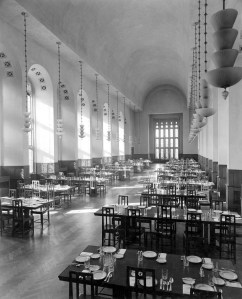
Take one of Cranbrook’s most iconic chairs – Eliel Saarinen Cranbrook School dining hall chair. Designed to withstand use by teenage boys, it combines durability with sophistication and has stood the test of time as they are still in use after 94 years. At the back of each chair is a bronze crane insert, a symbol that subtly gives identity to the community using the chair.

Cranbrook School Dining Hall, October 1936. Courtesy of Cranbrook Archives.

The 1940s and 1950s saw a flourishing of chair design from Academy of Art graduates, including Florence Schust Knoll BassettRalph Rapson (the first Cranbrook-trained designer to work for Knoll), Charles Eames, Benjamin Baldwin, Harry Weese, and Ruth Adler Schnee. The Organic Design in Home Furnishings competition at the Museum of Modern Art in 1941 generated many of these designs, including collaborative entries from Baldwin and Weese, as well as Eames and Eero Saarinen. 

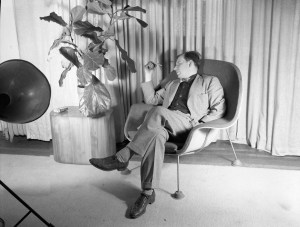
Interestingly, Eero’s later chair designs are all much inspired by nature—the Grasshopper chair, the Womb chair, and the Tulip Chair.  

Eero Saarinen sitting in the prototype of his Womb Chair at his Vaughn Road home. 18 June 1947. Photographer: Harvey Croze. Courtesy of Cranbrook Archives.

Inspired by nature in a different way, Finnish architect and furniture designer Olav Hammarstrom has a variety of designs that are born of the possibilities to which natural materials lend themselves. Hammarstrom worked with Alvar Aalto and Eero Saarinen and Associates, working on projects such as the Baker House dormitory at MIT and the furnishings at the GM Tech Center. Married to Head of the Weaving Department Marianne Strengell, he designed their house in Wellfleet on Cape Cod, as well as houses for friends and colleagues, along with chairs to go in them.

Bamboo Experimental “Basketchair” by Olav Hammarstrom. 10 February 1956. Courtesy of Cranbrook Archives.

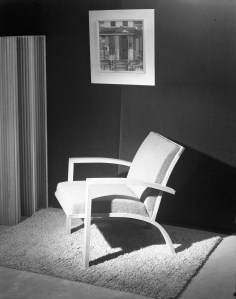
Furniture design was also the focus of another Academy affiliated designer, Pipsan Saarinen Swanson. Working in partnership with her husband, architect J. Robert F. Swanson, Pipsan typically designed the interiors while he designed the structure and exterior.

Chair designed by Pipsan Saarinen Swanson. December 8, 1945. Photographer: Harvey Croze. Courtesy of Cranbrook Archives.

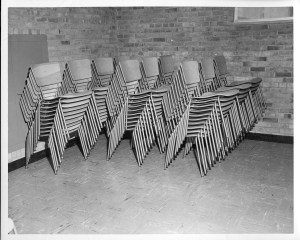
But Robert Swanson also designed furniture. Perhaps the most surprising thing I learned was that Swanson invented a ‘Stackable Chair,’ patented in 1957. A form we take for granted nowadays, these chairs can still be found in many buildings and classrooms on Cranbrook’s campus.

The “Stackable Chair” by J. Robert F. Swanson, 1957. Courtesy of Cranbrook Archives.

It was a great pleasure to share these archival stories with our guests and to explore Cranbrook’s part in the story of the chair. In the process I learned to see an everyday thing in a new light and how creativity can transform the ordinary into the extraordinary. 

Laura MacNewman, Associate Archivist, Cranbrook Center for Collections and Research

Create a website or blog at WordPress.com