Photo Friday: Feasting Together

The Center hopes you and your loved ones had a fantastic Thanksgiving, and that you were able to have a great meal together like these Cranbrook students back in 1935!

2791

Cranbrook School for Boys Dining Hall. Photographer, Dick G. Askew, June 1935.

Kevin Adkisson, Collections Fellow

Vitrolite: Better than Marble

At Saarinen House, the 1930 home of Eliel and Loja Saarinen at Cranbrook, the master bath is one of the best rooms in the house.
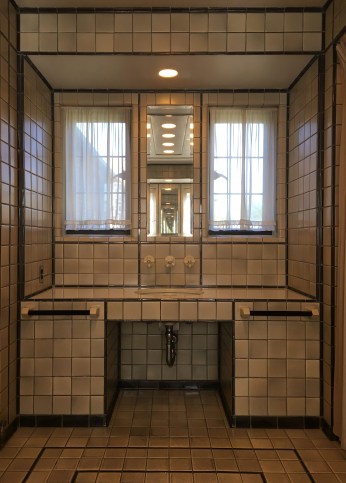
img_1580The bathroom is symmetrical, with his and hers sinks on either end of the room. The tile is off-the-shelf, not custom made for Saarinen, but deployed in an utterly unique way. In this post, I want to look specifically at the material of the countertops, Vitrolite glass.

Pigmented structural glass was developed at the start of the 20th century, and its first uses were in hospital, laboratory, and industrial food environments where its qualities of cleanliness, imperviousness, strength, and durability could be exploited. From institutional uses, structural glass took the next logical step into other places where sanitation mattered: bars, restaurants and restrooms.


vitrolitec1922

Vitrolite trade catalog, c. 1922, Courtesy of the Hagley Library Digital Archives

The first structural glass came out in 1900, Sani Onyx by the Marietta Manufacturing Company, but it was under the brand name Vitrolite that structural glass achieved its greatest success. Vitrolite was manufactured from 1908 to 1947, first by the Vitrolite Company, and after 1935, by the Libby-Owen-Ford Company (both out of Toledo, Ohio).

At first, structural glass was manufactured only in black or white, colors befitting its promotion as an alternative to marble (Pittsburgh Plate Glass’ Vitrolite rival was called Carrara Glass, after Carrara marble, and Vitrolite’s sometime slogan was “Vitrolite: Better Than Marble.”) In its 1922 promotional material “Vitrolite Sanitary Tables and Counters,” the company claims that the products “delightfully cool, bright surface is just the place to serve palatable drinks and dainties. It keeps clean— nothing stains it and it just wears and wears.”
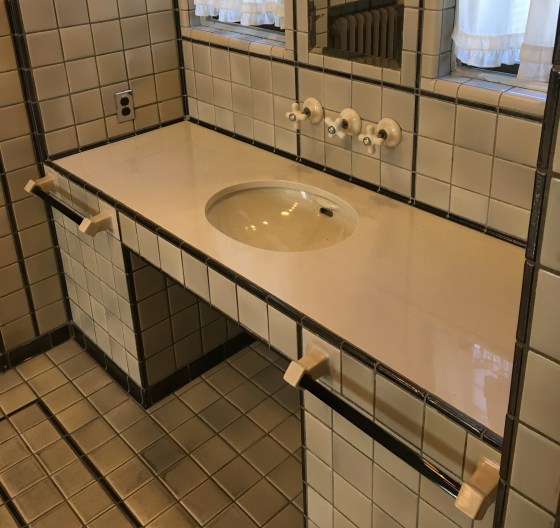
img_1585The sanitation and durability arguments likely appealed to Eliel Saarinen as he specified white Vitrolite for the master bathroom, but he was probably also drawn to its aesthetic potential: a single, seamless, and uniform surface for the countertop. It offsets the grid of the bathroom tile beautifully, providing a place to rest both your toothbrush and your eye.img_1590

caorecordsinvoice092

Correspondence concerning Saarinen House Vitrolite bathrooms, from our Archives

Installed by the plumbing contractor Robert Purcell, the sink bowls are vitreous china set beneath the Vitrolite counter. It’s likely that the oval for the sink basin was cut out of the Vitrolite by hand by Purcell’s team, and if you look at the result, it’s not a perfect oval—this isn’t your machined Corian countertop! In a house (and on a campus) where craftspeople are often celebrated, it’s neat that the bathroom counter’s utterly modern material still reflects the hand of the maker.
 

na6220_l69_tc_f_p69

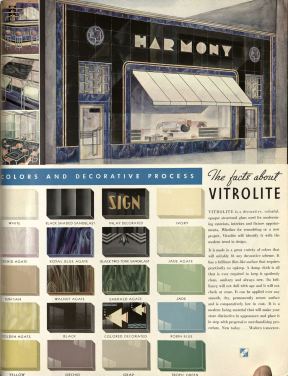
Colors of Vitrolite from 1936, published in “52 Designs to Modernize Main Street with Glass,” Libbey-Owens-Ford Glass Co., Courtesy of the Winterthur Library, Printed Book and Periodical Collection

Once Vitrolite bcame available in an array of colors and patterns, its aesthetic potential boomed. After its purchase by Libby-Owen-Ford in 1935, the glass was heavily marketed towards architects for its use in building facades, particularly for remodeling storefronts. In many design competitions and promotional literature, Vitrolite was sold as a way of “Modernizing Main Street,” a quick way to freshen up old buildings. Its these flashy, Art Deco facades that stand out in structural glass history, but it’s nice to remember its humbler, utilitarian beginnings.

 
One final note on the Saarinen House countertops: where are the faucets?! Look inside the sink, the water came out of the small bump at the top of the bowl itself. I hope they had great water pressure.
 

cleanliness-invites-vitrolite

Back cover of “Vitrolite Sanitary Tables and Counters,” c. 1922

-Kevin Adkisson, Collections Fellow, Cranbrook Center for Collections and Research


From the Outside Looking In

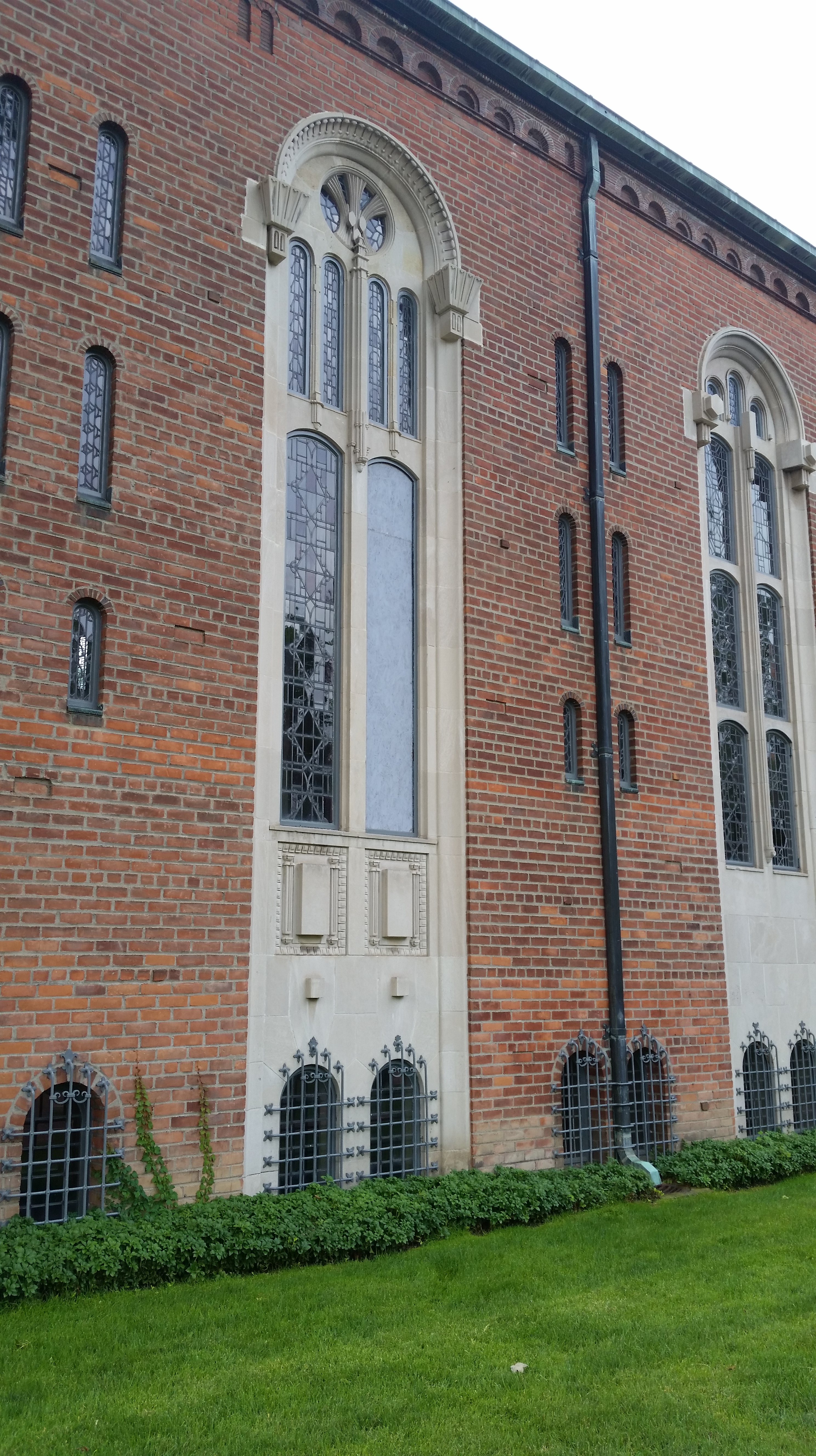
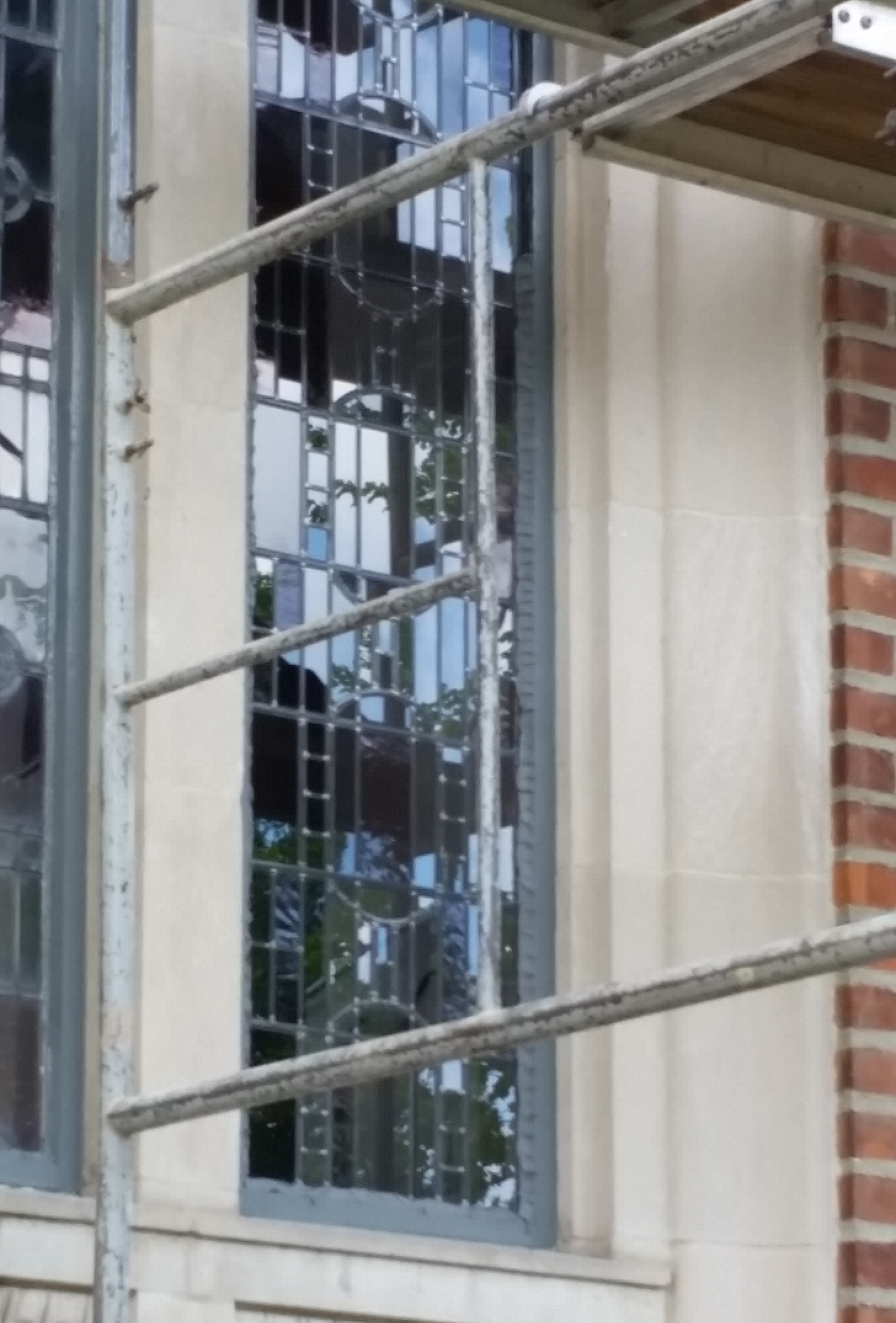
In the fall of 2015, one of the leaded glass windows in the Cranbrook Dining Hall was damaged. The window, one of many designed by Eliel Saarinen in 1927, is known as a lancet – a tall, narrow window, usually with a point at the top. The extent of the damage required that the window be removed and restored offsite by Thompson Art Glass in Brighton, Michigan. Yesterday, the window was returned and reinstalled.

The window, ready for reinstallation.

The window, ready for reinstallation.

Glaziers from Thompson Art Glass reinstalling the window.

Glaziers from Thompson Art Glass reinstalling the window.

An interior view of Charlie from Thompson Art Glass puttying the window. Photo by Giuliano N. Stefanutti, CKU '15.

An interior view of Charlie from Thompson Art Glass putting in the window. Photo by Giuliano N. Stefanutti, CKU ’15.

A putty knife and a steady hand completed the finish work.

A putty knife and a steady hand completed the finish work.

Watching Matt and Charlie from Thompson Art Glass work on the glazing made me think of all the craftspeople, artisans, and contractors who worked hard to create Cranbrook. You can find some of their stories archived on The Kitchen Sink.

Leslie Mio, Assistant Registrar

It’s a New Collection!

The Archives to Launch Our Poster Collection Online!

Over the coming summer, Cranbrook Archives will release a brand new collection into its online digital database! While building our digital archive is a perpetual process, we are working steadily to upload images and manuscripts so that you, our remote users, can browse and search through our collections no matter where you live. This summer we will be celebrating a new addition: the Cranbrook Poster Collection!

Over the past eight months, my colleague, Laura MacNewman, and I collaborated to upload this collection for online access. The posters date back to the early 1900s with topics covering the scope of the entire Cranbrook Educational Community, emphasizing exhibitions from the Academy of Art and the Institute of Science, and theatrical performances from Cranbrook Kingswood Schools, St. Dunstan’s Guild, and the Summer Theatre.

Cranbrook Institute of Science poster, n.d. Courtesy Cranbrook Archives.

Cranbrook Institute of Science poster, n.d. Courtesy Cranbrook Archives.

We created nineteen different series for the Poster Collection based on locations or departments on campus. We identified nearly 500 unique posters in our collection, and each one was given a distinct identifying number. Once the unique identifiers were established, we merged all the various poster inventories  into one master inventory spreadsheet, and arranged them in chronological order by series.

The next step was sorting through the physical posters folder by folder in order to take a reference photograph of each one for the database, record their dimensions, and describe them  in the master inventory spreadsheet. This was the longest stage of the process, lasting several weeks. After the data was entered into the spreadsheet, we renamed the individual images to match the posters’ unique identifiers in order to match the photograph.

Exhibition poster, 1973. Courtesy Cranbrook Archives.

Exhibition poster, 1973. Courtesy Cranbrook Archives.

While every step has been a learning process, my favorite part was working in Thornlea Studio and physically handling the poster collection for measurements and photographs. Laura and I were able to take a previously unorganized collection and make it discoverable online, which was rewarding and gave me a sense of accomplishment. I loved the huge diversity of the posters, too. Not only were they historically valuable, they were also aesthetically stunning. I can’t wait for the collection to be released for everyone to enjoy!

Danae Dracht, Archives Assistant

Editor’s Note: Thank you Danae and Laura for your hard work on this project! Congratulations also to Danae who recently graduated from Wayne State University’s School of Library Science! We wish you all the best as you embark on the next journey of your archival career.

New Center Logo & A Fond Farewell

The Cranbrook Center for Collections and Research has officially launched our new logo! What follows is a description of where each of the letters comes from in the history of Cranbrook or the location on the campus!
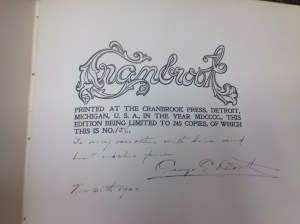
The (first) C in Cranbrook is from the logo George Gough Booth created for the Cranbrook Press in 1901, three years before he and his wife Ellen established their estate in Bloomfield Hills.

IMG_0361

The Cranbrook Press (1900-1902) was founded by George Booth in the attic of the Detroit Evening News Building.  Booth emulated the work of William Morris and his Kelmscott Press, not just in design but also in the level of hand-craftsmanship.

Continue reading

Photo Friday: “Things Architectural”

In November 1932, Cranbrook Academy of Art’s Executive Secretary, Richard Raseman, invited architects from the Detroit area to come to Cranbrook for “dinner and discussion of things Architectural.” The following Cranbrook School news article describes the evening.


Architectural

“Architects Gather Here for Forum,” The Crane, 20 Dec 1932

In addition to Raseman, Eliel Saarinen, Albert Kahn, and Emil Lorch, attendees included former Kahn associate Ernest Wilby and Ralph Hammett.

Leslie S. Edwards, Head Archivist


To Sit or Not to Sit

Chair design at Cranbrook has always had its own special niche and fascination among artists and patrons alike. George Booth altered chair designs for his own use at Cranbrook House. Eliel Saarinen designed unique chairs for Cranbrook School and Saarinen House. Ralph Rapson conceived of his chair design for what became known as the Rapson Rocker while a student here. Most of us are familiar with the famous chair designers, but what about projects by less famous designers?

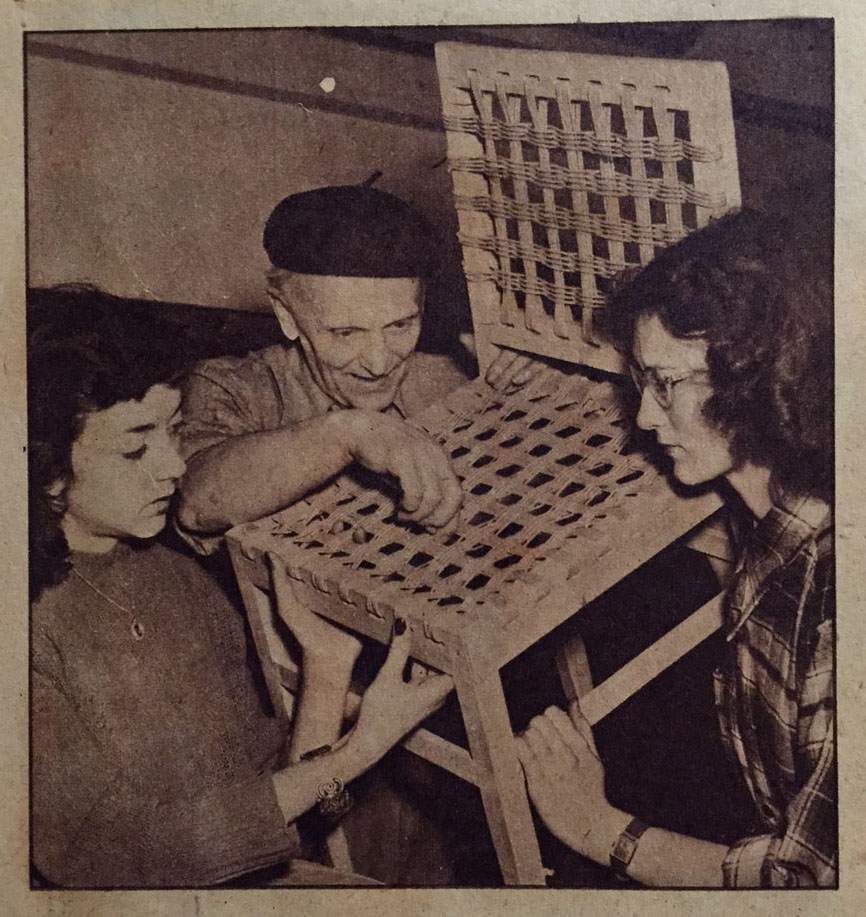
During the war years, Academy of Art students were encouraged to experiment with modern design and new and unusual materials. In 1944, Academy students Gloria Bucerzan and Jean Roberts designed and constructed a chair born of war shortages, by eliminating the use of springs and creating webbing using “non-critical” materials.

Gloria (left) and Jean with woodworking instructor Svend Steen, 1944. Copyright Cranbrook Archives.

Unknown student setting up work for Student Show, 1958. Copyright Cranbrook Archives.

Unknown student setting up work for Student Show, 1958. Copyright Cranbrook Archives.

Art Room, Early Childhood Center at Brookside School, 1997. Chairs designed by Dan Hoffman, Cranbrook Architecture Office. Photograph copyright Christina Capetillo.

Art Room, Early Childhood Center at Brookside School, 1997. Chairs designed by Dan Hoffman, Cranbrook Architecture Office. Photograph copyright Christina Capetillo.

For more on chair design in general, check out the 2012 Year of No-Chair-Design and the Guide to Great Chair Design which features links to chair blogs, the history of chair design, museums, galleries, and books that all feature what else? Chairs!

Leslie S. Edwards, Head Archivist

Hugh Ferriss: Visionary Illustrator

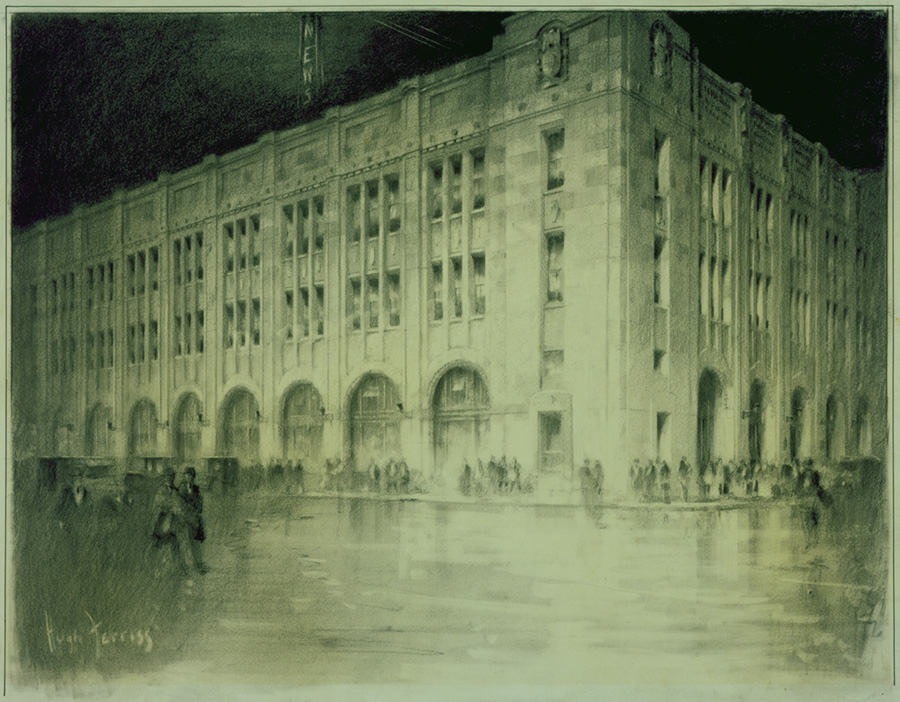
I came across Hugh Ferriss’s book The Metropolis of Tomorrow while assisting Judy Dyki, Director of the Cranbrook Academy of Art Library, in curating an exhibit of some of our rare and special collection books for the Bloomfield Township Public Library.  Ferriss (1889-1962) was a degreed architect, but he was most sought after for his architectural renderings of buildings. He developed an idiosyncratic style, often depicting buildings at night, seemingly enveloped in a kind of mist, with streetlights and the rays of the moon serving as illumination. I find Ferriss’s work intriguing because his drawings were so different from the typical architectural renderings of the 1920s to 1950s. The gothic yet futurist sensibility displayed in his work has influenced contemporary filmmakers like Tim Burton and Christopher Nolan. Ferriss has several connections to Cranbrook, the first being the drawing of the Detroit News Building that is in the collection of the Cranbrook Art Museum.

Hugh Ferriss in his studio, ca ? Photographer Stadler. Courtesy Creative Commons.

Hugh Ferriss in his studio, ca 1925. Photo by Stadler, New York. Courtesy Creative Commons.

The history of the Detroit News Building drawing is an interesting one. The J.L. Hudson Company, in honor of the company’s 46th anniversary and the opening of the new Detroit Institute of Arts building in 1927, commissioned Hugh Ferriss to create a series of architectural renderings of Detroit buildings, both extant and proposed, that contributed to Detroit’s rapidly changing skyline.  Twenty-two of these drawings where exhibited in the windows of Hudson’s downtown store in August 1927. Among these were two renderings of Eliel Saarinen’s proposed plan for a new Detroit Civic Center complex.  Also included was this drawing of the Detroit News Building. The Detroit News building, which opened in 1917, was commissioned by George Gough Booth, and designed by architect Albert Kahn.

Drawing of the Detroit News Building. Courtesy Cranbrook Art Museum (CAM1955.400)

Drawing of the Detroit News Building. Courtesy Cranbrook Art Museum. (CAM1955.400)

Booth, president of the Detroit News (and Cranbrook’s founder) purchased the drawing of the Detroit News Building directly from J.L. Hudson’s in October 1927 for the Academy of Art collections. (Accessions Book No. 1, Cranbrook Academy of Art).  To coinicide with the exhibition, J.L. Hudson Co. published a commemorative booklet entitled For a Greater Detroit, which contained Ferriss’s drawings and included editorials by various community leaders that discussed Detroit’s future. A copy of this booklet can be found in the Edsel Ford Office Papers at the Benson Ford Research Center. Ferriss’s drawing was transferred from the Academy of Art to the Art Museum in 1955, and is considered one of the museum’s “One Hundred Treasures”.

Stay tuned for a forthcoming blog post about Hugh Ferriss’s further connections to Cranbrook

Mary Beth Kreiner, Librarian, Cranbrook Academy of Art Library

Editor’s note: For additional information about the work of Hugh Ferriss, check out the Avery Architectural and Fine Arts Library at Columbia University.

Photo Friday: Academy of Art Graduation Day

Congratulations to the Cranbrook Academy of Art (CAA) students who graduate today! In honor of today’s festivities we are posting a photo of the cover of the program for the first Honors Convocation (29 May 1943). Although the Academy had been educating students for ten years, it was not until 1942 that it became independent and chartered by the State of Michigan as an institution of higher learning with power to grant degrees. The class of ’43 was the first class to receive an accredited degree. Henry Scripps Booth presented the candidates and degrees were conferred by Eliel Saarinen.

CAA Honors Convocation, 1943

Cranbrook Academy of Art Honors Convocation, 29 May 1943. Courtesy Cranbrook Archives.

Gina Tecos, Archivist

Frank Lloyd Wright & Cranbrook

With the strong lineage of Modern masters here at Cranbrook, it is no surprise that Frank Lloyd Wright has some relationship to the campus and its history. As a renowned architect, Wright had many projects all over Michigan from Kalamazoo, Okemos, Benton Harbor, Ann Arbor, Detroit, and Bloomfield Hills. Many of these homes came out of his “Usonian Architecture.”

FLW ext rear daylight-dc2

Photograph by James Haefner ©

The term Usonian means “of the United States,” and was used by Wright to emphasize his architecture as uniquely American, specifically the American Midwest.  The Usonian style was Wright’s solution to the rise of suburbia where people moved outside of cities. This was his solution to what he deemed “the small house problem,” a direct response to post war needs and the growing necessity of affordable and comfortable homes.

FLW ext front dusk-dc2

Photograph by James Haefner ©

Partnering with The Towbes Foundation, Cranbrook Center for Collections and Research will be providing tours of one of Wright’s Usonian homes in Bloomfield Hills, the Melvin Maxwell and Sara Stein Smith House. Known as “My Haven” by the owners, Wright called the house, “my little gem.” Designed in 1946 and completed in 1950 the home is a great example in Wright’s oeuvre of a Usonian home.
Another of Wrights’ Usonian homes within Bloomfield Hills can also be connected to Cranbrook.   Commissioned by Gregor S. Affleck, a chemical engineer who invented an automotive fast-drying paint, the Affleck House was completed in 1941. Affleck’s son, Gregor Porter Affleck, attended Cranbrook Academy of Art and studied Architecture with Eliel Saarinen from 1944-1945. In 1978, the Affleck children donated the house to Lawrence Technological University.

FLW073

Courtesy Cranbrook Archives, Cranbrook Foundation Records.

Saarinen and Wright were colleagues who supported each other in the field of Architecture, at least as much as two established architects with considerable egos could get along. Wright visited Cranbrook at least three times, for lectures in 1935, 1936 and 1937. All were sold out to standing room only.

The Melvin Maxwell and Sara Stein Smith House will be open for tours May – October on one Friday and one Sunday of each month. For more information on the tours, please visit our website.

Stefanie Dlugosz-Acton,  Collections Fellow, Center for Collections and Research

Create a website or blog at WordPress.com