History Detective: Light Fixture Edition

Did you ever watch the show History Detectives on PBS? I loved the show; it is all about uncovering the story of an object.

As Associate Registrar for the Center, I am working with our Director Gregory Wittkopp and our Associate Curator Kevin Adkisson on an ambitious project. We are reviewing all fourteen of our cultural properties collections (over 9,000 objects), reviewing the data already on file and adding as much additional information about each object as we can. How do we do this, when the people who created, collected, or purchased the objects are no longer here? It requires being something of a history detective!

The collection we are currently working on is the Cultural Properties Collection at Thornlea. Thornlea was the home of George and Ellen Booth’s youngest son, Henry Scripps Booth, and his wife, Carolyn Farr Booth, from 1926 to 1988. It is filled with antiques, artwork, furnishings, and personal objects. In Cranbrook Archives, there are multiple helpful records about the home’s collections: insurance inventories, an index card file of objects created and maintained by Henry, and receipts for items purchased.

Light fixture over front door at Thornlea.

The one object I wanted to feature today is the unique light fixture over the front door to Thornlea. This custom and distinctive iron and glass fixture is important to the architectural character of the house, but I knew next to nothing about it. It appeared in early images of the house, so I knew it had been a part of the house from the earliest years, perhaps since the house was built.

Henry Scripps Booth peaks out the front door of Thornlea, circa 1935. Courtesy Cranbrook Archives.

To learn more about the fixture, I first looked at the insurance inventories and Henry’s index card file. Nothing there.

Next, I looked at the receipts under “Electrical” in the Henry Scripps and Carolyn Farr Booth Papers in Archives. Eureka!

Continue reading

Twelfth Night, Sixty Years Ago

With the holidays upon us and the observance of annual traditions in high gear it seems fitting to look back at one of Cranbrook’s most storied and festive occasions. Starting in 1950, every year at the beginning of December preparations would begin for the annual Twelfth Night Gala at Cranbrook House. Held on January 6th, the event was originally conceived as a small costume party in the 1920s by Cranbrook Founders’ son, Henry Scripps Booth. It eventually became an official Cranbrook gathering, with Henry at the helm.

The aim of Twelfth Night, as Henry stated, was “to recognize the contribution each employee and board member makes to Cranbrook by bringing them all together as participants in an enjoyable, annual, and ‘classless’ social event.” It was, in essence, a staff holiday party, but its magnificence was a far cry from the typical.

Joseph R. Scott Jr. practicing “piper’s piping” in Cranbrook House basement for the 1966 performance. Harvey Croze, photographer. Courtesy of Cranbrook Archives.

Not sure exactly what Twelfth Night signifies?  Perhaps you know the classic carol Twelve Days of Christmas: “On the first day of Christmas, my true love gave to me ….” A medieval English observance, Twelfth Night, as defined by the Oxford English Dictionary, denotes “the twelfth and last day of Christmas festivities”—twelve days after Christmas, or January 6th. The Shakespeare play of the same name is thought to have been created as entertainment for a Twelfth Night celebration.

Inspired by his English heritage and impressed with a performance of the play at the Detroit Opera House when he was twelve years old, Henry Booth created a sixty-year tradition for Cranbrook staff, faculty, and supporters that revived the holiday’s twin themes of celebratory food and pageantry.

In Cranbrook Archives, the Twelfth Night Records meticulously document the planning and execution of the gala as it took place at Cranbrook House, through programs, scripts, invitations, guest lists, receipts, budgets, meeting minutes, photographs and more. These items bring the party alive–and what a party it was!  

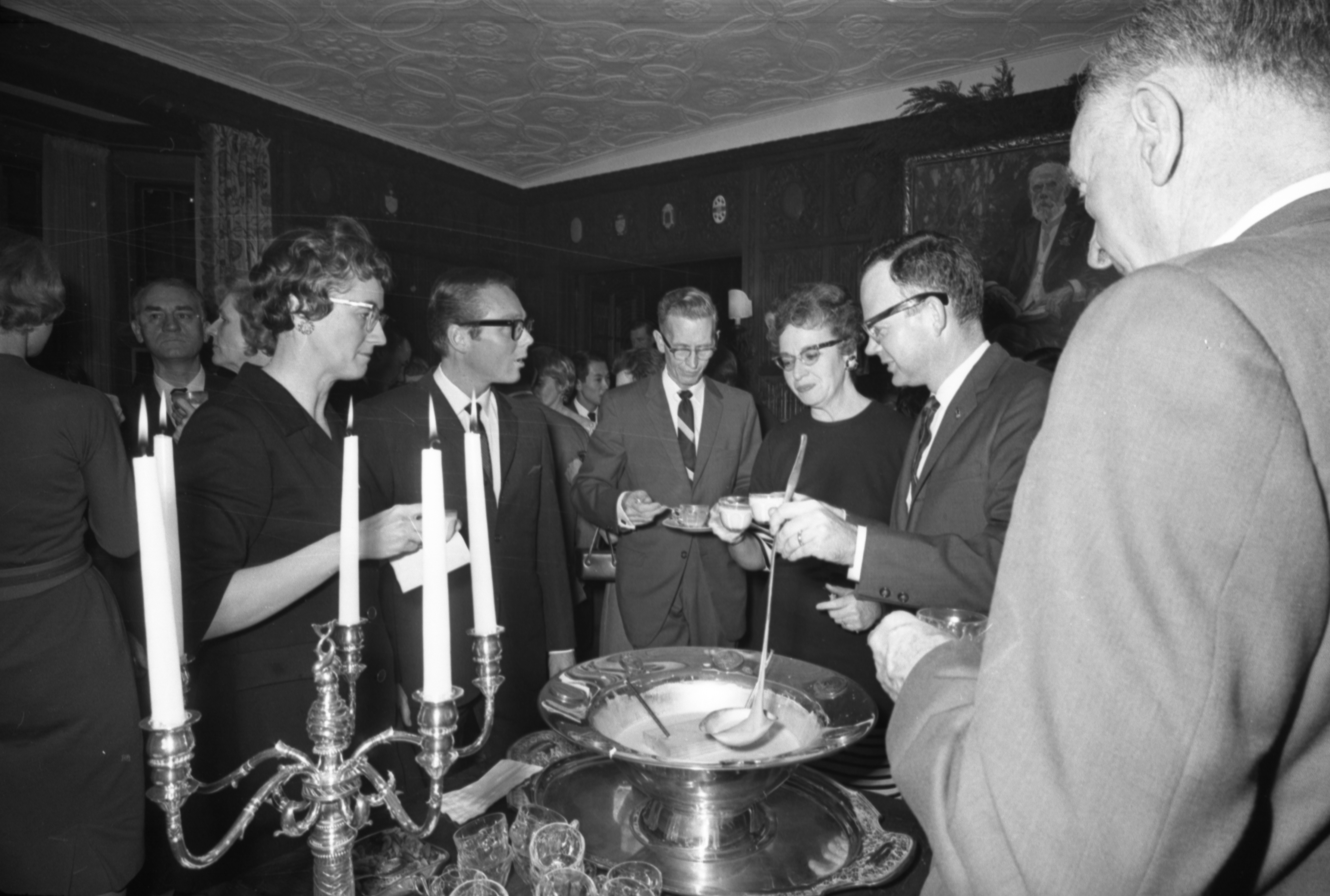
Eggnog in the Oak Room, 1967: (left to right) Helen Hays, Warren Hays, Chet Hard, Anita Hard, and Don Hays. Harvey Croze, photographer. Courtesy of Cranbrook Archives.

Choosing the decade of the 1960s to epitomize the revelry of the long-standing event, I give you the opening lines from the 1960 program, spoken by Cranbrook School Headmaster Harry Hoey:

We’ve all found a welcome in this mellow house
Including, we trust, some young shivering mouse
The wassail is heady
The fellowship’s steady
The mummers are ready
So gay may this gala be in Cranbrook House
On with the tom foolery!

Continue reading

Thornlea’s “Guardian Angel”

I would like to introduce you to the “guardian angel” of Thornlea, the home of Henry Scripps Booth and Carolyn Farr Booth. She is a flying winged spirit guardian, sometimes called a cradle guardian or spiritchaser, made in Bali, Indonesia.

Spirit guardian in the entrance hall of Thornlea House.

Spirit guardians have been used in Balinese temples and homes to ward off evil spirits for centuries. Typically, they are hung in a high location, looking down towards a door or window. 

Thornlea’s “Guardian Angel” flies high above visitors to the home, 2019. Photo by PD Rearick, CAA ‘10

Thornlea’s guardian hangs high above the entrance hall to the house, gazing down on all who enter. The guardian is in the form of Dewi Sri, who, in Balinese mythology, is the goddess of rice, fertility, a successful harvest, and family prosperity and harmony.  

Archival records point to Henry Scripps Booth purchasing the guardian in San Francisco, not in Bali, between 1978 and 1988 (Ed. note: per HSB’s grandson Charlie’s recollections in the comments below, the guardian was bought about 1984). 

In June 2020, our Associate Curator Kevin Adkisson took visitors on a virtual tour of Thornlea House. Here is a clip featuring Dewi Sri:

Cranbrook Center for Collections and Research’s Facebook Live at Five: Tour Thornlea House, June 17, 2020,

The next time you visit Thornlea, make sure to look up and say “om swastiastu” to Dewi Sri and ask her for prosperity and harmony for your family!

Leslie S. Mio, Associate Registrar, Cranbrook Center for Collections and Research

Sketching to Jazz and Judo: the Young People’s Art Center

Did you know that Cranbrook Art Museum’s educational partnerships with surrounding communities date back over sixty years? Long before the current museum trend of interactive educational programs for youth audiences, the Academy of Art and the Junior League of Birmingham had an idea:  the Young People’s Art Center (YPAC).

Young People’s Art Center logo, from the 1962 enrollment form. Courtesy of Cranbrook Archives.

The year was 1958, and the Museum had recently changed names to the Academy of Art Galleries, shifting focus to feature more contemporary art practices. With that, came the desire to encourage young visitors to express their own artistic voices—participatory education, rather than simply art appreciation. Documenting the program’s first year, a June 1959 Detroit News Pictorial Magazine feature noted that YPAC “is fast gaining a national reputation for its lively approach to art education.”

In particular, it was Henry Booth (Academy Board of Trustees Chairman), Wallace Mitchell (Head of Galleries), and Zoltan Sepeshy (Academy Director) that approached the Junior League with a plan. In a 1957 report by Mitchell during the Center’s development phase, he states, “ The personnel of the Cranbrook Academy of Art has become increasingly aware of the growing country-wide interest in the visual arts and has long wished to more directly participate in the fostering and guiding of this interest as expressed in our community.” Seeking support from the Junior League, this “unique opportunity to bring to the children of Oakland County an integrated program in art education which concerns itself with the totality of the art experience” was green-lighted for the following year.

Children watch a judo demonstrator as part of a class exercise. Erik Strylander, photographer. From the article “Sketching to Jazz and Judo,” Detroit News Pictorial Magazine, June 28, 1959.

A perfect partnership was formed. The Academy would provide leadership, through the support of its trustees, director, and faculty; the Junior League would provide the necessary finances. Naturally, with so many talented artists on campus, there was no lack of creativity or helping hands! Junior League members were also heavily involved, providing volunteer docents to conduct gallery tours and assist with classes, both of which were located on the ground level of the Museum below the Academy Library.

Continue reading

Playing our Part

As performance venues prepare to reopen in Michigan today, I thought it timely to take a look at the storied history of a group that’s nearly as old as Cranbrook itself: St. Dunstan’s Theatre Guild of Cranbrook. With ties to Cranbrook’s founding family, staff, and the physical Cranbrook campus, combined with its enduring cultural role in the surrounding community, this nearly ninety-year-old institution has a rich history. Allow me to share with you a few fascinating details from its early years.

View of St. Dunstan’s Playhouse from Lone Pine Road looking east. Balthazar Korab, photographer. Copyright Korab and Cranbrook Archives.

“The worst thing about it, it’s named for a saint. But don’t think it’s holy, ‘cause it certainly ain’t.”

Sheldon Noble, an early and active Guild member

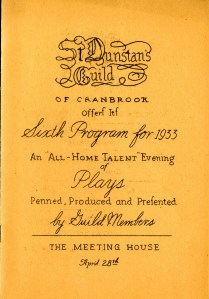
The Theatre Guild was indeed named after St. Dunstan, Archbishop of Canterbury in the ninth century and patron saint of the arts. As St. Dunstan lived in Kent, England, from where Cranbrook founder George Booth’s family hailed, the Guild’s name was fittingly suggested by his son and founding member, Henry Scripps Booth. Shortly after the Guild began in 1932, members were writing and producing their own one-act plays. In an April 1933 letter announcing an informal evening  of a “Home Talent programme,” for the 100 Guild members and their guests, Jessie Winter, Guild Secretary and Brookside School Headmistress, implores them to “Be kind, be understanding, be generous . . . give the actors and authors the warm reception which such offerings warrant.” One such author was Henry Scripps Booth. Billed as Thistle, his play, Sedative Bed, was one of four being performed that April 28th evening at Brookside School for just $1. It was the tail end of the Great Depression, after all!

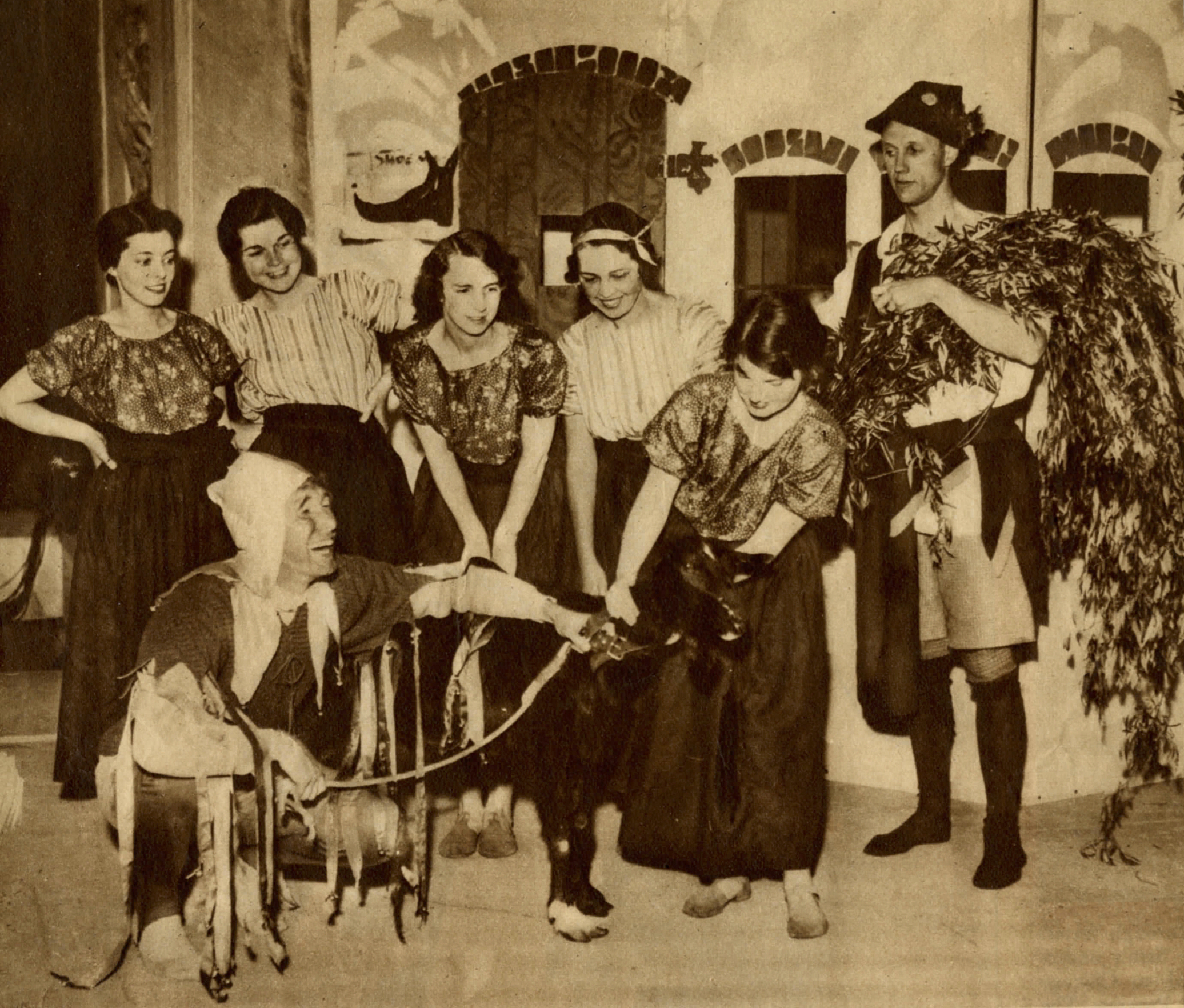
The first public performance of St. Dunstan’s Theatre Guild took place at the Greek Theatre with The King and the Commoner. Taking supporting roles were the likes of Annetta Wonnberger (Cranbrook Summer Theater School), Pipsan Saarinen Swanson (daughter of Cranbrook architect Eliel Saarinen), and Henry Scripps Booth, among others.

A scene from The King and the Commoner. Henry Booth on right. Detroit newspaper rotogravure clipping. Courtesy of Cranbrook Archives, Cranbrook Center for Collections and Research.

The cast and crew of the 1940 production of The Last of Mrs. Cheyney again reads like a who’s who of Cranbrook, including Harry Hoey (Cranbrook School Headmaster), Templin Licklider (Cranbrook School Faculty), Dorothy Sepeshy (wife of Cranbrook Academy of Art President, Zoltan Sepeshy), Rachel Raseman (wife of Richard Raseman, Cranbrook Academy of Art Executive Secretary and Vice President), the aforementioned Annetta Wonnberger, and various members of the Booth Family. Henry Scripps Booth, part of the Guild’s Scenic Design Committee, and his wife Carolyn, the production’s stage manager, created the sets.

Continue reading

The Monreale Fountain in the Quadrangle

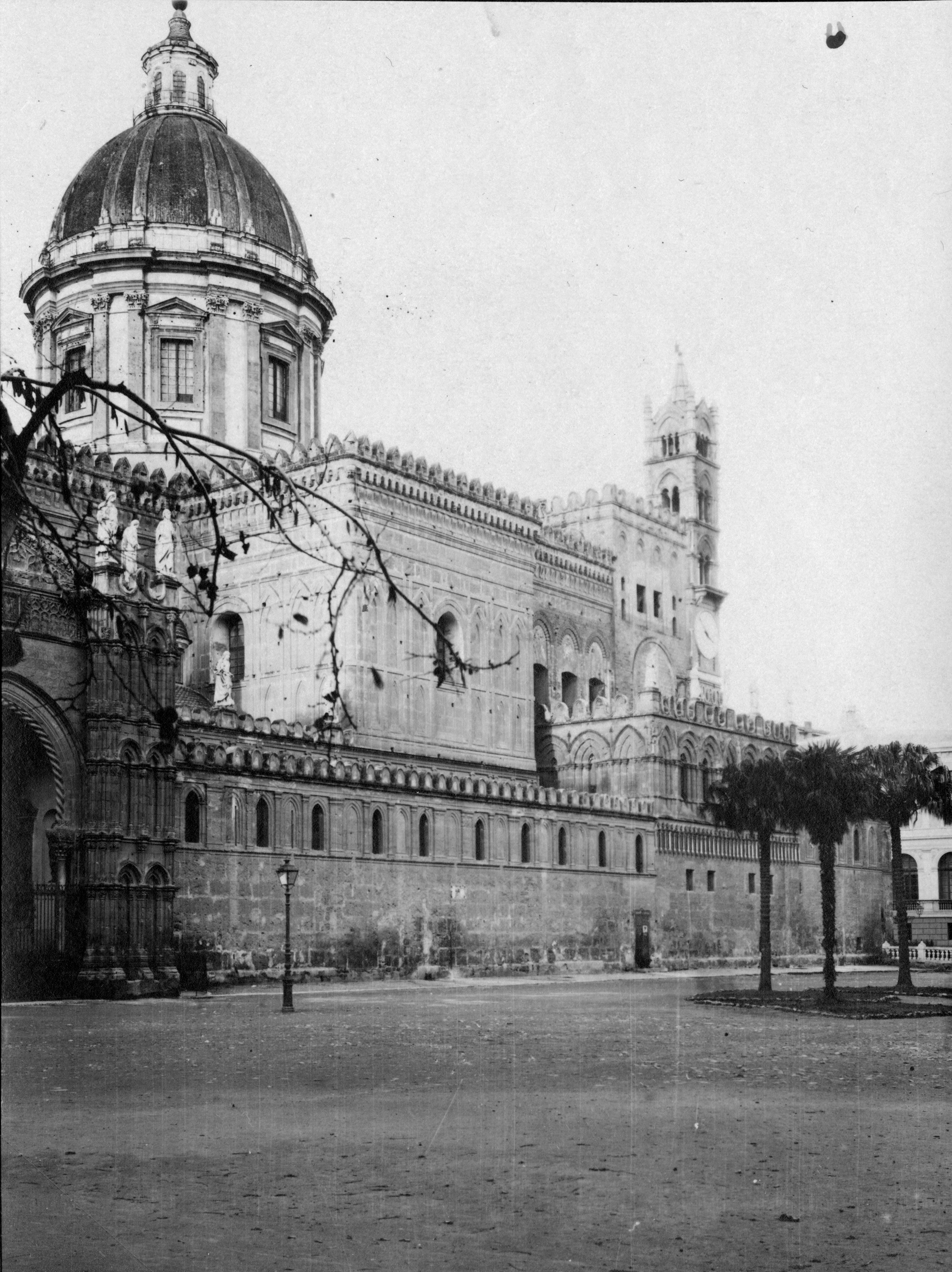
In the center of the Quadrangle at Cranbrook School is a replica of a fountain which stands in the southwestern corner of the cloister of Duomo Monreale in Palermo, Sicily. Completed in 1182, the cathedral unites Arabic, Byzantine, and Norman architectural and cultural influences and is famed for its mosaics.

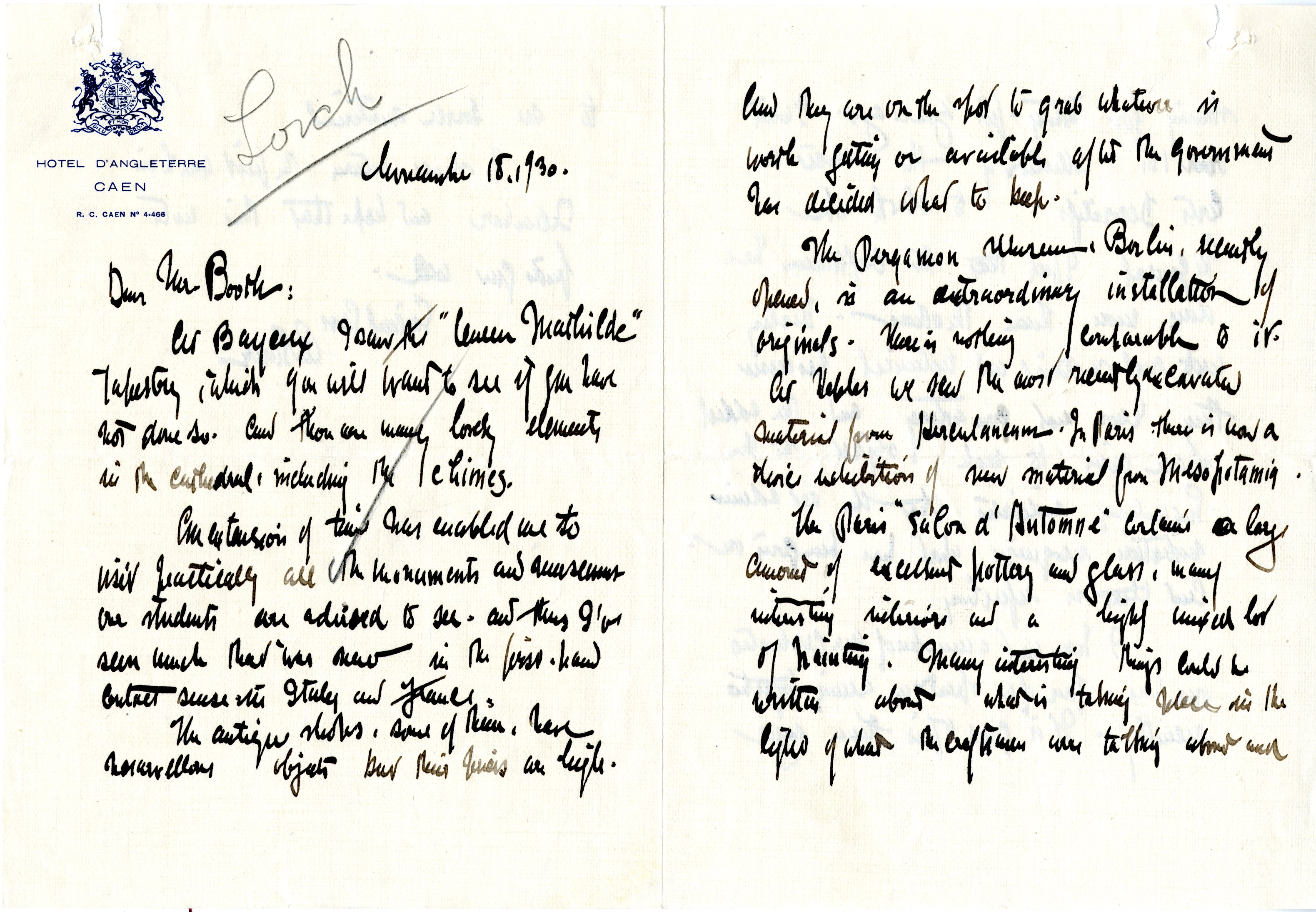
The inspiration for the fountain’s long-treasured presence on the Cranbrook campus dates back to 1922, when Henry Scripps Booth first saw the original in the cathedral cloister. This was a site that Henry seems to have particularly wanted to see while on a ten-month architectural study tour of Scandinavia, Germany, Switzerland, Italy, Great Britain, and France, with his friend, J. Robert F. Swanson.

View of the Duomo Monreale, December 1922. Henry Scripps Booth, photographer. Cranbrook Archives.

Writing to his father, Cranbrook founder George G. Booth, on December 26, 1922, he describes the cathedral thus:

“Mosaic everywhere — luminous gold, and dull colors — with intricate geometric patterns in abundance and fine but rather arcaic [sic] representations of Biblical stories roofed over with a richly decorated trussed ceiling. The cloister in the cathedral’s shade is that delightful one with such delicate columns in pairs, decorated by mosaics, that is illustrated so frequently.”

View of the Duomo Monreale, December 1922. Henry Scripps Booth, photographer. Cranbrook Archives.

Henry laments that there isn’t time enough to study the monuments as closely as he would like, to measure them and draw them up, for if they did, they would end up knowing only one thing well but miss out on so many others. His letter includes this sketch of the fountain:

Letter from Henry Scripps Booth to George Gough Booth, December 24-26, 1922. Cranbrook Archives.

Several years later, George is in Naples, Italy, at one of his favored workshops, the Chiurazzi Foundry. On March 2, 1927, George wrote to Henry to tell him of numerous purchases he made at the foundry, all to be gifts to the new Cranbrook School for Boys. While the specific uses of the items might be determined later, as was characteristic of George he had a tentative plan for all of them. The most important was the replica of the Monreale fountain. Here, we can see George’s sketch of the replica fountain, showing its dimensions:

Continue reading

Collection in Focus: Ellen Warren Scripps Booth Papers

One of the things I love about my work is that I never know what I will discover next. I go in search of one thing and find much more and, sometimes, the unexpected. This happened recently when I ventured into the Ellen Warren Scripps Booth Papers.

Ellen’s papers primarily record her personal life from the 1870s through 1948, with a preponderance on the years 1880-1910. They include drawings, maps, an autograph book from her school days, leaflets from the Epiphany Reformed Church and its reconstitution as Trinity Episcopal Church, letters from her mother, Harriet J. Scripps (letters written 1901-1927), and photographs.

Drawing by Ellen Warren Scripps, age 10, 1873. Cranbrook Archives.

But, the bulk of the collection are her diaries which cover 1880-1944, though the coverage is spotty after 1910. The research value of a diary is variable, depending much upon the focus and meticulousness of the author, and its intersection with the researcher’s interest.  The dates in Ellen’s diaries are unquestionably reliable, as other documents in the archives verify their accuracy. Frequently recorded topics include the weather, who preached at church/other churches attended, what she was reading, her music and singing lessons, unwell family members, and who came for tea or dinner.

Her diaries not only tell her story, but also describe the life of the Scripps family and the appearance of the Booth family, particularly Alice and George, in the early 1880s. We can also see glimpses of Detroit history, such as Governor Pingree’s funeral in July 1901, and her visit to Barnum Wire Works with George in January 1887. On February 15, 1882, Ellen writes:

“Walked to and from school today. Went to social at Mr. Woolfenden’s with Theodore. Had a splendid time. Theodore asked me to go to hear Oscar Wilde Friday evening but I concluded not to go. I began reading Old Curiosity Shop this afternoon.”

Oscar Wilde! She notes in her Friday entry, that Theodore went to hear Wilde with Mr. Woolfenden instead. There are many mentions of “Mr. Woolfenden,” who otherwise has only been found mentioned in George Booth’s Memories (pp.53-55).

Ellen Warren Scripps’ Diary, 1886. Cranbrook Archives.

Frederick W. Woolfenden is one of two people that Henry Wood Booth met during his first visit to Detroit in 1880, the other being James E. Scripps. This story is quite widely known and the information about it, published in Arthur Pound’s book about George Booth, The Only Thing Worth Finding (pp.63-68), comes from George’s writings. Woolfenden had taken interest in Henry Wood Booth’s Ka-o-ka idea, and, after visiting him in St. Thomas, Ontario, convinced him to move to Detroit in 1881. Woolfenden was Assistant Postmaster of Detroit and a co-founder of the Dime Savings Bank, but he was also a Pastor at the Epiphany Church where Henry Wood Booth had first met him.

Ellen’s diaries record his deep involvement with the family as a friend and pastor who conducted the christenings, confirmations, funerals, and weddings of both families. It was Woolfenden who married George and Ellen in 1887.

Ellen’s diaries provide a complete record of her life until 1910 and so the earliest memories of Cranbrook are recorded. The story that we know and love so well, of George and Ellen purchasing the old farm from Samuel Alexander is captured in her hand and it was lovely to read as she describes, albeit briefly, the snow drifts as they visit the farm:

Ellen Warren Scripps Booth’s Diary, 1904. Cranbrook Archives.

A few days later, on January 18, 1904, she writes, “Went down town to sign the mortgage for the farm. It is ours now, and we are all so glad.” All these years later, I am so glad too.

Laura MacNewman, Associate Archivist, Cranbrook Center for Collections and Research

Photo Friday: Happy Fourth of July!

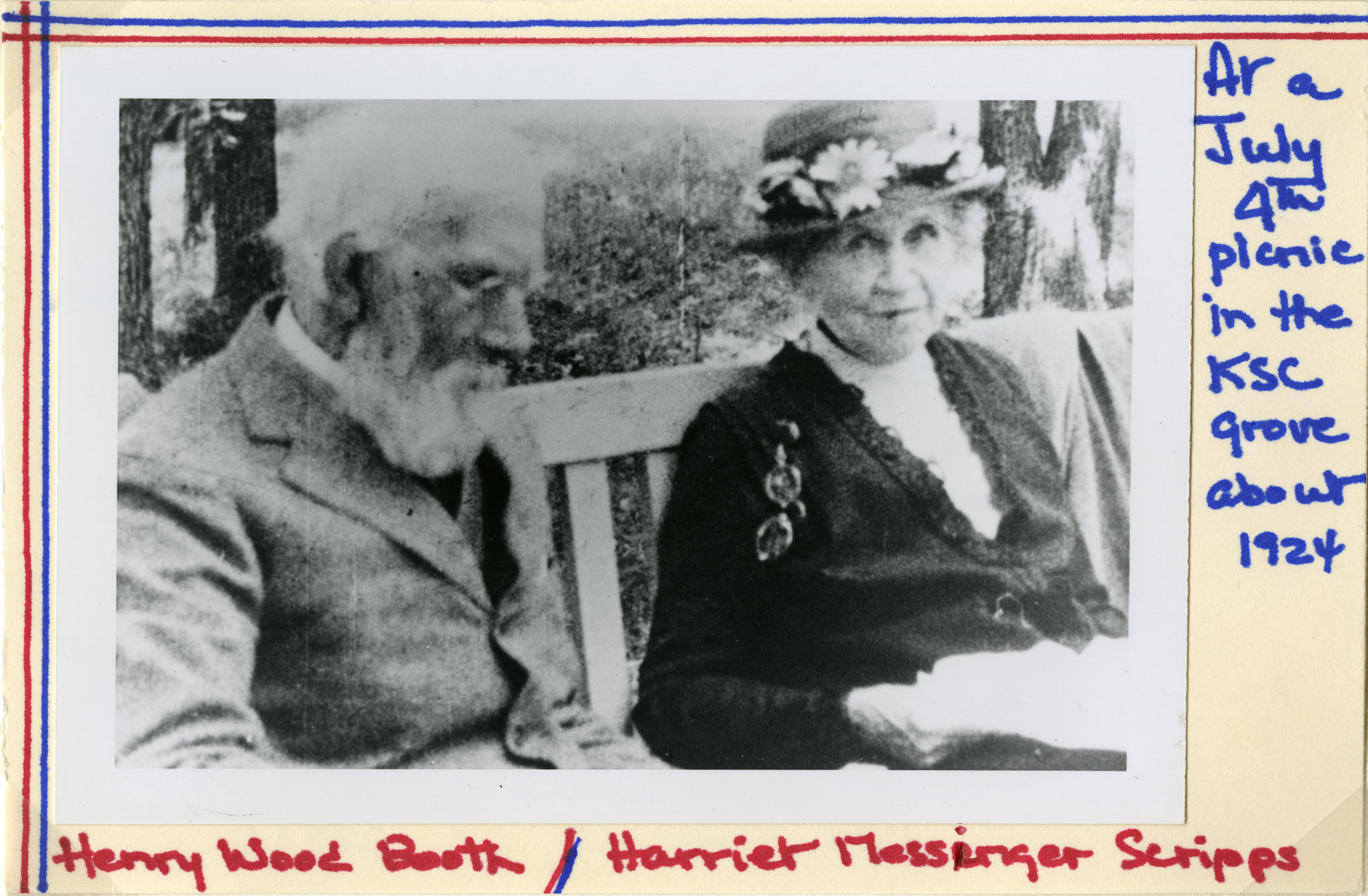
Henry Wood Booth and Harriet Messinger Scripps at a Fourth of July picnic on Kingswood School Grove, 1924. Cranbrook Archives.

In the earliest days of Cranbrook, Fourth of July picnics were held in the shade of a big oak tree on the site of the present Japanese Garden near Kingswood School. In his history, Henry Wood Booth reports that in 1910, George decided a well was needed so that drinking water would not need to be carried down from the house. After much digging, there was no water, and the new well remained dry. The family would need to come back to the project another day.

Later the same evening, Cranbrook Road was flooded with mud and water. The well, having burst through the last layer of mud, was shooting eight feet into the air! A fountain was placed there a few months later and it flowed for fifty or more years until the screen was clogged. In 1963, a new well was drilled nearby.

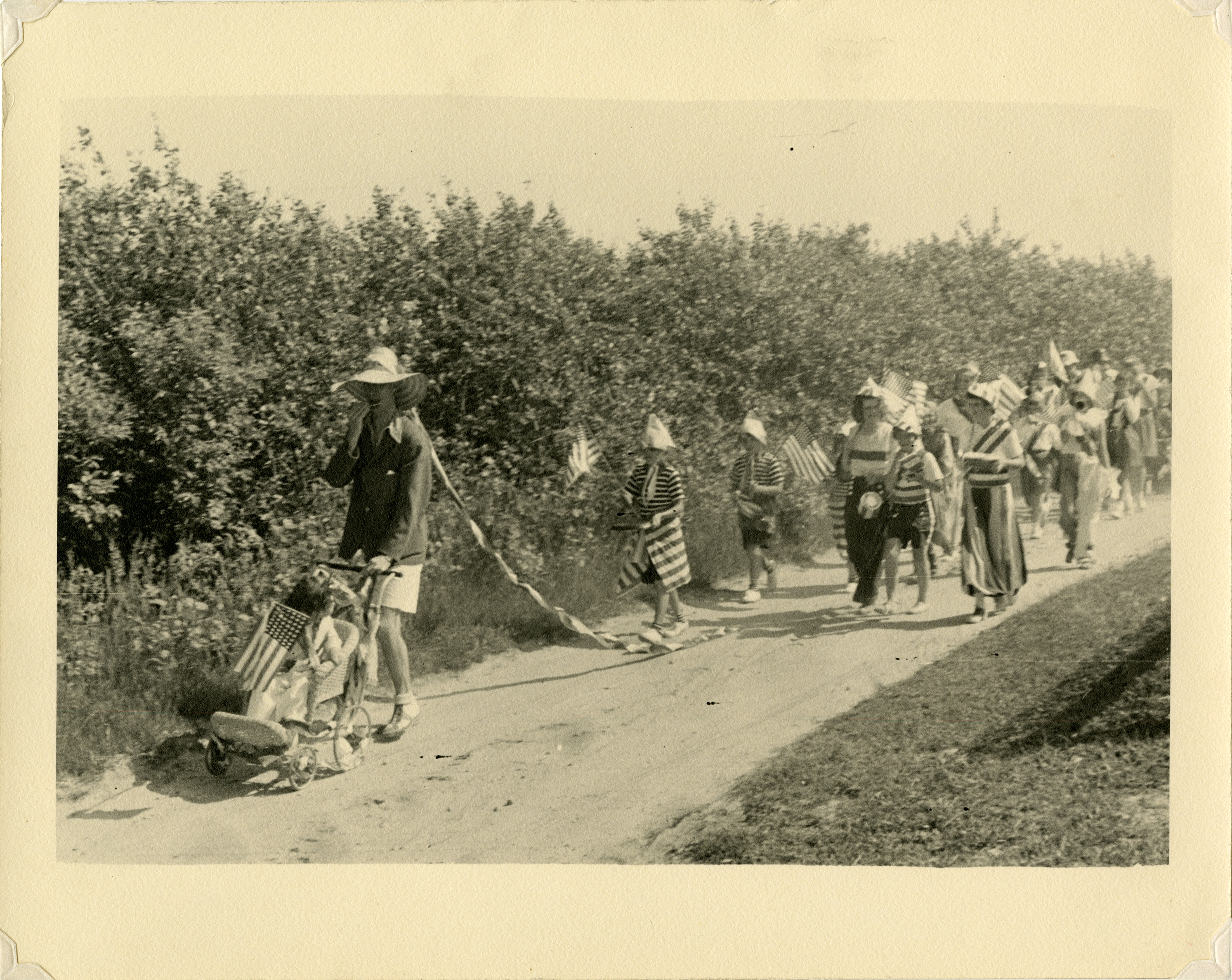
A Fourth of July Parade, Cuttyhunk Island, Massachusetts, 1935. Cranbrook Archives.

The family didn’t always celebrate the Fourth so close to home. Here’s a parade planned by Henry Scripps Booth in 1935 while vacationing on Cuttyhunk Island, south of New Bedford, Massachusetts, on Buzzard’s Bay. Daughter Cynthia Booth is in the carriage pushed by Henry, and sons Stephen and David are in the parade.

Happy Fourth of July, everyone!

Laura MacNewman, Associate Archivist, Cranbrook Center for Collections and Research

Stuck in the Mud

As Michigan emerges from our lockdown and we slowly begin driving to more places and contemplating summer road trips, I thought we’d look back to a time before asphalt, air conditioning, and safety features.

Ellen Scripps Booth, Jean McLaughlin Booth and Henry Scripps Booth on Lahser Road with the 1908 Pierce-Arrow in the ditch, 1911. Courtesy Cranbrook Archives.

Here, we see Ellen Scripps Booth, daughter-in-law Jean McLaughlin Booth, and young Henry stranded somewhere along Lahser Road. I love the ladies’ wide hats and wraps, intended to keep their hair in and dust out. Henry looks particularly pleased with the situation (sort of like me when my own mom got a speeding ticket—she didn’t appreciate my backseat smirking, either).

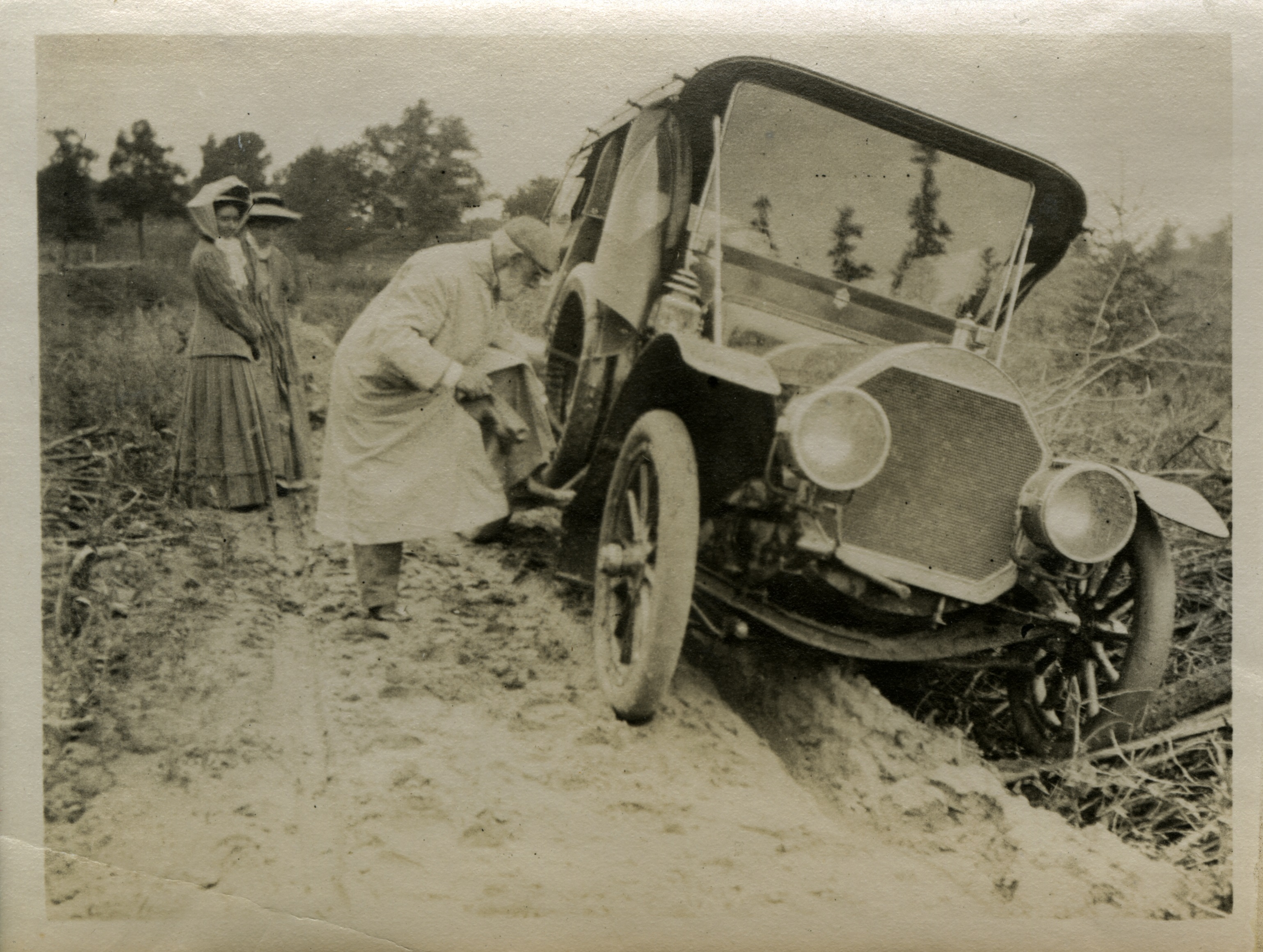
Instead of AAA, the family turned to their own skills. Here’s Henry Wood Booth, Ellen’s father-in-law, addressing the situation:

Henry Wood Booth works on the Pierce-Arrow on Lahser Road, 1911. Courtesy Cranbrook Archives.

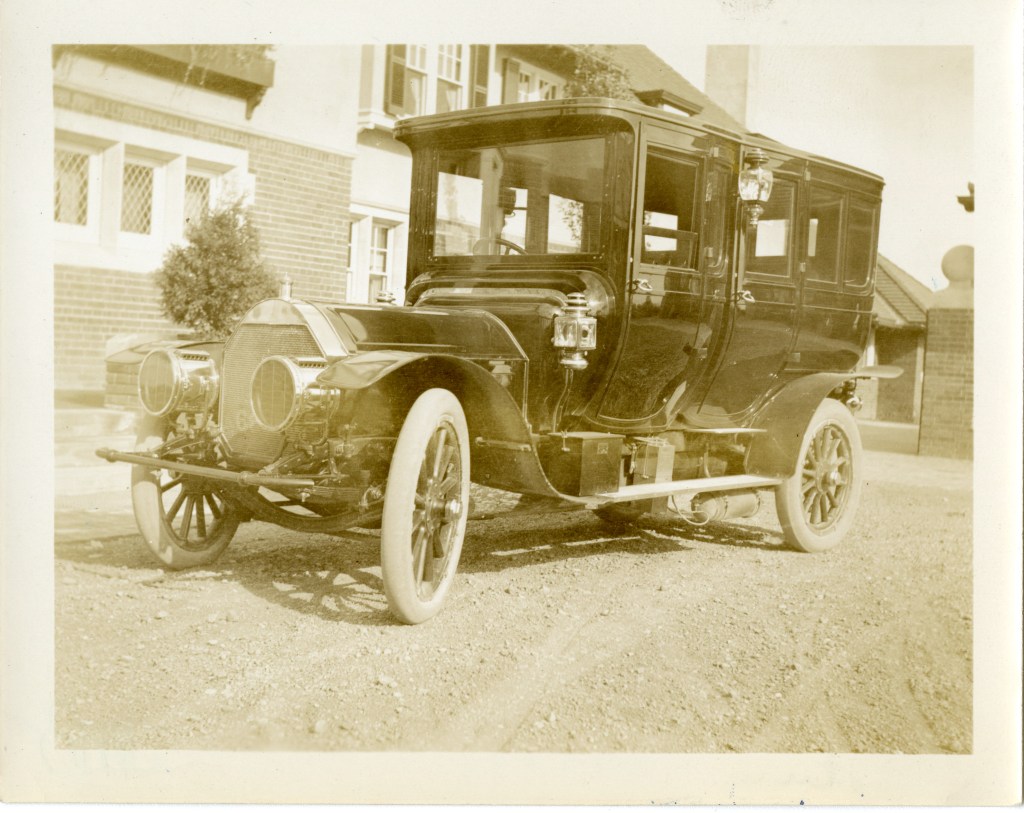
The Booth family’s Pierce-Arrow Limousine was one of several cars they used to move about here in Michigan and in Europe (where they traveled with the Pierce-Arrow and chauffeur). Purchased for $7,750 in July 1908 ($215,984.08 in 2020), the seven-seater, 6-cylinder touring car came with two bodies: a closed limousine body for winter use and a sports-touring body for summer. As Henry Scripps Booth later wrote:

The original garage at Cranbrook House had a traveling crane in it so the Pierce-Arrow’s winter and summer bodies could be conveniently changed with the seasons.  The crane spanned the depth of the garage, having an iron track bolted to the east and west walls on which the crane with a hand operated hoist could be pulled to the spot where the two respective bodies could be removed or hoisted into place. 

The accident on Lahser Road wasn’t the first time Ellen had been betrayed by poor road conditions. In 1908, she wrote in her diary of a similar event that took place as the family traveled from Grand Rapids to Lake Michigan:

“Wed. Aug. 12. We decided to take the auto as far as Holland on the way to Ottawa Beach but I wish we hadn’t for it took us five hours to go the 25 miles—We got off the road and one place slid into a ditch. It took an hour & a half to get a team to pull us out. We later frightened a horse and it ran down this deep ditch and horse, top-buggy and all just lay right down flat. The old couple in it were not hurt at all.”

If you want to learn more about the history and social impact of cars, register for our free virtual Bauder Lecture this Sunday, June 28, 2020, at 3:00pm EST. Brendan Cormier, Senior Design Curator at the Victoria and Albert Museum in London, will be speaking about his recent exhibition and publication, Cars: Accelerating the Modern World. Center for Collections and Research Director Greg Wittkopp will deliver an introduction about Cranbrook and cars, featuring more treasures from Cranbrook Archives relating to our place in automobile history.

—Kevin Adkisson, Associate Curator, Cranbrook Center for Collections and Research

Discovering the University of Michigan in the collections of Cranbrook Archives

In October, the University of Michigan Osher Lifelong Learning group visited Cranbrook for a lecture, luncheon, and tours of our historic houses, the Art Museum, and Cranbrook Archives. In gathering materials related to the university, I found that my growing archival display began to tell a wonderful story of the early relationship between the Booth family and the University of Michigan, predominantly between 1918 and 1924. The story begins with the friendship of George Booth and Emil Lorch.

Born in Detroit in 1870, Lorch had studied at MIT and Paris, before graduating Master of Arts at Harvard in 1903. In 1906, he arrived at the University of Michigan to establish the School of Architecture, which remained a unit of the School of Engineering until 1931. The correspondence between Booth and Lorch covers a manifold of topics over many years.


On January 11, 1918, George Booth gave an address to the students of the departments of Journalism and Architecture at the university, entitled The Spirit of Journalism and Architecture which focused on the development of the Detroit News business and the new News building, which had been recently completed.
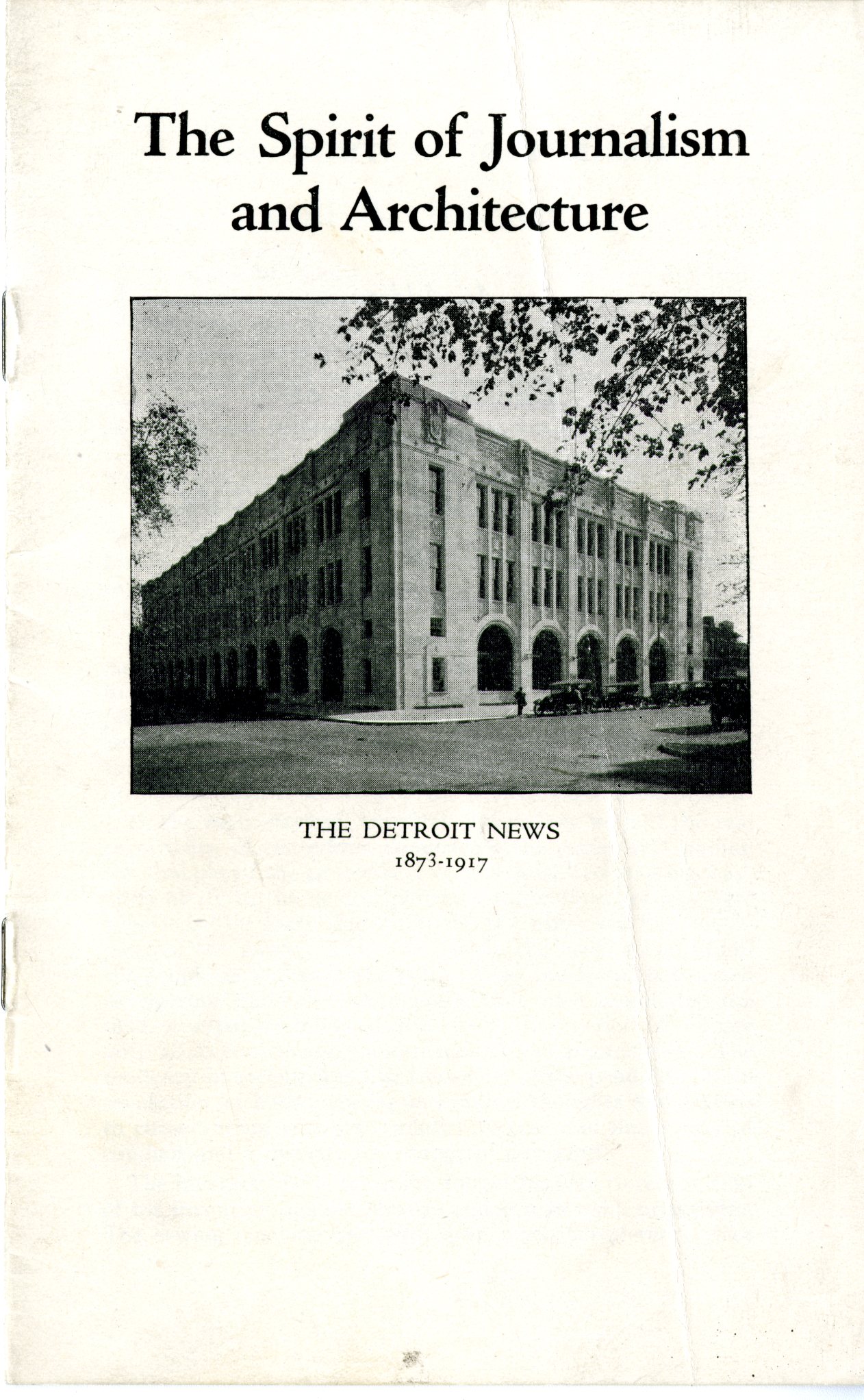
1981-01 1-19

Program for an address, The Spirit of Journalism and Architecture, delivered by George Booth at the University of Michigan, January 11, 1918. Copyright Cranbrook Archives.

Later that year, in October, George’s son, Henry Scripps Booth began his studies in architecture at the university. It was there that he met J. Robert F. Swanson, with whom he traveled Europe for ten months beginning in June 1922, and later established the architectural practice Swanson and Booth between 1924 and 1926. Henry took with him letters of endorsement to help facilitate access to architectural treasures on their journey, including one from Professor Lorch:
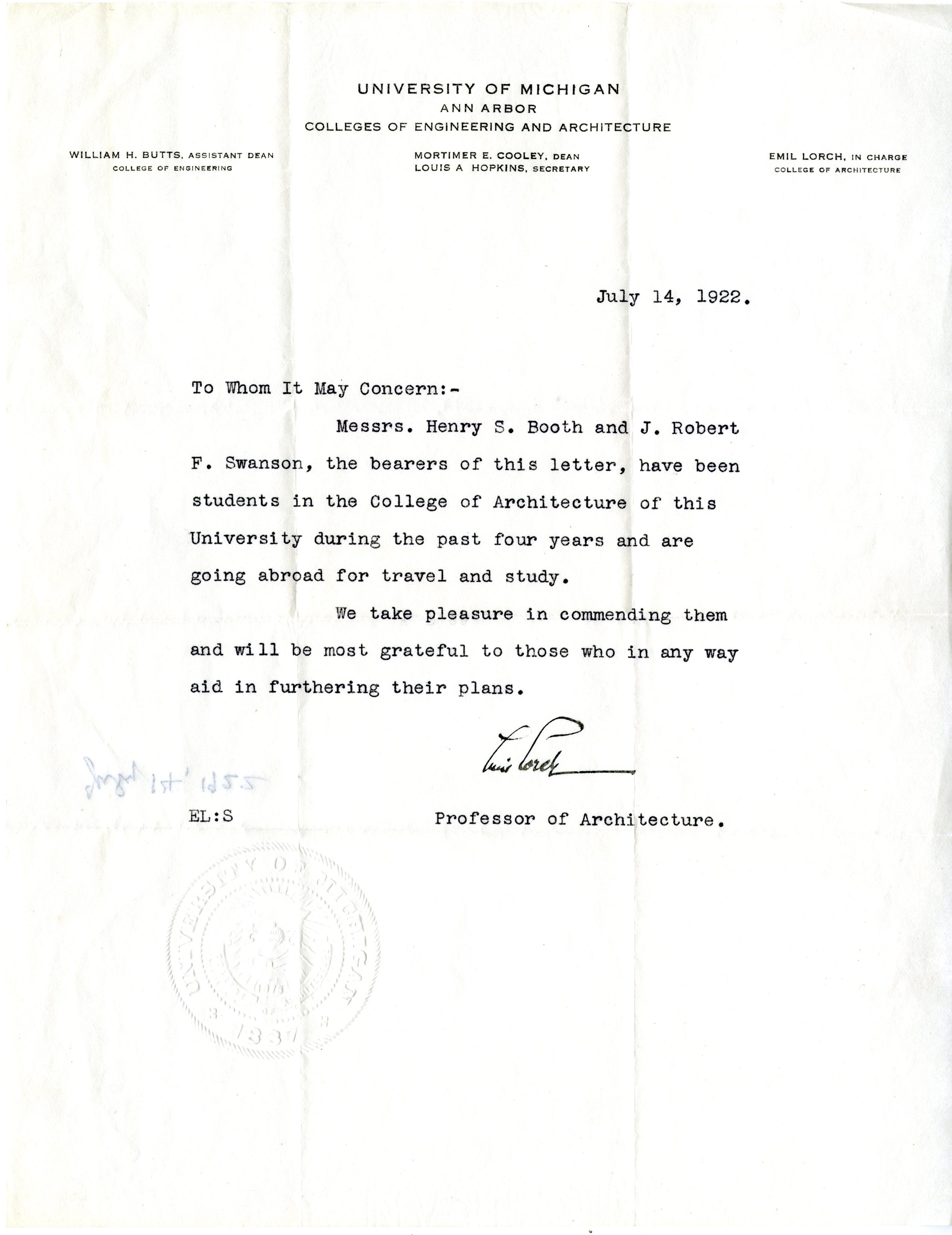
1982-05 5-7 EL

Letter of introduction for Henry Booth from Emil Lorch, July 17, 1922. Courtesy Cranbrook Archives.

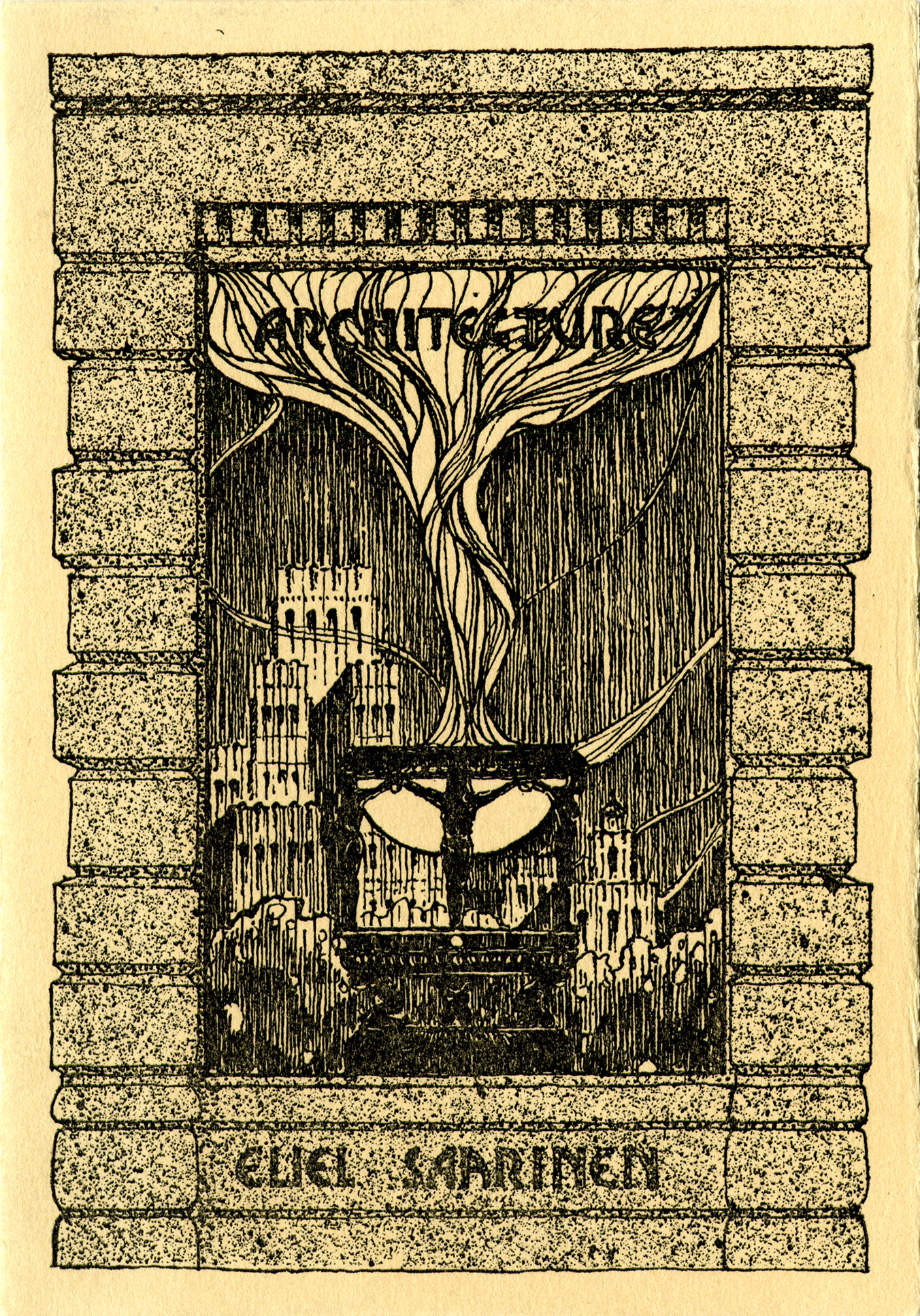
Eliel Saarinen arrived at the University of Michigan as a Visiting Professor at the invitation of Emil Lorch the next year, staying from September 1923 through 1925. To extend a warm welcome, Henry wrote, costumed, and performed in a pageant in honor of Saarinen. Many of Henry’s classmates performed in the pageant, including Ralph Calder and J. Robert F. Swanson, who also designed the program. The event took place on December 8, 1923, in the Michigan Union ballroom. Many of the members of the Michigan Society of Architects and the Michigan branch of the American Institute of Architects were present. During the dinner, George G. Booth made the principal address of welcome to Eliel.
1990-08 1-14 cover

Program for A Pageant of Arts and Crafts, a Reception for Eliel Saarinen, program design by J. Robert F. Swanson, December 1923. Courtesy Cranbrook Archives.

1990-08 1-14 p2

Interior of the program. Courtesy Cranbrook Archives.

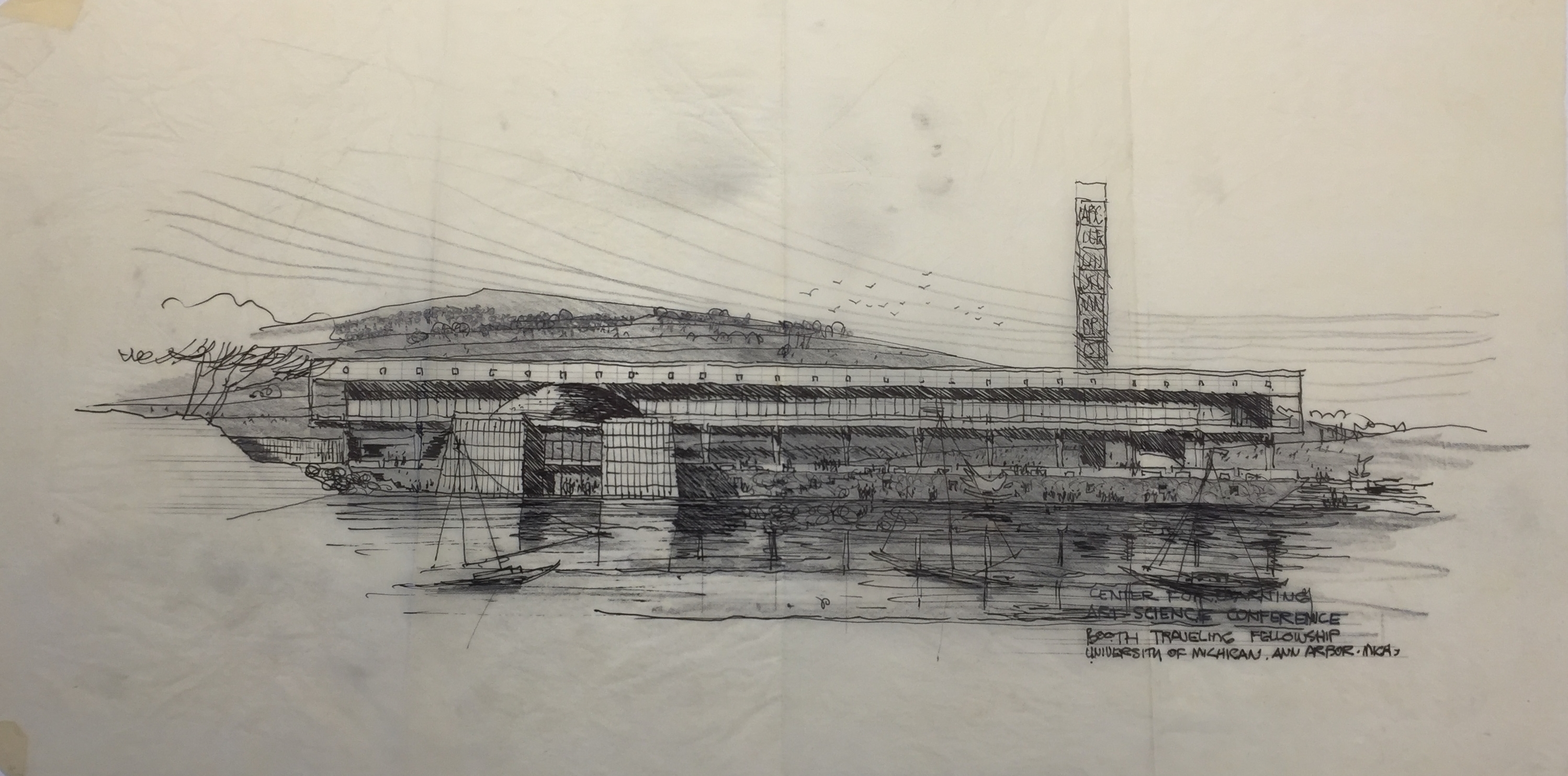
Henry and Robert graduated from the University of Michigan in 1924. Graduating with them was Ralph Calder, who was also one of the first two students to win the George G. Booth Traveling Fellowship, with which he traveled to England, France, and Italy. The fellowship continues to this day. Calder was among the original staff of the Cranbrook Architectural Office, working on Cranbrook School and Thornlea House. He later went on to design many buildings for colleges and universities in Michigan, including Michigan State University, Western Michigan University, Wayne State University, Hope College, and Hillsdale College.

1981-01 13-20 p1

Letter concerning the Booth Traveling Fellowship from the first recipient Ralph Calder to George G. Booth, June 12, 1924. Notice the Michigan logo on the letterhead. Courtesy Cranbrook Archives.

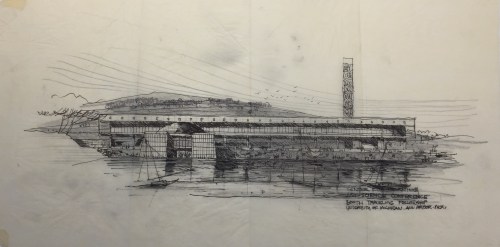
In another Cranbrook connection, Ralph Rapson submitted a Fellowship entry in 1938, and, while he didn’t win, his submission impressed Eliel Saarinen so much that Rapson was given a scholarship to the Art Academy.
AD.26.01.03

Ralph Rapson’s submission to the George G. Booth Traveling Fellowship, AD.26.01.03. Ralph Rapson Architectural Drawing Collection, Cranbrook Archives. Gift of Rip Rapson.

There is much more in our collections about the University of Michigan; this post has selected items covering only the early years. In preparing for the Osher tour, I realized that, while the contents of processed archival collections remain the same, what we find in them depends on the question being asked. The collections of George G. Booth, Henry S. Booth, the Cranbrook Foundation, Swanson Associates, Inc. are among the most highly used and yet there is always something new to learn, something wonderful to discover.

— Laura MacNewman, Associate Archivist

Create a website or blog at WordPress.com