Photo Friday: Academy of Art Graduation Day

Congratulations to the Cranbrook Academy of Art (CAA) students who graduate today! In honor of today’s festivities we are posting a photo of the cover of the program for the first Honors Convocation (29 May 1943). Although the Academy had been educating students for ten years, it was not until 1942 that it became independent and chartered by the State of Michigan as an institution of higher learning with power to grant degrees. The class of ’43 was the first class to receive an accredited degree. Henry Scripps Booth presented the candidates and degrees were conferred by Eliel Saarinen.

CAA Honors Convocation, 1943

Cranbrook Academy of Art Honors Convocation, 29 May 1943. Courtesy Cranbrook Archives.

Gina Tecos, Archivist

Happy Earth Day!

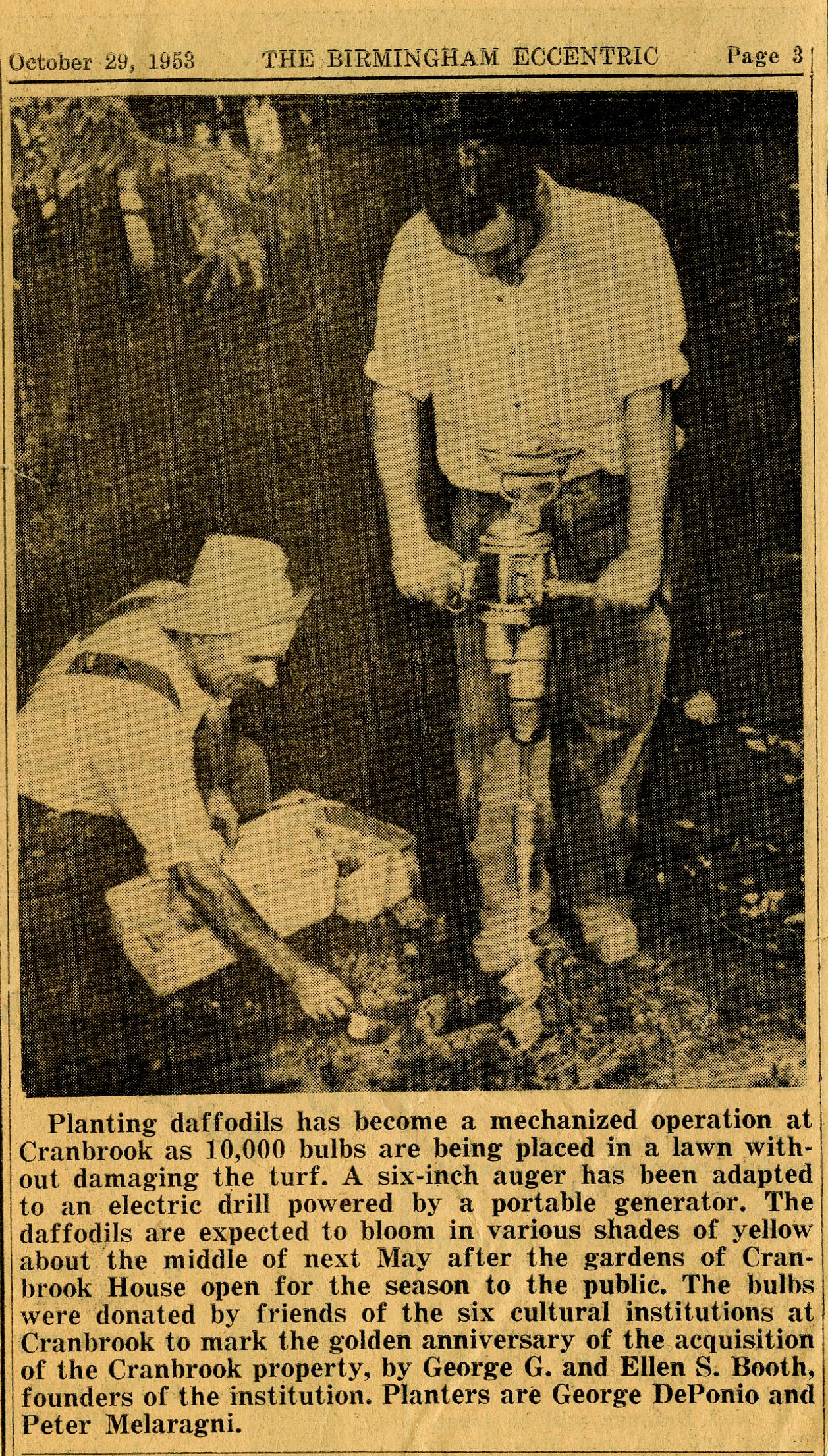
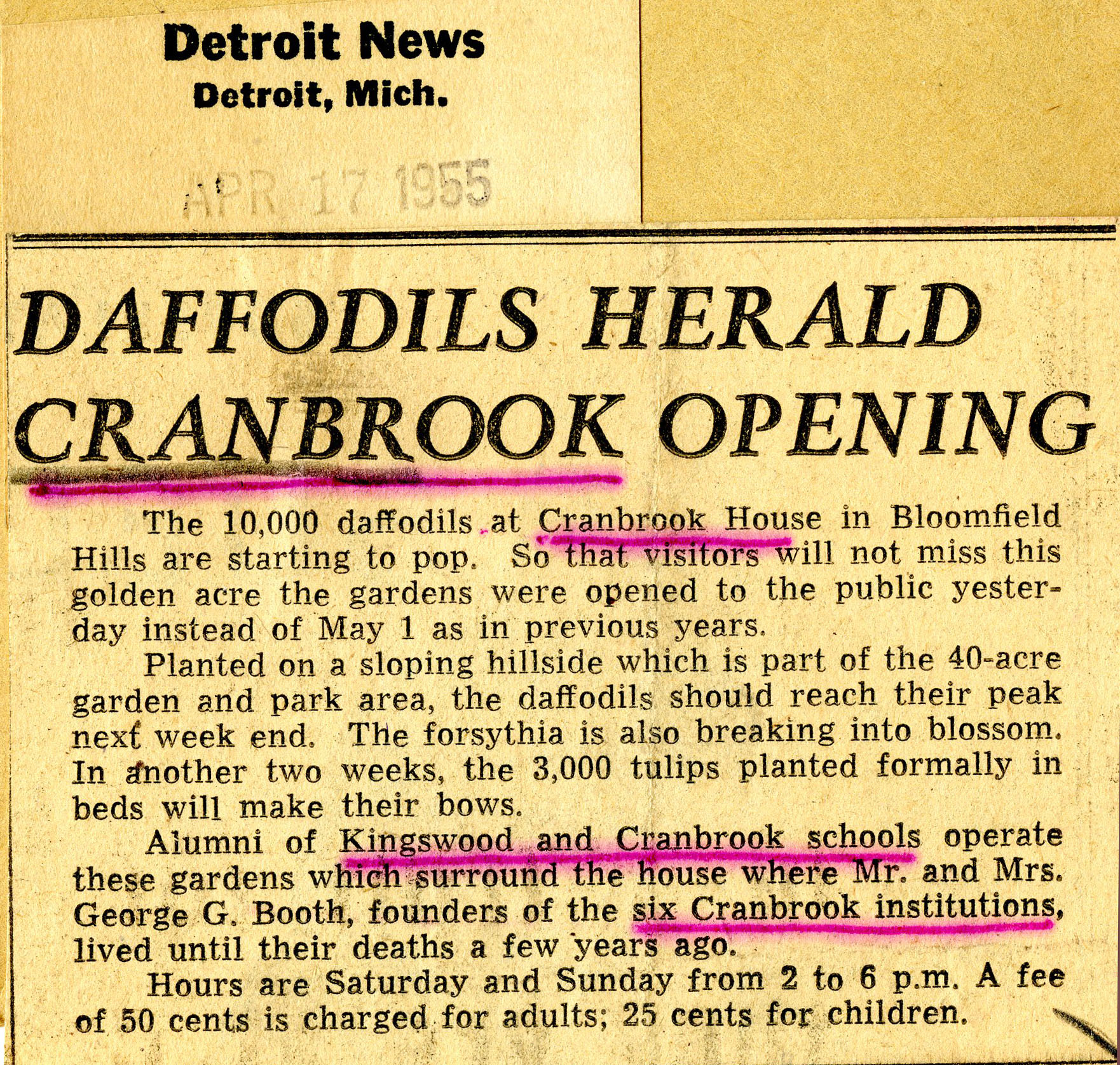
Even though Cranbrook experienced a few snow flurries today, the campus daffodils are also in bloom. It reminds me of what was known as “Daffodil Hill.” In 1953, in anticipation of Cranbrook’s Golden Jubilee celebration (the 50th anniversary of the year the Booths purchased the original 175 acres), Henry Scripps Booth led an effort to raise funds to plant daffodils at Cranbrook House.

The Cranbrook Foundation Daffodil Fund was established and enough money was raised to plant 10,000 daffodils in the fall. By 1955, visitors were flocking to the campus just to see them.

Birmingham Eccentric newsclipping, 1953

News clipping, The Birmingham Eccentric, 1953. Cranbrook Archives.

Detroit News, 1955

News clipping, The Detroit News, 1955. Cranbrook Archives.

Middle School girls planting daffodils for Earth Day, 1990

Middle School girls planting daffodils for Earth Day, 1990. Cranbrook Archives.

Daffodil Hill, 1985

Originally known as “Golden Glade,” the area soon became known as Daffodil Hill, Spring 1985. Ralph Mize, photographer. Cranbrook Archives.

Leslie S. Edwards, Head Archivist

Illumination!

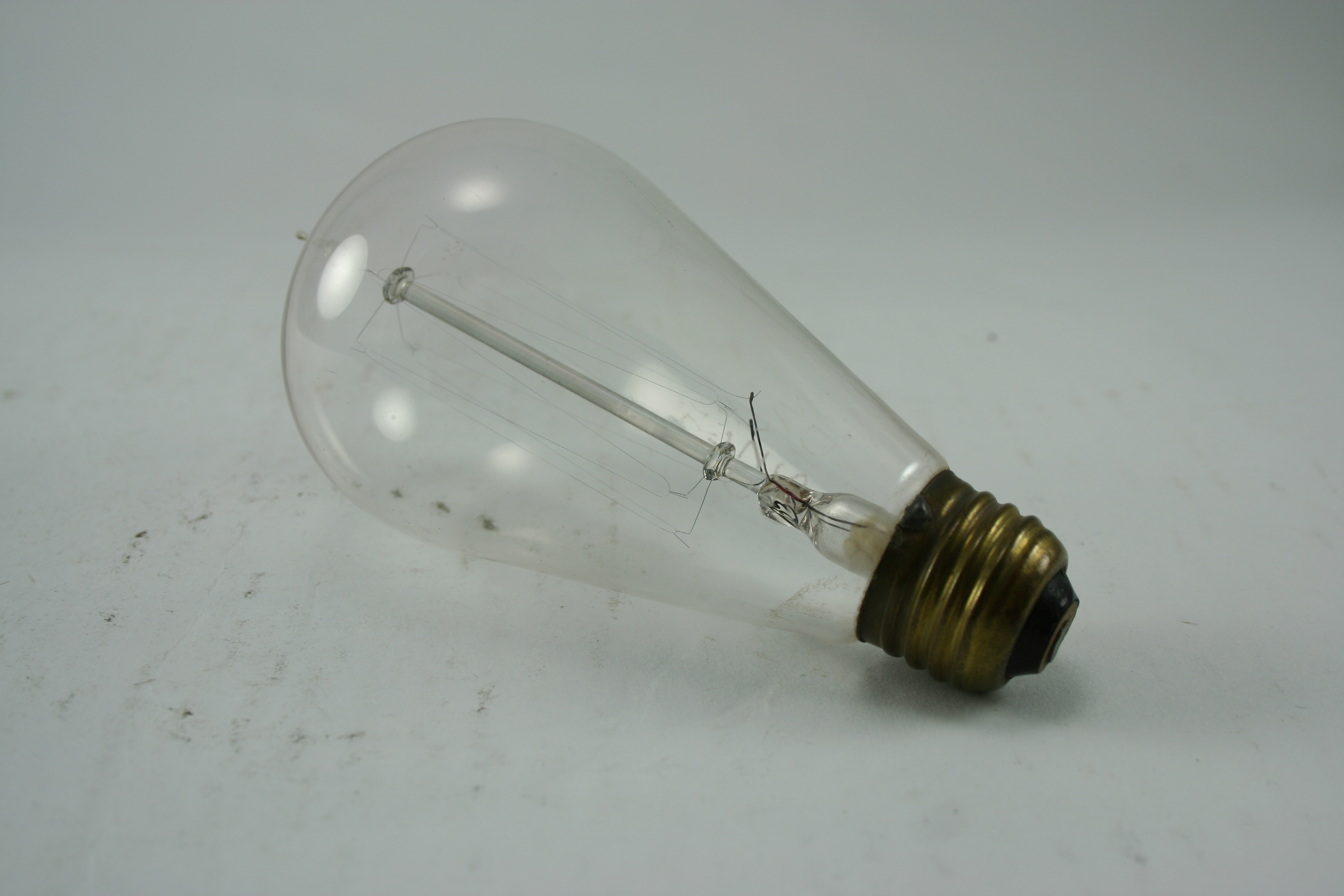
Glass etched Edison bulb from 1920, found in Cranbrook House.

Glass-etched Edison bulb from 1920, Cranbrook Cultural Properties Collection..

While browsing the historical writings of Henry Scripps Booth recently, I came upon the answer to a question that Collections Fellow, Stefanie Dlugosz, had posed late last year. As she prepared the Center for Collections and Research’s Holiday Tables exhibit (“Illuminate the Seasons” was the theme), which highlighted the early use of electricity in Cranbrook House, Stefanie had wondered what the source of electricity was, in 1908, for a relatively isolated place like Cranbrook. Efforts by several people could not turn up an answer. Until now.

“Although Caldwell’s electric fixtures had been installed about December 1, we still had to use candles and oil lamps for light because the private Edison line being installed from Highland Park to Cranbrook House was incomplete.”  This was recorded during the 1980’s in Henry’s unpublished History (which relates the history of Cranbrook Educational Community and the Booth family between 1800 and 1987).

As the bill from Albert Kahn shows, George G. Booth spent $1863.48, around $49,000 in today’s dollars, on lighting fixtures in Cranbrook House. The order is itemized, room by room, on seven pages of legal-sized paper, in Booth’s papers.

Albert Kahn’s bill to George Booth for Cranbrook House lighting fixtures provided by Edward.F. Caldwell Co.  Papers of George and Ellen Booth 14:23

George Gough Booth Papers, courtesy Cranbrook Archives.

Read the original blog for more information on the Caldwell lighting fixtures at Cranbrook House.

— Cheri Gay, Archivist

Meeting House Inaugurated


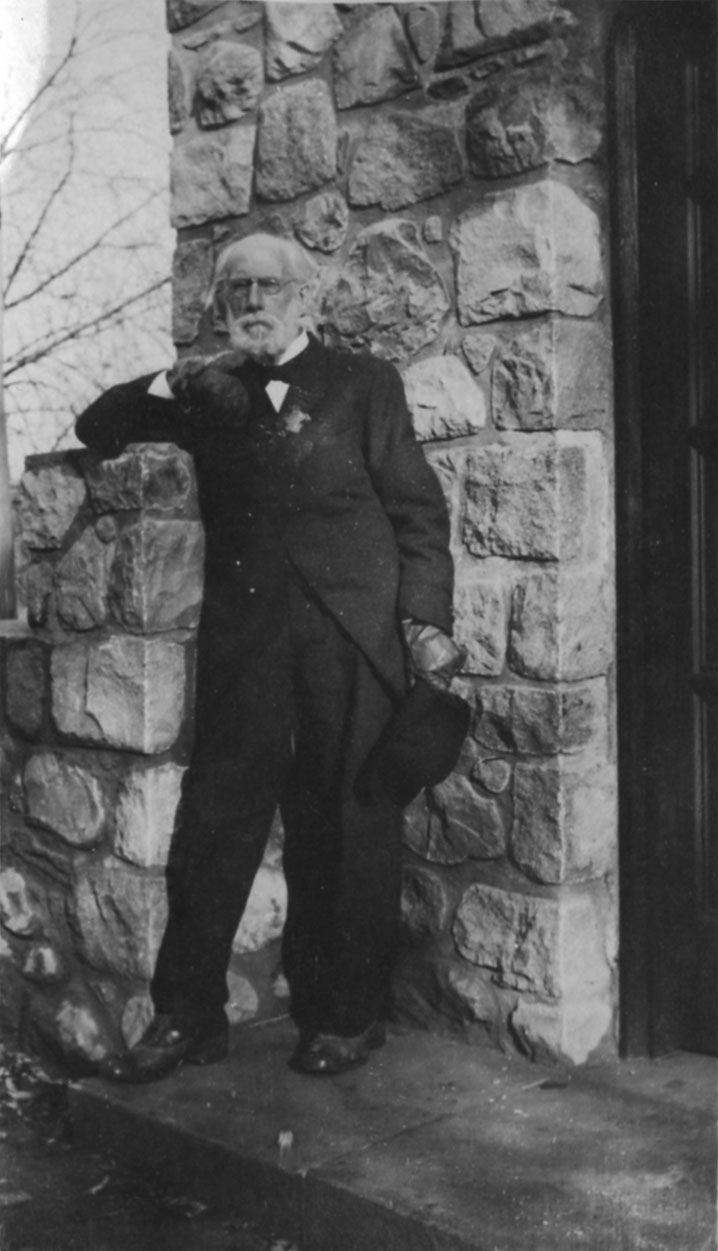
Henry Wood Booth outside the Meeting House (now Brookside School)

Henry Wood Booth outside the Meeting House (now Brookside School).

On January 5, 1919, Henry Wood Booth (HWB), father of George Gough Booth (GGB), “opened the Meeting House for divine worship,” according to the historical notes of Henry Scripps Booth (HSB). HWB, who would turn 82 on January 21st, conducted a vesper service and continued to officiate for six months. The Meeting House, designed by GGB and HSB, was the foundation for what later became Brookside School.

Cheri Gay, Archivist

Object in Focus: Gone but Not Forgotten

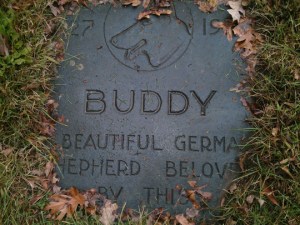
Buddy_blog

Grave of Buddy. Photo taken by Cheri Gay.

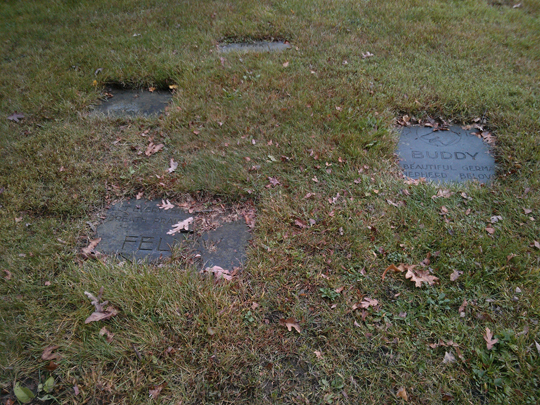
Taking a stroll one day on the grounds of the Thornlea Studio (where Cranbrook Archives was previously housed) I was startled to come across small tombstones, almost buried in the grass. What were these, I wondered? Seeing the names, I immediately understood: Buddy, Homer, Perky, Heinie, Fellow, Ricky, Zorah—a pet cemetery, which had seen better days.

Thornlea Studio was the artistic lair of Henry Scripps Booth, who designed and placed the building across the wide expanse of lawn from his home Thornlea. The family actually lived in the studio in 1949 when “… our daughter Melinda was a student at Kingswood. She was embarrassed by our living in “such a big house” and prevailed on her mother to close the house and move across the lawn to the Studio.”

The Henry Scripps Booth and Carolyn Farr Booth Papers document six dogs, almost all black and tan German shepherds. Receipts from Sheldon Granite Co. in Detroit reveal they made the monuments for Heinie, Perky and the lyrically named, Homer the Wanderer. A 1961 notebook paper receipt identifies Albert Leipold, of Birmingham, as the stone carver for Fellow’s monument for $40.
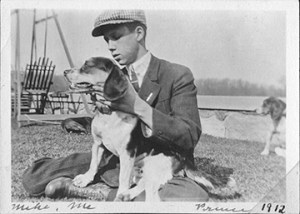
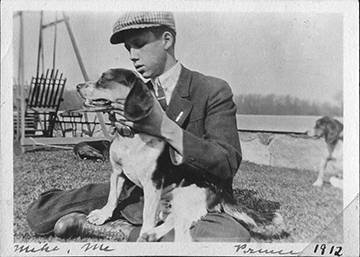
Mike

Henry Scripps Booth with Mike, 1912. Cranbrook Archives.
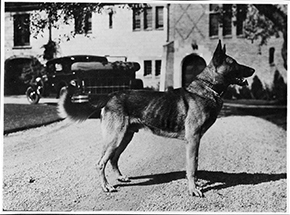
Buddy 1929

Buddy at Thornlea, 1929. Cranbrook Archives.

When Henry was growing up, the Booth family had beagles, Prince and Mike, and a great Dane, Ginger. Mike, according to Henry, “ … loved having a fuss made over him, one time going so far as being pushed around in a doll carriage while wearing a canvas hat.” Oh to have a photograph of that! When Henry had his own family, black and tan German shepherds predominated.

Henry’s photo albums, called Pleasures of Life, include 17 different dogs, though not all are his. His hand-written captions under the photographs always give the dog’s name followed by (dog) in case there’s any doubt, for example, in a photo of Cynthia and Curlytail, who is who.

Though the grounds and building of the Thornlea Studio are maintained, unfortunately that care doesn’t extend to Henry Booth’s lovingly buried companions. It’s a project waiting to happen.
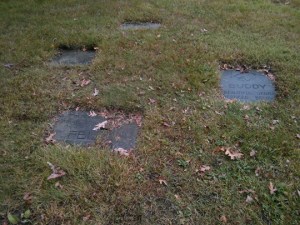
Dog Graveyard_Blog

Thornlea Studio pet cemetery. Photo by Cheri Gay.

–Cheri Gay, Archivist
Photo Friday: A Splash of Color

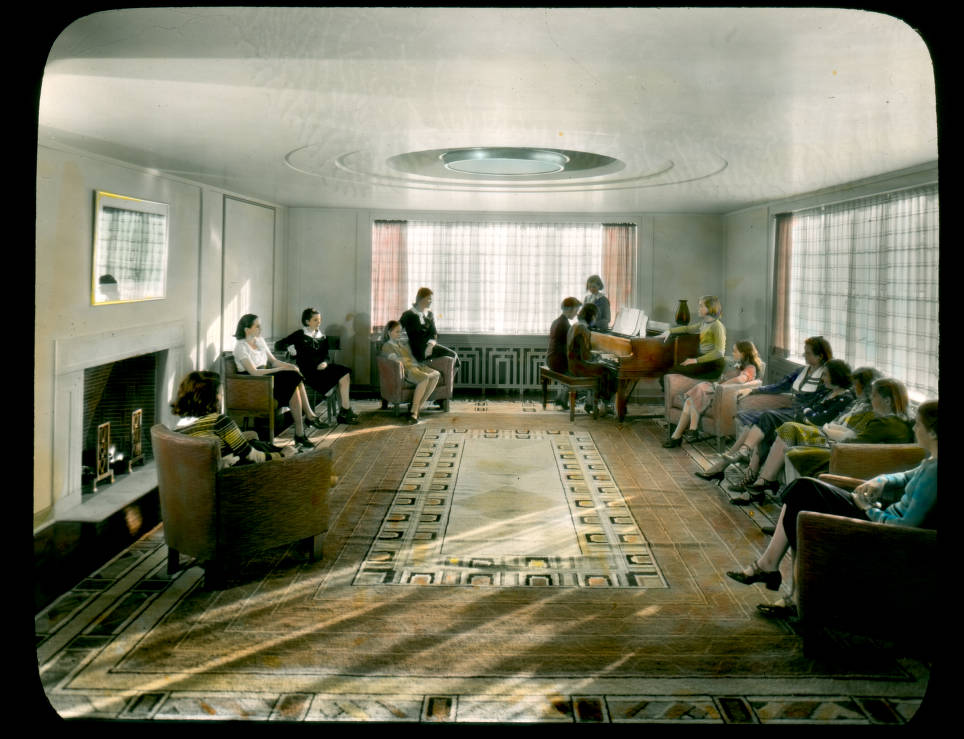
Kingswood School Rose Lounge. Cranbrook Archives

Kingswood School Rose Lounge, The Cranbrook Hand-Colored Lantern Slide Collection. Cranbrook Archives

As the weather here at Cranbrook is more than a little dreary, today’s photo provides a look into a bright and cozy atmosphere perfect for reading, relaxing and being inside. Taken around 1932, it shows a group of students gathered in the lounge of the Kingswood School dormitory (originally known as Reception Room III) listening to two of their peers play the piano. The photograph comes from Cranbrook Archives’ Hand-Colored Lantern Slide Collection. The photographs in this collection were originally black-and-white and were painted with watercolor years later, and not by the original photographer. This jump in time explains the vibrant color choices in the photograph as the painter was not present when the image was originally captured.

The Cranbrook Hand-Colored Lantern Slide Collection contains over 30 images of Cranbrook institutions taken primarily during the 1920s and 1930s. Several of the original black and white images were taken by architectural photographers for inclusion in publications.

Today’s photo was taken by George W. Hance, Cranbrook’s first paid staff photographer (1931-1932). Hance had been commissioned by George Booth as early as 1916 to photograph his art collection and later photographed Cranbrook’s campus and grounds including Kingswood, Cranbrook House (home to George and Ellen Booth) and Thornlea (home to Henry Scripps Booth). Explore more photographs like these on our digital image database or in person at the Archives!

Stefanie Dlugosz, Collections Fellow, Cranbrook Center for Collections and Research


Dispatch from the Archives: Documenting Liggett

Part of the job of an archivist is to network with colleagues and provide guidance when neighboring organizations or institutions are looking to establish a new archive.  As luck would have it, two weeks ago I had the pleasure of visiting the University Liggett School in Grosse Pointe Woods to look at their archives, and work with the two stellar Sara(h)s: Sara Day Brewer and Sarah Gaines.  Both women—also current parents at the school—are working to preserve the heritage of the school.

Image

Liggett School ephemera noting architect Albert Kahn’s entrance to the school, 1942. The Liggett School Collection, Courtesy University Liggett School Archives.

Continue reading

From an Intern’s Eyes: Old Drama and Timeless Art

In the second week of May, I began my first day at the Cranbrook Archives for my Senior May Project, a program ran by the Cranbrook Upper School to send anxious fourth quarter seniors off campus for internships and adventures.  And now, after two weeks of dealing with numerous dusty, yellowed papers (and one suspicious wooden box featuring some dead bugs and cobwebs) my initial excitement only grew.

One of my first projects here was to research the tenure of past Academy of Art faculty and staff members between the years of 1932-1976, and to make a comprehensive spreadsheet on the matter. That project led me to read through old faculty files comprised of payroll information (“how did people survive on $200 a month!” I thought to myself), retirement records, old correspondence­—I even came across the first telegram I had ever seen. I wondered, from time to time: “Did the secretary who typed this letter up ever think that a teenaged intern from China would one day behold this work and marvel at its antiquity?”

The first telegram I've ever seen.  1943, Cranbrook Archives.

The first telegram I’ve ever seen. 1943, Cranbrook Art Museum Exhibition Records, Cranbrook Archives.

Continue reading

Dispatch from the Archives: All Things Modernism

Mid-century Modernism has taken over my life!  I eat, sleep, and even dream Modernism these days.  In my role as Head Archivist, I wear many hats – the most recent being to assist the Michigan Modern curatorial team by locating all the cool “stuff” in our Archives related to the upcoming exhibition, which will be opening at the Cranbrook Art Museum on June 14, 2013.  This includes photographs, of course, but the most fun for me is finding correspondence, articles, and ephemera that when put together create a mosaic of a time or place. Continue reading

Create a website or blog at WordPress.com