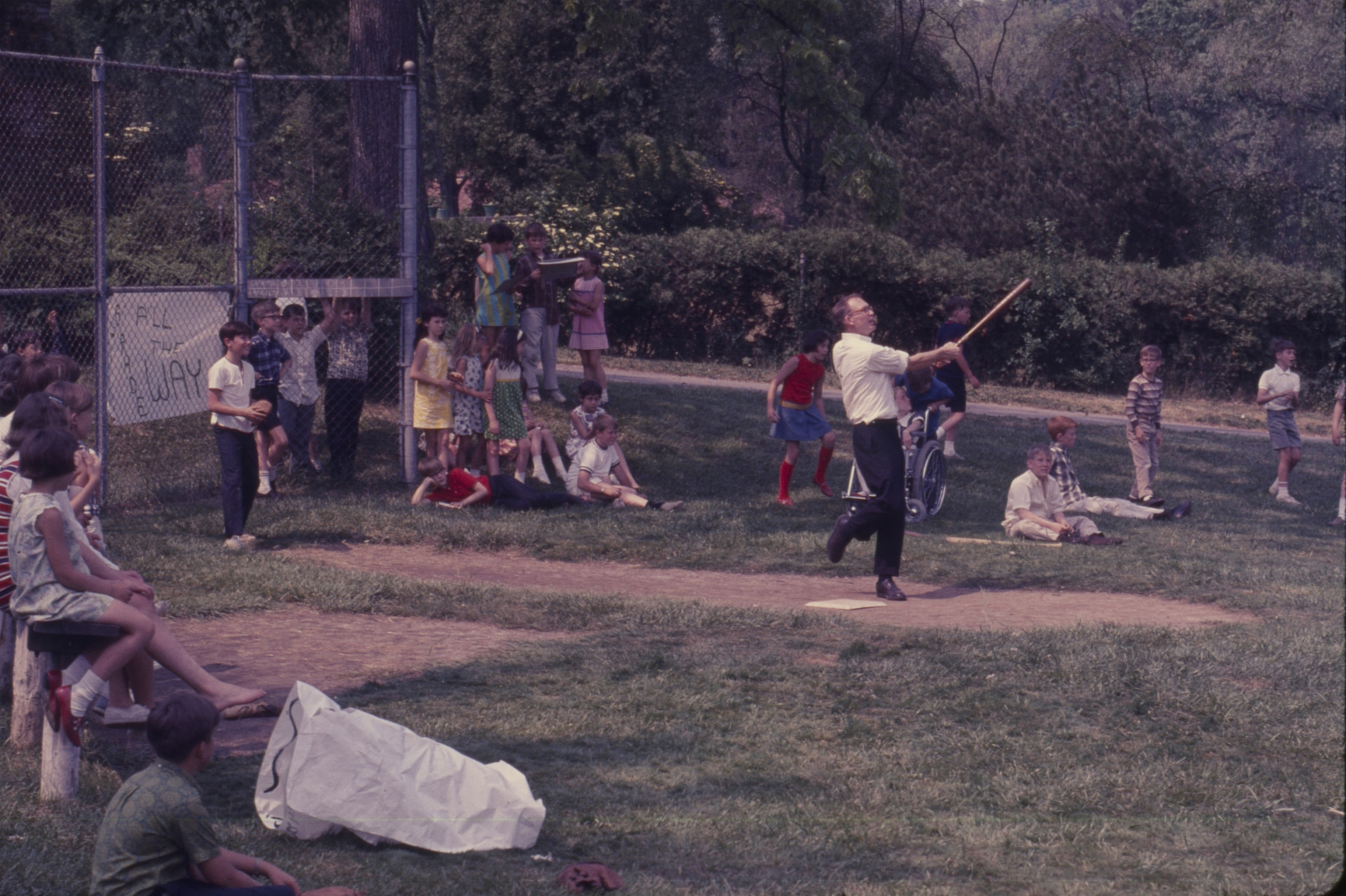
For many years, one of Brookside School’s highly anticipated end-of-year traditions was the Faculty/Sixth Grade Softball game. Every June, faculty and sixth graders would meet on the sandlot at Hedgegate, the faculty residence, to play against each other in friendly rivalry. It was a special day when students could play their favorite pastime with their teachers.
Brookside School Headmaster, Jock Denio, at bat, June 1967. Courtesy of Cranbrook Archives
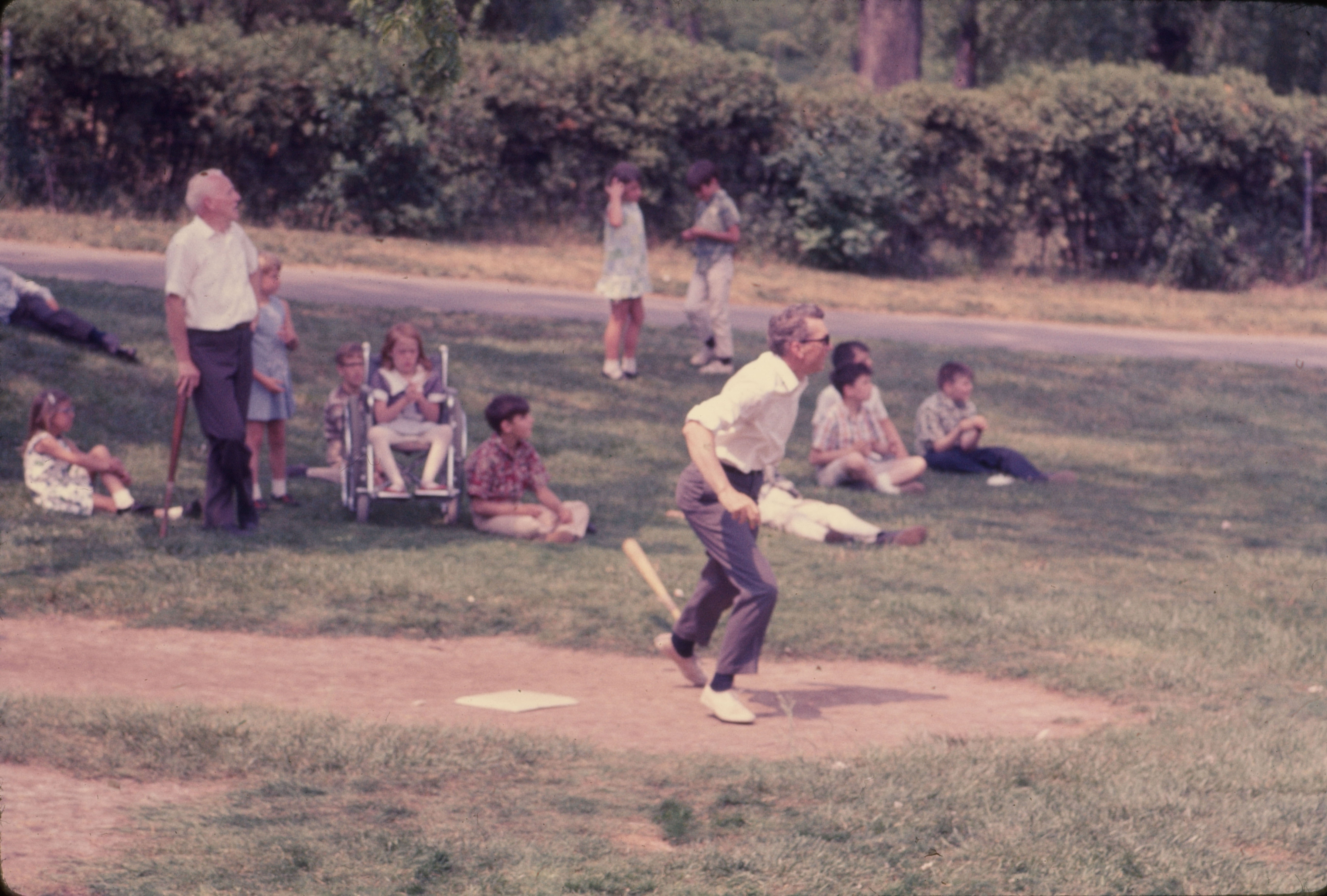
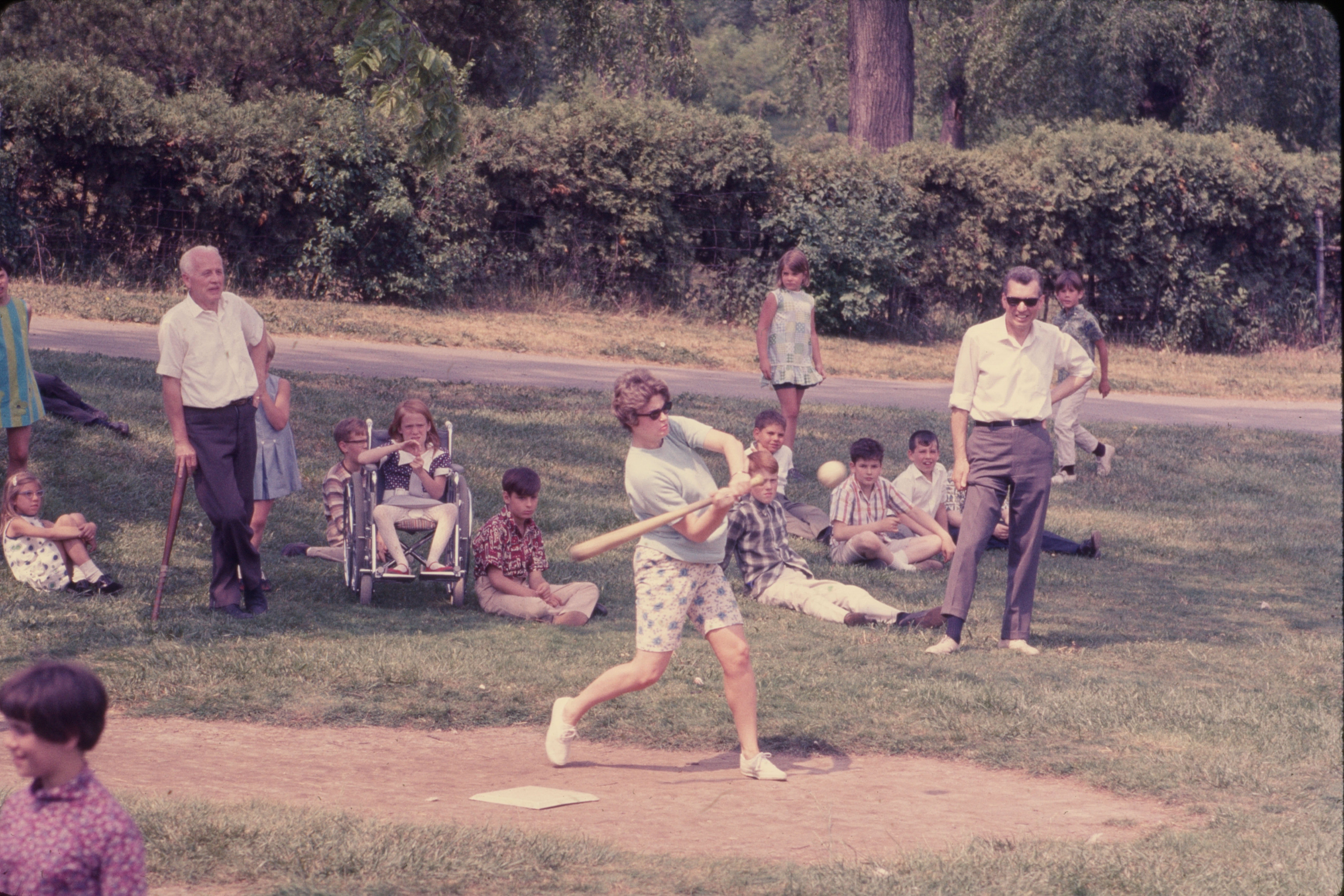
We recently received an addition to the James Carmel Papers from his son, which includes slides capturing the June 1967 softball game. The colorful images convey the camaraderie and joy of the event, with both faculty and students enthralled by the gameplay.
Brookside School students watch the softball game, June 1967Carolyn Tower and Paul Gerhardt, June 1967Louis Beer, June 1967Carolyn Tower at bat, with Paul Gerhardt, Louis Beer, and Brookside students looking on, June 1967. All images Courtesy of Cranbrook Archives
The sixth graders were up against Jock Denio, Brookside’s long-serving Headmaster; Carolyn Tower, music teacher; Louis Beer, third-grade teacher; and Paul Gerhardt, social studies teacher and director of testing and records.
In my work “fielding” research inquiries, I find that there is always a heartfelt nostalgia and tenderness in the memories and stories evoked by Brookside, a Cranbrook institution so deeply cherished by its alumni and former staff.
— Laura MacNewman, Associate Archivist Cranbrook Center for Collections and Research
These days, Instagram accounts are often used to curate and share our photographic memories. In a not-too-distant past, photographic albums were the medium of choice. One such album, created by a 1950 Academy of Art graduate, was recently donated to the Archives and gives us a rare student perspective of the Academy experience. As we welcome students back to campus, full of the promise of future opportunities, let’s take just a moment to look back at what that looked like for one student who attended seventy-five years ago.
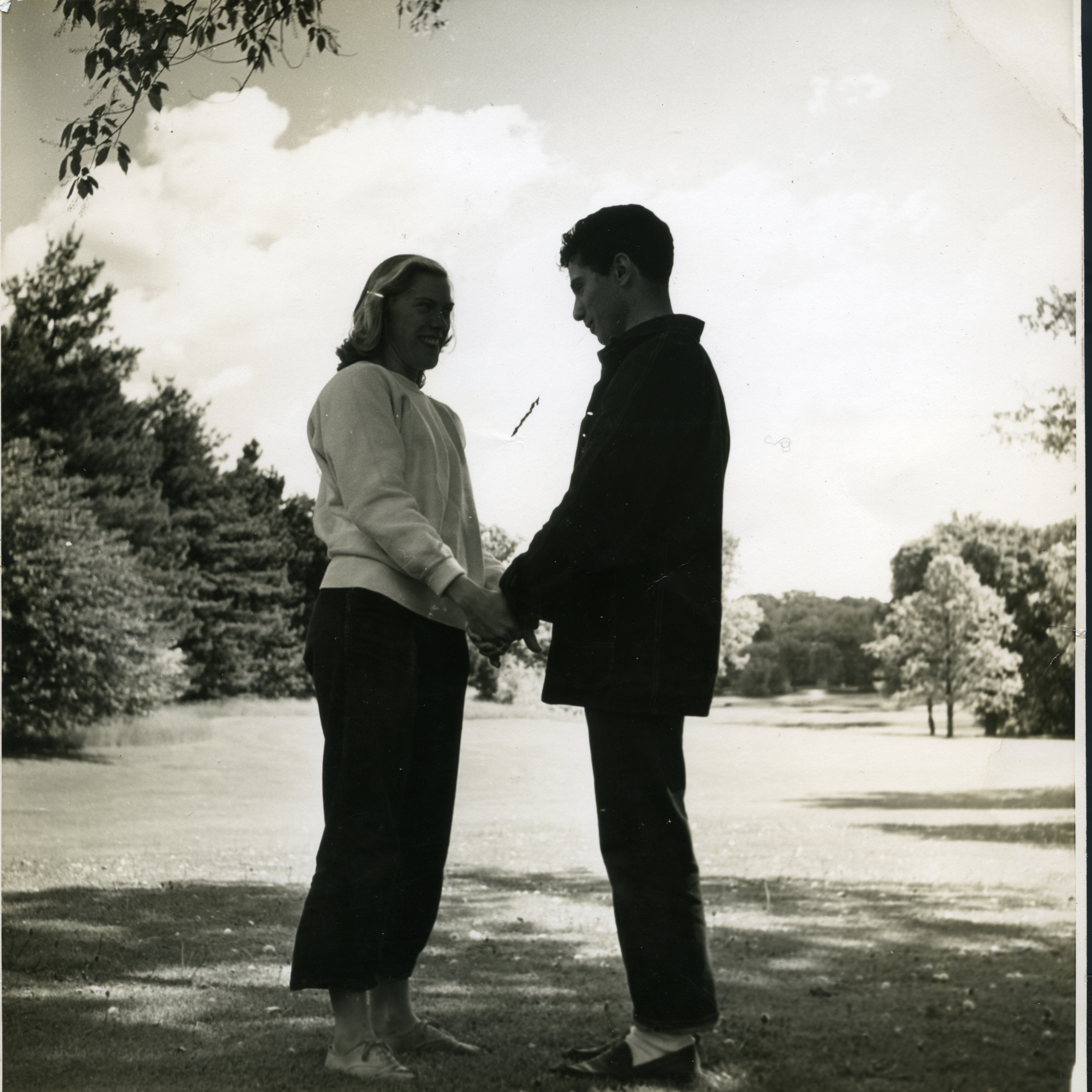
Eleanor Ann Middleton (Painting,1950) and Angelo Caravaglia (Sculpture, 1950) on Cranbrook grounds, circa 1950. Courtesy of Cranbrook Archives.
Eleanor Ann Middleton (Annie) received her BFA and MFA in Painting from Cranbrook Academy of Art in 1949 and 1950, respectfully. Her photo album, assembled at least in part post-graduation, contains photographs from Cranbrook staff photographer, Harvey Croze, who also managed the studio and darkroom in the basement of the Academy Administration Building. These images—class photos on the Art Museum peristyle or familiar shots of the Triton Pools— are copies of those already in the Cranbrook Photograph Collection. But the bulk of the album contains snapshots that are unique to the Archives.
Jack Kearney (Painting 1948) creates al fresco, circa 1947-1948. Courtesy of Cranbrook Archives.
While Middleton was herself a photographer, she appears in many of the images, so the snapshots are likely a mix of her work, fellow Academy students, and perhaps even Croze, in an unofficial capacity. While not Academy staff or student, Croze was a practicing artist (painting and photography) and was known to spend much of his free time with Academy students. Whatever the case, the result is an intimate glimpse into student life.
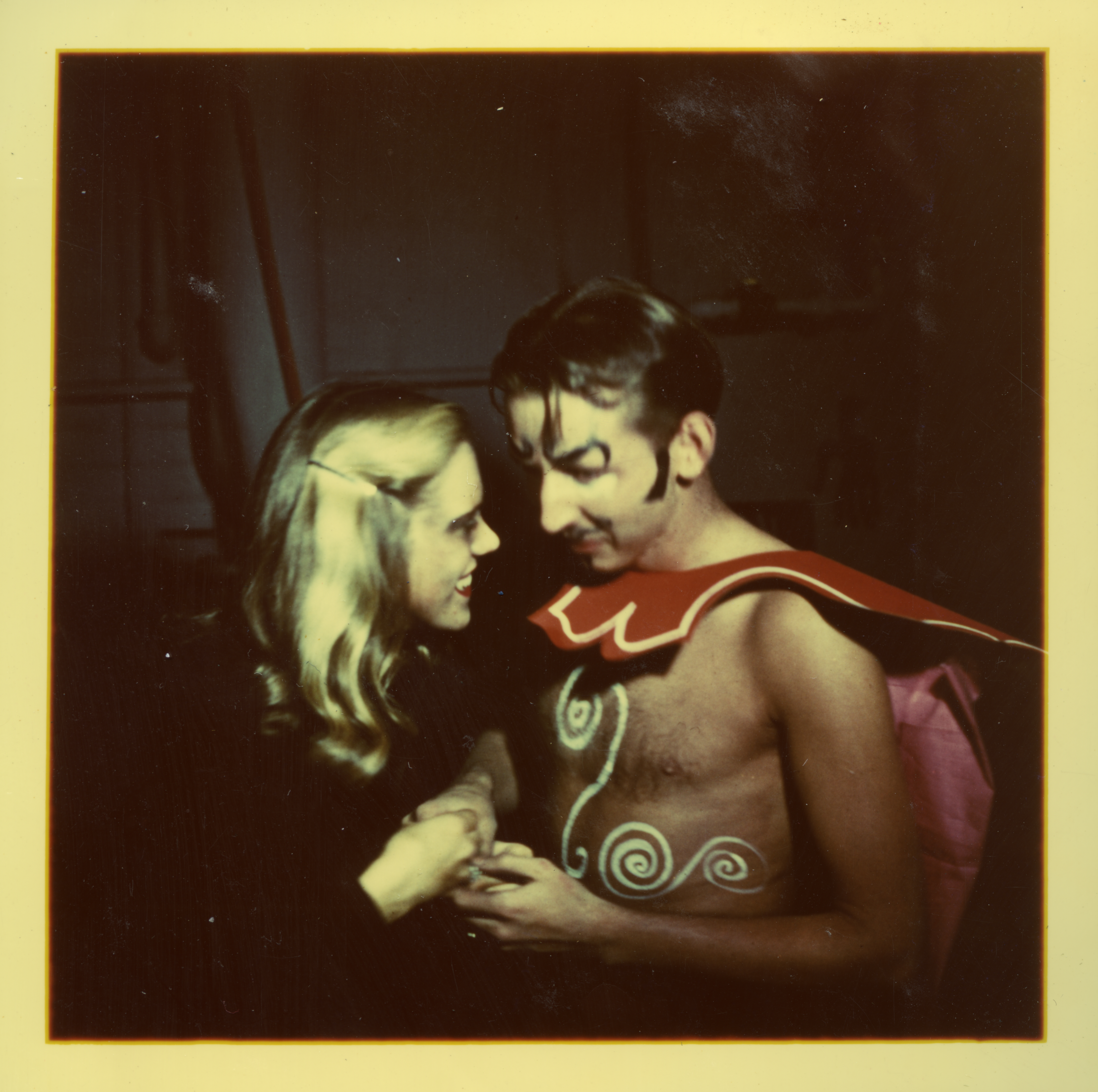
Annie Middleton and a fellow student at one of many costume parties featured in the album, circa 1947-1950. Courtesy of Cranbrook Archives.
The Center wishes all students at the Academy and Cranbrook Kingswood Schools a wonderful 2024-25 academic year!
—Deborah Rice, Head Archivist, Cranbrook Center for Collections and Research
Oakland County is decked out in checkered flags this Friday for the annual Woodward Dream Cruise. As the crowds gather in their folding chairs and thousands of classic cars roar past my windows, I’m reminded of a much more serene image from automotive history: the 1960 Plymouth Suburban stretched out on the manicured lawn of the Frank Lloyd Wright Smith House.
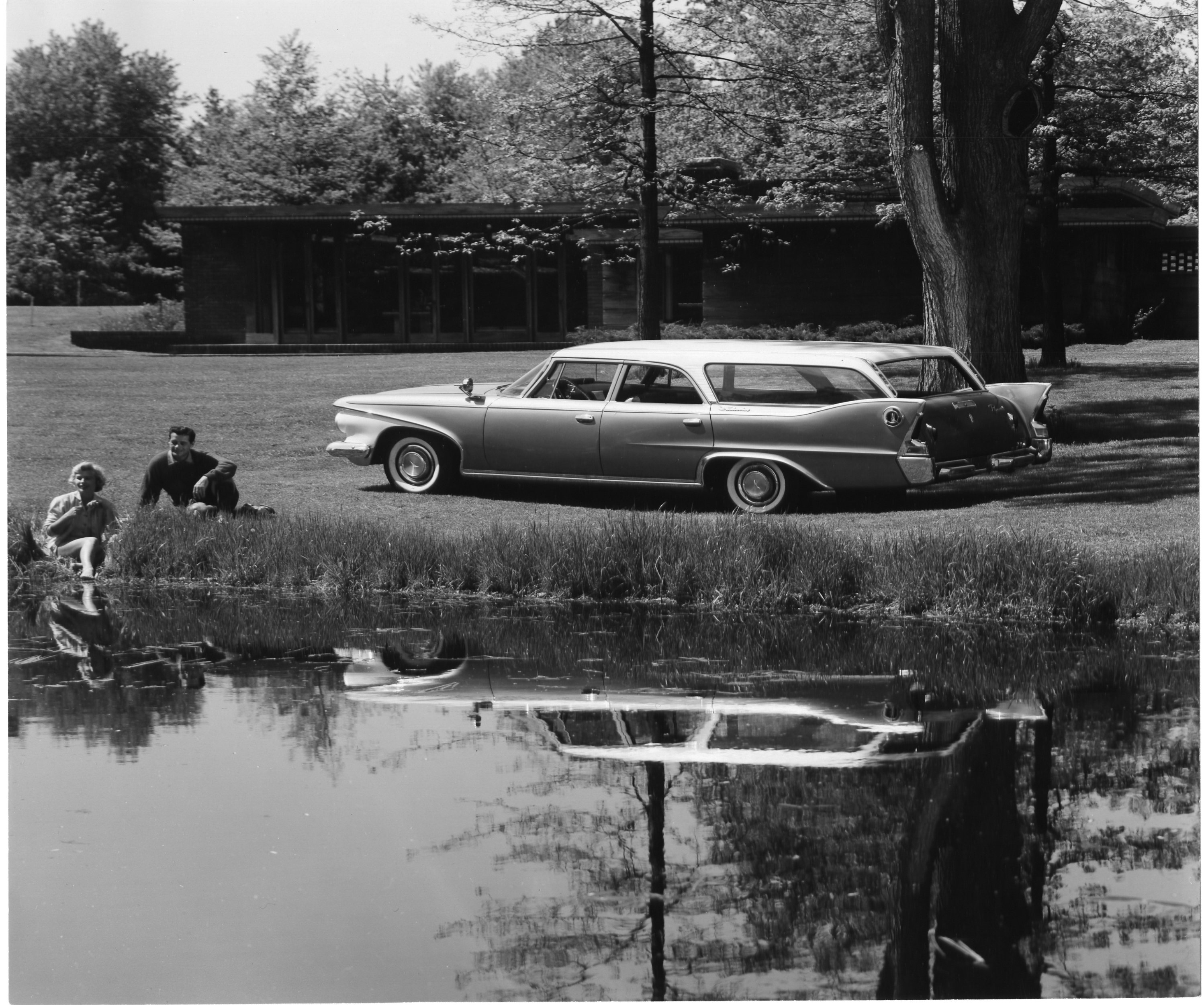
1960 Plymouth Suburban, on location at the Frank Lloyd Wright Smith House. Smith Papers, Cranbrook Archives.
In 1959, Chrysler was developing promotional materials for the 1960 Plymouth. Seeking a sleek, modern backdrop for the long lines of the Suburban station wagon, Chrysler’s Public Relations Department contacted Melvyn and Sara Smith about staging a photoshoot at their Frank Lloyd Wright-designed home in Bloomfield Hills. The resulting photographs show the 18-ft long Suburban, not parked in the pea-gravel driveway or the distinctive cantilevered carport, but pulled to the back of the house where it could be reflected in the natural setting of the Smith’s newly expanded pond.
1960 Plymouth Suburban, on location at the Frank Lloyd Wright Smith House. Smith Papers, Cranbrook Archives.
The long, low horizon line of Frank Lloyd Wright’s Usonian architecture, with its stacking roof planes, seems a great fit for the station wagon’s extended style lines and characteristic fins. In a second image, two casually-dressed models (check out those long socks and walking shorts!) lounge in rattan Tropi-Cal armchairs on the living room patio. Designed by Danny Ho Fong, the Tropi-Cal armchairs were recently identified through the diligent research of the Center’s Summer intern Clare Catallo.
Last weekend, Cranbrook’s Horizons-Upward Bound program celebrated the completion of its fifty-eighth annual six-week summer residency program. Students and their families spent Theme Day on campus learning about the academic and artistic successes of the summer (including a display organized by the Center about our Architecture Elective, and a performance in the Greek Theatre by students and the Autophysiopsychic Millennium collective).
Rosa Parks addresses Cranbrook’s Horizons-Upward Bound graduation, held at Cleveland Middle School, July 11, 1989. Cranbrook Archives.
But did you know that in 1989, HUB celebrated the end of the summer with a special graduation address by legendary activist Rosa Parks? The “mother of the freedom movement,” Parks spoke to Cranbrook’s HUB students in a ceremony held at Cleveland Middle School in Detroit on July 11, 1989.
A speaker at the HUB graduation stands beneath a banner welcoming Rosa Parks, July 11, 1989. Cranbrook Archives.
While we couldn’t find the subject matter of Park’s HUB address or too many details of the special occasion, I am confident we will learn more about this moment in HUB history (and so many others) as Cranbrook Archives embarks on an exciting, multi-year digitization effort of the Horizons-Upward Bound Records made possible by a grant from the National Archives and Records Administration, through the National Publications and Records Commission’s Access Program.
In fact, the work has already begun! During the summer months, two current HUB students worked in the archives, digitizing more amazing materials like these images of Rosa Parks! Look for more Cranbrook Kitchen Sink posts drawn from the HUB collection in the future!
—Kevin Adkisson, Curator, Cranbrook Center for Collections and Research
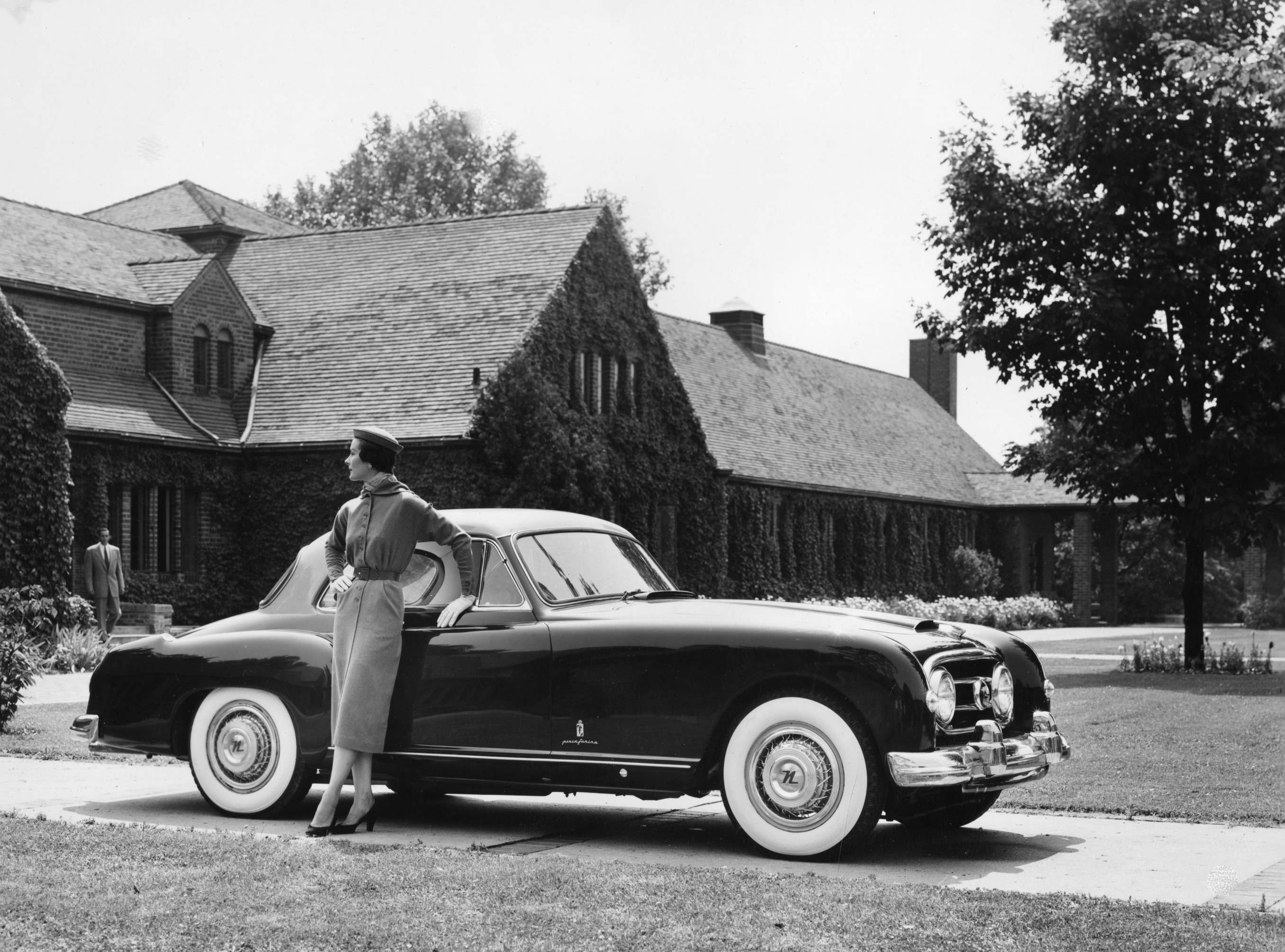
In honor of the Woodward Dream Cruise, happening in front of Cranbrook’s Woodward Entrance as I write, I thought we’d look back at this fabulous photograph of an unknown woman and a beautiful 1950s Nash Pininfarina parked in front of Cranbrook School for Boys’ study hall. This photograph is part of Cranbrook Archives’ Floyd Bunt Papers.
Nash-Healy Pinin Farina parked next to Cranbrook School for Boys, ca. 1956. New Center Photographic, Inc., photographer. Cranbrook Archives.
Toronto-native Floyd Bunt joined the faculty of Cranbrook School in 1944 and taught Chemistry and Engineer Science. He also was the faculty advisor for the Rifle Club and taught auto mechanics classes to the boys, quite possibly using this Nash-Healy Pinin Farina. He eventually served as chairman of the Science Department at Cranbrook from 1964 to 1969.
The Nash-Healy is a two-seat luxury sports car, made between 1951 to 1954. It was one of the first sports car sold in America after World War Two, launched two years before the Corvette. The 1951 models were built in Britain, and the redesigned 1952 through 1954 models built in Turin, Italy by Pinin Farina. There were only 506 of this chic little cars made, and it looks like our photo shows a 1953 roadster. I do wonder who owned it, and why this photo was taken!
Perhaps you’ll be venturing out to Woodward Avenue this weekend for the Dream Cruise. I’ve been enjoying the historic cars that are already cruising; perhaps there’s even a Nash-Healy Pinin Farina out there! Send us a picture if you see one!
—Kevin Adkisson, Associate Curator, Cranbrook Center for Collections and Research
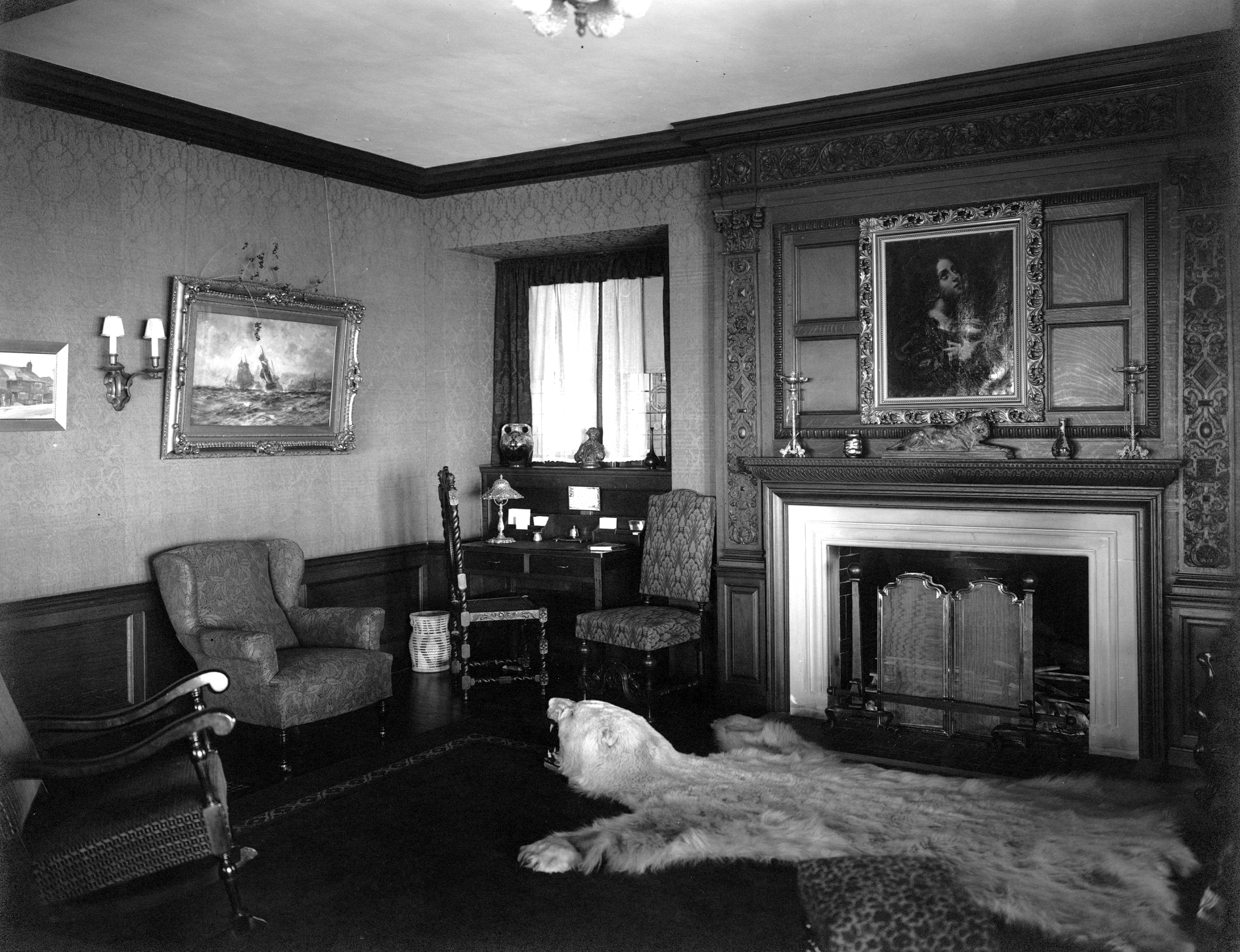
As the temperature dips and the days get shorter, it sure would be nice to end the week reading a book next to a roaring fire. The Booths likely had the same idea their second winter at Cranbrook House, where they could have curled up by the fire…on their new polar bear rug!?
Cranbrook House Living Room, ca. 1909, with one incredible rug. Photo from the collection of Carol Booth. Courtesy Cranbrook Archives, CCCR. Copyright Cranbrook Educational Community.
Elsewhere in the cozy Living Room of 1909, we see objects that are still in Cranbrook House today: the Ships at Sea painting by Robert Hopkin; the bust of Edgar Allen Poe (1898) by George Julian Zolnay; and even the mahogany desk chair, by W. & J. Sloane Company. Some objects are no longer at Cranbrook—the registrar and I can’t quite match the rocking chair, that exact easy chair, the lamp, or the candlesticks to things in the collection. The painting above the fireplace, The Penitent Magdalene after Carlo Dolci, is also no longer here in the house.
Where did these things go? Well, George and Ellen Booth lived in this house for another forty years after this photo was taken! They constantly added to, gifted away, and sold pieces from the collection.
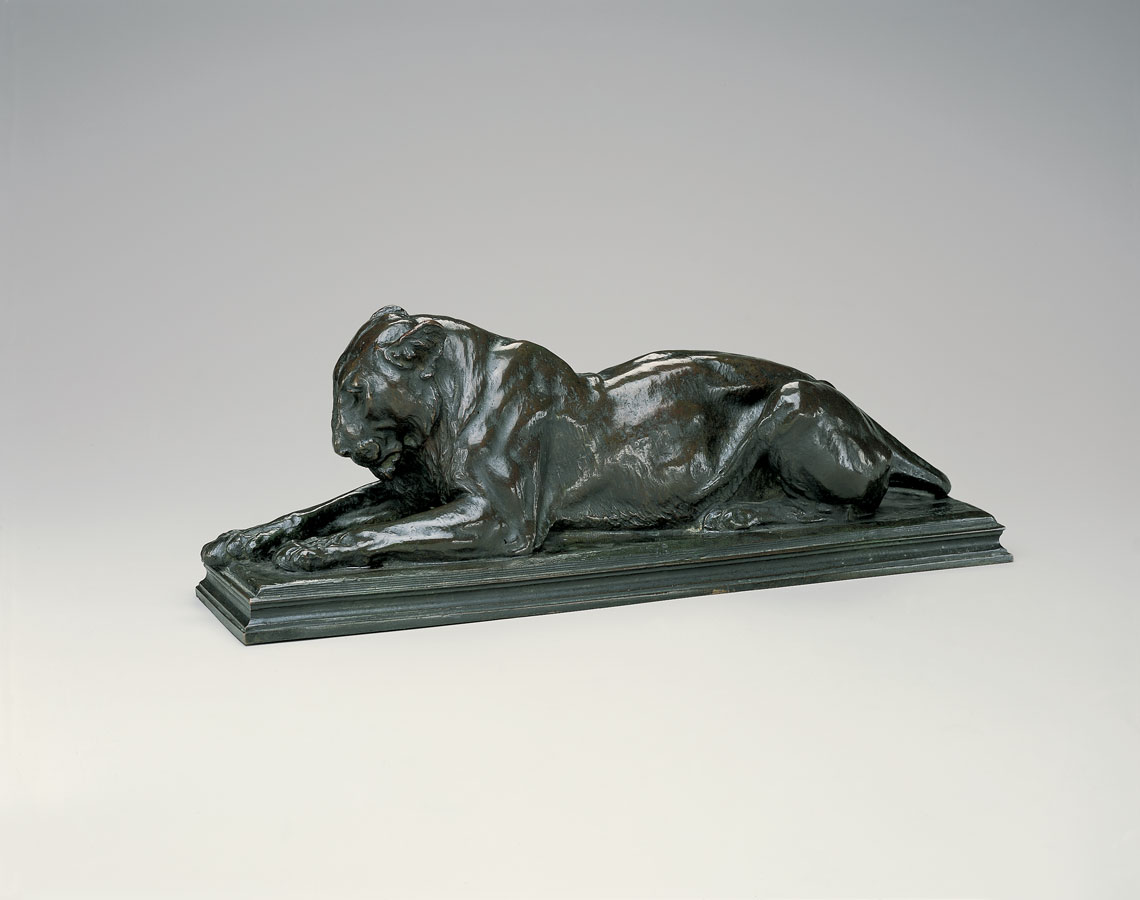
But not everything in this photograph that left the house went entirely off campus. You may notice one piece on the mantle: Recumbent Lioness by Eli Harvey. Booth purchased this sculpture in 1909 from Tiffany & Company in New York. In the 1930s, he gave this lioness to the new Cranbrook Art Museum, where it was assigned the first accession number in the collection: 1909.1. (It’s not actually on campus at the moment: it’s currently on display in Switzerland!)
Recumbent Lioness, Eli Harvey (born 1860, Ogden, Ohio; died 1957, Alhambra, California). Foundry: Pompeian Bronze Works, New York. Bronze; 7.5 x 5 x 21.5 inches. Gift of George Gough Booth and Ellen Scripps Booth, CAM 1909.1. Photograph by R. H. Hensleigh and Tim Thayer. Courtesy of Cranbrook Art Museum.
Using photographs like the one from 1909, as well as diary entries, books, and other records in Cranbrook Archives, I’ve spent the past week re-arranging Cranbrook House’s first floor back to this early aesthetic. On Sunday, the Center is partnering with Cranbrook House & Gardens Auxiliary to present a very special virtual tour: Home for the Holidays at Cranbrook House. I’ll be your host and guide, and will be joined (virtually) by volunteers from the Auxiliary to help share stories from holidays past. I think you’ll really enjoy this tour—there are lots of beautiful things I’ve placed back on display, and we are all very excited to share them with you!
—Kevin Adkisson, Associate Curator, Cranbrook Center for Collections and Research
PS: You’ll need to join our tour Sunday to see if the polar bear rug has made a reappearance!
Congratulations to the Cranbrook Academy of Art students who graduated with their MFA’s and MArch’s today! The ceremony was held in Christ Church Cranbrook, after too much rain water-logged the Greek Theater. Did you know the ceremony used to be held in the library?
Although the Academy welcomed students in 1932, it first granted degrees in 1942 after being chartered by the State of Michigan as an institution of higher learning.
Cranbrook Academy of Art Convocation in the Academy of Art Library, May 1948. Harvey Croze, photographer. Copyright Cranbrook Archives.
The first convocations were held in the Academy Library. Here, in 1948, we see Henry Scripps Booth speaking, with Zoltan Sepeshy seated to his far left and Carl Milles and Eliel Saarinen to Booth’s right. In the foreground of the image, bursting with blooms, is Maija Grotell’s blue and platinum vase of around 1943.
– Kevin Adkisson, 2016-2019 Collections Fellow, Cranbrook Center for Collections and Research
In pre-Columbian Mesoamerica, the calendar originated by the Mayans included 260 days. The “tzolkin” or “division of days” displayed in today’s photo are described as ceremonial or mythological. The calendar pages are part of a series of Mayan glyphs collected by Robert Hall Merrill (1881-1955). Merrill, an engineer and businessman, was a member of the Board of Trustees at Cranbrook Institute of Science from 1944-1953, as well as a consultant in the Anthropology department from 1948-1949.
Tzolkins 6 and 7 from the Robert Hall Merrill Papers, ca 1922.
Mary Miller, director of the Getty Research Institute, describes the Mesoamerican calendar as the oldest and most important calendar system (earliest evidence dating to 800-500 BCE). The original purpose of the 260-day calendar is unknown, but there are several theories. One theory is that the calendar is based on the mathematical operations for the numbers 20 and 13 (important numbers in the Mayan culture). The calendar combines a cycle of twenty named days with another cycle of thirteen numbers to produce 260 days. Each named day has a corresponding glyph as seen in the photo above.
The glyphs are part of a series sent to Merrill by Edith Gates McComas, sister of Maya scholar, William Gates. This extraordinary material was transferred to Cranbrook Archives in 2016.
Recently, I have been researching the objects in the historic rooms at Cranbrook House. The things I have noticed the most about these objects are the details: it seems no object was chosen for the house that did not have detailed ornamental carvings, woodwork, or decoration. Here are a few of my favorites:
Detail of the Zodiac Bowl, given to George and Ellen Booth by Henry and Carolyn Booth at Cranbrook on June 1st 1937 (TH 1993.1)
Detail of the Library’s Edward F. Caldwell & Company chandelier (CEC 535.2)
Detail of the Library’s Edward F. Caldwell & Company chandelier (CEC 535.1)
Detail of Queen Anne Style Settee upholstery (CEC 335)
Detail of Oscar Bruno Bach table lamp finial (CEC 292)
Detail of Queen Anne Style Open Armchair upholstery(CEC 261.4)
Detail of Edward F. Caldwell & Company table lamp (CEC 234)
Detail of andirons by Samuel Yellin (CEC 233)
Details of cassone chest by an unknown Italian maker (CAM 1929.74)
Detail from circa 1926 Reproduction Pompeian Hydria (Jug) (CIS 10368)
Detail of table lamp originally used in George G. Booth’s Bedroom (CEC 124)
“Craig the Faithful” stained glass panel (CEC 137)
In preparing for the Center’s upcoming Edible Landscapes Dinner, I came across a series of images from a photo shoot of George and Ellen Booth in the 1940s. Some images were clearly taken in the Cranbrook House Library or Oak Room, but other images were harder to place.
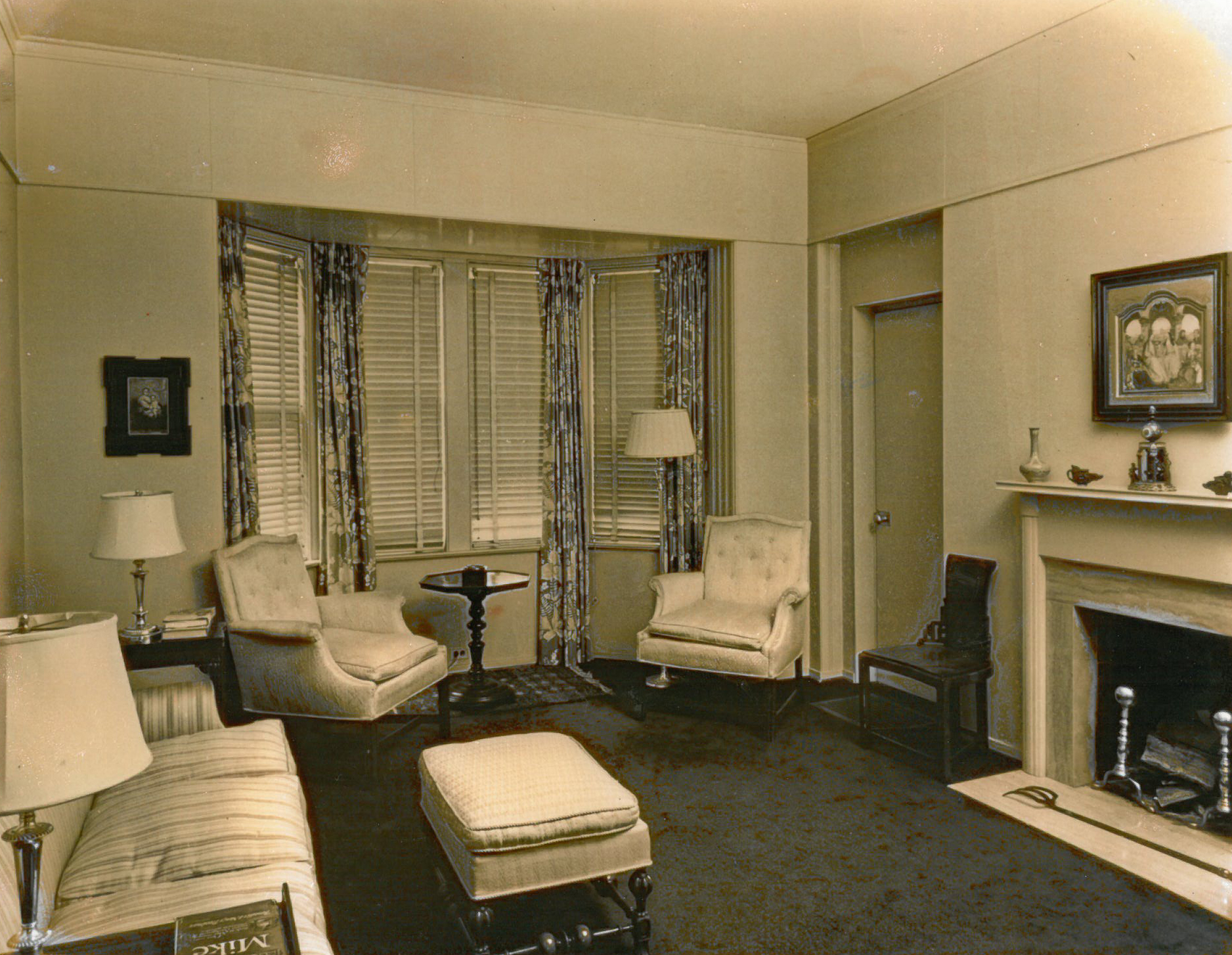
Here, George and Ellen are seated with a magazine, and she is examining a vase. Below (after a wardrobe change), they’re seen opening a package. While it may not look like a room we know in Cranbrook House, they’re in Mrs. Booth’s Morning Room—Mr. Booth’s old office.
With the completion of the West Wing addition to Cranbrook House in 1918, George Booth relocated his office to a largersuite of rooms beyond the grand new Library. His first office, original to the 1908 home, was converted into a Morning Room for use by Ellen. The conversion was spearheaded by the Booth children, who remodeled the space as a Christmas gift for their mother in the 1930s. Mrs. Booth apparently loved the room, and made great use of its bright, cheery atmosphere.
Ellen Booth’s Morning Room in Cranbrook House, 1952. Cranbrook Archives.
George insisted that the renovation of his old office be reversible to theoriginal Albert Kahn design. You can see in the photographs the seams of the panels that made up the new pale walls. In 1993, the room was returned to its original appearance as George’s office by the Cranbrook House & Gardens Auxiliary.
The images from this photo shoot in the 1940s have been used over the years in various Cranbrook histories and publications focused on the Booths themselves. I’m appreciating the photos for showing a small glimpse into the life of Ellen and her now-gone Morning Room.
– Kevin Adkisson, Collections Fellow, Cranbrook Center for Collections and Research







 Cranbrook Kitchen Sink