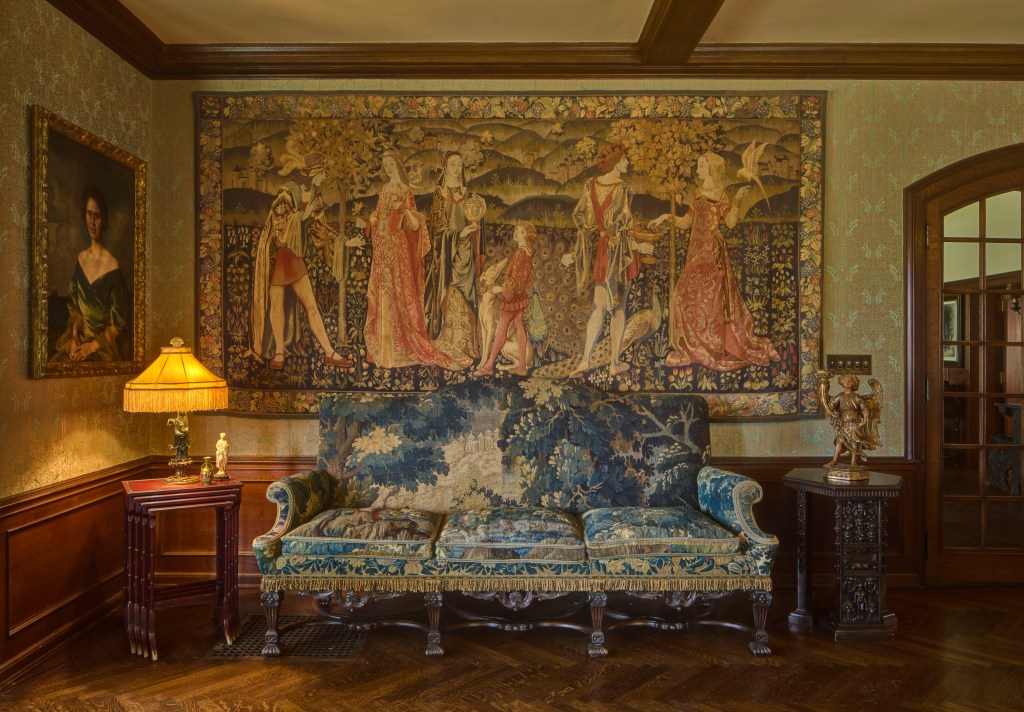
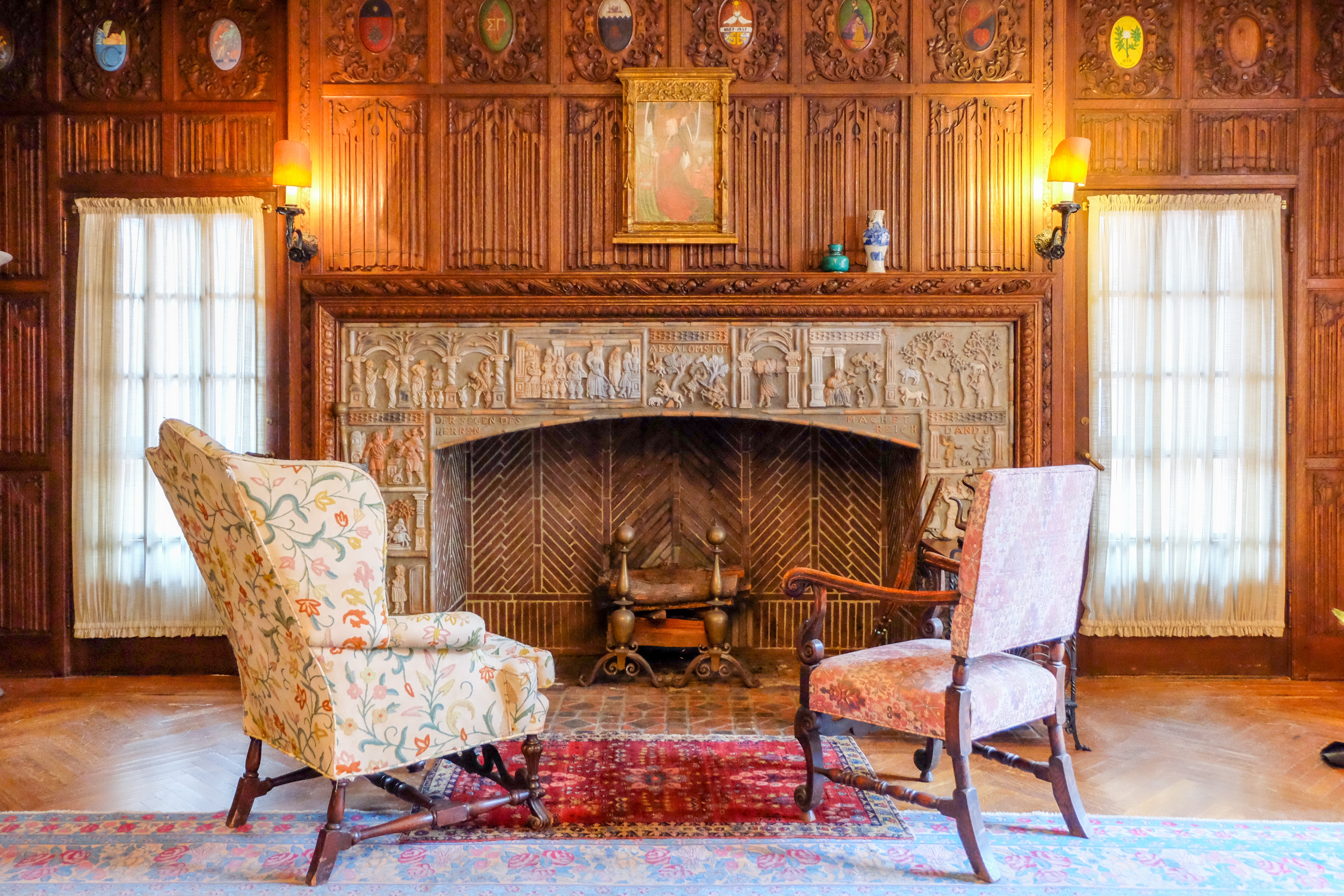
The Herter tapestry in the living room of Cranbrook House. Photograph by James Haefner, 2026.
The tapestry that now hangs on the east wall of the living room at Cranbrook House fools the eye of many visitors; far from the medieval masterpiece it appears to be, it was in fact woven in the early twentieth century by Herter Looms in New York. George Booth purchased the untitled tapestry in 1919; from that date until at least 1937 it hung in the living room of Cranbrook House, before the Booths gave it to Cranbrook Art Museum in 1943.
Tapestry-making is an ancient art form, which peaked in the medieval period, but by the nineteenth century had declined until only a few government-run workshops remained in Europe. In 1881, William Morris, England’s leading Arts and Crafts designer, founded a new tapestry workshop at the historic Merton Abbey, on the river Wandle, a tributary of the Thames. Morris began by teaching himself to weave, before recruiting others to work at the looms. He hired his close friend, Edward Burne-Jones, to create new designs rooted in the medieval tradition for the tapestry works. Through a year of experimentation, Morris also re-discovered the correct use of the traditional natural dyes that had been abandoned by manufacturers in favor of lurid, but fugitive, chemical-based colors. George Booth would purchase four tapestries from the Merton Abbey works; three he gave to Christ Church Cranbrook, and the fourth to the Detroit Institute of Arts.
Albert Herter, the designer of this tapestry, was a painter and, like William Morris, an enthusiast of traditional crafts. He was one of a number of American artists who sought to revive tapestries for the modern home, following William Morris’s inspiring example. Because of the specialized nature of the work, Herter employed weavers trained at Gobelins and Aubusson, who immigrated to America following his offer of employment at his workshop. Though he sought to train American workers at his factory as well, Herter always relied primarily on weavers already expert in the craft, and often sent designs overseas to be completed in France.
This tapestry depicts a festive scene in a medieval garden, but it does not pretend to be truly medieval: the poses of the figures, their costumes, and the fairytale landscape behind them all speak to a late-nineteenth-century aesthetic, influenced by the paintings of the Pre-Raphaelite movement, and particularly the work of Morris’s friend, Burne-Jones. Today, it remains a highlight of Cranbrook House, speaking to the Booth’s longstanding love of all things medieval.
To learn more about William Morris, Edward Burne-Jones, and the medieval revival, as well as their connection to Cranbrook, join us next week for a lecture and one-night-only exhibition at Cranbrook House!
Camelot to Cranbrook: King Arthur and the Arts & Crafts Movement
— Mariam Hale, 2025-2026 Martha J. Fleischman Collections Fellow
(This week’s Photo Friday is coming to you one day early, as the Cranbrook Center for Collections and Research will be closed tomorrow in honor of Juneteenth.)
Things have been happening in the Archives behind the scenes this past Winter. As we transition into Spring (I think?), I thought I’d share just a couple of new developments that we are all very excited about.
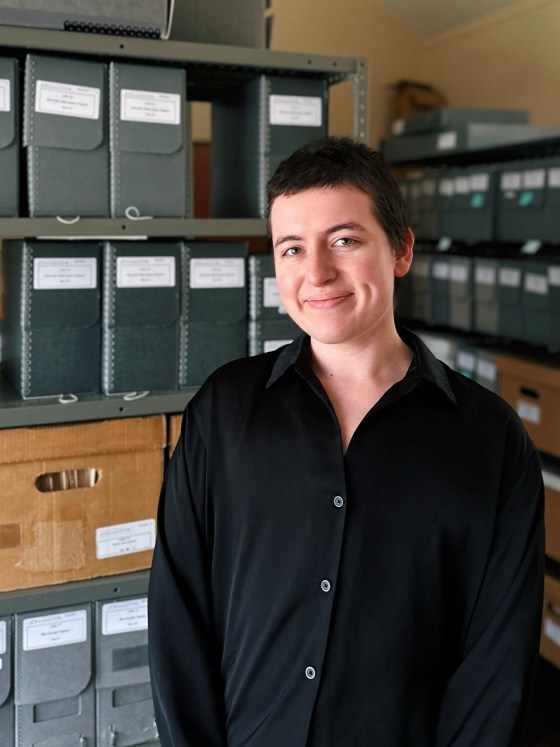
At the end of February, the Center welcomed Associate Archivist Xavi Danto. Xavi comes to Cranbrook Archives with five years of experience in a variety of academic and cultural heritage settings. Among other things, they have worked with web archives at the Lincoln Center for the Performing Arts, born-digital art for Rhizome at the New Museum, and architecture faculty papers at Pratt Institute Archives. A Visual and Critical Studies graduate of the Art Institute of Chicago, Xavi received their MS in Library and Information Science with an Advanced Certificate in Archives from Pratt Institute in 2025.
Xavi brings a personal passion for all things Cranbrook and an impressive enthusiasm for archival work that has already proven invaluable in their short time here. So far, they’ve been busy assisting with the preservation of both physical and digital materials, implementing new digital preservation tools, and diving into the arrangement and description of their first institutional records collection. Join us in welcoming Xavi and look forward to hearing from them on the blog soon!
I’m also pleased to announce the launch of the Cranbrook Archives Janice and Barry King Visiting Scholars Fellowship. An annual award for qualified researchers, whose work will benefit from utilizing our collections in person, stipends are now available to offset travel costs associated with one-to-two-week visits. We invite interested artists and scholars with projects leading to publication, lecture, film, public performance, or exhibition to learn more and apply through the Center’s website.
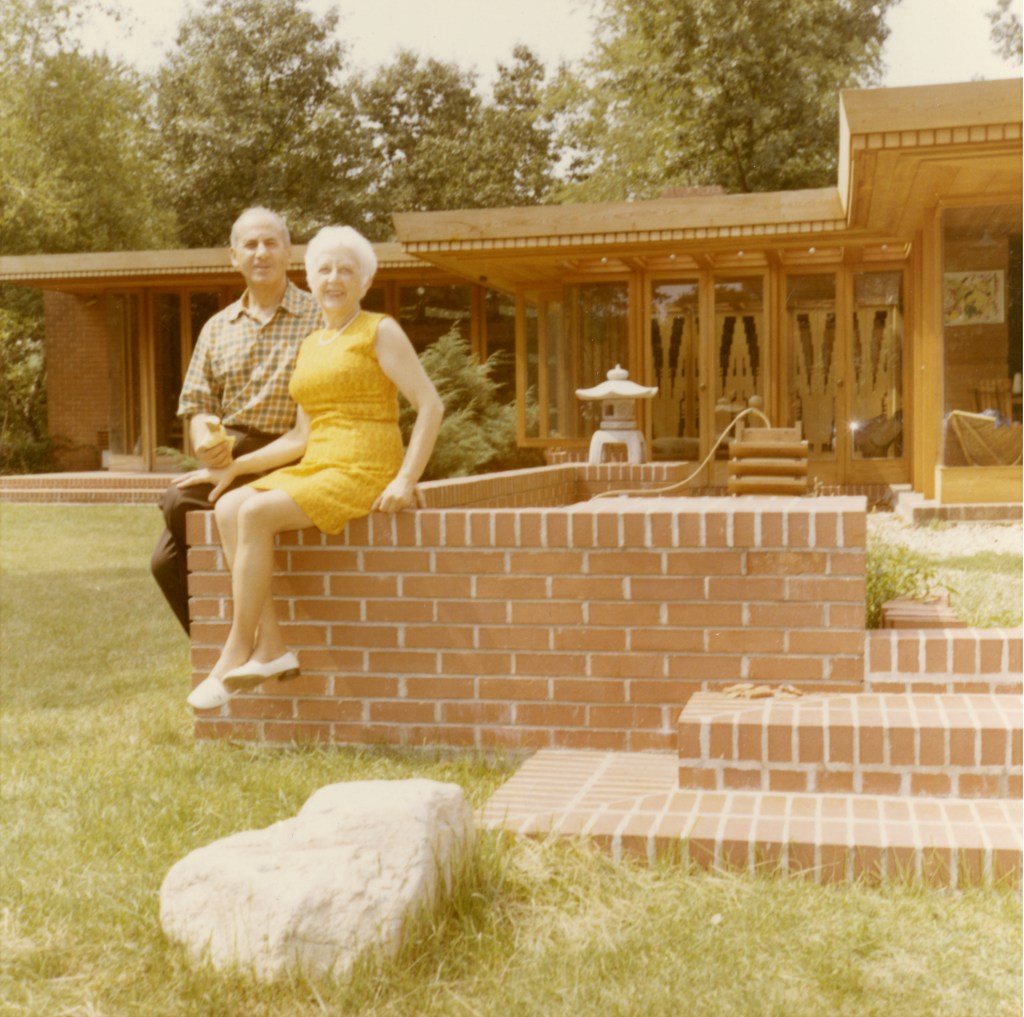
Lastly, we’ve added new materials to our collection finding aids, like the Clifford Bateman and Joy Griffin West Papers, and digital collections, like this fabulous photo of Melvyn and Sara Smith on the unfinished terrace of their Frank Lloyd Wright home. Be sure to check both sites regularly for the latest additions!
Circa 1970. Courtesy of Cranbrook Archives.
—Deborah Rice, Head Archivist, Cranbrook Center for Collections and Research
Cranbrook Archives is excited to announce the acquisition of the Clifford B. West and Joy Griffin West Papers. Since the boxes arrived this past summer, I have been inventorying their contents in preparation for making them accessible to the public for research. Completing this work involves continually unravelling the many interesting facets of Clifford and Joy’s stories to be brought to light through the collection. Among many other things, are their experiences at Cranbrook in the mid-twentieth century.
Joy Griffin and Clifford West in front of Carl Milles’ sculpture on the north wall of the Academy of Art library, 1941. Harvey Croze, photographer. Courtesy of Cranbrook Archives.
Clifford and Joy attended the Academy of Art at the tail end of its golden age, meeting and marrying in 1941. At that time, Carl Milles, Eliel Saarinen, Loja Saarinen, and Eero Saarinen taught and worked on campus. Clifford earned his MFA in painting under Zoltan Sepeshy and Joy took ceramics classes from Maija Grotell. Fellow students included Lily Swann Saarinen and Harry Bertoia, among others.
Bertoia and West: Three Decades
It was with Harry Bertoia, sculptor and designer, that Clifford enjoyed a lifelong friendship, serving as best man at his 1943 wedding to Brigitta Valentiner (fellow Academy student and daughter of Wilhelm Valentiner, Director of the Detroit Institute of Arts). While living in different parts of the country after graduation (or different countries all together), the two artists maintained close ties, both personally and professionally, evidenced by correspondence and other materials found in the Wests’ papers. Of particular note is the original 16mm film Clifford made in 1965, titled Harry Bertoia’s Sculpture, featuring a soundtrack by Bertoia.
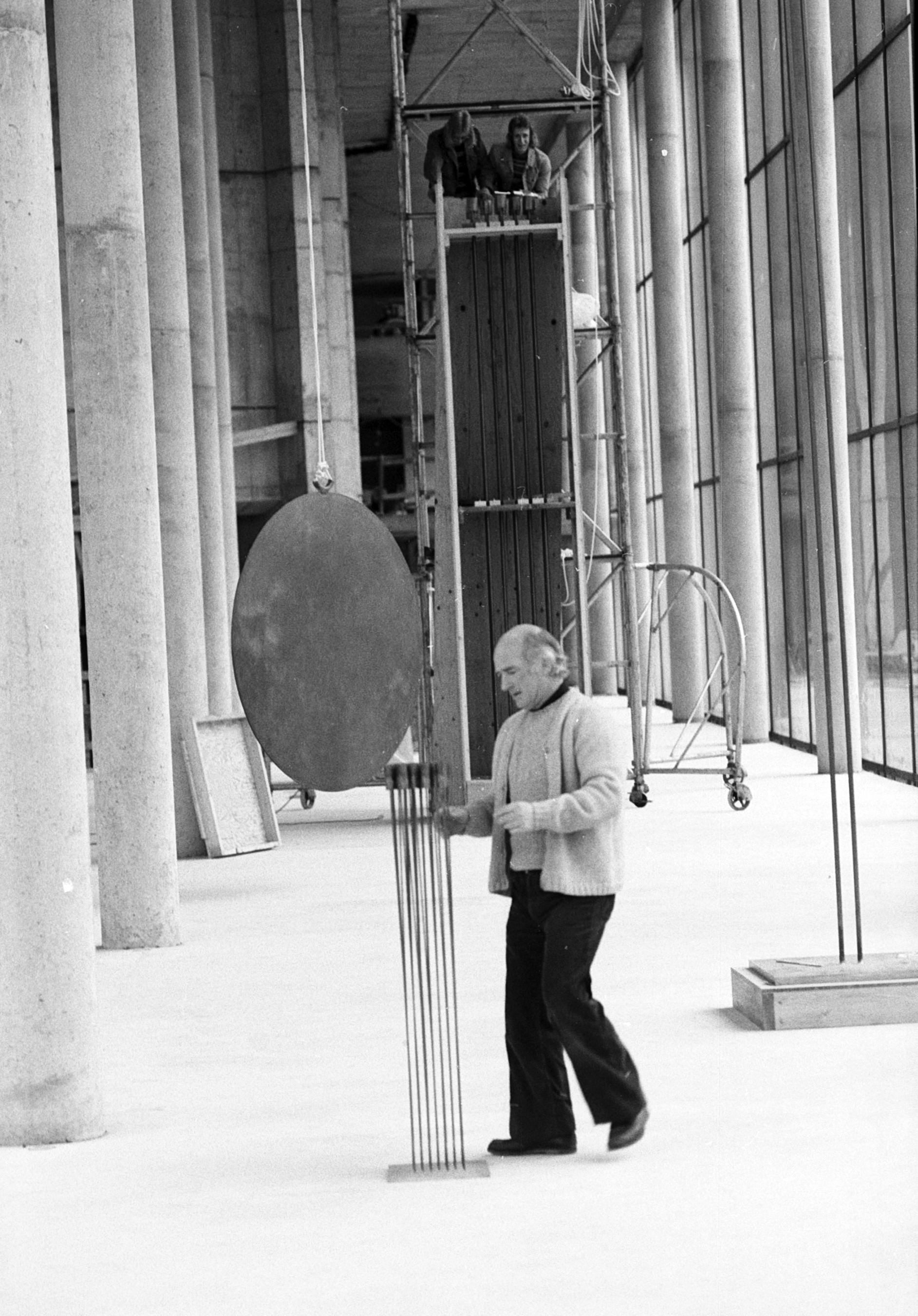
Harry Bertoia in his studio, circa 1976. Clifford West, photographer. Courtesy of Cranbrook Archives.
Another fascinating connection is Clifford’s involvement with a few 1976-1977 exhibitions of Bertoia’s sculptures in Norway. Bertoia’s work, including his sound sculptures, had been introduced to the Norwegian art scene in the late 1960s through Bente Torjusen, an educator at the Munch Museum who assisted Clifford on his 1968 film about artist Edvard Munch and later became his third wife. An accomplished filmmaker and photographer by the late 1970s, Clifford photographed the Bertoia exhibitions and designed the accompanying catalogs. In true Cranbrook fashion, Clifford’s artistic talents were not limited to just one medium.
Poster for The Sculpture of Harry Bertoia exhibition at the Grieg Music Festival, Bergen, Norway, 1976. Clifford West, photographer and designer. Courtesy of Cranbrook Archives.
On left: Bertoia installs his sculpture at Grieg Hall, Bergen, Norway, 1976. Clifford West, photographer. On right: Children enjoy outdoor sculpture at, Harry Bertoia, at the Henie-Onstad Foundation, Oslo, Norway, 1977. Clifford West, photographer. Courtesy of Cranbrook Archives.
The exhibitions would be the last collaborations between Clifford West and Harry Bertoia, as Bertoia would succumb to lung cancer one year later. Fifty years on, Cranbrook Art Museum will celebrate Harry Bertoia in an upcoming exhibition, opening summer of 2027. Bertoia’s work was last featured at Cranbrook in the 2015 exhibition, Bent, Cast, and Forged: The Jewelry of Harry Bertoia, which marked the centennial of his birth and the first exhibition devoted to his jewelry designs (see the full catalog here).
I look forward to uncovering and sharing more about Clifford and Joy’s remarkable lives. Stay tuned!
—Deborah Rice, Head Archivist, Cranbrook Center for Collections and Research
Related announcement from the Harry Bertoia Foundation:
The Harry Bertoia Catalogue Raisonné is announcing a call for works from the Cranbrook community to more fully develop the publication’s coverage of the artist’s early jewelry practice, a currently under-described area of the artist’s oeuvre.
Present owners of jewelry believed to be by Bertoia are invited to contact the Harry Bertoia Foundation and Harry Bertoia Catalogue Raisonné by sending an email to: catalogue@harrybertoia.org, and submitting an owner questionnaire, available on our website. Museums, art galleries, and other institutions that are in possession of works by the artist are also invited to submit relevant data and photographic documentation. All information will be treated with discretion and held in strictest confidence.
I have really enjoyed my time with the Horizons-Upward Bound (HUB) collection and community. Nearing the end of my role as project archivist for HUB’s digitization project, I’d like to share my experiences in my final post. Unlike prior archival projects I’ve contributed to, I experienced all aspects of the HUB project from beginning to end. I cherish early memories of lugging many boxes across campus from storage into my work area with head archivist, Deborah Rice. Seeing over 15 boxes packed with records, I could feel the weight of what two years of digitization might be like. Now after moving them back into storage, my work space feels a little empty. But I hold a sense of accomplishment knowing that all is digitized, described, and now available for public access!
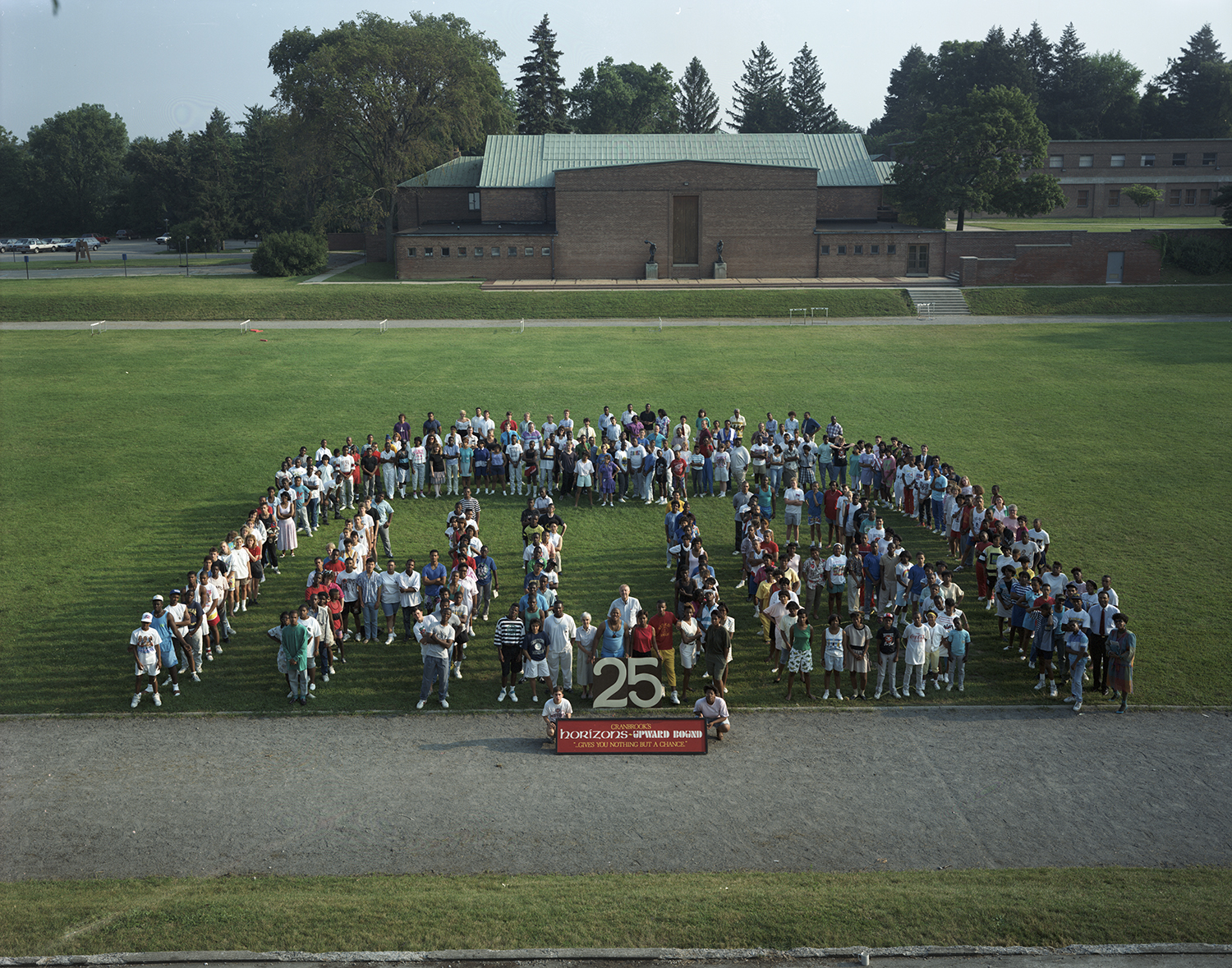
One of my favorite group images: HUB 25th anniversary aerial group photo, Summer 1989. Jack Kausch, photographer. Courtesy of Cranbrook Archives.
Being with Cranbrook Archives for two years, I’ve gained lessons, memories, and relationships. It will be bitter-sweet to leave. So, to help keep things fun and light, I’ve condensed my reflections and favorite HUB collection items into a top five list. I hope you enjoy!
First, a disclaimer…picking only five out of 3500+ items is pretty wild, in my opinion (though useful for brevity). So let’s just say, the following are my top five at this moment.
5. Annual Reports
Cover of Horizons-Upward Bound Annual Report, 1978-1979. Courtesy of Cranbrook Archives.
The annual reports were the first records I digitized and a fun gateway to studying HUB’s history. They also helped to identify and describe other material in the collection throughout the project. I became familiar with staff names/roles, faculty insights, courses and programs, case studies, and more. I especially hold a soft spot for physical media like this (including HUB’s class brochures) because they document the historical impact of such programs across multiple years. Initially created for promotional purposes, the reports can now live a second life as memory/reference tools for HUB’s community and the broader public today.
4. Media & Technology
HUB student playing piano in auditorium, Summer 1971. Courtesy of Cranbrook Archives.
My next highlight involves working with various technologies and materials. The date span of the collection, 1965 to 2000, provided a wide range of media not as common in our digital-driven world today, like cassette tapes, photographic prints, slides, and negative film. (See my post on Digitizing HUB’s Visual History to learn more about HUB’s photographs.)
I think I most enjoyed working on the negatives and cassette tapes. Both required learning advanced imaging software and working with converter hardware to digitize the tapes. Plus the older media itself was just fun to view and handle. For instance, we have contact sheets of photographs like the above shot through a fisheye lens. By also having an art and design background, it felt rewarding to apply my imaging skills in a different way for the archives.
3. HUB Stories
HUB graduates gather to share memories on graduation day at Cleveland Middle School, May 1994. Courtesy of Cranbrook Archives.
My third memorable takeaway is learning various stories from the HUB collection. Three stand out, in particular: the origin story of HUB’s flag designed by Gregory Loving (HUB ’74); HUB’s SoulFest community fundraiser inspired by HUB parent Lula Barnes and organized by Margot Snyder; and a personal account of Detroit’s 1967 Rebellion found among administrative records. Many graduation photos, as pictured above, also stand out, bearing witness to stories yet to be shared on the official record. I hope that my findings are only a prelude to many more HUB stories being accessed by the public through our digital collection.
2. 1984 Student Films
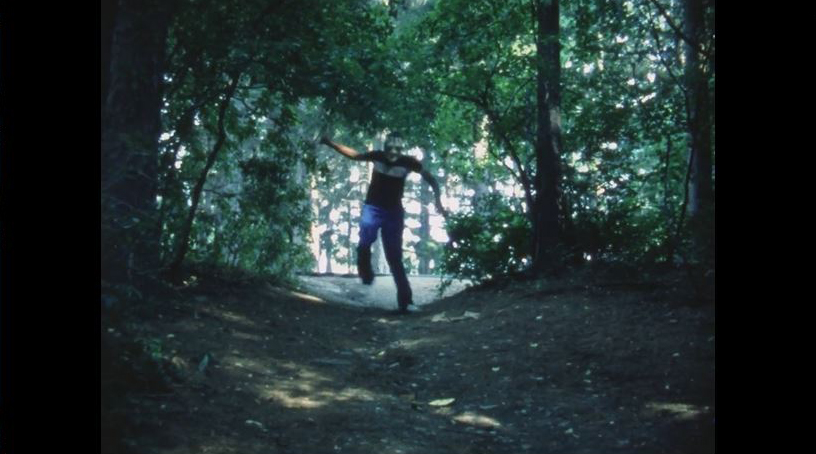
Video still from HUB student film, Dormitory of the Dead, 1984. Courtesy of Cranbrook Archives.
In second-place are the short student films produced in 1984. I wrote about their discovery in a previous blog, but to summarize, the films were influenced by 1980s pop-culture: a rom-com (Farewell My Summer Love) and two slasher-thrillers (Dormitory of the Dead and The Nightmare). HUB students asserted themselves as actors, producers, writers, and engineers during a time when diverse representation was less common in American pop culture than today.
During HUB’s 2024 summer assembly, I presented the films to students in the form of a trivia game. I’m not sure what I enjoyed more, sharing 1980s references with the students or hearing their insights about pop culture and the film genre.
Cover of HUB Literary Magazine, 1973. Courtesy of Cranbrook Archives.
Honorable Mention:
Also a favorite are other creative works made by HUB students like literary magazines, newsletters, and visual art.
1. Community Relationships
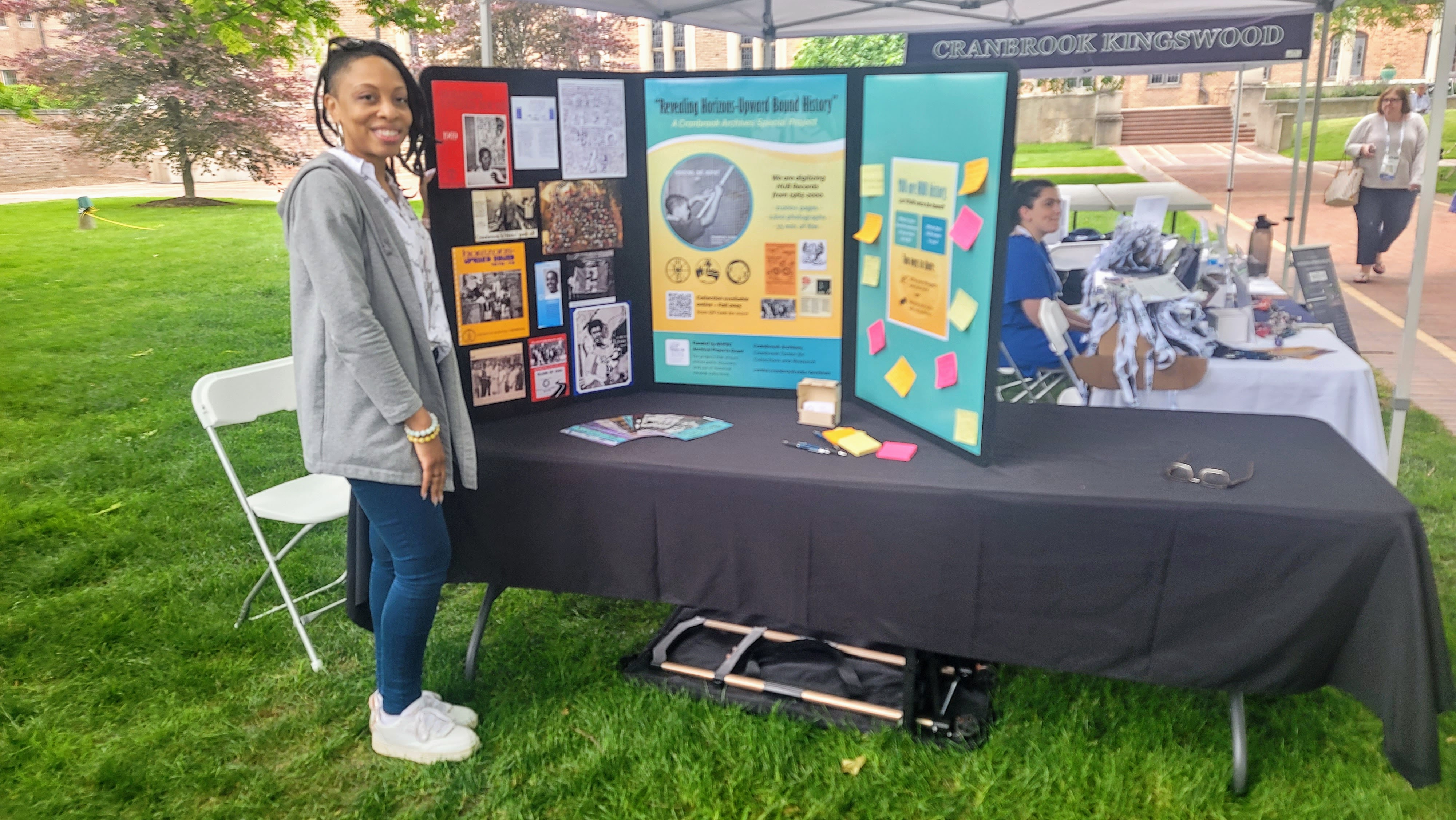
Project archivist Courtney Richardson at HUB display during Cranbrook Schools Reunion Weekend, June 2024. Deborah Rice, photographer. Courtesy of Cranbrook Archives.
Finally, my number one HUB memory are the memories-to-come (is that cheating?)! Pictured above is our archival display at HUB’s class reunion in Summer, 2024. I designed an info-graphic poster, small photo exhibit, and keepsake bookmarks highlighting items from the collection. The best part of this day involved Deborah and I gathering brief audio and written memories from alumni across classes from the 1960s to 2020s.
I thoroughly enjoyed connecting with the HUB/Cranbrook community over the last two years, discussing their stories while creating new memories to archive. Multiple times throughout the project, I connected with HUB alumni, students, and administration at class events, board meetings, and volunteer sessions (shout out to Barry Z. Roberts, HUB ’77) at the archives studio.
HUB students being transported to campus on HUB’s opening day, July 1978. Jack Kausch, photographer. Courtesy of Cranbrook Archives.
Thank you to HUB Director Lisa Smoots, HUB Director of Development Dillon Brown, and the HUB Advisory Board: Debra DeBose (former HUB Director of Development), Eric Brown (HUB ’82), Kenton Mills (HUB ’90), Barry Z. Roberts (HUB ’77), and Lynn Wiggins (HUB ’97). To my dear archives colleagues, Deborah Rice, Laura MacNewman, and Meredith Counts: I’ve learned so much from you and enjoyed our time together! I’m also grateful to the entire Center of Collections crew for welcoming me into the Cranbrook community!
—Courtney Richardson, Project Archivist, Cranbrook Center for Collections and Research
HUB digitization was funded by a NHPRC Archival Projects Grant for projects that ensure online public discovery and use of historical records collections. The NHPRC was established by Congress in 1934 as a statutory body affiliated with the National Archives and Records Administration and chaired by the Archivist of the United States.
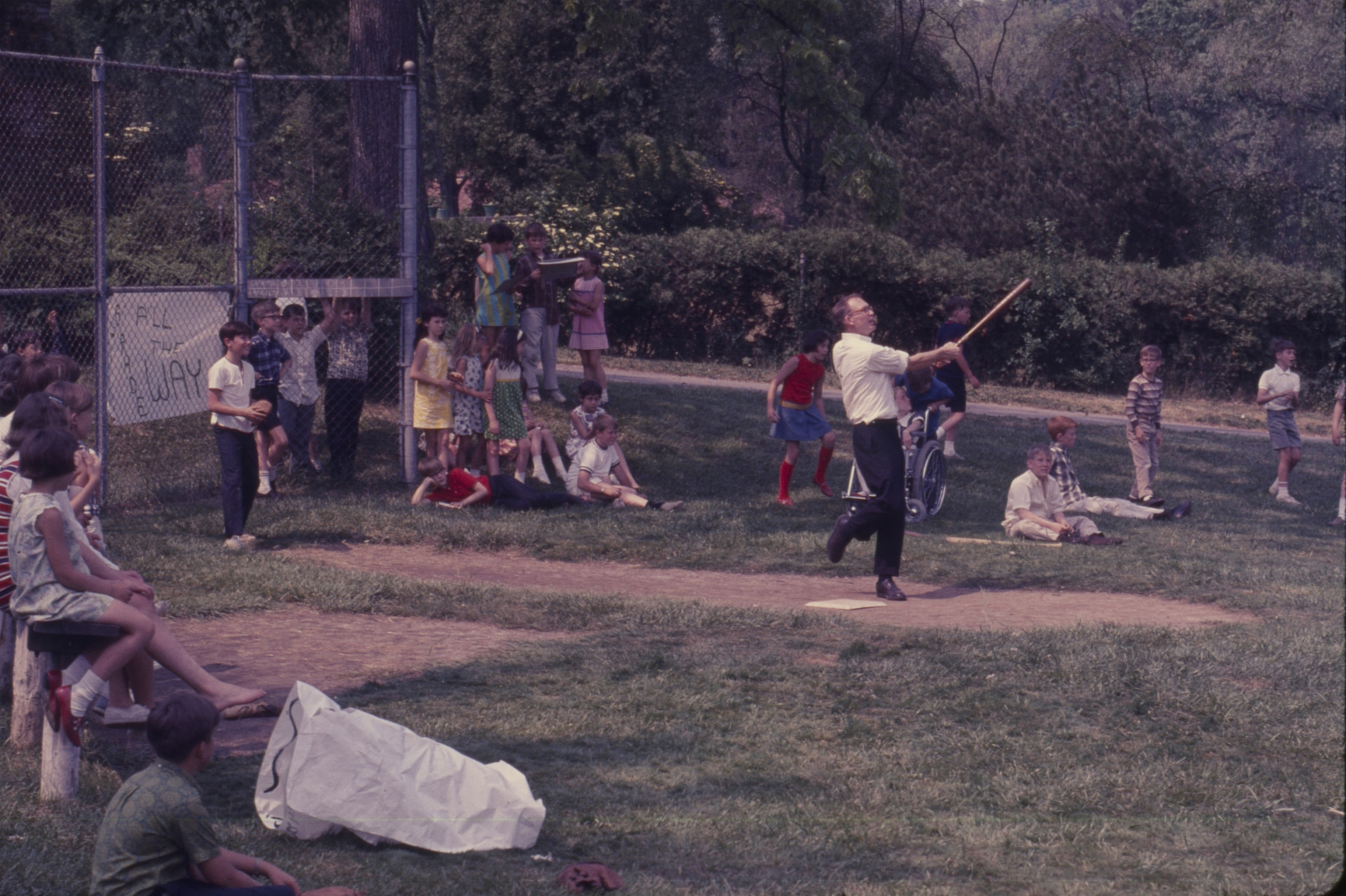
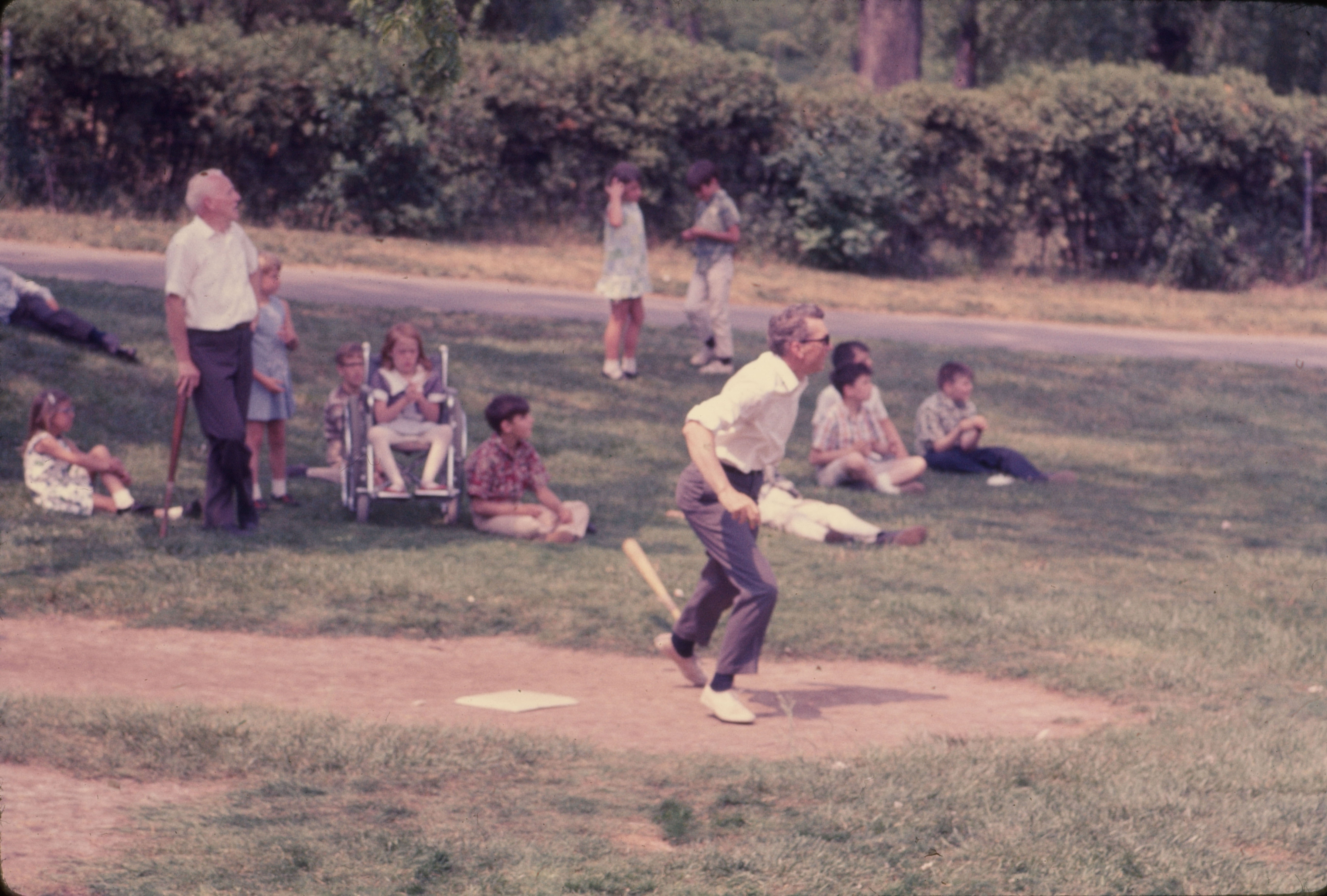
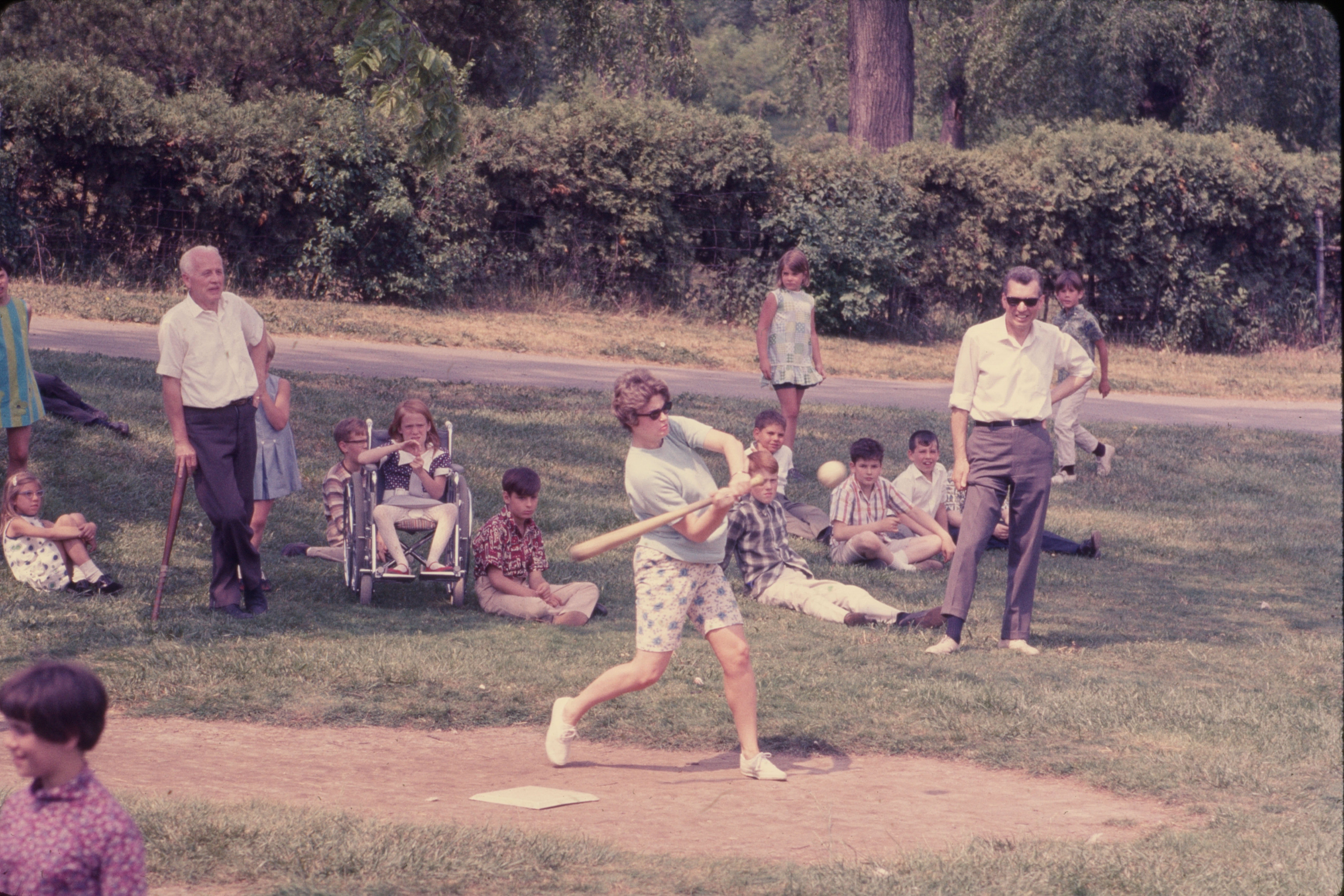
For many years, one of Brookside School’s highly anticipated end-of-year traditions was the Faculty/Sixth Grade Softball game. Every June, faculty and sixth graders would meet on the sandlot at Hedgegate, the faculty residence, to play against each other in friendly rivalry. It was a special day when students could play their favorite pastime with their teachers.
Brookside School Headmaster, Jock Denio, at bat, June 1967. Courtesy of Cranbrook Archives
We recently received an addition to the James Carmel Papers from his son, which includes slides capturing the June 1967 softball game. The colorful images convey the camaraderie and joy of the event, with both faculty and students enthralled by the gameplay.
Brookside School students watch the softball game, June 1967Carolyn Tower and Paul Gerhardt, June 1967Louis Beer, June 1967Carolyn Tower at bat, with Paul Gerhardt, Louis Beer, and Brookside students looking on, June 1967. All images Courtesy of Cranbrook Archives
The sixth graders were up against Jock Denio, Brookside’s long-serving Headmaster; Carolyn Tower, music teacher; Louis Beer, third-grade teacher; and Paul Gerhardt, social studies teacher and director of testing and records.
In my work “fielding” research inquiries, I find that there is always a heartfelt nostalgia and tenderness in the memories and stories evoked by Brookside, a Cranbrook institution so deeply cherished by its alumni and former staff.
— Laura MacNewman, Associate Archivist Cranbrook Center for Collections and Research
In November of 1920, George Gough Booth was getting impatient. For two years, his home, Cranbrook House, had been a construction site as the new library wing and east wing were slowly completed. A series of letters from George Booth to the Massachusetts woodcarving firm, William F. Ross & Co., implored them to finish the paneling in the east wing’s new Oak Room in time for the holidays.
By the end of the month, the room was finished, its four walls covered with hand-carved oak paneling designed by John Kirchmayer.
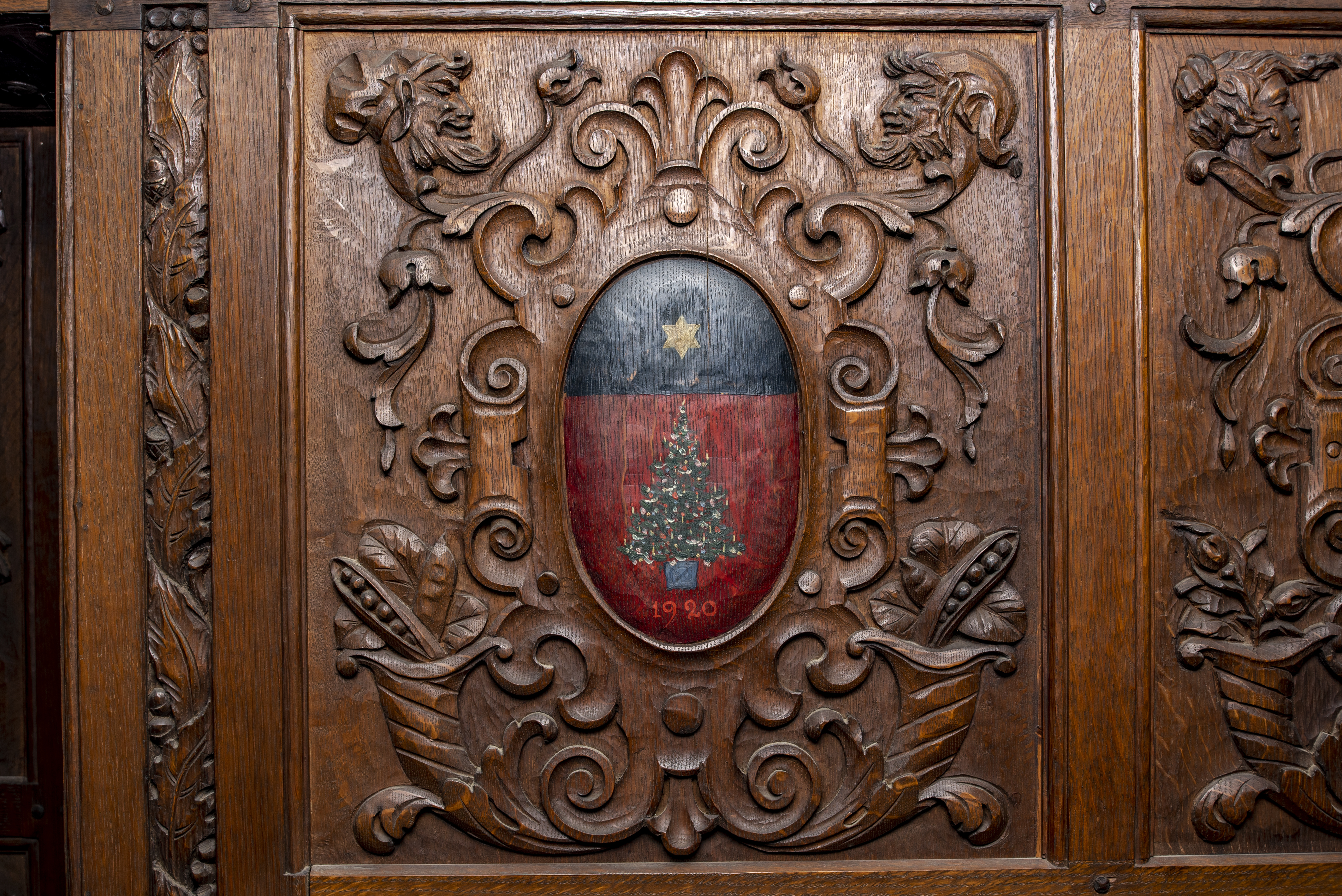
The Booths celebrated Christmas in the Oak Room that year, for the first and only time. A few years later, to commemorate the holiday, their youngest son, Henry Scripps Booth, painted a Christmas tree on one of the panels over the fireplace. Harry took advantage of the empty space at the center of the panel’s cartouche: a smooth, enclosed oval.
The Christmas panel is one of the first five cartouche paintings (all added above the fireplace) designed and executed by Harry in 1922. Each commemorated events held at Cranbrook House in 1920 (Christmas) and 1921 (a Sigma Gamma Association picnic outing; an engagement party for Ruth Raymond to Norton Ives and Margaret Booth to Frazer Whitehead; Warren Booth and Alice Newcomb’s pre-wedding dinner; and Ellen Scripps Booth’s surprise 58th birthday party).
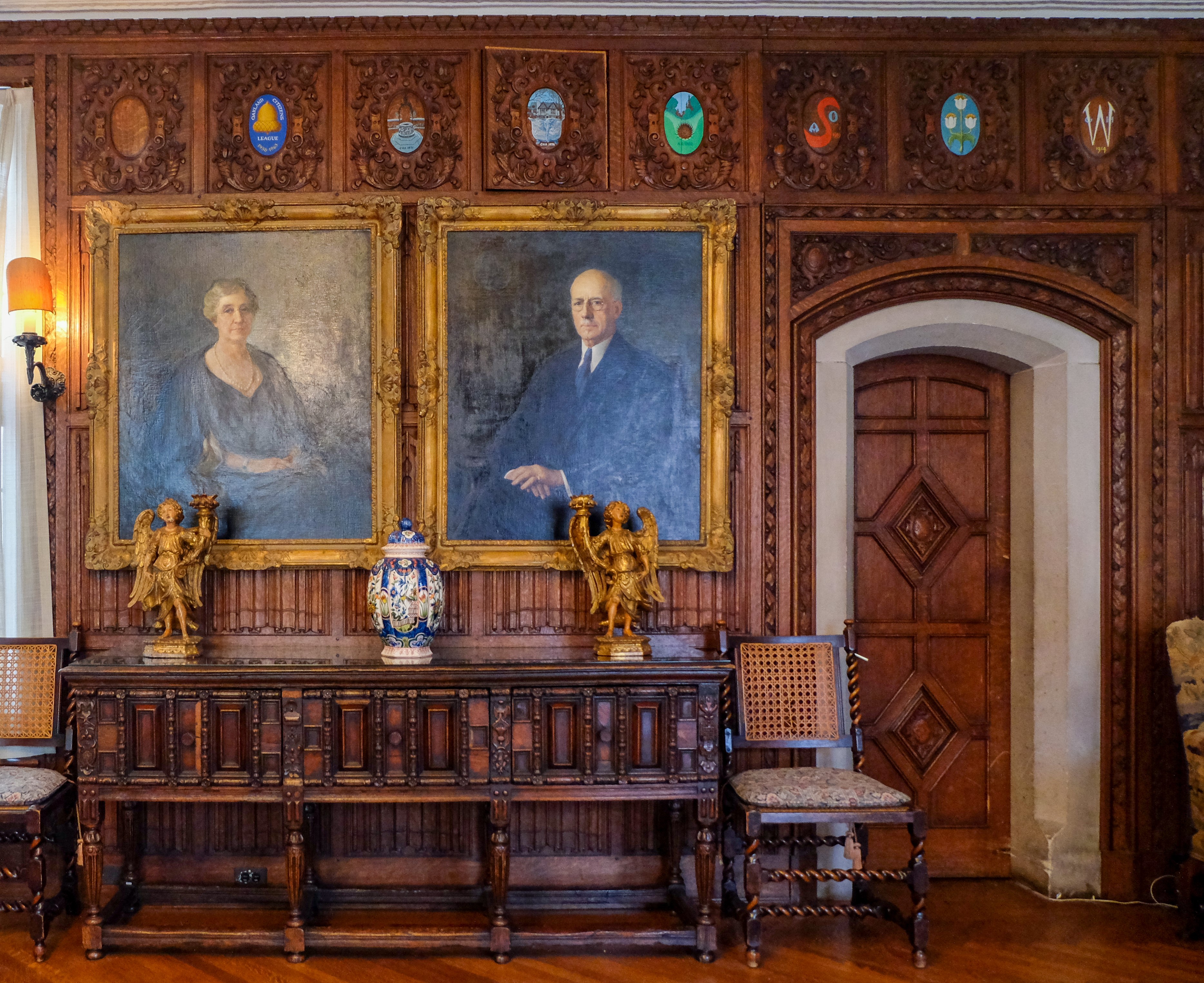
Over the following decades, Harry and artist friends or Academy students he recruited would paint in many more of the cartouche panels around the walls of the Oak Room. Those before the 1930s celebrate moments in the personal lives of the Booths at Cranbrook House. In following years, community initiatives, collaborations with national organizations, and the many achievements of the Cranbrook Foundation were commemorated with cartouche paintings. The tradition has continued through the generations.
Today, the Oak Room’s forty-one painted cartouche panels tell the story of Cranbrook’s evolution from a family estate to a globally-renowned center for art, science, and education. Most mark events that took place, entirely or in part, at Cranbrook House or in its gardens.
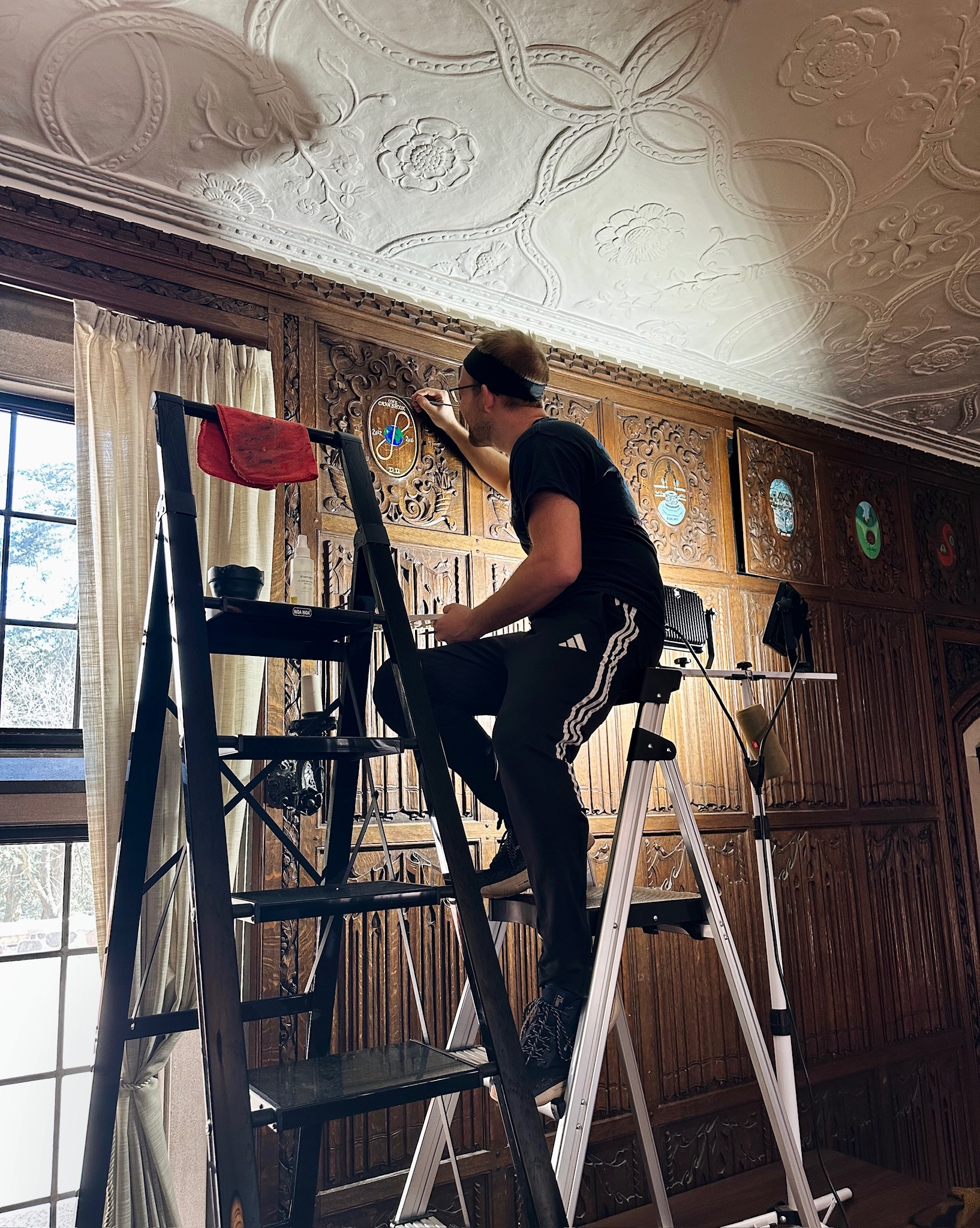
This past March, a new cartouche was painted in the Oak Room. The design was created and carried out by Corey Booth, the great-grandson of Henry Scripps Booth and an artist and animator. His portfolio of work includes The Powerpuff Girls and Rick and Morty.
The new cartouche celebrates the tenure and achievements of Cranbrook Education Community President Emeritus Dominic DiMarco, who served as President from 2012 to 2021.
Corey Booth at work on the cartouche, May 2025, photograph by Amy Klein.
The finished cartouche, May 2025, photograph by Amy Klein.
Henry Scripps Booth set a precedent for representing the subject of a cartouche painting through oblique symbols, even visual puns. Thus, the message of Corey Booth’s cartouche is also encoded in the image. In the artist’s own words,
A golden infinity symbol wraps around the Earth (passing over Cranbrook, Kent, England), signifying Cranbrook’s prestigious global impact extending beyond place and time. A shining golden star marks the Michigan institution on the globe, symbolizing the state’s connection to Cranbrook’s global influence. Seven distinct shines adorn the infinity symbol, representing the Schools, Academy of Art, Institute of Science, Art Museum, Center for Collections and Research, Horizons-Upward Bound, and House & Gardens Auxiliary – programs that empower students and professionals alike, contributing to Cranbrook’s continued positive global impact; One Cranbrook. This simple, yet effective, solution designed to represent that concept symbolizes the widespread contributions Cranbrook is able to make across the globe because of leaders like Dominic and the opportunities provided within those seven program areas.
The motto, “One Cranbrook,” was a concept championed by President DiMarco in his work to unite Cranbrook’s program areas as one community defined by collaborative work and shared successes. Alongside the other forty painted cartouches in the Oak Room, Corey Booth’s work speaks to Cranbrook’s global impact, and its aspirational spirit. Collectively, they recall how far Cranbrook has come from its not-so-long-ago beginnings, and challenge us to imagine what future achievements might be commemorated on the Oak Room’s walls.
— Mariam Hale, 2023-2025 Collections Fellow, Cranbrook Center for Collections and Research
Curious about the other cartouches in the Oak Room? Visit my newly posted essays on each cartouche via https://cranbrook.emuseum.com/search/cartouche to read their stories and to discover many other objects in the Founders Collection at the Cranbrook Center for Collections and Research.
You may also learn more on YouTube by watching our December 2021 Uncovering Cranbrook lecture, “Sign and Symbol: The Oak Room Cartouches,” by curator Kevin Adkisson and presented with Cranbrook House and Gardens Auxiliary docents.
This spring, Dawn Straith, Innovation & Technology Specialist at the Vlasic Early Childhood Center & Cranbrook Kingswood Lower School Brookside, used the bridges in the Japanese Garden as a tool in her Design Thinking Unit with the Senior Kindergarteners. I asked Mrs. Straith to explain the project.
The Senior Kindergarteners exploring the Cranbrook Japanese Bridge (aka Red Wood Bridge) in the Japanese Garden, 2025.
DS: In our design thinking and engineering unit, the Senior Kindergarten students became bridge investigators! They explored six different bridges in the Japanese Garden to see how safe and strong they are. While investigating, they discovered that bridges with beams and columns are much stronger than those without. They considered what goes over and under the bridges, who and what use the bridges, the materials the bridges are made from, and whether they had handrails. Some bridges didn’t have handrails at all, which we determined made them feel a bit less safe. They also noticed that the ground near a few of the bridges was eroding, which isn’t as safe either.
Side view of the Japanese Garden Round Island Footbridge.
DS: The bridge to “Round Island” (a small island the children have affectionately named for themselves as “SK Island”) got the lowest safety score—it’s tilted, there are no support beams, the ground is eroding, the materials used aren’t the strongest and there are no handrails to hold onto!
Japanese Garden Round Island Footbridge from the eastern shore of the Lily Pond. Photo by Saida Malarney.
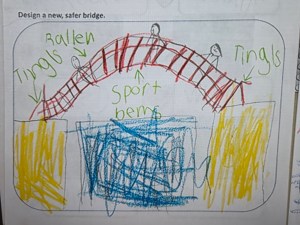
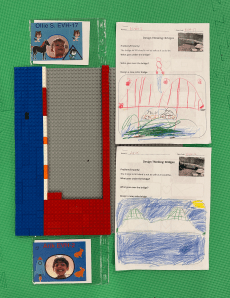
DS: After analyzing all this, the students got to work designing a safer bridge for “SK Island”. They learned that triangles are super strong shapes and that engineers use them all the time when building bridges. With their users in mind, the students carefully designed and built models of brand-new, safer bridges. Their final step is to share their ideas with the garden’s groundskeepers.
Round Island Bridge design, incorportating safety features like “rallens” and “sport beams.”
Enter the Center, the aforementioned “garden’s groundskeepers”!
I am the “Proud Museum Person” with some of our Japanese Garden volunteers working in the garden in April 2025.
As the Associate Registrar, and once-a-month “Gardener” in the Japanese Garden, I was invited to visit the SK classes as they presented their bridge models.
Most of my friends in SK had already helped cover garden sculptures for a number of seasons, so I knew they understood taking care of objects on the campus, but I was once again impressed by our students. They carefully considered what changes could be made to make our bridge safer for all visitors — kids, parents, guests with limitied mobility, and furry friends.
A very big THANKS! to our SK engineers.
Some of the students’ ideas even aligned with designs by our garden designer Sadafumi (Sada) Uchiyama, a third-generation Japanese gardener, registered landscape architect, and Curator Emeritus of Portland Japanese Garden.
Design for Round Island Bridge by Sadafumi Uchiyama.
Design for Round Island Bridge by Gretchen and Liam.
As we start the construction of the new Welcome Garden in the Japanese Garden this summer, we hope our future structural engineers will return in the fall to see how we are progressing.
– Leslie Mio, Associate Registrar, Cranbrook Center for Collections and Research
July 5th, 2025, marks one hundred years since the groundbreaking for Christ Church Cranbrook. As we mark this milestone in Cranbrook’s history, I believe it is important to reflect on George Gough Booth’s long discernment of this generous gift to the community.
From the beginning, there were always places of worship at Cranbrook. The story that leads us through these spaces to the establishment of Christ Church Cranbrook is especially meaningful to me.
Rev. Dr. S. S. Marquis, D.D. with the first spade of earth, July 5, 1925. Courtesy of Cranbrook Archives, Cranbrook Center for Collections and Research.
After George and Ellen Booth purchased ‘The Farm’ in January 1904, his father, Henry Wood Booth, was the first family member to live on the country estate. The elder Booth stayed for the month of May with Frank Brose, the farmer, and his family. On May 15, 1904, the first worship service at Cranbrook took place under a tent, on the site upon which the Altar of Atonement now sits, with Henry as lay preacher. He continued in this ministry, also offering Sunday School, at the same spot until 1909. This was the first act of service offered to the Bloomfield Hills community at Cranbrook.
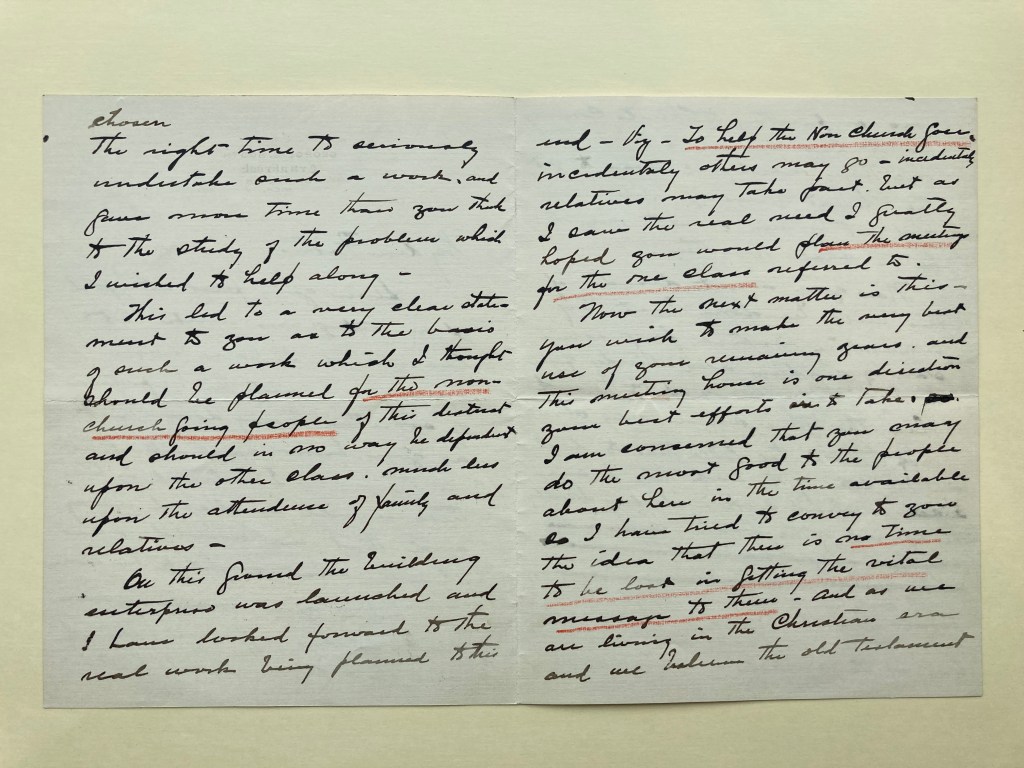
Letter from George Gough Booth to Henry Wood Booth, August 24, 1918. Courtesy of Cranbrook Archives, Cranbrook Center for Collections and Research.
In 1914, George and Ellen considered building a chapel at the site on which the Kingswood flagpole now sits, but the project was rejected, most likely due to the outbreak of World War I. As the war ended, a permanent place of worship and Sunday School was established with the building of the Meeting House.
The letter, above, preserves the dignity with which George writes of the Meeting House “building enterprise” to honor and give freedom to his father’s calling to share the Christ message with the non-church goers in the district. From this letter, we can learn and understand why George built the Meeting House for worship and Bible study through his father’s ministry.
Decoration of the Meeting House by Katherine McEwen, 1918. Laura MacNewman, photographer.
In the letter from George to his father, we also learn that he is prudent in observing the religious character of Bloomfield residents. During the years in which the Meeting House was used for religious services (1918-1926), Mr. Booth would reflect on the visiting clergy and service attendees (both of which came from diverse denominations), from which he would eventually discern the denomination of “Cranbrook church.”
Any chance you have a trip planned to Europe this summer? If so, your itinerary really must include Stockholm. Not only is it a beautiful city—one of my favorites—but it also was home to one of Cranbrook’s most celebrated artists, Carl Milles. Long before he took up residence at Cranbrook, the Swedish sculptor started to plan and build his home and studio, Millesgården. Built high on a cliff overlooking Stockholm’s harbor, Millesgården now is a magical museum and sculpture park and the site of this year’s summer-long birthday party, The Sculptor Carl Milles at 150. Yes, if Carl Milles had lived to be the world’s oldest man, he would have turned 150 this Monday, June 23.
Carl Milles working in his Cranbrook Academy of Art studio, circa 1950. Margueritte Kimball, photographer. Courtesy of Cranbrook Archives.
While anyone taking the time to read this blog no doubt has an image in mind of one of Milles’s works at Cranbrook (there are no fewer than 45 outdoors on our campus and another 52 in the Art Museum or other buildings), my guess is that the story of the twenty years he spent working in America are a little foggy (unless, of course, you attended our 2021 virtual fundraiser, A Global House Party at Cranbrook and Millesgården, and watched the film, Carl Milles: Beauty in Bronze, we produced for the occasion). As a refresher course, or even a primer, I thought I would take you on a journey, one that starts in America and ends, twenty-two years later, back in Sweden (and Italy, as the case may be).
Milles arrived in the United States for the first time in October 1929. With the stated purpose of attending the opening of his second group exhibition in New York City, he took advantage of the trip to sell work to collectors, negotiate a commission in Chicago for his Diana Fountain, present the concept for the monumental doors he would create for the Pennsylvania State Capitol, and meet with Tage Palm, the President of the Chicago-based Swedish Arts and Crafts Company who would become his business manager. Most important for this next chapter of his career, he also traveled by train to Michigan where he met with George Booth who asked him to teach at the art school he was building north of Detroit, Cranbrook Academy of Art.
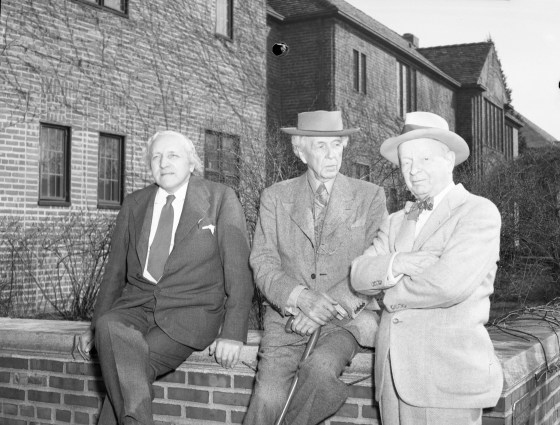
Carl Milles, Frank Lloyd Wright, and Eliel Saarinen (l to r) outside Saarinen House, March 1945. Harvey Croze, photographer. Courtesy of Cranbrook Archives.
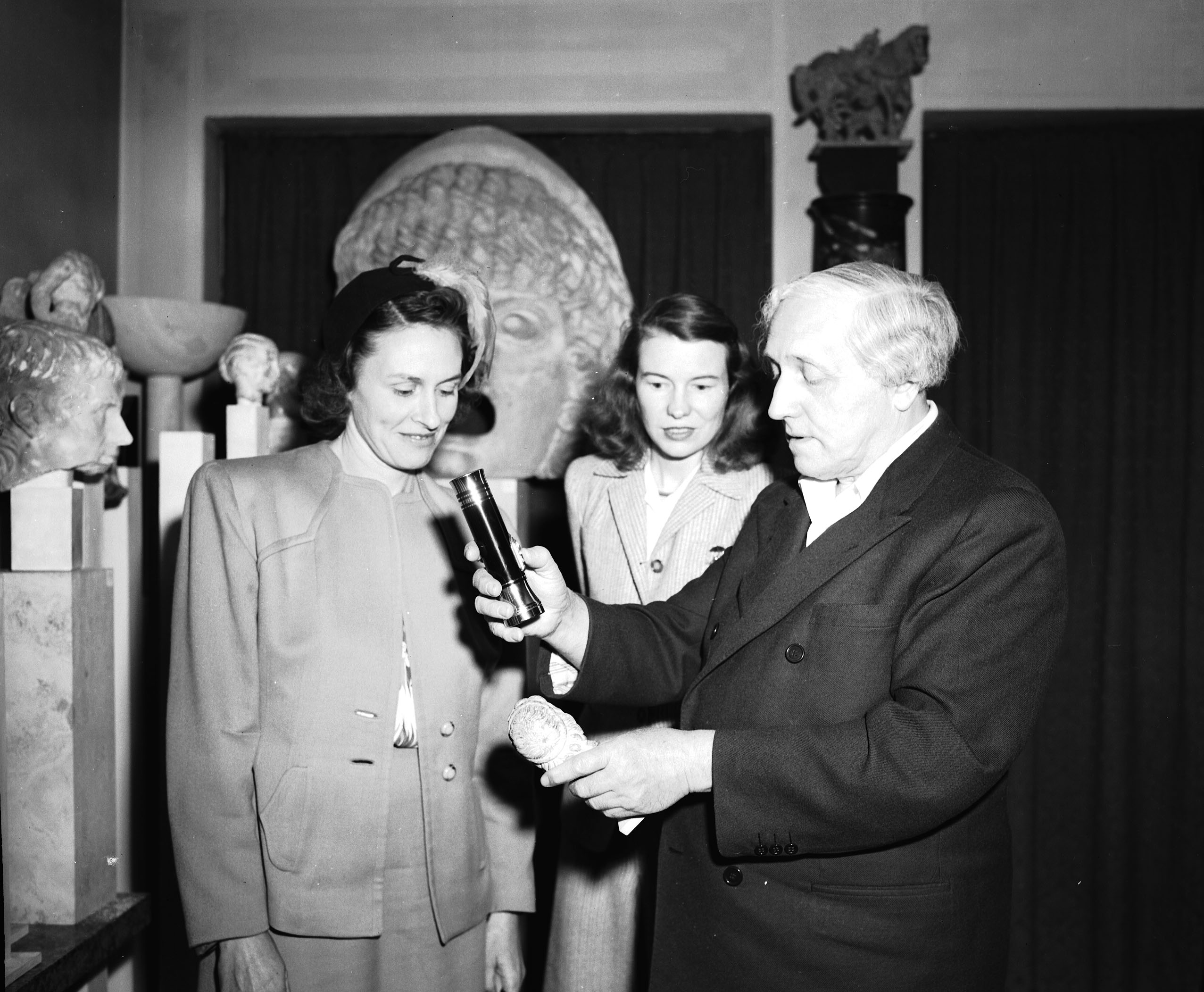
George Booth and his wife Ellen Scripps Booth, as most Cranbrook Kitchen Sink blog readers know, were wealthy newspaper publishers and philanthropists. Although their flagship paper, the Detroit News, was based in Detroit, their home was in the countryside of Bloomfield Hills. By the late 1920s, they had begun to work with the Finnish architect Eliel Saarinen to transform their private estate into an educational community that eventually included an Episcopal church, boys and girls schools, an art academy and museum, and an institute of science (and, even later, a center for collections and research). Although the archival record is a little murky, Saarinen and Milles were at least acquaintances long before the sculptor met with his future patron at Cranbrook.
As Milles contemplated moving to Cranbrook to direct the Academy’s Sculpture Department, there was one small problem: he had no desire to teach. Two years and many conversations later, Booth and Milles came to an agreement: the sculptor would not need to “teach” but simply “mentor” students in his studio. (Not a bad deal!)
Carl Milles discusses details of a sculpture during an open house, 10 May 1947. Courtesy of Cranbrook Archives.

In January 1931, Carl and his wife Olga Milles arrived at Cranbrook where they lived for the next twenty years. Their home, where they displayed Milles’s collection of ancient sculpture, was designed by Saarinen, as were his three studios—including the grand thirty-foot-tall studio Milles used for his largest commissions such as the Orpheus Fountain for the National Concert Hall in Stockholm.
Carl Milles in his studio at Cranbrook Academy of Art, sculpting the figure of Orpheus for the Orpheus Fountain, 1934. Richard G. Askew, photographer. Courtesy of Cranbrook Archives.
But Milles was not satisfied. He wanted to be surrounded by his sculpture just as he was at Millesgården. The four works Booth had acquired—including the only work Milles made at Cranbrook for Cranbrook, the playful Jonah Fountain—were not enough. In 1934, in the middle of the Great Depression, Booth agreed to pay Milles a princely sum—$120,000 and change—for sixty-three of his sculptures. This purchase not only included most of the works that had been part of a traveling exhibition that opened in St. Louis in 1931, but also casts of the eight figures from the Orpheus Fountain and his monumental Europa and the Bull from the fountain in Halmstad.
Milles’s Triton Pools, looking north towards Europa and the Bull, and beyond that, the future site of Cranbrook Art Museum, circa 1934. Richard G. Askew, photographer. Courtesy of Cranbrook Archives.
The decision, one that would come to define Cranbrook’s campus, was supported by Milles’s fellow Scandinavian and friend Eliel Saarinen, who Booth had named the President of Cranbrook Academy of Art in 1932. Indeed, there was a feeling of mutual respect between the architect and the sculptor, with Saarinen realizing that Milles’s work would enhance the buildings and Milles realizing that Saarinen’s architecture provided the perfect context.
Each May, the Center is honored to host outstanding seniors from Cranbrook Kingswood Upper School for a three-week immersive internship.
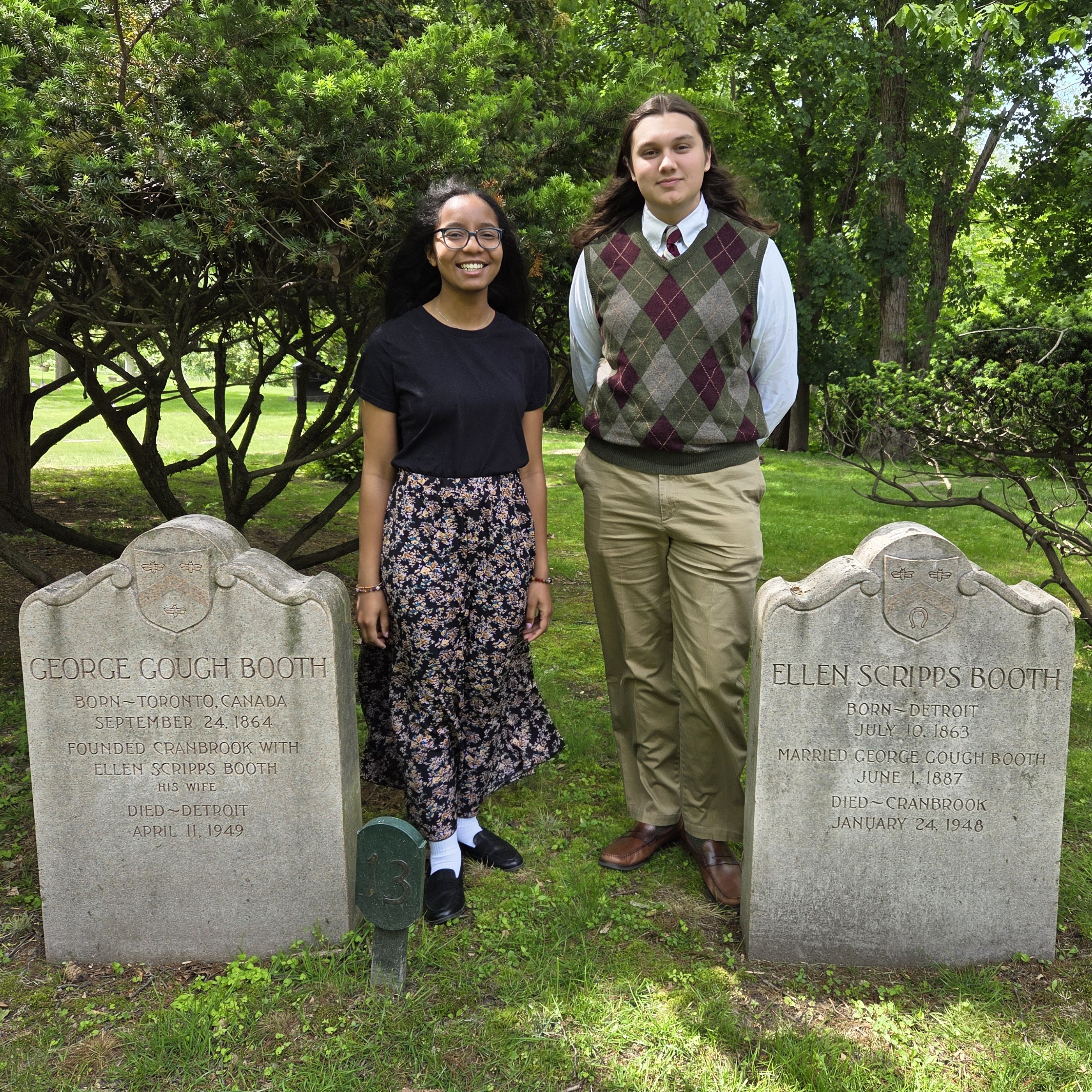
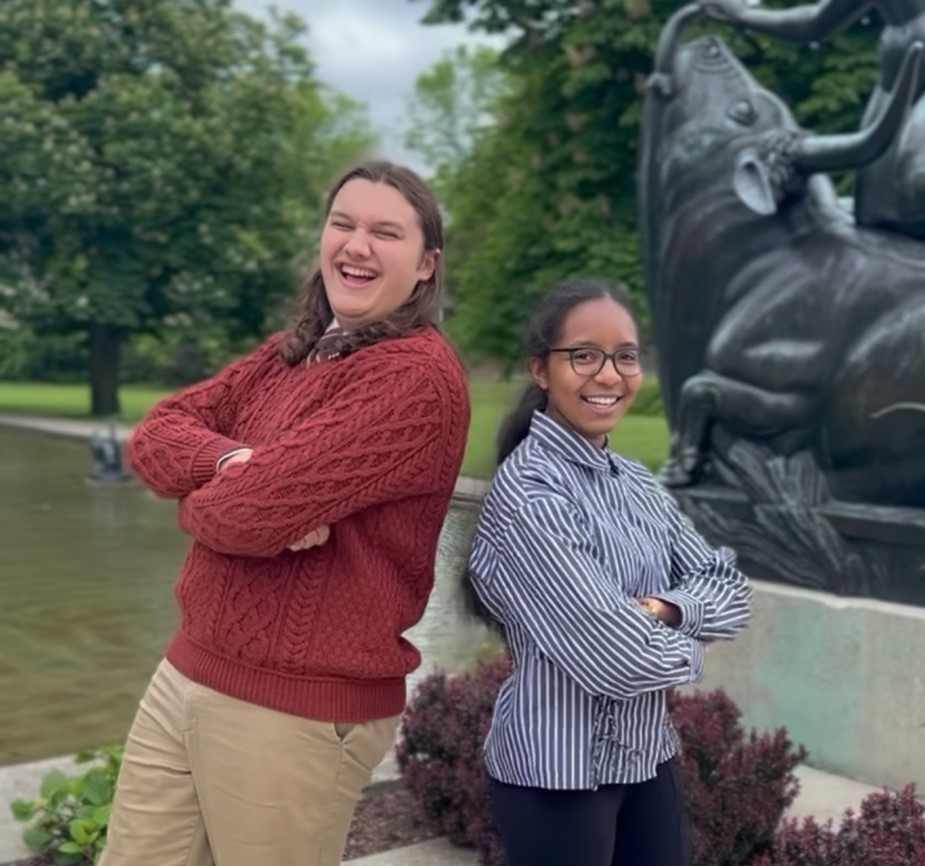
Kamilah Moore and Joel Kwiatkowski, 2025 Senior May interns, visit George and Ellen Booth at Greenwood Cemetery, Birmingham. Photography by Leslie Mio.
This year two seniors, Kamilah Moore and Joel Kwiatkowski, worked with the Center and Archives staff, including writing blogs! Hear from Joel today and look out for Kamilah’s post next week.
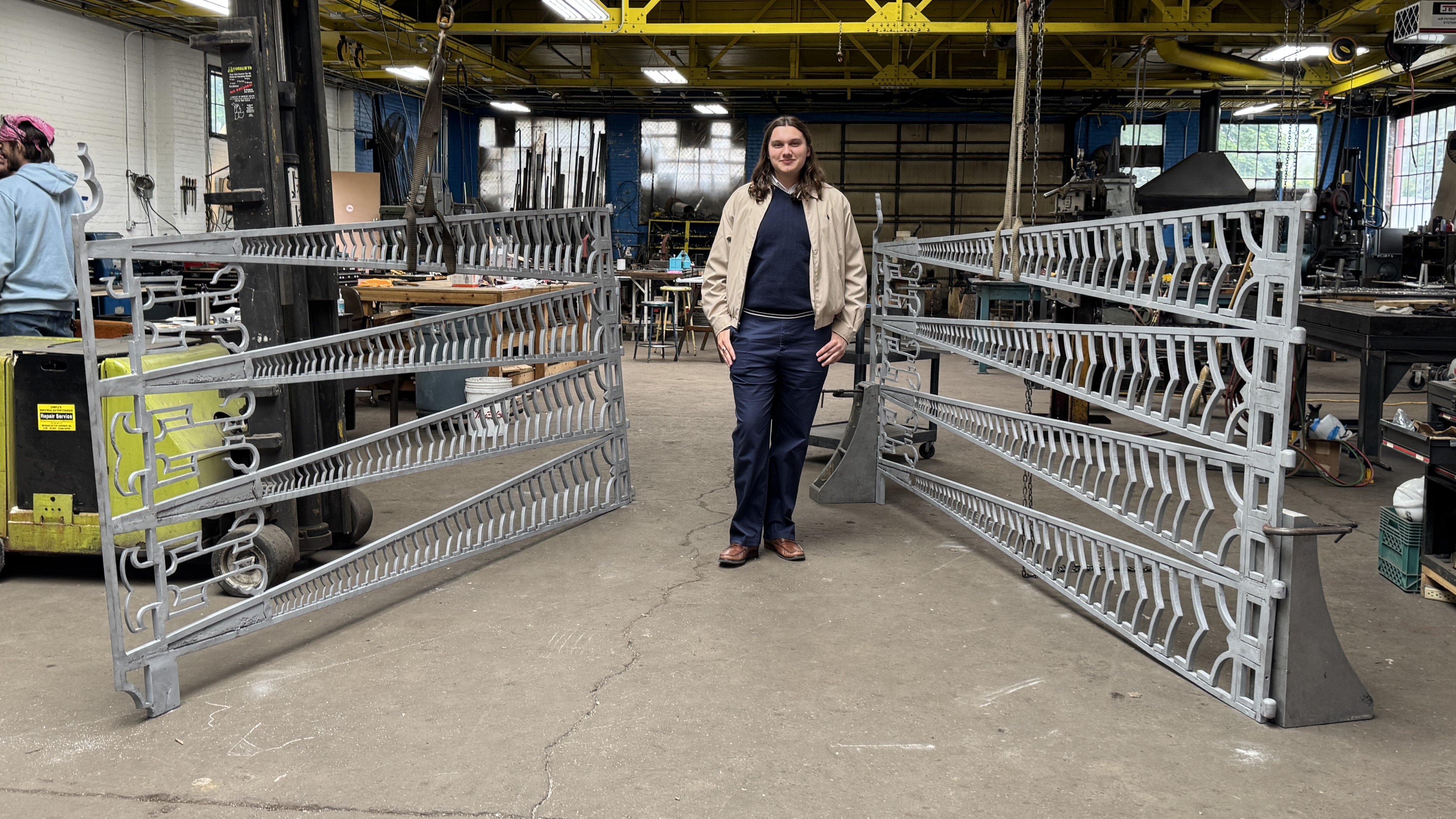
Checking in on the Eliel Saarinen-designed Kingswood main gate at Smith Shop in Highland Park, May 2025. Photography by Kevin Adkisson.
Cranbrook Center for Collections and Research is a name that invokes the image of some grand museum or hall, with many sterile prep rooms and rows upon rows of file cabinets. Now don’t get me wrong, there are plenty of file cabinets, but the Annex is far from grand. Instead, the rather humble staff apartment-turned-offices are befitting the lovely people there.
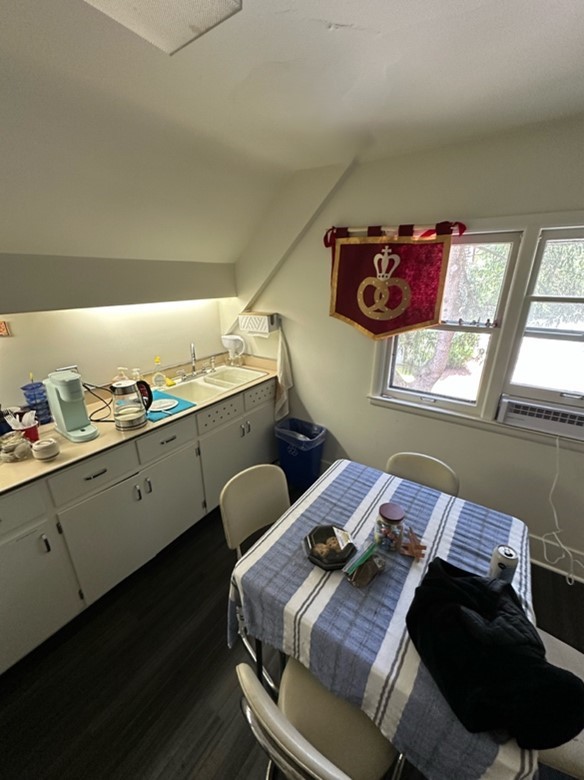
The Center’s Annex, next door to Cranbrook House, is situated above the House & Garden Auxiliary offices, up a set of winding stairs that require me to duck in a few places. But up there you will find a quaint little kitchen (complete with a toaster oven and healthy snack collection), a few offices, and closets and cabinets dotted with curiosities.
The quaint kitchenette of the Annex, compete with decommissioned Cranbrook Institute of Science Library chairs, May 2025. Photography by the Author.
It was this atmosphere, over many chatty lunches, that I got to know Leslie Mio, the Associate Registrar, and Mariam Hale, the 2023-2025 Center Collections Fellow. It was a pleasure to find two individuals who cared so greatly for history and conservation, and we bonded over our shared love of museums and particular historical eras.
But, let it be known that work at the collections isn’t all comfortable work behind a desk or searching a filing cabinet. This illusion, if I ever had it, was quickly broken on my first full day of the internship. Our task? Moving five solid wood cabinets from the rooms of retirement-age nuns across the building to be used to store Cranbrook’s lacy dresses and costumes.
Briarbank, a neighboring estate to Booth’s land, was converted into a place for sisters to stay once they needed a bit more care later in life. But, at some point, the demand for a place such as that ran dry, and Cranbrook bought the campus. And now, in that spirit, I was near horizontal in my penny loafers, shoving a giant wardrobe into place across some very tasteful carpet.
Mariam and I defy the friction of decades old carpet, May 2025. Photography by Leslie Mio.
In the coming days, the purpose of these heavy cabinets would be realized, as we began the true overarching theme of my time at the Center: moving a seemingly infinite number of objects from the hot attic of Cranbrook House to the comparatively “less hot” and climate-controlled storage area at Briarbank. Paintings, prints, textiles, rugs, hats, and racks of clothing and costumes were deftly maneuvered through the halls and offices of Cranbrook House (or, alternatively, very carefully down the narrowest, steepest, stairwell known to mankind).
Each day packing and moving Cultural Properties in the attic was sure to bring new surprises. Everything from a fur hat belonging to George Booth to paper parasols, or entire handwoven rugs the size of a small house. While these days meant a bit of manual labor, they never ceased to bring me joy, as the wonderful folk of the Center doled out tidbits of Cranbrook’s story connected to each unearthed gem.
The fabulous hat in a box marked “G.G.B.” — the box is possibly a later acquisition by Henry S. Booth — May 2025. Photography by the Author.
Now those familiar with the Center may be wondering: “Now wait just a minute. Where is my favorite curator? Where is the delightful presence of the steward of Saarinen House?” Well, fear not good reader, for while Kevin may not have been at every boxing and unboxing, Kevin joined Kamilah and me on many excursions outside the Samuel-Yellin-forged gates of Cranbrook. For those unacquainted, Kevin Adkisson is Curator of the Center, the veritable fountain of all knowledge concerning Cranbrook, and legend in his own time among students.
My first trip with Kevin came when we were tasked with heading to Detroit to give a tour of Holy Redeemer Church to a group of 8th graders from the Catholic school next door. I thought that getting middle schoolers excited about Corinthian columns would be impossible, but Kevin’s energy and skill made it look easy.
Kevin and I had fun teaching Holy Redeemer 8th graders about architecture. Photography by Holy Redeemer.
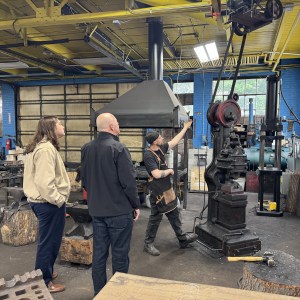
Afterword, we headed to visit the master ironworkers at Smith Shop, where the Eliel Saarinen-designed Kingswood main gate is being repaired and restored. I stood back and observed while Kevin, Cranbrook Capital Projects Director Jean-Claude Azar, and Amy Weiks and Gabriel Craig (co-owners of Smith Shop) debated the ins and outs of the gate’s making and breaking.
I enjoy a tour of the facilities of Smith Shop with Cranbrook Capital Projects Director Jean-Claude Azar and Smith Shop co-owner Gabriel Craig in Highland Park, May 2025. Photography by Kevin Adkisson.
Across my three week Senior May, I also took trips to the paint store to debate shades of grey, the frame shop to mount an object, Ken Katz’s painting conservation studio, and even Birmingham’s historic cemetery. On each of these trips, I gained insight into the multifaceted work of the Center for Collections and Research, including care and handling, teaching, conservation, and cataloging.
I cannot fully capture in a blog what a delight it was to be in the presence of such knowledgeable individuals. For every question about Cranbrook’s history, each member of staff was sure to add in their own expertise, citing obscure letters and photographs, adding a beautiful familiarity to their responses and giving color to the story of Cranbrook.
Of course, I would be remiss to leave out some of the other folks who make the Center function, like Greg, Jody, Amy, and Jess. These are the people who drive the work, managing, fundraising, and promoting the vision of Collections and ensuring the continued progress of the Center’s goals.
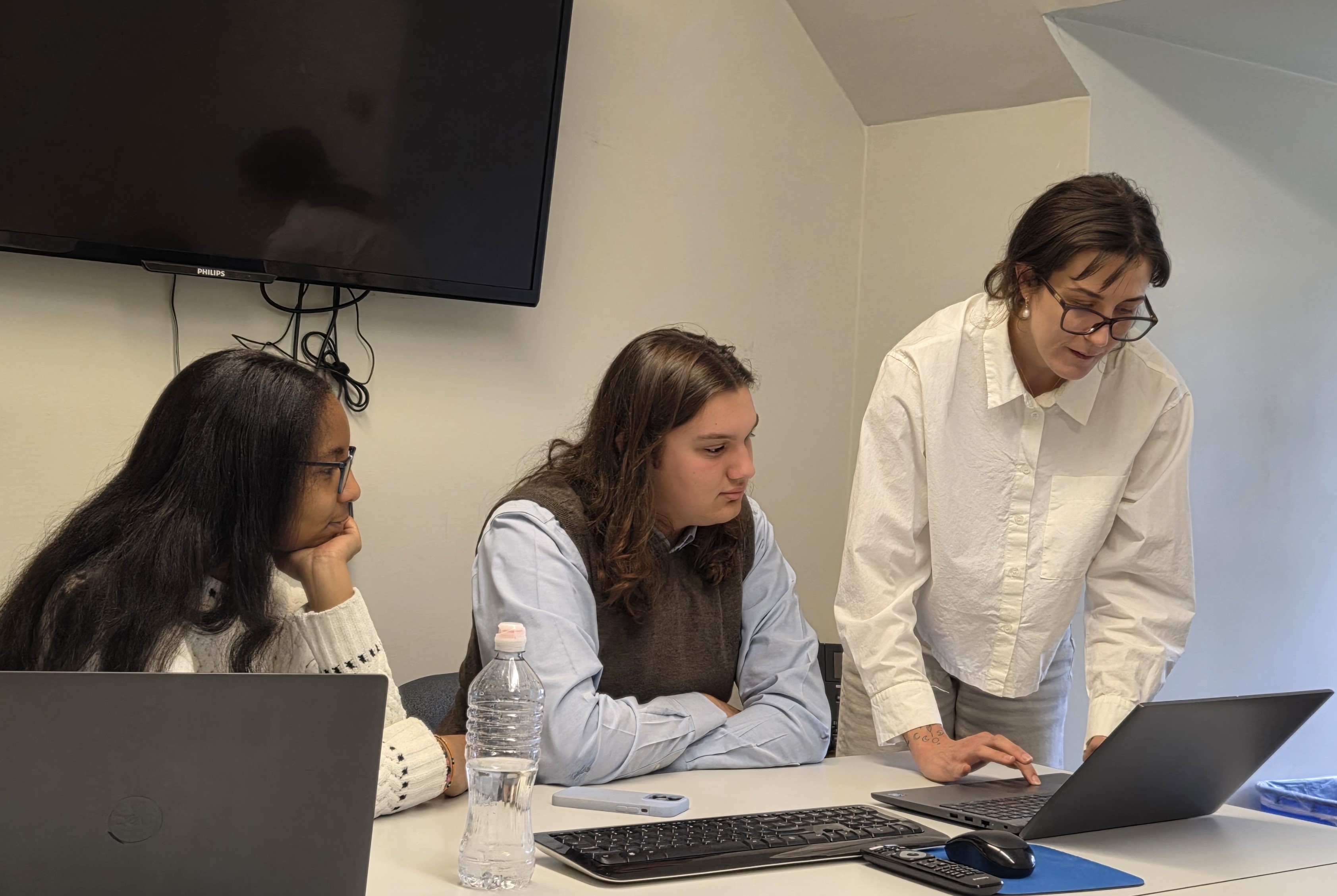
Even interns have meetings, Kamilah and I sat in on one of the Center’s weekly staff meetings. Photography by Kevin Adkisson.
On my last day, I had the privilege of working with Jess Webster, Development Coordinator, who also helps run the Center’s social media. With Kamilah, I researched, drafted, workshopped, and delivered a script for an Instagram Reel commemorating the 150th birthday of Carl Milles., During my time working out ideas for the video (and even this blog), I gained a new appreciation for the way in which Cranbrook is viewed from the outside.
Kamilah and I workshopping our reel for Carl Milles’s 150th birthday with Jess, May 2025. Photography by Leslie Mio.
For me, as a student at Cranbrook, my view is that of someone on the inside, who has the privilege to walk by art on campus each and every day (admittedly at times without a second thought). But getting to see the behind-the-scenes of Cranbrook’s beautiful historic campus has given me an appreciation that feels wholly unique amongst my peers.
If you’ve read this blog, I urge you to take a moment to appreciate all that goes on caring for a 100-plus-year-old campus to live on to this day and serve its many students and visitors. From calls, texts, emails, and meetings, the Center is busy planning, filing, caring, and protecting the legacy of Cranbrook. The work is never done.
Yet despite the challenges, the Center rises to the task, willing to give their all to something they passionately care for. It would be hard not to be inspired.
Kamilah and I make a video for Carl Milles’s 150th birthday, May 2025. Photography by Jessica Webster.
This internship has truly been a dream-come-true, and I am grateful to Mariam, Leslie, and Kevin for their warm welcome and tutelage.
– Joel Kwiatkowski, Cranbrook Kingswood Upper School Class of 2025 and Cranbrook Center for Collections and Research 2025 Senior May
Editor’s Note: The Senior May Project is a school-sponsored activity that encourages Cranbrook Kingswood Upper School seniors to acquire work experience in a field they are considering as a college major, a potential profession, and/or as a personal interest.
Joel Kwiatkowski graduated from Cranbrook in June 2025 and will be attending the University of California San Diego in the fall to pursue a degree in Molecular and Cellular Biology. Joel first came to Cranbrook Schools in sixth grade, and has since gained a passion for the institution’s rich history of influential artists and personalities.