Clifford West Papers Come to Cranbrook

Cranbrook Archives is excited to announce the acquisition of the Clifford B. West and Joy Griffin West Papers. Since the boxes arrived this past summer, I have been inventorying their contents in preparation for making them accessible to the public for research. Completing this work involves continually unravelling the many interesting facets of Clifford and Joy’s stories to be brought to light through the collection. Among many other things, are their experiences at Cranbrook in the mid-twentieth century.

Joy Griffin and Clifford West in front of Carl Milles’ sculpture on the north wall of the Academy of Art library, 1941. Harvey Croze, photographer. Courtesy of Cranbrook Archives.

Clifford and Joy attended the Academy of Art at the tail end of its golden age, meeting and marrying in 1941. At that time, Carl Milles, Eliel Saarinen, Loja Saarinen, and Eero Saarinen taught and worked on campus. Clifford earned his MFA in painting under Zoltan Sepeshy and Joy took ceramics classes from Maija Grotell. Fellow students included Lily Swann Saarinen and Harry Bertoia, among others.

Bertoia and West: Three Decades

It was with Harry Bertoia, sculptor and designer, that Clifford enjoyed a lifelong friendship, serving as best man at his 1943 wedding to Brigitta Valentiner (fellow Academy student and daughter of Wilhelm Valentiner, Director of the Detroit Institute of Arts). While living in different parts of the country after graduation (or different countries all together), the two artists maintained close ties, both personally and professionally, evidenced by correspondence and other materials found in the Wests’ papers. Of particular note is the original 16mm film Clifford made in 1965, titled Harry Bertoia’s Sculpture, featuring a soundtrack by Bertoia.

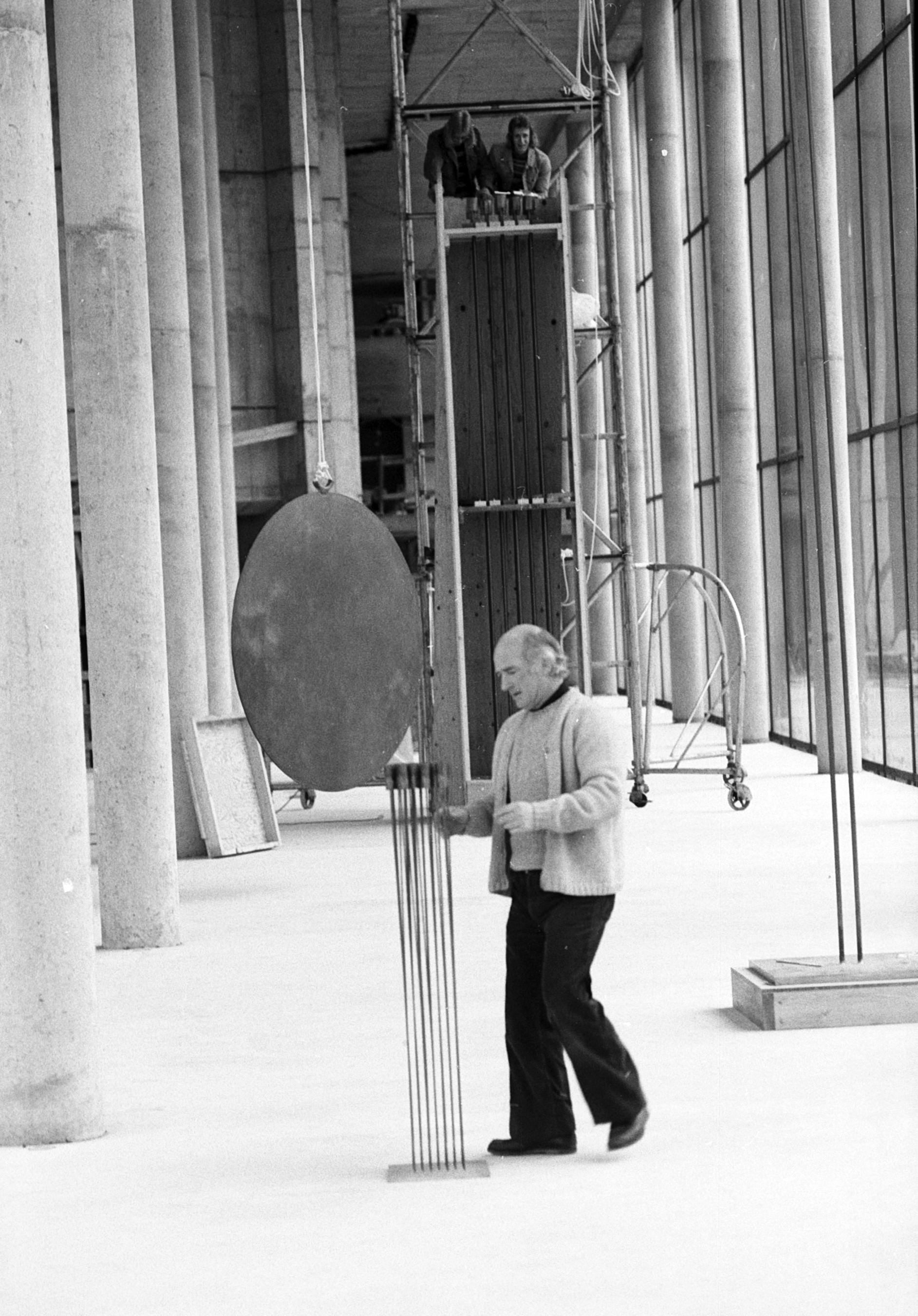
Harry Bertoia in his studio, circa 1976. Clifford West, photographer. Courtesy of Cranbrook Archives.

Another fascinating connection is Clifford’s involvement with a few 1976-1977 exhibitions of Bertoia’s sculptures in Norway. Bertoia’s work, including his sound sculptures, had been introduced to the Norwegian art scene in the late 1960s through Bente Torjusen, an educator at the Munch Museum who assisted Clifford on his 1968 film about artist Edvard Munch and later became his third wife. An accomplished filmmaker and photographer by the late 1970s, Clifford photographed the Bertoia exhibitions and designed the accompanying catalogs. In true Cranbrook fashion, Clifford’s artistic talents were not limited to just one medium.

Poster for The Sculpture of Harry Bertoia exhibition at the Grieg Music Festival, Bergen, Norway, 1976. Clifford West, photographer and designer. Courtesy of Cranbrook Archives.

The exhibitions would be the last collaborations between Clifford West and Harry Bertoia, as Bertoia would succumb to lung cancer one year later. Fifty years on, Cranbrook Art Museum will celebrate Harry Bertoia in an upcoming exhibition, opening summer of 2027. Bertoia’s work was last featured at Cranbrook in the 2015 exhibition, Bent, Cast, and Forged: The Jewelry of Harry Bertoia, which marked the centennial of his birth and the first exhibition devoted to his jewelry designs (see the full catalog here).

I look forward to uncovering and sharing more about Clifford and Joy’s remarkable lives. Stay tuned!

Deborah Rice, Head Archivist, Cranbrook Center for Collections and Research

Related announcement from the Harry Bertoia Foundation:

The Harry Bertoia Catalogue Raisonné is announcing a call for works from the Cranbrook community to more fully develop the publication’s coverage of the artist’s early jewelry practice, a currently under-described area of the artist’s oeuvre.

Present owners of jewelry believed to be by Bertoia are invited to contact the Harry Bertoia Foundation and Harry Bertoia Catalogue Raisonné by sending an email to: catalogue@harrybertoia.org, and submitting an owner questionnaire, available on our website. Museums, art galleries, and other institutions that are in possession of works by the artist are also invited to submit relevant data and photographic documentation. All information will be treated with discretion and held in strictest confidence.

Happy Birthday Milles!

Any chance you have a trip planned to Europe this summer? If so, your itinerary really must include Stockholm. Not only is it a beautiful city—one of my favorites—but it also was home to one of Cranbrook’s most celebrated artists, Carl Milles. Long before he took up residence at Cranbrook, the Swedish sculptor started to plan and build his home and studio, Millesgården. Built high on a cliff overlooking Stockholm’s harbor, Millesgården now is a magical museum and sculpture park and the site of this year’s summer-long birthday party, The Sculptor Carl Milles at 150. Yes, if Carl Milles had lived to be the world’s oldest man, he would have turned 150 this Monday, June 23.

Carl Milles working in his Cranbrook Academy of Art studio, circa 1950. Margueritte Kimball, photographer. Courtesy of Cranbrook Archives.

While anyone taking the time to read this blog no doubt has an image in mind of one of Milles’s works at Cranbrook (there are no fewer than 45 outdoors on our campus and another 52 in the Art Museum or other buildings), my guess is that the story of the twenty years he spent working in America are a little foggy (unless, of course, you attended our 2021 virtual fundraiser, A Global House Party at Cranbrook and Millesgården, and watched the film, Carl Milles: Beauty in Bronze, we produced for the occasion). As a refresher course, or even a primer, I thought I would take you on a journey, one that starts in America and ends, twenty-two years later, back in Sweden (and Italy, as the case may be).

Milles arrived in the United States for the first time in October 1929. With the stated purpose of attending the opening of his second group exhibition in New York City, he took advantage of the trip to sell work to collectors, negotiate a commission in Chicago for his Diana Fountain, present the concept for the monumental doors he would create for the Pennsylvania State Capitol, and meet with Tage Palm, the President of the Chicago-based Swedish Arts and Crafts Company who would become his business manager. Most important for this next chapter of his career, he also traveled by train to Michigan where he met with George Booth who asked him to teach at the art school he was building north of Detroit, Cranbrook Academy of Art.

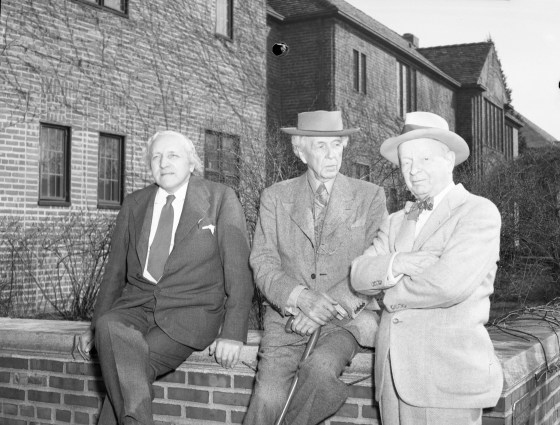
Carl Milles, Frank Lloyd Wright, and Eliel Saarinen (l to r) outside Saarinen House, March 1945. Harvey Croze, photographer. Courtesy of Cranbrook Archives.

George Booth and his wife Ellen Scripps Booth, as most Cranbrook Kitchen Sink blog readers know, were wealthy newspaper publishers and philanthropists. Although their flagship paper, the Detroit News, was based in Detroit, their home was in the countryside of Bloomfield Hills. By the late 1920s, they had begun to work with the Finnish architect Eliel Saarinen to transform their private estate into an educational community that eventually included an Episcopal church, boys and girls schools, an art academy and museum, and an institute of science (and, even later, a center for collections and research). Although the archival record is a little murky, Saarinen and Milles were at least acquaintances long before the sculptor met with his future patron at Cranbrook.

As Milles contemplated moving to Cranbrook to direct the Academy’s Sculpture Department, there was one small problem: he had no desire to teach. Two years and many conversations later, Booth and Milles came to an agreement: the sculptor would not need to “teach” but simply “mentor” students in his studio. (Not a bad deal!)

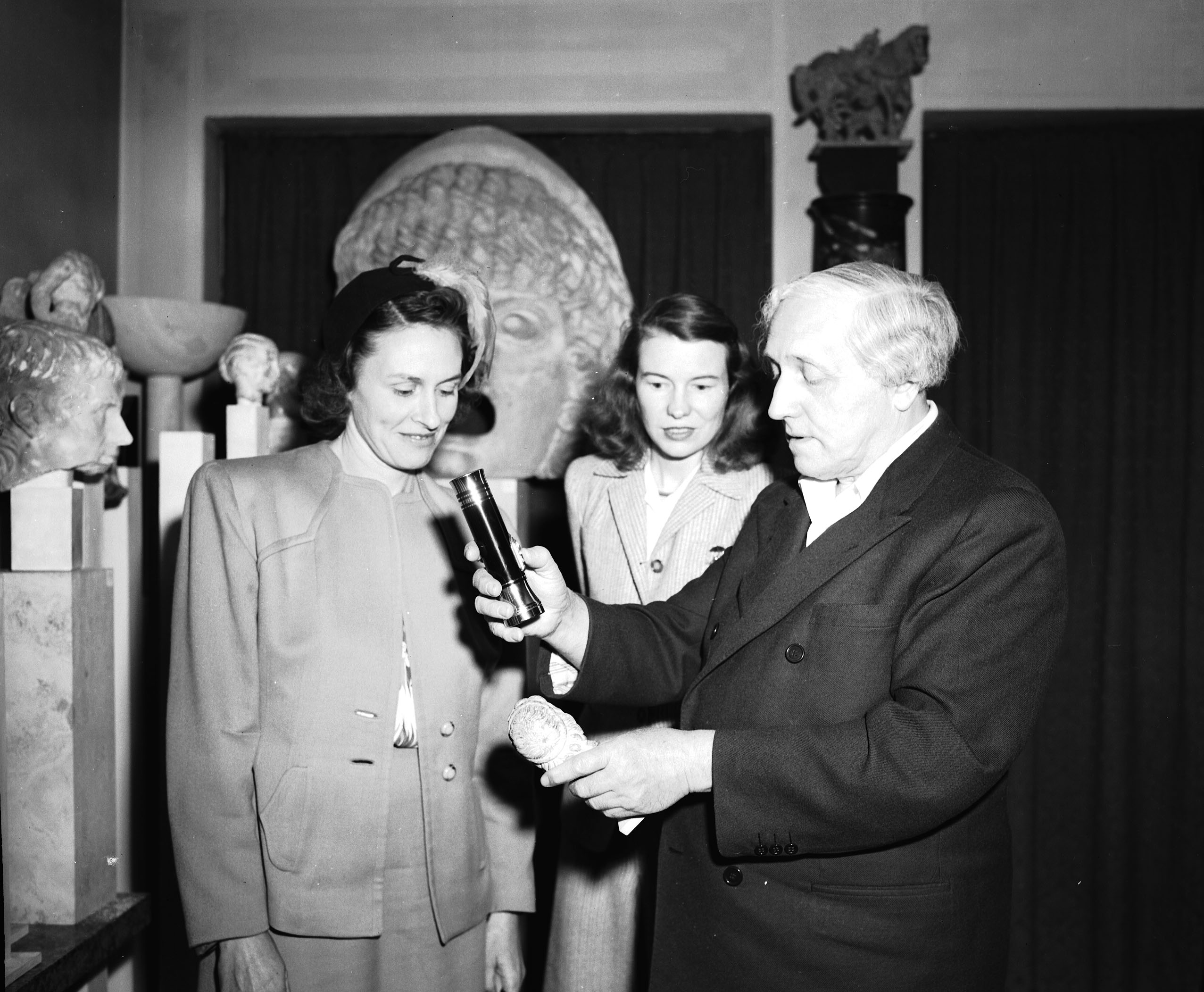
Carl Milles discusses details of a sculpture during an open house, 10 May 1947. Courtesy of Cranbrook Archives.


In January 1931, Carl and his wife Olga Milles arrived at Cranbrook where they lived for the next twenty years. Their home, where they displayed Milles’s collection of ancient sculpture, was designed by Saarinen, as were his three studios—including the grand thirty-foot-tall studio Milles used for his largest commissions such as the Orpheus Fountain for the National Concert Hall in Stockholm.

Carl Milles in his studio at Cranbrook Academy of Art, sculpting the figure of Orpheus for the Orpheus Fountain, 1934. Richard G. Askew, photographer. Courtesy of Cranbrook Archives.

But Milles was not satisfied. He wanted to be surrounded by his sculpture just as he was at Millesgården. The four works Booth had acquired—including the only work Milles made at Cranbrook for Cranbrook, the playful Jonah Fountain—were not enough. In 1934, in the middle of the Great Depression, Booth agreed to pay Milles a princely sum—$120,000 and change—for sixty-three of his sculptures. This purchase not only included most of the works that had been part of a traveling exhibition that opened in St. Louis in 1931, but also casts of the eight figures from the Orpheus Fountain and his monumental Europa and the Bull from the fountain in Halmstad.

Milles’s Triton Pools, looking north towards Europa and the Bull, and beyond that, the future site of Cranbrook Art Museum, circa 1934. Richard G. Askew, photographer. Courtesy of Cranbrook Archives.

The decision, one that would come to define Cranbrook’s campus, was supported by Milles’s fellow Scandinavian and friend Eliel Saarinen, who Booth had named the President of Cranbrook Academy of Art in 1932. Indeed, there was a feeling of mutual respect between the architect and the sculptor, with Saarinen realizing that Milles’s work would enhance the buildings and Milles realizing that Saarinen’s architecture provided the perfect context.

Continue reading

Photo Friday: The Football Game

Friday, September 27, 2024, is Homecoming at Cranbrook Kingswood Upper School. The game will be held in the Thompson Oval, to the east of The Football Game by David Evans.

The Football Game by David Evans. Thompson Oval, Cranbrook Kingswood Upper School – Cranbrook Campus.

Sculptor David Evans (1895-1959) was hired by the Cranbrook Foundation (through George Booth) as Professor of Sculpture and Life Drawing at the Academy of Art for 1929-1930. During that time, Booth commissioned him to create this bas relief for the football field at Cranbrook School for Boys. It is not just a bunch of nameless faces on the relief; it actually features members of the first football squad at Cranbrook School for Boys.

The 1930 Football Team, from The Brook, 1931 (Cranbrook School’s yearbook). Courtesy Cranbrook Archives.
Cranbrook School Football Sweater, circa 1930. Photographed by P.D. Rearick, 2019. Cranbrook Center for Collections and Research | Cultural Properties Collection, Archives.

During the 1930 football season, thirteen boys posed for Evans.

Members of the 1930 Cranbrook Football Team featured on The Football Game. Photos taken from 1931 and 1932 copies of The Brook. Courtesy Cranbrook Archives

The bas relief is in its original location – mounted above the steps leading to Alumni Court and overlooking Thompson Oval. If you are on campus for Homecoming, pose for a photo in your CKU green and blue with the 1930 football squad.

Leslie Mio, Associate Registrar, Cranbrook Center for Collections and Research

Ed. Note: The Football Game was recently cleaned and waxed by our friends at McKay Lodge Conservation Laboratory. They also touched up other Upper School favorites: Hermes, Discus Thrower, The Wrestlers, Running Dogs, Masque Art, Diana, Dancing Girls, and Aim High.

Photo Friday: Academy Student Life

These days, Instagram accounts are often used to curate and share our photographic memories. In a not-too-distant past, photographic albums were the medium of choice. One such album, created by a 1950 Academy of Art graduate, was recently donated to the Archives and gives us a rare student perspective of the Academy experience. As we welcome students back to campus, full of the promise of future opportunities, let’s take just a moment to look back at what that looked like for one student who attended seventy-five years ago.

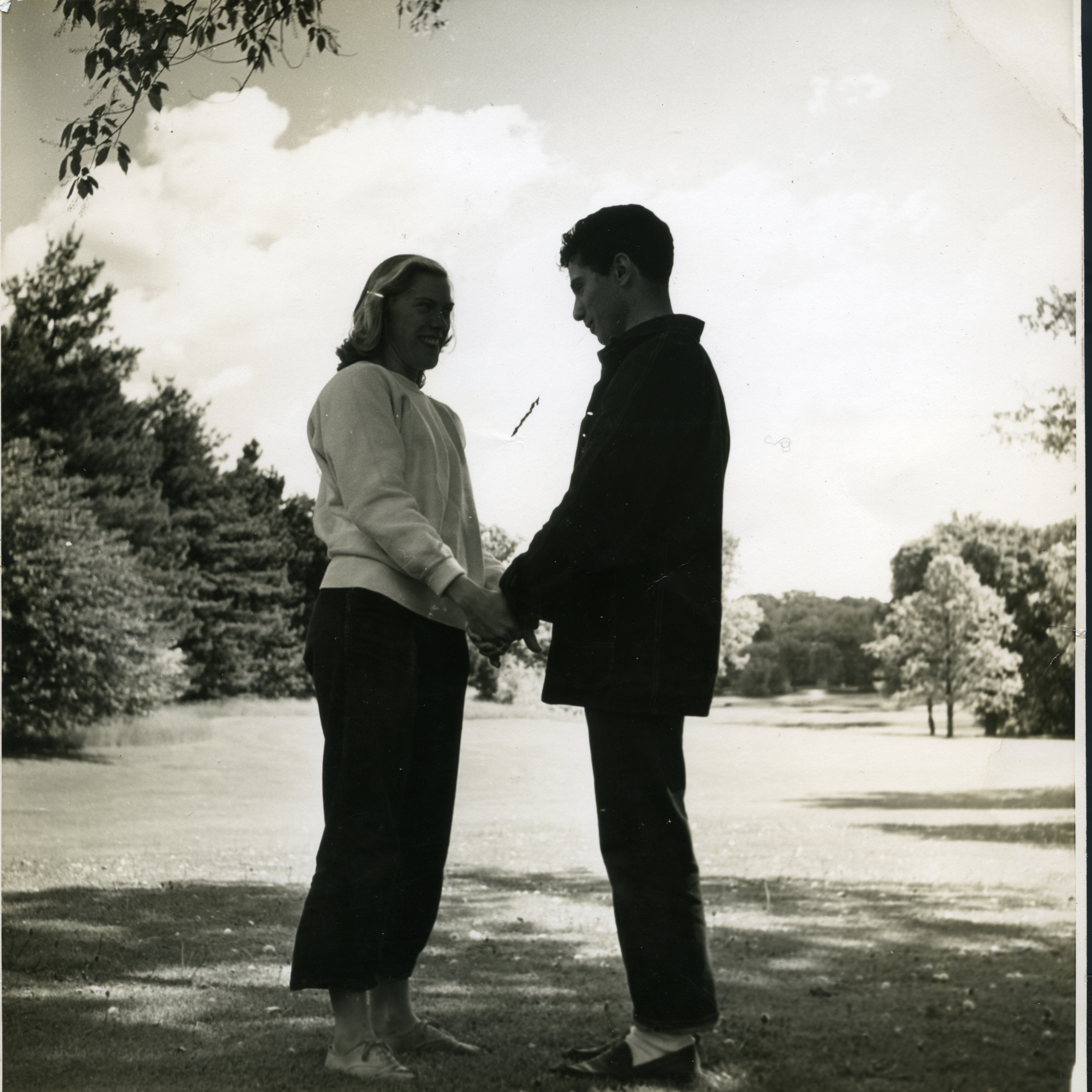
Eleanor Ann Middleton (Painting,1950) and Angelo Caravaglia (Sculpture, 1950) on Cranbrook grounds, circa 1950. Courtesy of Cranbrook Archives.

Eleanor Ann Middleton (Annie) received her BFA and MFA in Painting from Cranbrook Academy of Art in 1949 and 1950, respectfully. Her photo album, assembled at least in part post-graduation, contains photographs from Cranbrook staff photographer, Harvey Croze, who also managed the studio and darkroom in the basement of the Academy Administration Building. These images—class photos on the Art Museum peristyle or familiar shots of the Triton Pools— are copies of those already in the Cranbrook Photograph Collection. But the bulk of the album contains snapshots that are unique to the Archives.

Jack Kearney (Painting 1948) creates al fresco, circa 1947-1948. Courtesy of Cranbrook Archives.

While Middleton was herself a photographer, she appears in many of the images, so the snapshots are likely a mix of her work, fellow Academy students, and perhaps even Croze, in an unofficial capacity. While not Academy staff or student, Croze was a practicing artist (painting and photography) and was known to spend much of his free time with Academy students. Whatever the case, the result is an intimate glimpse into student life.

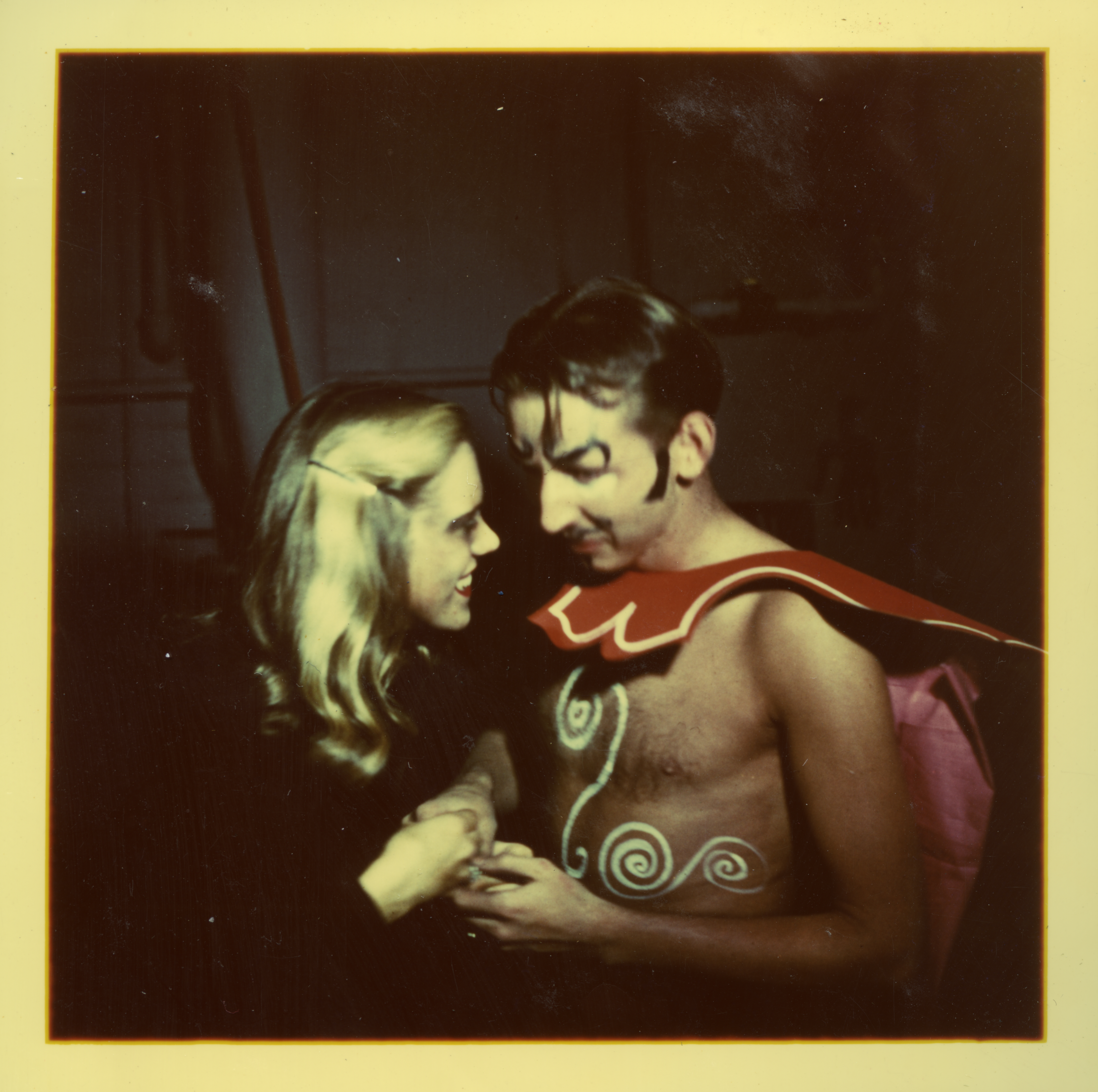
Annie Middleton and a fellow student at one of many costume parties featured in the album, circa 1947-1950. Courtesy of Cranbrook Archives.

The Center wishes all students at the Academy and Cranbrook Kingswood Schools a wonderful 2024-25 academic year!

Deborah Rice, Head Archivist, Cranbrook Center for Collections and Research

Harry Belafonte Visits Cranbrook

Following on the heels of Leonard Bernstein, Don Shirley, and Dave Brubeck, yet another famous musician came to Cranbrook: Harry Belafonte. While his trip to campus, unfortunately, did not involve a performance, it is well-recorded in the Archives: in news items, photographs, and a Society page headline in the Wednesday, November 23, 1960, Birmingham Eccentric.

Being a relatively new recording star on the RCA record label, the 1960 visit included Belafonte’s third Detroit performance. After his debut in 1956 in a show called “Sing, Man, Sing!” Belefonte played the newly converted live venue, the Grand Riviera Theater the following year in support of his record album, “An Evening With Belafonte.”

Portrait of Harry Belafonte, singer and actor. Courtesy of E. Azalia Hackley Collection, Detroit Public Library.

At this point, the actor and singer was pretty much a household name, having starred in the 1954 film Carmen Jones, and riding the wave of his 1956 breakthrough hit album, Calypso, the first million-selling LP by a single artist. Who doesn’t know the song “Day-O (The Banana Boat Song)?”

When Belafonte returned to the Riviera in 1960, his show was again billed as “An Evening With Belafonte” but now featuring an opening performance by South African singer Miriam Makeba, sponsored by the Junior Women’s Association for the Detroit Symphony Orchestra. And this time, in the audience were Henry Scripps Booth (son of Cranbrook founders George and Ellen Booth), his wife Carolyn, and their son Stephen with his wife Betty.

It’s not surprising that Henry (known to family and friends as Harry) was in attendance. An avid music aficionado, he was a charter member of the Cranbrook Music Guild, founded in 1951, and had been floating the idea of a creative music center on Cranbrook campus for at least that long. In fact, earlier in 1960, he had even proposed in a letter to Eero Saarinen the building of a music shell on the west lawn of Cranbrook House. Alas, the music center (and Saarinen music shell) never came to be.

In any case, Henry must have been visibly enjoying Belafonte’s concert. According to another Eccentric columnist, “Cheers went up at Harry Booth’s impromptu performance. Mr. Belafonte took his mike down to Mr. Booth’s ringside seat and induced him to give forth on a chorus of ‘Matilda‘ (it was all unrehearsed – we checked).”

A few days later, Belafonte made the trip from Detroit, at Henry’s invitation, to dine at the Booth’s home, Thornlea, with the family. Afterwards, he was given a brief tour of Cranbrook where he stopped at the Academy of Art to meet students and view work in their studios.

Join the Center on May 18 to help us celebrate the legacy of music at Cranbrook—dine at Thornlea and enjoy musical stylings from the era of Harry Belafonte’s visit. Head to our website to learn more and purchase your tickets to A House Party at Cranbrook!

Deborah Rice, Head Archivist, Cranbrook Center for Collections and Research

Collaging the Architecture of Detroit

Each year before my History of American Architecture lecture series, I like to commission Cranbrook Academy of Art student or recent alumni to design a poster to promote the event. This year, I asked second-year 2D Design student Luis Quintanilla to create a poster for this year’s series, Detroit and the World. I am thrilled with how the poster turned out—you can pick one up at the first lecture February 6, 2024—and thought I would share with you some of how it came about.

When I visited Luis’ studio in the Arts and Crafts Court, I was struck by their graphic sensibility combining imagery and text in sticker-like collages. I was also very impressed by a series of stipple drawings in ink on tracing paper, which Luis kept in a shoebox. As we talked about the themes of my upcoming lectures, and what we both admire about Detroit and its architecture, the idea of the poster came about. With Luis’ sketches strewn across the table in their studio, I was reminded of the great tradition of architectural capricci.

Architectural capprici are fantasies, where artists or architects combine buildings from across time in a single image. Traditionally, 18th century capprici could be oil paintings, pencil or ink sketches, or engravings. Joseph Michael Gandy is the most famous painter of architectural fantasies. Here, he is combining the London works of Sir John Soane into a single fantasy, set within the studio of Soane’s own house.

Joseph Michael Gandy, Public and Private Buildings Executed by Sir John Soane between 1780 and 1815, first exhibited 1818. Courtesy of Sir John Soane Museum, London.

If you’ve come to many of my previous architecture lectures, you might recognize my favorite painting: Thomas Cole’s The Architect’s Dream of 1840, a capprici which embodies the mid-19th century debate between gothic and classical styles. Contemporary British painter Carl Laubin creates stunning work inspired by Gandy, using contemporary architects for elaborate capprici.

What might an architectural capprici of Detroit include?

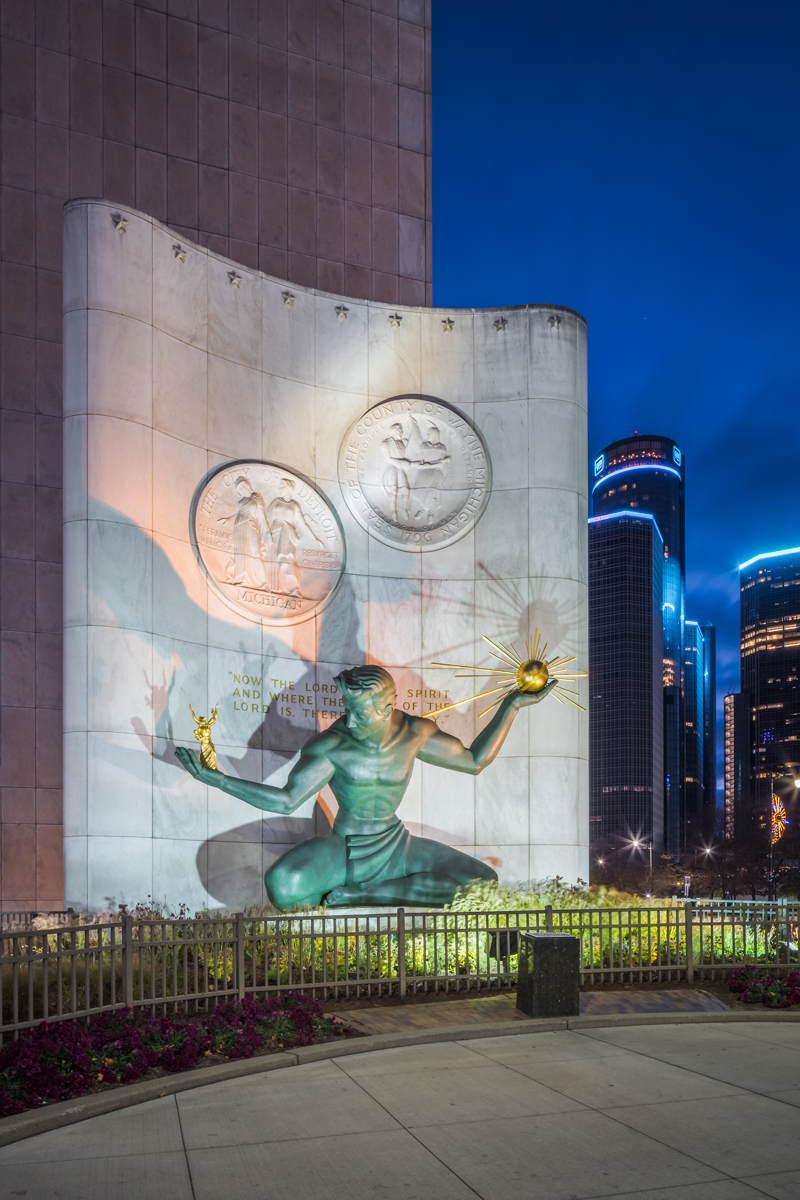
Marshall M. Fredericks’ The Spirit of Detroit, 1958, photographed by Helmut Ziewers for Historic Detroit Area Architecture.

I created a list of forty buildings I thought embodied the best of Detroit architecture. I narrowed it down to twenty buildings for Luis’ consideration, and shared images of each. My only real request: include at least one building from each of the five lectures, and center the poster on John Portman and Associates’ 1977 Renaissance Center.

I don’t think Detroit has a more iconic building than the RenCen, with its piston-like glass towers rising up from the Detroit River. There are better works of architecture, sure, but as far as an associated image of Detroit? Nothing tops the RenCen.

I suggested, too, that Luis include the 1901 St. Josaphat’s church by architects Joseph G. Kastler and William E. N. Hunter in front of the RenCen, to recall the almost too-good-to-be-true alignment of these two structures when driving into the city from the northern suburbs on I-75. After all, by the nature of delivering lectures about Detroit from the distance of Cranbrook, this is the view (from the suburbs, from the car) many of us hold toward the city.

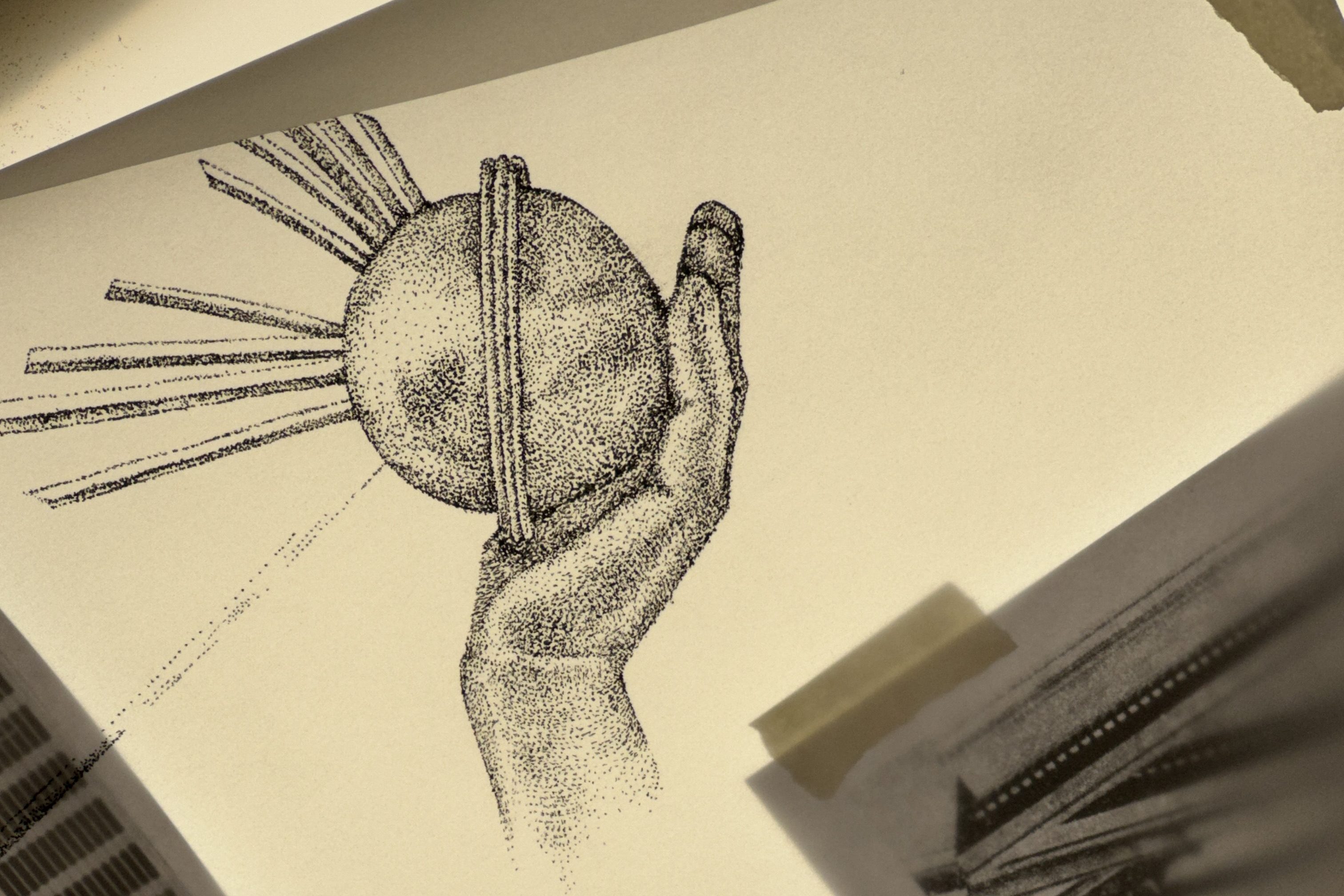
We went back and forth about including the Spirit of Detroit, former Cranbrook Schools faculty member Marshall M. Fredericks’ monumental bronze at the Detroit City-County Building. What attracts me to the Spirit is its iconic status and its graphic replicability: whether on the redesigned city buses or the new city holiday lights, all you really need is an orb and some rays of light to know: that’s the Spirit of Detroit.

What would be the mood of our Detroit capprici?

Inextricably linked to the history of Detroit since 1980 is Detroit Techno, a form of Electronic Dance Music (EDM) that combines synth-pop with African American styles such as house, electro, and funk. For me, Detroit is most exciting, and its dynamism most electrifying, at night. In riding through the city after dark, buildings become speeding landmarks, and its possible to disappear for a time into a former factory or repurposed commercial building for a party or a rave. In these moments, buildings become less defined by their former glory or current decay than by their inhabitation as a dancefloor pulsating with music and lights. It’s a new way of occupying the city’s architecture to unique advantage.

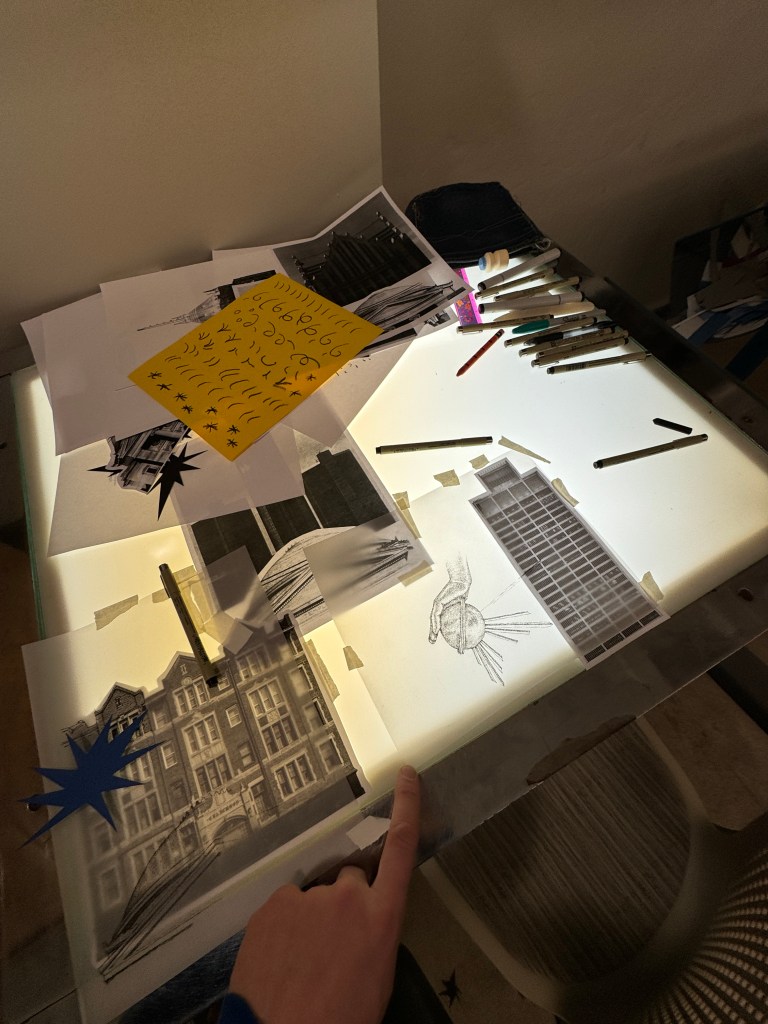
Luis went to work. They began by printing out and arranging the buildings I’d shared. Then, they began overdrawing some of the images—distorting or highlighting certain features.

Layering on tracing paper, Luis dutifully stippled certain prominent architectural elements. I was especially impressed at the beautifully rendered hand, orb, and rays of Spirit of Detroit.

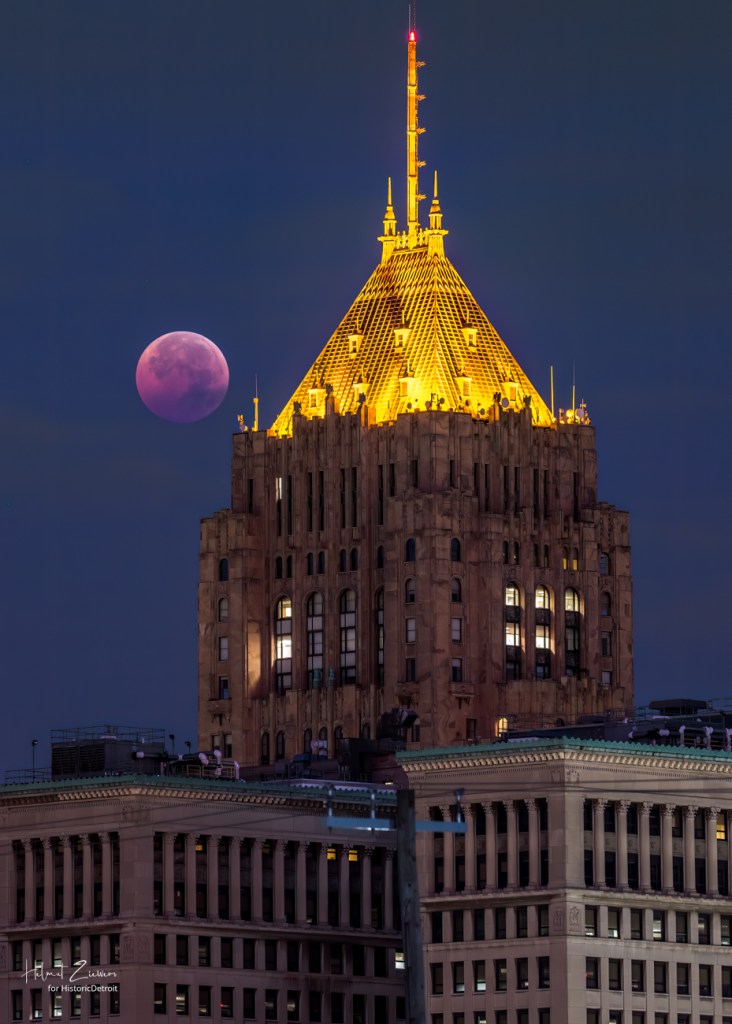
Luis then cut out stars on blue and yellow paper, adding in light sources to the night scene. The Ambassador Bridge, Dodge Memorial Fountain, Penobscot and Fisher Buildings are all recognized for their dramatic nighttime illumination, and Luis captured this with hand-drawn and cut stars.

Finally, Luis scanned in the physical elements of the poster and reassembled them in Illustrator, where text was added. Luis took inspiration from Detroit Techno posters for the colors and fonts. I could not be more thrilled with our poster, and the capprici of Detroit at night (with techno).

Luis Quintanilla, CAA ’24, working on the poster. Luis is from Austin, Texas, and earned their BFA from Virginia Commonwealth University.

Can you identify all the buildings shown? Can you speculate why I chose them?

If you can, you’ll love this year’s History of American Architecture: Detroit and the World lecture series! If you can’t, you’ll also love this year’s History of American Architecture: Detroit and the World lecture series! The first lecture is February 6, 2024, at 12:00pm ET online and at 6:30pm ET online and in de Salle Auditorium at Cranbrook Art Museum. Purchase your tickets and learn more on our website. All lectures will be available for viewing after the lecture to ticket holders. See you there!

Kevin Adkisson, Curator, Cranbrook Center for Collections and Research

Special thanks to Artist-in-Residence Elliot Earls, Head of 2D Design, for suggesting Luis for this project. A perfect fit!

Did Leonard Bernstein Write “West Side Story” at Cranbrook?

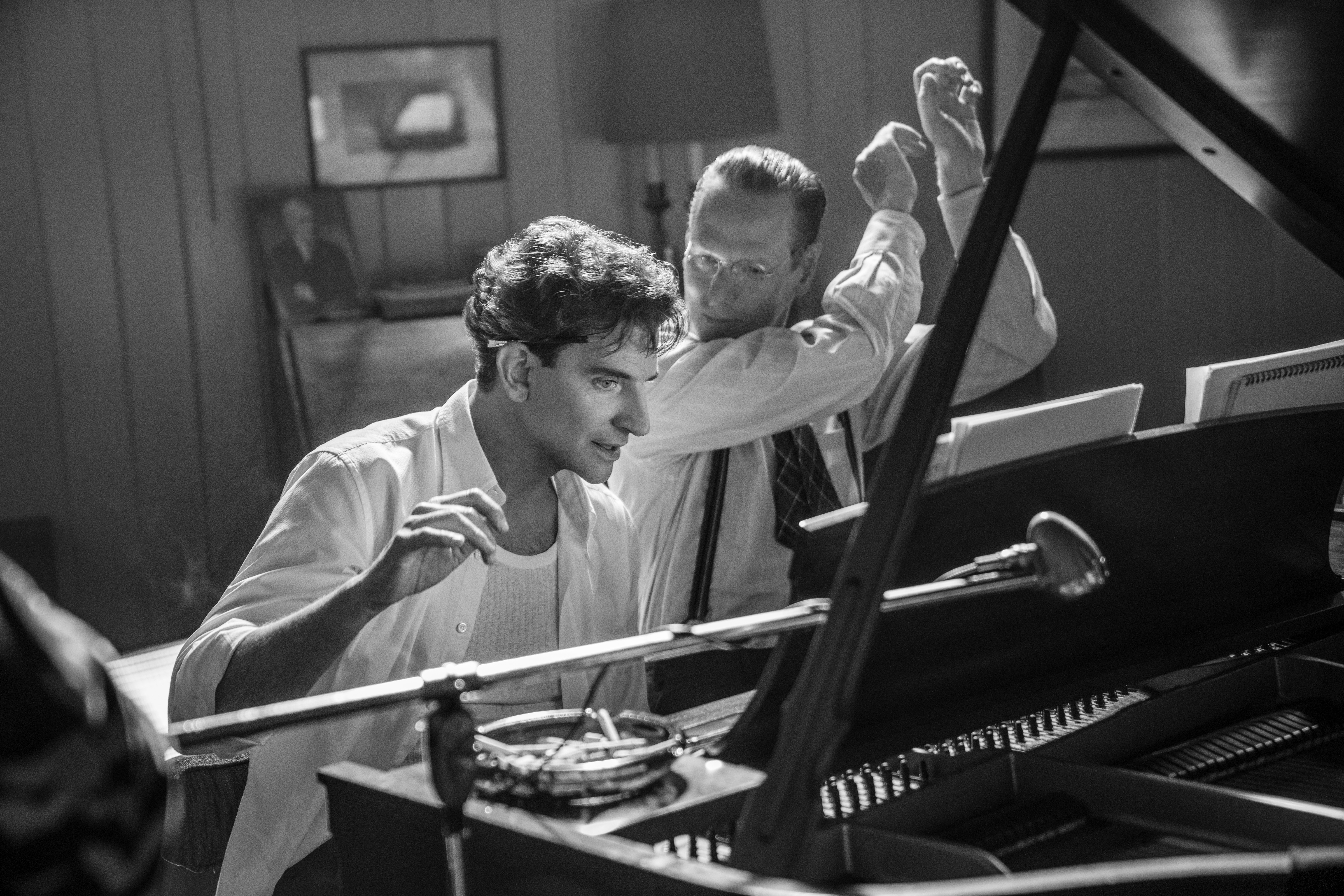
With Maestro now streaming on Netflix—and nominated for four Golden Globe Awards—it’s high time I set the record straight about the Cranbrook House Steinway Grand and its most famous pianist, Leonard Bernstein. It is a legendary story, told and retold for decades, that places Bernstein composing none other than his most famous work, West Side Story, here, at Cranbrook.

It is a story, however, that is hard to unravel fact from fiction. So, like all Center historians and archivists, I started by doing some digging in Cranbrook Archives. This is the story I uncovered.

Bradley Cooper as Leonard Bernstein, and Brian Klugman as Aaron Copland in Maestro. Courtesy of Netflix © 2023.

First, the Piano

Cranbrook has several Steinway grand pianos, including two of the grandest: a Model D concert grand in Page Hall on the original School for Boys campus, and a second Model D in the Cranbrook House Library. The Cranbrook House concert grand piano was manufactured by Steinway & Sons of New York City and completed a little more than eighty-five years ago on December 18, 1929. It was purchased by Grinnell Brothers of Detroit in January 1930 and, later that year, sold to the Colony Town Club, a women’s club located on East Jefferson Avenue in Detroit.

Cranbrook House library facing south. Steinway & Sons Model D Concert Grand piano sits below the “Story of Ceres” tapestry, March 1957. Photographer Harvey Croze. Courtesy of Cranbrook Archives.

Enter, George Booth

The black concert grand piano was to have a short life at the Colony Town Club. Within a few years, its members sold it back to Grinnell Brothers where, in February 1935, it was purchased by George Booth. I remain intrigued by the fact that Booth purchased a “pre-owned” piano. While America was in the throes of the Great Depression, I think it was more than a simple cost-saving measure; it was a decision warranted by the piano’s intended use.

The piano did not begin its life at Cranbrook in the Booths’ Library, the center of their social life after it was completed in 1919. Rather, Booth first placed the piano in the main hall of the Cranbrook Pavilion on Lone Pine Road. Known today as St. Dunstan’s Playhouse, in 1935 the recently renovated pavilion was being used as an exhibition gallery and event space for the Academy of Art and its nascent Art Museum. The piano was played at exhibition openings and for preludes before lectures, including at least one by Frank Lloyd Wright. Although St. Dunstan’s Guild began using the pavilion in 1937 for rehearsals and storage, Cranbrook Academy of Art continued to hold exhibitions there until 1942, when the new Eliel Saarinen-designed museum opened.

Cranbrook Pavilion staged for an Academy of Art formal party, January 16, 1936. In the center is what would become known as the Cranbrook House Steinway concert grand piano; in the background is the Cranbrook Map Tapestry, designed by Eliel Saarinen and woven by Studio Loja Saarinen in 1935. Courtesy of Cranbrook Archives.

Sometime between 1942 and the summer of 1946, when the pavilion was cleared out and rented by the Cranbrook Foundation to St. Dunstan’s Guild, George Booth moved the Steinway down the road to Christ Church Cranbrook “to protect the instrument from damage by dampness or other causes and to give it the benefit of expert use.” It was also during this period, in March 1944, that George and Ellen Booth formally deeded to the Cranbrook Foundation the Homestead Property, which encompassed not only Cranbrook House but also the forty acres adjacent to the house, including the Cranbrook Pavilion and its Steinway.

Enter, Leonard Bernstein

Continue reading

Time to Study! (History, that is)

As college students across the country buckle down to study for final exams and finish writing end-of-semester papers, there will be one school where that’s not happening: Cranbrook Academy of Art. Instead, our Academy students are busy making in their studios, and frantically producing work for their semi-regular critiques with Artists-in-Residence. This follows the model set up here by founding president Eliel Saarinen, who famously rejected what he called the “non-creative-school-book-learned-art-teacher” in favor of a method he called “self-education under good leadership.”
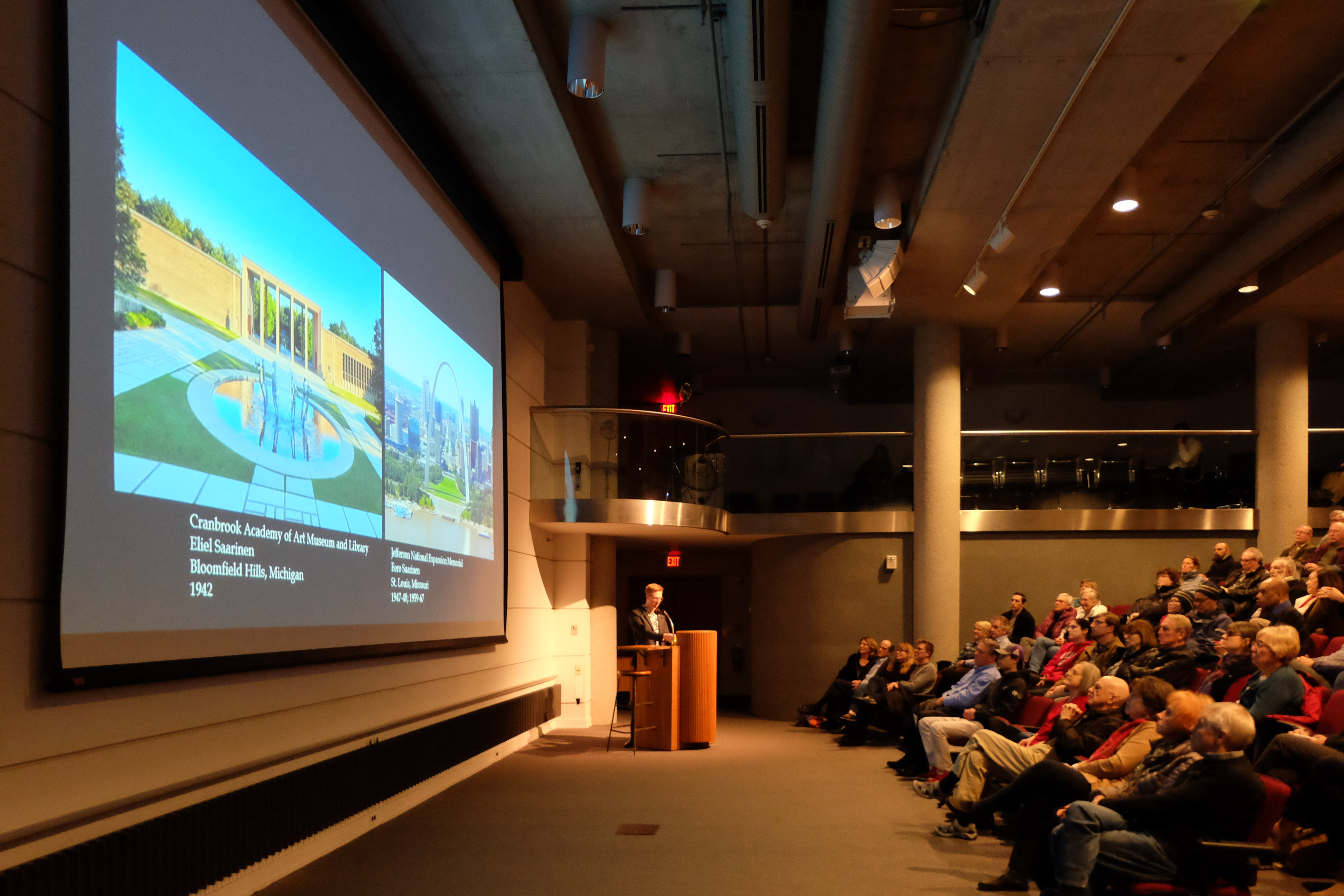
While the Academy’s extremely self-directed, studio-based education is proudly traced back to our founding, Cranbrook did, in fact, once offer formal courses in the history of art. These quarterly courses—taught by museum curators, visiting professors, and artists—utilized both slide shows and actual paintings.

Museum Director Albert Christ-Janer teaching his “Survey of the Arts” history class for Cranbrook Academy of Art students, 1945. Christ-Janer arrived at Cranbrook in June of 1945 and left for the University of Chicago in September 1947. Harvey Croze, photographer. Courtesy Cranbrook Archives.

Here, we see Museum Director Albert Christ-Janer lecturing in the then-new Cranbrook Academy of Art Museum and Library. The classroom is simple, just folding chairs and an illuminated blackboard set up in the lower-level galleries. In front of the students hangs Doris Lee’s Fisherman’s Wife. I admire Christ-Janers books, and imagine it would’ve been very exciting to attend one of his lectures.

Christ-Janer discussing Fisherman’s Wife by Doris Lee (CAM 1945.27). Lee painted the scene of Key West, Florida while she was a visiting artist at Michigan State in 1945. It was purchased by the Cranbrook Foundation that same year. Harvey Croze, photographer. Courtesy Cranbrook Archives.

In the Academy’s 1945 Course Catalog, Christ-Janer is listed as “Instructor in the Survey of the Arts.” By the 1970s, then President Wallace Mitchell stopped offering anything like a history of art course at the Academy in favor of a history/theory seminar called the Humanities Forum. This evolved into the Critical Studies program today—the only required lecture/seminar for Academy students, but which is, as always, ungraded.

I’d note that Christ-Janer is teaching in a full suit and tie—a sight rarer at the Academy today than a history of art course!

Even though the Academy no longer offers a History of Art course in its curriculum, I like to think that the Center’s History of American Architecture lecture series continues the tradition of art history at Cranbrook. For the past six years, I’ve taught architecture history to interested Academy and Cranbrook Schools students, and open to members of the public.

Kevin Adkisson teaching History of American Architecture: Cranbrook in Context, March 3, 2020. Photography by Daniel Smith, CAA 2021, Courtesy Cranbrook Center for Collections and Research.

Starting on February 6, 2024, the History of American Architecture lecture series returns. This year’s subject is “Detroit and the World,” and we are offering two ways to attend the lecture: virtually, at noon or 6:30pm EST, or in person at Cranbrook Art Museum’s de Salle Auditorium at 6:30pm. We launched the website and ticket sales on Wednesday, and I encourage you to read more about each week’s topic and consider signing up over on our website. There’s so much great Detroit architecture, and I am excited to share it with you in lectures this winter!

In his unpublished 1950 manuscript, The Story of Cranbrook, Eliel Saarinen wrote of Cranbrook students as “the pupil is like an empty sack to be filled during the school year.” I hope you’ll join me in February as we fill ourselves up with knowledge!

Kevin Adkisson, Curator, Cranbrook Center for Collections and Research

Image: The Greater Penobscot Building by Wirt Rowland of Smith, Hinchman & Grylls, Detroit, Michigan, 1928;  Photography by James Haefner, Courtesy James Haefner.    

HISTORY OF AMERICAN ARCHITECTURE

DETROIT AND THE WORLD

This installment will focus on the architecture of Detroit, studying the buildings, designers, and policymakers that shaped the city’s dramatic transformations from the late nineteenth century to today, and how Detroiters have influenced the course of architecture around the globe. 

Ruth Adler Schnee’s Interior Design Legacy

Cranbrook Archives was saddened at the passing of design icon Ruth Adler Schnee last month. As proud custodians of the Edward and Ruth Adler Schnee Papers we know that her legacy lives on in the many documents, photographs, drawings, and textile samples available to researchers. With a long and varied career in textile design and interior design, there are a plethora of materials to inform and admire, adding nuance and context to her catalog of accomplishments seen in current textile production, museum collections worldwide, and public, commercial, and residential buildings throughout the Detroit area.

Ruth and Edward Schnee, circa 1990. Courtesy of Cranbrook Archives.

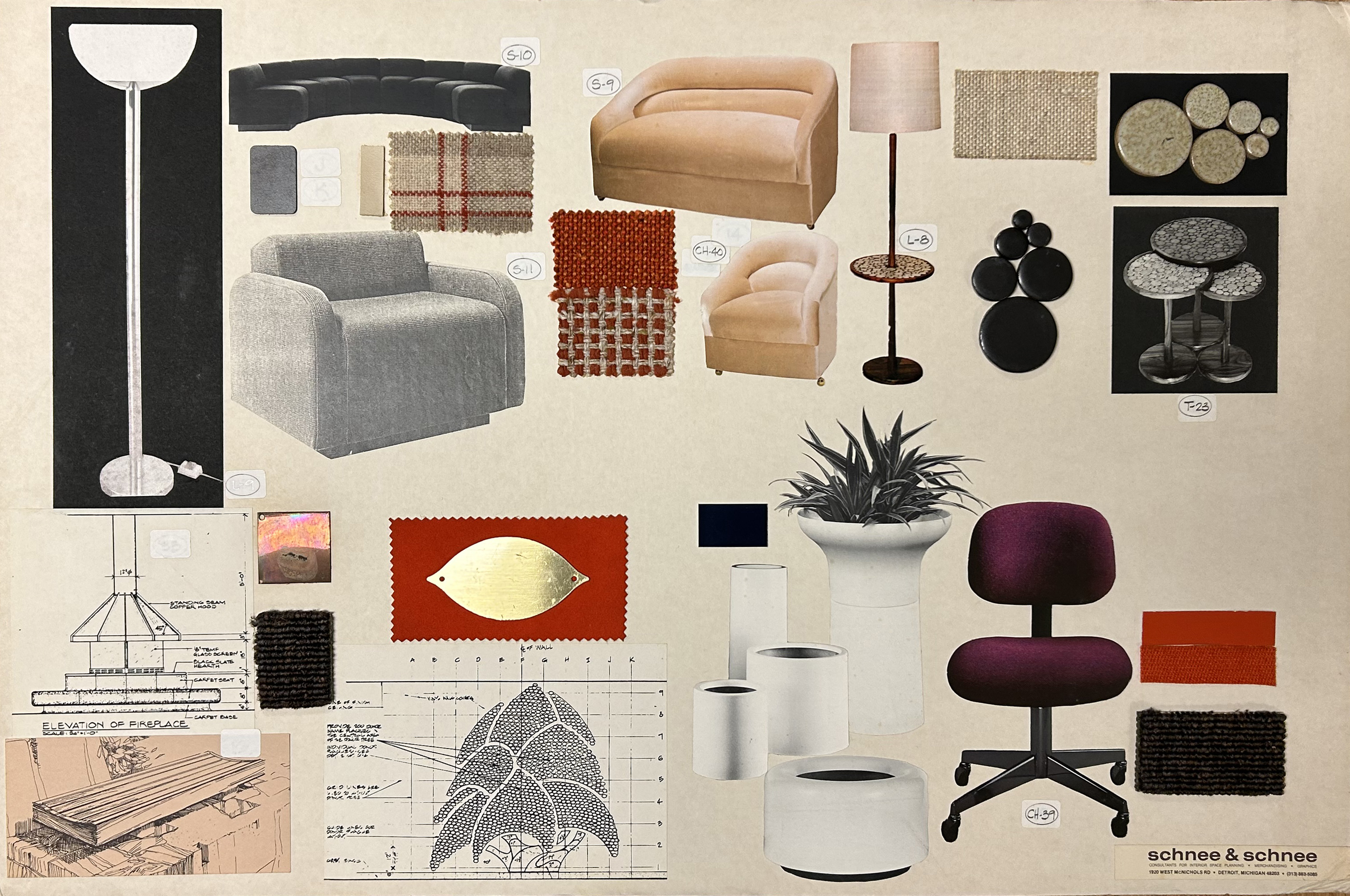
Her personal and professional story is inspiring in so many ways, not the least of which were the interior design projects completed for Schnee & Schnee Consultants, a company that Ruth owned with her husband Edward Schnee from 1977-1985. She designed, and he ran the business, much like their other design consulting partnerships, the earlier Adler-Schnee Associates, and the later Schnee and Schnee Inc.

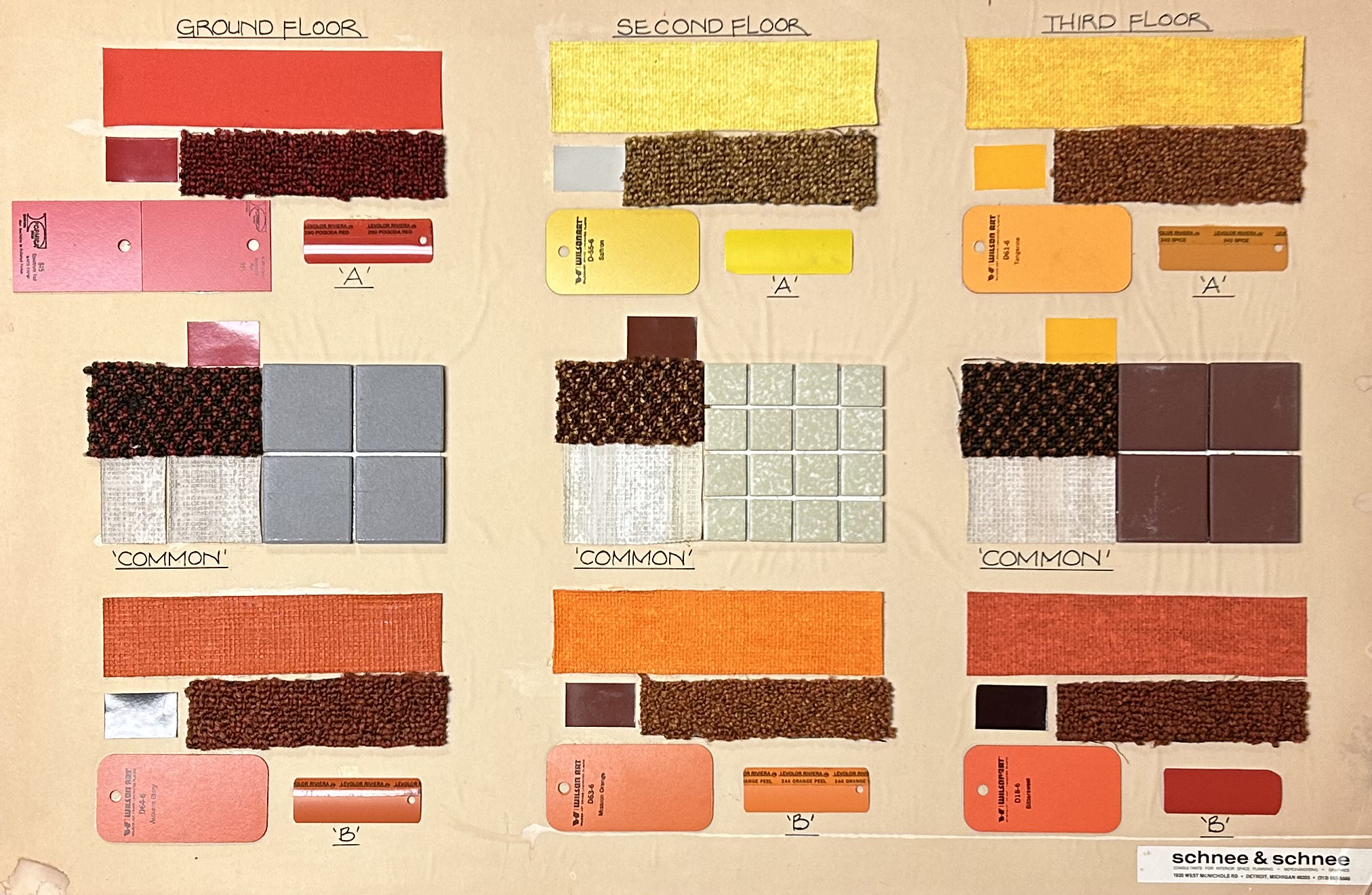
One of their major commissions, and particularly well-documented in their papers, was the Jewish Community Center’s Edward and Freda Fleischman Residence/Blumberg Plaza in West Bloomfield, a three-year project spanning 1982-1985. One does not automatically think of innovative design when considering assisted living facilities, so it is particularly a delight to view Ruth’s colorful palette at work in her project sketches and product choices, both of which evoke her affinity for vibrant textiles.

The Schnees’ thoughtful work in addressing the needs of the residents is evident in the detailed project records and numerous oversized room design presentation boards. In comments about the project Ruth stated, “every design decision became an important element in providing a warm and protective environment.” The residence quickly became a model for similar projects across the country as the modern idea of assisted living facilities, versus the institutional nursing home model, grew in popularity.

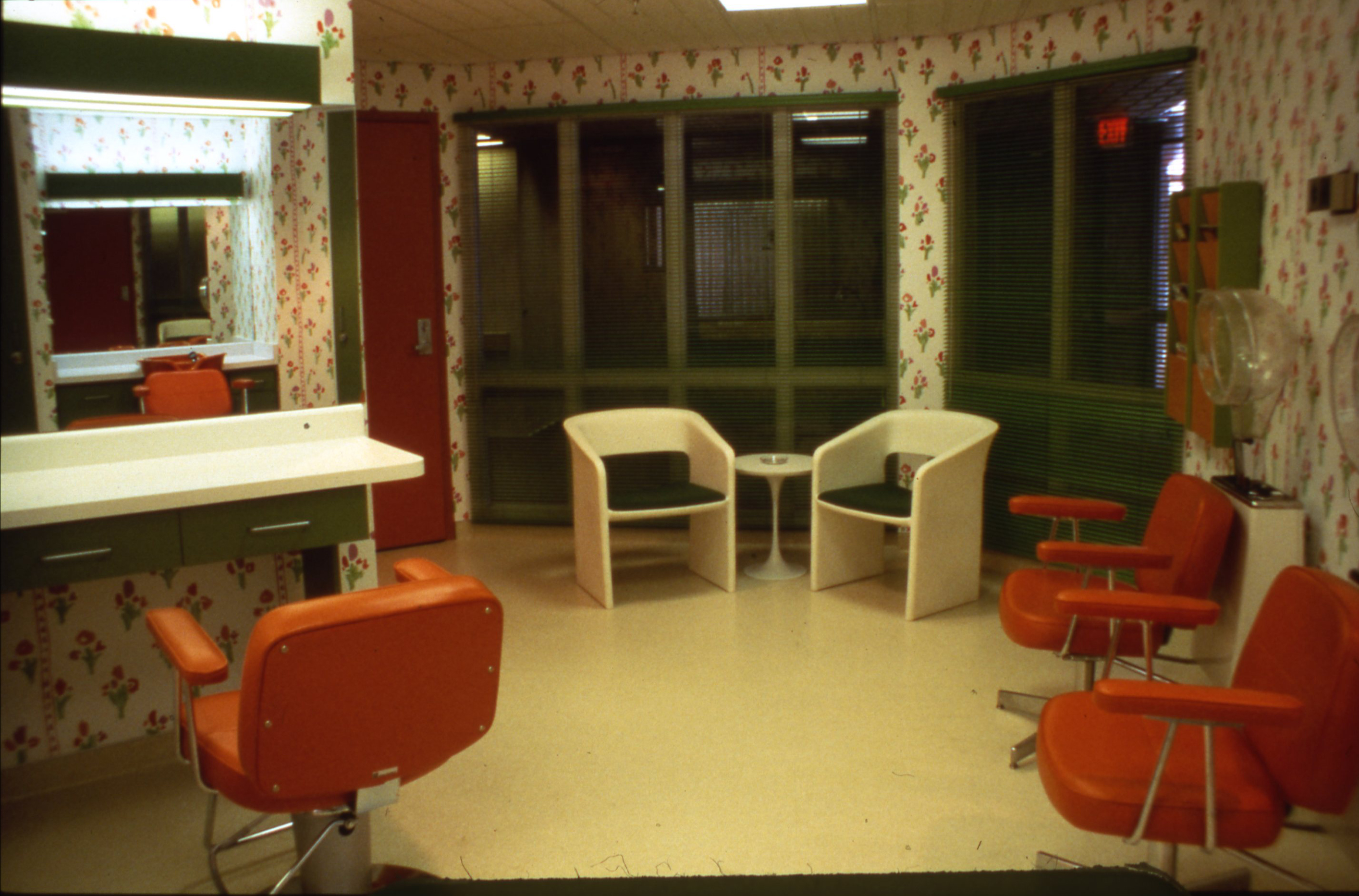
Immediately following their success with the Fleischman Residence, Schnee & Schnee consulted on a similar project just north of Cranbrook Educational Community, St. Elizabeth Briarbank. Collaborating with the architectural firm John Stevens Associates Inc. (Ruth was their Director of Interior Design from 1977-1979), Ruth designed the interiors for an addition to the Catholic assisted living community for women, drawing on her research and application at the Fleischman Residence. From the red and orange beauty parlor, featuring the same John Yellen chairs, to the softer wall murals in common rooms, to the light-hearted wallpaper in the communal kitchen, Ruth’s touch is irrefutable.

The Fleischman and Briarbank projects are just two of the eight senior residential complexes (four with architect John Stevens) that Ruth “transformed” with her sensitivity and playfulness, demonstrating yet another intriguing facet of Ruth Adler Schnee’s career.

Deborah Rice, Head Archivist, Cranbrook Center for Collections and Research

Editor’s Note: Find out more about Ruth’s early design pursuits and her retail business venture with husband Eddie in previous Cranbrook Kitchen Sink posts. Browse additional images from the Edward and Ruth Adler Schnee Papers here.

Traditions from the Weavers

Does your family have a certain pose that they always do for a family picture? My cousins and I always had to stand or sit by the same log at our cottage each summer to get a group picture. Even when the log had disintegrated, and we were all adults, we still stood in the same spot to take the picture.

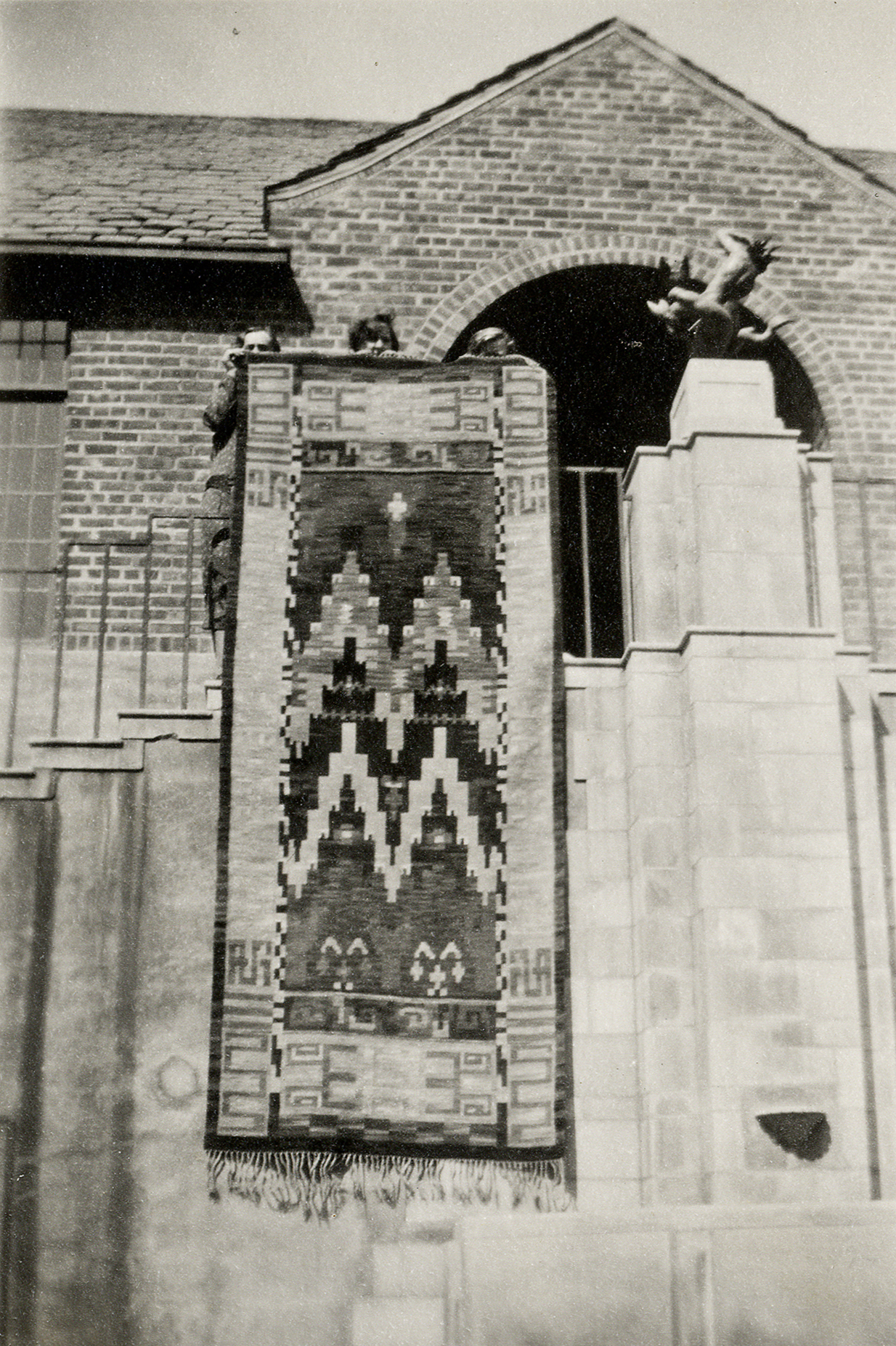
The Swedish weavers of Studio Loja Saarinen were the same way. After every rug was completed, they would unroll it behind the studio, lay it on the lawn, and pose at the end. This not only documented their work, but also served as a record of who worked on each piece. In Cranbrook Archives, we have a few examples of these images.
Cranbrook Academy of Art Rug No. 14

This rug lay in the center of the Studio Loja Saarinen Weaving Room. A flatwoven rug with stylized meanders in the border, and an elegant color scheme of dark browns, blues, and beiges, in form, structure, color, and design it shows the contemporary style of Swedish weaving that would become the foundation of Studio Loja Saarinen’s work.

Cranbrook Academy of Art Rug No. 14, designed by Maja Andersson Wirde and woven by Lillian Holm for Studio Loja Saarinen, 1930. CAM 1955.2. Photographer James Haefner.

This was one of the first rugs executed under the “Design and Supervision” of Maja Andersson Wirde, who was Loja’s right-hand-woman from 1930 to 1933. The rug is actually a variation of a design Wirde made for the 1925 International Exhibition of Modern Decorative and Industrial Arts in Paris (the “Art Deco” World’s Fair).

When Wirde wrote to Cranbrook’s secretary from Sweden before immigrating, she said she would bring along prepared designs and wool and linen yarns to be able to get started right away. She certainly did! Below, you can see Wirde and possibly Lillian Holm and Ruth Ingvarsson holding up the rug behind Studio Loja Saarinen just months after their arrival to Cranbrook.

Studio Loja Saarinen weavers with Rug No. 14 behind the Cranbrook Arts and Crafts Studios, 1930. Courtesy Smålands Museum, Sweden.
Continue reading

Create a website or blog at WordPress.com