Eat, Greek, and Be Merry: the Greek Theatre Turns 100!

Drama and arts and crafts have been intertwined in Detroit history for more than 100 years. Under the auspices of the Detroit Society of Arts and Crafts (DSAC), on January 19th 1910, May Morris (daughter of William Morris) captivated a capacity crowd at the Detroit Museum of Art with her illustrated lecture “Pageantry and the Mask.” Morris’s presentation helped mark a turning point in propelling Detroit onto the national stage as an arts and crafts center. Almost immediately after May Morris left Detroit, Alexandrine McEwen, a bookplate artist and founding member of the DSAC, penned what was termed a “modern immorality play” called Everywoman with characters named “Suffrage” and “Art.” Less than a month later, she wrote The Masque of Arcadia, another outdoor play held on the grounds of Clairview, J.L. Hudson’s Grosse Pointe estate. These performances led to the DSAC being the first to foster a little theatre as part of their program.

By 1914, George Booth (the first president of the DSAC) already had plans in mind for a bathing pavilion and a theatre on the hill overlooking Cranbrook House. (My own suspicion is that he did not like the fact that the DSAC performances were not held on HIS estate!) In early 1915, Booth commissioned Canadian architect Marcus Burrowes to draw up the plans for an outdoor Greek Theatre. The open-air amphitheater, constructed of stone, seats nearly 300 people and was described in contemporary news articles as a “gem of architecture” and a “temple of art.” By May 1916, landscaping was underway and red tulips graced the front of the bathing pavilion.

Invitation Card, The Cranbrook Masque, June 1916. George Gough Booth Papers.

Invitation Card, The Cranbrook Masque, June 1916. George Gough Booth Papers.

Meanwhile, the DSAC was planning the production of The Cranbrook Masque which would also serve as the public dedication for the new Greek Theatre. The play showed the development of drama from ancient to modern times in five episodes, emulating May Morris’s lecture theme from 1910. For more on the play, see an earlier blog post.

Greek Theater masque, 1916

The Cranbrook Masque at the Greek Theatre, 1916. Hand-tinted glass slide.

Fast forward to 1991 and the 75th anniversary of the Greek Theatre. A team of dedicated Cranbrook staff, historians, and theater enthusiasts initiated the restoration of the Greek Theatre and a contemporary production, using the script from the original Masque, this time with cast members from St. Dunstan’s Guild and dancers from Jessie Sinclair’s Cranbrook Kingswood Dancers.

E465

Cranbrook House sunken garden (originally called the kitchen garden) with staked tomato plants, ca 1915.

This year marks the 100th anniversary of the Greek Theatre and a long-standing tradition of theater programs at Cranbrook. In honor of this memorable event, the Cranbrook Center for Collections and Research will be presenting “Edible Landscapes: A Midsummer Night’s Dinner.”

Leslie S. Edwards, Head Archivist

New Center Logo & A Fond Farewell

The Cranbrook Center for Collections and Research has officially launched our new logo! What follows is a description of where each of the letters comes from in the history of Cranbrook or the location on the campus!

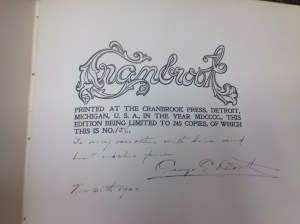
The (first) C in Cranbrook is from the logo George Gough Booth created for the Cranbrook Press in 1901, three years before he and his wife Ellen established their estate in Bloomfield Hills.

IMG_0361

The Cranbrook Press (1900-1902) was founded by George Booth in the attic of the Detroit Evening News Building.  Booth emulated the work of William Morris and his Kelmscott Press, not just in design but also in the level of hand-craftsmanship.

Continue reading

Photo Friday: Diogenes’ Search for an Honest Man

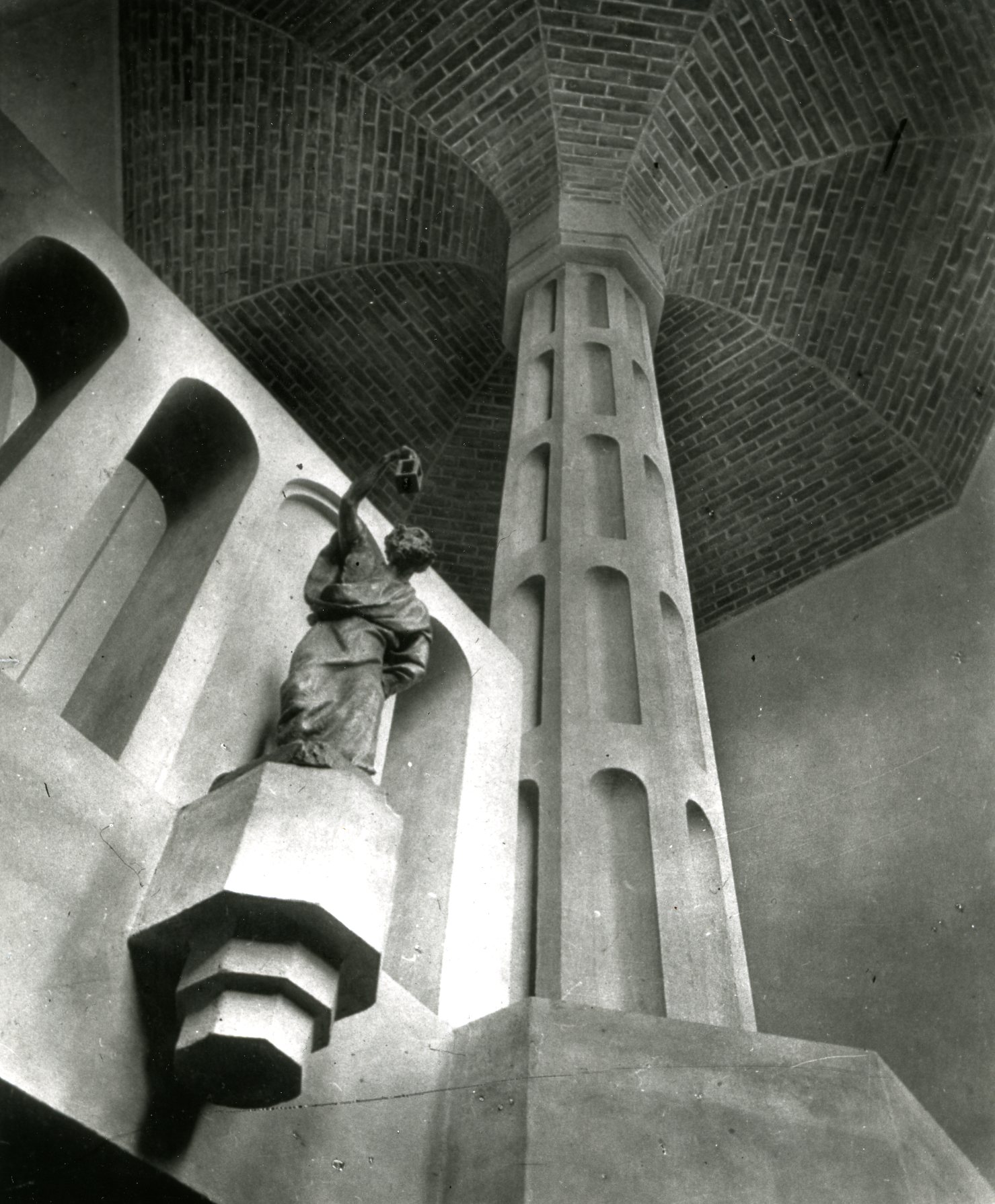
A view of Diogenes. Photographer, Harvey Croze, 1961.

A view of Diogenes. Photographer, Harvey Croze, 1961.

You might not immediately notice the small bronze statue that sits at the top of Hoey Tower’s stairwell at Cranbrook School. The statue is Diogenes – a Greek philosopher best known for holding a lantern and claiming to be on a quest for an honest man. Diogenes is considered to be one of the founders of Cynicism – a doctrine that supports a life in accordance with nature and rejects convention.

George Booth originally purchased Diogenes for Cranbrook House from the Gorham Silver Company in May 1914. One of the many statues he purchased during his lifetime, he bequeathed it to Cranbrook School upon his death.

Diogenes has been depicted throughout the centuries in paintings, drawings, and sculpture. Our sculpture was created by George Edwin Bissell (1839-1920) in 1906. Bissell, who was born in Connecticut, studied in Paris at the Academie Julian, the Academie Colarossi, the Ecole des Arts Decoratifs, and the Ecole des Beaux Arts. In 1876, he studied at the American Academy in Rome. He also served in the Civil War as a private in the 23rd Connecticut (1862-1863) and as assistant Postmaster for the U.S. Navy (1863, 1865).

Gina Tecos, Archivist

Photo Friday: Underlying Principles of Beauty

St. Paul Chapel reredos. Courtesy Cranbrook Archives.

St. Paul Chapel reredos. Courtesy Cranbrook Archives.

In a letter to George G. Booth ca 1931, Detroit News Art Critic Florence Davies, writes of artist Hildreth Meiere, “All over the place she discovered these refinements of line, these essential underlying principles of beauty. I have taken many people to Cranbrook, never anyone who saw it with so much understanding.”

Meiere (1892-1961) was a distinguished Art Deco muralist, painter, and decorative artist. Her commissions range from the medallions on the exterior of Radio City Music Hall to the dome in the National Academy of Sciences in Washington D.C. to the reredos panels in St. Paul’s Chapel in Christ Church Cranbrook. Educated at Manhattanville, the Art Students League, the California School of Fine Arts, the School of the Art Institute of Chicago, and in Florence, Italy, Meiere was a renowned muralist, as well as an important figure in the history of American Liturgical Art, and a preeminent mosaicist.

“It drives me wild to be spoken of as ‘one of the best women artists,” Meiere wrote to a friend in 1936, “I’ve worked as an equal with men and my rating as an equal is all that I value.” In 1956, she was the first woman honored with The Fine Arts Medal of the American Institute of Architects. Although it has taken years for her work to be discovered and viewed in its rich cultural context, we are grateful for her artistry here at Cranbrook.

Note: You can view more information and images of Hildreth Meiere’s work here.

Gina Tecos, Archivist

Three Women and a Conservator

One of the interesting components of our jobs as collections managers, registrars, and archivists is that we get to interact and learn from conservators in our fields. On Friday, three of us went down to Detroit and met with Giogio Ginkas of Venus Bronze Works. A non-descript warehouse building sported a gray metal door which led us into the lobby gallery where Giorgio has displayed art from his personal collection of metro-Detroit artists, including Cranbrook’s Gary Griffin. Then we walked into the “shop” where his tools and equipment are interspersed with numerous sculptures (primarily metal) in various stages of repair, restoration, and conservation.

Giorgio Ginkas explaining the conservation process for the Wishing Well. Courtesy Cranbrook Archives.

Giorgio Ginkas explaining the conservation process for the Wishing Well. Courtesy Cranbrook Archives.

Currently, Venus Bronze Works has three of Cranbrook’s works in his shop – two are awaiting reinstallation on the grounds, while the metal “arch” from the Wishing Well at Cranbrook House is just undergoing restoration.

Parts of the Wishing Well “arch” removed for restoration. One element was missing so a replacement piece had to be fabricated. Courtesy Cranbrook Archives.

Parts of the Wishing Well “arch” removed for restoration. One element was missing so a replacement piece had to be fabricated. Courtesy Cranbrook Archives.

Orpheus figure, restored and waiting to be reinstalled at Cranbrook Academy of Art (CAM 1931.9). Courtesy Cranbrook Archives.

Orpheus figure, restored and waiting to be reinstalled at Cranbrook Academy of Art (CAM 1931.9). Courtesy Cranbrook Archives.

For more on Venus Bronze Works, including Detroit’s own RoboCop statue, see: http://www.dailydetroit.com/2015/08/24/remember-robo-cop-statue/

Leslie S. Edwards, Head Archivist

The Green Lobby: A Cranbrook Gem

Cranbrook’s largest installation of Pewabic Pottery tile is at Kingswood School, boasting several fireplaces, and all of the dormitory bathrooms (forty-nine total), and most notably the infamous Green Lobby. Pewabic was not, nor was it ever intended to be a commercial manufacturer. And although the pottery was incredibly prolific, it was envisioned as an Arts & Crafts pottery, where each piece of tile was hand-molded.

As a result of its high quality craftsmanship, Pewabic had issues producing the amount of tile needed in the timeframe for the installation and completion of Kingswood School. The contractors responsible for installing the tile were forced to travel to Detroit twenty-six times for small batches of tile; in other words, as the pottery produced the tile batch by batch, the contractor would pick them up in an effort to maintain their scheduled completion date! Unfortunately this caused financial issues between Pewabic and the contractor due to the delayed production and inevitable delayed installation, not to mention the extra time and travel needed to obtain the batches which hindered the completion of the building.

Kingswood School Green Lobby, photographer PD Rearick, 2015

Kingswood School Green Lobby, photographer PD Rearick, 2015.

Despite these issues, the Green Lobby remains today as one of the gems of Cranbrook’s campus and is a favorite of students, faculty, and visitors alike. In 1931, the lobby featured a Pewabic fireplace, wainscoting, and flooring, as well as the staircase and railing to the second floor. However, when the lobby was restored in 1997, new floor tiles needed to be installed. Unfortunately, the floor tiles we see today are reproduction, not Pewabic though the original fireplace, wainscoting, and stairwell remain.

Green Lobby stairwell leading to the second floor, photographer PD Rearick, 2015.

Green Lobby stairwell leading to the second floor, photographer PD Rearick, 2015.

Stefanie Dlugosz-Acton, Collections Fellow, Center for Collections and Research


Photo Monday: Oops!

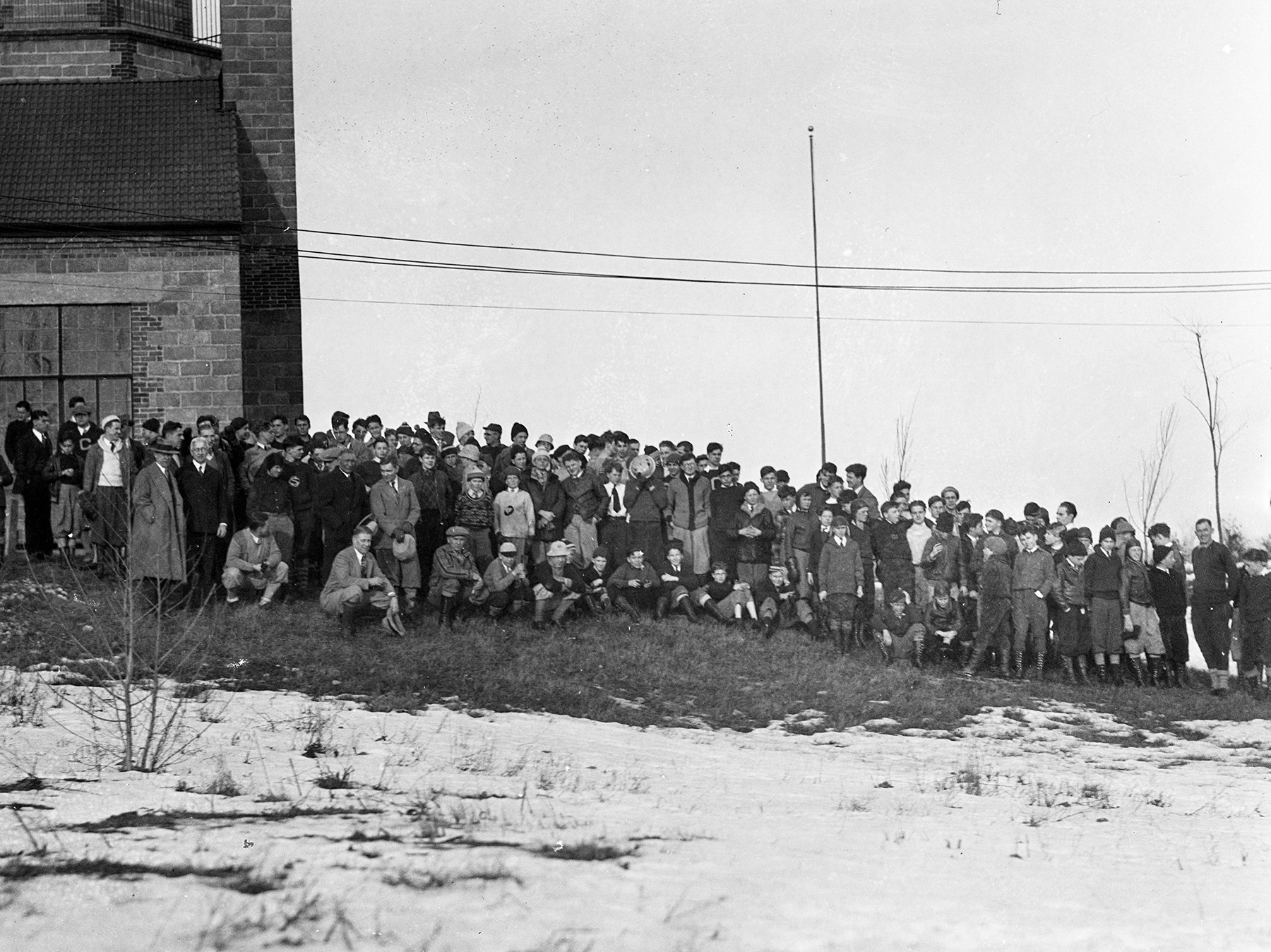
Photo Friday ran away with us last week, so here it is Monday already. Today’s post is about Camp Brady on Green Lake, Independence Township, Michigan. You are probably wondering how this camp relates to Cranbrook? The photo below shows a group photo of Cranbrook School boys, taken at Camp Brady in the winter 1930.

Cranbrook School boys at Camp Brady, Feb 1930. W. Bryant Tyrrell, photographer. Courtesy Cranbrook Archives.

Cranbrook School boys at Camp Brady, Feb 1930. W. Bryant Tyrrell, photographer. Courtesy Cranbrook Archives.

Camp Brady was established in 1921 in honor of George Nexsen Brady (1837-1920). Brady, born and raised in Detroit, became a businessman and philanthropist always interested in the welfare of children. He was a big supporter of the Boy Scouts of America and allowed the Detroit chapter to use his forty-acre parcel on Green Lake as a summer camp. After he passed away (and donated his land to the Scouts), it was known as Camp Brady until it was sold in 1946.

What does Brady have to do with Cranbrook? After he retired, Brady moved to Bloomfield Hills and was a member of the Bloomfield Hills Country Club. He purchased 45 acres along Cranbrook Road, across the street from Cranbrook. Thornlea Studio (the old archives building) is located on his property, on what is known as Brady Lane!

Leslie S. Edwards, Head Archivist
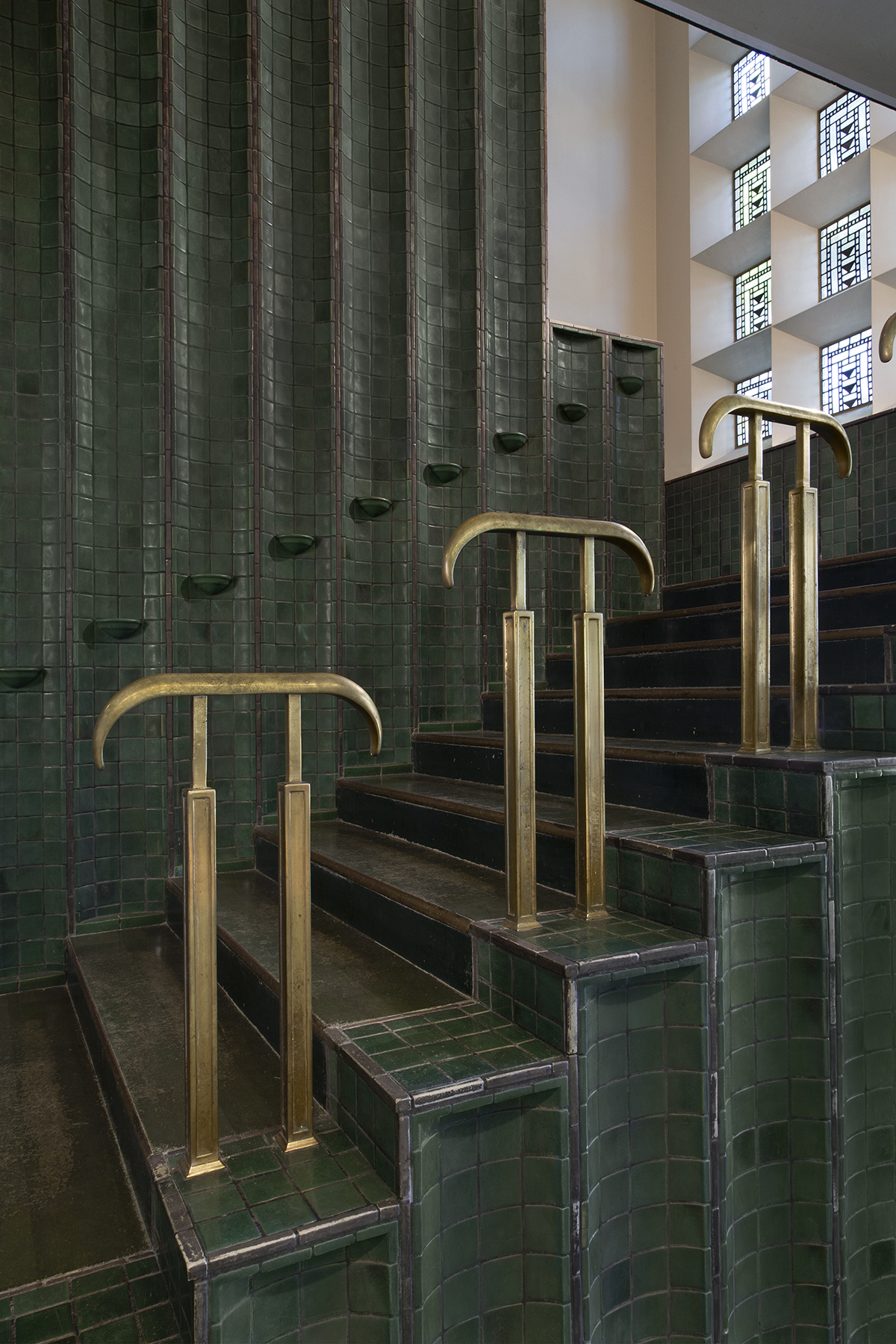
Photo Friday: Opening Doors

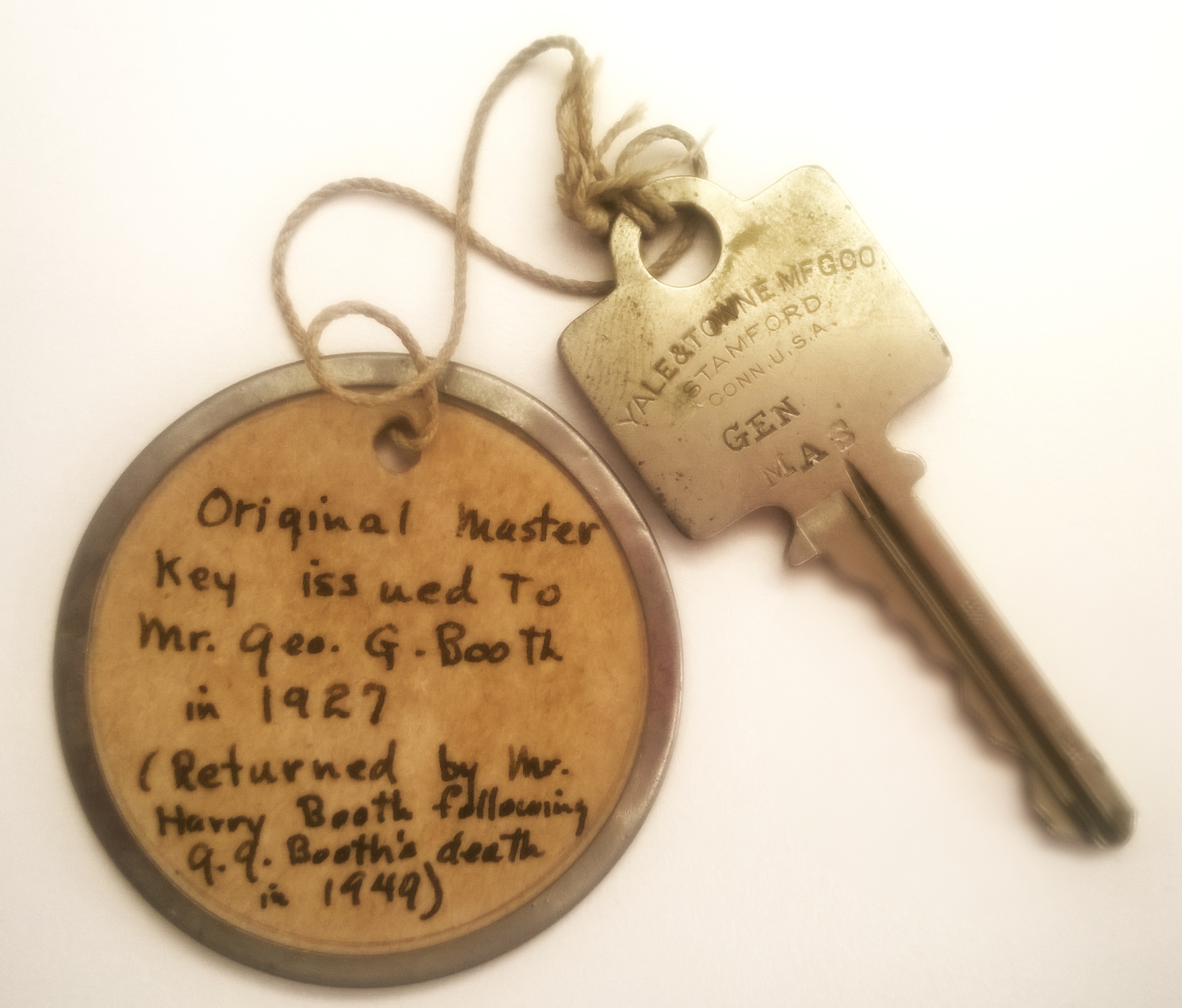
Today, while up in storage at Cranbrook House, we rediscovered the Master Key for Cranbrook School For Boys, given to George G. Booth in 1927. The locks have changed, after almost 90 years, but it is still fun to see and think about.

Cranbrook Schools original master key.

Cranbrook School original master key.

Bart Simpson: What’s that weird key for?
Ralph Wiggum: That’s Daddy’s magic key. It opens every door in town.
Bart Simpson: The police master key? Oh, Ralph. Do you realize what we can do with…

Like Bart Simpson in This Little Wiggy, what would you do with the Master Key to the Cranbrook Schools? I think I’d eat all the cookies in the dining hall . . .

Leslie Mio, Assistant Registrar

Edison House: A Modern Icon

Approaching the Cranbrook Institute of Science (CIS), one easily overlooks the low-set modern structure built into the eastern hillside. Shaded by trees and obscured by a brick courtyard wall, Edison House assumes a low profile much like its Modernist predecessors.

The 1960’s was a decade where modern conveniences flourished. Electric appliances began appearing in households across the country which made the lives of working families easier and more efficient. Backed by CIS’s Chairman of the Board of Directors, James Beresford, Director Robert T. Hatt and Detroit Edison’s Edwin O. George began plans for an innovative, all-electric residence that would suit their needs equally. Cranbrook would house scientists as part of the Distinguished Scholar Program, while Detroit Edison would have a showcase for their newest and greatest electrical equipment. The architect, William P. Smith Jr., was commissioned by Detroit Edison, and construction began in 1965. National and local firms contributed products, services, time, and funding to complete the house. Once construction was completed Detroit Edison turned Edison House over to CIS in a dedication ceremony held on June 1, 1966.

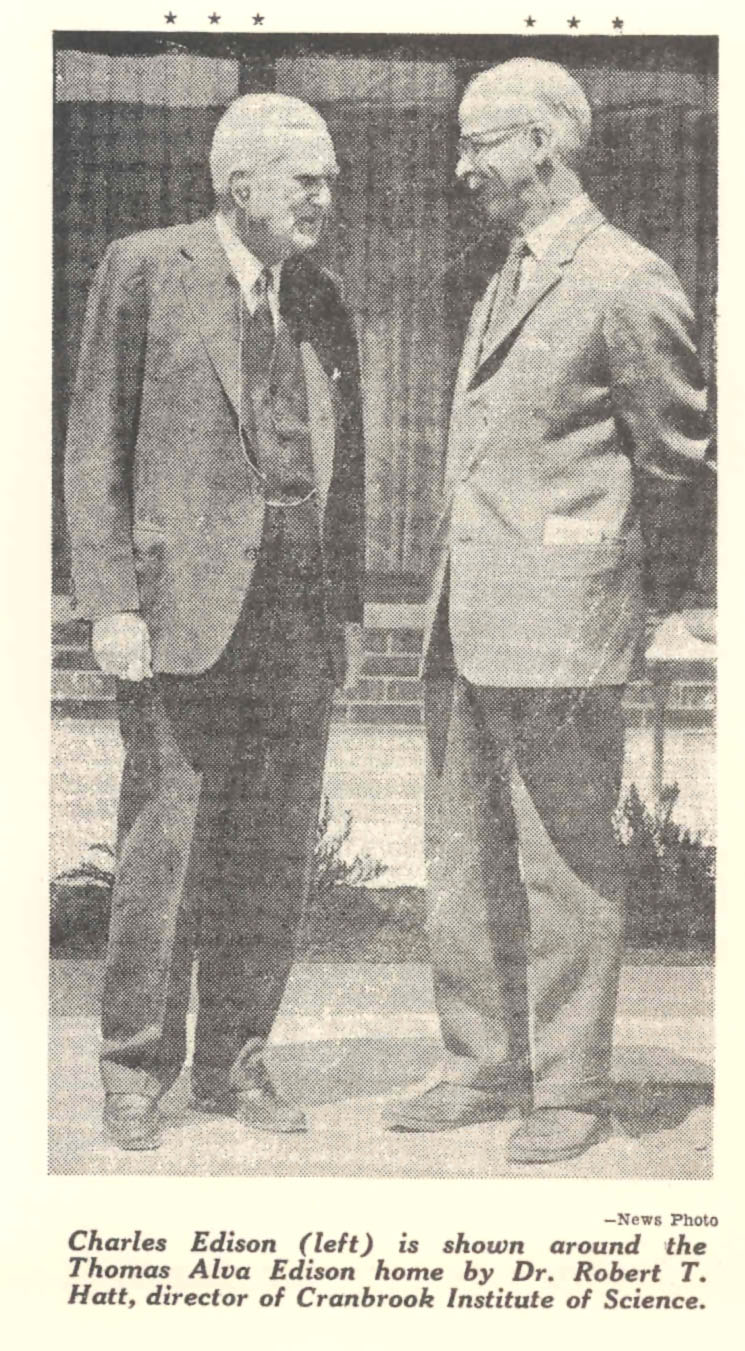
Thomas Edison's son, Charles Edison, visits Edison House Courtesy Detroit News, June 1966

Thomas Edison’s son, Charles Edison, visits Edison House
Courtesy Detroit News, June 1966

The finished product was a functionally efficient piece of art and an “outstanding demonstration of the application of science to everyday living.” Not only did it have the best and most innovative appliances, it was aesthetically advanced as well. The architectural style melds aspects of late Modernism and Art & Crafts. The broad eaves and natural material selection are reminiscent of the American Craftsman style home, while the clean-lines and mechanical innovations evolved from the Modernist International Style.

Also referred to as “Cranbrook’s New Idea Home,” a 1965 Detroit Free Press article described it as “organic contemporary in design.” Expansive windows run floor to ceiling which opened up the back face of the house to the surrounding natural landscape. Constructed of laminated redwood, extruded brick, and masonry, the home blends with its neighbors – the trees, grass and rocks. Broad overhanging eaves provide a feeling of shelter and enclosure. The natural backdrop contrasted with the interior’s modernist chrome and leather furnishings, and in true modernist style, linen drapes graced the windows in order to soften the hard surfaces. In addition to traditional living space, the open floor plan also accommodated conference rooms for faculty needs.

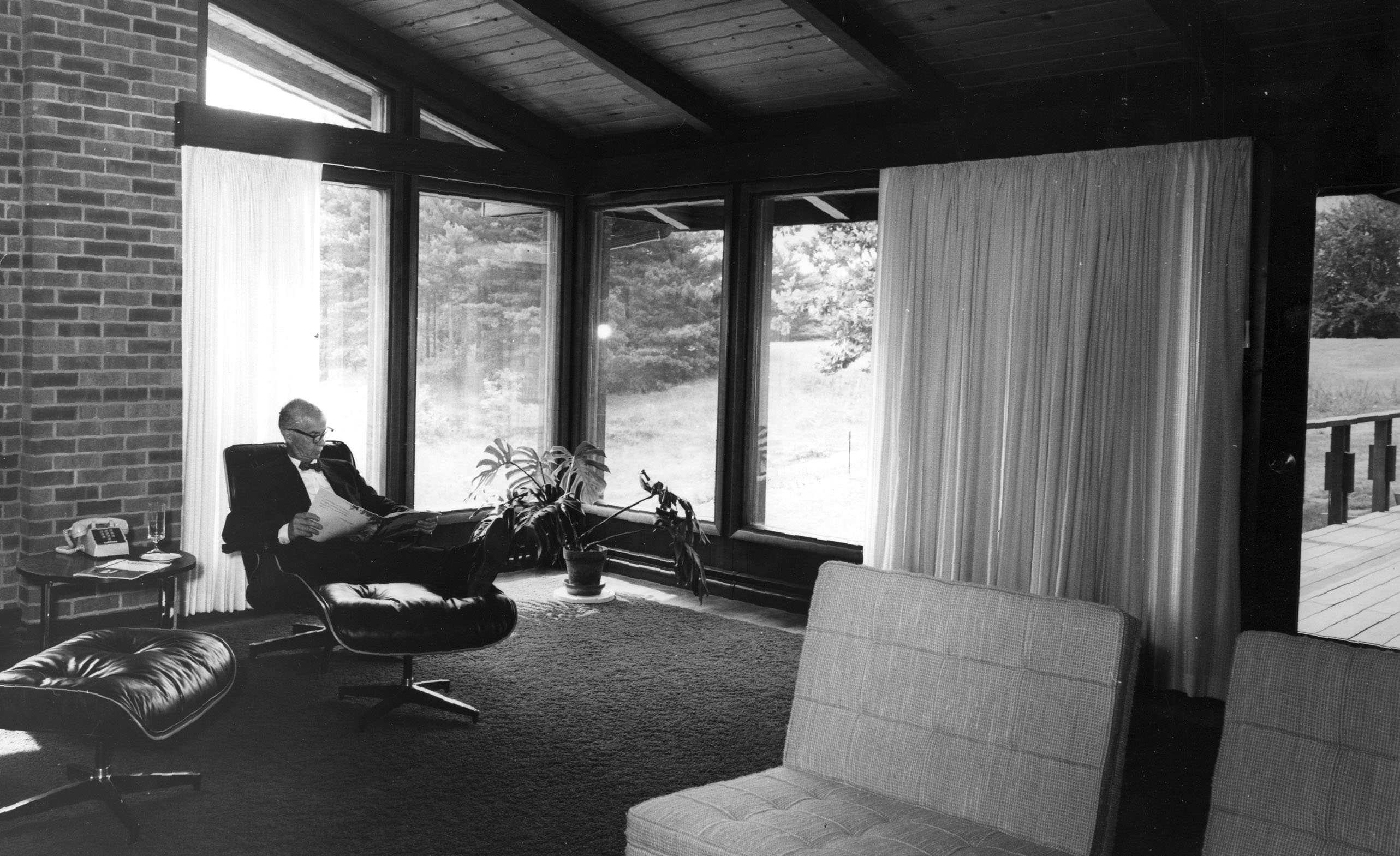
Dr. Robert Hatt in Edison House  living room, August 1966. Harvey Croze, photographer  Courtesy Cranbrook Archives

Dr. Robert Hatt in Edison House living room, August 1966. Harvey Croze, photographer. Courtesy Cranbrook Archives.

Every aspect of the 3,500 square foot house was intended to promote electronic living. Snow melting heating coils were laid under the pavement and built into the eaves and gutter system which trace the perimeter of the copper roof. Snow sensors were installed to automatically switch on the melting equipment. Electronically heated windows, state of the art at the time, line the lower-level family room. An invisible metallic coating spans the interior glass surface and is warmed by an electric current in order to remit just enough heat to reduce the cold.

The garage boasted automatic radio-operated door openers. In the master bedroom dressing room a sun lamp was mounted in the ceiling with a timer for automatic shut-off. A built-in toaster was installed adjacent to the breakfast table for easy access. The kitchen also held the control panel for the intercom system that reached every room in the house as well as the front door and terrace. Speakers on the terrace doubled as microphones so the residents could “pick up sounds of birds and other wildlife.”

After a summer as a demonstration house open to the public, Edison House was occupied by notable botanist and geneticist Karl Sax, the first Distinguished Scholar. Farrington Daniels, Denis L. Fox, and V. Elliott Smith followed. The last Edison House resident was mineralogist and CIS Director, Daniel E. Appleman, who was instrumental in the Earth Exhibit housed in the Institute’s 1996 addition designed by Steven Holl.

Over the past twenty years, Edison House has been used for a variety of purposes including office space for Events Planning and a staging area for IT infrastructure technicians. And although the once innovative electrical equipment is outdated and certainly not modern by contemporary standards, Edison House remains an icon of Michigan Modernist architecture. Edison House will celebrate its 60th anniversary in June 2016.

Originally authored by Stephanie White (2011); updated in July 2015

Anne Morrow Lindbergh: The Cranbrook Connection

The Archives has in its collection photographs of a sculpture modeled by Anne Morrow Lindbergh. How did Lindbergh come to study at Cranbrook? In April 1942, Charles Lindbergh, at the invitation of Henry Ford, came to metro-Detroit as a technical consultant to assist with retrofitting the Willow Run plant from auto manufacturing to bomber production. In July, the Lindberghs moved to Bloomfield Hills and signed a one-year lease for a furnished home then owned by Kathleen Belknap. Originally known as “Stonelea,” the home, designed by Albert Kahn in 1923, is located at the corner of Cranbrook Road and Woodward Avenue and is now known as Lyon House. The Lindberghs were quickly welcomed to the neighborhood by Carolyn Farr Booth (wife of Henry Scripps Booth). During the summer of 1943, Anne enrolled at the Cranbrook Academy of Art where she studied modeling and sculpture with sculptor Janet DeCoux, and art history with Ernst Scheyer. Since Charles was away much of the time, Anne asked Janet and her partner, Eliza Miller, to move in with her to help raise her four children. Thus began a friendship among the three women that lasted until the end of Mrs. Lindbergh’s life. (Approximately fifty letters, 1944-1952, from Anne Morrow Lindbergh to DeCoux can be found in the Janet De Coux Papers at the Smithsonian’s Archives of American Art.)

Anne Morrow Lindbergh

Anne Morrow Lindbergh, 1943. Cranbrook Archives.

At the Academy, Anne was treated not as the wife of a celebrity or even as a grieving mother, but as any other student. In her diaries (published in “War Within and Without”) Anne wrote of the freedom she experienced at Cranbrook “where people take me on faith.” Work in the studio, exhibitions at the Art Museum, and parties with music and conversation about art, books, and writing allowed Anne the freedom to “give my true self as I have never done in a group of people before.” She developed social courage and friendships with Janet and Eliza, Carl and Olga Milles, Ernst Scheyer, and neighbors like Kate Thompson Bromley. Her work as a sculptor taught her to see the world through a different lens – she learned how to sketch the human figure and transpose her ideas into her sculpture and it both surprised and excited her that she could actually see beauty in a sculpture, especially one made of her own hands. She was inspired by the natural beauty of Cranbrook, cross-country skiing on the grounds, and writing in her brown trailer in the woods. (Anne wrote her novella “The Steep Ascent” while at Cranbrook.) She relished the time with her children, and often walked them down the hill to Brookside School. Dinners with the Saarinens were exhilarating where they talked of “cities of the future.”

AnneLindbergh021

Anne Morrow Lindbergh picnicking at the Greek Theatre at Cranbrook, Jun 1944. Copyright The Detroit News.

In August 1943, Kathleen Belknap decided to sell the home, then known as Belwood, and the Lindberghs moved into a home at 411 Goodhue Road, behind Christ Church Cranbrook, for the next year. The two years spent at Cranbrook forever changed Anne spiritually. She discovered self-confidence, and that people liked her for who she was. After the Lindberghs returned to the east coast in 1944, Anne missed her Cranbrook friends and the life she had discovered here and wrote that she felt “only half alive since I left Cranbrook.” The Lindbergh family continued to return to the Detroit area to visit Charles’ mother Evangeline at her Grosse Pointe residence until she passed away in 1954. In January 1974, at the request of the Class of 1974, Kingswood School headmaster Wilfred Hemmer invited Anne to be the school’s forty-fourth commencement speaker.

Leslie S. Edwards, Head Archivist
Create a website or blog at WordPress.com