Happy Birthday Milles!

Any chance you have a trip planned to Europe this summer? If so, your itinerary really must include Stockholm. Not only is it a beautiful city—one of my favorites—but it also was home to one of Cranbrook’s most celebrated artists, Carl Milles. Long before he took up residence at Cranbrook, the Swedish sculptor started to plan and build his home and studio, Millesgården. Built high on a cliff overlooking Stockholm’s harbor, Millesgården now is a magical museum and sculpture park and the site of this year’s summer-long birthday party, The Sculptor Carl Milles at 150. Yes, if Carl Milles had lived to be the world’s oldest man, he would have turned 150 this Monday, June 23.

Carl Milles working in his Cranbrook Academy of Art studio, circa 1950. Margueritte Kimball, photographer. Courtesy of Cranbrook Archives.

While anyone taking the time to read this blog no doubt has an image in mind of one of Milles’s works at Cranbrook (there are no fewer than 45 outdoors on our campus and another 52 in the Art Museum or other buildings), my guess is that the story of the twenty years he spent working in America are a little foggy (unless, of course, you attended our 2021 virtual fundraiser, A Global House Party at Cranbrook and Millesgården, and watched the film, Carl Milles: Beauty in Bronze, we produced for the occasion). As a refresher course, or even a primer, I thought I would take you on a journey, one that starts in America and ends, twenty-two years later, back in Sweden (and Italy, as the case may be).

Milles arrived in the United States for the first time in October 1929. With the stated purpose of attending the opening of his second group exhibition in New York City, he took advantage of the trip to sell work to collectors, negotiate a commission in Chicago for his Diana Fountain, present the concept for the monumental doors he would create for the Pennsylvania State Capitol, and meet with Tage Palm, the President of the Chicago-based Swedish Arts and Crafts Company who would become his business manager. Most important for this next chapter of his career, he also traveled by train to Michigan where he met with George Booth who asked him to teach at the art school he was building north of Detroit, Cranbrook Academy of Art.
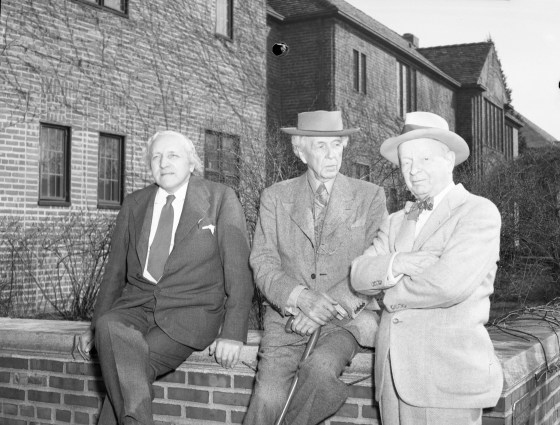
Carl Milles, Frank Lloyd Wright, and Eliel Saarinen (l to r) outside Saarinen House, March 1945. Harvey Croze, photographer. Courtesy of Cranbrook Archives.

George Booth and his wife Ellen Scripps Booth, as most Cranbrook Kitchen Sink blog readers know, were wealthy newspaper publishers and philanthropists. Although their flagship paper, the Detroit News, was based in Detroit, their home was in the countryside of Bloomfield Hills. By the late 1920s, they had begun to work with the Finnish architect Eliel Saarinen to transform their private estate into an educational community that eventually included an Episcopal church, boys and girls schools, an art academy and museum, and an institute of science (and, even later, a center for collections and research). Although the archival record is a little murky, Saarinen and Milles were at least acquaintances long before the sculptor met with his future patron at Cranbrook.

As Milles contemplated moving to Cranbrook to direct the Academy’s Sculpture Department, there was one small problem: he had no desire to teach. Two years and many conversations later, Booth and Milles came to an agreement: the sculptor would not need to “teach” but simply “mentor” students in his studio. (Not a bad deal!)
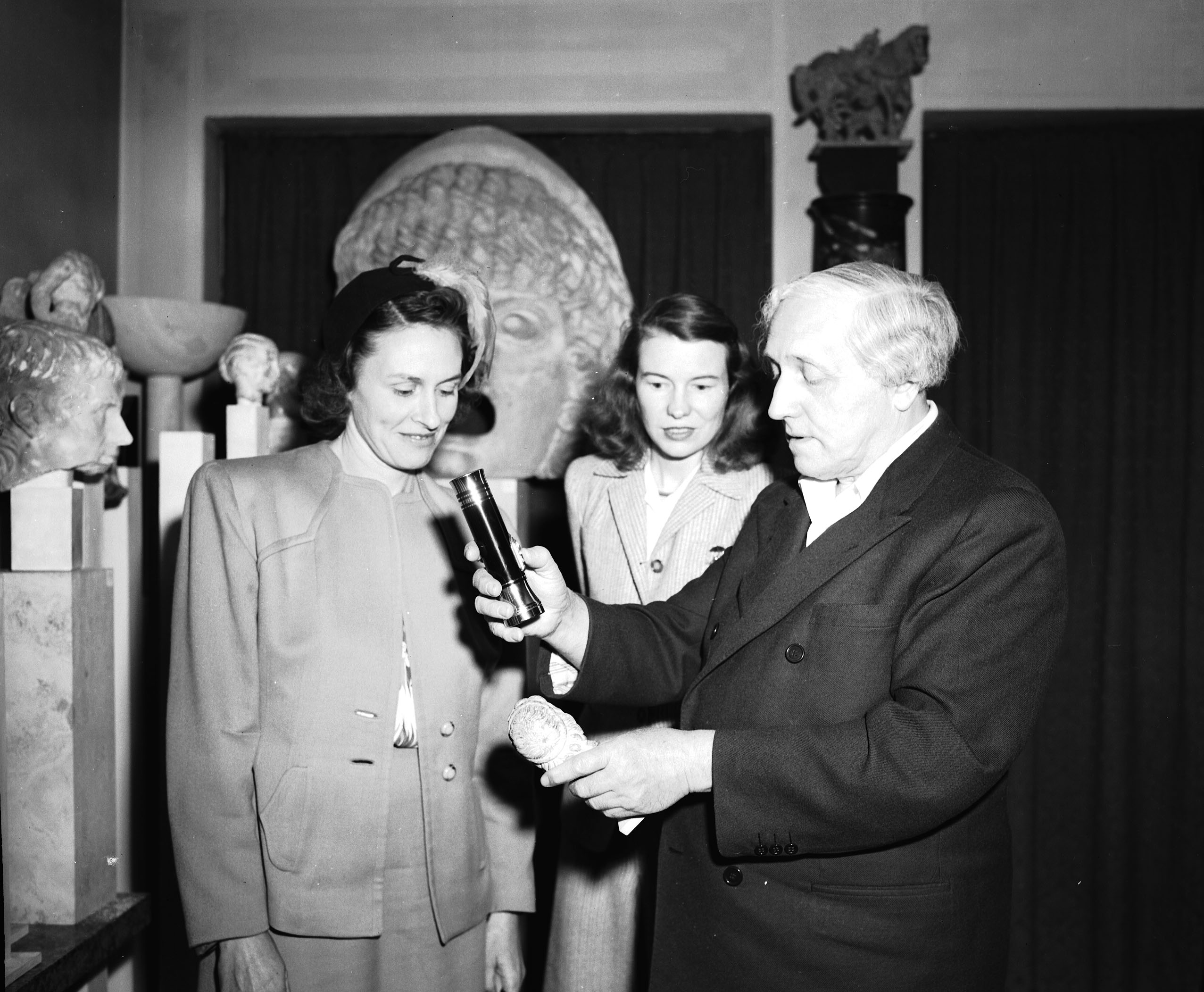
Carl Milles discusses details of a sculpture during an open house, 10 May 1947. Courtesy of Cranbrook Archives.

In January 1931, Carl and his wife Olga Milles arrived at Cranbrook where they lived for the next twenty years. Their home, where they displayed Milles’s collection of ancient sculpture, was designed by Saarinen, as were his three studios—including the grand thirty-foot-tall studio Milles used for his largest commissions such as the Orpheus Fountain for the National Concert Hall in Stockholm.

Carl Milles in his studio at Cranbrook Academy of Art, sculpting the figure of Orpheus for the Orpheus Fountain, 1934. Richard G. Askew, photographer. Courtesy of Cranbrook Archives.

But Milles was not satisfied. He wanted to be surrounded by his sculpture just as he was at Millesgården. The four works Booth had acquired—including the only work Milles made at Cranbrook for Cranbrook, the playful Jonah Fountain—were not enough. In 1934, in the middle of the Great Depression, Booth agreed to pay Milles a princely sum—$120,000 and change—for sixty-three of his sculptures. This purchase not only included most of the works that had been part of a traveling exhibition that opened in St. Louis in 1931, but also casts of the eight figures from the Orpheus Fountain and his monumental Europa and the Bull from the fountain in Halmstad.

Milles’s Triton Pools, looking north towards Europa and the Bull, and beyond that, the future site of Cranbrook Art Museum, circa 1934. Richard G. Askew, photographer. Courtesy of Cranbrook Archives.

The decision, one that would come to define Cranbrook’s campus, was supported by Milles’s fellow Scandinavian and friend Eliel Saarinen, who Booth had named the President of Cranbrook Academy of Art in 1932. Indeed, there was a feeling of mutual respect between the architect and the sculptor, with Saarinen realizing that Milles’s work would enhance the buildings and Milles realizing that Saarinen’s architecture provided the perfect context.

Continue reading
The Annex, the Attic, and My Senior May Adventures

Each May, the Center is honored to host outstanding seniors from Cranbrook Kingswood Upper School for a three-week immersive internship.

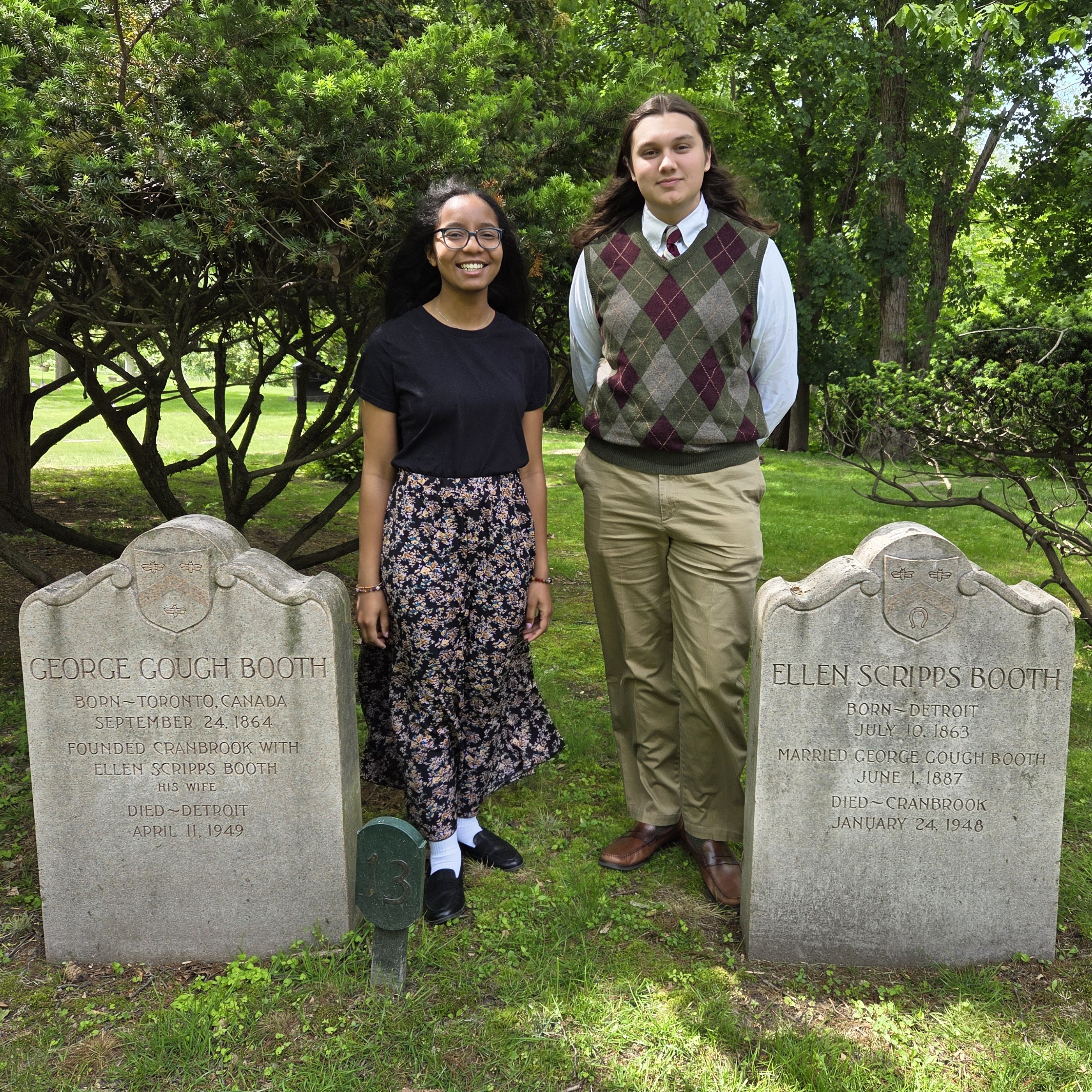
Kamilah Moore and Joel Kwiatkowski, 2025 Senior May interns, visit George and Ellen Booth at Greenwood Cemetery, Birmingham. Photography by Leslie Mio.

This year two seniors, Kamilah Moore and Joel Kwiatkowski, worked with the Center and Archives staff, including writing blogs! Hear from Joel today and look out for Kamilah’s post next week.

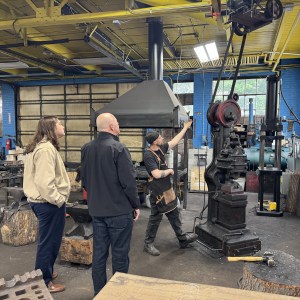
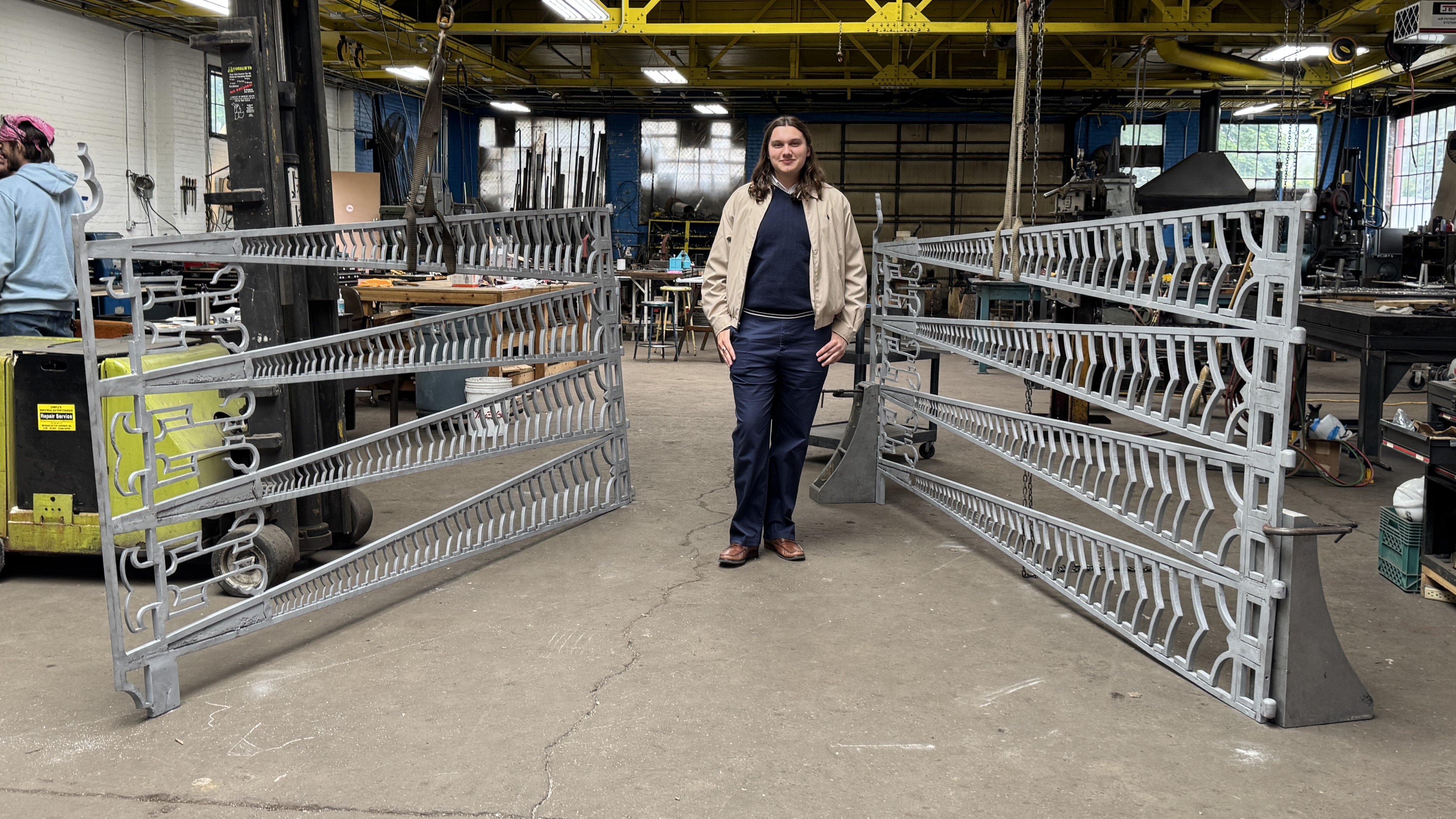
Checking in on the Eliel Saarinen-designed Kingswood main gate at Smith Shop in Highland Park, May 2025. Photography by Kevin Adkisson.

Cranbrook Center for Collections and Research is a name that invokes the image of some grand museum or hall, with many sterile prep rooms and rows upon rows of file cabinets. Now don’t get me wrong, there are plenty of file cabinets, but the Annex is far from grand. Instead, the rather humble staff apartment-turned-offices are befitting the lovely people there.

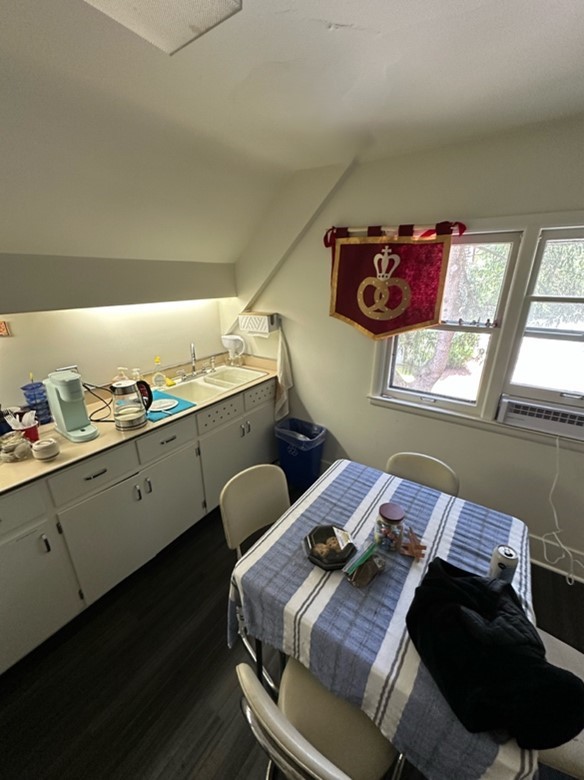
The Center’s Annex, next door to Cranbrook House, is situated above the House & Garden Auxiliary offices, up a set of winding stairs that require me to duck in a few places. But up there you will find a quaint little kitchen (complete with a toaster oven and healthy snack collection), a few offices, and closets and cabinets dotted with curiosities.

The quaint kitchenette of the Annex, compete with decommissioned Cranbrook Institute of Science Library chairs, May 2025. Photography by the Author.

It was this atmosphere, over many chatty lunches, that I got to know Leslie Mio, the Associate Registrar, and Mariam Hale, the 2023-2025 Center Collections Fellow. It was a pleasure to find two individuals who cared so greatly for history and conservation, and we bonded over our shared love of museums and particular historical eras.

But, let it be known that work at the collections isn’t all comfortable work behind a desk or searching a filing cabinet. This illusion, if I ever had it, was quickly broken on my first full day of the internship. Our task? Moving five solid wood cabinets from the rooms of retirement-age nuns across the building to be used to store Cranbrook’s lacy dresses and costumes.

Briarbank, a neighboring estate to Booth’s land, was converted into a place for sisters to stay once they needed a bit more care later in life. But, at some point, the demand for a place such as that ran dry, and Cranbrook bought the campus. And now, in that spirit, I was near horizontal in my penny loafers, shoving a giant wardrobe into place across some very tasteful carpet.

Mariam and I defy the friction of decades old carpet, May 2025. Photography by Leslie Mio.

In the coming days, the purpose of these heavy cabinets would be realized, as we began the true overarching theme of my time at the Center: moving a seemingly infinite number of objects from the hot attic of Cranbrook House to the comparatively “less hot” and climate-controlled storage area at Briarbank. Paintings, prints, textiles, rugs, hats, and racks of clothing and costumes were deftly maneuvered through the halls and offices of Cranbrook House (or, alternatively, very carefully down the narrowest, steepest, stairwell known to mankind).

Each day packing and moving Cultural Properties in the attic was sure to bring new surprises. Everything from a fur hat belonging to George Booth to paper parasols, or entire handwoven rugs the size of a small house. While these days meant a bit of manual labor, they never ceased to bring me joy, as the wonderful folk of the Center doled out tidbits of Cranbrook’s story connected to each unearthed gem.

The fabulous hat in a box marked “G.G.B.” — the box is possibly a later acquisition by Henry S. Booth — May 2025. Photography by the Author.

Now those familiar with the Center may be wondering: “Now wait just a minute. Where is my favorite curator? Where is the delightful presence of the steward of Saarinen House?” Well, fear not good reader, for while Kevin may not have been at every boxing and unboxing, Kevin joined Kamilah and me on many excursions outside the Samuel-Yellin-forged gates of Cranbrook. For those unacquainted, Kevin Adkisson is Curator of the Center, the veritable fountain of all knowledge concerning Cranbrook, and legend in his own time among students.

My first trip with Kevin came when we were tasked with heading to Detroit to give a tour of Holy Redeemer Church to a group of 8th graders from the Catholic school next door. I thought that getting middle schoolers excited about Corinthian columns would be impossible, but Kevin’s energy and skill made it look easy.

Kevin and I had fun teaching Holy Redeemer 8th graders about architecture. Photography by Holy Redeemer.

Afterword, we headed to visit the master ironworkers at Smith Shop, where the Eliel Saarinen-designed Kingswood main gate is being repaired and restored. I stood back and observed while Kevin, Cranbrook Capital Projects Director Jean-Claude Azar, and Amy Weiks and Gabriel Craig (co-owners of Smith Shop) debated the ins and outs of the gate’s making and breaking.

I enjoy a tour of the facilities of Smith Shop with Cranbrook Capital Projects Director Jean-Claude Azar and Smith Shop co-owner Gabriel Craig in Highland Park, May 2025. Photography by Kevin Adkisson.

Across my three week Senior May, I also took trips to the paint store to debate shades of grey, the frame shop to mount an object, Ken Katz’s painting conservation studio, and even Birmingham’s historic cemetery. On each of these trips, I gained insight into the multifaceted work of the Center for Collections and Research, including care and handling, teaching, conservation, and cataloging.

I cannot fully capture in a blog what a delight it was to be in the presence of such knowledgeable individuals. For every question about Cranbrook’s history, each member of staff was sure to add in their own expertise, citing obscure letters and photographs, adding a beautiful familiarity to their responses and giving color to the story of Cranbrook.

Of course, I would be remiss to leave out some of the other folks who make the Center function, like Greg, Jody, Amy, and Jess. These are the people who drive the work, managing, fundraising, and promoting the vision of Collections and ensuring the continued progress of the Center’s goals.

Even interns have meetings, Kamilah and I sat in on one of the Center’s weekly staff meetings. Photography by Kevin Adkisson.

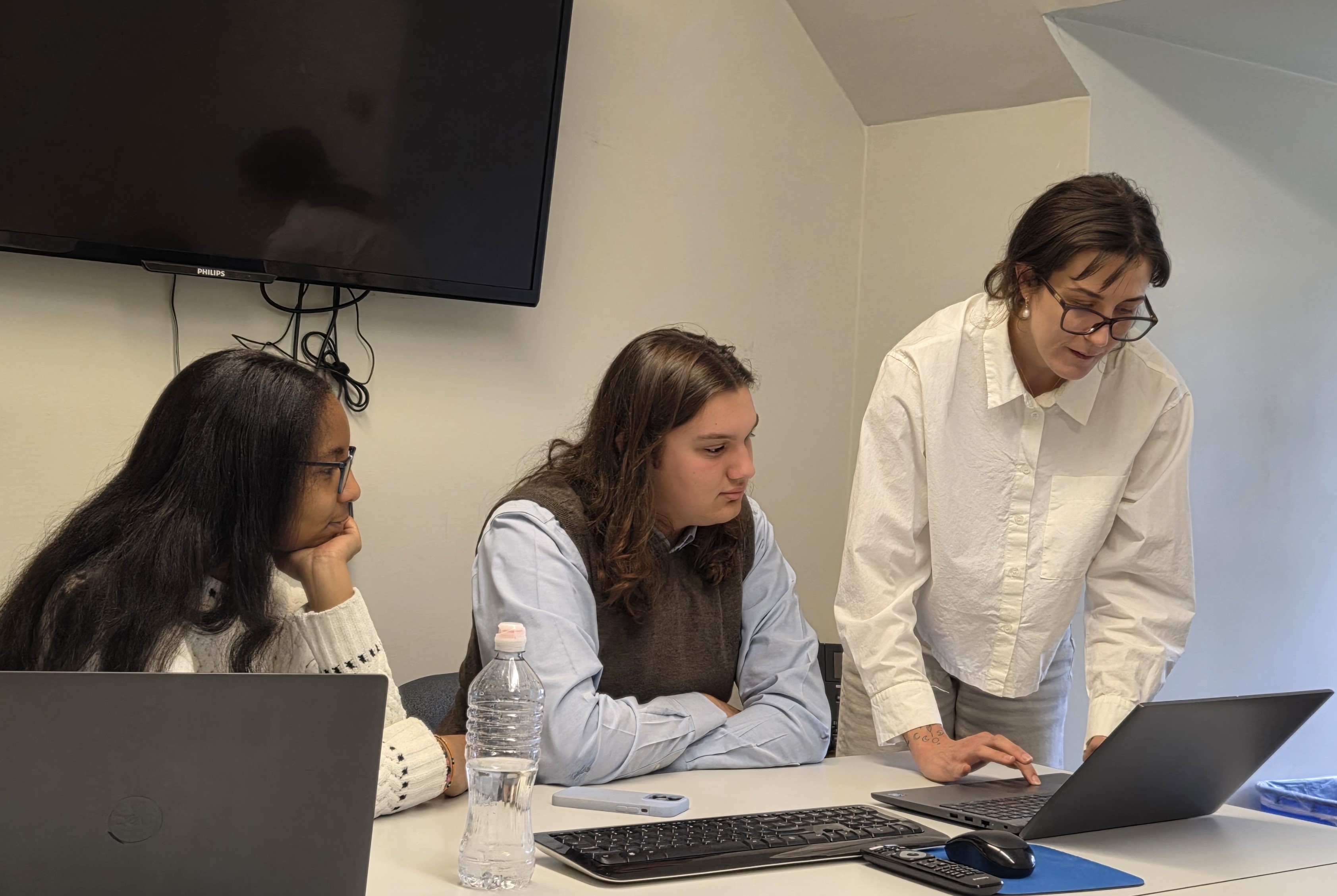
On my last day, I had the privilege of working with Jess Webster, Development Coordinator, who also helps run the Center’s social media. With Kamilah, I researched, drafted, workshopped, and delivered a script for an Instagram Reel commemorating the 150th birthday of Carl Milles., During my time working out ideas for the video (and even this blog), I gained a new appreciation for the way in which Cranbrook is viewed from the outside.

Kamilah and I workshopping our reel for Carl Milles’s 150th birthday with Jess, May 2025. Photography by Leslie Mio.

For me, as a student at Cranbrook, my view is that of someone on the inside, who has the privilege to walk by art on campus each and every day (admittedly at times without a second thought). But getting to see the behind-the-scenes of Cranbrook’s beautiful historic campus has given me an appreciation that feels wholly unique amongst my peers.

If you’ve read this blog, I urge you to take a moment to appreciate all that goes on caring for a 100-plus-year-old campus to live on to this day and serve its many students and visitors. From calls, texts, emails, and meetings, the Center is busy planning, filing, caring, and protecting the legacy of Cranbrook. The work is never done.

Yet despite the challenges, the Center rises to the task, willing to give their all to something they passionately care for. It would be hard not to be inspired.

Kamilah and I make a video for Carl Milles’s 150th birthday, May 2025. Photography by Jessica Webster.

This internship has truly been a dream-come-true, and I am grateful to Mariam, Leslie, and Kevin for their warm welcome and tutelage.

Joel Kwiatkowski, Cranbrook Kingswood Upper School Class of 2025 and Cranbrook Center for Collections and Research 2025 Senior May

Editor’s NoteThe Senior May Project is a school-sponsored activity that encourages Cranbrook Kingswood Upper School seniors to acquire work experience in a field they are considering as a college major, a potential profession, and/or as a personal interest.

Joel Kwiatkowski graduated from Cranbrook in June 2025 and will be attending the University of California San Diego in the fall to pursue a degree in Molecular and Cellular Biology. Joel first came to Cranbrook Schools in sixth grade, and has since gained a passion for the institution’s rich history of influential artists and personalities. 

Particular Architects, Elusive Materials: Headaches in Green and Red

I recently found myself at Joann Fabrics five minutes before the store closed, desperately selecting supplies for a project that was, of course, best completed that night. My delay was self-inflicted, but it got me thinking about times when much larger projects have been strained by access to supplies.

Specifically, both Eliel Saarinen and Frank Lloyd Wright created buildings with strong creative vision. Their architecture demanded specific, and sometimes hard to source, materials. Let’s look at two examples and decide if the headaches my favorite architects caused their suppliers and contractors/builders were worth the final product!

Example 1: Eliel Saarinen and Pewabic Pottery Tiles

Eliel Saarinen, Kingswood School for Girls Main Entrance Lobby (Green Lobby) plan, section, elevation, and reflected ceiling plan, c. 1930-1931. Ink, colored pencil, and pencil on tracing paper. Approx. 28½ inches x53 inches. Cranbrook Art Museum 1982.35. Photography by P.D. Rearick, Courtesy Cranbrook Center for Collections and Research.

When Eliel Saarinen specified thousands of hand-molded, hand-glazed, and hand-fired Pewabic Pottery tiles for use at Kingswood School for Girls, his contractor pushed back. Pewabic was less a tile factory than an artists’ workshop. As supplier of Kingswood’s industrially produced tile for bathrooms and basements, a concerned Mr. Burt of the Detroit Mantel and Tile Company wrote to the contractor, Charles Wermuth & Son:

We are doubtful as to [Pewabic Pottery] being able to manufacture the amount of tile as selected for this job. We raised this question during the course of selections but [Pewabic cofounder and artist] Mrs. Stratton advises that she will be able to produce this tile without any hold-up. We have advised her that any hold-up or delays caused from her material will be charged back to her.

We are writing you this letter merely as a protection against delays beyond our control.

Cranbrook Architectural Office, Box 26 Folder 11. Cranbrook Archives.

Saarinen wasn’t wrong to select Pewabic Pottery for Kingswood—it’s stunning and perfect in every way—but Burt wasn’t wrong about issues of production. It does appear that delays in the tile making caused delays in construction, raising blood pressure on both ends of Woodward Avenue.

As the first day of classes at Kingswood drew nearer, truck drivers from Cranbrook made near-daily trips to the pottery for small batches of tiles. I imagine the kiln-fresh mini-masterpieces still warm to the touch!

Did the delay in tile delivery keep Kingswood from opening on time? No. An outbreak of polio in metro Detroit meant all schools were closed by state health officials. But Wermuth used the extra time to finish the building—all Pewabic tiles were well-set and grouted for classes to begin September 21, 1931.

Eliel Saarinen and Mary Chase Perry Stratton’s 1931 masterpiece, the Green Lobby Stair. The headache of contractor Charles Wermuth and Son was worth the stress. Photography by James Haefner, 2018. Courtesy Cranbrook Center for Collections and Research.

Example 2: Frank Lloyd Wright and “The Wood Eternal”

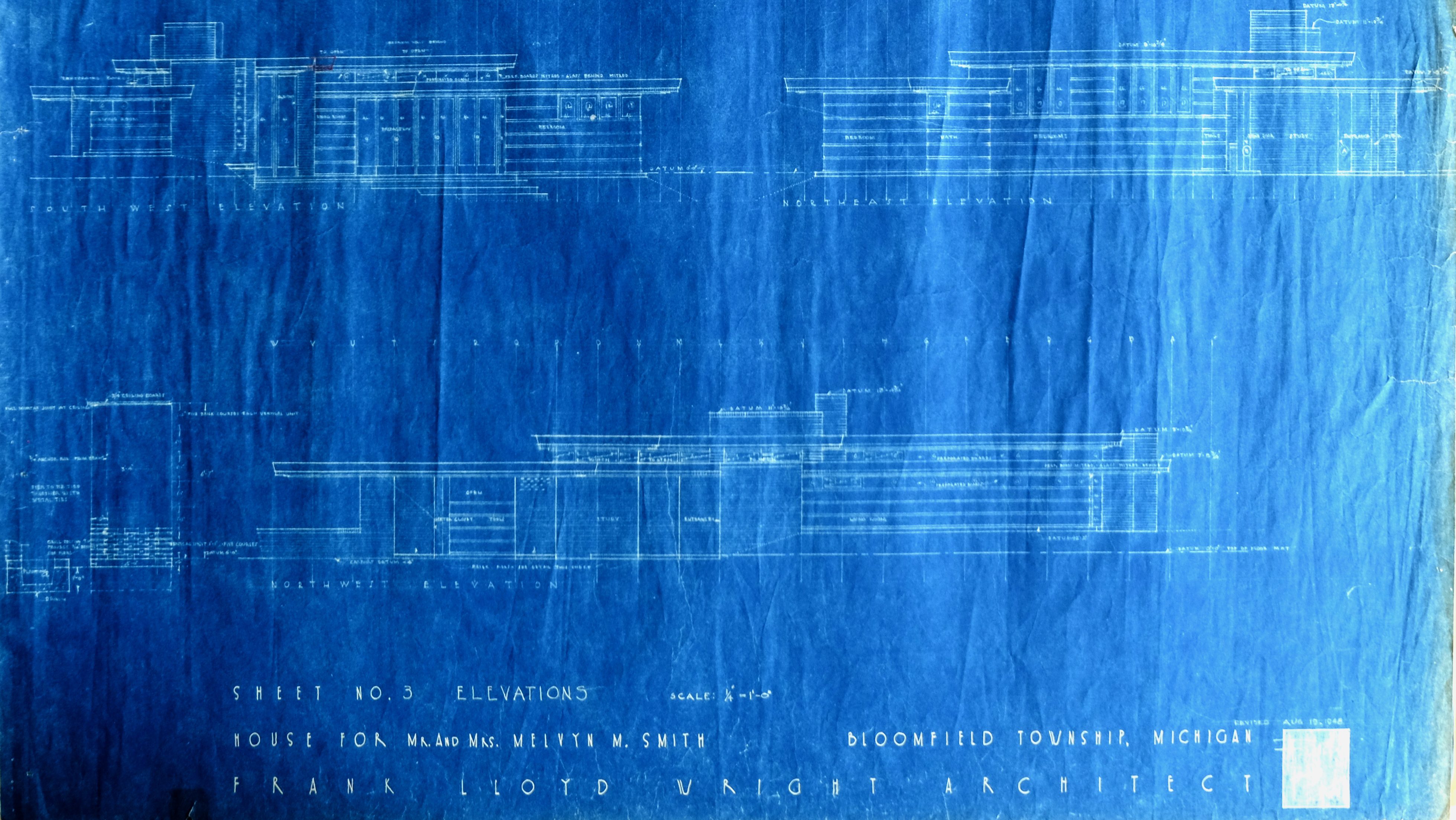
In February 1949, Melvyn Maxwell Smith was ready to start building his long-awaited dream: a wood and brick Usonian house designed by Frank Lloyd Wright. With enough money squirreled away to begin construction, Smithy was ready to order materials. Including 14,000 linear feet of clear, old-growth, 16’ x 1’ x 2” boards of Tidewater Red Cypress wood.

Frank Lloyd Wright, detail of House for Mr. and Mrs. Melvyn M. Smith elevation, August 1948. Blueprint. Courtesy Cranbrook Archives.

Wright had built in Cypress since at least 1914, with his first all-Cypress design, the Wiley House, coming off the drafting board in 1932. The iconic Usonian houses of the 30s and 40s are mostly built of this swamp-grown, super strong, rot-resistant golden wood.

Cypress proved to be perfect for Wright’s organic architecture. And by 1949, Cypress was incredibly hard to find.

Smithy wrote to many different lumberyards with his needed material list. Those closest to the swamps where Cypress grows—lumberyards in South Carolina and Louisiana—were unable to furnish the volume of wood needed. Lumber yards in the Midwest simply stated they did not carry Cypress. Chicago-based Hilgard Lumber Company wrote, “We duly received your inquiry…on a carload of Tidewater Red Cypress (clear grade) but clear grade in this species is extremely scarce.”

In February 1949, Fleishel Lumber Company of St. Louis (who had been forwarded Smithy’s large request) agreed to fulfill the order. Smithy simply needed to let the yard know when he wanted the wood delivered. Or at least, that was the idea.

Every month, Smith wrote, called, or telegrammed Fleishel, asking for his order. And every month, the lumber yard replied: we don’t have it all, but we have some. As time ticked by and Smithy’s house waited to take shape, Fleishel offered up concessions. Instead of kiln dried, would Smithy accept natural dried Cypress? No. Recycled or swamp-preserved? No. Smaller boards, but more boards? No.

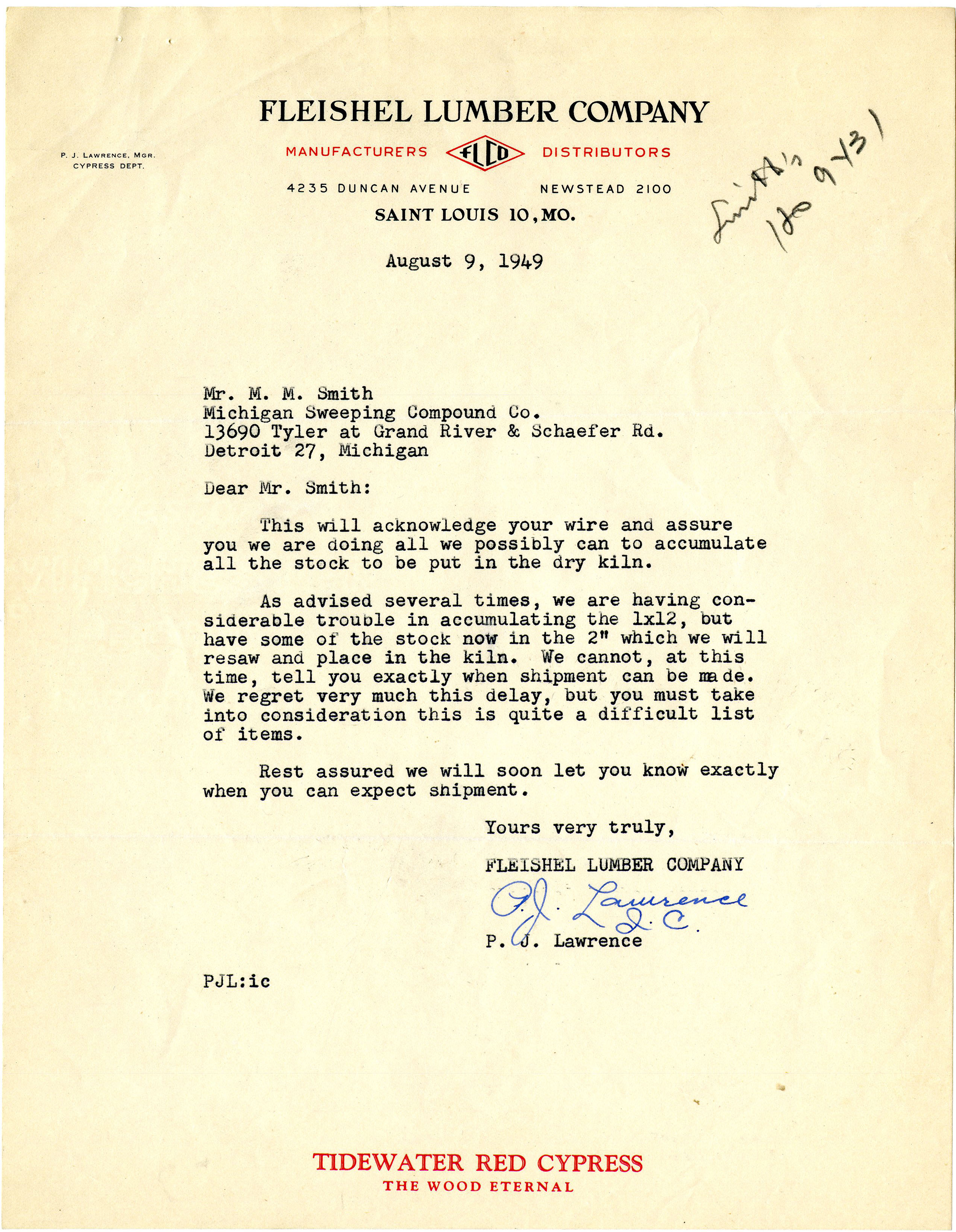
Smithy needed what Wright specified: long, wide boards. By August 9, 1949, things were looking up, even if Fleishel’s salesman sounds a bit annoyed:

…We are doing all we possibly can to accumulate all the stock to be put in the dry kiln.

As advised several times, we are having considerable trouble in accumulating the 1×12…We cannot, at this time, tell you exactly when shipment can be made. We regret very much this delay, but you must take into consideration this is quite a difficult list of items.

Smithy’s goal of having the lumber on hand during the Summer holiday, when he could be on-site every day, did not happen. His first day teaching his Cody High English class that year? September 5.

Finally, on September 23, 1949, Fleishel Lumber packed a railroad car full of 14,000 linear feet of clear, kiln-dried Cypress and sent it toward Bloomfield Hills. Just seven months and a few days after it was ordered.

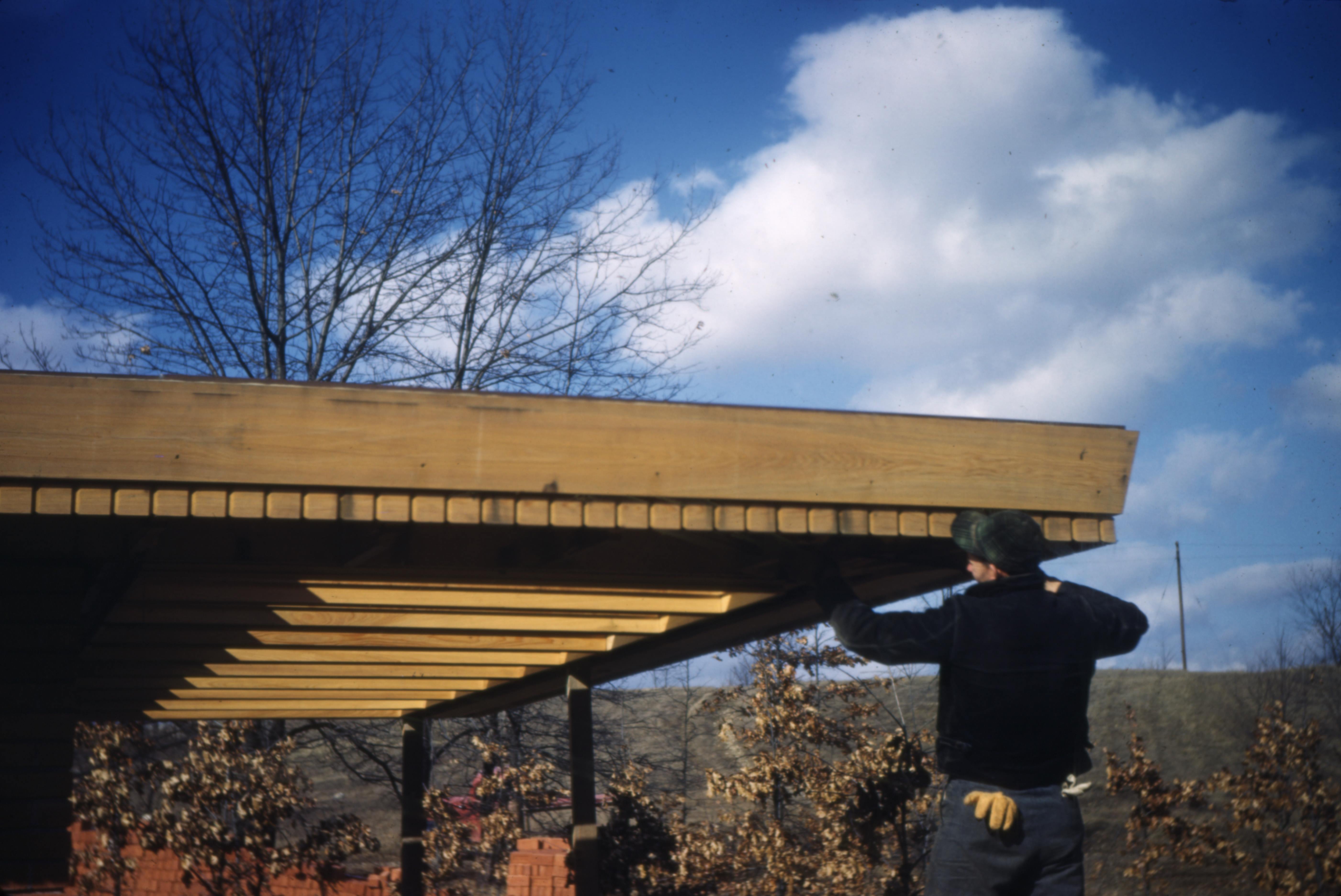
Work continues on Cypress boards of Smith House, winter 1949-1950. Courtesy Cranbrook Archives.

About seven months later, Melvyn and Sara Smith had a Cypress house! When it was completed in May 1950, the Smith House became Frank Lloyd Wright’s last entirely Cypress-built project.

Tidewater Red Cypress with Detroit Common Brick defines the Frank Lloyd Wright-designed Smith House, 1950. Courtesy Cranbrook Archives.

So, did being particular about materials pay off for Mr. Wright and Mr. Saarinen? I think the Smiths and thousands of Cranbrook students would agree: absolutely.

Kevin Adkisson, Curator, Cranbrook Center for Collections and Research

Note: Oh, and if you want old-growth Cypress today? The current owner of the Frank Lloyd Wright Willey House, Steve Sikora, described the purchasing of Cypress wood in the 2010s as operating among “an assortment of hucksters, charlatans, and petty criminals, or in industry parlance, ‘wood brokers.’” Head on over to The Whirling Arrow blog to read a lot more about Cypress and Wright!

Eero Saarinen at School in Ann Arbor, Age 14

Welcome back! After a hiatus, the Center for Collections and Research team is excited to return to weekly blog posts here at Cranbrook Kitchen Sink. Look forward to more stories from Cranbrook’s rich past every Friday! As always, we appreciate your comments and suggestions here or via email, center@cranbrook.edu. We return with a special guest essay from Dr. Jeffrey Welch, Retired Faculty Member, Cranbrook Schools (1977 – 2015)

-Kevin Adkisson, Curator and Editor

Readers of this issue of the Cranbrook Kitchen Sink, please settle in for an excursion to Ann Arbor.

The architect of the original Cranbrook institutions, Eliel Saarinen, came to America from Finland in 1923, first to Chicago, then to Ann Arbor, and finally to Cranbrook. He had won $20,000 in an architectural competition to design “the most beautiful office building in the world.” Anyone who might want to compare the winning design with Saarinen’s striking drawing of a skyscraper for the Chicago Tribune newspaper competition would see instantly that Eliel Saarinen’s idea was the better idea.

He brought his family over in April 1923 after being invited to teach a short course in architectural design at the University of Michigan in Ann Arbor. At Michigan Saarinen discovered that he was an exceptional teacher. He moved from Evanston to Ann Arbor in 1924, settling in at 8 Geddes Heights, and he continued as a professor in the architecture program.

The Broadcaster (University High School, Ann Arbor) staff members, 1925. Eero Saarinen
is third from the right and three rows back. All images courtesy of Jeffrey Welch.

At just this time, the University opened an experimental school, called University High School (UHS), accommodating grades 7-10. Eero entered at grade level 8. His sister, Eva Lisa “Pipsan” Saarinen, could not join him, as she had been born in 1905, five years before him.

By February 1925, University High School students began publishing a periodical they called The Broadcaster: UHS Station. That “UHS Station” tag indicated the idea that these students saw their school as a station point in the big, wide world. Between February and June, UHS student staff members published six editions of The Broadcaster. In this group, Eero was the Art Editor, and it was the case that more 8th and 9th graders were on the newspaper staff than 10th grade students.

A quick riffle through the pages of The Broadcaster would reveal immediately the fact that Eero Saarinen, even at fourteen, was already a gifted artist. His drawings, whether carved from a linoleum block or a line drawing, expressed energy, psychological insight, and movement. They conveyed a clear narrative action, and they revealed a profound sensitivity to human endeavor, to creative engagement with the natural world, and to competitive behavior. Another insight into the youthful Eero can be found in the last issue for school year 1925, where all the students gave their favorite saying, their best subject and their hobby. Eero’s answers: “‘Oh, Yeah!’ Math. Swimming (but not in a bathtub).”

In May, the University alumni magazine, The Michigan Alumnus, published a story about The Broadcaster, singling out Eero for his artist’s contributions. The title of the article complimented the school and its ambitious young journalists: “The Youngest Adventurers in Campus Journalism: ‘The Broadcaster’ Published by Students of the University High School,” all of whom certainly deserved the recognition: “The keynote of the paper is originality.” But there were two indicators as to Eero’s impact on the editors of The Michigan Alumnus.

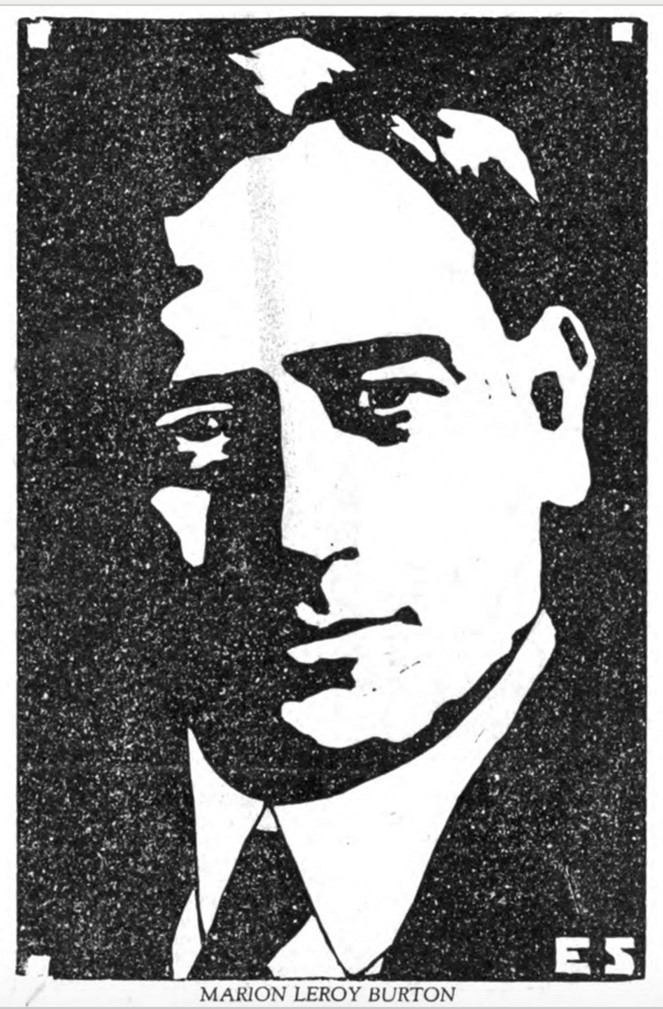
First, Eero’s portrait of President Marion LeRoy Burton was used as the centerpiece in a story about the recently deceased president. The article printed parts of President Burton’s last report on the State of the University: “President Burton’s Last Survey of the University: The President’s Report for 1923-1924 Covering the Final Year of his Active Administration.”

It is not widely known that President Burton conferred with George Booth, the founder of Cranbrook, about Cranbrook as a location for a world class art academy. The fact is, Dr. Burton and George Booth were very close friends. It is well known that Eliel Saarinen produced a design for the Burton Memorial Campanile (Bell Tower) at the request of the alumni who attended the University during the Burton years: 1920-1925. Eero’s linoleum cut portrait of President Burton closely resembled the official portrait of the man, but there is a subtle quality of emotion in what Eero has done. It is no wonder that the editors at The Michigan Alumnus used Eero’s portrait to illustrate their article on President Burton.

Secondly, Cranbrook Kingswood students and alumni/ae will see immediately the probable source of the Motto for Cranbrook School: Aim High. Eero brought this idea with him to Cranbrook, and during those fruitful years when his father was planning the Boys’ School, Eero’s enthusiasm and interest in the planning no doubt brought forward the suggestion of this inspiring phrase: Aim High, as a possible motto for the school. Furthermore, Eero studied with Géza Maróti, the Hungarian designer-architect of many cherished elements of the Cranbrook School architectural ambience, including the figure of Galileo, the door to the (then) Middle School science wing below it, the overmantel in the Cranbrook Library and wood carvings on the Library doors, the brilliantly windowed exterior at the Marquis entrance to the Cranbrook Dining Hall, and the design of the Gateway of Friendship.

Eero, who at the time was thinking of becoming a sculptor, was put to work designing the crane insert in the dining hall chairs, the animal forms in the gates between Marquis Hall and the Infirmary and at the Lone Pine Road entrance to the Infirmary, the grotesque faces on Page Hall and the abstract forms on the columns at the quadrangle entrance to Page Hall. Eero also designed the brown terra-cotta tiles, showing athletes in their poses, for the fireplace in the South Lobby of Hoey Hall. One of his South Lobby tiles, “The Wrestlers,” was included in the Second International Exhibition of Ceramic Art in New York in October 1928. The Pewabic Pottery in Detroit fired these tiles, and it included this one among representative objects for this American Federation of the Arts show, which also traveled to Philadelphia, Minneapolis, Cleveland, Baltimore, Detroit, Newark and Pittsburgh, closing on September 29, 1929.

Later, Eero designed furniture for his parents’ bedroom in Saarinen House, and, for Kingswood, he was given the contract to design all the furniture for the girls’ school, including for the public spaces, the dining hall, the auditorium, the classrooms and the dormitory. Mr. Booth included a special clause giving Eero rights to any income derived from the mass production of any of the pieces he had designed. Essentially, George Booth was turning Eero (at the age of 19) into an industrial designer. However, as it happened, the contract lapsed at the end of 1930, and soon after Eero was on his way to Yale.

The years of his extraordinary success as a designer-architect were in the future; now, looking back at his career, one can easily make the claim that he was the most important designer-architect of the 20th century. It is wonderful to see that his promise was already evident at the age of fourteen, through proven performance, and that those around him fostered and promoted the development of his talent with every instrument at their disposal.

– Jeffrey Welch, Retired Faculty Member, Cranbrook Schools (1977 – 2015)
©All Rights Reserved

Cranbrook Behind the Scenes: My Senior May Experience

Ms. Rice warned me that the first week of my Senior May Project would be hectic and slightly crazy, and it definitely was, but in the best possible way! Being a lifer at Cranbrook, I have learned a lot about our amazing campus over the years, but nothing could have prepared me for the intensely interesting and extremely entertaining Senior May opportunity I have encountered at the Center for Collections and Research.

Riya Batra on set in Saarinen House for the Susan Saarinen interview. Photo by Nina Blomfield.

I joined the department in the week prior to A House Party, the Center’s annual fundraiser, this year honoring Loja Saarinen. Within minutes I was fully immersed into the event preparation. From unboxing the beautifully printed mugs to sitting in on engaging interviews, I was able to experience and assist in a variety of tasks that made me feel like I was actually contributing, even though my contribution was likely quite small in the grand scheme of things.

Riya as Susan Saarinen’s camera stand-in. Photo by Nina Blomfield.

One moment I will never forget was driving Susan Saarinen back to her hotel, after her interview for the film, and seeing an actual dress created by her cherished grandmother Loja. Where else in the world would I ever get to experience something like this?

Leslie Mio packs up the dress by Loja Saarinen. Photo by Riya Batra.
Continue reading

Traditions from the Weavers

Does your family have a certain pose that they always do for a family picture? My cousins and I always had to stand or sit by the same log at our cottage each summer to get a group picture. Even when the log had disintegrated, and we were all adults, we still stood in the same spot to take the picture.

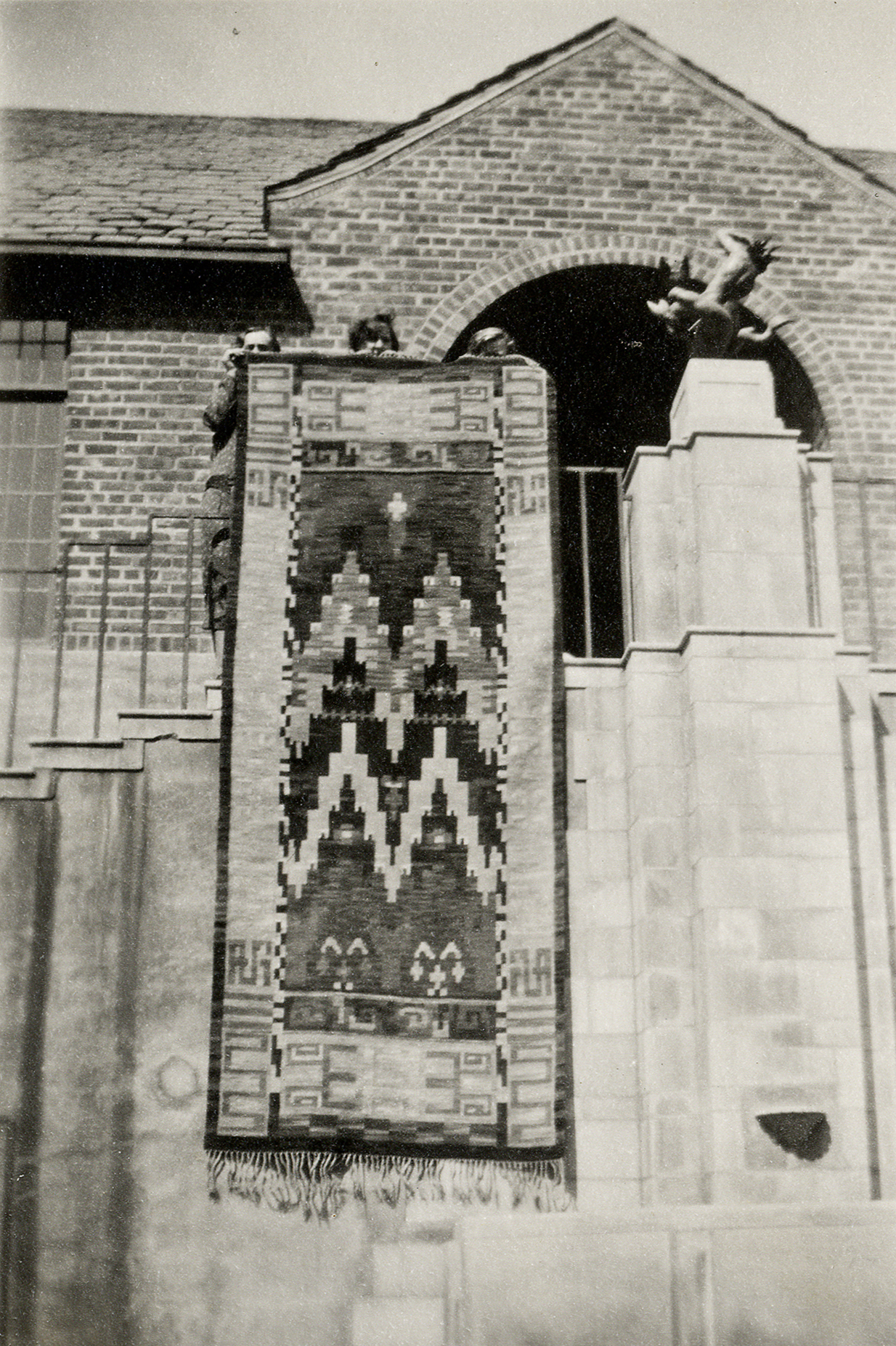
The Swedish weavers of Studio Loja Saarinen were the same way. After every rug was completed, they would unroll it behind the studio, lay it on the lawn, and pose at the end. This not only documented their work, but also served as a record of who worked on each piece. In Cranbrook Archives, we have a few examples of these images.

Cranbrook Academy of Art Rug No. 14

This rug lay in the center of the Studio Loja Saarinen Weaving Room. A flatwoven rug with stylized meanders in the border, and an elegant color scheme of dark browns, blues, and beiges, in form, structure, color, and design it shows the contemporary style of Swedish weaving that would become the foundation of Studio Loja Saarinen’s work.

Cranbrook Academy of Art Rug No. 14, designed by Maja Andersson Wirde and woven by Lillian Holm for Studio Loja Saarinen, 1930. CAM 1955.2. Photographer James Haefner.

This was one of the first rugs executed under the “Design and Supervision” of Maja Andersson Wirde, who was Loja’s right-hand-woman from 1930 to 1933. The rug is actually a variation of a design Wirde made for the 1925 International Exhibition of Modern Decorative and Industrial Arts in Paris (the “Art Deco” World’s Fair).

When Wirde wrote to Cranbrook’s secretary from Sweden before immigrating, she said she would bring along prepared designs and wool and linen yarns to be able to get started right away. She certainly did! Below, you can see Wirde and possibly Lillian Holm and Ruth Ingvarsson holding up the rug behind Studio Loja Saarinen just months after their arrival to Cranbrook.

Studio Loja Saarinen weavers with Rug No. 14 behind the Cranbrook Arts and Crafts Studios, 1930. Courtesy Smålands Museum, Sweden.
Continue reading

Let’s Beguine Again: A Syllabus for Music and Dance

This year the Center is celebrating the life and work of Loja Saarinen for our House Party fundraiser. Lynette Mayman’s post on 1930s fashion offered an excellent guide to dressing à la mode for this historically themed evening event, while highlighting Loja’s freedom and creativity in celebrating her own authentic style. Being curious about the events to which such attire might be worn, I looked to the Kingswood School records to explore its history of music and dance events during that era.

Kingswood School Annual Dance Book, 1932. Courtesy of Cranbrook Archives.

From the abundance of programs and ephemera, it was clear that music and dance were a valued part of the curriculum and school life, and its purpose was elucidated by the educational philosophy in the school catalogs for the 1930s:

“Music and Dance, two of the greatest social forces, and most closely related in essential nature, are organized in the curriculum under the direction of one department for concurrent purposes… The program of work is such as to encourage the fullest and freest development of individual personality which is the basis for true dramatic and musical expression.”

Kingswood School Catalogs, Kingswood School Records (1980-01)

Formal classes in music theory and social dancing (taught in physical education classes under the direction of Luella Hauser) were augmented by extracurricular activities. These included the Glee Club and various kinds of themed and annual dances, which offered students a variety of ways in which they could learn through participation, as well as recitals by visiting performers, which offered learning through observation and listening.

Program for the Mothers’ Day Tea, May 1937. Courtesy of Cranbrook Archives.

The Glee Club for girls was formed in 1932 for those interested in singing. They performed one concert per year, the first being held on March 11, 1932. The Club would also perform at other events throughout the year, such as the Mothers’ Day Tea and the ‘Carnival,’ which was an informal jamboree of themed gaiety and fun. The first Carnival, on December 10, 1932, was described as one of “grand vaudeville,” including a fashion show that embraced lovely old fashions and lively modern ones.

The 1937 Carnival was a Masque that traced the development of dance from the fourteenth century to the present time, including the Carole, Pavane, Sarabande, Minuet, Gavotte, Waltz, Schottische, Tango, and Fox Trot. The Glee Club sang songs typical of each period, while three jolly spirits, Dance, Play, and Song, presented the dancers.

Invitation to the Ypsilanti Madrigal Club performance, December 1931. Courtesy of Cranbrook Archives.

The first visiting performance was held on December 11, 1931, when the Madrigal Club, a choir of men and women from State Normal College, Ypsilanti, under the direction of Mr. Frederic Alexander, performed as a Christmas gift from Mr. Alexander to Mr. George Booth. The concert of unaccompanied songs and compositions on harpsichord was described as “unusual in character and delightful in content,” and became an annual event at the school.

Other annual visitors included Mildred Dilling, the internationally known harpist, and Cameron McLean, the Canadian baritone who was accompanied by various local pianists, including Detroiter Gizi Szanto. There were also one-time visits by performers such as pianists Stanley Fletcher and Samuel Sorin, singer Marion Anderson, baritone Earle Spicer, and opera singer Alexander Kipnis.

Program of Music printed by Cranbrook Press, April 1932.

Kingswood School Records. Courtesy of Cranbrook Archives.

Celebrated teachers of modern dance were invited to give dance recitals including Ted Shawn, Ronny Johansson, and Martha Graham. Visiting in March 1936, Graham gave a comprehensive recital of her work, leaving us with an autographed program—an archival treasure!

Program for Dance Recital autographed by Martha Graham, March 1936. Courtesy of Cranbrook Archives.

While Graham’s dance was reported in the Kingswood Newssheet as casting aside, “all old standards of beauty and grace,” through her use of angles and quick movements rather than the legato rhythm of conventional dancing, her philosophy of the dancer speaks poetically to the purpose of the 1930s Kingswood curriculum for music and dance—drawing out the essence of the individual through social artforms:

“You traverse, you come to the light, you work, you make it right… you embody within yourself as much curiosity, use that curiosity and avidity for life … and the body becomes a sacred garment – it’s your first and your last garment, and as such it should be treated with honor, and with joy, and with fear too, but always with blessing.”

Martha Graham, Martha Graham on Technique

As we celebrate the life and work of Loja Saarinen this year, we celebrate her as immigrant, entrepreneur, designer, and fashionista. Please join us for the Virtual Film Premiere as we support and acknowledge the work of the Center at our House Party, May 21, 2022.

Laura MacNewman, Associate Archivist, Center for Collections and Research

Photographing the Rugs of Studio Loja Saarinen

In 2021, the home of Loja Saarinen at Cranbrook Academy of Art, which she shared with her husband Eliel, was designated as a site in the Historic Artists’ Homes & Studios program. As the team at the Center were going through the process of researching Loja, the too-often-overlooked designer of textiles, gardens, and clothing, we were constantly reminded that the rugs created by Loja and her professional weaving studio, Studio Loja Saarinen, were poorly documented in our records.

Studio Loja Saarinen made rugs, window treatments, wall hangings, upholstery fabrics, and more at Cranbrook between 1928 and 1942. Many of the Studio’s largest rugs were made for Kingswood School for Girls between 1930 and 1932. Because of the fragility of the rugs, and through natural wear-and-tear, almost all of the original Studio Loja Saarinen rugs were put in storage at Cranbrook Art Museum in the 1970s and 1980s.

Loja Saarinen, circa 1934. Courtesy Cranbrook Archives.

We have excellent archival records about the operation of the studio, including records of yarn orders and charts of the time spent weaving rugs (it was a lot!). But the rugs are very large, and often, we only had black-and-white photographs of the rugs on the floor in the 1930s. Color photographs were limited to poorly distorted slides, or photographs of portions of the rugs taken on early digital cameras while the rugs were half-rolled-up in storage.

We had almost no ‘born digital’ high-resolution photographs of Loja’s work–these are the best kind of photographs for sharing her work in slides, online, or in print. The lack of excellent, high quality images limited not only how we at Cranbrook understood and shared Loja’s legacy, but also made it difficult for students or scholars researching Loja Saarinen to get a complete sense of her artistic output.

This winter, as the Center prepares for our next fundraiser, A House Party at Cranbrook Celebrating Loja Saarinen on May 21, 2022, it has become mission-critical to get better documentation of Studio Loja Saarinen’s rugs.

Enter in our latest project!

On January 7, 2022, photographer James Haefner and his assistant Erik Henderson, with the help of Center Curator Kevin Adkisson, Center Associate Registrar Leslie Mio, Cranbrook Art Museum Registrar Corey Gross, Cranbrook Art Museum Head Preparator Jon Geiger, and Jon’s installation crew embarked on a very ambitious project: documenting all the Studio Loja Saarinen rugs in the Cranbrook collections.

First, we had to take the several-hundred-pound rugs down from racks where they are stored, rolled. Then, we covered the floor in clean plastic drop cloths. With a camera bolted via a vise-grip to the ceiling of the Cranbrook Art Museum Collections Wing, and controlled via computer from a remote workstation, we unrolled, photographed, and rerolled over forty works of Studio Loja Saarinen’s functional art.

No detail went undocumented, from weaver’s signatures knotted into the face of a rug, to maker’s labels written and sewn on by Loja herself.

Below is just a fraction of the forty-plus pieces photographed:

It was a joy to unroll and see these pieces up close after knowing many of them for years through black-and-white images. While even these photographs do not do justice to seeing their beauty in person, having such high-resolution photography of Studio Loja Saarinen’s rugs means that future scholars and fans of Loja Saarinen will be able to have a richer understanding of her, and Cranbrook’s, remarkable legacy.

For even more Loja Saarinen, join the Center in person or online on May 21, 2022 for A House Party at Cranbrook Celebrating Loja Saarinen. We’ll be premiering a new, thirty-minute documentary about Loja, produced by the Center, at the event–you don’t want to miss it!

Leslie S. Mio, Associate Registrar, and Kevin Adkisson, Curator, Cranbrook Center for Collections and Research

Photo Friday: A Working Honeymoon?!

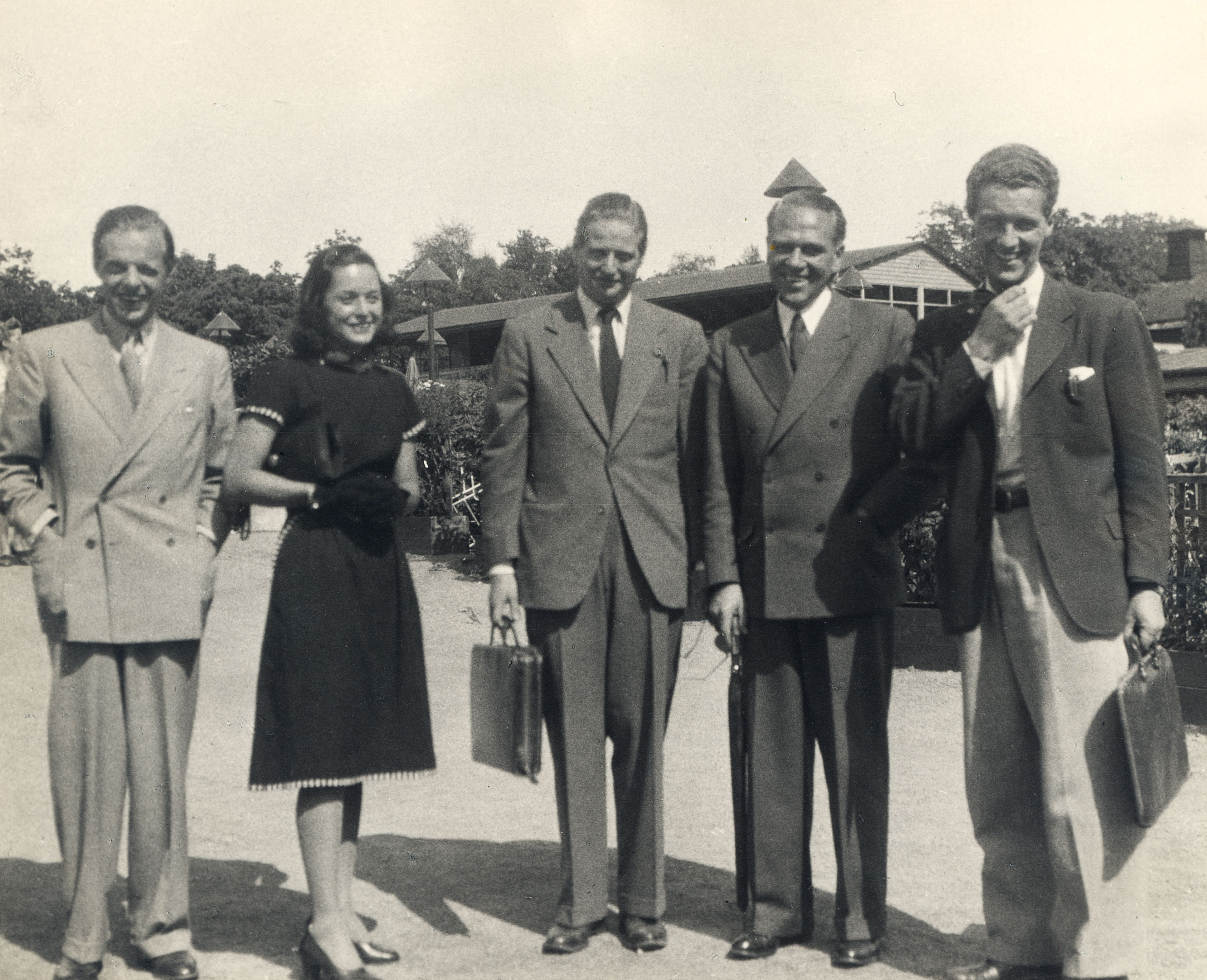
From left: Lars Eriksson, Florence Knoll, Hans Knoll, Tom Bjorklund, and Elias Svedberg, 1946. Courtesy Cranbrook Archives.

This photo was taken sometime in August or September 1946 during Florence and Hans Knolls’ honeymoon to Sweden. The newlyweds, who met in New York where Florence was an architect and Hans ran his eponymous furniture company, traveled throughout Sweden on a “working honeymoon.”

The Knolls were there to make arrangements and agreements with Nordiska Kompaniet (NK, or The Nordic Company), a large Stockholm-based department store, and other companies to import Swedish furniture and textiles into the United States.

Florence “Shu” Knoll, née Schust, (1917-2019) is, of course, one of Cranbrook’s most distinguished alumna (Kingswood School Cranbrook 1934, Cranbrook Academy of Art student 1934-1937, 1939), and Hans Knoll (1914-1955) was the son of a German furniture maker associated with the Bauhaus. While we couldn’t find much information on the Swedes the Knolls are pictured with here, Elias Svedberg (1913-1987), on the far right, was an architect and designer with a long career at NK, starting in the mid-1940s. His midcentury modern Swedish furniture certainly would have appealed to the fashionable and modern Knolls!

This week at the Center, we’ve had Knoll (the company) on our mind since Monday’s important announcement of the merger of Knoll, Inc. and Herman Miller, Inc. into one company; we’ve also had Sweden on our mind as we gear up for our grand Swedish-themed fundraiser coming up on May 22, 2021:  A Global House Party at Cranbrook and Millesgården. Of course, there’s a photo in Cranbrook Archives for every occasion!

Leslie Mio, Associate Registrar, and Kevin Adkisson, Associate Curator, Cranbrook Center for Collections and Research

PS: Don’t forget to purchase your tickets to House Party today so you don’t miss out on our special Carl Milles film premiere!

Observing Landscapes: Topography and Photogrammetry

One of my favorite items in the collections of Cranbrook Archives is George Booth’s hand drawn map of Cranbrook, which he created over a 24-year period between 1904 and 1928. It is the earliest topographical record of Cranbrook and visually documents his ideas and plans for developing the landscape. In 1951, George’s son, Henry, created annotations to accompany the map, which are useful both in deciphering the map and identifying locations. Henry’s notes on what was envisioned and what was implemented during those early years, are a good starting point from which to venture into the manuscript collections for verification.

Cranbrook Map drawn by George G. Booth between 1904 and 1928.
Courtesy of Cranbrook Archives

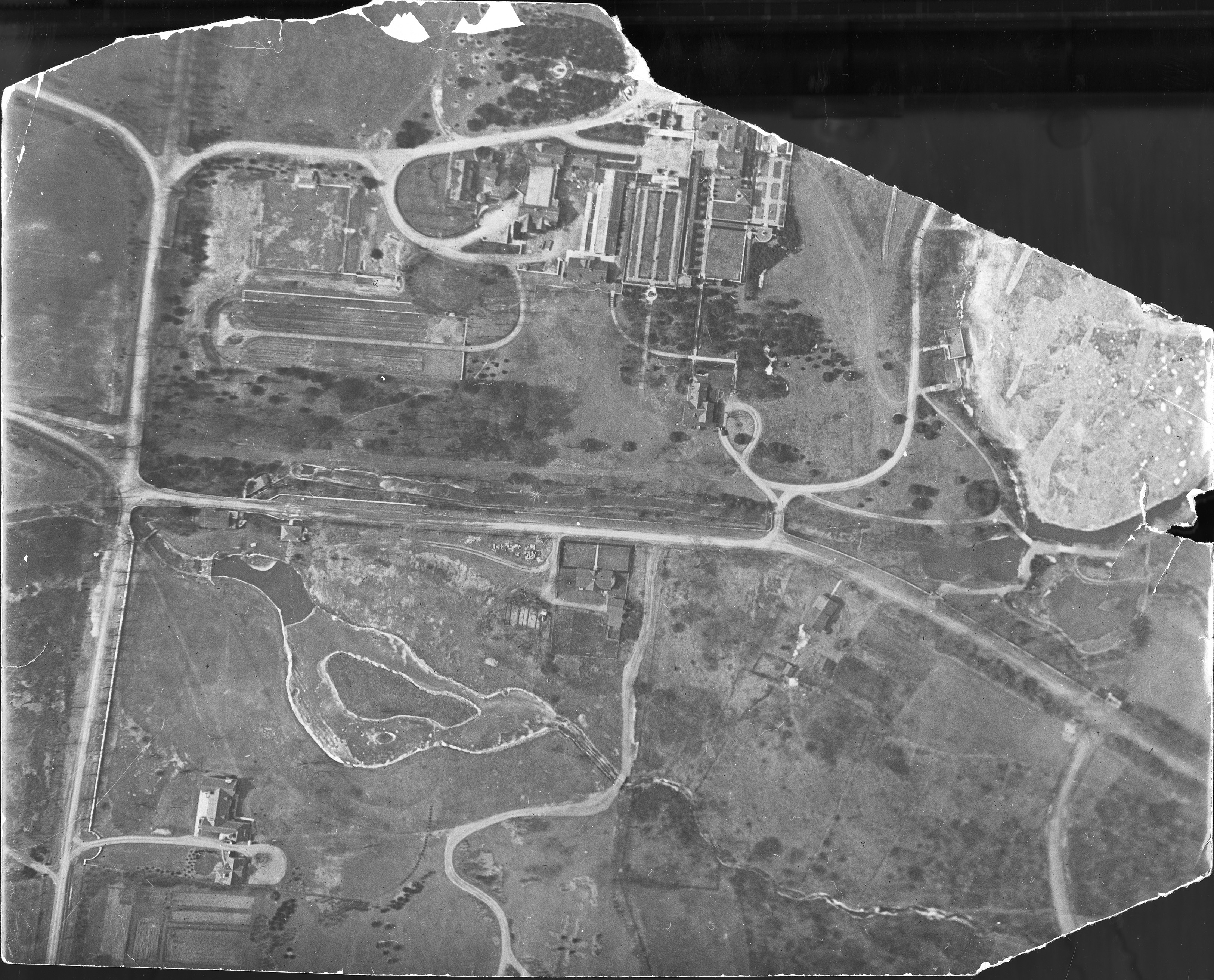
As Cranbrook’s landscape evolved from a family estate into a center for art and education, the means of recording and viewing the topography was assisted by developments in aerial photography, known as photogrammetry. Talbert Abrams, a native of Michigan, is regarded as a key contributor to this field of photography, as he founded the Abrams Aerial Survey Corporation in 1923. The earliest aerial photograph of Cranbrook I could locate is from circa 1918.

Aerial photograph of Cranbrook estate and environs, circa 1918.
Courtesy of Cranbrook Archives

In the Cranbrook Photograph Collection there are many aerial photographs taken by Abrams, as well as other photography firms, ranging from the 1920s through the 1990s. Since the purposes of aerial surveys are manifold, correspondence provides some insight into why they were commissioned and how they were specifically used, for example, as publicity and advertising. In 1932 Cranbrook’s public relations manager, Lee A. White, engaged Cranbrook School Headmaster William Stevens to select an image for the coming year’s brochure, and aerial views appear in all the early Cranbrook brochures. Aerial surveys have also been used to assess and understand the landscape prior to making a change to it. This was the case in 1961, when a topographic map and aerial photography were requested for the Off-Street Parking Study.

Letter from Keith A. Smith to Arthur B. Wittliff, November 1961.
Courtesy of Cranbrook Archives

Correspondence between Arthur Wittliff, Secretary for the Cranbrook Foundation Board of Trustees, and Abrams Aerial Survey Corporation, provides intriguing details about the scale of the photography and the material base of the prints. The images below are from a December 6, 1961 set of 12 double weight velvet prints of aerials covering 1 square mile at a scale of 1 inch per 600 feet.

Aerial photograph ASP-5 taken by Abrams Aerial Survey Corporation on 6 December 1961.
Courtesy of Cranbrook Archives

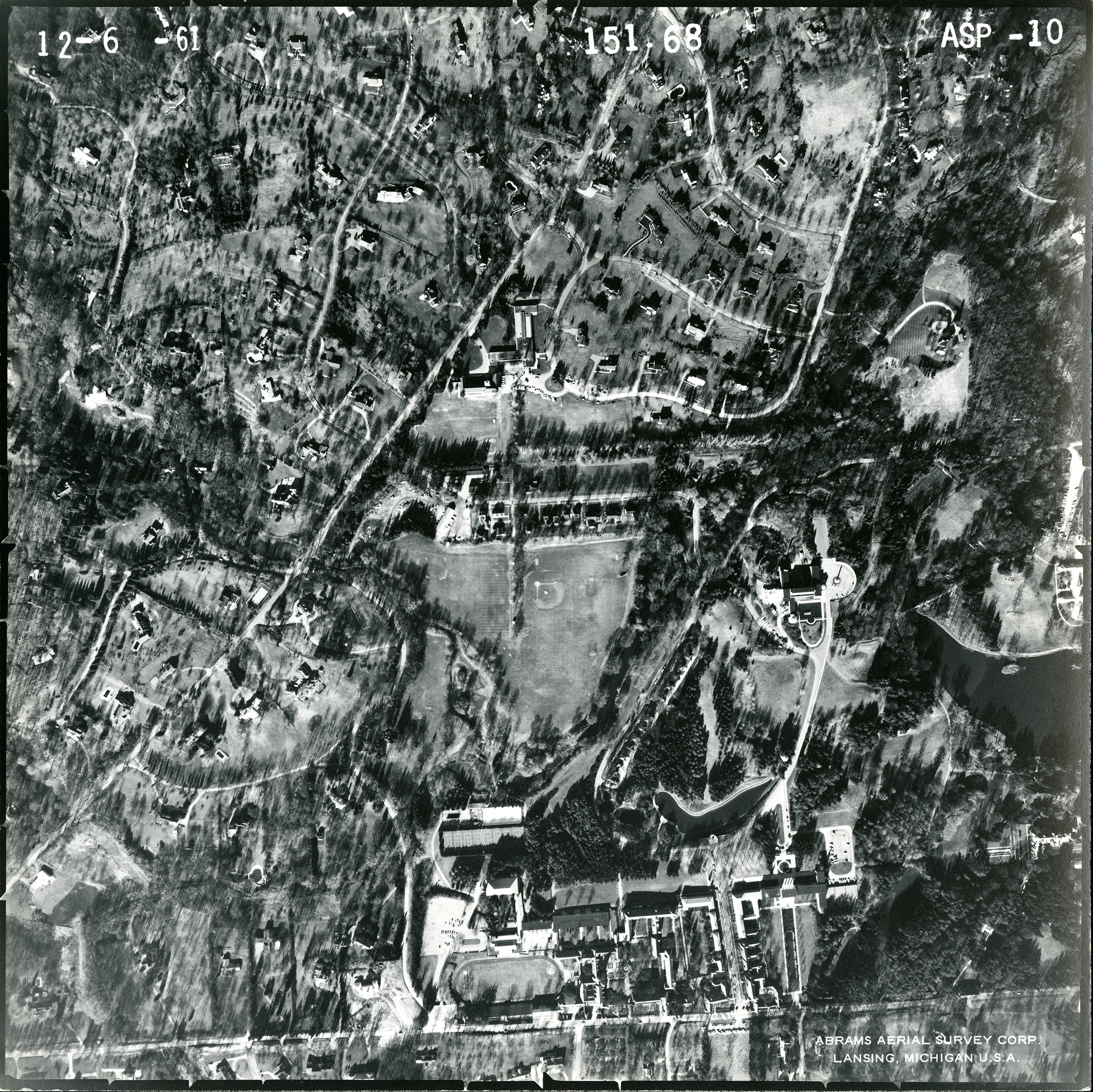
ASP-5 (above) shows the intersection of Cranbrook Road and Lone Pine Road, and includes Kingswood School and Lake, the Institute of Science, Cranbrook House, Brookside School, Christ Church Cranbrook, and the Academy of Art and Academy Way. ASP-10 (below) shows another view of Cranbrook and its environs, encompassing the Institute of Science, Academy of Art, and Cranbrook School.

Aerial photograph ASP-10 taken by Abrams Aerial Survey Corporation on 6 December 1961.
Courtesy of Cranbrook Archives

When looking across the topographical history of Cranbrook from George’s map through aerial photographs, it is always fascinating to discern the changing landscape alongside the features that are unchanging. And, for me, the great inspiration of George’s map is that, although each individual project necessitated getting into the weeds and meticulous details, his ideas were always guided by situating them within a bigger picture.

Laura MacNewman, Associate Archivist, Cranbrook Center for Collections and Research

Create a website or blog at WordPress.com