Sometimes it seems there are infinite possible discoveries within a single archives collection. Such is the case with the Edward and Ruth Adler Schnee Papers. Just over a year ago I wrote about the Schnees’ long-running Detroit retail business, Adler/Schnee, but I knew then that story was only the tip of the iceberg.
And so I was happy to find myself returning recently to one of my favorite collections in the Archives. Replacing materials that had been on loan to the Cranbrook Art Museum for their exhibit, Ruth Adler Schnee: Modern Designs for Living, I was once again struck by her achievements as a high school student at Cass Technical High School in Detroit from 1940-1942. In particular, her skill at fashion design. Maybe it was the months of hearing about sweatpants and Zoom shirts, but it was so refreshing to spend a few moments remembering what real fashion means.
Ruth Adler Schnee illustration, circa 1941. Courtesy of Cranbrook Archives.
Before Ruth Adler Schnee made a name for herself in interior design, including her iconic textile designs, she was interested in becoming a fashion designer. Attending Cass Tech afforded Ruth the opportunity to nurture her natural artistic talents, which are clearly evident in drawings from her primary school days. And, she had already shown an affinity for fashion design—out of necessity, Ruth had already been designing her own clothes since she was a 13-year-old Jewish girl in Nazi Germany (her family emigrated in 1939).
Pages from “Dress Design VI,” Ruth Adler Schnee, circa 1942. Courtesy of Cranbrook Archives.
Amongst other documents in her collection, the story of Ruth’s high school years and her passion for fashion are perhaps best captured in three notebooks. One of my favorite boxes in the collection holds nothing but pages from a notebook entitled Dress Design VI. Labeled “hours 1-4″ it is clearly a class project, and one for which Ruth received high marks. Divided into four parts (Machine Attachments, Illustrative Material, Drafting Problems, and Analysis of Dresses), the book includes drawings, pattern pieces (not to scale), paper mockups of mainly women’s sportswear designs, samples of sewing technique (actual fabric pinned to the page), textile identification pages (with real fabric samples), and an essay on silk.
Sleeve Form page, in “Notes on the Draping of Garments,” Ruth Adler Schnee, circa 1942. Courtesy of Cranbrook Archives.
On November 21, 1935, celebrated French architect Le Corbusier arrived in Detroit and promptly demanded to be taken to Henry Ford’s River Rouge Complex. That one of the world’s leading modernist architects wanted to visit Ford’s factory shouldn’t have been too surprising, as for the previous two decades Le Corbusier—born Charles-Édouard Jeanneret—had been advocating for a revolution in architecture like Ford’s revolution in transportation.
In his groundbreaking 1923 book, Toward an Architecture (or, as it was titled in its first English translations, Towards a New Architecture,) Le Corbusier made the famous claim, “A house is a machine for living in.” As he believed, “Machines will lead to a new order both of work and of leisure.”
Le Corbusier told reporter Florence Davies of the Detroit News that “Detroit is the logical city for the production of the houses of tomorrow, the pre-fabricated efficient mass-production house.” He went on to claim that it would be automobile manufacturers, not architects, who would “undertake the production of the homes of tomorrow” because they understood the problems of mass production.
But while Ford may have attracted Le Corbusier to visit Detroit during the his one and only trip to America, it was Cranbrook Academy of Art and its president Eliel Saarinen that played host to the great architect.
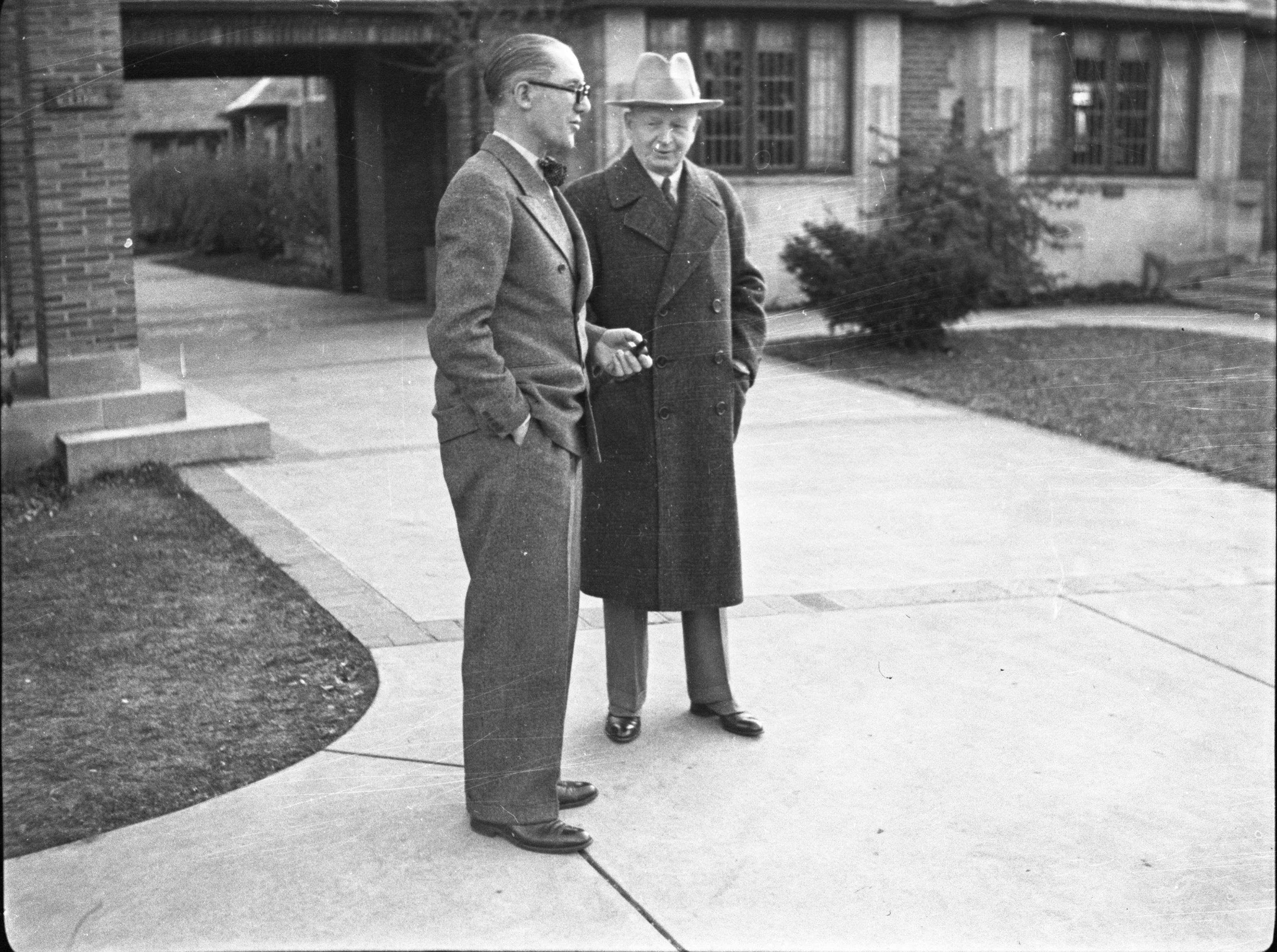
Le Corbusier, with pipe, and Eliel Saarinen at Cranbrook, November 1935. Richard G. Askew, photographer. Cranbrook Archives.
After seeing the Ford complex and a making a few stops downtown, Le Corbusier wound his way up to Bloomfield Hills. On display in the Cranbrook Pavilion (now St. Dunstan’s Theater) were twenty-four enlarged photographs, a selection of movies, fourteen building and city plans, and a single model documenting his work. These items were part of a small show on the architect open from November 19 to November 22. But the main event was Le Corbusier’s lecture at 8:00pm on November 21, 1935.
Delivered in French and translated by his American associate Robert Jacobs, Le Corbusier enthralled an at-capacity audience with his theories of architecture. He spoke of his work in Europe, including the recently completed Villa Savoye in Poissy. The focus, however, were his theories of city planning and mechanization. Le Corbusier used a sheet of tracing paper some 8- to 12-feet-long and pinned along the wall to execute large, colorful pastel sketches that illustrated his ideas of architecture and planning. This drawing was saved by the Academy, though it has since, sadly, been lost.
Installation view of Modern Architecture: International Exhibition at the Museum of Modern Art with Le Corbusier’s Villa Savoye at center and in photographs on left, February 9–March 23, 1932. While no photographs of Le Corbusier’s lecture or exhibition at Cranbrook survive, it was likely similar to this installation. MoMA Archives.
Le Corbusier lectured throughout most of his career as an architect. As he told an interviewer in 1951:
I never prepare my lectures…Improvisation is a wonderful thing: I draw, and when you draw and speak at the same time, you create something new. And all my theory—my introspection and retrospection on the phenomenon of architecture and urbanism—derives from my improvisation and drawings during these lectures.
After the Cranbrook lecture, Le Corbusier was the guest of the Academy of Art’s Executive Secretary Richard Raseman and Instructor in Interior Design Rachel DeWolfe Raseman. The couple had both studied architecture at Cornell (Rachel Raseman was Cornell’s first woman architecture graduate) and resided at Academy Residence #3 across Academy Way from Saarinen House. In the morning, Le Corbusier continued by train to the next stop on his cross-country journey.
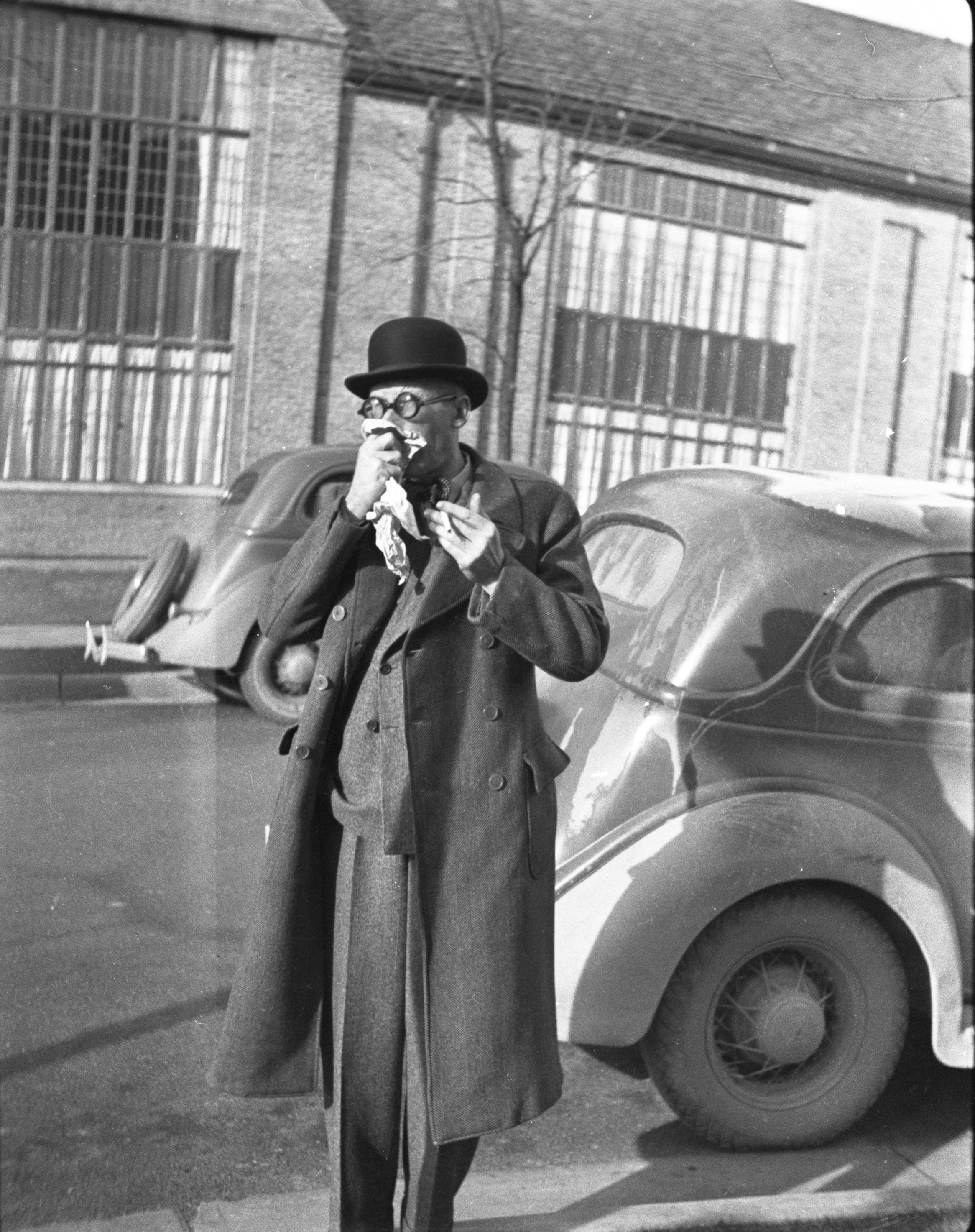
As the Detroit Free Press reported November 22, “With a few deft strokes Thursday, Le Corbusier, the famous French modernist-architect…sketched the vision that he sees through what is perhaps the most ponderous pair of eyeglasses ever fabricated.”
Le Corbusier in his famous eyeglasses at Cranbrook, November 1935. Richard G. Askew, photographer. Cranbrook Archives.
Alongside an earlier lecture in April 1935 by Frank Lloyd Wright, the visit to Cranbrook by Le Corbusier was one of the highlights of the Academy’s first decade. Reflecting in his Annual Report to the Cranbrook Foundation, Richard Raseman wrote that:
The Le Corbusier lecture, although delivered in French, was a good show, and as he is a world figure we were well satisfied…the public must have agreed with us as these lectures [by Wright and Le Corbusier] were by far the best attended of any of our functions…men of this caliber are rare indeed.
To learn more about Le Corbusier and his visit to Cranbrook, sign up for the Center’s History of American Architecture: Cranbrook VisitorsLecture Series! For the next five weeks, I will be discussing visitors, like Le Corbusier, who have lectured at Cranbrook since the Academy opened in 1932. From Le Corbusier, Wright, and Alvar Aalto in the 1930s through to Jeanne Gang, Greg Pasquarelli, and David Adjaye in the 2010s, I will tell the story of American design through architects who’ve spoken at Cranbrook. Learn more and sign up on our website. “See” you Monday at 11:00am or 7:00pm EST for our first virtual lecture!
—Kevin Adkisson, Associate Curator, Cranbrook Center for Collections and Research
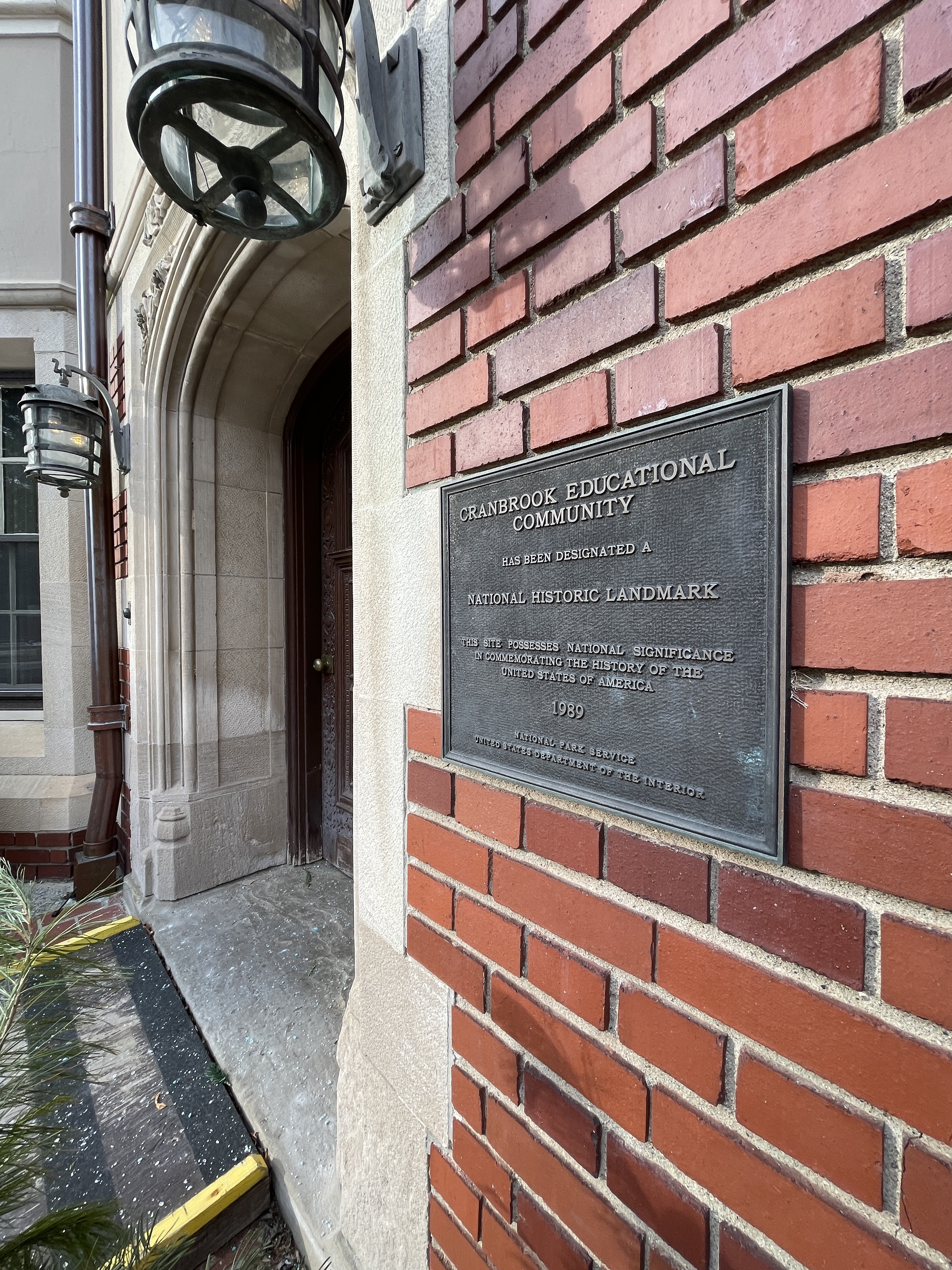
In August 1989, Cranbrook became a National Historic Landmark. America’s highest designation for a place of outstanding historical significance, it was no small feat for Cranbrook to become Michigan’s twenty-second National Historic Landmark (there are only forty-two today). So, what exactly is a National Historic Landmark, and how did we become one?
National Register of Historic Places plaque on the Kingswood Campus. Photographs by Kevin Adkisson, Cranbrook Center for Collections and Research.
Statutory provision for historic preservation began in America in 1906 with the Antiquities Act, which was further developed by the Historic Sites Act of 1935. Administered by the Department of the Interior, this Act was enacted to document and protect sites of national significance. In 1960, the National Park Service began administering the survey data from the Historic Sites Act, and the National Historic Landmark designation was introduced.
The National Historic Preservation Act of 1966 expanded the 1935 Act to local and state sites. This created the National Register of Historic Places, which began to identify, evaluate, and protect America’s historic resources. Many thousands of buildings have since been added to the National Register. In June of 1972, Cranbrook’s application was prepared by an Assistant Historian at the Michigan Department of State in Lansing, and the nomination was based on Cranbrook’s significance as a complete district of educational and architectural structures.
National Register of Historic Places plaque at Brookside.
To be eligible for designation on the National Register (a step below the National Historic Landmark status), the nominated site must have in its architecture, archeology, engineering, or culture integrity of location, design, setting, materials, workmanship, feeling, and association.
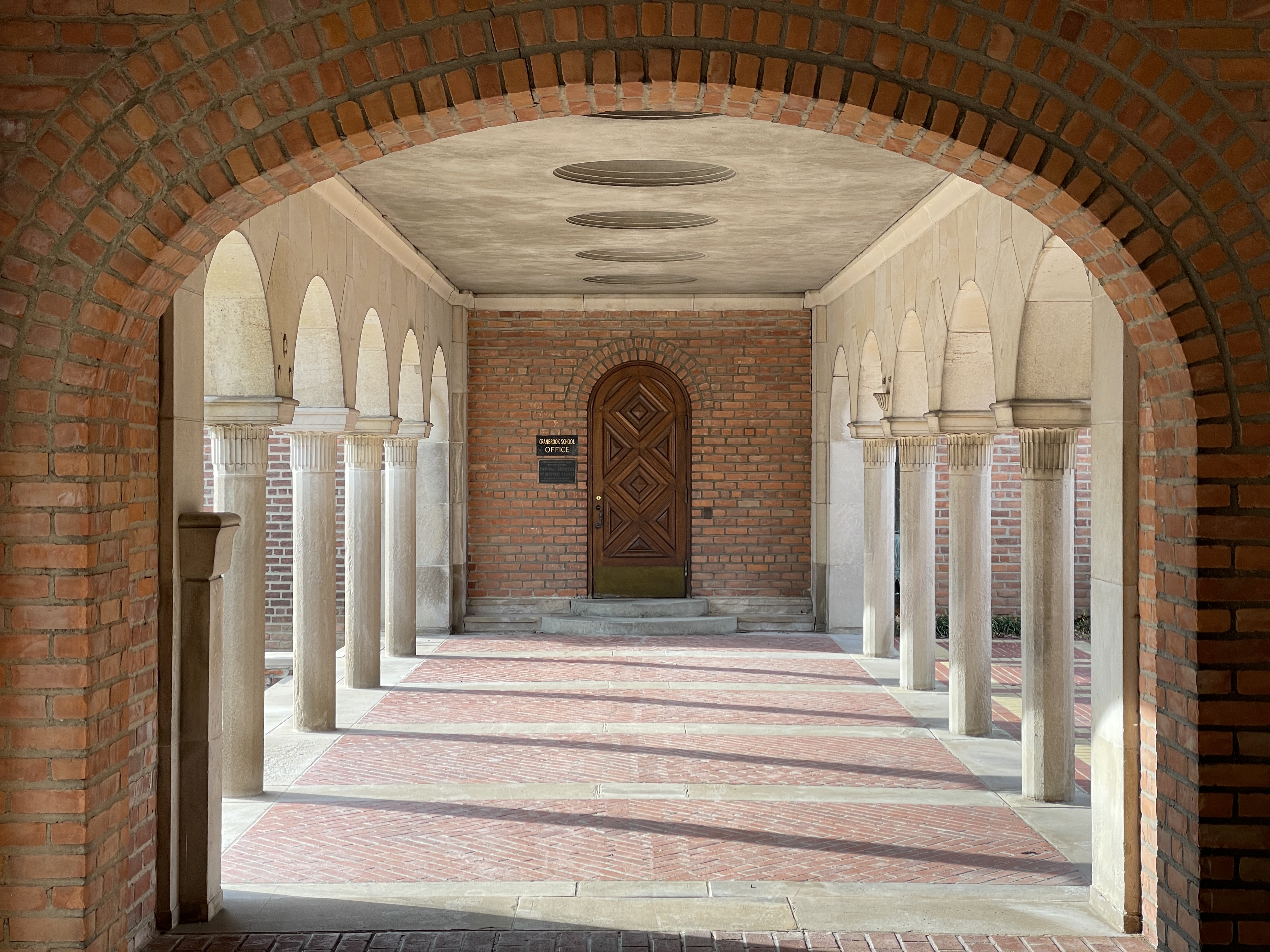
National Register of Historic Places plaque at Cranbrook School.
In addition, sites on the National Register must meet one of four criteria: be associated with events in the lives of significant persons; embody distinctive characteristics of a type, period, or method of construction; represent work of a master and high artistic values; or have or be likely to yield information important to prehistory or history. Once these criteria are evaluated and met, the site may be listed.
National Register of Historic Places plaque at Cranbrook Institute of Science.
Cranbrook was added to the National Register in March 1973, and it was at this point seven National Historic Landmark signs were ordered to be placed at each of the original Cranbrook Institutions and on Cranbrook House. (Christ Church Cranbrook was included in the designation, even though it would formally split off as a separate entity later in 1973 with the formation of Cranbrook Educational Community.) In writing to inform us of the designation, Samuel Milstein at the Department of Natural Resources eloquently wrote that:
“The State of Michigan is very proud of the fact that the property is qualified for this designation. The National Register records the story of the Nation, and is a list of distinction identifying those properties by which present and future generations can sense the heartbeat of the United States.”
Letter from Samuel A. Milstein to Cranbrook Institutions, March 30, 1973. National Register for Historic Places Records.
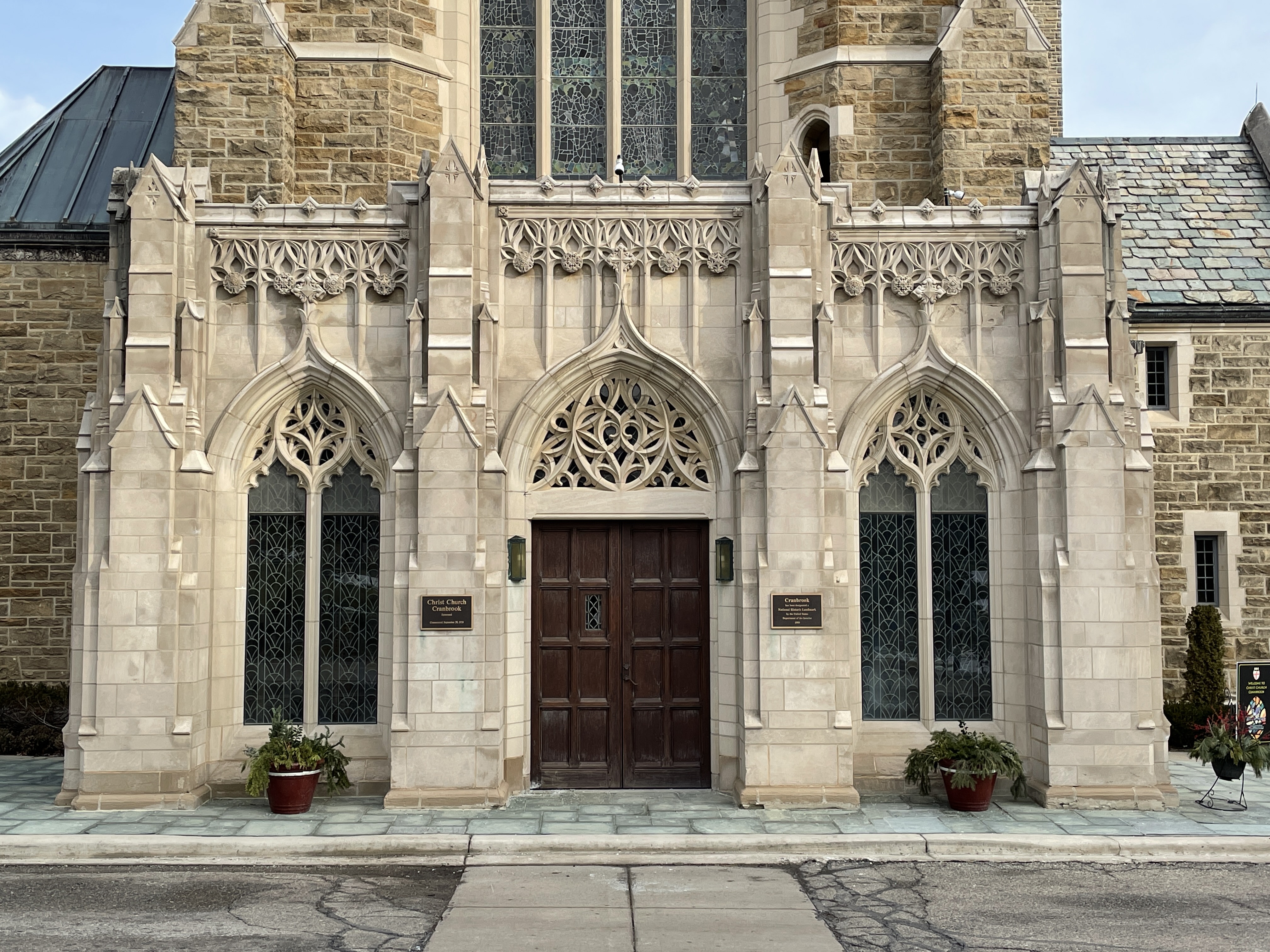
Non-official National Historic Landmark plaque at Christ Church Cranbrook, on right. The official plaque was changed at some point.
This language echoes that of George Booth in speaking to Cranbrook School in 1928, in which he emphasizes the importance of finding the treasure at your feet, the building up of an ethos of service from the local to the national to the global:
“If we feel our first loyalty to our State and are determined in every way we can to enrich it; if we never fail to see that we must give; if we are resolved to strive only for that which is worth while, then will our State have a place in the Nation, of which we will all be proud. The stronger and more glorious each of the States may be, the stronger and more glorious the Nation; and hence, the better and finer our opportunity for service to the world.”
Address by George Booth given on “Founders’ Day” at Cranbrook School for Boys, October 26, 1928. Cranbrook Archives.
But of course, our story doesn’t end with the National Register. In June 1987, the Chief Historian of the National Park Service (NPS) wrote to Cranbrook’s president, Dr. Lillian Bauder, to inform her that they were studying the property to determine its potential as a National Historic Landmark. Only 3% of sites on the National Register of Historic Places receive the higher honor of becoming National Historic Landmarks.
National Register of Historic Places plaque at Cranbrook Academy of Art.
The designation process follows three steps: study, including a visit to the property; review by the NPS Advisory Board; and a decision of designation by the Secretary of the Interior. The study was completed in February 1989 and the Advisory Board made its recommendation to Secretary Manuel Lujan in May. Cranbrook was designated a National Historic Landmark in August 1989.
The Cranbrook House sign was swapped from a National Register of Historic Places sign to a National Historic Landmark sign, encompassing all of the Cranbrook district.
National Historic Landmark plaque for the entire Cranbrook Educational Community next to the front door of Cranbrook House.
The work of the Center for Collections and Research is embedded in the obligations of historic preservation in caring for and maintaining the community’s history, but also in articulating its meaning and value. Our mission nicely parallels the goals of the National Historic Landmark program. Even without such recognition, all who visit Cranbrook know it is a special place—but sometimes it is nice to have a plaque say so, too.
—Laura MacNewman, Associate Archivist, Cranbrook Center for Collections and Research
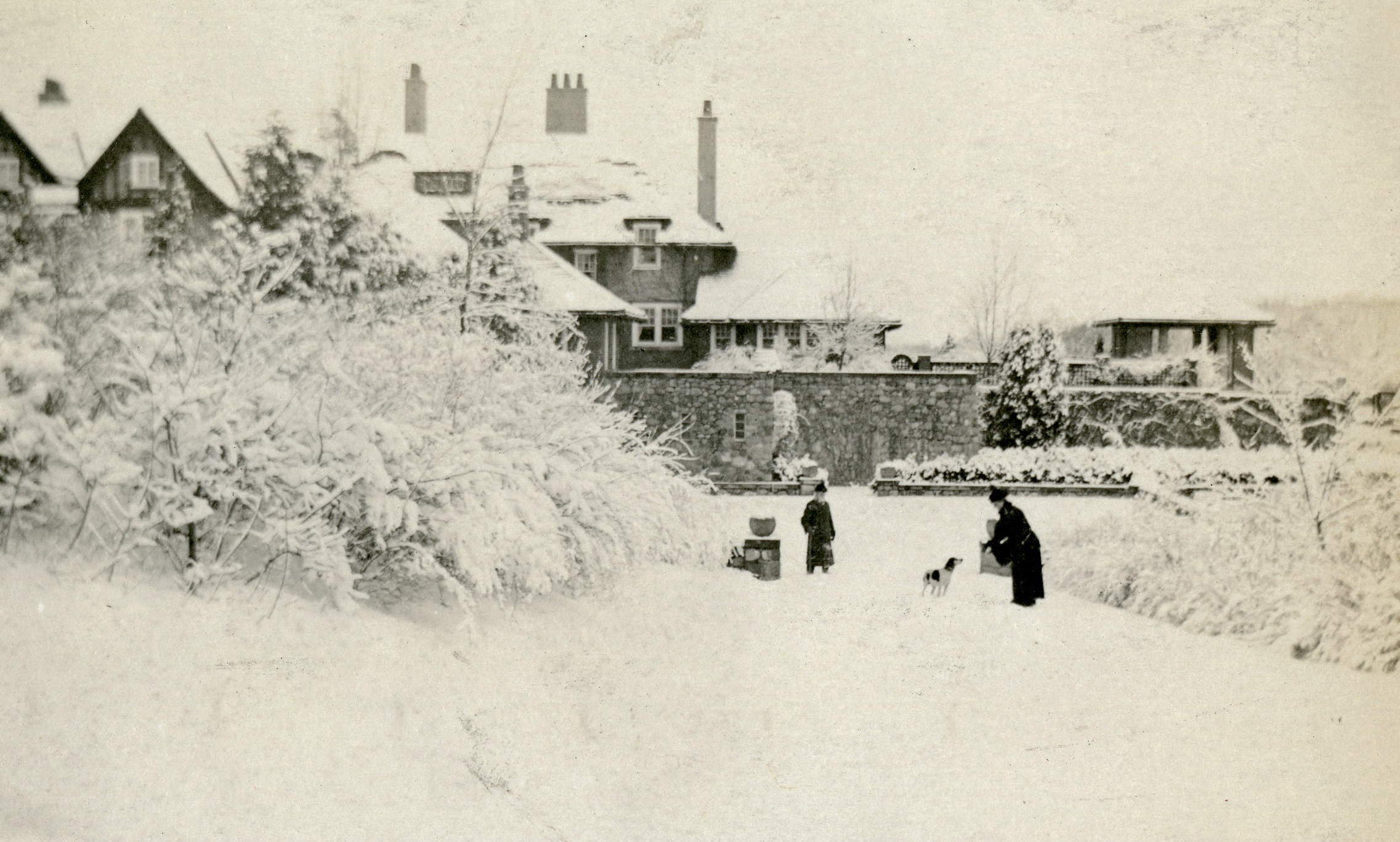
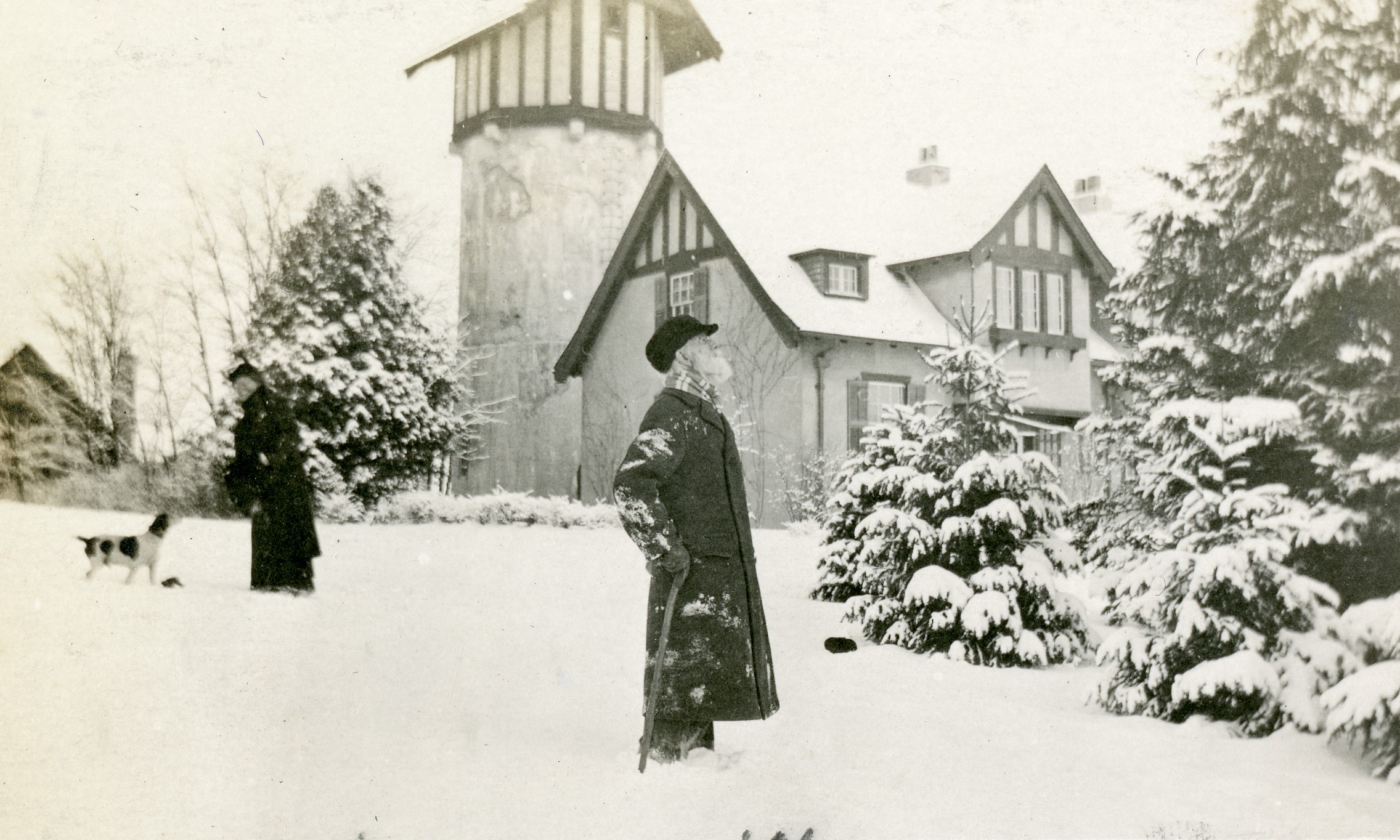
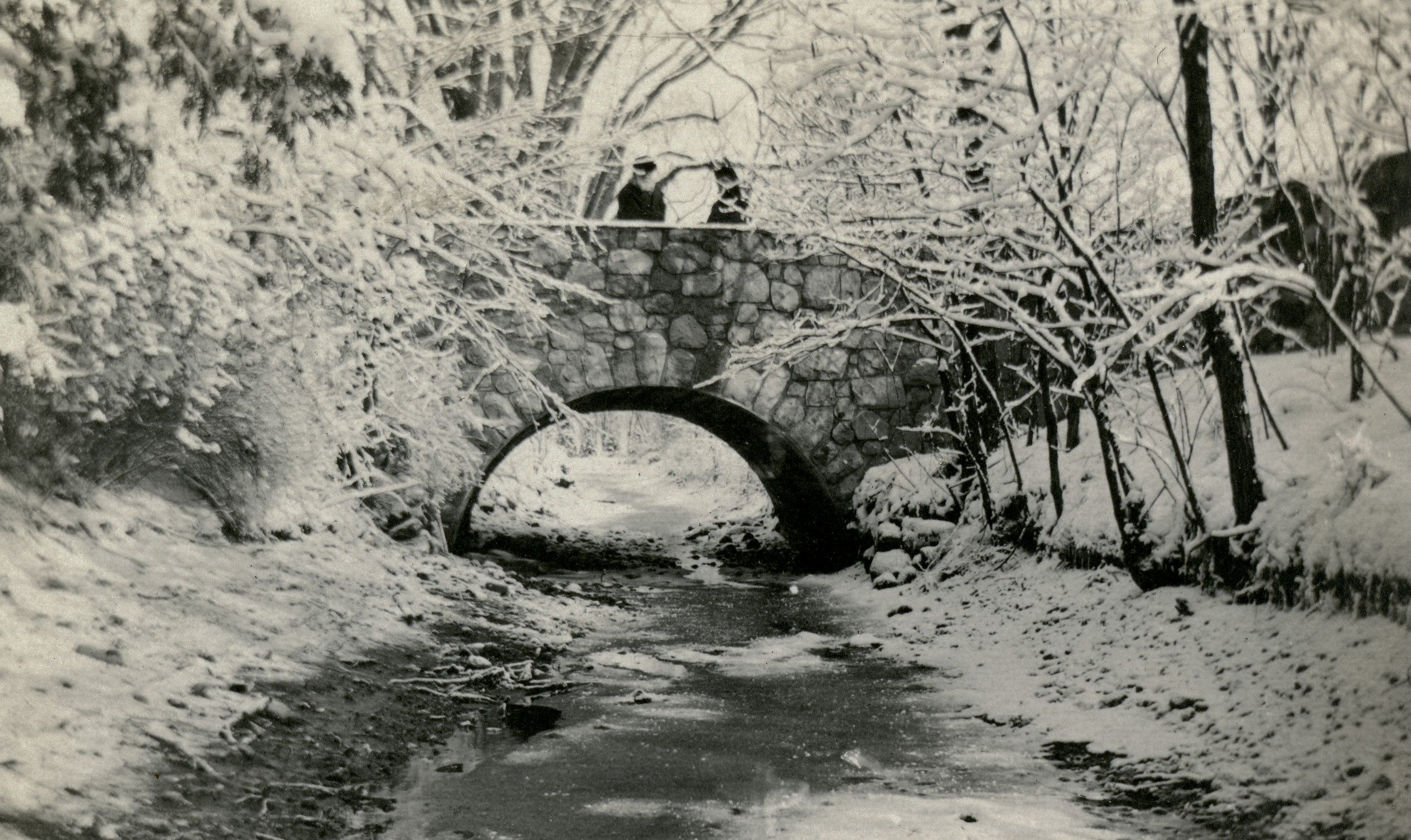
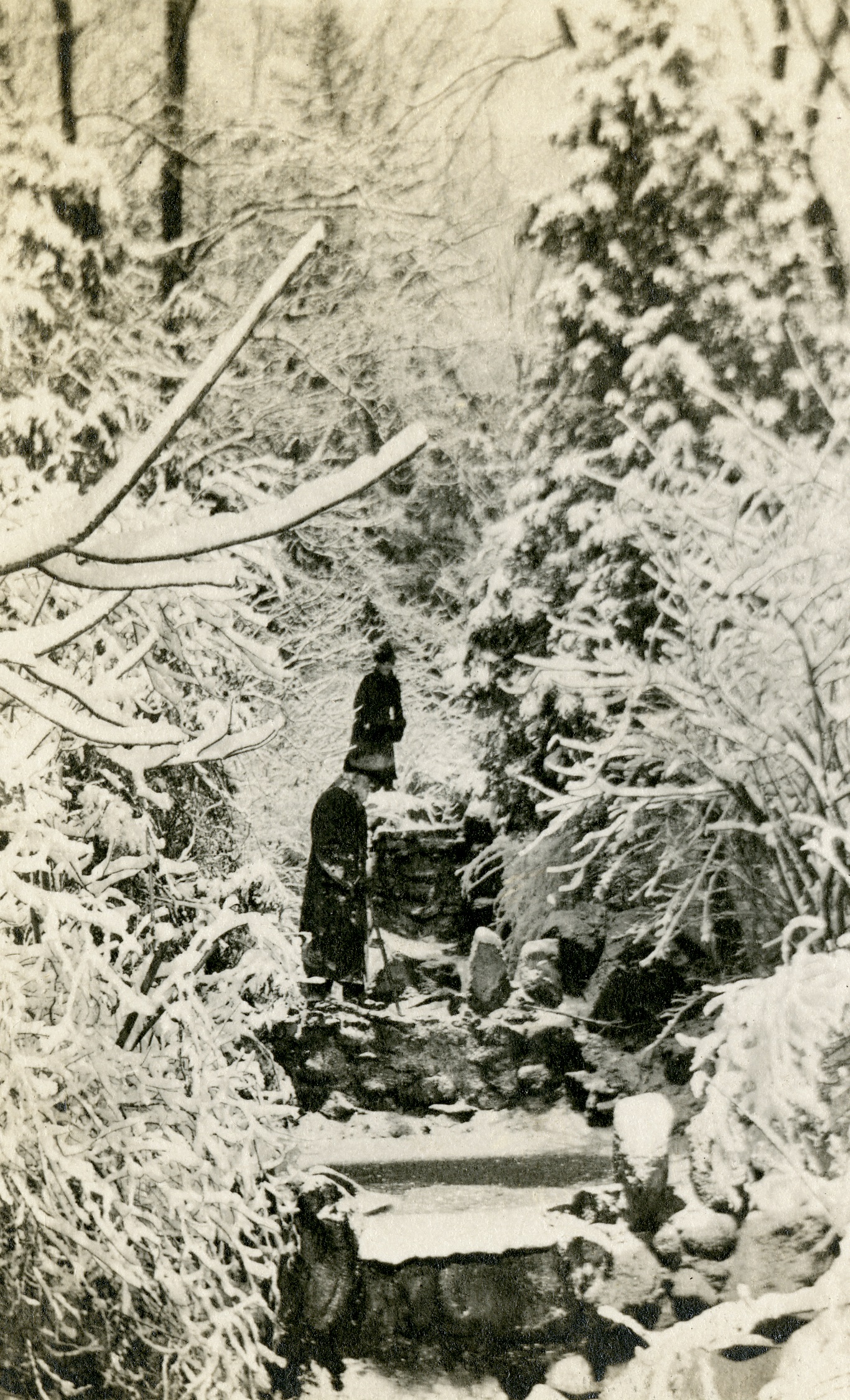
As we start a new year, I thought I would share some winter scenes at Cranbrook from 105 years ago. In the Winter of 1916, Henry Wood Booth and his daughter Alice Booth Miller took a stroll around the grounds of a snow-covered Cranbrook Estate. The journey was documented in pictures now in the Estate Albums in Cranbrook Archives.
Henry Wood Booth and Alice Booth Miller on the trail between the Cottage and Cranbrook House, March 1916.
Henry Wood Booth and Alice Booth Miller on the road to the Service Court, just above the Sunken Garden, at Cranbrook House, March 1916.
Henry Wood Booth and Alice Booth Miller beside Tower Cottage (then known as the Summer Cottage and water tower), March 1916.
Henry Wood Booth and Alice Booth Miller on the arched bridge over the Mill Race, March 1916.
Henry Wood Booth and Alice Booth Miller at the Cascades (now the site of the Morris Mill), March 1916.
Best wishes for a happy and healthy New Year from your friends at Cranbrook Center for Collections and Research!
– Leslie S. Mio, Associate Registrar, Cranbrook Center for Collections and Research
Correspondence, including special occasion cards, are not uncommon in archival collections, but sometimes you find remarkable standouts such as the panoramic handmade masterpiece in the Marianne Strengell Papers. Measuring 5 x 24 inches, I invite you to click on the image below and zoom in to see all of the amazing details.
Titled, “This Way to the Strengell-Hammarstrom Gallery,” the card depicts a wall of portraits of Strengell family members, each complete with a short anecdote.
First portrait in the gallery. Courtesy of Cranbrook Archives.
At the end of the gallery is an abstract portrait of “Marianne Strengell Hammarstrom ‘Our Birthday Gal’” (curious, since she was born in May!). The card is signed, “love from your Weavers.”
Portrait and greeting detail. Courtesy of Cranbrook Archives.
Since no real names are used and the card is not dated, the origins and meaning behind the drawings and greeting remain as yet unknown. So far, research has not yielded any definitive answers. What we do know, however, is that Strengell enjoyed a wonderful relationship with her students and developed many deep friendships with both students and colleagues such as Wallace Mitchell and Zoltan Sepeshy. The wry, irreverent humor that imbues the card certainly suggests the close-knit, sociable atmosphere Marianne experienced at the Academy. “In all a very happy studio and many wonderful, now famous students. For me, 25 marvelous years.” (Marianne Strengell, 1989)
Last portrait in the gallery. Courtesy of Cranbrook Archives.
Strengell’s students included Nelly Mehta Sethna, Ed Rossbach, Robert Sailors and Jack Lenor Larsen, but she also had students from other departments study with her. These ‘Minors’ as Strengell dubbed them included Charles Eames, Benjamin Baldwin, Harry Bertoia, and Harry Weese.
Letter to Mark Coir, Archives Director, 1995. Courtesy of Cranbrook Archives.
Strengell, in fact, highly encouraged interaction between the departments, establishing Open House Days in the weaving studio, as well as Weavers Parties, which were very popular.
Revelers at a Weavers Party, 1959. Harvey Croze, photographer. Courtesy of Cranbrook Archives.
Marianne Strengell was a weaving instructor (1937-1942) and head of the Department of Weaving and Textile Design (1942-1961) at the Academy of Art. She often worked closely with her second husband, Olav Hammarstrom, architect and furniture designer, whom she married in 1948.
Farewell dinner for Marianne Strengell in the weaving studio, 1961. Strengell is shown middle left. Harvey Croze, photographer. Courtesy of Cranbrook Archives.
There are several other examples of holiday greetings in the Archives’ collections from Strengell’s contemporaries, but, in my opinion, none as witty as the one created by her Academy admirers.
May your holiday season be as merry and bright!
—Deborah Rice, Head Archivist, Cranbrook Center for Collections and Research
Merrill was an engineer who developed an interest in archaeology, becoming an authority on the Maya calendar, particularly focusing on time measurement. Merrill was associated with the Institute of Science in the 1940s and 1950s, but the Merrill Papers in Cranbrook Archives document over fifty years of his research, graphs, findings, and conclusions.
Merrill’s graph of Venus phases. Courtesy of Cranbrook Archives.
The Maya were an agricultural civilization and used observations of the sun, moon, and Venus to determine ideal dates for planting and harvest. The calendar, which is comparable in its exactitude to the Western system of time measurement, is based on the movement of the sun. Archaeologists access and interpret this knowledge through writing, represented by characters or pictures, and astronomical markers which have been uncovered by geologists.
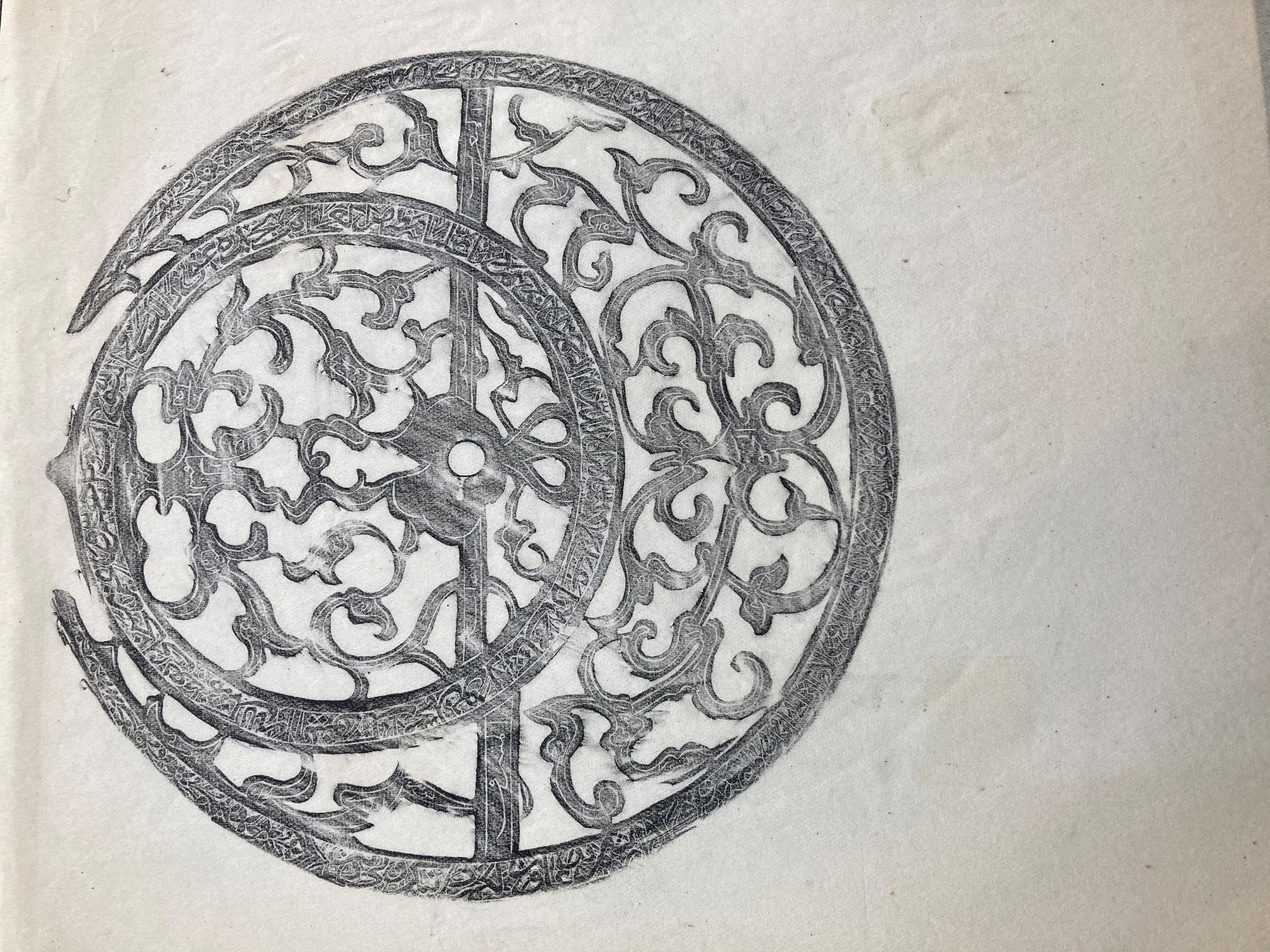
Astrolabe Rubbing. Courtesy of Cranbrook Archives.
Merrill graphed the phases of the sun, moon, and the planets to decipher the calendar. By applying engineering methods to archaeological studies, Merrill developed a device for photo-surveying in 1941. The device enabled vertical photographs of large areas of artifacts, which facilitated documentation of the excavation process which had previously been recorded by sketching.
Maya Sun Calendar Cycles Chart. Courtesy of Cranbrook Archives.
The correspondence and publications in the collection document his work with numerous scholars around the world, including the Maya archaeologist J. Eric S. Thompson, who was a visiting scholar to Cranbrook Institute of Science between January and April 1967.
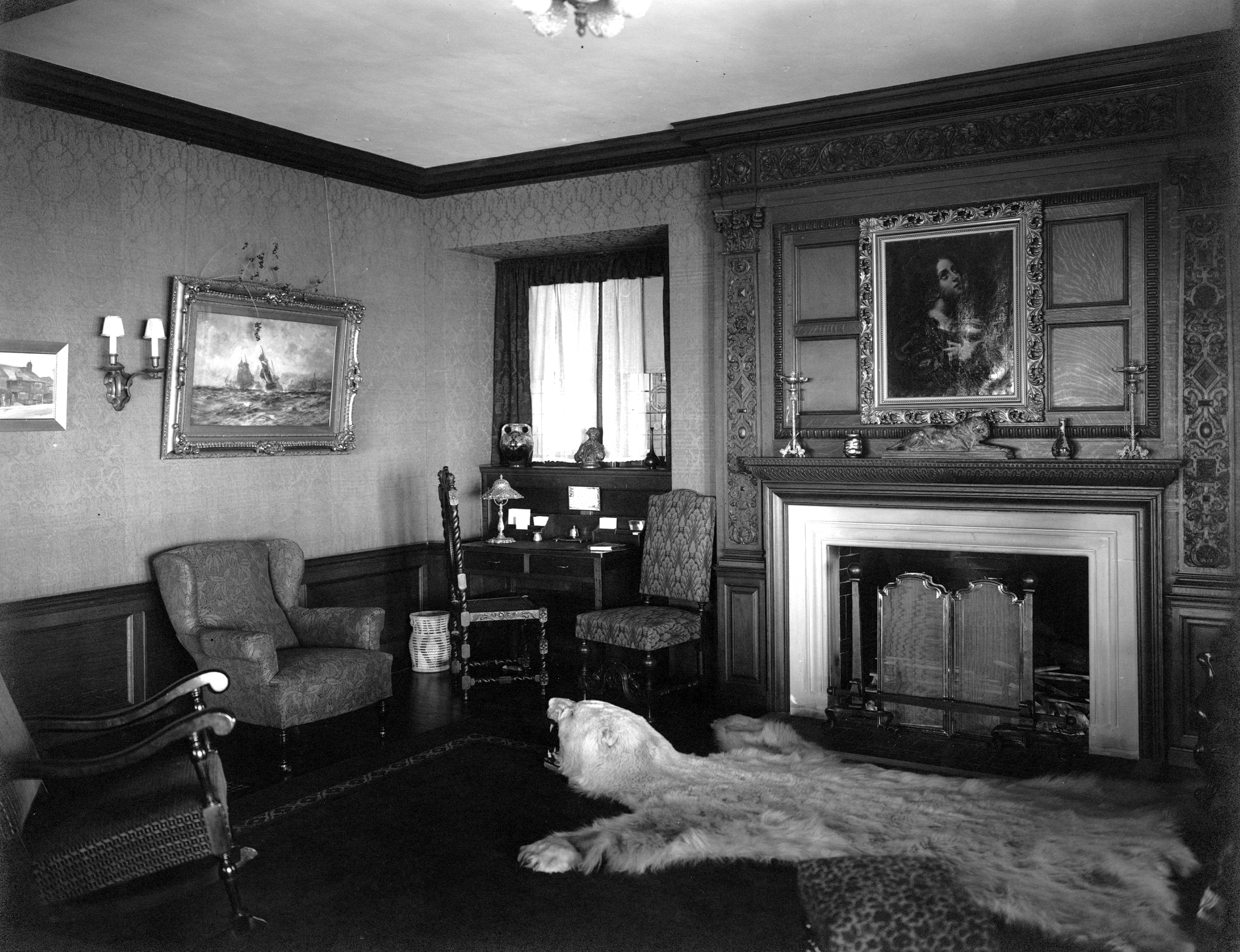
As the temperature dips and the days get shorter, it sure would be nice to end the week reading a book next to a roaring fire. The Booths likely had the same idea their second winter at Cranbrook House, where they could have curled up by the fire…on their new polar bear rug!?
Cranbrook House Living Room, ca. 1909, with one incredible rug. Photo from the collection of Carol Booth. Courtesy Cranbrook Archives, CCCR. Copyright Cranbrook Educational Community.
Elsewhere in the cozy Living Room of 1909, we see objects that are still in Cranbrook House today: the Ships at Sea painting by Robert Hopkin; the bust of Edgar Allen Poe (1898) by George Julian Zolnay; and even the mahogany desk chair, by W. & J. Sloane Company. Some objects are no longer at Cranbrook—the registrar and I can’t quite match the rocking chair, that exact easy chair, the lamp, or the candlesticks to things in the collection. The painting above the fireplace, The Penitent Magdalene after Carlo Dolci, is also no longer here in the house.
Where did these things go? Well, George and Ellen Booth lived in this house for another forty years after this photo was taken! They constantly added to, gifted away, and sold pieces from the collection.
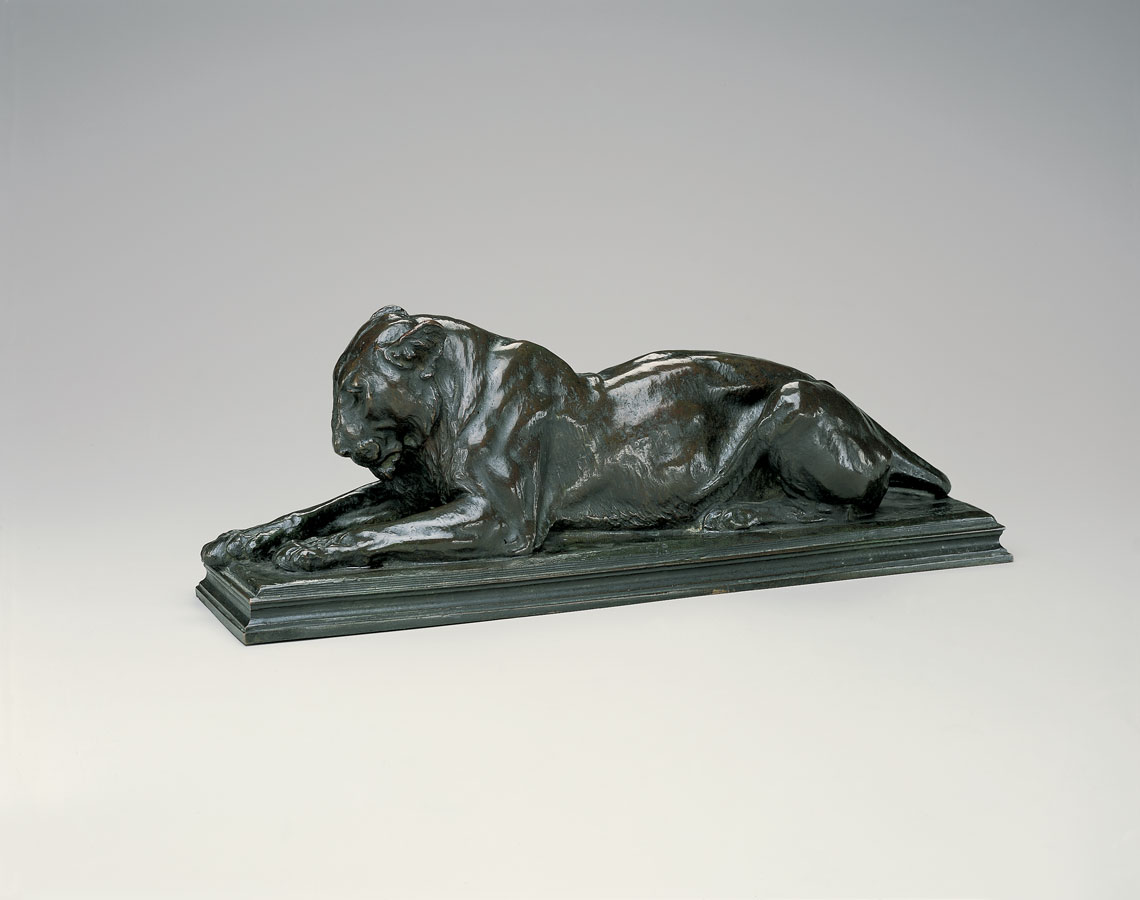
But not everything in this photograph that left the house went entirely off campus. You may notice one piece on the mantle: Recumbent Lioness by Eli Harvey. Booth purchased this sculpture in 1909 from Tiffany & Company in New York. In the 1930s, he gave this lioness to the new Cranbrook Art Museum, where it was assigned the first accession number in the collection: 1909.1. (It’s not actually on campus at the moment: it’s currently on display in Switzerland!)
Recumbent Lioness, Eli Harvey (born 1860, Ogden, Ohio; died 1957, Alhambra, California). Foundry: Pompeian Bronze Works, New York. Bronze; 7.5 x 5 x 21.5 inches. Gift of George Gough Booth and Ellen Scripps Booth, CAM 1909.1. Photograph by R. H. Hensleigh and Tim Thayer. Courtesy of Cranbrook Art Museum.
Using photographs like the one from 1909, as well as diary entries, books, and other records in Cranbrook Archives, I’ve spent the past week re-arranging Cranbrook House’s first floor back to this early aesthetic. On Sunday, the Center is partnering with Cranbrook House & Gardens Auxiliary to present a very special virtual tour: Home for the Holidays at Cranbrook House. I’ll be your host and guide, and will be joined (virtually) by volunteers from the Auxiliary to help share stories from holidays past. I think you’ll really enjoy this tour—there are lots of beautiful things I’ve placed back on display, and we are all very excited to share them with you!
—Kevin Adkisson, Associate Curator, Cranbrook Center for Collections and Research
PS: You’ll need to join our tour Sunday to see if the polar bear rug has made a reappearance!
With the holidays upon us and the observance of annual traditions in high gear it seems fitting to look back at one of Cranbrook’s most storied and festive occasions. Starting in 1950, every year at the beginning of December preparations would begin for the annual Twelfth Night Gala at Cranbrook House. Held on January 6th, the event was originally conceived as a small costume party in the 1920s by Cranbrook Founders’ son, Henry Scripps Booth. It eventually became an official Cranbrook gathering, with Henry at the helm.
The aim of Twelfth Night, as Henry stated, was “to recognize the contribution each employee and board member makes to Cranbrook by bringing them all together as participants in an enjoyable, annual, and ‘classless’ social event.” It was, in essence, a staff holiday party, but its magnificence was a far cry from the typical.
Joseph R. Scott Jr. practicing “piper’s piping” in Cranbrook House basement for the 1966 performance. Harvey Croze, photographer. Courtesy of Cranbrook Archives.
Not sure exactly what Twelfth Night signifies? Perhaps you know the classic carol Twelve Days of Christmas: “On the first day of Christmas, my true love gave to me ….” A medieval English observance, Twelfth Night, as defined by the Oxford English Dictionary, denotes “the twelfth and last day of Christmas festivities”—twelve days after Christmas, or January 6th. The Shakespeare playof the same name is thought to have been created as entertainment for a Twelfth Night celebration.
Inspired by his English heritage and impressed with a performance of the play at the Detroit Opera House when he was twelve years old, Henry Booth created a sixty-year tradition for Cranbrook staff, faculty, and supporters that revived the holiday’s twin themes of celebratory food and pageantry.
In Cranbrook Archives, theTwelfth Night Recordsmeticulously document the planning and execution of the gala as it took place at Cranbrook House, through programs, scripts, invitations, guest lists, receipts, budgets, meeting minutes, photographs and more. These items bring the party alive–and what a party it was!
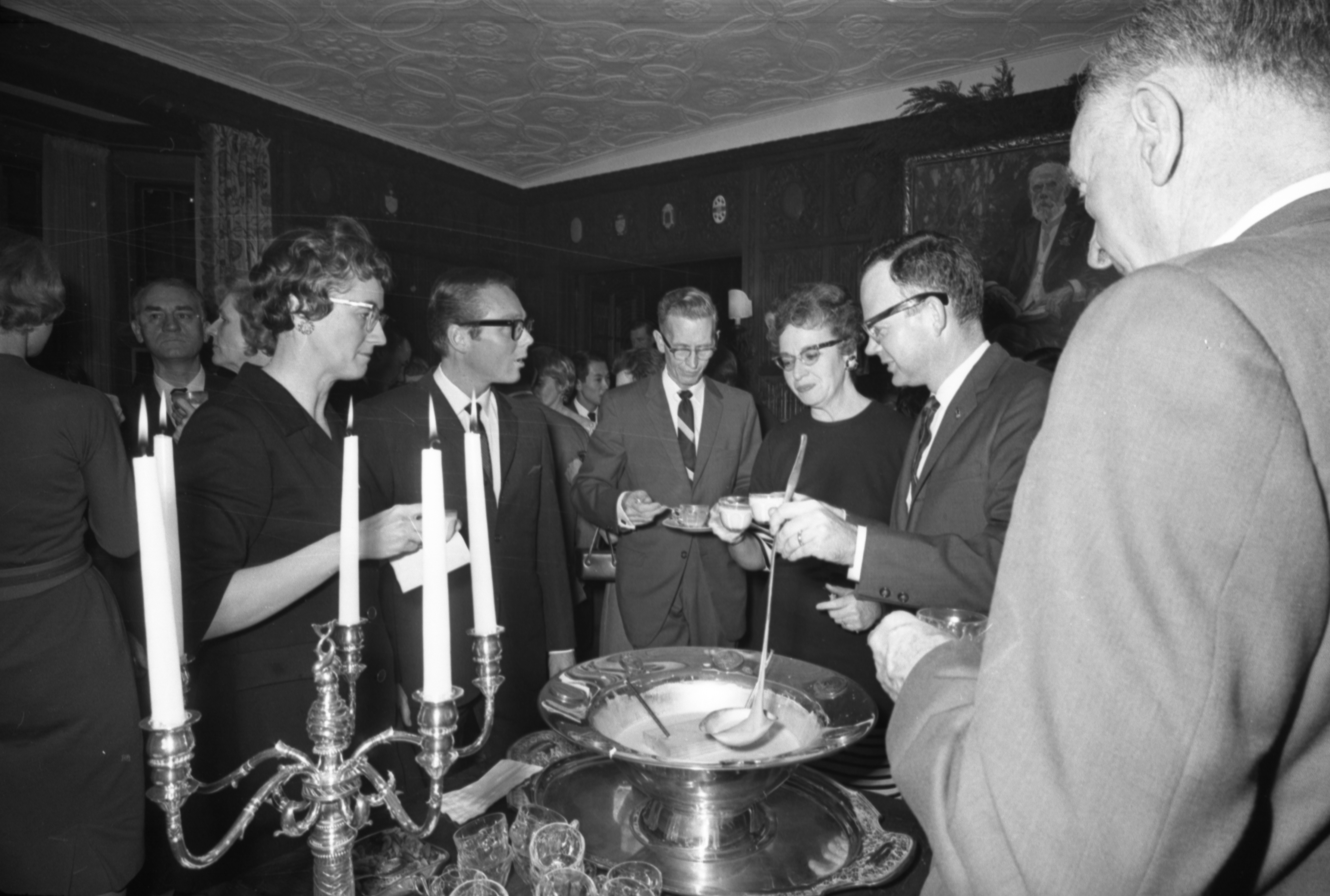
Eggnog in the Oak Room, 1967: (left to right) Helen Hays, Warren Hays, Chet Hard, Anita Hard, and Don Hays. Harvey Croze, photographer. Courtesy of Cranbrook Archives.
Choosing the decade of the 1960s to epitomize the revelry of the long-standing event, I give you the opening lines from the 1960 program, spoken by Cranbrook School Headmaster Harry Hoey:
We’ve all found a welcome in this mellow house Including, we trust, some young shivering mouse The wassail is heady The fellowship’s steady The mummers are ready So gay may this gala be in Cranbrook House On with the tom foolery!
I would like to introduce you to the “guardian angel” of Thornlea, the home of Henry Scripps Booth and Carolyn Farr Booth. She is a flying winged spirit guardian, sometimes called a cradle guardian or spiritchaser, made in Bali, Indonesia.
Spirit guardian in the entrance hall of Thornlea House.
Spirit guardians have been used in Balinese temples and homes to ward off evil spirits for centuries. Typically, they are hung in a high location, looking down towards a door or window.
Thornlea’s “Guardian Angel” flies high above visitors to the home, 2019. Photo by PD Rearick, CAA ‘10
Thornlea’s guardian hangs high above the entrance hall to the house, gazing down on all who enter. The guardian is in the form of Dewi Sri, who, in Balinese mythology, is the goddess of rice, fertility, a successful harvest, and family prosperity and harmony.
Archival records point to Henry Scripps Booth purchasing the guardian in San Francisco, not in Bali, between 1978 and 1988 (Ed. note: per HSB’s grandson Charlie’s recollections in the comments below, the guardian was bought about 1984).
In June 2020, our Associate Curator Kevin Adkisson took visitors on a virtual tour of Thornlea House. Here is a clip featuring Dewi Sri:
Cranbrook Center for Collections and Research’s Facebook Live at Five: Tour Thornlea House, June 17, 2020,
The next time you visit Thornlea, make sure to look up and say “om swastiastu” to Dewi Sri and ask her for prosperity and harmony for your family!
– Leslie S. Mio, Associate Registrar, Cranbrook Center for Collections and Research
With the Thanksgiving holiday almost upon us, it is time to begin planning and preparing one of the essential parts of any celebration: food. It seems timely, then, to highlight Flora Leslie, Brookside’s long-serving dietician and food director. I would like to introduce her to you in her own voice, recalling a memory of some precarious pumpkin pies:
Floral Leslie interview with Mark Coir, Archivist (OH1990.09.28), November 5, 1987. Courtesy of Cranbrook Archives.
Hearing this story in Flora’s voice brings the memory to life in a different way than simply reading it in written form. Cranbrook Archives’ Oral History Collection holds recordings of many voices that add dynamism and richness to their stories. Flora Leslie’s interview describes her life at Cranbrook and her experience of its people and places in the mid-twentieth century.
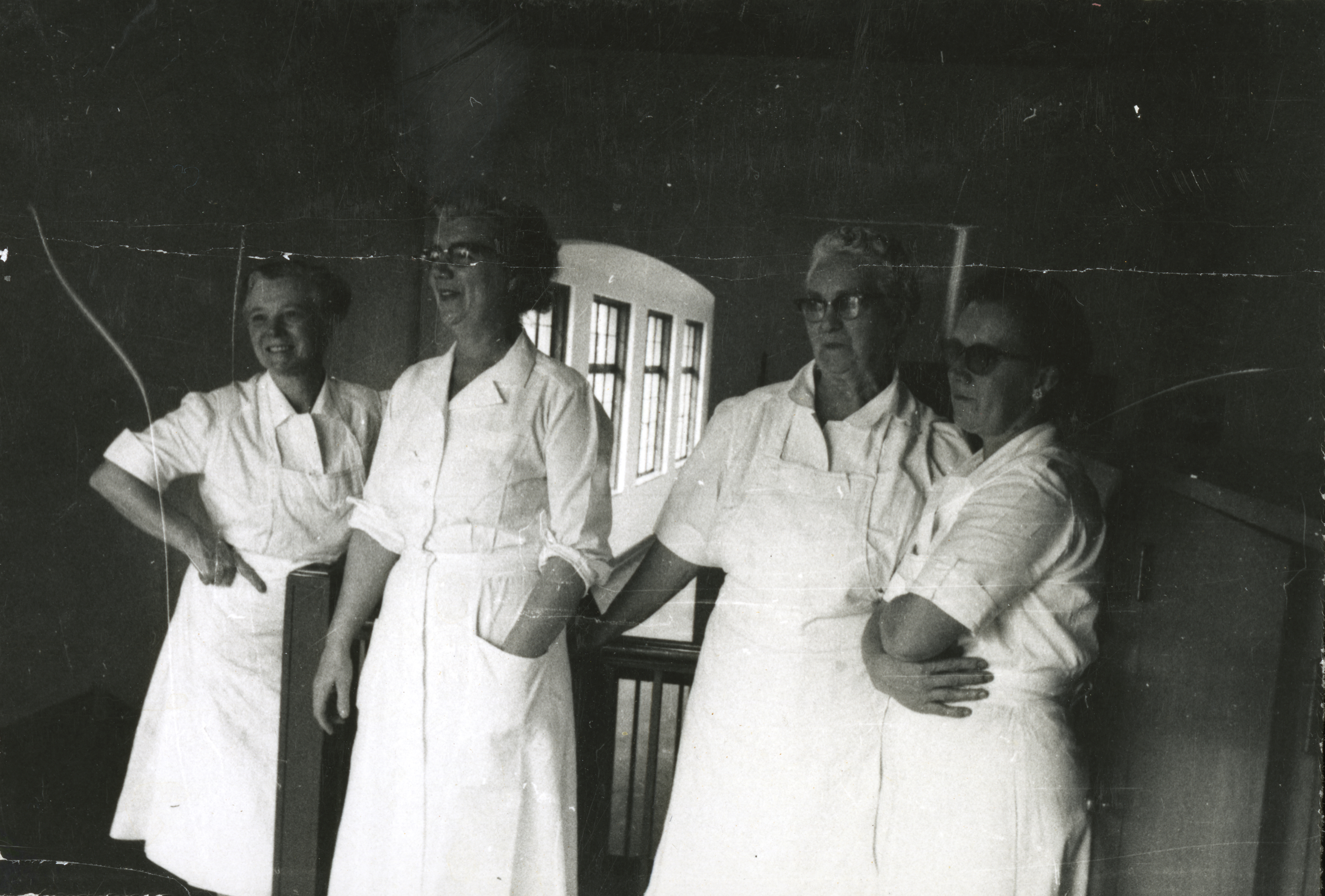
Flora Leslie (second from left) with cooking staff at Brookside School. Courtesy of Cranbrook Archives.
Born Flora MacFarlane in Alexandria, Scotland, in 1906, she made her way to the United States alone in December 1930. Journeying by ship on a very stormy sea, the passengers were required to stay below deck where they got to know each other more than they would have had they been able to wander on deck. Having worked in a photographer’s office in Scotland, Flora initially sought the same occupation in America.
But a fellow passenger Flora met aboard the ship told her that if she had no luck finding work, to contact her for employment. It is thus that Flora began to work for the Ward family in Pontiac, a family whose children were students at Cranbrook.
In 1932, Flora started working at Cranbrook, initially at Kingswood School. Flora married George Leslie in 1934, a landscaper and gardener, and later a superintendent of buildings at Cranbrook.
George Leslie (left) and Flora Leslie (right) in the garden of their apartment, the Ram’s House, at Brookside School, circa 1935. Courtesy of Cranbrook Archives.
After several invitations from Jessie Winter, Headmistress of Brookside School, Flora became the dietician and food director at Brookside School, a position she held from 1934-1975. The position came with an apartment, and though at first Flora preferred to stay at Kingswood, which she describes as “light and bright and lovely,” Winter asked Flora and George back to Brookside one further time and had arranged the apartment beautifully. Most importantly, there was a brand-new Frigidaire refrigerator, a novelty in those days. As Flora recalled, seeing this small luxury she told the headmistress, “We’ll come!” The apartment was in the part of Brookside known as the ‘Ram’s House’ and had previously been occupied by Jessie Winter and by J. Robert F. Swanson.
View of the front of George and Flora Leslie’s apartment, known as the Ram’s House, circa 1935-1938. Courtesy of Cranbrook Archives.
During the war years, when food was in short supply, George and Flora Leslie kept Brookside stocked with vegetables—he grew them and she canned them.
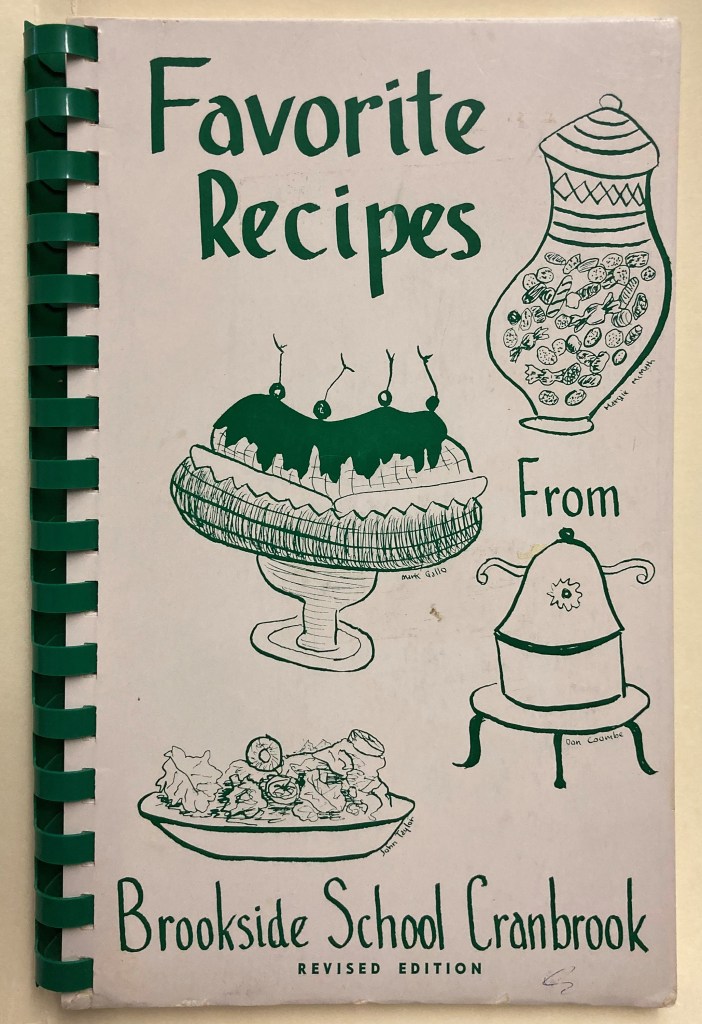
The Favorite Recipes cookbook from Brookside School, 1970.
View of original recipes from Flora Leslie in the Favorite Recipes cookbook from Brookside School, 1970.
View of dessert page from the Favorite Recipes cookbook from Brookside School, 1970.
Favorite Recipes, the Brookside cookbook, 1970. Courtesy of Cranbrook Archives.
After feeding generations of students, Flora published many of her favorite and original recipes in the Brookside cookbook, Favorite Recipes, which are still enjoyed by alumni far and wide. Perhaps you might like to try one of Flora’s original recipes this Thanksgiving, or a dessert recipe from one of the faculty families?
—Laura MacNewman, Associate Archivist, Cranbrook Center for Collections and Research

















 Cranbrook Kitchen Sink