Late in the spring, I was a part of the Eastern Michigan University Historic Preservation Field School hosted at Cranbrook (read about the amazing weekhere). That week I discovered what a magical place Cranbrook is, and was inspired to ask Cranbrook Center for Collections and Research Associate Registrar, Leslie Mio, about doing my graduate final project here. The Center agreed to have me, so after three years of working hard on my Masters, I’m finishing up here at Cranbrook. I have worked closely with Leslie two days a week since August, mainly focusing on the Smith House and “other duties as assigned.”
The Smith House is a beautiful Usonian Frank Lloyd Wright house (1950) that was owned by Melvyn Smith and his wife Sara. Cranbrook acquired the house by donation in 2017. The main project I have been working on is numbering objects and updating The Museum System (TMS, Cranbrook’s digital database of objects) as we go along. This has been a monumental job: not only did Cranbrook acquire the house in 2017, but also everything that was in it – over 1,800 objects!
Numbering a jar in Smith House. Photo by author.
Numbering objects isn’t for everyone, it is a slow and repetitive task. But, it gives me a chance to look over the object, confirm that the location is recorded correctly in TMS, make any additional notes about its appearance, and even appreciate the object itself.
Here I am working in the kitchen of Smith House. Photo by author.
My final report for my degree won’t just be about numbering, but about collection management. This is considered the development, storage, preservation, and organization of collections and cultural heritage. I am consulting resources likeMRM5: Museum Registration Methodsby Rebecca Buck, andThings Great and Small by John E. Simmons, and applying information gleaned to what Leslie and I are doing in Smith House.
Other duties I have had since August: helping prepare a disaster kitfor Smith House, so objects and people remain safe in the event of a disaster (especially since it’s off the main campus); meeting with conservators who are helping to restore furniture in the house; helping prepare for the Center’s fundraiser “A House Party at Cranbrook”; rolling textiles for better storage; and helping move and process new donations.
I say, “other duties as assigned” because one thing I’ve learned in my semester at Cranbrook: the work of a registrar is never boring. We may have our main plan mapped out, but sometimes you must go with the flow.
– Kate Nummer, Eastern Michigan University Historic Preservation Program 2019
In October, the University of Michigan Osher Lifelong Learning group visited Cranbrook for a lecture, luncheon, and tours of our historic houses, the Art Museum, and Cranbrook Archives. In gathering materials related to the university, I found that my growing archival display began to tell a wonderful story of the early relationship between the Booth family and the University of Michigan, predominantly between 1918 and 1924. The story begins with the friendship of George Booth and Emil Lorch.
Born in Detroit in 1870, Lorch had studied at MIT and Paris, before graduating Master of Arts at Harvard in 1903. In 1906, he arrived at the University of Michigan to establish the School of Architecture, which remained a unit of the School of Engineering until 1931. The correspondence between Booth and Lorch covers a manifold of topics over many years.
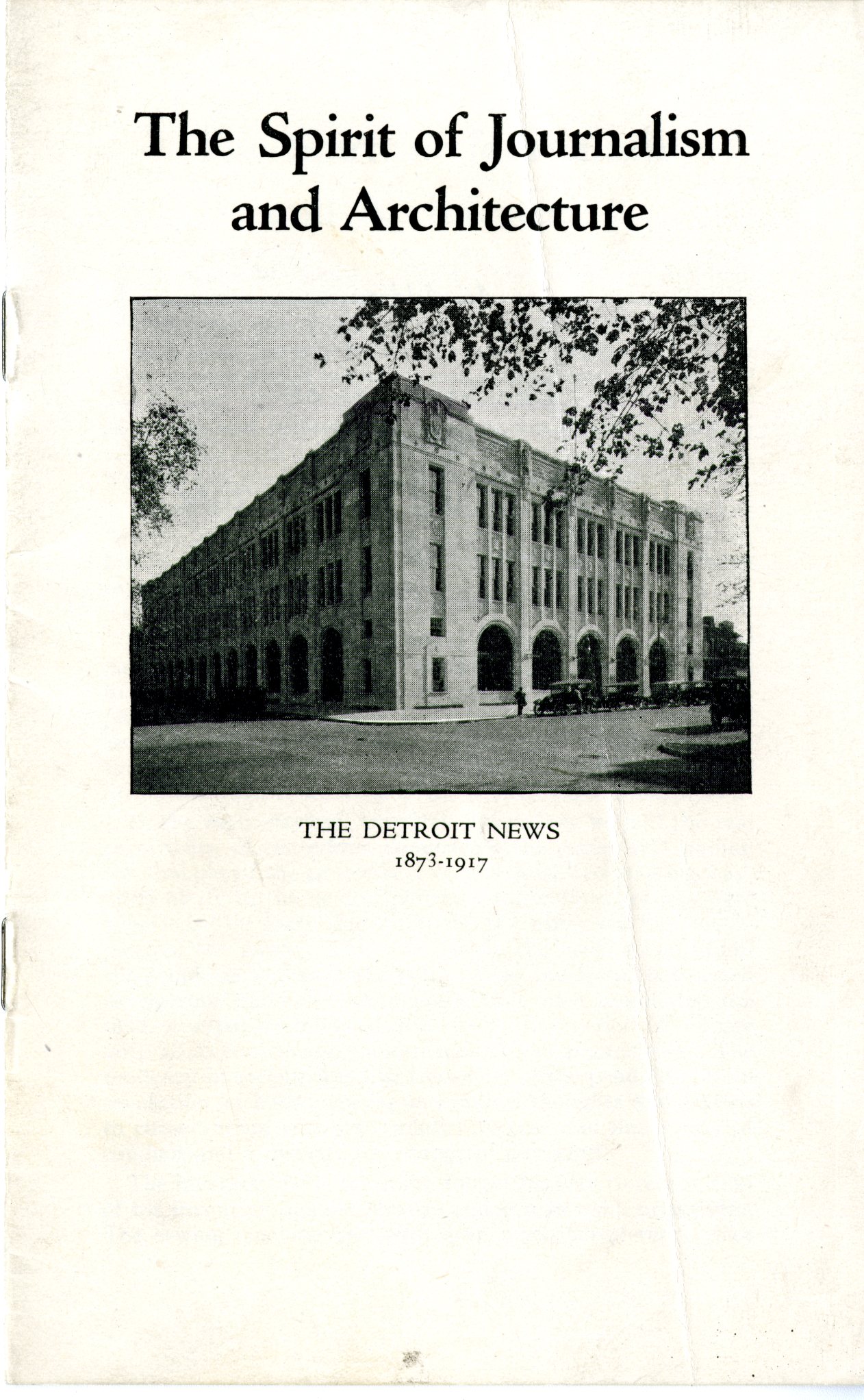
On January 11, 1918, George Booth gave an address to the students of the departments of Journalism and Architecture at the university, entitled The Spirit of Journalism and Architecture which focused on the development of the Detroit News business and the new News building, which had been recently completed.
Program for an address, The Spirit of Journalism and Architecture, delivered by George Booth at the University of Michigan, January 11, 1918. Copyright Cranbrook Archives.
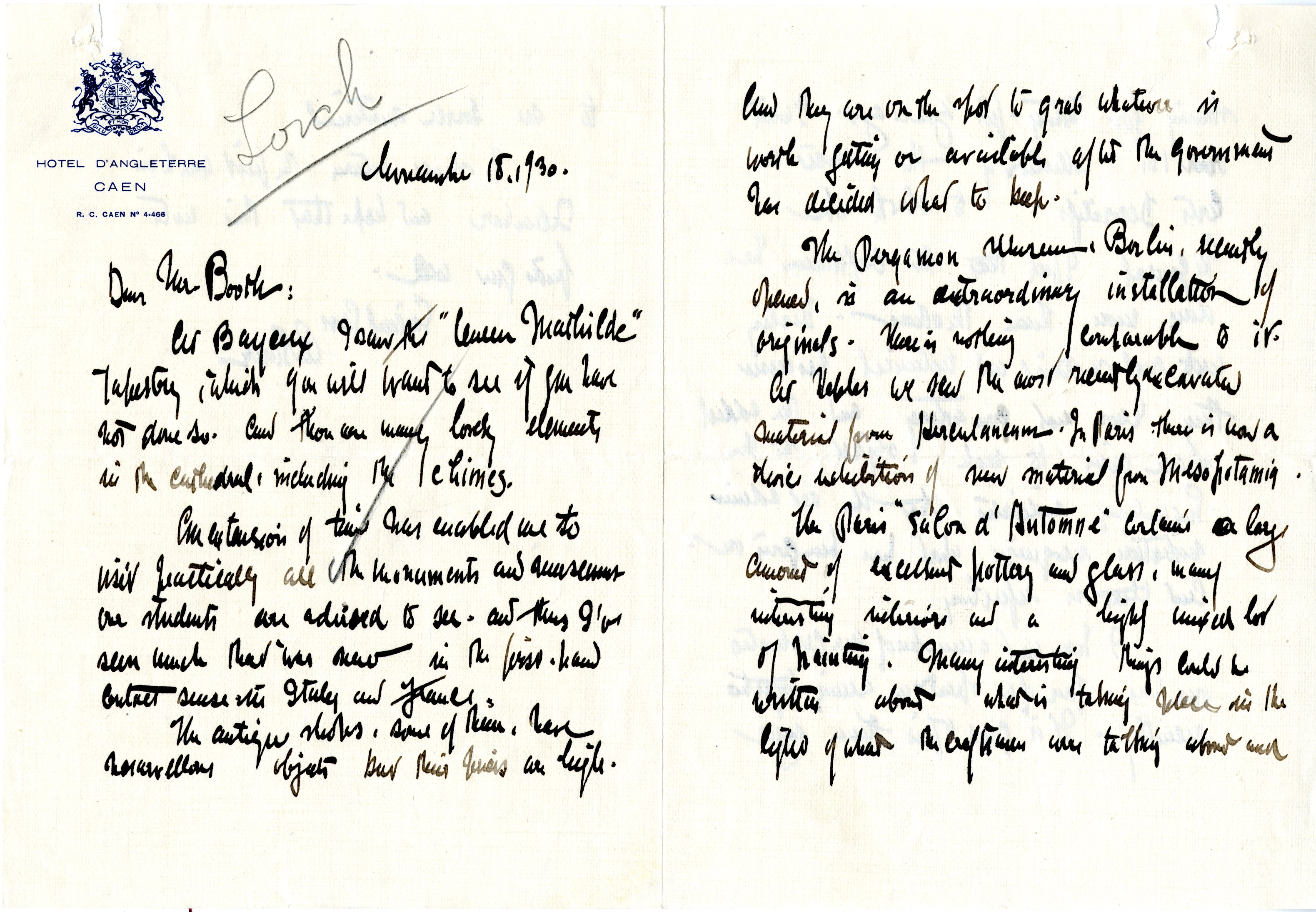
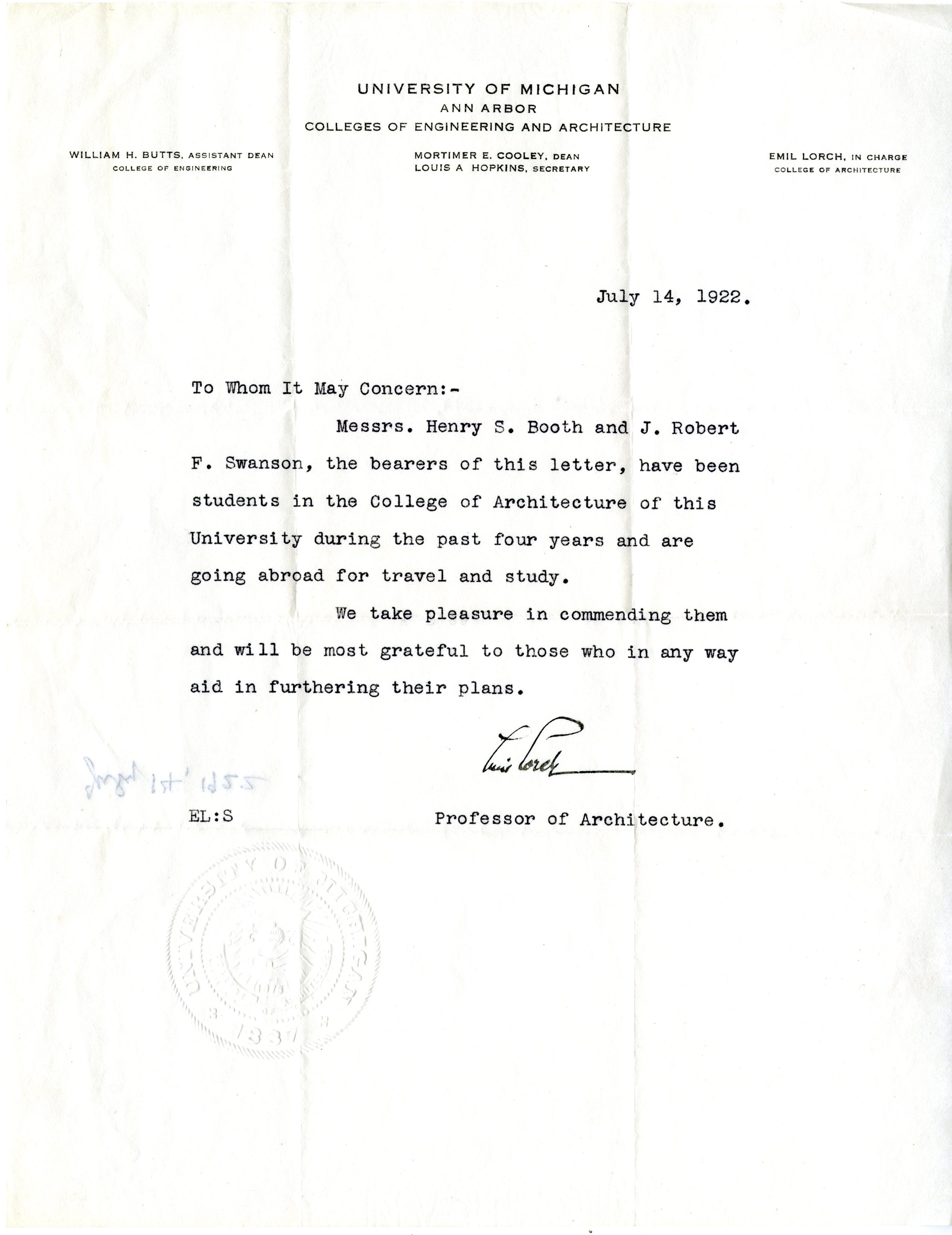
Later that year, in October, George’s son, Henry Scripps Booth began his studies in architecture at the university. It was there that he met J. Robert F. Swanson, with whom he traveled Europe for ten months beginning in June 1922, and later established the architectural practice Swanson and Booth between 1924 and 1926. Henry took with him letters of endorsement to help facilitate access to architectural treasures on their journey, including one from Professor Lorch:
Letter of introduction for Henry Booth from Emil Lorch, July 17, 1922. Courtesy Cranbrook Archives.
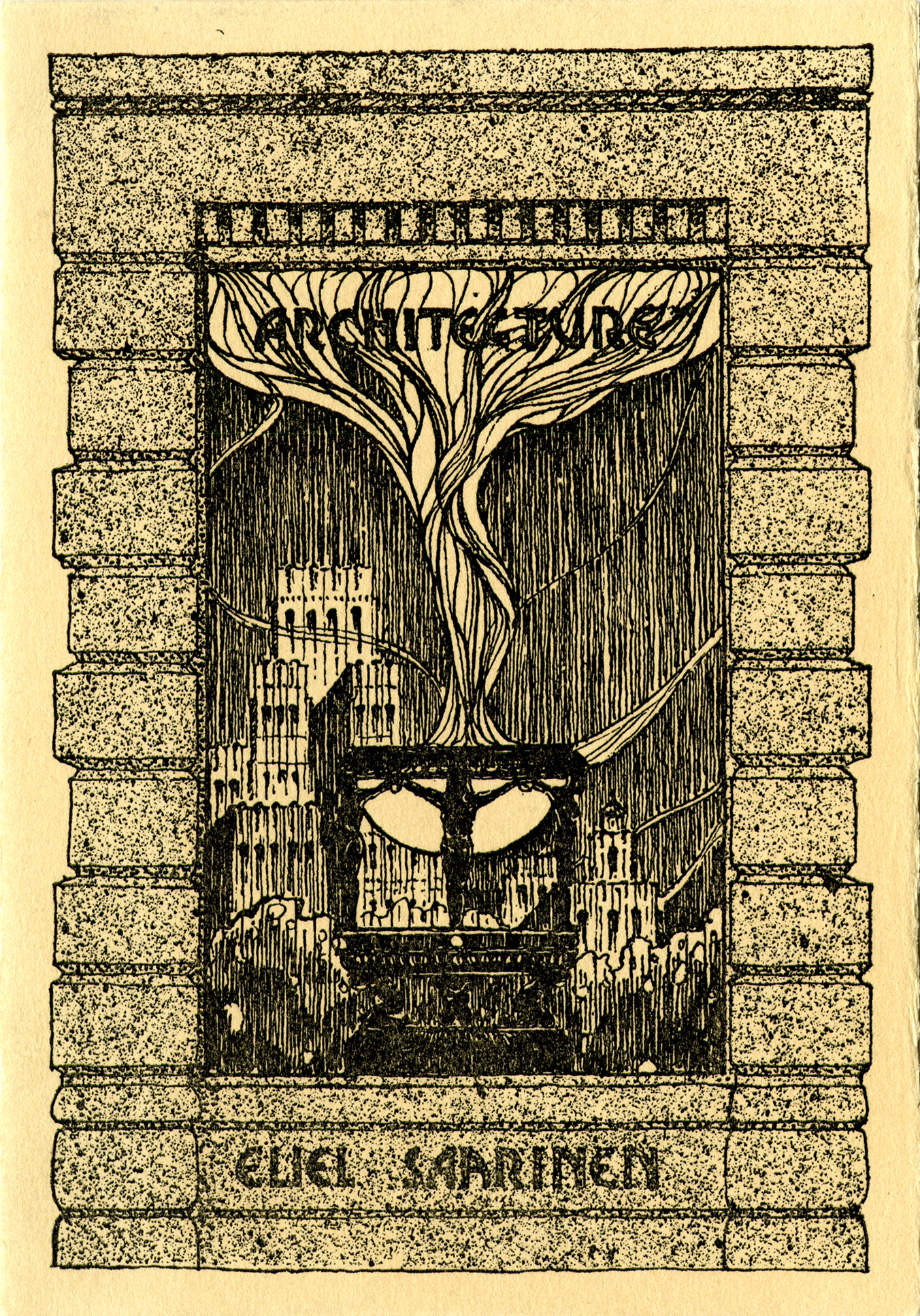
Eliel Saarinen arrived at the University of Michigan as a Visiting Professor at the invitation of Emil Lorch the next year, staying from September 1923 through 1925. To extend a warm welcome, Henry wrote, costumed, and performed in a pageant in honor of Saarinen. Many of Henry’s classmates performed in the pageant, including Ralph Calder and J. Robert F. Swanson, who also designed the program. The event took place on December 8, 1923, in the Michigan Union ballroom. Many of the members of the Michigan Society of Architects and the Michigan branch of the American Institute of Architects were present. During the dinner, George G. Booth made the principal address of welcome to Eliel.
Program for A Pageant of Arts and Crafts, a Reception for Eliel Saarinen, program design by J. Robert F. Swanson, December 1923. Courtesy Cranbrook Archives.
Interior of the program. Courtesy Cranbrook Archives.
Henry and Robert graduated from the University of Michigan in 1924. Graduating with them was Ralph Calder, who was also one of the first two students to win the George G. Booth Traveling Fellowship, with which he traveled to England, France, and Italy. The fellowship continues to this day. Calder was among the original staff of the Cranbrook Architectural Office, working on Cranbrook School and Thornlea House. He later went on to design many buildings for colleges and universities in Michigan, including Michigan State University, Western Michigan University, Wayne State University, Hope College, and Hillsdale College.
Letter concerning the Booth Traveling Fellowship from the first recipient Ralph Calder to George G. Booth, June 12, 1924. Notice the Michigan logo on the letterhead. Courtesy Cranbrook Archives.
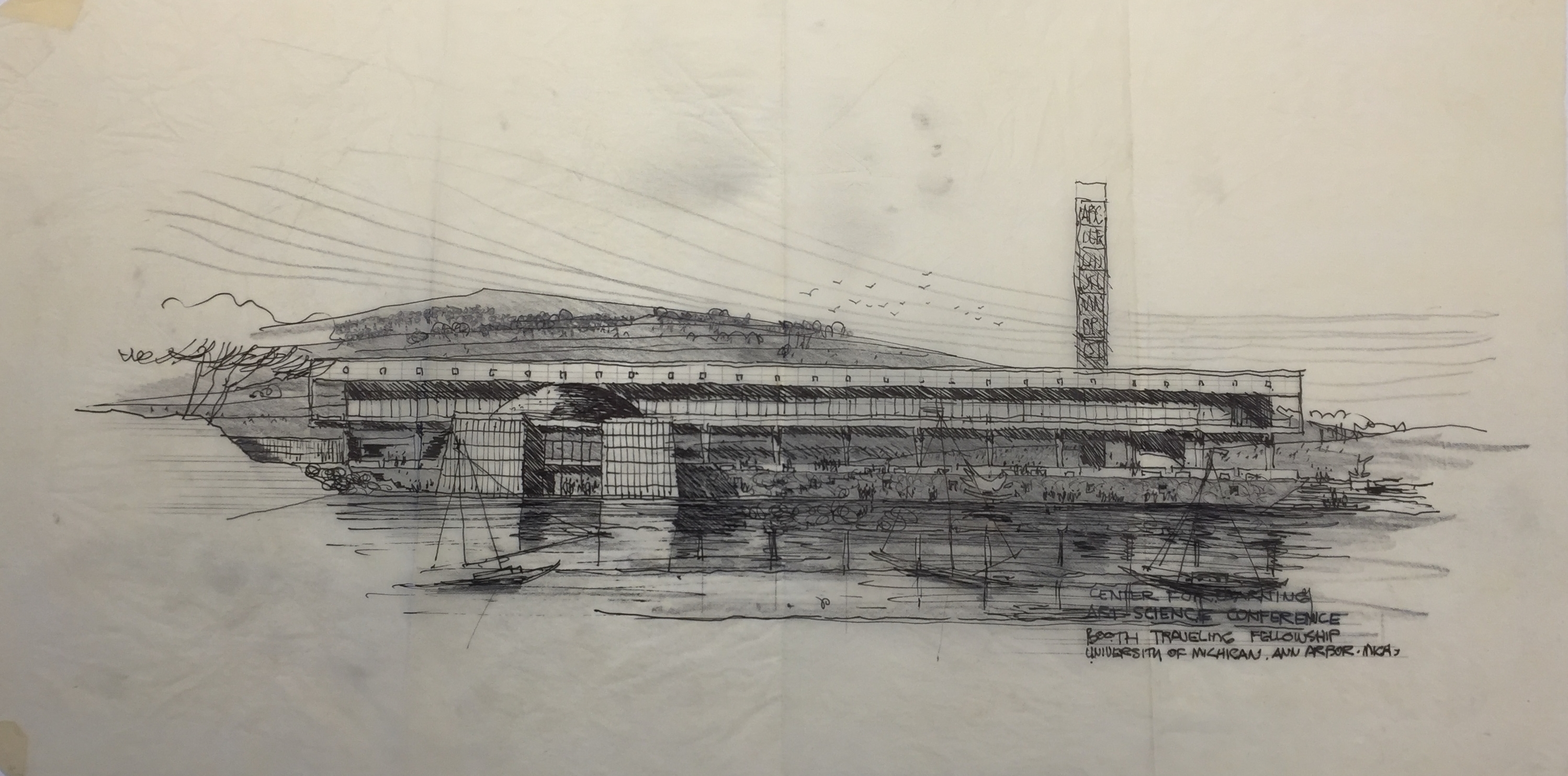
In another Cranbrook connection, Ralph Rapson submitted a Fellowship entry in 1938, and, while he didn’t win, his submission impressed Eliel Saarinen so much that Rapson was given a scholarship to the Art Academy.
Ralph Rapson’s submission to the George G. Booth Traveling Fellowship, AD.26.01.03. Ralph Rapson Architectural Drawing Collection, Cranbrook Archives. Gift of Rip Rapson.
There is much more in our collections about the University of Michigan; this post has selected items covering only the early years. In preparing for the Osher tour, I realized that, while the contents of processed archival collections remain the same, what we find in them depends on the question being asked. The collections of George G. Booth, Henry S. Booth, the Cranbrook Foundation, Swanson Associates, Inc. are among the most highly used and yet there is always something new to learn, something wonderful to discover.
This week, we’re proud to announce that the Center is launching its first online exhibition! With the tireless efforts of the Center’s Administrative Assistant and resident website guru, Alissa Seelmann-Rutkofske, we have adapted my 2018 exhibition Saarinen House: Presidents/Residents, 1946-1994 for the web.
Installation view of Saarinen House: Presidents/Residents, 1946-1994. You can learn much more about the content of the show in the new online exhibition, or learn about the display system here. July 2018, Meng Li, photographer.
The show, which was on display in Saarinen House from April to November 2018, focuses on the first five Presidents of Cranbrook Academy of Art. These were the only five leaders to live in Saarinen House (built to be the President’s residence) and the only five who held the title “President” (we now have Directorsof the Academy and a Presidentof Cranbrook Educational Community).
In the online exhibition, you will learn about President Eliel Saarinen and the four subsequent presidents: Zoltan Sepeshy, Glen Paulsen, Wallace Mitchell, and Roy Slade. Each man’s page features a short biography, history of their artistic practice, and an account of the Academy under their leadership. Their tenure is documented through photographs from Cranbrook Archives, showing the presidents and their era of the Academy (including publications, Museum exhibitions, protests, parties, and other examples of student life and strife).
You’ll also find an Exhibition Checklistof the paintings and drawings from each president that were included in the show; click on the title of each work to see a larger image. Also online are photographs of the Exhibition Installation and information about the design and construction of our custom-made displays.
Exhibitions are a lot of research and work, and once they’re deinstalled it can feel like all the effort was for naught. Using the show’s text and images, documentary photography from P.D. Rearick, and with the encouragement of the Center’s Director, Greg Wittkopp, I am happy that Presidents/Residents and the efforts that went into its physical production will live on in digital form. Please go take a click around, and let me know what you think.
“My work here is done!” The curator in a moment of repose during the installation of Presidents/Residents. Seen sitting in a Platner chair that belonged to Roy Slade, and is currently back in use at the Academy administration offices, but was used in Saarinen House from 1977 to around 1990 and again during the exhibition. April 2018, Ashley Bigham, photographer.
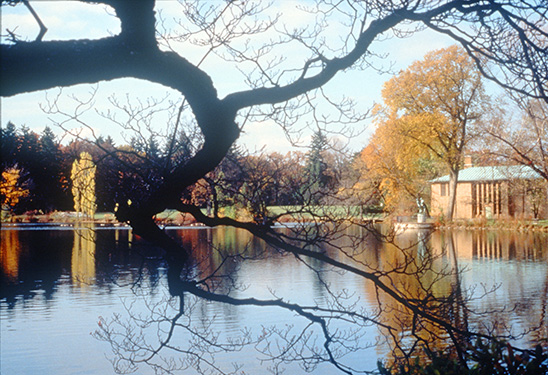
Have you noticed? Cranbrook campus is awash in color!
Kingswood School, 1980. Balthazar Korab, photographer. View of the rear of Kingswood Campus from across Kingswood Lake. Sculpture “Dancing Girls” by Carl Milles in distance. Copyright Balthazar Korab/Cranbrook Archives. S.08.263
The drive in every morning, a walk outside, or a quick glance out the window, and it’s hard to miss.
Cranbrook Academy of Art: Maija Grotell Court, circa 1944. Color transparency. Copyright Cranbrook Archives. 2007-1-C70
But like every year, just as the foliage begins turning brilliant reds, yellows, and oranges, it is soon falling to the ground. Squirrels scurry past, busy adding to their winter store. The Triton Pools are emptied. A trash can marked “Salt” mysteriously appears along the walk by the Academy Studios. The air is crisp; the days shorter. Fall is undeniably here. And Winter – just around the corner.
Oriental Garden Bridge, Fall 1980. Balthazar Korab, photographer. View of the red bridge over the pond in the Japanese Garden. Copyright Balthazar Korab/Cranbrook Archives. S.04.83
While musing on this rite of seasonal change, I happened to come across an article written in the Cranbrook Institute of ScienceNews Letter [sic], November 1949 (Vol. 19, No. 3), apropos to my current mood. It was titled: “The Hibernation of Plants,” by Stanley A. Cain. It begins:
“Had you been a wealthy Roman you would have owned what you called an hibernaculum, or winter residence, somewhere on the sunny warmer shores of the Mediterranean … but the theme of these few pages is the hibernation of plants … plants do not migrate with the changing seasons, induced by shortening days and the onset of cold or drought, but are mostly rooted to the earth and must stand and take it.”
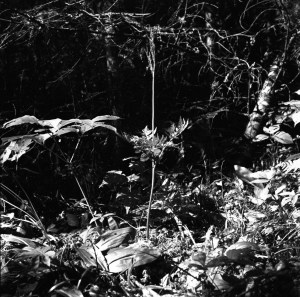
Botrychium virginianum (Rattlesnake Fern), Burt Lake, MI, August 15, 1945. Robert T. Hatt, photographer. Copyright Cranbrook Archives. CIS B3980
Most of us Michiganders must stand and take it, as well. But, as humans, we weather the colder temperatures by finding comfort in a warm fire, a snug scarf, or a hot mug of our favorite beverage. Plants – well, plants have other coping mechanisms.
In his article, Cain elaborates on the structural and functional changes plants undergo in “preparing for the difficult times ahead.” Central to the scientific discussion, Cain includes the importance of buds, seeds, and root structures for deciduous perennials.
Flora and Fauna. Undated. Copyright Cranbrook Archives. CIS B2483
Stanley Cain was a botanist on staff at Cranbrook Institute of Science (CIS) from 1946-1950, who became well-known as a conservationist. In fact, he was awarded the CIS Mary Soper Pope Award in 1969 for distinguished accomplishment in plant science.
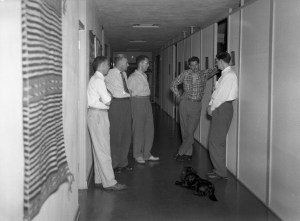
Thomson, Cain, Katz, Messner, & Thompson (l to r), June 21, 1949. Luella Schroeder, photographer. Copyright Cranbrook Archives. CIS B3648
His article on plant hibernation is typical of CIS newsletters from 1931-1968, which included feature articles illuminating research conducted by its scientific staff. CIS had an ambitious program of research and publication since its inception, and botany was long a main focus. According to the first annual report, the Division of Botany was one of eight original scientific divisions. In 1949, over 30 staff publications are listed in the annual report, a quarter of those on vegetation. The News Letter [sic] was published for Institute members, and summarized developments and events on a monthly basis, September through May, from 1931 to the mid-1980s. In 1993 it became Science Scope and continues to be published under that name on a quarterly basis today.
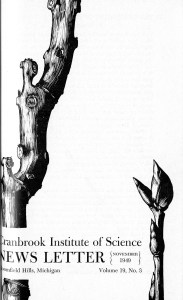
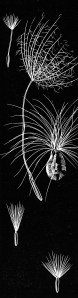
While the article itself is intriguing and particularly interesting to botany enthusiasts, it is the accompanying drawings that captivate me.
Cover botanical drawing [ink on paper] by James Carmel, 1949. Copyright Cranbrook Archives.
Reminiscent of the recent popularity of vintage botanical specimen school charts or nature illustrations, like those of Julia Rothman, these drawings point to the function of illustration in the research process. Here, before me, was a classic example of ‘art meeting science’. A topic (drawing as an analytic tool), in fact, addressed in the 2013/2014 Cranbrook Art Museum exhibit, which included Stanley Cain’s own drawings.
But these drawings were not Cain’s! Cain often used Academy of Art students for illustrators, as indicated by another 1949 article, “Plants and Vegetation as Exhaustible Resources,” which feature drawings by Matt Kahn. In the case of the hibernation article, however, the illustrations are attributed to Jim Carmel, Cranbrook Institute of Science Preparator, circa 1944-1973 (prior to WWII he had been Assistant Preparator). Better known for his work with the Institute’s exhibits, Carmel was educated as an artist and designer. In the 1949 annual report he is listed as Artist and Preparator under the division of Arts of Exhibition and Illustration.
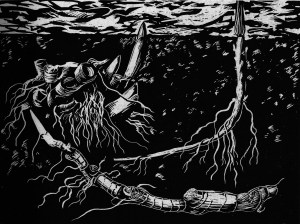
Carmel’s papers were graciously donated by his son in 2016, but unfortunately do not cover his years at Cranbrook. CIS Office of the Director Records only include Carmel’s exhibit design work. The newsletter remains the only known record of these early drawings, striking as they are, in their black & white simplicity.
Drawing [scratchboard] of seed pods by James Carmel, 1949. Copyright Cranbrook Archives.
Drawing [scratchboard] of plant tubers and root structures by James Carmel, 1949. Copyright Cranbrook Archives.
Exploring the natural world around us in both a scholarly and creative fashion is the very essence of Cranbrook. The next time you’re on campus, instead of thinking, “oh, there’s a pretty tree!”, consider the myriad ways in which Cranbrook’s flora has inspired scientific study and artistic endeavor. This may just spark your enthusiasm for learning more about nature, and deepen your appreciation of our landscape in all its Fall glory as it prepares to hibernate for the Winter.
We typically write blogs about what projects we are working on – a research question, an exciting piece of furniture – but I wanted to let you in on something a little more pedestrian:
One of the regular projects I work on is numbering and labeling the Cultural Properties. Each object gets a unique number to identify and differentiate it from other cultural properties.
Me at work, numbering silverware. Photo by Desai Wang, CKU ’19
The numbering system is done in two different ways here at Cranbrook. All collections have a prefix set of letters that lets us know what collection it is in. For example, there is a Brookside School Collection with the prefix “BS,” as well as collections for each of the three historic houses we oversee. Next, there is either a number to match an inventory of the collection or the year the object was created or acquired.
The Brookside Lobby Fixture designed by Henry Scripps Booth and created by Leonard Electric is numbered BS 1929.1. It was created in 1929 for use in the school. I haven’t been able to put the number on it yet! Photo by Daniel Smith, CAA ’21
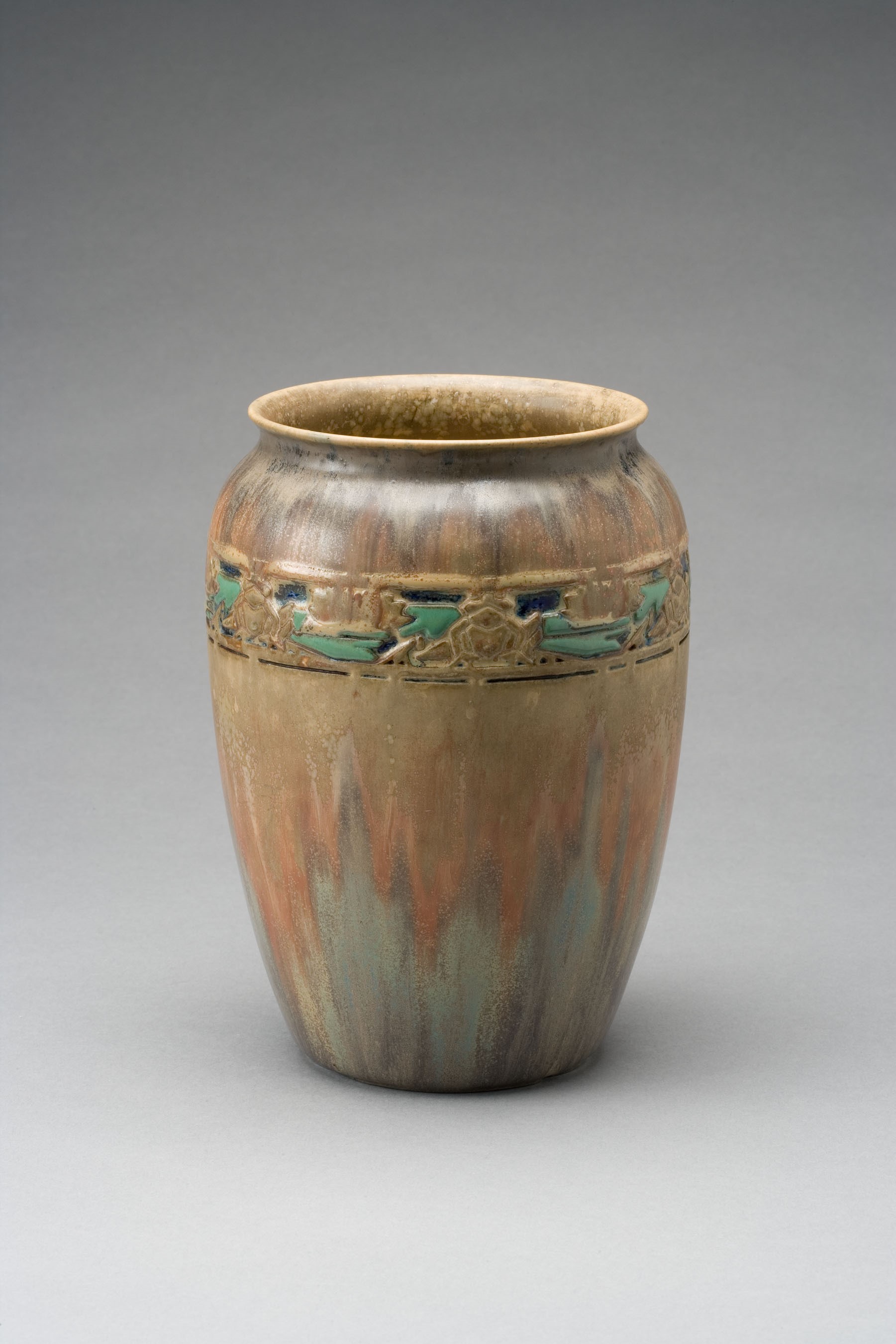
The Frog and Lily Pad Vase by Adelaide Alsop Robineau in the Founders Collection is numbered “CEC 16.” It was the 16th item cataloged in a 1975 inventory of the house. Photo by R. H. Hensleigh
Once we have numbers assigned to the object, we need to physically apply them to the object. Putting a number directly on an object is the most secure way. There are a number of techniques used to apply labels to the objects.
We currently use a method of spreading on a thin layer of special clear adhesive (B-72) to the object, putting down a number written or printed on acid-free paper, and then covering that paper with another coat of the clear adhesive. Printing the numbers on a printer allows you to control the size of the numbers (typically 7-point font) and also ensures they are legible.
A number applied to an object. This is from the Smith House collection, which the CEC acquired in 2017.
B-72, one of the tools of the trade.
There are all sorts of exceptions to the above rule: You can’t number plastics this way – the solvent in the B-72 would melt the plastic. To number them, we tie on a tag made of Tyvek using Teflon tape (also known as plumber’s tape).
Cotton twill “tape” used to number textiles.
And what about textiles? For that, we write the number on cotton twill “tape” with archival ink and sew the tags onto the objects.
Chapter 5E of Museum Registration Methods– what is referred to as the “Registrar’s Bible” — is all about marking objects, best practices, and recommended materials. When in doubt, I start there.
A recent reference request took me into the collection of the architect and interior designerBenjamin Baldwin. While the bulk of his collection contains the drafts and revisions of his autobiography, An Autobiography in Design, his collection holds an abundance of historical treasures in the form of letters, drawings, and photographs. Finishing his autobiography shortly before his death in 1993, Baldwin dedicated it to, “many who have touched my life with the magic of friendship and love.”
Such magic is timeless and ineffable; yet, a glimpse of it is captured in the trove of letters written by his friends, his fellow Cranbrook Academy of Art alumni. Baldwin won a scholarship to attend the Academy while at Princeton, where he had graduated with a bachelor’s degree in Architecture in 1935, and MFA in Architecture in 1938 following a year studying painting with Hans Hoffman.
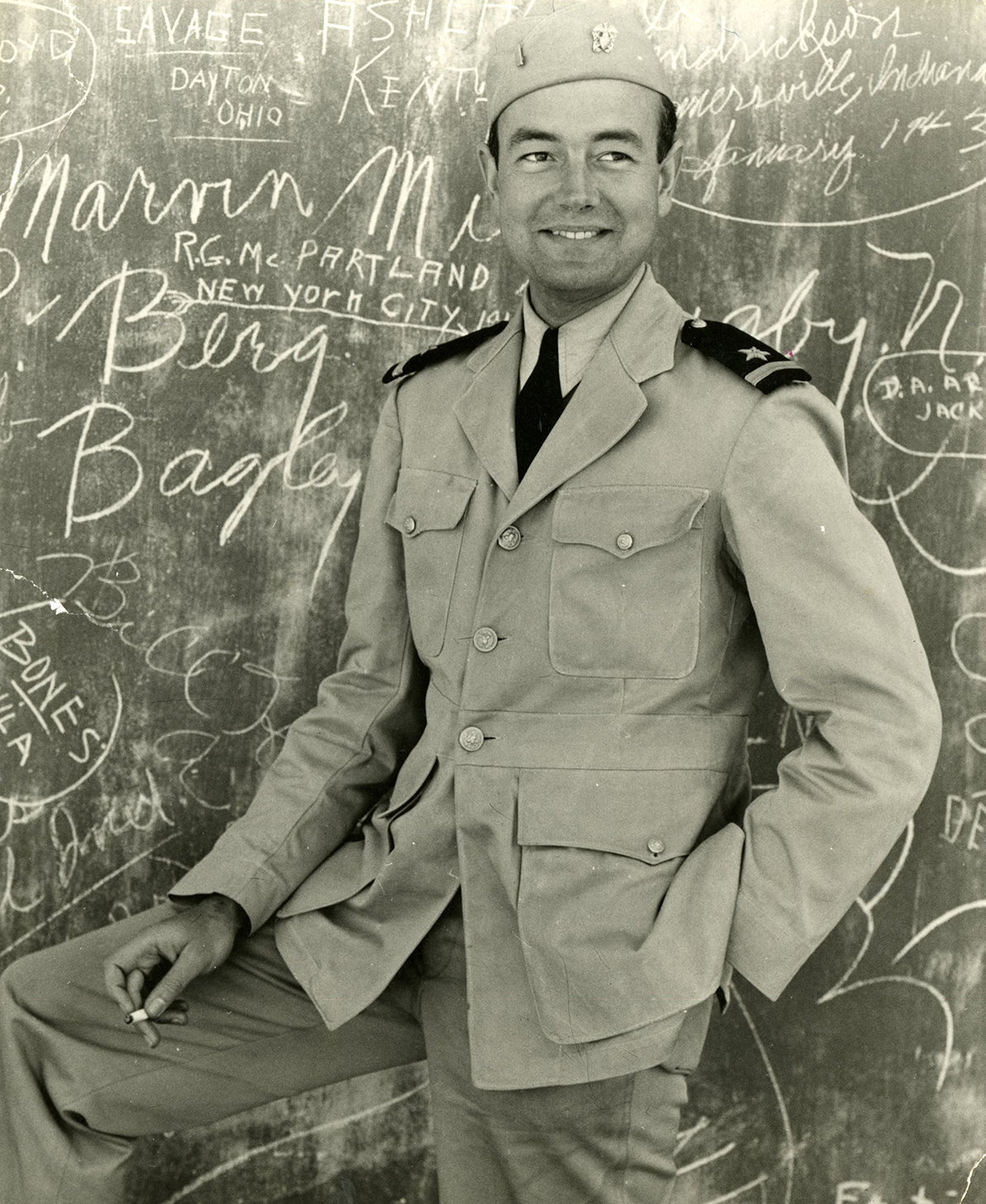
Benjamin Baldwin as a Navy ensign in Morocco in 1942. Courtesy Cranbrook Archives.
Baldwin arrived at Cranbrook in 1938, the same year as Ralph Rapsonand Charles Eames, and he formed a lifelong friendship with Harry Weese, who married Baldwin’s sister Kitty. The collection includes many letters to Harry Weese from Baldwin and others, notably Ralph Rapson, who signs himself “Le Rapson,” Wally Mitchell, Marianne Strengell, Eero Saarinen, Aline Saarinen, andLily Swann Saarinen.
Page of a letter from Ralph Rapson to Harry Weese, written despite Rapson being “not in a writing mode,” April 9, 1939. Perhaps unexpectedly, Baldwin’s collection has many letters connected to Weese but not Baldwin, likely because the collection was donated by Baldwin’s niece/Weese’s daughter, Shirley Weese Young. Courtesy Cranbrook Archives.
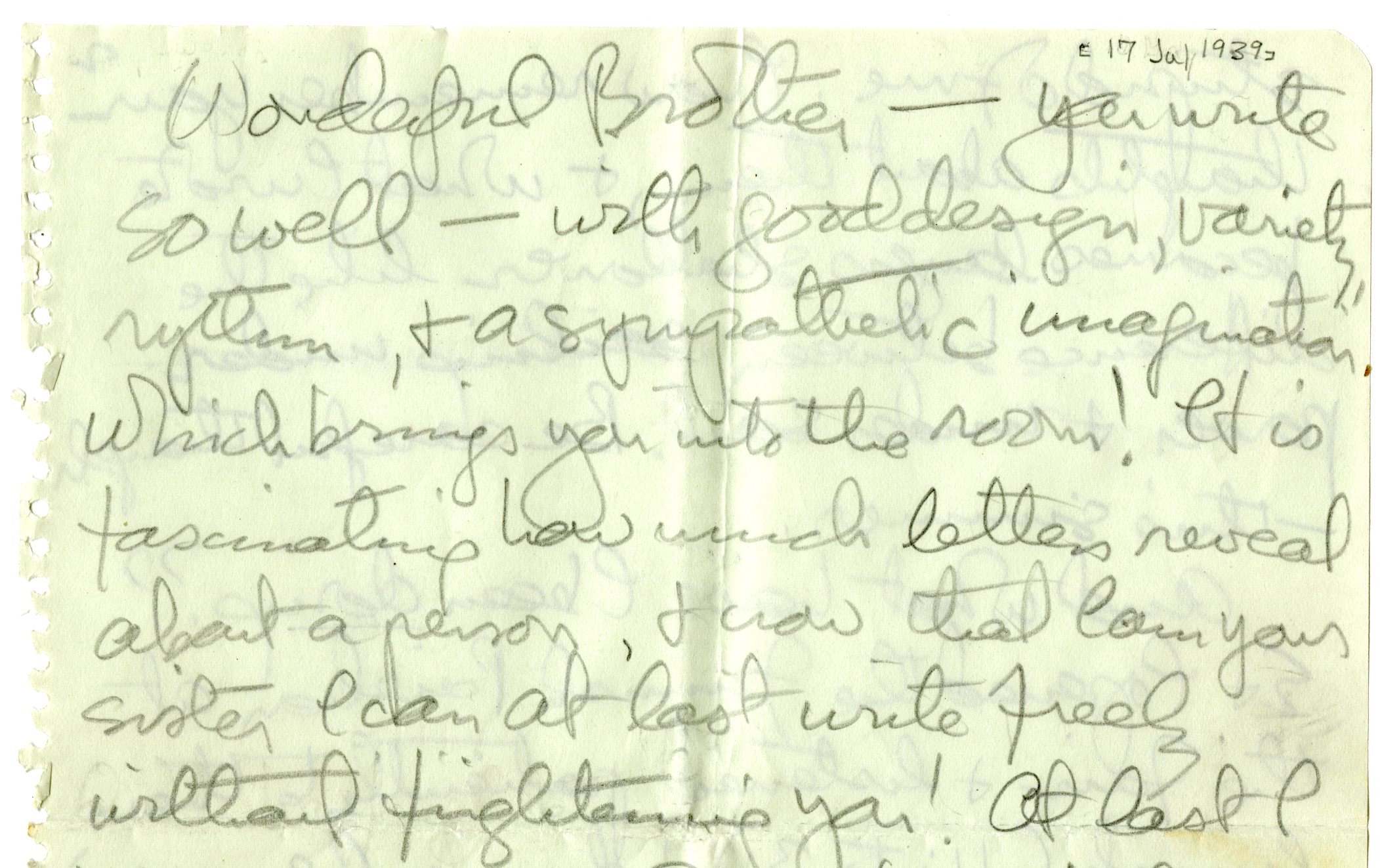
Section of letter from Lily Swann Saarinen to Harry Weese discussing the importance of letters and friendship, July 17, 1939. Courtesy Cranbrook Archives.
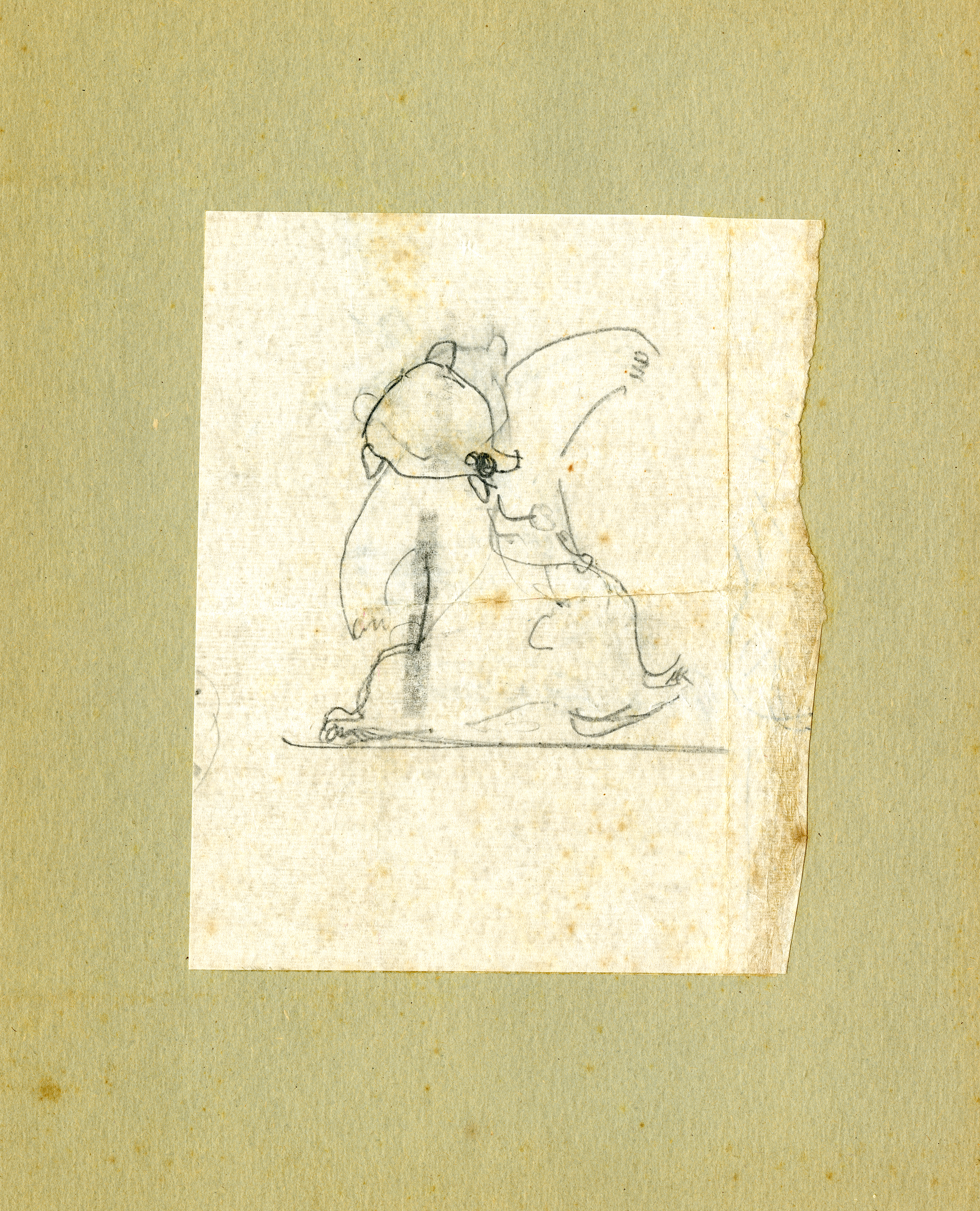
Drawing of an animal by Lily Swann Saarinen from the Baldwin collection, no date. Courtesy Cranbrook Archives.
The handwriting and the composition of these letters open a window into their world, their ideas and projects, and their hopes and concerns for each other. Certainly, this correspondence provides richer detail, and perhaps the inside view, to information found in other collections, like Rapson’s early projects in Chicago and his design for Longshadows (the Hoey summer house). It also documents events that I have previously only seen in secondary sources, such as Wally Mitchell’s car accident over the Christmas of 1942, which is poignantly described by Marianne Strengell. It is also quite striking that the gift of art is not a “thing set apart” but pervades their everyday life.
Postcard from Harry Weese to Ralph Rapson, c. 1942. Courtesy Cranbrook Archives.
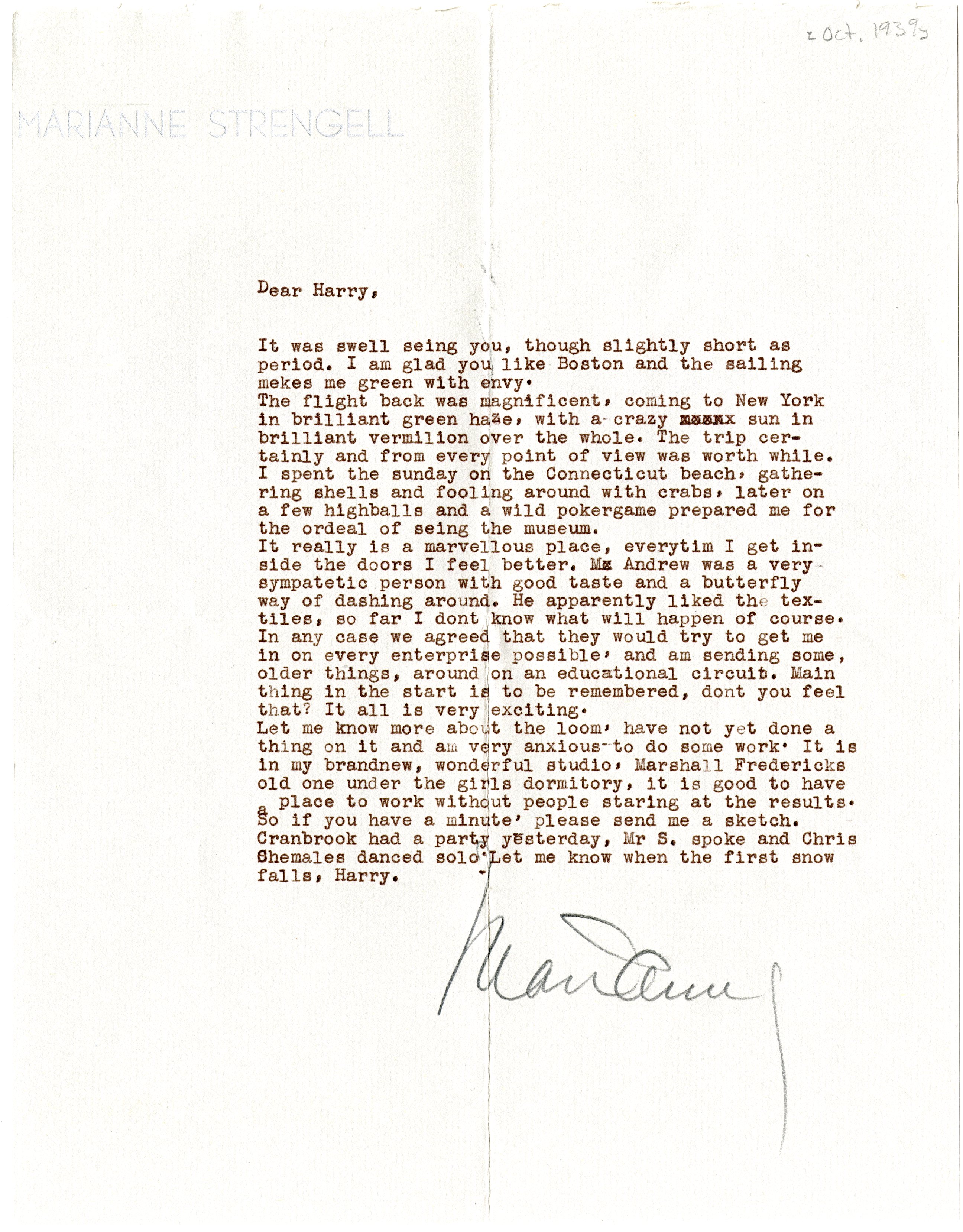
Letter from Marianne Strengell to Harry Weese, October 1939. Courtesy Cranbrook Archives.
Section of a letter from Wally Mitchell to Harry Weese, with Mitchell apologizing for his letterhead, c. 1940. Courtesy Cranbrook Archives.
During his year at Cranbrook, Baldwin and Weese built a much celebrated and sought-afterfolding loom. In the Fall of 1939, Baldwin returned to Cranbrook to work with Eliel and Eero Saarinen and J. Robert F. Swanson on the model for theSmithsonian Art Gallery competition. The submission won, but the design was never built.
In 1940, when the Smithsonian work was finished, Baldwin joined Harry Weese in Chicago, where they opened a private practice (1940-1941). The same year, they also won a competition called ‘Organic Design,’ which focused on contemporary furniture. Following Navy service during World War II, Baldwin initially worked with Skidmore, Owings and Merrill in New York before setting up an independent workshop, also in New York.
Although a registered architect, Baldwin’s career predominantly focused on interior design, including designs for furniture, textiles, chinaware, and gardens, which he loved the best. His aim was one of simplicity: flowing space and comfort to reflect the serenity that he found in nature. Baldwin’s designs for textiles and chinaware, filled with color and symmetry, are a truly wonderful part of this collection.
Ben Baldwin’s award-winning Ritz chair, 1979. Cranbrook Art Museum, Gift of Ben Baldwin.
An invitation for the opening of the Ben Baldwin Collection for Larsen Furniture, completed for fellow Cranbrook alum Jack Lenor Larsen, 1978. Courtesy Cranbrook Archives.
A design for textiles by Benjamin Baldwin, c. 1970. Courtesy Cranbrook Archives.
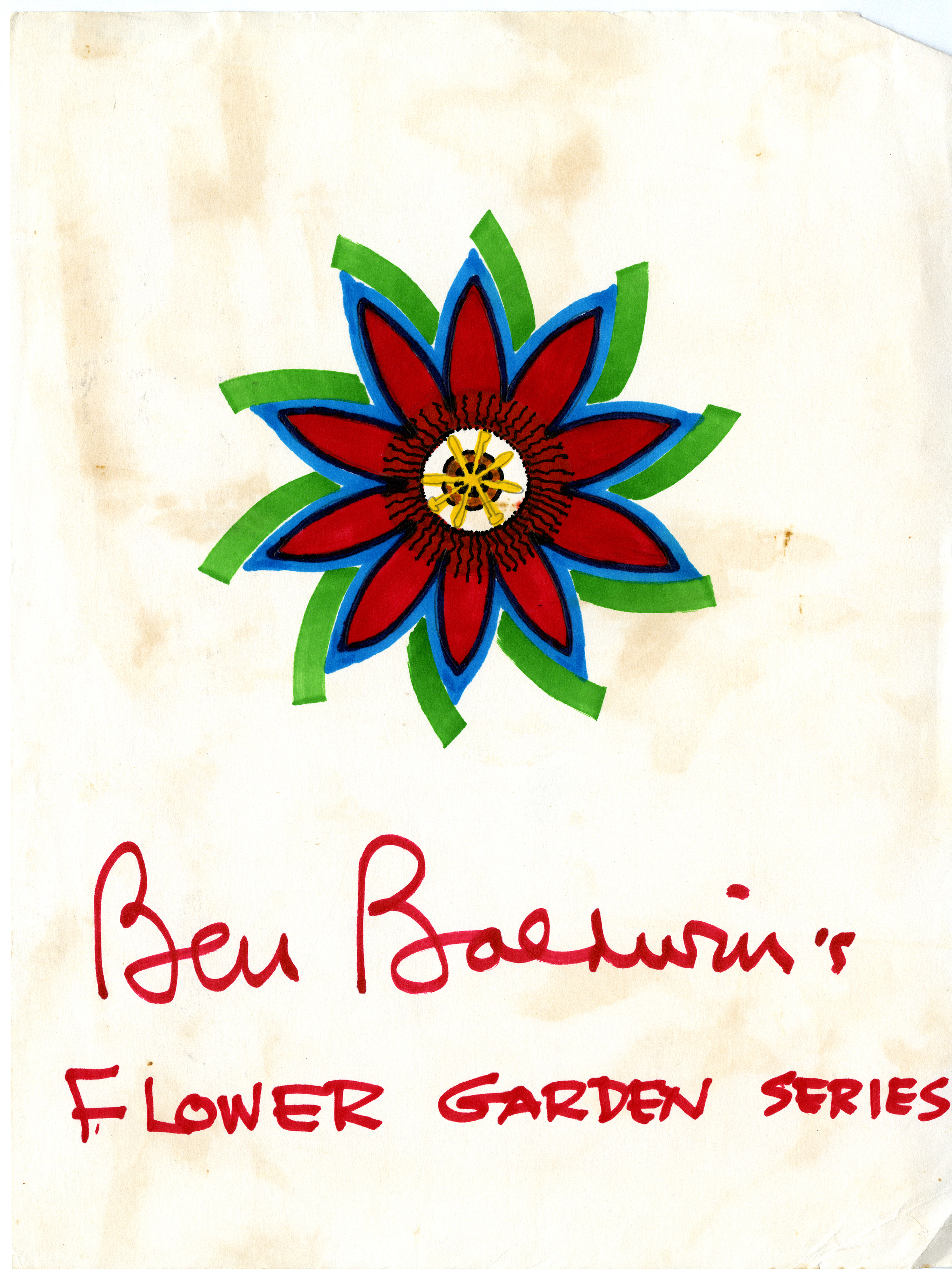
Ben Baldwin’s Flower Garden Series, c. 1970. Courtesy Cranbrook Archives.
A design for chinaware by Benjamin Baldwin, c. 1970. Courtesy Cranbrook Archives.
From 1973, Baldwin split his time between East Hampton, New York, and Sarasota, Florida. He died in Sarasota on April 4, 1993. He had just completed his autobiography and his niece, Shirley Weese Young, made great efforts to finalize its publication. It was published in 1995.
When I’m talking with visitors to Cranbrook about our many famous alumni, there is perhaps only one graduate whose legacy and name recognition so divides responses between “Who is that?” and “Oh-my-gosh, really?!”
If the visitor was born before 1982, they likely have never heard of her. If they’re born after 1982, they almost certainly know her—even if they don’t know she’s a real person: Lisa Frank.
A typical example of Lisa Frank’s art: unicorns, golden retrievers, pandas, and rainbows, c. 2005-2015. Copyright Lisa Frank, Inc.; courtesy of Pinterest.
Lisa Deborah Frank graduated from Kingswood in 1972. For kids in the 80s and 90s, her iconic neon designs decorated our backpacks, Trapper Keepers, pencils, folders, and stickers. Anything that you might possibly need for the daily rigors of preteen life, Lisa Frank could provide. Rainbow kittens and neon unicorns adorned practically everything, and you’d be forgiven if you chalked these creations up to the work of some anonymous office supply conglomerate with a cadre of slightly nutty illustrators.
But no. Lisa Frank is very much a real person and artist, and she has led her company, Lisa Frank, Inc., as a successful commercial art studio since 1979. Her Day-Glo depictions of flora and fauna were sensational, ubiquitous, and often imitated but never equaled. Despite her success at brightening elementary schools across the globe, as an artist and businesswoman she has been a reclusive figure. So who exactly is Lisa Frank?
In 2015, Cranbrook Kingswood alumna Carly Marks interviewed Lisa Frank at her Tucson, Arizona headquarters for the art magazine Foundations, one of the only in-depth interviews Frank has ever sat for. Frank had this to say about her time at Kingswood (1966 to 1972):
“They had real people teaching, accomplished artists. We sat in the original Saarinen chairs. I don’t think we realized what we were surrounded by. I can tell you I wouldn’t be who I am without that experience.”
There was also art at home: Lisa Frank’s father served on the board of the Detroit Institute of Arts and had an impressive collection in their Palmer Woods (Detroit) house, including works by Jasper Johns, Josef Albers, Richard Anuszkiewicz, and Jean Arp. One of Frank’s proudest moments was when her father hung one of her Kingswood-era paintings in the house—not because it was his daughter’s painting, but because he liked the work itself.
At Kingswood, Lisa Frank served on the Woodwinds yearbook staff as the advertising coordinator, among other activities. She also took advantage of the art opportunities, telling Foundations, “I had a senior show of the paintings I made…They were up on the wall, I sold out, and received a ton of commissions. Lee Iacocca, former president of Chrysler, bought a painting.”
Untitled. Lisa Frank, c. 1971-1972. Painted while Frank was a student at Kingswood School for Girls. Photo courtesy of Carly Mark for Foundations magazine, 2015.
Frank’s work at Cranbrook was abstract, using acrylic on Masonite or canvas, and sometimes incorporating paper on the canvas for additional texture. Although the work was nonrepresentational, the bright colors that would become her brand’s signature are present in these early paintings.
Untitled. Lisa Frank, c. 1971-1972. Painted while Frank was a student at Kingswood School for Girls. Photo courtesy of Carly Mark for Foundations magazine, 2015.
Her success in the Kingswood senior show led to early independence: “I lived on those earnings forever. When I was in high school [my dad] was paying for all my materials. When I got the commissions he said, ‘You’re paying for all the supplies.’ Then when I told him I was going to the University of Arizona he said, ‘That’s fine and I love you all the same but I’m not going to support you.’”
In college, Frank supported herself by selling Native American art and jewelry. She noticed what sold and what didn’t, and she encouraged the artisans she represented to make certain pieces for commercial sale. Her knack for knowing what designs would sell extended into her own art.
As she recalls, “At first I didn’t want to do unicorns. The artist in me said no. Then I thought, wait a minute, this is commercial art. Let’s do what’s going to sell.”
She started a line of jewelry made up of plastic fruits assembled with hot glue guns. She sold this line, called Sticky Fingers, at gift shows, and its success led to the establishment of her eponymous business. She entered into the pin/button market, painting licensed figures like Felix the Cat or Betty Boop, along with her own colorful animals with big eyes. These buttons were mass produced in Asia and imported to the U.S. Her breakout moment came in 1982, when teen mall staple Spencer’s Gifts ordered a million dollars’ worth of colorful Lisa Frank-designed stickers. She was only 28 years old.
Panda Painter, Lisa Frank, c. 1982-85. Frank worked with markers, acrylics, and airbrush. By 1989, the production had shifted to computer design. Artwork was created by various artists (including Rondi Kutz, Senior Designer, and Frank’s then-husband James Green, CEO) but always approved by Lisa Frank. Courtesy of Carly Marks for Foundations magazine, 2015.
Her success skyrocketed, and her technicolor art expanded onto the menagerie of product I remember from my own elementary school bookstore in the late 1990s. Since the very beginning of the company, Frank has served as the art director and sole source of product approval. Even with so many thousands of products, she and her team spend hours making each piece of new art. One thing Lisa Frank does not want? Repetition.
To her, using the same imagery over and over is not only bad business, its insulting to the customer. As she notes, “believe it or not, the consumers with less money have a keener eye than the ones with more. Consumers with less money only have so much to spend. For this reason they are critical and want to buy the best of the best. I’ve always appealed to the masses because, I felt so lucky to grow up in a beautiful world, and believe just because someone has less money, why should they not be offered the best of the best, as well?”
Trapper Keeper depicting Markie (unicorn) in Airfluff Island, Lisa Frank, Inc., c. 1990-2000. Markie was one of the early characters from Lisa Frank. According to Frank, Markie enjoys butterflies, exploring, collecting starts, cloud hopping, and dreams. Courtesy of Today.
As for her unique, technicolor style? “I think the reason I made what I made is because I’m unconventional,” she explained. “I am who I am. You read stuff about me; people think it was all influenced by drugs. You couldn’t do what I did if I was on drugs. . . I was running my business. You can’t be just a creative; you have to be a businesswoman, too. You have to have the motivation to get there.”
Panda Painter Scented Sticker sheet, Lisa Frank, Inc. c. 1990-2000. Panda Painter is seen here surrounded by rainbows and gumballs. Gumballs are a common Frank motif, inspired by a childhood gift of an antique gumball machine from her father. Copyright Lisa Frank, Inc.; scan courtesy of Nicole on Flickr.
Even at the helm of a multi-national, billion dollar company, Lisa Frank is still focused on her art: “I feel like I’m fortunate enough to live my passion…There’s a big commitment to making beautiful quality work.” She continues, “I mean, yes, it’s a business but it’s more important that the art is beautiful.”
Halloween sticker sheet, Lisa Frank, Inc. c. 1993-2000. The signature bright colors of Lisa Frank are printed using a proprietary four-color print process that keeps the colors from muddying. All licensees producing Lisa Frank, Inc. materials must sign confidentiality agreements as the ink mixtures are a closely-held secret. Copyright Lisa Frank, Inc.; scan courtesy of Nicole on Flickr.
Lisa Frank was awarded the Distinguished Alumna Award in 1994 from the Kingswood Alumnae Association. Perhaps one day we’ll even get an original Lisa Frank for Cranbrook Art Museum!
Sometimes, what appears to be a simple question doesn’t have an easy answer in the archives. By combining forces with colleagues, and looking in places you might not first suspect, you can ideally turn a boggling question into a rewarding quest. Provided, of course, you can solve the mystery! Happily, this was recently the case.
When contacted by a Kingswood School graduate about the origins of a certain sculpture that had graced the Green Lobby in the 1960s-1970s, I had two names to go on: Suki and Pam Stump Walsh. Was either of these the name of the sculptor and was the sculpture even still there? After checking several possible sources in the archives, it was time for a field trip to Kingswood. There she was opposite the green stairs, just as she had been described to me: a bronze sculpture of a girl, sitting cross-legged, head bowed, reading a book. I’d answered part of the question: she was still there.
And much to my delight there was also a plate tacked to the sculpture’s wooden pedestal. It read: “In Remembrance, Suzanne Anderson Stenglein, Class of 1947.”
Could this be Suki?
Back in Archives, I found a Suzanne Anderson in the 1947 Kingswood yearbook, Woodwinds. Next to her picture, this description: “That dashing station wagon, that’s always on the go, beautiful taste in clothes, and exciting vacations make Suki the ideal senior for every underclassman. Her pertness, her nose, and her spirit, that help to create her charm, match perfectly her conversational ability on all subjects from Broadway to baseball.”
I still didn’t know if this was the sculptor, or if it was Pam Stump, who is perhaps best known at Cranbrook for her work, Jane: Homage to Duchamp in the Kingswood courtyard. It certainly appeared to be Stump’s style. Associate Registrar Leslie Mio found a listing in Cranbrook Cultural Properties records for Suki, described as a patinated bronze sculpture attributed to Pam Stump.
Detroit native M. Pamela Stump graduated from Kingswood School in 1946. After attending the University of Michigan College of Architecture and Urban Planning for one year, she left to study sculpture under Marshall Fredericks in his Saginaw studio. Twenty-three years after leaving Kingswood, Stump, now Pamela Stump Walsh (she married Cranbrook School 1944 graduate, David E. Walsh), returned to teach sculpture. She retired in 1990, but continued creating and showing her own work throughout the state and internationally.
I appeared to have my answer, but I wanted definitive proof, and, ideally, a date. Back to Kingswood School. This time, with the help of Associate Archivist Laura MacNewman, I found the artist’s signature, and, a date!
End of story, right? Not quite. I still wondered about the sculpture’s origins. The Archives, thankfully, hold the M. Pamela Stump Papers. Consisting mainly of her Cranbrook Kingswood Chronicle, a memoir she titled, “Ubi Ignes Est or Where’s the Fire?” it provided the final details.
Stump made eighteen sculptures for Cranbrook while on the Kingswood faculty. Shortly after she started, in 1969, she was commissioned by the Class of 1947 to create a sculpture in memory of their classmate Suzanne Anderson Stenglein, who had died prematurely the year before. Stump refers to the bronze sculpture of Suzanne as Girl Reading or Suki. It was specifically designed to fit in the niche just outside the Headmistress’ office, directly opposite the staircase in the Green Lobby, and purposely placed on a revolving wooden pedestal so it could be turned 180-degrees to face the wall and enable examination of all the various textures and symbols on its surface. Stump writes, “On her body are many symbols of her life. This was easy because I had known her at Kingswood and in Saginaw.” Here you see this symbolism, along with the names of Suzanne’s schools before she came to Kingswood; her initials, S.A.; and her nickname, found on the crown of her head:
To bring things full circle: a close examination of negatives in the archives collections (identified only as “Kingswood Interiors”) found period images of the sculpture:
The Reading Girl by Pamela Stump, July 2, 1969. Bradford Herzog, photographer. Courtesy Cranbrook Archives, Cranbrook Photograph Collection.
I also learned from The Birmingham Eccentric, that Suki was the daughter of Goebel Brewing Company President Edwin John Anderson. She grew up in Saginaw, where she presumably met her husband, Harold Stenglein. The pair were married at Christ Church Cranbrook in 1955, and made their own home in Saginaw. At this juncture, little else is known about the girl behind the sculpture’s name.
In the main hallway of Kingswood and in the living room of Thornlea, there are paintings by artist Myron G. Barlow (1873-1937). I love the look of these paintings and began to wonder about the artist. I’ve come to learn he was an internationally known Detroit-raised painter. As with all things Cranbrook, it seems, there is always a Detroit connection.
Two Women with a Bowl of Flowers on a Table, circa 1912 by Myron G. Barlow.
The Kingswood painting Two Women with a Bowl of Flowers on a Table depicts two peasant girls, one standing and one bending over a bowl of flowers. It was donated to Kingswood around 1970 by Herbert Sott in memory of his wife Mignon Ginsburg Sott, who was Kingswood Class of 1943.
Young Girl Braiding Her Hair, circa 1912 by Myron G. Barlow
The other painting, Young Girl Braiding Her Hair, is of a girl looking in a mirror braiding her hair. It was purchased by James Scripps Booth from the artist in 1912. James attended the Ecole des Beaux-Arts in Paris and in 1911 had studied under Barlow; James’ painting “Onion Gatherer, Cote d’Azure” depicts Barlow’s cottage studio. James gave Young Girl Braiding Her Hair to his parents George and Ellen Booth. It originally hung in Cranbrook House’s main staircase. George and Ellen gifted the painting to Henry and Carolyn Booth, who hung it in their home, Thornlea.
Myron G. Barlow (1873-1937), son of Adolph and Fanny Barlow who were members of Temple Beth-El in Detroit. Courtesy Temple Beth El.
Myron G. Barlow was born in Ionia, Michigan in 1873 and raised in Detroit. As a teenager, he trained at the Detroit Museum School, where he studied under Joseph Gies, and then at the Art Institute of Chicago. He began his career as a newspaper artist. He eventually traveled to Paris and enrolled in the Ecole des Beaux-Arts where studied under Jean-Leon Gerome.
While copying paintings in the Rijksmuseum in Amsterdam, Barlow discovered Johannes Vermeer. As stated in William H. Gerdts’ Masterworks of American Impressionism from the Pfeil Collection, “Like Vermeer, one of Barlow’s favorite artistic themes became the depiction of figures, often female and usually set in an interior; frequently isolated and motionless, surrounded by a dream-like atmosphere rendered in a single, dominant tonality, often blue.”
Barlow in his studio after 1900. Courtesy of Nancy Brett (Barlow’s great-niece) via Temple Beth-El.
Around 1900, Barlow moved to the French village of Trepied. There he transformed a peasant’s house into his studio. He would, however, make frequent trips back to Detroit and kept a home there as well.
He served as the Chairman of the Scarab Club around 1918. According to his Detroit News obituary, “Among his major achievements in Detroit are six large murals which he painted for the main auditorium of Temple Beth-El, which were completed in 1925.”
In 1907, he was the only American elected to the Societe Nationale des Beaux-Arts and in 1932 was made a Knight of the Legion of Honor by the French Government. He was recognized for his work with gold medals at the St. Louis and Panama Pacific Exhibition, and by having his works purchased by many international museums, including the Musée Quentovic in France, Pennsylvania Academy of Fine Arts, and the Detroit Institute of Arts. The Detroit Cluband the private collection of Baron Edmond de Rothschild also included works by Barlow.
In May 1937, he left Detroit with the intention of selling his studio in France and returning to the city for the remainder of his life. Unfortunately, he died in his home in Trepied that fall.
A recent request made me curious about Albert Charpaize, a French landscape gardener with expertise in rustic woodwork. In the annals of Henry Wood Booth, it states that he was engaged by George Gough Booth in the fall of 1914 to complete rustic woodwork on the estate. He had worked until Christmas that year, when he had returned to his home in Dayton, Ohio, before returning to Cranbrook in the Spring of 1915.
Having found no correspondence between George and Charpaize, I anticipated there would be mention of him in the letters that George sent to his son, Henry Scripps Booth. The correspondence between George and Henry is always a delightful source for information on Booth family life and travels, as well as the progress of early Cranbrook architectural projects. While I found no direct mention of Charpaize, I noticed that George referred instead a “Rustic Man”.
Letter from George Gough Booth to Henry Scripps Booth, September 20, 1914. Henry Scripps and Carolyn Farr Booth Papers (1982-05), Cranbrook Archives, Center for Collections and Research
Henry Wood Booth’s Annals state that, between 1914 and 1915, Charpaize built two rustic summer houses (small one near the Pump House and a larger one on the hillside west of Nob Hill), a rustic fence on the northward side of Oakdale Road, a rustic wood bannister on Nob Hill, and five rustic bridges – one across the entrance to Mill Pond, one across the Serpentine near the Spillway, one across the brook near Cranbrook Road, and one each across Sunny Brook (located between Kingswood School and the lake) and Stony Brook (located north yet parallel of Sunny Brook).
Bridge across Sunny Brook, Pleasures of Life Volume 2, Page 2
Visual sources are an important source for verifying information in documents, in this case for identifying the work of Charpaize, and his artistic signature is distinctive. Look again at the bridge across Sunny Brook and compare it with the rustic fence and the rustic tea house below:
March 1916, Rustic fence with steps to gazebo
Looking east over Cranbrook Road, Gazebo by Albert Charpaize, “Rustic Tea House”
Archives are the vestiges of times past – they are the key to historical accuracy. Yet, different types of records hold varying degrees of evidential value. From the description of the work of the Rustic Man given by George, the list of projects described by Henry Wood Booth, and the visual sources, it is possible to confidently infer that the rustic man is Albert Charpaize.
Ideally, the list of projects in the annals should be corroborated by an informal source (a document created to officially record an activity, rather than consciously conveying history as is the case with annals, chronicles, and newspapers). The test for historical evidence is always who created it, for whom, when, why and for what purpose. Then I found Charpaize in the Coats and Burchard Appraisal of 1914-1918, which refers to him four times: “pergola to well” at Colony House, and three rustic bridges – one at mill race, one across the stream near Brookside Cottage and one across the stream at Cranbrook Road (all in 1915). The appraisal provides the evidence for Charpaize working on specific projects across the estate.
Page of appraisal listing three rustic bridges built by Albert Charpaize in 1915. Coats and Burchard Appraisal, 1914-1918, George Gough and Ellen Scripps Booth Financial Papers (1981-02), Cranbrook Archives, Center for Collections and Research
The archives of three generations of the Booth family have contributed to our knowledge of Albert Charpaize. I feel sure there is more to be discovered – the appraisal only listed three of the bridges described by Henry Wood Booth. The story of Cranbrook’s Rustic Man is to be continued…
We are busy preparing for House Party this weekend, where we are celebrating the history of the Cranbrook Archives! And there are many more events coming up – we all look forward to seeing you soon!