When incoming Academy President Roy Slade arrived at Cranbrook in July 1977, the President’s House (known, off and on, as Saarinen House) was in need of a refresher. Three other families had lived in and changed the aesthetic of the house following Eliel Saarinen’s death in 1950, and the house was a far cry from Saarinen’s design intent. Slade worked with designers Jean Faulkner and Carl Magnusson (then Director of Graphics and Showroom Design at Knoll) to rework the house into something befitting the new President of the Academy.
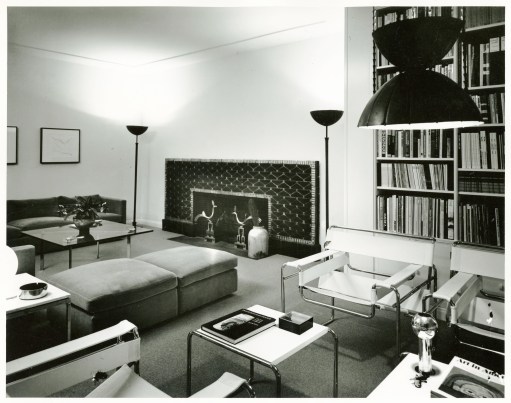
Saarinen House, February 8, 1978. Norman McGrath, photographer. Courtesy of Cranbrook Archives.
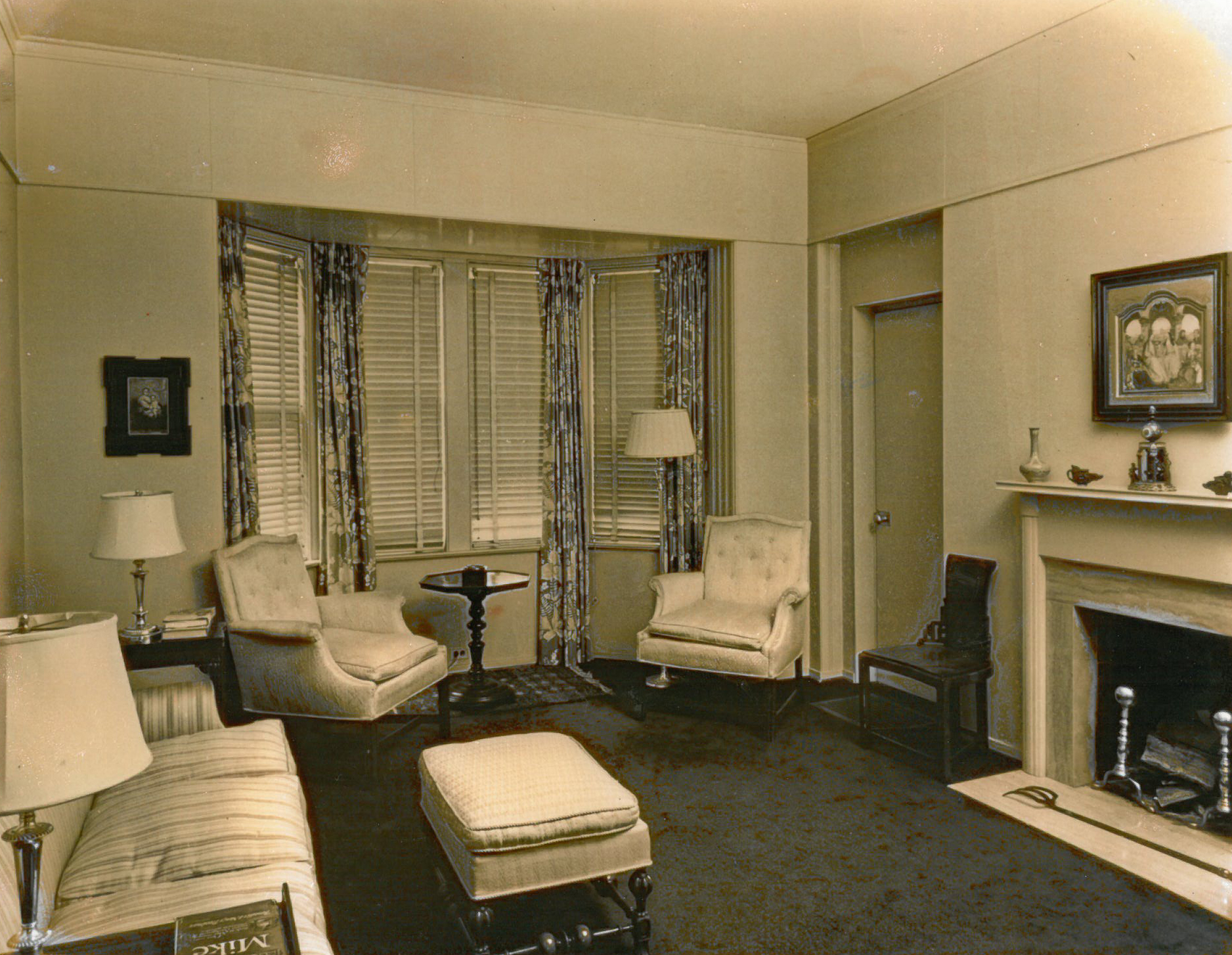
The original Saarinen-designed furniture had been spread throughout the campus and Museum, and in the redesign much of it was returned for use in the house. But instead of restoring rooms to their 1930s appearance (that would happen a decade or so later), the house was kept as a blend of old and new. “Gibraltar Ash” off-white wool wall-to-wall carpeting by Jack Lenor Larsen stretched between the foyer, living room, dining room, and library, making the main room of the house feel like one continuous open space. Furnishings and art pieces by Cranbrook (and Cranbrook-adjacent) artists and designers from many decades–not just the 1930s–were blended together into a comfortable, deliberately eclectic look. The 1977 interiors of the house were featured in local papers and even included, with text by Paul Goldberger, in Living Well: The New York Times Book of Home Design and Decoration (1981).


It’s interesting in these photos by Jack Kausch how well the space works, but how alien Saarinen’s furniture seems to be! Particularly in the dining room–the holly wood table and brass fixture are decontextualized by the foreign whiteness of the walls, ceiling, and floor. The next restoration, completed in 1994, brought back Saarinen’s rich color scheme and variety of materials–including the gilded ceiling.
If you’d like to learn more about the later lives of Saarinen House, Roy Slade’s tenure as President of the Academy, and other fascinating Cranbrook Academy of Art stories, come out to visit my exhibition, Saarinen House: Presidents/Residents, 1946-1994, opening later this month.
The exhibition features archival material and works by each former resident: painter Zoltan Sepeshy, who directed the Academy from 1946 to 1966 and moved into the house in late 1951 following the death of Eliel Saarinen; architect Glen Paulsen, who led the Academy from 1966 to 1970 and expanded Cranbrook’s campus with late-Modern additions; Wallace Mitchell, a Detroit native whose career at Cranbrook developed from student to painting instructor, then director of the Art Museum and finally president; and painter and educator Roy Slade, who led the Academy and its Museum from 1977 to 1994. Slade initiated the restoration of Saarinen House in the late 1970s and encouraged and supported Greg Wittkopp (then a curator at the Art Museum) in the transformation of this early modern, Art Deco design treasure into a public house museum in 1994.
The free Opening Reception will take place Sunday, April 29, 2018, from 1pm-5pm (in conjunction with Open Studios) and the exhibition will be included on all tours of Saarinen House through November. Learn more on our website.
– Kevin Adkisson, Collections Fellow, Cranbrook Center for Collections and Research







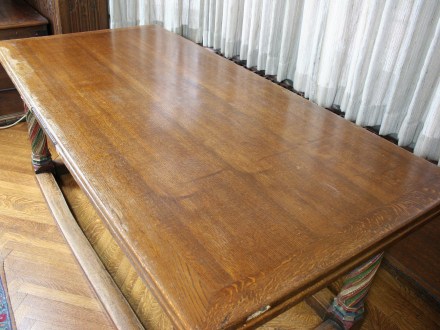 Purchased by George G. Booth, before 1949, for use in Cranbrook House, the Refectory Table (CEC 37) in the Cranbrook House Oak Room has a plain 76 inch by 35-1/2 inch rectangular top, with two extendable tops of 31-1/2 inches each.
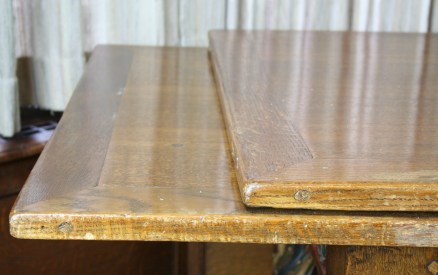 The extension mechanism works by removing the top wood leaf, pulling out each side of tabletop – these are supported by bars under the table top that pull out – removing the center section, then placing the top leaf in the center.
 The frieze runs all around the table and features a grapevine interspersed at regular intervals with Medieval-style figures: mermaids, men, women, and animals.
 The figures carry banners and staffs, are sitting on benches, and, in the case of the mermaid, holding a fish.
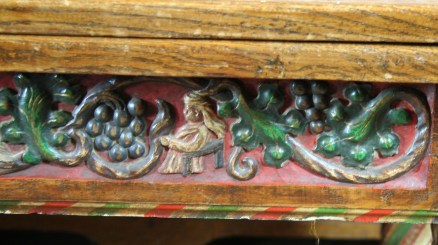 The frieze background is painted red; the grapevine and grapes are brown with black and the leaves are green with gold detailing; the figures and animals are mostly tan with gold and the mermaids are gold as well. The lower edge molding of the frieze is painted with diagonal lines of green, gold, and red.
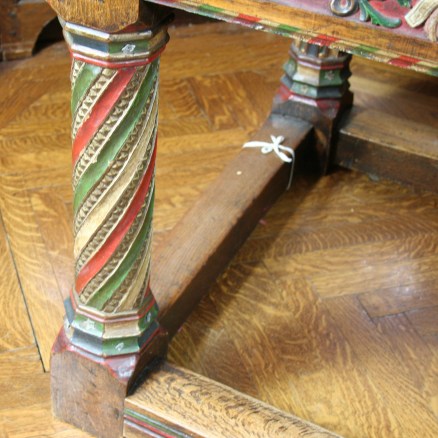 Each of the four carved and painted legs is decorated with a different linear design of stripes, twisted around the trunk, with hexagonal base and top.
 Metal stars are attached to the base and top of each leg. The legs are painted blue, green, red, and tan, all with gold detailing.
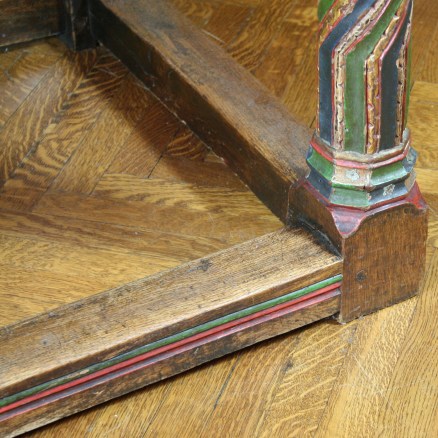 The outer side of each stretcher has carved lines painted red and green.


 Cranbrook Kitchen Sink