Eagle Scout Project in Smith House

This past March, the Center for Collections and Research was honored to host Kevin Wilburn, a Life Scout going for the rank advancement of Eagle Scout, as he performed his required service project.

https://www.scouting.org/programs/boy-scouts/advancement-and-awards/eagle

Eagle Scout badge from scouting.org

The mission of the Boy Scouts of America is to prepare young people to make ethical and moral choices over their lifetimes by instilling in them the values of the Scout Oath and Scout Law. The ranks of the Boy Scouts are Tenderfoot, Second Class, First Class, Star, Life, and Eagle. To receive the highest achievement rank in the Boy Scouts of America, a Life Scout must not only earn twenty-one merit badges but also perform an extensive service project. He must plan, develop, and give leadership to others in a service project helpful to any religious institution, any school, or his community.

Kevin’s project was to work with the book collection in the Frank Lloyd Wright-designed Melvyn Maxwell and Sara Stein Smith House. It was especially great having Kevin work with the house, as Robert Smith, the only son of Melvyn and Sara, also achieved the rank of Eagle Scout in his youth (the Smith House collection contains his Eagle Scout uniform).

When Cranbrook acquired the Smith House late last year, we also acquired the extensive library amassed by the Smiths. The collection of more than 900 works ranges from books on Frank Lloyd Wright to Art in America and other periodicals, to yearbooks and popular fiction.

EagleScoutProject_Mar2018 (KevinWilburn) (2)

Kevin and his team working on the Smith House book collection.

On the day of the project, Kevin and his team of scouts and parent volunteers did an inventory of the books in the Living Room and the Study. They utilized a computer program which allowed them to gather all pertinent information about the books by simply searching the Library of Congress Control Number (LCCN) or the International Standard Book Number (ISBN). They also took images of the books as well as any inscriptions found within. What they ended up with, after just one day working in only two rooms in the house, was a database of 658 individual titles. (Knowing how many more books are in the other rooms, maybe there are more than 900 books in the house…)

I recently asked Kevin his thoughts on the project over email:

LM: First off, what does becoming an Eagle Scout mean to you?

KW: I’ve been in Scouts for 11 years now there were times that I questioned my continuation in Scouts. However, on the cusp of this final accomplishment, I don’t regret staying on the path. It has been a lot of commitment and there is no substitution for the hard work required, but as a scout, I have had opportunities so few people get to have—just like doing this project. It is special to be part of the small group of Scouts that accomplish the Eagle Rank. I think the Scout program and achieving Eagle has made me a better person.

LM: Can you give me your overall impression of the Smith House?

KW: To me, I struggle with the words to describe the Smith House. It is truly a one-of-a-kind home and the attention to detail is absolutely marvelous. Whether it’s the striking color of the red tidewater cypress wood that forms the walls or the glistening flat skylights that illuminate the tight, yet airy library, this home is Usonian Style in its truest form. Additionally, there is such a great story to the Smith’s and how the house came to be that makes it even more special than the physical aspects.

LM: What motivated you to take on this project?

KW: The driving force behind this entire project was the fact that I was assisting in the preservation of a Wright-designed home. I’ve always had an appreciation for his work and have a personal interest in helping the preservation of his work. I never expected that I would have such a unique opportunity to combine my passion and interest so directly on my Eagle project—it was a truly special project. I really appreciate the opportunity Cranbrook provided me.

EagleScoutProject_Mar2018 (KevinWilburn) (1)

Kevin photographing one of the 658 titles cataloged during the one-day project.

LM: What was the hardest thing about the project?

KW: We had very unique requirements compared to many projects that are often construction based, so going into it I knew that getting people started on the cataloging process would be difficult and it probably took an hour for volunteers to get into a rhythm. It was also physically demanding, in some cases sitting or standing for hours at a time—luckily we were able to rotate some positions to help people with fatigue. In the end, the hardest part was it was a very long 10 hour day typing in book details into our cataloging software and photographing the books.

LM: What was your favorite part of the project?

KW: Planning to pursue architecture as a career, I’ve always been interested in Frank Lloyd Wright; so, my favorite part was to be able to do a project in one of his Usonian homes. It was also exciting during the cataloging process to see some of the personal connections of the Smiths with Wright.

LM: Any final thoughts?

KW: I want to thank Cranbrook Center for Collections and Research, Leslie Mio, Associate Registrar, for supporting the project, and Lynette Mayman, Program Presenter, for being on-site during the project. I also want to thank the members of Troop 1005 that came out to support this effort. Finally, I want to thank Collectorz.com for donating the Book Collector software used to catalog the collection.

EagleScoutProject_Mar2018 (KevinWilburn) (4)

Kevin (fourth from the right) and some of his team of volunteers on the back patio of Smith House.

The Center for Collections and Research wishes Kevin the best of luck in achieving his Eagle Rank and would like to thank him and his team for the hours of work on this project.

Leslie Mio, Associate Registrar

Cranbrook Alumni Court: Phase 1 Ends, Phase 2 Begins!

In my previous post related to the Alumni Court restoration project, we had recently finished the masonry restoration of the vertical walls and were preparing the upper level walkway for concrete installation.  Now, it is safe to say Phase 1 has been completed and is looking just as beautiful as when the courtyard was originally constructed in 1927.

Over the past 6 months, we have been busy finishing up Phase 1 and completing activities such as: pouring the upper level concrete walkway; installing all flat paving (including brick, fieldstone, and red slate); and replacing limestone columns and bases. We also restored three windows and the interior plaster work damaged by water infiltrating the building over the years.

It was very exciting to see how the contractor replaced the columns and their bases. Before any demolition could begin, the brick arches were supported by heavy duty scaffolding with an I-beam and custom-made wooden forms fitted directly into each arch. With this configuration, the contractor was able to ever-so-slightly raise each arch so that there was enough room to remove the column capitals, the columns, and finally the column bases.  At that point, the new bases could be installed, followed by new columns, and the existing column capitals.

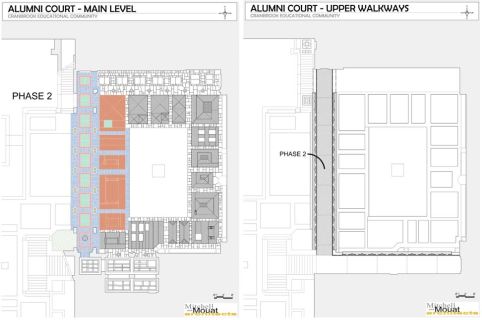
Throughout the Spring, we will be continuing with Phase 2 which includes restoring the upper level walkway running north/south, columns/arches running north/south, paving work directly below the walkway, and the remaining paving within the courtyard.

Phase 2 Alumni Court

Left: Plan of Phase 2 activity (in color) at the Alumni Court. Phase 1 is at right (grey). Right: Upper level of Phase Two, walkway replacement. Courtesy of Cranbrook Capital Projects.

Stay tuned for a progress report on Phase 2. As always, many thanks to the contractors and architects who work so hard on these projects.

Ryan Pfeifer, Project Manager II, Cranbrook Capital Projects

Editor’s Note: The four new columns have the alumni names carved into them, and the originals (which had severely degraded and were illegible) will be stored safely elsewhere on campus.

New Digital Collection Focusing on the Middle East

Thanks to a generous grant from the Fred A. and Barbara M. Erb Family Foundation, thousands of negatives from the collections at Cranbrook Archives have been re-housed to ensure their long-term stability and preservation. One of these collections, which documents a research trip conducted in the Middle East by Cranbrook Institute of Science (CIS), has been digitized and is now available to users from our online database.

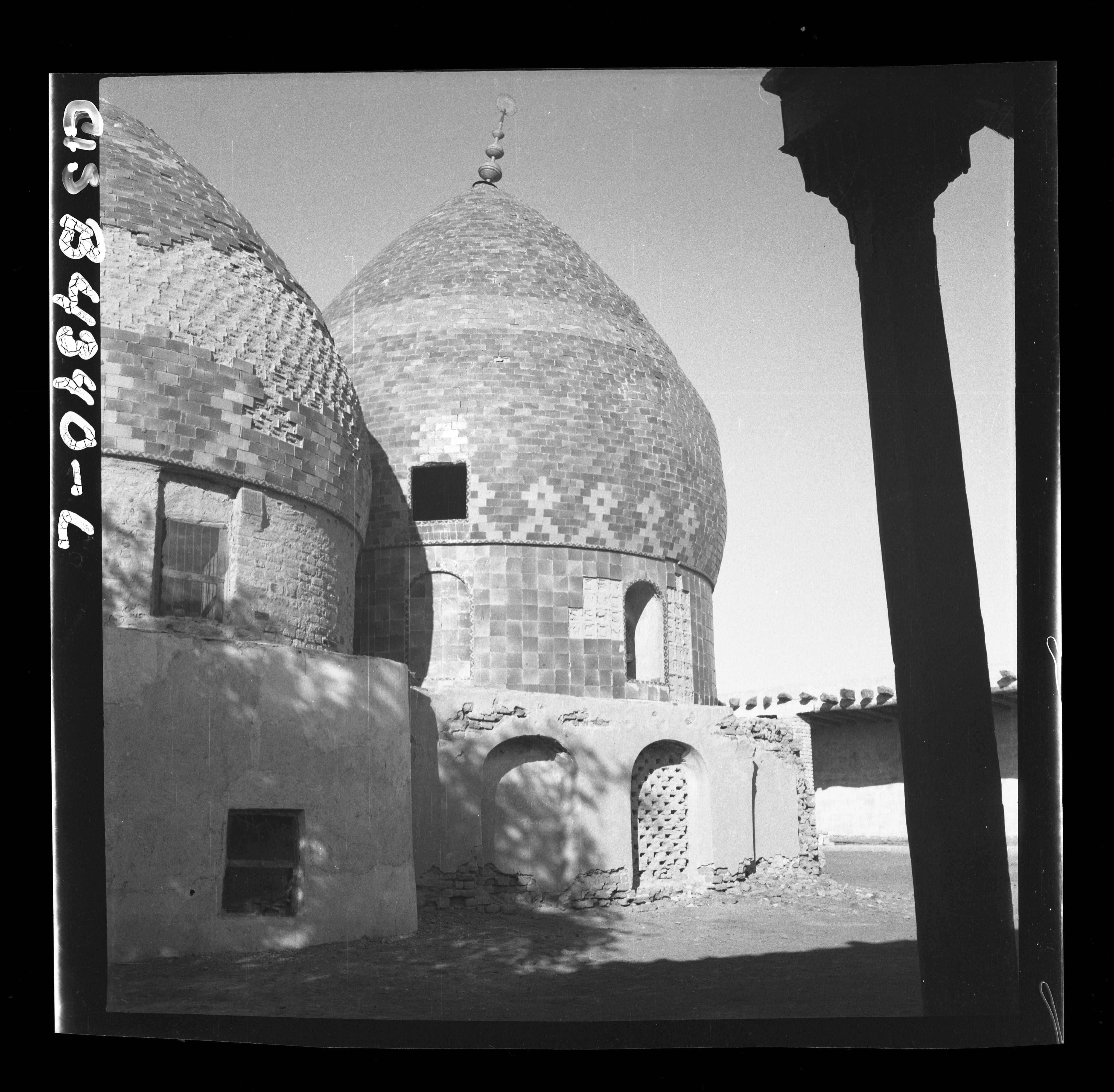
Domed Structures near Babylon. Photograph by Robert T. Hatt.

From 1952-1953, Dr. Robert T. Hatt (Director of CIS from 1935-1967) led an exhibition in Iraq, Syria, Jordan, and Egypt. Hatt recorded his observations in a travel journal which is part of the Robert Torrens Hatt Papers at Cranbrook Archives. In addition to his research and work as a scientist, Hatt was an avid photographer. Our collection includes more than 400 photographs taken by Hatt during his travels.

Dr. Hatt’s travel diary, 1952-1953. Courtesy Cranbrook Archives.

We are excited to share this unique collection that documents communities and antiquities which may no longer exist. Users can browse the collection image by image, or use the Search box at the top of each page in the online database.  To browse the 400+ images in the collection, click the Browse All button (next to Home).

Dr. Hatt (right) and an unidentified man in Babylon.

We hope you enjoy this new collection! Special thanks to Archives Assistants Veronica Wood and Kaitlin Scharra Eraqi for their hard work and the many hours they spent on this project.

Gina Tecos, Archivist


A Hunter of Taos

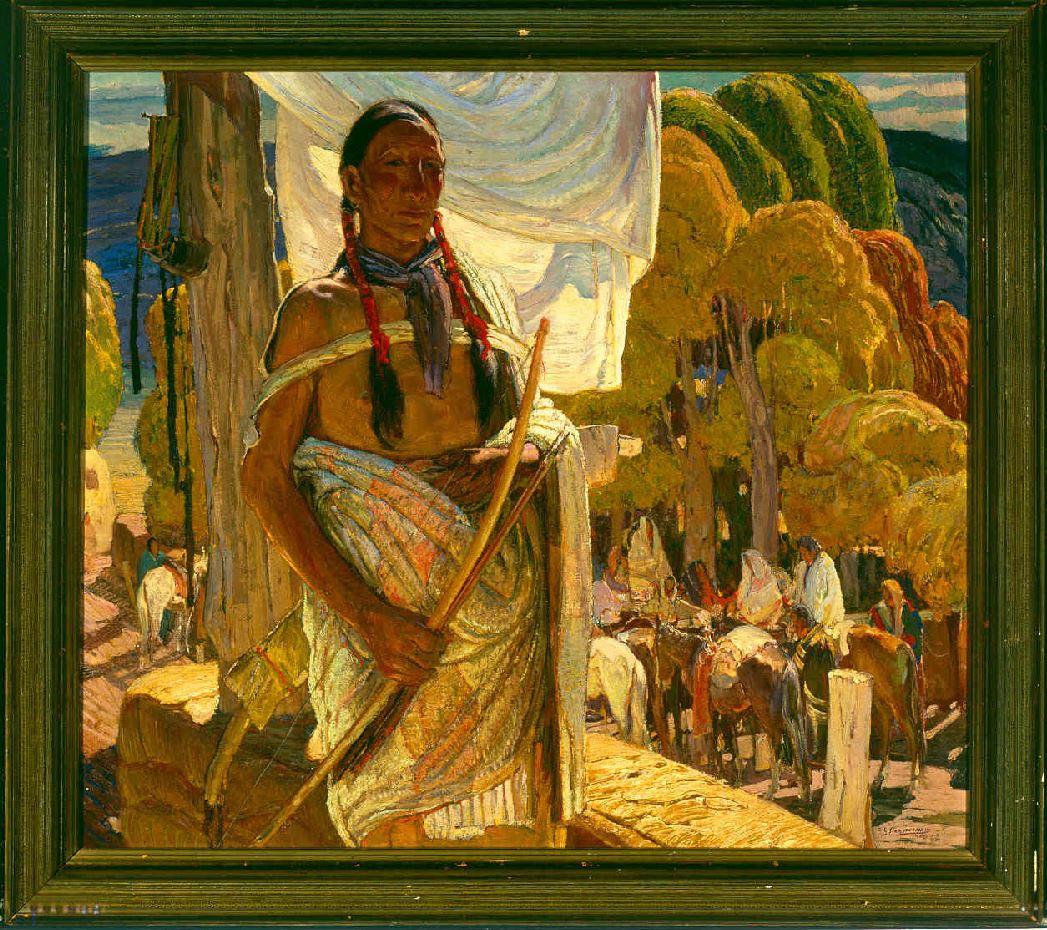
Earlier this week, as part of our regularly scheduled inventory and evaluation of cultural properties, I took a specialist from Sotheby’s New York to see a painting a bit off the beaten track of Cranbrook’s usual spots to find art. Hanging in the Cranbrook Kingswood Middle School for Boys, A Hunter of Taos is an incredible work by the American painter Oscar Edmund Berninghaus.

A Hunter of Taos

A Hunter of Taos, 1926
Oscar Edmund Berninghaus, American, 1874-1952
Oil on canvas, 34 x 39 in.
Gift of Henry S. Booth to the Cranbrook School

The painting shows a male American Indian proudly standing with a bow and arrows, while horses and riders pass behind through a rocky landscape and trees aglow in warm sunlight. The trees are made up of swirling golds, ochres, and greens, their abstraction complimenting the almost impressionistic rendering of the figures immediately below. The central hunter, however, is rendered clearly, with his face set immediately in front of a draped white fabric and his gaze looking back at the viewer. The scale of the painting, about three-feet square, is impressive. But why is it here in the Boys Middle School, or even at Cranbrook?

First, let’s step back a bit further to the artist himself: Oscar Edmund Berninghaus (1874-1952). A native of St. Louis, he began his career as a commercial lithographer, draftsman, and illustrator. He explored painting as a fine art through classes at Washington University and at the St. Louis School of Fine Arts, where in 1899 the twenty-five year-old was awarded a month’s long paid journey westward by the Denver and Rio Grande Railroad. On this trip, Berninghaus was introduced to beauty and culture of the American Southwest, particularly Taos, New Mexico.

The Taos Pueblo, in north central New Mexico, is one of the oldest continuously inhabited places in North America, with the Pueblo people settling there over one-thousand years ago. It became a popular spot for artists in the late-1890s, and by 1910, Berninghaus was making annual pilgrimages between Taos and St. Louis. In the winter he would work on his lithography and commercial mural work to finance summers at Taos. There, he painted Native Americans, their horses, scenes of daily life, and the landscape. In 1915 he became a founding member of the Taos Society of Artists, composed of European-Americans who came to Taos to paint American Indian subjects. Berninghaus claimed he was “infected with the Taos germ” and was “fascinated by the people, the Indians and Mexicans, the adobe architecture, the sagebrush, the mountains; they all inspired me as a subject matter.”

In 1925, Berninghaus relocated permanently to Taos. He painted landscapes, animals, and scenes of daily life in the pueblo and village. In A Hunter of Taos, the model was Santiago Bernal, a Pueblo farm laborer and frequent model for Berninghaus. In a letter to a newspaper in 1927, Berninghaus wrote, “I think the colony in Taos is doing much for American Art. From it I think will come a distinctive art, something definitely American–and I do not mean that such will be the case because the American Indian and his environment are the subjects. But the canvases that come from Taos are as definitely American as anything can be. We have had French, Dutch, Italian, German art. Now we must have American art. I feel that from Taos will come that art” (as quoted in Pioneer Artists of Taos, p. 98).

Our painting, considered one of the artist’s finest, was first exhibited at New York’s National Academy of Design in its 1926 Winter Exhibition. The work won the Second Altman Prize, one of several awards given out by the Academy of Design. On June 6, 1927, Henry Booth purchased the painting from the artist.

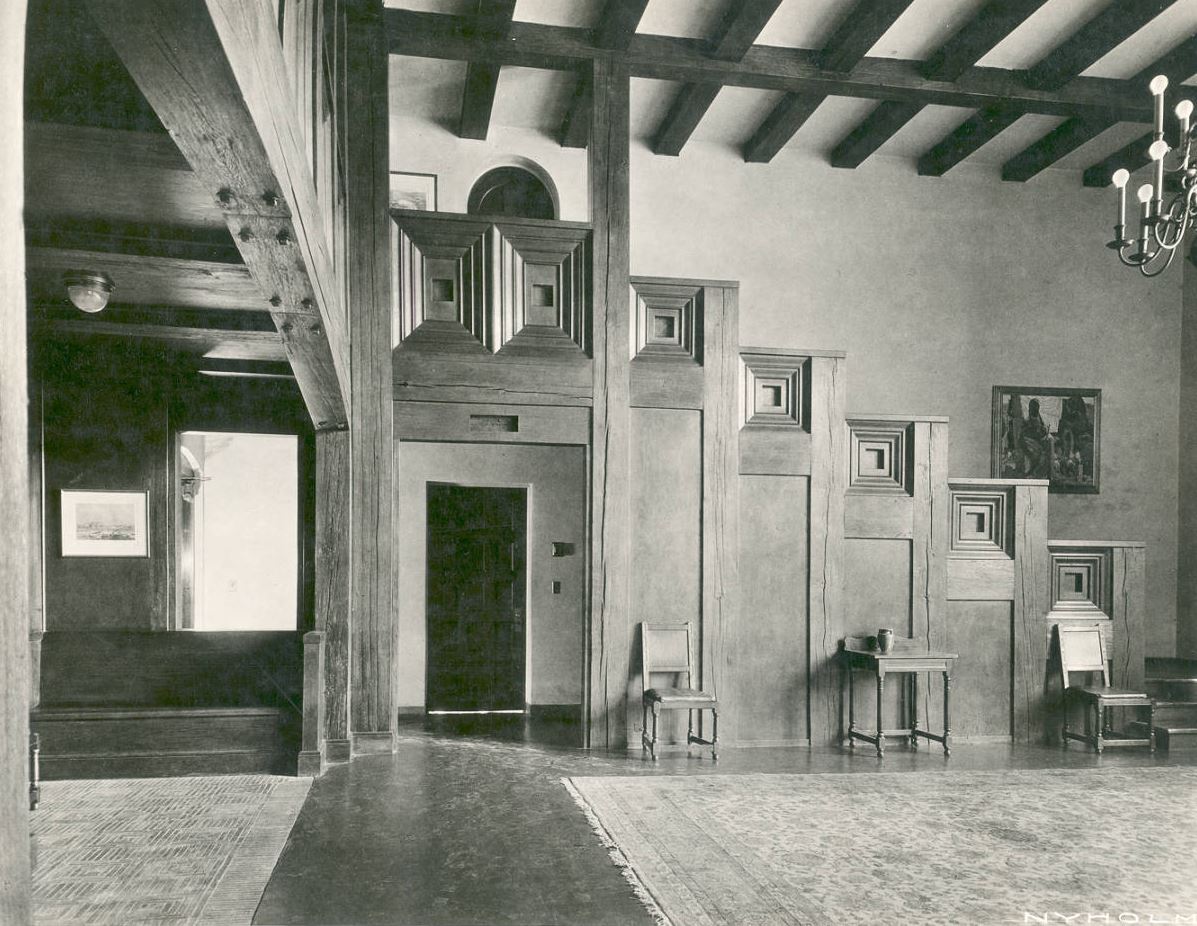
North Lobby with Taos Painting

View of A Hunter of Taos in the North Lobby, Hoey Hall, Cranbrook School. 1928. Peter A. Nyholm, Photographer. Cranbrook Archives.

After Booth purchased the work, the painting hung in the north lobby of Hoey Hall for the opening of Cranbrook School for Boys in September of 1927. Henry formally presented the painting to Cranbrook School on October 18, 1927. In the last half of the century, the painting was moved to the new Cranbrook Kingswood Middle School for Boys, where it hangs in a small lobby for administrative offices. Examining the painting Tuesday, we saw it is in excellent condition, and I appreciated that it’s in a spot where many young men and their parents have a chance to sit and appreciate it. It’s one of the great assets of Cranbrook that the campus is sprinkled with great art in all of our buildings—I think it’s a big part of what makes this place so magical.

– Kevin Adkisson, Collections Fellow, Cranbrook Center for Collections and Research

NB: If you want to learn about another Cranbrook connection to the Southwest and the Pueblo people, revisit this excellent post on Amelia Elizabeth White and her gift of Native American art and artifacts to the Cranbrook Institute of Science in 1937.

Photo Friday: Details, Details, Details

Recently, I have been researching the objects in the historic rooms at Cranbrook House. The things I have noticed the most about these objects are the details: it seems no object was chosen for the house that did not have detailed ornamental carvings, woodwork, or decoration. Here are a few of my favorites:


– Leslie S. Mio, Associate Registrar

First Female Graduates

We recently had a query in the Archives about who the first woman was to receive an MFA at the Academy of Art. Actually, there were two – both in Ceramics. Edna Vogel’s bio can be found in a previous blog post. The other woman was Florence Kee Chang, a Chinese-American from Hawaii. Born in 1915 in Wahiawa on Oahu Island, Chang attended the California College of Arts and Crafts in Oakland, California after high school, where she received her B.A. in Art Education in 1942. She immediately applied to Cranbrook, where she studied ceramics with Maija Grotell, weaving with Marianne Strengell, and took a course in Metals with Harry Bertoia.

Picture1.jpg

Chang’s bowl and vase acquired by Cranbrook Academy of Art in 1943 as part of the Acquisitions Honors. On the right is Chang’s mark.

In May 1943, Chang was part of the first class of MFA graduates at the newly accredited Academy of Art. She and Vogel were the only two women to receive degrees that inaugural year. In addition, the Academy purchased two of her pieces of pottery, for which she received an “Acquisitions Honor.”

IMG_7389.jpg

Although she was from Hawaii, Chang adapted well to winter in Michigan! Courtesy Margueritte Kimball Papers.

Very little is known about Chang after she graduated. In 1955, she traveled to Japan, where she worked for two years as an arts and crafts director for the U.S. Army as part of what became known as The Army Crafts Program. Chang returned to Hawaii where she passed away in 2001.

Chang.jpg

Chang’s 1942 Christmas card reflects the Academy Art’s sculpture and architecture.

If you have any further information about Florence Kee Chang, please contact us!

– Leslie S. Edwards, Head Archivist

Photo (Shoot) Friday

In preparing for the Center’s upcoming Edible Landscapes Dinner, I came across a series of images from a photo shoot of George and Ellen Booth in the 1940s. Some images were clearly taken in the Cranbrook House Library or Oak Room, but other images were harder to place.

Here, George and Ellen are seated with a magazine, and she is examining a vase. Below (after a wardrobe change), they’re seen opening a package. While it may not look like a room we know in Cranbrook House, they’re in Mrs. Booth’s Morning Room—Mr. Booth’s old office.

With the completion of the West Wing addition to Cranbrook House in 1918, George Booth relocated his office to a larger suite of rooms beyond the grand new Library. His first office, original to the 1908 home, was converted into a Morning Room for use by Ellen. The conversion was spearheaded by the Booth children, who remodeled the space as a Christmas gift for their mother in the 1930s. Mrs. Booth apparently loved the room, and made great use of its bright, cheery atmosphere.

Ellens Morning Room 1952.jpg

Ellen Booth’s Morning Room in Cranbrook House, 1952. Cranbrook Archives.

George insisted that the renovation of his old office be reversible to the original Albert Kahn design. You can see in the photographs the seams of the panels that made up the new pale walls. In 1993, the room was returned to its original appearance as George’s office by the Cranbrook House & Gardens Auxiliary.

The images from this photo shoot in the 1940s have been used over the years in various Cranbrook histories and publications focused on the Booths themselves. I’m appreciating the photos for showing a small glimpse into the life of Ellen and her now-gone Morning Room.

Kevin Adkisson, Collections Fellow, Cranbrook Center for Collections and Research

Object Spotlight: Refectory Table

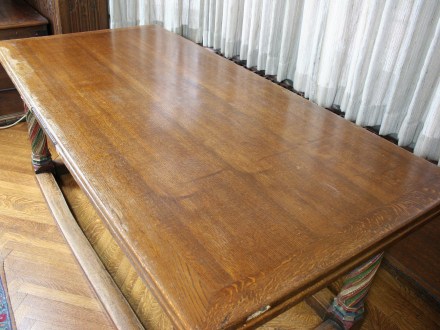
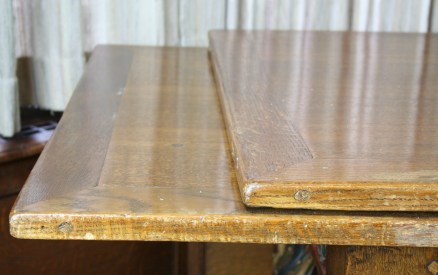
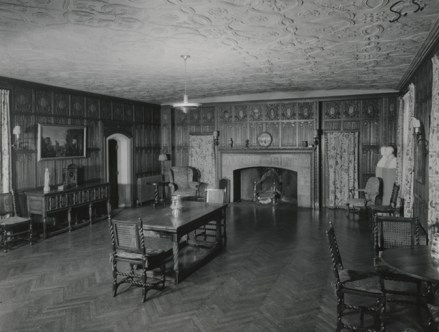
Generally, the term “Refectory Table” describes long dining tables resembling those in dining halls of monasteries, especially oblong tables with four or six turned legs that may be expanded by leaves.CEC37 (4)Purchased by George G. Booth, before 1949, for use in Cranbrook House, the Refectory Table (CEC 37) in the Cranbrook House Oak Room has a plain 76 inch by 35-1/2 inch rectangular top, with two extendable tops of 31-1/2 inches each.cec37-13.jpgThe extension mechanism works by removing the top wood leaf, pulling out each side of tabletop – these are supported by bars under the table top that pull out – removing the center section, then placing the top leaf in the center.

“Interesting, but not really worthy of a spotlight,” you say?

“My table at home has leaves built into it. Why is this one so special?”

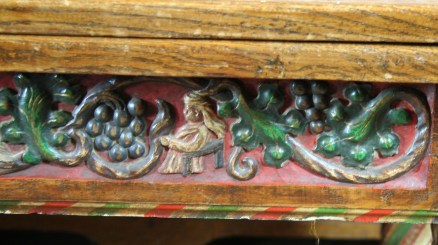
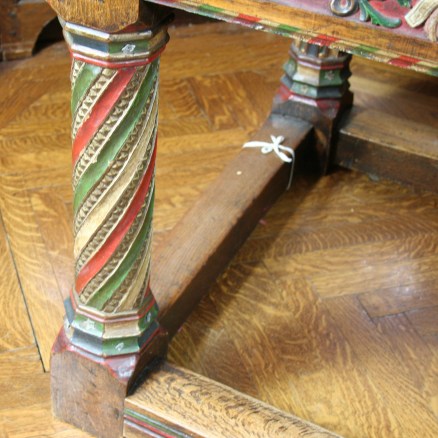
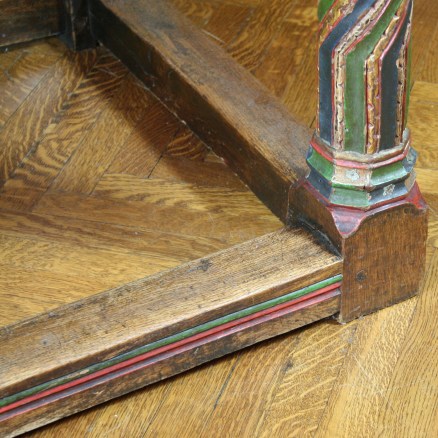
It is distinct because the top of this table sits over a beautiful and vibrantly carved and painted frieze, and is raised on four carved and painted legs and a box stretcher with a carved and painted linear design. It is the frieze and the carvings that make the table stand out.CEC37 (3).JPGThe frieze runs all around the table and features a grapevine interspersed at regular intervals with Medieval-style figures: mermaids, men, women, and animals.CEC37 (10)The figures carry banners and staffs, are sitting on benches, and, in the case of the mermaid, holding a fish.CEC37 (18)The frieze background is painted red; the grapevine and grapes are brown with black and the leaves are green with gold detailing; the figures and animals are mostly tan with gold and the mermaids are gold as well.  The lower edge molding of the frieze is painted with diagonal lines of green, gold, and red.CEC37 (11)Each of the four carved and painted legs is decorated with a different linear design of stripes, twisted around the trunk, with hexagonal base and top.CEC37 (6)Metal stars are attached to the base and top of each leg.  The legs are painted blue, green, red, and tan, all with gold detailing.CEC37 (12)The outer side of each stretcher has carved lines painted red and green.

The table is an English antique, likely from the 19th century. A careful study of comparable tables in books or at other museums could help us narrow down its age.

I am happy to share this beautiful table on the blog. If you ever find yourself in the Oak Room at Cranbrook House, whether for a meeting, house tour, or special event, please take the time and give this exception table a closer look.

Refectory Table

Refectory Table in the Oak Room, 1952. Cranbrook Archives.

– Leslie S. Mio, Associate Registrar and “Keeper of Keys and Cultural Properties” at Cranbrook Center for Collections and Research


“Smoking and Coking”: The Kingswood Senior Cabin

In March 1940, Kingswood girls were invited to party at Cranbook School’s senior cabin. (George Booth had given the boys the gift of the senior cabin in December 1927.) While the girls had known about the cabin, their visit really brought home the fact that they did not have one to enjoy for themselves. Spearheaded by then sophomore, Mary Adie ‘42, the Kingswood girls began to push for their own cabin.

Henry Scripps Booth supported the idea and was the architect. The cabin had an open floor plan with a fireplace, bathroom, and a small kitchenette. Bench seating lined the window wall that looked out over the brook. The Cranbrook Foundation paid for the structure which cost $2392. The Kingswood School Board of Directors felt that student involvement would help stimulate class and school spirit, and that the cabin would provide an informal respite from the rigors of the school day. The girls raised money and paid for furnishings themselves (from Sears), and even made curtains to decorate the space. Each successive senior class left their mark by adding something to the décor. Mr. Wentz made a wrought iron screen for the fireplace which featured the Kingswood seal. Mrs. Dow contributed a combination radio-Victrola which was very popular as it played twelve records simultaneously! And eventually, the girls even got a telephone.

View of the Senior Cabin (left) with the Western Playfield Shelter, 1963. Courtesy Cranbrook Archives

Once the plan was approved, a location was determined. Then Headmistress, Margaret Auger stated: “I thought I was very clever” when she sited the cabin on the edge of the Kingswood School grounds – close enough where there could be adult supervision, but far enough away so it did not seem as if the faculty was spying on the students. Ground was broken November 19, 1940, and the girls had a housewarming party May 9, 1941 with juniors and the outgoing seniors. The party became an annual “right of passage” which transferred the rights to use the cabin from one class to another. The cabin was so popular that initially there was a column in The Clarion called “Cabin Close-ups!”

Kingswood Seniors hanging out, Feb 1957. Notice the décor.

The cabin was used for a variety of leisure activities. Bridge club was held on Wednesdays, which was the only time that girls were allowed to smoke on campus. Auger’s smoking rule was that students could smoke cigarettes at the cabin, but only on Wednesdays, when faculty member Josephine Waldo was there to supervise. (She, by the way, was a smoker herself). The catch was that if Auger found out that the girls smoked on any other day of the week, she would close the cabin. By far, one of the best parts was that the girls could drink cokes – by the case full! During exam weeks, girls took study breaks at the cabin and revived themselves by “smoking and coking.” In 1964, smoking at the cabin ended when Michigan State law outlawed cigarette smoking for  minors under the age of eighteen.

Smoking and Coking, Dec 1952. Courtesy Cranbrook Archives.

As time went on, various updates and changes were made to the cabin. However, by 1966, the foundation of the building had begun to erode. In the early 1980s, the cabin was only used as a restroom facility for Kingswood School outdoor events, end of year parties for the Girls Middle School field hockey team, and by Academy of Art students as a space to build the models for the Design in America: The Cranbrook Vision 1925-1950 exhibition. The cabin faced increased neglect. There was not enough interest or funds to maintain or repair it and it in the mid 1990s it was demolished. The boys’ Senior Cabin still stands today.

Leslie S. Edwards, Head Archivist

Speak up!

Every once in a while, you stumble upon an artifact that takes you down an interesting path.

Recently, while discussing interesting artifacts in museum collections – specifically “Edison’s Last Breath” in the collections of The Henry Ford – I discovered that we had George Booth’s hearing aid!

SpeakUpBlog (3)

The hearing aid was manufactured by Western Electric Company of Kearny, NJ in 1938. A Google search directed me to the Hearing Aid Museum (yes, there is a museum for everything), which claims to be the “largest on-line hearing aid museum in the world, and indeed, probably the second largest collection of old hearing aids in the world.”

George Booth’s hearing aid is a Model 1-A “Ortho-Technic” Carbon Hearing Aid. We have the microphone, receiver, amplifier, battery, and soft leather carrying case. We are only missing the molded earpiece which was attached to the receiver.

SpeakUpBlog (2).jpg

Having a “use” item in such great condition is rare in most museum collections and I’m glad we have it as part of the George Gough Booth Papers in the archives.

– Leslie Mio, Associate Registrar
 

Create a website or blog at WordPress.com