Can You Say Lobster Roll?

It feels as though summer is winding down and this week is the final session of Cranbrook Art Museum Summer Camp. We enjoyed a visit from students earlier in the week who were part of the “Costumes and Characters” session. While pulling materials to show the students, we came across this photo of Ralph Russell Calder (1894-1969), an architect and friend of Henry Scripps Booth. He is in a lobster costume made by Loja Saarinen for a “May Party” in 1926.

1926

From the Henry Scripps and Carolyn Farr Booth Papers, Cranbrook Archives.

Calder, born in 1894, was a veteran of World War I and an accomplished musician. He graduated in 1923 from the University of Michigan College of Architecture (he and Henry were classmates). In 1924, he studied in England, France, and Italy as the winner of the George G. Booth Traveling Fellowship in Architecture.

Calder Card007

A card from Ralph Calder & Associates, Inc. with a 1924 sketch by Ralph Calder during his travels in Europe on the Booth Traveling Fellowship.

In 1925, Calder worked for several months as part of U of M’s Near East Research Expedition in Tunisia. The research and objects obtained from this expedition are the basis of the collection at the Francis W. Kelsey Museum of Archaeology at U of M. Calder joined the Cranbrook Architectural Office in 1926 and remained there until staff was reduced due to the economic depression. In 1937, he joined the firm of William G. Malcomson and Maurice E. Hammond where he stayed until 1945, when he started his own firm, Ralph Calder and Associates, in Detroit.

Calder worked on the following buildings on the Cranbrook campus: the main academic building (Hoey Hall) at Cranbrook School, Thornlea, and Thornlea Studio. In addition, he was the architect for buildings at Michigan State University, Michigan Technological University, Hope College, Northern Michigan University, Hillsdale College, Wayne State University, Ferris State University, Western Michigan University, and Lake Superior State University. He enjoyed music as a hobby and was the organist and choirmaster for St. Paul’s Episcopal Cathedral in Detroit in the 1940s.

Gina Tecos, Archivist

Faculty Housing is for the Birds

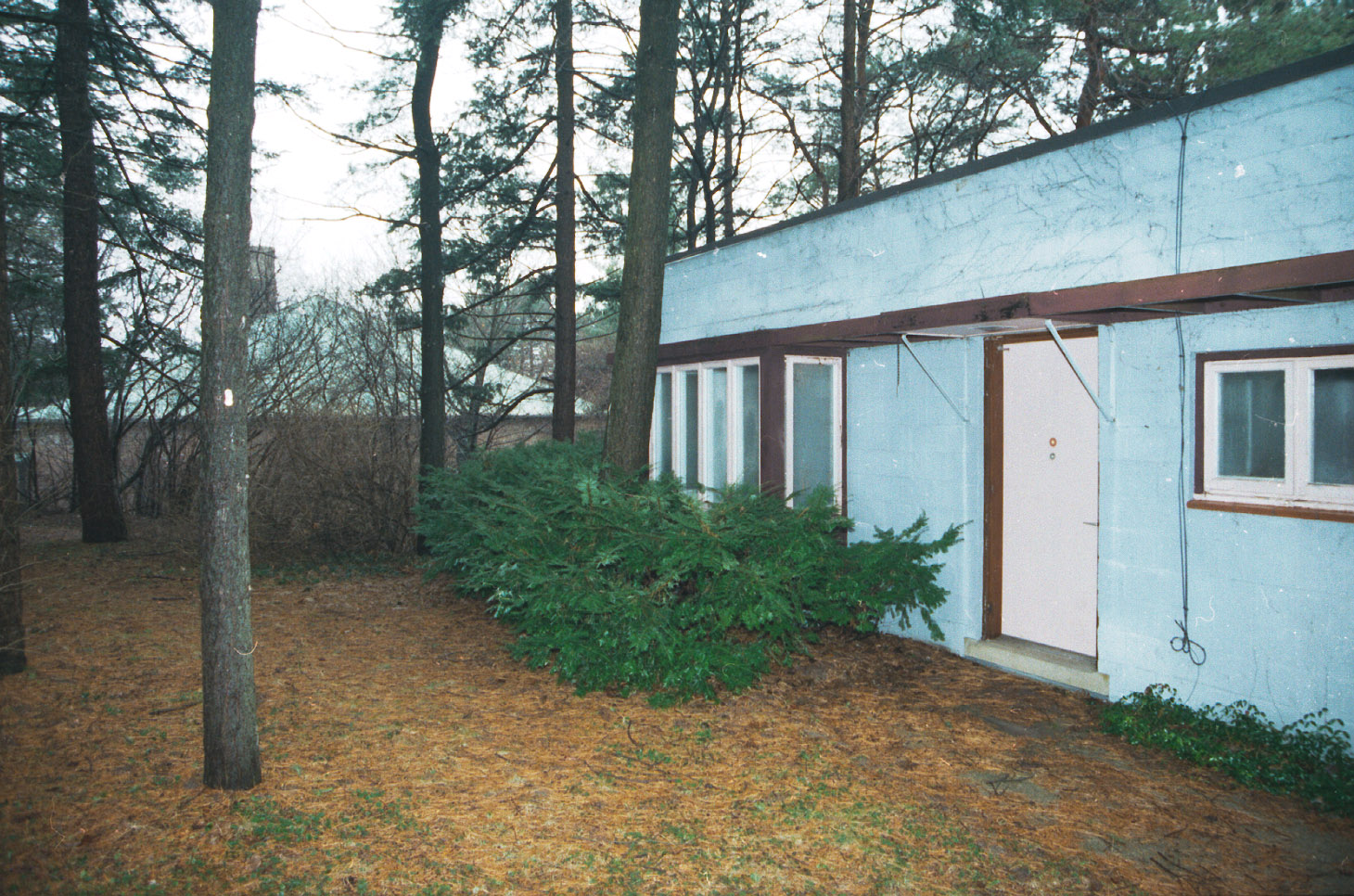
While working in our digital database recently, I came across an image of something called Chanticleer Cottage. The unusual name and image piqued my interest.

Chanticleer Cottage, 1998

Chanticleer Cottage, 1998. Courtesy Cranbrook Archives

Chanticleer Cottage started out as the “Chicken House,” built in 1945 on the site of the old toboggan slide at Cranbrook School. It was also known as the “Biological Lab,” “Experimental Building,” and “Animal House.” The structure was built to house chickens that accompanied Holland Sperry, the new head of Cranbrook School’s science department. The cost of the 20 x 30 foot building was just under $10,000. Sperry used the chickens to study genetics, and students in the science department completed experiments and conducted research on animals. The most famous resident of the “Chicken House” was Esmerelda, a single-comb White Leghorn who celebrated her 12th birthday (100 in human years) with a cake and candles.

Early cottage occupant Esmerelda celebrates her birthday

Early cottage occupant Esmerelda celebrates her birthday with student Ethan Golden. Pontiac Daily Press

Sperry retired in 1957. In 1958 the building was remodeled into a three bedroom house, at a recommended cost of $25,000 and turned into faculty housing. It was given the more elegant name of Chanticleer Cottage. The building was demolished in 1998 to make way for the Natatorium.

Cheri Y. Gay, Archivist


The Golden Anniversary of Horizons-Upward Bound at Cranbrook

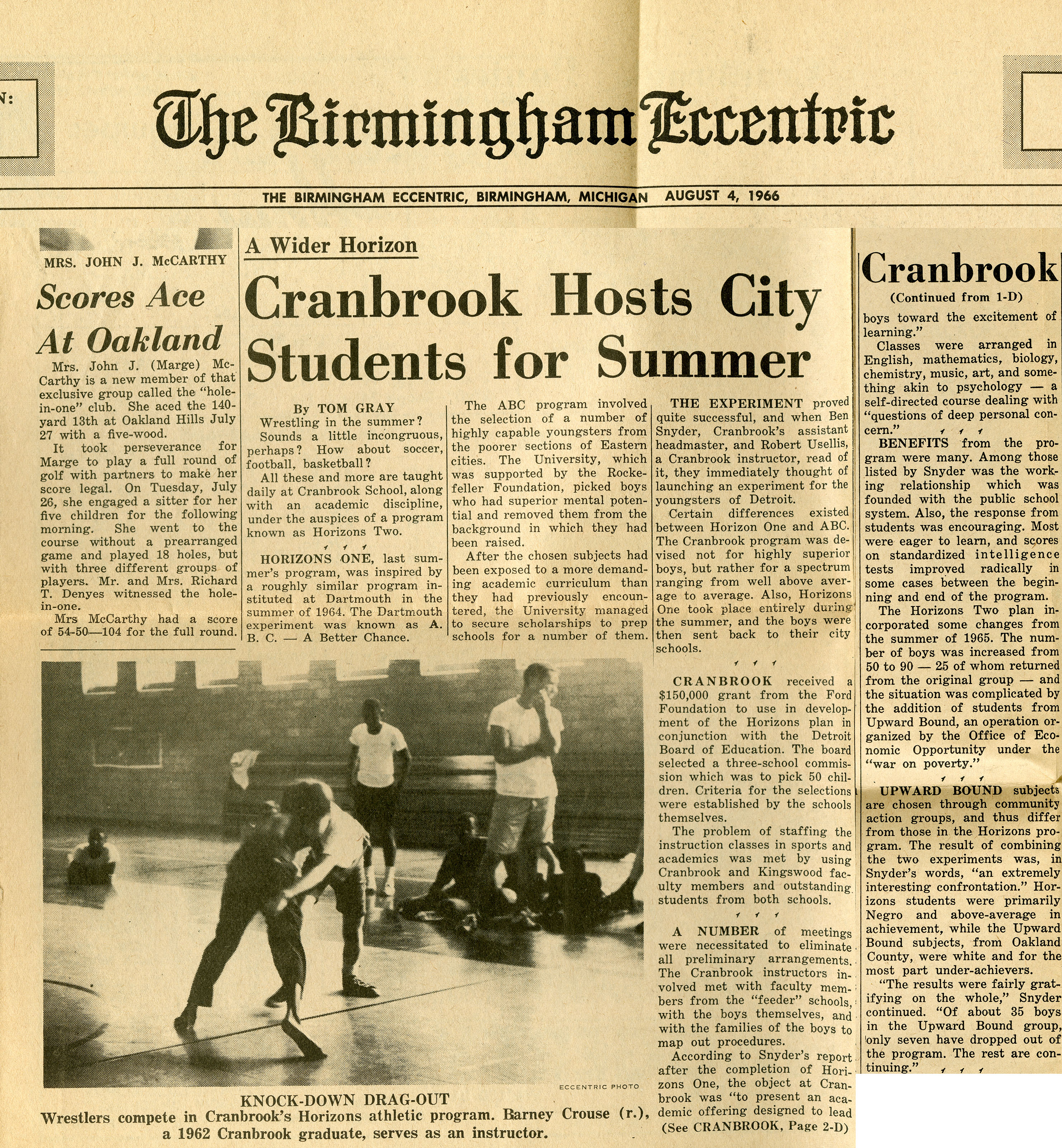
The Archives new exhibition, “50 Years Strong: The Evolution of HUB at Cranbrook,” opens this Saturday, April 25th, in the lower level of Cranbrook Art Museum. Horizons-Upward Bound, known as HUB, has its roots in a partnership with Cranbrook Schools that began in 1965. Over the past fifty years, HUB has evolved into a year-round program which prepares both boys and girls with limited financial opportunities to enter and succeed in post-secondary education.

HUB Theme Day, 1971

Horizons-Upward Bound Theme Day, 1971. Photographer, Jack Kausch. Cranbrook Archives.

The exhibition sheds light on the history of the program and its continued affiliation with Cranbrook Schools and highlights key individuals and events that have helped make it the successful legacy it is today. Through news clippings, program invitations, brochures and newsletters, student publications, and historic photographs, the exhibition presents a chronological history of the multi-faceted academic enrichment program known as HUB.

News Clipping, 1966.

News clipping, The Birmingham Eccentric, 1966. Cranbrook Archives.

A Man of Many Words

At Cranbrook, the legacy of Samuel Simspon Marquis is clearly visible. A trusted advisor to George Booth, Dr. Marquis oversaw the completion of Christ Church Cranbrook and became the first Rector when the parish was officially established in 1927. He was also instrumental in the founding of the Cranbrook School for Boys and was a Trustee of the school from 1926-1939. On 23 May 1940, Marquis Hall was dedicated in his honor.

Prior to his arrival at Cranbrook, Dr. Marquis was invited by Henry Ford to head the Sociological Department at Ford Motor Company. Marquis remained in this position for five years and accompanied Ford on the ill-fated “Peace Ship” to Europe in 1915. In 1923 Marquis published Henry Ford: An Interpretation, one of the first works written by an employee close to Ford. Marquis’ work with Ford is well-documented in our collection here at Cranbrook and at the Benson Ford Research Center.

When the Fairies Go To Church

Unpublished poem by Samuel S. Marquis, Samuel Simpson Marquis Papers, Cranbrook Archives.

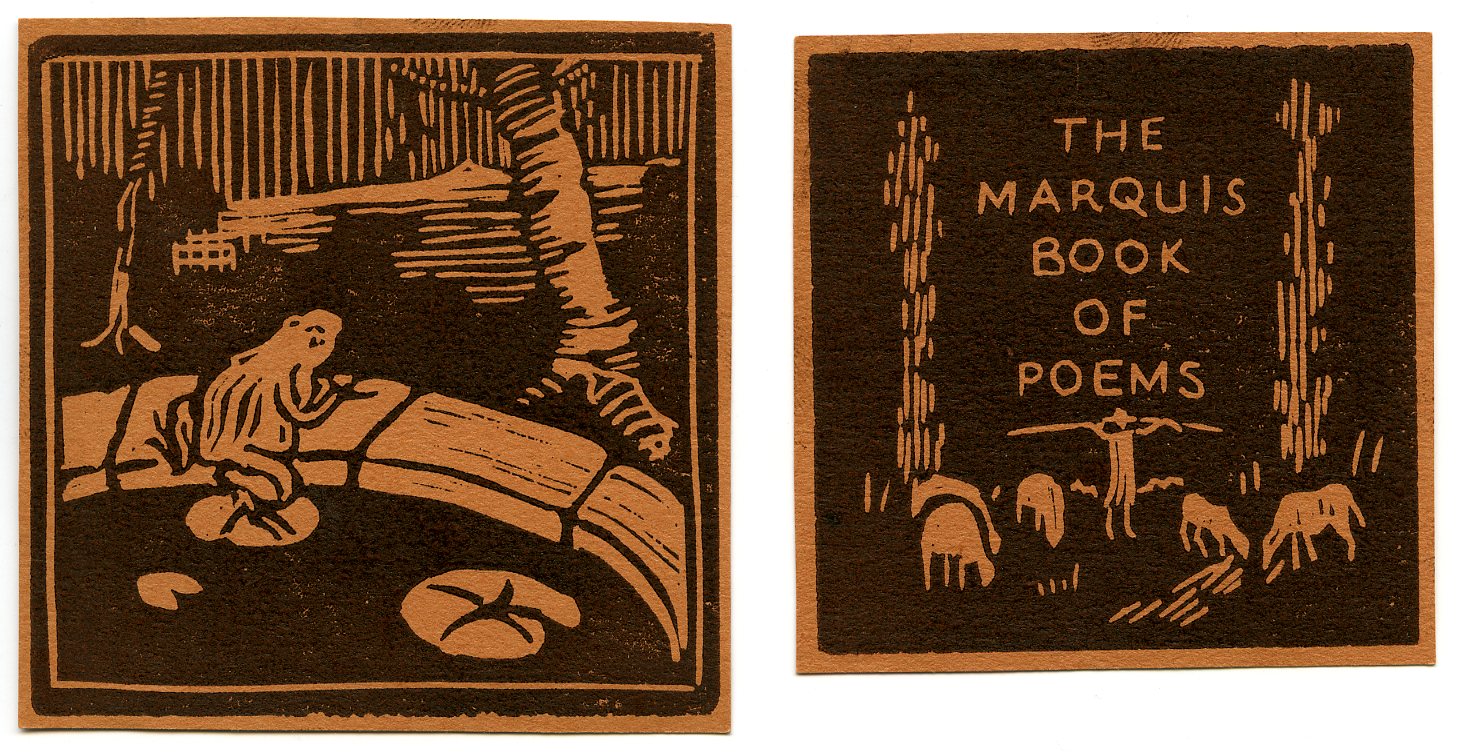
While doing research here at Cranbrook, I discovered that Marquis was also a prolific writer. He wrote not only about religious topics, but about history, the political climate of the day, and even poetry. Below are samples of the book plates for the unpublished Marquis Book of Poems. Enjoy!

Marquis Book of Poetry

Cover and interior plates from The Marquis Book of Poems, Samuel Simpson Marquis Papers, Cranbrook Archives.

Gina Tecos, Archivist

Photo Friday: The Art of Richard Thomas

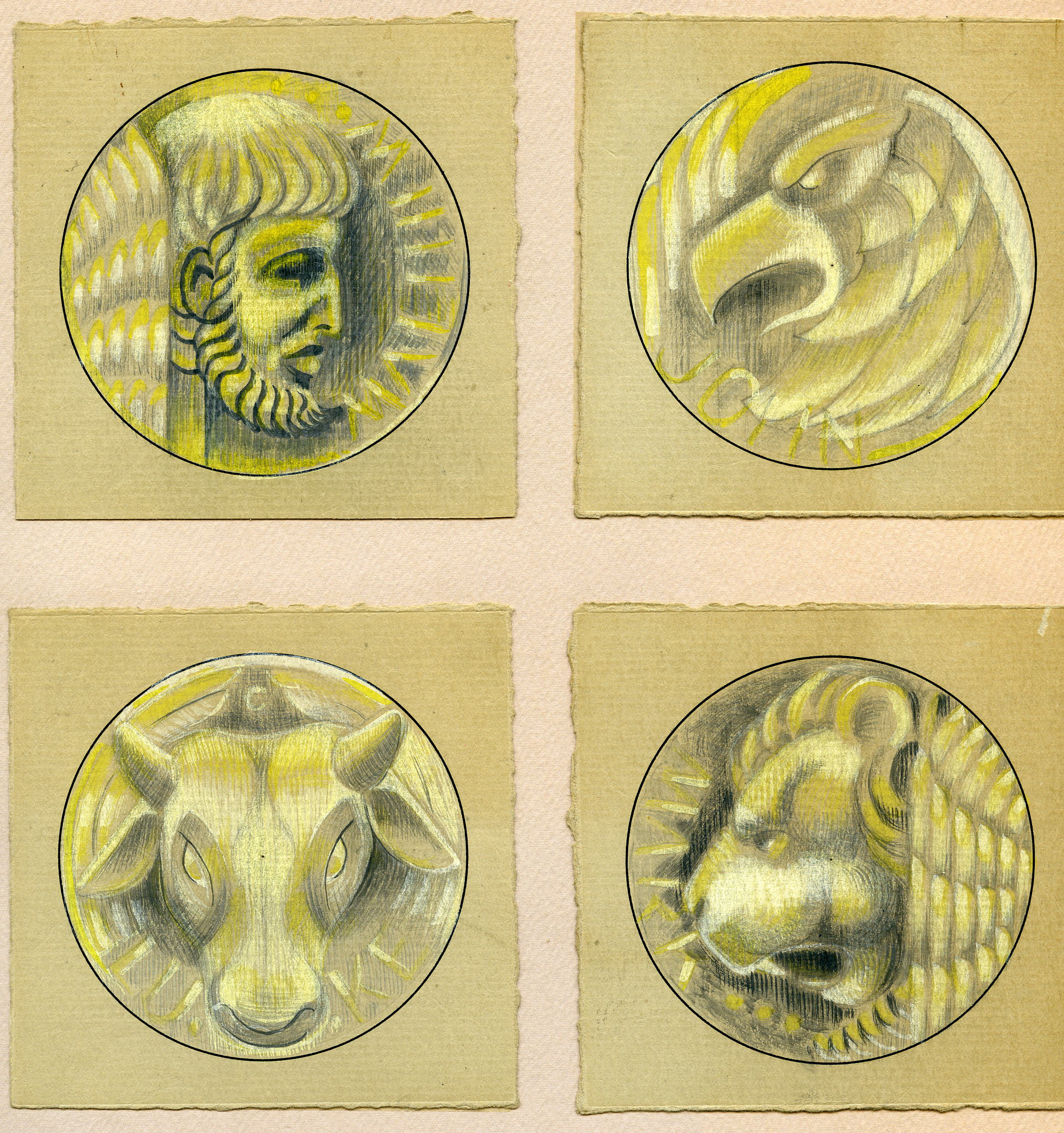
While researching an archival query this past week I discovered yet more hidden gems in our collection—the work of metalsmith Richard Thomas (1917-1988). Thomas held several positions at Cranbrook, including Head of the Metalsmithing Department, Dean of Students, Registrar, and Administrative Assistant to the President. The Archives has a small collection which documents many of Thomas’ private commissions.

One of the key works he created for Cranbrook was the Ceremonial Mace (1978) at the request of the Cranbrook Educational Community. Traditionally, the Christian processional cross had been carried at Cranbrook and Kingswood Upper School graduation ceremonies, but by the 1970s, upper school students objected to the fact that the cross did not accurately reflect the religious beliefs of the diverse student body. In 1973 and 1974, Kingswood head, Wilfred Hemmer, moved the cross from the front of the processional to the rear, then in 1975 agreed to remove it from the ceremony altogether.

Cranbrook Mace

Photo courtesy Cranbrook Art Museum.

After Hemmer’s resignation in early 1976, acting head Christopher Corkery reinstated the processional cross and a student protest ensued. Letters to the editor were written to both upper school newspapers and four Kingswood seniors refused to attend the Kingswood commencement. By May, ten percent of the student body threatened to boycott the ceremony.

Thomas’ design of the Cranbrook Mace incorporates symbols of four major religions: the Christian cross, the Star of David, the Crescent of Islam, and the symbol of Yin and Yang which represents the Eastern philosophies of China, Japan, India and Indonesia. The seals of the Cranbrook institutions are also a part of the design of the mace, which is made of rosewood, ivory, steel, sterling silver and gold.  The Cranbrook Mace is still used in graduation ceremonies to this day.

Richard Thomas sketch

Sketch from the Richard Thomas Papers, Cranbrook Archives.

In 1981, Thomas was awarded the Cranbrook’s Founders Medal. His design and fabrication of liturgical objects can be seen in more than ninety churches, synagogues, and temples across the country. He designed the Cranbrook Foundation’s silver punch bowl, the Saarinen Medal, and the commemorative medal for the Academy of Art’s fiftieth anniversary.

Gina Tecos, Archivist and Leslie S. Edwards, Head Archivist

John Cunningham and the Cranbrook School Mosaics

One of Cranbrook School’s earliest art teachers, John Cunningham (1904-2004), was a man of many talents. Born in New Jersey to a literary and artistic family, Cunningham attended a Manhattan prep school but spent summers working on ships that sailed the globe. After receiving both his undergraduate and graduate degrees in art from the University of California,  he studied painting with Hans Hoffman in Munich, and sculpture and painting with André Lhote in Paris.

Cunningham landed back in New York during the depression where he picked up odd jobs painting murals in the Catskills and set design for the Philadelphia Symphony Orchestra before he landed a position as the Head of the Fine Arts Department at Cranbrook School for Boys in 1931. By December, Cunningham had created a large transparency in imitation of a stained glass window. It was placed in the Cranbrook School dining hall during the Christmas pageant and was illuminated from behind with floodlights.

Cranbrook School Art Instructor, John Cunningham

John Cunningham in the Club Room, 1933 Richard G. Askew, photographer.

Wildly popular with the students and the faculty, Cunningham formed an Art Club. One of the major projects of the club students was to transform an unfinished room (now home to the Robotics Club) under the Senior Study Hall into a “very elaborate club room.” The highlight of the room was a series of hand-set glass mosaics by Cunningham that represented great men of antiquity. (Originally, his plan was to have one wall of panels representing ancient figures and a second wall which featured more modern figures including Sun Yat Sen, Ghandi and Lenin. This was never realized.) Additional changes to the room included the addition of a fireplace and ceiling stencils created by the boys that portrayed the history of transportation.

Cunningham was also known for the work of his students – particularly wood sculptures created by the Lower School boys. These were featured in an exhibition at the Kalamazoo Art Institute in 1932, and were so well received that additional museums across the state featured the exhibition as well before being displayed in the 1933 Century of Progress Exposition in Chicago.

Mosaic detail by John Cunningham

Mosaic detail by John Cunningham, 2015. Leslie S. Edwards, photographer.
The mosaic, which features Imhotep, Buddha, Christ, and Francis of Assissi remains today. The door no longer exists and the painted beams have been covered by a drop ceiling.

While it is not clear exactly why Cunningham left Cranbrook, his view of modern art did not mesh with that of headmaster William O. Stevens. The Cranbrook School paper The Crane reported that Cunningham was leaving to pursue work in Czechoslovakia. At the end of the 1932-1933 school year (during the time of the national Bank Holiday), Cunningham resigned. He and his wife ultimately returned to California where they purchased the Carmel Art Institute where Cunningham taught until it closed in 1992.

~ Leslie S. Edwards, Head Archivist

Lost and Found in a Sea of Cranbrook History

Ye Triumphe Ship

Ye Triumphe Ship, CEC 1918.1

Every day at the Center for Collections and Research brings new adventures and discoveries. During a visit to one of the storage spaces on Cranbrook’s campus, I stumbled upon a curious object, which inspired me to research it and its past. Like most things around here, the object has a great lineage throughout the campus with connections to George Booth, the Detroit Society of Arts and Crafts, and Cranbrook School.

The Ye Triumphe model ship was crafted by Henry Brundage Culver (1869-1946), and although it is a model, it is a large one: about 40 inches long and 32 inches high. George Gough Booth purchased the Ye Triumphe in September 1918 from the Detroit Society of Arts and Crafts. The model, which was advertised in the Detroit Sunday News, had been on display in the window of the Detroit Society of Arts and Crafts shop during that same year.

Henry Brundage Culver worked as an attorney and also served as secretary for The Ship Model Society in New York. He participated in building ship models, and contributed to scholarship on the art of model-making. He produced several publications including Contemporary Scale Models of Vessels of the Seventeenth Century (1926) and The Book of Old Ships: Something of their Evolution and Romance (1924). In the introduction to Contemporary Scale Models Culver compares the art of ship-model building to that of painting.

The finest examples of these miniature vessels are, in the eyes of those best fitted to judge productions of the highest artistic quality, appealing in general composition, line, mass and technical execution, to the aesthetic susceptibilities of those, who have eyes to see, in a no less degree than do the best examples of pictorial art.”

­—Henry B. Culver, Contemporary Scale Models of Vessels of the Seventeenth Century, New York: Payson and Clarke Ltd.1926, pg.ix.

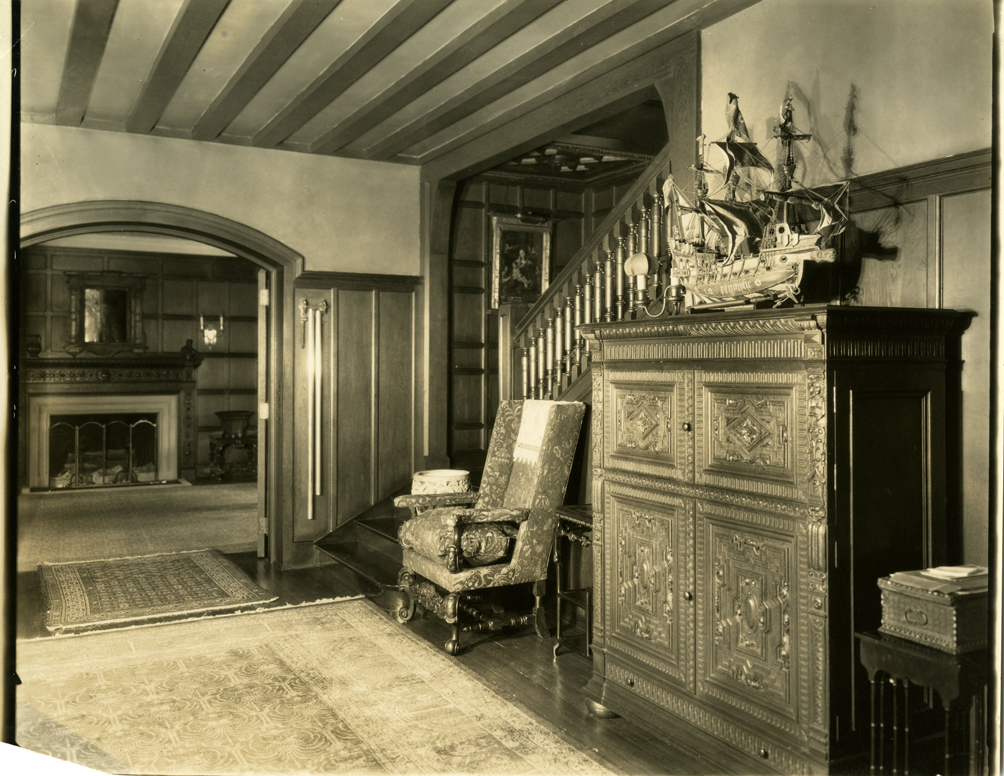
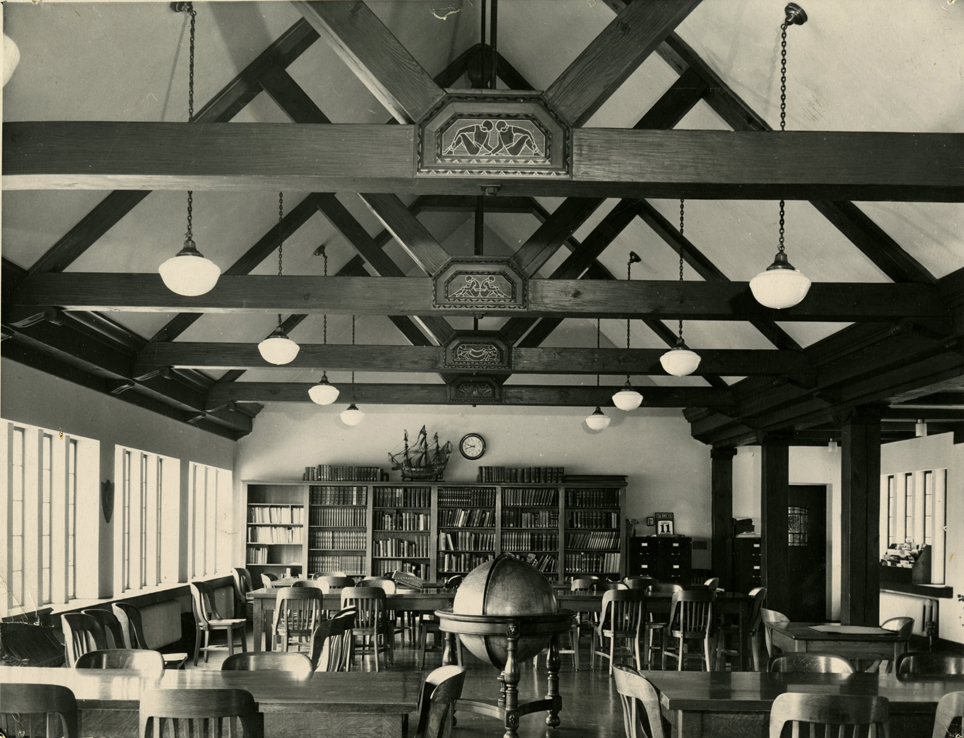
Originally, the ship was placed in the reception hall of Cranbrook House, and was later loaned by Booth for display in the library at Cranbrook School for Boys. Each of the photographs show the ship on display and its presence throughout Cranbrook.

CH_entrance hall_Ship_Blogpost

Cranbrook House reception hall, ca. 1920. Cranbrook Archives

CS_Library_Ship_Blogpost

Cranbrook School for Boys, Library interior, ca. 1945. Cranbrook Archives.

The Ye Triumphe will be returning to view at the Cranbrook Art Museum’s upcoming exhibition The Cranbrook Hall of Wonders: Artworks, Objects, and Natural Curiosities opening November 23rd, 2014. Come and check out the Ye Triumphe and many other fabulous objects from across the Cranbrook campus including works from the Center for Collections and Research, Cranbrook Art Museum, and the Cranbrook Institute of Science!

—Stefanie Kae Dlugosz, Center for Collections and Research, Collections Fellow

Happy Belated Birthday to Our Founder!

September 24th marked the 150th birthday of Cranbrook’s founder, George Gough Booth. Born in Toronto, Mr. Booth had an early interest in art and architecture. In 1881 his family moved to Detroit and he put his artistic talents to work by purchasing half of an interest in an ornamental ironworks firm. The business was successful and used many of Booth’s product designs.

George Gough Booth, ca 1876.  W. E. Lindop, photographer.  Cranbrook Archives

George Gough Booth, ca 1876. W. E. Lindop, photographer. Cranbrook Archives

In 1887 Booth married Ellen Warren Scripps, daughter of Detroit News founder James Scripps. The following year he sold his share in the ironworks business and joined the News staff as its business manager. The News blossomed under Booth’s direction, becoming one of the leading metropolitan dailies in the nation. In 1906, Booth became president of the newspaper, succeeding his father-in-law.

In 1904 George and Ellen Booth purchased a run-down 174 acre farm in Bloomfield Hills and named it Cranbrook after Booth’s ancestral town in England. Booth called upon his long-time friend, and noted Detroit architect, Albert Kahn, to prepare working drawings for the building of Cranbrook House. Kahn responded with an English Arts and Crafts inspired design the Booths moved into their new home in 1908.

In 1922, believing their country estate could serve a larger public purpose, the Booths shifted their focus toward building the six institutions at Cranbrook: Brookside School, Christ Church Cranbrook, Cranbrook School (for boys), Cranbrook Academy of Art, Cranbrook Institute of Science, and Kingswood School (for girls). George Booth was a visionary, and with his wife Ellen, set new standards for generosity, leaving us a legacy we are proud to be a part of. Happy belated birthday George!

“We were unwilling to go through life with our aims centered mainly in the pursuit of wealth and with a devotion wholly to the ordinary opportunities for social satisfaction.  We were not willing to leave all of the more enduring joys for our children or the joy of work in so good a cause entirely to our friends after we had passed on; rather did we wish, in our day, to do what we could and give tangible expression now to our other accomplishments by adventures into a still more enduring phase of life.  We wished to see our dreams come true while we were, to the best of our ability, helping to carry on the work of creation.”  (George Gough Booth, Address at Founders Day, October 28, 1927)

Gina Tecos, Archivist

Currently off-site doing research at the Archives of American Art in Washington, DC, Cranbrook Art Museum’s Jeanne and Ralph Graham Collections Fellow Shelley Selim has been making her way through the Harry Bertoia papers there. She stumbled upon this delightful tidbit today:

A September, 1942, letter from artist and designer Bertoia to his fiance Brigitta Valentiner captures the awkwardness of eating on Cranbrook’s campus as an instructor at the Academy of Art: “We still go over to the boys’ school to eat. Excellent food is served with an overdose of etiquette which for me is hard to swallow.”

Harry Bertoia, 1942. Richard Askew/Cranbrook Archives.

Harry Bertoia, who began studying at the Cranbrook Academy of Art in 1937 and was enlisted as the head of the Metalsmithing Department by 1938, might have felt an extra level of discomfort at the dining experience at Cranbrook School—only 24 years old when he began his tenure as an instructor, he likely looked the same age as many of the high school students.

The formality captured in Bertoia’s letter is not overstated, however. Film footage of Cranbrook School in the 1930s shows a formalized dining experience that would be unrecognizable to today’s students, with uniformed maids delivering hot dishes to the young boys who line up at their tables in coats and ties, waiting to sit in unison.  The film is featured in the Center’s current exhibition Cranbrook Goes to the Movies, on view now at Cranbrook Art Museum.

Shelley’s Bertoia research, meanwhile, has proven productive, feeding into an exciting project that Cranbrook Art Museum is cooking up in honor of the 100th anniversary of Harry Bertoia’s birth in 2015. We can’t say more right now, but watch the CAM website as this project develops over the new few months. And, just because we love it, enjoy a photo of Harry Bertoia and Brigitta Valentiner at Cranbrook Academy of Art’s themed “Come as a Song” party in 1942! We featured it as a Photo Friday a while ago, but it is just too good to not post again.

"Come as a Song" party, 1942.  Cranbrook Archives.

“Come as a Song” party; Harry Bertoia and fiance Brigitta Valentiner speak with an unidentified man in a playing card costume, 1942. Cranbrook Archives.

Shoshana Resnikoff, Collections Fellow, and Shelley Selim, Jeanne and Ralph Graham Collections Fellow, Cranbrook Art Museum

Photo Friday: Cranbrook’s World Cup

Cranbrook student John Vining Ogden (left) competes for the ball in a match against the opposing team from Nichols, a rival school, 1960. Cranbrook Archives/Harvey Croze.

Cranbrook student John Vining Ogden (left) competes for the ball in a match against the opposing team from Nichols, a rival school, 1960. Cranbrook Archives/Harvey Croze.

As we prepare for the final round of World Cup soccer (Germany vs. Argentina, this Sunday), we’re looking back on Cranbrook’s own soccer history. Here, Cranbrook student John Vining Ogden tries to get one step ahead of a rival player as they vie for control of the ball. We’re especially taken with the Nichols’ players’ uniforms: with their striped jerseys, they look like a team made up entirely of referees!

Create a website or blog at WordPress.com