July 5th, 2025, marks one hundred years since the groundbreaking for Christ Church Cranbrook. As we mark this milestone in Cranbrook’s history, I believe it is important to reflect on George Gough Booth’s long discernment of this generous gift to the community.
From the beginning, there were always places of worship at Cranbrook. The story that leads us through these spaces to the establishment of Christ Church Cranbrook is especially meaningful to me.
Rev. Dr. S. S. Marquis, D.D. with the first spade of earth, July 5, 1925. Courtesy of Cranbrook Archives, Cranbrook Center for Collections and Research.
After George and Ellen Booth purchased ‘The Farm’ in January 1904, his father, Henry Wood Booth, was the first family member to live on the country estate. The elder Booth stayed for the month of May with Frank Brose, the farmer, and his family. On May 15, 1904, the first worship service at Cranbrook took place under a tent, on the site upon which the Altar of Atonement now sits, with Henry as lay preacher. He continued in this ministry, also offering Sunday School, at the same spot until 1909. This was the first act of service offered to the Bloomfield Hills community at Cranbrook.
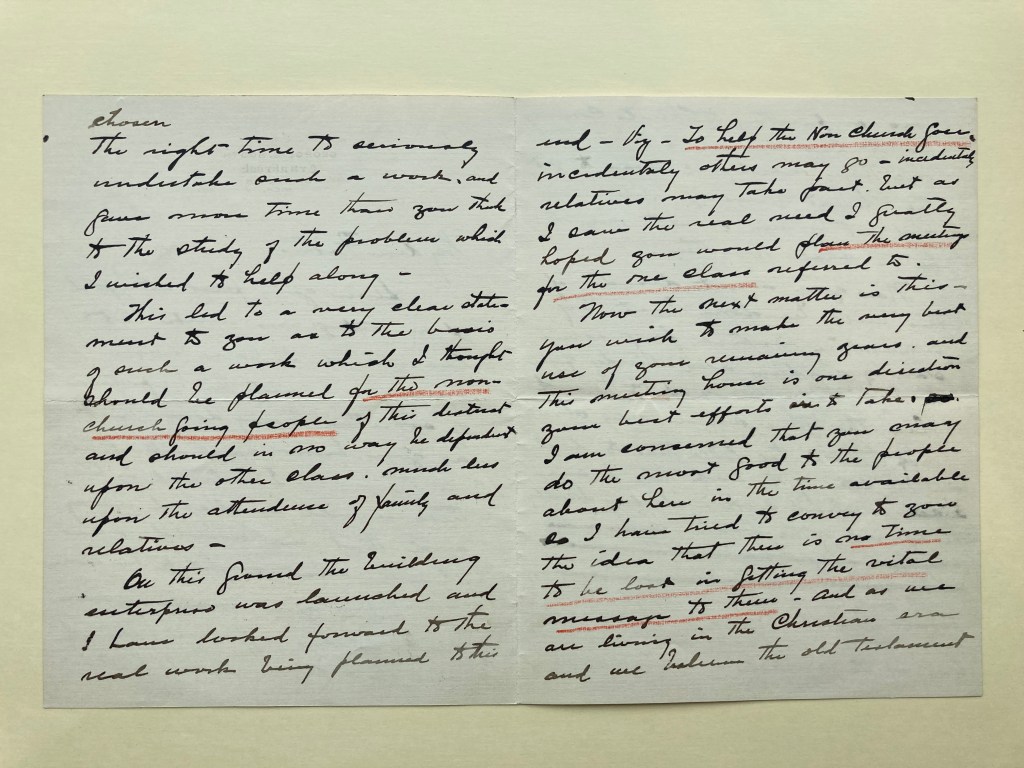
Letter from George Gough Booth to Henry Wood Booth, August 24, 1918. Courtesy of Cranbrook Archives, Cranbrook Center for Collections and Research.
In 1914, George and Ellen considered building a chapel at the site on which the Kingswood flagpole now sits, but the project was rejected, most likely due to the outbreak of World War I. As the war ended, a permanent place of worship and Sunday School was established with the building of the Meeting House.
The letter, above, preserves the dignity with which George writes of the Meeting House “building enterprise” to honor and give freedom to his father’s calling to share the Christ message with the non-church goers in the district. From this letter, we can learn and understand why George built the Meeting House for worship and Bible study through his father’s ministry.
Decoration of the Meeting House by Katherine McEwen, 1918. Laura MacNewman, photographer.
In the letter from George to his father, we also learn that he is prudent in observing the religious character of Bloomfield residents. During the years in which the Meeting House was used for religious services (1918-1926), Mr. Booth would reflect on the visiting clergy and service attendees (both of which came from diverse denominations), from which he would eventually discern the denomination of “Cranbrook church.”
What would you want for your 75th birthday? If you were painter Robert Hopkin, it would be an artists’ club named in your honor. The Hopkin Club, formed in 1907, had no rules, officers, or dues. The members wanted to get together occasionally, to talk about art or host artists visiting Detroit. Hopkin passed away in 1909, but the club continued. In 1913, The Hopkin Club established by-laws and was renamed the Scarab Club–the name it continues under today.
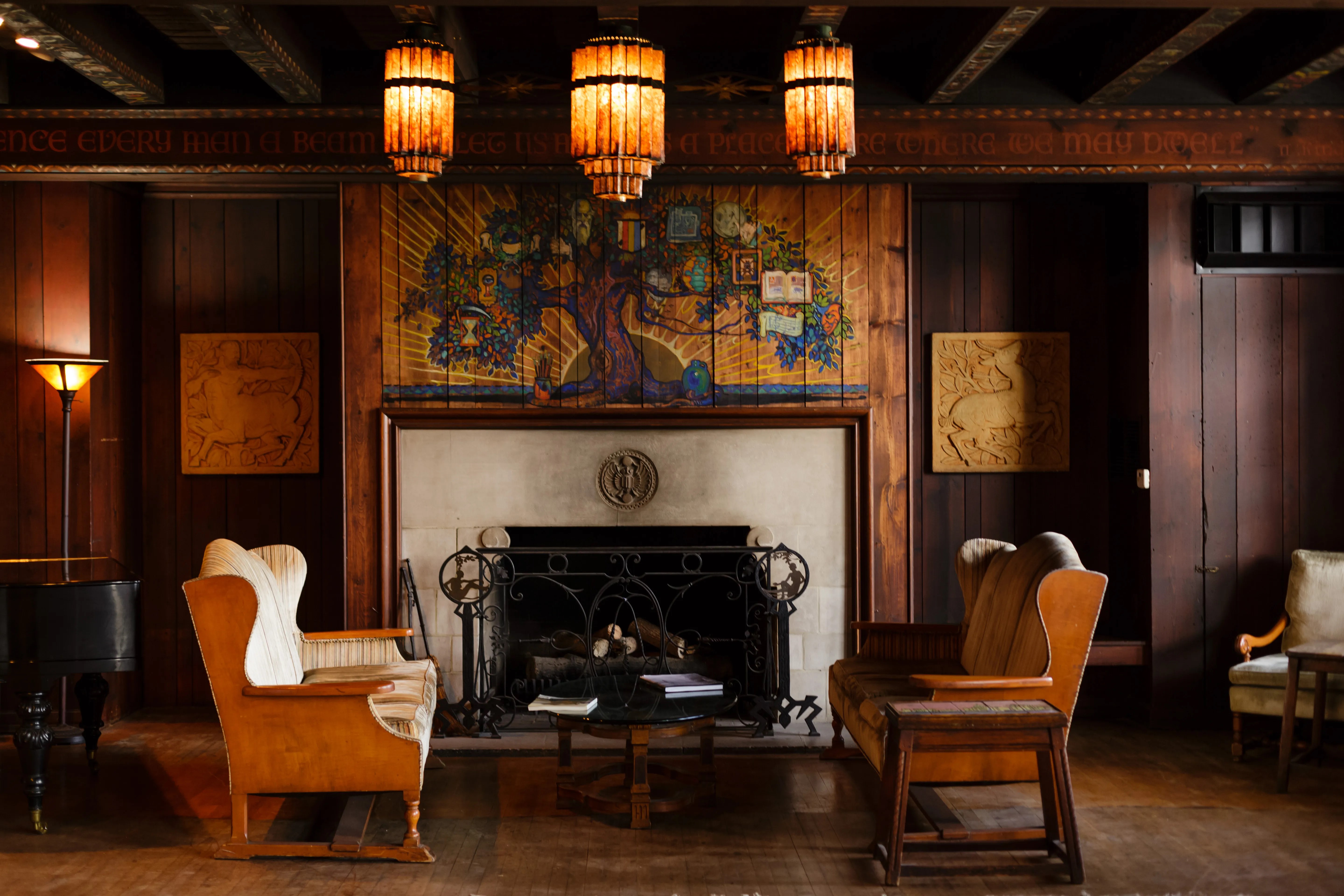
Scarab Club Room. Photography courtesy of Scarab Club.
But who was the man the club was originally named after?
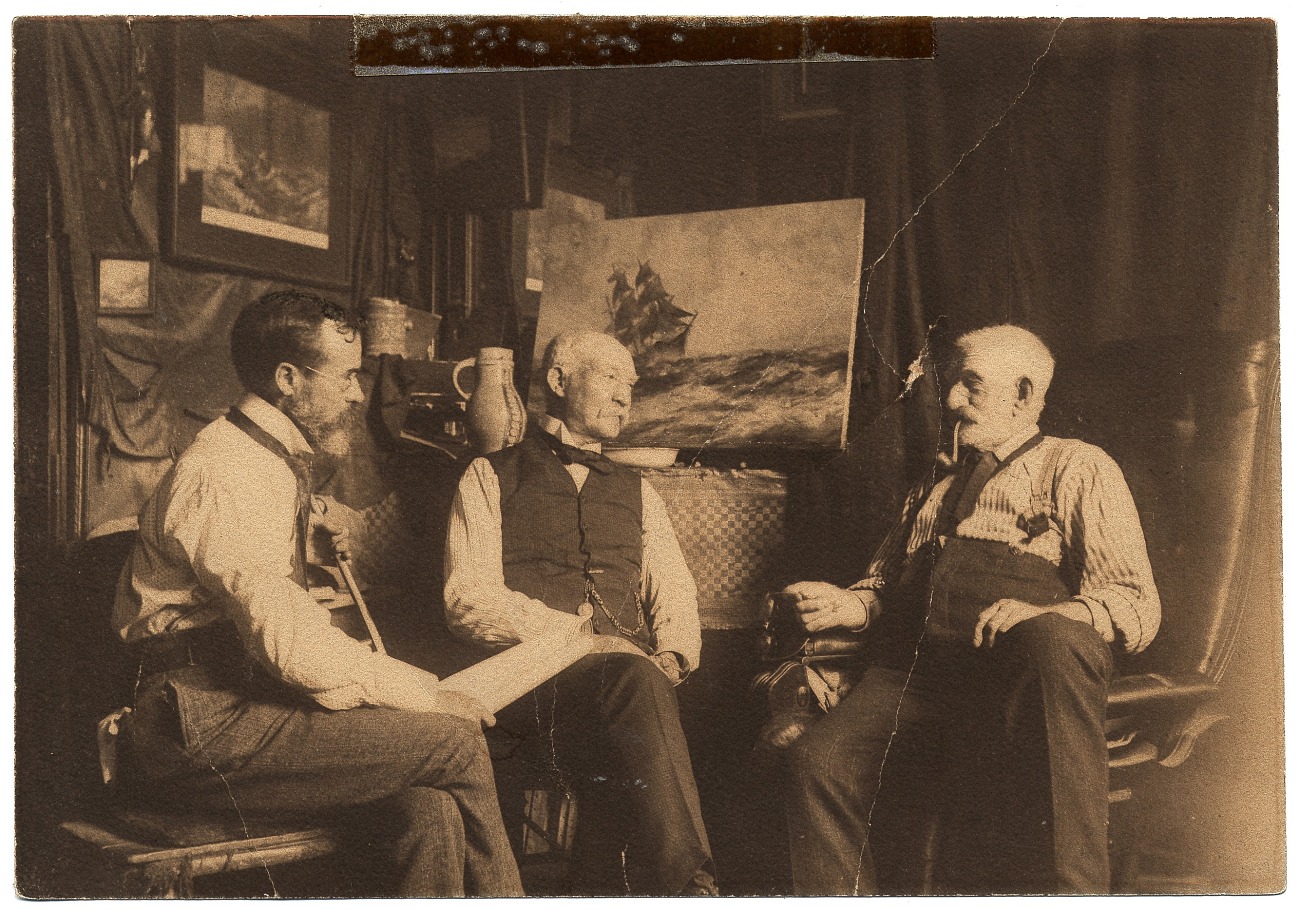
Robert Hopkin was a maritime/marine artist born in Glasgow, Scotland, in 1832. He learned to paint and draw from his father. The family emigrated to Detroit in 1842. His grandfather was a sea captain which drew Hopkin to work on the wharves in Detroit and inspired his art. Though chiefly known as a painter of marine scenes and seascapes, Hopkin made frequent trips throughout the American west from 1860 to 1885, painting murals for public buildings and drop curtains and scenery for theaters, including the Tabor Grand Opera House in Denver.
Robert Hopkin (right) and others in studio, ca. 1900. William H. Thomson papers, 1912-1950. Archives of American Art, Smithsonian Institution
In the latter half of the 19th century, Hopkins was considered the dean of Detroit artists; he decorated the interior (as well as the stage curtain) for the original Detroit Opera House (1868), painted murals in Detroit’s Fort Street Presbyterian and Ste. Anne’s churches, as well as the Cotton Exchange in New Orleans (1883). By April 1900, the Detroit Free Press wrote, “Many of the art lovers of this city possess one or more of [Hopkin’s] splendid marines, and they have been reproduced and published until everyone is familiar with his work.”
When Mr. Robert Hopkin’s Collection of Paintings opened at the Detroit Museum of Art in May 1901, “There was a large attendance of art-loving Detroiters” (Detroit Free Press, May 16, 1901).
Robert Hopkin (Scottish American, 1832 – 1909), Marine,Oil on Canvas. Cranbrook Center for Collections and Research.
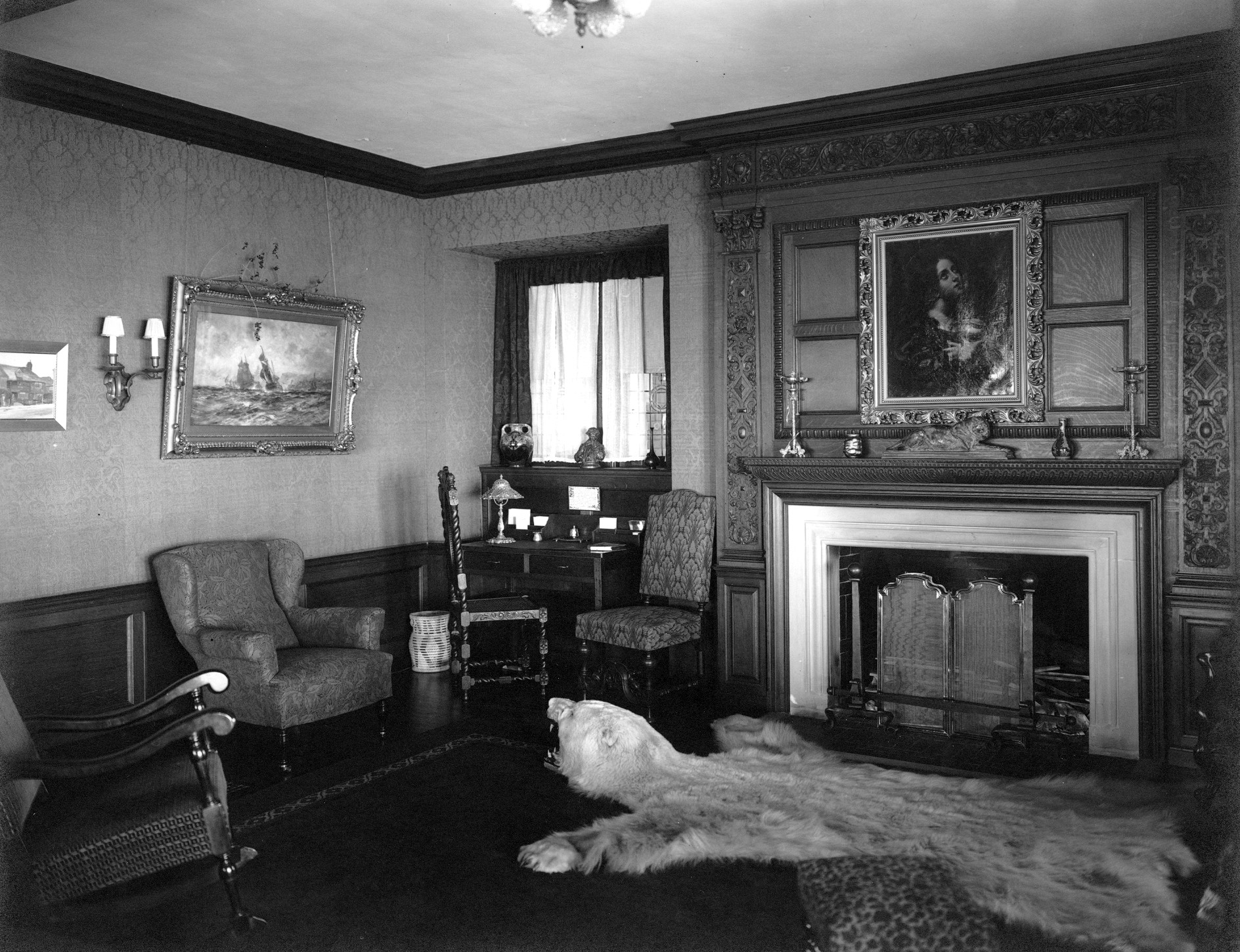
George and Ellen Booth were no exception. Art lovers with many Detroit-based and self-taught artists in their growing collection, the first inventory of Cranbrook House in 1914 lists two Hopkin “Marine” paintings. The Booths gifted the larger of the two paintings to their daughter Grace Ellen Booth and her husband Harold L. Wallace. The painting returned to Cranbrook House about 1955, when Grace Booth Wallace’s collection was donated to the Cranbrook Foundation.
Cranbrook House Living Room, circa 1909, with Marine visible on the left. Cranbrook Archives, Cranbrook Center for Collections and Research.
The Detroit Historical Society has a copy of the Souvenir Catalogue of Mr. Robert Hopkin’s Collection of Paintings in its collection. The 85 exhibited paintings are listed, with several black and white images of them. “Price List” is written on the cover, and notes have been made indicating which have been sold and who purchased them. (Sadly, the name “Booth” does not appear.)
Another art-loving Detroiter was Merton E. Farr president of the American Shipbuilding Company and owner of a number of freighters on the Great Lakes. His daughter, Carolyn, married George and Ellen Booth’s youngest son, Henry.
The Hopkin painting in the Thornlea collection. Cranbrook Center for Collections and Research.
In 1927, Farr gifted the couple a Hopkin “Marine.” The painting hung in Thornlea, home to Harry and Carol Booth, from 1927.
The painting’s official title is not noted. The Thornlea painting is interchangeably referred to as Homeward Bound, Schooner on a Stormy Sea, Sailing Ship at Sea, and Marine. However, the 1901 Hopkin exhibition catalog does not list any paintings with those titles.
– Leslie Mio, Associate Registrar, Cranbrook Center for Collections and Research
Some years ago, former Cranbrook Archivist, Robbie Terman, posted a short blog post on one of the Titanic’s sister ships, RMS Olympic. In recent years, Cranbrook Archives has responded to numerous requests for images of the Olympic which are preserved in the first volume of Harry Scripps Booth’s Pleasures of Life albums.
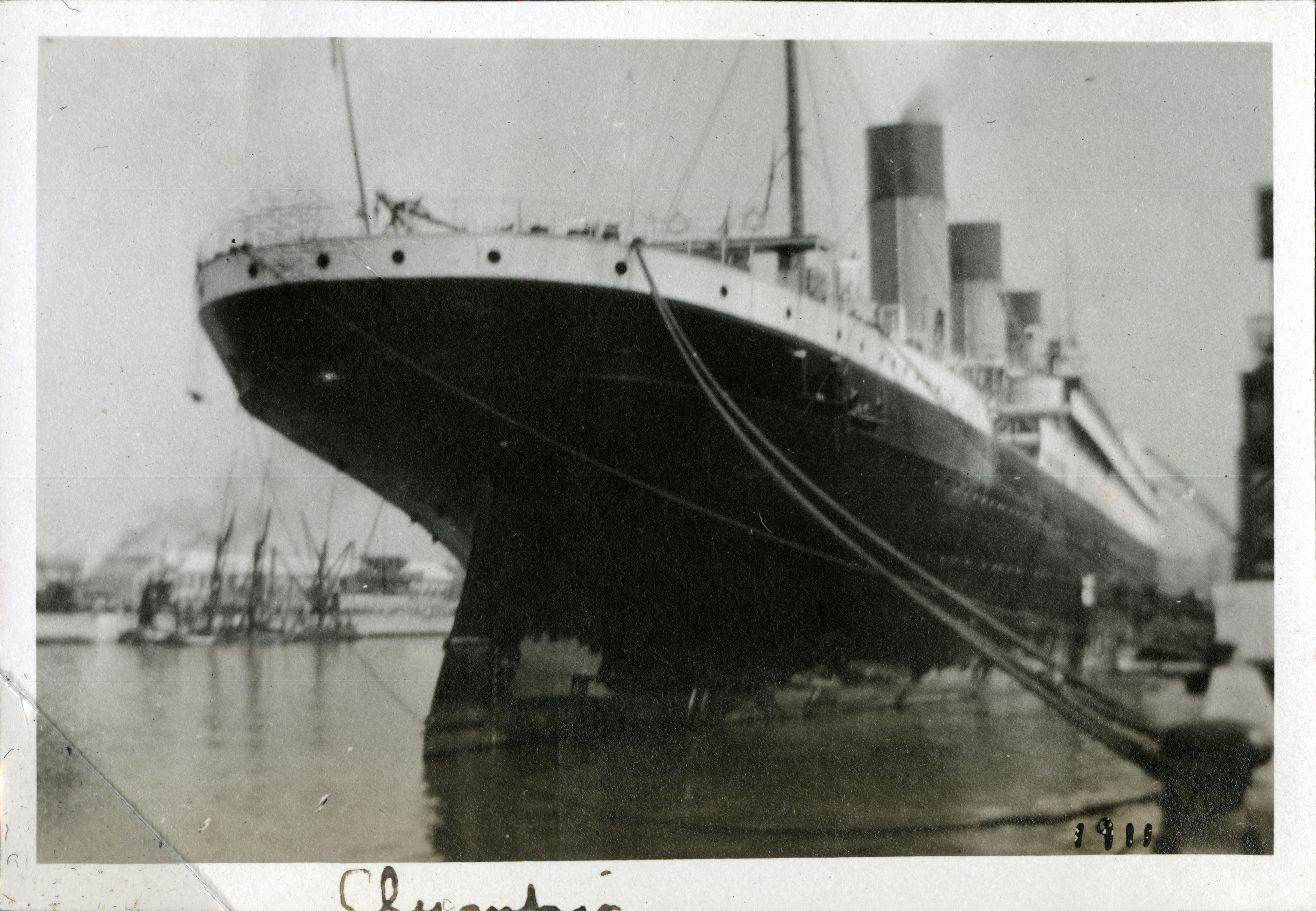
View of RMS Olympic before its first eastward crossing, June 28, 1911. [POL1.14.5]. Courtesy of Cranbrook Archives, Cranbrook Center for Collections and Research.
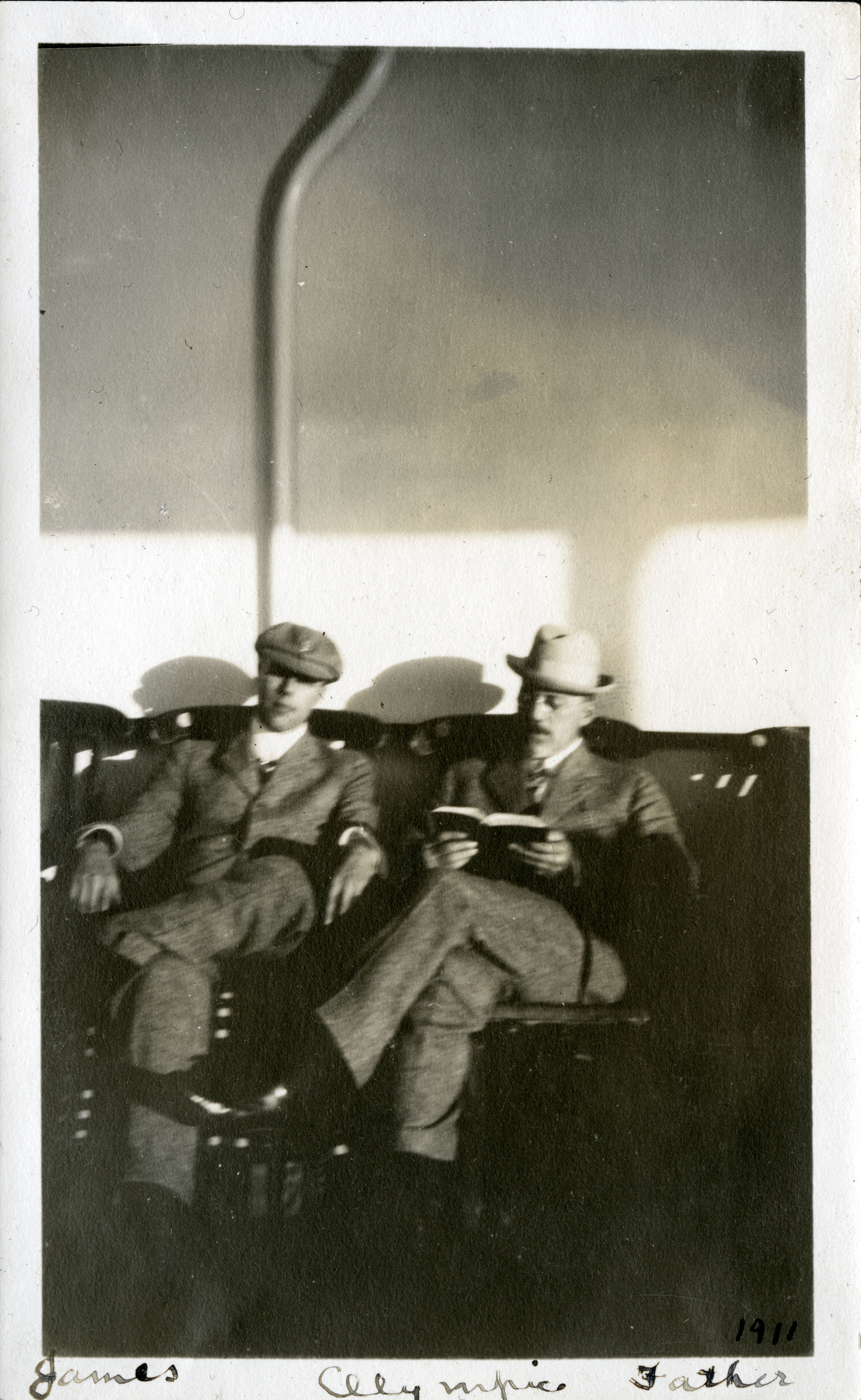
On June 28, 1911, the Booth family took the first eastward crossing of RMS Olympic from New York to Southampton, England. The family at that time was George and Ellen Booth; James Scripps and Jean McLaughlin Booth who had married the previous year; Grace, Warren, Henry, and Florence. They were joined by their Grand Rapids cousin, Esther Booth.
As I come from a maritime nation, these requests are particularly intriguing to me. I have wondered what other archives we have at Cranbrook to tell the story of transatlantic crossing and explain some of the images. George Gough Booth kept a record of the expenses in planning for the trip. These records tell us that he booked the steamship tickets with the Christian Leidich Travel Bureau in Detroit and he purchased Motor Union badges for himself and James.
James Scripps Booth and George Gough Booth on the RMS Olympic, July 1911.[POL1.10.2] Courtesy of Cranbrook Archives, Cranbrook Center for Collections and Research.
As Henry recalls in his memoir after listing the family members who sailed,
“That wasn’t enough. Parks, the chauffeur, went; also The Pierce-Arrow, a 7-passenger touring car, and a Lozier Briarcliff, which accommodated four plus one in an airy seat on the left running board, designed for the chauffeur when the “master” took the wheel. That seat was a thrill for the young at heart.”
Then I came upon something quite wonderful—Henry’s journal of the sea crossing! He began the trip when he was just 14 years old, celebrating his 15th birthday in August during the vacation. As I read the entries, the images in the Pleasures of Life came alive. Here follows some moments from the journey in Henry’s words.
“Stayed at the Plaza. Esther’s trunk was lost. We found it later. On June 28, we went abord [sic] the great ship, “Olympic.” Henry Scripps Booth, June 27, 1911
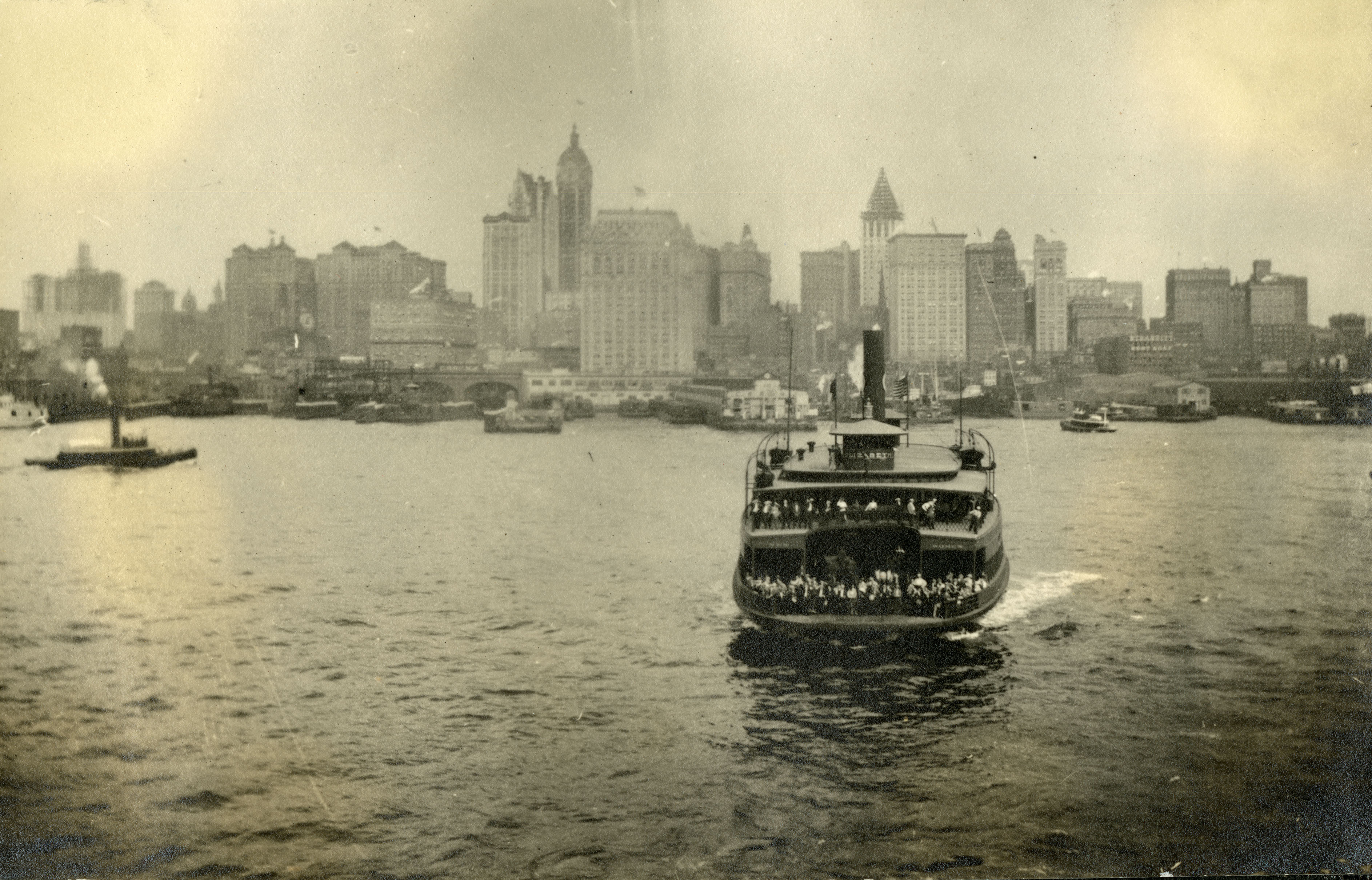
Leaving New York, June 28, 1911. Courtesy of Cranbrook Archives, Cranbrook Center for Collections and Research.
“On June 28, we went abord [sic] the great ship, “Olympic”. The Olympic is a fine ship. Florence was sick first night and day. It was somewhat rough on June 29th. I met a new friend but did not remember his name. In the morning, I could hardly stand, because of the new sensation. I was somewhat sick, but ate lots and I felt fine.” Henry Scripps Booth, June 28, 1911
“On June 30th the Campania was in view. I got acquainted with two girls, Constance Peabody and Katherine somebody.” Henry Scripps Booth, June 30th, 1911
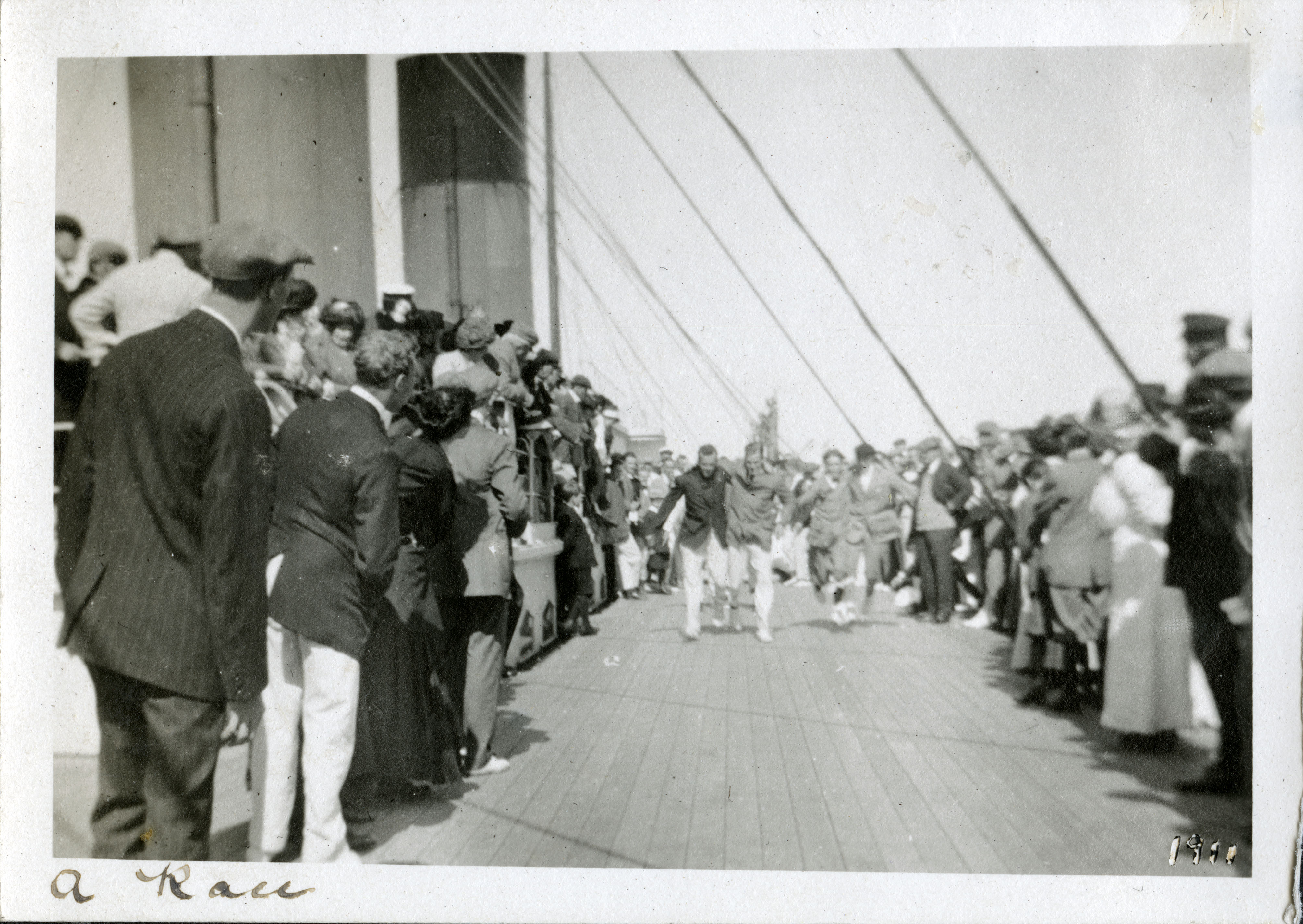
A race aboard the RMS Olympic on its first eastward crossing from New York to Southampton, July 1911. [POL1.11.4]. Courtesy of Cranbrook Archives, Cranbrook Center for Collections and Research.
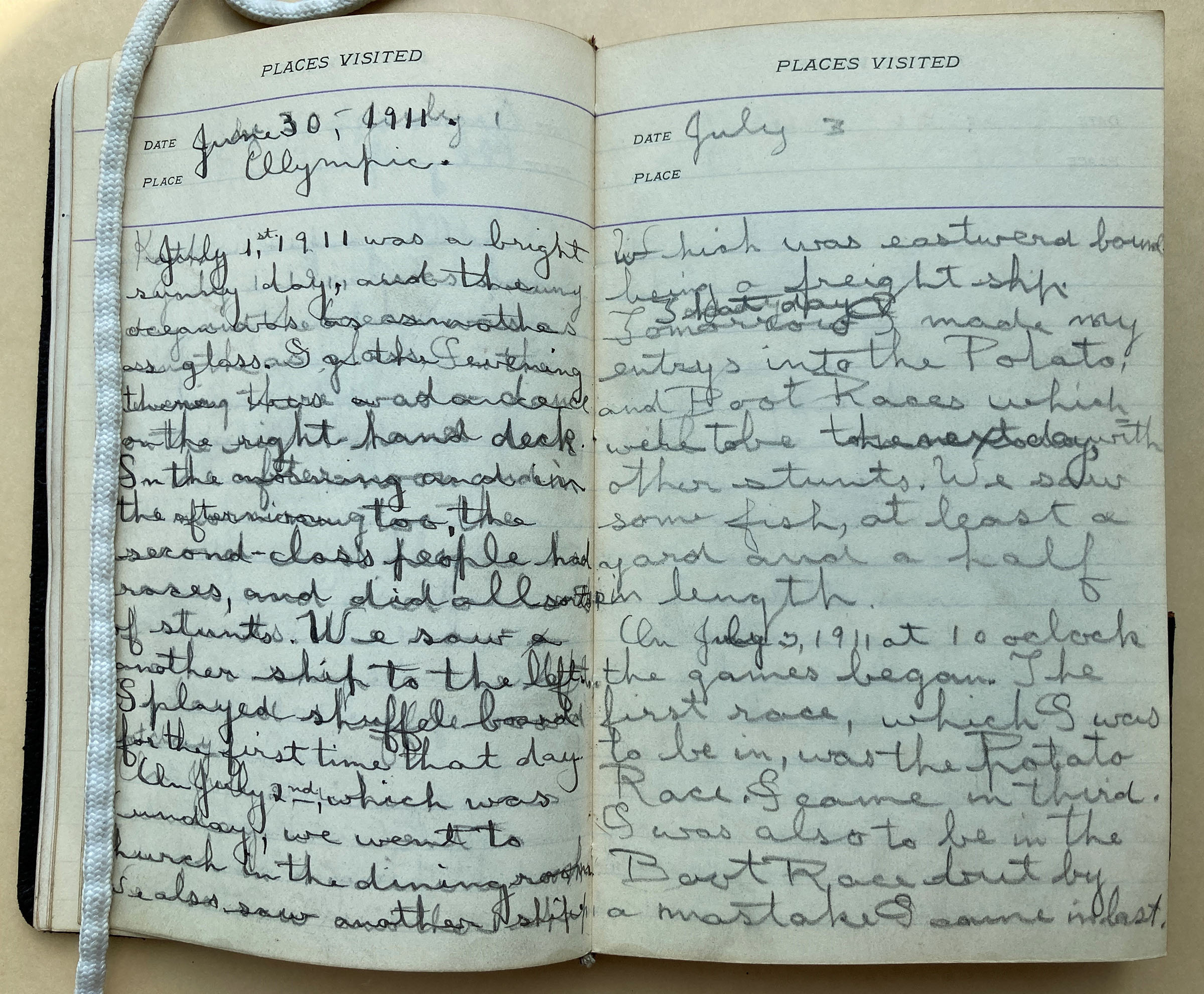
“July 1st, 1911, was a bright sunny day, and the ocean was as smooth as glass. In the evening, there was a dance on the right hand deck. In the morning and in the afternoon too, the second-class people had races, and did all sorts of stunts. We saw another ship to the left. I played shuffleboard for the first time that day. On July 2nd, which was Sunday, we went to church in the dining room. We also saw another ship [July 3] which was eastwerd [sic] bound being a freight ship.” Henry Scripps Booth, July 1, 1911
A race aboard the RMS Olympic on its first eastward crossing from New York to Southampton, July 1911. [POL1.12.5]. Courtesy of Cranbrook Archives, Cranbrook Center for Collections and Research.
“Tomorrow That day, I made my entrys [sic] into the Potato and Boot Races which were to be the next day with other stunts. We saw some fish, at least a yard and a half in length.
On July 3, 1911, at 10 o’clock the games began. The first race, which I was to be in, was the Potato Race. I came in third. I was also to be in the Boot Race but by a mistake, I came in last.
After other races came the Standing Broad Jump in which James sliped [sic].” Henry Scripps Booth, July 3, 1911
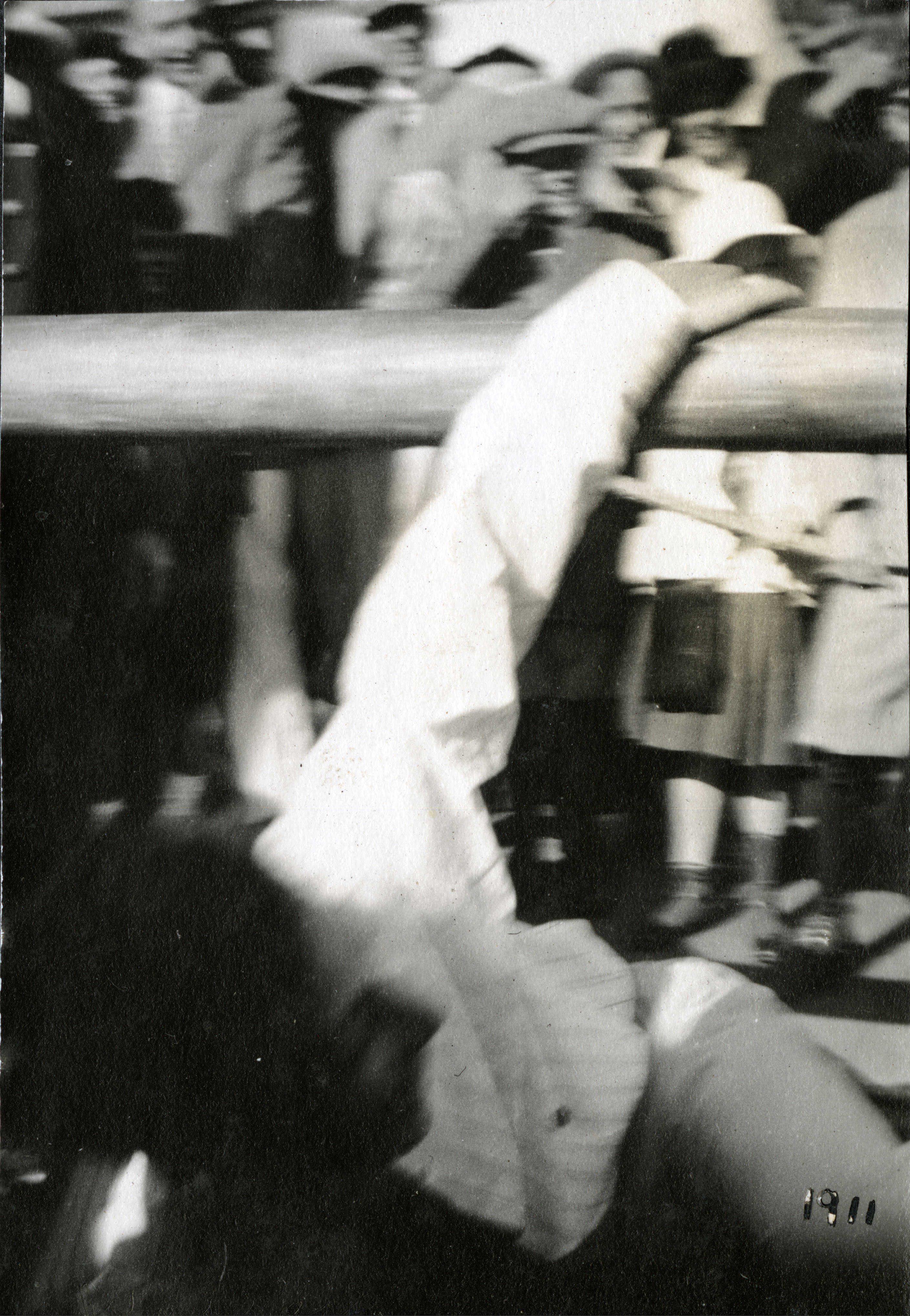
Warren Scripps Booth during a Spar Pillow Fight aboard the Steamship RMS Olympic, July 1911. [POL1.12.4]. Courtesy of Cranbrook Archives, Cranbrook Center for Collections and Research.
“James and Warren were both in the Spar Pillow Fight. In Warren’s case both fell off the bar at first but Warren was nocked [sic] off a second time. Warren did not win. James stayed on a number of times but was forced to give up. After dinner in the Reception Room the prizes were awarded. Also a dance on deck was given.” Henry Scripps Booth, July 3, 1911
Disembarking the RMS Olympic, July 5, 1911. [POL1.14.1]. Courtesy of Cranbrook Archives, Cranbrook Center for Collections and Research.
“Breakfast was served in the usual manner. After breakfast in the hall on the Sun Deck the band played the national cirs. Every body stood up. In the afternoon, at 4 o’clock we entered Plymouth Harbor. The mailtender got the mail and other boats got passengers off to land. We then started across the channel.” Henry Scripps Booth, July 4, 1911
“After getting off the steamer and having the officers make sure that we had no cigars or liquors with us, we took a cab to the hotel.” Henry Scripps Booth, July 5, 1911
Unloading the cars in France, August 1911. Courtesy of Cranbrook Archives, Cranbrook Center for Collections and Research.
As always, it is a great delight to share with scholars, colleagues, and those who are simply curious, these stories from the Archives. What is preserved in Cranbrook Archives help us to understand and enjoy not just Cranbrook, but any number of historic events from new perspectives.
There are more stories to tell about the family’s sojourn through England and France in 1911, which are both heartwarming and educational. But those tales must wait for another blog post–or for you to schedule a visit and come into the Archives Reading Room!
— Laura MacNewman, Associate Archivist, Cranbrook Archives, Cranbrook Center for Collections and Research
Across Cranbrook’s campus are eleven different spaces, including the Archives, that house book collections – some 110,000 physical items. Several of these spaces are typical school or academic research libraries, where students, faculty, and staff can check out the majority of these books. As a library and information science professional, I champion the importance of these lending libraries and the egalitarian access to information they provide.
In this post, however, I’d like to focus on Cranbrook’s non-circulating book collections – those rare, historic, or valuable tomes that, in many cases, hide in plain sight in public areas. With help from colleagues at the Academy of Art, Schools, Institute of Science, and Center for Collections and Research, I’ll highlight some of these gems that promise to delight the bibliophile, art appreciator, historian, or simply the Cranbrook curious.
Cranbrook’s special book collections are carefully preserved as both informational and evidential artifacts, and many are housed within cultural heritage areas. Valued not only for research purposes, they also serve as historical objects which help individually or collectively to tell the Cranbrook story.
South end view of the newly completed Cranbrook House Library, 1920. John Wallace Gillies, photographer. Courtesy of Cranbrook Archives.
The origin of book collecting at Cranbrook actually predates any of the current collection spaces and begins with Cranbrook founders George and Ellen Booth. George, in particular, was an enthusiastic collector, and started acquiring volumes in 1900, commissioning purchases of William Morris works and other fine books in London. As George explained, “I am not a millionaire and cannot pay the big prices now prevailing in New York.” His strategy allowed him to accumulate 1,000 books by 1916, effectively seeding the Cranbrook House Library Collection when construction of the library wing was completed four years later.
In preparation for the Center’s upcoming seminar, featuring research on weaver Nelly Sethna, I became curious about an Academy of Art scholarship established in honor of Cranbrook founder, Ellen Scripps Booth.
Sethna had been a recipient of this financial award, which had allowed her to study abroad (Sethna was a citizen of India) at Cranbrook for one year, 1958-1959. Though it was Sethna’s artistic ability, not financial need, that earned her the award, she would never have made it to Cranbrook without this assistance, as indicated in letters to Weaving Department Head, Marianne Strengell.
Nelly H. Sethna, circa 1958. Courtesy of Cranbrook Archives.
Sethna’s subsequent successful career in textile design demonstrated the value of providing assistance for artists to attend the Academy. I wondered how many other similar stories there were in the Archives. I did not need to look past the first decade of memorial scholarship awardees to find plenty.
While the scholarship was granted to deserving artists in metalsmithing, painting, ceramics, and weaving in the ten years between 1951-1961, it was two fellow weavers of Sethna’s that caught my eye. They, too, had proven themselves worthy of distinction through their artistic accomplishments, but they, too, had financial needs that would have prohibited their attending the Academy otherwise.
Dixie Roto Magazine article featuring Katherine Choy, Sept. 14, 1952. Copyright The Times-Picayune, New Orleans States. Courtesy of Cranbrook Archives.
The first recipient of the scholarship was Katherine P. Choy, a Chinese expatriate and graduate of Mills College in Oakland, California. Choy came to Cranbrook in 1951 to study ceramics for one year as a non-degree student. She would spend near equal time in both the ceramics and weaving departments, under the dual tutelage of Maija Grotell and Marianne Strengell.
Upon leaving Cranbrook, she would enjoy success in both fields, first heading up the legendary Newcomb College Ceramics Department at Tulane University and later joining the design team at Isabel Scott Fabrics in New York. With fellow artist Henry Okamoto, Choy also founded The Clay Art Center in Port Chester, New York, which still exists today. Choy’s ceramics can be found in the collections of the Cooper-Hewitt Smithsonian Design Museum, theMuseum of Arts and Design in New York, as well as the New Orleans Museum of Art.
Tsuneko Yokota, circa 1955. Courtesy of Cranbrook Archives.
Another scholarship winner, and weaver, in the first decade of the award was Tsuneko Yokota (Fujimoto), for the academic year 1957-1958. A graduate of the Design Department at Tama College of Fine Arts in Tokyo, Yokota distinguished herself in fabric dying, winning several awards and a scholarship for an additional year at Tama as an honor graduate. At the suggestion of one of her instructors, and with a recommendation from Marianne Strengell, who knew her instructor, Yokota came to Cranbrook to further her studies in weaving and textile design. Unlike Sethna and Choy, though, Yokota stayed an additional year at the Academy and earned her MFA in Weaving.
By all accounts, Yokota lived up to Strengell’s confidence that she, “will most certainly have ample chance and desire to spread our particular brand of education and design in Japan,” working with celebrated modernist interior designers like Isamu Kenmochi.
Cranbrook Academy of Art scholarship announcement, 1960. Courtesy of Cranbrook Archives.
The Ellen Scripps Booth Memorial Scholarship was established in 1951 along with the George Gough Booth and Eliel Saarinen Memorial Scholarships by the Academy of Art Board of Trustees. Academy faculty, under the leadership of Director Zoltan Sepeshy, recommended these scholarships be granted based on unusual merit of work submitted rather than financial need. Academy administrative documents indicate that the Ellen Scripps Booth Scholarship Fund had wide support from not only Academy faculty and staff, but also many at the Foundation, Press, Central Committee, and House. Scholarship award amounts varied somewhat from year to year, (in 1953 they were evenly split between two awardees), but the scholarship continued to be granted until at least 1965. While these named scholarships are no longer awarded (and I was unable to deduce exactly why or when they stopped), scholarships and financial aid for talented students are still vital to the success of the Academy and its artists.
—Deborah Rice, Head Archivist, Cranbrook Center for Collections and Research
Editor’s Notes: On Tuesday, June 22 the Center broadcasts live from Cranbrook and India for scholar Vishal Khandelwal’s examination, using materials from Cranbrook Archives, of a fascinating connection between mid-century textile design in the United States and India, as seen through the work of Nelly Sethna. Register here for this illuminating virtual event.
Along with Nelly Sethna (1958-59), find early scholarship winners, such as Paul R. Evans (1952-53) and Howard William Kottler (1956-57) featured in Cranbrook Art Musuem’s new exhibit and companion publication, With Eyes Opened. Find details and purchase advance tickets to the exhibit on the Museum’s website.
Read a recent exciting announcement about new scholarship and financial opportunities for students on the Academy’s website.
One of the things I love about my work is that I never know what I will discover next. I go in search of one thing and find much more and, sometimes, the unexpected. This happened recently when I ventured into the Ellen Warren Scripps Booth Papers.
Ellen’s papers primarily record her personal life from the 1870s through 1948, with a preponderance on the years 1880-1910. They include drawings, maps, an autograph book from her school days, leaflets from the Epiphany Reformed Church and its reconstitution asTrinity Episcopal Church, letters from her mother, Harriet J. Scripps (letters written 1901-1927), and photographs.
Drawing by Ellen Warren Scripps, age 10, 1873. Cranbrook Archives.
But, the bulk of the collection are her diaries which cover 1880-1944, though the coverage is spotty after 1910. The research value of a diary is variable, depending much upon the focus and meticulousness of the author, and its intersection with the researcher’s interest. The dates in Ellen’s diaries are unquestionably reliable, as other documents in the archives verify their accuracy. Frequently recorded topics include the weather, who preached at church/other churches attended, what she was reading, her music and singing lessons, unwell family members, and who came for tea or dinner.
Her diaries not only tell her story, but also describe the life of the Scripps family and the appearance of the Booth family, particularly Alice and George, in the early 1880s. We can also see glimpses of Detroit history, such as Governor Pingree’s funeral in July 1901, and her visit to Barnum Wire Works with George in January 1887. On February 15, 1882, Ellen writes:
“Walked to and from school today. Went to social at Mr. Woolfenden’s with Theodore. Had a splendid time. Theodore asked me to go to hear Oscar Wilde Friday evening but I concluded not to go. I began reading Old Curiosity Shop this afternoon.”
Oscar Wilde! She notes in her Friday entry, that Theodore went to hear Wilde with Mr. Woolfenden instead. There are many mentions of “Mr. Woolfenden,” who otherwise has only been found mentioned in George Booth’s Memories (pp.53-55).
Ellen Warren Scripps’ Diary, 1886. Cranbrook Archives.
Frederick W. Woolfenden is one of two people that Henry Wood Booth met during his first visit to Detroit in 1880, the other being James E. Scripps. This story is quite widely known and the information about it, published in Arthur Pound’s book about George Booth, The Only Thing Worth Finding (pp.63-68), comes from George’s writings. Woolfenden had taken interest in Henry Wood Booth’s Ka-o-ka idea, and, after visiting him in St. Thomas, Ontario, convinced him to move to Detroit in 1881. Woolfenden was Assistant Postmaster of Detroit and a co-founder of the Dime Savings Bank, but he was also a Pastor at the Epiphany Church where Henry Wood Booth had first met him.
Ellen’s diaries record his deep involvement with the family as a friend and pastor who conducted the christenings, confirmations, funerals, and weddings of both families. It was Woolfenden who married George and Ellen in 1887.
Frederick W. Woolfenden, ca. 1880s. Cranbrook Archives.
Memorial notice for Frederick W. Woolfenden, ca. 1881. Cranbrook Archives.
Ellen’s diaries provide a complete record of her life until 1910 and so the earliest memories of Cranbrook are recorded. The story that we know and love so well, of George and Ellen purchasing the old farm from Samuel Alexander is captured in her hand and it was lovely to read as she describes, albeit briefly, the snow drifts as they visit the farm:
Ellen Warren Scripps Booth’s Diary, 1904. Cranbrook Archives.
A few days later, on January 18, 1904, she writes, “Went down town to sign the mortgage for the farm. It is ours now, and we are all so glad.” All these years later, I am so glad too.
—Laura MacNewman, Associate Archivist, Cranbrook Center for Collections and Research
As Michigan emerges from our lockdown and we slowly begin driving to more places and contemplating summer road trips, I thought we’d look back to a time before asphalt, air conditioning, and safety features.
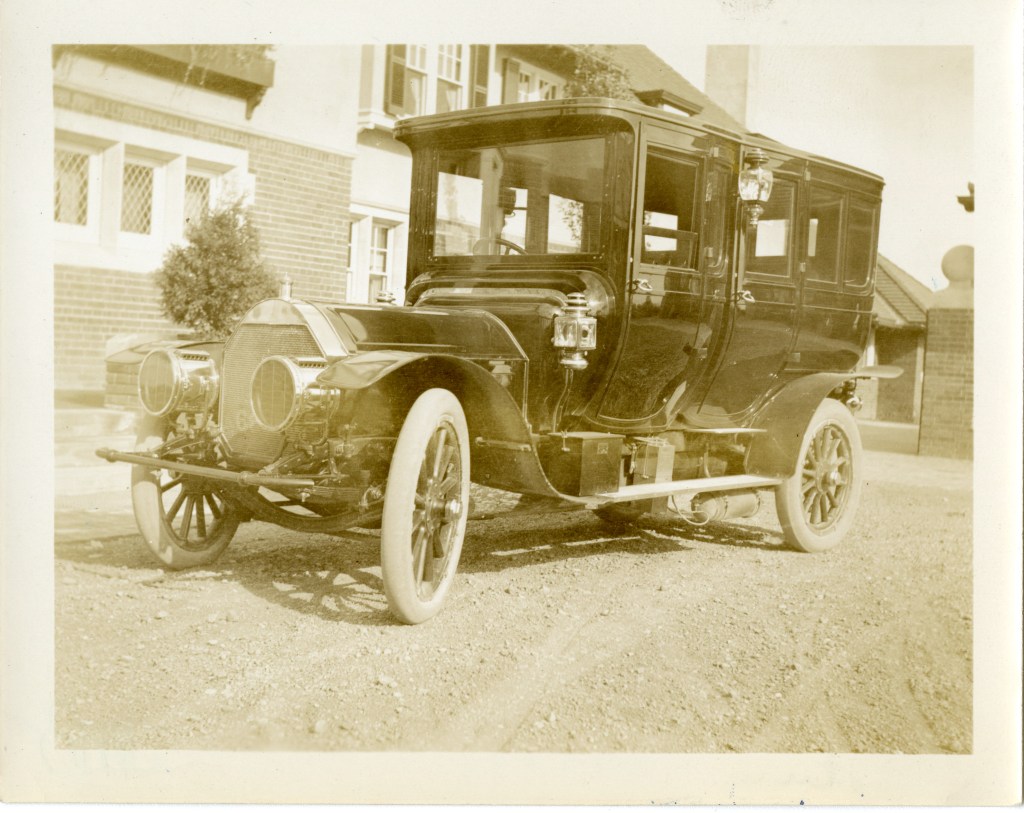
Ellen Scripps Booth, Jean McLaughlin Booth and Henry Scripps Booth on Lahser Road with the 1908 Pierce-Arrow in the ditch, 1911. Courtesy Cranbrook Archives.
Here, we see Ellen Scripps Booth, daughter-in-law Jean McLaughlin Booth, and young Henry stranded somewhere along Lahser Road. I love the ladies’ wide hats and wraps, intended to keep their hair in and dust out. Henry looks particularly pleased with the situation (sort of like me when my own mom got a speeding ticket—she didn’t appreciate my backseat smirking, either).
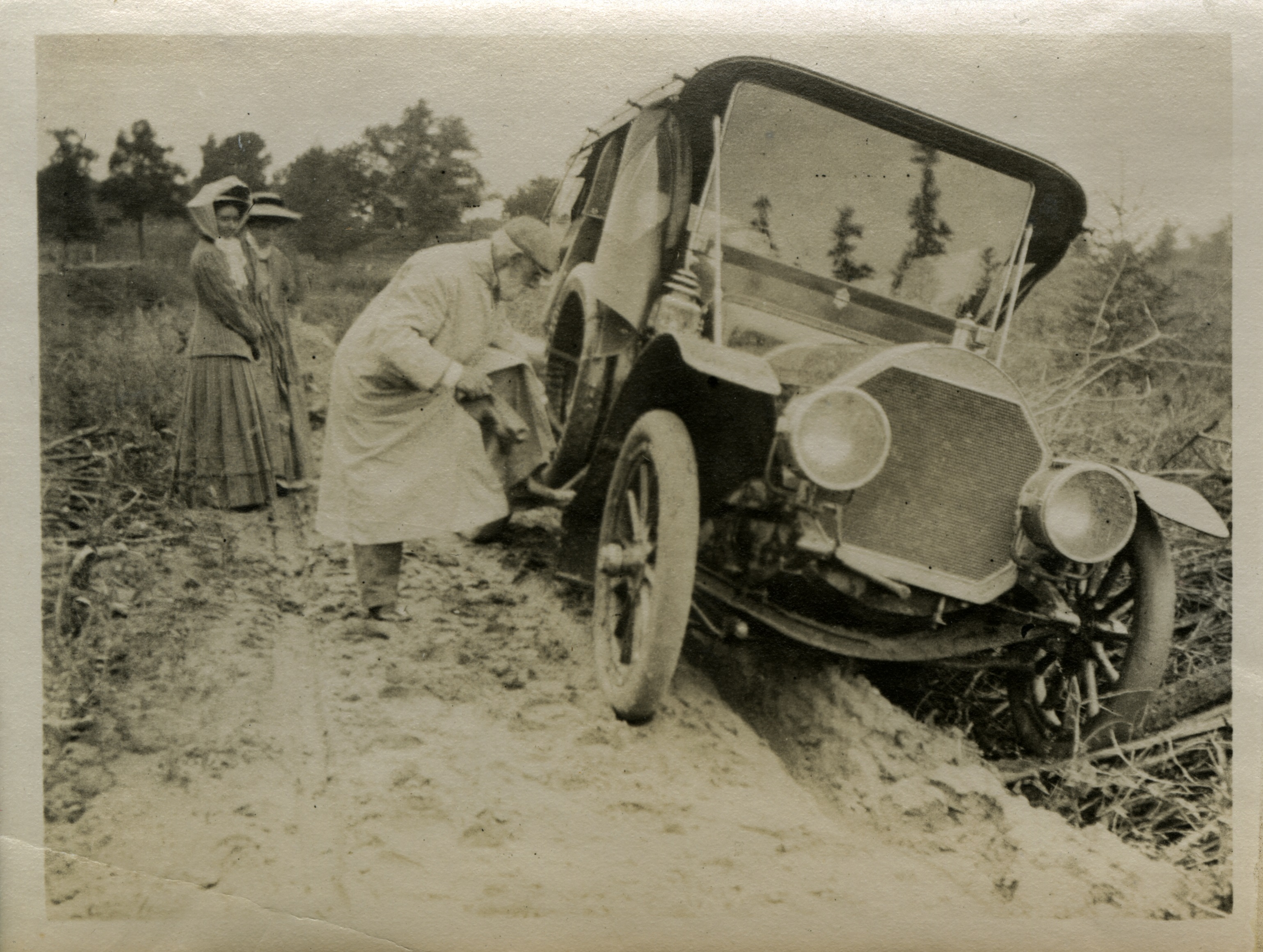
Instead of AAA, the family turned to their own skills. Here’s Henry Wood Booth, Ellen’s father-in-law, addressing the situation:
Henry Wood Booth works on the Pierce-Arrow on Lahser Road, 1911. Courtesy Cranbrook Archives.
The Booth family’s Pierce-Arrow Limousine was one of several cars they used to move about here in Michigan and in Europe (where they traveled with the Pierce-Arrow and chauffeur). Purchased for $7,750 in July 1908 ($215,984.08 in 2020), the seven-seater, 6-cylinder touring car came with two bodies: a closed limousine body for winter use and a sports-touring body for summer. As Henry Scripps Booth later wrote:
The original garage at Cranbrook House had a traveling crane in it so the Pierce-Arrow’s winter and summer bodies could be conveniently changed with the seasons. The crane spanned the depth of the garage, having an iron track bolted to the east and west walls on which the crane with a hand operated hoist could be pulled to the spot where the two respective bodies could be removed or hoisted into place.
The Pierce-Arrow with its winter body in front of Cranbrook House, 1908. James Scripps Booth photographer, Copyright Cranbrook Archives.
The Pierce-Arrow with its summer body in front of Cranbrook House, 1908. James Scripps Booth photographer, Copyright Cranbrook Archives.
The accident on Lahser Road wasn’t the first time Ellen had been betrayed by poor road conditions. In 1908, she wrote in her diary of a similar event that took place as the family traveled from Grand Rapids to Lake Michigan:
“Wed. Aug. 12. We decided to take the auto as far as Holland on the way to Ottawa Beach but I wish we hadn’t for it took us five hours to go the 25 miles—We got off the road and one place slid into a ditch. It took an hour & a half to get a team to pull us out. We later frightened a horse and it ran down this deep ditch and horse, top-buggy and all just lay right down flat. The old couple in it were not hurt at all.”
If you want to learn more about the history and social impact of cars, register for our free virtual Bauder Lecturethis Sunday, June 28, 2020, at 3:00pm EST. Brendan Cormier, Senior Design Curator at the Victoria and Albert Museum in London, will be speaking about his recent exhibition and publication, Cars: Accelerating the Modern World. Center for Collections and Research Director Greg Wittkopp will deliver an introduction about Cranbrook and cars, featuring more treasures from Cranbrook Archives relating to our place in automobile history.
—Kevin Adkisson, Associate Curator, Cranbrook Center for Collections and Research
2020 marks ninety years of temporary traveling exhibitions at Cranbrook Art Museum. Perhaps one of the best examples that brings to life this aspect of the Museum’s programs is Cranbrook’s brief but wildly successful partnership withLIFE Magazine.
The Cranbrook-LIFE Exhibition of Contemporary American Painting opened in 1940, ten years after Cranbrook Art Museum hosted its first traveling exhibition, organized by the American Union of Decorative Artists and featuring contemporary interior design. The idea of temporary traveling exhibits at Cranbrook began the same year as the permanent collection was established by founder George G. Booth. It furthered Booth’s commitment to presenting contemporary art as foremost a learning tool for Academy of Art students. It was intended “to remind our students that art is a living thing and that the record of our times is being created from day to day by the artists of this age, and in so doing perhaps to stimulate the creative spirit among those who work here.”
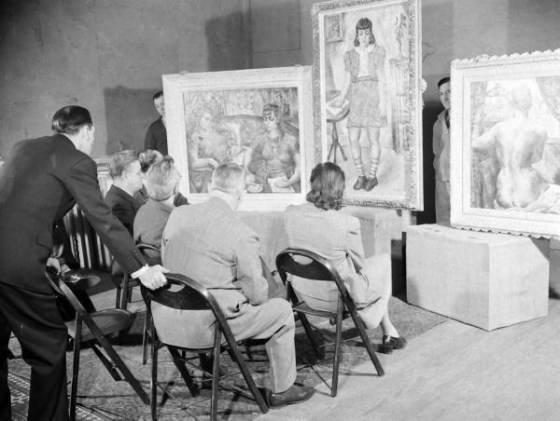
Judges examine paintings in New York, April 1940. Hansel Meith, photographer. Copyright Time Inc.
Cranbrook-LIFE was a celebration of contemporary U.S. art meant to symbolize “America’s increasing responsibility as a democratic world art center.” (Life, May 27, 1940) As such, LIFE invited sixty painters, living and working in America, to submit three paintings to be voted on by a jury of six. The painters included Edward Hopper, Charles Sheeler, and Cranbrook’s own Zoltan Sepeshy. The jury, comprised of Sepeshy, two leading art museum directors, an editor at LIFE Magazine, a representative from the Federal Works Agency Section of Fine Arts, and a well-respected American painter and educator, convened in a New York City warehouse where they spent four hours whittling down 180 submissions to the final sixty paintings shipped to Cranbrook for the show. One of these was Grant Wood’s American Gothic! Loaned by the Art Institute of Chicago, the already famous painting appears to be the only piece in the exhibition to come from another art museum.
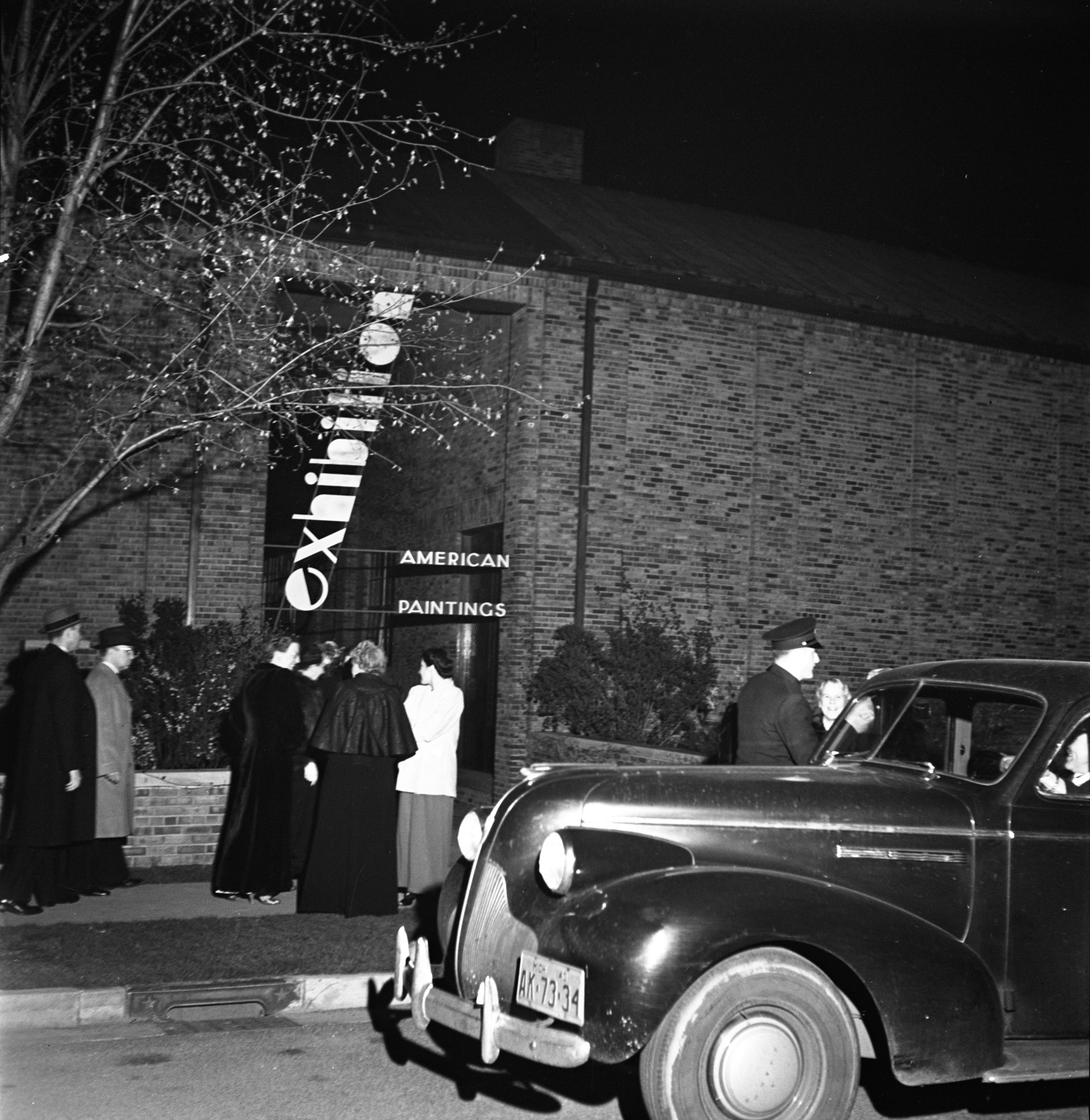
Opening night attendees arrive. Courtesy Cranbrook Archives.
If you’re at all familiar with LIFE, you may be asking yourself why a popular weekly magazine, known for its photographic general-interest stories, would make a foray like this into the art world? According to a 1940 TIME Magazine article, in the previous three years, “the No. 1 U.S. source of popular knowledge of U.S. art has been LIFE, which has reproduced for the man-in-the-street’s weekly dime some 452 paintings (usually in full color) by U.S. artists.” Your next question might be why it was held at Cranbrook, as opposed to, say, the newly constructed Museum of Modern Art building in New York City? Florence Davies of the Detroit News may have answered that, when she wrote at the time: “Life Magazine picked Cranbrook not only because of the enchanting setting of the place as a whole, but more particularly because it found there ‘work in progress—an atmosphere of creative activity.’”
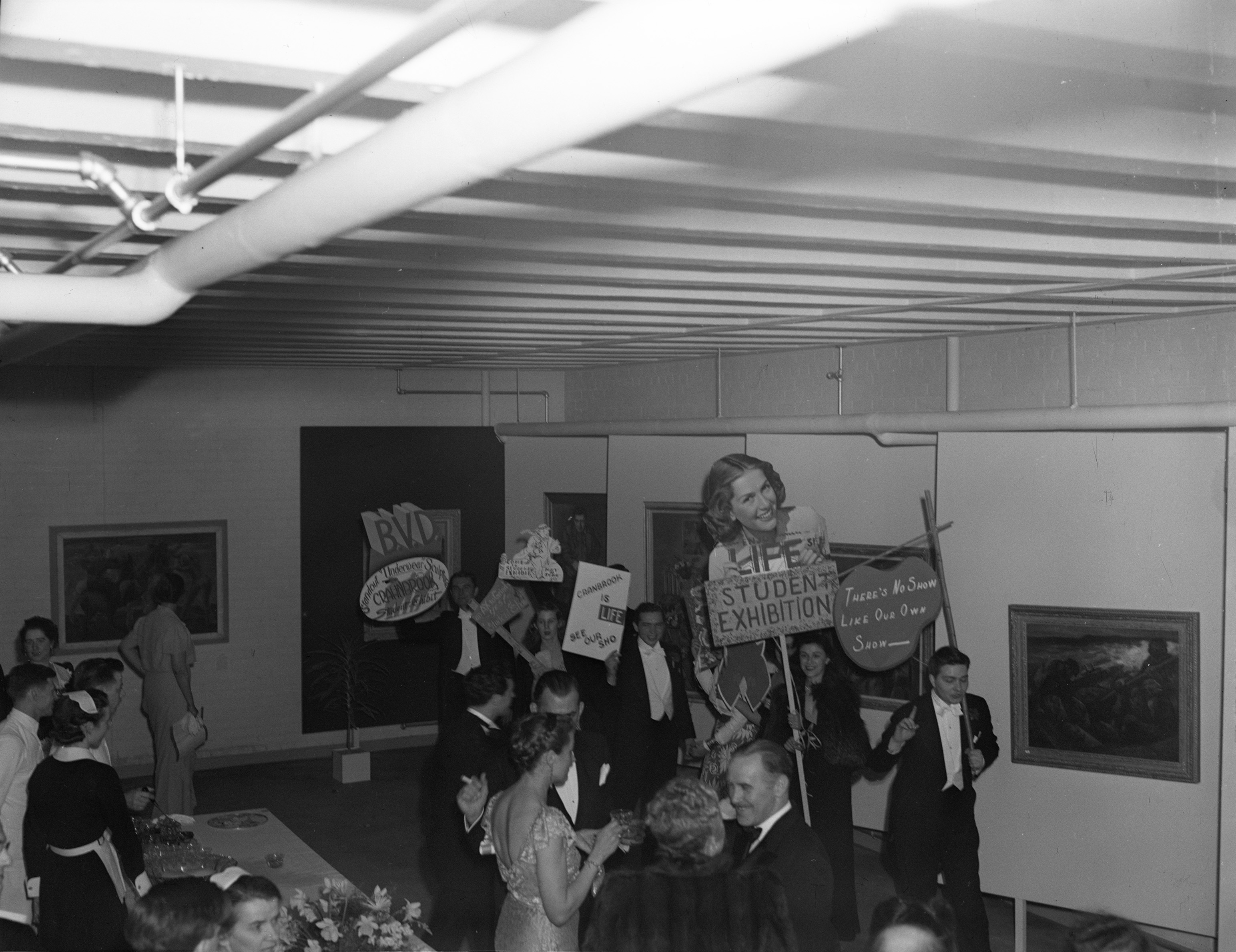
Academy of Art students parade through the opening night gala reminding attendees of the student exhibition simultaneously on display at the Cranbrook Pavilion. Courtesy Cranbrook Archives.
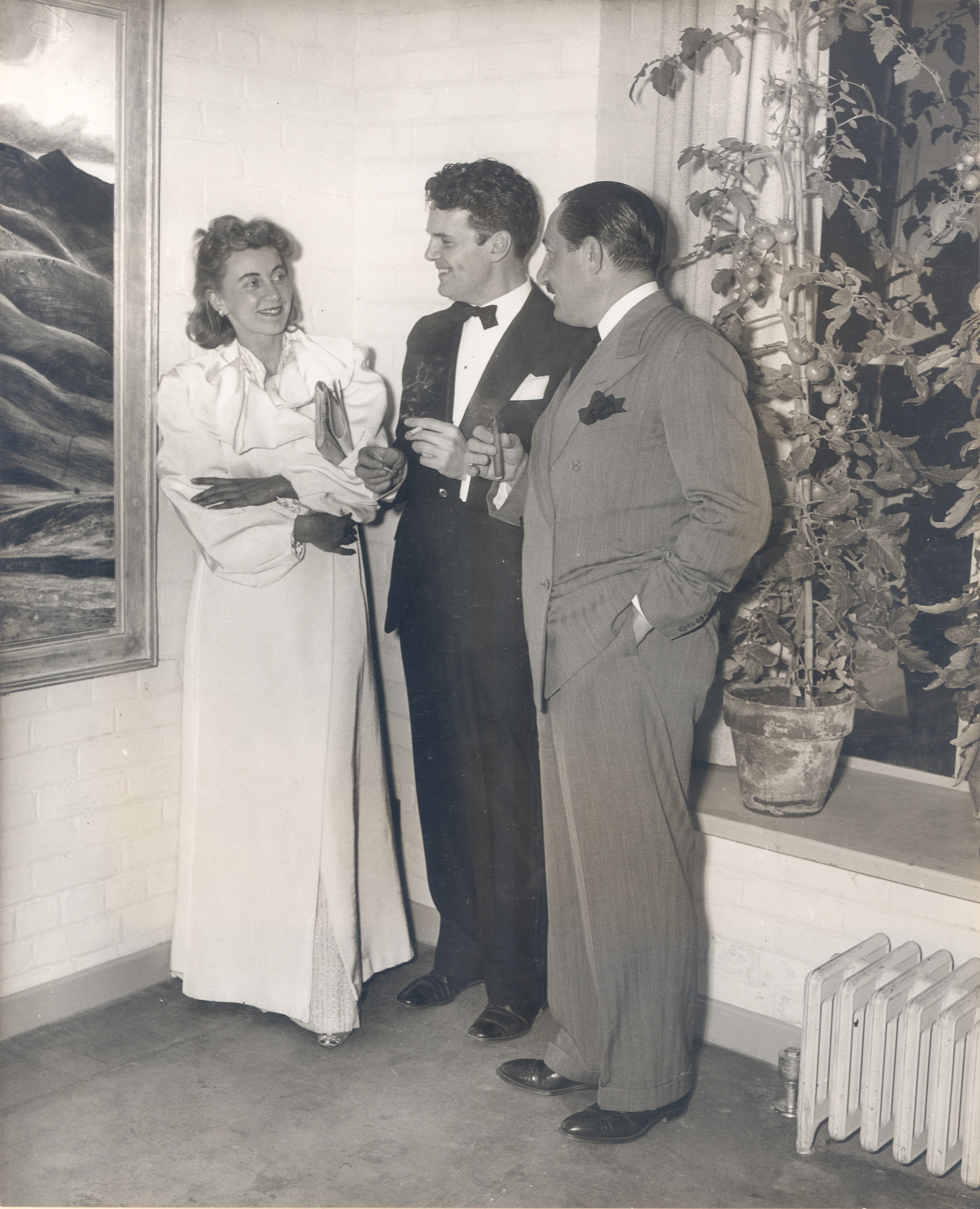
The exhibition drew an estimated 2,500 national and international visitors in the short two weeks it was on display from May 17-June 2, 1940. Because of the size of the show, it could not be held in the current museum building on Lone Pine Road and Academy Way (Eliel Saarinen’s museum buildingbegan construction during the exhibition). And, as the Academy student exhibition was currently occupying the Cranbrook Pavilion, the decision was made to utilize the Academy’s Painting Department Studios. Opening night was a festive gala. Attendees, including George and Ellen Booth, Loja and Eliel Saarinen, Edsel B. Ford, Albert Kahn, and “1,000 Detroit socialites braved wintry winds” in formal attire. (Time, June 3, 1940)
Marianne Strengell, Charles Eames, and Richard Reinhardt. Richard A. Askew, photographer. Courtesy Cranbrook Archives.
Coming on the heels of the Great Depression and during the beginning months of the War in Europe, pro-American sentiment was high, as evidenced by the placement of potted American-grown tomatoes in windowsills as decoration. According to TIME Magazine, the music for the evening was by U.S. composers and refreshments included “Rhine wine flavored to taste like U.S. new-mown hay.” (!?)
Cranbrook-LIFE marks the beginning of the Cranbrook Art Museum Exhibition Records, which illuminate thirty-six years of temporary traveling exhibits, and are rife with names of renowned artists that have exhibited at Cranbrook throughout its history.
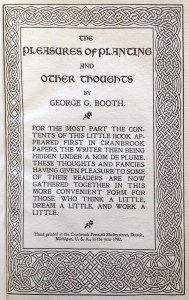
It is hard to think of Spring during this week of frigid temperatures, but I promise it is coming. Soon, the Cranbrook House and Gardens Auxilary will be out planting their gardens around Cranbrook House. In honor of the coming Spring, this week I share George G. Booth’s feelings on planting from his Pleasures of Planting and Other Thoughts which was printed by the Cranbrook Press in 1902.
George G. Booth, The Pleasures of Planting and Other Thoughts, Title Page. Printed by The Cranbrook Press and finished on August 30, 1902. Courtesy of Cranbrook Academy of Art Library.
The Cranbrook Press was established in the unused attic space in the Shelby Street office of the Detroit Evening News in 1900. In two short years, the Press produced nine books. Pleasures of Planting was one of three books written by George Booth printed on the Press. In it, he writes:
Don’t, I pray you, envy the man who has builded a house, or reared a monument in marble or granite; for I say unto you most truly that the cap-stone has no sooner been let unto its place and the builder attained the joy he dreamed of, than the work of his hands begins to decay and crumble before his eyes.
Portrait of Ellen S. and George G. Booth in the Oak Room at Cranbrook House. Photo by PD Rearick.
Choose, rather, for yourself the most delightful and beneficial of exercises, and plant. Plant when the March winds blow – plant when the gentle rains of springtime pour blessings on the earth – plant where the mother of us all permits it. Work not for glory in cold bricks and stone alone, but plant living things, and watch with joy the increasing glory of your labor.
Cranbrook House Dining Room. Photo by PD Rearick.
Stone, and iron, and brass cannot put flowers at the bedside of the sick, nor fill the air with odors of sweetness or furnish a soft and coll bed for the birds; neither will the grandest monumental piles fill the heart of the poet with sweetest songs or make us feel so truly that “God is good;” but under spreading branches of the trees rest is found, love flourishes, and all humanity drinks at the well of life.
Where ever you go, plant – rear monuments of elm and maples, of poplars and beech, and trees bearing fruit, and plant on your right hand and on your left the rose, lilac, snow-ball and syringa. Strew at your feet the sweet, life-giving flowers of summer, and live out your days in happiness.
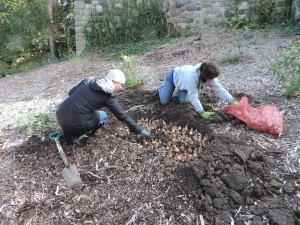
Cranbrook House and Gardens Auxiliary volunteers plant in the Sunken Garden. Photo by Eric Franchy, Cranbrook House & Gardens.
There is something magnificent in such work. It fills the earth with beautiful scenes; wealth is added to the land, which grows richer daily; “there is something in it like the work of creation.”
Cranbrook House and Gardens Auxiliary volunteers plant in the gardens around Cranbrook House. Photo by Eric Franchy, Cranbrook House & Gardens.
Plant and see your plantation arriving at greater degrees of perfection as long as you live. If you want to be helpful; if you love your country; if you have regard for posterity – plant. You cannot be excused if you fail in this duty. Just put a few twigs in the ground and do good to one who will make his appearance in the world fifty years hence, or perhaps make one of your descendants easy or rich at such a trifling cost.
“If man find himself averse to planting, he must indeed be void of all generous principles and love of mankind,” and so I say unto you – Plant.
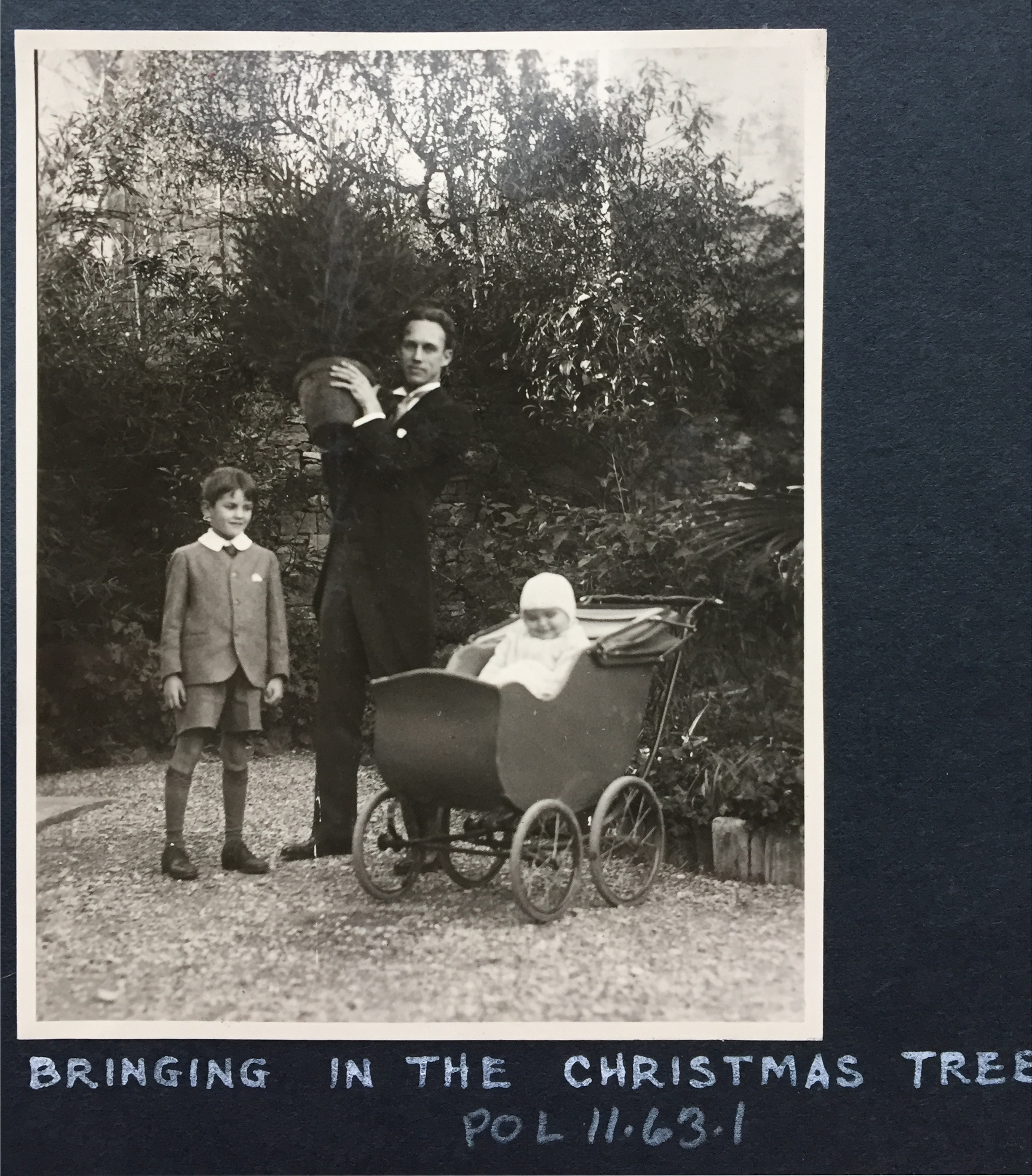
Henry and Carolyn Booth spent the Christmas of 1933 at the Villa Eveline in San Remo, Italy with their children Stephen (8), David (6) and Cynthia (10 months). In Henry’s letters home he writes about the traditions he and Carolyn tried to maintain while spending Christmas away from home. He also writes about the “rustle of palm trees” in their garden and the crowds of people gathering at the churches on St. Stephen’s Day – a national holiday in Italy.
Henry Scripps Booth carrying the Christmas tree with Stephen and Cynthia (in stroller), 1933.
In one of Henry’s letters to his parents, he writes, “greetings from our Christmas tree and it’s real candles, to yours of the electric bulbs.” He later describes the event of Christmas night as lighting the candles and sparklers on the tree, “I never expected to see that kind of illumination again, and probably the children never will in future.”
Holiday wishes from Henry Scripps Booth to his parents, Ellen and George Gough Booth, 1933.
The photos sent home are both formal and candid – very much like posed photos captured on photo cards today, as well as informal images of families and friends enjoying time together at the holidays. My favorite shows a very happy Cynthia following Christmas dinner!

















 Cranbrook Kitchen Sink