The Skeptics Tale

The dichotomy of reading is much like the daily work undertaken in the archives. Reading, like research, can feel private, almost sacrosanct, something to escape to; on the other hand, there is a great draw to share the stories and information one discovers, seek commentary and comparison, enlighten someone’s thought process. As archivists, it is our job to assist researchers on their paths to discovery. Often times this direction and assistance leads us to insights as well. In fact, I have yet to assist a researcher along their path of inquiry without further developing my own along the way.

This was very much the case last week while I was scouring our collections for autumnal ephemera to add color to our Facebook followers’ harvest season. In my seasonally focused search I was delighted to come across Cranbrook’s very own ghost story—Cranbrook Boasts a Ghost; or, The Skeptics Tale, by Henry Scripps Booth (Thistle, as he was commonly known). I was intrigued and excited — what a timely discovery, what with Halloween just around the corner! And while I was enticed by the mystery, and enjoyed reading the descriptions of the vaulted spaces of St. Dunstan’s chapel [editor’s note: St. Dunstan’s is at Christ Church Cranbrook] filled with apparitions (a place I was lucky enough to tour, and you can too!) The Skeptics Tale, more importantly, reiterated an intrinsic truth about Cranbrook – that it is a space imagined and created by many minds and hands.
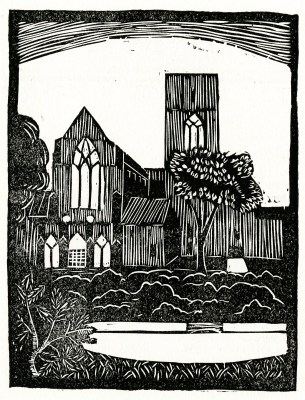
Christ Church Cranbrook, from "Highlights of Detroit". Cut by Eugene Reeber, Jefferson Intermediate School, 1932.

Christ Church Cranbrook, from “Highlights of Detroit”. Cut by Eugene Reeber, Jefferson Intermediate School, 1932.

Throughout the tale, I gained a sense of workmanship and craft, two features indicative of most spaces on Cranbrook’s sprawling campus. The characters in the tale pined over the construction of the brilliant structure, venerating its beauty as a testament to their commitment to their craft. It is, however, only near the end of the short story where I began to feel (if not see) the intentions of individuals who worked throughout the years to craft Cranbrook into the sprawling idyllic landscape of natural and man-made elements we know today.

“He discovered familiar faces in that strange assembly—faces of men who had lived and worked at Cranbrook. There before him was Tony by the column which bears his name; Mike Vettraino; Henry Booth, the coppersmith; his distinguished-looking father with the sideburns who brought the craftsman’s tradition from the ancient Cranbrook to this continent. There in the fourth chair of the fifth row: Milles, famed for his sculpture; a row or two behind, Saarinen, famed for his buildings; and nearby, Kirk, the silversmith.”

Though only apparitions in The Skeptics Tale, these individuals’ real accomplishments and contributions to Cranbrook, along with those of countless other influential men, women, and students, can be discovered through our collections. In the spirit of the season, we invite you to journey into our crypt and discover some of their stories yourself.

Belinda Krencicki, Associate Archivist

Upcoming Day Away: Albert Kahn and the University of Michigan

Henry Scripps Booth, photographer. Pleasures of Life, Vol. IV. Courtesy Cranbrook Archives.

Henry Scripps Booth, photographer. Pleasures of Life, Vol. IV. Courtesy Cranbrook Archives.

In this 1919 photo taken by Henry Scripps Booth of his two friends and architecture classmates Fred Morse and Martin Lexen, they’re all hanging out (and almost off of!) the roof of the University of Michigan’s brand new General Library by architect Albert Kahn. I found this snapshot in volume four of Booth’s Pleasures of Life series, which has lots of great images of the Booths at Cranbrook and of his friends at the university (where Henry studied from 1918- 1924). The building they’re sitting on here, known as the Harlan Hatcher Graduate Library since 1971, figures prominently in the Center for Collections and Research’s next Day Away trip on October 28!

Henry Scripps Booth’s Scrapbook Album, Courtesy Cranbrook Archives.

Dedication of the new (Hatcher) library building, 1920. Henry Scripps Booth’s Scrapbook Album, Courtesy Cranbrook Archives.

While we won’t be quite so daring as to dangle our feet off the roof, you are invited to join the Center as we explore Albert Kahn’s architecture at University of Michigan. Best known for his industrial architecture in and around Detroit (and of course Cranbrook House), this tour will introduce you to his academic buildings. The day includes morning lectures followed by in-depth tours of five Kahn structures (including rarely accessible spaces like the carillon in Burton Memorial Tower), all interspersed with narrated walks and drives.

I should mention, though, that the Day Away won’t just be about touring. We’ll stop for a delicious lunch at Taste Kitchen, an acclaimed new restaurant by owner and chef Danny Van. It came highly recommended by friends of the Center, and we’re very happy Van has designed a three course meal, with optional drink pairings, just for us.

Henry Scripps Booth, photographer. Pleasures of Life, Vol. IV. Courtesy Cranbrook Archives.

Henry Scripps Booth, photographer. Pleasures of Life, Vol. IV. Courtesy Cranbrook Archives.

In this photo, we see Booth’s friend Fred’s “long, lankey and lean” body around a street sign—with assistance from the bottom-half of another Cranbrook luminary and friend of Henry, J. Robert F. Swanson.* The photo shows the two goofing around on a road outside of Ann Arbor. For this post’s purposes, I’ll imagine they’re on the very route we’ll be taking from Cranbrook to Ann Arbor on October 28! There shouldn’t be any dangerous curves on our trip, though it’s guaranteed to be informative, delicious, and fun. Call and get your tickets today!

*Did you know Booth and Swanson met studying architecture at U of M, where they also encountered a certain visiting professor, Eliel Saarinen?

-Kevin Adkisson, Collections Fellow, Cranbrook Center for Collections and Research

Photo Friday: Good Things Come To Those Who Wait

In October 2014, archivist Cheri Gay, wrote a blog on the pet cemetery at Thornlea Studio and the love the Booth family had for their animals.

In the blog, Cheri states, “When Henry was growing up, the Booth family had beagles, Prince and Mike, and a great dane, Ginger. Mike, according to Henry, ‘… loved having a fuss made over him, one time going so far as being pushed around in a doll carriage while wearing a canvas hat.’ Oh to have a photograph of that!”

On this Photo Friday, the Cranbrook Kitchen Sink is proud to present:

Mike the beagle, being pushed in a doll stroller... wearing a canvas hat!

Mike the beagle, being pushed around in a doll carriage… while wearing a canvas hat!

Leslie S. Mio, Assistant Registrar

Opulence and Splendor

In the spring of 1927, Cranbrook founders George Gough and Ellen Scripps Booth traveled to Egypt. In addition to visiting Cairo and having their photograph taken after an hour long camelback ride, the Booths visited the tomb of the Egyptian Pharaoh, Tutankhamun (King Tut).

Letter from Cairo, Mar 1927.

Letter from Cairo, Mar 1927.

In a letter to his son Henry, Booth describes in detail the opulent beauty of the tomb: “When in Luxor we went to the Valley of the Kings and saw the tomb – that is we saw one room where the King lay. He is there still in one of the gold coffins – the mummy had over it a gold mask covering head and shoulders and many jeweled ribbons of gold covering the joints of the mummy cloth. Thimbles on each finger and toe… this lay inside a gorgeous solid gold coffin inlaid with stones. This was all in the finest carved sarcophagus and that inside a splendid wooden shrine – and this inside of a beautifully decorated room.”

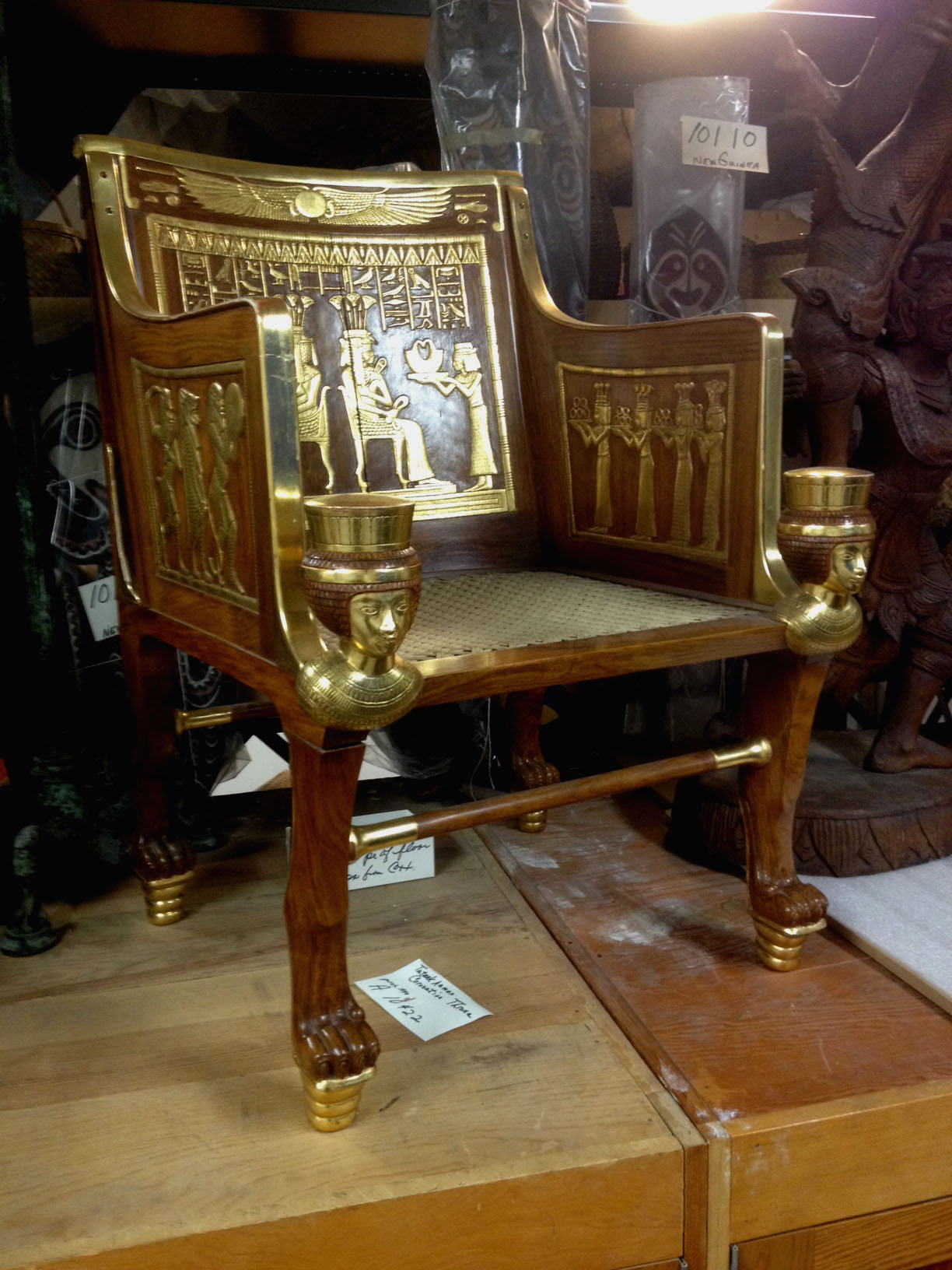
Replica created by Egyptian artisans and purchased by George Booth in 1927. The original chair is in the Egyptian Museum in Cairo. Photograph courtesy of Cranbrook Institute of Science.

Replica created by Egyptian artisans and purchased by George Booth in 1927. The original chair is in the Egyptian Museum in Cairo. Photograph courtesy of Cranbrook Institute of Science.

The Booths also visited the Egyptian Museum while in Cairo. Booth writes that although there is still a great deal in the actual tomb, he is in awe of the exhibition’s craftsmanship and value. He was particularly interested in a chair that at the time was believed to be the State Chair of Queen Taia, wife of King Amenhotep III (grandfather of Tutankhamun). Booth writes to Henry, “I would cheerfully give $10,000 for the throne –  which is an ordinary sized chair, but beautifully wrought.”

Exhibition poster, 1973.

Exhibition poster, 1973.

As the original chair was not for sale, Booth commissioned a replica to be made for the Art Museum collection. The chair, of carved wood with relief decorations covered in gold leaf, was later determined to be the chair of Sitamun, an Egyptian princess (and thought by many scholars to be the mother of King Tutankhamun). The chair was lent to the Institute of Science for a 1973 exhibition titled, “Ancient Egypt and the Tomb of Tutankhamen”. In 1984 the chair was transferred from the Art Museum to the Institute of Science, where it still resides today.

Gina Tecos, Archivist

The Fascinating Notebooks of John Buckberrough

John H. Buckberrough (1874-1955), an immigrant from Ontario, Canada, was a civil engineer for the Cranbrook Foundation from 1927 until he retired in 1955. As described by Henry Scripps Booth:

Buckberrough, a slight man of medium height, started working for Swanson and Booth as that firm’s sole employee two years before Cranbrook officially employed him. That was in the firm’s tiny architectural office located in the below-road-level room of the Ram House section of Brookside’s buildings. … He became one of the first employees of what was known as the Cranbrook Architectural Office in January 1927. … Over the years he was chief surveyor, planned most of the pump rooms, transformer vaults and underground systems, kept copious notes and made detailed plans regarding changes which not only proved increasingly valuable in solving complicated problems but put to shame those who were later supposed to fill his shoes.

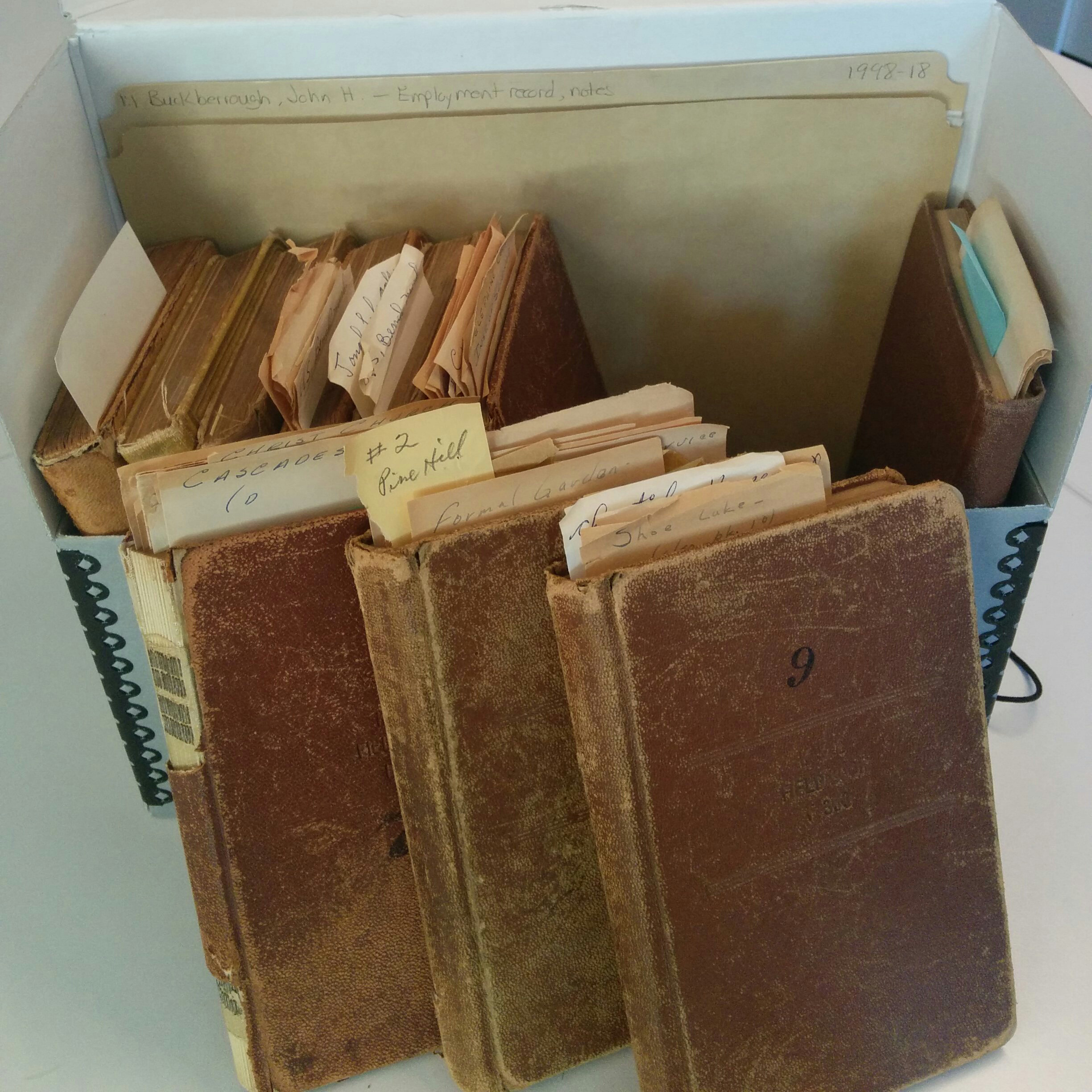
In addition to numerous architectural drawings that bear his signature, Buckberrough’s legacy in the Cranbrook Archives is 10 calfskin engineers’ field books, chock full of drawings and notations, covering 1926-1955.

Courtesy Cranbrook Archives

Courtesy Cranbrook Archives

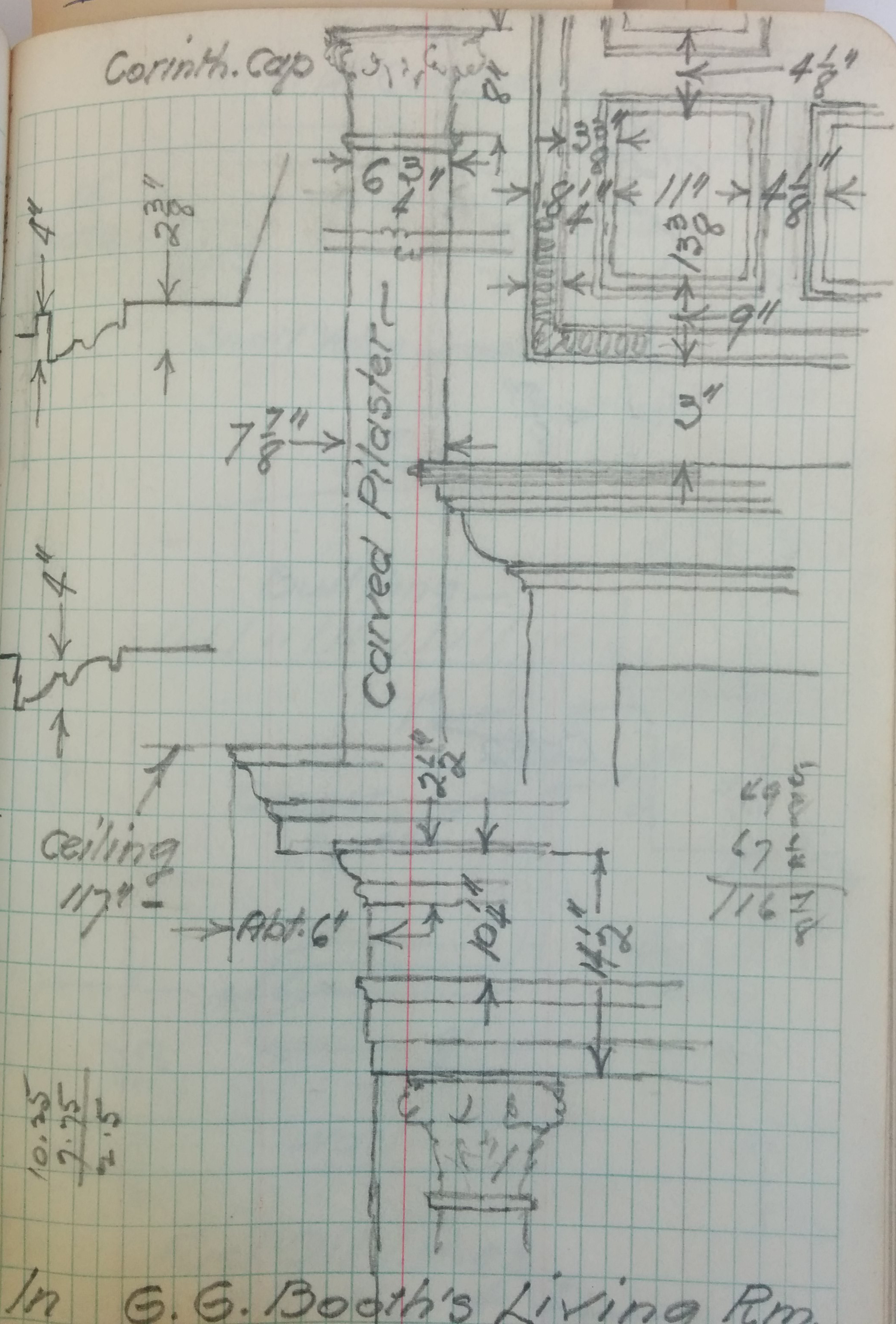
Descriptions and diagrams of Cranbrook property, heating and plumbing data for Cranbrook buildings, data on Cranbrook roads and lakes, drawings of pump houses, sidewalks, lighting layouts and water lines can be found in the notebooks. Here are some examples:

Design of a bridge.

Bridge at Kingswood Lake, 1938.

Column design for fireplace in Cranbrook House living room.

Column design for fireplace in Cranbrook House living room.

The Archives’ staff often finds valuable information in the notebooks, which is used for campus restoration and renovation projects including the recent restoration of Cranbrook School Quad. Little did Buckberrough know how valuable his meticulous note-taking would prove to be. Though a search for information requires a careful page-by-page hunt, it’s a pleasant change from the impersonality of electronic resources.

Cheri Y. Gay, Archivist

Welcoming Our Two Archives Assistants!

Prior to volunteering at Cranbrook Archives, I had been studying history and had become aware of the importance of primary sources for historiography, and the value of preserving heritage for the wider community. I began volunteering in 2012 which helped me decide to pursue a career in archives, and I began studying for the MA Archive Administration with Aberystwyth University in Wales (distance learning) in 2013. As part of a university assignment, I processed the HUB (Horizons-Upward Bound) Records, and am currently researching George Gough Booth’s interest in tapestries, which he purchased and commissioned for Cranbrook institutions and family members. I am interested in Booth’s involvement in the Arts and Crafts Movement, and the way in which the movement used medieval themes and techniques as a response to the social experience of the time. The Edgewater Looms, Herter Looms, and Morris & Co. tapestries are an ideal focus for exploring these ideas. I am looking forward to learning more about scanning/digitisation/digital preservation/cataloguing. The university modules emphasize access as the flip-side of preservation. I tend to have the latter foremost in my mind, so it will be great to see how the archive is used.

Laura MacNewman, Archives Assistant

Correspondence, George Gough Booth Papers, box 16, folder 11.

Correspondence, George Gough Booth Papers, box 16, folder 11.

As a graduate student mid-way through the Library and Information Science master’s program at Wayne State University, I’ve been given a healthy dose of libraries, archives, and the world of information over the past year. My interest in archives administration began while I was volunteering at the Cranbrook Archives last fall (2014). Here, I was introduced to the process of digitizing manuscripts, taking inventory of donated artist materials, and sifting through photographic negatives for future digital preservation and storage. I’ve also been working on the Cranbrook Archives’ Oral History Project. Much of my work at Cranbrook corresponds to my studies at Wayne State. In fact, this past week Head Archivist Leslie Edwards spoke about Cranbrook Archives’ oral history project in my oral histories course. As a new employee, I am keen to expand the number of digital images available online, help preserve the negative photograph collection, and understand what it really means to be an archivist.

Danae Dracht, Archives Assistant

From left: Carleton McClain, Henry S. Booth and Margaret Russell interviewing former Cranbrook School Headmaster, Harry Hoey at his home, 1964.

From left: Carleton McClain, Henry S. Booth and Margaret Russell interviewing former Cranbrook School Headmaster, Harry Hoey at his home, 1964.

Both Laura and Danae are working for us as part-time Archives Assistants, an entry-level archival position for graduate students. They will be working on a variety of projects during the coming year while gaining experience to propel them in their careers. Look for future blog posts from them in the upcoming months!

Historical Menus Reveal Cultural Past

The Henry Scripps Booth Collection of Menus is a fascinating glimpse into another era and the travel exploits of the leisure class. The Cranbrook Archives has digitized a portion of the collection, mainly menu covers, that can be viewed in our digital database. Menus are wonderful cultural documents that reveal economic, dietary, artistic, sometimes geographic and even literary information about an era.

Many of the menu covers have artistic renderings, some of them signed. The 1952 menu for the farewell dinner on the Queen Elizabeth has a reproduction of a painting of the ship, with the name “C.F. Hopkinson” visible in the lower right corner.

Farewell Dinner Menu for R.M.S. Queen Elizabeth Courtesy Cranbrook Archives

Farewell Dinner Menu for R.M.S. Queen Elizabeth.
Courtesy Henry Scripps Booth Menu Collection, Cranbrook Archives

Doing a Google search, I found Hopkinson’s name in a blog post, written by the archivist in charge of the Cunard Archives (imagine what a fascinating archive that must be) in the Special Collections & Archives at the University of Liverpool Library. The blog cited C.F. Hopkinson in a discussion about land-based Cunard employees who served during World War I. The Cunard Line Staff Magazine was the source for this information, and the blog emphasized the importance of staff magazines in an archival collection, as company records rarely contain information about individual employees. The little information they presented on C.F. Hopkinson confirmed that he was an artist, even though employed as an accountant by Cunard. Moreover, the blog post elicited a response and additional information from C.F. Hopkinson’s daughter.

Charles Francis Hopkinson completeing bust of Samuel Cunard Courtesy Cunard Archiv, Special Collections and Archives at the University of Liverpool

Charles Francis Hopkinson working on bust of Samuel Cunard.
Courtesy Cunard Archive, Special Collections and Archives at the University of Liverpool

While there’s nothing earthshaking about the tidbit of information I found, it’s always fun to have a bit of serendipity in one’s work and to be reminded of what a small world we live in–and of the power of blogs!

– Cheri Y. Gay, Archvist

Can You Say Lobster Roll?

It feels as though summer is winding down and this week is the final session of Cranbrook Art Museum Summer Camp. We enjoyed a visit from students earlier in the week who were part of the “Costumes and Characters” session. While pulling materials to show the students, we came across this photo of Ralph Russell Calder (1894-1969), an architect and friend of Henry Scripps Booth. He is in a lobster costume made by Loja Saarinen for a “May Party” in 1926.

1926

From the Henry Scripps and Carolyn Farr Booth Papers, Cranbrook Archives.

Calder, born in 1894, was a veteran of World War I and an accomplished musician. He graduated in 1923 from the University of Michigan College of Architecture (he and Henry were classmates). In 1924, he studied in England, France, and Italy as the winner of the George G. Booth Traveling Fellowship in Architecture.

Calder Card007

A card from Ralph Calder & Associates, Inc. with a 1924 sketch by Ralph Calder during his travels in Europe on the Booth Traveling Fellowship.

In 1925, Calder worked for several months as part of U of M’s Near East Research Expedition in Tunisia. The research and objects obtained from this expedition are the basis of the collection at the Francis W. Kelsey Museum of Archaeology at U of M. Calder joined the Cranbrook Architectural Office in 1926 and remained there until staff was reduced due to the economic depression. In 1937, he joined the firm of William G. Malcomson and Maurice E. Hammond where he stayed until 1945, when he started his own firm, Ralph Calder and Associates, in Detroit.

Calder worked on the following buildings on the Cranbrook campus: the main academic building (Hoey Hall) at Cranbrook School, Thornlea, and Thornlea Studio. In addition, he was the architect for buildings at Michigan State University, Michigan Technological University, Hope College, Northern Michigan University, Hillsdale College, Wayne State University, Ferris State University, Western Michigan University, and Lake Superior State University. He enjoyed music as a hobby and was the organist and choirmaster for St. Paul’s Episcopal Cathedral in Detroit in the 1940s.

Gina Tecos, Archivist

Corajoyce Rauss (1925-2015): A Cranbrook Legend

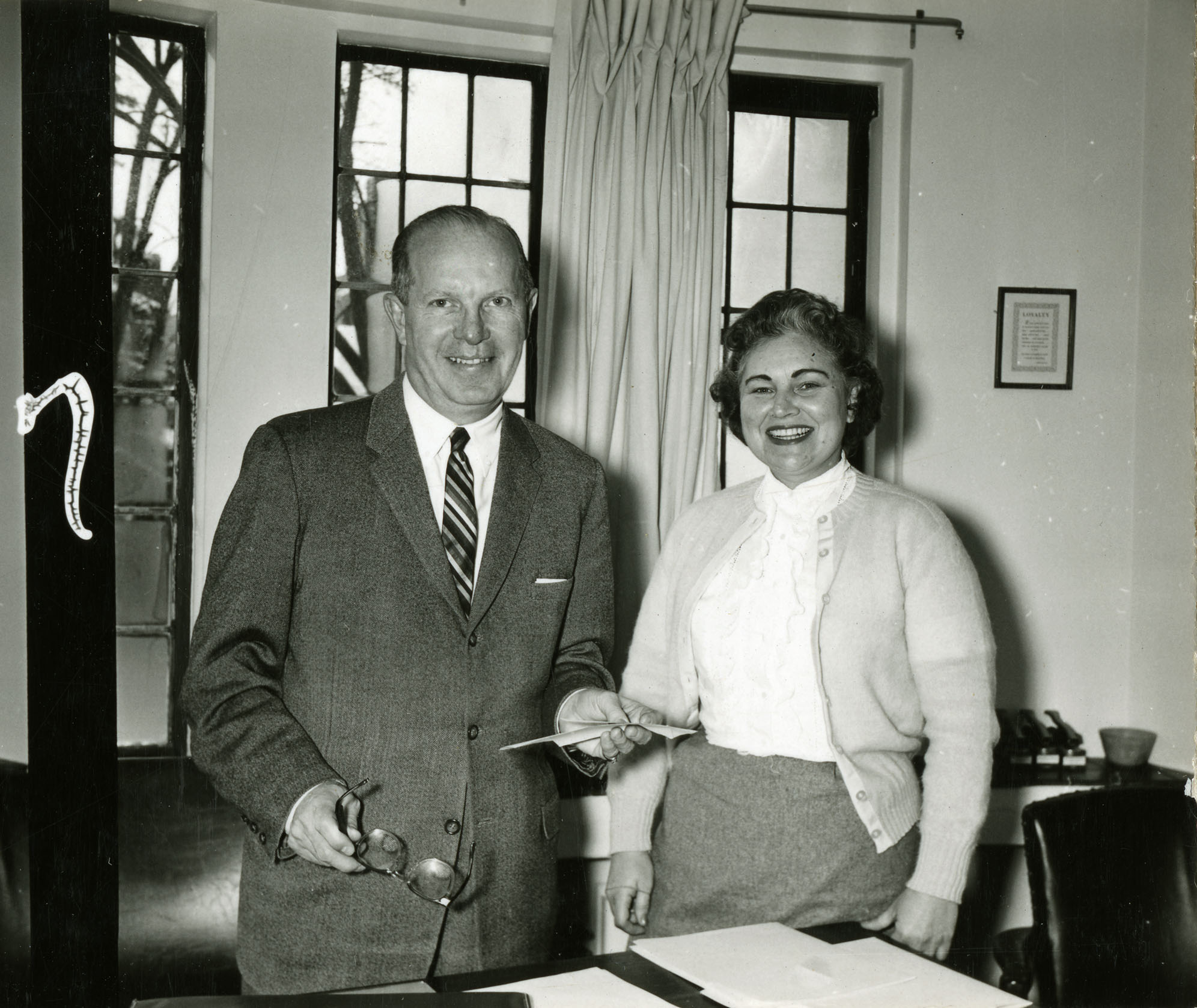
The Archives was saddened to learn this week of the passing of Corajoyce Nancy Lane, of Bloomfield Hills, who worked at Cranbrook for over five decades. Raised by parents who taught her that women didn’t, and shouldn’t, work, Corajoyce (who was headstrong even at a young age!) tried to convince her parents to let her get a job. Her first thought was airplane pilot, followed by truck driver so that she could drive across the country! Instead, at the age of 20, without her parents’ permission, she responded to an ad in the Birmingham Eccentric for a photographer’s assistant at the Cranbrook Foundation. Corajoyce was offered the job by staff photographer Harvey Croze, and finally received consent from her parents. The job only lasted two months, which she followed with a job working for Margaret Auger, then headmistress of Kingswood School. In 1948, Corajoyce married Robert Rauss (they honeymooned at a dude ranch in Colorado) and two years later, left Cranbrook to become a stay-at-home mom to her daughter.

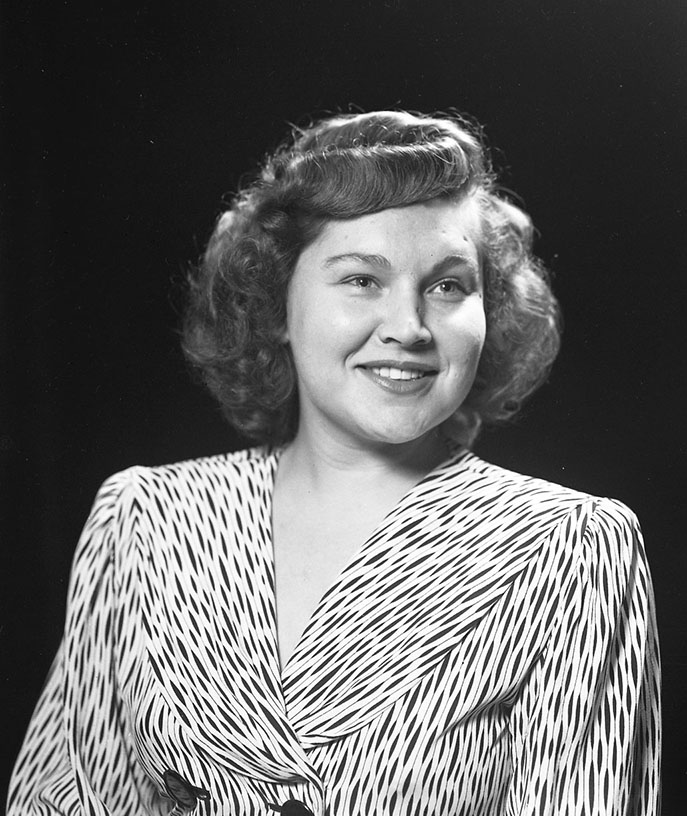
Corajoyce Rauss, Nov 1947.

Corajoyce Rauss, Nov 1947. Harvey Croze, photographer.

In 1961, Corajoyce returned to Cranbrook, this time securing a job as Henry Scripps Booth’s personal secretary. As she and Henry became lifelong friends, she was given more responsibility and became the manager of Henry’s personal estate. During her tenure at Cranbrook, Corajoyce met Carl Milles, Zoltan Sepeshy and Eliel Saarinen among others. George and Ellen Booth used to drop by Kingswood School, often unannounced, and Corajoyce also met visitors including Isaac Stern, Leonard Bernstein, and Princess Christina of Sweden.

Arthur Witleff and Corajoyce Rauss, Jan 1962.

Arthur Wittliff and Corajoyce Rauss, Jan 1962. Harvey Croze, photographer.

Soon after Henry’s death in 1988, Corajoyce began work at the Cranbrook Archives as the part-time bookkeeper. She volunteered additional time and took on the task of organizing, with the help of a core of volunteers, the Booth family photographs, creating photo albums that are housed in the Archives today. She worked tirelessly on compiling The Cranbrook Booth Family of America genealogy which required copious amounts of correspondence with various Booth family members. Her hard work and dedication earned her Cranbrook’s President’s Award for Excellence in 1990. Corajoyce remained a fixture at Cranbrook Archives until her retirement in 2007. She was once quoted as saying that she “lived a Cinderella life.” While Cranbrook has lost a dedicated employee, her love of Cranbrook and the work she accomplished here lives on in the Archives.

Leslie S. Edwards, Head Archivist

Cranbrook Up North

For many of us who grew up in Michigan, going up north during summer vacation was (and still is) something very special – a way to escape the hustle and bustle of city and suburban life and become one with the natural beauty it has to offer. Throughout the 20th century, Cranbrook scientists, artists, architects, students and faculty, as well as members of the Booth family, took advantage of the native woods, white sandy beaches, and waters of Lake Michigan.

Logo for Pinehurst Inn, Indian River, 1940. Cranbrook Archives

Logo for Pinehurst Inn, Indian River, 1940. Cranbrook Archives.

Shelley Selim, Cranbrook Art Museum’s Ralph and Jeanne Graham Assistant Curator, curated the exhibition Designing Summer: Objects of Escape which features Michigan designers and companies who have contributed to summer innovations including tents, boats, and bicycles as well as a summer home designed by Florence Schust Knoll. In response to the opening of the exhibition on Saturday, June 20th, I opted to post a few highlights of Cranbrook’s ongoing relationship with northern Michigan.

Dudley Blakely painting at group site, Bois Blanc Island, 1938. Cranbrook Archives.

Dudley Blakely painting at group site, Bois Blanc Island, 1938. Cranbrook Archives.

As early as 1929, staff and faculty from the Institute of Science traveled north to conduct studies of animal and plant life on the many islands in Lake Michigan – from Bois Blanc to the Manitous. Reports of these research trips were documented in photographs, field notes, and ultimately published in Institute of Science newsletters and bulletins.

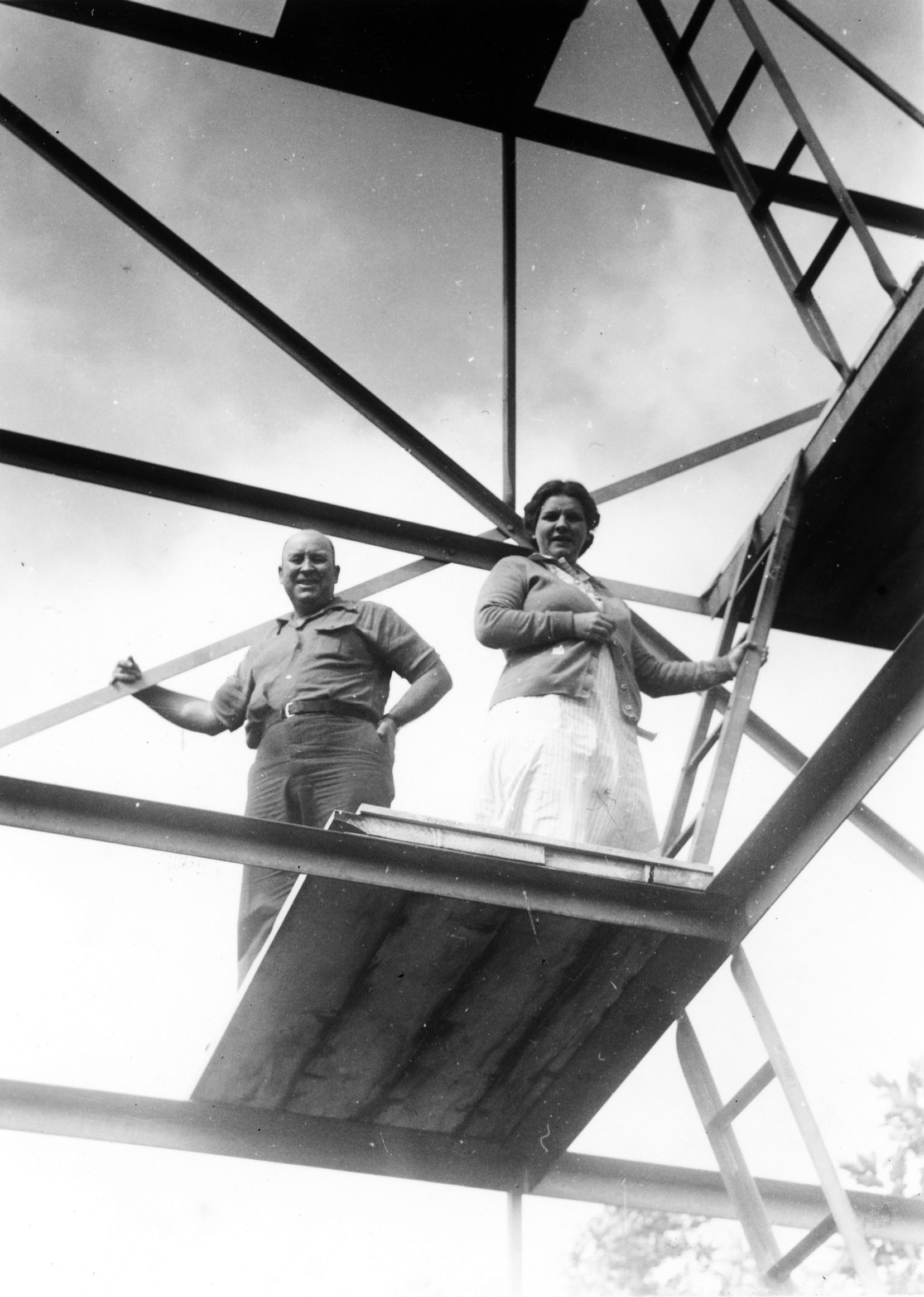
During the 1940s and 1950s, Henry Scripps Booth took his family up north for several summers, often vacationing with friends. One of their favorite spots was Good Hart, where they stayed either at The Krude Kraft Lodge or the Old Trail Inn.

Carolyn Farr Booth and Chauncy Bliss on the Fire Tower at Good Hart, ca 1940. Cranbrook Archives.

Carolyn Farr Booth and Chauncy Bliss on the Fire Tower at Good Hart, ca 1940. Cranbrook Archives.

Communities like Cross Village, Harbor Springs, and Glen Arbor have been inspirational for Cranbrook artists and architects for centuries. Former head of architecture, Robert Snyder, designed an A-Frame beach cottage for Wally Mitchell, while architecture student Harry Weese designed a trifecta of summer homes (two for the Weese family) at Glen Arbor. “Shack Tamarack” (named after the tamarack logs used in its construction) was built in 1936 and is still used by Weese descendants today. Harry followed that with “Cottage Two” in 1939, a one story house designed with his brother John, and the Pritchard House which spoke to the modern aesthetic Weese experienced as an architecture student at Cranbrook Academy of Art.

Robert F. Swanson and Pipsan Saarinen Swanson spent decades designing commissions up north including the ultra-modern MacDonald Building in Harbor Springs, the L’Arbre Croche Condominium development, and the family’s own summer cottage at Menonaqua (along with son, Bob). Check out Shelley’s blog about Pipsan’s Sol Air furniture which is featured in the Designing Summer exhibition.

While architect Tod Williams (Cranbrook School ‘61) served as project manager for Richard Meier’s Douglas House project also located in Harbor Springs, other Cranbrook-related projects up north include The Munising Design Strategy Matrix – a community design project managed by The Community Design Advisory Program (CDAP). Established in 1987 by Design Michigan, a non-profit, state outreach program housed at Cranbrook Academy of Art, CDAP provided tailored community design and revitalization services to the city of Munising.

And, in 2013, Peter Pless (CAA ‘02) lead a design collaboration between the Human Centered Design Program at Northern Michigan University and the Lloyd Flanders furniture company of Menominee, Michigan.

Thankfully, there is seemingly no end in sight to the inspiration and possibilities of art, architecture, science, and plain old fashioned relaxation one can find up north.

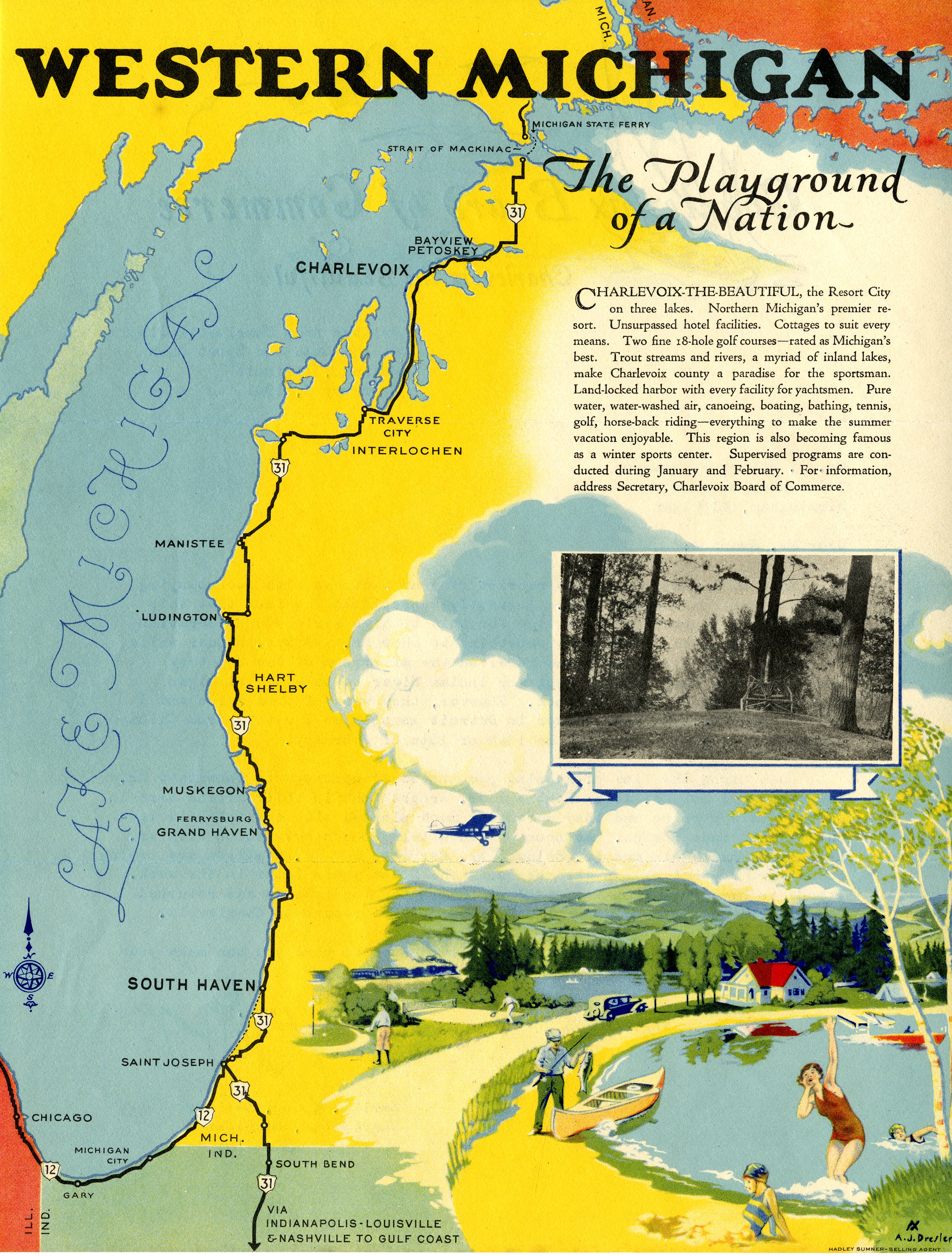
Promotional Literature, Charlevoix Chamber of Commerce, 1941. Cranbrook Archives.

Promotional Literature, Charlevoix Chamber of Commerce, 1941. Cranbrook Archives.

Leslie S. Edwards, Head Archivist

Create a website or blog at WordPress.com