Form Follows Emotion

View-Master 3D Viewer by Design Logic

View-Master 3D Viewer by Design Logic

This is one of the more successful products created by Design Logic, a product design company whose records I’m currently processing. This View-Master 3D Viewer was a new take on an old, familiar product, and reflected the company’s philosophy that every product has both a technical and emotional element. This new version, created in 1985, featured “push-button technology,” and larger image magnification to make it more technologically competitive with other toys of the era, while maintaining the overall look of its predecessor. Time magazine named it one of the best designs of the year.

Design Logic was founded in 1985 by Cranbrook Art Academy graduate David Gresham, and Martin Thayer, a Royal College of Art graduate; the two worked together at ITT Corporation. Operating out of Chicago, the mission of the company was to “create designs that are functional, beautiful, profitable and based on a distinctively American perspective.” The company is no longer in business.

Once the processing of the Design Logic records is complete, a finding aid will be posted on our web site and more images of their creative, unusual products will be in our digital database, so keep an eye out!

– Cheri Gay, Archivist

Photo Friday: Fall is Leaf-ing Us

Oriental Bridge, 1980.  Balthazar Korab, photographer.

Oriental Bridge, 1980. Balthazar Korab, photographer.

Autumn is a second spring when every leaf is a flower.     –Albert Camus

Fall is probably my favorite time of year, and on the Cranbrook campus, there is no lack of beautiful spots to capture on film.  Though taken nearly 25 years ago, this photo captures the beauty and serenity found all around us.  Built before 1914, the bridge was originally called the Japanese bridge and was made of arched cypress.  How do we know this?  George Booth had meticulous inventories taken in the early days and every piece of wood, metal, and otherwise was accounted for!  Now, the bridge, part of the Oriental Gardens and known as the Oriental bridge, is painted red and is one of the centerpieces of  the gardens meticulously maintained by members of the Cranbrook House and Gardens Auxiliary.

With the recent winds and rain, the leaves are fast falling from the trees and gracing us with a different set of vistas.    Good-bye autumn leaves until next year.

Leslie E. Edwards, Head Archivist

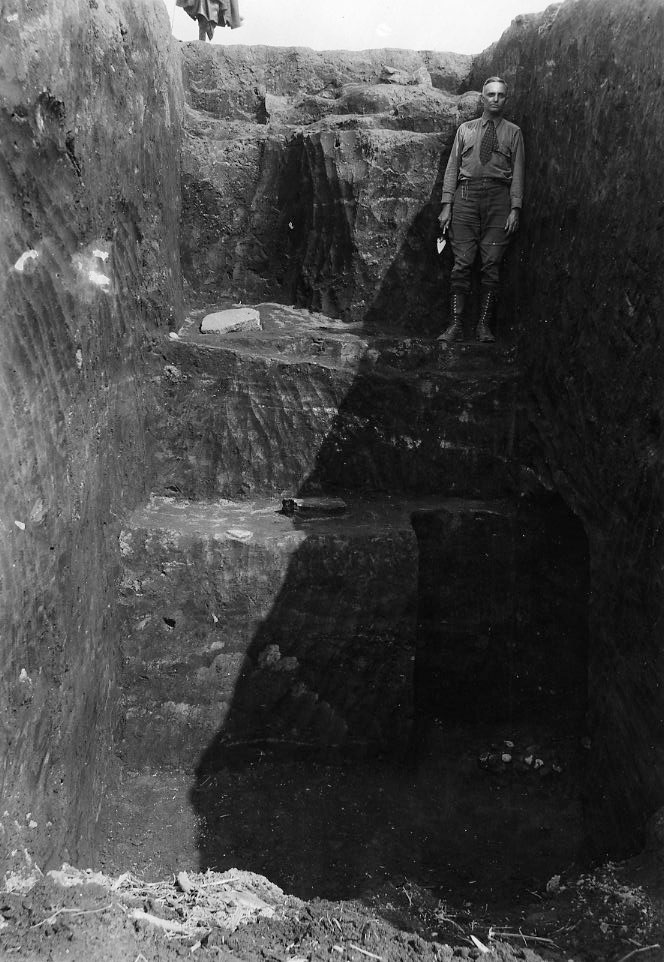
Photo Friday: Excavation at Greenwood Mound

William Colburn, February 1932. Cranbrook Archives

William Colburn, February 1932. The William Colburn Papers, Cranbrook Archives.

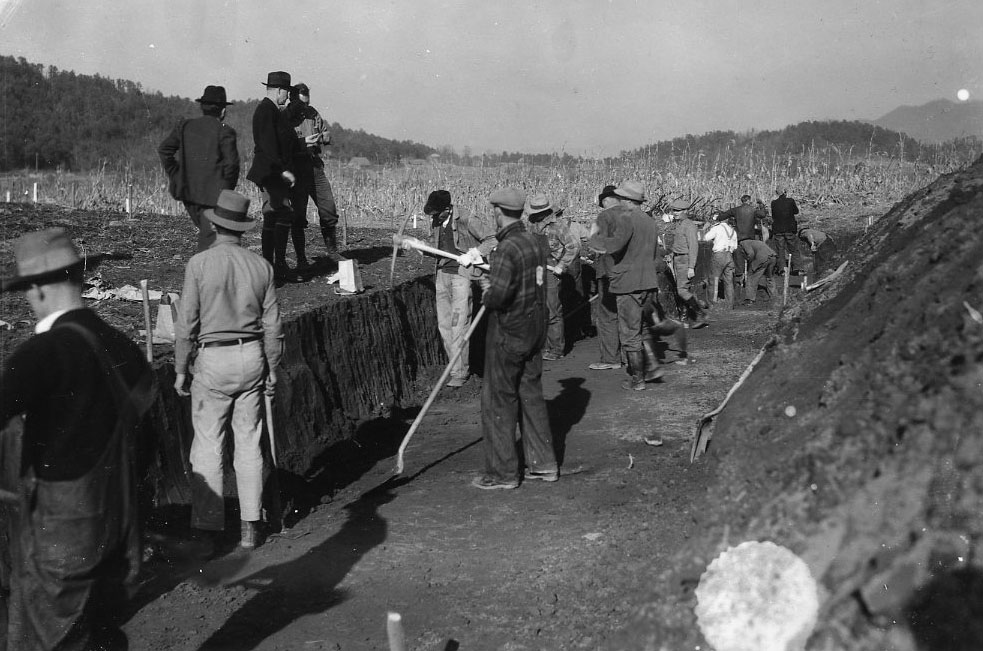
Team of men at dig. Cranbrook Archives.

Team of men at dig. The William Colburn Papers, Cranbrook Archives.

In honor of International Archaeology Day, today’s Photo Friday is a tribute to Archaeologist William Colburn (1882-1966). Colburn, a Detroit native, first visited Cranbrook Institute of Science in 1932. He spent a few weeks in December of the same year fixing display and lighting issues the Institute had in the “mineralogical room.” It came to his attention in 1933 that there were multiple collections of mineral specimens held by the Detroit Museum of Art (now the Detroit Institute of Art) that were not being displayed due to lack of space. Colburn secured an indefinite loan of these collections to the Institute, and spent the majority of the summer of 1933 cataloging and displaying them. Subsequently, Colburn accepted a position on the Institute’s Board of Trustees, a position he held from 1933-1944.

Colburns sketch of the bowling alley. Cranbrook Archives.

Colburn’s sketch of the bowling alley. The William Colburn Papers, Cranbrook Archives.

"Showing field rocks on bowling alley after cloudburst." Cranbrook Archives.

Taken after the rain, the arrangement of fieldstones can be seen. The William Colburn Papers, Cranbrook Archives.

Colburn is well-known for an excavation he led in February 1932 of the J.J. Greenwood Mound, a Cherokee civilization near Dillard, Georgia. Although he did not find any major burials or relics, Colburn’s team did come across some interesting finds. In his report, Colburn describes the discovery of a stone alignment that he interpreted as a Cherokee “bowling alley” (a Native American game). A formation of fieldstones was found with a smooth hard-baked clay runway. A rainstorm shortly after the discovery shifted the original arrangement of the stones. Thirty-two disk-shaped stones with rounded edges discovered at the sides of the “runway” were used for the game. One of the stones was found with a chip that had been carefully repaired by the Cherokee.

Colburn's drawing of the mound site. Cranbrook Archives.

Colburn’s drawing of the mound site. The William Colburn Papers, Cranbrook Archives.

Colburn made several innovations for which Cranbrook became known, including internally lit display cases and back-lighting mineral specimens. Colburn  sought out specimens, making numerous trips to the Upper Peninsula, and even the Eastern and Western parts of the country, in order to build the collections at the Institute. Through his many excavations Colburn obtained numerous mineral specimens for the Institute. In addition, he bequeathed a generous amount of specimens to the Institute.

Gina Tecos, Archivist

Photo Friday: A Labor of Love

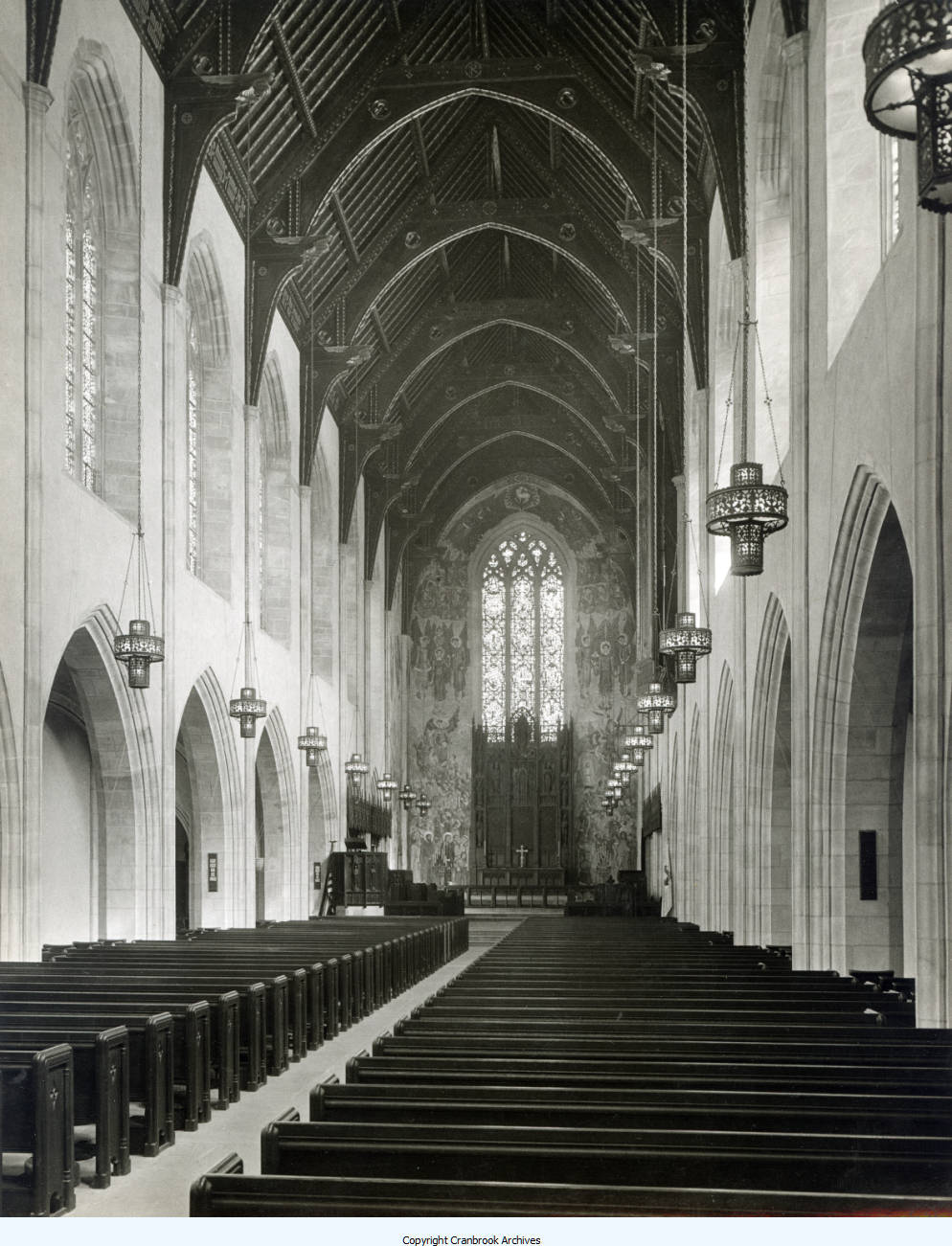
Christ Church Cranbrook Interior. Cranbrook Historic Photograph Collection, Cranbrook Archives.

CCCnave

Christ Church Cranbrook Nave. Cranbrook Historic Photograph Collection, Cranbrook Archives.

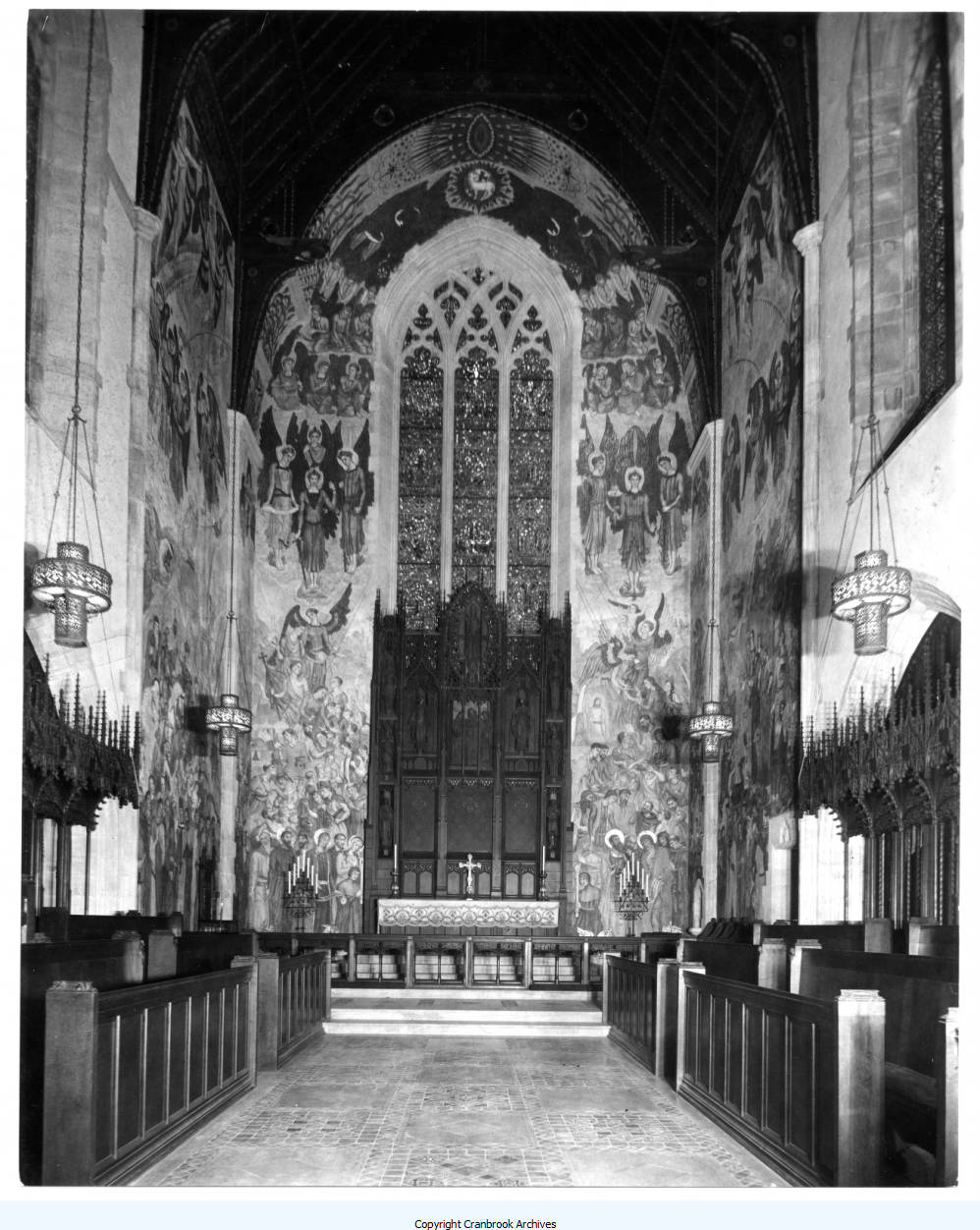
After a visit to Christ Church Cranbrook earlier this week, I knew it needed to be highlighted as today’s Photo Friday! George G. Booth conceived Christ Church to be the moral center of the new community which he was building at Cranbrook. The photos show a great overview of the expansiveness of the church and shed some light on the magnitude of the work involved in its design. Each of these elements adds to the overwhelming detail of George Booth’s vision and the care in the design of Christ Church Cranbrook.

The church is Booth’s testament to the Arts and Crafts movement. He carefully acquired and commissioned each work of art to add to the overall wonderment of the church and to pay tribute to those who have devoted their lives toward artistic and altruistic pursuits.  The works of art range from the sterling altar plate to stained glass windows, altar frontals, tilework, woodcarvings, paintings, sculptures, and metalwork, most from noted Arts and Crafts men and women.

These photographs, taken five years after the 1928 dedication of Christ Church Cranbrook show the interior of the church sanctuary and a detail view of the nave of the church. The large fresco flanking the high altar was designed and executed by Katherine McEwen, an old friend of Booth’s, and one of the founding members of the Detroit Society of Arts and Crafts.  From the work of Katherine McEwen to Oscar Bach, Samuel Yellin, and Hildreth Meire, to name a few, Christ Church Cranbrook is an architectural gem which should be experienced in person!

Stefanie Dlugosz, Center for Collections and Research, Collections Fellow


Photo Friday: A Splash of Color

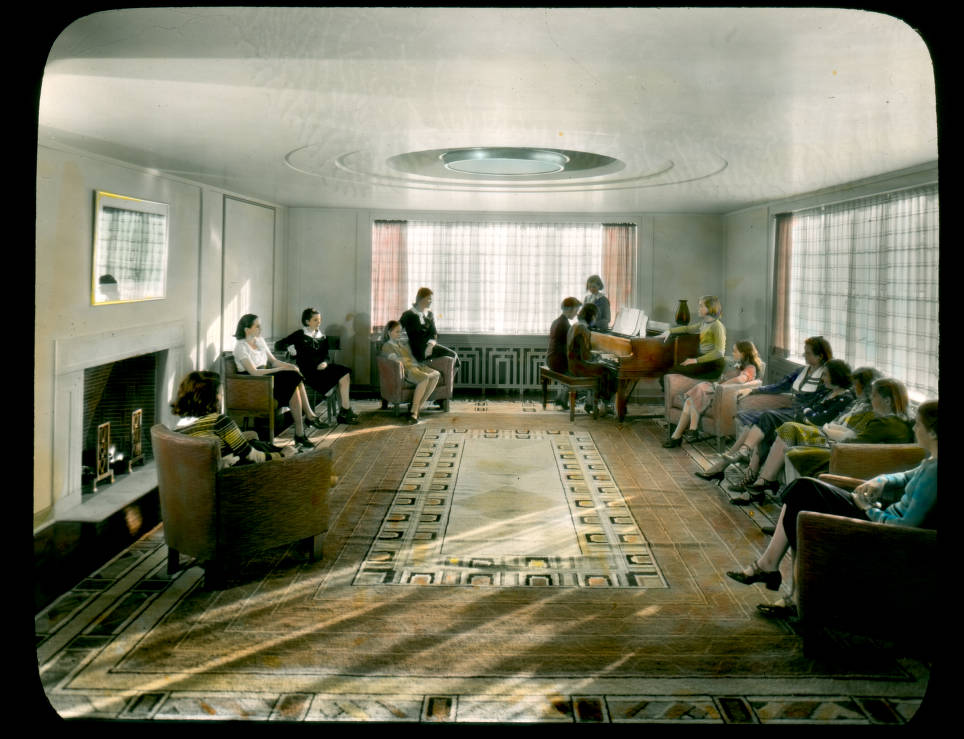
Kingswood School Rose Lounge. Cranbrook Archives

Kingswood School Rose Lounge, The Cranbrook Hand-Colored Lantern Slide Collection. Cranbrook Archives

As the weather here at Cranbrook is more than a little dreary, today’s photo provides a look into a bright and cozy atmosphere perfect for reading, relaxing and being inside. Taken around 1932, it shows a group of students gathered in the lounge of the Kingswood School dormitory (originally known as Reception Room III) listening to two of their peers play the piano. The photograph comes from Cranbrook Archives’ Hand-Colored Lantern Slide Collection. The photographs in this collection were originally black-and-white and were painted with watercolor years later, and not by the original photographer. This jump in time explains the vibrant color choices in the photograph as the painter was not present when the image was originally captured.

The Cranbrook Hand-Colored Lantern Slide Collection contains over 30 images of Cranbrook institutions taken primarily during the 1920s and 1930s. Several of the original black and white images were taken by architectural photographers for inclusion in publications.

Today’s photo was taken by George W. Hance, Cranbrook’s first paid staff photographer (1931-1932). Hance had been commissioned by George Booth as early as 1916 to photograph his art collection and later photographed Cranbrook’s campus and grounds including Kingswood, Cranbrook House (home to George and Ellen Booth) and Thornlea (home to Henry Scripps Booth). Explore more photographs like these on our digital image database or in person at the Archives!

Stefanie Dlugosz, Collections Fellow, Cranbrook Center for Collections and Research


Photo Friday: Seeing the Unseen

Dr. Harold Edgerton

Dr. Harold E. Edgerton giving a lecture at Cranbrook Institute of Science, Jan 1950. Cranbrook Archives.

A Fellow of the American Academy of Arts and Sciences, who was awarded the National Medal of Science, and won an Oscar  – the subject of today’s Photo Friday has quite the list of accomplishments! Dr. Harold E. Edgerton gave a lecture at Cranbrook Institute of Science in 1950 called “Seeing the Unseen”. Edgerton advanced the development of strobes – using them to freeze objects in motion to capture on film. Utilizing short duration electronic flash, Edgerton developed techniques for photographing athletic events, bullets, and drops and splashes. Many of his photographs were published in Time magazine.  In 1937, one of Edgerton’s milk-drop photographs was included in the first photography exhibition at the Museum of Modern Art.

In 1952, the National Geographic Society invited Edgerton to join Jacques Cousteau on an underwater exploration. Edgerton built underwater cameras and flashes for Cousteau, and also developed sonar technology that enabled him to search for the ancient Greek city of Helike (submerged around 373 B.C.) and locate an H-bomb off the coast of Spain.

Gina Tecos, Archivist


Photo Friday: Happy Birthday Ralph Rapson!

New Moon by Ralph Rapson

Plan for Rapson’s New Moon Homes, Alma, Michigan, 1945. (Project not realized) Cranbrook Archives

In honor of Ralph Rapson’s 100th birthday, (September 13th) today’s Photo Friday features images from the Ralph Rapson Collection (1935-1954). Rapson studied architecture under Eliel Saarinen at the Cranbrook Academy of Art from 1938-1940.  He worked in the Saarinen office until 1941 when he moved to Chicago and taught at the New Bauhaus with Lazlo Moholy-Nagy.  In 1954, he relocated to Minneapolis where he established the University of Minnesota’s School of Architecture.  One of the country’s leading modernist architects, Rapson created hundreds of sketches and is perhaps best known for his whimsical illustrations of people and transportation.

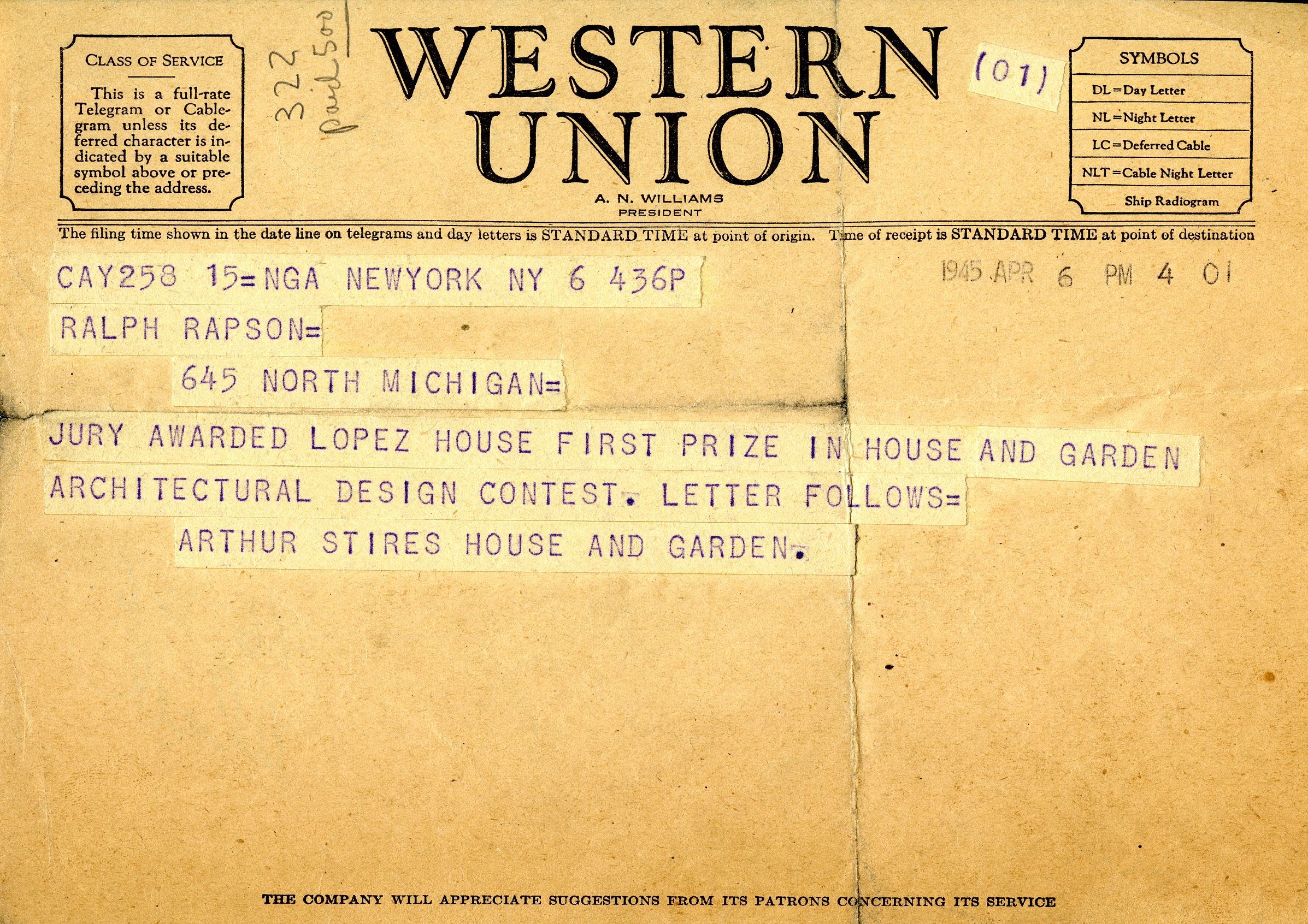
Ralph Rapson telegram

Telegram announcing Ralph Rapson’s first prize win for the “Lopez House” in the House and Garden Architectural Design Contest, 1945. Cranbrook Archives

Leslie S. Edwards, Head Archivist, and Gina Tecos, Archivist

Photo Friday: Back to School in 1912

Stock certificate for the Bloomfield Hills Seminary issued in 1912/Courtesy Cranbrook Archives.

Stock certificate for the Bloomfield Hills Seminary issued in 1912. Cranbrook Archives.

In early June of 1912 a small group of Bloomfield Hills residents assembled at the home of William T. Barbour (president of Detroit Stove Works) to discuss the formation of a small local private school. After general discussion, it was moved by George Gough Booth to establish a corporation with capital of $5,000.00 in order to establish the school. According to meeting minutes, the objectives were to “give the young people of Bloomfield Hills, and those from nearby towns, the opportunity to study in the country; to offer a course of study that will fit them for life as well as for college.” With these objectives in place, the Bloomfield Hills Seminary was incorporated in August.

Often referred to as the precursor to Brookside School, the Seminary was located on five acres at the corner of Woodward Avenue and Lone Pine, in a historic house built in 1820 by Ezra Parke. Booth, who had purchased the property in 1910, offered use of the house and added a five-class-room addition with the caveat that the property would revert back to him should the school ever close.

Mary Eade, who had been the principal of the Detroit Seminary for Girls, became the principal and taught grammar and upper level courses, including History of Art. Elizabeth K. Seward (granddaughter of William Henry Seward of the Alaska purchase fame) taught intermediate classes including French, and Winifred Eastman was responsible for the elementary age children. The coeducational day school used the Montessori method of instruction.

In 1916, the trustees voted to change the name of the school to the Bloomfield Hills School. At its peak, there were eight teachers and fifty-one students enrolled. Due in part to the resignation of Mary Eade (who resigned to do war work) and the construction of new schools in Birmingham and Pontiac, the school closed in 1918 after six years. The property reverted back to Booth who purchased all of the stock certificates back from the trustees, and later became known as the Lone Pine Inn and Tea House, but that’s another story!

Leslie S. Edwards, Head Archivist and, Gina Tecos, Archivist

Photo Friday: Ciao Cranbrook!

Italian workers at Cranbrook

Italian laborers at Cranbrook, ca 1906/Cranbrook Archives

For many Americans, Labor Day’s most popular meaning is a “last hurrah to summer,” but its national significance is much greater than that. In 1894, Grover Cleveland designated the first Monday in September as a national holiday paying tribute to the contributions and achievements of the working force in America. The Italian laborers pictured here arrived at Cranbrook in 1905. Hired by George Booth, men with the last names of Angelosanto, DiPonio, Roselli, Soave, and Vettraino built roads and stone walls, dug ponds, contoured the land, planted, and cared for the property. In 1955 the Cranbrook Foundation Board of Trustees dedicated a plaza north of the Brookside School in appreciation of groundskeeper Michael Vettraino’s 50 years of service to the Cranbrook community. In his speech at the “Piazza Vettraino” dedication, Henry S. Booth said, “We acknowledge a debt to his native Italy, his affection for the world of growing things, his quest for beauty, his tireless hands and feet, and the part he has played as one of the many founders of Cranbrook today.”

Click here to listen to a clip from our oral history collection of Dominick Vettraino speaking about the work the Italians did on the grounds of Cranbrook.

Gina Tecos, Archivist

Photo Friday: Arthur Nevill Kirk on Facebook

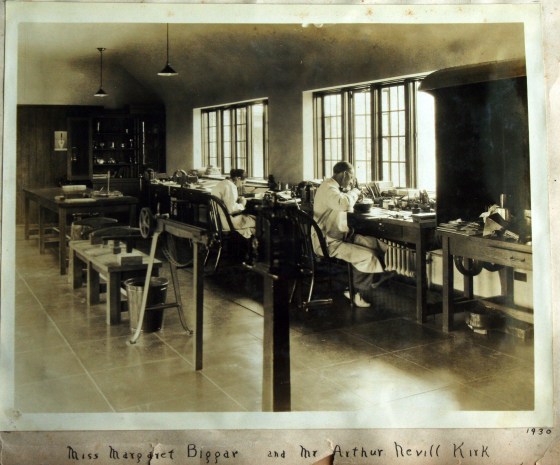
Famed metalsmith Arthur Nevill Kirk and apprentice Margaret Elleanor Biggar work in the metalsmithing studio at the Cranbrook Academy of Art, 1930. Cranbrook Archives.

Famed silversmith Arthur Nevill Kirk and apprentice Margaret Elleanor Biggar work in the metalsmithing studio at the Cranbrook Arts and Crafts Studios, 1930. Cranbrook Archives.

In this scrapbook page from 1930, “Miss Margaret Biggar” and “Mr. Arthur Nevill Kirk” are found working in the metalsmithing studios at the arts and crafts studios, the predecessor to the Cranbrook Academy of Art. An English-born silversmith, Arthur Nevill Kirk came to Cranbrook in 1927 at the urging of George Booth, who contracted him to produce silver designs for Christ Church Cranbrook. Kirk eventually taught silversmithing at the Cranbrook Arts and Crafts Studios before going on to found the Metals department at Wayne State, where he worked until 1957.

We at the Kitchen Sink are excited to use this post as an opportunity to promote not just the amazing history of Arthur Nevill Kirk but also highlight a new edition to the Cranbrook social media landscape – Cranbrook Archives’ Facebook page! As the beating heart of the Center for Collections and Research and the repository for all things historical at Cranbrook, the Archives uses Facebook to promote its extensive holdings, provide a portal through which researchers can access information about the collection, and give casual readers a daily glimpse into the fascinating history of the community through posts like yesterday’s, which featured this very photo. Check out their Facebookpage and learn more about this incredible resource!


Create a website or blog at WordPress.com