The Iconic Kitty Kingswood

A colleague recently inquired about a painting on the mezzanine wall leading to the music practice rooms at Kingswood School. The painting is of a girl, “Kitty Kingswood,” who is holding a pennant and is accompanied by a swan on the waves of Kingswood Lake. Eliel Saarinen painted the image in the 1930s to camouflage clay sewer pipes.

Painting by Eliel Saarinen in Kingswood School of Kitty Kingswood. Photo courtesy of Cassandra Nelson.

In 1950, Lillian Holm (Head of Weaving at Kingswood School from 1933-1965) copied the pattern of the gown from the painting and Louise Raisch hand-wove the first Kitty Kingswood doll. This doll was auctioned at the 1950 Autumn Festival.

The original Kitty Kingswood doll auctioned at the 1950 Autumn Festival. Photograph by Harvey Croze. Courtesy Cranbrook Archives.

Is there more to the Kitty Kingswood story? A recent trip over to the Girls Middle School, as well as a dive into our files here at the Archives, indicates that there is much more—and the iconic Kitty still plays an integral role.

Fast forward to 1964. The Kingswood Alumnae Association presents a new award to a seventh or eighth grade girl who has contributed to the spirit of Kingswood and is an outstanding citizen. The Association commissions Kingswood sculpture teacher, Pamela Stump Walsh, to create a statue of Kitty Kingswood for the award. The Birmingham Eccentric describes the sculpture as “a typical KSC girl who holds a hockey stick and a pennant and stands on the KSC seal.”

A sketch for the Kitty Kingswood award by Pamela Stump Walsh. Courtesy Cranbrook Archives.

Today, the statue resides at the Girls Middle School as does a plaque (also donated by Pamela Stump Walsh) with the award recipients’ names. An additional case at the middle school displays a Kitty Kingswood doll, which was reproduced and auctioned off for many years to raise funds for the school.

Kitty Kingswood sculpture by Pamela Stump Walsh at the Girls Middle School today.

The Kitty Kingswood Citizenship Award is still presented to an outstanding student each year at the Girls Middle School. The award is determined by vote of the faculty. Pamela Stump Walsh presented the award to the first recipient in 1964, and her words still inspire students today: “Good citizenship is more than simple obedience to a set of rules or laws. It is a loving obedience to just laws and the courage to change the unjust…but most of all, it is serious concern for the condition of others, even for the condition of our enemies.”

Gina Tecos, Archivist

Photo Friday: Thornlea Studio

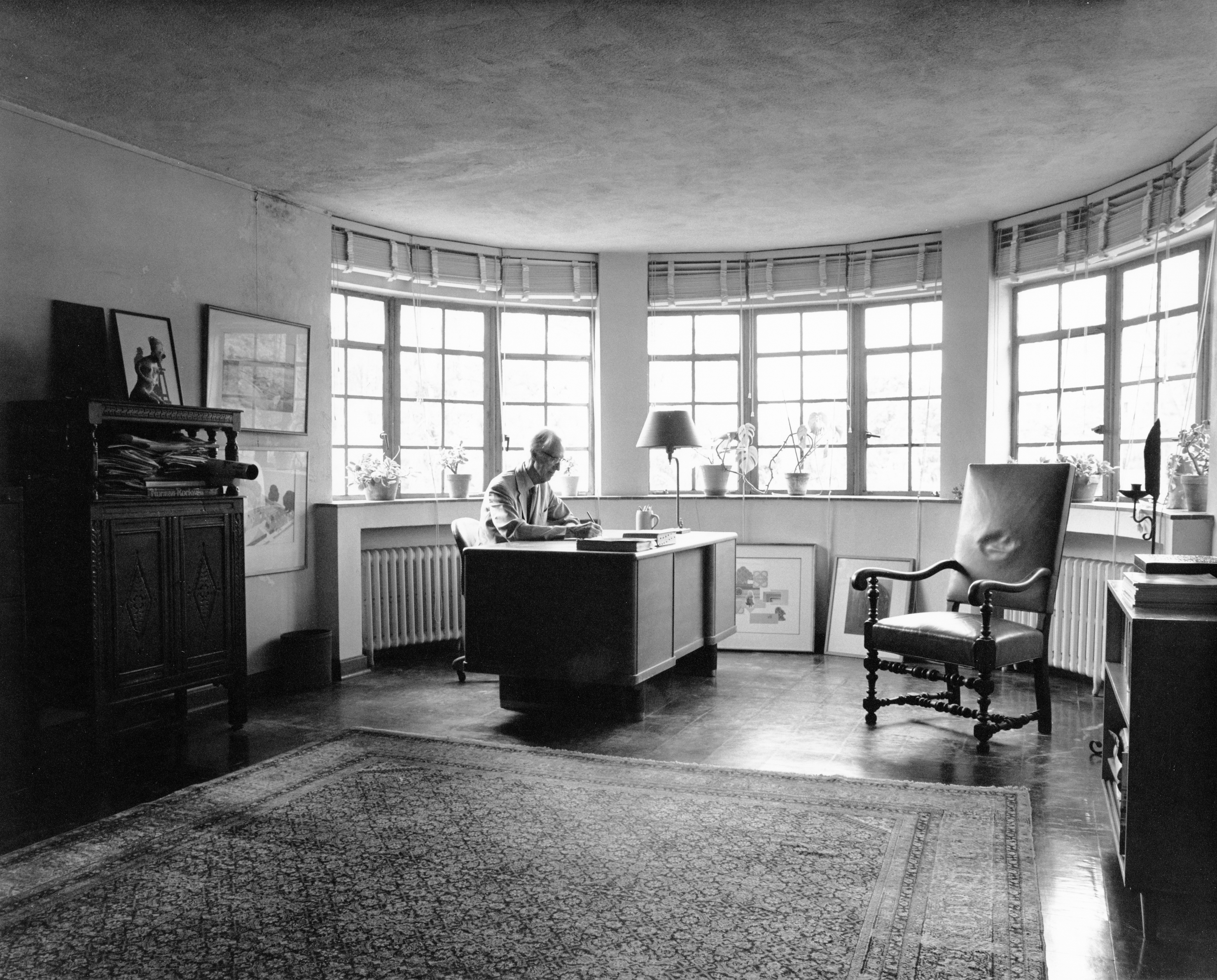
In this moody photograph by Jack Kausch, we see Henry Scripps Booth with his plants, prints, antiques, and drawings in the Thornlea Studio alcove.

Thornlea Studio Kausch 1981

Henry Scripps Booth at his desk in the Thornlea Studio alcove. October 1981. Courtesy Cranbrook Archives/Jack Kausch Photographic Collection.

Henry designed Thornlea Studio as a working retreat behind his house, Thornlea, off Cranbrook Road. Completed to his own designs in 1937, here Henry worked on architectural projects for himself, for Cranbrook (like redesigning the Art Museum bathrooms and building the Cranbrook House gatehouse), and for friends and clients. He also used the studio as a place to write and read next to the cozy fireplace or beautiful expanses of windows.

Thornlea Studio Askew 1940

Henry built this studio in 1937; in 1988 it was converted into the home of the Cranbrook Archives. Richard G. Askew, photographer, 1940. Copyright Cranbrook Archives.

After Henry’s death in 1988, the studio was converted into a home for the Cranbrook Archives. The Archives were begun in part through Henry’s efforts sifting and organizing the Booth family papers and ephemera held at Cranbrook House. Relocated from the (very wet) basement and (very hot) attic of Cranbrook House, the Archives and its professional staff moved into Thornlea Studio. The most significant change to the building involved converting the Studio garage into a vault, with the reading room occupying the first floor drafting room and the alcove and offices on the second floor.

In 2012, the Archives offices, Reading Room, and certain parts of the collections were moved into the lower level of Cranbrook Art Museum. This summer, with the help of former Art Museum Preparator Mark Baker and Cranbrook Capital Projects, we moved again, into the Collections Wing.

Gina and Laura in Reading Room Sept 11 18

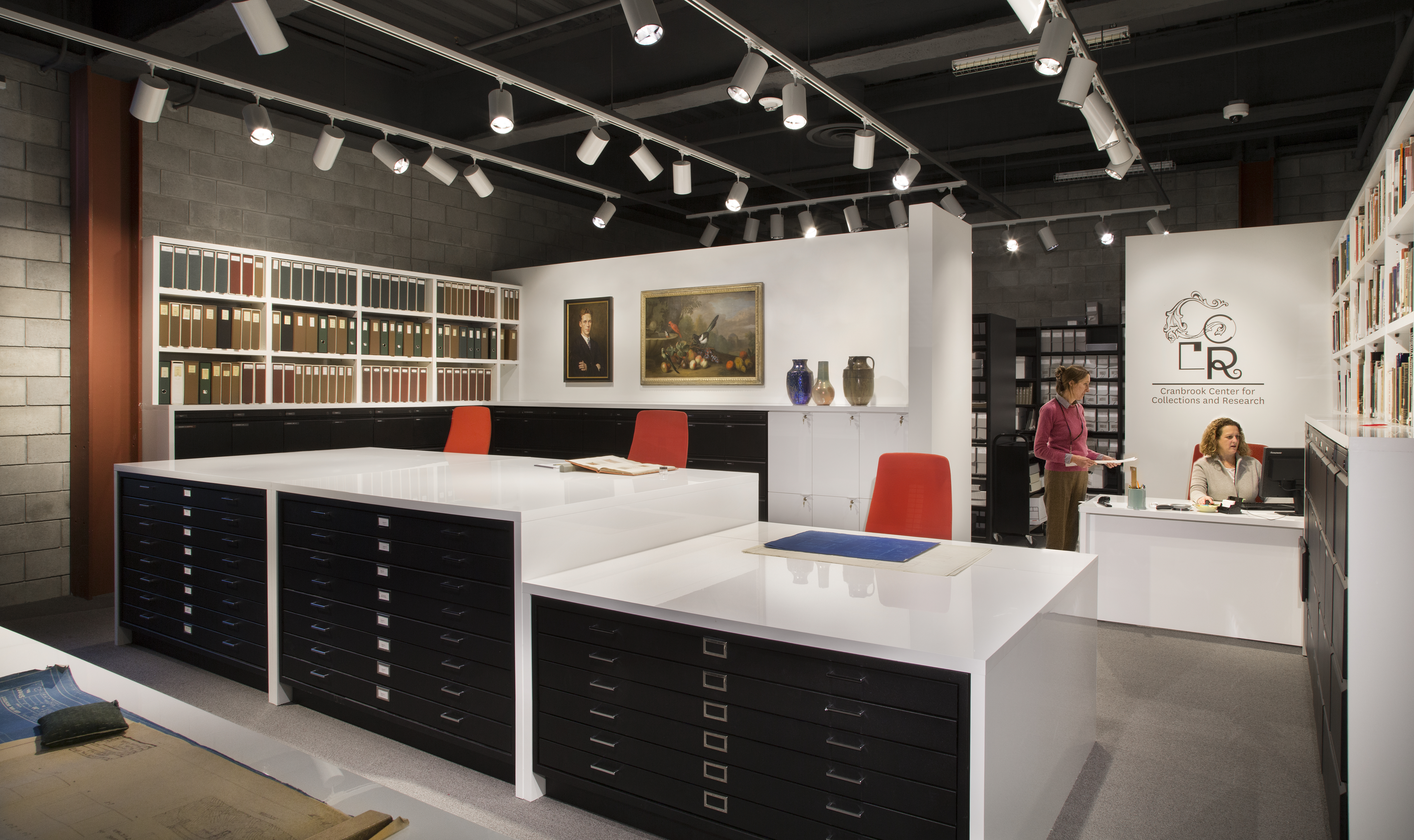
The new Archives Reading Room in the Cranbrook Art Museum Collections Wing. PD Rearick, photographer, 2018. Courtesy of the Cranbrook Center for Collections and Research.

In our beautiful new Archives Reading Room, we’ve hung a 1922 portrait of Henry Booth to commemorate his efforts to create and steward Cranbrook Archives. To visit our new Reading Room, see treasures from the Archives, and hear new research from five patrons of the Archives, come to our Open Archives event this Sunday from 1 to 5pm (short talks begin at 3pm). More information is available on our website.

Register online or at the door for this free event, and join us Sunday to celebrate Cranbrook Archives and see the new Reading Room!

Kevin Adkisson, Collections Fellow, 2016-2019, Cranbrook Center for Collections and Research

Editors Note: The Archives is also excited to announce new hours! We will be open on Tuesday to Friday 11 to 5pm and the second Saturday of each month, 11 to 5pm.

Brighty of Thornlea House

20180822_125558

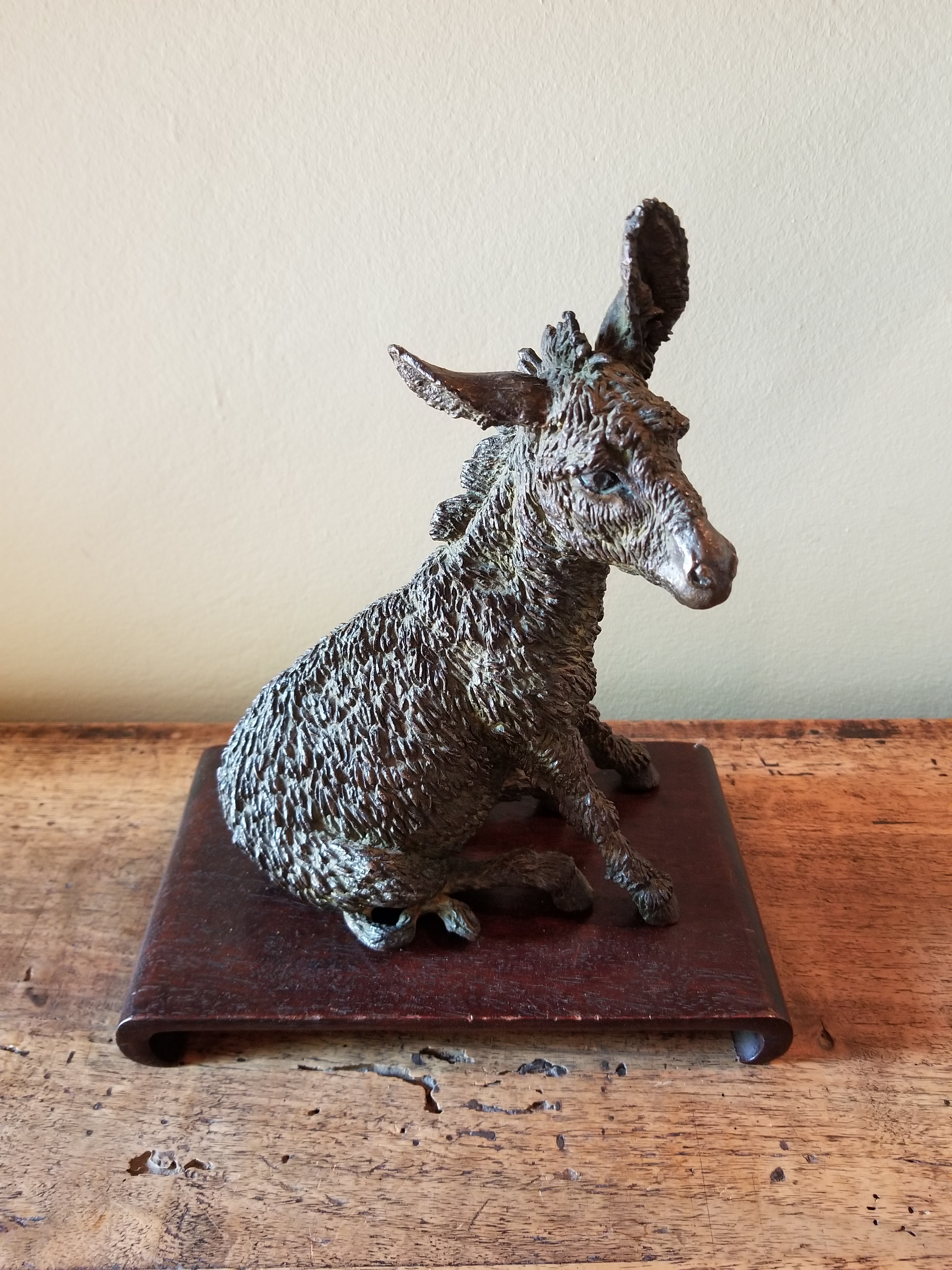
Peter Jepsen, Brighty, cast bronze. 1966. Collection of Thornlea House, Cranbrook. Courtesy of Cranbrook Center for Collections and Research.

In the foyer of Thornlea, the home of Henry Scripps and Carolyn Farr Booth, sits this statue of a burro, Brighty, by Peter Jepsen. He was a gift from their son, Stephen, commemorating a movie project he spearheaded.
BrightyOfTheGrandCanyon

Dust jacket of Brighty of the Grand Canyon. 1953 (first edition). Courtesy of Michigan eLibrary (MelCat).

In 1953, Newbery Award winner Marguerite Henry (1902-1999) published the novel Brighty of the Grand Canyon. It tells the story of a real burro named Brighty who lived in the Grand Canyon from 1890-1922. Brighty spent summers carrying water up the canyon to the North Rim. He was rewarded for his work with pancakes. Brighty became popular with visitors, and is said to have accompanied Teddy Roosevelt on one of his three visits to the Grand Canyon. In 1963, Betty Booth bought a copy of Brighty of the Grand Canyon for her three boys, Douglas, Charlie, and Woody, to read on vacation. Betty was the wife of Stephen Farr Booth, who was a television producer at the time. Stephen read the book and loved it so much he decided to make it into a movie of the same name. The movie premiered in Detroit in 1967.
Brighty-poster

Movie poster for Brighty of the Grand Canyon. 1967. Courtesy WikiCommons.

To promote the movie, Stephen had commercial artist Peter L. Jepsen (1921-1994) create a life-sized, 600-pound statue of Brighty to be placed in the Grand Canyon’s South Rim’s Visitor Center (it was later moved to the North Rim’s Grand Canyon Lodge, where it resides today and where visitors rub his nose for good luck). Stephen also had 100 small-scale versions of the sculpture made and distributed to various people who worked on the movie. Stephen also gave one to his parents, who placed Brighty right inside the door of their home Thornlea. We don’t encourage visitors to rub Brighty’s nose for good luck, but he is a fun and memorable addition to welcome guests to Thornlea. – Leslie S. Mio, Associate Registrar Note: The book, movie, and statue have kept the legend of Brighty alive. Brighty even has his own Facebook page. Ed. Note (July 17, 2025): It appears the Dragon Bravo wildfire has severly damaged the original Brighty statue at the the lodge on the North Rim of the Grand Canyon. https://www.facebook.com/share/p/1CDkSfoutX/ Please know that the Cranbrook Center for Collections and Research will do everything it can to support efforts to restore or replace Brighty,

Ralph Rapson: New Archival Collection

Cranbrook Archives is excited to announce the opening of the Ralph Rapson Collection (1935-1954) for research. The collection focuses on the early years of Rapson’s work, including his time as a student at Cranbrook Academy of Art. Rapson’s later work is retained at the Northwest Architectural Archives at the University of Minnesota, where he was the Dean of the School of Architecture from 1954-1984.

Rapson was born in Alma, Michigan in 1914. He earned Architecture degrees at the University of Michigan (1938) and at Cranbrook Academy of Art (1940). Upon completing his studies at CAA, Rapson set up his studio and was invited to help Eliel Saarinen with a planning project, which was to provide an analysis of the site for a new State Capitol complex in Lansing, Michigan. Following this experience, Rapson decided to focus more on architecture than planning. Between 1938 and 1942, Rapson contributed designs and drawings, and built models, for various projects and competitions for Eliel Saarinen and his associates.

While at Cranbrook, Rapson collaborated on several competition drawings with Eero Saarinen, Frederick James, David Runnells, Walter Hickey, Harry Weese and others. Rapson established an early reputation for his experimental concept houses like the 1939 “Cave House” and “Fabric House,” (both designed at CAA with fellow student David Runnells) and the 1945 “Greenbelt House” or Case Study House #4, one of the experiments in American residential architecture sponsored by Arts & Architecture magazine.

Case Study House #4 for Arts & Architecture magazine, Jun 1944.

In the early 1940s, Rapson moved to Chicago where he taught under the Hungarian Bauhaus artist, Laszlo Moholy-Nagy. Rapson served as Head of the Architectural Curriculum at the Institute of Design (New Bauhaus) from 1942-1946. He left this position late in 1946, when MIT Dean of Architecture, William Wurster, invited him to relocate to Massachusetts where he taught architecture alongside Finnish architect, Alvar Aaalto.

In 1951, Rapson was hired by the U.S. State Department to design a series of American embassies in Western Europe with architect John Van der Meulen. Rapson worked on several embassy projects, as well as residential projects, in the mid-1950s. In the spring of 1954, Rapson and his family moved to Minnesota where Rapson served as the Dean of the School of Architecture at the University of Minnesota from 1954-1984. He continued to work in private practice in Minneapolis until his death in 2008 at the age of 93.

The Ralph Rapson Collection includes project files, research, correspondence, architectural drawings, and photographic material from many of Rapson’s embassy projects, as well as design competition materials and residential projects. In addition to the physical collection, a digital site (including drawings, photographs, and ephemera) is now accessible from our web site. The Archives staff will continue to add to this site, as more material is digitized.

Gina Tecos, Archivist

Sources:
Hession, Jane King, Rapson, Rip, and Wright, Bruce. Ralph Rapson Sixty Years of Modern Design. Afton, MN: Afton Historical Society Press, 1999.

Heyer, Paul, ed. Architects on Architecture. New York: Walker and Co. 1965.

Garden Plans: A Tea House and Jacuzzi Gazebo

As we continue to research Cranbrook’s recently acquired Frank Lloyd Wright Smith House, new treasures keep popping up. When California landscape architect Thomas Church visited the Smiths in 1957 and sketched out changes to the grounds, he included a small Japanese garden due west of the house. From that point on, Melvyn Smith always pictured adding a small tea house or garden gazebo to the landscape.

Frank Lloyd Wright’s architecture (including the Smith House) was deeply influenced and indebted to Japanese design: the country’s architecture, landscape, gardens, and art–Wright was one of the foremost collectors and dealers of Japanese prints in America. The Smiths too had a deep interest in Japan (perhaps inspired by Wright’s own interest) and hosted many Japanese visitors to their home over the years. Their photo albums are full of images of Japanese guests and holiday cards from Japanese friends, while in the house sit many items from Japan: sake sets, nabemono pots, and multiple cast iron Japanese teakettles.

Melvyn and Sara Smith in Kimono at Smith House 1968.jpg

Melyvn (Smithy) and Sara Smith in Kimono outside of their Frank Lloyd Wright home, March 1968. Courtesy of Cranbrook Archives.

Nothing, however, shows their interest as fully as plans drawn up in July 1965 for a Japanese Tea House to be built across their backyard pond. The design was by Taliesin Associated Architects’ William Wesley Peters, Frank Lloyd Wright’s protégé who managed Wright’s office following his death in 1959.

The small tea house, designed on a diagrid, centered on a hexagonal room with six triangular tables (forming a hexagon) surrounded by benches on two sides and tall french doors looking back to the Smith House. Immediately outside was an ample patio and trellis above. Across the rear of the tea house ran vertical louvered panels, pieced by Wright’s earlier design from the clerestory windows of the house. (This system of cut-out folding panels was incorporated in Peters’ 1968 sunroom addition to the main Smith House).

Whether the sunroom addition took funds away from the tea house, or the fact the Smith’s never owned this side of the pond, the 1965 tea house would remain unbuilt. After Melvyn Smith retired from teaching English at Detroit’s Cody High School in 1977 or 1978, he again took up the idea of building a tea house on the property. This time, it would be situated due west of the house where Thomas Church had suggested a Japanese garden and on land the Smith’s already owned.

Around 1980 Wesley Peters was again called in to do a design for the tea house. This version of the tea house was taller, featuring french doors flanked by brick walls set with glass openings. Behind the pavilion was a plunge pool for swimming. Peters was assisted in this design by Jon deKoven Hill, who joined the Taliesin Fellowship in 1938 and worked there off and on until 1996.

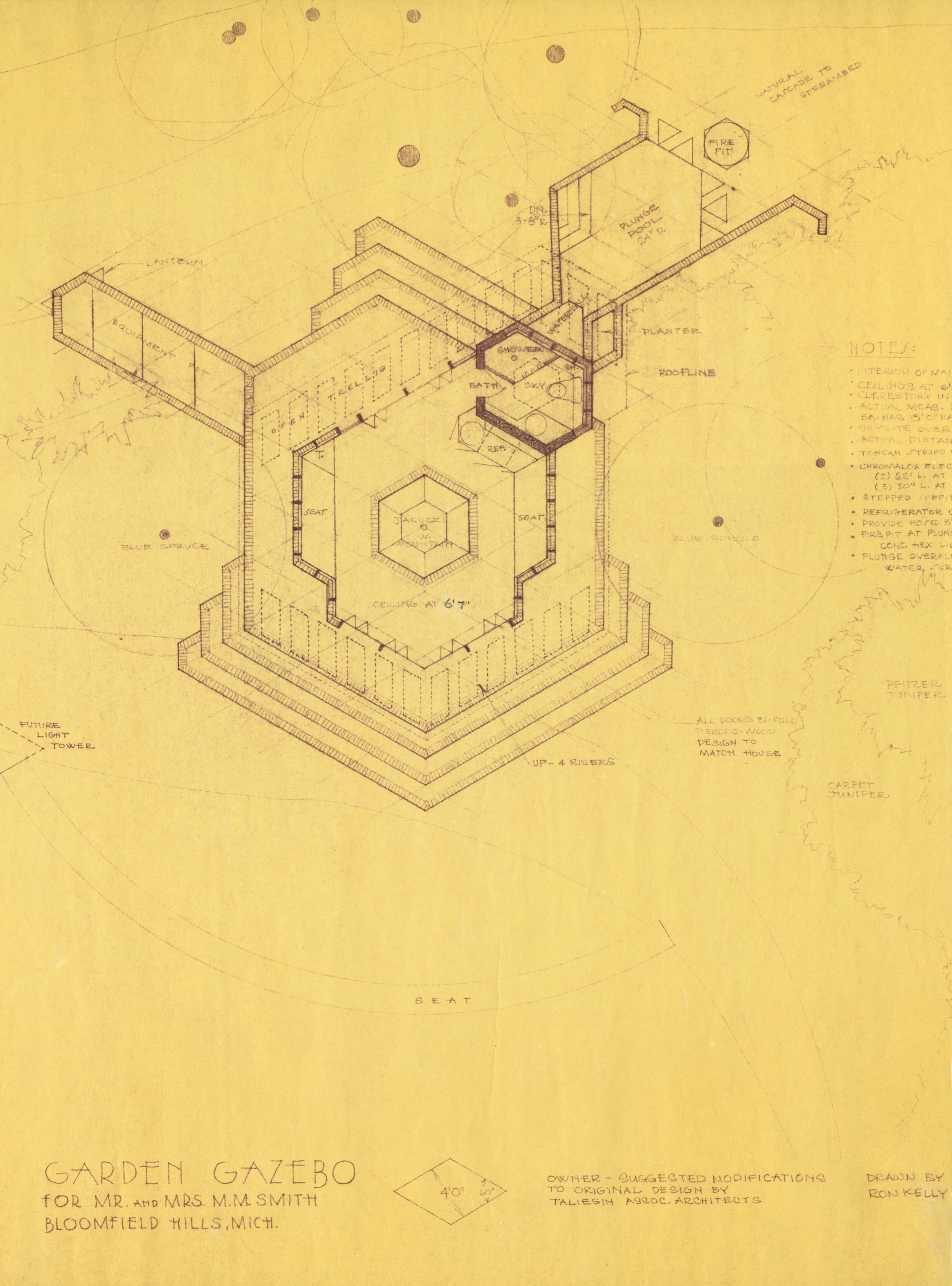
Smith fell ill in the Summer of 1984, at the same time revisions to his little tea house were being completed by a local architect or builder Ron Kelly. Perhaps in retirement the purpose of a tea house had changed from purely a place of beauty and repose: the latest versions, reviewed by Smith in the hospital, featured a Jacuzzi sunk within the center of the tea house.

Smith House Tea House c 1984 with changes by Ron Kelly and possibly Melvyn Smith

Plan of the Garden Gazebo with Jacuzzi at center, plunge pool at top right, and mechanical space top left. Adapted from plans by Taliesin Associated Architects, 1984. Courtesy of Cranbrook Archives.

Melvyn Smith died that summer. At his memorial service, William Wesley Peters spoke about the philosophy of architecture; how much Wright had enjoyed Smithy as a client; and paced out the spot for the newly redesigned Japanese tea house. “What else would your dad want me to be doing right now?” Peters asked Robert, the Smith’s only son, who had admired his father’s endless determination to beautify and ornament his dream house.

Although there was never any tea house or gazebo built on the property, fast forward to earlier this summer. As we were changing out light bulbs in the high soffits of a bedroom at Smith House, we found two Ziploc bags holding quite the surprise: An unfinished model of the tea house.

Kevin Adkisson, 2016-2019 Cranbrook Center Collections Fellow

To learn more about Frank Lloyd Wright and his lifelong relationship with Japan, the Smith’s tea house, and the traditional Japanese Chanoyu tea ceremony, join us next Saturday, August 25, 2018 for presentations and demonstrations at Cranbrook Institute of Science and the Frank Lloyd Wright Smith House. I’ll be delivering a free lecture on Wright at 10:00am, followed by a presentation and Karesansui demonstration by Japanese Horticulturalist Chisato Takeuchi. In the afternoon, there are a few spots left for the 1:30 and 2:30 Chanoyu Tea Ceremony in Smith House presented by the Japan Society of Detroit Women’s Club. More information and registration is on our website.


Weeping Zeus

A folly, in landscaping terms, is a ornamental building or tower with no practical purpose built in a large garden or park. Around 1961, Mr. and Mrs. Henry S. Booth placed a small folly on the grounds of Cranbrook. However, for anyone wanting to play a joke on a friend, this folly has a very practical purpose.

IMG_2531.JPGWeeping Zeus (or more formally Zeus of Otricoli [Roman copy of Greek original]) is a marble bust comprised of the shoulders, chest, and head of the Greek god, Zeus. The chest is carved to resemble draped cloth. The curly hair has a wreath in it, and the beard is curly with a full mustache. The bust is set on top of a concrete block column.

This sculpture has an interesting and complex history. It was carved of Carrara marble in Italy in the early 19th Century and soon afterward became a decorative feature of the manor house of Abercairny, Crieff, Perthshire, Scottland. It remained there for well over 100 years until it sold at auction. Henry Scripps Booth purchased the bust in 1961 from Michael Brett of Broadway, England. Brett had purchased it from the Abercairny the year before. The manor house, once visited by Queen Victoria, was demolished in 1960, hence the sale of sculptures from the estate.

IMG_2535.JPGHere at Cranbrook, it would seem the father of the Greek gods finds the peace of this Michigan mountain dull in comparison with the revelries of either Mt. Olympus or his later home in the Scottish Highlands. It is reported tears well up in his eyes and sometimes gush forth. The sculpture became a folly (and why we call him Weeping Zeus) after Henry had holes drilled through the eyes to allow water to flow (squirt, really) out.

In reality, he’s not crying on his own. Have your guest stand in front of Zeus while you, as their friend, stand on the special stone that activates water to splash the guest from Zeus’s eyes.

As Summer comes to a close, invite that one friend who always pulls tricks on you for a beautiful walk through Cranbrook House Gardens and introduce them to Zeus.

Leslie S. Mio, Associate Registrar

Note: Weeping Zeus is located on the Mountain in the Cranbrook House Gardens, up the stairs directly opposite the House’s front door. Cranbrook Gardens is open daily from 9:00 am to 5:00 pm, May 1 through October 31. Admission to Cranbrook Gardens is FREE for the 2018 tour season, courtesy of presenting sponsor, PNC Bank, and sponsors, All Seasons Independent Livingfleurdetroit, and Roberts Restaurant Group

Hidden Carvings: Misericords

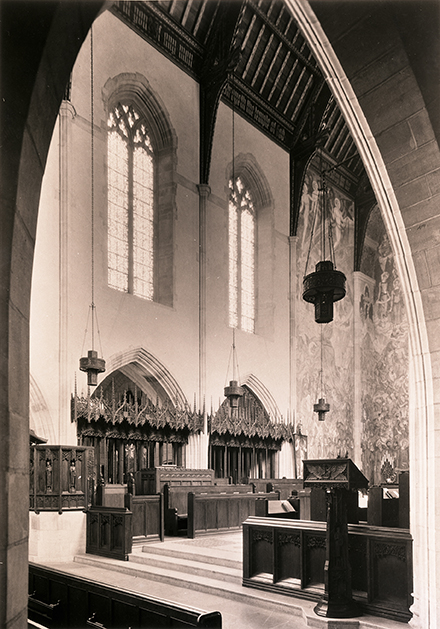
Of the many beautiful works of art and ornament at Christ Church Cranbrook, I have noticed one type is much less documented than others: the misericords. I set out to explore the story behind these little hidden carvings. Misericords are hinged wooden seats that swing up to provide a supportive ledge in the choir stalls of churches and cathedrals—the choir, in the architectural sense, is situated within the chancel between the nave and the sanctuary.

CS68

Christ Church Cranbrook choir stalls in the chancel taken from the south aisle of the nave, ca. 1946. Copyright Cranbrook Archives.

The seat appears to be quite ordinary until you lift it up to reveal its carved underside. Traditionally, they were carved with mythological or real animals, foliage, or humorous scenes.

This slideshow requires JavaScript.

The history of misericords goes back to the monastic churches of the middle ages, when the monks spent many hours praying in the choir. Their name comes from the Latin ‘miserericordia’ meaning ‘mercy’ or ‘compassion,’ stemming from ‘misereri’ (to have pity) and ‘cor’ (heart). Misericords were introduced into churches and cathedrals around the thirteenth century, so that elder monks could lean on them and didn’t have to stand unaided for the entire service.

AD.10.743

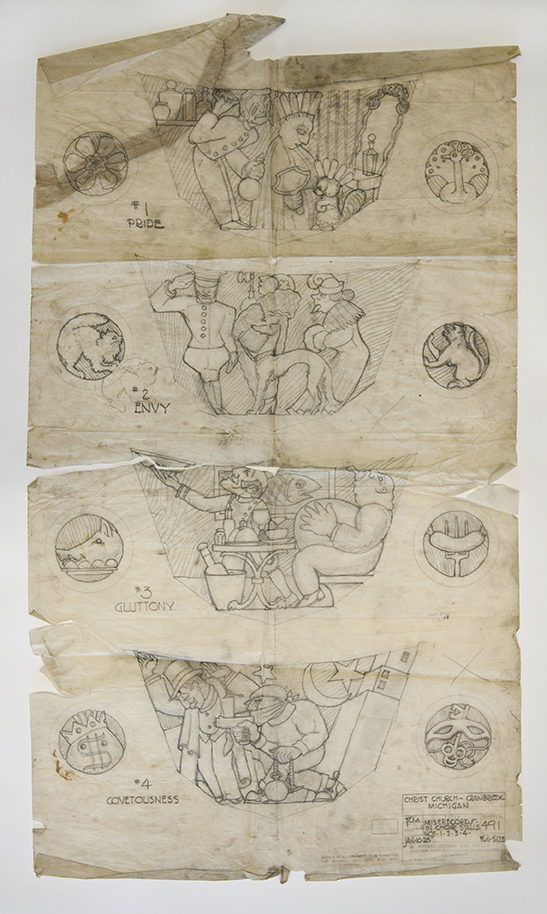
Architectural Drawing for Misericords in Choir Stalls Nos. 1-4 depicting pride, envy, gluttony, and covetousness, January 10, 1928. Bertram Grosvenor Goodhue Associates/Courtesy Cranbrook Archives.

The misericord carvings for Christ Church Cranbrook were drawn by a designer with the initials ‘TCM’ at Bertram Grosvenor Goodhue Associates, who were also the architects of the church itself. The carvings for choir stalls 1-7 depict the seven deadly sins (pride, envy, gluttony, covetousness, anger, sloth, and lust). Choir stalls 8-16 depict more contemporary images reflecting life in 1927, including charlatanism in art, politics, machinery, jazz and prize fighting (8-12) and building the church, speed, big business, and prohibition (13-16).

0 Planes Trains Automobiles

Misericord depicting “Speed,” represented by different modes of transportation (choir stall 14), the metal braces are a later repair. Courtesy Cranbrook Archives.

The misericord design for ‘building the church’ (choir stall 13) is particularly noteworthy for its representation of Oscar Murray and George Gough Booth extending the church by pulling it apart and adding another bay:

0 George and Oscar Murray Pulling Church cropped

Misericord depicting Oscar H. Murray and George Gough Booth lengthening the church (choir stall 13). Courtesy Cranbrook Archives.

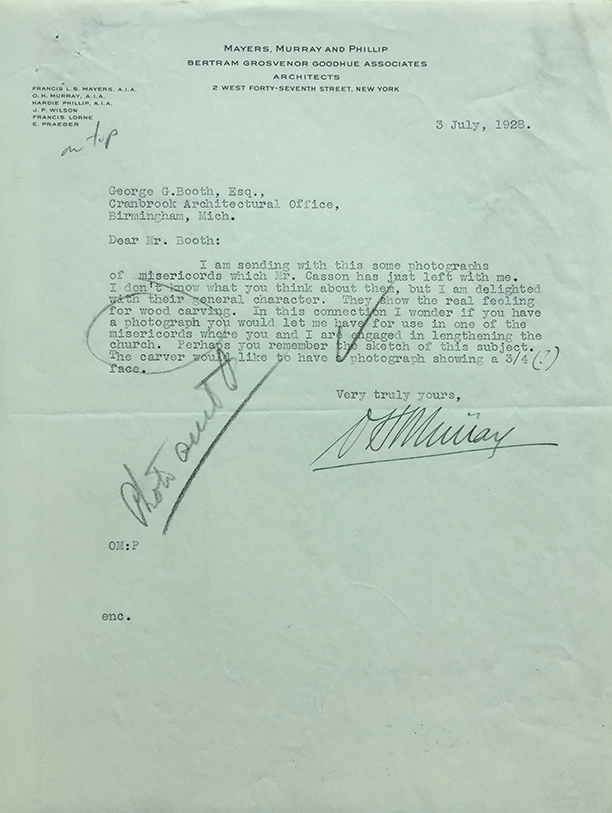
In George Gough Booth’s correspondence, I found this letter, which is instructive in discovering the creative process from idea to design to finished object:

1981-1 21-14

Letter from Oscar H. Murray to George Gough Booth regarding the misericord showing the building of the church, July 3, 1928. Copyright Cranbrook Archives.

The letter tells us that the carver used a photograph of George Gough Booth (depicted on the right side of the misericord) to help with the details of the carving.

The misericords were carved by Irving and Casson of Boston, who also carved the screen between the narthex and the nave and the canopied vaulting above the choir stalls. However, the name of the carver is not recorded. Christ Church Cranbrook is celebrating its 90th anniversary on September 29. Also stay tuned for our ‘Ecclesiastical Structures of Detroit’ Day Away trip in the fall.

-Laura MacNewman, Associate Archivist

Summer Blockbuster

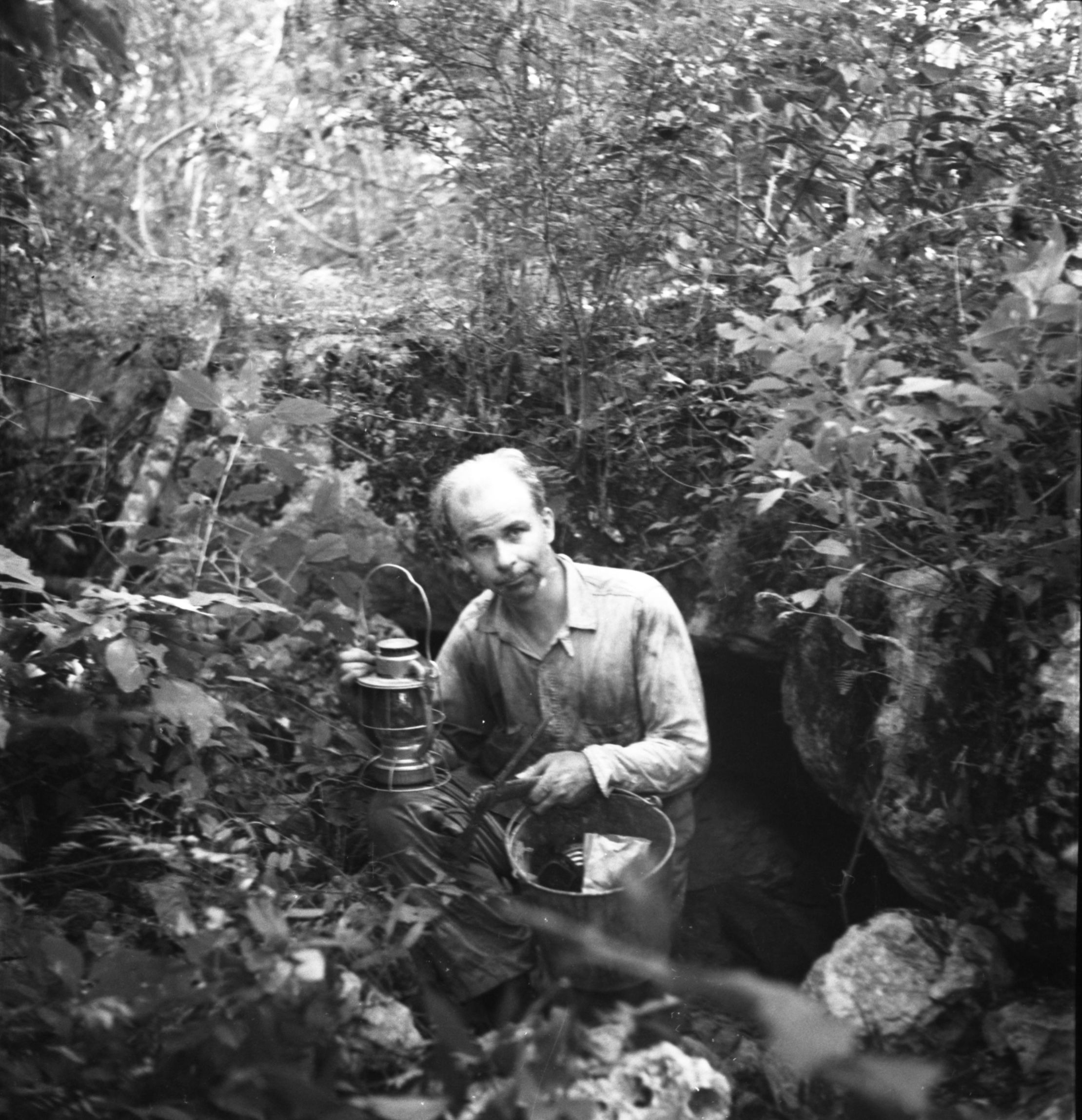
With the melodies of John Williams’ score in my mind, the image below conjures up the 1981 summer blockbuster, Raiders of the Lost Ark. Stunt doubles and special effects aside – the photograph is actually of the Cranbrook Institute of Science (CIS) Director, Robert T. Hatt, in the caves of Calcehtok on Mexico’s Yucatan peninsula. Dr. Hatt conducted a ten-day expedition in the Yucatan in 1947, spending most of his time at Hacienda Calcehtok.

Dr. Hatt in the caves at Calcehtok, 1947.

While in the Yucatan, Hatt worked with two other scientists, Sr. Bernardo Villa, chief of Mastozoology at the University of Mexico’s Institute of Biology, and Dr. Helmuth Wagner an ornithologist with expertise in Mexico and the Malayan region. For ten days the trio conducted excavations of four caves and sunk eleven trenches. They also trapped and netted vertebrates to compare them to bones found in the caves. Of this team, Dr. Hatt said, “it is rare for three men to work together in the field in the perfect harmony we enjoyed.”

Dr. Hatt’s travel diary includes a drawing of one of the trenches, Nov 1947.

The principal focus of the expedition was the Actun Spukil cave (the Mayan equivalent of Cave of the Mice). A series of tunnels lies within the cave, and here Hatt and his fellow scientists uncovered bones, shards of pottery, and stone hammers. Glyphs were spotted on the cave walls, as well as rock carvings depicting a monkey’s head and a man’s head.

Dr. Hatt at the cave entrance, 1947.

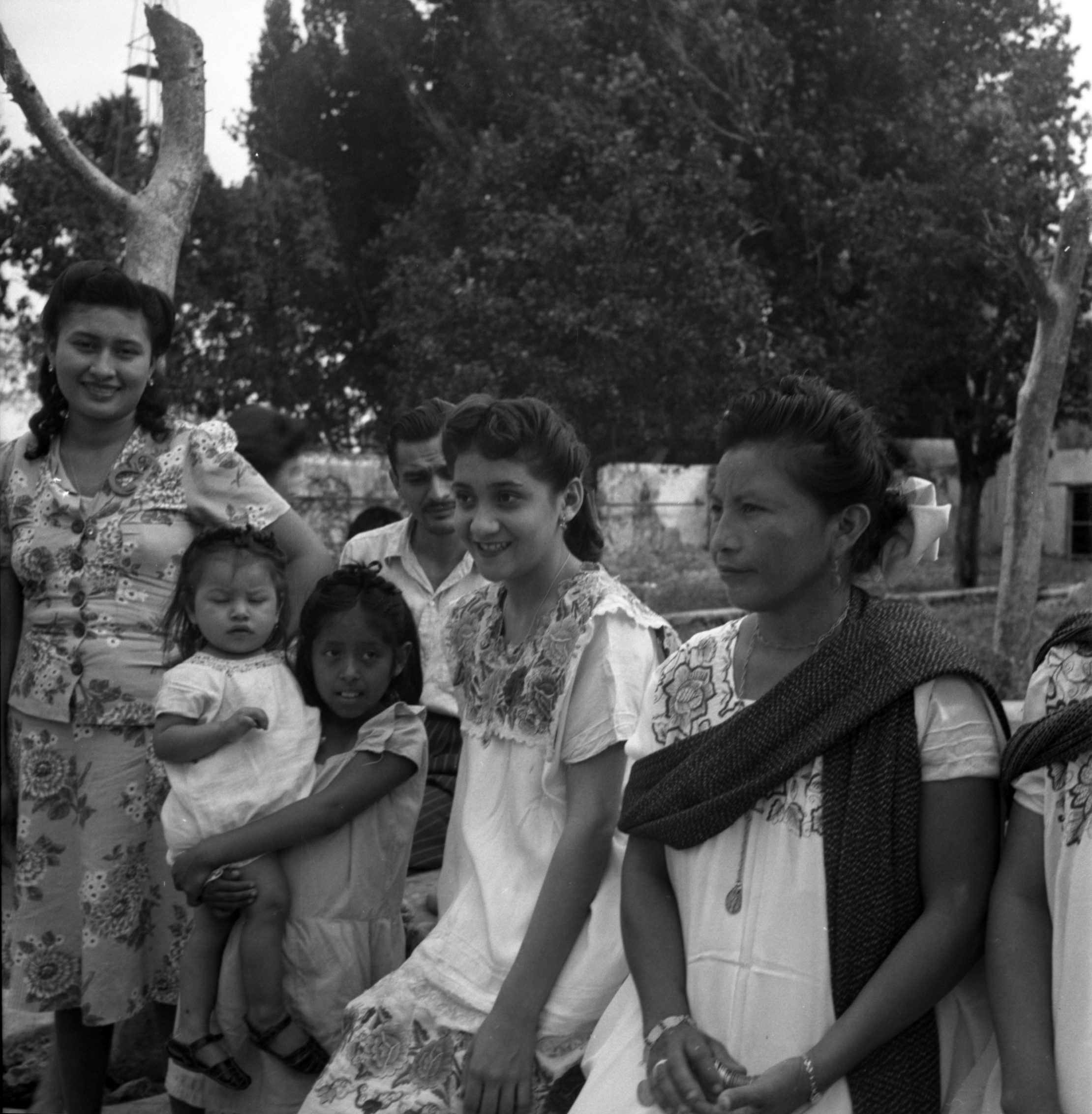
In the year following his return from Calcehtok, Hatt wrote about his discoveries and gave several lectures. His expertise in the Yucatan region is well-documented, and he was asked by several institutions, including the Carnegie Institution of Washington and the University of Michigan, to identify specimens in their respective collections. More than half of the photographs from this expedition are of the people Hatt interacted with in Calcehtok. In an article in the February 1948 CIS Newsletter, Hatt wrote, “we were quickly accepted as friends by the little community. They collected for us, sang for us, dedicated a dance to us, and a few children and a grown boy shed a tear when we left. Bless the good people of Calcehtok.”

Friends made in Calcehtok, 1947.

Although I enjoy the adventure and suspense of an Indiana Jones expedition, the reality and humanity in Dr. Hatt’s reports was an exceptional find in the Archives this week.

Gina Tecos, Archivist


A Face Above Beauty

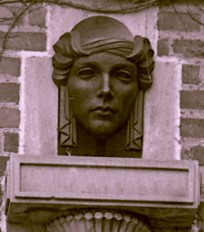
Sometimes we walk past something 100 times and see it but never really “notice” it. For me, it is the masque of “Art”  (left) in the Cranbrook School Quadrangle, near the dining hall. It is a woman’s face beautifully created by sculptress Elizabeth Palmer Bradfield, but, as always, there is more to the story.CR1588-2

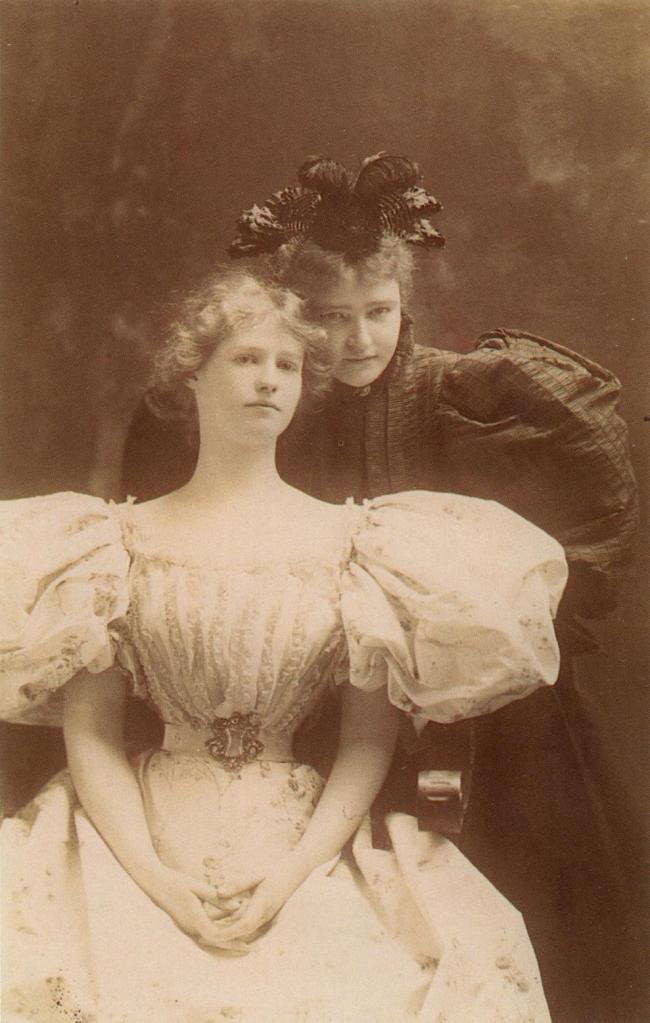
Elizabeth Virginia (Palmer) Bradfield (1875-1954) was born in Port Huron and grew up in Pontiac. Her grandfather was Charles Henry Palmer (railroad and mining developer who established the Pewabic mine in the Upper Peninsula). The Palmer family was well known in Pontiac and their house still exists on Huron Street. In the months before her wedding, Elizabeth traveled to Paris with her parents, where she studied sculpture at the Académie Julian in Paris. In 1896, she married Thomas P. Bradfield.

63541262_133164903264

Elizabeth Palmer Bradfield with her mother, Mrs. Charles H. Palmer, Jr. Source

Thomas and Elizabeth Bradfield lived in Grand Rapids, Michigan, until 1904. The Bradfields and their two children (Virginia Palmer Bradfield Ward and Thomas Palmer Bradfield) later settled in Pontiac, Michigan, where Bradfield lived until her death in 1954.

In 1914, Bradfield began exhibiting her work — first paintings, then sculpture — in the Scarab Club’s Annual Exhibition at the Detroit Museum of Arts, alongside such artists as Myron Barlow, Katherine McEwen, and James Scripps Booth. The Scarab Club honored her sculpture “Myra” with their first presentation of the annual Scarab-Hopkin Prize for Sculpture. She exhibited again in 1915, 1916, 1917, and 1921. In 1921, she won “Honorable Mention” for her bronze sculpture “Baby’s Head.”

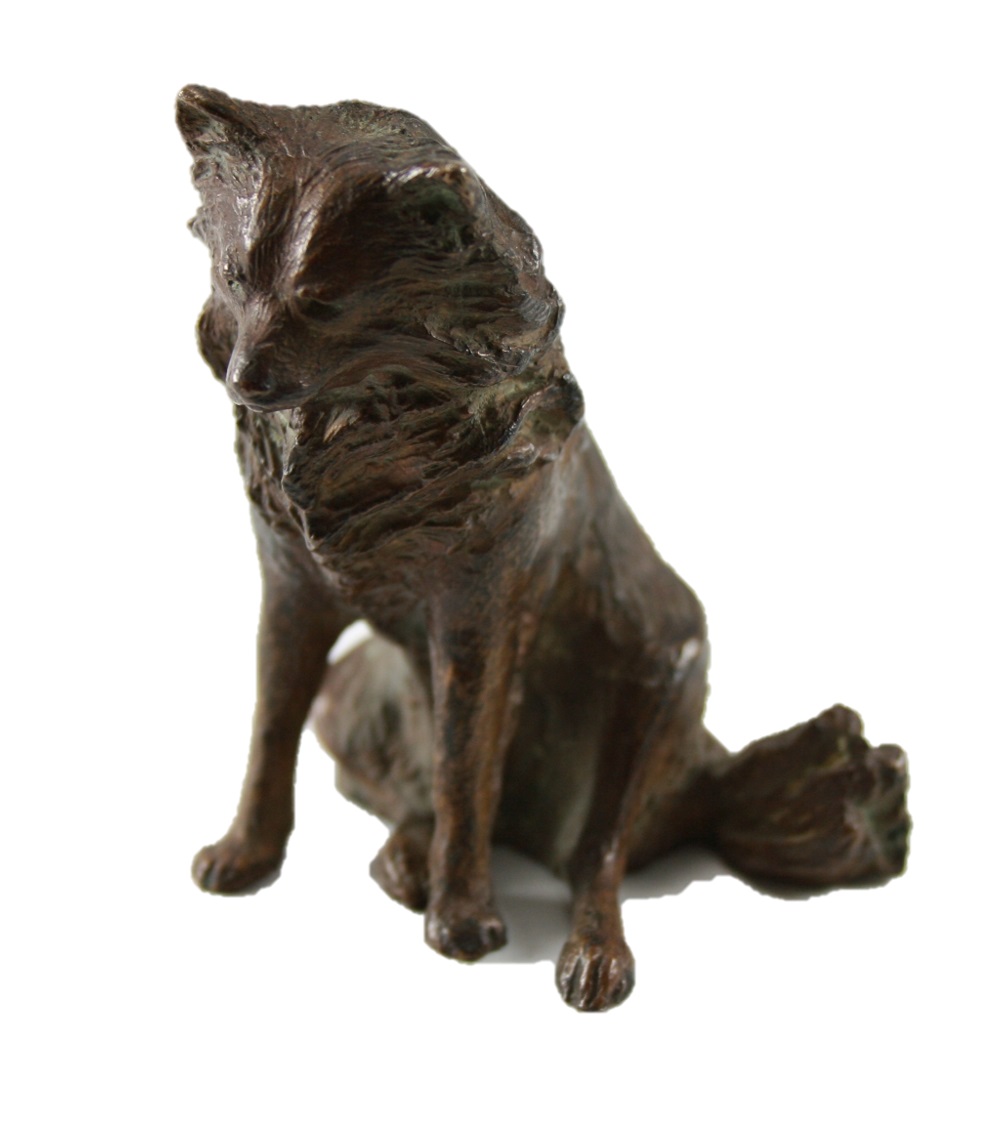
It is likely George Gough Booth met Bradfield at one of these exhibitions; correspondence between them began in 1926 when Booth purchased a small bronze of a dog from her.

Dog CEC 188

Dog, 1912, by Elizabeth Palmer Bradfield (CEC 188).

Booth then commissioned her to model “two large groups of Great Danes ready for plaster cast” to be displayed at Cranbrook School. These sculptures were to be approximately 6 feet high, by 2 feet wide, by 3 feet tall, but subject to Eliel Saarinen’s approval. Bradfield used the studio and architectural office, without expense to her. It is not known if Bradfield ever completed these large dogs, or if Saarinen negated the idea, but the sculptures were never realized in full scale. Milles’ “Running Dogs” probably replaced them on the Cranbrook Campus.

The masque of “Art” was purchased by Booth in October 1927. It was exhibited in two shows. One was in March 1929 – the annual exhibition of the Detroit Society of Women Painters. It was written up in the Detroit News, which said, “The masque has the imponderable quality we find in things of lasting beauty.”

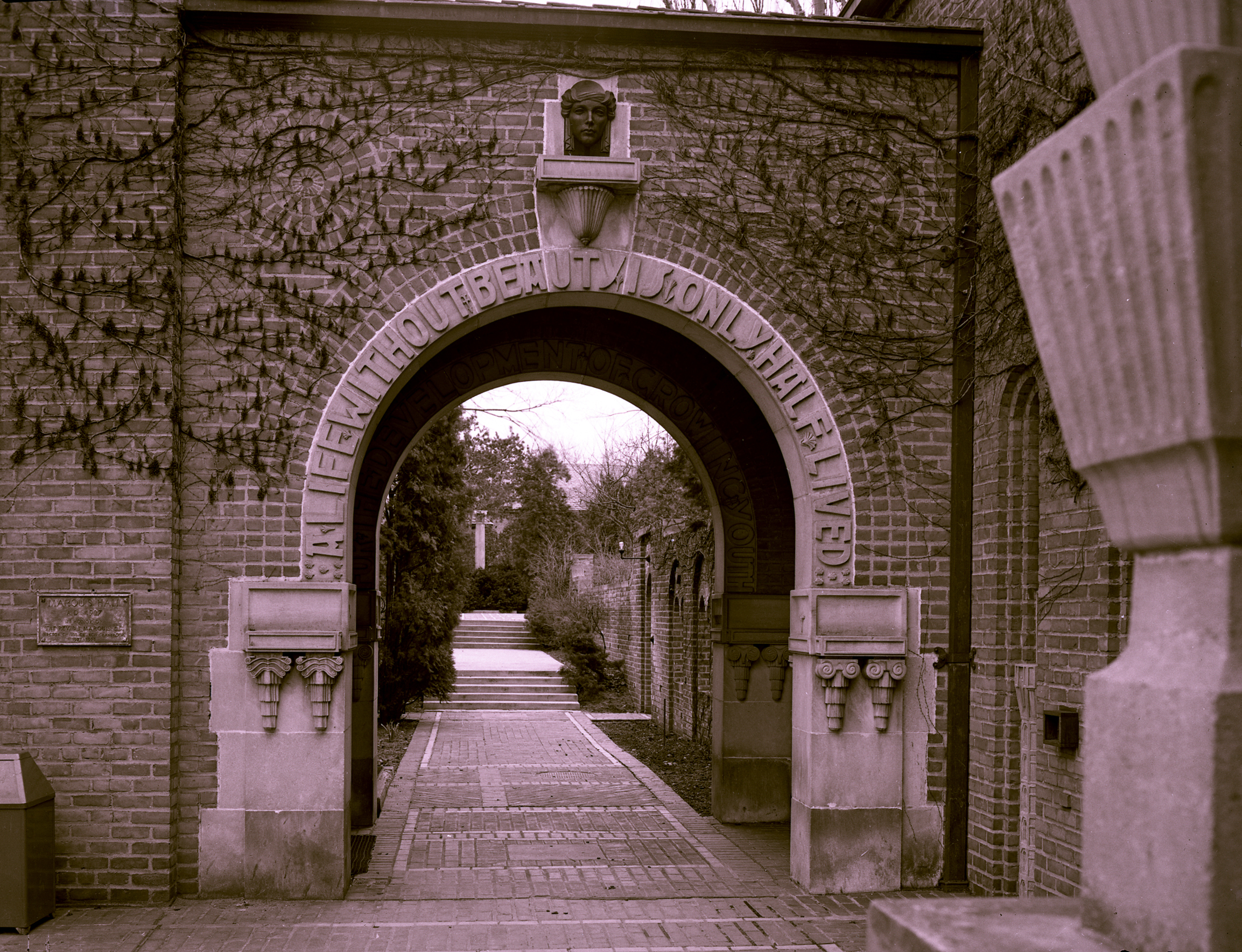
It was then in the first Cranbrook Art Museum for several years before being installed over the “Beauty Arch” in Cranbrook School’s Quadrangle.

CR1588-2.jpg

The “Art” Masque, that “lasting beauty,” hangs over George Booth’s famous quote, “A life without beauty is only half lived” on the so-called “Beauty Arch” in Cranbrook School’s Quadrangle

Leslie S. Mio, Associate Registrar

Related links:

Clothing worn by Elizabeth Virginia (Palmer) Bradfield

Biographical information

The Multiple-George Theory

From my office window in Cranbrook House, I have a great view of the motor court. I can see the comings and goings of the house: coworkers rushing to meetings, facilities moving tools and tables, the busy bees of the Cranbrook House and Gardens Auxiliary at work, and visitors to the campus exploring the house and grounds.

As guests walk around finding flowers, sculptures, and fountains, I always see them step up to the locked side entrance of the house and try and figure out one of the most unusual pieces of art at Cranbrook: George Washington brandishing a flyswatter over George Booth. DSC_0523The acrylic painting, set within a blind window, shows George Booth napping on the daybed in his Still Room (those guests who’ve been on a Cranbrook House tour know the Still Room’s daybed is literally right behind this wall). Behind him is the ghostly figure of Washington, holding a copy of the July 4, 1776, Philadelphia Gazette and his swatter. It is a (not-terribly-convincing) trompe-l’œil fitted within the existing window frame. The 47×22” painting was completed in 1976 by Academy student Gregory High (MFA, Painting, 1977). George and GeorgeHenry Scripps Booth commissioned the painting while he was serving as a Cranbrook Educational Community trustee and while he was using George’s office suite for his own offices. He told the alumni magazine, the window commemorates “the long list of founders who seized opportunities that have been bequeathed to them from those who have gone before.”

Further, Henry explained that “there is at least one fly in almost every organizational ointment as well as in many of our best dreams…Those pesky flys require a decisive swat by a person of intuition and experience of historical perspective. George Washington, in a haze of tradition, plays that part of this bit of symbolic fantasy.”

Henry commissioned the painting as part of the Bicentennial celebrations of 1976, and it was revealed on Cranbrook’s Founders Day by George and Ellen’s three-year-old great-great-granddaughter Stephanie Booth, who was dressed in an 1867 dress belonging to Ellen.

The Cranbrook Quarterly (Fall 1976) wrote, “[the painting] could be considered one of the more unusual commemorations of the Bicentennial because it…develops the ‘multiple-George theory’ of Cranbrook’s—and the nation’s—founding.” Henry told the Quarterly that he “hoped that this window will be enjoyed by the passerby as it would be by Cranbrook’s founders if they were suddenly to come upon it and discover one of them was being spoofed.”

I can certainly attest that the painting gets a lot of looks and begs a lot of questions from the viewer. It’s one of the strangest—and most accessible—works on campus.

Happy Fourth of July everyone!

– Kevin Adkisson, 2016-2019 Collections Fellow, Cranbrook Center for Collections and Research

Create a website or blog at WordPress.com