A Rugged Individualist: Luella Schroeder

One of the best things about being an archivist here is learning about the amazing people connected to Cranbrook’s history. Part II of our posts for Women’s History month focuses on Luella C. Schroeder (1918-2004). In 1946, Schroeder was hired as an Assistant Preparator at Cranbrook Institute of Science. A woman of many talents, she worked at a book binding studio in Delaware and as a draftsman during World War II for Chrysler before taking the position at CIS.

Schroeder’s college studies were divided between the natural sciences and art. She later studied photography – a skill she relied on heavily at CIS – as the photographer of the Institute’s collections and exhibitions. A member of the Photographic Guild of Detroit, she was one of 100 photographers to be awarded a prize in Popular Photography magazine’s 1957 photo contest.
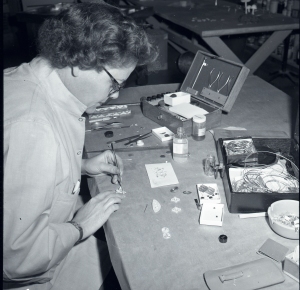
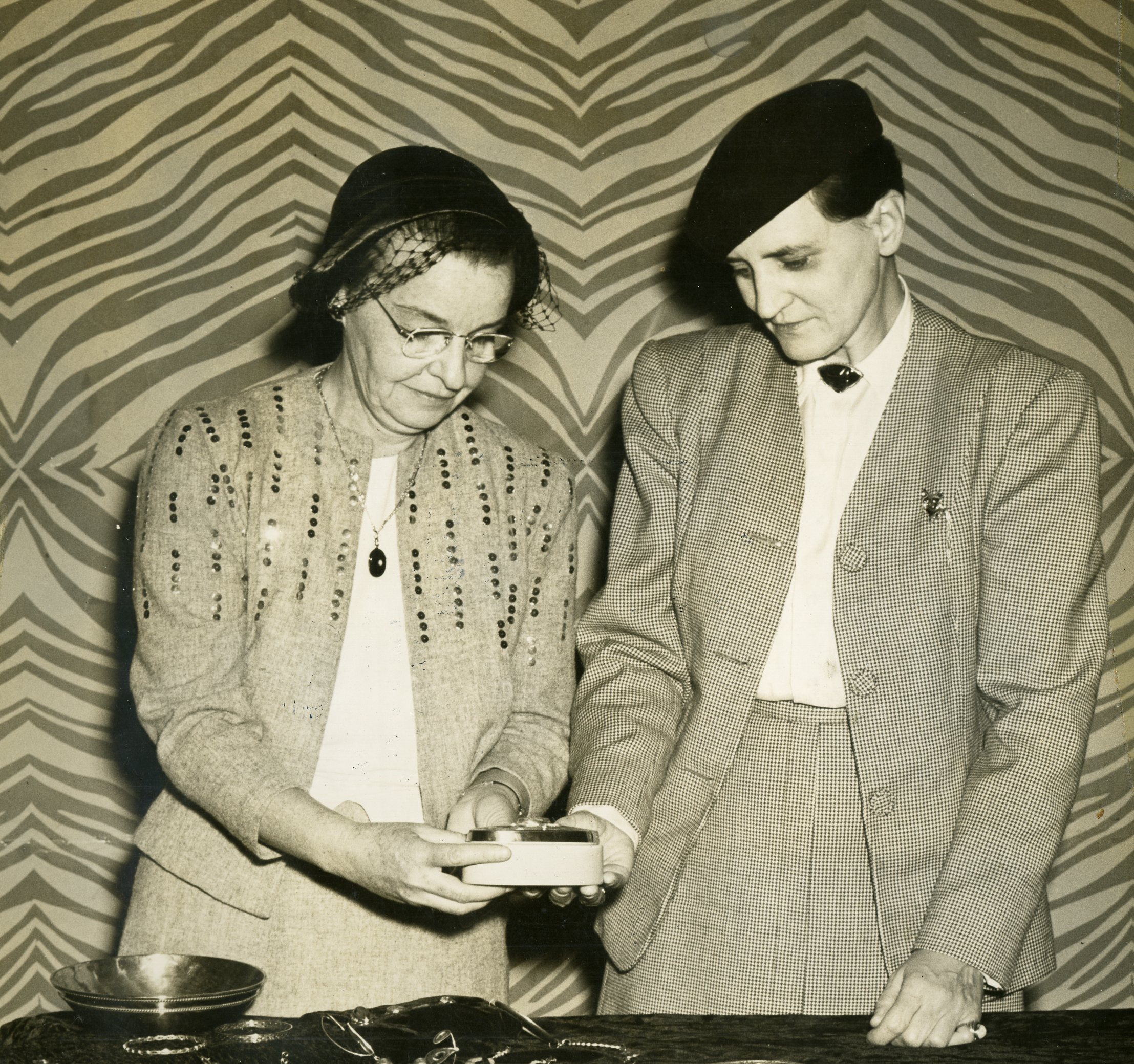
CISB4970

Schroeder preparing an exhibition, 1956. Courtesy Cranbrook Archives.

In addition to her photography work, Schroeder created dioramas and models for exhibits and taught lapidary classes. Her love of nature was evident in her creations for the Institute – from plant life to insects to bee hives. In 1954, she built an elaborate hive illustrating the lifecycle and production cycle of bees. Her work was admired and praised by her colleagues and visitors alike.
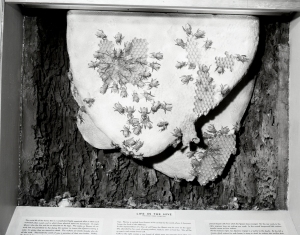
IS380

Bee Hive exhibition, 1954. Courtesy Cranbrook Archives.

After working at CIS for 12 years, Schroeder left her position in 1958 to pursue her hobby of silver jewelry making. She fell in love with Vermont, and moved there to devote herself to her craft. In a 1961, Times-Argus article she was quoted, “I wish I could tell you why I love Vermont, maybe it’s because it is the last stand of the rugged individualists – the one place where people still really make their lives for themselves.”

Schroeder’s hobby became her life-work. She credited the Institute in making her jewelry more creative (due to her ability to cut gems which she learned while at CIS). Her work was on display at several museums nationally and abroad, and was exhibited at the 1964 World’s Fair. In 1965 she created a pin she titled, “Forged Sunburst.” America House re-named the pin “Solar Flair” in an advertisement in New Yorker magazine and Schroeder was deluged with orders.
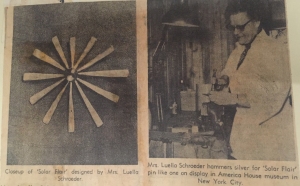
schroederpin

Burlington Free Press, 13 May 1965. Courtesy Cranbrook Archives.

Several pieces of Schroeder’s work were selected by the American House retail store in New York, which is sponsored by the American Craftsman Council. Her jewelry was also marketed by the Detroit Artist’s Market and the Boston Society of Arts and Crafts. In 1985, the Vermont Handcrafters bestowed a Lifetime Membership to Schroeder for her dedication to Vermont Crafts. Clearly her work and dedication made an impression on many – including the Cranbrook community.

Gina Tecos, Archivist


Three Women and a Conservator

One of the interesting components of our jobs as collections managers, registrars, and archivists is that we get to interact and learn from conservators in our fields. On Friday, three of us went down to Detroit and met with Giogio Ginkas of Venus Bronze Works. A non-descript warehouse building sported a gray metal door which led us into the lobby gallery where Giorgio has displayed art from his personal collection of metro-Detroit artists, including Cranbrook’s Gary Griffin. Then we walked into the “shop” where his tools and equipment are interspersed with numerous sculptures (primarily metal) in various stages of repair, restoration, and conservation.

Giorgio Ginkas explaining the conservation process for the Wishing Well. Courtesy Cranbrook Archives.

Giorgio Ginkas explaining the conservation process for the Wishing Well. Courtesy Cranbrook Archives.

Currently, Venus Bronze Works has three of Cranbrook’s works in his shop – two are awaiting reinstallation on the grounds, while the metal “arch” from the Wishing Well at Cranbrook House is just undergoing restoration.

Parts of the Wishing Well “arch” removed for restoration. One element was missing so a replacement piece had to be fabricated. Courtesy Cranbrook Archives.

Parts of the Wishing Well “arch” removed for restoration. One element was missing so a replacement piece had to be fabricated. Courtesy Cranbrook Archives.

Orpheus figure, restored and waiting to be reinstalled at Cranbrook Academy of Art (CAM 1931.9). Courtesy Cranbrook Archives.

Orpheus figure, restored and waiting to be reinstalled at Cranbrook Academy of Art (CAM 1931.9). Courtesy Cranbrook Archives.

For more on Venus Bronze Works, including Detroit’s own RoboCop statue, see: http://www.dailydetroit.com/2015/08/24/remember-robo-cop-statue/

Leslie S. Edwards, Head Archivist

Forays in Metalwork: Cranbrook and Fairhope, AL

Women’s History month always gives us a good excuse (not that we need one!) to spotlight the accomplishments of some of Cranbrook’s lesser-known but equally important women. They may not have been famous artists or designers, but rather women who educated scores of students, worked tirelessly behind the scenes to catalog thousands of scientific specimens, or played a role in documenting the history and heritage of the Cranbrook community. So this month we have chosen to make each post about a Cranbrook woman – the work she accomplished, an artwork she created, or some other notable fact that we find interesting.

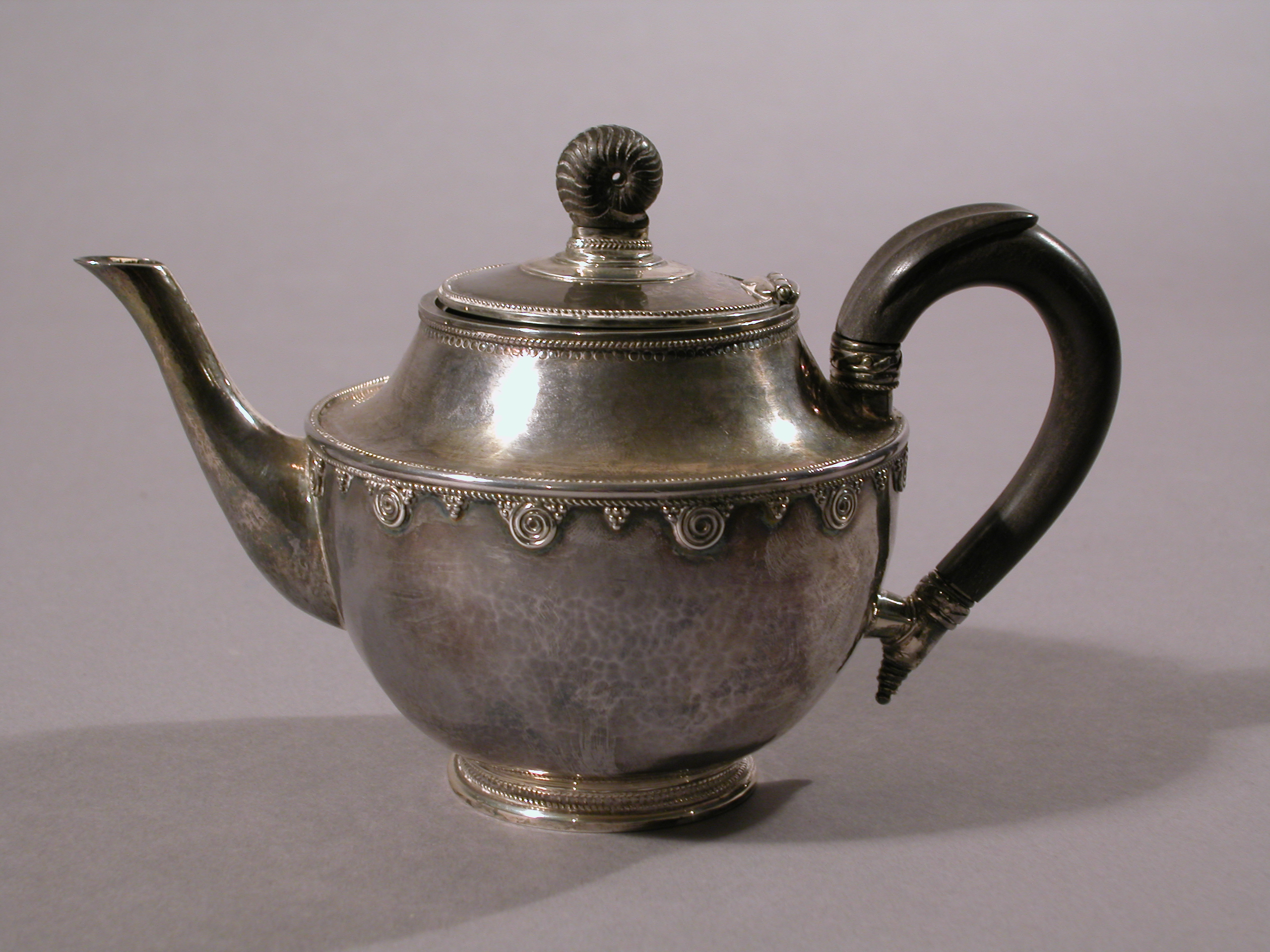
Margaret Elleanor Biggar (1906-1992) was born in Detroit, and became interested in silverwork when she attended spent her senior year in high school at Marietta Johnson’s experimental School of Organic Education in Fairhope, Alabama. After graduation, Biggar returned home to Detroit, where she attended the Detroit Society of Arts and Crafts school. In November 1929, renowned British silversmith Arthur Nevill Kirk (who headed the silver department at Cranbrook), called Biggar and asked if she would like to come and be his student apprentice. She worked for Kirk in the Arts and Crafts Studio until 1931, where she made thirty cents an hour executing and polishing Kirk’s designs.

Silver Teapot, 1929. Designed and executed by Margaret Biggar. Image Courtesy Cranbrook Art Museum (CAM 1933.45).

Silver Teapot, 1929. Designed and executed by Margaret Biggar. Image Courtesy Cranbrook Art Museum (CAM 1933.45).

In 1931, Biggar returned to Fairhope, Alabama in where she taught metals at the Marietta Johnson School of Organic Education and formed a lasting relationship with Elise Hooker (1895-1977), who was head of the school’s craft department. In 1938, the two women left the school to open their own studio where they taught metalcraft classes in silver, copper, and brass. Generous and hard-working, their primary objective was not to make money but rather to teach others the craft they loved. In 1946, they only charged fifty cents for a two-hour lesson!

Biggar and Hooker’s home on Magnolia Avenue, Fairhope, AL. The studio was called “Metalcraft Studio.” Photo courtesy Margaret Elleanor Biggar Scrapbook, Cranbrook Archives.

Biggar and Hooker’s home on Magnolia Avenue, Fairhope, AL. The studio was called “Metalcraft Studio.” Photo courtesy Cranbrook Archives, Margaret Elleanor Biggar Scrapbook.

The studio was successful and works of their students were shown in local exhibitions. People came from around the country to take classes, and the studio became a part of local crafts tours in Fairhope.

Hooker (left) and Biggar at an exhibition in Pensacola, Florida. Photo courtesy Cranbrook Archives, Margaret Elleanor Biggar Scrapbook, U.S. Navy photographer.

Hooker (left) and Biggar at an exhibition in Pensacola, Florida. Photo courtesy Cranbrook Archives, Margaret Elleanor Biggar Scrapbook, U.S. Navy photographer.

Metalwork was not Biggar’s only interest. In 1943, she spearheaded the “War Dog Fund” effort in Fairhope. This was a project organized to enlist the help of dogs on the “home front” to secure funds through the donations of their owners. Dogs could be enrolled as a Sergeant ($1) or Lieutenant ($5) all the way up to General ($100). The funds were then used to help feed and care for the dogs in WWII combat zones.

Leslie S. Edwards, Head Archivist

Photo Friday: Field Trip!

Today the staff from the Center for Collections and Research hopped into a fancy van and headed off to Lansing to take a behind-the-scenes tour of the Archives of Michigan. We really enjoyed our visit with State Archivist, Mark Harvey, and his staff. Here are few photos from our day away.

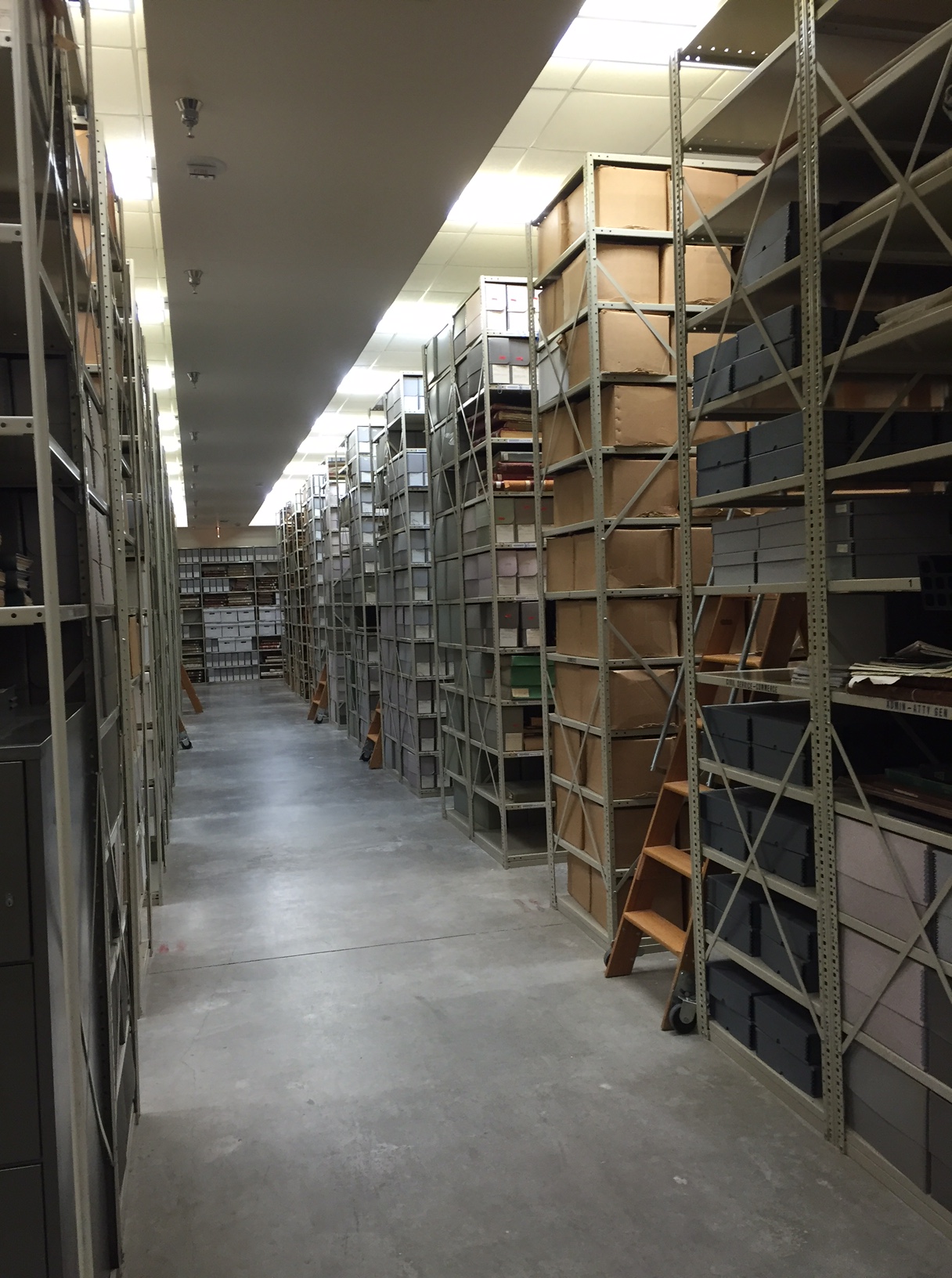
A view of just one of the storage areas at the Archives of Michigan.

A view of just one of the storage areas at the Archives of Michigan. Photographs courtesy of Leslie Edwards.

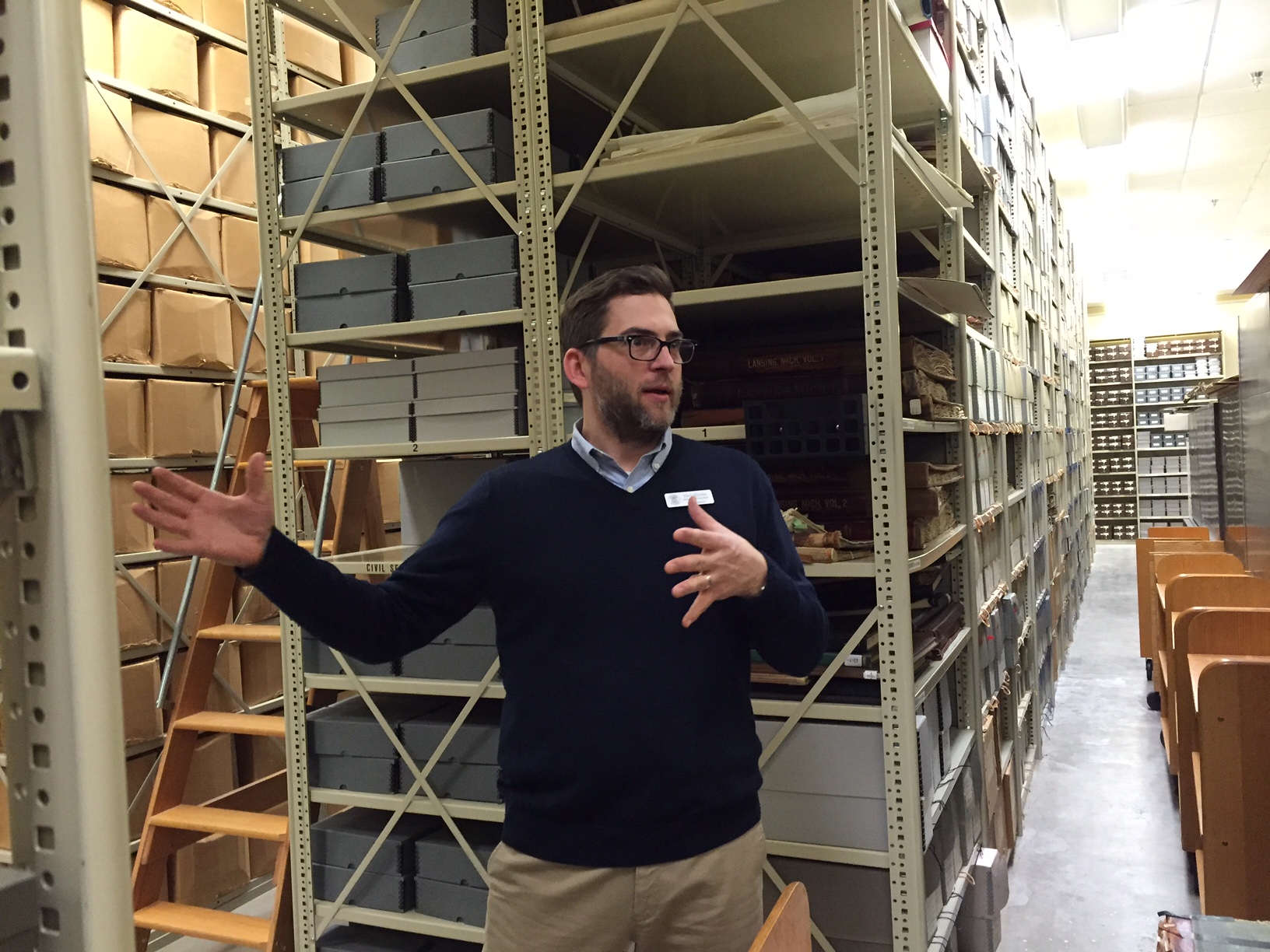
State Archivist, Mark Harvey, talks with our staff about processes at the Archives of Michigan.

State Archivist, Mark Harvey, talks with our staff about processes at the Archives of Michigan.

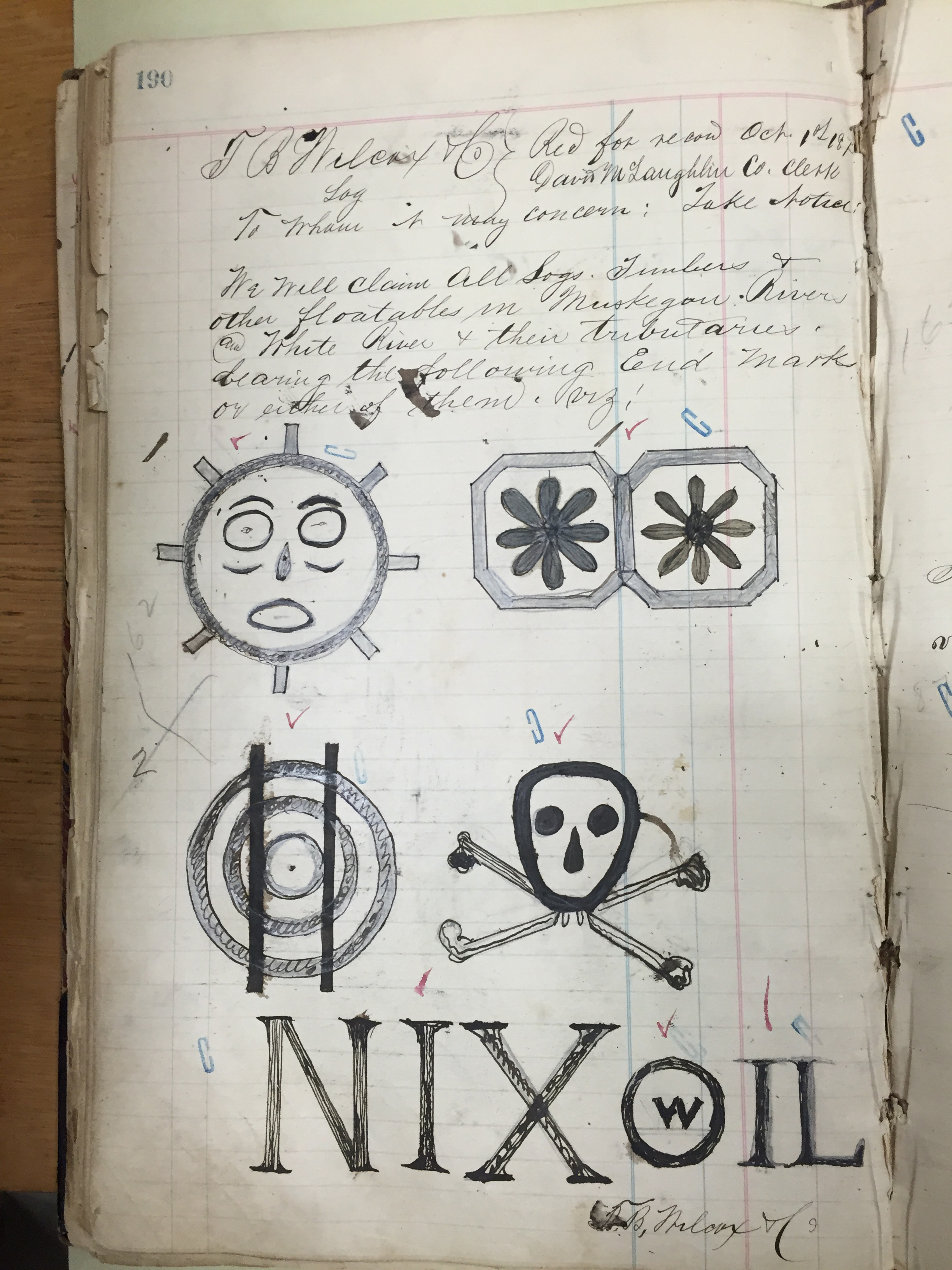
The Archives of Michigan is responsible for preserving the records of Michigan government and other public institutions. One example is the prison record of the notorious "Gypsy Bob."

The Archives of Michigan is responsible for preserving the records of Michigan government and other public institutions. One example is the prison record of the notorious “Gypsy Bob.”

Captivating "log marks" from early logging days in Michigan.

Captivating “log marks” from early logging days in Michigan.

Gina Tecos, Archivist


Photo Monday: Oops!

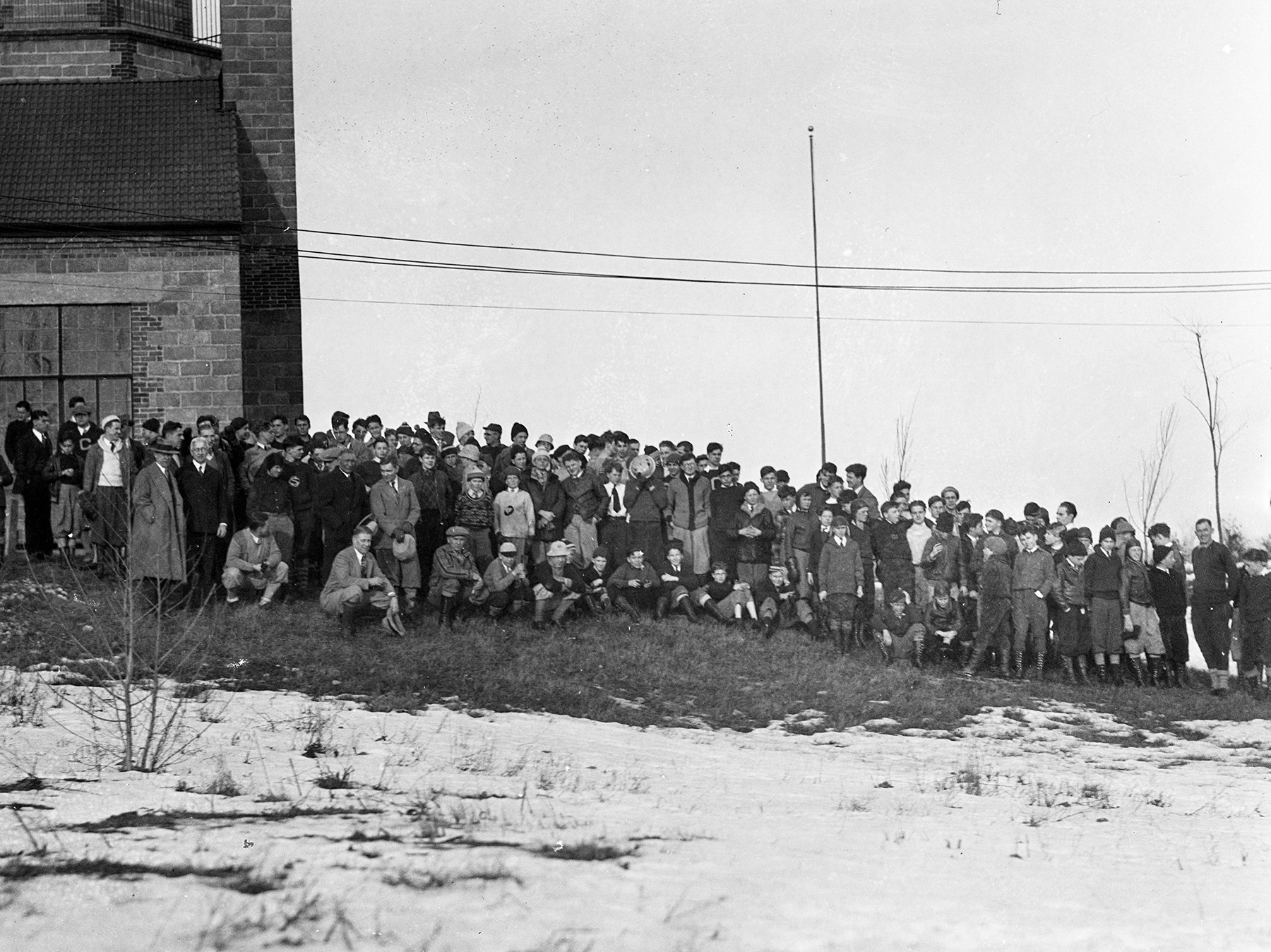
Photo Friday ran away with us last week, so here it is Monday already. Today’s post is about Camp Brady on Green Lake, Independence Township, Michigan. You are probably wondering how this camp relates to Cranbrook? The photo below shows a group photo of Cranbrook School boys, taken at Camp Brady in the winter 1930.

Cranbrook School boys at Camp Brady, Feb 1930. W. Bryant Tyrrell, photographer. Courtesy Cranbrook Archives.

Cranbrook School boys at Camp Brady, Feb 1930. W. Bryant Tyrrell, photographer. Courtesy Cranbrook Archives.

Camp Brady was established in 1921 in honor of George Nexsen Brady (1837-1920). Brady, born and raised in Detroit, became a businessman and philanthropist always interested in the welfare of children. He was a big supporter of the Boy Scouts of America and allowed the Detroit chapter to use his forty-acre parcel on Green Lake as a summer camp. After he passed away (and donated his land to the Scouts), it was known as Camp Brady until it was sold in 1946.

What does Brady have to do with Cranbrook? After he retired, Brady moved to Bloomfield Hills and was a member of the Bloomfield Hills Country Club. He purchased 45 acres along Cranbrook Road, across the street from Cranbrook. Thornlea Studio (the old archives building) is located on his property, on what is known as Brady Lane!

Leslie S. Edwards, Head Archivist

A Fond Farewell

It’s been a little over five years since I accepted a position as archivist at Cranbrook Archives. I had toured the Archives some years before, when I first became photo archivist in the Burton Historical Collection of the Detroit Public Library. Though familiar with Cranbrook from growing up in the area, I thought, boy, this would be a cool place to work.

My wishful thinking turned into reality when, after retiring from Detroit Public Library and working as a volunteer in Cranbrook Archives, a position opened up. Lucky me! And my first assignment was to process the papers of Edward and Ruth Adler Schnee. I had shopped in their iconic store in Harmonie Park and was delighted to meet Ruth and hear all about her fascinating life, which gave me a framework for processing her papers.

RAS

Ruth Adler Schnee in a fun moment.

Meeting Ruth was just the beginning of a deep plunge into subjects of which I was only marginally aware: the George Gough Booth family who founded Cranbrook; the Saarinens who designed its campus, many of its buildings and furnishings; artists such as Harry Bertoia, Marianne Strengell, Katherine McEwen, Charles & Ray Eames, Maija Grotell, Harry Weese. My head was spinning trying to keep up!

Gradually I became familiar with the history of Cranbrook as documented by the rich material in the Cranbrook Archives. The manuscript collection (institutional and individual), the photograph collection, the architectural drawings, and the myriad other informational sources, not to mention my coworkers, other Cranbrook staff, and Archives’ volunteers, all helped fill in the blanks. Most of all, head archivist Leslie S. Edwards, guided me through the intricacies of building names and campus personalities, filling me in on strange anomalies such as Chanticleer Cottage, or some of the unheralded people like the Vettraino family or John Buckberrough who, in small but important ways, helped make Cranbrook what it is today.

farewell

A favorite view when eating outside in the summer!

If you haven’t guessed by now, I’m moving on to other adventures; today is my last day. I learned so much here, thanks to everyone I worked with. And it turns out I was right. Cranbrook is a cool place to work!

– Cheri Gay, Archivist


Phenomenologically Speaking

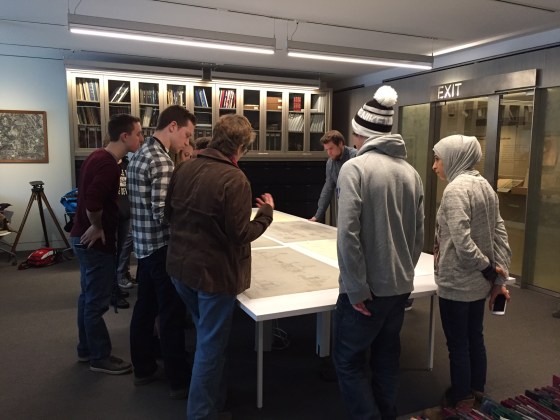
Ok, so I have to admit, I had no idea what the term “phenomenological” meant until yesterday when the Archives was host to a group of architecture students from Lawrence Technological Institute. Phenomenology was defined by the German philosopher Edmund Husserl as the philosophical study of the structures of experience and consciousness. So how does this fit in with architecture? Well, the idea that we experience architecture with all of our senses does seem perfectly logical and of course Cranbrook is a perfect example of that.

The two buildings the students focused on were the Cranbrook School Dining Hall and the Natatorium. If you have ever walked into either of those spaces, you can absolutely understand the phenomenological experience – the dining hall with its’ high vaulted ceilings, the Orrefors glass pendant light fixtures, and the 12 foot leaded glass windows that line the walls and throw patterns of light across the room – all of these contribute to both our visual and non-visual senses as we experience the space.

image2

Head Archivist, Leslie Edwards, discusses drawings with LTU students.

The Natatorium illustrates this concept even more dynamically. The complex use of materials – glazed exterior and interior brick, concrete block interior walls, the gray stone pool deck, the hand-glazed tiles in the locker rooms, and the use of mahogany for the walls, railing, and vertical louver panels – all contribute to the total sensation of the space. Add to that the windows that look out to the woods and the ceiling oculi that open up to the sky and you definitely experience phenomenology.

So thanks LTU students for teaching me something new when you came to the Archives to look at the architectural drawings. Days like this are another one of the perks of being a Cranbrook archivist.

Leslie S. Edwards, Head Archivist

Opulence and Splendor

In the spring of 1927, Cranbrook founders George Gough and Ellen Scripps Booth traveled to Egypt. In addition to visiting Cairo and having their photograph taken after an hour long camelback ride, the Booths visited the tomb of the Egyptian Pharaoh, Tutankhamun (King Tut).

Letter from Cairo, Mar 1927.

Letter from Cairo, Mar 1927.

In a letter to his son Henry, Booth describes in detail the opulent beauty of the tomb: “When in Luxor we went to the Valley of the Kings and saw the tomb – that is we saw one room where the King lay. He is there still in one of the gold coffins – the mummy had over it a gold mask covering head and shoulders and many jeweled ribbons of gold covering the joints of the mummy cloth. Thimbles on each finger and toe… this lay inside a gorgeous solid gold coffin inlaid with stones. This was all in the finest carved sarcophagus and that inside a splendid wooden shrine – and this inside of a beautifully decorated room.”

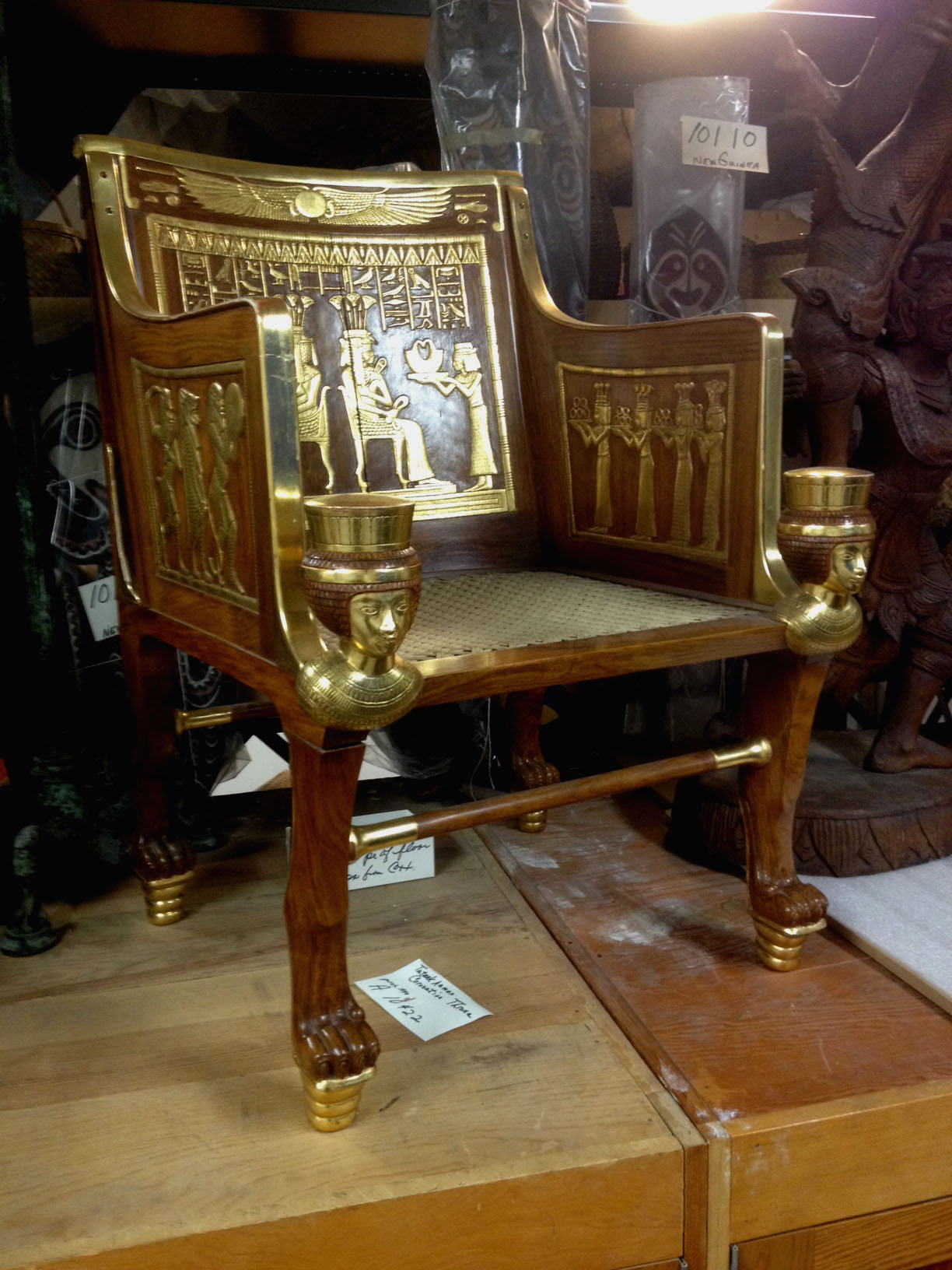
Replica created by Egyptian artisans and purchased by George Booth in 1927. The original chair is in the Egyptian Museum in Cairo. Photograph courtesy of Cranbrook Institute of Science.

Replica created by Egyptian artisans and purchased by George Booth in 1927. The original chair is in the Egyptian Museum in Cairo. Photograph courtesy of Cranbrook Institute of Science.

The Booths also visited the Egyptian Museum while in Cairo. Booth writes that although there is still a great deal in the actual tomb, he is in awe of the exhibition’s craftsmanship and value. He was particularly interested in a chair that at the time was believed to be the State Chair of Queen Taia, wife of King Amenhotep III (grandfather of Tutankhamun). Booth writes to Henry, “I would cheerfully give $10,000 for the throne –  which is an ordinary sized chair, but beautifully wrought.”

Exhibition poster, 1973.

Exhibition poster, 1973.

As the original chair was not for sale, Booth commissioned a replica to be made for the Art Museum collection. The chair, of carved wood with relief decorations covered in gold leaf, was later determined to be the chair of Sitamun, an Egyptian princess (and thought by many scholars to be the mother of King Tutankhamun). The chair was lent to the Institute of Science for a 1973 exhibition titled, “Ancient Egypt and the Tomb of Tutankhamen”. In 1984 the chair was transferred from the Art Museum to the Institute of Science, where it still resides today.

Gina Tecos, Archivist

“The Last Minstrel” at Cranbrook

Richard Dyer-Bennet poster

Troubadour, poet, and composer Richard Dyer-Bennet (1913–1991) was among the best known and most respected folk singers in America during the 1940s and 1950s. He became the first solo folk musician to appear in Carnegie Hall and on December 7, 1941, NBC radio broadcast Richard Dyer-Bennet singing “The Ploughboy” when the broadcast was interrupted with the announcement of the attack on Pearl Harbor.

Richard Dyer-Bennet performs at Cranbrook, Feb 1954. Harvey Croze, photographer.

Richard Dyer-Bennet performs at Cranbrook, Feb 1954. Harvey Croze, photographer.

Brought to Cranbrook by the Cranbrook Music Guild in February 1954, Dyer-Bennet presented “The Voice of Minstrelsy,” a program of traditional folk songs which spanned six centuries and included old-world European songs as well as American folk ballads.  A year later, Dyer-Bennet founded his own record label in order to maintain artistic control over the sound quality, repertory, and style of his performances.

To see the poster featured in this blog, as well as numerous others from our collection, visit the Archives’ exhibition Designs of the Times: 100 Years of Posters at Cranbrook.

Leslie S. Edwards, Head Archivist

The Name Game

From the beginning of Cranbrook’s history in 1904, place names at Cranbrook have evolved and changed. Once the Booths turned the original mill pond into a lake, they named it first Glassenbury Lake (after Glassenbury, England), then it was known as Cranbrook Lake for a very short time, and ultimately Kingswood Lake. The man-made Jonah Lake (or Lake Jonah as it is also known) was originally called Lake Manitou. Brookside School was originally called Bloomfield Hills School and Cranbrook School was Cranbrook School for Boys. Although Brookside School retains its name, since 1985 when the boys and girls schools merged, they are jointly known as Cranbrook Kingswood Schools.

Building names have also changed, often due to an alteration in use or sometimes because they were dedicated to an influential or long-time faculty member.  The Garden House became the Cranbrook Pavilion and is now St. Dunstan’s Playhouse. The Cranbrook School academic building became Hoey Hall after former Headmaster Harry Hoey and what was originally called the “Arcade” is now known as the Peristyle at the Cranbrook Art Museum. Lyon House was first called Stonelea (after its owner Ralph Stone, a long-time friend of George Booth), then Belwood, then the Kyes House before being acquired by Cranbrook.

And even Cranbrook Educational Community is not our first name. In 1927, the Booths established The Cranbrook Foundation as the legal and financial entity that oversaw the then six institutions: Brookside School, Christ Church Cranbrook, Cranbrook Academy of Art, Cranbrook Institute of Science, Cranbrook School, and Kingswood School.

So, what is really in a name? How do we name our campus buildings and landmarks going forward and what legacy will we be imparting with them?

That said, I wish you all a Happy New Year! Or should I say Bonne année? Feliz Año Nuevo? Or maybe Xin nian kuai le?

(And thank you Stefanie Dlugosz-Acton for getting me thinking about names at Cranbrook!)

From the Virginia Kingswood Booth Vogel Papers.

From the Virginia Kingswood Booth Vogel Papers.

Leslie S. Edwards, Head Archivist

Create a website or blog at WordPress.com