How many high schools can lay claim to hosting a performance of the legendary Detroit band, the MC5? In 1967, Cranbrook School joined a handful of Metro Detroit high schools as a venue for arguably one of the most influential rock bands of all time.
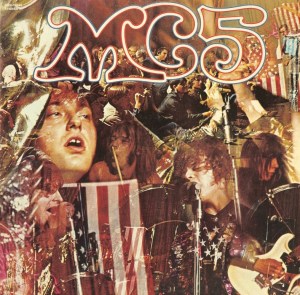
Cover of the MC5’s debut album, recorded live at Grande Ballroom in Detroit, 1969. Courtesy of private collection.
Known the world over today for their groundbreaking music, and as progenitors of the subsequent 1970s punk rock movement, the MC5 (Motor City Five) were relatively unknown outside the Detroit area when they played the Cranbrook School Little Gym on April 28, 1967.
Rob Tyner, lead singer of the MC5, performing for the Cranbrook audience. The Brook, 1968. Courtesy of Cranbrook Archives.
Billed as a Jazz Psychedelic, the concert featured fellow Detroit musicians, the Charles Moore Octet and the Joseph Jarman Quartet, both avant-garde jazz groups. Trumpeter Charles Moore’s band had already played earlier that year at Cranbrook (their musical repertoire including poetry by John Sinclair) and had developed a following among students and faculty. Accompanying the music at the April concert was a light show by the Magic Veil, which consisted of several sheets placed around the gym, a large number of lenses, watercolors, and an overhead projector. Open to Cranbrook and Kingswood students, faculty, and the area’s interested general public, tickets cost $3.25.
Charles Moore Octet at Cranbrook. The Crane, January 20, 1967. Courtesy of Cranbrook Archives.
The event was sponsored by the revamped Jazz Society, a student club formed in 1966 with a goal of exposing students to different forms of jazz (including a trip to the Masonic Temple in Detroit to see Count Basie). Under their new name, REAL (Revolutionary Enjoyment Authenticity and Love), they continued to arrange musical experiences both on and off campus, providing tickets and transportation to venues such as the Fisher Theater, Meadowbrook, and the Grande Ballroom. A trip to this last venue, “home base,” if you will, of the MC5, included a concert by the Eric Clapton band, Cream.
Cranbrook Archives is pleased to announce a new collection available for research. An intriguing collection, it comprises the personal and professional papers, photographs, realia, and architectural drawings of Walter Preston Hickey, a student of Eliel Saarinen. Yet, while traces of key life events and relationships—birth, parentage, education, marriage, friends, and employers—can be found in the collection, Hickey’s life after Cranbrook remains largely a mystery.
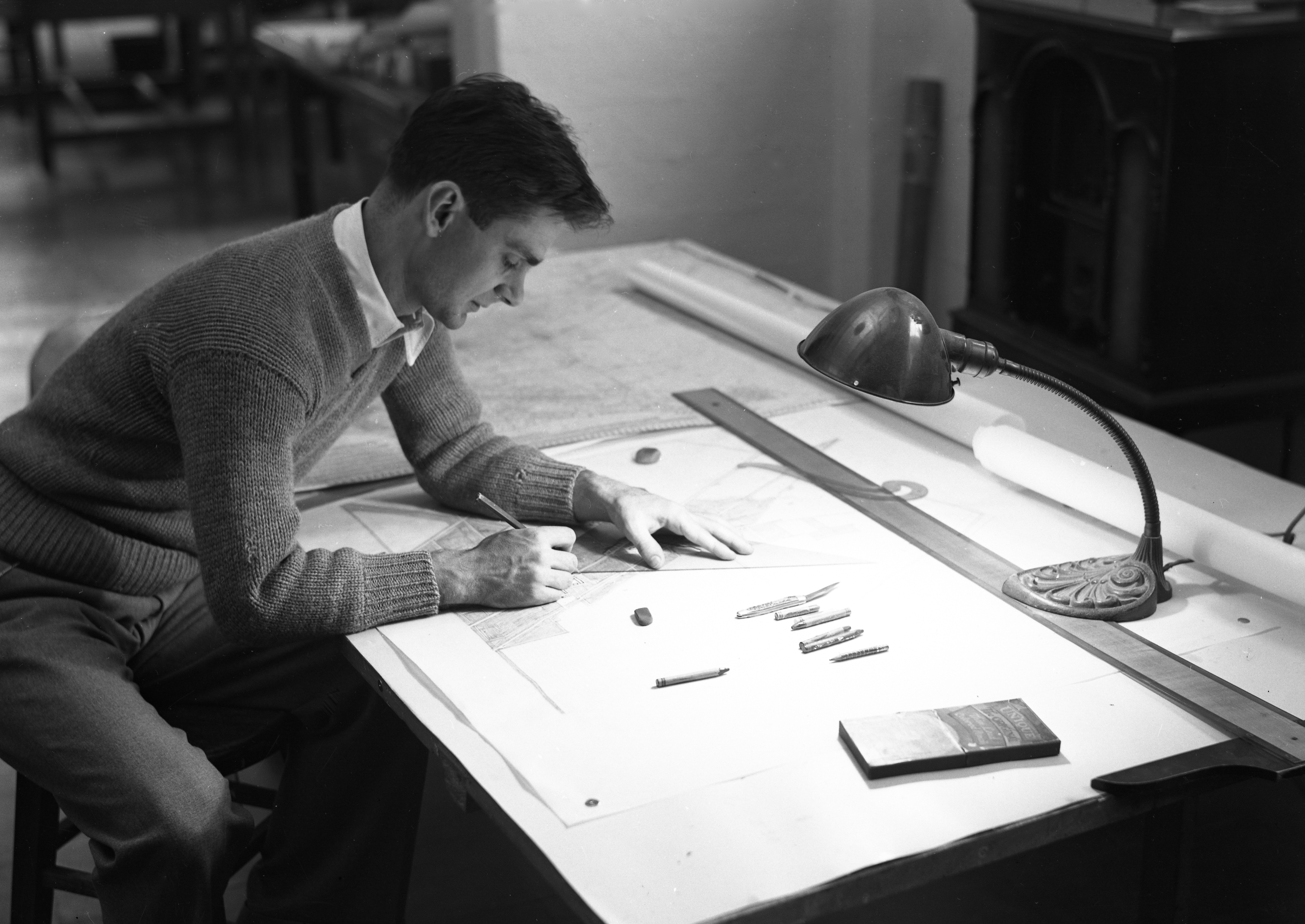
Walter Hickey working in the Architecture Studio, 1935. Courtesy of Cranbrook Archives, Cranbrook Center for Collections and Research.
A native of Detroit, Hickey attended the University of Michigan School of Architecture (1926-1930), during which time he worked with architects Albert Kahn (1928) and Thomas Tanner, as well as being one of the first staff members of the Cranbrook Architectural Office.
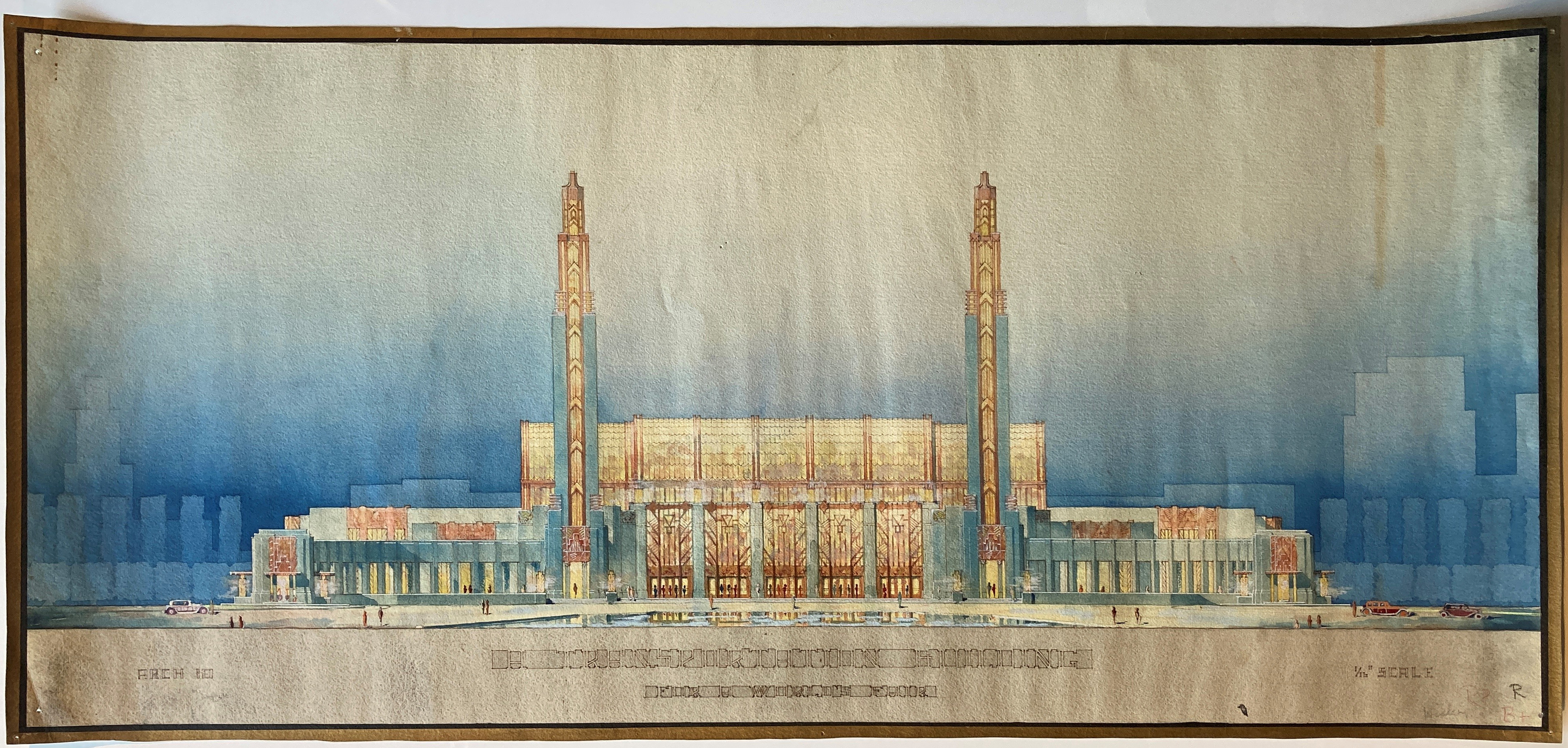
A Transportation Building for a World’s Fair, circa 1926-1930. A University of Michigan Class Project by Walter Hickey. Courtesy of Cranbrook Archives, Cranbrook Center for Collections and Research.
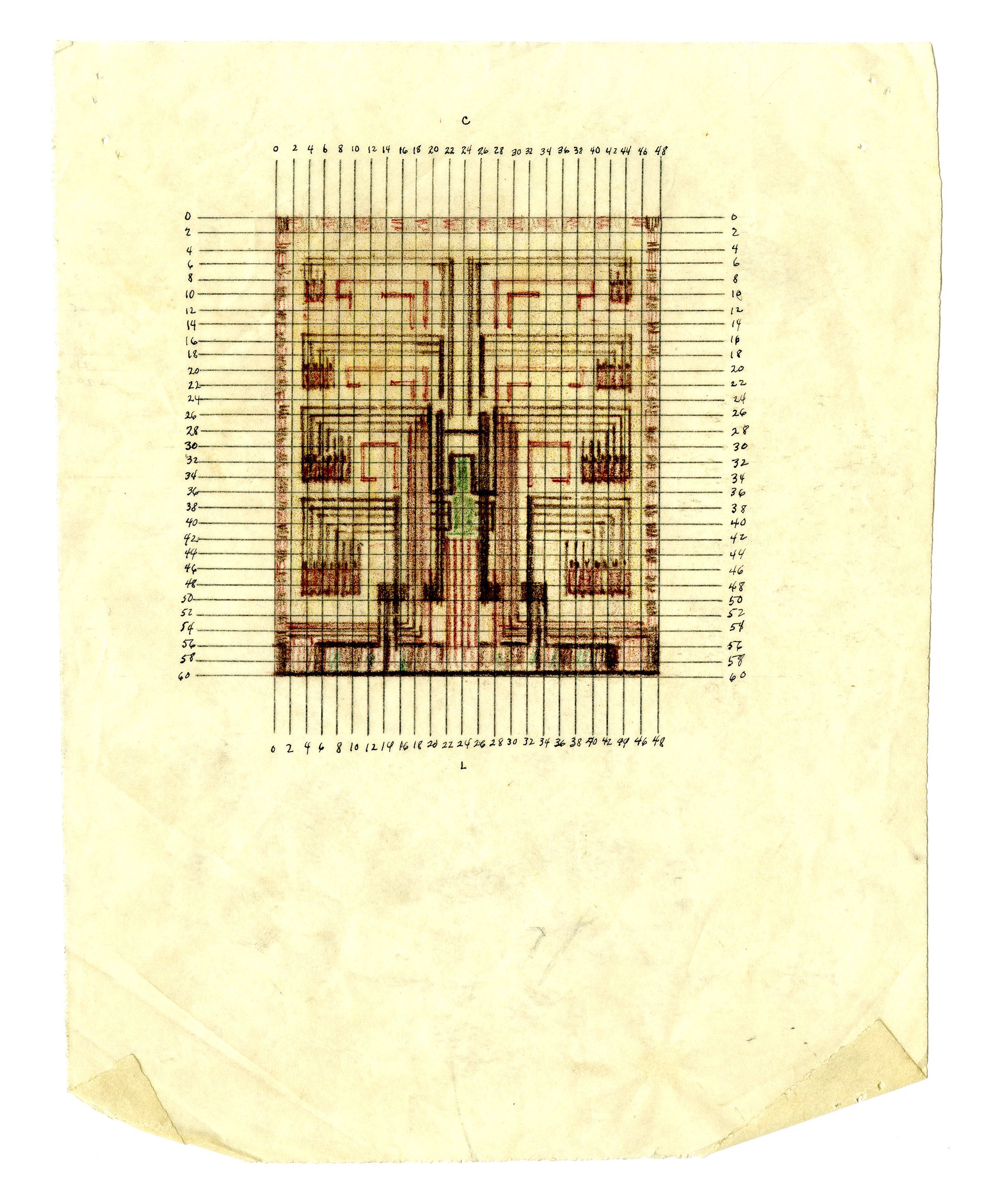
He applied to study architectural design with instruction in city planning at Cranbrook Academy of Art, starting in September of 1932. He became especially interested in highway traffic control, which formed the topic of his 1935 thesis on theWaterfront Development for the City of Detroit. Hickey submitted designs to various Academy competitions and won a $10 prize from Loja Saarinen for design No. 13 in the Cranbrook Academy of Art Rug Competition in 1934.
Drawing by Walter Hickey, undated. Courtesy of Cranbrook Archives, Cranbrook Center for Collections and Research.
After leaving Cranbrook, Hickey worked for various architecture firms, including Smith, Hinchman, and Grylls, and Clair W. Ditchy. After a short time with the Federal Housing Administration, he returned to work with Eliel and Eero Saarinen on the Kleinhans Music Hall project. He also completed private architectural designs for residences, including work on Ralph Rapson’s Hoey vacation home, Longshadows, in Metamora, MI. Around this time, he went to work at the General Motors Technical Center and continued to live in Birmingham, Michigan. And here is where his story ends in the collection.
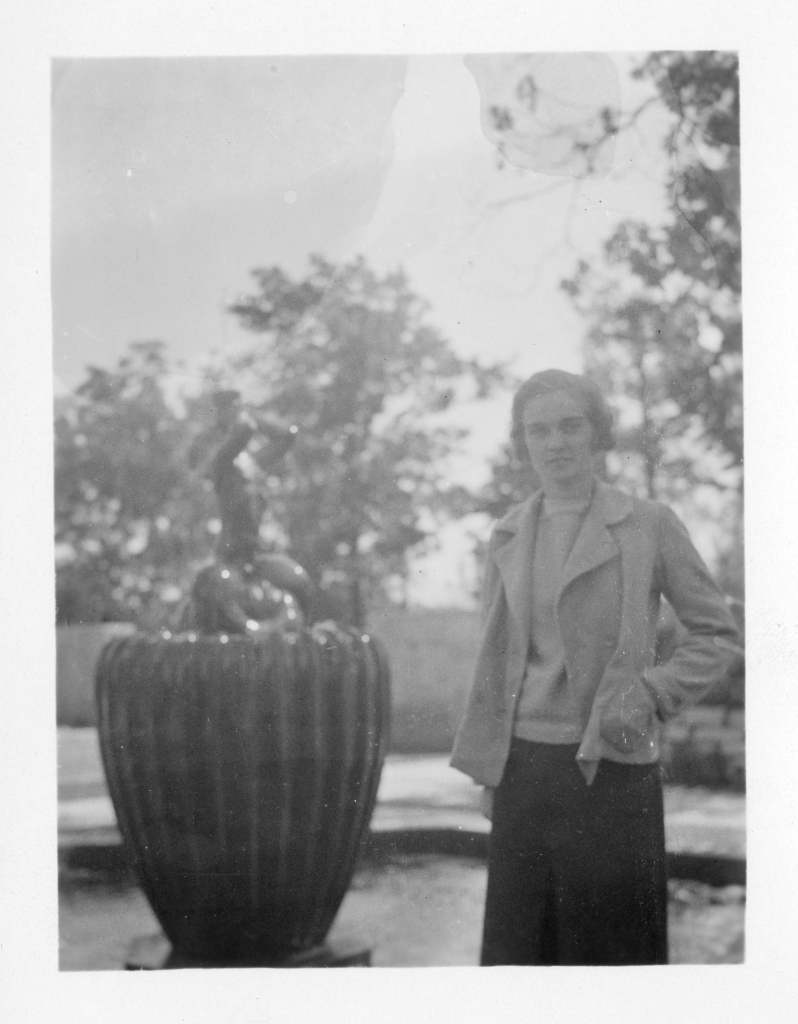
Jane Viola Shepherd. Courtesy of Cranbrook Archives, Cranbrook Center for Collections and Research.
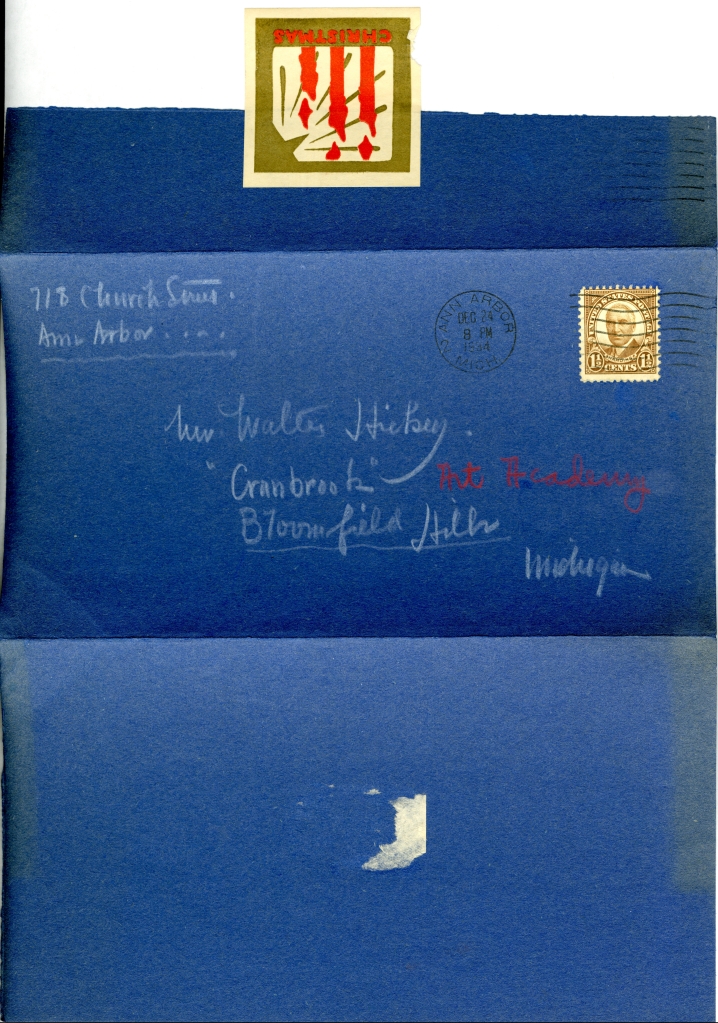
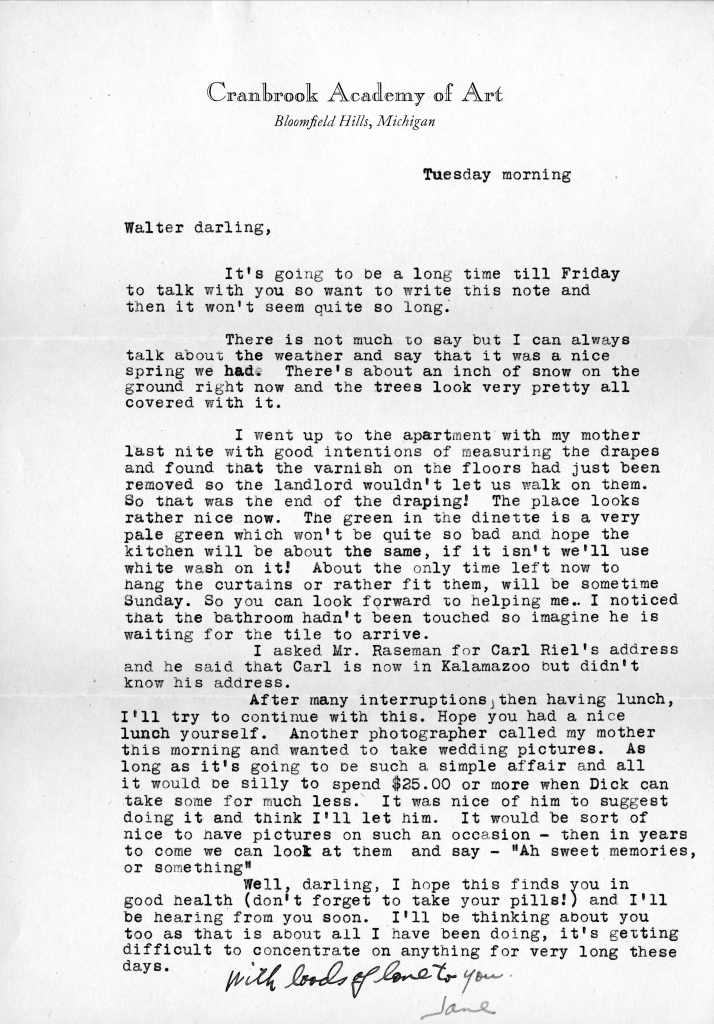
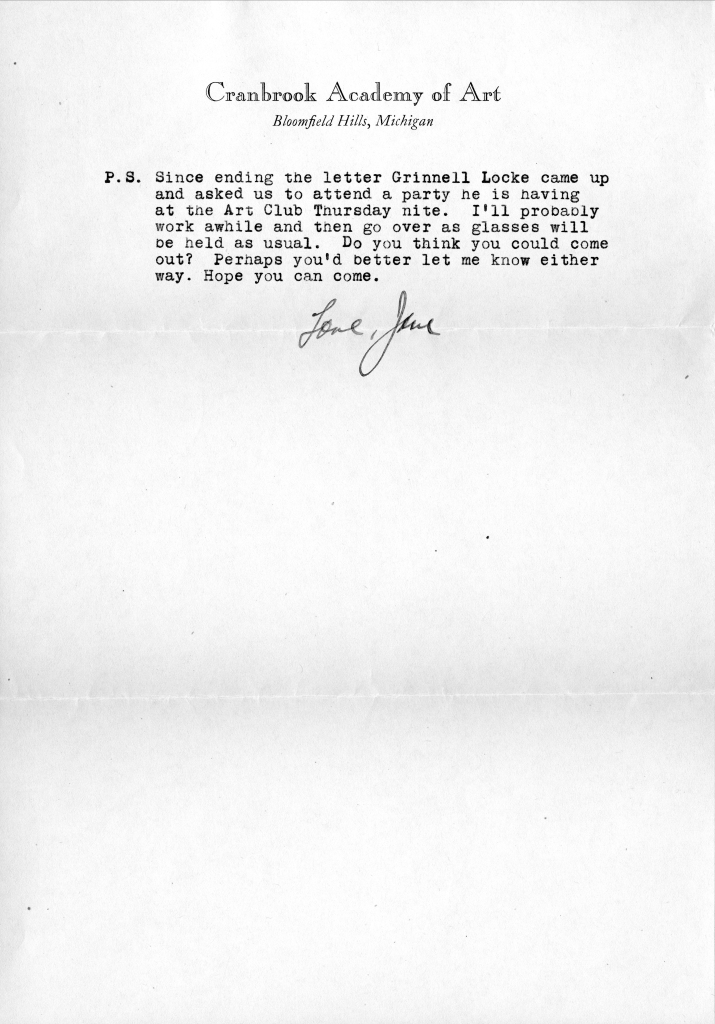
Although this is a very small collection, the diversity of content is rewarding for its ability to convey snapshots of his life in individual and unique items. It includes Christmas cards, such as one from “the Lorches” (Emil Lorch was the President of the University of Michigan Architecture School), a few letters from friends, and something of a typed love letter (on Cranbrook Academy of Art letterhead!) from Zoltan Sepeshy’s Secretary Jane Viola Shepherd to whom he was married on April 22, 1937.
Correspondence to Walter Hickey, 1934-1937. Courtesy of Cranbrook Archives, Cranbrook Center for Collections and Research.
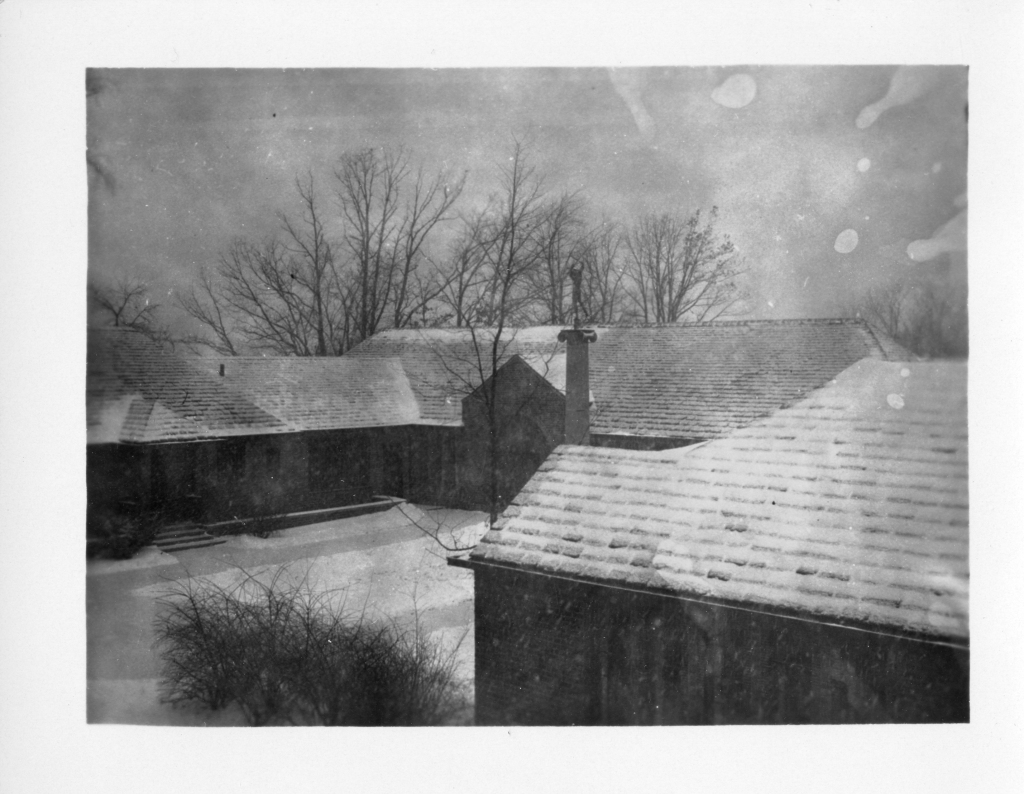
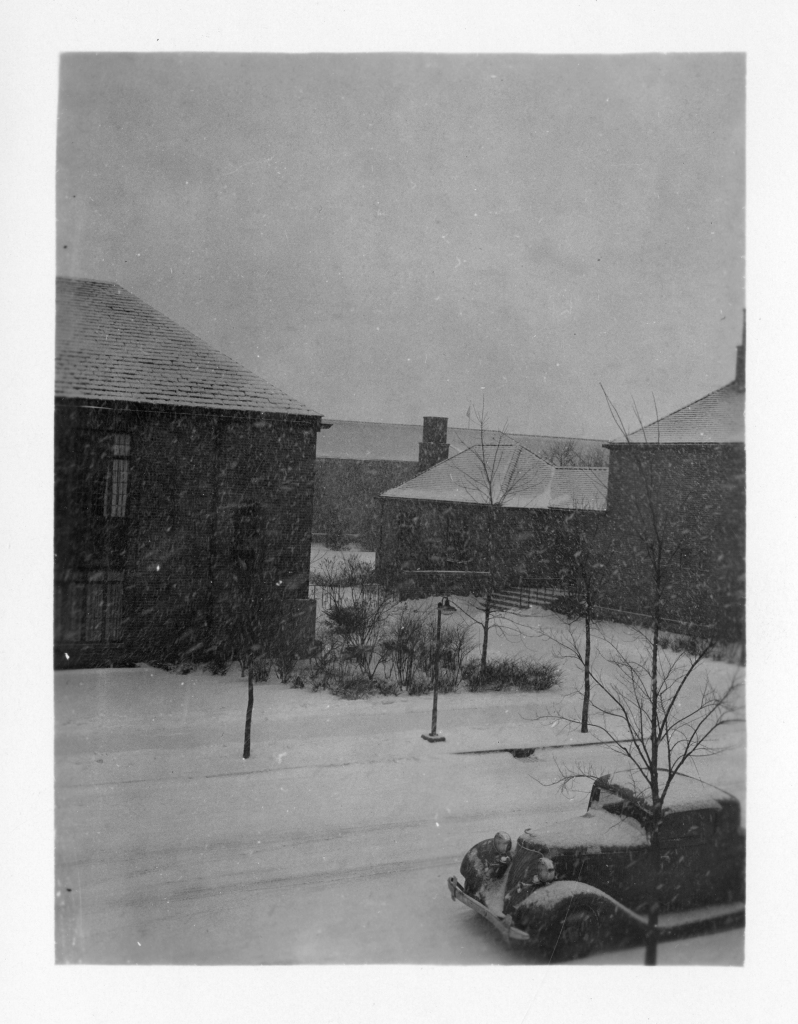
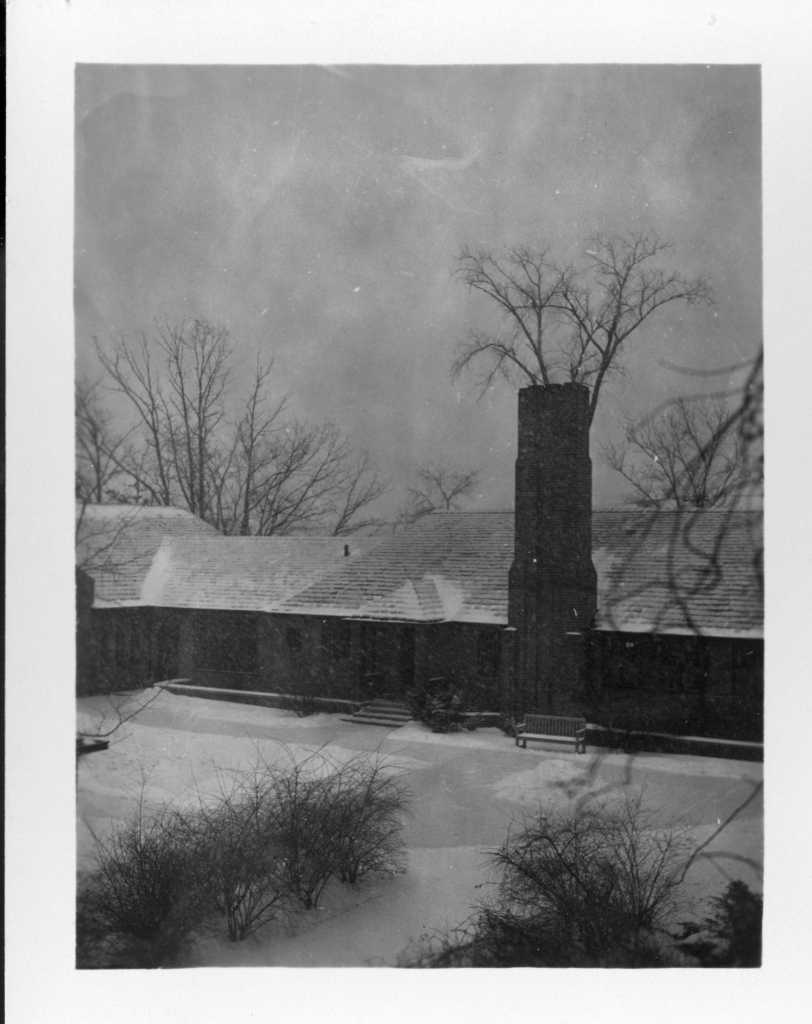
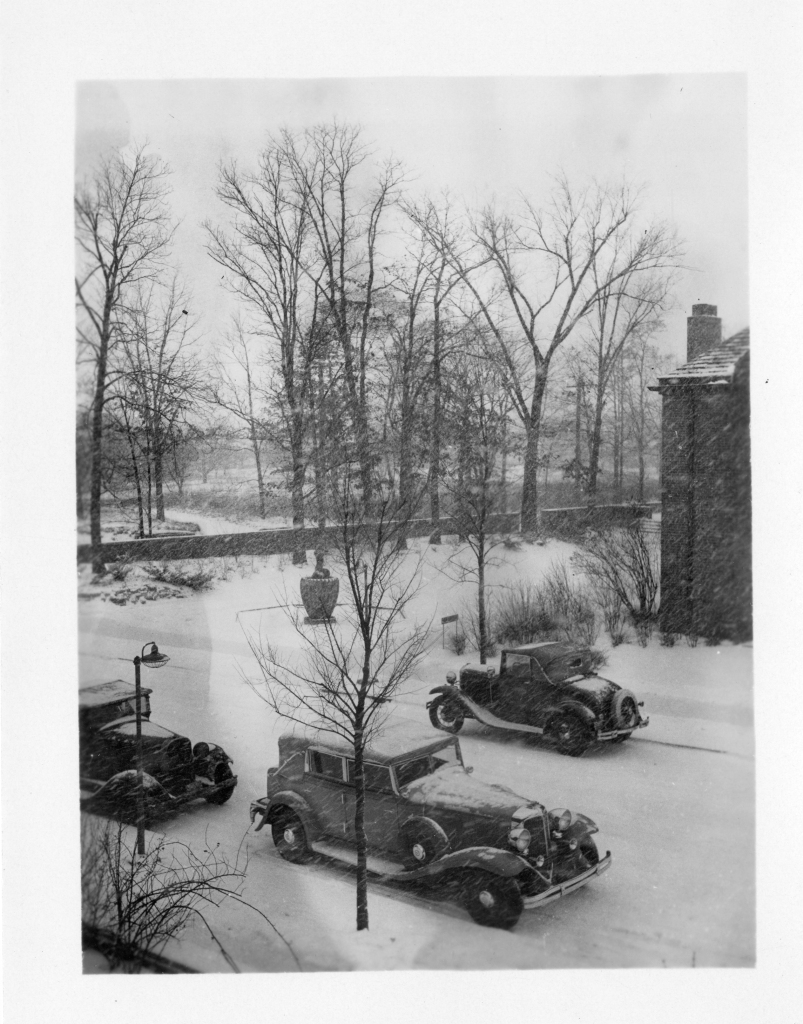
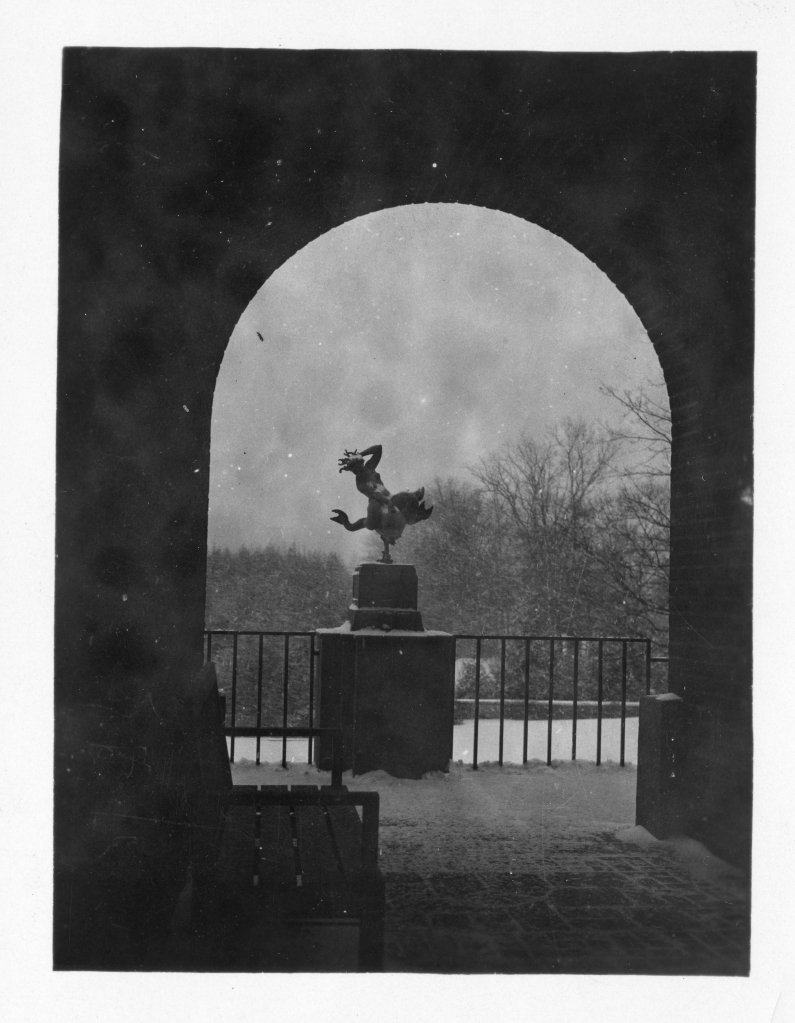
A small series of photographs hold moments of his life and some of the people with whom he shared it, including his father, eminent roentgenologist (radiography) Dr. Preston Hickey; his wife, Jane; his teacher, Eliel; and his fellow Academy students. A series of snowy scenes of Cranbrook campus beautifully capture the quietness of falling snow with hints of sunlight upon the architecture and sculptures that were then in their infancy and are now historic.
Cranbrook Academy of Art campus, circa 1932-1935. Courtesy of Cranbrook Archives, Cranbrook Center for Collections and Research.
The Walter Hickey Papers give insight into a short period in Hickey’s life and the Cranbrook of his time. It also gives us a lovely look into a life that was surely shaped by his experience at Cranbrook, but one that remains yet to be fully discovered.
–Laura MacNewman, Associate Archivist, Cranbrook Center for Collections and Research
September 24 is the birthday of Cranbrook’s co-founder George Gough Booth. Trying to decide how best to commemorate his 157th birthday, I landed on the idea of sharing the story of the day he came into the world.
Portrait of George when he was around twelve years old. Photographer W. E. Lindop, Elgin Gallery, St. Thomas, Ontario. Courtesy of Cranbrook Archives, Cranbrook Center for Collections and Research.
In 1864, Henry Wood Booth and Clara Louise Irene Gagnier Booth were living in Canada. Clara had already given birth to three children: Charles, Alice, and Grace. Baby Grace had, unfortunately, died at seven months. Clara would go on to have six more children—Edmund, Theodora, Adelaide, Ralph, Roland, and Bertha—for a total of nine children to live past infancy.
Clara Louise Irene Gagnier Booth in 1857. Courtesy of Cranbrook Archives, Cranbrook Center for Collections and Research.
Henry Wood Booth in 1862. Courtesy of Cranbrook Archives, Cranbrook Center for Collections and Research.
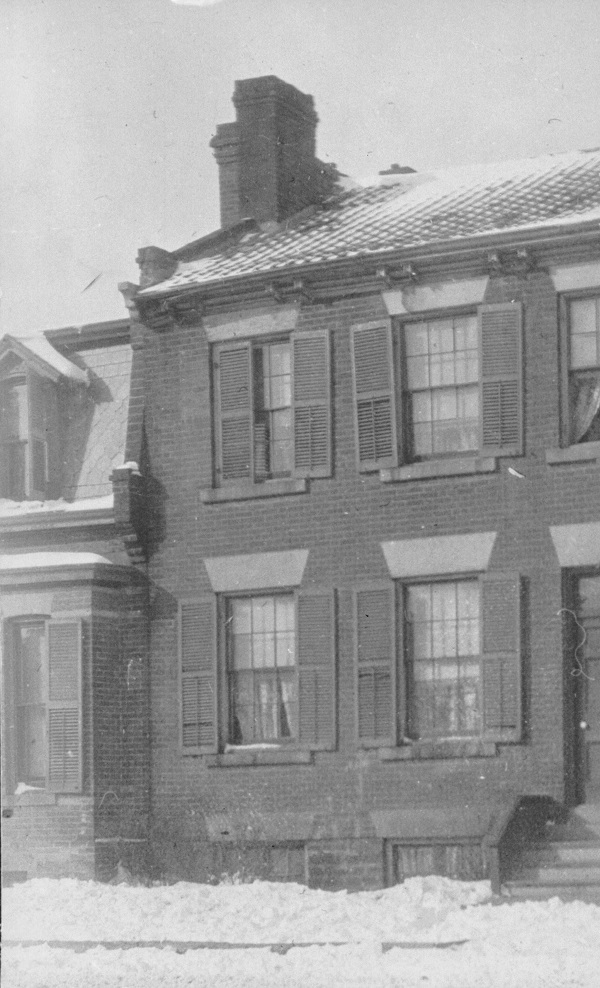
George Gough Booth arrived on September 24, 1864, at 8 Magill (now McGill) Street in Toronto, Ontario, Canada. Henry Wood Booth recalled that George was, “Born in the house at the East end of row on the South side of Magill St. about the middle of the block from Younge St. at 11.30 p.m. on Saturday, Sept. 24, 1864.”
The terrace house at No. 8 Magill Street, the birthplace of George G. Booth in Toronto, Ontario, Canada, as it looked in 1902. Courtesy of Cranbrook Archives, Cranbrook Center for Collections and Research
In a missive written much later about the night of George’s birth, Henry recalled “the time when, on opening the front door, I heard your sonorous voice for the first time, while your grandmother, coming down the stairs, assured me ‘it’s a fine boy.’”
But why was Henry out so late on the night George was born? Shouldn’t he have been home with Clara?
Henry Wood Booth’s recollection of the birth of George Gough Booth in 1864. George Gough Booth (1864-1949) Papers (1981-01), Box 1 Folder 1, Cranbrook Archives.
Distraught during Clara’s labor—”The warning came at about 10 p.m.” Henry recalled—the father-to-be was ushered out of the house to get help. His first stop was the home of Mrs. Cavie, across Magill Street, “who was in bed but promised to ‘dress and go over at once,’ which she did.” Henry then ran to Mother Gagnier’s house. She lived a mile away. “She also promised to go at once, and did.”
His final stop was the home of Dr. James Ross, who lived almost three miles away. Dr. Ross, however, took his time, dressing while a nervous Henry waited. He regretted waiting for the doctor, “I should have hurried home and told them there that the doctor was coming.”
George, “being a lively one,” commented Henry, “and his mother equal to the task,” had already made his entrance into the world, with the assistance of the experienced Grandmother Gagnier, before the doctor and Henry had reached the house.
George Gough got his first name from his great-grandfather as well as his uncle, both named George Booth. Gough came from two sources. Henry’s grandmother Elizabeth Dann Gough Booth had been a member of the influential Gough family back in England, and Henry’s father’s name was Henry Gough Booth.
In addition, Henry and Clara enjoyed the work of the famous temperance orator John Gough. Henry had once heard Gough lecture in 1849, where Henry signed “the pledge” to stop drinking, and became a champion of temperance. The Booths sought to dedicate George to “the sacred cause of temperance” and thought the strong middle name would help.
George Gough Booth did maintain a temperate life, so Henry and Clara’s goal was achieved.
Another thing Henry and Clara passed on to their son George: a tradition of honoring the family ancestry through names:
George’s second son’s name was Warren, his wife Ellen Scripps Booth’s middle name
His first daughter was named Grace Ellen, after his sister who died in infancy and his wife
His youngest son was named Henry after his father, grandfather, and a long line of Henrys before him
His youngest daughter Florence’s middle name was Louise, his mother’s middle name
All three of his sons’ middle names were Scripps, his wife’s maiden name
Ellen Scripps Booth and George Gough Booth with their children on their 50th wedding anniversary in 1937. The Booths are, from front row, from left: James Scripps, Henry Scripps, Warren Scripps. Second row from left: Ellen Scripps, George Gough, Grace Ellen, Florence Louise. Courtesy of Cranbrook Archives, Cranbrook Center for Collections and Research
And George and Ellen’s home, estate, and community they founded was, of course, named for the town in Kent, England, where Henry Wood Booth was born: Cranbrook.
And with that, I’d like to wish a very Happy Birthday, Mr. Booth!
—Leslie S. Mio, Associate Registrar, Cranbrook Center for Collections and Research
Throughout this past spring and summer, I’ve been arranging and describing the recently donated papers of designer and architectural educator Ken Isaacs. Isaacs was an Academy of Art design student and faculty alumnus–his Superchair and a film by Barbara Isaacs are currently featured in the With Eyes Opened exhibit at the Art Museum and in the beautiful new book of the same title. Organizing his papers to ready them for researchers has led my learning about the environments Isaacs designed as well as the larger environments he navigated. These include Cranbrook, Manhattan, Chicago, and the rural acres of Groveland, Illinois where he designed and built a village of stylish, portable Microhouses, predating the current Tiny House movement by decades.
Portrait of Ken Isaacs, found tucked into his 1957 daybook. Courtesy of Cranbrook Archives.
For example, while completing his MFA at Cranbrook from 1952-1954, Isaacs redesigned the interior of The Little Gallery, founded by Peggy DeSalle in neighboring Birmingham in 1949. DeSalle was a great supporter and benefactor of the Cranbrook community and the lead donor and namesake of Cranbrook Art Museum’s DeSalle Auditorium, so how wonderful to get a peek at The Little Gallery’s early years through Isaacs’ papers. I learned DeSalle was once married to Cranbrook President Zoltan Sepeshy, though long before Isaacs came to study here. I also learned, thanks to one of Isaacs’ presentation boards, that Peggy’s second husband and lifelong partner, Albert DeSalle, bought a 1955 couch Isaacs designed of steel and canvas.
A third anniversary announcement from The Little Gallery and Isaacs’ 1955 presentation board for his steel couch. Courtesy of Cranbrook Archives.
During those same years, Ken Isaacs built the 18-foot-long, seven-foot-tall Matrix Drum environment. This large structure with its curving wall of graphic, black and white collage was stored here on campus until Zoltan Sepeshy persuaded Isaacs to return as faculty. (No wonder Isaacs was still on Sepeshy’s mind, having left a work larger than a Buick Roadmaster on the president’s turf).
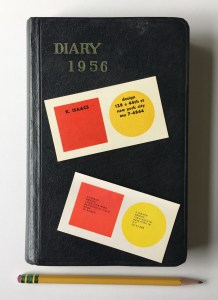
On left: K. Isaacs Design business cards, which used the same graphics as his letterhead, c. 1956. Center and right: A 2-page handwritten note from “Zoltan S” gives Isaacs directions to New Milford, Connecticut, June 1956. Courtesy of Cranbrook Archives.
I’ve recently foldered letters back and forth from Isaacs and Sepeshy. Their correspondence is a study in contrasts: Isaacs’ design stationery is mid-century modern with simple shapes in bold primary colors; one of Sepeshy’s handwritten notes has elegant, looping script that stands out against typed missives. They negotiated that Isaacs would retain and commute to his New York City design offices from Bloomfield Hills. The arrangement worked, for a while. The contract for the 1956-1957 school year included a residence for Ken and Barbara Isaacs in the “apartment in Guest House” on Academy Way and Isaacs headed the Design department from 1956 to 1958.
Isaacs regards a student’s work in an Art Academy studio. Courtesy of Cranbrook Archives.
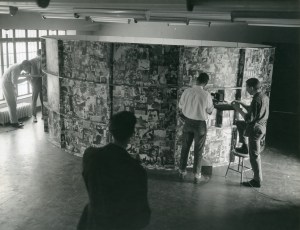
Back at Cranbrook, photographs show Isaacs’ reuse of his Matrix Drum structure as a collaborative art project with Academy students who helped to collage its black and white pholage exterior. His notes detail how he redesigned the first Academy year to include field trips and visiting experts. They also explain how students designed a multimedia, immersive Matrix Drum lesson about the American Civil War using multiple slide projectors and moving pallets for participants to sit upon.
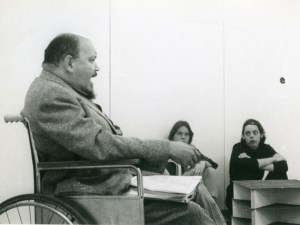
On left: The Matrix Drum (1954-1958) at Cranbrook: Outside and In. Isaacs in foreground regards students at work on the Drum’s exterior. On right: design students listen to a lecture from visiting anthropology professor Dan Crowley inside the drum. Courtesy of Cranbrook Archives.
These are a few curiosity-rousing items in the Ken Isaacs Papers, from just his time at Cranbrook, with plenty more boxes of his writings and images left to go through. I’ll confess, his papers make it a real challenge for me to stay on task with processing duties, when there are so many things I want to know more about. Stay tuned for further finds!
– Meredith Counts, Archives Assistant, Center for Collections and Research
In Cranbrook Archives’ Christ Church Cranbrook Records, there is a binder on two needlepoint projects undertaken between 1957 and 1964, the first of which focuses on replacing the cushions and kneelers in St. Dunstan’s Chapel. It gives insight into the design process, symbolism, and handwork, as well as providing much information that would be of interest to the sociology of gender roles and art.
St. Dunstan’s Chapel, Christ Church Cranbrook. The Chapel’s first service was Easter Sunday 1926; the current configuration of the Chapel dates to 1934. Photograph by Kevin Adkisson, August 2021. Cranbrook Center for Collections and Research.
The project, a collaboration of the Women’s Auxiliary and the Altar Guild, began in June 1957 when a Needlepoint Committee was convened to oversee the project through its planning, implementation, and dedication. The project was inspired by a similar project at Washington Cathedral where women across the nation contributed 461 pieces of needlepoint to the Cathedral, including altar pieces for Bethlehem Chapel which were worked by women of Michigan.
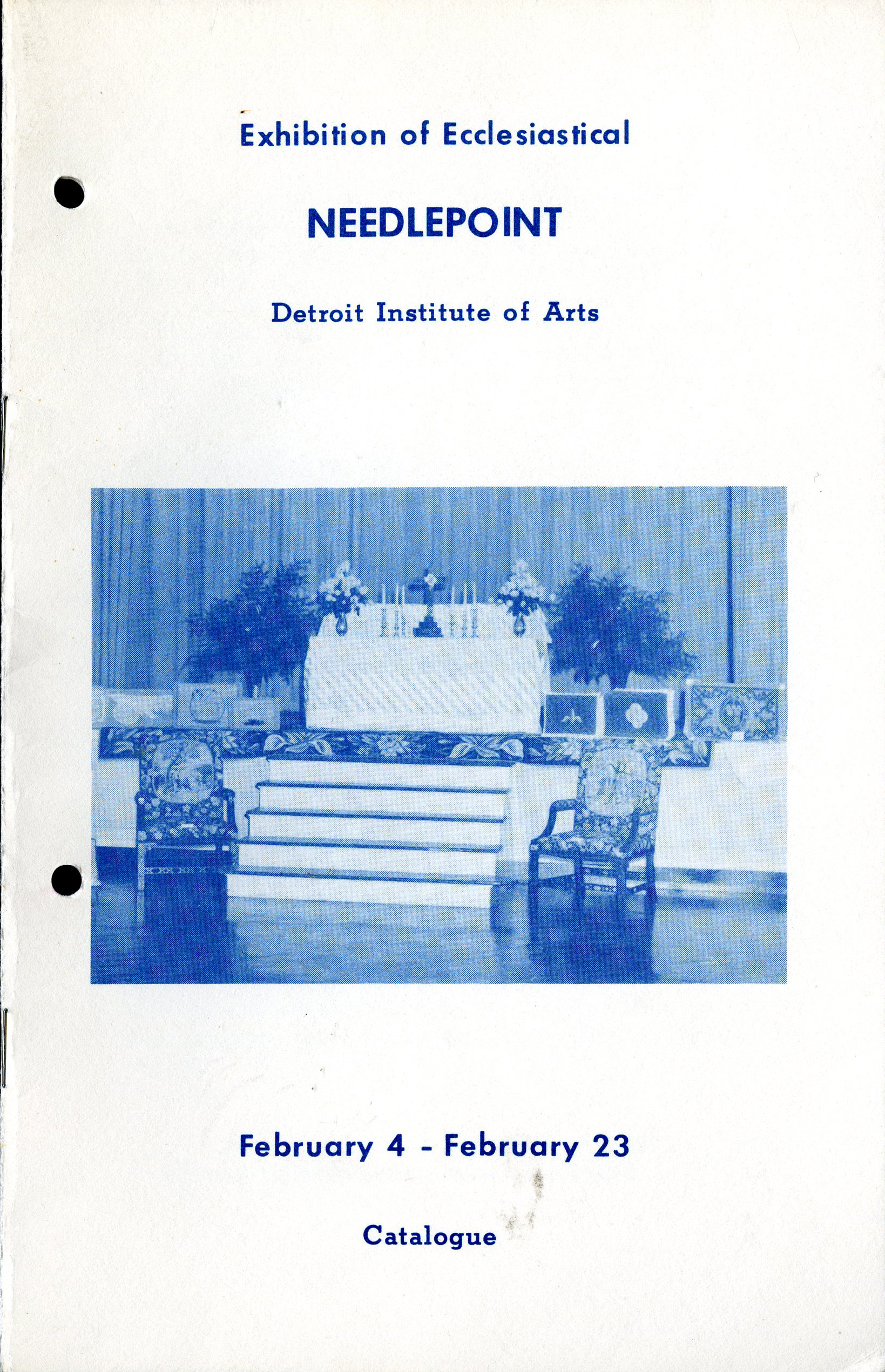
Twenty designs from the Washington Cathedral project were displayed in the Exhibition of Ecclesiastical Needlepoint at the Detroit Institute of Arts in February 1958 prior to their dedication at the Cathedral. Rt. Rev. Richard S. Emrich commended the idea to all churches in Michigan.
Catalog for the Exhibition of Ecclesiastical Needlepoint at the Detroit Institute of Arts, February 1958. Courtesy of Cranbrook Archives, Cranbrook Center for Collections and Research.
St. Dunstan’s Chapel was selected as the most appropriate place for the women of the church to use their handwork for its adornment, since St. Dunstan is the patron saint of Arts and Crafts. St. Dunstan, born in Glastonbury, Somerset, in the tenth century, is commemorated in St. Dunstan’s Chapel with a stone from Glastonbury Abbey where he served as abbot.
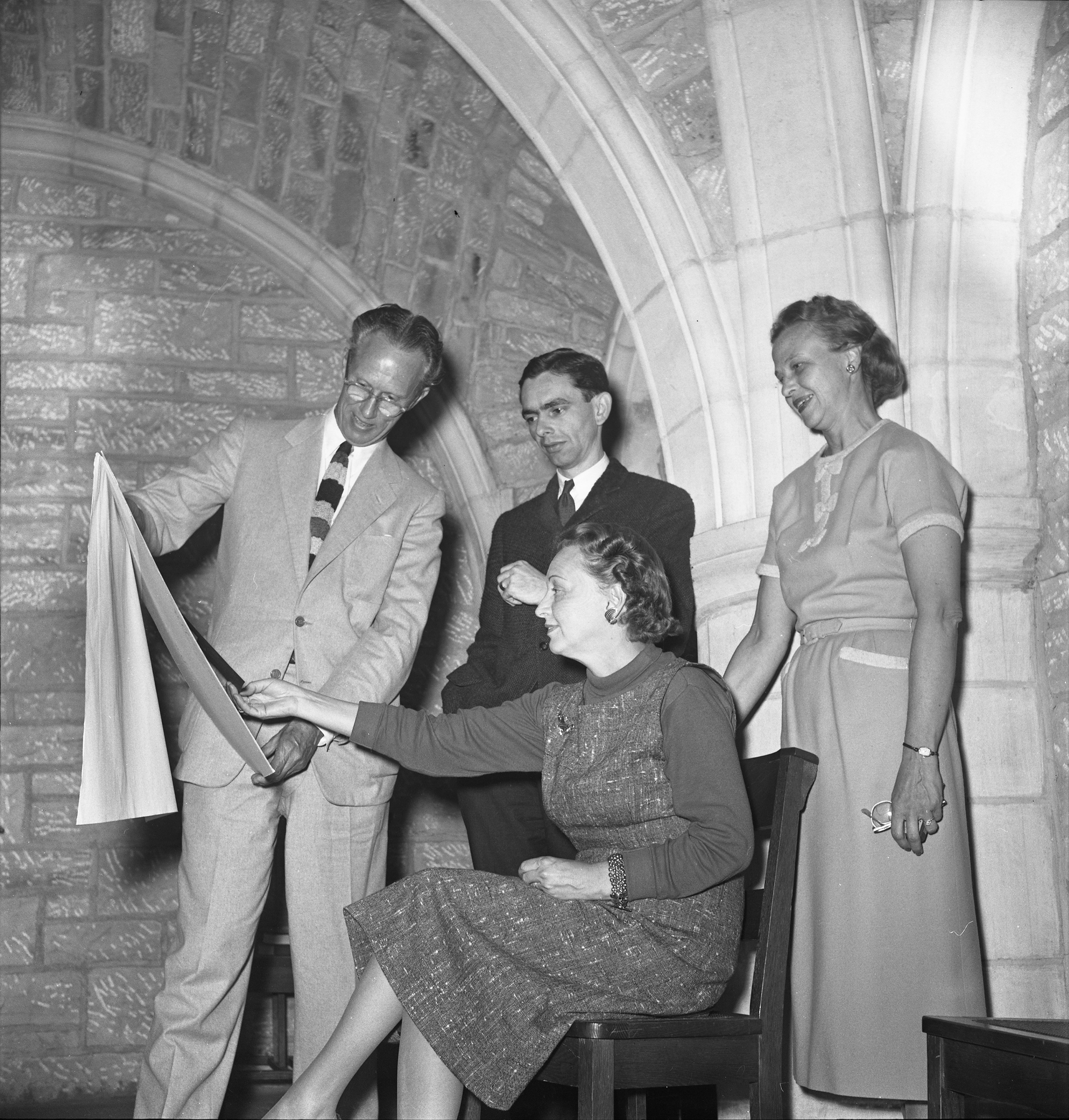
Initially, the Committee decided to seek designs for the project by opening a contest for Cranbrook Academy of Art students, with Henry Scripps Booth, Pipsan Saarinen Swanson, Ken Isaacs, and Marion Leader as judges. Harry Soviak (Painting 1957/MFA 1959) won the competition. However, there were problems in implementing the design in terms of types and quantities of wool, and the Committee sought to consider more traditional designs before making a final choice.
Henry Scripps Booth, Ken Isaacs, Pipsan Saarinen Swanson (seated), and Marion Leader judging entries from Academy of Art students to the needlepoint contest for St. Dunstan’s Chapel at Christ Church Cranbrook. April 19, 1957. Photograph by Harvey Croze. Cranbrook Archives, Cranbrook Center for Collections and Research.
Rachel T. Earnshaw of the Needlework Studio, Inc., of Bryn Mawr, Pennsylvania was contacted for information on how to proceed. Earnshaw had won first place for her designs for the Chapel of the Holy Spirit at Washington Cathedral. Having been sent some information and images of St. Dunstan’s Chapel, she advised on symbolism as well as offering guidance on canvas, wool, and stitches.
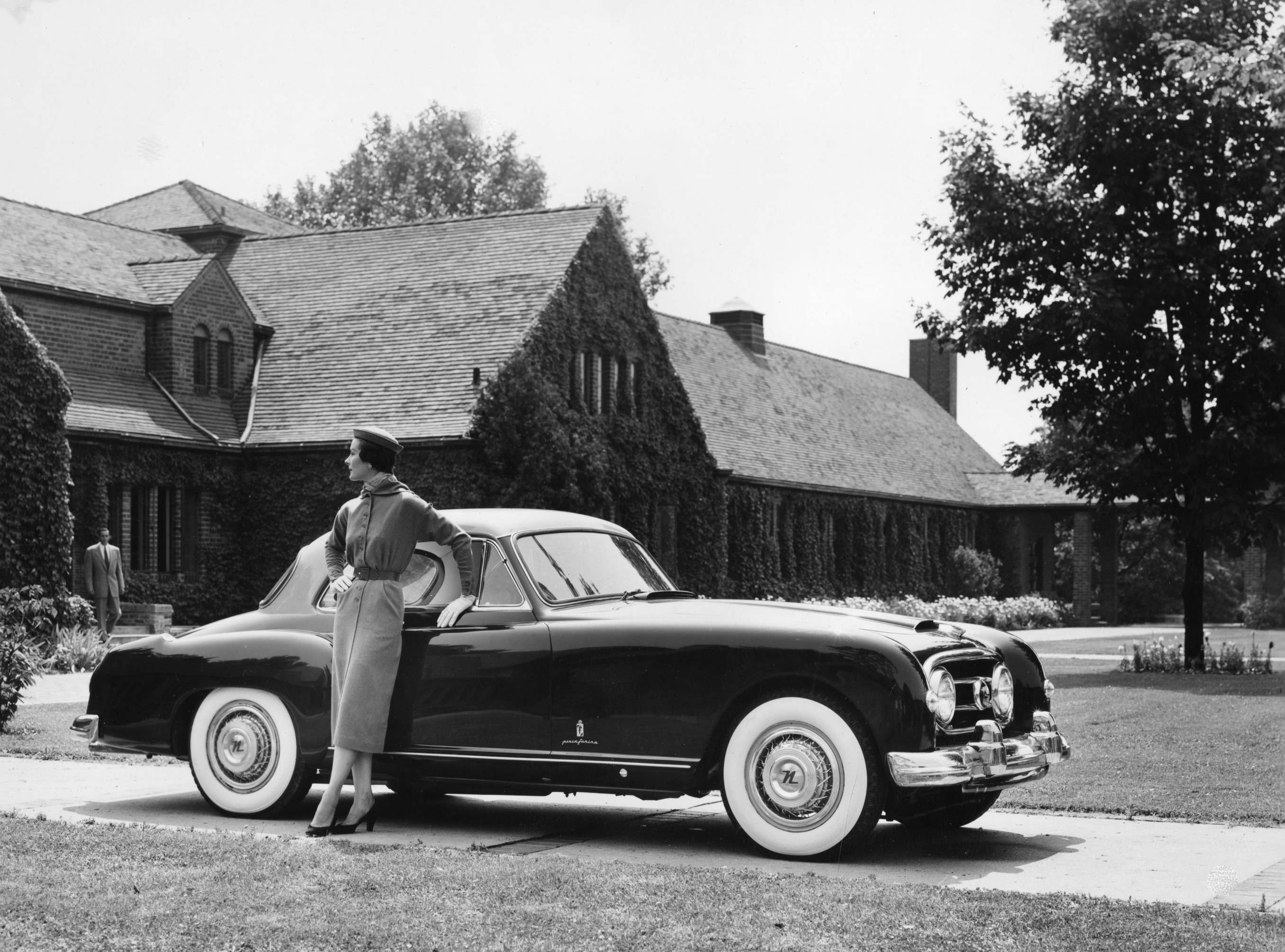
In honor of the Woodward Dream Cruise, happening in front of Cranbrook’s Woodward Entrance as I write, I thought we’d look back at this fabulous photograph of an unknown woman and a beautiful 1950s Nash Pininfarina parked in front of Cranbrook School for Boys’ study hall. This photograph is part of Cranbrook Archives’ Floyd Bunt Papers.
Nash-Healy Pinin Farina parked next to Cranbrook School for Boys, ca. 1956. New Center Photographic, Inc., photographer. Cranbrook Archives.
Toronto-native Floyd Bunt joined the faculty of Cranbrook School in 1944 and taught Chemistry and Engineer Science. He also was the faculty advisor for the Rifle Club and taught auto mechanics classes to the boys, quite possibly using this Nash-Healy Pinin Farina. He eventually served as chairman of the Science Department at Cranbrook from 1964 to 1969.
The Nash-Healy is a two-seat luxury sports car, made between 1951 to 1954. It was one of the first sports car sold in America after World War Two, launched two years before the Corvette. The 1951 models were built in Britain, and the redesigned 1952 through 1954 models built in Turin, Italy by Pinin Farina. There were only 506 of this chic little cars made, and it looks like our photo shows a 1953 roadster. I do wonder who owned it, and why this photo was taken!
Perhaps you’ll be venturing out to Woodward Avenue this weekend for the Dream Cruise. I’ve been enjoying the historic cars that are already cruising; perhaps there’s even a Nash-Healy Pinin Farina out there! Send us a picture if you see one!
—Kevin Adkisson, Associate Curator, Cranbrook Center for Collections and Research
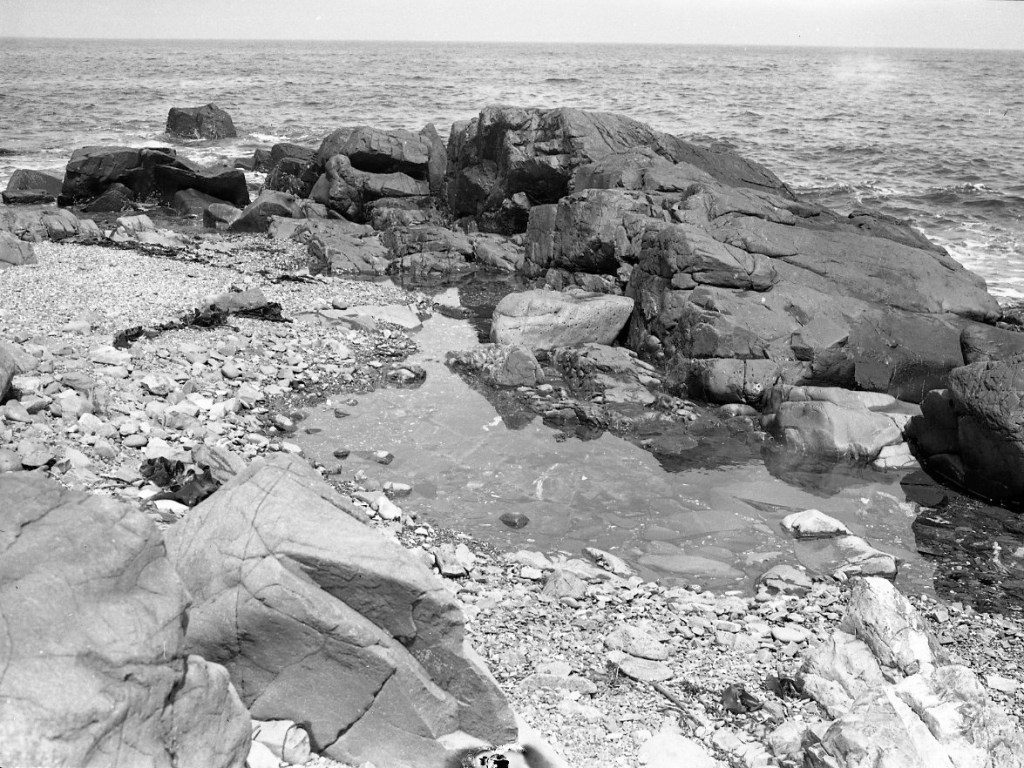
Recently returned from a sojourn to the coastal towns of Midcoast and Downeast Maine, the sights, sounds, and rhythm of the ocean remain with me still. For eight days many activities, particularly swimming and beachcombing, were often dictated by the tides. Twice daily the ebb tide revealed fascinating marine life – plant and animal – in tide pools, beaches, and on rocks, of which I attempted to capture with my iPhone camera to varying degrees of success.
One of the good ones! View of Spruce Head from Clark Island, Maine. July 2021.
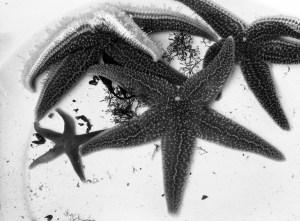
Photographs taken by Institute of Science Exhibition Artist and Preparator, Dudley Moore Blakely, do much more justice to the varied species found in tidal pools along this majestic coastline. He, too, spent a part of his summer in Maine, traveling instead in 1948 to the southern beach towns just over the New Hampshire state line.
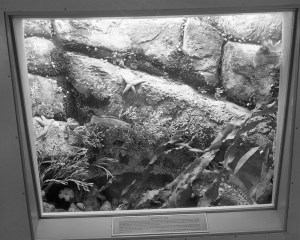
Blakely’s trip involved field studies for a permanent biological exhibit, Between the Tides, which would be mounted in 1949, after his departure for the Boston Museum of Science.
Blakely’s photographs helped him simulate in rubber mold casting the barnacle encrusted rocks, and exhibition staff members George Marchand the lesser algae and animals, Luella Schroeder the kelp, and Dorothy Olsen Davies the sea anemones. The exhibit’s purpose was to recreate the “zonal distribution of life in response to the rhythm of the tides.” (Cranbrook Institute of Science 1949-1950 Annual Report, Vol. 20, p.14)
A man of unique talents, Blakely also created a ripple pattern of lighting for the Tides exhibit where “light from a single source passes through actual waves on its way to the exhibit.” (Cranbrook Institute of Science Newsletter, October 1949, Vol.19:2, p.23)
Between the Tides exhibit, Alcove 5, Cranbrook Institute of Science, 1949. Courtesy of Cranbrook Archives.
Dudley Blakely oversaw the exhibition department at the Institute from 1936-1948 (except during the war years), where he designed and fabricated exhibits and provided architectural drawings and models for the Institute.
– Deborah Rice, Head Archivist, Cranbrook Center for Collections and Research
Last week, I was happy to welcome a small group tour into the reading room to view archival materials about chairs. After the tour request appeared in my inbox, I learned a lot about chairs in a short time and found a new appreciation for this commonplace object.
As I searched and gathered materials for the display, I began to see how imagination and inspiration can transform an ordinary thing from complete obscurity to one of curiosity and sometimes great celebrity.
Florence Knoll in Eero Saarinen’s Grasshopper Chair in the Dallas Original Showroom, 1950. Courtesy of Cranbrook Archives
The chair has been creatively reinvented time and again according to the social context of its use, the cultural meaning imbued in it, or the inspiration from which its design sprang. Just think throne, pew, sofa, deck chair, chaise-lounge, and so on.
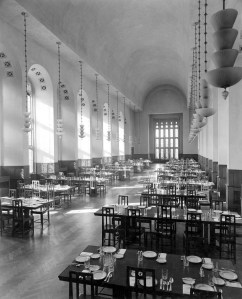
Take one of Cranbrook’s most iconic chairs – Eliel Saarinen Cranbrook School dining hall chair. Designed to withstand use by teenage boys, it combines durability with sophistication and has stood the test of time as they are still in use after 94 years. At the back of each chair is a bronze crane insert, a symbol that subtly gives identity to the community using the chair.
Cranbrook School Dining Hall, October 1936. Courtesy of Cranbrook Archives.
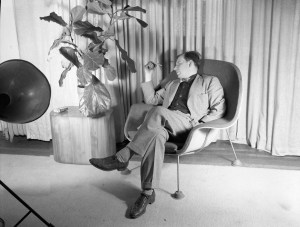
Interestingly, Eero’s later chair designs are all much inspired by nature—the Grasshopper chair, the Womb chair, and the Tulip Chair.
Eero Saarinen sitting in the prototype of his Womb Chair at his Vaughn Road home. 18 June 1947. Photographer: Harvey Croze. Courtesy of Cranbrook Archives.
Inspired by nature in a different way, Finnish architect and furniture designer Olav Hammarstrom has a variety of designs that are born of the possibilities to which natural materials lend themselves. Hammarstrom worked with Alvar Aalto and Eero Saarinen and Associates, working on projects such as the Baker House dormitory at MIT and the furnishings at the GM Tech Center. Married to Head of the Weaving Department Marianne Strengell, he designed their house in Wellfleet on Cape Cod, as well as houses for friends and colleagues, along with chairs to go in them.
Bamboo Experimental “Basketchair” by Olav Hammarstrom. 10 February 1956. Courtesy of Cranbrook Archives.
Furniture design was also the focus of another Academy affiliated designer, Pipsan Saarinen Swanson. Working in partnership with her husband, architect J. Robert F. Swanson, Pipsan typically designed the interiors while he designed the structure and exterior.
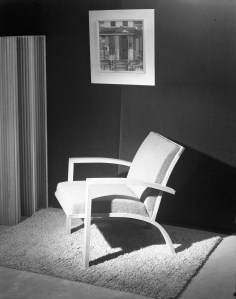
Chair designed by Pipsan Saarinen Swanson. December 8, 1945. Photographer: Harvey Croze. Courtesy of Cranbrook Archives.
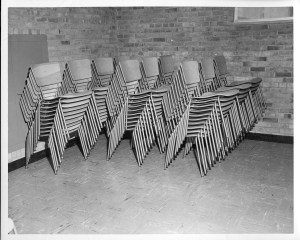
But Robert Swanson also designed furniture. Perhaps the most surprising thing I learned was that Swanson invented a ‘Stackable Chair,’ patented in 1957. A form we take for granted nowadays, these chairs can still be found in many buildings and classrooms on Cranbrook’s campus.
The “Stackable Chair” by J. Robert F. Swanson, 1957. Courtesy of Cranbrook Archives.
It was a great pleasure to share these archival stories with our guests and to explore Cranbrook’s part in the story of the chair. In the process I learned to see an everyday thing in a new light and how creativity can transform the ordinary into the extraordinary.
–Laura MacNewman, Associate Archivist, Cranbrook Center for Collections and Research
Summer school. Those two words usually make most children cringe—who wants to spend their summer vacation studying and attending classes? Sheer morbid curiosity made me explore further a few folders in Brookside School Records, a collection just opened for research last month. What I found was not the usual story.
The Brookside summer school program, AWAKE, had a different purpose than remedial education for elementary students. Developed in 1968 by Pontiac Elementary Principal Jim Hawkins and Brookside Headmaster John P. Denio, it was designed to promote harmony and understanding amongst young children who might not otherwise share life experiences due to racial, social, and economic segregation.
AWAKE followed on the heels of the “long hot summer” of 1967, which saw civil unrest in Detroit and cities across Michigan, including Pontiac, due to long-standing racial inequalities for Black Americans. Instituted in 1968, AWAKE’s purpose was to “bring together young children in essentially two segregated school areas,” in some ways foreshadowing the desegregation of Pontiac and Detroit schools in the early 1970s.
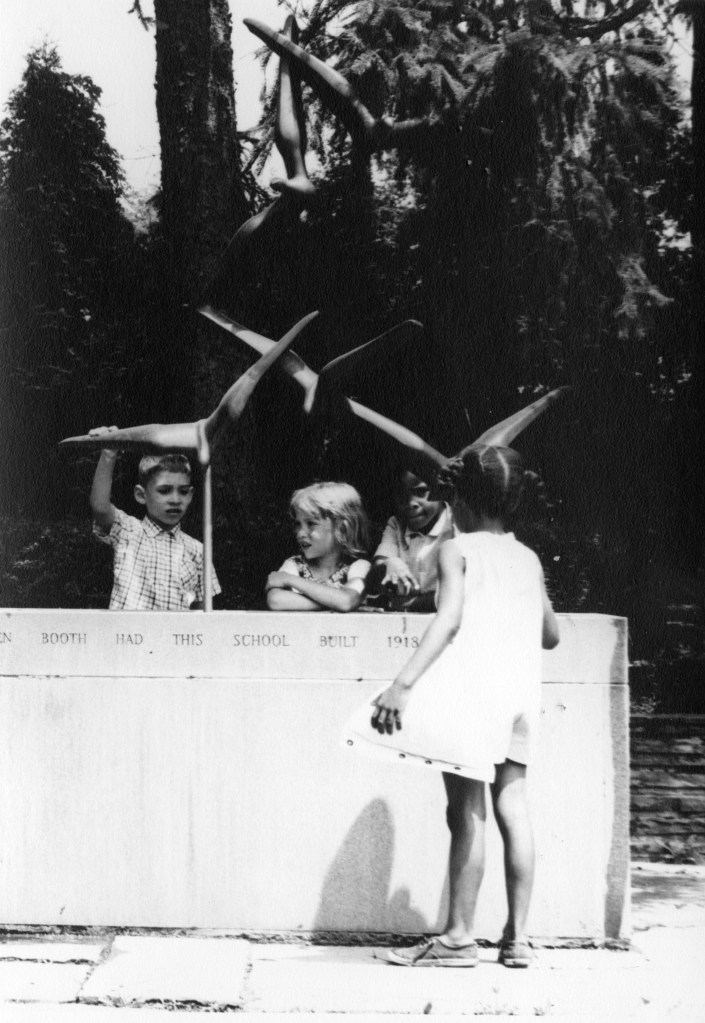
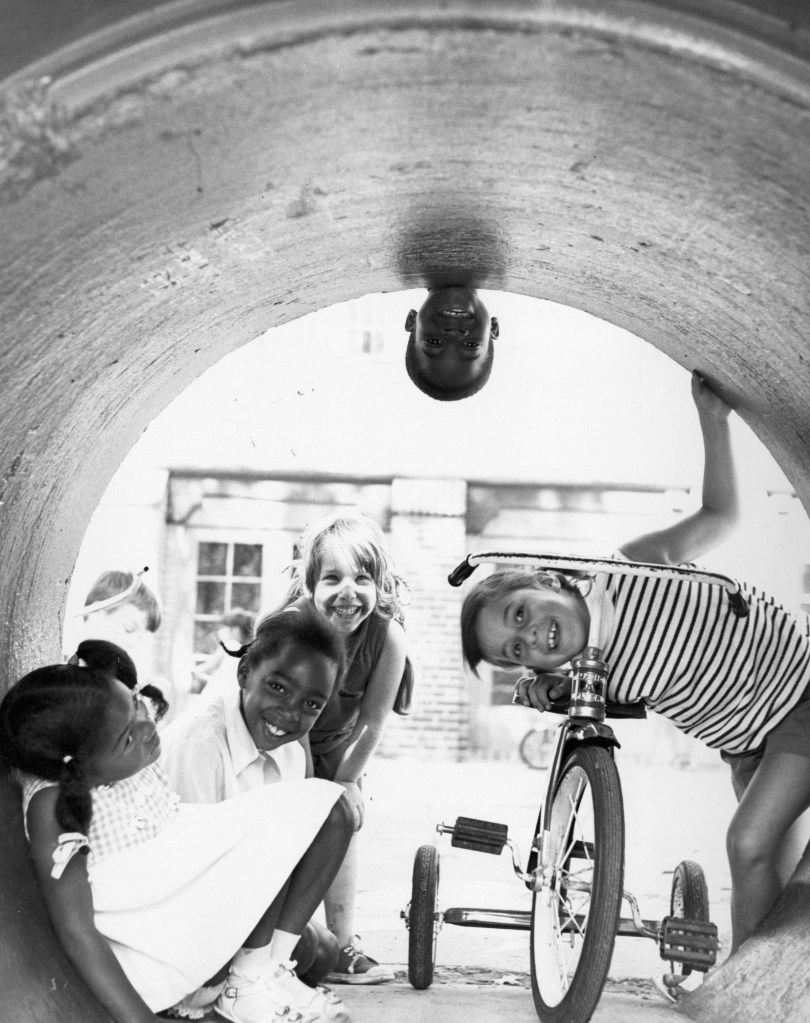
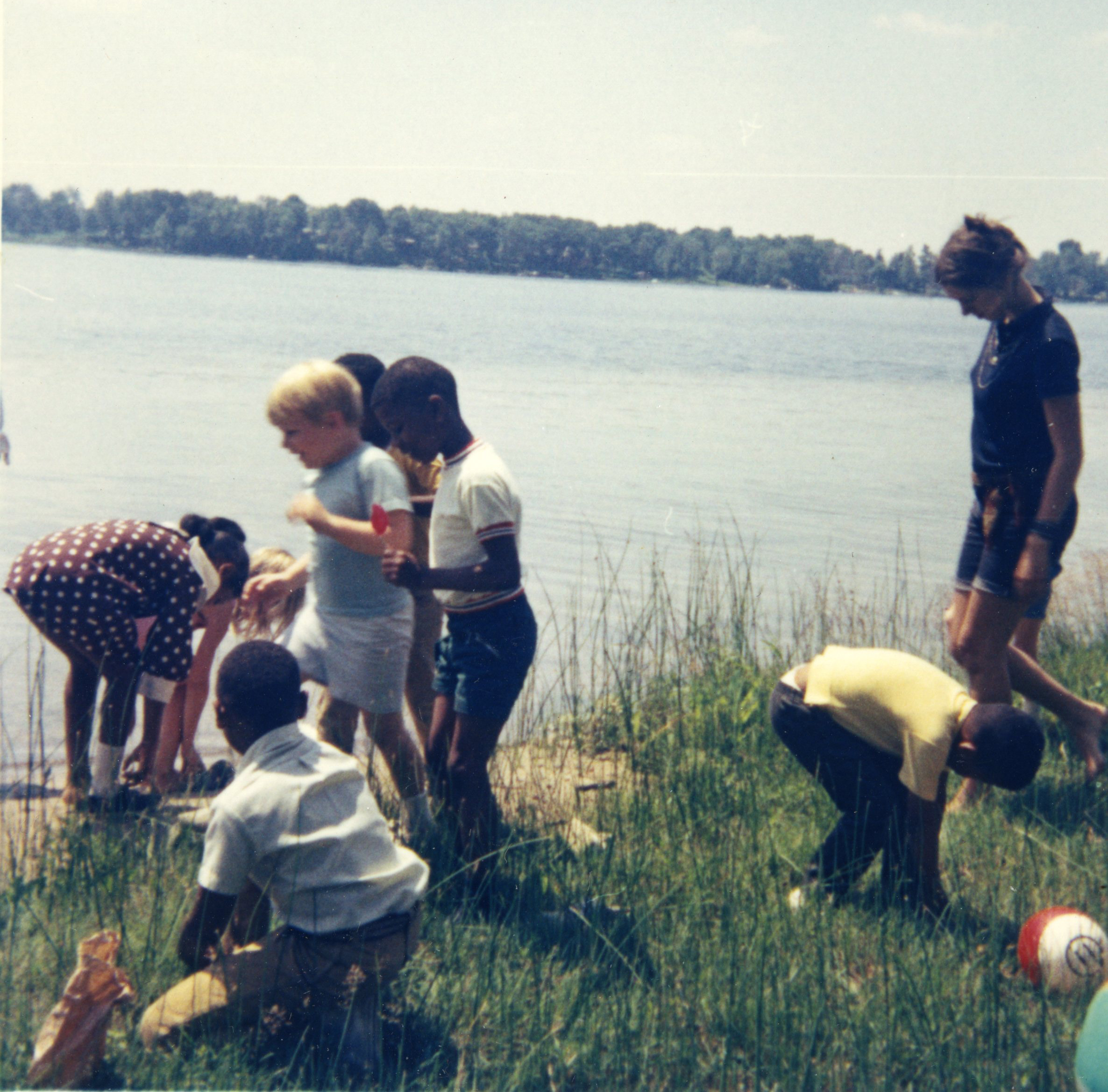
On the playgrounds of Brookside School and Bethune Elementary, circa 1968. Jack Kausch, photographer. Courtesy of Cranbrook Archives.
Roughly fifty children split their time equally between the Bloomfield Hills and Pontiac schools for five mornings a week, over a four-week period in July and August. Co-sponsored by Cranbrook’s Brookside School and Pontiac Public Schools’ Bethune and Whittier Elementary Schools, the program included art projects, field trips, swimming, reading, and other enrichment activities for kindergarten-age children in both communities. Directed at young children because of their natural receptiveness at that age, Denio believed that,
With AWAKE, children four through six, through work and play activities and through simple, open contact with each other may perhaps develop the knowledge and understanding necessary to reinforce their acceptance of each other as human beings.
Governed by a Board comprised of community members and Pontiac Public School administrators and teachers, the program was self-sustained through tuition fees (waived in cases of need), financial contributions, and community support. Christ Church Cranbrook, for example, played a significant role through both donations and parishioners’ participation in the program. Familiar Cranbrook names, such as Cranbrook School teacher and Horizons-Upward Bound founder, Ben Snyder, and his wife Margot were also regular advocates of the program.
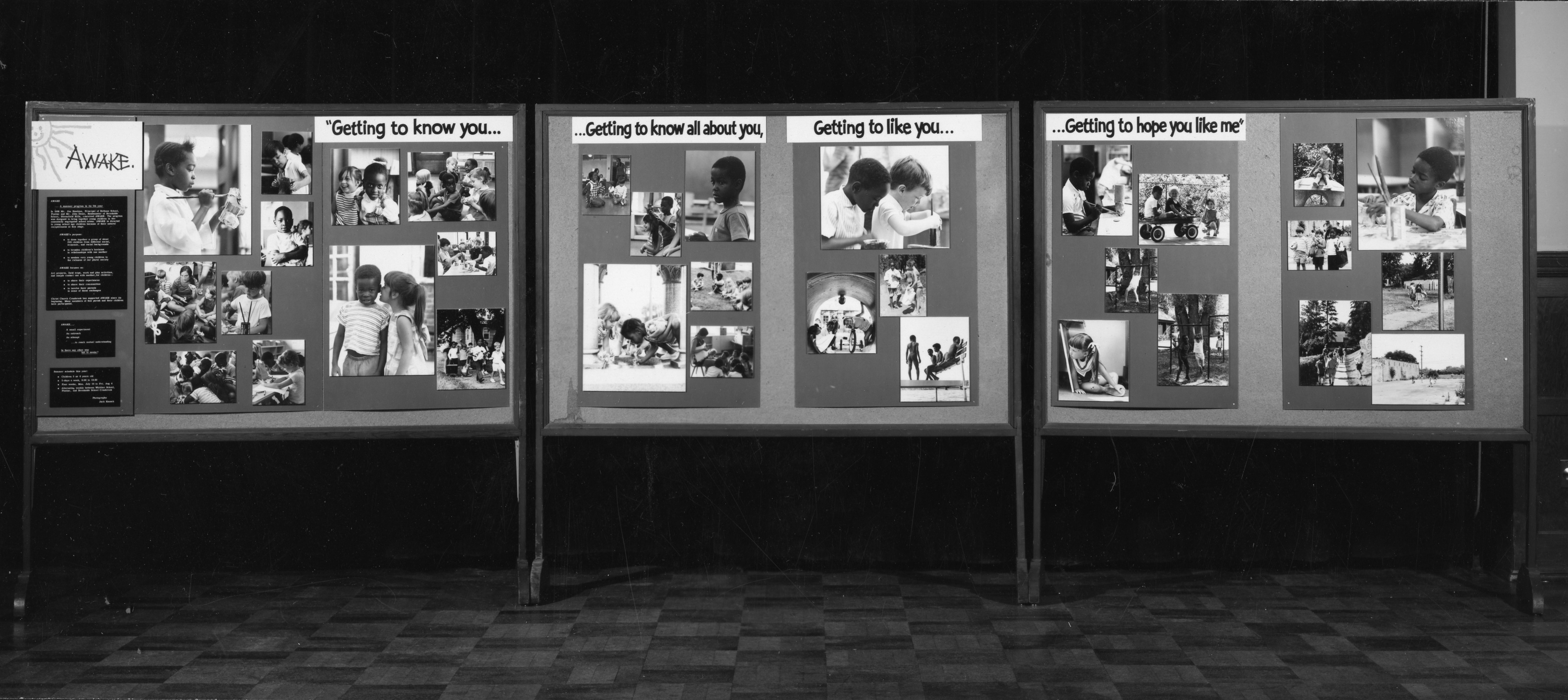
Borrowing lyrics from Rogers and Hammerstein and with photographs by Jack Kausch, poster displays sum up AWAKE’s ethos: “Getting to know you … Getting to know all about you … Getting to like you … Getting to hope you like me.” Courtesy of Cranbrook Archives.
A grass roots experiment in creative problem-solving of the urban crisis faced by cities across the country, AWAKE only lasted for five years (1968-1972). Because of its short duration, the effectiveness of the program was never fully appreciated, despite a 1969 study conducted by a University of Michigan Ph.D. student in education and social sciences and regular solicitation of teacher and parent feedback. Ultimately, rising costs and a lack of grant money; shortages of staff; and dwindling enrollment, undoubtedly due in part to the integration of Pontiac schools and the unsettling atmosphere of anti-busing protests, prohibited the continuation of the program.
—Deborah Rice, Head Archivist, Cranbrook Center for Collections and Research
In the summer of 1961, Dr. Robert Hatt, Director of Cranbrook Institute of Science (CIS) from 1935 to 1967, took a field trip to Africa to study small mammals in South Rhodesia (now Zimbabwe). Using his travel journals, photographs, and his published articles, we can follow his field work, analysis, and conclusions quite closely.
On his trip he kept one scientific journal and one for general observations from region to region, which provides a rich source for social, political, geographical, and anthropological insights into the region’s society.
Dr. Hatt and his wife, Sue, set off for Africa on July 1, 1961, traveling from New York to Dakar then through Ghana, Nigeria, and the Congo, arriving at the Atlantica Ecological Research Station (AERS) in Salisbury, (now Harare, Zimbabwe) on July 21st.
Dr. Robert Hatt and his wife, Suzannah at the Atlantica Ecological Research Station in South Rhodesia, now Zimbabwe. August 1961. Courtesy of Cranbrook Archives.
Upon arriving at Salisbury airport, they were met by Rudyerd and Louise Boulton. Rudyerd, an American ornithologist and the Director of AERS, had invited Hatt to undertake the study with financial support from the New York Zoological Society. Hatt began his field study journal at this point, writing,
“The house is charming, stone walled, 1 storey, good garden beyond. The lab building attached still under construction but RB had my desk set up and equipped—a dozen volumes on mammals in a book shelf, ready to work. RB & I went out with my collector, Kenny, and made an incomplete circuit of the property, setting 15 Sherman traps out near stream.”
Journal #44, Africa. Robert T. Hatt Papers (1999-14)
Atlantica Ecological Research Station, South Rhodesia (now Zimbabwe). July 1961. Courtesy of Cranbrook Archives.
It is fascinating to see his research data in its raw form, which can be compared with his account in the CIS newsletter and a more formal and scientifically dense report in a published journal, later reproduced in Zoologica.
Hatt studied the small mammal population of Zimbabwe from July 21 until the beginning of September, similar to the research he conducted in Michigan and other regions (his doctoral dissertation was on a type of red squirrel). In Zimbabwe, he contributed to an understanding of the local fauna, which presents a nuisance to agriculture and animal husbandry.
With assistance from his wife, he captured mice, rats, shrews, and elephant shrews which were measured, weighed, and marked in the ears with a serial number to recognize them if recaptured. In the first three weeks of field work, they had marked and released over 150 animals with 65 recaptures, some recaptured 3 or 4 times.
Journal #44, Africa. Robert T. Hatt Papers (1999-14). Courtesy of Cranbrook Archives
Hatt variously notes these small mammals as generally uncooperative with the study, and remarks,
“This matter of ear marking is not to the animal’s liking and despite my use of rubber gloves and plastic handling boxes, rare is the morning in which I am not given some identifying perforation of my own by their sharp teeth.”
Cranbrook Institute of Science Newsletter, Vol. 31, No. 2, October 1961, p.13
Dr. Robert T. Hatt and his assistant, Kenny, handling mice. August 1961. Courtesy of Cranbrook Archives.
Hatt describes the landscape of the 150-acre Station as a combination of grassland and Brachystegia woodland, noting the prevalence of “picturesque kopjes” which provided good lookout sites and defensive structures for Bushmen and Bantu prior to the British colonial settlement of Salisbury in 1890. Most interesting are the “Bushmen paintings” that evidence early occupation of the area. One location, Somerby Farm, is recorded both photographically and in his manuscripts. This group of paintings indicates the presence of elephants, hippopotamus, buffalo, hartebeest, kudu, and reedbuck.
Somerby Farm Cave Paintings, South Rhodesia (now Zimbabwe). August 1961. Courtesy of Cranbrook Archives
The Hatts left Salisbury on September 4th, heading first to Arusha, Tanzania; then to Nairobi, Kenya; Uganda; Khartoum, Sudan; and finally to London.
Hatt’s small journal includes his observations along the way and his comments include the cockroaches in their first hotel bathroom, types of trees, cocoa tree disease, termites, religious missions, types of goats, museums, meetings, markets (and what was for sale in them), local people, anthropological marks of beauty, and signs on shops and wagons. The latter include “Aim High,” “Do Good,” “Still it makes me laugh,” “Give all to God,” and “Forget me Not.”
One comment on his journey from the Ivory Coast to Accra made me smile, as I could relate to the experience of plane food:
“Our plane, DC-3, was “First Class” and we were obliged to pay $50 extra for upgrading our ticket (Nigerian Airways). All we got for it was one whiskey and a sandwich which I wouldn’t eat.”
Journal #43, Africa. Robert T. Hatt Papers (1999-14)
Kiva Volcano and Travelers’ Rest in Kisora, Uganda. September 1961. Courtesy of Cranbrook Archives
Often archives hold information on individuals, institutions, and society that were not the original purpose of the document, and this is true with Hatt’s Papers. His field journals yield rich information not only on his process of data collection and analysis, but they also provide a lot of description of human geography and regions that he visited, as well as biographical insights into Hatt himself. The CIS collections are a wonderful resource for many avenues of study, and we would welcome researchers to come and explore these wonderful and valuable resources.
—Laura MacNewman, Associate Archivist, Cranbrook Center for Collections and Research
Editor’s Note: This Sunday, join the Center for a fascinating discussion with Elizabeth Rauh, Assistant Professor, Modern Art and Visual Cultures, American University in Cairo for her talk, “Iraq en Route: A Photographic Journey, 1952-1953.” Rauh has conducted a year-long study into the photographs Dr. Hatt took on his 1952 trip to Iraq, and her presentation will weave together Hatt’s images with the history of both ancient and mid-twentieth century Iraq.
References
Hatt, Robert Torrens. The Mammals of the Atlantica Ecological Research Station, Southern Rhodesia, reprinted in Zoologica, Scientific Contributions of the New York Zoological Society, vol.48, issue 2, Summer 1963
Hatt, Robert Torrens. ‘Hunting Africa’s Smallest Game,’ Cranbrook Institute of Science Newsletter, Vol. 31, No. 2, pp.10-14




















 Cranbrook Kitchen Sink