The Grand Old Man of the Overmantel

On a visit to Cranbrook House, Johannes Kirchmayer’s overmantel is one of the first things to catch your attention. Tours and blog posts have examined this chef d’œuvre and its iconography, and admirers tracing the quotation popping out from the carved eglantine find it a typical George Booth choice: art, nature, his love for both. The inscription reads: 

“Nature I loved and next to nature art”

Cranbrook is the Booths’ creation, brimming with art and nature and George Booth quotes, but who wrote this line, and how did it end up in such a prominent spot? 

Johannes Kirchmayer’s overmantel at Cranbrook House, 1918. The Walter Savage Landor quote is called out in gold leaf at the top of the overmantel. Photograph by PD Rearick, CAA ’10. Cranbrook Center for Collections and Research.

It comes from the pen of Walter Savage Landor.

Born into minor aristocratic wealth in Warwick, England, in 1775, Landor was a wild child, quite possibly because he was sent away to school at 4 ½ years old and was a wonderment to his parents who didn’t know what to do with a child who wrote Latin as well as he wrote English and showed remarkable talent for not obeying rules of any kind.
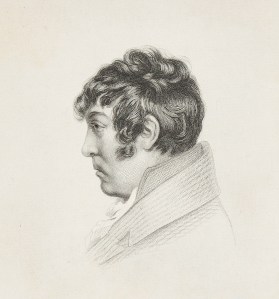
Walter Savage Landor in profile, from Walter Savage Landor: A Biography by John Forster, 1869. Courtesy Heritage Auctions.

Landor enjoyed such violent fights over political opinion that his parents banned him from the dinner table when guests were present. No school could hang onto him. Even Trinity College, Oxford had enough of his rebelliousness, his anti-government stance, his French Revolution republican garb. Landor fought back by writing nasty aphoristic poems about his critics in Latin and English, a practice he continued throughout his life. He was particularly vicious in Latin, partly because in England libel laws did not extend to texts in Latin. He was very clever and iconoclastic, favoring social reform and liberal nationalism. He felt himself superior to others and hated competition just in case it might prove him wrong. Hence his epigram, if not epitaph, written on his 74th birthday in 1849:

FINIS

I strove with none, for none was worth my strife:

Nature I loved, and, next to Nature, Art:

I warmed both hands before the fire of life;

It sinks; and I am ready to depart.

He may have been ready to depart, but it would be another fifteen years before he got around to it.

Much earlier, in 1805, Landor inherited a huge amount of money from his father and determined to set up an estate in Wales, restore an abandoned priory on the property, build a large mansion, and reform the peasantry. Impetuous as ever, he flew off to Spain in 1808 to fight in the Peninsular War against Napoleon’s generals, raising his own regiment. Unfortunately, Landor couldn’t stop himself from quarreling with hosts, commanding officers, and his own troops whereupon he fled back to Wales to find building materials for his hoped-for mansion had trickled away much as had his regiment.
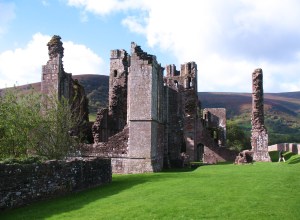
Ruins of Llanthony Priory. Photograph copyright Gordon Hatton, reused by CC BY-SA 2.0.

Here we enter into the realm of coincidence. Landor, an Englishman, building in Wales, found upon his return from Spain that the locals had run off with a lot of his bricks. In an 1809 letter to the local bishop, Landor cursed the Welsh in his inimitable manner insisting that they would demolish the tomb of famed poet Taliesin if they could get away with it. For those readers who are architecture buffs, the name Taliesin can only conjure up one image, not that of the 5th or 6th century Welsh bard, but that of Welsh-connected Frank Lloyd Wright who thus named his east and west architectural compounds, citing the translation as “shining brow.”

But, back to Landor. Once restored to the throne, the king of Spain sent Landor a flock of sheep in recognition for his services. When the sheep arrived at the English docks, they were assumed to be a gift for the king (George III), and try as he might, Landor could not get them back, and one couldn’t sue the king. He had to wait until George IV died before publishing his opinion, one of his most famous attacks:

George the First was always reckoned

Vile, but viler George the Second.

And what mortal ever heard

A good word of George the Third,

But when from earth the Fourth descended

God be praised the Georges ended.

Alas, even though Landor was able to persuade a lovely young woman, 16 years his junior, to marry him in 1811, all was not well. Quarrelsome as always and with no business sense, Landor fled again from Wales to Fiesole outside Florence in Italy where he fared slightly better. In spite of money troubles and a wife who loved to taunt him about his age, this was the period of his great creativity, writing the totally invented Imaginary Conversations between two famous historical people. Poets such as Byron and Robert Southey loved his work, Byron even doing Landor the honor of stealing the Greek name chosen for a young Landor love to apply to the principal lady in his Child Harold. Readers struggled through these long obscure works (or didn’t) and praised a beautifully succinct passage or two, and those are the excerpts along with his crusty aphorisms that made him famous.
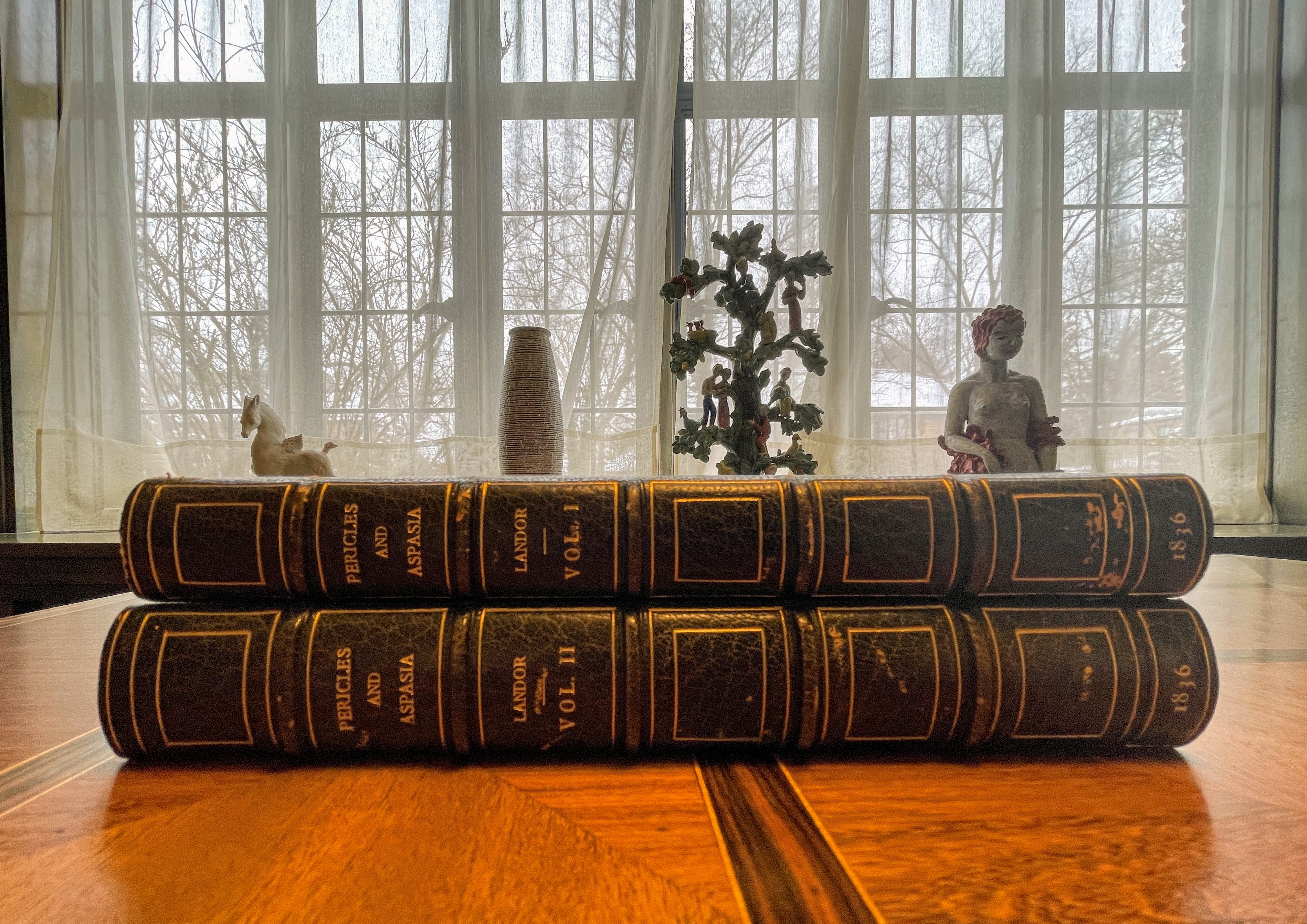
Walter Savage Landor’s two volume Pericles and Aspasia at Saarinen House, a gift from George G. Booth to Eliel Saarinen. Cranbrook Center for Collections and Research.

And here is the second coincidence. The inscription in Cranbrook House inspired this blog on Landor, who deserved some recognition. Yet it was while idling in Saarinen House waiting for a COVID-safe tour for Cranbrook students that I found myself looking at the beauty spots of the house. My eye fell on the table in the book room. Upon it lay a couple of tastefully placed little books from the Saarinen collection. I peered at the spine and saw in gold capitals the name LANDOR. They were volumes one and two of his Conversation Pericles and Aspasia, his best-known conversation, first published 1836. The flyleaf revealed the occasion for a gift to Saarinen upon his 60th birthday in 1933, wishing him a happy life, signed G. G. Booth.
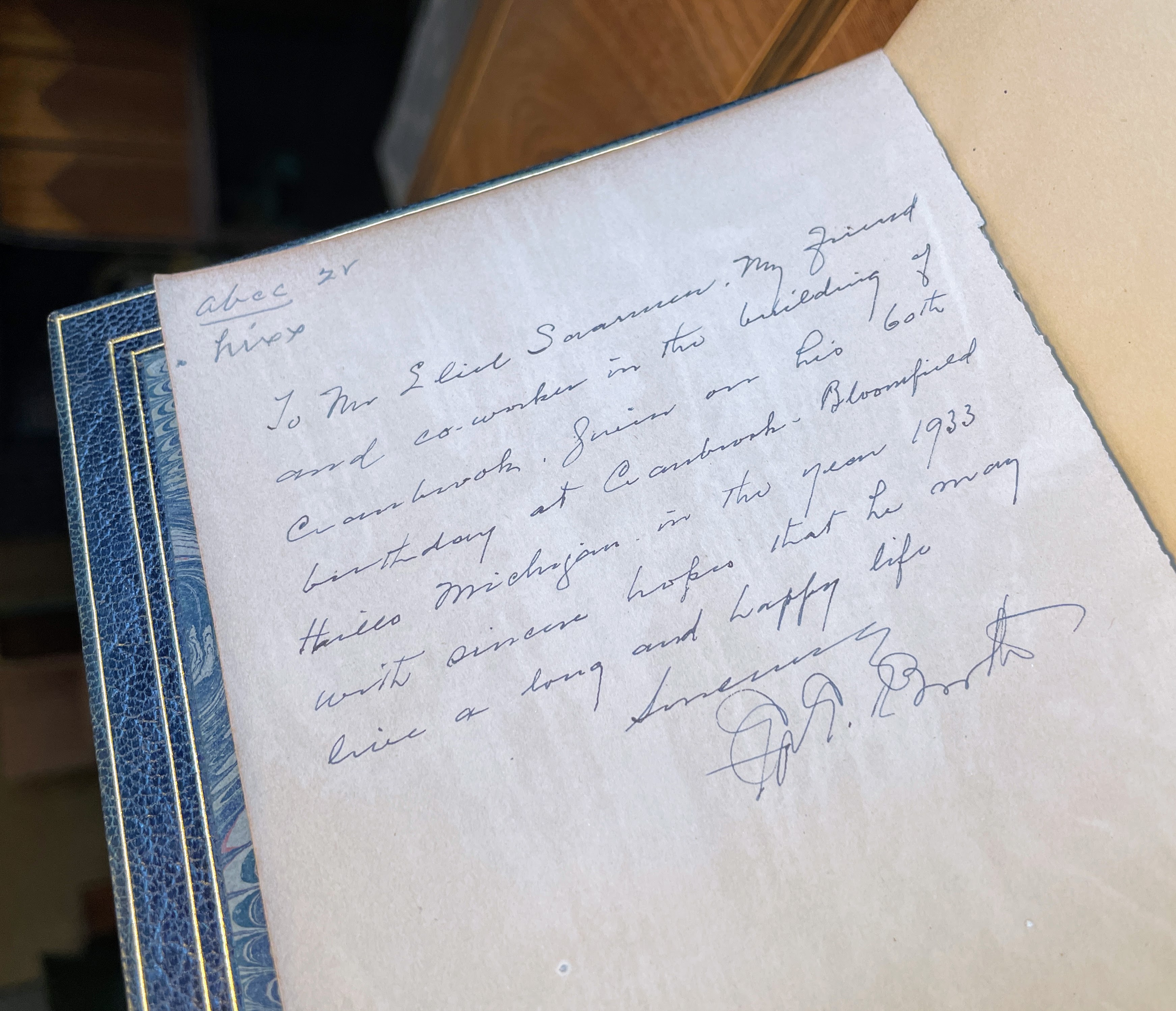
Inscribed flyleaf of Pericles and Aspasia from Booth to Saarinen on the latter’s 60th birthday, August 20, 1933. Cranbrook Center for Collections and Research.

Pericles was the great Athenian general of the 5th century BCE Peloponnesian wars, and Aspasia his female companion. Their conversation by Landor is a series of letters between the lovers and their immediate companions with walk-on roles for Aeschylus, Pindar, Socrates, and Alcibiades.
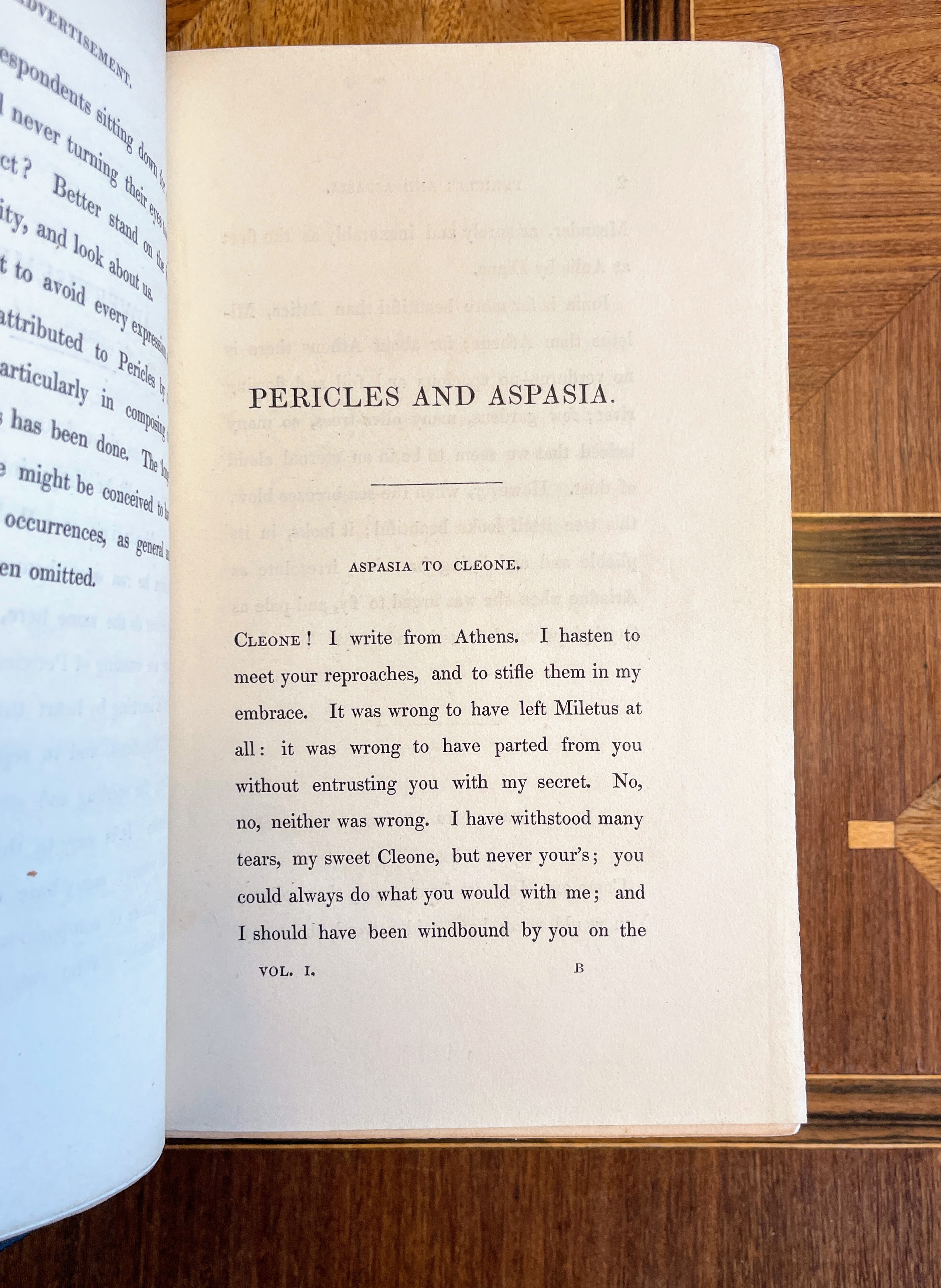
First page of Landor’s Pericles and Aspasia. Cranbrook Center for Collections and Research.

The language is high-flown and not all that accessible; no wonder Landor is hardly known today.

He continued to quarrel with everyone, finally getting thrown out of his own house in 1835 at age 60 by wife, daughter and one son, and fled Italy after scurrilous Latin verses excited the authorities. Back in England, as irascible as ever, Landor continued to write conversations and poems and found himself the grand old man of letters as his fame grew. Carlyle, Tennyson, Browning, Trollope, and Dickens (Landor appears in Bleak House as Lawrence Boythorn) were admiring dinner companions when Landor wasn’t in too bad a temper.
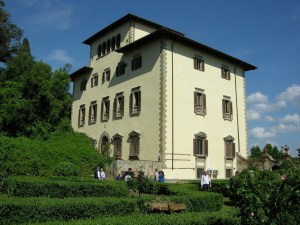
Villa La Torraccia, or Villa Landor, in Fiesole, Italy. Photograph by Sailko, reused by CC BY 3.0.

His last six years were spent back in Italy. He died, escaping as usual, in a hotel in Florence in 1864. The villa was later bought by explorer Willard Fiske and renamed Villa Landor. The villa, altered over the years, is now the Fiesole School of Music, echoing no doubt to the rages and laughter of its most prominent owner. Llanthony Priory continued to decay until protected by the Welsh government cultural group, Cadw.

Even though Landor’s life can hardly have met his approval, it is not surprising, perhaps, that George Booth found a quote from the grand old man of the previous century to adorn his own masterpiece, though one might find the use of the word “strife” ambiguous. Just as well Booth chose only the line that suited his purpose: “Nature I loved, and, next to Nature, Art.” The grand old man has come to rest.

–Lynette Mayman, Collections Interpreter
Le Corbusier Comes to Cranbrook

On November 21, 1935, celebrated French architect Le Corbusier arrived in Detroit and promptly demanded to be taken to Henry Ford’s River Rouge Complex. That one of the world’s leading modernist architects wanted to visit Ford’s factory shouldn’t have been too surprising, as for the previous two decades Le Corbusier—born Charles-Édouard Jeanneret—had been advocating for a revolution in architecture like Ford’s revolution in transportation.

In his groundbreaking 1923 book, Toward an Architecture (or, as it was titled in its first English translations, Towards a New Architecture,) Le Corbusier made the famous claim, “A house is a machine for living in.” As he believed, “Machines will lead to a new order both of work and of leisure.”

Le Corbusier told reporter Florence Davies of the Detroit News that “Detroit is the logical city for the production of the houses of tomorrow, the pre-fabricated efficient mass-production house.” He went on to claim that it would be automobile manufacturers, not architects, who would “undertake the production of the homes of tomorrow” because they understood the problems of mass production.
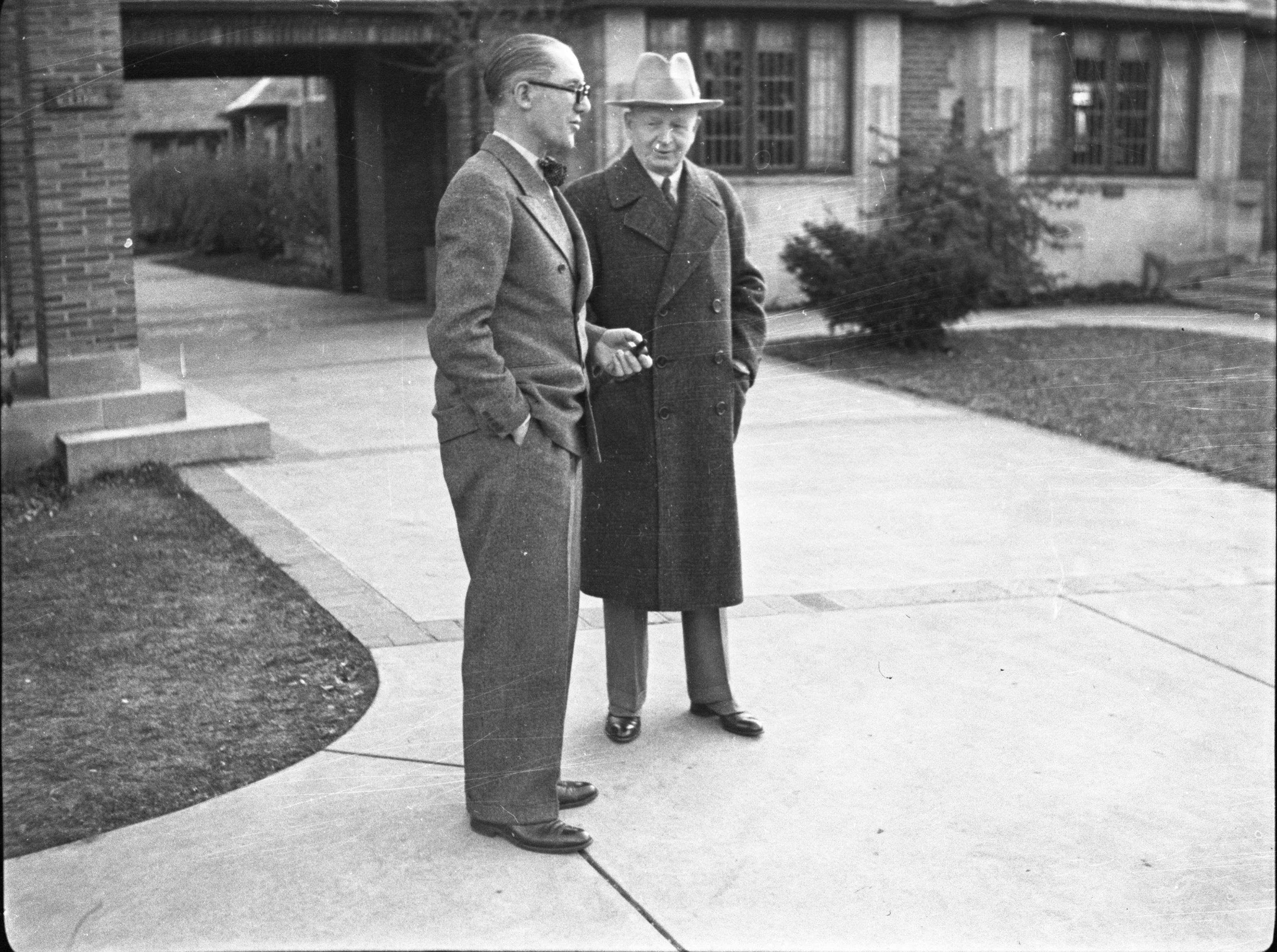
But while Ford may have attracted Le Corbusier to visit Detroit during the his one and only trip to America, it was Cranbrook Academy of Art and its president Eliel Saarinen that played host to the great architect.

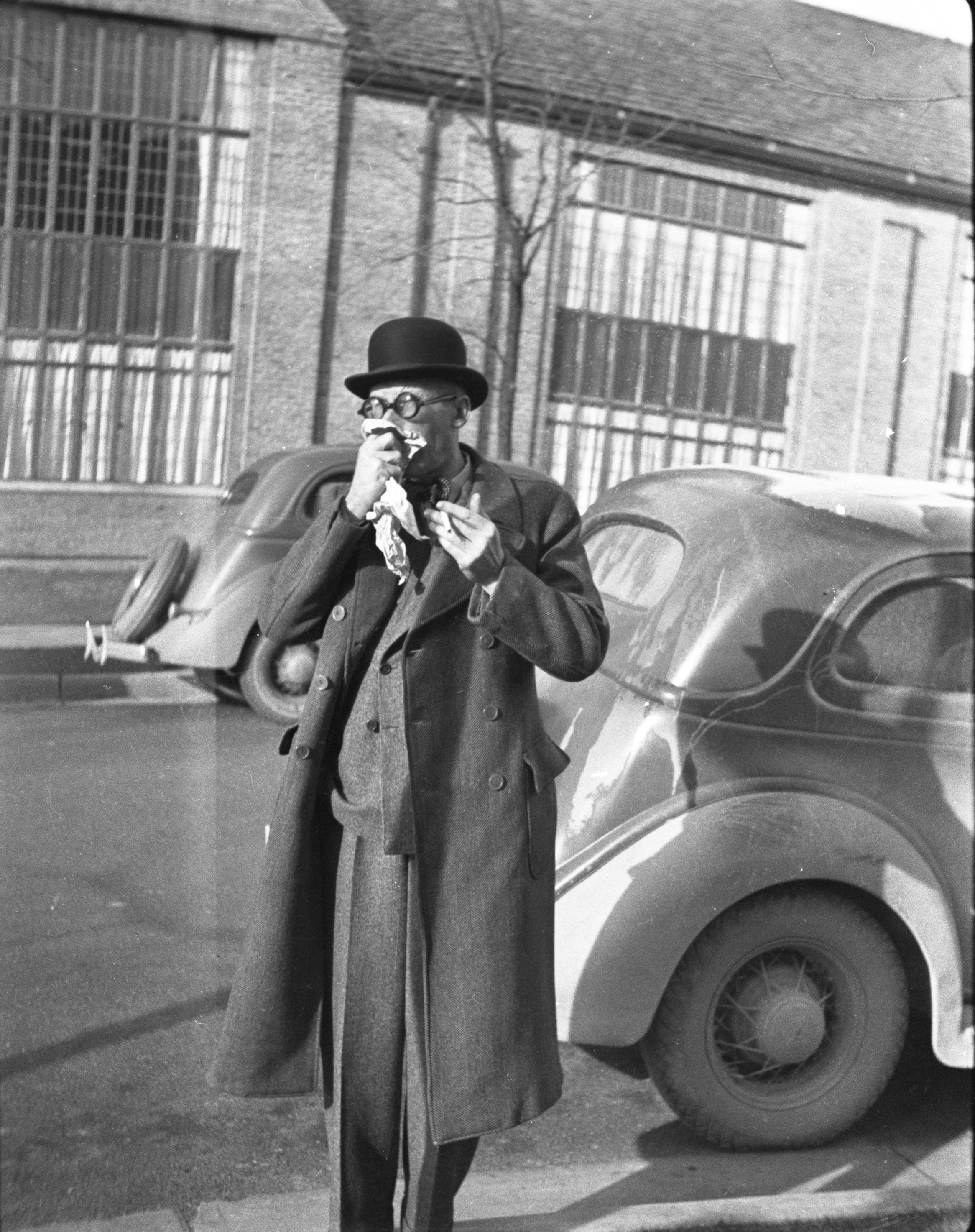
Le Corbusier, with pipe, and Eliel Saarinen at Cranbrook, November 1935. Richard G. Askew, photographer. Cranbrook Archives.
After seeing the Ford complex and a making a few stops downtown, Le Corbusier wound his way up to Bloomfield Hills. On display in the Cranbrook Pavilion (now St. Dunstan’s Theater) were twenty-four enlarged photographs, a selection of movies, fourteen building and city plans, and a single model documenting his work. These items were part of a small show on the architect open from November 19 to November 22. But the main event was Le Corbusier’s lecture at 8:00pm on November 21, 1935.

Delivered in French and translated by his American associate Robert Jacobs, Le Corbusier enthralled an at-capacity audience with his theories of architecture. He spoke of his work in Europe, including the recently completed Villa Savoye in Poissy. The focus, however, were his theories of city planning and mechanization. Le Corbusier used a sheet of tracing paper some 8- to 12-feet-long and pinned along the wall to execute large, colorful pastel sketches that illustrated his ideas of architecture and planning. This drawing was saved by the Academy, though it has since, sadly, been lost.

Installation view of Modern Architecture:
International Exhibition
at the Museum of Modern Art with Le Corbusier’s Villa Savoye at center and in photographs on left, February 9–March 23, 1932. While no photographs of Le Corbusier’s lecture or exhibition at Cranbrook survive, it was likely similar to this installation. MoMA Archives.

Le Corbusier lectured throughout most of his career as an architect. As he told an interviewer in 1951:

I never prepare my lectures…Improvisation is a wonderful thing: I draw, and when you draw and speak at the same time, you create something new. And all my theory—my introspection and retrospection on the phenomenon of architecture and urbanism—derives from my improvisation and drawings during these lectures.

After the Cranbrook lecture, Le Corbusier was the guest of the Academy of Art’s Executive Secretary Richard Raseman and Instructor in Interior Design Rachel DeWolfe Raseman. The couple had both studied architecture at Cornell (Rachel Raseman was Cornell’s first woman architecture graduate) and resided at Academy Residence #3 across Academy Way from Saarinen House. In the morning, Le Corbusier continued by train to the next stop on his cross-country journey.

As the Detroit Free Press reported November 22, “With a few deft strokes Thursday, Le Corbusier, the famous French modernist-architect…sketched the vision that he sees through what is perhaps the most ponderous pair of eyeglasses ever fabricated.”

Le Corbusier in his famous eyeglasses at Cranbrook, November 1935. Richard G. Askew, photographer. Cranbrook Archives.

Alongside an earlier lecture in April 1935 by Frank Lloyd Wright, the visit to Cranbrook by Le Corbusier was one of the highlights of the Academy’s first decade. Reflecting in his Annual Report to the Cranbrook Foundation, Richard Raseman wrote that:

The Le Corbusier lecture, although delivered in French, was a good show, and as he is a world figure we were well satisfied…the public must have agreed with us as these lectures [by Wright and Le Corbusier] were by far the best attended of any of our functions…men of this caliber are rare indeed.

To learn more about Le Corbusier and his visit to Cranbrook, sign up for the Center’s History of American Architecture: Cranbrook Visitors Lecture Series! For the next five weeks, I will be discussing visitors, like Le Corbusier, who have lectured at Cranbrook since the Academy opened in 1932. From Le Corbusier, Wright, and Alvar Aalto in the 1930s through to Jeanne Gang, Greg Pasquarelli, and David Adjaye in the 2010s, I will tell the story of American design through architects who’ve spoken at Cranbrook. Learn more and sign up on our website. “See” you Monday at 11:00am or 7:00pm EST for our first virtual lecture!

Kevin Adkisson, Associate Curator, Cranbrook Center for Collections and Research

The Heartbeat of the Nation

In August 1989, Cranbrook became a National Historic Landmark. America’s highest designation for a place of outstanding historical significance, it was no small feat for Cranbrook to become Michigan’s twenty-second National Historic Landmark (there are only forty-two today). So, what exactly is a National Historic Landmark, and how did we become one?

National Register of Historic Places plaque on the Kingswood Campus. Photographs by Kevin Adkisson, Cranbrook Center for Collections and Research.

Statutory provision for historic preservation began in America in 1906 with the Antiquities Act, which was further developed by the Historic Sites Act of 1935. Administered by the Department of the Interior, this Act was enacted to document and protect sites of national significance. In 1960, the National Park Service began administering the survey data from the Historic Sites Act, and the National Historic Landmark designation was introduced.

The National Historic Preservation Act of 1966 expanded the 1935 Act to local and state sites. This created the National Register of Historic Places, which began to identify, evaluate, and protect America’s historic resources. Many thousands of buildings have since been added to the National Register. In June of 1972, Cranbrook’s application was prepared by an Assistant Historian at the Michigan Department of State in Lansing, and the nomination was based on Cranbrook’s significance as a complete district of educational and architectural structures.

National Register of Historic Places plaque at Brookside.

To be eligible for designation on the National Register (a step below the National Historic Landmark status), the nominated site must have in its architecture, archeology, engineering, or culture integrity of location, design, setting, materials, workmanship, feeling, and association.

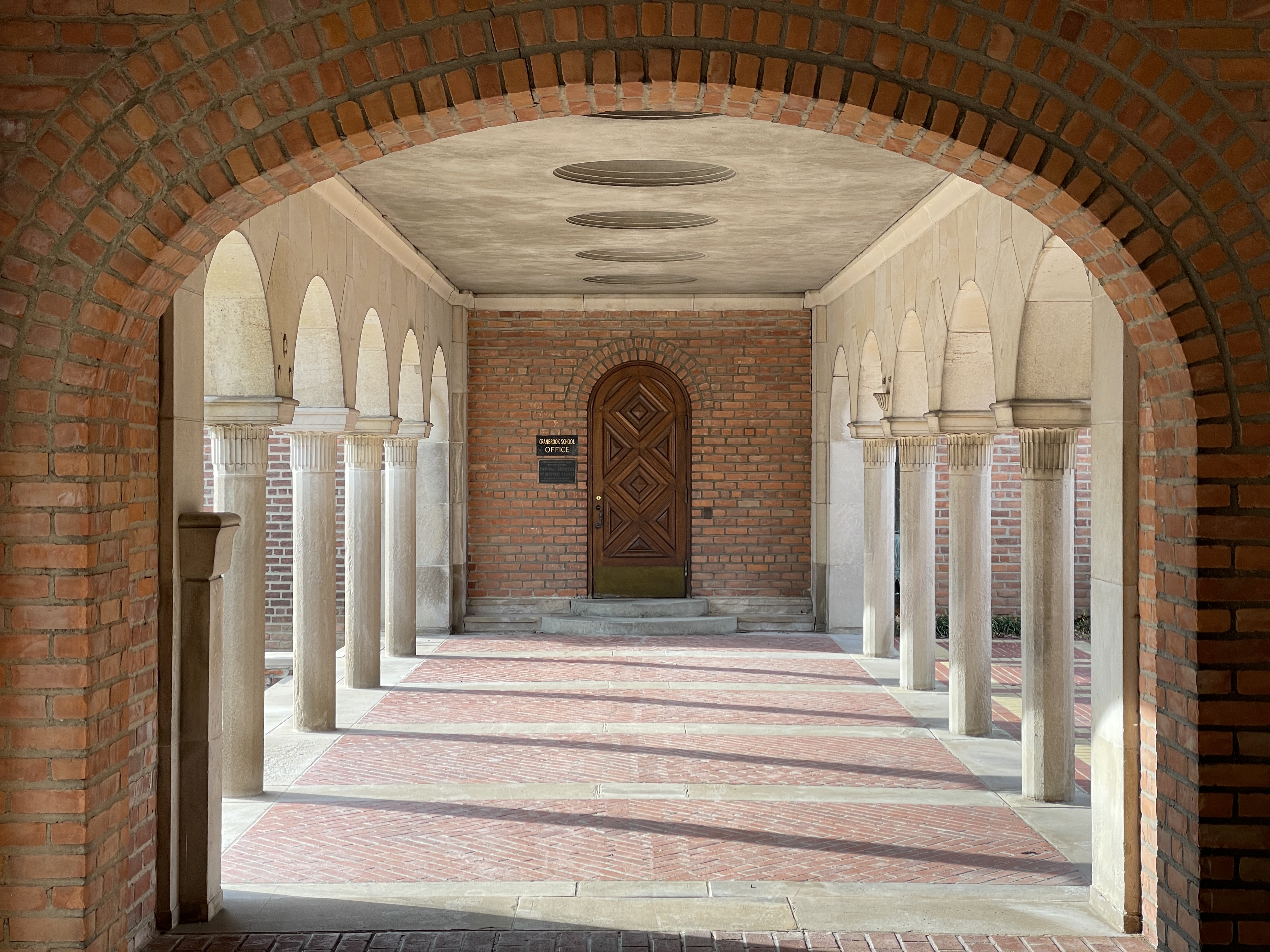
National Register of Historic Places plaque at Cranbrook School.

In addition, sites on the National Register must meet one of four criteria: be associated with events in the lives of significant persons; embody distinctive characteristics of a type, period, or method of construction; represent work of a master and high artistic values; or have or be likely to yield information important to prehistory or history. Once these criteria are evaluated and met, the site may be listed.

National Register of Historic Places plaque at Cranbrook Institute of Science.

Cranbrook was added to the National Register in March 1973, and it was at this point seven National Historic Landmark signs were ordered to be placed at each of the original Cranbrook Institutions and on Cranbrook House. (Christ Church Cranbrook was included in the designation, even though it would formally split off as a separate entity later in 1973 with the formation of Cranbrook Educational Community.) In writing to inform us of the designation, Samuel Milstein at the Department of Natural Resources eloquently wrote that:

“The State of Michigan is very proud of the fact that the property is qualified for this designation. The National Register records the story of the Nation, and is a list of distinction identifying those properties by which present and future generations can sense the heartbeat of the United States.”

Letter from Samuel A. Milstein to Cranbrook Institutions, March 30, 1973. National Register for Historic Places Records.
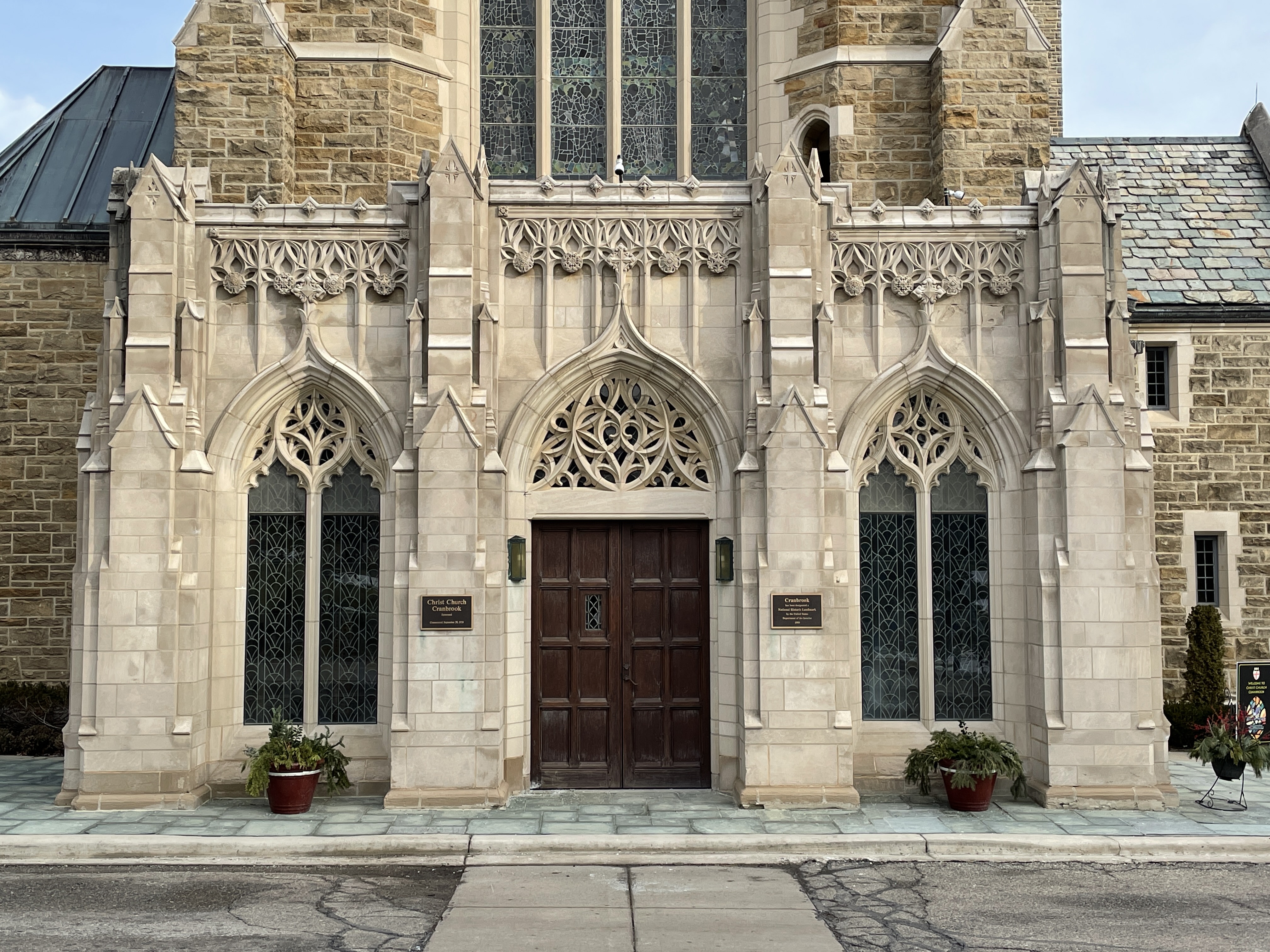
Non-official National Historic Landmark plaque at Christ Church Cranbrook, on right. The official plaque was changed at some point.

This language echoes that of George Booth in speaking to Cranbrook School in 1928, in which he emphasizes the importance of finding the treasure at your feet, the building up of an ethos of service from the local to the national to the global:

“If we feel our first loyalty to our State and are determined in every way we can to enrich it; if we never fail to see that we must give; if we are resolved to strive only for that which is worth while, then will our State have a place in the Nation, of which we will all be proud. The stronger and more glorious each of the States may be, the stronger and more glorious the Nation; and hence, the better and finer our opportunity for service to the world.”

Address by George Booth given on “Founders’ Day” at Cranbrook School for Boys, October 26, 1928. Cranbrook Archives.

But of course, our story doesn’t end with the National Register. In June 1987, the Chief Historian of the National Park Service (NPS) wrote to Cranbrook’s president, Dr. Lillian Bauder, to inform her that they were studying the property to determine its potential as a National Historic Landmark. Only 3% of sites on the National Register of Historic Places receive the higher honor of becoming National Historic Landmarks.

National Register of Historic Places plaque at Cranbrook Academy of Art.

The designation process follows three steps: study, including a visit to the property; review by the NPS Advisory Board; and a decision of designation by the Secretary of the Interior. The study was completed in February 1989 and the Advisory Board made its recommendation to Secretary Manuel Lujan in May. Cranbrook was designated a National Historic Landmark in August 1989.

The Cranbrook House sign was swapped from a National Register of Historic Places sign to a National Historic Landmark sign, encompassing all of the Cranbrook district.

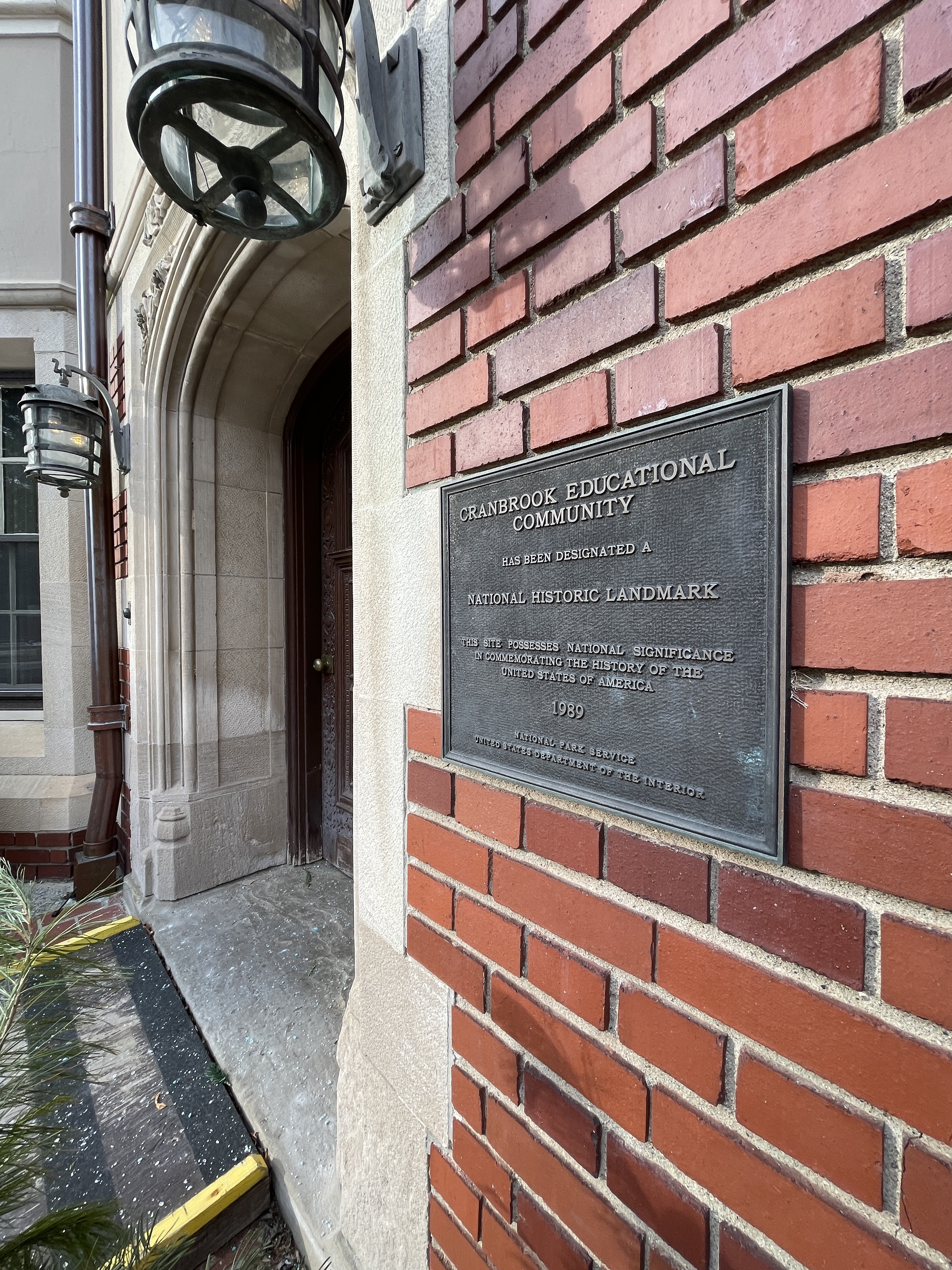
National Historic Landmark plaque for the entire Cranbrook Educational Community next to the front door of Cranbrook House.

The work of the Center for Collections and Research is embedded in the obligations of historic preservation in caring for and maintaining the community’s history, but also in articulating its meaning and value. Our mission nicely parallels the goals of the National Historic Landmark program. Even without such recognition, all who visit Cranbrook know it is a special place—but sometimes it is nice to have a plaque say so, too.

Laura MacNewman, Associate Archivist, Cranbrook Center for Collections and Research

Photo Friday: Cranbrook House, 1909

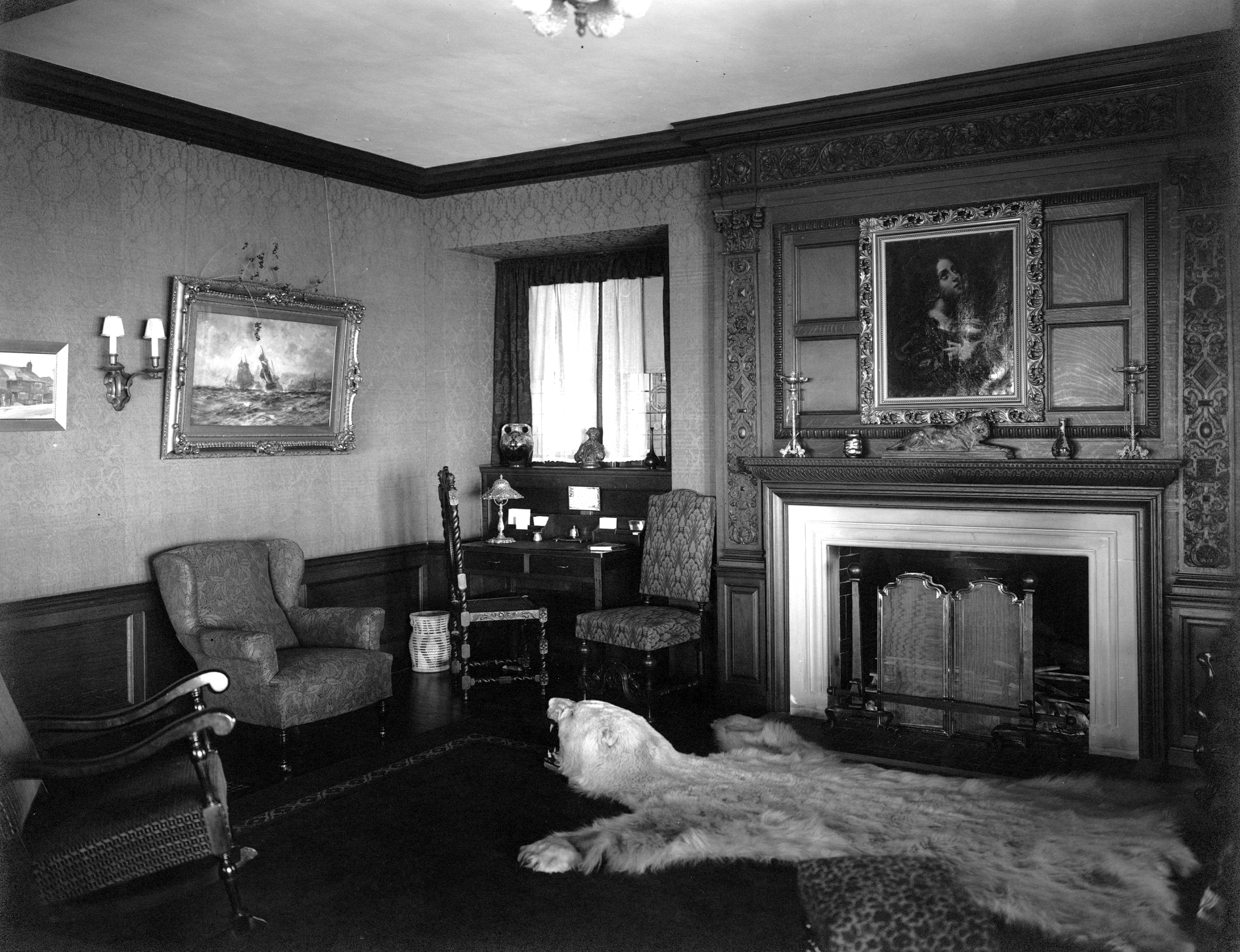
As the temperature dips and the days get shorter, it sure would be nice to end the week reading a book next to a roaring fire. The Booths likely had the same idea their second winter at Cranbrook House, where they could have curled up by the fire…on their new polar bear rug!?

Cranbrook House Living Room, ca. 1909, with one incredible rug. Photo from the collection of Carol Booth. Courtesy Cranbrook Archives, CCCR. Copyright Cranbrook Educational Community.

Elsewhere in the cozy Living Room of 1909, we see objects that are still in Cranbrook House today: the Ships at Sea painting by Robert Hopkin; the bust of Edgar Allen Poe (1898) by George Julian Zolnay; and even the mahogany desk chair, by W. & J. Sloane Company. Some objects are no longer at Cranbrook—the registrar and I can’t quite match the rocking chair, that exact easy chair, the lamp, or the candlesticks to things in the collection. The painting above the fireplace, The Penitent Magdalene after Carlo Dolci, is also no longer here in the house.

Where did these things go? Well, George and Ellen Booth lived in this house for another forty years after this photo was taken! They constantly added to, gifted away, and sold pieces from the collection.

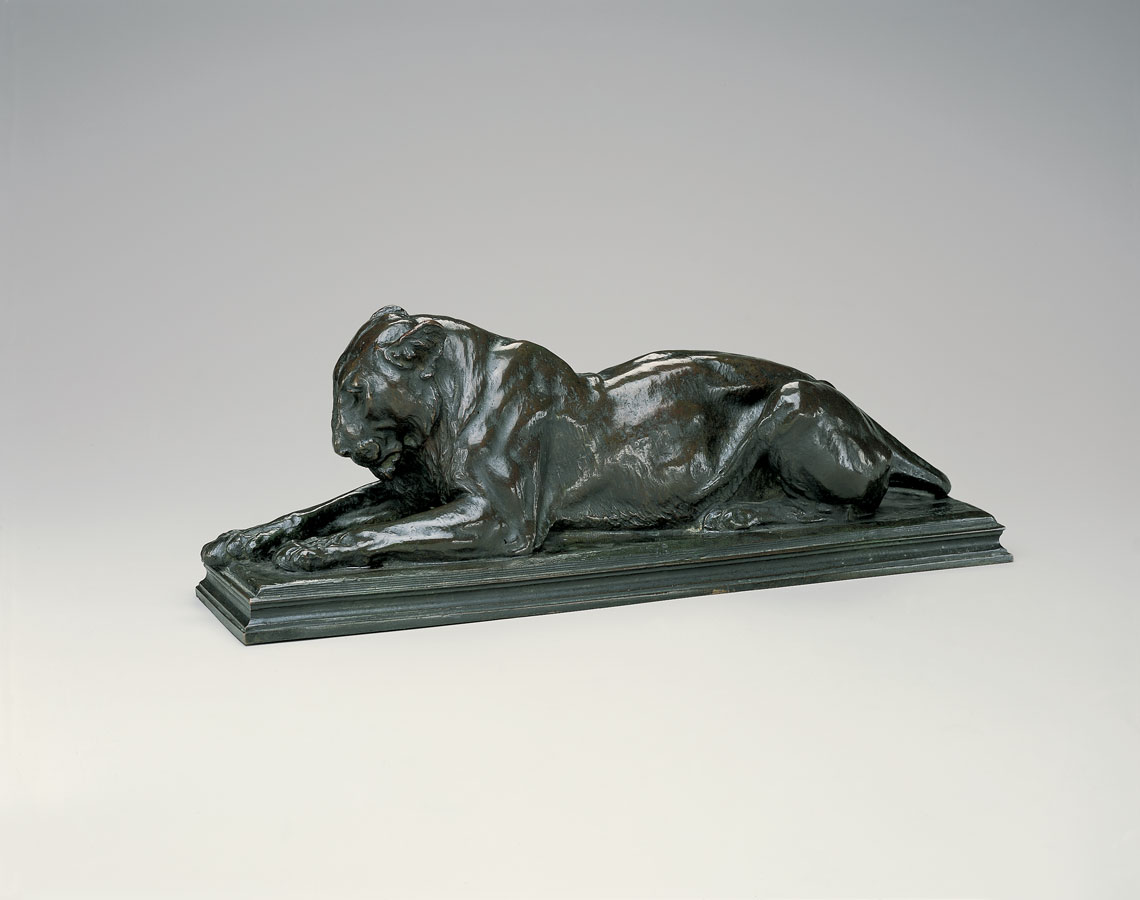
But not everything in this photograph that left the house went entirely off campus. You may notice one piece on the mantle: Recumbent Lioness by Eli Harvey. Booth purchased this sculpture in 1909 from Tiffany & Company in New York. In the 1930s, he gave this lioness to the new Cranbrook Art Museum, where it was assigned the first accession number in the collection: 1909.1. (It’s not actually on campus at the moment: it’s currently on display in Switzerland!)

Recumbent Lioness, Eli Harvey (born 1860, Ogden, Ohio; died 1957, Alhambra, California). Foundry: Pompeian Bronze Works, New York. Bronze; 7.5 x 5 x 21.5 inches. Gift of George Gough Booth and Ellen Scripps Booth, CAM 1909.1. Photograph by R. H. Hensleigh and Tim Thayer. Courtesy of Cranbrook Art Museum.

Using photographs like the one from 1909, as well as diary entries, books, and other records in Cranbrook Archives, I’ve spent the past week re-arranging Cranbrook House’s first floor back to this early aesthetic. On Sunday, the Center is partnering with Cranbrook House & Gardens Auxiliary to present a very special virtual tour: Home for the Holidays at Cranbrook House. I’ll be your host and guide, and will be joined (virtually) by volunteers from the Auxiliary to help share stories from holidays past. I think you’ll really enjoy this tour—there are lots of beautiful things I’ve placed back on display, and we are all very excited to share them with you!

Kevin Adkisson, Associate Curator, Cranbrook Center for Collections and Research

PS: You’ll need to join our tour Sunday to see if the polar bear rug has made a reappearance!

Flora Leslie, Brookside’s Dietician and Food Director

With the Thanksgiving holiday almost upon us, it is time to begin planning and preparing one of the essential parts of any celebration: food. It seems timely, then, to highlight Flora Leslie, Brookside’s long-serving dietician and food director. I would like to introduce her to you in her own voice, recalling a memory of some precarious pumpkin pies:

Floral Leslie interview with Mark Coir, Archivist (OH1990.09.28), November 5, 1987.
Courtesy of Cranbrook Archives.

Hearing this story in Flora’s voice brings the memory to life in a different way than simply reading it in written form. Cranbrook Archives’ Oral History Collection holds recordings of many voices that add dynamism and richness to their stories. Flora Leslie’s interview describes her life at Cranbrook and her experience of its people and places in the mid-twentieth century.

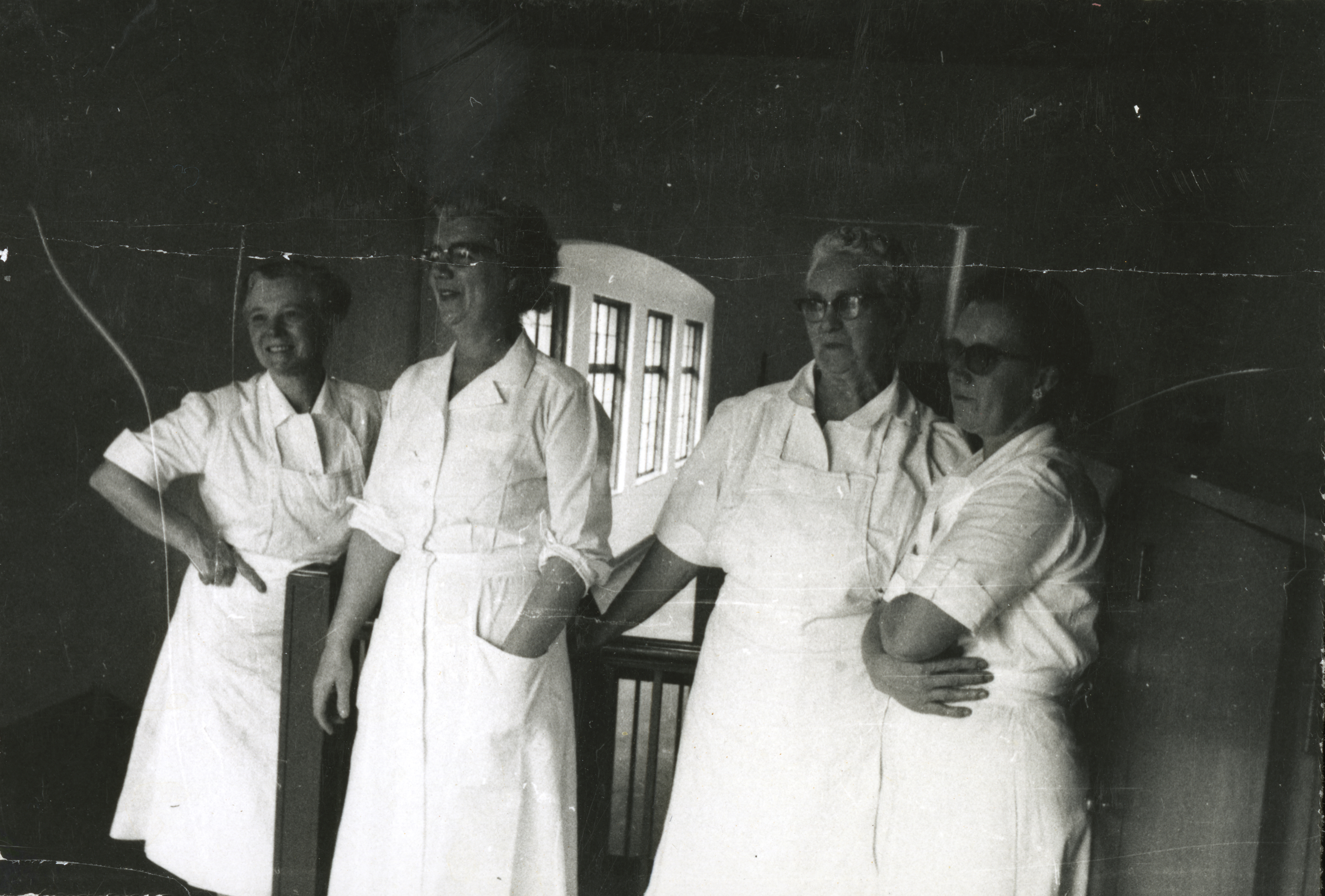
Flora Leslie (second from left) with cooking staff at Brookside School. Courtesy of Cranbrook Archives.

Born Flora MacFarlane in Alexandria, Scotland, in 1906, she made her way to the United States alone in December 1930. Journeying by ship on a very stormy sea, the passengers were required to stay below deck where they got to know each other more than they would have had they been able to wander on deck. Having worked in a photographer’s office in Scotland, Flora initially sought the same occupation in America.

But a fellow passenger Flora met aboard the ship told her that if she had no luck finding work, to contact her for employment. It is thus that Flora began to work for the Ward family in Pontiac, a family whose children were students at Cranbrook.

In 1932, Flora started working at Cranbrook, initially at Kingswood School. Flora married George Leslie in 1934, a landscaper and gardener, and later a superintendent of buildings at Cranbrook.

After several invitations from Jessie Winter, Headmistress of Brookside School, Flora became the dietician and food director at Brookside School, a position she held from 1934-1975. The position came with an apartment, and though at first Flora preferred to stay at Kingswood, which she describes as “light and bright and lovely,” Winter asked Flora and George back to Brookside one further time and had arranged the apartment beautifully. Most importantly, there was a brand-new Frigidaire refrigerator, a novelty in those days. As Flora recalled, seeing this small luxury she told the headmistress, “We’ll come!” The apartment was in the part of Brookside known as the ‘Ram’s House’ and had previously been occupied by Jessie Winter and by J. Robert F. Swanson.

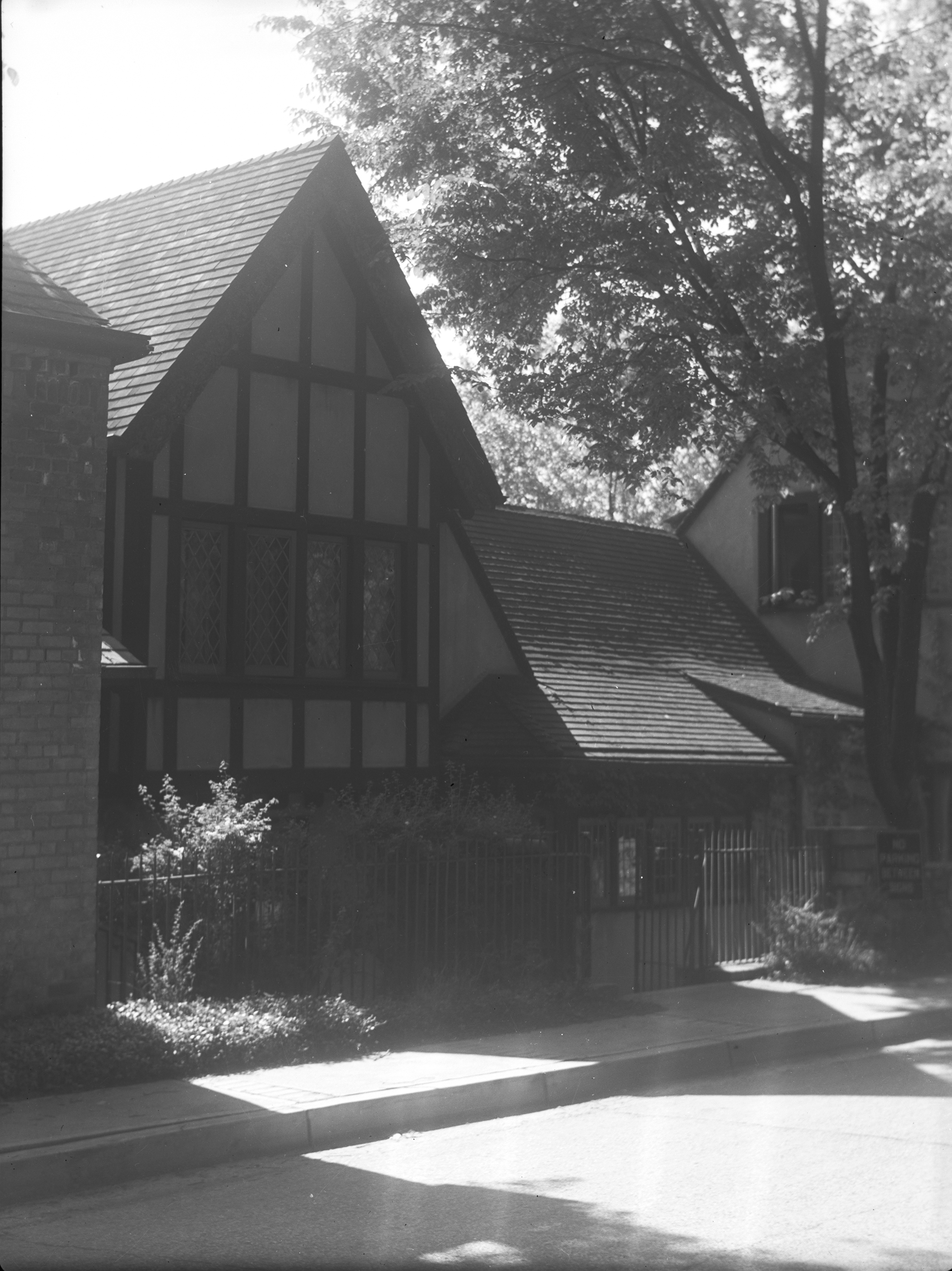
View of the front of George and Flora Leslie’s apartment, known as the Ram’s House, circa 1935-1938. Courtesy of Cranbrook Archives.

During the war years, when food was in short supply, George and Flora Leslie kept Brookside stocked with vegetables—he grew them and she canned them.

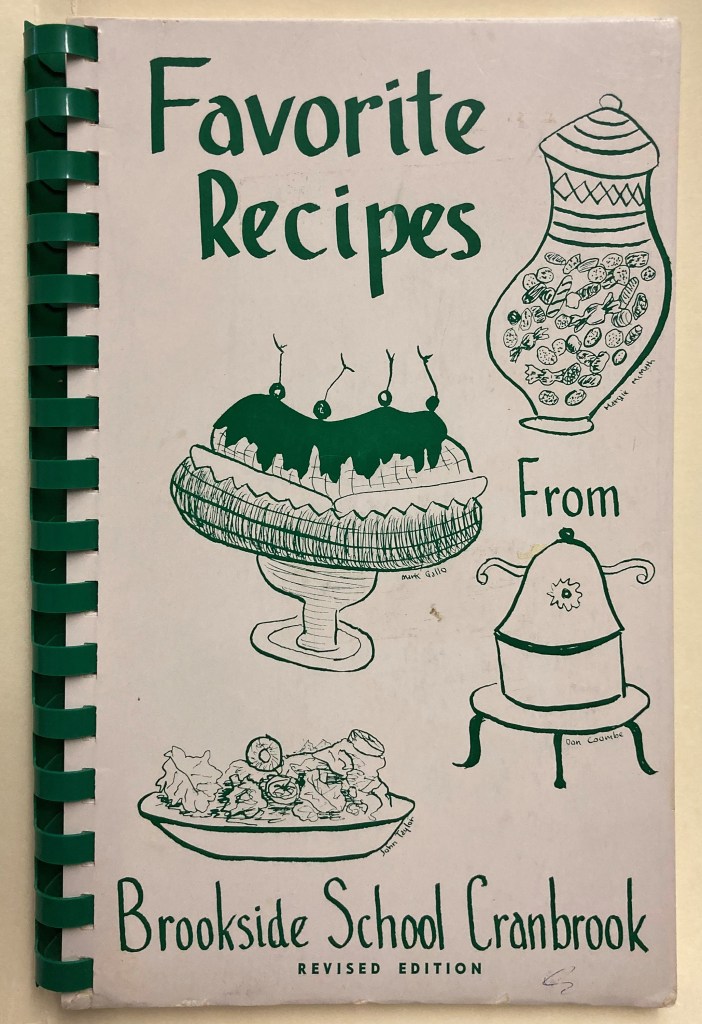
After feeding generations of students, Flora published many of her favorite and original recipes in the Brookside cookbook, Favorite Recipes, which are still enjoyed by alumni far and wide. Perhaps you might like to try one of Flora’s original recipes this Thanksgiving, or a dessert recipe from one of the faculty families?

Laura MacNewman, Associate Archivist, Cranbrook Center for Collections and Research

One Competition, Many Designs: Ralph Rapson and the Jefferson National Expansion Memorial

Of the 5,000 plus architectural drawings in Cranbrook Archives, one of my favorite series is the work of Ralph Rapson. His drawings convey a seemingly endless stream of unique inspiration, and his letters to his friends and colleagues are always wonderfully lively and convivial. Rapson’s work covers diverse projects including residences, embassies, businesses, and competitions.

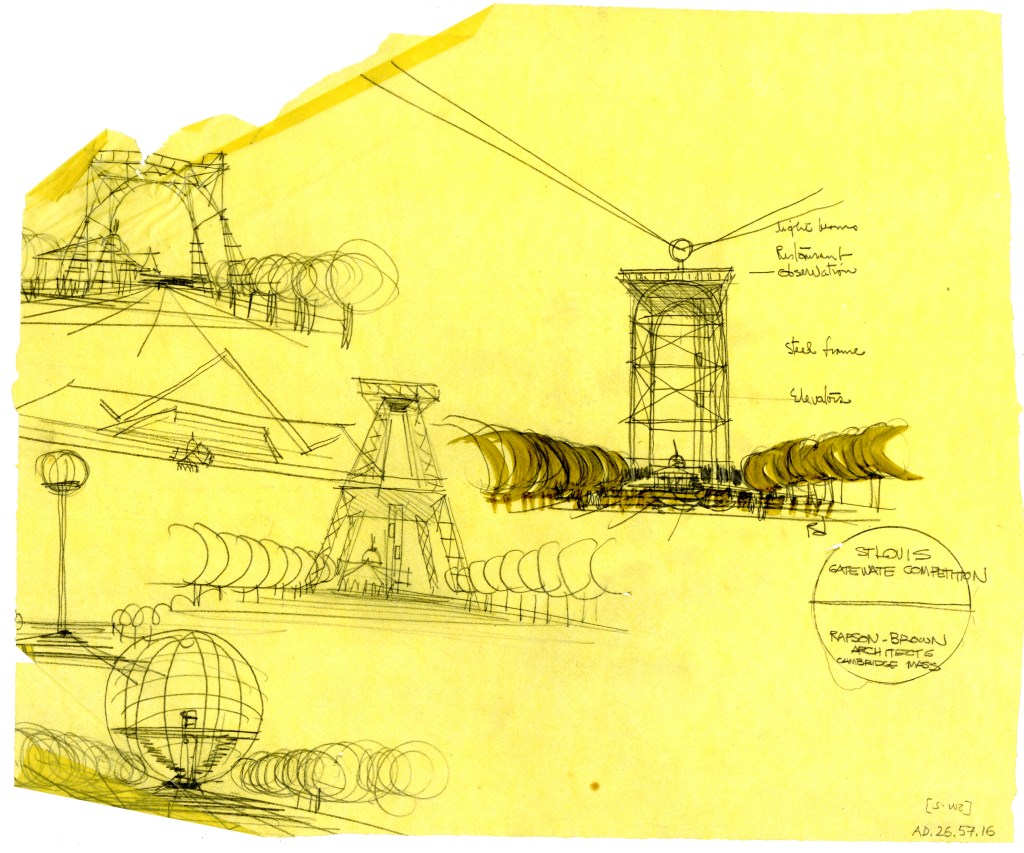
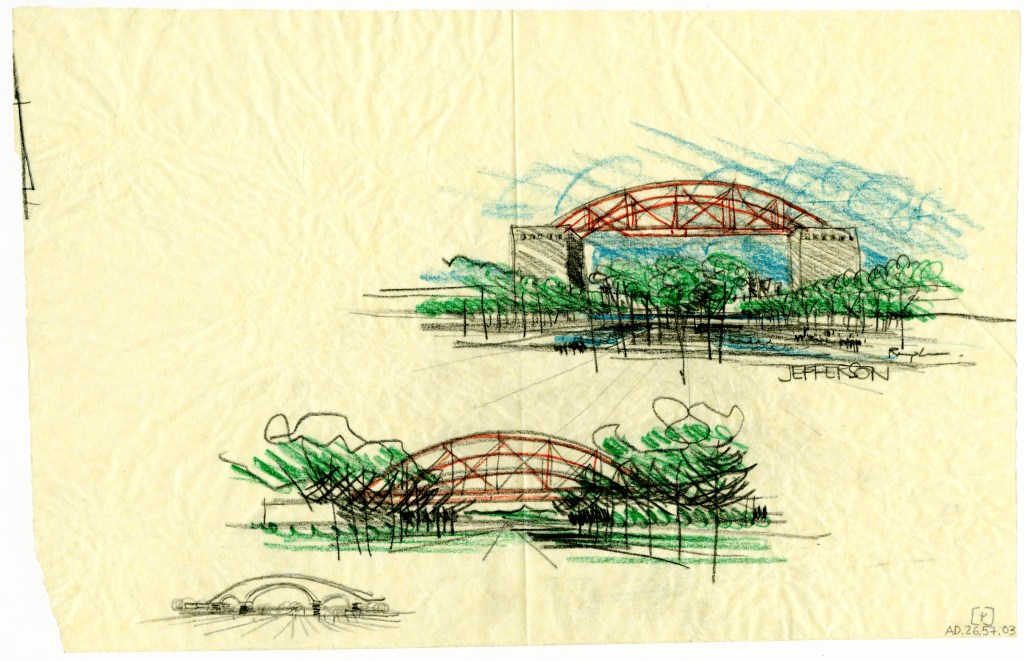
Today, I want to share some examples from just one architectural competition to showcase this creativity: Rapson’s studies for his entry into the Jefferson National Expansion Memorial competition.

Ralph Rapson’s preliminary study for a submission to the Jefferson National Expansion Memorial competition in 1948. This is very similar to his final submission.

A decade before the Memorial competition, Rapson had been invited to study architecture and urban planning at Cranbrook Academy of Art by Eliel Saarinen. Saarinen had been much impressed by Rapson’s submission to the George G. Booth Traveling Fellowship at the University of Michigan in 1938. After studying at the Academy between 1938 and 1940, Rapson collaborated on various projects with Saarinen and his associates before moving to teaching positions in Chicago during the early 1940s and at MIT in 1946.

Ralph Rapson, January 1943. Cranbrook Archives

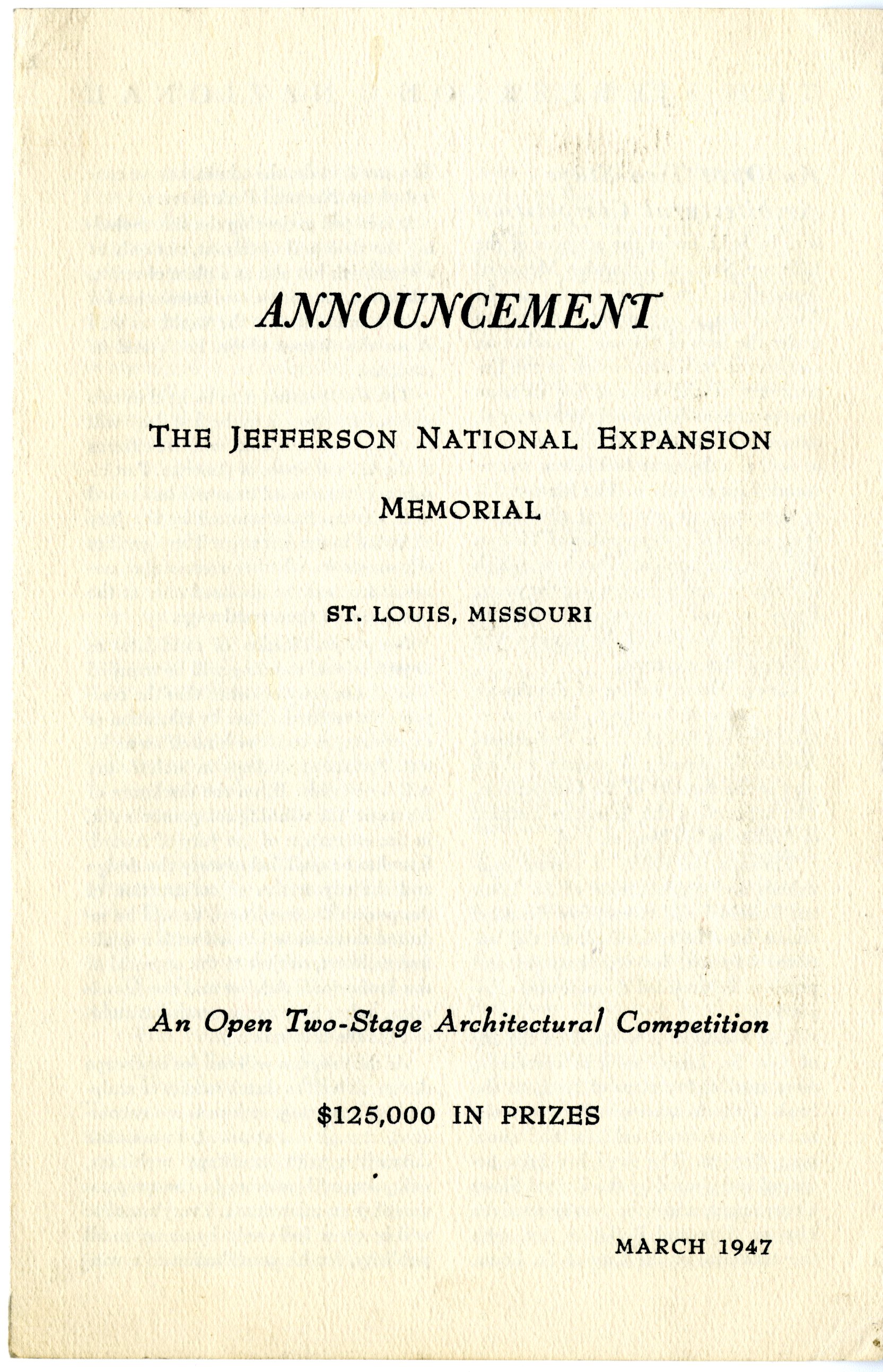
In March 1947, the Jefferson National Expansion Memorial Association announced an ‘Open Two-Stage Competition’ to design and execute a memorial located in St. Louis, Missouri. The first stage of the competition was open to all architects who were citizens of the United States and the second stage was limited to five competitors as selected by the jury in the first stage.

The competition brief was distributed to some 1,100 architects and students around the country. 172 entries were received by the September 1, 1947 deadline. Cranbrook Archives.

In the architectural drawing set for Rapson’s submission, there are nineteen conceptual studies. These have recently been digitized and added to the Ralph Rapson Projects in our Digital Collections online. Below is a selection of his studies that show the diversity and breadth of Rapson’s creative vision:

It is interesting to see Rapson work out his ideas in ink and colored pencil about what shape, materials, and structure might best serve as a memorial to Jefferson’s Louisiana Purchase and America’s westward expansion.

In addition to Rapson, Cranbrook alumni and faculty including Charles and Ray Eames, Harry Weese, Gyo Obata, and both Eliel and Eero Saarinen submitted designs. Of course, it was Eero’s monumental stainless steel arch that won the competition and remains an iconic landmark to this day.

There is much to see and learn from Rapson’s drawings for just this one project. As we hold sets of drawings for another 87 of his projects, stay tuned to the Kitchen Sink—there is so much more to see and say about Ralph Rapson.

Laura MacNewmanAssociate Archivist, Cranbrook Center for Collections and Research

Eds. Note: On Tuesday, October 27, 2020, Associate Curator Kevin Adkisson will deliver our next Uncovering Cranbrook virtual lecture. This month’s lecture, Eero Saarinen and Yale University: Education and Architecture, will examine the younger Saarinen’s time at Yale as both a student of architecture and designer of three important campus buildings. Tickets are available now for the 10:00am and 7:00pm EDT lectures.

Magical Oven: The Frigidaire Flair

As part of its efforts to maintain safe distancing during classes, Cranbrook Schools has spread out all over campus. This includes the use of the Edison House, former home of visiting scholars to Cranbrook Institute of Science.

The history of Edison House and a look at some of its unique features have been explored already (see earlier Kitchen Sink blogs Edison House a Modern Icon and Photo Friday: Modern inside and Out). But one particular object in the house has a special Cranbrook, and a magical, connection.

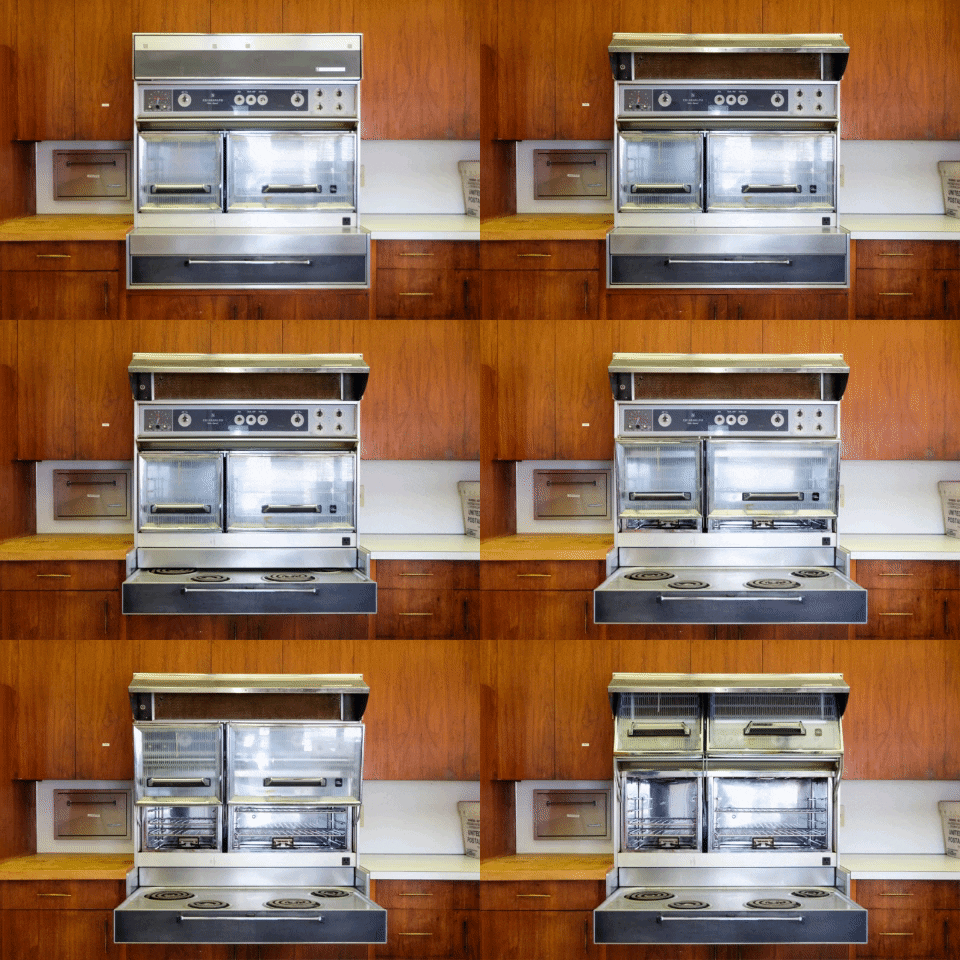
1965 Frigidaire Imperial Flair oven installed in Edison House. Photos by Daniel Smith, CAA ’22.

In the Edison House kitchen is installed a 1965 model Frigidaire Imperial Flair range and oven in Honey Beige. Frigidaire was owned by General Motors when the Flair was introduced to the market in 1962. An electric range, the Flair has burners that roll in and out much like a drawer, hidden from view when not in use. The double ovens sit right at counter height, and the oven doors lift up instead of swinging out. As a Frigidaire advisement in Cranbrook Archives proudly pronounced, “Flair has every automatic feature you’ve ever wanted!”

Ideas for Living, 1960
An image from “Ideas for Living,” 1960. Copyright General Motors. Courtesy Cranbrook Archives.

First, the Cranbrook connection: Many aspects of the oven, including the mechanics of the lifting oven doors, were designed by M. Jayne van Alstyne. Van Alstyne, whose papers are held in Cranbrook Archives, studied ceramics at Cranbrook Academy of Art in 1941 and 1942 before going on to study industrial design at Pratt Institute and Alfred University in New York. From 1955 to 1969, she worked for General Motors, first with GM Frigidaire and later as one of Harley Earl’s “Damsels of Design” in the automotive division.

As Studio Head for GM Frigidaire, she led the research and development of appliances and oversaw product exhibitions, including the “Ideas for Living” show where the Flair debuted in 1960. Her signature oven and range (as well as many other modern electric appliances detailed in the dedication booklet) was installed at Edison House in 1966.

Kitchen in Edison House, “Cranbrook’s New Idea Home,” May 1966. Harvey Croze, photographer. Copyright Cranbrook Archives.

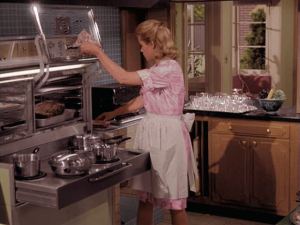
Second, the magical connection: From 1964 to 1972, Actress Elizabeth Montgomery starred in the television sitcom, Bewitched. It told the story of Samantha, a witch, who marries a mortal, Darrin Stephens (Dick York). Samantha agrees to live the life of an ordinary housewife. Of course, things don’t go as planned and hilarity ensues. In their kitchen, the Stephens had a Frigidaire Flair, which appeared in a number of episodes.

Actress Elizabeth Montgomery on the set of Bewitched with her Frigidaire Flair. Photo Courtesy of Grace Kelly, Kitchen Designs by Ken Kelly, Inc.

Anyone who sees the Flair in Edison House will agree it is a marvel of design. While they won’t be whipping up lunch on the appliance, I hope the kids taking classes in the house will take a moment appreciate it. As Frigidaire promised in 1962, the Flair is “The happiest thing that ever happened to cooking… OR YOU!”

Leslie S. Mio, Associate Registrar, Cranbrook Center for Collections and Research

All’s well that ends well

This is a story about a wonderful discovery and a trial of patience. A few years ago, I processed the F. Shirley Prouty Collection on Johannes Kirchmayer, which documents the life and work of her great uncle and contains many years of meticulous research. It was a wonderful collection to work with, and a trove of information on architects and craftsmen of the American gothic revival.

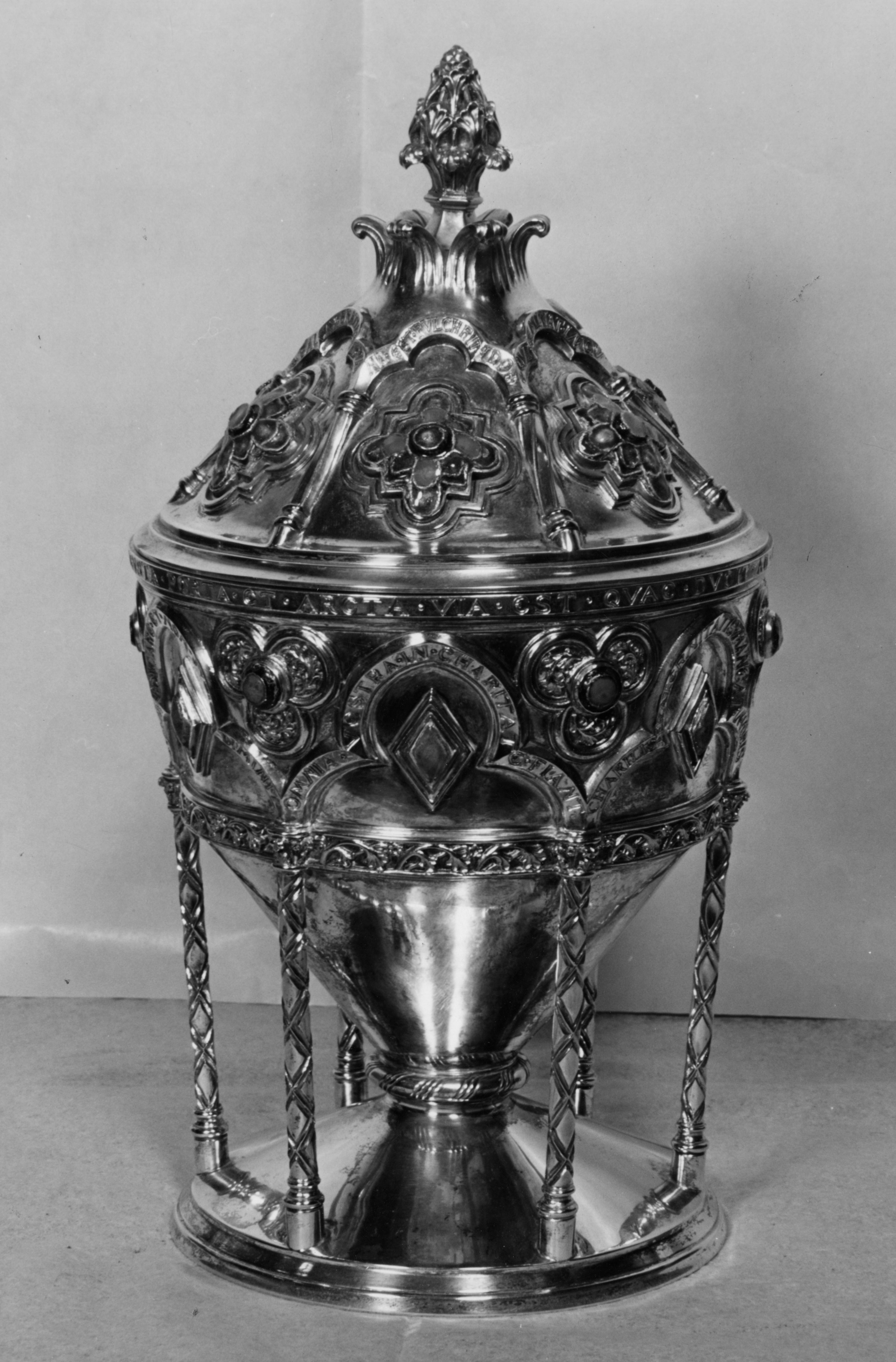
Two of the most outstanding of these are architect Ralph Adams Cram and woodcarver Johannes Kirchmayer, who worked together on many projects. This week I made a wonderful new discovery of another product of their hearts, minds, and hands: a silver and gilt portable font initially commissioned as a gift for the Detroit Museum of Art (now the Detroit Institute of Arts) by George Booth. Cram designed it and Kirchmayer created the sculpture models and chasings for it; then, the piece was executed by silversmith James T. Woolley and decorated by enamellist Elizabeth Copeland.

Silver gilt font completed in 1920 for Detroit Museum of Art. Ralph Adams Cram, Johannes Kirchmayer, James T. Woolley, and Elizabeth Copeland. Cranbrook Archives.

In February 1918, Cram designed the font, which George Booth hoped to have ready for display at the General Convention of the Episcopal Church, to be held in Detroit for the first time in October of 1919.

The making of the font did not follow the anticipated timeline, but rather than a story of delay and disappointment, it becomes a story of patience and its reward.

During the spring, Booth visited Boston and left the Cram blueprint with Woolley. On May 1st, he enquired to know Woolley’s interest in executing the design and an estimate of cost, to which Woolley replied positively, quoting $450 excluding the enamel parts. Giving the commission to Woolley, Booth advised him to confer with Cram or his assistant, Mr. Cleveland, and that Copeland will complete the enameling work.

Continue reading

Tool of the Trade

Light, temperature, and humidity can all harm a museum’s objects and artifacts. In a previous blog, I talked about what damage light can do and how we are combating that at the Frank Lloyd Wright Smith House. The battle for consistent temperature and humidity in the house is another issue.

Frank Lloyd Wright Smith House, 2012. Photo by James Haefner.

In October 2018, we had a Conservation Assessment done at Smith House by ICA – Art Conservation. According to ICA,

Temperature can affect a collection in . . . significant ways. Elevated temperatures have the capacity to increase the rate of deterioration . . . [and] temperature affects relative humidity.

Relative humidity is the ratio of the amount of water vapor in a particular volume of air relative to the maximum amount of water vapor this same volume of air can hold at the same temperature.

As relative humidity fluctuates, the environment and the materials within it will seek equilibrium with one another . . . Within a museum or historic structure, the collection objects and building materials will act like a sponge to these fluctuations, which can cause irreversible mechanical damage.

In the museum community, it is recommended that the relative humidity be kept as stable as possible and the temperature as low as practicable. A relative humidity (RH) range between 55% to 35% is thought to be best for general conditions. However, it is the stability of the relative humidity that is more significant than the actual value. Temperatures below 72˚F and above 32˚F are considered acceptable when the relative humidity is controlled.

So, what was the Center to do? Equipment for monitoring (data loggers) was purchased. We started regular environmental monitoring throughout Smith House. Logs were created to record the environment ranges for temperature and relative humidity for the spaces.

Data loggers are devices equipped with sensors and a microprocessor to monitor and record data such as temperature and relative humidity. We chose Lascar’s EL-USB-2. This standalone data logger measures more than 16,000 readings and features a USB drive so data can be downloaded directly to a computer.

Data logger used to monitor temperature and humidity in Smith House.

However, it is not always practical to carry a laptop around Smith House to download the data or remove the data loggers to download on my office PC. Instead, I use the EL-DataPad. It allows the configuration and download of temperature and humidity data loggers on the spot.

Data pad with attached data logger.

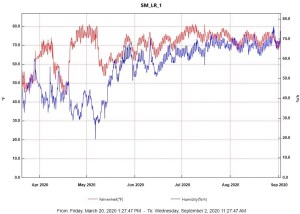
In the Smith House, the temperature and humidity is recorded every 30 minutes. I log this data and graph it, to see trends or issues in the house.

Graph of Smith House Living Room temperature and humidity readings from March to September 2020.

How will this documentation help conservation of objects in Smith House? The data will be useful for establishing achievable set points and ranges for the house environment. It will also be helpful for writing grants to help fund equipment or materials for further environmental management.

Leslie S. Mio, Associate Registrar, Cranbrook Center for Collections and Research

The Smiths and World War II

World War II caused global upheaval and change. Closer to home, two schoolteachers from Detroit—Melvyn and Sara Smith—and their dream of building a home designed by Frank Lloyd Wright would have to wait for war.

On December 7, 1941, the Japanese bombed Pearl Harbor. Sara Smith recalled her husband’s concern: “One day he confessed to [me] that in addition to his worries about the catastrophe the country was facing, he felt if there was a war, that also would be the end of his Frank Lloyd Wright house.”

Melvyn Maxwell Smith’s draft card, 1942. Source: Ancestry.com. U.S. WWII Draft Cards Young Men, 1940-1947 [database on-line]. Lehi, UT, USA: Ancestry.com Operations, Inc., 2011.

In February 1942, Melvyn Maxwell Smith was drafted into the U.S. Armed Forces. “Smithy thought about being a conscientious objector because he didn’t believe in wars,” recalled Sara, “but the more he thought about it, the more he decided he would have to go. ‘We want peace and I’m going to do what I can to help,’ he told me.” The thought of Smithy going off to war weighed heavily on Sara. They had only been married a short time, and now they were being separated.

Smithy was sent off to training, first at Fort Custer near Battle Creek, Michigan, then Sheppard Field in Wichita Falls, Texas, and finally Atlantic City, New Jersey. The Smiths could only see each other during school vacations (Sara was still teaching) or holidays, provided Smithy was not shipped off to the front.

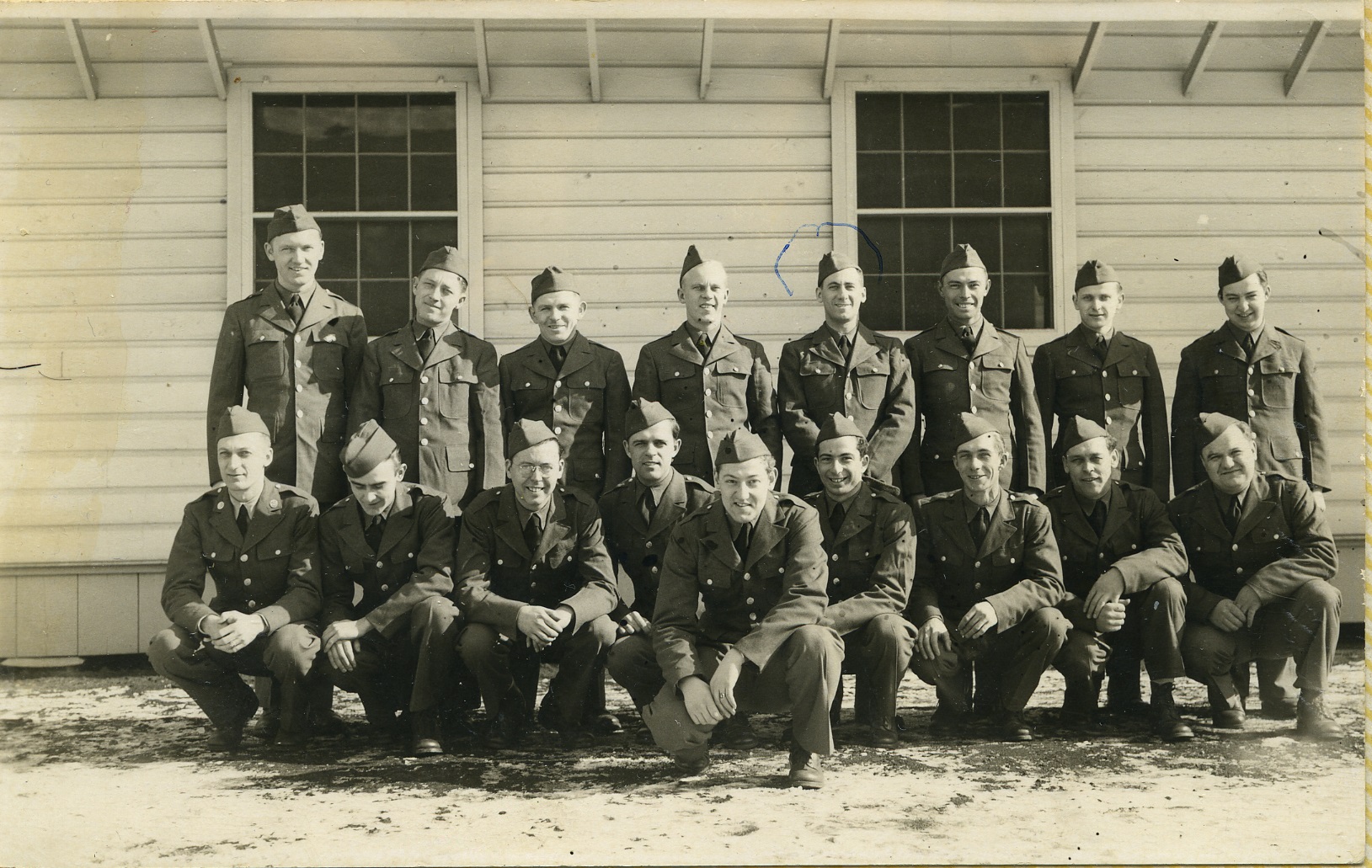
Melvyn (circled in back row) and other officers, circa 1943. Courtney of Smith Family Papers, Cranbrook Archives.

In Atlantic City, Smithy was offered the opportunity to train as a Warrant Officer in the Army Air Corps. He would be sticking around Atlantic City for a while and, with an officer’s salary, Sara could finally join him. At Christmas 1942, “[Sara] boarded the night train to Atlantic City and her new life.”

Sara and Melvyn Smith in Atlantic City, 1942. Courtney of Smith Family Papers, Cranbrook Archives.

After Atlantic City, the Smiths were relocated to Goldsborough, North Carolina. Sara and Smithy lived in a studio apartment in an Army project. Sara enjoyed living there, commiserating with all the other Army wives. Since they were all typically newly married and removed from their families, the wives helped each other. “The women, on their own during the days, supported each other by sharing supplies and tips and small and large acts of kindness.”

Warrant Officer Melvyn Maxwell Smith. Courtney of Smith Family Papers, Cranbrook Archives.

It was in Goldsborough that Sara became pregnant with her son Bobby. When she was seven months pregnant, Smithy was transferred to Gulfport, Mississippi. Sara was sure this would mean Smithy would be shipped to the front. Smithy worried too, so he asked Sara to return to Detroit and her family for the birth of their baby, instead of following him to Mississippi. While Sara was in Detroit awaiting the birth of Bobby, Smithy was again transferred, this time to Biloxi, Mississippi, for which the Smiths were happy. It meant not being overseas.

Continue reading

Create a website or blog at WordPress.com