I would like to introduce you to the “guardian angel” of Thornlea, the home of Henry Scripps Booth and Carolyn Farr Booth. She is a flying winged spirit guardian, sometimes called a cradle guardian or spiritchaser, made in Bali, Indonesia.
Spirit guardian in the entrance hall of Thornlea House.
Spirit guardians have been used in Balinese temples and homes to ward off evil spirits for centuries. Typically, they are hung in a high location, looking down towards a door or window.
Thornlea’s “Guardian Angel” flies high above visitors to the home, 2019. Photo by PD Rearick, CAA ‘10
Thornlea’s guardian hangs high above the entrance hall to the house, gazing down on all who enter. The guardian is in the form of Dewi Sri, who, in Balinese mythology, is the goddess of rice, fertility, a successful harvest, and family prosperity and harmony.
Archival records point to Henry Scripps Booth purchasing the guardian in San Francisco, not in Bali, between 1978 and 1988 (Ed. note: per HSB’s grandson Charlie’s recollections in the comments below, the guardian was bought about 1984).
In June 2020, our Associate Curator Kevin Adkisson took visitors on a virtual tour of Thornlea House. Here is a clip featuring Dewi Sri:
Cranbrook Center for Collections and Research’s Facebook Live at Five: Tour Thornlea House, June 17, 2020,
The next time you visit Thornlea, make sure to look up and say “om swastiastu” to Dewi Sri and ask her for prosperity and harmony for your family!
– Leslie S. Mio, Associate Registrar, Cranbrook Center for Collections and Research
As part of its efforts to maintain safe distancing during classes, Cranbrook Schools has spread out all over campus. This includes the use of the Edison House, former home of visiting scholars to Cranbrook Institute of Science.
The history of Edison House and a look at some of its unique features have been explored already (see earlier Kitchen Sink blogs Edison House a Modern Icon and Photo Friday: Modern inside and Out). But one particular object in the house has a special Cranbrook, and a magical, connection.
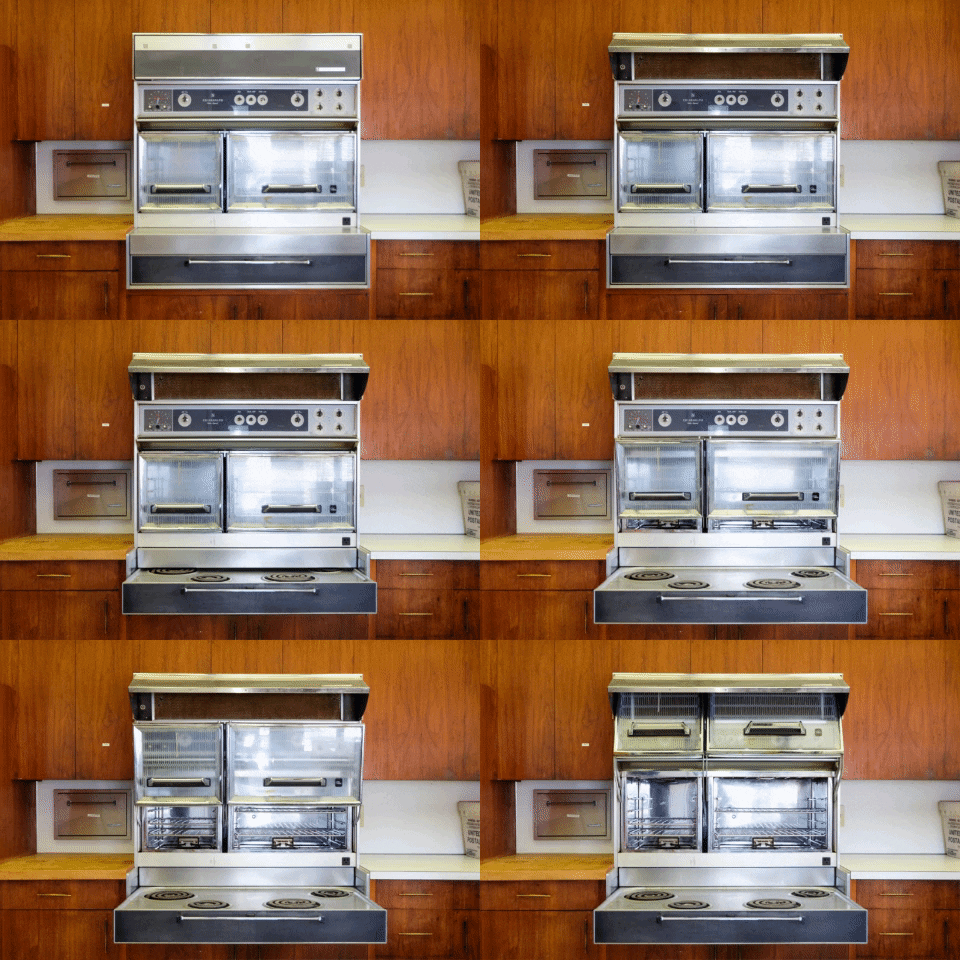
1965 Frigidaire Imperial Flair oven installed in Edison House. Photos by Daniel Smith, CAA ’22.
In the Edison House kitchen is installed a 1965 model Frigidaire Imperial Flair range and oven in Honey Beige. Frigidaire was owned by General Motors when the Flair was introduced to the market in 1962. An electric range, the Flair has burners that roll in and out much like a drawer, hidden from view when not in use. The double ovens sit right at counter height, and the oven doors lift up instead of swinging out. As a Frigidaire advisement in Cranbrook Archives proudly pronounced, “Flair has every automatic feature you’ve ever wanted!”
An image from “Ideas for Living,” 1960. Copyright General Motors. Courtesy Cranbrook Archives.
First, the Cranbrook connection: Many aspects of the oven, including the mechanics of the lifting oven doors, were designed by M. Jayne van Alstyne. Van Alstyne, whose papers are held in Cranbrook Archives, studied ceramics at Cranbrook Academy of Art in 1941 and 1942 before going on to study industrial design at Pratt Institute and Alfred University in New York. From 1955 to 1969, she worked for General Motors, first with GM Frigidaire and later as one of Harley Earl’s “Damsels of Design” in the automotive division.
As Studio Head for GM Frigidaire, she led the research and development of appliances and oversaw product exhibitions, including the “Ideas for Living” show where the Flair debuted in 1960. Her signature oven and range (as well as many other modern electric appliances detailed in the dedication booklet) was installed at Edison House in 1966.
Kitchen in Edison House, “Cranbrook’s New Idea Home,” May 1966. Harvey Croze, photographer. Copyright Cranbrook Archives.
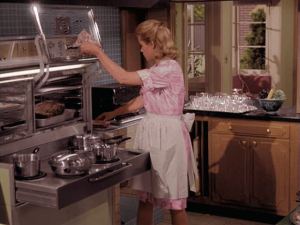
Second, the magical connection: From 1964 to 1972, Actress Elizabeth Montgomery starred in the television sitcom, Bewitched. It told the story of Samantha, a witch, who marries a mortal, Darrin Stephens (Dick York). Samantha agrees to live the life of an ordinary housewife. Of course, things don’t go as planned and hilarity ensues. In their kitchen, the Stephens had a Frigidaire Flair, which appeared in a number of episodes.
Actress Elizabeth Montgomery on the set of Bewitched with her Frigidaire Flair. Photo Courtesy of Grace Kelly, Kitchen Designs by Ken Kelly, Inc.
Anyone who sees the Flair in Edison House will agree it is a marvel of design. While they won’t be whipping up lunch on the appliance, I hope the kids taking classes in the house will take a moment appreciate it. As Frigidaire promised in 1962, the Flair is “The happiest thing that ever happened to cooking… OR YOU!”
– Leslie S. Mio, Associate Registrar, Cranbrook Center for Collections and Research
This is a story about a wonderful discovery and a trial of patience. A few years ago, I processed the F. Shirley Prouty Collection on Johannes Kirchmayer, which documents the life and work of her great uncle and contains many years of meticulous research. It was a wonderful collection to work with, and a trove of information on architects and craftsmen of the American gothic revival.
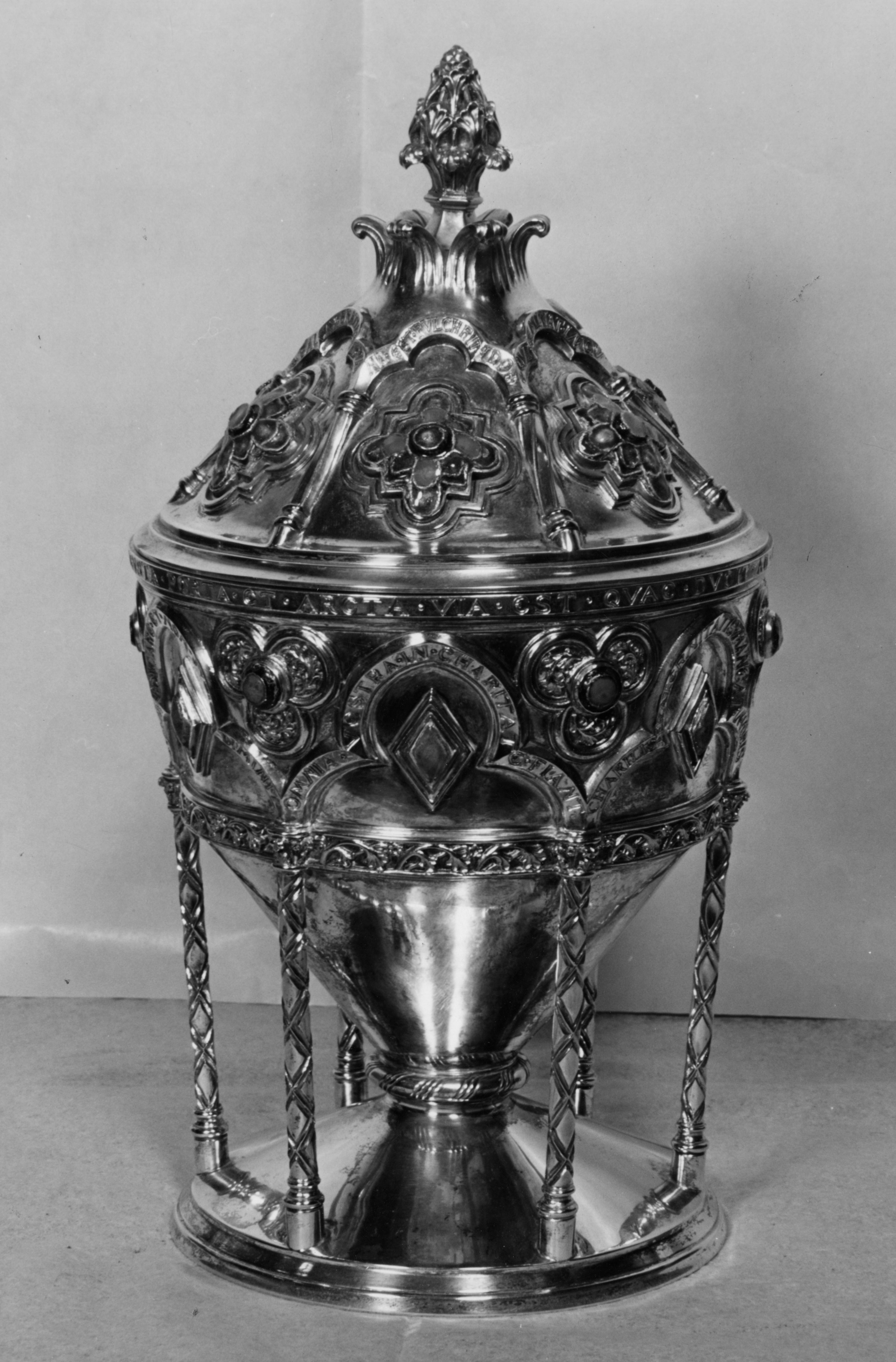
Two of the most outstanding of these are architect Ralph Adams Cram and woodcarver Johannes Kirchmayer, who worked together on many projects. This week I made a wonderful new discovery of another product of their hearts, minds, and hands: a silver and gilt portable font initially commissioned as a gift for the Detroit Museum of Art (now the Detroit Institute of Arts) by George Booth. Cram designed it and Kirchmayer created the sculpture models and chasings for it; then, the piece was executed by silversmithJames T. Woolley and decorated by enamellist Elizabeth Copeland.
Silver gilt font completed in 1920 for Detroit Museum of Art. Ralph Adams Cram, Johannes Kirchmayer, James T. Woolley, and Elizabeth Copeland. Cranbrook Archives.
In February 1918, Cram designed the font, which George Booth hoped to have ready for display at the General Convention of the Episcopal Church, to be held in Detroit for the first time in October of 1919.
The making of the font did not follow the anticipated timeline, but rather than a story of delay and disappointment, it becomes a story of patience and its reward.
During the spring, Booth visited Boston and left the Cram blueprint with Woolley. On May 1st, he enquired to know Woolley’s interest in executing the design and an estimate of cost, to which Woolley replied positively, quoting $450 excluding the enamel parts. Giving the commission to Woolley, Booth advised him to confer with Cram or his assistant, Mr. Cleveland, and that Copeland will complete the enameling work.
Light, temperature, and humidity can all harm a museum’s objects and artifacts. In a previous blog, I talked about what damage light can do and how we are combating that at the Frank Lloyd Wright Smith House. The battle for consistent temperature and humidity in the house is another issue.
Frank Lloyd Wright Smith House, 2012. Photo by James Haefner.
In October 2018, we had a Conservation Assessment done at Smith House by ICA – Art Conservation. According to ICA,
Temperature can affect a collection in . . . significant ways. Elevated temperatures have the capacity to increase the rate of deterioration . . . [and] temperature affects relative humidity.
Relative humidity is the ratio of the amount of water vapor in a particular volume of air relative to the maximum amount of water vapor this same volume of air can hold at the same temperature.
As relative humidity fluctuates, the environment and the materials within it will seek equilibrium with one another . . . Within a museum or historic structure, the collection objects and building materials will act like a sponge to these fluctuations, which can cause irreversible mechanical damage.
In the museum community, it is recommended that the relative humidity be kept as stable as possible and the temperature as low as practicable. A relative humidity (RH) range between 55% to 35% is thought to be best for general conditions. However, it is the stability of the relative humidity that is more significant than the actual value. Temperatures below 72˚F and above 32˚F are considered acceptable when the relative humidity is controlled.
So, what was the Center to do? Equipment for monitoring (data loggers) was purchased. We started regular environmental monitoring throughout Smith House. Logs were created to record the environment ranges for temperature and relative humidity for the spaces.
Data loggers are devices equipped with sensors and a microprocessor to monitor and record data such as temperature and relative humidity. We chose Lascar’s EL-USB-2. This standalone data logger measures more than 16,000 readings and features a USB drive so data can be downloaded directly to a computer.
Data logger used to monitor temperature and humidity in Smith House.
However, it is not always practical to carry a laptop around Smith House to download the data or remove the data loggers to download on my office PC. Instead, I use the EL-DataPad. It allows the configuration and download of temperature and humidity data loggers on the spot.
Data pad with attached data logger.
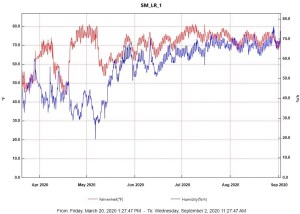
In the Smith House, the temperature and humidity is recorded every 30 minutes. I log this data and graph it, to see trends or issues in the house.
Graph of Smith House Living Room temperature and humidity readings from March to September 2020.
How will this documentation help conservation of objects in Smith House? The data will be useful for establishing achievable set points and ranges for the house environment. It will also be helpful for writing grants to help fund equipment or materials for further environmental management.
– Leslie S. Mio, Associate Registrar, Cranbrook Center for Collections and Research
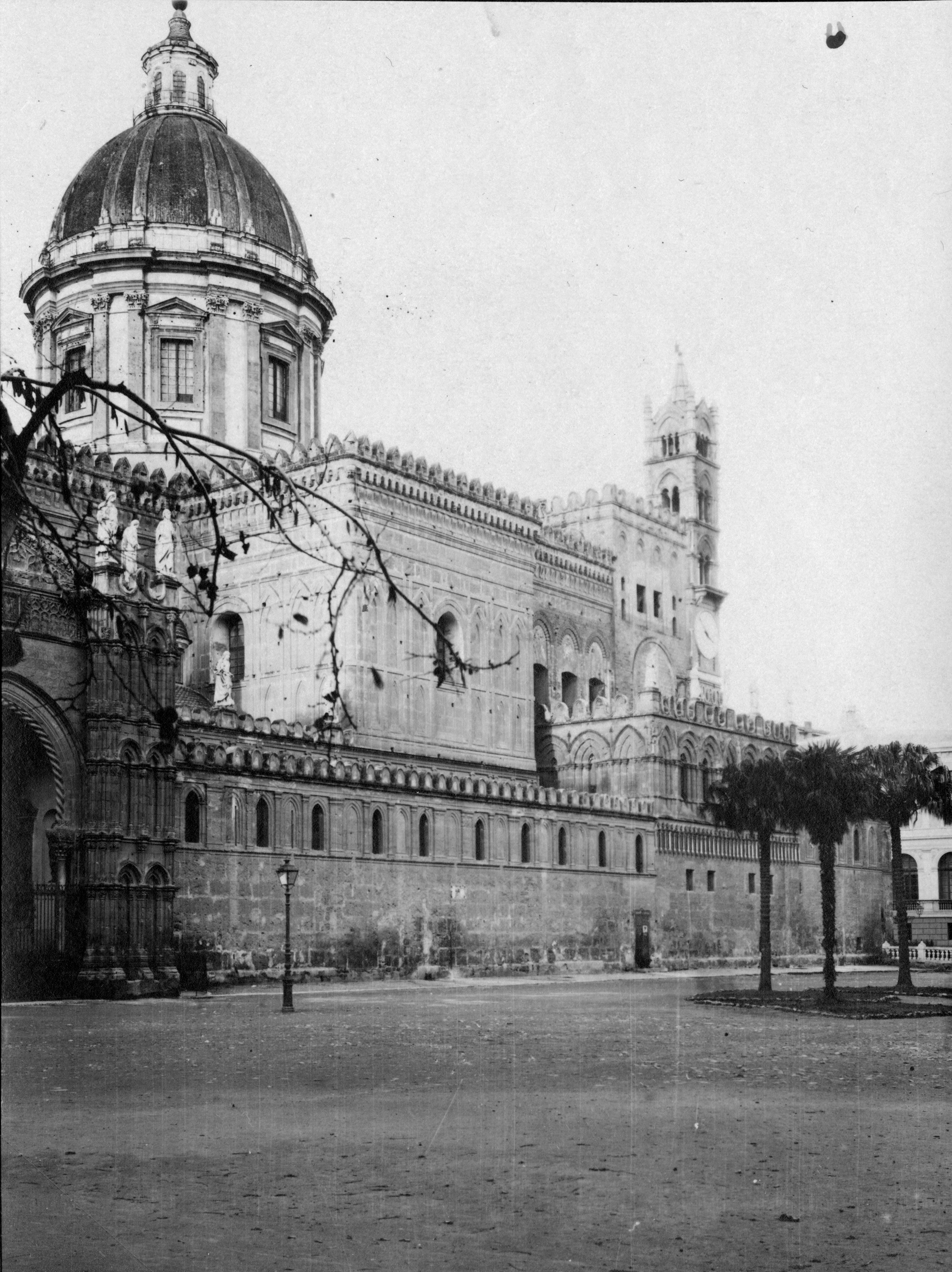
In the center of the Quadrangle at Cranbrook School is a replica of a fountain which stands in the southwestern corner of the cloister of Duomo Monreale in Palermo, Sicily. Completed in 1182, the cathedral unites Arabic, Byzantine, and Norman architectural and cultural influences and is famed for its mosaics.
The inspiration for the fountain’s long-treasured presence on the Cranbrook campus dates back to 1922, when Henry Scripps Booth first saw the original in the cathedral cloister. This was a site that Henry seems to have particularly wanted to see while on a ten-month architectural study tour of Scandinavia, Germany, Switzerland, Italy, Great Britain, and France, with his friend, J. Robert F. Swanson.
View of the Duomo Monreale, December 1922. Henry Scripps Booth, photographer. Cranbrook Archives.
Writing to his father, Cranbrook founder George G. Booth, on December 26, 1922, he describes the cathedral thus:
“Mosaic everywhere — luminous gold, and dull colors — with intricate geometric patterns in abundance and fine but rather arcaic [sic] representations of Biblical stories roofed over with a richly decorated trussed ceiling. The cloister in the cathedral’s shade is that delightful one with such delicate columns in pairs, decorated by mosaics, that is illustrated so frequently.”
View of the Duomo Monreale, December 1922. Henry Scripps Booth, photographer. Cranbrook Archives.
Henry laments that there isn’t time enough to study the monuments as closely as he would like, to measure them and draw them up, for if they did, they would end up knowing only one thing well but miss out on so many others. His letter includes this sketch of the fountain:
Letter from Henry Scripps Booth to George Gough Booth, December 24-26, 1922. Cranbrook Archives.
Several years later, George is in Naples, Italy, at one of his favored workshops, the Chiurazzi Foundry. On March 2, 1927, George wrote to Henry to tell him of numerous purchases he made at the foundry, all to be gifts to the new Cranbrook School for Boys. While the specific uses of the items might be determined later, as was characteristic of George he had a tentative plan for all of them. The most important was the replica of the Monreale fountain. Here, we can see George’s sketch of the replica fountain, showing its dimensions:
When asked, late in life, about the furniture he designed for Kingswood School for Girls, Eero Saarinen referred to himself as “a child of my period.” Two chairs in particular show how the young, precocious designer was able to work in both traditional and modern modes. As designers in the 1920s and 1930s debated the merits of traditional and modern design, Eero worked with both.
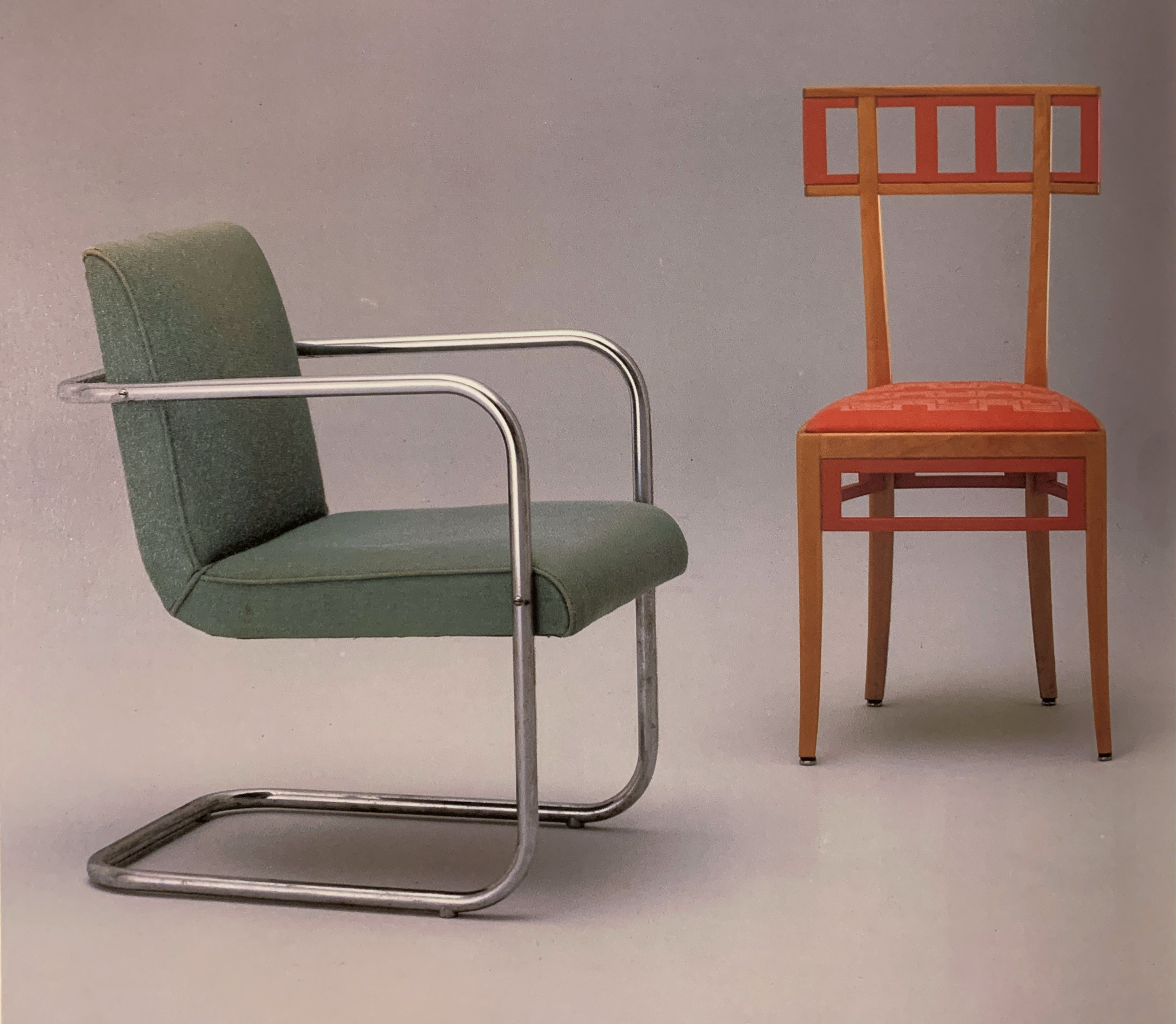
Auditorium and Dining Hall chairs for Kingswood School for Girls by Eero Saarinen, 1929-1931. Cranbrook Art Museum.
He was just 18 years old when he began sketching designs for Kingswood in 1929. Later that year, he departed for Paris to study sculpture for eight months. These two Kingswood chairs show an understanding of two major European designs trends of the era: the evolutionary Art Deco, with its roots in neoclassical design, and the revolutionary Modern movement, emerging most forcefully out of the German Bauhaus.
First, the Kingswood Dining Hall chairs. These birch wood chairs with painted coral-colored elements and linen damask upholstery are delicate adaptations of the ancient Greek klismos chair. The klismos form, which features curving splayed legs and a concave crest rail, became popular in late-18th-century Europe and America as part of the Greek Revival and the neoclassical style. The form again became a favorite among designers in the 1920s, when its clean lines and soft curves were used throughout Art Deco interiors. Kilsmos chairs were especially fashionable in Scandinavian modern design, with architects and designers like Aino and Alvar Aalto, Gunnar Asplund, Erik Bryggman, and Carl Malmsten producing versions of the chair. In fact, Carl Milles had a set of Malmsten-designed klismos chairs in his Cranbrook dining room. Eero Saarinen’s klismos chairs for Kingswood fit perfectly within the clean lines, rich materials, and Swedish Grace-styling of the light-filled dining hall.
Left: Klismos-stlye chair from Carl Milles House at Cranbrook Academy of Art by Carl Malmsten, manufactured by Firma David Blomberg, designed 1926. Right: Chair for Kingswood Dining Hall by Eero Saarinen, manufactured by Stickley Brothers Furniture Company, designed 1929-1931. Courtesy Cranbrook Art Museum.
Second, a chair that eschews historic forms for the avant-garde: the chrome plated, tubular steel Kingswood Auditorium armchair. Eero Saarinen’s cantilevered design recalls the furniture coming out of Germany in the 1920s, particularly the work of Marcel Breuer at the Bauhaus. Breuer was a twenty-three-year-old student at the revolutionary German design school when, inspired by bicycle handlebars, he ordered tubular steel from the bicycle manufacturer Adler and built the world’s first tubular steel chair in 1925. Architect and president of the Bauhaus Walter Gropius was so taken with the initial tubular steel chair he invited Breuer to design most of the furnishings for the school’s new modern buildings in Dessau.
In the past, we have discussed how we cover our stone sculptures on campus to protect them in the winter. But what about the many bronze sculptures? Europe and the Bull? Persephone? The Centaurs?
These pieces are more robust and able to withstand what winter throws at them, but they still need some love each year.
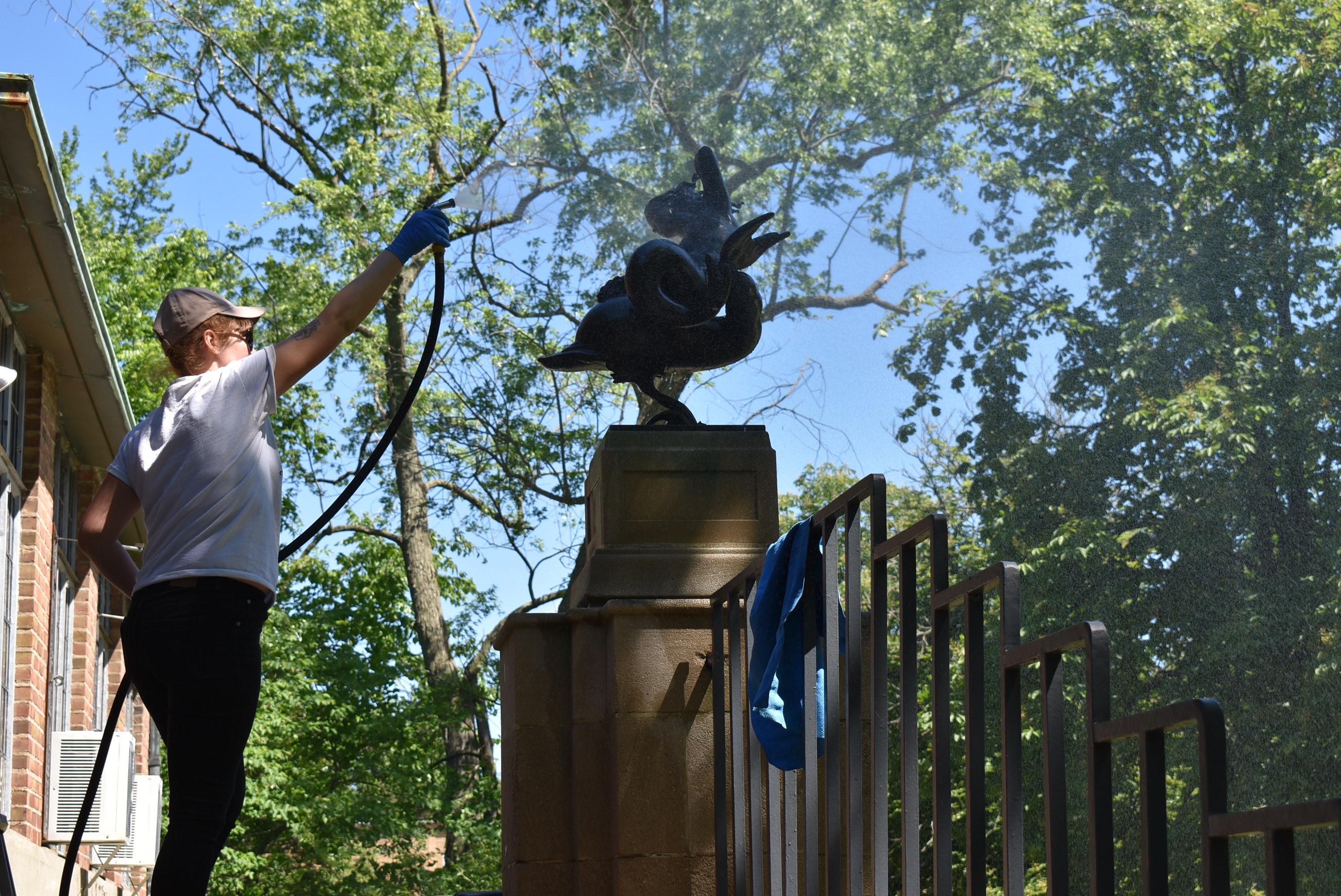
Each spring since 1987, the Community has brought in Venus Bronze Works to recondition the bronzes across the campus. Venus Bronze Works is a member of the American Institute for Conservation of Historic and Artistic Works, which means all the cleaning they do is in accordance with AIC’s Code of Ethics and Guidelines for Practice.
All sculptures are inspected and cleaned by dusting them off with compressed air or wet down and washed with a mild detergent, sponges, soft bristle brushes, and fine cotton pads.
Terra Gillis of Venus Bronze Works gives Carl Milles’s Sunglitter (also know as Naiad and Dolphin, CAM 2002.1) a quick shower, 2020. Photo by Kevin Adkisson.Harlow Toland of Venus Bronze Works gives one of Carl Milles’s Running Deer (CAM 1934.30) a good scrub, 2020. Photo by Kevin Adkisson.
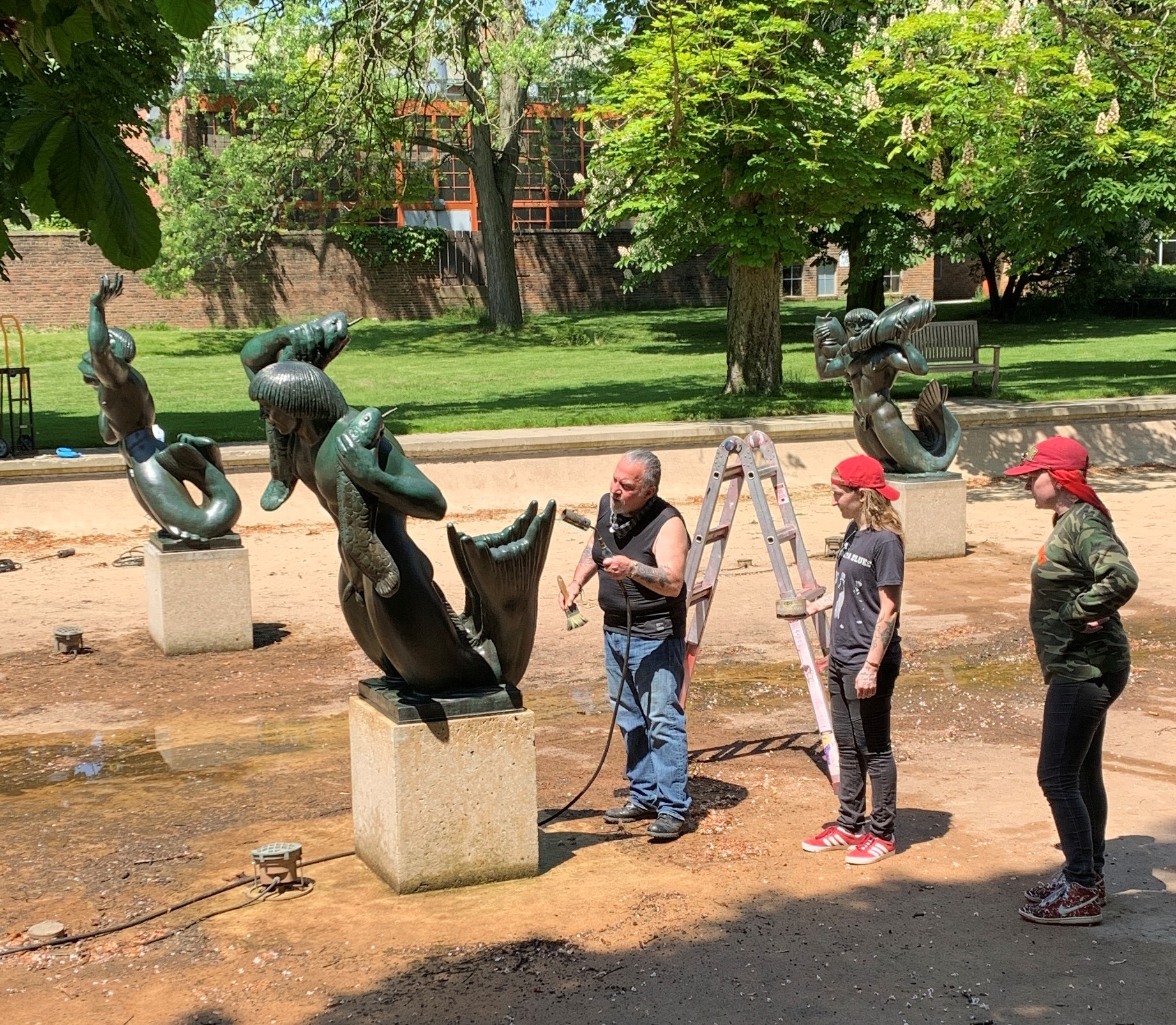
When the works are dried, one or two thin coats of wax are applied and the sculptures are buffed. This wax can be applied directly from the container or applied to a hot surface (by heating the sculpture with a propane-fed torch).
Giorgio Gikas, founder of Venus Bronze Works, holds the torch while his assistants Harlow Toland and Sara Myefski help prepare Triton with Fishes in the Triton Pools at Cranbrook Art Museum to receive a hot wax treatment, 2020. Photo by Kevin Adkisson.
This wax acts as a barrier to the air and humidity on the bronze surface and prevents damaging oxidization or corrosion from developing. When deciding how each individual work is cleaned, we look back to the artist’s intent for each sculpture (was it meant to be patinated green? dark bronze? polished? gilded?) and treat it accordingly.
Venus Bronze Works cleans and waxes all the Milles sculptures at the Cranbrook Art Museum and Cranbrook Academy of Art and the Cranbrook Institute of Science. They also work on such sculptures as Brookside’s Birds in Flight; Kingswood’s Dancing Girls and Diana; Cranbrook House and Gardens’ Fortuna delle Tartaruga (Turtle Fountain); and Cranbrook School’s athletic sculptures. Check out a recent Instagram post about the athletic sculptures below:
In the collection of the Cranbrook Archives, we have a number of objects related to Kingswood School for Girls. These include uniforms, pennants, and one curious kangaroo tagged “Leapin’ Lena.”
In the Alumni Relations Office for many years, the kangaroo was never the official mascot for Kingswood School Cranbrook (KSC). It was likely part of a popular craze in the 1950s and 1960s, when Collegiate Manufacturing Company, which started out manufacturing school pennants, was promoting stuffed animals as school “mascots” or “personality pets.”
Advertisement for Collegiate Manufacturing Company’s “Personality Pets.” Source: Kagavi.com
Because she’s in mint condition with her tag still on, perhaps our Lena was a sample from one of the many salesmen Collegiate Manufacturing employed?
Most likely just an alliterative name — think “Mickey Mouse” or “Lois Lane” — the name “Leapin’ Lena” could also come from a number of sources. “Leapin’ Lena” has been used as a nickname for a car; a fictional B-52 bomber in the 1944 movie The Purple Heart; a kangaroo in a Rex the Wonder Dog comic in 1952; and a 1954 Cold War hero pigeon.
I like to think our Leapin’ Lena name came from Rex the Wonder Dog, where the character was part of a story line called “The Saga of Leapin’ Lena.” Lena was a kangaroo from an old vaudeville act, that also happened to foil crime.
A page from Rex the Wonder Dog, Volume 1, #5, “The Saga of Leapin’ Lena.” Source: vlcomic.com
I really don’t know how this model marsupial got to the Alumni Relations Office, who then gave it to Archives; nor am I familiar with other Kingswood kangaroo mascots (only Kitty Kingswood). Do you know more about our Leapin’ Lena or other Kingswood kangaroos?
We typically write blogs about what projects we are working on – a research question, an exciting piece of furniture – but I wanted to let you in on something a little more pedestrian:
One of the regular projects I work on is numbering and labeling the Cultural Properties. Each object gets a unique number to identify and differentiate it from other cultural properties.
Me at work, numbering silverware. Photo by Desai Wang, CKU ’19
The numbering system is done in two different ways here at Cranbrook. All collections have a prefix set of letters that lets us know what collection it is in. For example, there is a Brookside School Collection with the prefix “BS,” as well as collections for each of the three historic houses we oversee. Next, there is either a number to match an inventory of the collection or the year the object was created or acquired.
The Brookside Lobby Fixture designed by Henry Scripps Booth and created by Leonard Electric is numbered BS 1929.1. It was created in 1929 for use in the school. I haven’t been able to put the number on it yet! Photo by Daniel Smith, CAA ’21
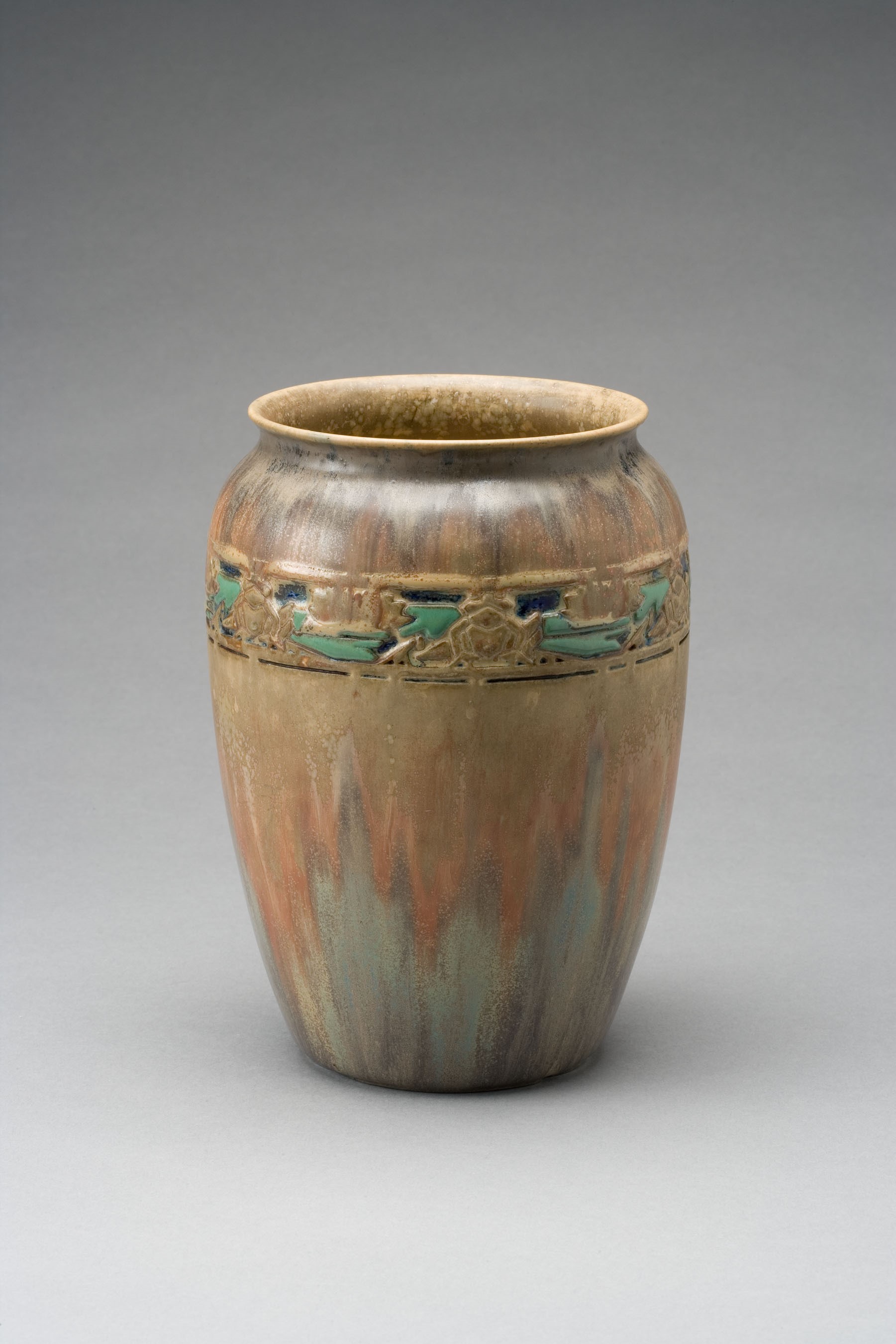
The Frog and Lily Pad Vase by Adelaide Alsop Robineau in the Founders Collection is numbered “CEC 16.” It was the 16th item cataloged in a 1975 inventory of the house. Photo by R. H. Hensleigh
Once we have numbers assigned to the object, we need to physically apply them to the object. Putting a number directly on an object is the most secure way. There are a number of techniques used to apply labels to the objects.
We currently use a method of spreading on a thin layer of special clear adhesive (B-72) to the object, putting down a number written or printed on acid-free paper, and then covering that paper with another coat of the clear adhesive. Printing the numbers on a printer allows you to control the size of the numbers (typically 7-point font) and also ensures they are legible.
A number applied to an object. This is from the Smith House collection, which the CEC acquired in 2017.
B-72, one of the tools of the trade.
There are all sorts of exceptions to the above rule: You can’t number plastics this way – the solvent in the B-72 would melt the plastic. To number them, we tie on a tag made of Tyvek using Teflon tape (also known as plumber’s tape).
Cotton twill “tape” used to number textiles.
And what about textiles? For that, we write the number on cotton twill “tape” with archival ink and sew the tags onto the objects.
Chapter 5E of Museum Registration Methods– what is referred to as the “Registrar’s Bible” — is all about marking objects, best practices, and recommended materials. When in doubt, I start there.
Sometimes, what appears to be a simple question doesn’t have an easy answer in the archives. By combining forces with colleagues, and looking in places you might not first suspect, you can ideally turn a boggling question into a rewarding quest. Provided, of course, you can solve the mystery! Happily, this was recently the case.
When contacted by a Kingswood School graduate about the origins of a certain sculpture that had graced the Green Lobby in the 1960s-1970s, I had two names to go on: Suki and Pam Stump Walsh. Was either of these the name of the sculptor and was the sculpture even still there? After checking several possible sources in the archives, it was time for a field trip to Kingswood. There she was opposite the green stairs, just as she had been described to me: a bronze sculpture of a girl, sitting cross-legged, head bowed, reading a book. I’d answered part of the question: she was still there.
And much to my delight there was also a plate tacked to the sculpture’s wooden pedestal. It read: “In Remembrance, Suzanne Anderson Stenglein, Class of 1947.”
Could this be Suki?
Back in Archives, I found a Suzanne Anderson in the 1947 Kingswood yearbook, Woodwinds. Next to her picture, this description: “That dashing station wagon, that’s always on the go, beautiful taste in clothes, and exciting vacations make Suki the ideal senior for every underclassman. Her pertness, her nose, and her spirit, that help to create her charm, match perfectly her conversational ability on all subjects from Broadway to baseball.”
I still didn’t know if this was the sculptor, or if it was Pam Stump, who is perhaps best known at Cranbrook for her work, Jane: Homage to Duchamp in the Kingswood courtyard. It certainly appeared to be Stump’s style. Associate Registrar Leslie Mio found a listing in Cranbrook Cultural Properties records for Suki, described as a patinated bronze sculpture attributed to Pam Stump.
Detroit native M. Pamela Stump graduated from Kingswood School in 1946. After attending the University of Michigan College of Architecture and Urban Planning for one year, she left to study sculpture under Marshall Fredericks in his Saginaw studio. Twenty-three years after leaving Kingswood, Stump, now Pamela Stump Walsh (she married Cranbrook School 1944 graduate, David E. Walsh), returned to teach sculpture. She retired in 1990, but continued creating and showing her own work throughout the state and internationally.
I appeared to have my answer, but I wanted definitive proof, and, ideally, a date. Back to Kingswood School. This time, with the help of Associate Archivist Laura MacNewman, I found the artist’s signature, and, a date!
End of story, right? Not quite. I still wondered about the sculpture’s origins. The Archives, thankfully, hold the M. Pamela Stump Papers. Consisting mainly of her Cranbrook Kingswood Chronicle, a memoir she titled, “Ubi Ignes Est or Where’s the Fire?” it provided the final details.
Stump made eighteen sculptures for Cranbrook while on the Kingswood faculty. Shortly after she started, in 1969, she was commissioned by the Class of 1947 to create a sculpture in memory of their classmate Suzanne Anderson Stenglein, who had died prematurely the year before. Stump refers to the bronze sculpture of Suzanne as Girl Reading or Suki. It was specifically designed to fit in the niche just outside the Headmistress’ office, directly opposite the staircase in the Green Lobby, and purposely placed on a revolving wooden pedestal so it could be turned 180-degrees to face the wall and enable examination of all the various textures and symbols on its surface. Stump writes, “On her body are many symbols of her life. This was easy because I had known her at Kingswood and in Saginaw.” Here you see this symbolism, along with the names of Suzanne’s schools before she came to Kingswood; her initials, S.A.; and her nickname, found on the crown of her head:
To bring things full circle: a close examination of negatives in the archives collections (identified only as “Kingswood Interiors”) found period images of the sculpture:
The Reading Girl by Pamela Stump, July 2, 1969. Bradford Herzog, photographer. Courtesy Cranbrook Archives, Cranbrook Photograph Collection.
I also learned from The Birmingham Eccentric, that Suki was the daughter of Goebel Brewing Company President Edwin John Anderson. She grew up in Saginaw, where she presumably met her husband, Harold Stenglein. The pair were married at Christ Church Cranbrook in 1955, and made their own home in Saginaw. At this juncture, little else is known about the girl behind the sculpture’s name.

















 Cranbrook Kitchen Sink