In the main hallway of Kingswood and in the living room of Thornlea, there are paintings by artist Myron G. Barlow (1873-1937). I love the look of these paintings and began to wonder about the artist. I’ve come to learn he was an internationally known Detroit-raised painter. As with all things Cranbrook, it seems, there is always a Detroit connection.
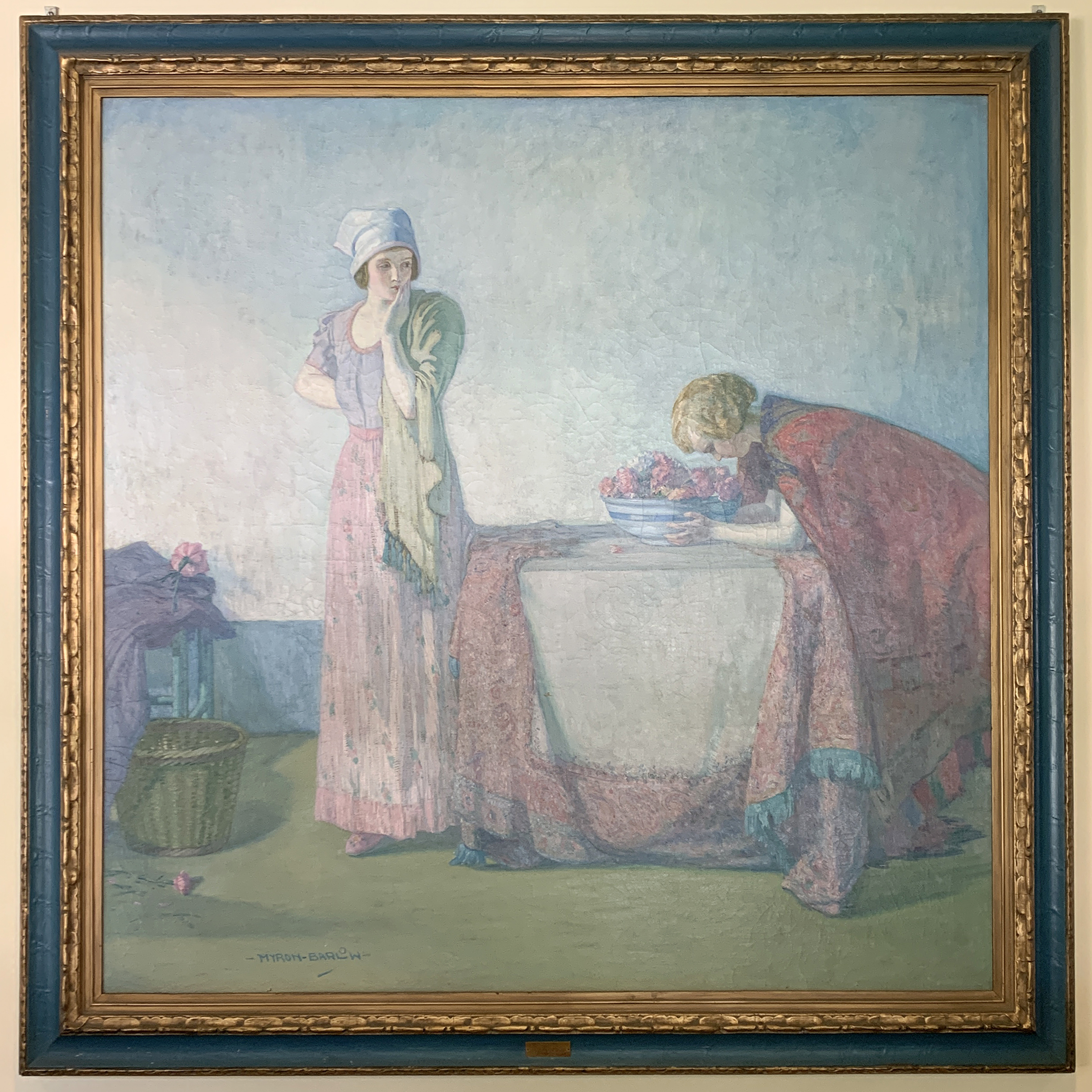
Two Women with a Bowl of Flowers on a Table, circa 1912 by Myron G. Barlow.
The Kingswood painting Two Women with a Bowl of Flowers on a Table depicts two peasant girls, one standing and one bending over a bowl of flowers. It was donated to Kingswood around 1970 by Herbert Sott in memory of his wife Mignon Ginsburg Sott, who was Kingswood Class of 1943.
Young Girl Braiding Her Hair, circa 1912 by Myron G. Barlow
The other painting, Young Girl Braiding Her Hair, is of a girl looking in a mirror braiding her hair. It was purchased by James Scripps Booth from the artist in 1912. James attended the Ecole des Beaux-Arts in Paris and in 1911 had studied under Barlow; James’ painting “Onion Gatherer, Cote d’Azure” depicts Barlow’s cottage studio. James gave Young Girl Braiding Her Hair to his parents George and Ellen Booth. It originally hung in Cranbrook House’s main staircase. George and Ellen gifted the painting to Henry and Carolyn Booth, who hung it in their home, Thornlea.
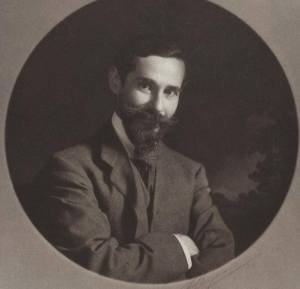
Myron G. Barlow (1873-1937), son of Adolph and Fanny Barlow who were members of Temple Beth-El in Detroit. Courtesy Temple Beth El.
Myron G. Barlow was born in Ionia, Michigan in 1873 and raised in Detroit. As a teenager, he trained at the Detroit Museum School, where he studied under Joseph Gies, and then at the Art Institute of Chicago. He began his career as a newspaper artist. He eventually traveled to Paris and enrolled in the Ecole des Beaux-Arts where studied under Jean-Leon Gerome.
While copying paintings in the Rijksmuseum in Amsterdam, Barlow discovered Johannes Vermeer. As stated in William H. Gerdts’ Masterworks of American Impressionism from the Pfeil Collection, “Like Vermeer, one of Barlow’s favorite artistic themes became the depiction of figures, often female and usually set in an interior; frequently isolated and motionless, surrounded by a dream-like atmosphere rendered in a single, dominant tonality, often blue.”
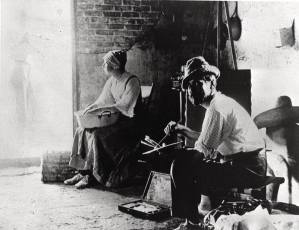
Barlow in his studio after 1900. Courtesy of Nancy Brett (Barlow’s great-niece) via Temple Beth-El.
Around 1900, Barlow moved to the French village of Trepied. There he transformed a peasant’s house into his studio. He would, however, make frequent trips back to Detroit and kept a home there as well.
He served as the Chairman of the Scarab Club around 1918. According to his Detroit News obituary, “Among his major achievements in Detroit are six large murals which he painted for the main auditorium of Temple Beth-El, which were completed in 1925.”
In 1907, he was the only American elected to the Societe Nationale des Beaux-Arts and in 1932 was made a Knight of the Legion of Honor by the French Government. He was recognized for his work with gold medals at the St. Louis and Panama Pacific Exhibition, and by having his works purchased by many international museums, including the Musée Quentovic in France, Pennsylvania Academy of Fine Arts, and the Detroit Institute of Arts. The Detroit Cluband the private collection of Baron Edmond de Rothschild also included works by Barlow.
In May 1937, he left Detroit with the intention of selling his studio in France and returning to the city for the remainder of his life. Unfortunately, he died in his home in Trepied that fall.
While Kingswood alumnae will recognize Studio Loja Saarinen’s largest weaving at Cranbrook, The Festival of the May Queen, did you know there’s an even larger piece by the studio off campus?
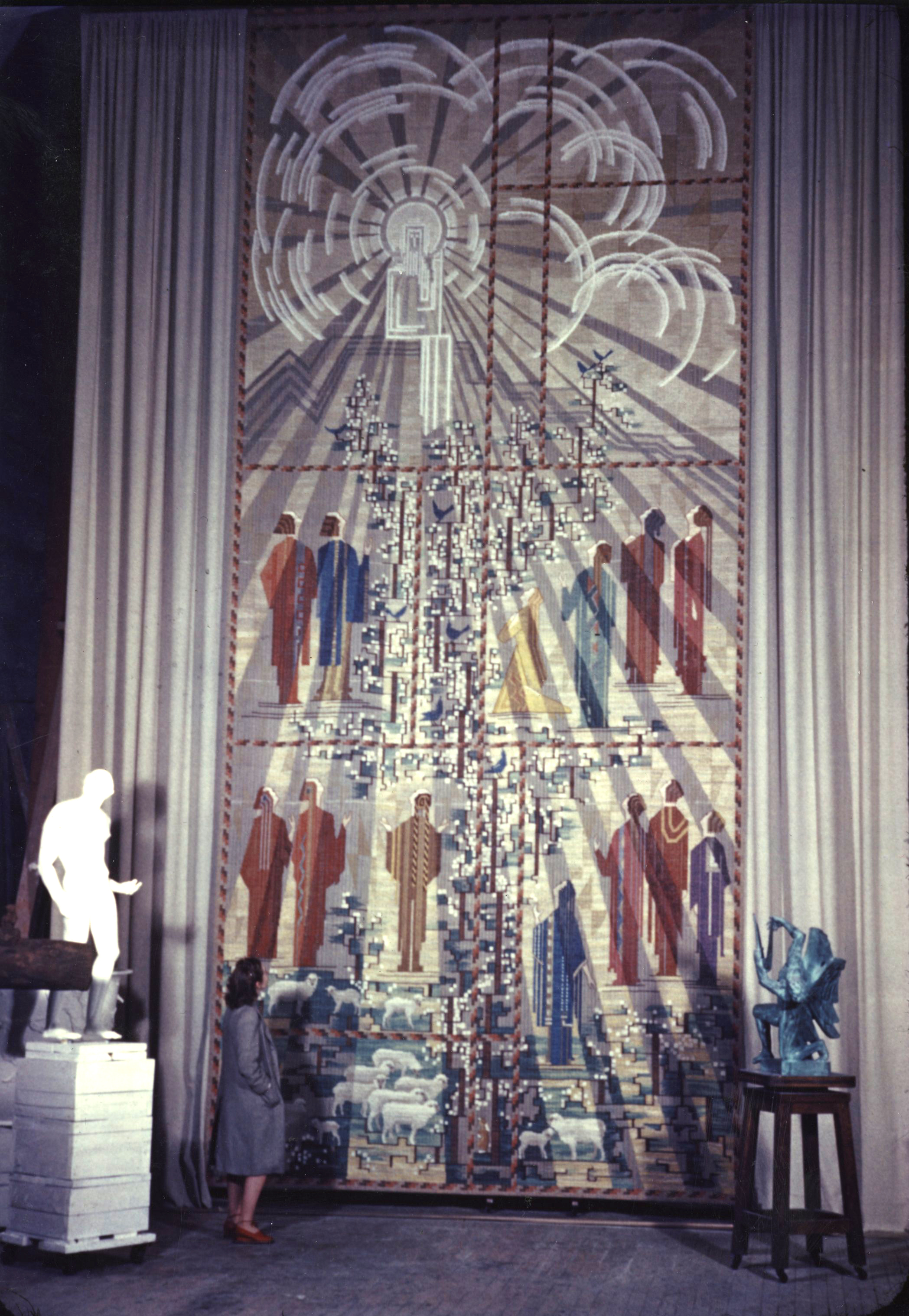
Ordered in connection with Eliel Saarinen’s commission for the Tabernacle Church of Christ in Columbus, Indiana (today the First Christian Church), the monumental Sermon on the Mount hanging was an artistic and technical triumph completed by Studio Loja Saarinen in 1941.
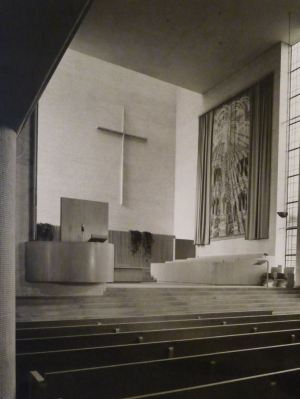
Interior view of First Christian Church, showing Studio Loja Saarinen’s The Sermon on the Mount hanging. 1942. Courtesy of Progressive Architecture.
The subject was chosen by the church, and according to their archives, the Sermon on the Mount was selected as a topic because it is “the ideal for human conduct.” The tapestry, they went on, would need to suggest “worship as well as obedience.”
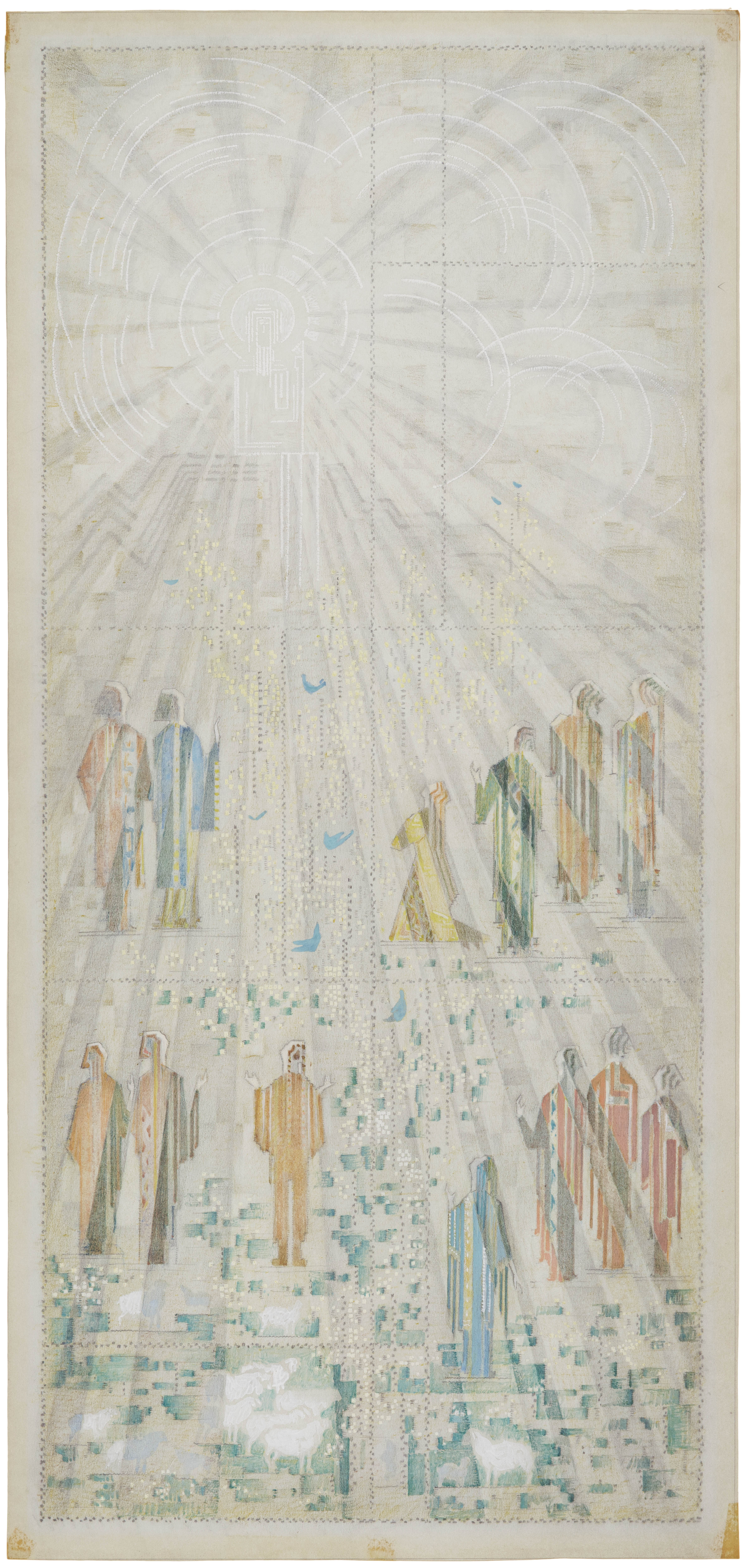
Sketch for the The Sermon on the Mount, 1941. Eliel Saarinen (attributed). Pencil, colored pencil, and gouache on paper. 26 7/8 x 11 7/8 inches. Courtesy of Cranbrook Art Museum. Gift of Robert Saarinen Swanson.
Eliel Saarinen likely produced the sketch of the hanging, an unsigned colored pencil and gouache drawing now in Cranbrook Art Museum. Interestingly, this is the only textile with a religious subject to come out of the Saarinen studio.
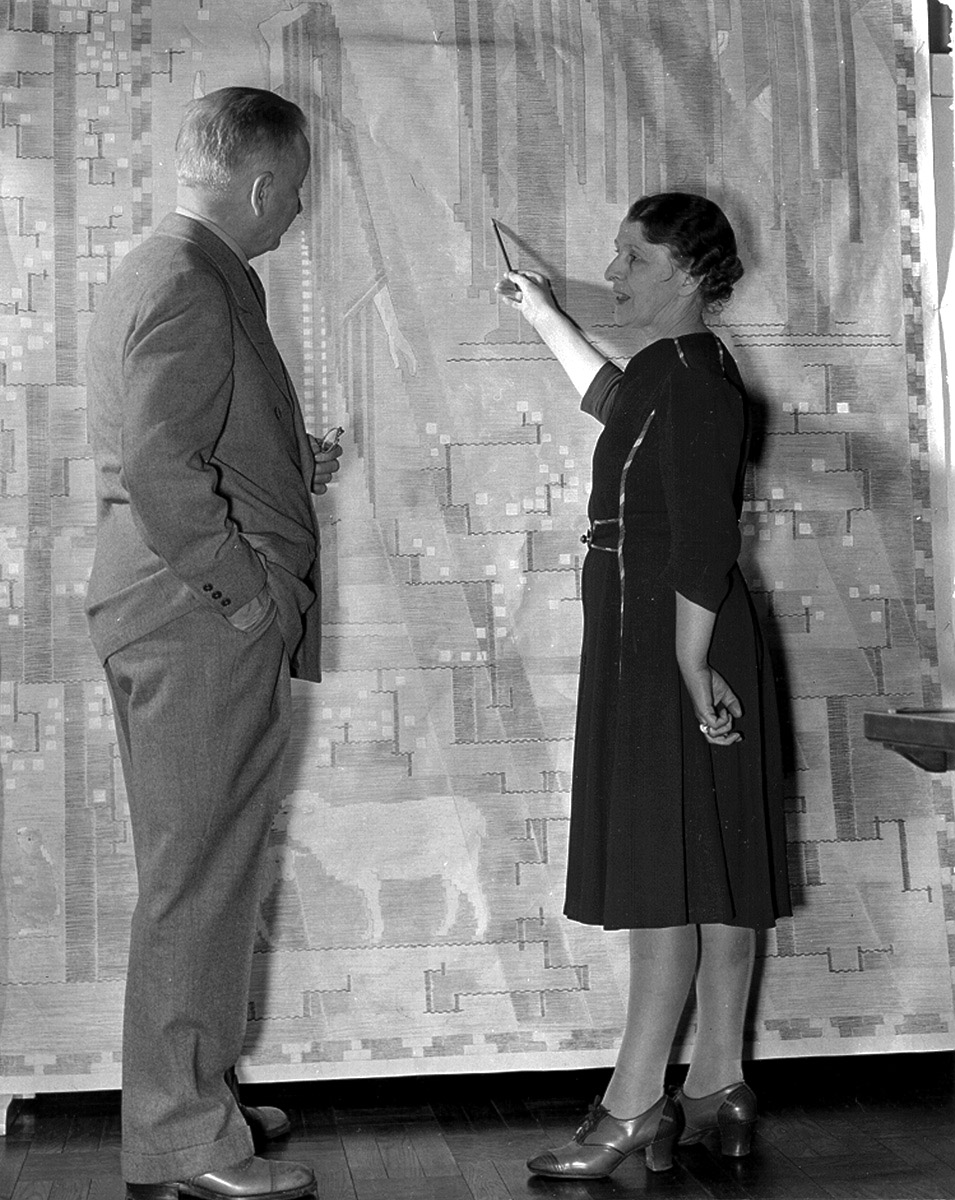
The small sketch was then enlarged onto full-size paper mock-ups, which allowed the Saarinens to review and edit the design and provided direction to the weavers at the loom.
Loja Saarinen showing Eliel a cartoon of their tapestry, The Sermon on the Mount, April 1941. Photo by Betty Truxell. Cranbrook Archives.
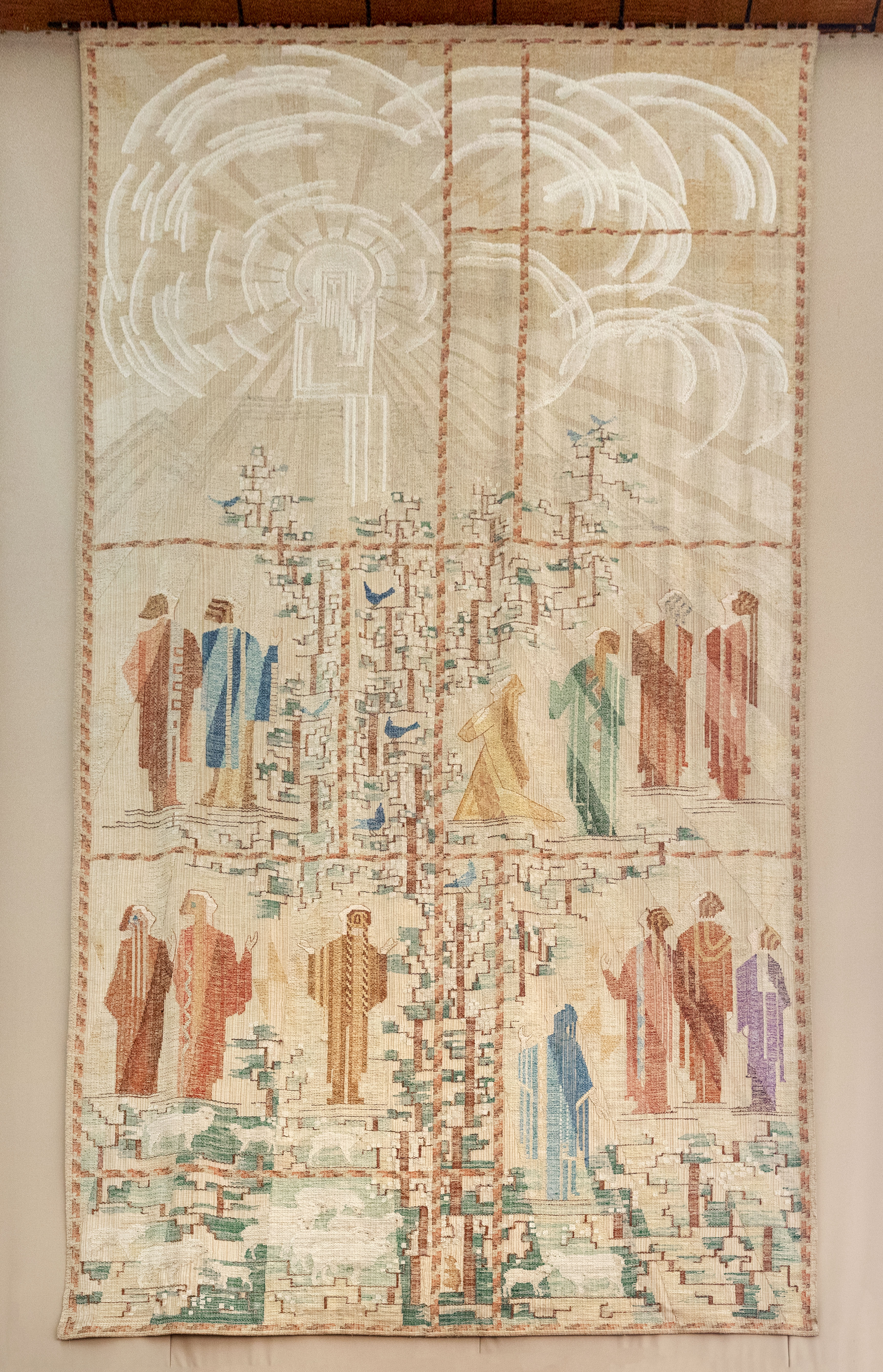
Thirteen patterned and colorfully-robed worshipers in two rows stand looking toward Christ, rendered in all white yarn on a cream background. Christ is surrounded by arcs and beams of white light that masterfully descend throughout the hanging, adding a rich depth to the composition.
The Sermon on the Mount Hanging. 1941. Loja & Eliel Saarinen (designers), Lillian Holm, Ruth Ingvarson (weavers). Wool and linen with supplemental wool weft; 12 x 27’. First Christian Church, Columbus, Indiana. Photo by Hadley Fruits.
Much like The Festival of the May Queen, the weaving is subdivided asymmetrically into rectangular shapes of varying dimensions by rhythmic bands of alternating rust, coral, and gold. These lines link into the scene’s landscape, which is made up of a series of highly stylized branches connecting green and white masses. These color-blocks sometimes read like meadows or hills; in other places, the green reads like flowering shrubs, climbing vines, or a branching tree. In the lower fields are sheep, as the tapestry moves up, birds rest within the branches.
Detail of The Sermon on the Mount showing the lambs, branches, and worshipers. Notice the rich variety of patterning and depth of color on the figures. Photo by Hadley Fruits.
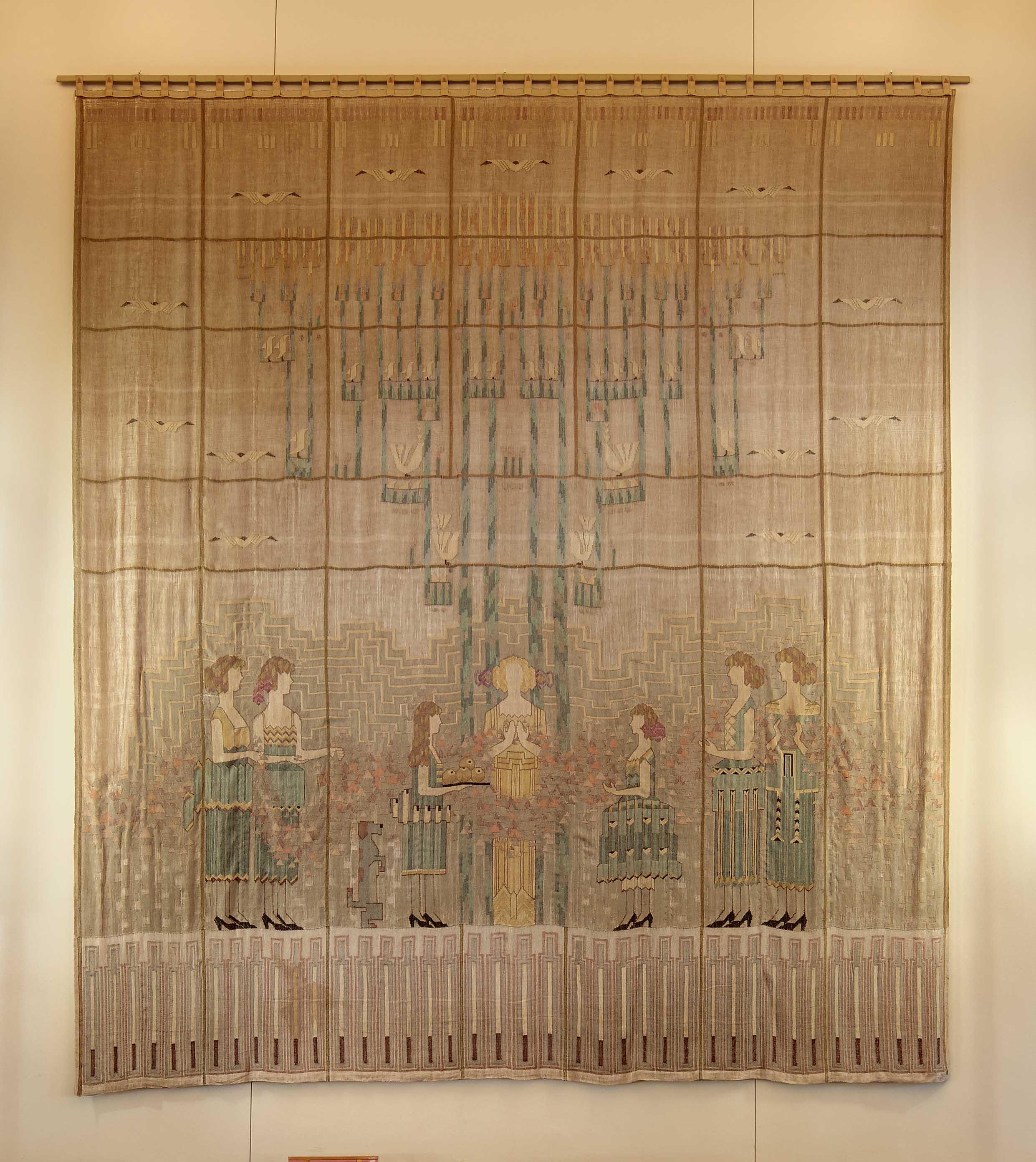
These climbing, abstract elements helps provide movement and energy to the tapestry, balancing the white radiance of the Christ-figure with the wonder of nature. The movement of the geometric green, rust, and white blocks courses between the worshipers, much like the swag of triangles (are they flowers, butterflies, or perhaps something more abstract?) that flow through the maiden’s hands in the Festival of the May Queen hanging at Kingswood.
Festival of the May Queen hanging, 1932.
Loja & Eliel Saarinen (designers), Studio Loja Saarinen (production). Loose linen warp and weft of wool and synthetic yarns; 216 x 192.” Photo by James Haefner, Courtesy of Cranbrook Center for Collections and Research.
The Columbus tapestry was woven by two Swedish weavers who’d worked for Studio Loja Saarinen (intermittently) since 1929: Lillian Holm, who also taught at Kingswood from 1933 until 1966, and Ruth Ingvarson. After previous projects for Loja Saarinen had been met with less-than-thorough credit given to the weavers themselves, Holm and Ingvarson demanded acknowledgement from Loja Saarinen in the press materials, as well as on the weaving itself–supposedly, Holm wove her name into the tapestry in multiple places.
After Holm and Ingvarson had completed their work at the loom, Loja worked on the hanging for weeks, unrolling it section by section on a large table in her studio and accentuating the colors through the inlay of additional threads into the primary weave. This was possible because of the discontinuous weft, known as the Handarbetes Vanner (H.V.) technique after the Stockholm school where it was developed, used in all of Studio Loja Saarinen’s large hangings.
The hanging is labeled on the reverse, with an ink-signed piece of appliqued fabric label listing Eliel, Loja, Lillian, and Ruth and their roles. Everyone’s names were also included in the invitation to the hanging’s reveal at Cranbrook in the winter of 1942, where it was displayed in the forty-foot high studio of Carl Milles.
The Sermon on the Mount on display in Carl Milles’ Cranbrook studio. February 1942. Saarinen Family Papers, Cranbrook Archives.
Cranbrook neighbor and diarist Kate Thompson Bromley described the event in February 1942:
“It had been months in the weaving…One of the biggest tapestries woven in this country, and probably as beautiful as any, for the colors are soft and rich. The large studio [Carl Milles’] was the only place with a high enough ceiling at Cranbrook to hang it. At the end of that huge room it was decorative and glowing. It must have been a great happiness to the weavers to see it in place, for as they could only judge the section on which they were working.”
Once installed in Indiana, the weaving completed the remarkable church by Eliel Saarinen. Protected by curtains meant to shield the hanging from light and smoke, The Sermon on the Mount hangs opposite a wooden organ screen, which itself reads like a tapestry. Outside, the building façade and its glass-illuminated bell tower take on the grid and rhythm of weaving. Even the meandering lines and subtle arcs of the stone architectural ornament relates back to the design of The Sermon on the Mount.
In all its beauty, The Sermon on the Mount served as a high-point on which Loja Saarinen was forced to close her studio. As she wrote to George Booth, she was being “forced into” retirement because of a number of pressures: declining commissions, her husband’s exit from the Academy’s presidency, World War II, and a shift in focus for the Academy Weaving Department away from pictorial handweaving. Studio Loja Saarinen closed in 1942.
You can learn more about Studio Loja Saarinen, her weavers, and her products; see where the works were woven on campus; and visit Kingswood’s weaving studio and dining hall on my upcoming Behind-the-Scenes: Studio Loja Saarinen, 1928-1942 tours August 22 and 29. You can also experience the exhibition on any of our regular Saarinen House tours. If you find yourself in Indiana, see the Sermon on the Mount any Sunday at First Christian Church or through tours with Visit Columbus.
-Kevin Adkisson, Curatorial Associate
Special thanks to Cranbrook Academy of Art graduate Hadley Fruits (Photography, 1990) for the contemporary color photographs of The Sermon on the Mount and First Christian Church.
One of my many duties here at the Center for Collections and Research is to maintain the sculptures on the campus. This can mean finding conservators to repair works, contractors to clean them, or, in some cases, clean them myself. Recently, I was working on a sculpture in the gardens at Cranbrook House. I had seen the sculpture before but wondered about its backstory. Turns out it was a tale of two names.
The sculpture is Mario Korbel’s statue Atalanta, the Greek goddess of the hunt, travel, and adventure. It was commissioned by George Gough Booth in 1927 for one of the gardens at Cranbrook House, part of a series of work Korbel completed for the Booth house and gardens — including Dawn and Harmonyin the gardens and Andante and Nocturne in the house.
July 12, 1927 letter from Mario Korbel to George G. Booth, referencing both his works Atalanta and Andante. George Gough Booth Papers, Cranbrook Archives.
Booth, admiring the beauty of the clear, white marble of Atalanta, transferred the work into the collection of the Art Museum. It was part of the original art museum exhibition in 1930.
Atalanta (left) in the first Art Museum exhibition in 1930. Courtesy Cranbrook Archives.
Later, Booth wrote: “We have finally concluded that the figure will make a very important and striking center art element in connection with the new School for Girls at Cranbrook.” When the Kingswood dormitory was built, the sculpture was transferred to Kingswood and installed on the terrace.
Atalanta (right) adorns the terrace at the Kingswood School for Girls dormitory in this undated photo. Courtesy Cranbrook Archives.
In 1969, the sculpture was vandalized and smashed into many pieces (no one was ever implicated in the crime–or at least, their name isn’t in my file!). Those pieces were put back together, but when Atalanta was finally repaired, she was not as pristine. Henry Scripps Booth decided to rename her Ecolo. He also wrote a verse to explain the new name:
Ecolo, Goddess of Earth
Who is this sweet maid who stoops protectively to save the earth from man’s pernicious tread?
It is the blithe spirit of Ecology by whom all life and natural things are fed.
Ecolo in her new home in the Herb Garden at Cranbrook House.
Ecolo, or the sculpture-formerly-known-as-Atalanta, now greets visitors in the Herb Garden at Cranbrook House.
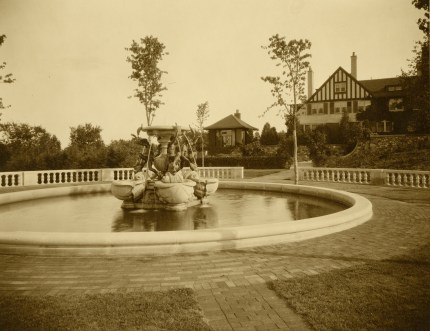
The collections at Cranbrook Archives are used by a wide population of researchers and have a broad reach academically and internationally. The collections are also used internally for diverse purposes, including historic preservation, education, program development, and fact-checking. A recent research request related to the original installation of Turtle Fountain on the circular terrace at Cranbrook House.
Turtle Fountain, 1925. K. Hance, photographer. Copyright Cranbrook Archives.
In the late winter of 1924, George and Ellen Booth took a trip to Europe. In a letter dated February 15, 1924, to Cecil Billington, George explains,
“We stopped in Rome to see if by chance I could find a fountain for the new circular terrace basin – and I did – at first it seemed quite out of reach, but some favorable circumstances helped a lot…”
He goes on to discuss the agreements for packaging and shipping the fountain, which is no less than 10 tons of Verona marble. Similar information is found in a letter from George to Henry Scripps Booth, which also describes their experience of staying in Paris and Rome:
Letter from George G. Booth to Henry S. Booth, February 15, 1924. Copyright Cranbrook Archives.
While Florence and Carol [Farr Booth] went to see the sights and do a little shopping, George writes,
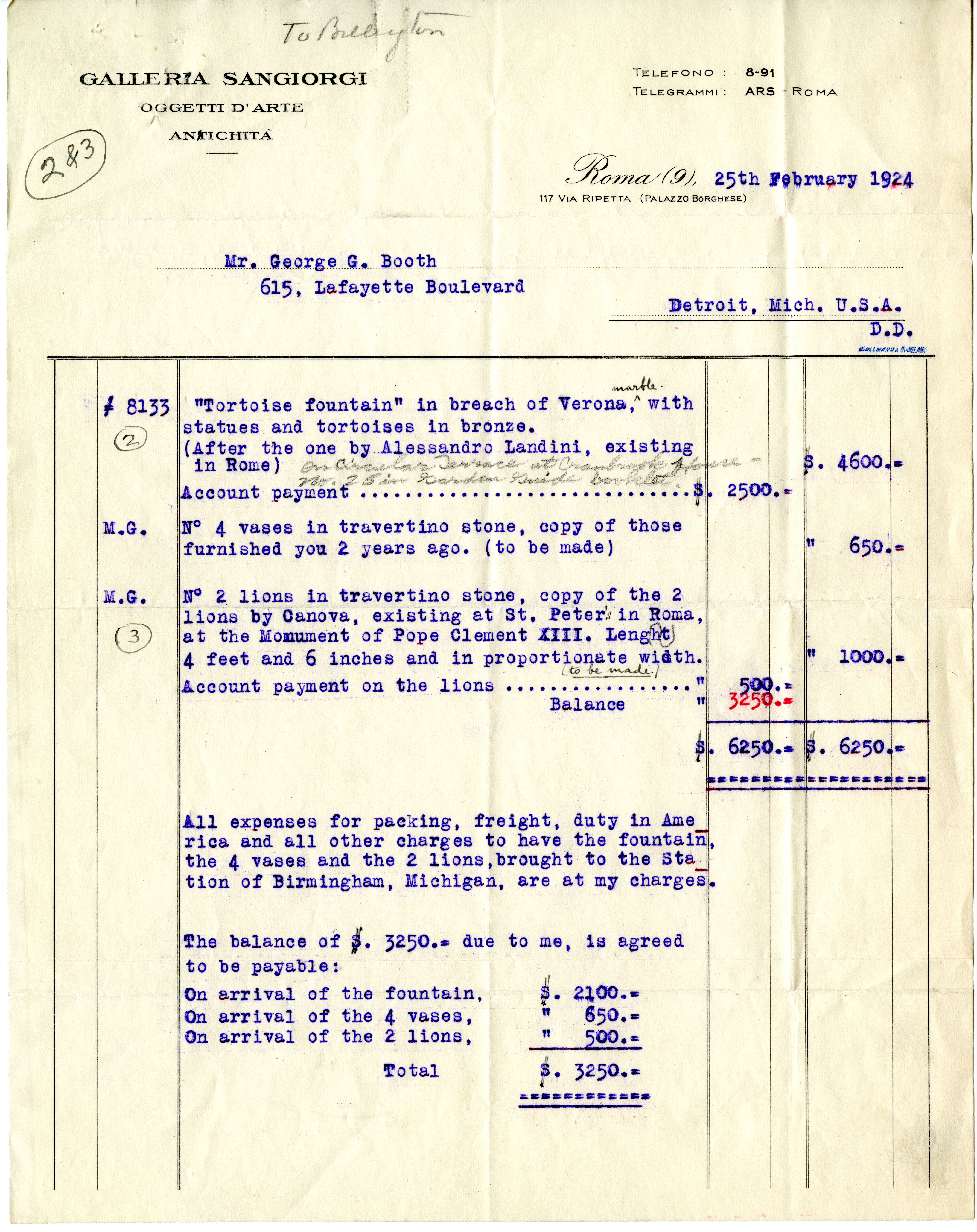
“I at once went to the Galerie Sangiorgi where I bought the last fountain – and at first was disappointed as I had a mind picture which could not be realized there. There was one fountain which they had when I was there last – a replica of one in Rome often regarded as the best if not, as some say, “the most beautiful”…”
The letter is very informative about the materials from which the fountain is made, what they weigh, and how he envisions it on the circular terrace, even including a small drawing of the base of the fountain (top of page 2).
Invoice, Galleria Sangiorgi, February 25, 1924. Copyright Cranbrook Archives.
The fountain was cast by Chiurazzi Foundry in Naples, whose works were often sold by the Galerie Sangiorgi. The design of the fountain was inspired by the Fontana delle Tartarughe, which stands in the Piazza Mattei in Rome. The original was designed by Giacomo della Porta and Taddeo Landini in 1581, which featured dolphins instead of turtles. During restoration in 1658, the dolphins were removed due to their weight and replaced by bronze turtles, which were sculpted by Giovanni Lorenzo Bernini. Cranbrook’s Turtle Fountain was restored in September 1980 through the Gardens Auxiliary. Visit the fountain this spring on your own or on a tour with Cranbrook House and Gardens Auxiliary.
At the Cranbrook Center for Collections and Research, we care for not only the historic objects on the campus, called Cultural Properties, but also the three-dimensional objects that often come in with Archival Collections, known as Realia.
These three-dimensional objects need different storage than the papers in archival collections. Often, these items are only listed as “Realia” in the Archives Finding Aidswithout individual descriptions- you have to pull out the box to know what is inside. For this reason, we are now recording Realia individually in our Collections Management System.
Recently, I have begun working to rehouse, catalog, and photograph the Realia in the Archives to make it more accessible and searchable. The first collection I worked on was the Virginia Kingswood Booth Vogel Papers, which contained some fun objects.
Virginia Kingswood Booth on her European trip in 1920. Courtesy of Virginia Kingswood Booth Vogel Papers, Cranbrook Archives.
Virginia Kingswood Booth Vogel was born in 1908, the only daughter of Ralph Harman Booth and Myrtle Mary Batterman Booth. Ralph Harman Booth was a co-founder of Booth Newspapers and a brother of George Gough Booth, founder of Cranbrook.
“My On-Hangers” were what Virginia Kingswood Booth (Vogel) called the charms she collected on her European trip with her parents in 1920 at age 12. Virginia purchased the charms at the various stops on the trip. She found charms that represented the places they visited or an event that happened, like the cold she had (bedpan charm) or the baby born to a family friend (baby rattle). Some other examples are the globe, which represented the trip itself, and the 1910 Passion Play Medallion that was purchased when the family visited the town of Oberammergau, famous for (as readers of the blog know) its Passion Play. She would continue to collect charms on later trips, though none are as documented as those from the 1920 trip.
Globe charm representing, to Virginia Kingswood Booth, the start of her European journey.
1910 Passion Play Medallion.
These charms were originally stored in a box, wrapped in tissue, and tied together on strings. This made viewing individual charms difficult and, being tied together, caused unnecessary abrasion and wear. I removed each charm from the string and placed it in its own compartment in an acid-free tray. So that the charms would not get jumbled when moving the box, each one was sewn to a piece of foam.
Some of the “On-Hangers” in their new, archival housing.
Edelweiss charm in its new housing. The number indicates that the object is in Archives (ARC), in the Virginia Kingswood Booth Vogel papers (1999.1), in the 1920 collection of charms (.1), and that this is the 61st charm (.61).
Look for more fascinating discoveries in the coming weeks, as more Archival Realia is cataloged and rehoused.
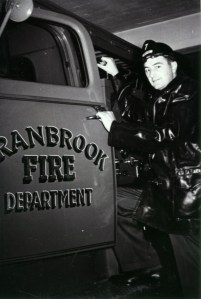
Recently, the Center for Collections and Research received a Cranbrook Fire Department Firefighter’s Helmet. It had been given to Charles Zimmerman while he was a Police Officer at Cranbrook by one of the Vettraino brothers. Because of the new acquisition, I decided to read up on the Cranbrook Fire Department.
Cranbrook Fire Department Firefighter’s Helmet. Gift of Frank M. Edwards.
In 1934, George G. Booth asked the Cranbrook Foundation to purchase a fire truck and equipment, essentially beginning the Cranbrook Fire Department. A fire hall was built in early 1935 to house the new truck – a 1934 Ford Truck V8 Chassis with a Proctor-Keefe Company body and fire equipment, including a 500-gallon Barton-American Pump mounted on the front of the truck.
In the existing Tower Cottage fire hall (built in 1921) was a 1934 Ford Pick-up with fire equipment and a Barton-American U-355 pump mounted on the front of the car; booster tank and fittings, 2 lengths suction hose, and a hydrant adapter. It had been purchased by George and Ellen Booth for use at the homestead property.
In 1935, after studying at the University of Michigan’s Fire School, Dominick Vettraino was named the Fire Chief. The Assistant Chief was his brother John Vettraino. All other firefighters were volunteers from the maintenance staffs of all the Cranbrook institutions. Because they were paid, the Chief or Assistant Chief was always on call, including Sundays and holidays, and lived on campus, but it was not until 1938, that the Cranbrook Foundation decided a residence for the Chief should be built next to the fire hall.
Cranbrook Fire Department Chief Dominick Vettraino. Dominick Vettraino Papers. Courtesy Cranbrook Archives.
To cover the cost of the department, and to pay the Chief and Assistant Chief, proportional interdepartmental support was required. The insurance savings to Cranbrook for having its own fire department ended up offsetting the cost of having the department and gave Cranbrook a better insurance rating than even the City of Bloomfield Hills.
Left to right: Louis Larson, Ed Morrow, Homer Murphy, Walter Powell, Donald Tompkins, Pete Peterson, Chief Dominick Vettraino, and Floyd Pickering, members of the Cranbrook Fire Department in 1944. Not pictured, George Leslie, John Winfield, O.D. Hillman, and John Vettraino. Dominick Vettraino Papers. Courtesy Cranbrook Archives.
The Cranbrook Fire Department protected all the Cranbrook institutions and residences as well as the nearby homes of the Booth’s children: the Beresfords, the Henry S. Booths, the Warren S. Booths, and Harry L. & Grace B. Wallace. Though strictly a Cranbrook institution, the department was always willing to assist neighbors in the community when possible.
For more great images related to the Cranbrook Fire Department, click here.
In pre-Columbian Mesoamerica, the calendar originated by the Mayans included 260 days. The “tzolkin” or “division of days” displayed in today’s photo are described as ceremonial or mythological. The calendar pages are part of a series of Mayan glyphs collected by Robert Hall Merrill (1881-1955). Merrill, an engineer and businessman, was a member of the Board of Trustees at Cranbrook Institute of Science from 1944-1953, as well as a consultant in the Anthropology department from 1948-1949.
Tzolkins 6 and 7 from the Robert Hall Merrill Papers, ca 1922.
Mary Miller, director of the Getty Research Institute, describes the Mesoamerican calendar as the oldest and most important calendar system (earliest evidence dating to 800-500 BCE). The original purpose of the 260-day calendar is unknown, but there are several theories. One theory is that the calendar is based on the mathematical operations for the numbers 20 and 13 (important numbers in the Mayan culture). The calendar combines a cycle of twenty named days with another cycle of thirteen numbers to produce 260 days. Each named day has a corresponding glyph as seen in the photo above.
The glyphs are part of a series sent to Merrill by Edith Gates McComas, sister of Maya scholar, William Gates. This extraordinary material was transferred to Cranbrook Archives in 2016.
The pursuit of historical truth, from national heritage to community identity or individual biography, depends upon archives—the portion of records selected for permanent preservation. In the west, recordkeeping emerged within the development of justice and administration—the earliest English law code is that of King Aethelberht of Kent, c.600, following the arrival of Augustine of Canterbury and the encouragement of peaceful dispute resolution. Henceforth, a fundamental and enduring feature of legal process comes to us from the Anglo-Saxons: the writ and the charter. Yet, throughout the early middle ages, grants and other legal deeds were made in public ceremonies where the attendant witnesses were the ‘memory’ of the act, not always supplemented by a charter. But, by the thirteenth century, documentary evidence had become necessary to prove ownership of land or other grants of the king, and records began to constitute the activity itself.
Over time, the type, format, and number of records has proliferated but those that are preserved, as archives, are the critical vestiges of ancient and recent memory—individual memories, institutional memories, national memories. They are primary sources essential to historical method to evidence claims of historical fact based on a reasoned interpretation of the records—these are the tasks of historians and scholars whose published research is found in secondary sources. Both types of sources are necessary when greeted with the archival FAQ, “I want to know more about this person, place, or thing—what do you have?” A recent request related to a church vessel, the “gold ciborium” at Christ Church Cranbrook. As is the case with any research, the starting place is to discover what has already been done. The first place to look for information on the art works at Christ Church Cranbrook is the Pilgrims’ Guide, first published in 1939, which guides visitors through the church with details of its artworks and craftsmen.
The Pilgrim’s Guide (4th Ed.), Thistle [Henry S. Booth], 1956
While the Guide is full of meticulously researched information, there was no mention of a ciborium. The reference files were similarly silent, except a photocopied memo from George Gough Booth dated 1927, listing a ciborium made by Arthur Stone (1992-01 5:2). And, sure enough, in the George Gough Booth Papers (1981-01, 22:7), there is correspondence with Arthur Stone about a gold-plated ciborium. Voilà! Well, not quite… it was not the right one. So, we found a photograph of it in the photo files, though it had no date, photographer or artist details, only the words “silver gilt ciborium”.
Silver Gilt Ciborium Copyright Cranbrook Archives, photographer unknown.
An inventory written by Henry Scripps Booth in 1960 (1981-01 20:6) has two ciboriums listed—that of Arthur Stone and another one with blanks for the creator and date of creation. But, taking a step back to the contemporaneous records for the building of the church, there are detailed ledgers for its construction and decoration. If the ciborium was purchased by George Gough Booth, there would most certainly be a record of it. Looking closely at the ledger pages, it is clear that a ciborium was commissioned from three separate artists: A. Nevill Kirk, Arthur Stone, and Helen K. Mills. These have certificate numbers which can be matched up with the ‘Cranbrook Church notebook’. So, we know that a third ciborium was purchased from an artist called Helen K. Mills, and the notebook gives us the date, February 7, 1928.
Pages of ledger showing entries related to chancel furnishings and equipment George Gough Booth Papers, Ledger—Cost of church, rectory, furnishings, etc., 1925-1935 (1981-01, 21:6)
There is correspondence with Kirk and Stone in the Christ Church Cranbrook series of George’s papers but none with Helen Mills. But there must be some elsewhere. When we are processing archives, we must carefully consider three things: content (who created the documents and what is in them?), context (in what circumstances were they created and why?), and structure (how do they relate to other documents in the collection and the institution?). These things can also be applied in using archives. So, in looking for correspondence with artists regarding artwork at the time of the construction of the church, there is another place to look—the Detroit Society of Arts and Crafts correspondence. Here we find correspondence between Helen Keeling Mills, Helen Plumb, and George Gough Booth.
Correspondence of Helen Keeling Mills, Helen Plumb, and George Gough Booth, January 26, 1928, and February 8,1928George Gough Booth Papers, Detroit Society of Arts and Crafts 1914-1957 (1981-01, 12:19)
Correspondence of Helen Keeling Mills, Helen Plumb, and George Gough Booth, January 26, 1928, and February 8,1928 George Gough Booth Papers, Detroit Society of Arts and Crafts 1914-1957 (1981-01, 12:19)
While records might initially be kept to evidence an activity, over time they are of historical value. They can help us understand a person, provide knowledge of an organization, contribute to knowledge of a craft or a culture, they inform us of the creation of an object so that it may be maintained and preserved in its most beneficial environment. Last, but not least, a document becomes an artifact in itself because of who wrote it, what it says, and because it is simply beautiful. This correspondence was kept initially to document his transaction with Helen as part of the wider collection of records for the church. But we can learn much more from it. We know something about the creative process of the ciborium—what it is made of, the saints depicted upon it, that it was sent to another artist after which it was damaged. We know the importance that Helen placed in her work and her regret of the damage. We can see George’s gracious response and understanding—his appreciation of her devotion to her work and the joy that will be taken in the object she created.
This research query helped to draw information out of the archive that was hitherto not expressly known. There is now a reference file to aid future researchers so that the knowledge is accessible with references to the records that document it, and the research process need not be made again. And so, just as teachers learn from their students, the archive and archivists learn from their researchers.
Sisu is a Finnish concept described as stoic determination, a tenacity of purpose, grit, bravery, resilience; it is also the word weaver Marianne Strengell used to describe her friend Maija Grotell.
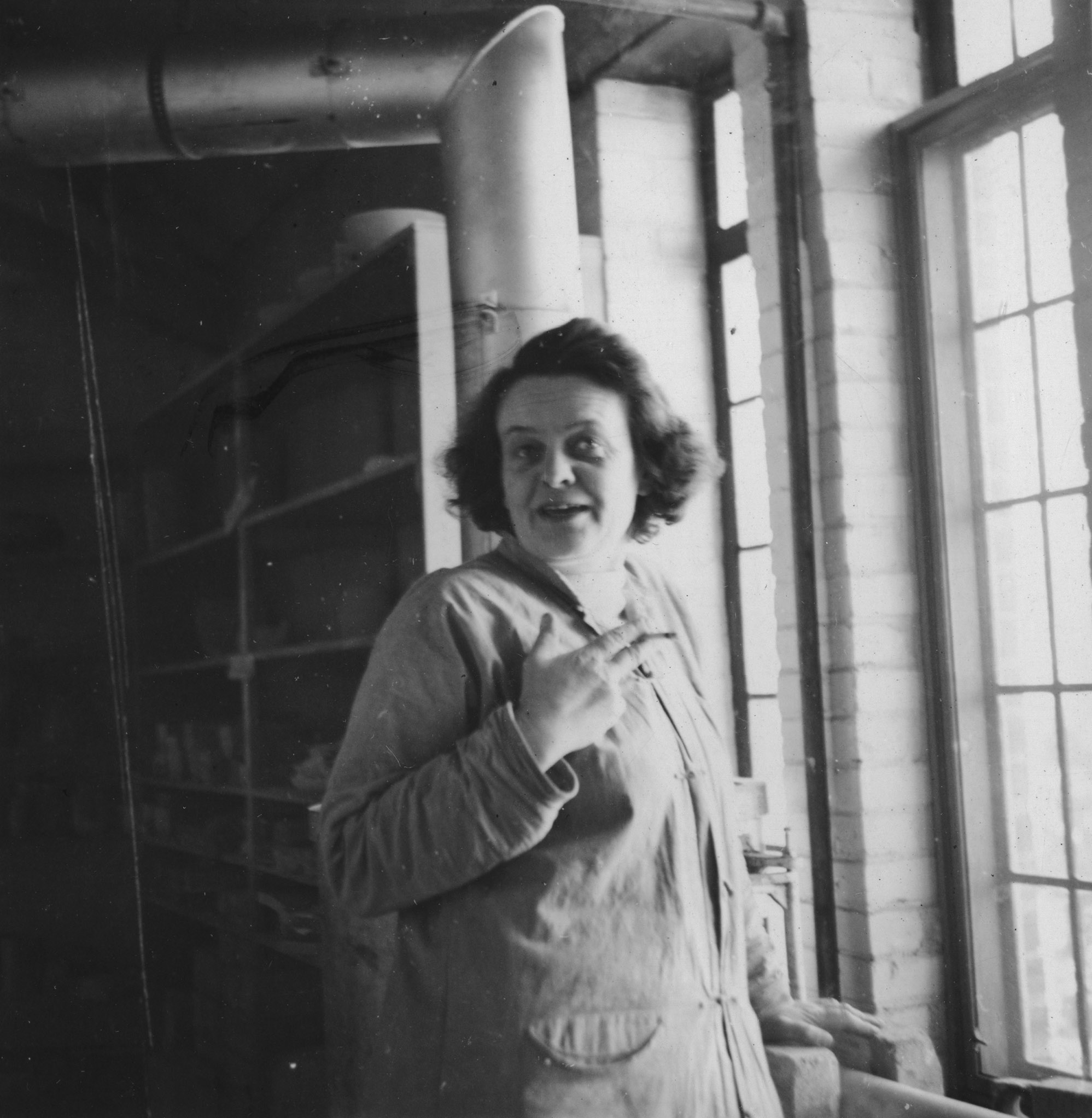
Maija Grotell at Cranbrook Academy of Art Faculty Breakfast, 1939. Courtesy of Cranbrook Archives.
Maija Grotell was born August 19, 1899, in Helsinki, Finland. She studied painting and sculpture in Helsinki, graduating in 1920. While working at a textile firm as an artist, she completed six years of graduate work in ceramics (1920-1926) under Alfred William Finch, a noted Belgian ceramicist and painter who practiced in Finland.
In October 1927, Grotell immigrated to the United States, settling in New York where she studied for one summer under Charles Fergus Binns. Her first employment was as an Instructor at Inwood Pottery Studios in New York City (1927-1928). She went on to teach children at the Union Settlement (1928-1929) and at the Henry Street Craft School Settlement (1929-1937), both in New York. While teaching ceramics and researching glazes, Grotell was also exhibiting and selling her own ceramics. From 1937 to 1938, Grotell was a ceramics instructor and research assistant at the Department of Ceramics at Rutgers University in Newark, New Jersey. She became a naturalized United States citizen in 1934.
Maija Grotell in the Cranbrook Academy of Art Ceramics Studio. Courtesy of Cranbrook Archives.
According to the Metropolitan Museum of Art, “Maija Grotell was one of the most significant potters working independently during the late 1930s. Although a relatively large number of women played important roles in the art pottery movement in the early twentieth century, few female ceramists were active between the first and second World War. Grotell was one of the exceptions.”
Maija Grotell at work. From the Maija Grotell Papers, Cranbrook Archives.
As Eliel Saarinen’s complex of buildings at Cranbrook began to take shape, he sought out distinguished artists and craftspeople to work in the studios. Impressed with a gallery exhibition of Grotell’s work, Saarinen envisioned her ceramics contributing to the architecture of Cranbrook. In the fall of 1938, Saarinen invited Grotell to join himself, Carl Milles, and Marianne Strengell at the Cranbrook Academy of Art as head of the ceramics department, a position she held until her retirement in 1966.
Grotell described the way she worked as such, “I always have something I am aiming at, and I keep on. I do not sketch on paper, I sketch in clay. So if it is not what I want, I make another one and keep on. In that way I have many similar pieces. My reason is not for repeating, but for improving.”
Maija Grotell overlooks her students in the Cranbrook Academy of Art Ceramics Studio, 1939. Courtesy of Cranbrook Archives.
In her teaching, Grotell emphasized ceramics as a medium of artistic expression. Many students trained by her went into teaching and were integral to the development of America’s university ceramics programs following World War II. In her twenty-eight years at Cranbrook, her students included Richard DeVore, Toshiko Takaezu, John Glick, Susanne Stephenson, Lydia Kahn Winston Malbin, and Jeff Schlanger.
Of Grotell, Takaezu said, “Majia’s astute, honest, sharp criticism would sometimes fall into place months later, but it was always true. Maija didn’t say very much and what she didn’t say was as important as what she did say, once you realized she was thoroughly aware of everything you did.”
Under This Roof Six Dreams Were Dreamed and All Came True – 1908, 1961. Commissioned by Henry Scripps Booth and executed by Maija Grotell, the vessel commemorates the founding of Cranbrook. Courtesy of the Cranbrook Center for Collections and Research.
Her “astute, honest, sharp criticism” may have been what Marianne Strengell was thinking of when she started calling her Sisu. She had the tenacity to tell her students the truth; no holding back to spare feelings.
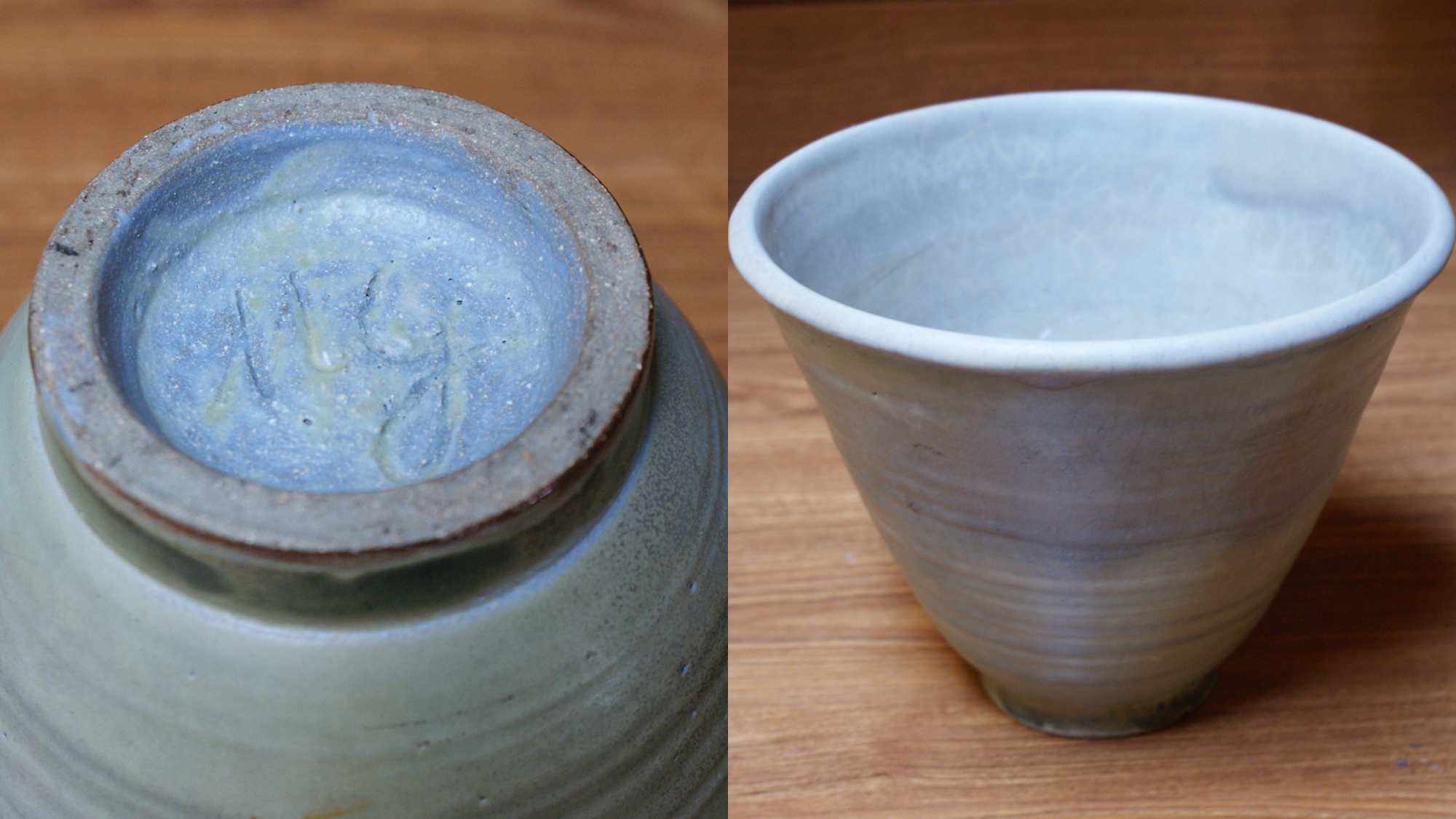
“MG” signature on the bottom of a vessel at the Frank Lloyd Wright Smith House. Courtesy of the Cranbrook Center for Collections and Research.
Throughout her career, Grotell actively engaged in research on glazes. She developed copper reds, ash glazes, intense blues, and crackle glazes. One of her original discoveries was the use of chromium and iron in place of uranium to produce a brilliant orange glaze. Her work opened the door to the architectural uses of glazed, colored bricks in midcentury architecture, including those used by Eero Saarinen at the General Motors Technical Center (1953-1955).
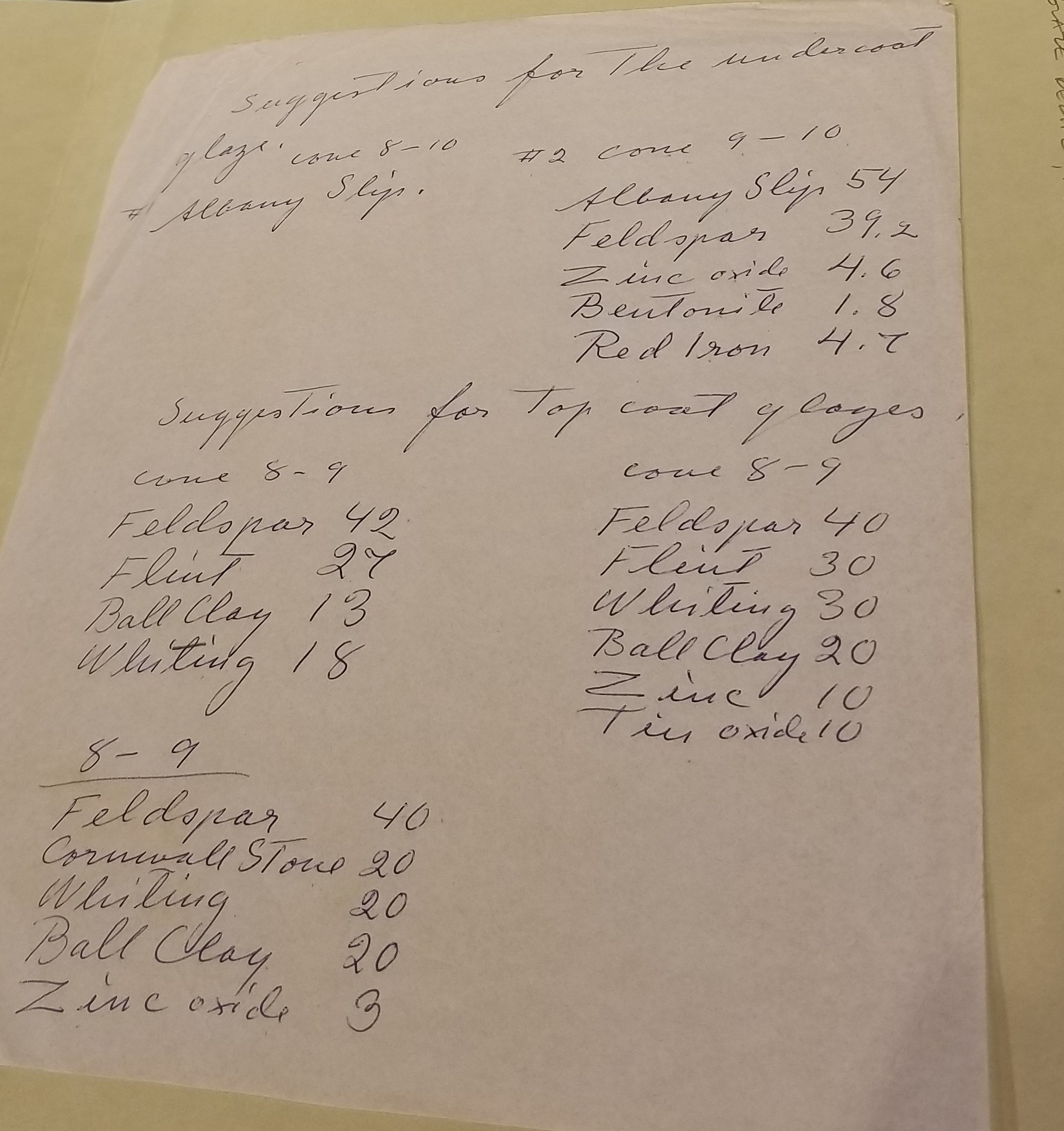
A glaze recipe from the Maija Grotell Papers in Cranbrook Archives.
She died on December 6, 1973, in Pontiac, Michigan, but Grotell’s glaze formulas remain a large part of her legacy. Another legacy came in 1977: the “Arts & Craft Court” at the Cranbrook Academy of Art was renamed the “Maija Grotell Court” in her honor.
Exceptional that such a strong, well-respected woman was so influential at the Cranbrook Academy of Art in its formative years as well as the art world.
There’s people down to Clovertown whose only end an’ aim Is jest to set an’ fiddle with some dern fool, silly game They used to play at tid’lywinks an’ authors – an’ I guess, They hankered after dominoes, an’ crokinole, an’ chess: An’ as fer checkers – goodness me! – they said you couldn’t find A better thing to cultivate the morals an’ the mind But now – by gum, it makes me laugh – they wouldn’t give a pinch Of salt, fer’ all them former games: The only thing is “Flinch”
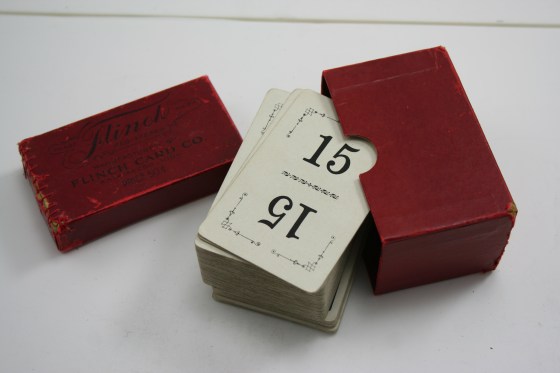
The Booths didn’t “give a pinch of salt” and had a number of copies of the game “Flinch.” Henry Scripps Booth wrote, “The commonest social entertainment when we lived in Detroit was playing the card game of Flinch. It was also popular across Trumbull Avenue at the Scripp’s home. Later we also played it at Cranbrook.”
One of the Booth’s copies of the game Flinch (CECT 277)
Invented in 1901 by Arthur J. Patterson (1869-1948) of Kalamazoo, Michigan, “Flinch” is the card game that took America by storm in the early 1900’s. The object of the game is to stockpile and then get rid of all your cards.
Flinch is played with a deck of 150 cards numbered 1-15. Players can play cards in sequence (building up from 1 to 15) to piles formed in the center of the table. “1” cards must be played to start the piles, but others may be played or held at the player’s discretion. Cards may be played from several sources: a player’s hand (five cards to start), a player’s “game pile” (a stack of 10 cards of which only the top card is face up and playable), or a player’s “reserve piles” (whenever a player passes or completes a turn, they must add a card from their hand to their reserve piles – up to five reserve piles may be formed). Hands are continually replenished with new sets of five cards during the game. The object is to play all 10 cards from game pile to the center of the table.
– Leslie S. Mio, Associate Registrar
*”Allurements of Flinch,” Kalamazoo Gazette, 12 July 1903, page 14, column 4