New Discoveries in Old Collections

Today, the Archives is pleased to announce the completion of a photographic negative rehousing project funded by the Fred A. and Barbara M. Erb Family Foundation. The first part of this grant-funded project ran from March 2017 through February 2018, when thousands of negatives were rehoused by Veronica Wood and Kaitlin Sharra Eraqi. The success of this first part allowed us to extend the grant project, and from November 2018 through June 2019 Veronica rehoused many more negatives. We are grateful to Veronica for her many hours of hard work and, as of today, over 20,000 Cranbrook School negatives have been rehoused.

Alongside this effort, we are thankful for the work of our steadfast volunteers—Lois Harsh, Judy Pardonnet, and Ellen Vanderkolk—who have been rehousing other collections. These have included the Portrait series, the Institute of Science series by Harvey Croze, Kingswood School, St, Dunstan’s Theater, the Summer Theater, the Cranbrook Community/Foundation negatives, and the Pleasures of Life. We also currently have two new volunteers, Aya and Brandon, who have completed rehousing of some smaller collections, including Marianne Strengell, Swanson Associates, and Carol Waldeck.

Why all of this rehousing? Many of the photographic negatives are made of acetate cellulose or nitrate cellulose, both of which have a plastic base which deteriorates over time. Cranbrook employed a professional photographer from 1933 to 1970, and their images were maintained by the Cranbrook Press Office before they were transferred to Cranbrook Archives. Here, they have been stored in their original plain paper envelopes or, more detrimentally, in plastic sleeves. As they age, we must stabilize the negatives for future generations by rehousing them in acid-free paper envelopes.
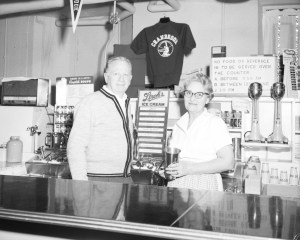
CR3182-2

Mr. and Mrs. Price at the Cranbrook School Store, April 1963. Photographer, Harvey Croze, neg.CR3182-2. Copyright Cranbrook Archives.

The twofold goal of any archive is preservation and access of its holdings, and to this effect, much is achieved through arrangement and description—how the materials are stored, in what order, and how they are described. While the primary goal of the rehousing project was to address the physical preservation needs of our photographic negatives, it has also been advantageous for their intellectual control. As we work through thousands of negatives, photographs have been found alongside their negatives, as well as ephemera such as Summer Theatre playbills. These discoveries have helped us to enhance the descriptive metadata (the who, what, when and where) for the negatives. More detailed descriptions will help us, and our researchers, know what exactly is available within Cranbrook Archives.

The numbering system for Cranbrook photographs was developed by Richard G. Askew, Cranbrook photographer from 1933-1941. There were several short-term photographers until Harvey Croze became the photographer from 1943-1970. Each collection has its own index, which records the negative number given to each photograph, the content of the photograph, when it was taken, and by whom. However, sometimes the content field may only record an event without giving any details of who is in the photograph.

An unexpected outcome of the Erb Foundation negative rehousing project has been to enhance the metadata in the indexes, whether by seeing the photographs with the negatives and being able to identify the people or places, or by cross-referencing with the collections to establish the context of the content. By adding in more information to the metadata in this way, the usefulness of the negative collection is improved and the relationships between collections are also strengthened. I would like to share with you some examples of these discoveries that will help us to know more about the people, places, and things of Cranbrook.

The following are examples of images that were recorded by only their event name. Now, the index contains the names of the individuals and objects, enabling us to better utilize the negatives:
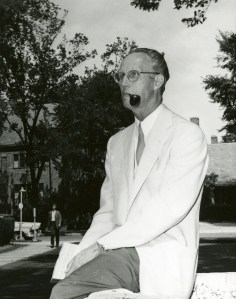
FD84

Henry Scripps Booth photographed during an Editors visit to Cranbrook, 1958. Photographer, Harvey Croze, neg. FD84-22. Copyright Cranbrook Archives.
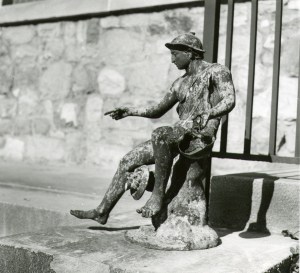
CC201

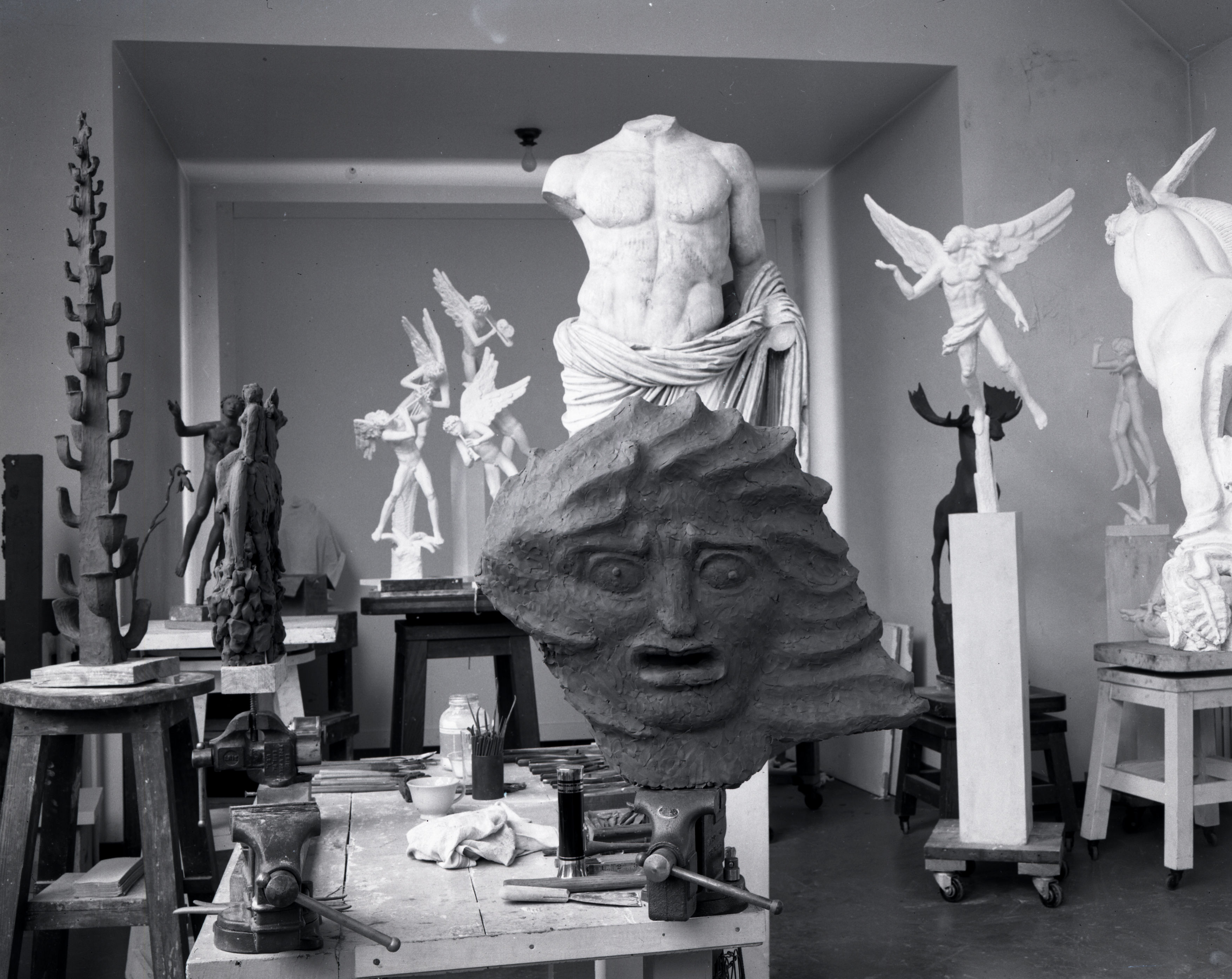
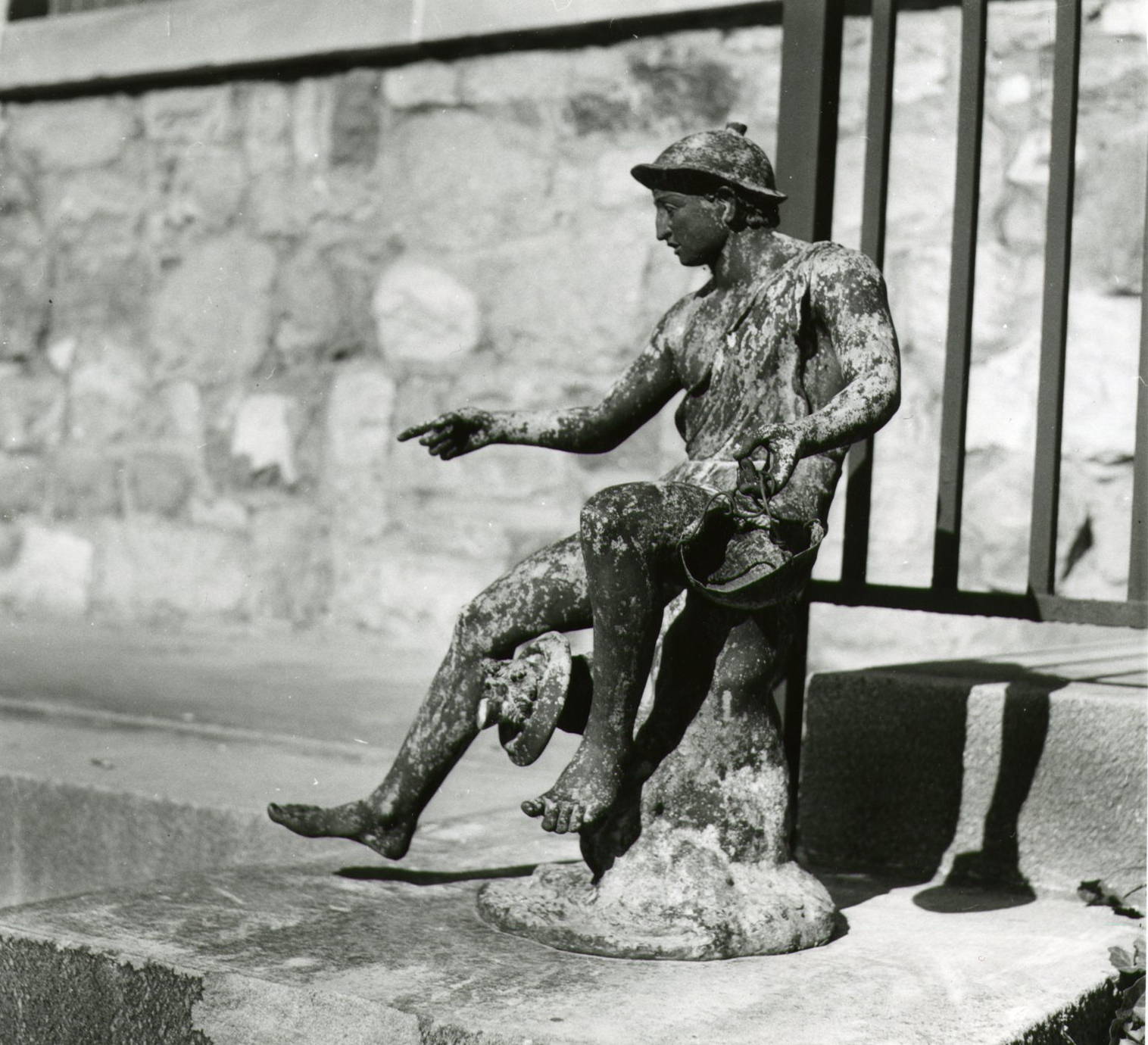
“Formal Garden Opening” 1951. Unknown (Roman Warrior) by Unknown (Italian).
Bequest of George Gough Booth and Ellen Scripps Booth to the Cranbrook Foundation. Photographer, Harvey Croze, neg. CC201. Copyright Cranbrook Archives.

As another example, before our negative rehousing project, a researcher looking into Lillian Holm would have been highly unlikely to discover this picture of her. The image was previously indexed only as “Founders’ Day 1965”:
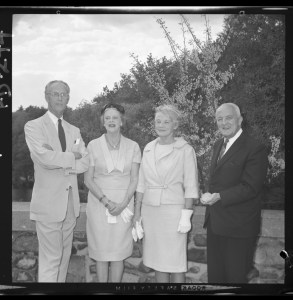
FD244-85

Henry Scripps Booth, Josephine Hodges Waldo, Lillian Holm and Carl G. Wonnberger on Founders’ Day 1965. Photographer, Harvey Croze, neg. FD244-85. Copyright Cranbrook Archives.

Another interesting find was a series of photographs for which the index simply noted “Jack Speohr, Cranbrook School alumnus.” Wanting to know more, I looked up Speohr in the Cranbrook Institute of Science newsletter index. I learned Jack Spoehr, who graduated from Cranbrook School in 1949, and went on to study ethnological studies at Harvard. In 1950, he visited a remote part of Mexico called Cuauhtémoc, which about 75 miles southwest of Chihuahua City, where he studied the native peoples there, the Darámuli, (also called Tarahumara), who often crafted violins both for trade and for use in religious ceremonies. A short article, ‘A Visit to the Tarahumaras,’ about his observations there, is published in the Cranbrook Institute of Science Newsletter, Vol. 21 No.1, of September 1951. The first photograph, below, shows a member of the Darámuli just as Spoehr describes on page 3 of his article.

CC277-9

A member of the Darámuli (Tarahumaras). Photographer, Jack Spoehr, neg. CC277-9. Courtesy Cranbrook Archives.

CC277-13P

A member of the Darámuli (Tarahumaras) crafting a violin. Photographer, Jack Spoehr, neg. CC277-13. Courtesy Cranbrook Archives.

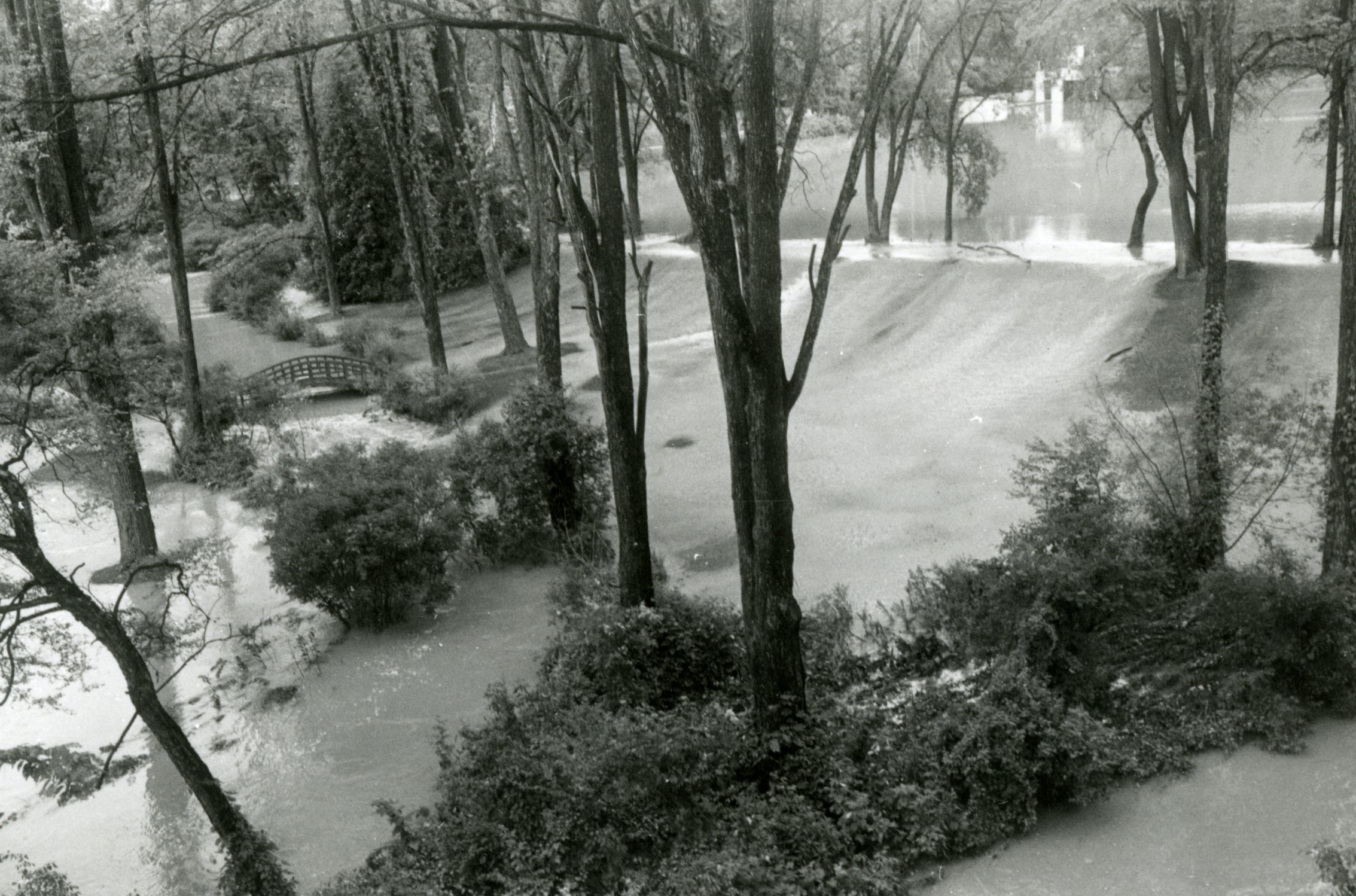
For those who have not been delighted by the weather recently, you will see that it was much worse in June of 1969, when there were floods at Brookside and Kingswood:

FD290-29

View of the old Meeting House during flooding at Brookside, June 1969. Photographer, Harvey Croze, neg. FD290-12. Copyright Cranbrook Archives.

FD290-22

View of the Japanese Garden bridge during flooding at Kingswood, June 1969. Photographer, Harvey Croze, neg. FD290-12. Copyright Cranbrook Archives.

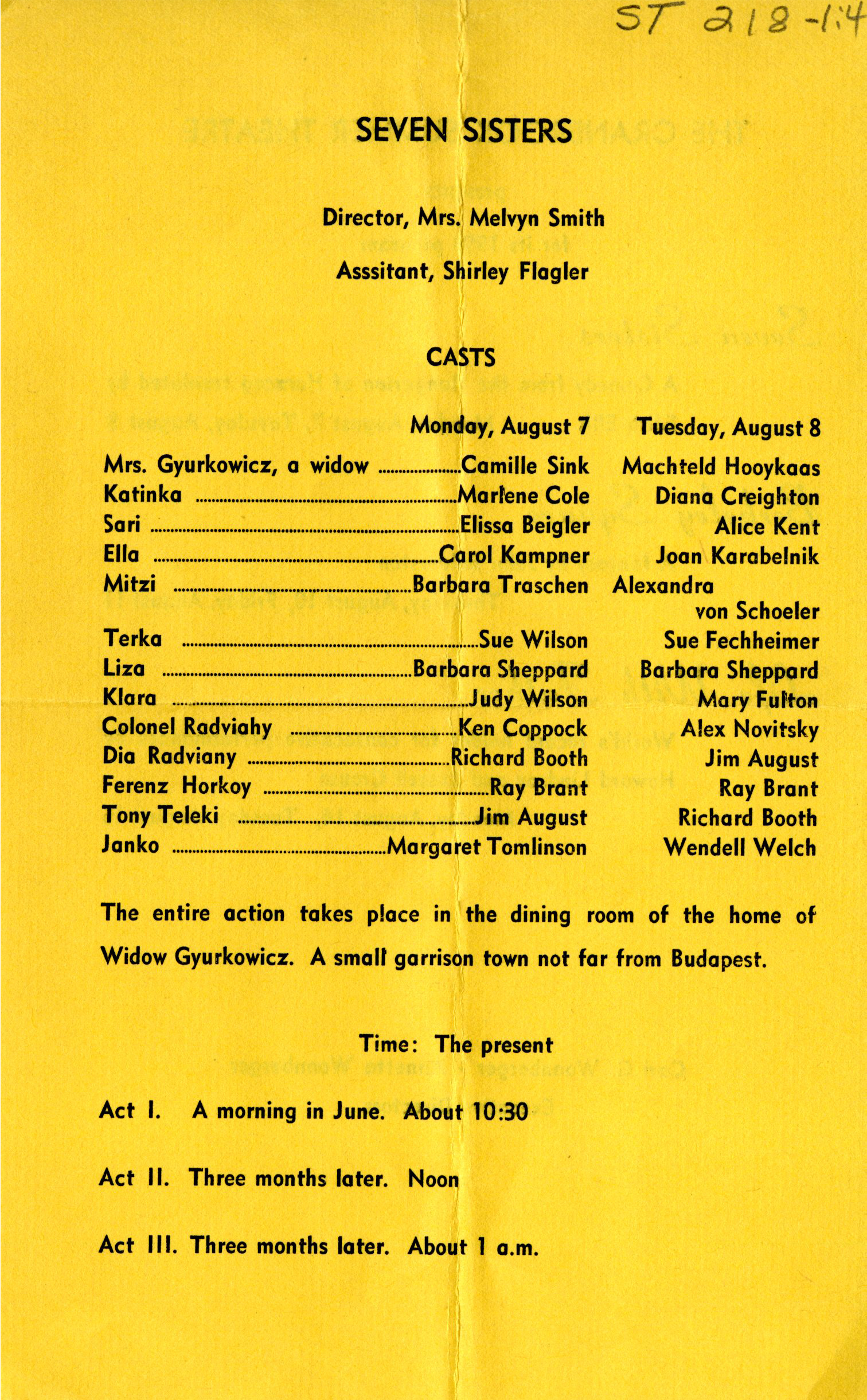
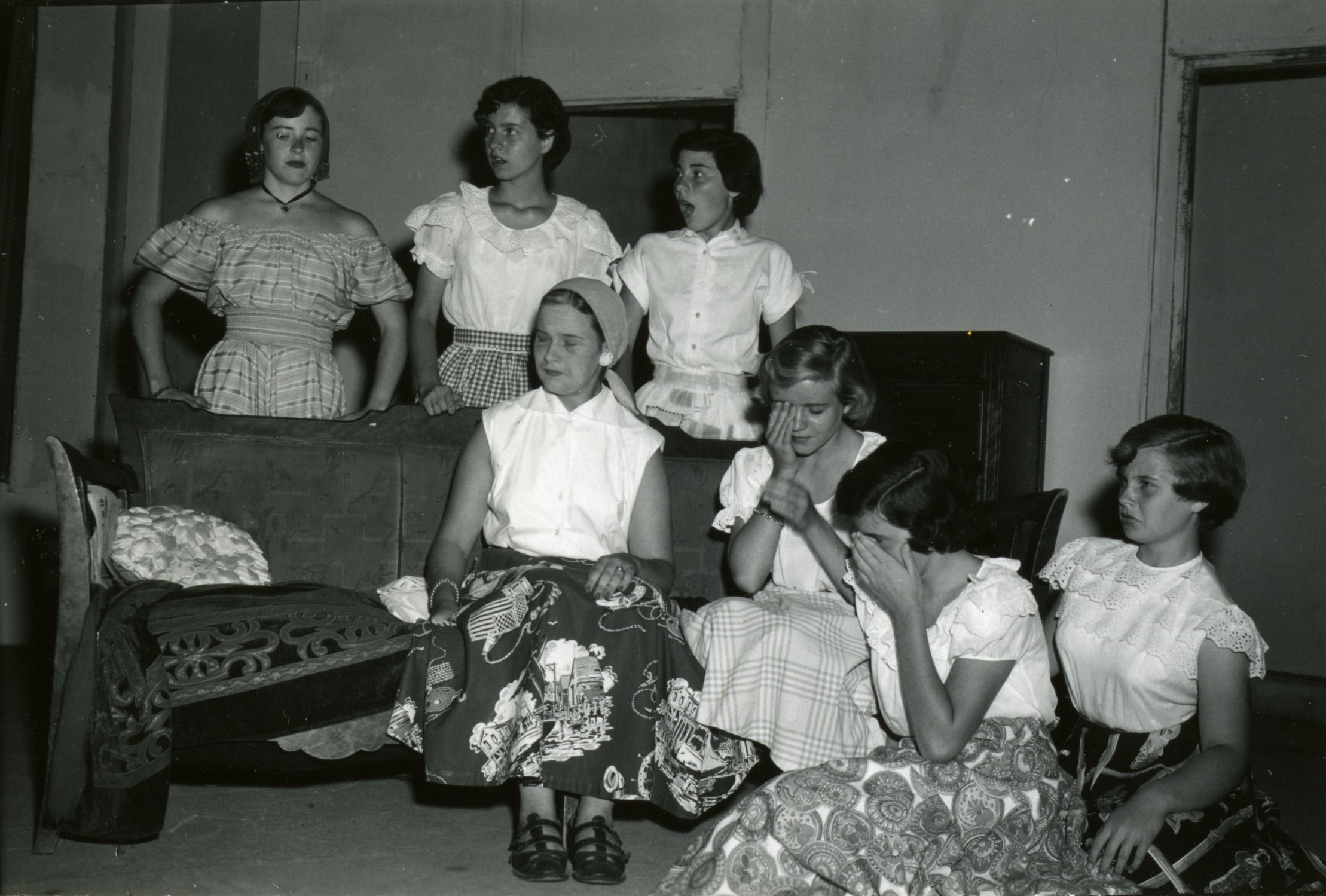
Filed among the negatives, we have found numerous playbills from both the Summer Theatre series and the Ergasterion performances in the Cranbrook School series. These relate to their respective manuscript collections as well as the poster collection, which was completely digitized in 2015. It is interesting to see Sara Smith as Director of some of the plays as the Smith House Records are currently being processed and will be open for research later this year.

Seven Sisters Flyer

The playbill for the Summer Theatre performance of Seven Sisters, 1950. Copyright Cranbrook Archives.

ST218

Seven Sisters Dress Rehearsal, 1950. Photographer, Harvey Croze, neg. #ST218-3. Copyright Cranbrook Archives.

We are very pleased to have made these new connections across existing collections within Cranbrook Archives, and are grateful to the Erb Family Foundation for enabling us to better preserve these important images.

– Laura MacNewman, Associate Archivist

In the Archives: My Senior May Experience

I went into my Senior May Project hoping to find the “secrets” of Cranbrook. On the second or third day, Mr. Adkisson asked Desai, another Senior May student, and me why we chose the Archives. I said because I wanted to learn more—and because I thought it would be easy. What I meant to say is that I thought it would be low stress. Even though I didn’t uncover any “secrets,” I learned a lot about the history of Cranbrook Schools and had a very enjoyable (and low stress) Senior May experience.

IMG_5707

Aya Miller, CKU ’19, at work in the Archives Reading Room. Photo Kevin Adkisson.

My project was primarily scanning copies of The Cranbrook Kingswood Crane-Clarion to create a database of The Crane and moving the archival files to different shelving units. Along the way, I helped out with other Archives related tasks that came up. These included transferring larger files to and from Thornlea Studio, preparing displays for small tour groups, and picking out photos that could be used on the Center for Collections and Research Facebook page.

One of the high points of my experience was a task we did on the first day. Laura MacNewman, my supervisor, Mr. Adkisson, Desai, and I went to Christ Church Cranbrook in search of a friar within the Women’s Window. The friar was an insignia from the designer and glassmaker who constructed the window. We took a very narrow staircase, hidden in the wall, up to the bottom of the window. The area was so small that Mr. Adkisson could barely walk over with his tripod to take the picture. While we were up there, they turned the lights out in the main sanctuary. The daylight filtered in through the stained-glass window and gave the church a faint pink tint. I was awe struck; it was simply stunning. I felt like I was in a picture from National Geographic. That view and many other small things I learned helped make my time in the Archives memorable.

IMG_8952

A view from the Women’s Window at Christ Church Cranbrook. Photo by Aya Miller, CKU ’19.

As for scanning, I learned a lot about stories that were covered in the past. In the March 2006 issue of the Crane-Clarion there was a two-page article called “The Problem of ‘Self-Segregation’ at Cranbrook.” The article covered how minorities often group together and how white students don’t notice that the majority of their friends, as well as the majority of the school, is white. It takes editors that find these issues important to bring them to the forefront. Although for many it may be an uncomfortable subject, it is a necessary one to discuss.

I also read interesting articles about the removal of a Robert E. Lee statue that used to stand in Gordon Hall of Science. In reading the articles, I was surprised that the students had many contrasting opinions. Some people quoted were against the statue’s removal because they saw Lee as an American hero in terms of his post-War accomplishments and his fight for states’ rights in the Civil War. In the end, the faculty choose to remove it because Lee’s role as a leading general in support of slavery during the Civil War was offensive to many students and families. The coverage opened my eyes to different opinions and reaffirmed my belief that there are always many sides and opinions to a situation.

No. 3, February 2004, Opinion, Pg.2

Opinion section of The Cranbrook Kingswood Crane-Clarion, February 2005. Courtesy of Cranbrook Archives.

To put it simply, Senior May was great. The Archives was a relaxing and enjoyable place to work for the last three weeks of my Senior Year. I’m proud that I was able to help and make a difference, even if it was a small one. In fact, I enjoyed it so much that I’ll be staying on throughout the summer to continue working as a volunteer. I’d like to thank those who work at the Center for Collections and Research as well as my supervisor, Laura MacNewman, for welcoming and hosting me.

Aya Miller, Cranbrook Kingswood Upper School 2019

Editor’s Note: The Senior May Project is a school-sponsored activity that encourages Cranbrook Kingswood Upper School seniors to acquire work experience in a field they are considering as a college major, a potential profession, and/or as a personal interest.

Aya Miller is a native of Kalamazoo, Michigan, and has been a boarding student at Cranbrook since 2015. Aya will be enrolling at Western Michigan University in Kalamazoo this fall. The Center thanks her for her tireless efforts scanning important documents about Cranbrook’s history, and her volunteering to continue with us this summer. We know she will be a success as she embarks on the next phase of her education!


Revel in the Clutter of Edward Fella’s 1972 Cranbrook Map

On the inside cover of the 1973/1975 Cranbrook Academy of Art Catalog is a hand-drawn, fold-out map of the campus. I’ve always liked this map, with its witty labels like “Brookside School for Little Kids” and “Another Famous Statue.”

Map of Cranbrook from 1973 Catalog by Edward Fella.jpg

Map of Cranbrook drawn by Edward Fella (CAA Design 1987), 1972. Printed on the inside cover of the 1973/1975 Cranbrook Academy of Art Course Catalog. Courtesy of Cranbrook Archives.

On the top left, you’ll see “Athletic Fields (Detroit Lions practice here).” The map also documents the neighborhood: on the far right, “Houses of the Bloomfield Hills wealthy” and on the bottom left, “Used to be orchards here, now houses.” If you look nearby, you’ll see “Map drawn by Edward Fella 1972.”

There are other labels that help expand our understanding of Cranbrook in 1972. The Old Water Tower (a thorn in Saarinen’s side) is still standing, and Cranbrook House is listed as “Booth Estate, Cranbrook House, now Institute for Pastoral Studies.” There are still tennis courts where the New Studios and Middle School for Girls would be built. There’s no label for Saarinen House, instead, sandwiched between the “Foundry Studio,” “Architecture,” “Ceramics,” “Fabrics,” and “Metalsmithing” reads a label for “President’s House.” (Wallace Mitchell was the Academy’s president at the time). Although there are lots of cars and some people—I spy football players, an entrance guard, and a life guard—the only proper name I see is “McCoy Studio.” This makes sense: Ed Fella was a frequent collaborator with, and later a student of, Katherine and Michael McCoy.

Edward Fella is a native of Detroit who graduated from Cass Technical High School in 1957. There, he studied lettering, illustration, paste-up, and other commercial-art techniques. He went directly from high school into advertising work as a commercial artist, working primarily for automotive and health-care clients. He had a successful career in advertising for almost three decades in Detroit.

In the early 1970s, the period in which Fella drew our map, he was working on freelance work between more conventional assignments. These pieces were often whimsical collages of photocopied materials with hand drawing and lettering additions. In 1970, Fella met Katherine McCoy (future Artist-in-Residence at Cranbrook) at Designers & Partners, his employer, in downtown Detroit. As McCoy recalled to Design Traveler last year, “I interviewed with the senior design partner, Al Evans, who offered me a job that day and introduced me to Ed Fella as I left. I recall a 32-year-old Ed sitting at his drawing board smoking his usual cigarette in his studio space right by the studio’s front door. I was 25 and very impressed by his wall of books, stacks of magazines, and graphic ephemera pinned up everywhere.” She noted that Fella was “already a Detroit advertising design celebrity.”

McCoy only worked at Design & Partners one year, leaving in 1971 to head Cranbrook’s design department with her husband Michael. There, she would often invite Fella to present his work to students and offer critiques. As McCoy told the American Institute of Graphic Arts (AIGA), “If anyone is meant to be a student and teacher in a rigorous educational environment, it’s Ed Fella. He was a powerful influence on our students.” It would have been around this time Fella was commissioned to produce the Cranbrook map for the 1973/1975 course catalog.

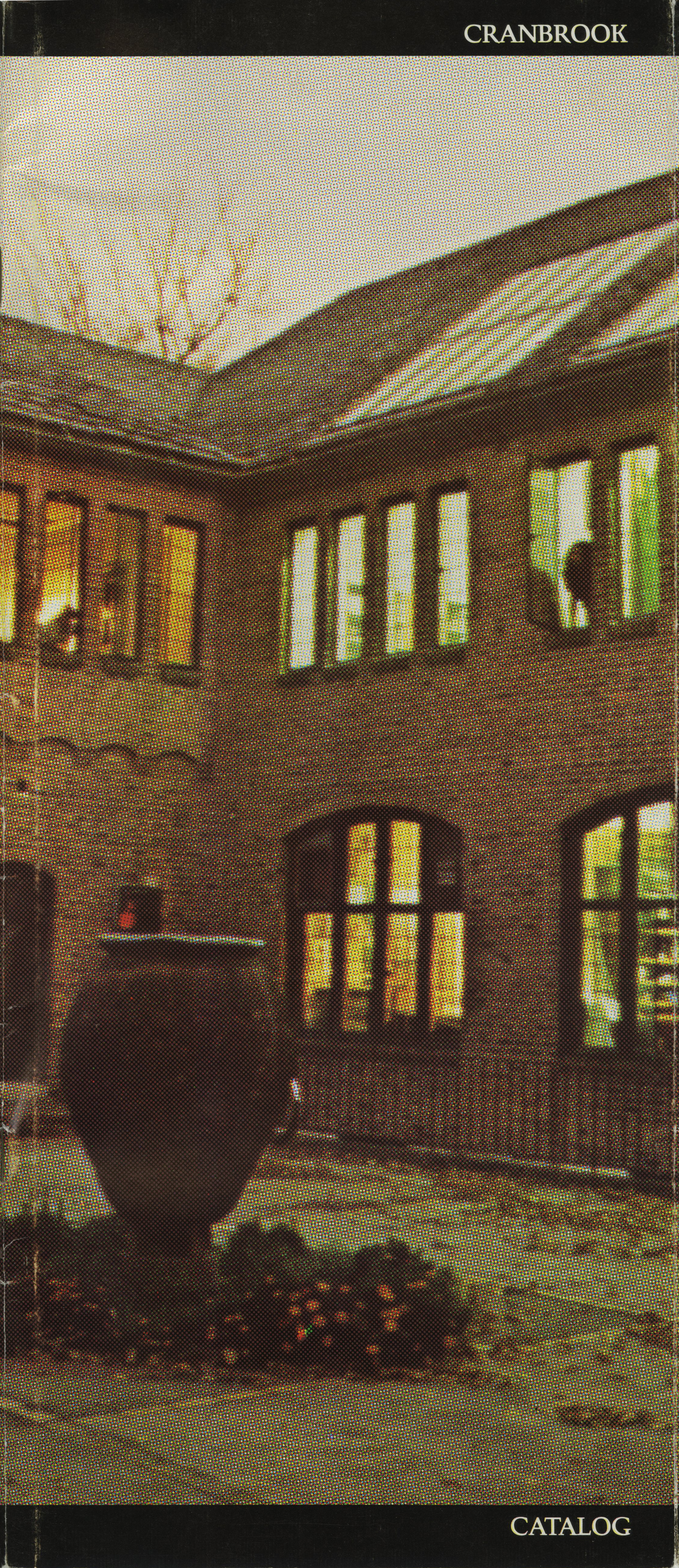
Cranbrook Academy of Art Cover for 1973 Catalog by Katherine McCoy

Cover, 1973/1975 Cranbrook Academy of Art Course Catalog, designed by Katherine McCoy. Courtesy of Cranbrook Archives.

After over a decade “hanging out” in the “hippie” and “loosely structured” atmosphere of Cranbrook (Fella’s words), in 1985 at the age of 47 Fella entered into the MFA program at Cranbrook. Although older than his fellow students (and his department heads), Fella didn’t view his years of professional practice as an advantage: “At Cranbrook, I really was fortunate to be in such an amazing class dynamic…I used to say, experience never trumps a great idea; a 20-year-old can have one as easily as a 40- year-old…and it was certainly the case in that class!” He immersed himself into the era’s discussions about the postmodern movement. At Cranbrook, he also studied photography with Carl Toth and attended discussions with architect Daniel Libeskind (meanwhile, Fella’s two daughters babysat Libeskind’s young children).

Throughout his career, Fella produced work for local art cooperatives and events, like the Detroit Focus Gallery, Detroit Artist Market, and Cranbrook. Over 100 of these posters were donated in 2012 to Cranbrook Art Museum. It is in the experimental nature of these posters where we can see how Fella perfected his art of distorting text and collaging high and low imagery.

SONY DSC

Practice and Preach and Theorize and Teach! Edward Fella, American, 2004. One-color, offset-print on bond paper, 17 x 11 in. Gift of the Artist, Courtesy of Cranbrook art Museum.

In 1987 Ed Fella left Michigan to begin teaching design at the California Institute of the Arts. He recently retired from the school after a long career of mentoring and producing experimental works of graphic design. In 2014, he was awarded Cranbrook Academy of Art’s Distinguished Alumni Award. You can read and see more about Fella’s life, work, and education here in this excellent biography by Design Traveler.

Fella’s 2007 AIGA medal biography summarizes Fella’s career as: “prodigiously mashing up low-culture sources with high-culture erudition, Fella’s work—perhaps more than that of any other contemporary designer—makes visible the postmodern concept of deconstruction, which recognizes that behind every articulated meaning is a host of other, usually repressed meanings, some antithetical. By battering and mixing fonts, engaging in visual puns and generally violating the tenets of ‘good design,’ Fella lets a thousand flowers bloom. His designs don’t cut through the clutter—they revel in it.”

I think this quite aptly summarizes the joy I find in Fella’s Cranbrook map of 1972: reveling in the mashup of landscape, architecture, activity, and text. Fella captures the diversity and beauty of this unique assemblage we call Cranbrook.

– Kevin Adkisson, 2016-2019 Collections Fellow, Cranbrook Center for Collections and Research

Minks in the Rainforest

The week of May 19, the Center for Collections and Research hosted the Eastern Michigan University Historic Preservation Program as they conducted their annual Field School. The EMU Historic Preservation Program is among the largest graduate programs in Historic Preservation in the United States, and this was their third year working at Cranbrook.

Two groups worked on documenting the exterior and landscape of Lyon House.

Lyon House Site Plan with Landscape Features, documented May 19-24, 2019 by Eastern Michigan University Historic Preservation students.

Lyon House Site Plan with Landscape Features, documented May 19-24, 2019 by Eastern Michigan University Historic Preservation students.

The third group once again tackled Tower Cottage. The cottage started its life as a simple Tudor Revival cottage that was designed by Albert Kahn, who also designed Cranbrook House. Built in 1908, it mimics the style and design of Cranbrook House. The cottage itself has seen many changes but over time it has retained its original character and style. Tower Cottage, along with Cranbrook House, is among the original structures belonging to the Booth family.

Tower Cottage circa 1915 with water tower behind.

Tower Cottage circa 1915 with water tower behind. Courtesy Cranbrook Archives.

Long unoccupied, the building’s historic window sashes required rehabilitation, painting, and replacement of missing pieces. The students restored a number of windows and worked on a paint analysis of Tower Cottage with Ron Koenig of Building Arts Conservation.

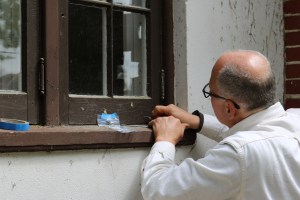
Ron Koenig of Building Arts Conservation discusses paint sampling with the EMU students.

Ron Koenig of Building Arts Conservation discusses paint sampling with the EMU students. Photo Desai Wang, CKU ’19.

What they discovered was far more colorful than the simple brown paint that adorns the house now. Koenig took various samples of the trim, stucco, and window sashes. He did preliminary examinations on site, looking through a special magnifying glass to see where best to sample.

Desai Wang, CKU '19, the Center's Senior May student, looking at the sample on the window sash.

Desai Wang, CKU ’19, the Center’s Senior May student, looking at a sample on a window sash of Tower Cottage.

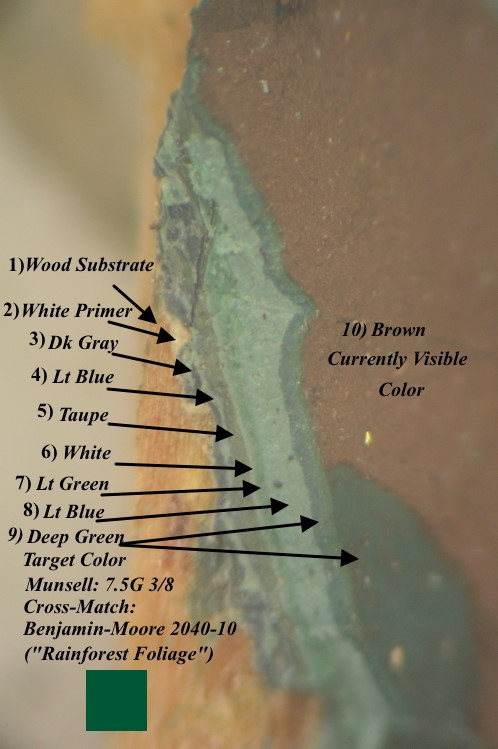
In his workshop, Koenig used a microscope to see the various layers (or campaigns) of paint. From this microscopic sample, he was able to determine the color of paint used on the house in the 1920s  – the era when the additions to the house were completed by architects J. Robert F. Swanson and Henry Scripps Booth.

Microphoto of the color campaigns of the Tower Cottage sashes, South Elevation. Courtesy Building Arts & Conservation.

Microphoto of the color campaigns of the Tower Cottage window sashes, south elevation. Courtesy Building Arts & Conservation.

Koenig matched the sample to a color on the Munsell color system (a system to visually identify and match color using a scientific approach) and from the Munsell color to a Benjamin Moore paint color. Our colors were Mink (#2112-10) for the trim and Rainforest Foliage (#2040-10) for the window sashes. The secret to historic paint colors is that while a company such as Benjamin Moore, founded in 1883, may change a color’s name, the reference number stays the same. If you know the identification number of a paint that you had in 1949, you could find the same color in the catalog today.

We couldn’t keep this great color combination to ourselves. We decided to paint a sample of it on some of the windows at Tower Cottage.

Rainforest Foliage green sashes and Mink brown trim at Tower Cottage, June 2019.

Rainforest Foliage green sashes and Mink brown trim at Tower Cottage, June 2019.

20190606_145203

Close-up of the green sashes and brown trim on Tower Cottage, June 2019.

Next year, should our friends form EMU return for their field school, the rest of the cottage’s trim and windows can be painted with its historic colors.

Leslie S. Mio, Associate Registrar

Cranbrook, Unseen: My Senior May Experience

When I first visited Cranbrook on a snowy January day, the campus felt magical. I knew nothing about its history—not of the Booths, Saarinens, Milles. Yet when I pulled open the heavy leaded glass doors and stepped into a green-tiled lobby, I was in awe of its beauty.

Desai Wang, CKU ‘19, with Jim Miller-Melberg’s Porpoise play structure at the Cranbrook Middle School for Boys.

Desai Wang, CKU ‘19, with Jim Miller-Melberg’s Porpoise play structure at the Cranbrook Kingswood Middle School for Boys. Photo Kevin Adkisson.

For the past three years, I have been fortunate to study here and to call Kingswood dorms my home. The names previously foreign now ring close to heart.

Or do they?

As senior year came to a close, I realized that perhaps my understanding was no more than the facts handed to Gold Key student tour guides. I knew “the names,” and roughly, their accomplishments, but not why; I did not know their stories.  

I knew I wanted to use my Senior May Project to better understand Cranbrook. My wish was vague, and if asked to define it I probably would have said something about wanting to learn more about the buildings and “the names.” As my three-week internship with the Cranbrook Center for Collections and Research comes to an end, I think my time working with Mrs. Mio and Mr. Adkisson can be summarized by one word: unseen.

I finally toured Cranbrook House, Saarinen House, and the Smith House, and the past three weeks were filled with discoveries of details I never noticed before. However, I think the most important thing the Center gave me is a change in perspective.

Previously, my interest rested directly on what was visible: the existing architecture, their designers and their history. But, as trips to Cranbrook Archives proved, plans unbuilt are just important as those built. I saw George Booth’s plan for a school attached to Christ Church, Saarinen’s original designs for the Institute of Science and Academy of Art (only parts were realized for both), the multi-story elevations for Gordon Hall of Science, and a guest house proposed by John Hejduck that would have sat behind Lake Jonah.

Further, I was introduced to Cranbrook beyond its schools and museums. I joined Eastern Michigan University historic preservation students as they surveyed Tower Cottage and Lyon House. The former previously hosted a water tower, Cranbrook’s fire truck, and apartments that were in use through the 1980s. The latter was a family home built in the 1920s and acquired by Cranbrook almost twenty years ago. Both historic buildings have been repainted many times, so a paint analysis was performed. I found the process of slicing out small pieces of the buildings, analyzing them under a microscope, and studying the layers of paint and dirt to determine original colors, exciting. For the Tower Cottage window frames, layers of green appeared under the current brown.

Ron Koenig, the owner of Building Arts & Conservation, takes samples of paint on the window frame at Tower Cottage.

Ron Koenig, the owner of Building Arts & Conservation, takes samples of paint on the window frame at Tower Cottage. Photo Desai Wang, CKU ’19.

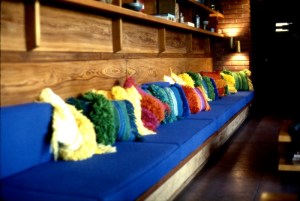
Most importantly, I saw Cranbrook from behind the scenes. I spent some of my first week scanning photographs and slides of Andrea Arens, a local artist who wove pillows for the Smith House.

Slide of Andrea Arens's pillows on display on the bench in Smith House. Courtesy Arens Family.

Slide of Andrea Arens’s pillows on display on the bench in Smith House. Courtesy Arens Family.

Yet the small stack of material I digitized is nothing compared to the cabinets after cabinets of pictures and files stored in the Archives. Just thinking about the amount of time it took to digitize my small binder sends a shiver through my spine about how much work it takes to digitize records, and about just how vast the collections of Cranbrook Archives are.

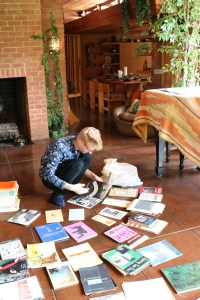
Scanning aside, at the Frank Lloyd Wright-designed Smith House Mr. Adkisson, Mrs. Mio and I cleaned the Smiths’ exterior cabinets and organized a closet full of their pamphlets and magazines. We vacuumed and moved around artworks so UV protection film could be installed on windows to prevent further textile damages.

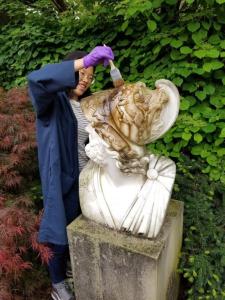
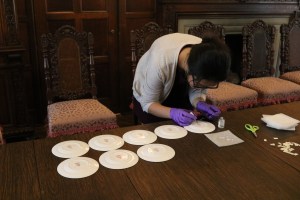
One day, we drove to Ken Katz’s conservation studio in Detroit to deliver a wood panel painting, a lamp, and a jade piece—all in need of restoration. Mrs. Mio and I applied inventory numbers to George and Ellen Booth’s silverware and china, and we even scrubbed Menelaus with Elephant Snot (a cleaning product).

Ken Katz, Mrs. Mio, and Mr. Adkisson discuss restoration plans for the painting on wood panels— Flora, Ceres, Pomona (Three Goddesses) by Corrado Scapecchi.

Ken Katz, Mrs. Mio, and Mr. Adkisson discuss restoration plans for the painting on wood panels— Flora, Ceres, Pomona (Three Goddesses) by Corrado Scapecchi. Photo Desai Wang, CKU ’19.

Desai, brushing Elephant Snot onto Menelaus.

Desai, brushing Elephant Snot onto Menelaus. Photo Leslie Mio.

I feel privileged to have organized items in a Frank Lloyd Wright house-museum, handled art created by famous painters, sculptors and ceramicists, and labeled plates and spoons that were used by the Booths. Above all, I am grateful to have met some of the people who dedicate themselves to preserving and sustaining Cranbrook’s history and beauty.

Desai, applying removable adhesive on Booths’ saucers to attach inventory numbers.

Desai, applying removable adhesive on Booths’ saucers to attach inventory numbers. Photo Leslie Mio.

Mr. Adkisson, at Smith House, organizing Smiths’ pamphlets, brochures and magazines.

Mr. Adkisson, at Smith House, organizing Smiths’ pamphlets, brochures and magazines. Photo Desai Wang, CKU ’19.

Three years ago, I opened a door that led me to Cranbrook, and to my interest in its past. Three weeks ago, I opened a door that led beyond history and urged me to see the present. I leave here with “the names,” some stories, but most importantly, acknowledgment and appreciation of the ongoing work that keeps this place running.

Desai Wang CKU ‘19

Editor’s NoteThe Senior May Project is a school-sponsored activity that encourages Cranbrook Kingswood Upper School seniors to acquire work experience in a field they are considering as a college major, a potential profession, and/or as a personal interest.

A native of Xi’an, China and Ann Arbor, Desai Wang has been a boarding student at Cranbrook since 2016. This fall, she will head off to Cornell University to study architecture. We thank her for her willingness to assist in projects across campus and her enthusiasm for Cranbrook history. We wish her luck as she embarks on another chapter of her life!

Musical Hassocks, Anyone?

While we celebrate Melvyn Maxwell and Sara Stein Smith for their tenacity in getting their Frank Lloyd Wright house built and maintained, there are other aspects to their home ownership to entertain us.

Visitors enjoy coming into a home which is unlike most other FLW houses they have ever seen. This house is full of objects the Smiths collected, loved and placed pretty much where they remain now.  Instantly visitors feel this is a home, not just a house museum and that the personalities of the owners come across loud and clear.

Smith House Library. Photo Cranbrook Center for Collections and Research | Brett Mountain for SEEN Magazine.

Smith House Library. Photo Cranbrook Center for Collections and Research | Brett Mountain for SEEN Magazine.

The Smiths had a zest for life which filters through to this day.

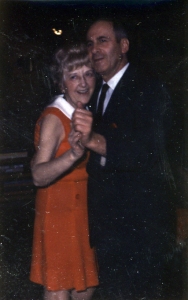
The Smiths in March 1968.

The Smiths in March 1968. Courtesy Cranbrook Archives.

They were readers; they loved art, particularly ceramics and smaller sculptures they could place on the built-in cypress shelves.  At the far end of the living room where Smithy had his built-in desk you might spot a GE Stereophonic High-Fidelity Turntable and speakers. You might also see on the shelves beneath stacks of record albums.

The "entertainment center" of the Smith House, with its GE Stereophonic High-Fidelity Turntable and records stacked three deep on shelves added below the desk in the late 1960s. Hassocks in the foreground. Photo Cranbrook Center for the Collections and Research | Brett Mountain for SEEN Magazine.

The “entertainment center” of the Smith House, with its GE Stereophonic High-Fidelity Turntable and records stacked three deep on shelves added below the desk in the late 1960s. Hassocks in the foreground. Photo Cranbrook Center for the Collections and Research | Brett Mountain for SEEN Magazine.

The Smiths owned at least 400 albums and boxed sets ranging from spoken voice through the great musicals to opera and classical music, but the vast majority of their collection was dance music: The Smiths were dancers. Smith himself taught ballroom dance as a means to supplement his meager teaching salary as a younger man. In 1934 he served as president of Detroit’s Northern High School Alumni Association and chaired a semi-annual ball in the General Motors Building ballroom.

In those days, dance halls were everywhere, dancing was the great social activity of the 40s and 50s and easily accessible even to the penurious. Kathryn Watterson in her book Building a Dream quotes Sara Smith as mentioning at least one evening of dance in their young days at the Northwood Inn, a roadhouse in Berkley, Michigan famed for its dance floor and frog legs.

Writing down the names of the albums for cataloging purposes brought me right up against the music the Smiths enjoyed listening to. I can just see them dancing the Lindy Hop to Big Band leader Benny Goodman’s Sing, Sing, Sing. Or maybe more adventurously the quickstep which is a lively, fast-moving dance for the fleet of foot. Something about the Smiths in photos tells me they could handle these dances. Here’s a clip of some So You Think You Can Dance competitors starting with a little Lindy Hop then Charleston then quickstep. All these dances are 4/4 time and fast: Sing, Sing, Sing (Quick step)

Your Guy Lombardo Melody album cover.

Your Guy Lombardo Melody album cover, one of many in the Smith’s record collection.

Guy Lombardo is another favorite. To these smooth, slightly jazzy tunes you would dance the foxtrot which by the 30s had slowed down from its fast pace. This was a dance invented in the Smiths’ lifetime by one Harry Fox.

If the Smiths got tired of 4/4 time they could find themselves a waltz, maybe to one of their Sing Along with Mitch Miller albums.

Sara and Melvyn Smith dance together in Smith House.

The Smiths dancing in their house on that glossy dance floor they were so proud of. Courtesy Cranbrook Archives.

They had a number of records called Dance Party.  I wonder…

Melvyn and Sara Smith on the dance floor

Melvyn and Sara Smith on the dance floor. Courtesy Cranbrook Archives.

The Smiths left their house and their possessions intact, and through the great beneficence of their extended Smith and Towbes families, the Smith joie de vivre persists in a light-filled gem of a house. In their honor, let’s set up a dance floor outside, put on some big band music and dance by the golden glow of a Frank Lloyd Wright jewel box.

–Lynette Mayman, Collections Interpreter

To See a World in a Grain of Sand…

A recent research inquiry made me curious about the Great West Window, also known as the Women’s Window, at Christ Church Cranbrook.

Bloomfield Hills was sparsely settled when the church was built and, reporting on his visit to Cranbrook in July 1924, the architect Oscar H. Murray speaks of George Gough Booth’s intention to build a community church and school “to form the core around which this new district shall develop”.

The church was a gift to the Bloomfield Hills community from George and Ellen Booth, their five children and their families, all of whom donated to its construction and fabric. The local history of settlement in Bloomfield extends some hundred years before the building of Christ Church Cranbrook; yet its flourishing as a community for families and as a center of cultural activity begins with the church, the first of the original group of Cranbrook institutions. All the artworks at the church are beautiful and unique, but to me, none more so than the Women’s Window.

View of the Great West Window, Christ Church Cranbrook.

View of the Great West Window, Christ Church Cranbrook. Jack Kausch, photographer. Copyright Cranbrook Archives

The Women’s Window is the gift of James Alfred Beresford and Florence Booth Beresford. It was designed by James H. Hogan and fabricated by James Powell and Sons, (Whitefriars) Ltd, then based in Wealdstone, London, England. Established in 1680, their insignia is a whitefriar monk wearing a white cowl. Their original location on Fleet Street was in the Whitefriar district where a Carmelite order had once resided. The insignia is included in the Women’s Window, but at just a few inches high, it is impossible to see from the church floor.

Whitefriar close up

The whitefriar insignia of James Powell and Sons (Whitefriars), Ltd on Panel 16 of the Women’s Window of Christ Church Cranbrook. Kevin Adkisson, photographer. Copyright Cranbrook Archives.

The key component of stained glass is silica from river sand. Modern stained glass is made of sand, lime, and soda and is more durable than the stained glass of the middle ages, which used ash instead of lime, making it more susceptible to the elements.

“The coloured glasses used in the making of the window are all the product of the Whitefriars works, in fact what comes to us in the form of sand, leaves us as a work of art in the form of a Stained Glass Window.” Adrian A. Buck, October 31st, 1927 (1981-01 20:9)

The glass pieces are fitted into cames—H or I shaped lead fixtures—which are then soldered together at the ends to form the design, and the whole window is supported by larger T bars and saddle bars. The Women’s Window stands 19 ½  feet tall and 8 feet wide.

As with most of the windows at Christ Church Cranbrook, the Women’s Window is made of antique glass—this does not refer to the age of the glass, but rather to its method of manufacture. It is hand-made glass using the traditional medieval method of glass blowing, giving it an irregular surface that adds to the effect of jewel tones. Other types of stained glass (cathedral and opalescent) are machine made and do not convey the same vibrancy of antique glass.

The Window’s aesthetic style is Gothic Revival and its coloring is thought to suggest the pre-Raphaelite influence of William Morris and Edward Burne-Jones, with whom Powell was acquainted and with whom George Booth found deep inspiration and kinship.

It features 60 women within 16 panels arranged in 4 tiers. Each panel depicts an area of contribution to sacred and secular life, including motherhood, Christ’s associates, early missionaries, early saints, religious orders, American church missionaries, educators, nurses, musicians, artists, poets, novelists, sovereigns, liberators, suffrage workers, and actresses. These panels are mediated by 6 smaller panels, each depicting two angels with shields portraying the fiery cross, the word of God, the mirror of truth, the flame of inspiration, the regal crown, and tragedy/comedy.

The women were selected from across history, from biblical times to 1920s, by the Rev. Samuel S. Marquis, the first rector of the church. Inscribed at the base of the window is the verse, “Her children rise up and call her blessed, and her works praise her in the gates” (Proverbs 31:28, 31).

The window has long been beloved by members and visitors to Christ Church. It was also the featured window of the Michigan Stained Glass Census in June 1998. The Women’s Window underwent restoration in 2004-2005 by Thompson Art Glass to celebrate the 75th anniversary of the church. Speaking at the time of its completed restoration, the Rev. Edward L. Mullins remarked that, “when the light shines through it, we see a wonderful picture of the world”.

– Laura MacNewman, Associate Archivist
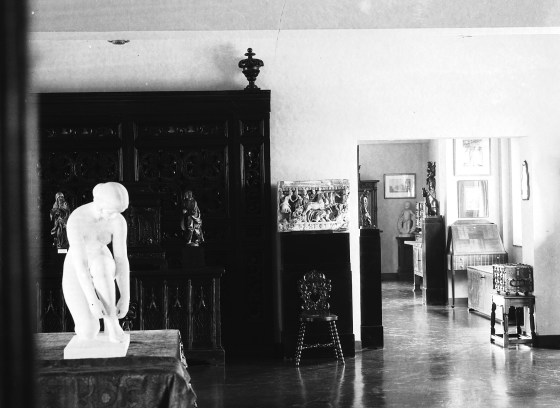
Photo Friday: Academy of Art Graduation Day

Congratulations to the Cranbrook Academy of Art students who graduated with their MFA’s and MArch’s today! The ceremony was held in Christ Church Cranbrook, after too much rain water-logged the Greek Theater. Did you know the ceremony used to be held in the library?
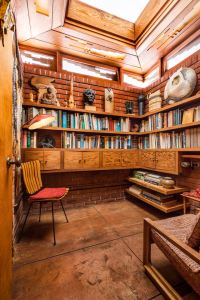
Although the Academy welcomed students in 1932, it first granted degrees in 1942 after being chartered by the State of Michigan as an institution of higher learning.
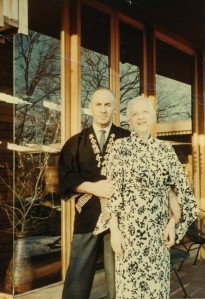
AA2349 (002)

Cranbrook Academy of Art Convocation in the Academy of Art Library, May 1948. Harvey Croze, photographer. Copyright Cranbrook Archives.

The first convocations were held in the Academy Library. Here, in 1948, we see Henry Scripps Booth speaking, with Zoltan Sepeshy seated to his far left and Carl Milles and Eliel Saarinen to Booth’s right. In the foreground of the image, bursting with blooms, is Maija Grotell’s blue and platinum vase of around 1943.

– Kevin Adkisson, 2016-2019 Collections Fellow, Cranbrook Center for Collections and Research

Sunscreen for Smith House: UV Window Film

Sunlight is the enemy of artwork and textiles. As the sun’s rays filter through unprotected windows, they cause fading. In addition to colors changing, sunlight can cause holes in fabric, paper to become brittle, plastics to fall apart, and wood to warp.

Woven Tapestry by Urban Jupena.

You can see the effects of light and heat from the windows on the woven tapestry by Urban Jupena in Smith House. On the left is the part exposed to sunlight, and on the right (folded back) is the underside that has been protected.

Recently, the Center had a Conservation Assessment for Preservation (CAP) done for the Frank Lloyd Wright Smith House by ICA-Art Conservation. In the report, one of the recommendations was to protect the artifacts in Smith House from visible and UV light streaming in the wonderful floor-to-ceiling single-pane windows of the house.

Rear exterior view of Smith House.

Rear exterior view of Smith House.

To protect the house, we would either need to create storm windows to apply to the outside, put up shades on the inside, or apply a UV-blocking film to the windows. As you can imagine, the storm windows and shades would alter the look of the house, so they were rejected outright. The UV film, however, was something we could consider.

What we discovered is that not all films are created equal. There is dark film, light film, mirror film, frosted film – we needed a clear film that diffused 99.9 percent of the harmful ultraviolet light but still allowed natural daylight into the house. Every company promised theirs was the best and gave the most protection. How would we choose? This was a pretty long-term decision. We decided to turn to the experts.

When there is a question about the condition, the best environment for collections, or the damage caused by environmental factors, we turn to experts called conservators. We were able to find some studies of the effectiveness of window film by conservation experts published in the Western Association for Art Conservation (WAAC) Newsletter: UV-Blocking Window Films for Use in Museums and the follow-up Aging Properties of Select UV-Blocking Window Films.

After we got through all the scientific talk about procedures and data and met with product representatives at the house, we landed on a film. Aging Properties of Select UV-Blocking Window Films stated that “CPFilms (Llumar and Vista) performed well according to all criteria used. None of the films tested showed a significant change in UV absorbance . . . Because this brand easily met all our criteria, it can be strongly recommended with regard to optical performance”

Llumar/Vista films had performed well in the conservation studies, they had the clear film we were looking for (SpectraSelect VS61 SR CDF), and we had a distributor/installer in the area: SRF Enterprises, Inc. William Kish, the owner, stood behind his product with an excellent warranty, personally acting as the installer of the film, and proof that the product lasted, in some installations, for up to 40 years.

Bill Kish of SRF Enterprises, Inc. installing window film in Smith House.

Bill Kish of SRF Enterprises, Inc. installing window film in Smith House. Can you tell where he has put the film and where he has not?

Other benefits of the film: you can still clearly see in and out of the windows; there is reduced glare from the sun; the textiles will last longer and book jackets can stay on (they were beginning to crumble and fade); and the house will be cooler in the summer. Finally, the windows will be safer. When Smithy installed the windows, they were not safety glass. With the film on the windows they now function as safety glass should one ever break (heaven forbid).

Rear exterior view of Smith House after the installation of the window Film.

Rear exterior view of Smith House after the installation of the window film.

All of this research for Smith House served us well– we decided to use it in the Studio at Saarinen House to protect the textiles on display in our 2019 exhibition Studio Loja Saarinen.

Bill Kish of SRF Enterprises, Inc. installing window film in Saarinen House Studio.

Bill Kish of SRF Enterprises, Inc. installing window film in Saarinen House Studio.

To learn more about conservation, you can read “What is a Conservation?” on the American Institute for Conservation and the Foundation for Advancement in Conservation website or attend our free 2019 Bauder Lecture with Timothy Whalen, Director of the Getty Conservation Institute, this Sunday, May 5, 2019 in de Salle Auditorium. Whalen will discuss the Getty’s conservation work in the tomb of Tutankhamen, repainting sculpture by Louise Nevelson, restoring building of Louis Kahn and other modern masters, and the future of conservation and cultural preservation.

Leslie S. Mio, Associate Registrar

Look up! Studio Loja Saarinen Ceiling Murals

The Center for Collections and Research’s newest intervention in Saarinen House opens on Sunday, April 28: Studio Loja Saarinen: The Art and Architecture of Weaving, 1928-1942.

In researching the exhibition, Collections Fellow Kevin Adkisson has discovered many remnants of the Studio in the Archives, Art Museum Collections, and on the campus of the Cranbrook Academy of Art. One part of the Studio remains that you’re likely not familiar with: the weaving allegories by Katherine Sibley McEwen (1875-1957), one of the founders of the Detroit Society of Arts and Crafts and a friend of George G. Booth. Her eight allegories and border elements were painted directly onto the ceiling of the former Studio Loja Saarinen Weaving Room — now the studio of Elliott Earls, Artist-in-Residence and head of the 2D Design Department at Cranbrook Academy of Art.

CEC1424_Annie Margaret Frykohlm CAM 28-12 on wall

Studio Loja Saarinen Weaving Room, 1930. Bouquets by Anne Frykolm (left), Cranbrook Rug No. 1 by Maja Andersson Wirde (floor), furniture by Eliel Saarinen (center), weaving allegories by Katherine McEwen (ceiling). Courtesy Cranbrook Archives.

CCR_18_01

Ceiling murals designed and executed by Katherine McEwen in what was once Studio Loja Saarinen. Each is an allegory of weaving. Photo by PD Rearick.

CCR_18_03

Winding thread on the bobbin – detail of ceiling murals by Katherine McEwen in what was once Studio Loja Saarinen. Photo by PD Rearick.

CCR_18_04

Collecting the thread – detail of ceiling murals by Katherine McEwen in what was once Studio Loja Saarinen. Photo by PD Rearick.

CCR_18_05stain removed

Harvesting cotton and flax (linen) – detail of ceiling murals by Katherine McEwen in what was once Studio Loja Saarinen. Photo by PD Rearick.

CCR_18_02

Harvesting silkworms and shearing wool – detail of ceiling murals by Katherine McEwen in what was once Studio Loja Saarinen. Photo by PD Rearick.

CCR_18_06

Detail of the decorative borders by Katherine McEwen along the ceiling of what was once Studio Loja Saarinen. Photo by PD Rearick.

McEwen executed other works at Cranbrook, including the magnificent frescoes at Christ Church and a witty history of education series in the lower level of the Cranbrook School for Boys Dining Hall.

This Sunday, April 28, 2019 from 1-5pm visitors will have the very rare opportunity to see the Studio Loja Saarinen murals as part of the Academy’s Open(Studio) event–just follow the signs to the 2D Department. At the same time the Center’s special Studio Loja Saarinen show will be opening in Saarinen House, incorporating six historic Studio Loja Saarinen rugs and tapestries new to the house, dozens of archival and new color photographs, and a handful of small personal accessories from Loja Saarinen. And, the loom is up and running and Cranbrook Kingswood students will be giving hands-on demonstrations.

If you can’t make it to the opening, the Studio Loja Saarinen exhibition may be viewed on both public and private tours of Saarinen House during the 2019 Tour Season, Friday, May 10, 2019 through Sunday, December 1, 2019.

– Leslie S. Mio, Associate Registrar

Create a website or blog at WordPress.com