These days, Instagram accounts are often used to curate and share our photographic memories. In a not-too-distant past, photographic albums were the medium of choice. One such album, created by a 1950 Academy of Art graduate, was recently donated to the Archives and gives us a rare student perspective of the Academy experience. As we welcome students back to campus, full of the promise of future opportunities, let’s take just a moment to look back at what that looked like for one student who attended seventy-five years ago.
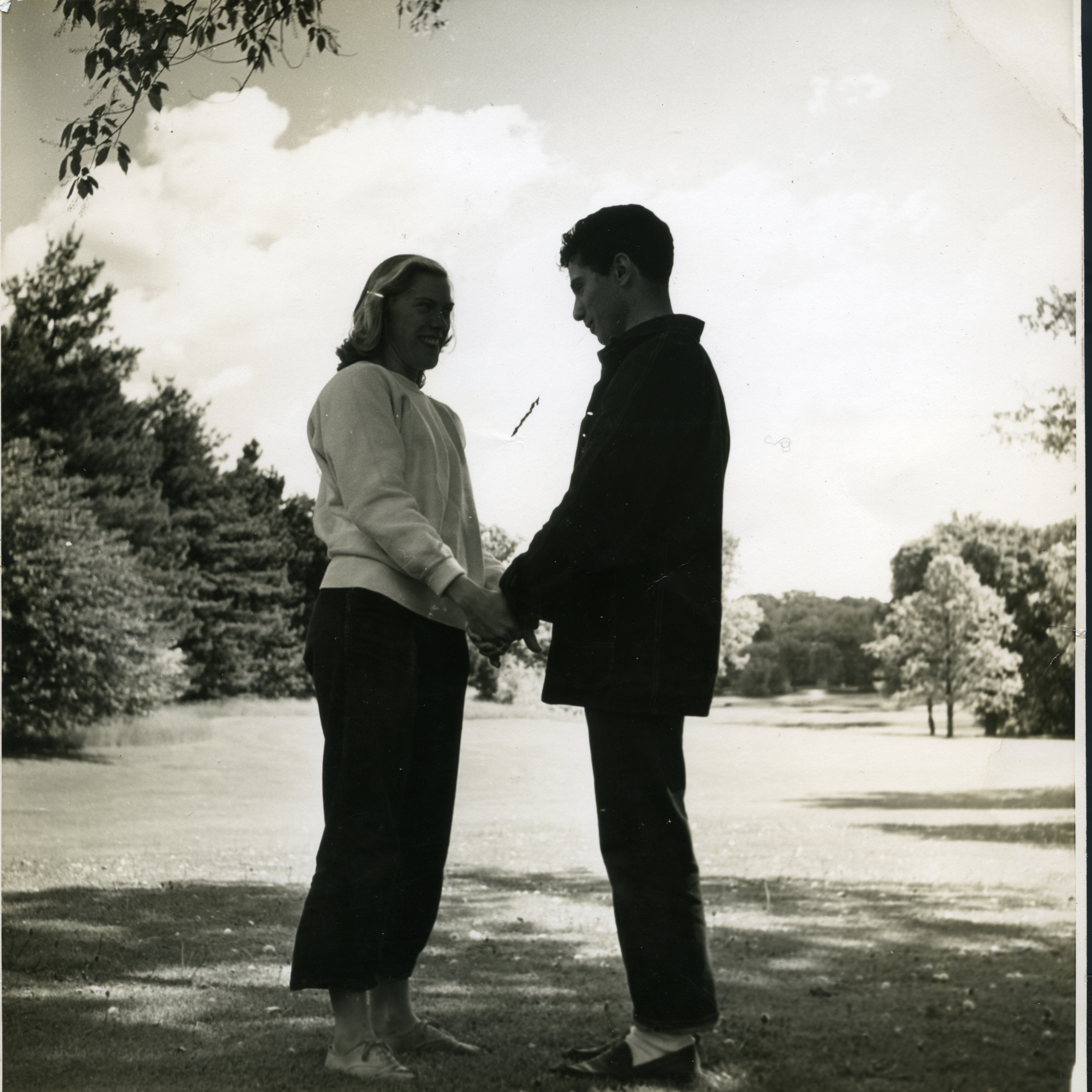
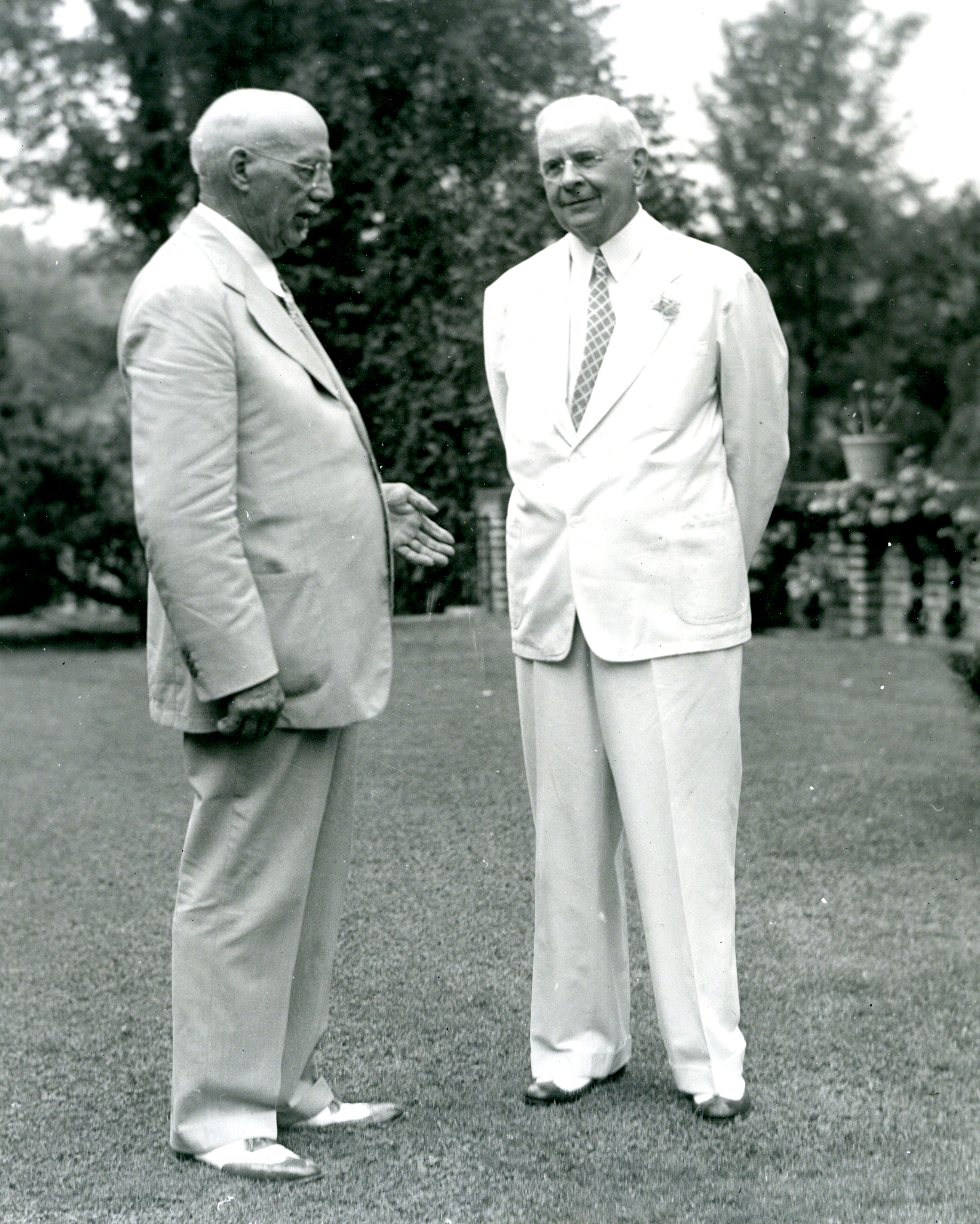
Eleanor Ann Middleton (Painting,1950) and Angelo Caravaglia (Sculpture, 1950) on Cranbrook grounds, circa 1950. Courtesy of Cranbrook Archives.
Eleanor Ann Middleton (Annie) received her BFA and MFA in Painting from Cranbrook Academy of Art in 1949 and 1950, respectfully. Her photo album, assembled at least in part post-graduation, contains photographs from Cranbrook staff photographer, Harvey Croze, who also managed the studio and darkroom in the basement of the Academy Administration Building. These images—class photos on the Art Museum peristyle or familiar shots of the Triton Pools— are copies of those already in the Cranbrook Photograph Collection. But the bulk of the album contains snapshots that are unique to the Archives.
Jack Kearney (Painting 1948) creates al fresco, circa 1947-1948. Courtesy of Cranbrook Archives.
While Middleton was herself a photographer, she appears in many of the images, so the snapshots are likely a mix of her work, fellow Academy students, and perhaps even Croze, in an unofficial capacity. While not Academy staff or student, Croze was a practicing artist (painting and photography) and was known to spend much of his free time with Academy students. Whatever the case, the result is an intimate glimpse into student life.
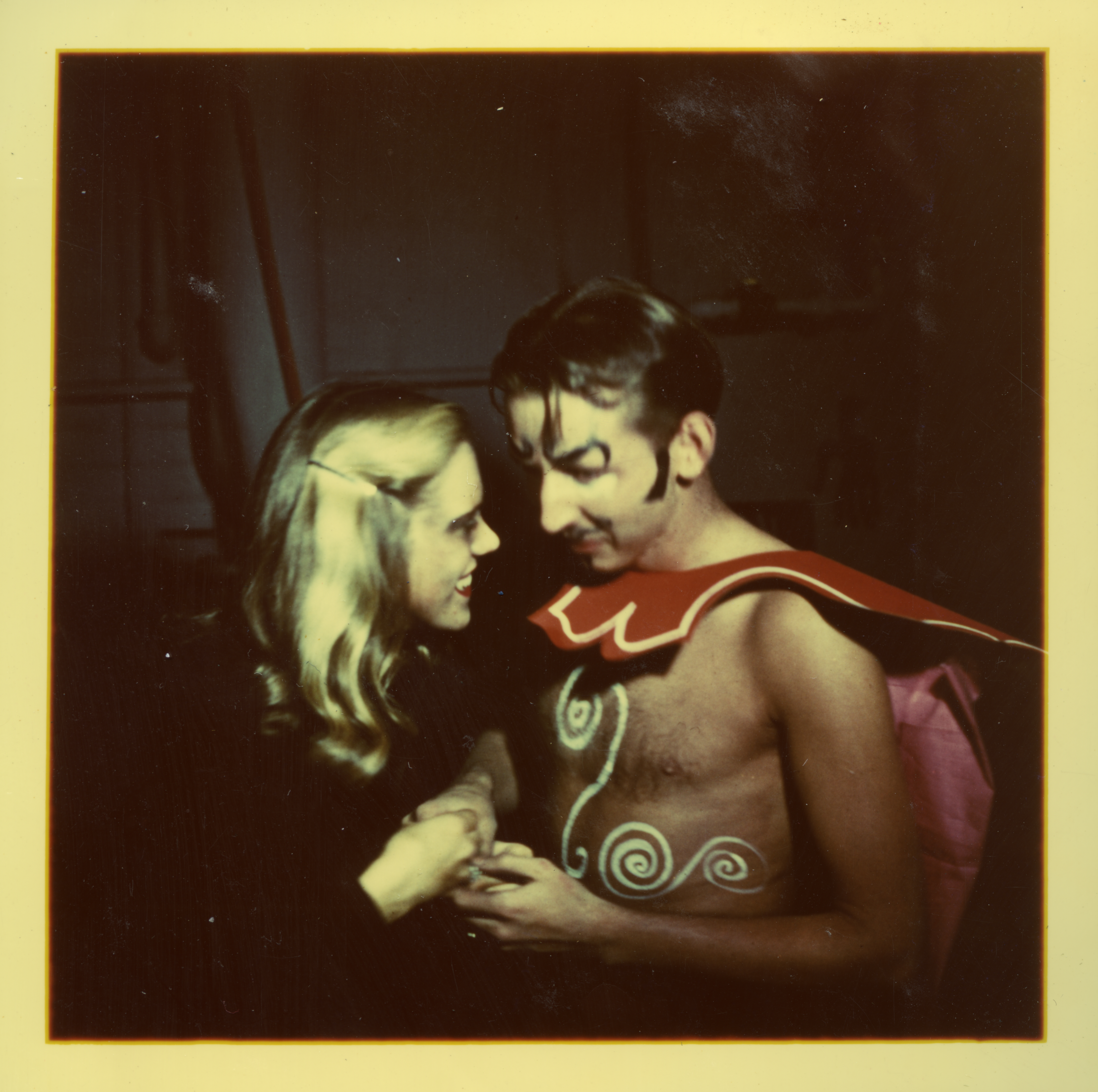
Annie Middleton and a fellow student at one of many costume parties featured in the album, circa 1947-1950. Courtesy of Cranbrook Archives.
The Center wishes all students at the Academy and Cranbrook Kingswood Schools a wonderful 2024-25 academic year!
—Deborah Rice, Head Archivist, Cranbrook Center for Collections and Research
I recently found myself at Joann Fabrics five minutes before the store closed, desperately selecting supplies for a project that was, of course, best completed that night. My delay was self-inflicted, but it got me thinking about times when much larger projects have been strained by access to supplies.
Specifically, both Eliel Saarinen and Frank Lloyd Wright created buildings with strong creative vision. Their architecture demanded specific, and sometimes hard to source, materials. Let’s look at two examples and decide if the headaches my favorite architects caused their suppliers and contractors/builders were worth the final product!
Example 1: Eliel Saarinen and Pewabic Pottery Tiles
Eliel Saarinen, Kingswood School for Girls Main Entrance Lobby (Green Lobby) plan, section, elevation, and reflected ceiling plan, c. 1930-1931. Ink, colored pencil, and pencil on tracing paper. Approx. 28½ inches x53 inches. Cranbrook Art Museum 1982.35. Photography by P.D. Rearick, Courtesy Cranbrook Center for Collections and Research.
When Eliel Saarinen specified thousands of hand-molded, hand-glazed, and hand-fired Pewabic Pottery tiles for use at Kingswood School for Girls, his contractor pushed back. Pewabic was less a tile factory than an artists’ workshop. As supplier of Kingswood’s industrially produced tile for bathrooms and basements, a concerned Mr. Burt of the Detroit Mantel and Tile Company wrote to the contractor, Charles Wermuth & Son:
We are doubtful as to [Pewabic Pottery] being able to manufacture the amount of tile as selected for this job. We raised this question during the course of selections but [Pewabic cofounder and artist] Mrs. Stratton advises that she will be able to produce this tile without any hold-up. We have advised her that any hold-up or delays caused from her material will be charged back to her.
We are writing you this letter merely as a protection against delays beyond our control.
Saarinen wasn’t wrong to select Pewabic Pottery for Kingswood—it’s stunning and perfect in every way—but Burt wasn’t wrong about issues of production. It does appear that delays in the tile making caused delays in construction, raising blood pressure on both ends of Woodward Avenue.
As the first day of classes at Kingswood drew nearer, truck drivers from Cranbrook made near-daily trips to the pottery for small batches of tiles. I imagine the kiln-fresh mini-masterpieces still warm to the touch!
Did the delay in tile delivery keep Kingswood from opening on time? No. An outbreak of polio in metro Detroit meant all schools were closed by state health officials. But Wermuth used the extra time to finish the building—all Pewabic tiles were well-set and grouted for classes to begin September 21, 1931.
Eliel Saarinen and Mary Chase Perry Stratton’s 1931 masterpiece, the Green Lobby Stair. The headache of contractor Charles Wermuth and Son was worth the stress. Photography by James Haefner, 2018. Courtesy Cranbrook Center for Collections and Research.
Example 2: Frank Lloyd Wright and “The Wood Eternal”
In February 1949, Melvyn Maxwell Smith was ready to start building his long-awaited dream: a wood and brick Usonian house designed by Frank Lloyd Wright. With enough money squirreled away to begin construction, Smithy was ready to order materials. Including 14,000 linear feet of clear, old-growth, 16’ x 1’ x 2” boards of Tidewater Red Cypress wood.
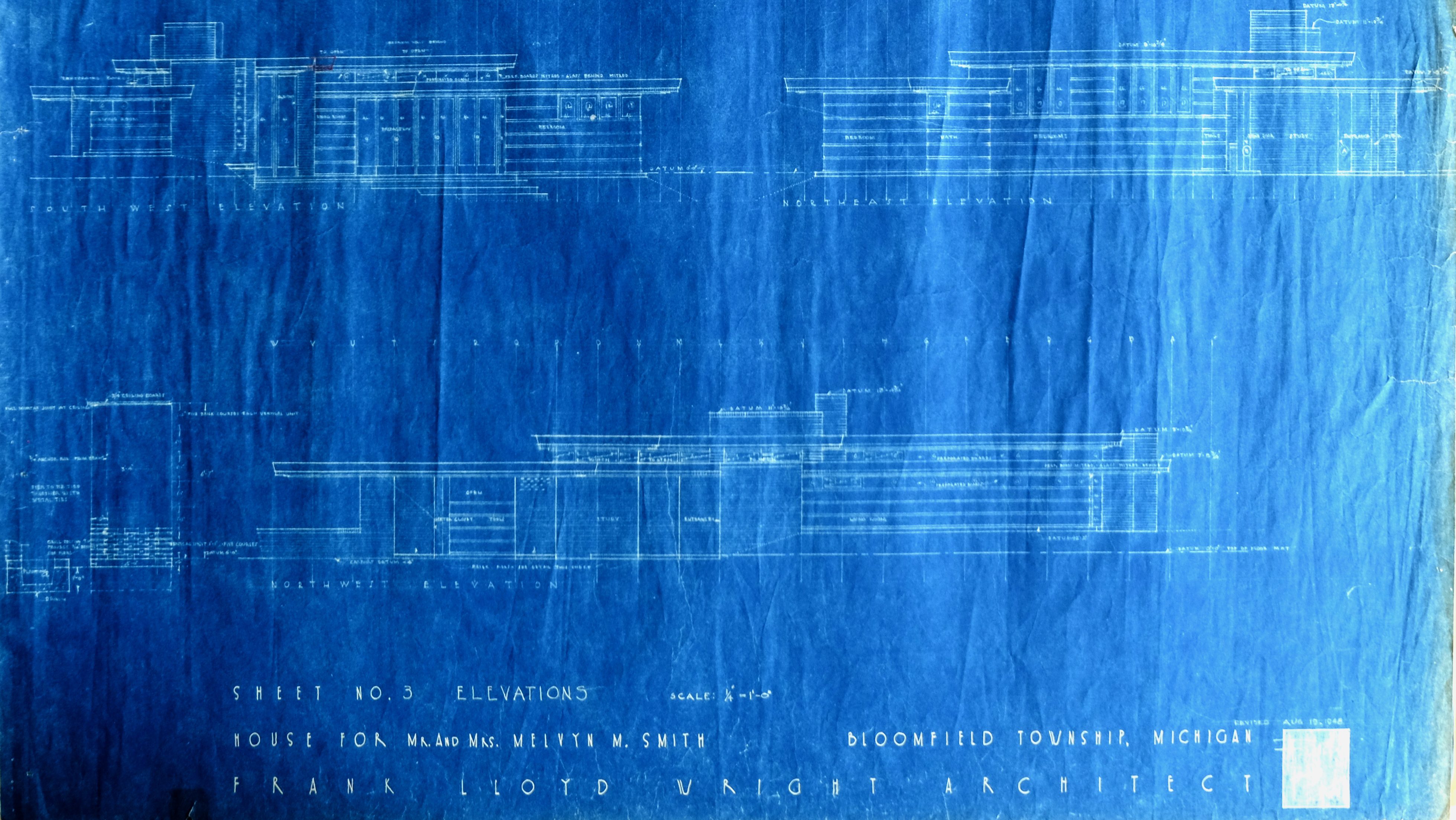
Frank Lloyd Wright, detail of House for Mr. and Mrs. Melvyn M. Smith elevation, August 1948. Blueprint. Courtesy Cranbrook Archives.
Wright had built in Cypress since at least 1914, with his first all-Cypress design, the Wiley House, coming off the drafting board in 1932. The iconic Usonian houses of the 30s and 40s are mostly built of this swamp-grown, super strong, rot-resistant golden wood.
Cypress proved to be perfect for Wright’s organic architecture. And by 1949, Cypress was incredibly hard to find.
Smithy wrote to many different lumberyards with his needed material list. Those closest to the swamps where Cypress grows—lumberyards in South Carolina and Louisiana—were unable to furnish the volume of wood needed. Lumber yards in the Midwest simply stated they did not carry Cypress. Chicago-based Hilgard Lumber Company wrote, “We duly received your inquiry…on a carload of Tidewater Red Cypress (clear grade) but clear grade in this species is extremely scarce.”
In February 1949, Fleishel Lumber Company of St. Louis (who had been forwarded Smithy’s large request) agreed to fulfill the order. Smithy simply needed to let the yard know when he wanted the wood delivered. Or at least, that was the idea.
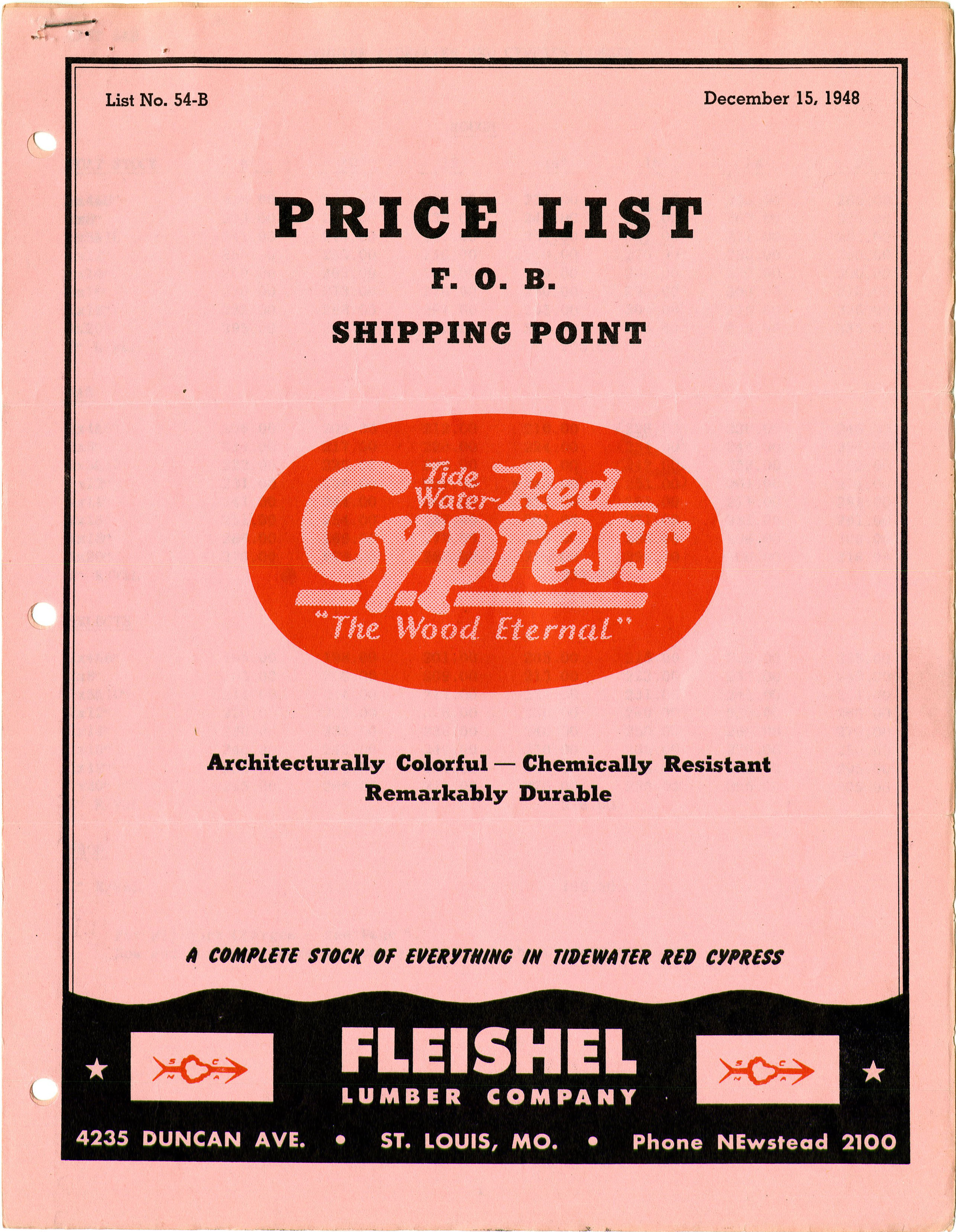
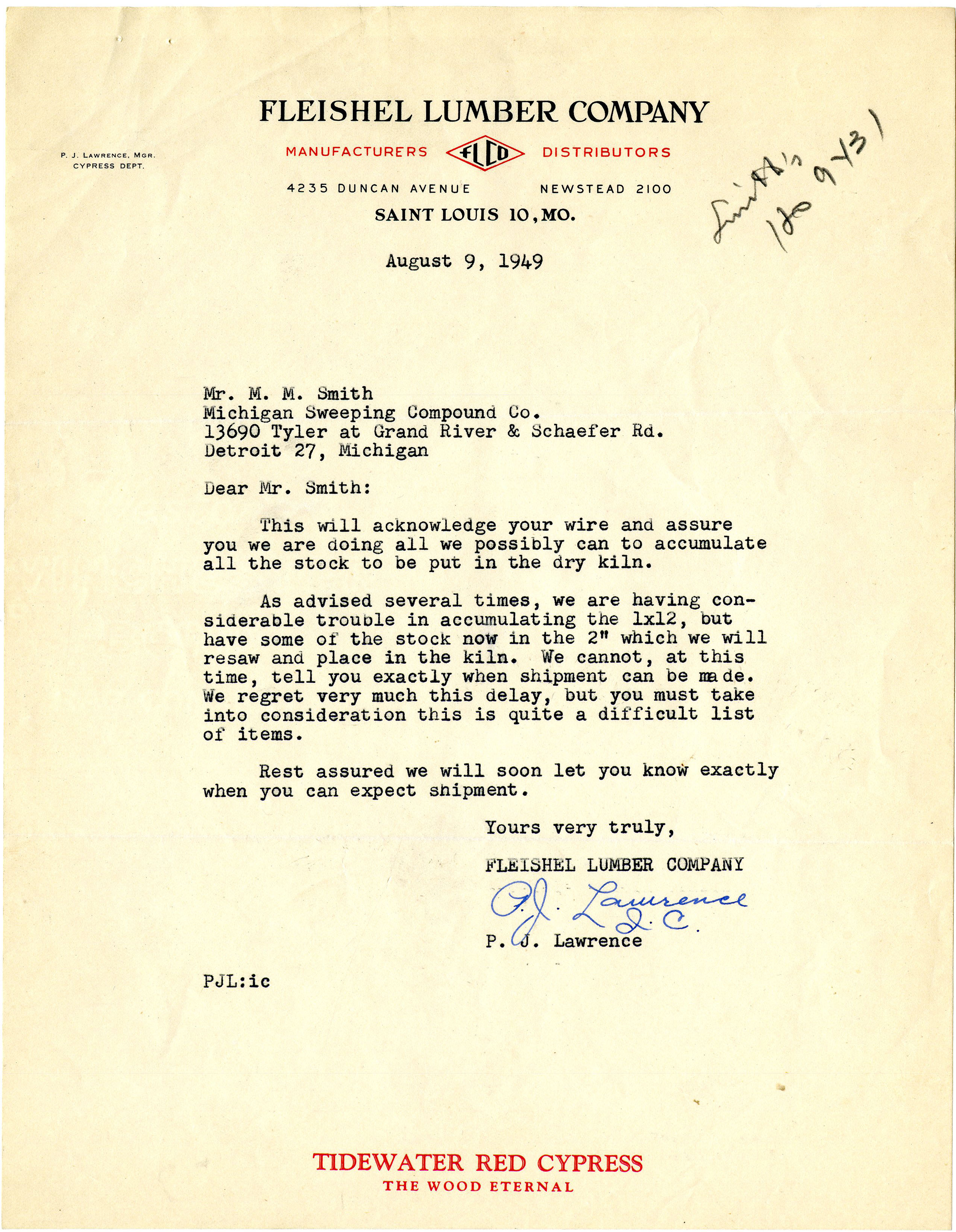
The initial price list for “Tidewater Red Cypress ‘The Wood Eternal'” from Fleishel Lumber Company, sent to Melvyn Maxwell Smith on February 21, 1949, followed by an August disappointment, and then, the packing list of the Cypress shipment sent on September 23, 1949. Cranbrook Archives. Smith Papers, 2017-10, Box 11, Folder 11.
Every month, Smith wrote, called, or telegrammed Fleishel, asking for his order. And every month, the lumber yard replied: we don’t have it all, but we have some. As time ticked by and Smithy’s house waited to take shape, Fleishel offered up concessions. Instead of kiln dried, would Smithy accept natural dried Cypress? No. Recycled or swamp-preserved? No. Smaller boards, but more boards? No.
Smithy needed what Wright specified: long, wide boards. By August 9, 1949, things were looking up, even if Fleishel’s salesman sounds a bit annoyed:
…We are doing all we possibly can to accumulate all the stock to be put in the dry kiln.
As advised several times, we are having considerable trouble in accumulating the 1×12…We cannot, at this time, tell you exactly when shipment can be made. We regret very much this delay, but you must take into consideration this is quite a difficult list of items.
Smithy’s goal of having the lumber on hand during the Summer holiday, when he could be on-site every day, did not happen. His first day teaching his Cody High English class that year? September 5.
Finally, on September 23, 1949, Fleishel Lumber packed a railroad car full of 14,000 linear feet of clear, kiln-dried Cypress and sent it toward Bloomfield Hills. Just seven months and a few days after it was ordered.
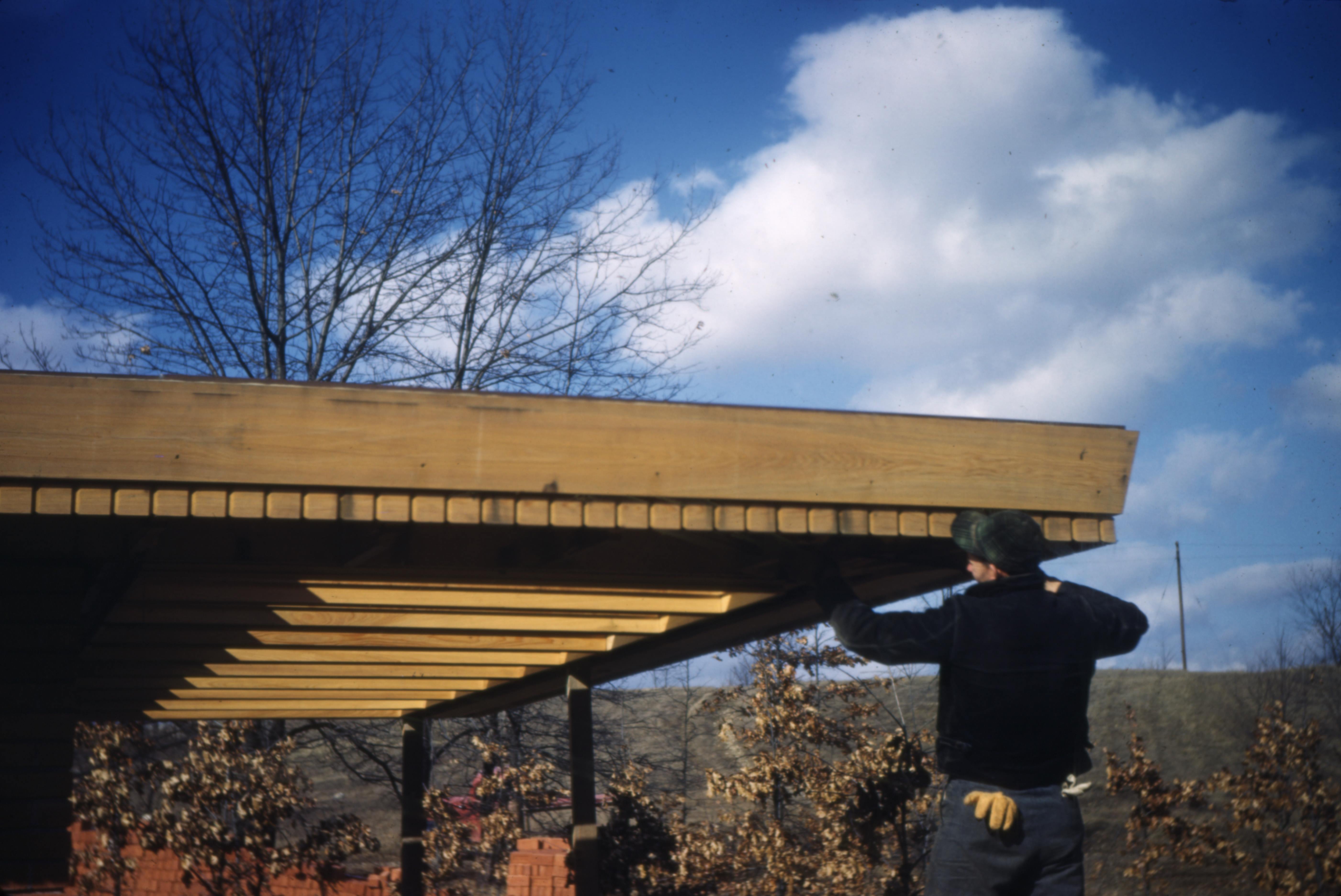
Work continues on Cypress boards of Smith House, winter 1949-1950. Courtesy Cranbrook Archives.
About seven months later, Melvyn and Sara Smith had a Cypress house! When it was completed in May 1950, the Smith House became Frank Lloyd Wright’s last entirely Cypress-built project.
Tidewater Red Cypress with Detroit Common Brick defines the Frank Lloyd Wright-designed Smith House, 1950. Courtesy Cranbrook Archives.
So, did being particular about materials pay off for Mr. Wright and Mr. Saarinen? I think the Smiths and thousands of Cranbrook students would agree: absolutely.
—Kevin Adkisson, Curator, Cranbrook Center for Collections and Research
Note: Oh, and if you want old-growth Cypress today? The current owner of the Frank Lloyd Wright Willey House, Steve Sikora, described the purchasing of Cypress wood in the 2010s as operating among “an assortment of hucksters, charlatans, and petty criminals, or in industry parlance, ‘wood brokers.’” Head on over to The Whirling Arrowblog to read a lot more about Cypress and Wright!
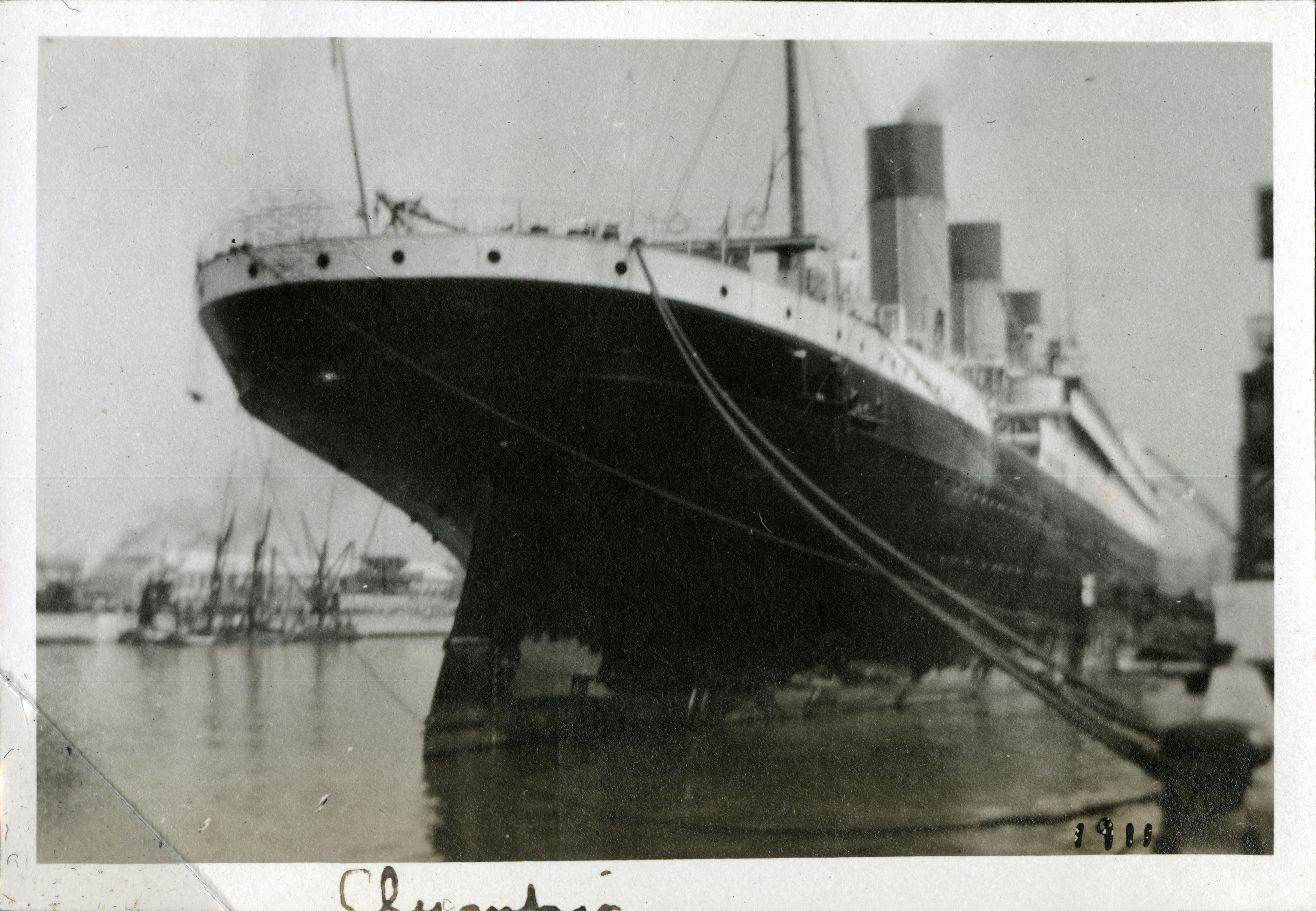
Some years ago, former Cranbrook Archivist, Robbie Terman, posted a short blog post on one of the Titanic’s sister ships, RMS Olympic. In recent years, Cranbrook Archives has responded to numerous requests for images of the Olympic which are preserved in the first volume of Harry Scripps Booth’s Pleasures of Life albums.
View of RMS Olympic before its first eastward crossing, June 28, 1911. [POL1.14.5]. Courtesy of Cranbrook Archives, Cranbrook Center for Collections and Research.
On June 28, 1911, the Booth family took the first eastward crossing of RMS Olympic from New York to Southampton, England. The family at that time was George and Ellen Booth; James Scripps and Jean McLaughlin Booth who had married the previous year; Grace, Warren, Henry, and Florence. They were joined by their Grand Rapids cousin, Esther Booth.
As I come from a maritime nation, these requests are particularly intriguing to me. I have wondered what other archives we have at Cranbrook to tell the story of transatlantic crossing and explain some of the images. George Gough Booth kept a record of the expenses in planning for the trip. These records tell us that he booked the steamship tickets with the Christian Leidich Travel Bureau in Detroit and he purchased Motor Union badges for himself and James.
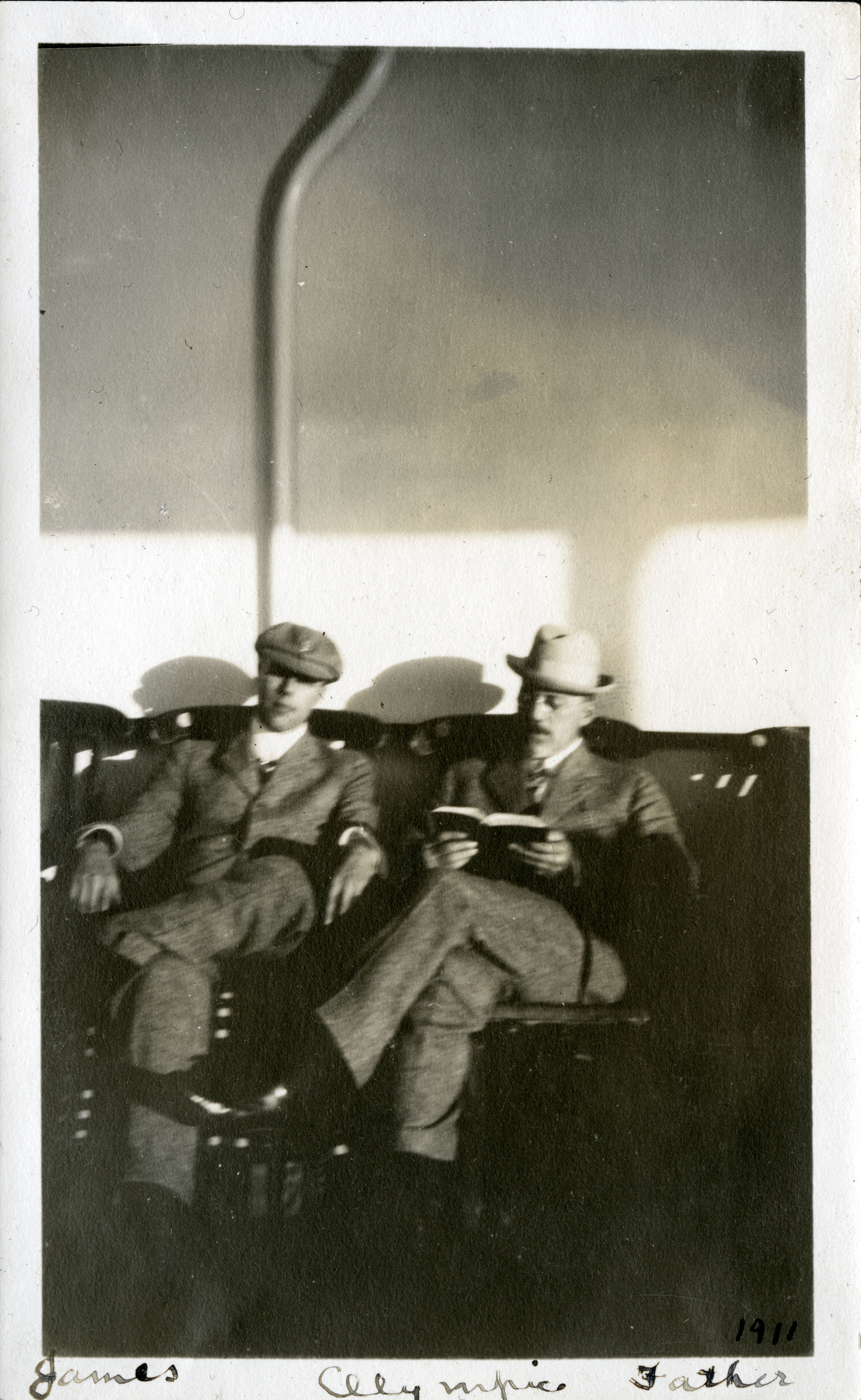
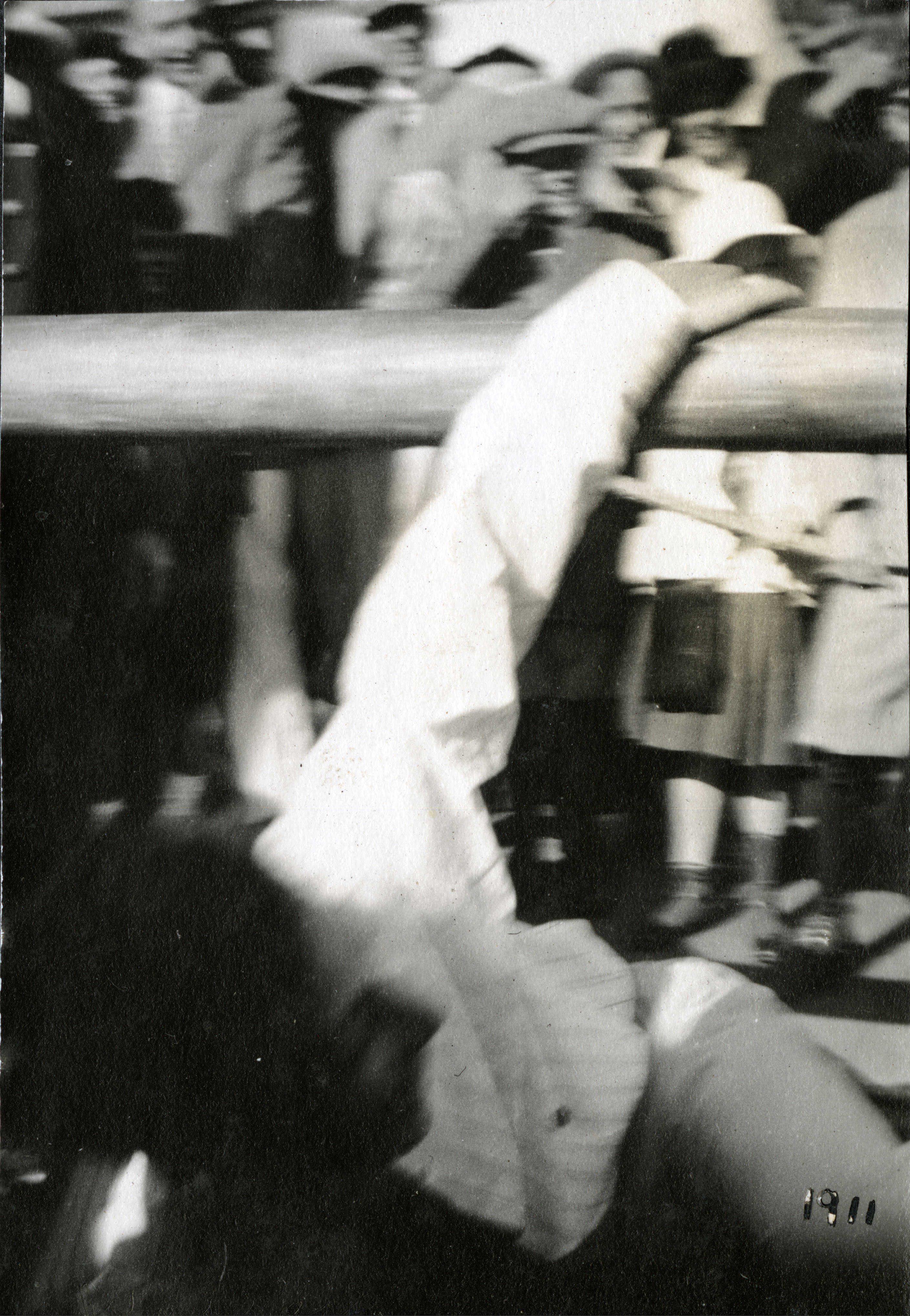
James Scripps Booth and George Gough Booth on the RMS Olympic, July 1911.[POL1.10.2] Courtesy of Cranbrook Archives, Cranbrook Center for Collections and Research.
As Henry recalls in his memoir after listing the family members who sailed,
“That wasn’t enough. Parks, the chauffeur, went; also The Pierce-Arrow, a 7-passenger touring car, and a Lozier Briarcliff, which accommodated four plus one in an airy seat on the left running board, designed for the chauffeur when the “master” took the wheel. That seat was a thrill for the young at heart.”
Then I came upon something quite wonderful—Henry’s journal of the sea crossing! He began the trip when he was just 14 years old, celebrating his 15th birthday in August during the vacation. As I read the entries, the images in the Pleasures of Life came alive. Here follows some moments from the journey in Henry’s words.
“Stayed at the Plaza. Esther’s trunk was lost. We found it later. On June 28, we went abord [sic] the great ship, “Olympic.” Henry Scripps Booth, June 27, 1911
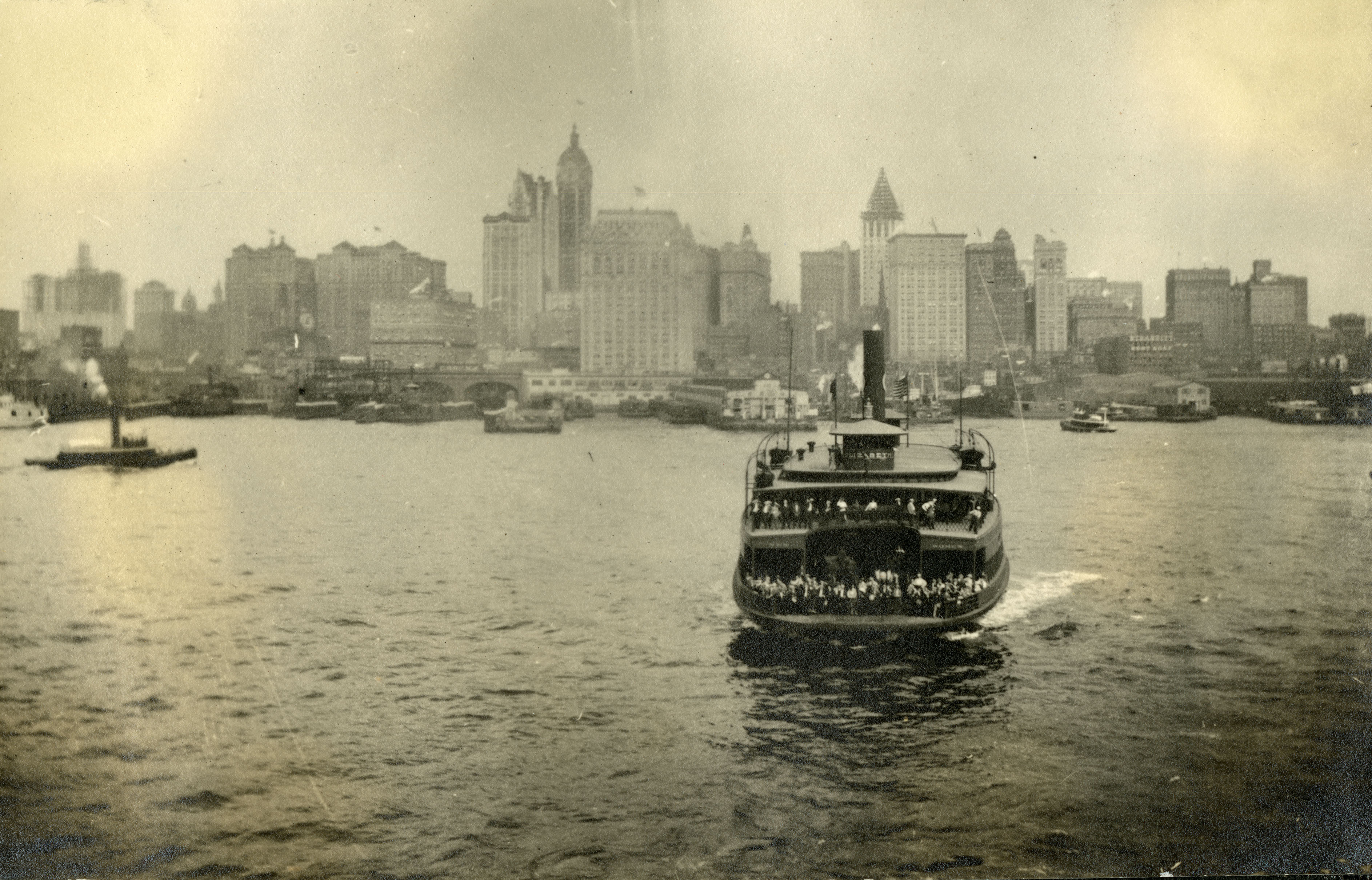
Leaving New York, June 28, 1911. Courtesy of Cranbrook Archives, Cranbrook Center for Collections and Research.
“On June 28, we went abord [sic] the great ship, “Olympic”. The Olympic is a fine ship. Florence was sick first night and day. It was somewhat rough on June 29th. I met a new friend but did not remember his name. In the morning, I could hardly stand, because of the new sensation. I was somewhat sick, but ate lots and I felt fine.” Henry Scripps Booth, June 28, 1911
“On June 30th the Campania was in view. I got acquainted with two girls, Constance Peabody and Katherine somebody.” Henry Scripps Booth, June 30th, 1911
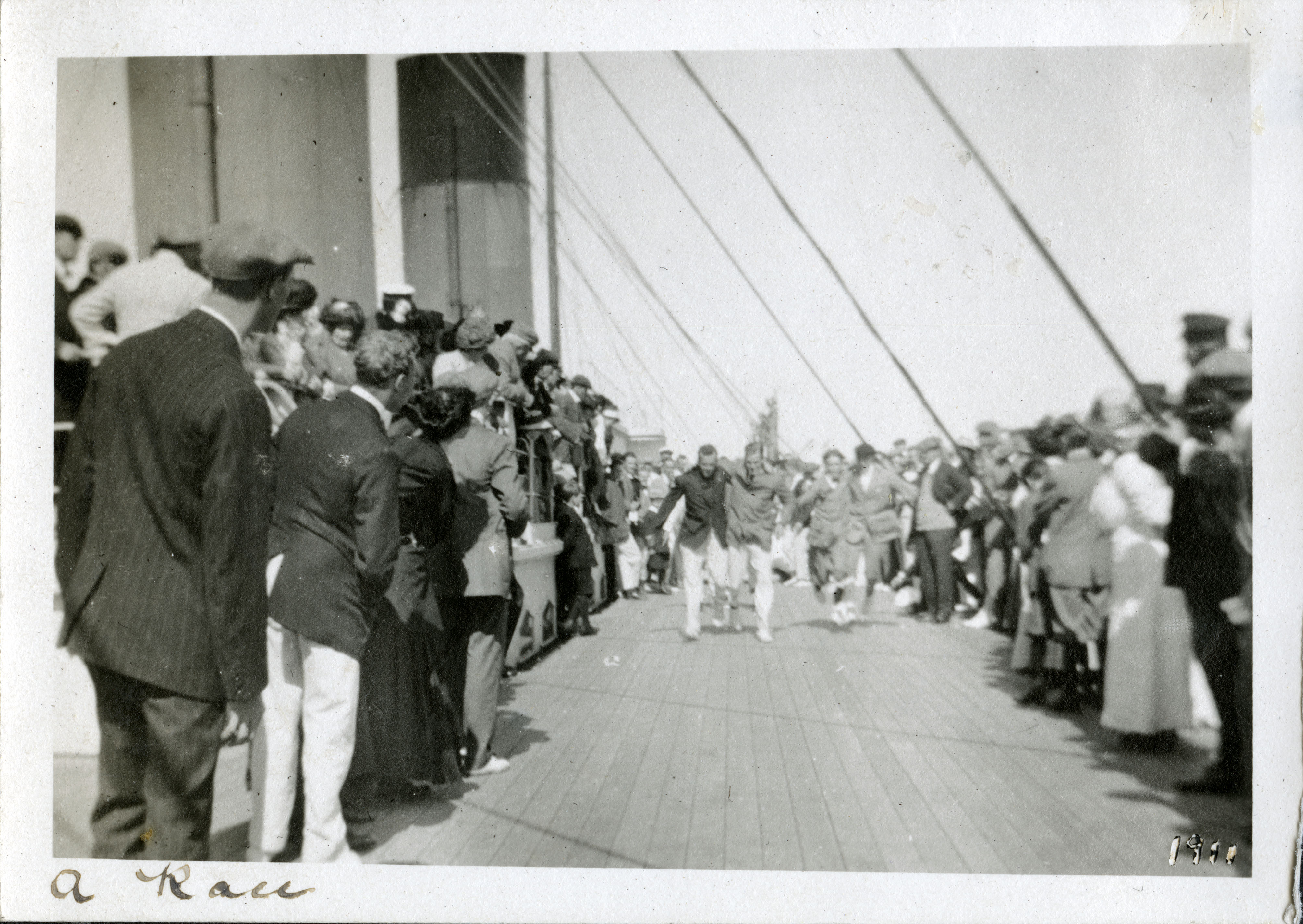
A race aboard the RMS Olympic on its first eastward crossing from New York to Southampton, July 1911. [POL1.11.4]. Courtesy of Cranbrook Archives, Cranbrook Center for Collections and Research.
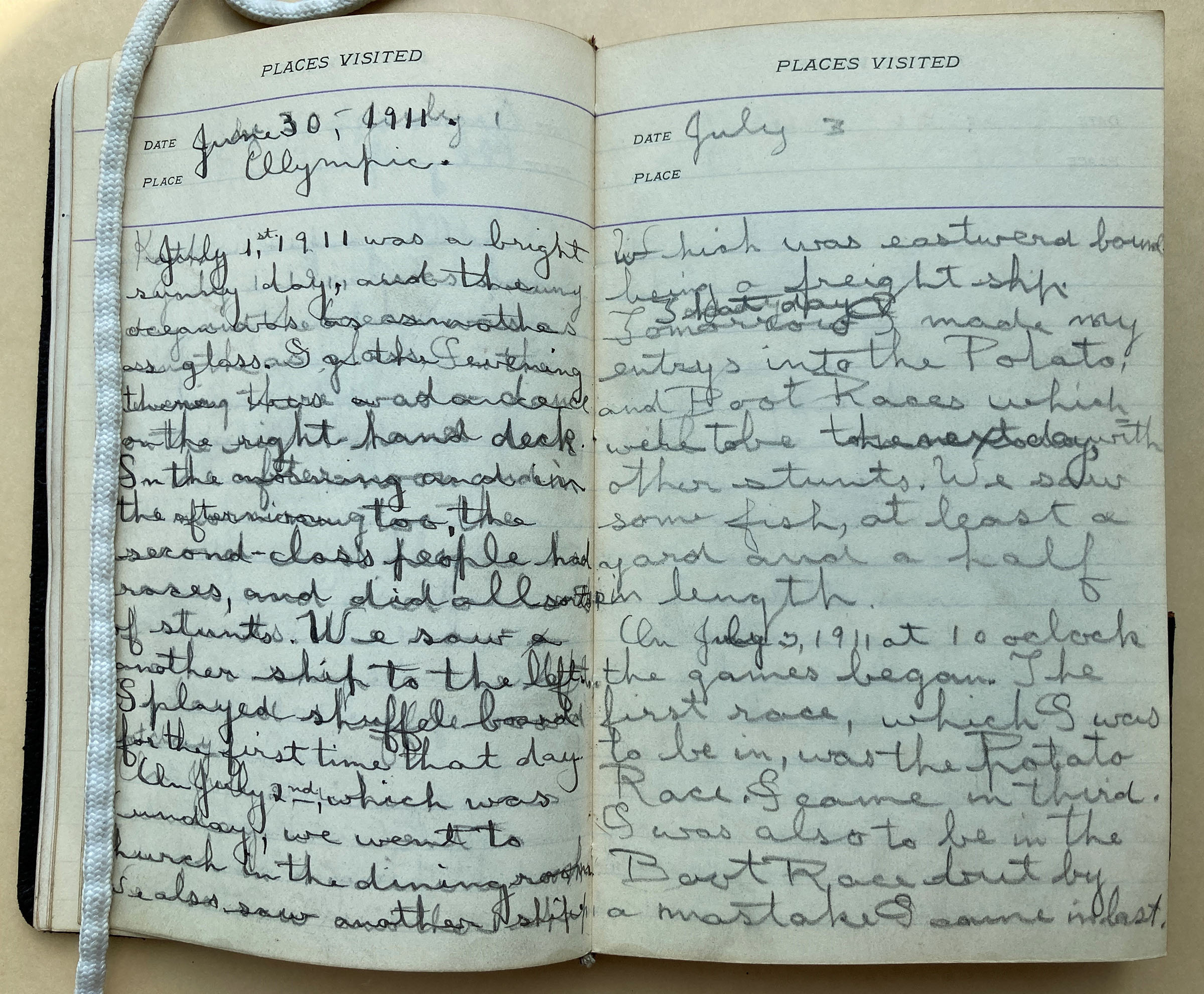
“July 1st, 1911, was a bright sunny day, and the ocean was as smooth as glass. In the evening, there was a dance on the right hand deck. In the morning and in the afternoon too, the second-class people had races, and did all sorts of stunts. We saw another ship to the left. I played shuffleboard for the first time that day. On July 2nd, which was Sunday, we went to church in the dining room. We also saw another ship [July 3] which was eastwerd [sic] bound being a freight ship.” Henry Scripps Booth, July 1, 1911
A race aboard the RMS Olympic on its first eastward crossing from New York to Southampton, July 1911. [POL1.12.5]. Courtesy of Cranbrook Archives, Cranbrook Center for Collections and Research.
“Tomorrow That day, I made my entrys [sic] into the Potato and Boot Races which were to be the next day with other stunts. We saw some fish, at least a yard and a half in length.
On July 3, 1911, at 10 o’clock the games began. The first race, which I was to be in, was the Potato Race. I came in third. I was also to be in the Boot Race but by a mistake, I came in last.
After other races came the Standing Broad Jump in which James sliped [sic].” Henry Scripps Booth, July 3, 1911
Warren Scripps Booth during a Spar Pillow Fight aboard the Steamship RMS Olympic, July 1911. [POL1.12.4]. Courtesy of Cranbrook Archives, Cranbrook Center for Collections and Research.
“James and Warren were both in the Spar Pillow Fight. In Warren’s case both fell off the bar at first but Warren was nocked [sic] off a second time. Warren did not win. James stayed on a number of times but was forced to give up. After dinner in the Reception Room the prizes were awarded. Also a dance on deck was given.” Henry Scripps Booth, July 3, 1911
Disembarking the RMS Olympic, July 5, 1911. [POL1.14.1]. Courtesy of Cranbrook Archives, Cranbrook Center for Collections and Research.
“Breakfast was served in the usual manner. After breakfast in the hall on the Sun Deck the band played the national cirs. Every body stood up. In the afternoon, at 4 o’clock we entered Plymouth Harbor. The mailtender got the mail and other boats got passengers off to land. We then started across the channel.” Henry Scripps Booth, July 4, 1911
“After getting off the steamer and having the officers make sure that we had no cigars or liquors with us, we took a cab to the hotel.” Henry Scripps Booth, July 5, 1911
Unloading the cars in France, August 1911. Courtesy of Cranbrook Archives, Cranbrook Center for Collections and Research.
As always, it is a great delight to share with scholars, colleagues, and those who are simply curious, these stories from the Archives. What is preserved in Cranbrook Archives help us to understand and enjoy not just Cranbrook, but any number of historic events from new perspectives.
There are more stories to tell about the family’s sojourn through England and France in 1911, which are both heartwarming and educational. But those tales must wait for another blog post–or for you to schedule a visit and come into the Archives Reading Room!
— Laura MacNewman, Associate Archivist, Cranbrook Archives, Cranbrook Center for Collections and Research
In 1759, British forces led by General James Wolfe defeated the French in a pivotal battle outside besieged Quebec. General Wolfe’s death from injuries sustained on the battlefield, just moments after victory was declared, made him a hero to the British public. The victory at Quebec turned the tide in the Seven Years War for the British, securing Britain’s rule of their new North American territories and paving the way for the eventual creation of Canada and the USA. But what does the Battle of Quebec have to do with Cranbrook?
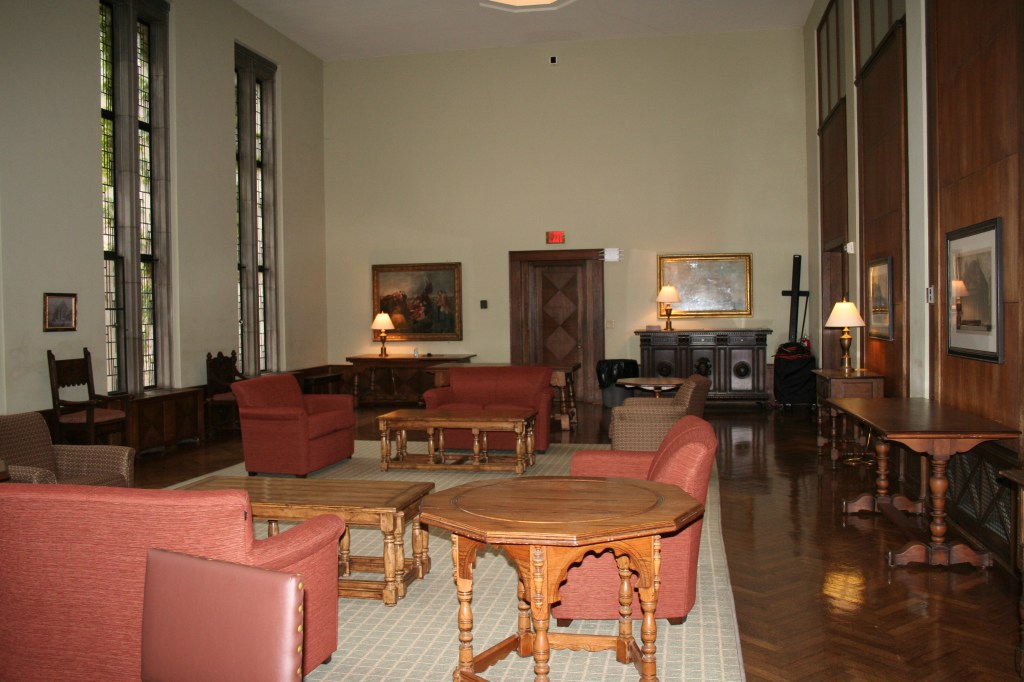
In October 1928, George Booth bought three paintings from a Boston gallery, including one depicting the battle, The Death of General Wolfe, attributed to Benjamin West. He gave all three paintings to Cranbrook School for Boys, where they still hang today, on the walls of Page Hall Commons. Cranbrook’s The Death of General Wolfe is a studio copy of a famous work depicting the end of the Battle of Quebec. The painting represents a turning point both in American history, and in the history of art.
The artist, Benjamin West, was born in Springfield, Pennsylvania, in 1732. Like many artists living in the North American colonies, he was acutely conscious of the shortage of opportunities for training and patronage on this side of the Atlantic. At 31, he left America for Europe, where he embarked on a study tour of Italy, before settling in England. There, he quickly established himself as an artist of skill and imagination. West attracted clients to his studio by deliberately playing up his background as an émigré from the still largely unknown North American continent, even claiming to have had his first lessons in painting from Native American artists. His talent and social charms quickly won him support from colleagues and patrons alike, but it was the triumph of The Death of General Wolfe that made him a national celebrity.
Self Portrait, Unknown 18th century artist, after Benjamin West, circa 1776. National Gallery of Art, Andrew W. Mellon Collection, Washington, D.C.
In 1771, twelve years after the Battle of Quebec, West exhibited a monumental canvas depicting Wolfe’s death on the battlefield at the Royal Academy of Art’s summer exhibition in London. At its debut, West’s painting was lambasted by critics for his then unconventional choice to portray all the subjects of his work in accurate, contemporary dress, rather than classical draperies. However, critical disputes were drowned by popular acclaim.
The painting’s dramatization of an already thrilling moment in recent British history captured the public’s sentiments, while fellow artists praised West’s dynamic composition, effective use of classic postures and gestures, and brilliant color. Joshua Reynolds, the first President of the Royal Academy, who had advised West against his choice to include contemporary dress, confessed that he had been wrong. West’s balance of realistic costumes and props with compositional techniques borrowed from the Italian Renaissance set a new standard for verisimilitude and expressiveness in British history painting.
The Death of General Wolfe, Benjamin West, 1770. National Gallery of Canada, Ottawa. Gift of the 2nd Duke of Westminster to the Canadian War Memorials, 1918; Transfer from the Canadian War Memorials, 1921.
At the center of the eight foot wide canvas, General Wolfe lies dying in the arms of his officers. From the far left, a messenger approaches bearing news of the French surrender, while in the background, windblown clouds and smoke open up to reveal a patch of blue sky, signaling the imminent arrival of good news. Though all accounts of the general’s death place just three men with him, West has ringed Wolfe with fellow soldiers, whose gestures direct our attention to the dying man, and express mingled grief and awe. Wolfe’s own pose echoes that of the dead Christ in the Virgin Mary’s lap in Michaelangelo’s Pieta (1499). His upturned face is illuminated by the sun breaking through the clouds. It is a profoundly unsubtle portrait of a patriotic martyr.
At the left of the group, two figures speak to the specifically North American character of the battlefield. The figure in the green coat, who points over his shoulder at the approaching messenger, is Sir William Johnson, an English immigrant to the North American colonies who established close personal relationships with the Mohawk, and was appointed by their leadership to represent their interests to the British government. Johnson’s negotiations were critical to the British alliance with four Iroquois peoples, who fought alongside the British against the French in the Seven Years War. The unknown Native American man who sits beside Johnson represents the Iroquois contribution to the British war effort. His pensive posture as he watches the dying general is based on two major art historical precedents; the “Belvedere Torso”, a fragment of Roman sculpture at the Vatican Museums in Rome, and Melancholia, an allegorical depiction of melancholy, by Albrecht Dürer. The pose reflects two of the many views of Native American people then current in British society – they were both recognized as valiant military allies, and romanticized as tragic representatives of a culture fated to disappear in the face of inevitable British conquest and the expansion of their colonized territories.
Melencolia I, Albrecht Dürer, 1514. Metropolitan Museum of Art, New York. Harris Brisbane Dick Fund, 1943.
The triumph of The Death of General Wolfe, like the real victory it depicts, is a watershed moment in history – that is, in the history of British historical subject art. Over the next hundred years, history painting would evolve from a genre reserved for the walls of palaces, and confined by the conventions royal aggrandizement and allegory, to a popular genre of narrative art, characterized by dual commitments to historical accuracy and psychological drama. Though West was not the first to introduce modern dress into historical scenes (nor even the first to portray the death of Wolfe in this manner), the extraordinary merits of his work turned the tide in favor of realism and emotionally driven narrative for the genre as a whole.
And When Did You Last See Your Father?, William Frederick Yeames, 1878. Walker Art Gallery, Liverpool. A fictionalized depiction of the interrogation of the young son of a Royalist sympathizer by a Parliamentarian, Yeames’s work epitomizes the 19th century turn towards envisioning history through the lens of individual experiences.
West went on to be appointed court historical painter under George III, and became the second president of the Royal Academy of Art, succeeding Joshua Reynolds in 1792. Though he never resettled in America, West lent his support to many young American artists visiting England, fostering the growth of American art up to the Revolution and beyond.
The Death of General Wolfe Comes to Cranbrook
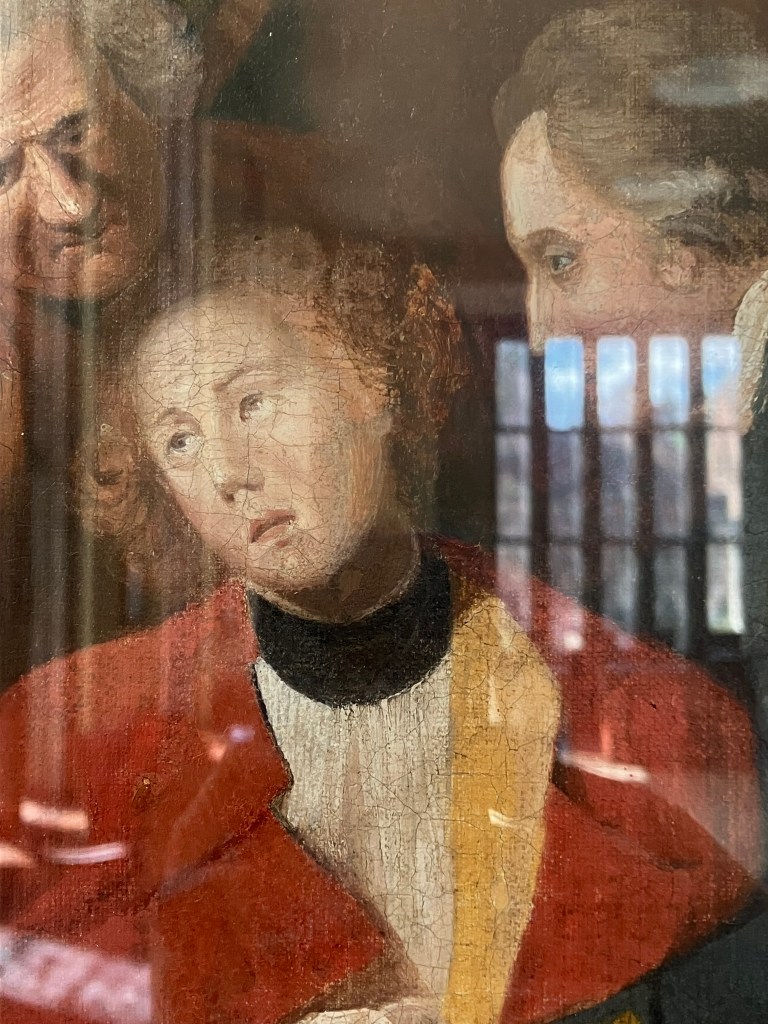
The version of The Death of General Wolfe at Cranbrook is one of at least seven copies of the painting produced in West’s lifetime. Several were painted by West himself, others by studio assistants. We do not know the exact provenance of this painting. The technique reveals it to be the work of a less experienced artist, perhaps a junior studio assistant. The painting lacks the exacting finish that characterized West’s work and was demanded of all artists at this period. In the original work, not a single brushstroke is visible, while in the Cranbrook copy, the artist has not learned to conceal the work of their brush.
The panel is about half as large as the original, slightly taller and narrower in its dimensions. To adapt the painting to a differently proportioned canvas, the artist was forced to compress the space between some of its figures. Many features of the battle in the background, such as press of boats along the river’s edge on the right of the canvas, were omitted altogether. A key figure, the messenger bearing news of victory, is crammed into the left-hand margin, and partially cut off by the frame. The missing details raise the possibility that this work was painted from a print, rather than from close study of the original or a copy by West himself.
Print of The Death of General Wolfe, William Boydell and Rowlands Woollett, after Benjamin West, 1 January 1776. National Maritime Museum, Greenwich, London.
George Booth paid the Vose Gallery $3,000 for this painting – twice as much as he paid for either of the other two paintings, and a remarkable price for a work that is almost certainly not from the artist’s own hand. (The other works were The Clipper Midnight, by Samuel Walters, and a portrait of Washington Irving by John Vanderlyn.) Why was it so important to the Booths that Cranbrook have some version of West’s masterpiece?
Six months before George Booth bought the painting, another version of The Death of General Wolfe was presented to the University of Michigan at Ann Arbor, by William L. Clements. Clements, a noted collector of American artifacts and documents, bought the painting to ornament the library of Americana that he had just given to the university, the William L. Clements library. The painting at Ann Arbor is a full-scale replica of the original work, painted by Benjamin West in 1775 for the Prince Regent of Waldeck, a region in Germany. The library, with its new painting in place, opened to the public in June of 1928, when visitors packed the rooms to see the collection. The Booths may well have been in attendance, and would certainly have been aware of the well-publicized gift. Perhaps it was Clements’s generosity that inspired George Booth to seek out a Death of General Wolfe for the Cranbrook campus as well.
The Death of General Wolfe, Benjamin West, 1776. William L. Clements Library. Courtesy of the University of Michigan.
By giving the painting to the school, George Booth probably hoped that it would add something to the students’ education there. In the most straightforward sense, the painting depicts a critical moment in the history of the United States, Canada, Great Britain, and the First Nations. It also represents a turning point in the history of art, and in the life of one artist in particular. Benjamin West rose from American obscurity to the highest eminence in British art, thanks to his talent, effort, and amiable personality, but it was this painting that secured him national recognition. Throughout his career, he sought to help younger artists to success, teaching many American artists in his own studio. General Wolfe was a hero of his own nation and time, but to an art lover and sometime pacifist like George Booth, Benjamin West may well have seemed like the true exemplar of a life well spent, and an ideal role model for the students of Cranbrook School.
— Mariam Hale, 2023-2025 Collections Fellow, Cranbrook Center for Collections and Research
Nothing at Cranbrook is just one thing. Every tree, garden, rock, and railing has a story–and often times, a name.
In 2022, with the help of an anonymous donor and our friends at RE-TREE, a Camperdown elm (Ulmus glabra ‘Camperdownii’) was transplanted from a local garden to the Meadow in Cranbrook House Gardens, where it joined another established Camperdown elm. Since RE-TREE names all of the trees they relocate, I decided our Camperdown elms needed names, too. I started to refer to the larger tree as Thistle and the smaller tree as Smike to honor the two youngest Booth children, who grew up primarily on the Cranbrook Estate.
Thistle and Smike, the Camperdown elms below the West Terrace, in the Meadow, in Cranbrook House Gardens. Photographed by Leslie Mio, July 2024.
In 1908, George and Ellen Booth and their children, James, Grace, Warren, Harry, and Florence, moved from their home on Trumbull Avenue in Detroit to their new home Cranbrook, in the “wilds” of Bloomfield Township. At the time of the move, James was twenty, only two years away from marriage; Grace was eighteen; and Warren, fourteen, was already in boarding school. Youngest siblings Harry (eleven) and Florence (six) pretty much had the run of the grounds, exploring every nook and cranny (pun intended).
As the family explored and improved their country estate, they also took to naming significant features: every pond, hill, tree, and drive would be christened with its own name. Some names stuck (Angley Woods), others changed (Glassenbury Lake became Kingswood Lake), and others have been forgotten.
From the beginning of Cranbrook’s history in 1904, place names at Cranbrook have evolved and changed. Once the Booths turned the original mill pond into a lake,…
Harry and Florence were no exception; they had pet names for each other. Harry, known as Thistle, received his nickname during an illness. He did not shave for days, and someone said kissing his cheek was like kissing a thistle. We don’t have a record of the origin of Florence’s nickname, but friends and family called her Smike her whole life.
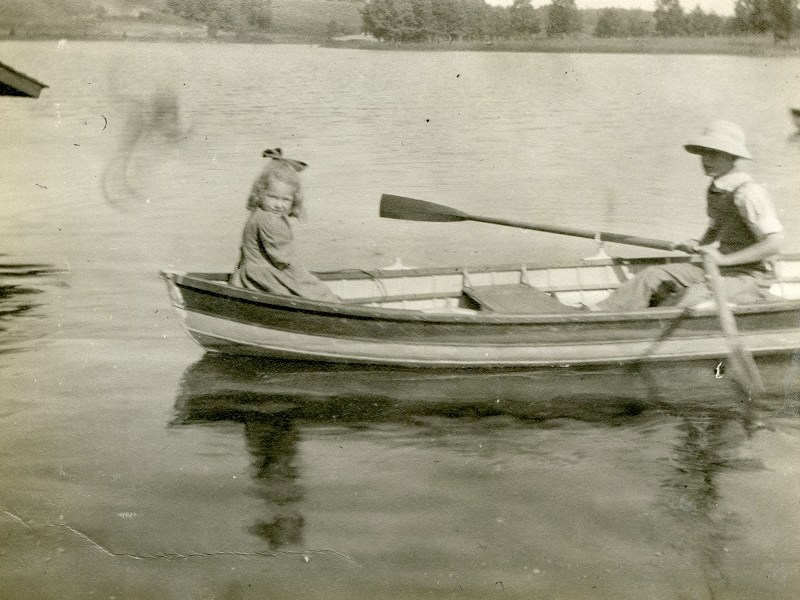
Harry (Thistle) and Florence (Smike) Booth with Spot in 1912. Courtesy Cranbrook Archives, Cranbrook Center for Collections and Research.
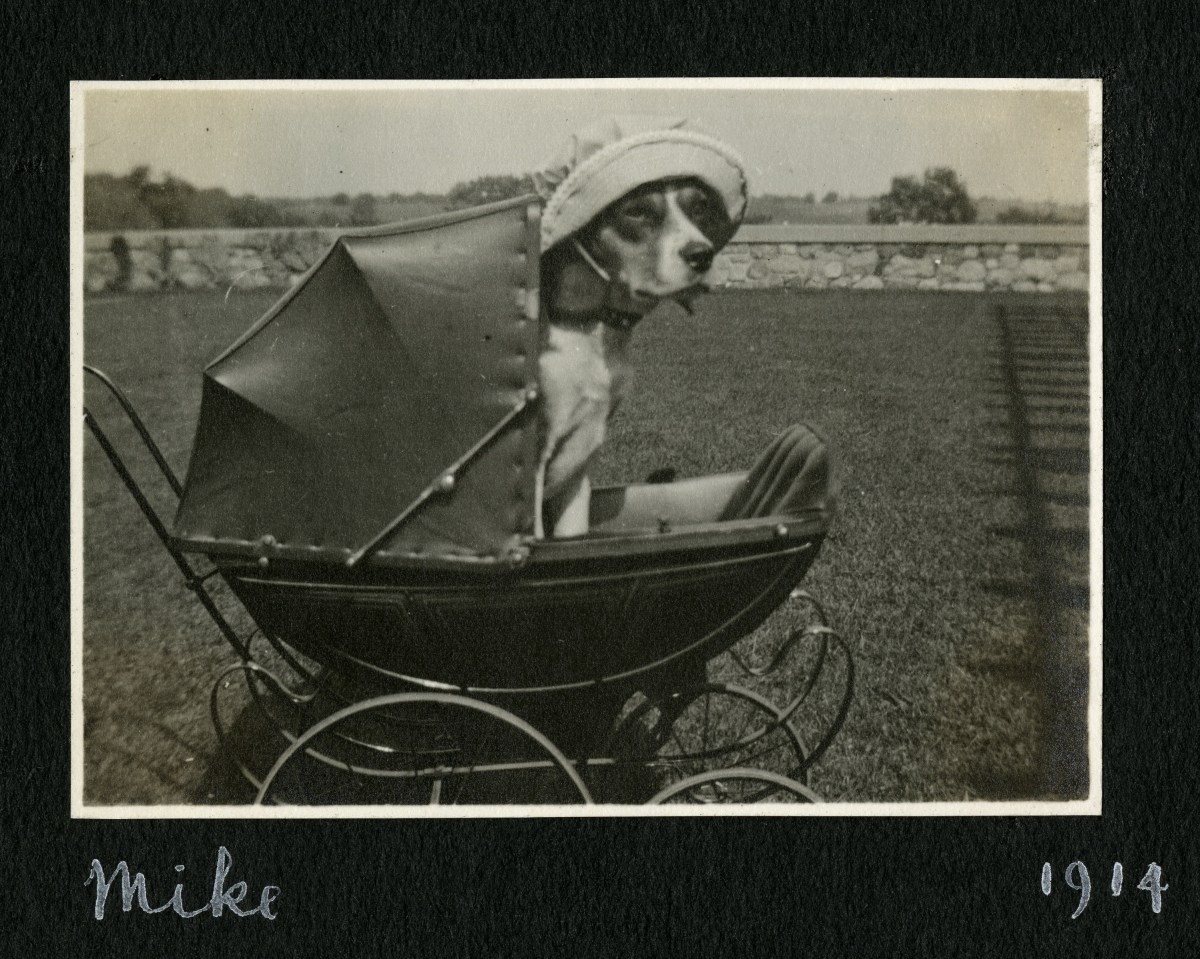
The Camperdown elms’ location below the West Terrace are also significant to Smike’s story. The Booths (especially Florence) loved animals. Family dogs Bud, Sandy, Spot, Prince, Larkspur, and Craig were well cared for and loved. The family beagle Mike was so beloved as to be made to wear a bonnet as he travelled around in a baby carriage!
The biggest canine event at Cranbrook came in 1914. As Harry Booth later wrote, “On June 20, 1914, the Booth family celebrated the 70th anniversary of the family’s landing on North America from England. After a picnic, everyone attended a dog show Florence Booth organized on the new West Terrace.”
The Bloomfield Hills Dog Show, June 20, 1914, on the West Terrace at Cranbrook House. Courtesy Cranbrook Archives, Cranbrook Center for Collections and Research.
Invitation to the Bloomfield Hills Dog Show, June 20, 1914, on the West Terrace at Cranbrook House. Courtesy Cranbrook Archives, Cranbrook Center for Collections and Research.
So, when I look at the two Camperdown elms below the West Terrace–one slightly bigger than the other–I think of all the stories the grounds of Cranbrook hold, and of the happy days Thistle and Smike spent growing, adventuring, and imagining around campus.
Perhaps you’ll agree with my names for the trees, and next time you are strolling in the Meadow at Cranbrook House Gardens, just below the West Terrace, say hello to Thistle and Smike.
– Leslie Mio, Associate Registrar, Cranbrook Center for Collections and Research
Ed. note: Special thanks to Paul Nelson, one of the arborists for Cranbrook House and Gardens Auxiliary. He has been a champion for Thistle and Smike, making sure they are trimmed, watered, fertilized, and kept looking their best.
In recent years, new residential development along the small strip of Cranbrook Road between Lone Pine Road and Woodward Avenue has given Cranbrook a few new neighbors. One of Cranbrook’s first neighbors on the street, however, dates back one hundred years!
As George and Ellen Booth began developing their country estate in the mid-1920s into what we know today as Cranbrook Educational Community, a new house was completed just north of what would soon become Kingswood School for Girls.
Picture of Stonelea from an ad in Afterglow: A Country Life Magazine, August-September 1925.
Ralph Stone, president of the Detroit Trust Company, with which George Booth did business, purchased this land around 1923. He quickly commissioned Albert Kahn to design a country residence for the site, which Stone named “Stonelea.” This was just a few years after Kahn had completed additions to Cranbrook House.
Residence for Mr. Ralph Stone. Albert Kahn Architect. November 17, 1923. Courtesy of Cranbrook Archives.
The close neighbors shared some correspondence regarding their properties that provides a glimpse of both men’s personalities, and highlights their shared affability and elegance of prose. Their letters, part of the George Gough Booth Papers, begin a year before Ralph Stone and his wife Mary would finalize construction of their home in 1925. It seems they could not wait to spend a summer of leisure in Bloomfield Hills, away from the hustle and bustle of Detroit. The Stones sought to rent the Booth’s Brookside Cottage–an impossibility due to occupancy by Booth family members.
But perhaps the most interesting exchange takes place in 1926 when Ralph writes regarding the shocking lack of water needed to preserve his lawn and garden in a green state in the middle of July (not a problem in 2024!). He proposes to pump water from Cranbrook, but George’s reply a week later masterfully circumnavigates the issue:
Opening lines of the George Booth letter, August 2, 1926. Courtesy of Cranbrook Archives.
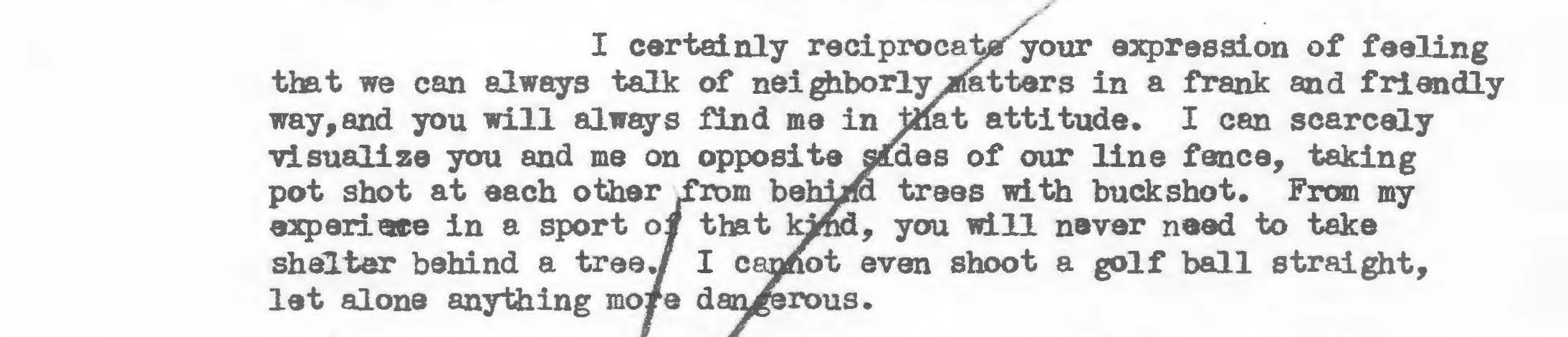
In Ralph’s reply he acquiesces with good humor:
Second paragraph of the Ralph Stone letter, August 3, 1926. Courtesy of Cranbrook Archives.
The sentiments expressed in these letters appear genuine as their families remained on neighborly terms. George and Ellen were occasional guests at Stonelea for dinner parties until the Stones sold their property in 1931.
In fact, Ralph Stone proved to be much more than just a friendly neighbor of George Booth, continuing his connection to Cranbrook long after he had moved from the area. He was an early and steadfast supporter of Cranbrook, serving on various boards for over twenty-five years as a Cranbrook School Trustee (1928-1951), Kingswood School Trustee (1930-1951), Brookside School Trustee (1945-1951), Academy of Art Trustee (1941-1946), and Foundation Trustee (1940-1952).
George Gough Booth and Ralph Stone attend the 80th birthday party of Ellen Scripps Booth at Cranbrook House, 1943. Courtesy of Cranbrook Archives.
Today, Stonelea is no longer just a neighbor: the property was acquired by Cranbrook Educational Community in 2003. In the coming years, Stonelea will become the future home of Cranbrook Center for Collections and Research!
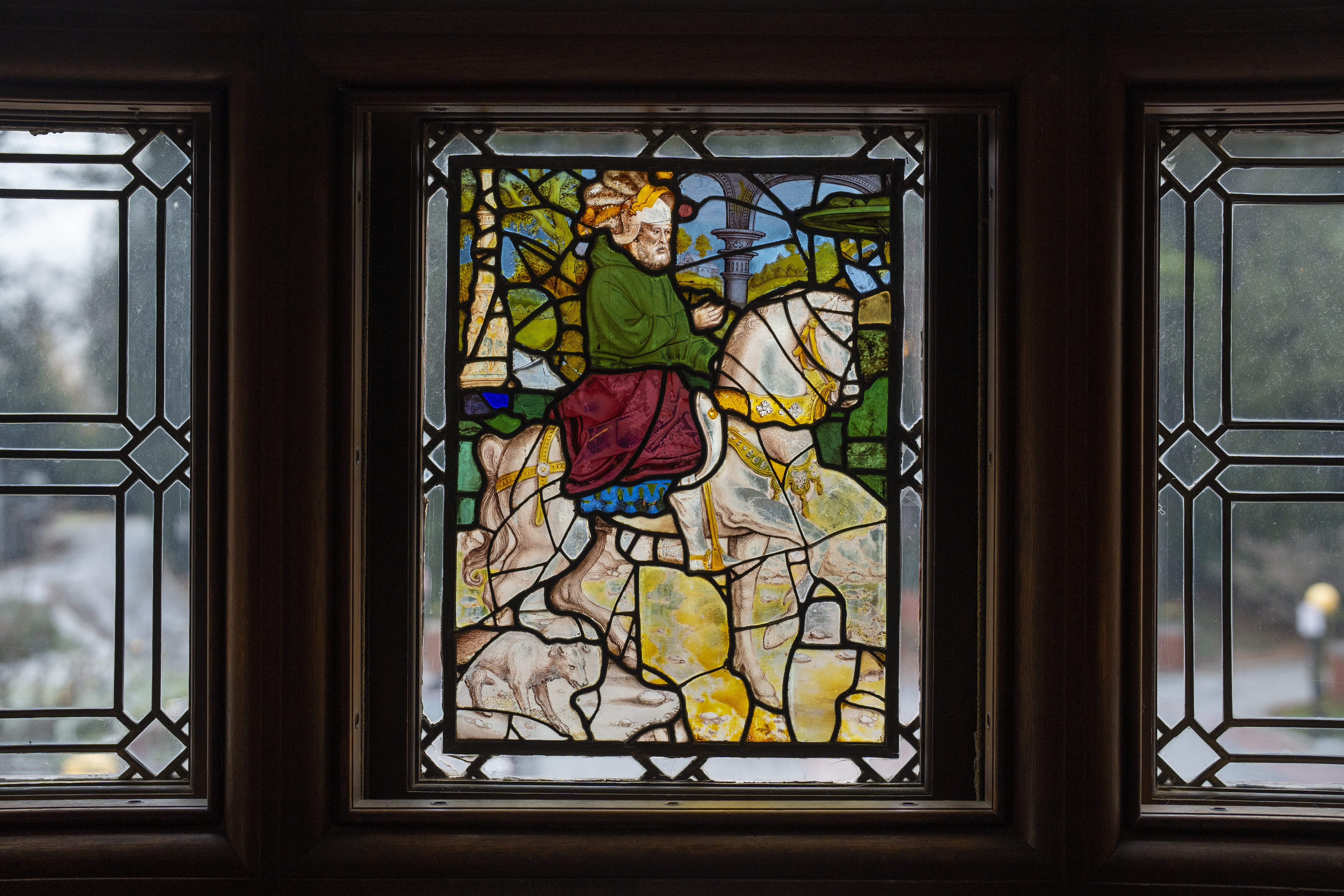
When you take the time to look, the windows of Cranbrook House are surprisingly varied. Some are leaded casement windows straight out of an Elizabethan manor house, others are modern sash windows, fitted with plate glass. A few rooms in the house enjoy a special distinction – their windows are fitted with inset panels of stained glass.
These stained-glass panels were a later addition to Cranbrook House. When first completed in 1908, the windows were all clear glass. It was only while pondering extending the house, in the latter half of the 1910s, that George Booth began purchasing stained-glass panels for his home. The most prominent stained-glass work in Cranbrook House is the 16th-century Flemish panel, depicting a man on horseback, placed in the main window over the staircase in the Reception Hall.
It was not part of the original design for the window, but added in 1922. That panel, and several others scattered throughout the house, were purchased from Thomas & Drake, an English firm specializing in historic glass.
Others, like the heraldic roundel in the library’s east window, were purchased by the Booths in Lucerne, Switzerland. There was some debate as to their final destination. George Booth wrote, in a letter to his son Henry, in March 1922:
They do not make an imposing collection but I think they are good and that everyone will like them – I did think I would let the [Detroit] museum [of Art] buy them at cost if they wished to begin to accumulate some historical glass, but your mother and Florence say no – they are to be put into the windows at Cranbrook but we will see.
(George Gough Booth to Henry Scripps Booth, 26 March 1922. Cranbrook Archives, George Gough Booth Papers.)
In the event, Ellen and Florence won out, and at least a few of the Swiss purchases made their way into the windows of Cranbrook House.
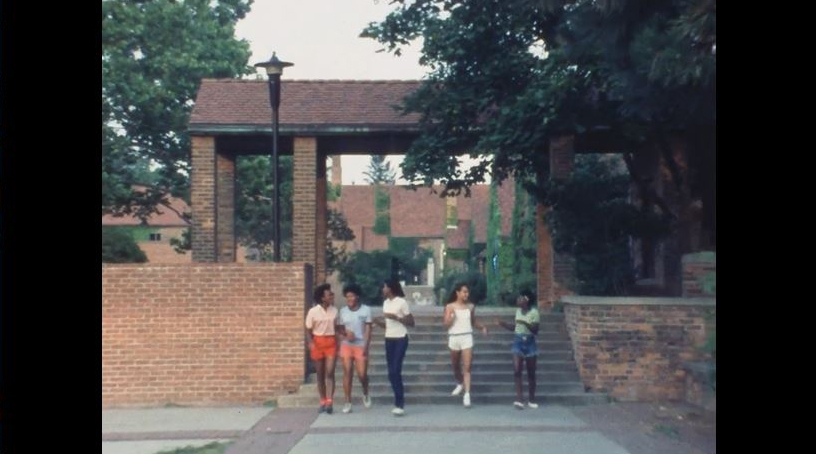
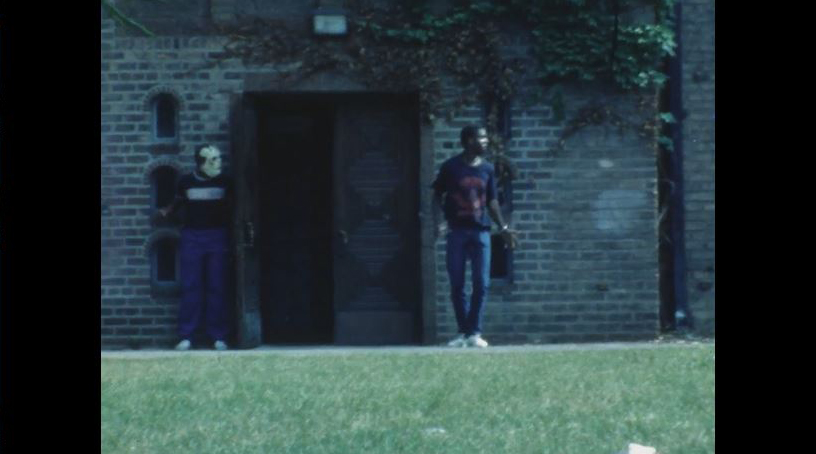
Films titles like Farewell My Summer Love, The Nightmare, and Dormitory of the Dead were recently rediscovered while working on the Horizons-Upward Bound (HUB) digitization project. The 8mm film reels were unmarked, but cross-referencing with film festival entry packets and faculty reports in the HUB Records, along with viewing the first few frames of each reel, revealed their origin.
Produced in 1984 by HUB summer students in John Prusak’s class, these films had been submitted to The Michigan Student Film and Video Festival, held at Friends Auditorium, Detroit, MI in 1985.
Opening scene from The Nightmare, 1984. Courtesy of Cranbrook Archives.
Top section of film evaluation sheet for the Michigan Student Film and Video Festival, 1985. Courtesy of Cranbrook Archives.
Digitizing film for today
When applying for the grant that is allowing digitization of the HUB Records only one student film, The Great Dictator, from William H. Moran’s 1969 summer class, had been labeled and identified. So it was indeed a nice surprise to find that there were more! Along with the 1969 film and a fifth film, Together, produced in John Geoghegan’s Advanced Film Class 1972 summer class, the 1984 films were sent to a lab for digitization.
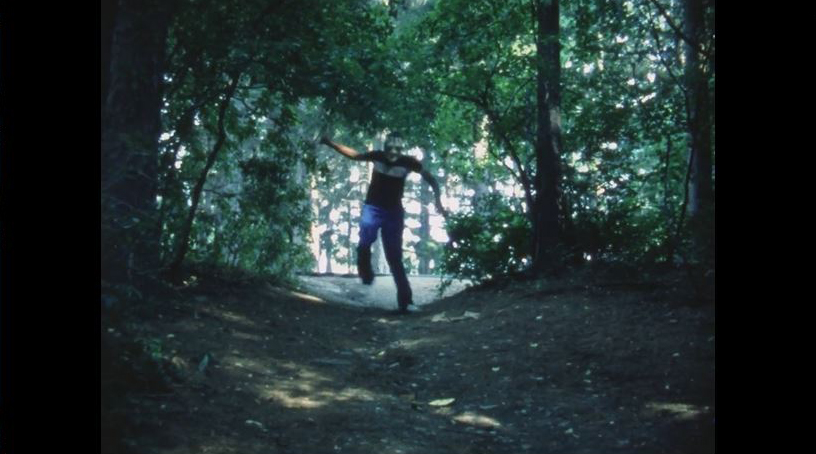
Title Title screen and scenes from Dormitory of the Dead, 1984. Courtesy of Cranbrook Archives.
Scene from Farewell My Summer Love, 1984. Courtesy of Cranbrook Archives.
Viewing the digitized films helped further identify the students involved and corroborate the information listed on the entry forms. With this information in hand, we have eagerly begun sharing this newly accessible resource with the HUB community.
Head archivist, Deborah Rice, screens two films during Cranbrook Schools Reunion Weekend June 2024. Courtesy of Cranbrook Archives.
Future Discoveries
The summer film elective class was offered sporadically throughout HUB’s history beginning in 1969. It is yet unknown how many films have been produced over the years. Other titles listed in the 1985 festival entries alone include six films: Money, Spectrum, Street People, That’s Life Kid (It’s Gonna Be Lonely II), The Mix, and Class of 86 – Memories. Together, the films are invaluable documentation of the student perspective.
Please reach out to archives@cranbrook.edu with any information about the films mentioned above or other HUB student films. We’d love to know more!
—Courtney Richardson, Project Archivist and Deborah Rice, Head Archivist, Cranbrook Center for Collections and Research
HUB digitization is funded by a NHPRC Archival Projects Grant for projects that ensure online public discovery and use of historical records collections. The NHPRC was established by Congress in 1934 as a statutory body affiliated with the National Archives and Records Administration and chaired by the Archivist of the United States.
Each May, the Center is honored to host an outstanding senior from Cranbrook Kingswood Upper School for a three-week immersive internship.
The Center’s 2024 “Senior May” Sav Hayward writes about their time working with the Center team.
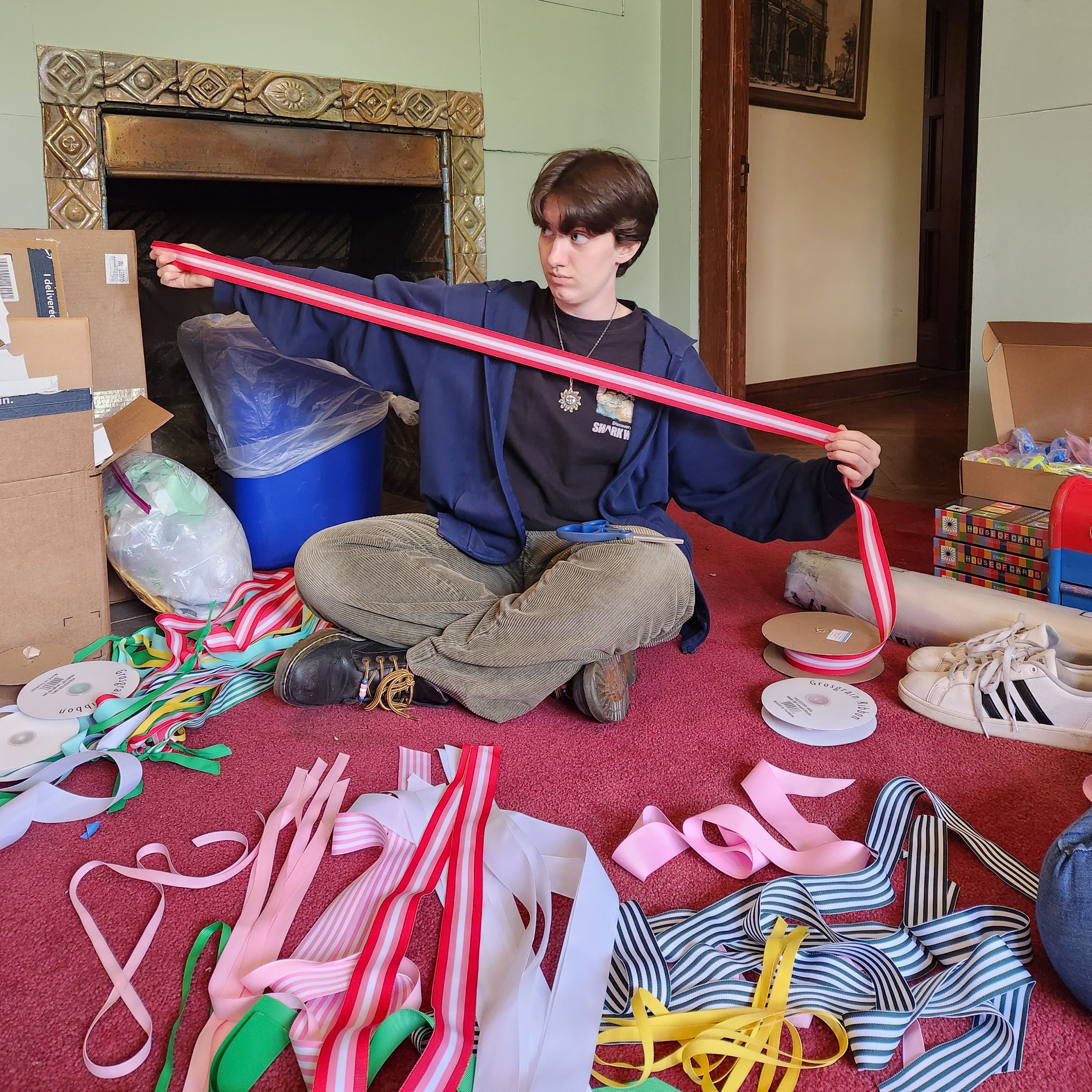
I hit the ground at my Senior May running. The very first day, I had to help prepare for the Center’s annual House Party gala. This year it was held at Thornlea House which needed a lot of TLC before the event on Saturday. During my first week, I worked all over the house to help prepare it. Things like vacuuming (Ed. note: No one, in the history of the universe, was as excited as Sav about vacuuming), wiping windows, sorting cupboards, cutting ribbons, crafting decorations, and going to Cranbrook Archives to help move items from the collection for displays. Once everything was completed the final product was extremely satisfying, and I heard many wonderful things about the night. I had to decline my invitation to the House Party in favor of my Senior Prom.
Cutting ribbon to create bunting for the House Party. Photograph by Leslie Mio, May 2024.
The following two weeks, I never had the same task twice in a row. Some of my favorite days consisted of working in the Archives with Deborah Rice and Laura MacNewman, helping around in the Annex offices with the Center’s Registrar, Leslie Mio, and going on random little trips.
In the Archives, I helped organize and re-box some items we got out for the House Party. There was a very relaxed environment there, and it was cool seeing all the documentation Cranbrook has about our history.
The following day I helped Kevin and Leslie take the painting A Hunter of Taos by Oscar Edmund Berninghaus from the Cranbrook Kingswood Middle School for Boys and drive it to a conservation studio in Detroit. When we were finishing our visit, the conservator, Ken Katz, told us to go upstairs and check out the exhibit being set up at the Metropolitan Museum of Design Detroit (MM-O-DD). There we met some cool people, including the Founder/Executive BOD President Leslie Ann Pilling and Chuck Duquet of Collected Detroit, who took us downstairs and showed us artwork stored there.
Standing around looking at the framing studio. Photograph by Kevin Adkisson, May 2024.
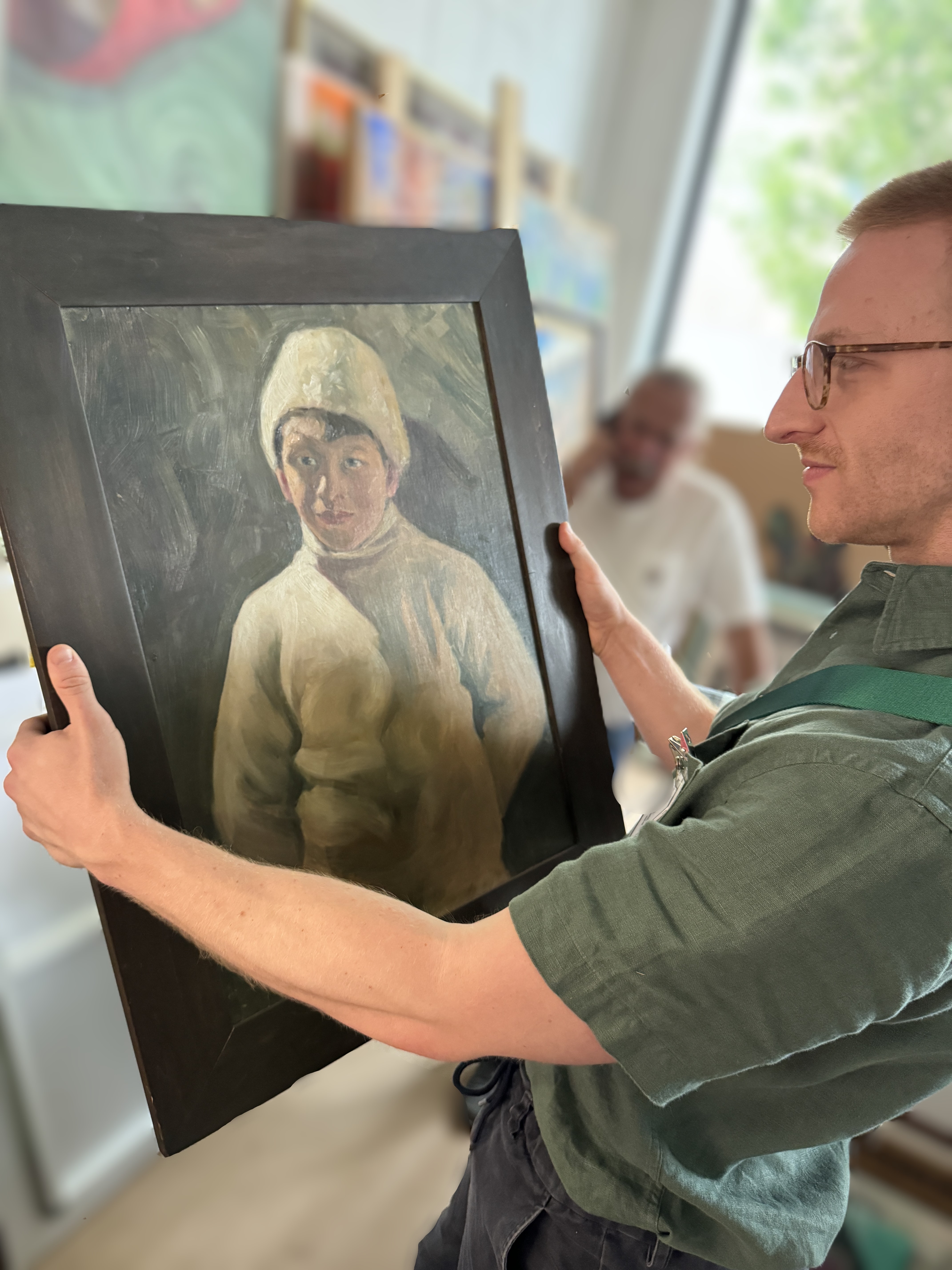
While looking around I saw pieces by many Cranbrook Artists, including some that had been loaned to Cranbrook Art Museum’s recent exhibition LeRoy Foster: Solo Show. I also saw an amazing painting of Eero Saarinen as a boy, painted in Finland by his father (and architect of Cranbrook) Eliel Saarinen.
Kevin admires Eliel Saarinen’s painting of his son Eero at Collected Detroit. Photograph by Leslie Mio, May 2024.
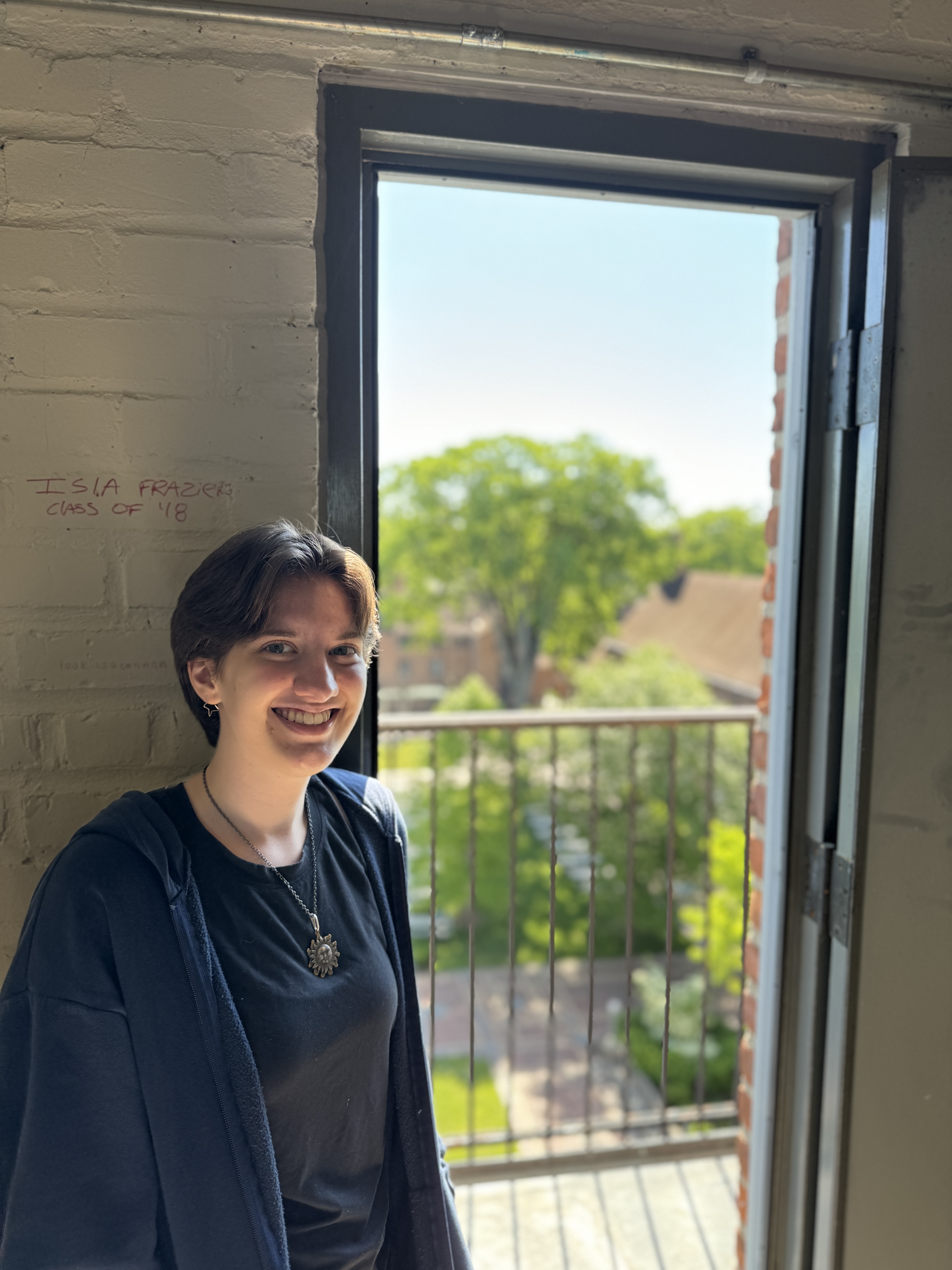
Ever since I started going to Cranbrook, I have dreamed of going up into the old astronomy tower at Hoey Hall. I was able to achieve this dream thanks to Kevin. He was working with photographer James Haefner to document the tower after some recent cleaning. Luckily, I was invited to join Kevin and see how the entire photshoot process worked. I helped do some tasks, like dusting, carrying equipment cases, and bringing water up to the ridiculously hot rooms.
Standing next to the upper door in the Cranbrook Campus tower. Photograph by Kevin Adkisson, May 2024.
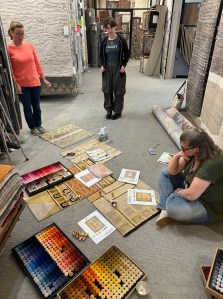
On the last day of Senior May, I joined Leslie and Kevin on a trip to Hagopian World of Rugs in Birmingham. We met with architect Erinn Rooks of Cranbrook Capital Projects to pick out colors for a reproduction rug. Suzanne Hagopian, Executive Vice President, brought out a test sample made a while back to see if the colors matched the original and if it was what we were looking for.
When we looked at the sample, we realized that the colors were lacking, so we all sat around and debated over small tufts of colorful yarn samples. What was nice was that these color samples were neatly lined up in multiple boxes. After a while, we finally decided on more vibrant colors compared to the sample, but this was to help make the carpet pop. Ed. note: Sav’s knowledge of color theory and use of technology to compare color tones greatly assisted in this project.
Erinn, Leslie, and I examine carpet and color samples. Photograph by Kevin Adkisson, May 2024.
Kevin and I take a “magic carpet ride” while looking at yarn samples. Photograph by Leslie Mio, May 2024.
I will always remember this Senior May and how fun it was. The people I met during this time are amazing and I will miss seeing them every day. While some of my classmates went off campus for their Senior May, doing mine on Cranbrook’s entire campus felt like I was a part of one large family. I have never felt more connected to Cranbrook, its history, and its legacy.
– Sav Hayward, Cranbrook Kingswood Upper School Class of 2024 and Cranbrook Center for Collections and Research 2024 Senior May
Editor’s Note: Sav Hayward is a member of the CKU Class of 2024 and a proud resident of Lansing, Michigan. In Fall 2024, Sav will continue their education at the College for Creative Studies in Detroit, where they will study Interior Design. CCS is the modern iteration of the Detroit Society of Arts and Crafts, co-founded by George G. Booth in 1906. Sav is hoping to land a paper route for the Detroit News to complete the Booth trifecta.
Another day, another lunch break. The Center feeds its Senior Mays well – Sav was treated to lunches at some of the staff’s favorite local eats, including Panera, 29º 41º Mediterranean Street Food, Green Dot Stables, and Paris Baguette Café (pictured here on their last day with us). Photograph by Kevin Adkisson, May 2024.
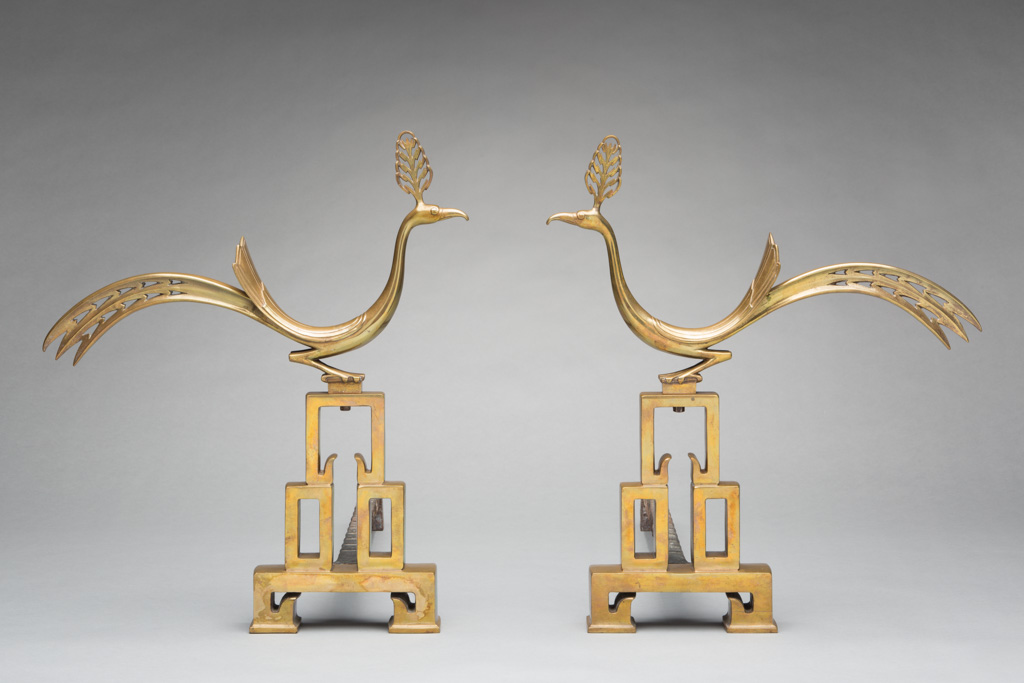
While researching the step-backed Peacock Andirons at Saarinen House last spring, I enthusiastically mustered a muster of peacocks from across Cranbrook’s campus with the generous help of my colleagues.
“Muster” is the official label for a group of peacocks.
Unlike a gaggle of geese, a muster of peacocks lacks both onomatopoeia and alliteration and implies a level of formality and regimental order in direct conflict with the species’ behavior! That is…judging by the peacocks I’ve witnessed at historic homes and castles throughout Europe, including a visit to Scone Castle in Scotland where an earlier visitor captured these free-spirited troops. Whether iridescent blue or albino, their graceful necks and distinctive crests rise to magnificence when tail feathers are splayed to attract a peahen mate or intimidate predators.
Throughout the ages, blue aka Indian peafowl have symbolized beauty and prosperity and served as sources of artistic inspiration. A favored theme at Cranbrook, the peacock’s dramatic curvilinear lines are represented at each institution across the campus.
One can discover…
WORKS IN METAL:
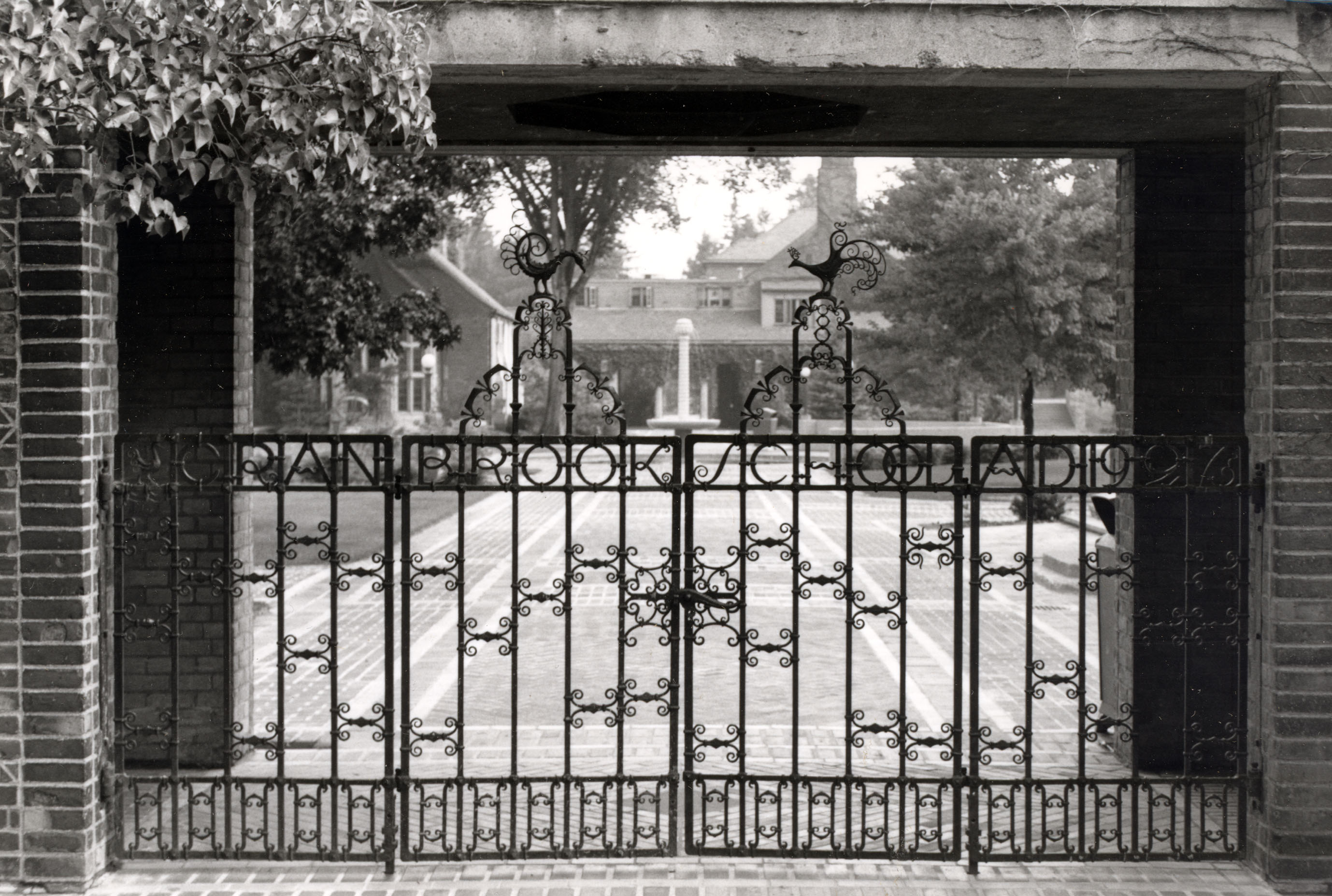
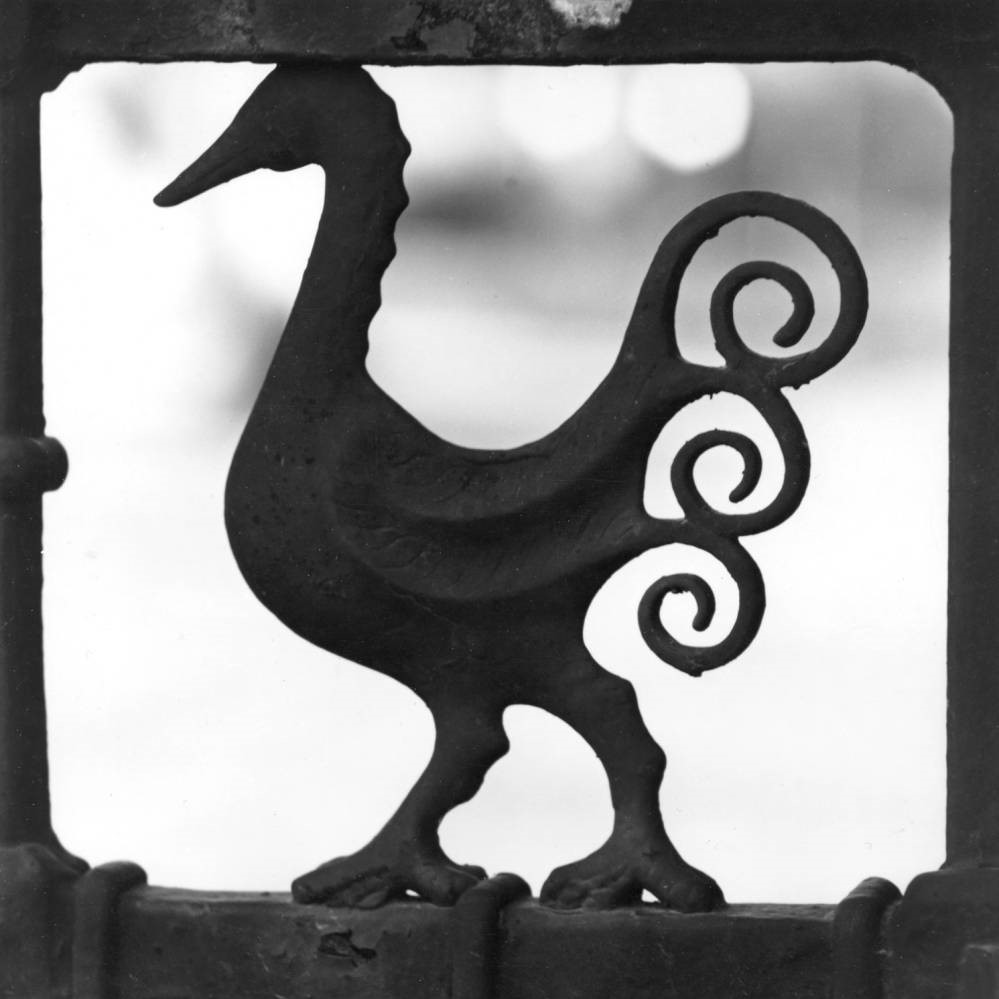
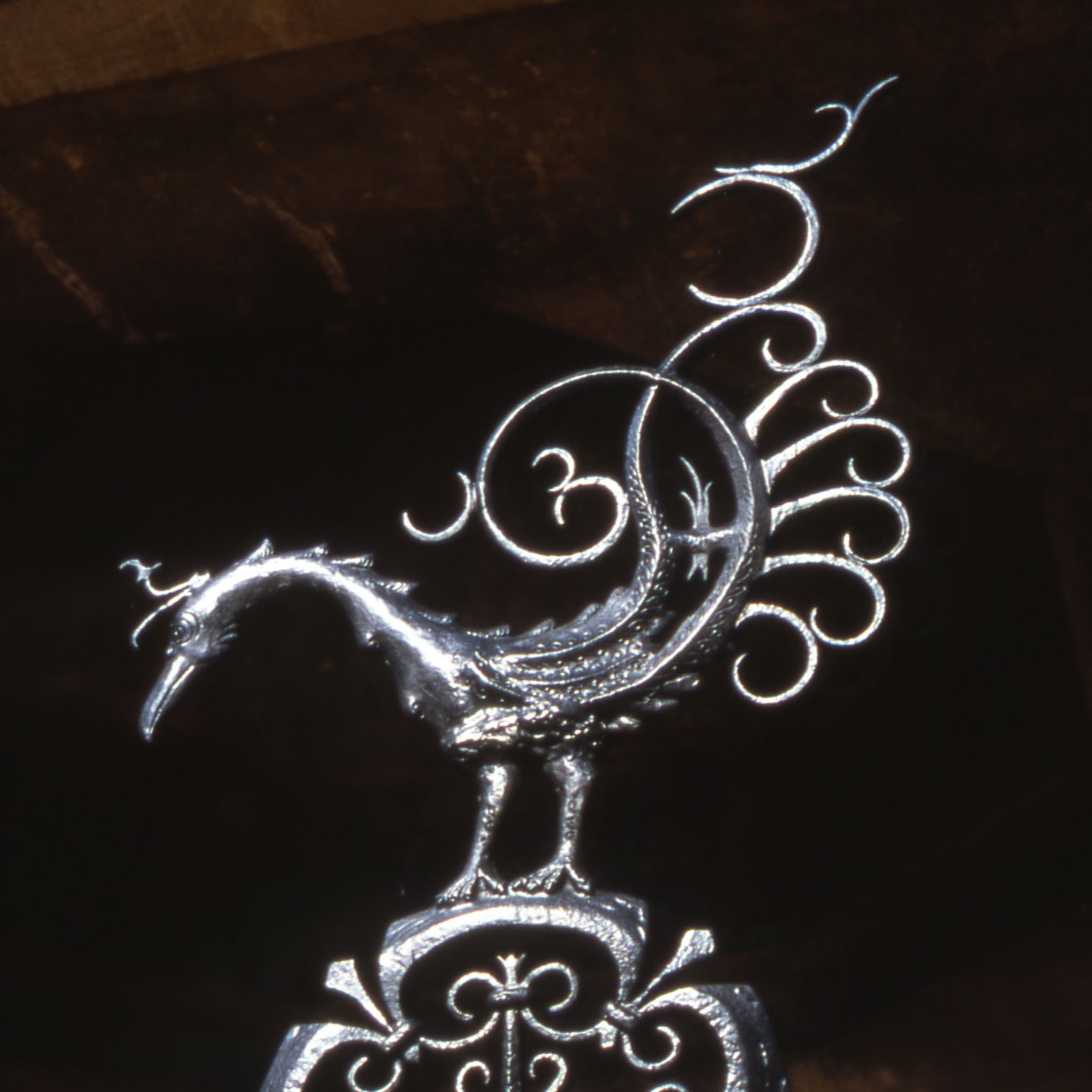
• The famed Peacock Gates designed by Finnish-American architect Eliel Saarinen and fabricated in wrought and cast iron by Oscar Bruno Bach, 1927, marking the former Lone Pine Road entrance to Cranbrook School for Boys:
Peacock Gates at Cranbrook School circa 1980. Jeffrey Welch, photographer. Courtesy Cranbrook Archives.
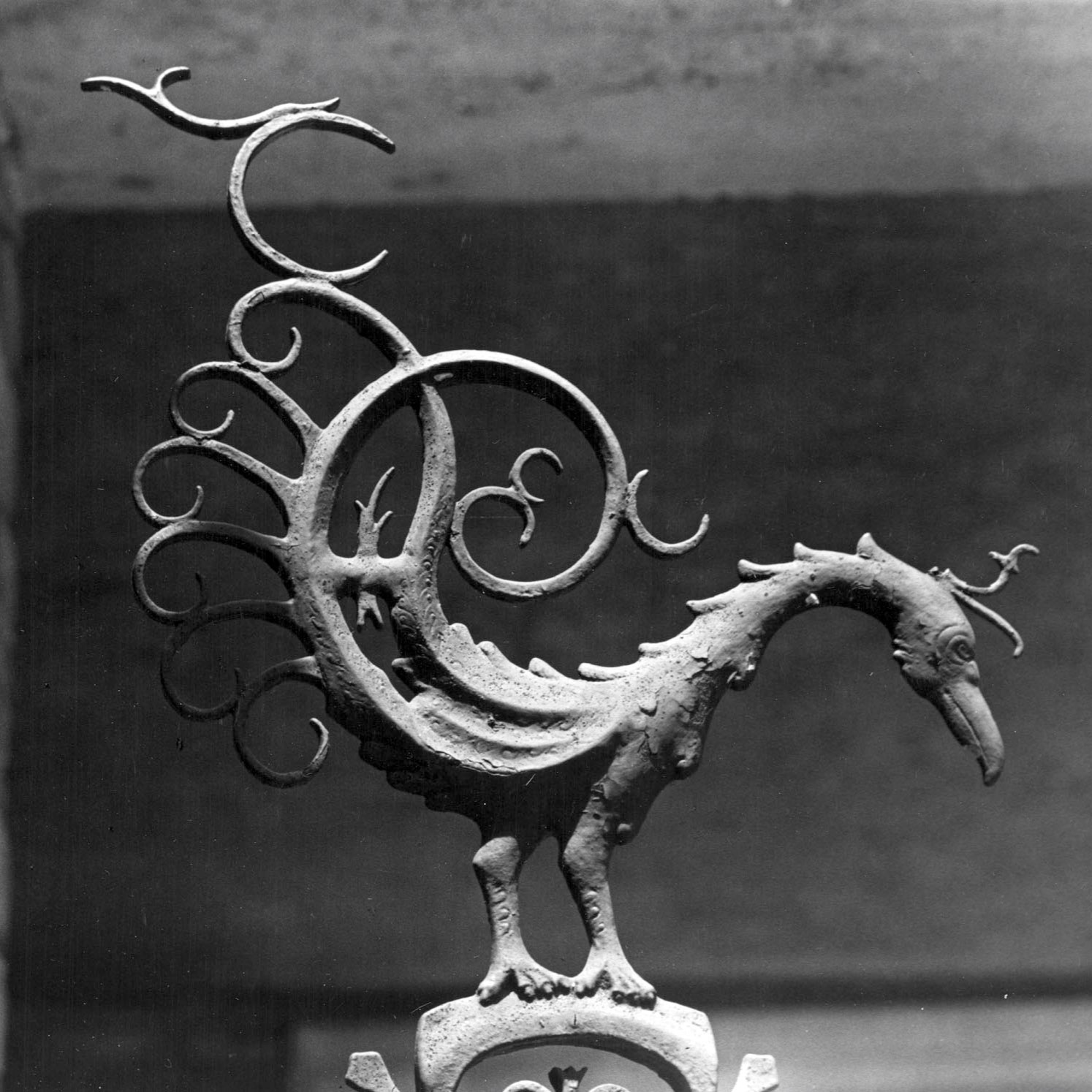
Details of the peacocks in cast iron:
Detail of Cranbrook School Peacock Gate, circa 1935. Courtesy Cranbrook Archives.
Detail of Cranbrook School Peacock Gate, circa 1935. Courtesy Cranbrook Archives.
Detail of Cranbrook School Peacock Gate, 2001. Balthazar Korab, photographer. Copyright Balthazar Korab | Cranbrook Archives.
• Eliel Saarinen’s cast bronze Peacock Andirons, 1928-29, on view at Saarinen House. Collection of Cranbrook Art Museum. Produced by Sterling Bronze Company, New York, between 1928 and 1929, these cast bronze andirons were paid for by the Cranbrook Foundation and entered in the 1928-1930 Arts & Crafts Building ledger on pages 40-41—Date: 1-7-30; No.: 515; Name: Sterling Bronze Co; Remarks: 1 pair/ Andirons for Saarinen Res[idence]; Amount: $152.50 (the equivalent of $2,704 in 2024):
Robert Hensleigh, photographer. Courtesy Cranbrook Art Museum.




















 Cranbrook Kitchen Sink