Collaging the Architecture of Detroit

Each year before my History of American Architecture lecture series, I like to commission Cranbrook Academy of Art student or recent alumni to design a poster to promote the event. This year, I asked second-year 2D Design student Luis Quintanilla to create a poster for this year’s series, Detroit and the World. I am thrilled with how the poster turned out—you can pick one up at the first lecture February 6, 2024—and thought I would share with you some of how it came about.

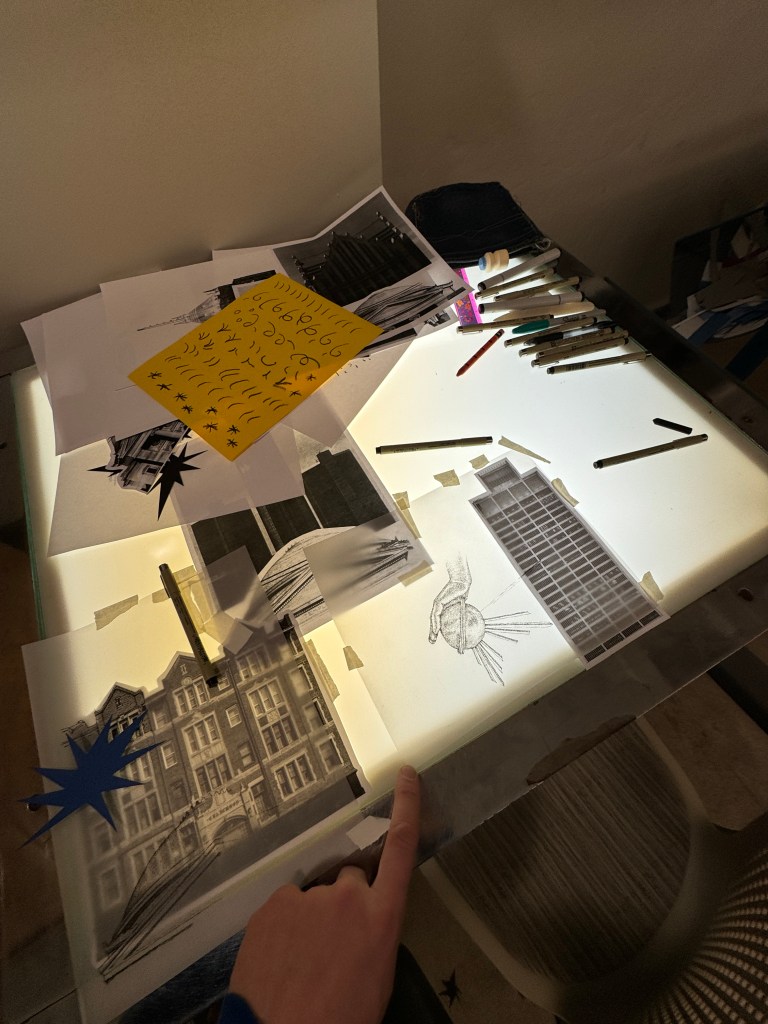
When I visited Luis’ studio in the Arts and Crafts Court, I was struck by their graphic sensibility combining imagery and text in sticker-like collages. I was also very impressed by a series of stipple drawings in ink on tracing paper, which Luis kept in a shoebox. As we talked about the themes of my upcoming lectures, and what we both admire about Detroit and its architecture, the idea of the poster came about. With Luis’ sketches strewn across the table in their studio, I was reminded of the great tradition of architectural capricci.

Architectural capprici are fantasies, where artists or architects combine buildings from across time in a single image. Traditionally, 18th century capprici could be oil paintings, pencil or ink sketches, or engravings. Joseph Michael Gandy is the most famous painter of architectural fantasies. Here, he is combining the London works of Sir John Soane into a single fantasy, set within the studio of Soane’s own house.

Joseph Michael Gandy, Public and Private Buildings Executed by Sir John Soane between 1780 and 1815, first exhibited 1818. Courtesy of Sir John Soane Museum, London.

If you’ve come to many of my previous architecture lectures, you might recognize my favorite painting: Thomas Cole’s The Architect’s Dream of 1840, a capprici which embodies the mid-19th century debate between gothic and classical styles. Contemporary British painter Carl Laubin creates stunning work inspired by Gandy, using contemporary architects for elaborate capprici.

What might an architectural capprici of Detroit include?
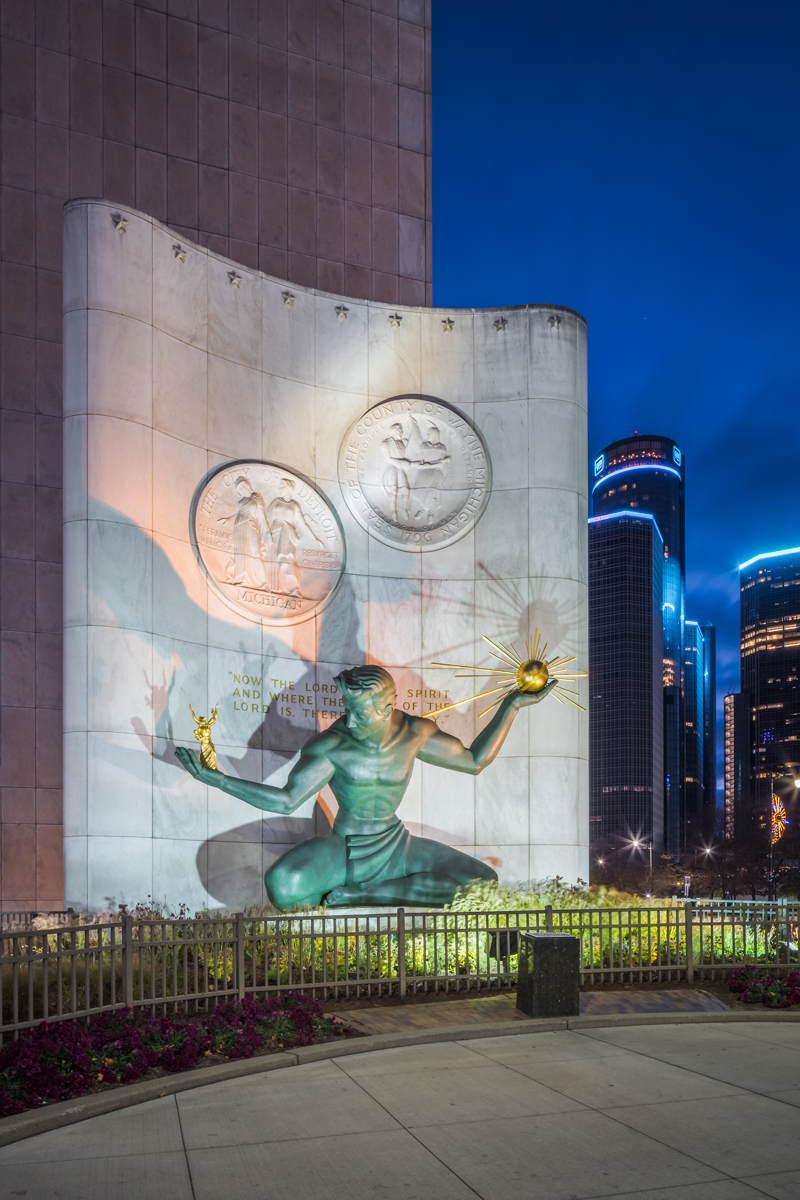
Marshall M. Fredericks’ The Spirit of Detroit, 1958, photographed by Helmut Ziewers for Historic Detroit Area Architecture.

I created a list of forty buildings I thought embodied the best of Detroit architecture. I narrowed it down to twenty buildings for Luis’ consideration, and shared images of each. My only real request: include at least one building from each of the five lectures, and center the poster on John Portman and Associates’ 1977 Renaissance Center.

I don’t think Detroit has a more iconic building than the RenCen, with its piston-like glass towers rising up from the Detroit River. There are better works of architecture, sure, but as far as an associated image of Detroit? Nothing tops the RenCen.

I suggested, too, that Luis include the 1901 St. Josaphat’s church by architects Joseph G. Kastler and William E. N. Hunter in front of the RenCen, to recall the almost too-good-to-be-true alignment of these two structures when driving into the city from the northern suburbs on I-75. After all, by the nature of delivering lectures about Detroit from the distance of Cranbrook, this is the view (from the suburbs, from the car) many of us hold toward the city.

We went back and forth about including the Spirit of Detroit, former Cranbrook Schools faculty member Marshall M. Fredericks’ monumental bronze at the Detroit City-County Building. What attracts me to the Spirit is its iconic status and its graphic replicability: whether on the redesigned city buses or the new city holiday lights, all you really need is an orb and some rays of light to know: that’s the Spirit of Detroit.

What would be the mood of our Detroit capprici?

Inextricably linked to the history of Detroit since 1980 is Detroit Techno, a form of Electronic Dance Music (EDM) that combines synth-pop with African American styles such as house, electro, and funk. For me, Detroit is most exciting, and its dynamism most electrifying, at night. In riding through the city after dark, buildings become speeding landmarks, and its possible to disappear for a time into a former factory or repurposed commercial building for a party or a rave. In these moments, buildings become less defined by their former glory or current decay than by their inhabitation as a dancefloor pulsating with music and lights. It’s a new way of occupying the city’s architecture to unique advantage.

Luis went to work. They began by printing out and arranging the buildings I’d shared. Then, they began overdrawing some of the images—distorting or highlighting certain features.

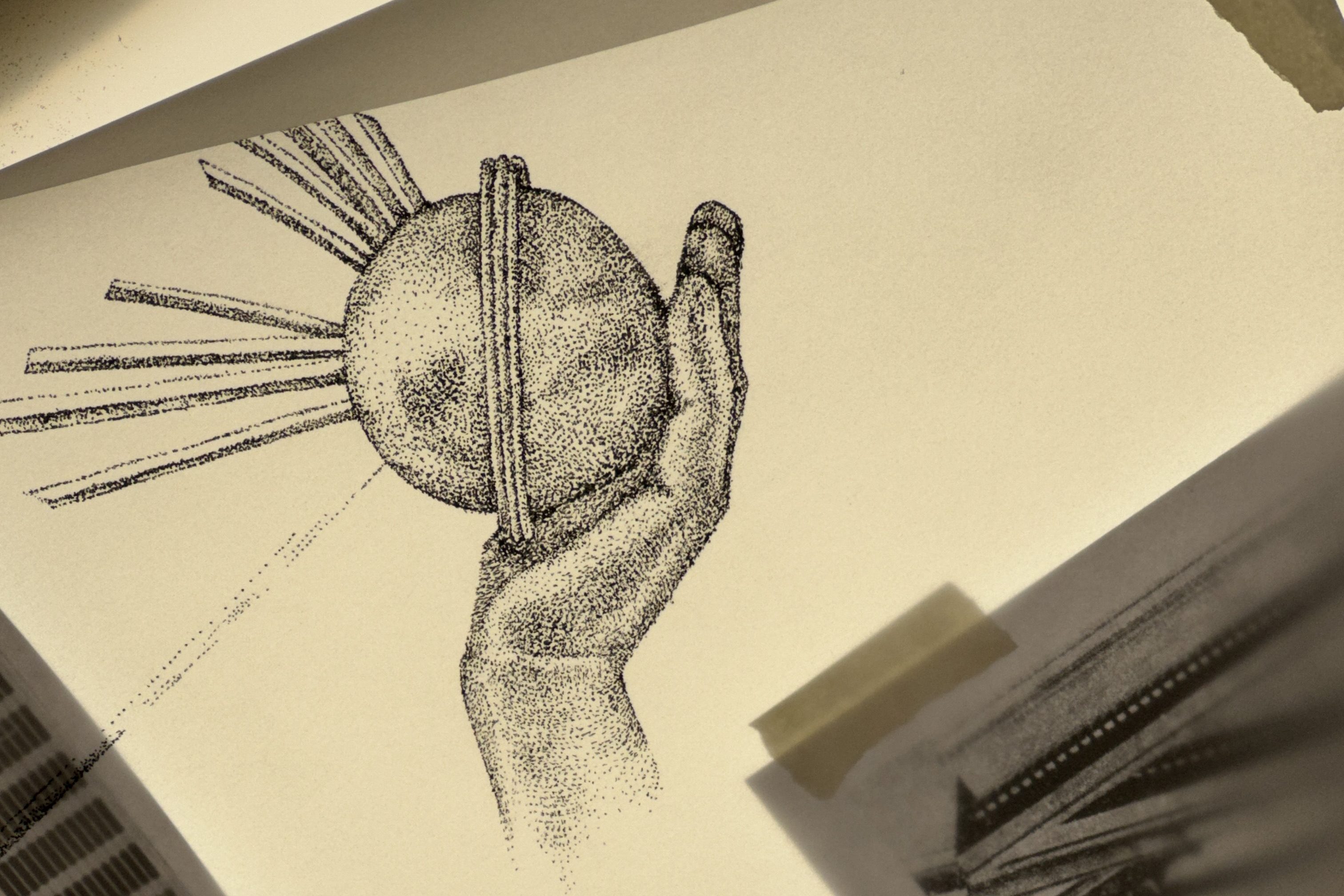
Layering on tracing paper, Luis dutifully stippled certain prominent architectural elements. I was especially impressed at the beautifully rendered hand, orb, and rays of Spirit of Detroit.
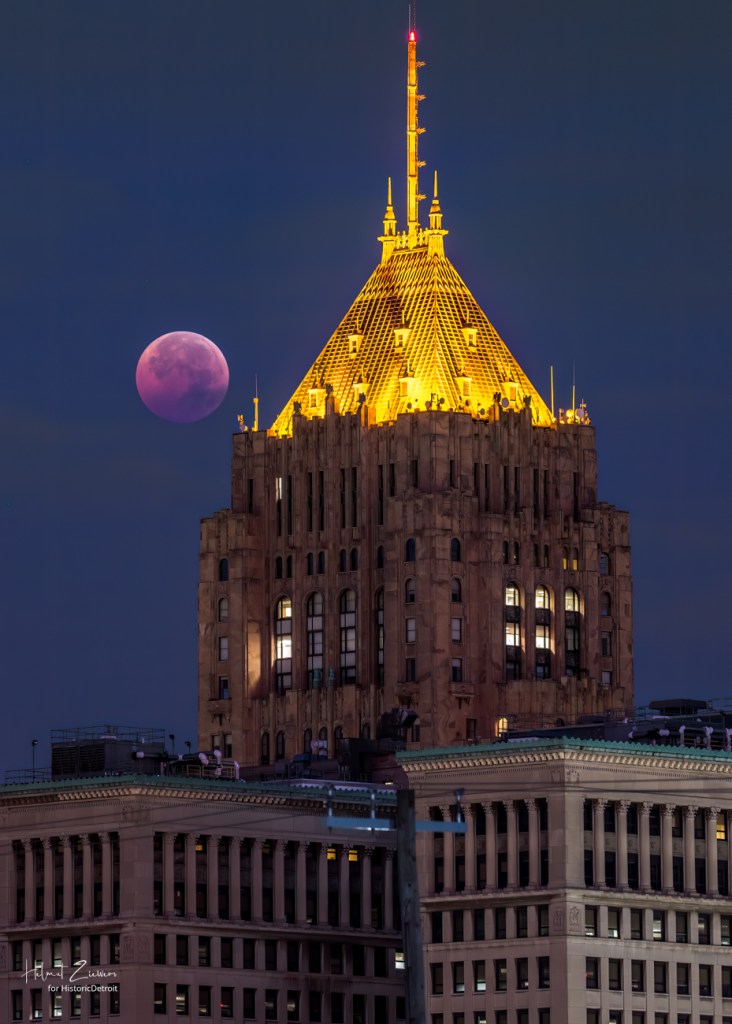
Luis then cut out stars on blue and yellow paper, adding in light sources to the night scene. The Ambassador Bridge, Dodge Memorial Fountain, Penobscot and Fisher Buildings are all recognized for their dramatic nighttime illumination, and Luis captured this with hand-drawn and cut stars.

Finally, Luis scanned in the physical elements of the poster and reassembled them in Illustrator, where text was added. Luis took inspiration from Detroit Techno posters for the colors and fonts. I could not be more thrilled with our poster, and the capprici of Detroit at night (with techno).

Luis Quintanilla, CAA ’24, working on the poster. Luis is from Austin, Texas, and earned their BFA from Virginia Commonwealth University.

Can you identify all the buildings shown? Can you speculate why I chose them?

If you can, you’ll love this year’s History of American Architecture: Detroit and the World lecture series! If you can’t, you’ll also love this year’s History of American Architecture: Detroit and the World lecture series! The first lecture is February 6, 2024, at 12:00pm ET online and at 6:30pm ET online and in de Salle Auditorium at Cranbrook Art Museum. Purchase your tickets and learn more on our website. All lectures will be available for viewing after the lecture to ticket holders. See you there!

Kevin Adkisson, Curator, Cranbrook Center for Collections and Research

Special thanks to Artist-in-Residence Elliot Earls, Head of 2D Design, for suggesting Luis for this project. A perfect fit!
Adler/Schnee’s Flower Fiesta

Are you enjoying the snow this winter? Or do you need something to brighten your February mood? Have you considered fake flowers?

This week, as the country was pummeled by winter storms, I was busy in Cranbrook Archives researching for my History of American Architecture: Eero Saarinen and His Circle lecture series. One important member of Eero’s circle of designers? Ruth Adler Schnee.

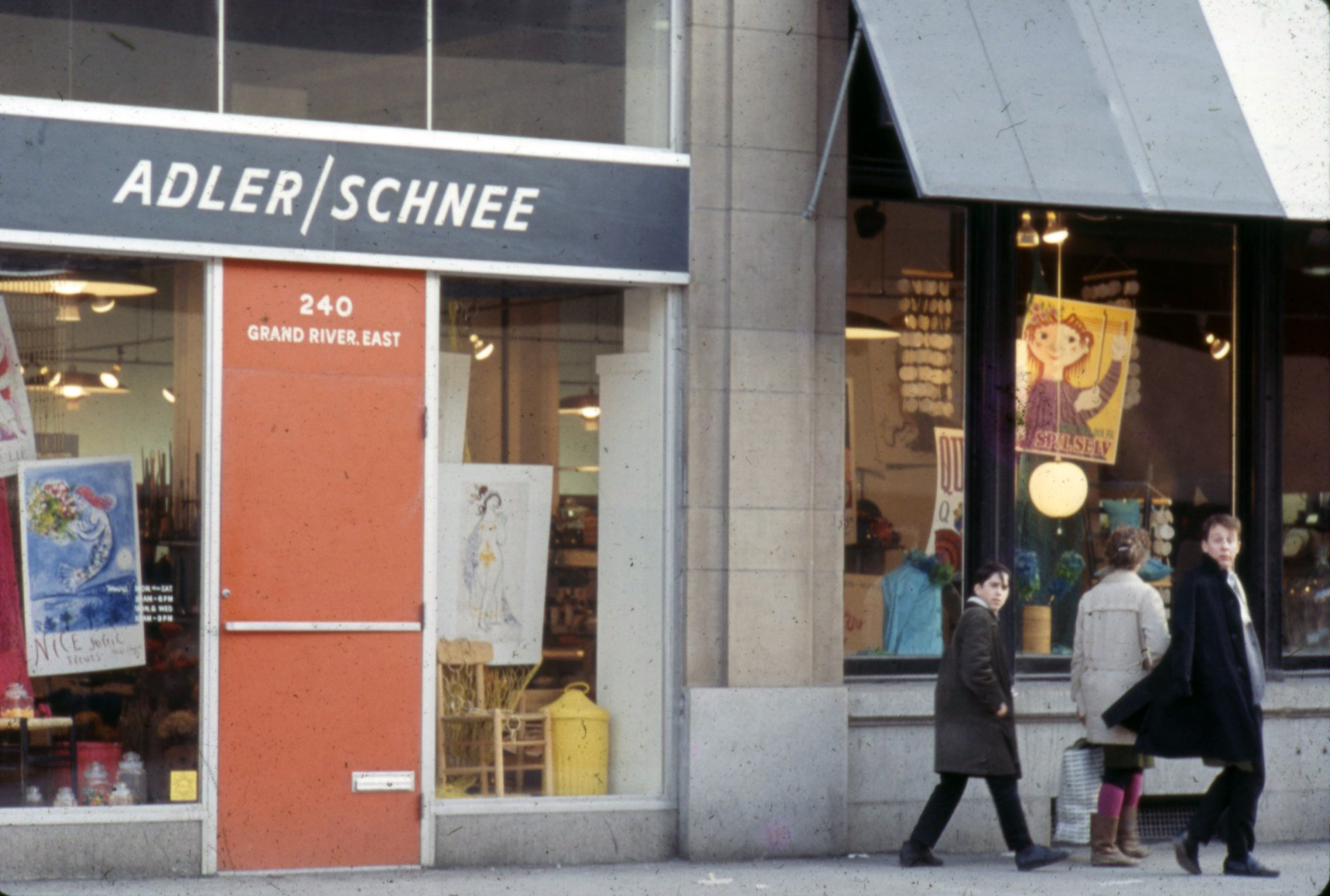
Ruth, a 1946 graduate of Cranbrook Academy of Art’s Design Department, was known for her printed textiles, interior designs, and the store she operated with her husband, Edward, in Detroit from 1948 to the 1977. In Cranbrook Archives, we have the Edward and Ruth Adler Schnee Papers, which includes a wide variety of designs, notes, samples, and PR materials.

Adler/Schnee, Inc. on Harmonie Park. The design store was located at 240 Grand River East in Detroit between 1964 and 1977. Photograph February 1965. Copyright Cranbrook Archives.

As I looked for materials related to Ruth’s work on the General Motors Technical Center—the subject of my lecture Monday—I came across this charming fold-out advertisement from the winter of 1966. Although it has nothing to do with my upcoming talk, it certainly brightened my mood, and I wanted to share it with you! The outside reads:

Sometimes it’s June in January…but at A/S it’s Bloomin’ February

The ad copy gets even better inside. Underneath a bright-pink line drawing of Scandinavian, Japanese, Danish, and Mexican home goods surrounded by Ferry-Morse seeds, a cat, birds, and flowers, it reads:

Stamp out snow with fake and fabulous flowers!

Put posies on everything—put posies in everything.

Color runs riot at Adler/Schnee Flower Fiesta

With kooky dried flowers ala Dr. Seuss; passionate pillows, dizzy dinnerware, palpitating papergoods, terrific totes and much marvelous more—all bursting with scintillating springtime.

Kick winter gloom and check Adler/Schnee, where even Harmonie Park itself is coming up new and exciting.

This pamphlet made me smile, and gets first prize in the alliterative Olympics. Based on other handwritten records in the Archives, it is possible Ruth herself wrote this little ditty (she wrote and designed much of the firm’s PR materials). Again based off other mailers, it seems likely the Schnees mailed out between 5,000 and 15,000 of these large fold-out advertisements.

Continue reading

Cranbrook Students Kick Out the Jams

How many high schools can lay claim to hosting a performance of the legendary Detroit band, the MC5? In 1967, Cranbrook School joined a handful of Metro Detroit high schools as a venue for arguably one of the most influential rock bands of all time.

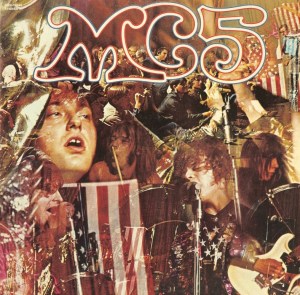
Cover of the MC5’s debut album, recorded live at Grande Ballroom in Detroit, 1969. Courtesy of private collection.

Known the world over today for their groundbreaking music, and as progenitors of the subsequent 1970s punk rock movement, the MC5 (Motor City Five) were relatively unknown outside the Detroit area when they played the Cranbrook School Little Gym on April 28, 1967.

Rob Tyner, lead singer of the MC5, performing for the Cranbrook audience. The Brook, 1968. Courtesy of Cranbrook Archives.

Billed as a Jazz Psychedelic, the concert featured fellow Detroit musicians, the Charles Moore Octet and the Joseph Jarman Quartet, both avant-garde jazz groups. Trumpeter Charles Moore’s band had already played earlier that year at Cranbrook (their musical repertoire including poetry by John Sinclair) and had developed a following among students and faculty. Accompanying the music at the April concert was a light show by the Magic Veil, which consisted of several sheets placed around the gym, a large number of lenses, watercolors, and an overhead projector. Open to Cranbrook and Kingswood students, faculty, and the area’s interested general public, tickets cost $3.25.

Charles Moore Octet at Cranbrook. The Crane, January 20, 1967. Courtesy of Cranbrook Archives.

The event was sponsored by the revamped Jazz Society, a student club formed in 1966 with a goal of exposing students to different forms of jazz (including a trip to the Masonic Temple in Detroit to see Count Basie). Under their new name, REAL (Revolutionary Enjoyment Authenticity and Love), they continued to arrange musical experiences both on and off campus, providing tickets and transportation to venues such as the Fisher Theater, Meadowbrook, and the Grande Ballroom. A trip to this last venue, “home base,” if you will, of the MC5, included a concert by the Eric Clapton band, Cream.

Continue reading

A Summer Education at Brookside

Summer school. Those two words usually make most children cringe—who wants to spend their summer vacation studying and attending classes? Sheer morbid curiosity made me explore further a few folders in Brookside School Records, a collection just opened for research last month. What I found was not the usual story.

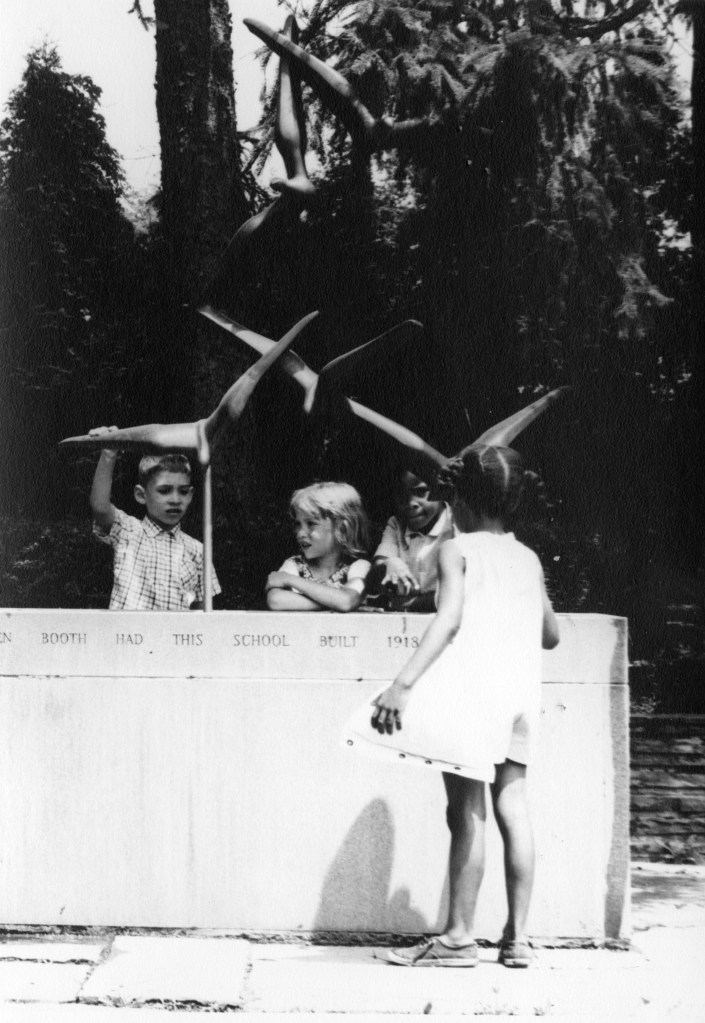
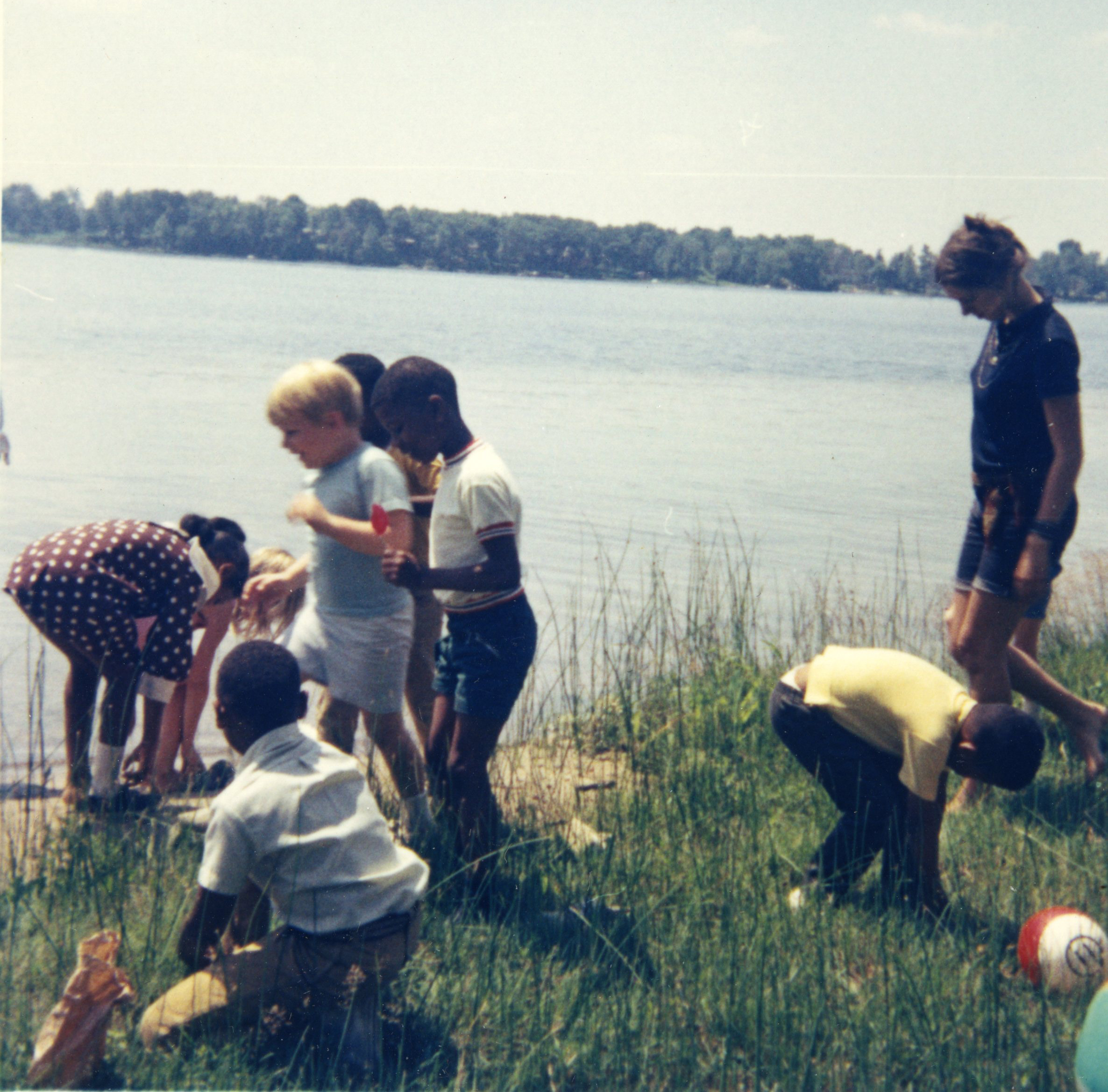
The Brookside summer school program, AWAKE, had a different purpose than remedial education for elementary students. Developed in 1968 by Pontiac Elementary Principal Jim Hawkins and Brookside Headmaster John P. Denio, it was designed to promote harmony and understanding amongst young children who might not otherwise share life experiences due to racial, social, and economic segregation.

AWAKE followed on the heels of the “long hot summer” of 1967, which saw civil unrest in Detroit and cities across Michigan, including Pontiac, due to long-standing racial inequalities for Black Americans. Instituted in 1968, AWAKE’s purpose was to “bring together young children in essentially two segregated school areas,” in some ways foreshadowing the desegregation of Pontiac and Detroit schools in the early 1970s.

Roughly fifty children split their time equally between the Bloomfield Hills and Pontiac schools for five mornings a week, over a four-week period in July and August. Co-sponsored by Cranbrook’s Brookside School and Pontiac Public Schools’ Bethune and Whittier Elementary Schools, the program included art projects, field trips, swimming, reading, and other enrichment activities for kindergarten-age children in both communities. Directed at young children because of their natural receptiveness at that age, Denio believed that,

With AWAKE, children four through six, through work and play activities and through simple, open contact with each other may perhaps develop the knowledge and understanding necessary to reinforce their acceptance of each other as human beings.

Governed by a Board comprised of community members and Pontiac Public School administrators and teachers, the program was self-sustained through tuition fees (waived in cases of need), financial contributions, and community support. Christ Church Cranbrook, for example, played a significant role through both donations and parishioners’ participation in the program. Familiar Cranbrook names, such as Cranbrook School teacher and Horizons-Upward Bound founder, Ben Snyder, and his wife Margot were also regular advocates of the program.

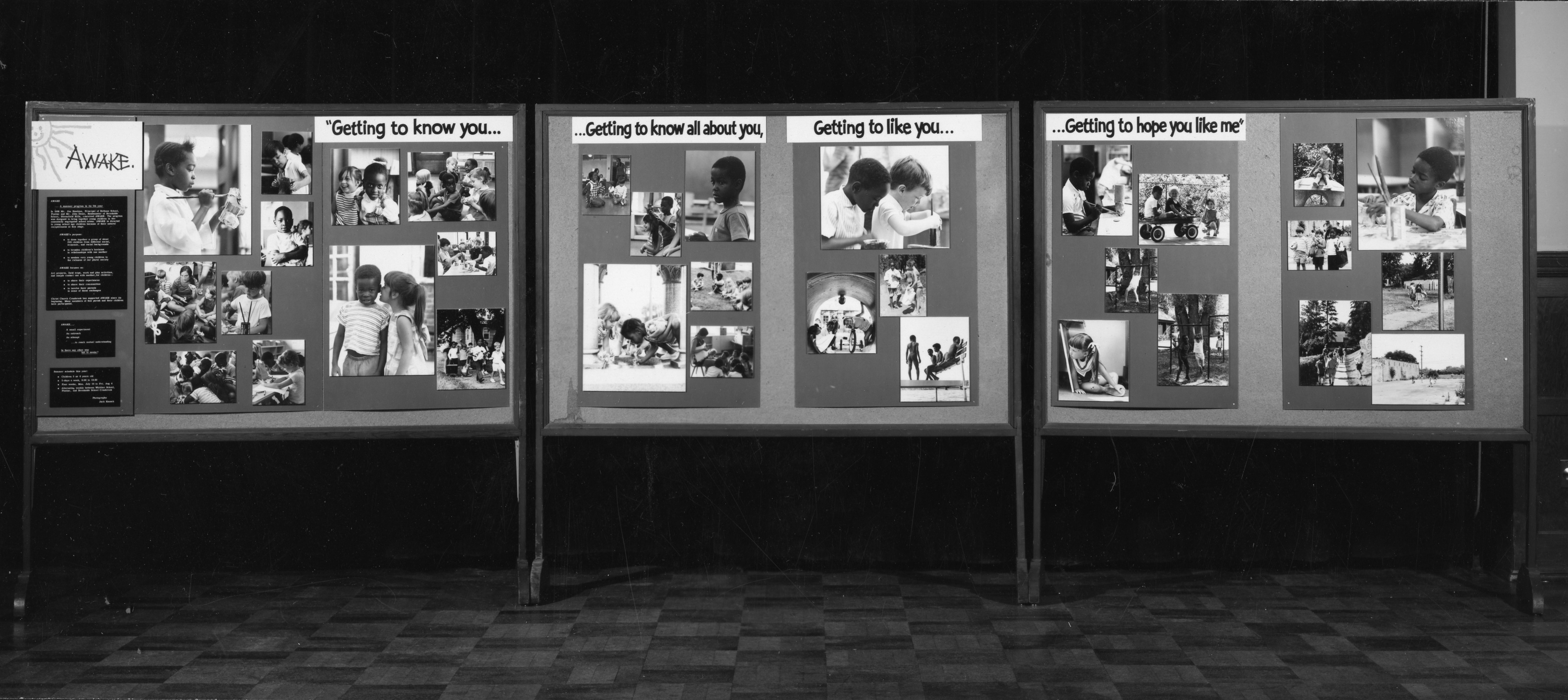
Borrowing lyrics from Rogers and Hammerstein and with photographs by Jack Kausch, poster displays sum up AWAKE’s ethos: “Getting to know you … Getting to know all about you … Getting to like you … Getting to hope you like me.” Courtesy of Cranbrook Archives.

A grass roots experiment in creative problem-solving of the urban crisis faced by cities across the country, AWAKE only lasted for five years (1968-1972). Because of its short duration, the effectiveness of the program was never fully appreciated, despite a 1969 study conducted by a University of Michigan Ph.D. student in education and social sciences and regular solicitation of teacher and parent feedback. Ultimately, rising costs and a lack of grant money; shortages of staff; and dwindling enrollment, undoubtedly due in part to the integration of Pontiac schools and the unsettling atmosphere of anti-busing protests, prohibited the continuation of the program.  

Deborah Rice, Head Archivist, Cranbrook Center for Collections and Research

Cranbrook Gets the Royal Treatment

Not once, but twice, Cranbrook has pulled out the figurative red carpet and with appropriate fanfare welcomed Swedish royalty to its campus. Anyone who knows and loves Cranbrook might not be all that surprised by this revelation. After all, Cranbrook is a very special place—the home of dozens of sculptures by Sweden’s celebrated sculptor Carl Milles, who lived and worked at Cranbrook for twenty years, as well as many tapestries woven by Loja Saarinen’s renowned Swedish weavers. But the larger Detroit community has also boasted a significant Swedish cultural presence.

While most Michiganders might be familiar with the role that Swedish immigrants played in Michigan’s Upper Peninsula mining and lumber industries, Swedes also played major roles in Detroit’s development, from the auto industry to the fine and performing arts. Not least of all were the contributions made by Milles, including his sculpture The Hand of God, which has stood in front of the city’s Frank Murphy Hall of Justice since 1970. The founding in 1963 of the Detroit Swedish Council by Charles J. Koebel (who, decades earlier, had commissioned Eliel Saarinen to design his family home in Grosse Pointe Farms), saw a concerted effort to promote Swedish culture in the area. It was likely the unique combination of Cranbrook’s artistic works and Detroit’s vibrant Swedish community that attracted visits from Sweden’s royal family on two separate occasions.

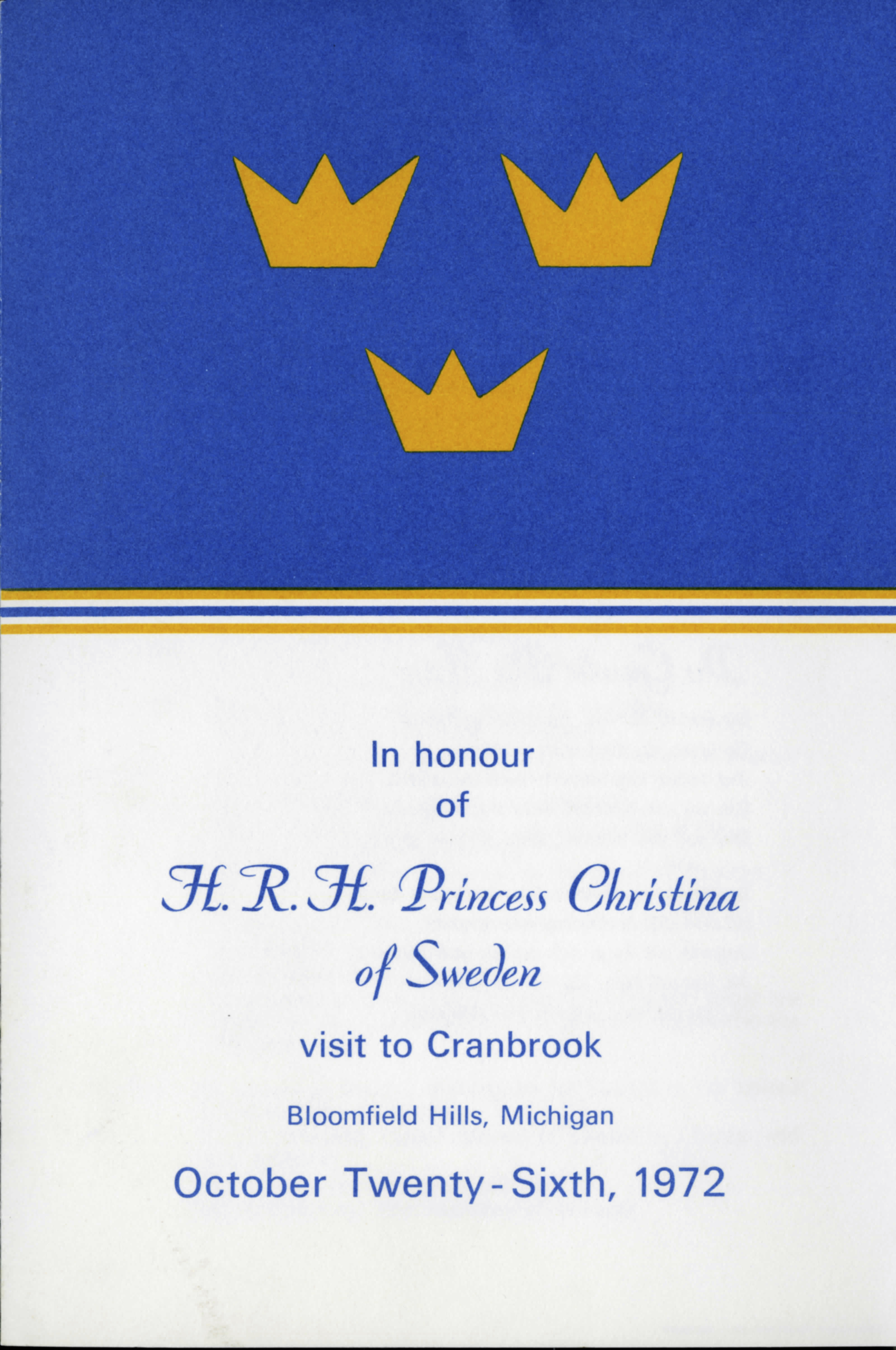
Program for the day’s activities. Courtesy of Cranbrook Archives.

So it was that on October 26, 1972, Princess Christina of Sweden set foot on Cranbrook grounds as part of her two-week tour of the States. And sixteen years later, her brother and his wife, King Carl XVI Gustaf and Queen Silvia, followed suit on April 18, 1988. Both visits focused largely on Carl Milles’ Cranbrook legacy, directly involved the Academy of Art and Art Museum, and were the result of collaborations between Cranbrook and the Detroit Swedish Council. Yet each visit had its own unique activities and sense of purpose.

Continue reading

The Fashions of Ruth Adler Schnee

Sometimes it seems there are infinite possible discoveries within a single archives collection. Such is the case with the Edward and Ruth Adler Schnee Papers. Just over a year ago I wrote about the Schnees’ long-running Detroit retail business, Adler/Schnee, but I knew then that story was only the tip of the iceberg.  

And so I was happy to find myself returning recently to one of my favorite collections in the Archives. Replacing materials that had been on loan to the Cranbrook Art Museum for their exhibit, Ruth Adler Schnee: Modern Designs for Living, I was once again struck by her achievements as a high school student at Cass Technical High School in Detroit from 1940-1942. In particular, her skill at fashion design. Maybe it was the months of hearing about sweatpants and Zoom shirts, but it was so refreshing to spend a few moments remembering what real fashion means. 

Ruth Adler Schnee illustration, circa 1941. Courtesy of Cranbrook Archives.

Before Ruth Adler Schnee made a name for herself in interior design, including her iconic textile designs, she was interested in becoming a fashion designer. Attending Cass Tech afforded Ruth the opportunity to nurture her natural artistic talents, which are clearly evident in drawings from her primary school days. And, she had already shown an affinity for fashion design—out of necessity, Ruth had already been designing her own clothes since she was a 13-year-old Jewish girl in Nazi Germany (her family emigrated in 1939).

Amongst other documents in her collection, the story of Ruth’s high school years and her passion for fashion are perhaps best captured in three notebooks. One of my favorite boxes in the collection holds nothing but pages from a notebook entitled Dress Design VI. Labeled “hours 1-4″ it is clearly a class project, and one for which Ruth received high marks. Divided into four parts (Machine Attachments, Illustrative Material, Drafting Problems, and Analysis of Dresses), the book includes drawings, pattern pieces (not to scale), paper mockups of mainly women’s sportswear designs, samples of sewing technique (actual fabric pinned to the page), textile identification pages (with real fabric samples), and an essay on silk. 

Sleeve Form page, in “Notes on the Draping of Garments,” Ruth Adler Schnee, circa 1942. Courtesy of Cranbrook Archives.
Continue reading

Sketching to Jazz and Judo: the Young People’s Art Center

Did you know that Cranbrook Art Museum’s educational partnerships with surrounding communities date back over sixty years? Long before the current museum trend of interactive educational programs for youth audiences, the Academy of Art and the Junior League of Birmingham had an idea:  the Young People’s Art Center (YPAC).

Young People’s Art Center logo, from the 1962 enrollment form. Courtesy of Cranbrook Archives.

The year was 1958, and the Museum had recently changed names to the Academy of Art Galleries, shifting focus to feature more contemporary art practices. With that, came the desire to encourage young visitors to express their own artistic voices—participatory education, rather than simply art appreciation. Documenting the program’s first year, a June 1959 Detroit News Pictorial Magazine feature noted that YPAC “is fast gaining a national reputation for its lively approach to art education.”

In particular, it was Henry Booth (Academy Board of Trustees Chairman), Wallace Mitchell (Head of Galleries), and Zoltan Sepeshy (Academy Director) that approached the Junior League with a plan. In a 1957 report by Mitchell during the Center’s development phase, he states, “ The personnel of the Cranbrook Academy of Art has become increasingly aware of the growing country-wide interest in the visual arts and has long wished to more directly participate in the fostering and guiding of this interest as expressed in our community.” Seeking support from the Junior League, this “unique opportunity to bring to the children of Oakland County an integrated program in art education which concerns itself with the totality of the art experience” was green-lighted for the following year.

Children watch a judo demonstrator as part of a class exercise. Erik Strylander, photographer. From the article “Sketching to Jazz and Judo,” Detroit News Pictorial Magazine, June 28, 1959.

A perfect partnership was formed. The Academy would provide leadership, through the support of its trustees, director, and faculty; the Junior League would provide the necessary finances. Naturally, with so many talented artists on campus, there was no lack of creativity or helping hands! Junior League members were also heavily involved, providing volunteer docents to conduct gallery tours and assist with classes, both of which were located on the ground level of the Museum below the Academy Library.

Continue reading

Science Projects

Cranbrook Institute of Science (CIS) has long held a special place in the hearts of many area schoolchildren. Field trips, weekend family outings, and onsite demonstrations in schools and community centers are a part of the fabric of the metro Detroit K-12 educational experience.

Elementary students visit the Cranbrook Institute of Science in 1935. Robert T. Hatt, photographer. Courtesy of Cranbrook Archives, Cranbrook Center for Collections and Research.

A recent discovery in our collections furthered my appreciation of the Institute’s educational outreach and its commitment to ensuring access to the world of science for all its surrounding communities. It all started with the folder titled “Pontiac Area Urban League, 1988” in the Institute of Science Director’s Records.

The Pontiac Area Urban League (PAUL), was founded in 1950 as an affiliate of the National Urban League. An integral part of PAUL’s mission was to improve educational opportunities for underserved residents. Through its Education Committee, they partnered with Pontiac Public Schools in the 1980s to empower students of color to seek equity in science and math education by providing real-world role models and encouraging parent involvement. In 1988 this effort took the form of a project that focused specifically on middle school students and lead PAUL to approach Cranbrook Institute of Science. The resulting partnership formed the basis of CIS’s relationship with students in the School District of the City of Pontiac that continues to this day.

A visiting school group, 1966. Robert T. Hatt, photographer. Courtesy of Cranbrook Archives, Cranbrook Center for Collections and Research.

Correspondence in the CIS Director’s Records suggests that CIS had already been considering educational outreach efforts to Pontiac residents. Janet M. Johnson, Director of Education, states in a 1988 memo to Director Robert M. West regarding the possible partnership with PAUL: “This may be another avenue for us to pursue interests with Pontiac.” West expresses his “delight” a few months later in a letter addressed to PAUL’s Interim Director, Jaqueline Washington:

Continue reading

The Power of Knowledge

In commemoration of this significant day, Juneteenth, I thought we’d look back at one of many compelling stories in Cranbrook’s history. In the summer of 1970, Horizons-Upward Bound (HUB) offered four new electives that reflected the experimental nature of a project in its sixth year of operation. These electives allowed for innovation and creative thought around topics of particular relevancy to HUB students, investigating issues that still resonate fifty years later.

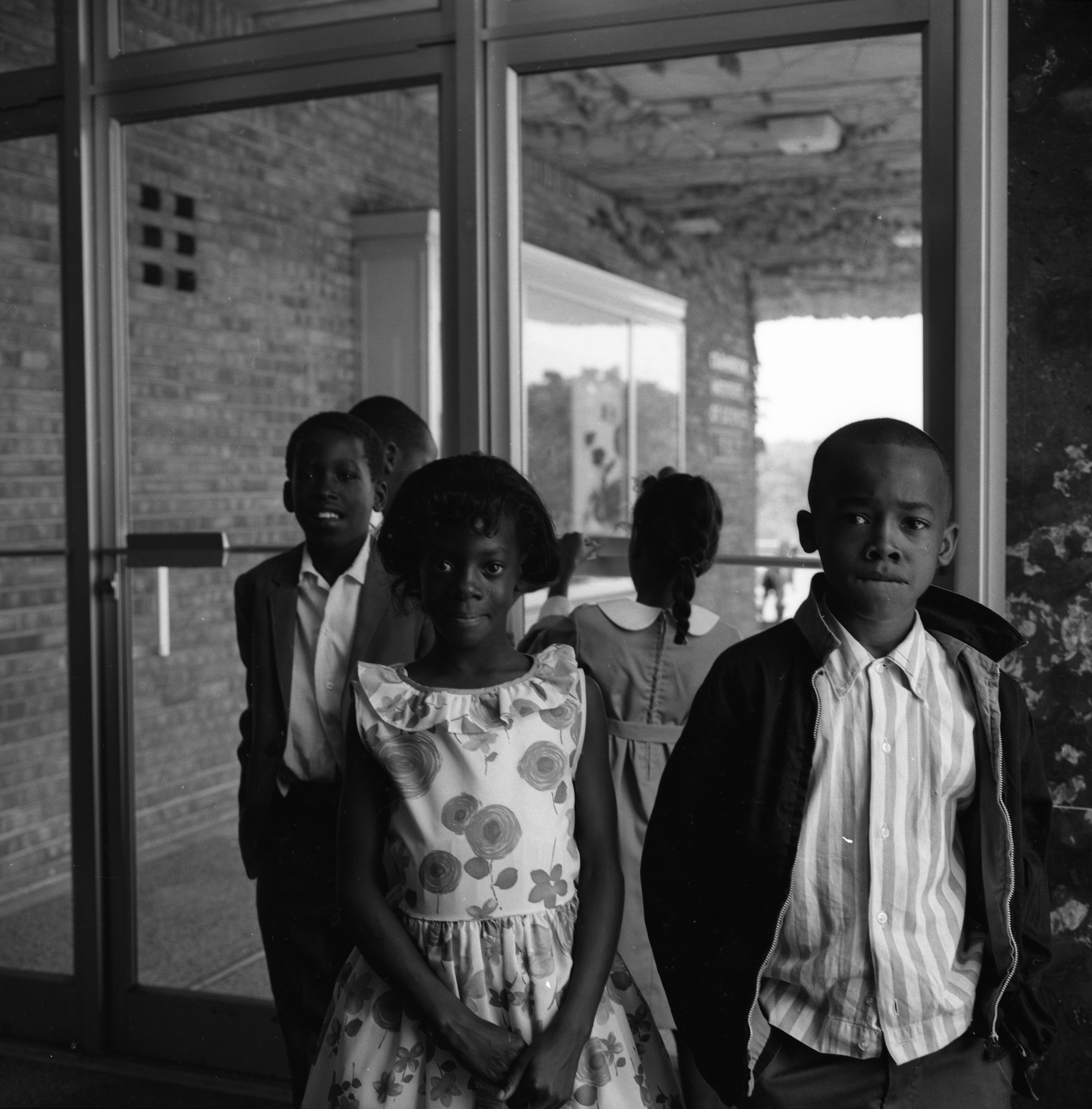
1969 HUB student photo used on the inside cover of the 1970-1971 annual report. Courtesy of Cranbrook Archives.

Black Creative Writing, taught by Highland Park Community College English instructor Stephen D. Chennault, involved readings, examinations of concepts, and self-directed writing. Students surveyed a Langston Hughes edited short story collection and works by the Black Arts Movement poet, Don L. Lee (later known as Haki Madhubuti). They also explored Black awareness, the role of the Black professional writer, and created skits centered on Black life, in what Chennault describes as a “careful observation of their niche in today’s America.”

The Black Contributions course was co-taught by Wayne State University interns, Ervin Brinker and Fred Massey, and grew out of the Black History course of the two previous summers. Refocused with a more contemporary slant, students studied organizations such as the Black Panther Party, the Student Non-Violent Coordination Committee, and the Southern Christian Leadership Conference. Reporting on the course, Brinker and Massey observed that “both instructors and students were sensitized to the realization that solutions to racial problems are imbedded in institutional living patterns of long standing, protected by mazes of barrier that must be recognized and understood if they are to be nullified.”

George W. Crockett Jr., 1968. Courtesy of Walter P. Reuther Library.

Law was team taught by Detroit attorney Michael Brady and University of Wisconsin law student Norman Prance. Half of class time focused on criminal law, which included examination of Yale Sociology Professor Albert J. Reiss’ 1967 study of police brutality and discussion of the Wayne County Juvenile Court. The subject culminated in a field trip to the Detroit Recorders Courtroom of Judge George Crockett Jr., a civil rights advocate known for confronting the practice of race-based sentencing.

Ben Snyder and Horizons scholarship students, 1968. Courtesy of Cranbrook Archives.

In the course, Power, developed by HUB founder and director Ben M. Snyder, students explored the idea of power through a combination of contemporary theory and current realities. Stemming from two works: Adolf Berle’s 1969 Power and Nathan Wright’s 1968 Black Power and Urban Unrest, the course addressed complicated regional situations, such as the redistricting of Detroit schools. When replying to a question regarding the value of the course to his future, one student remarked, “As long as I am more aware of the American way of working power, it should make me more alert.”

Cover illustration by David McMurray for The HUB 101 Literary Magazine, 4 (Summer 1970). Courtesy of Cranbrook Archives.

A tradition since 1967, the Literary Magazine, a sampling of writing and art produced by HUB students, is perhaps the most important summation of the student experience. Against the backdrop of the civil rights movement, national Vietnam War protests, and the beginnings of an economic downturn that would hit the Detroit metro area hard, the Summer 1970 issue reflects powerful emotions. It’s clear to see that these four thought-provoking electives left a profound effect on students’ views of American society and their role in it. With titles like Discrimination, Revolution, Black Power, Choice of Colors, The Man, The Militant, and Pride, the poignancy of their voices is striking and remarkably germane to events, both then and today.

Deborah Rice, Head Archivist, Cranbrook Archives Cranbrook Center for Collections and Research

A Michigan Mural

Metro Detroiters, out-of-town visitors, and architectural aficionados worldwide have long admired the Penobscot Building in Detroit’s Financial District. Like its close neighbor, the Guardian Building, and the Fisher Building further north in Midtown, it is one of the city’s finest examples of art deco architecture and one of the iconic structures that still make up Detroit’s skyline today. Designed by Wirt C. Rowland of Smith, Hinchman, & Grylls, when its 47 stories were built in 1928, it was the tallest building in the city and the fourth tallest in the nation.

The Penobscot, on the National Register of Historic Places, is perhaps best known architecturally for its tiered upper seventeen floors and the exterior ornament by sculptor Corrado Parducci, whose work can be seen on many other Detroit buildings. It’s also known to locals for the red-lit globe at the top (originally designed as an aviation beacon), the legendary Caucus Club (Barbara Streisand reportedly launched her singing career here), or the famed roof observation deck which offered an excellent panorama of the city.

But, what about the interior of the Penobscot? Well it just so happens there’s a Cranbrook connection!

penob-1

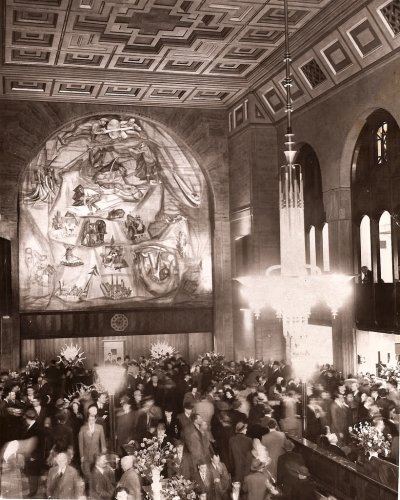
The original bank lobby. Courtesy Detroit Free Press Archives.

The Guardian Detroit Group was the first tenant of the two-story bank hall at 635 Griswold St. before they had their own skyscraper commissioned just a block away. A later occupant, Detroit City Bank, opened in the same space in February 1949. When they did, adorning one wall was a mural painted by Cranbrook Academy of Art graduate and Head of Kingswood School Art Department (1940-1956), Clifford B. West. Known as the “Mural of Michigan” the twenty-six-foot painting depicts scenes representing state commerce and industry. West, who studied under Zoltan Sepeshy, and with fellow muralist David Fredenthal, had already completed a bank mural in Alamosa, Colorado, as well as Detroit-area murals in the Rackham Building, Stockholm Restaurant, and Fox & Hounds Restaurant.

Following a meticulous process that involved a series of sketches at different scales, cartoons plotted to a numbered grid and traced on the wall, and painting in two steps (large blocks of color followed by detail work), the scenes were applied in casein tempera on canvas cemented to the wall. Joining in this process was West’s wife and fellow artist, Joy Griffin West, and several academy students. Fortuitously, each stage of work was captured in a series of photographs by Cranbrook photographer, Harvey Croze.

This slideshow requires JavaScript.

Upon completion of the mural, West mounted an exhibit at Cranbrook Art Museum titled, Progress of a Mural in April 1949, detailing his process for the Penobscot mural, and featuring many of the preliminary sketches and cartoons.

It’s largely unknown whether the Penobscot mural exists today, since a drop ceiling was installed many years ago, completely obscuring West’s creation.

Deborah Rice, Head Archivist

Create a website or blog at WordPress.com