A Fond Farewell

It’s been a little over five years since I accepted a position as archivist at Cranbrook Archives. I had toured the Archives some years before, when I first became photo archivist in the Burton Historical Collection of the Detroit Public Library. Though familiar with Cranbrook from growing up in the area, I thought, boy, this would be a cool place to work.

My wishful thinking turned into reality when, after retiring from Detroit Public Library and working as a volunteer in Cranbrook Archives, a position opened up. Lucky me! And my first assignment was to process the papers of Edward and Ruth Adler Schnee. I had shopped in their iconic store in Harmonie Park and was delighted to meet Ruth and hear all about her fascinating life, which gave me a framework for processing her papers.

RAS

Ruth Adler Schnee in a fun moment.

Meeting Ruth was just the beginning of a deep plunge into subjects of which I was only marginally aware: the George Gough Booth family who founded Cranbrook; the Saarinens who designed its campus, many of its buildings and furnishings; artists such as Harry Bertoia, Marianne Strengell, Katherine McEwen, Charles & Ray Eames, Maija Grotell, Harry Weese. My head was spinning trying to keep up!

Gradually I became familiar with the history of Cranbrook as documented by the rich material in the Cranbrook Archives. The manuscript collection (institutional and individual), the photograph collection, the architectural drawings, and the myriad other informational sources, not to mention my coworkers, other Cranbrook staff, and Archives’ volunteers, all helped fill in the blanks. Most of all, head archivist Leslie S. Edwards, guided me through the intricacies of building names and campus personalities, filling me in on strange anomalies such as Chanticleer Cottage, or some of the unheralded people like the Vettraino family or John Buckberrough who, in small but important ways, helped make Cranbrook what it is today.

farewell

A favorite view when eating outside in the summer!

If you haven’t guessed by now, I’m moving on to other adventures; today is my last day. I learned so much here, thanks to everyone I worked with. And it turns out I was right. Cranbrook is a cool place to work!

– Cheri Gay, Archivist


Opulence and Splendor

In the spring of 1927, Cranbrook founders George Gough and Ellen Scripps Booth traveled to Egypt. In addition to visiting Cairo and having their photograph taken after an hour long camelback ride, the Booths visited the tomb of the Egyptian Pharaoh, Tutankhamun (King Tut).

Letter from Cairo, Mar 1927.

Letter from Cairo, Mar 1927.

In a letter to his son Henry, Booth describes in detail the opulent beauty of the tomb: “When in Luxor we went to the Valley of the Kings and saw the tomb – that is we saw one room where the King lay. He is there still in one of the gold coffins – the mummy had over it a gold mask covering head and shoulders and many jeweled ribbons of gold covering the joints of the mummy cloth. Thimbles on each finger and toe… this lay inside a gorgeous solid gold coffin inlaid with stones. This was all in the finest carved sarcophagus and that inside a splendid wooden shrine – and this inside of a beautifully decorated room.”

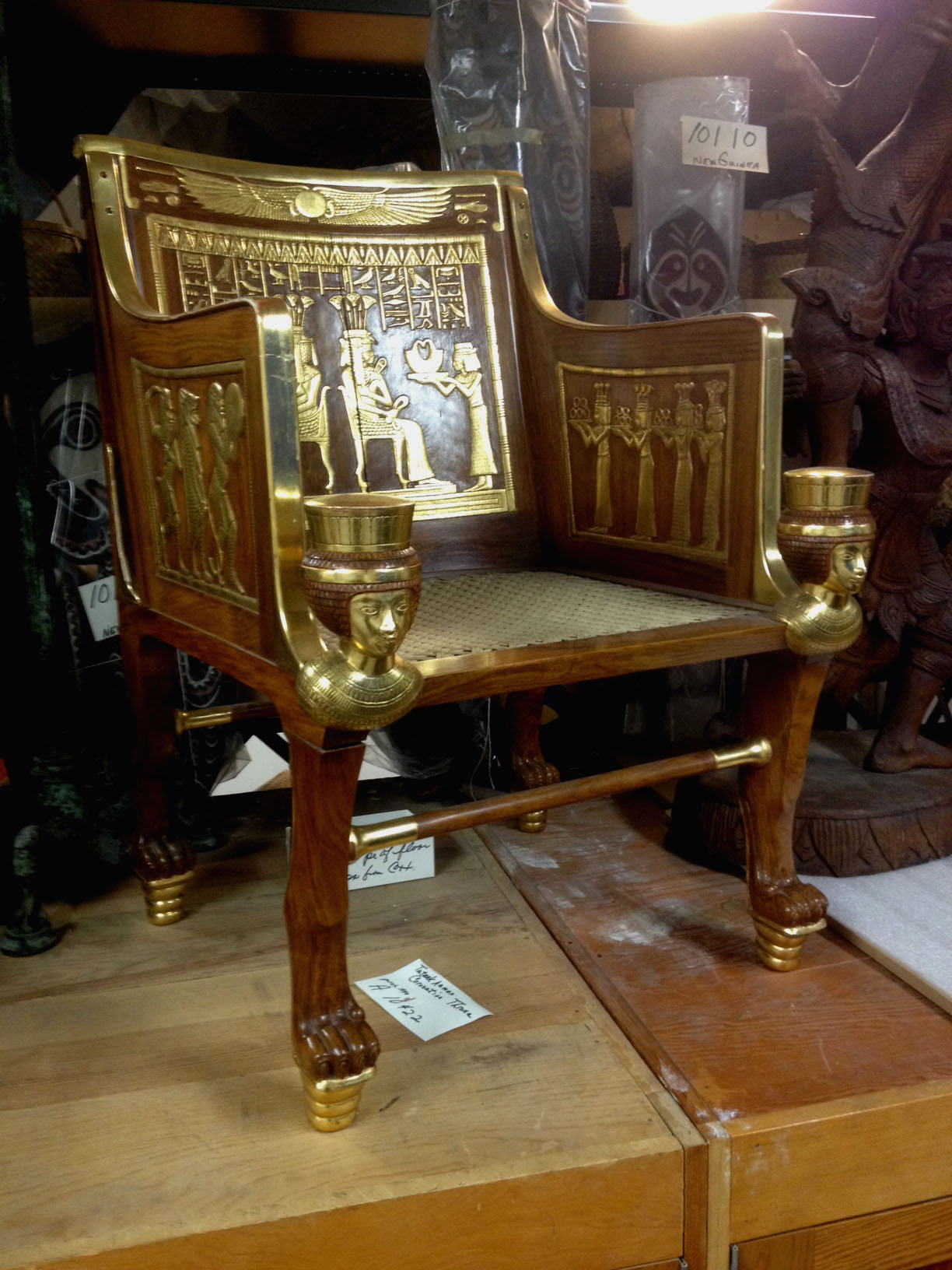
Replica created by Egyptian artisans and purchased by George Booth in 1927. The original chair is in the Egyptian Museum in Cairo. Photograph courtesy of Cranbrook Institute of Science.

Replica created by Egyptian artisans and purchased by George Booth in 1927. The original chair is in the Egyptian Museum in Cairo. Photograph courtesy of Cranbrook Institute of Science.

The Booths also visited the Egyptian Museum while in Cairo. Booth writes that although there is still a great deal in the actual tomb, he is in awe of the exhibition’s craftsmanship and value. He was particularly interested in a chair that at the time was believed to be the State Chair of Queen Taia, wife of King Amenhotep III (grandfather of Tutankhamun). Booth writes to Henry, “I would cheerfully give $10,000 for the throne –  which is an ordinary sized chair, but beautifully wrought.”

Exhibition poster, 1973.

Exhibition poster, 1973.

As the original chair was not for sale, Booth commissioned a replica to be made for the Art Museum collection. The chair, of carved wood with relief decorations covered in gold leaf, was later determined to be the chair of Sitamun, an Egyptian princess (and thought by many scholars to be the mother of King Tutankhamun). The chair was lent to the Institute of Science for a 1973 exhibition titled, “Ancient Egypt and the Tomb of Tutankhamen”. In 1984 the chair was transferred from the Art Museum to the Institute of Science, where it still resides today.

Gina Tecos, Archivist

The Name Game

From the beginning of Cranbrook’s history in 1904, place names at Cranbrook have evolved and changed. Once the Booths turned the original mill pond into a lake, they named it first Glassenbury Lake (after Glassenbury, England), then it was known as Cranbrook Lake for a very short time, and ultimately Kingswood Lake. The man-made Jonah Lake (or Lake Jonah as it is also known) was originally called Lake Manitou. Brookside School was originally called Bloomfield Hills School and Cranbrook School was Cranbrook School for Boys. Although Brookside School retains its name, since 1985 when the boys and girls schools merged, they are jointly known as Cranbrook Kingswood Schools.

Building names have also changed, often due to an alteration in use or sometimes because they were dedicated to an influential or long-time faculty member.  The Garden House became the Cranbrook Pavilion and is now St. Dunstan’s Playhouse. The Cranbrook School academic building became Hoey Hall after former Headmaster Harry Hoey and what was originally called the “Arcade” is now known as the Peristyle at the Cranbrook Art Museum. Lyon House was first called Stonelea (after its owner Ralph Stone, a long-time friend of George Booth), then Belwood, then the Kyes House before being acquired by Cranbrook.

And even Cranbrook Educational Community is not our first name. In 1927, the Booths established The Cranbrook Foundation as the legal and financial entity that oversaw the then six institutions: Brookside School, Christ Church Cranbrook, Cranbrook Academy of Art, Cranbrook Institute of Science, Cranbrook School, and Kingswood School.

So, what is really in a name? How do we name our campus buildings and landmarks going forward and what legacy will we be imparting with them?

That said, I wish you all a Happy New Year! Or should I say Bonne année? Feliz Año Nuevo? Or maybe Xin nian kuai le?

(And thank you Stefanie Dlugosz-Acton for getting me thinking about names at Cranbrook!)

From the Virginia Kingswood Booth Vogel Papers.

From the Virginia Kingswood Booth Vogel Papers.

Leslie S. Edwards, Head Archivist

The Fascinating Notebooks of John Buckberrough

John H. Buckberrough (1874-1955), an immigrant from Ontario, Canada, was a civil engineer for the Cranbrook Foundation from 1927 until he retired in 1955. As described by Henry Scripps Booth:

Buckberrough, a slight man of medium height, started working for Swanson and Booth as that firm’s sole employee two years before Cranbrook officially employed him. That was in the firm’s tiny architectural office located in the below-road-level room of the Ram House section of Brookside’s buildings. … He became one of the first employees of what was known as the Cranbrook Architectural Office in January 1927. … Over the years he was chief surveyor, planned most of the pump rooms, transformer vaults and underground systems, kept copious notes and made detailed plans regarding changes which not only proved increasingly valuable in solving complicated problems but put to shame those who were later supposed to fill his shoes.

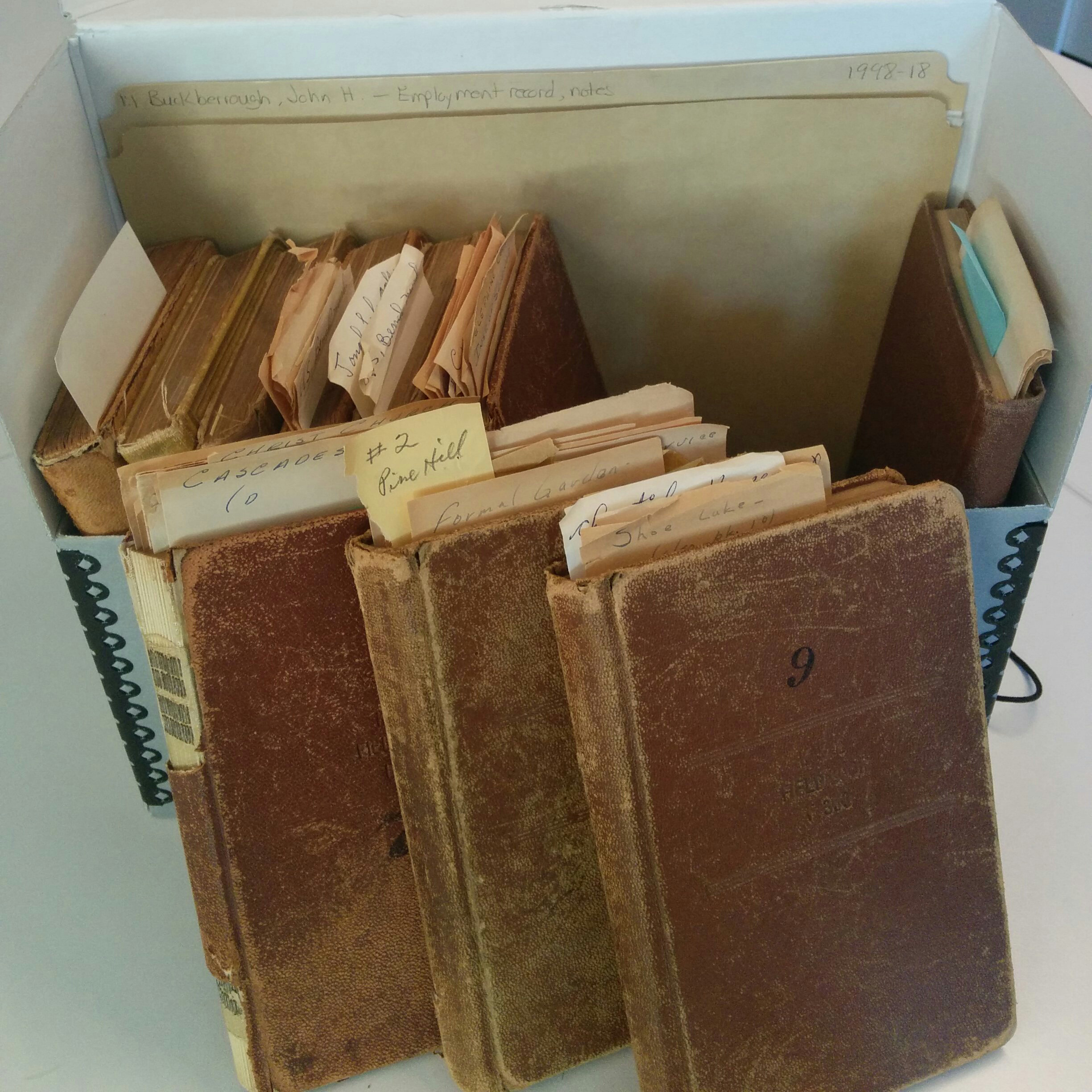
In addition to numerous architectural drawings that bear his signature, Buckberrough’s legacy in the Cranbrook Archives is 10 calfskin engineers’ field books, chock full of drawings and notations, covering 1926-1955.

Courtesy Cranbrook Archives

Courtesy Cranbrook Archives

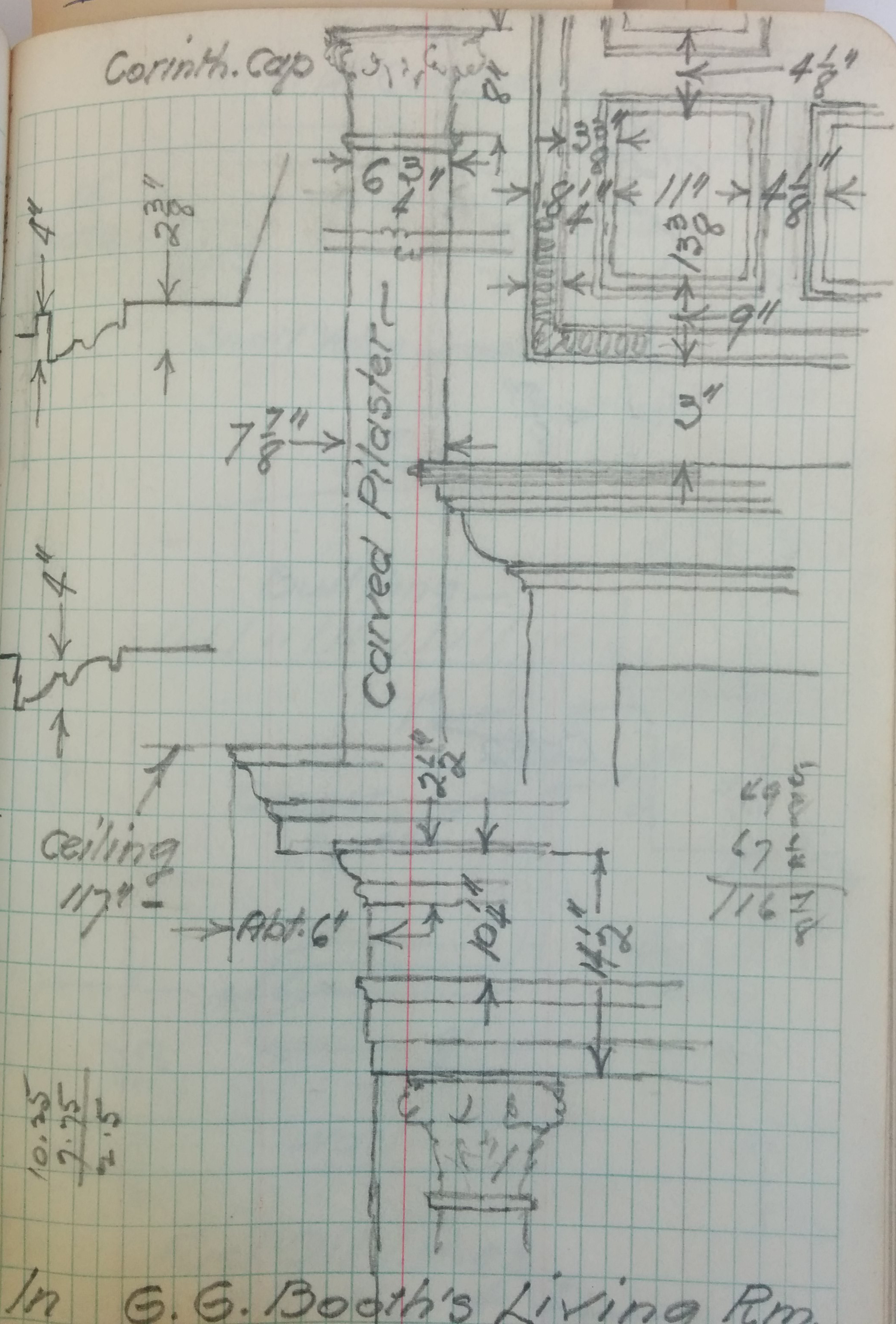
Descriptions and diagrams of Cranbrook property, heating and plumbing data for Cranbrook buildings, data on Cranbrook roads and lakes, drawings of pump houses, sidewalks, lighting layouts and water lines can be found in the notebooks. Here are some examples:

Design of a bridge.

Bridge at Kingswood Lake, 1938.

Column design for fireplace in Cranbrook House living room.

Column design for fireplace in Cranbrook House living room.

The Archives’ staff often finds valuable information in the notebooks, which is used for campus restoration and renovation projects including the recent restoration of Cranbrook School Quad. Little did Buckberrough know how valuable his meticulous note-taking would prove to be. Though a search for information requires a careful page-by-page hunt, it’s a pleasant change from the impersonality of electronic resources.

Cheri Y. Gay, Archivist

To Sit or Not to Sit

Chair design at Cranbrook has always had its own special niche and fascination among artists and patrons alike. George Booth altered chair designs for his own use at Cranbrook House. Eliel Saarinen designed unique chairs for Cranbrook School and Saarinen House. Ralph Rapson conceived of his chair design for what became known as the Rapson Rocker while a student here. Most of us are familiar with the famous chair designers, but what about projects by less famous designers?

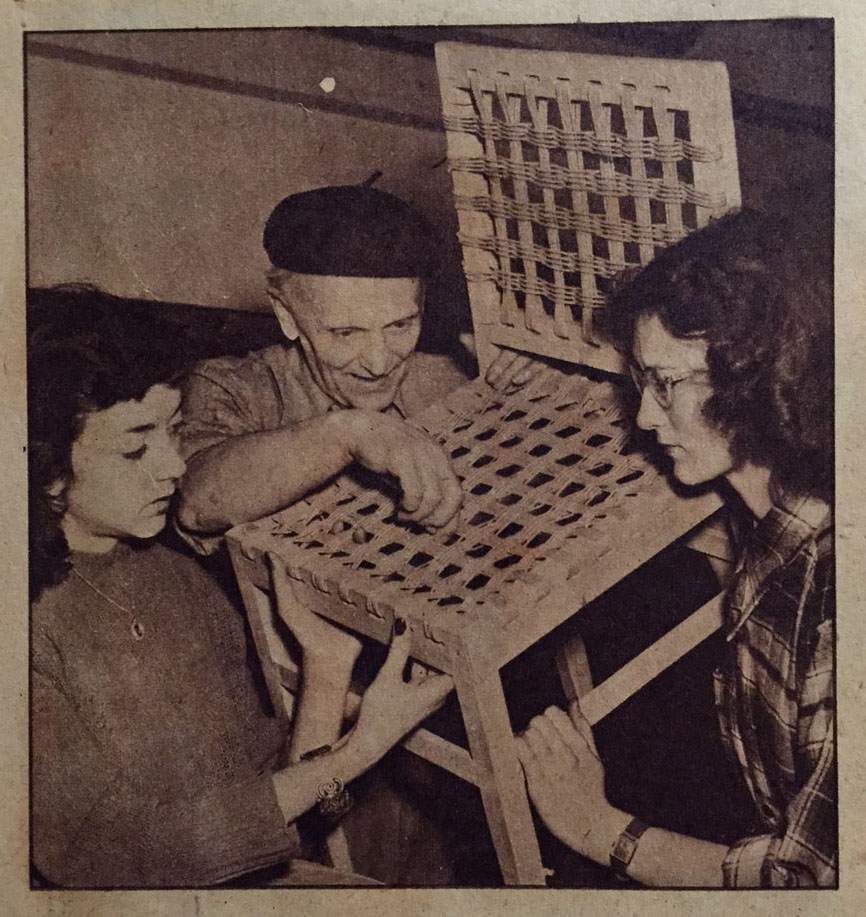
During the war years, Academy of Art students were encouraged to experiment with modern design and new and unusual materials. In 1944, Academy students Gloria Bucerzan and Jean Roberts designed and constructed a chair born of war shortages, by eliminating the use of springs and creating webbing using “non-critical” materials.

Gloria (left) and Jean with woodworking instructor Svend Steen, 1944. Copyright Cranbrook Archives.

Unknown student setting up work for Student Show, 1958. Copyright Cranbrook Archives.

Unknown student setting up work for Student Show, 1958. Copyright Cranbrook Archives.

Art Room, Early Childhood Center at Brookside School, 1997. Chairs designed by Dan Hoffman, Cranbrook Architecture Office. Photograph copyright Christina Capetillo.

Art Room, Early Childhood Center at Brookside School, 1997. Chairs designed by Dan Hoffman, Cranbrook Architecture Office. Photograph copyright Christina Capetillo.

For more on chair design in general, check out the 2012 Year of No-Chair-Design and the Guide to Great Chair Design which features links to chair blogs, the history of chair design, museums, galleries, and books that all feature what else? Chairs!

Leslie S. Edwards, Head Archivist

A Treasure Hunt in the Archives

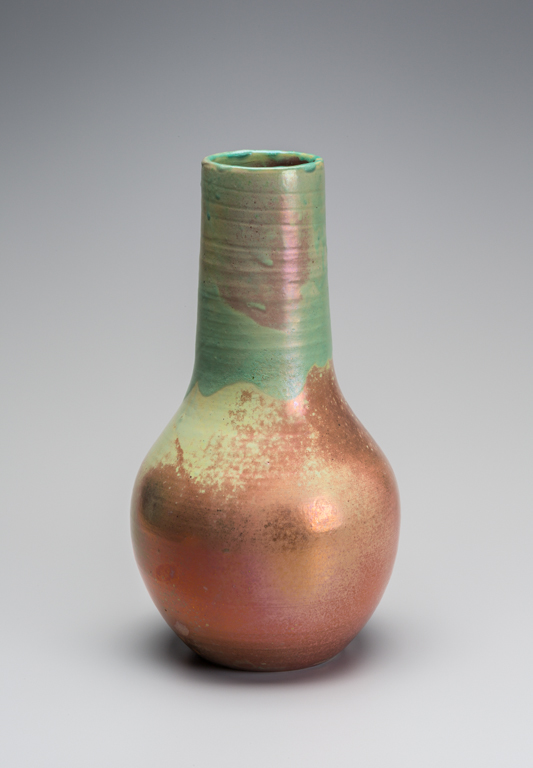
I have had the pleasure of spending much of my time over the last year going through the Cranbrook Archives in search of information about Pewabic Pottery.  This is in preparation for the upcoming exhibition Simple Forms, Stunning Glazes: The Gerald W. McNeely Pewabic Pottery Collection opening December 12. Through the Archives’ amazing resources, including inventories, architectural drawings, correspondence, receipts, historic photographs, and even meeting notes from the founding of Cranbrook School, one of the most awesome discoveries was regarding one of the Pewabic Pottery vases in our collection.

Cranbrook Educational Community Collection, CEC 276 Photographers: Tim Thayer and R. H. Hensleigh

Cranbrook Educational Community Collection, CEC 276
Photographers: Tim Thayer and R. H. Hensleigh

Through inventories we can trace the placement of this vase from during its life in Cranbrook House. It was located in the Living Room in 1921, and by 1933 had been relocated to the Sunset Room. In 1937, George Booth notes the work by its size and a brief description, “14 inch vase- luster- Pewabic.” Cranbrook has 15 Pewabic works purchased during Booth’s lifetime which now reside between the collections of the Art Museum and the Cranbrook Educational Community. While I am still working to place the pieces of the puzzle together to see if we can do this for other work, it may not be possible as some of the receipts and notations are much more cryptic including only “Pewabic Vase” with no dimensions, or description.

It’s treasure hunts like these that make the Archives such a great place to spend my time as you never know what you might find and where it will take you!

Stefanie Dlugosz-Acton, Collections Fellow, Center for Collections and Research

Welcoming Our Two Archives Assistants!

Prior to volunteering at Cranbrook Archives, I had been studying history and had become aware of the importance of primary sources for historiography, and the value of preserving heritage for the wider community. I began volunteering in 2012 which helped me decide to pursue a career in archives, and I began studying for the MA Archive Administration with Aberystwyth University in Wales (distance learning) in 2013. As part of a university assignment, I processed the HUB (Horizons-Upward Bound) Records, and am currently researching George Gough Booth’s interest in tapestries, which he purchased and commissioned for Cranbrook institutions and family members. I am interested in Booth’s involvement in the Arts and Crafts Movement, and the way in which the movement used medieval themes and techniques as a response to the social experience of the time. The Edgewater Looms, Herter Looms, and Morris & Co. tapestries are an ideal focus for exploring these ideas. I am looking forward to learning more about scanning/digitisation/digital preservation/cataloguing. The university modules emphasize access as the flip-side of preservation. I tend to have the latter foremost in my mind, so it will be great to see how the archive is used.

Laura MacNewman, Archives Assistant

Correspondence, George Gough Booth Papers, box 16, folder 11.

Correspondence, George Gough Booth Papers, box 16, folder 11.

As a graduate student mid-way through the Library and Information Science master’s program at Wayne State University, I’ve been given a healthy dose of libraries, archives, and the world of information over the past year. My interest in archives administration began while I was volunteering at the Cranbrook Archives last fall (2014). Here, I was introduced to the process of digitizing manuscripts, taking inventory of donated artist materials, and sifting through photographic negatives for future digital preservation and storage. I’ve also been working on the Cranbrook Archives’ Oral History Project. Much of my work at Cranbrook corresponds to my studies at Wayne State. In fact, this past week Head Archivist Leslie Edwards spoke about Cranbrook Archives’ oral history project in my oral histories course. As a new employee, I am keen to expand the number of digital images available online, help preserve the negative photograph collection, and understand what it really means to be an archivist.

Danae Dracht, Archives Assistant

From left: Carleton McClain, Henry S. Booth and Margaret Russell interviewing former Cranbrook School Headmaster, Harry Hoey at his home, 1964.

From left: Carleton McClain, Henry S. Booth and Margaret Russell interviewing former Cranbrook School Headmaster, Harry Hoey at his home, 1964.

Both Laura and Danae are working for us as part-time Archives Assistants, an entry-level archival position for graduate students. They will be working on a variety of projects during the coming year while gaining experience to propel them in their careers. Look for future blog posts from them in the upcoming months!

Photo Friday: Reporting the News in Style

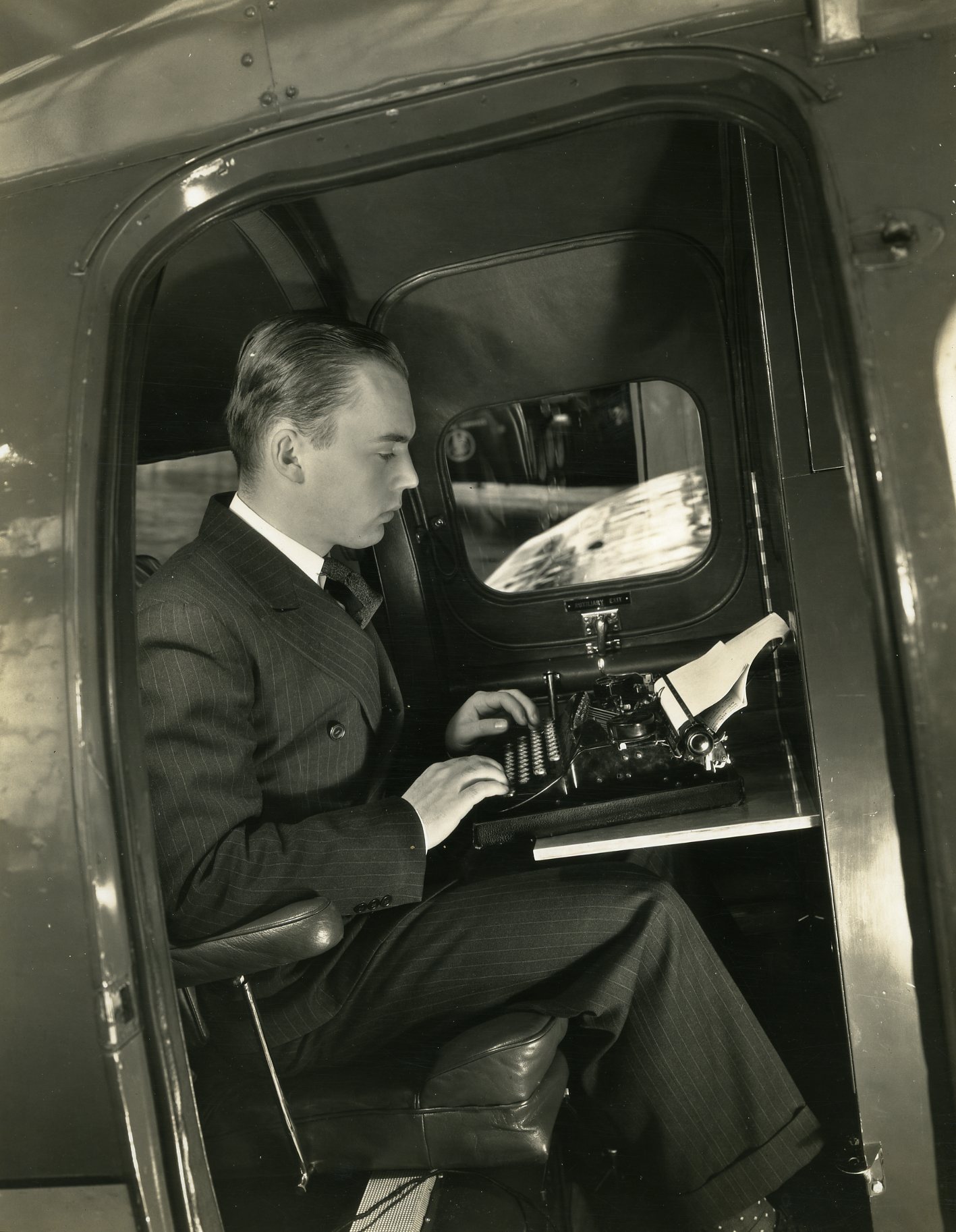
Archivists never know what we might run across during the course of our daily work, which is, of course, part of the allure of the job! Today it was a photo of W Stoddard White (1913-1972) from the Lee A White Papers. (No typo – neither man used a period after his initial!)  Lee White (Stoddard’s father) was a personal friend and confidante of George Booth’s from the Detroit News. White followed Booth to Cranbrook once Cranbrook School was opened and was on the Board of Directors, later becoming head of the public relations department for the community. Clearly Stoddard followed in his father’s footsteps, becoming a news reporter after his graduation from UM in 1935. (Interestingly, while at UM, he was in Sigma Chi along with Edgar Guest Jr.)

Stoddard White, Detroit News Employee, Oct 1935. Courtesy Cranbrook Archives, Lee A White Papers.

Stoddard White, Detroit News Employee, Oct 1935. Courtesy Cranbrook Archives, Lee A White Papers.

This photo caught my attention because of the content – what a great image of young Stoddard, as a Detroit News reporter, seated at his typewriter in what was likely the Detroit News Lockheed Vega airplane. Just one more reason I love my job!

Leslie S. Edwards, Head Archivist

Can You Say Lobster Roll?

It feels as though summer is winding down and this week is the final session of Cranbrook Art Museum Summer Camp. We enjoyed a visit from students earlier in the week who were part of the “Costumes and Characters” session. While pulling materials to show the students, we came across this photo of Ralph Russell Calder (1894-1969), an architect and friend of Henry Scripps Booth. He is in a lobster costume made by Loja Saarinen for a “May Party” in 1926.

1926

From the Henry Scripps and Carolyn Farr Booth Papers, Cranbrook Archives.

Calder, born in 1894, was a veteran of World War I and an accomplished musician. He graduated in 1923 from the University of Michigan College of Architecture (he and Henry were classmates). In 1924, he studied in England, France, and Italy as the winner of the George G. Booth Traveling Fellowship in Architecture.

Calder Card007

A card from Ralph Calder & Associates, Inc. with a 1924 sketch by Ralph Calder during his travels in Europe on the Booth Traveling Fellowship.

In 1925, Calder worked for several months as part of U of M’s Near East Research Expedition in Tunisia. The research and objects obtained from this expedition are the basis of the collection at the Francis W. Kelsey Museum of Archaeology at U of M. Calder joined the Cranbrook Architectural Office in 1926 and remained there until staff was reduced due to the economic depression. In 1937, he joined the firm of William G. Malcomson and Maurice E. Hammond where he stayed until 1945, when he started his own firm, Ralph Calder and Associates, in Detroit.

Calder worked on the following buildings on the Cranbrook campus: the main academic building (Hoey Hall) at Cranbrook School, Thornlea, and Thornlea Studio. In addition, he was the architect for buildings at Michigan State University, Michigan Technological University, Hope College, Northern Michigan University, Hillsdale College, Wayne State University, Ferris State University, Western Michigan University, and Lake Superior State University. He enjoyed music as a hobby and was the organist and choirmaster for St. Paul’s Episcopal Cathedral in Detroit in the 1940s.

Gina Tecos, Archivist

Hugh Ferriss: Visionary Illustrator

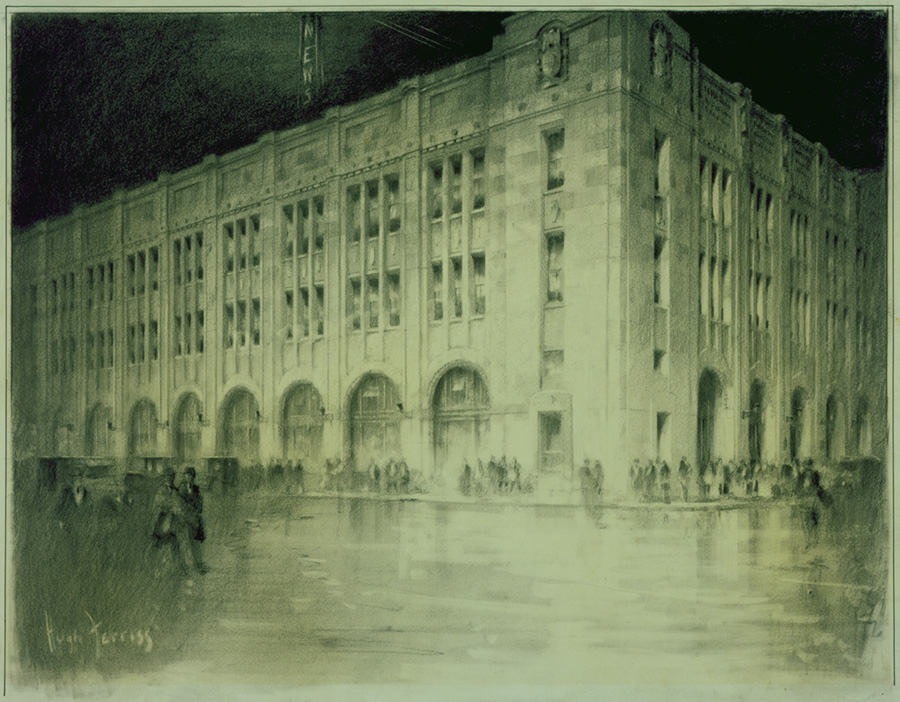
I came across Hugh Ferriss’s book The Metropolis of Tomorrow while assisting Judy Dyki, Director of the Cranbrook Academy of Art Library, in curating an exhibit of some of our rare and special collection books for the Bloomfield Township Public Library.  Ferriss (1889-1962) was a degreed architect, but he was most sought after for his architectural renderings of buildings. He developed an idiosyncratic style, often depicting buildings at night, seemingly enveloped in a kind of mist, with streetlights and the rays of the moon serving as illumination. I find Ferriss’s work intriguing because his drawings were so different from the typical architectural renderings of the 1920s to 1950s. The gothic yet futurist sensibility displayed in his work has influenced contemporary filmmakers like Tim Burton and Christopher Nolan. Ferriss has several connections to Cranbrook, the first being the drawing of the Detroit News Building that is in the collection of the Cranbrook Art Museum.

Hugh Ferriss in his studio, ca ? Photographer Stadler. Courtesy Creative Commons.

Hugh Ferriss in his studio, ca 1925. Photo by Stadler, New York. Courtesy Creative Commons.

The history of the Detroit News Building drawing is an interesting one. The J.L. Hudson Company, in honor of the company’s 46th anniversary and the opening of the new Detroit Institute of Arts building in 1927, commissioned Hugh Ferriss to create a series of architectural renderings of Detroit buildings, both extant and proposed, that contributed to Detroit’s rapidly changing skyline.  Twenty-two of these drawings where exhibited in the windows of Hudson’s downtown store in August 1927. Among these were two renderings of Eliel Saarinen’s proposed plan for a new Detroit Civic Center complex.  Also included was this drawing of the Detroit News Building. The Detroit News building, which opened in 1917, was commissioned by George Gough Booth, and designed by architect Albert Kahn.

Drawing of the Detroit News Building. Courtesy Cranbrook Art Museum (CAM1955.400)

Drawing of the Detroit News Building. Courtesy Cranbrook Art Museum. (CAM1955.400)

Booth, president of the Detroit News (and Cranbrook’s founder) purchased the drawing of the Detroit News Building directly from J.L. Hudson’s in October 1927 for the Academy of Art collections. (Accessions Book No. 1, Cranbrook Academy of Art).  To coinicide with the exhibition, J.L. Hudson Co. published a commemorative booklet entitled For a Greater Detroit, which contained Ferriss’s drawings and included editorials by various community leaders that discussed Detroit’s future. A copy of this booklet can be found in the Edsel Ford Office Papers at the Benson Ford Research Center. Ferriss’s drawing was transferred from the Academy of Art to the Art Museum in 1955, and is considered one of the museum’s “One Hundred Treasures”.

Stay tuned for a forthcoming blog post about Hugh Ferriss’s further connections to Cranbrook

Mary Beth Kreiner, Librarian, Cranbrook Academy of Art Library

Editor’s note: For additional information about the work of Hugh Ferriss, check out the Avery Architectural and Fine Arts Library at Columbia University.

Create a website or blog at WordPress.com