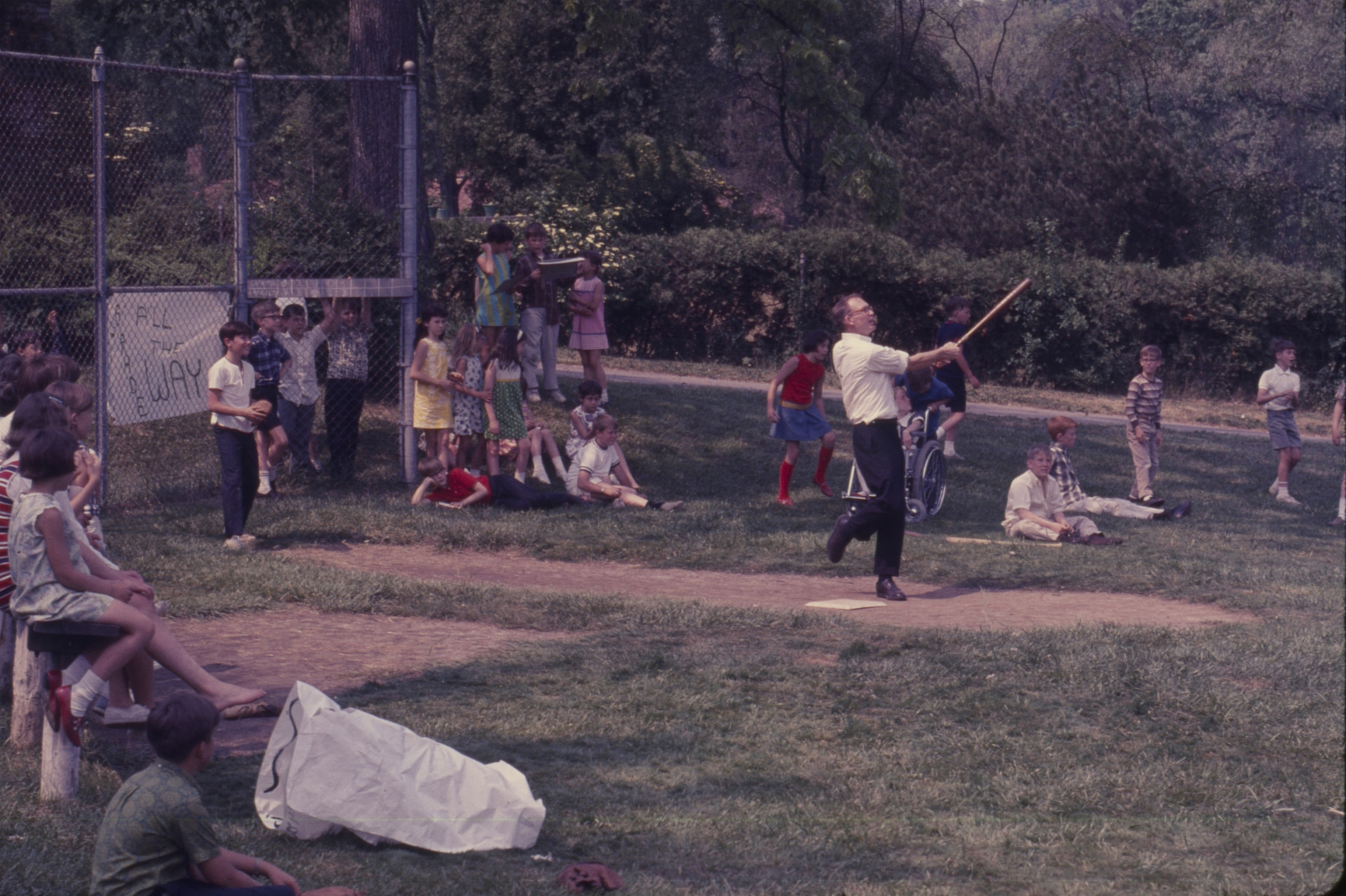
For many years, one of Brookside School’s highly anticipated end-of-year traditions was the Faculty/Sixth Grade Softball game. Every June, faculty and sixth graders would meet on the sandlot at Hedgegate, the faculty residence, to play against each other in friendly rivalry. It was a special day when students could play their favorite pastime with their teachers.
Brookside School Headmaster, Jock Denio, at bat, June 1967. Courtesy of Cranbrook Archives
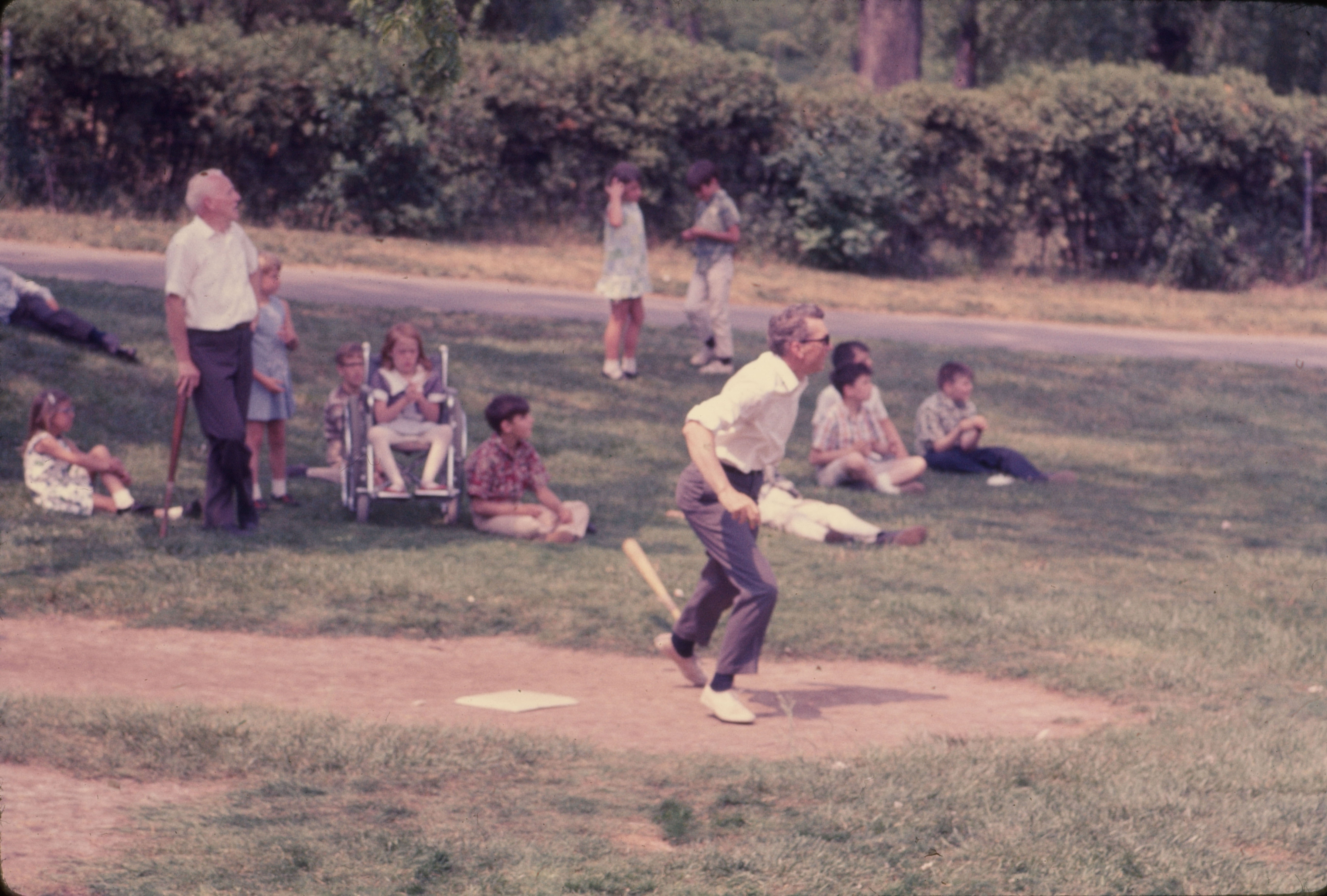
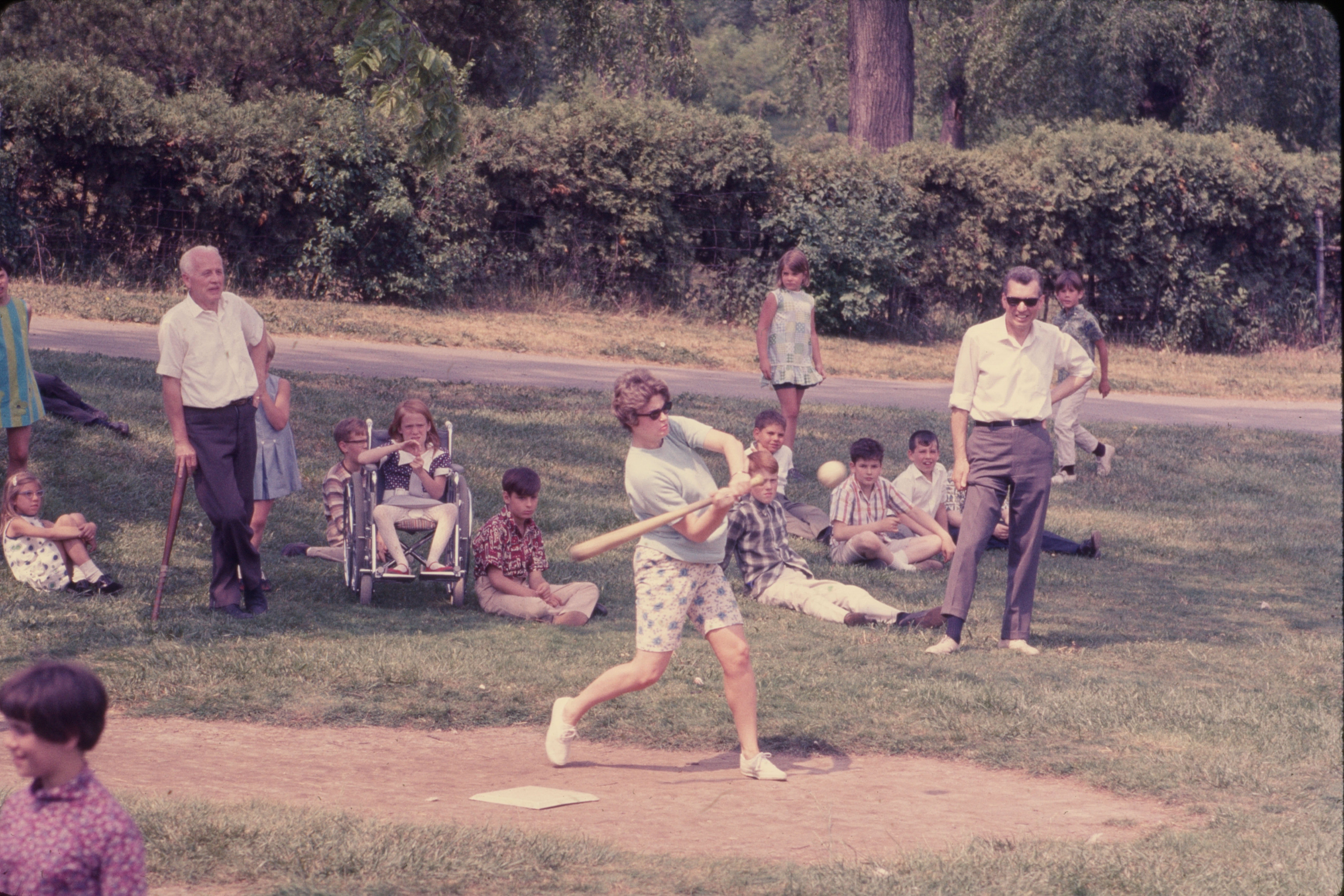
We recently received an addition to the James Carmel Papers from his son, which includes slides capturing the June 1967 softball game. The colorful images convey the camaraderie and joy of the event, with both faculty and students enthralled by the gameplay.
Brookside School students watch the softball game, June 1967Carolyn Tower and Paul Gerhardt, June 1967Louis Beer, June 1967Carolyn Tower at bat, with Paul Gerhardt, Louis Beer, and Brookside students looking on, June 1967. All images Courtesy of Cranbrook Archives
The sixth graders were up against Jock Denio, Brookside’s long-serving Headmaster; Carolyn Tower, music teacher; Louis Beer, third-grade teacher; and Paul Gerhardt, social studies teacher and director of testing and records.
In my work “fielding” research inquiries, I find that there is always a heartfelt nostalgia and tenderness in the memories and stories evoked by Brookside, a Cranbrook institution so deeply cherished by its alumni and former staff.
— Laura MacNewman, Associate Archivist Cranbrook Center for Collections and Research
Did you know that Horizons-Upward Bound (HUB) had its own flag and that it was created by a HUB student? Continuing with the HUB Records digitization project, I came across evidence of this unique item and an interesting story behind it.
Feature on the front page of The Hub, a newsletter published by students in the Summer Program Publications Class, July 26, 1974. Courtesy of Cranbrook Archives.
In 1974, Gregory Loving, HUB student and a senior from Cass Technical High School (17 years old), won a flag design contest for Cranbrook School’s event, Soulfest II. Building on the tradition of institutional flags at Cranbrook begun by Henry Scripps Booth, Gregory’s design incorporated three wide vertical stripes. The center stripe displayed multiple hands of varying skin tones holding an upward-pointing arrow, a motif that would repeat often in HUB graphics and is likely based on Cranbrook School’s logo.
Detroit News clipping featuring Gregory Loving with Henry S. Booth, and Nancy Corkery, May 1974. Courtesy of Cranbrook Archives.
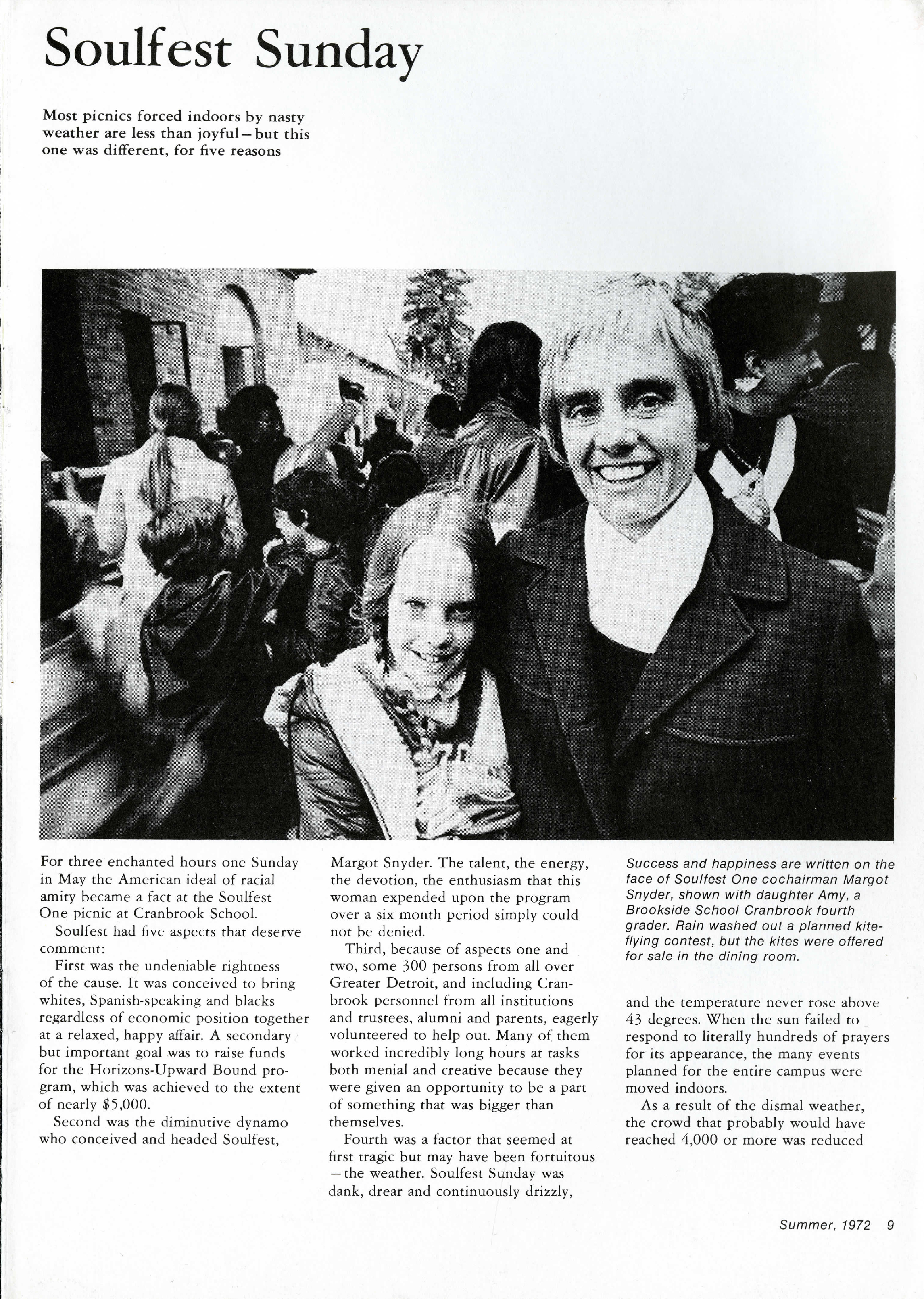
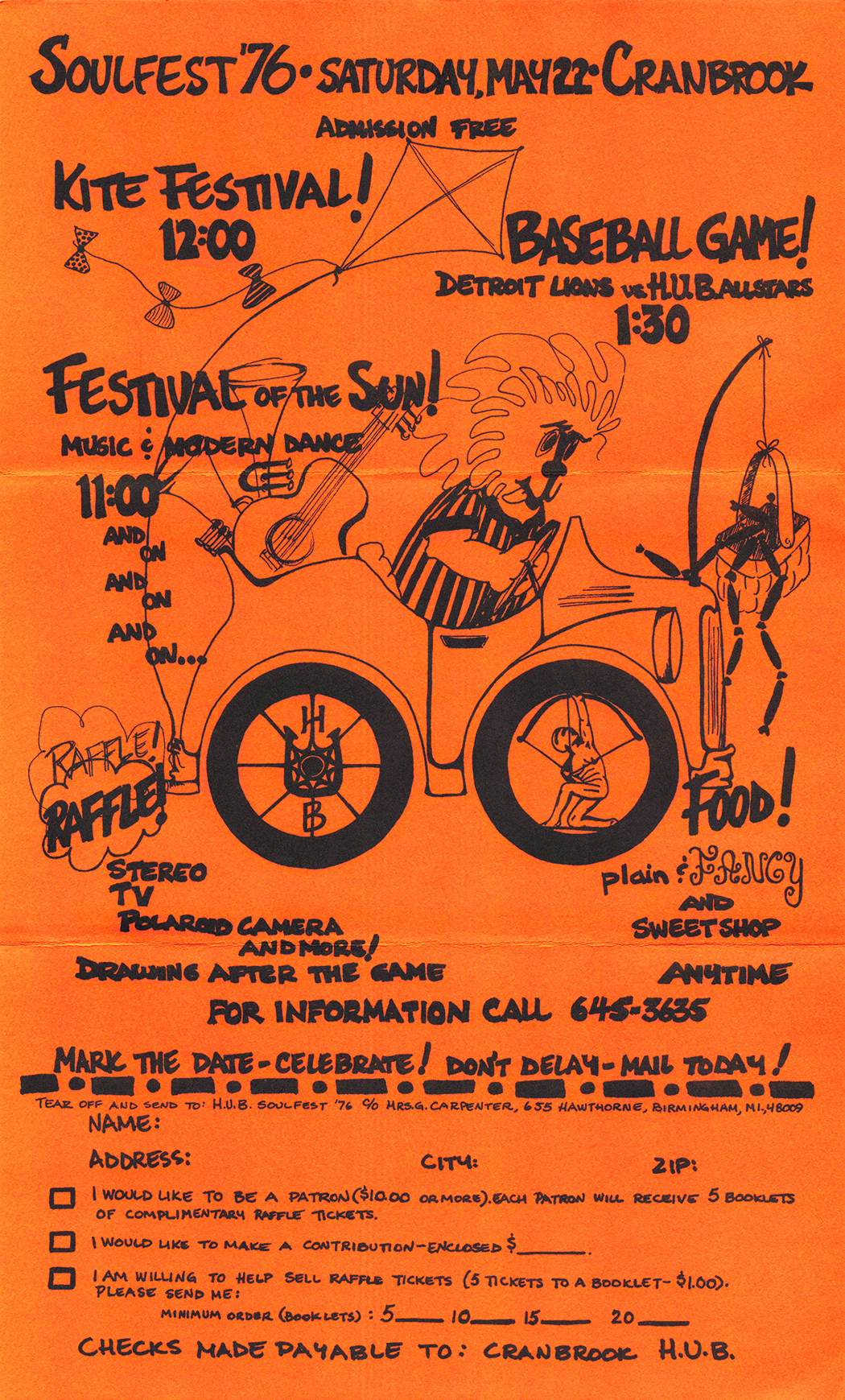
Soulfest was an biannual and major community fundraising event for the HUB program in the 1970s. It was inspired by HUB parent, Lula Barnes, who also provided the recipes, and created and organized by Margot Snyder. Margot, “whose sustaining and nurturing hands…helped shape Horizons-Upward Bound since its beginnings, ” was an integral and beloved member of the Cranbrook Schools and HUB community and wife of HUB founder Ben M. Snyder (HUB class brochure, 1994).
Cranbrook Magazine, Vol. 3, No. 4, Summer 1972, featuring Soulfest’s inaugural event with Margot Snyder and daughter, Amy. Courtesy of Cranbrook Archives.
1976 flyer featuring repeats of popular features of the 1974 event, including participation of the Detroit Lions! Courtesy of Cranbrook Archives.
In a memo to Cranbrook School and HUB faculty in March 1974, Margot writes, ” We look upon this as a project stressing Cranbrook’s involvement with the community at large…we hope to raise some much need funds for HUB, we are trying to beat the high cost of living and labor.” Gregory’s winning flag design can be viewed as a visual interpretation of Margot and the Soulfest committee’s goal of increased community involvement. Both the event and flag embody collectivity and upward mobility through the work of multiple hands from varying backgrounds.
—Courtney Richardson, Project Archivist, Cranbrook Center for Collections and Research
HUB digitization is funded by a NHPRC Archival Projects Grant for projects that ensure online public discovery and use of historical records collections. The NHPRC was established by Congress in 1934 as a statutory body affiliated with the National Archives and Records Administration and chaired by the Archivist of the United States.
Friday, September 27, 2024, is Homecoming at Cranbrook Kingswood Upper School. The game will be held in the Thompson Oval, to the east of The Football Game by David Evans.
The Football Game by David Evans. Thompson Oval, Cranbrook Kingswood Upper School – Cranbrook Campus.
Sculptor David Evans (1895-1959) was hired by the Cranbrook Foundation (through George Booth) as Professor of Sculpture and Life Drawing at the Academy of Art for 1929-1930. During that time, Booth commissioned him to create this bas relief for the football field at Cranbrook School for Boys. It is not just a bunch of nameless faces on the relief; it actually features members of the first football squad at Cranbrook School for Boys.
The 1930 Football Team, from The Brook, 1931 (Cranbrook School’s yearbook). Courtesy Cranbrook Archives.
Cranbrook School Football Sweater, circa 1930. Photographed by P.D. Rearick, 2019. Cranbrook Center for Collections and Research | Cultural Properties Collection, Archives.
During the 1930 football season, thirteen boys posed for Evans.
Members of the 1930 Cranbrook Football Team featured on The Football Game. Photos taken from 1931 and 1932 copies of The Brook. Courtesy Cranbrook Archives
The bas relief is in its original location – mounted above the steps leading to Alumni Court and overlooking Thompson Oval. If you are on campus for Homecoming, pose for a photo in your CKU green and blue with the 1930 football squad.
– Leslie Mio, Associate Registrar, Cranbrook Center for Collections and Research
Ed. Note: The Football Game was recently cleaned and waxed by our friends at McKay Lodge Conservation Laboratory. They also touched up other Upper School favorites: Hermes, Discus Thrower, The Wrestlers, Running Dogs, Masque Art, Diana, Dancing Girls, and Aim High.
These days, Instagram accounts are often used to curate and share our photographic memories. In a not-too-distant past, photographic albums were the medium of choice. One such album, created by a 1950 Academy of Art graduate, was recently donated to the Archives and gives us a rare student perspective of the Academy experience. As we welcome students back to campus, full of the promise of future opportunities, let’s take just a moment to look back at what that looked like for one student who attended seventy-five years ago.
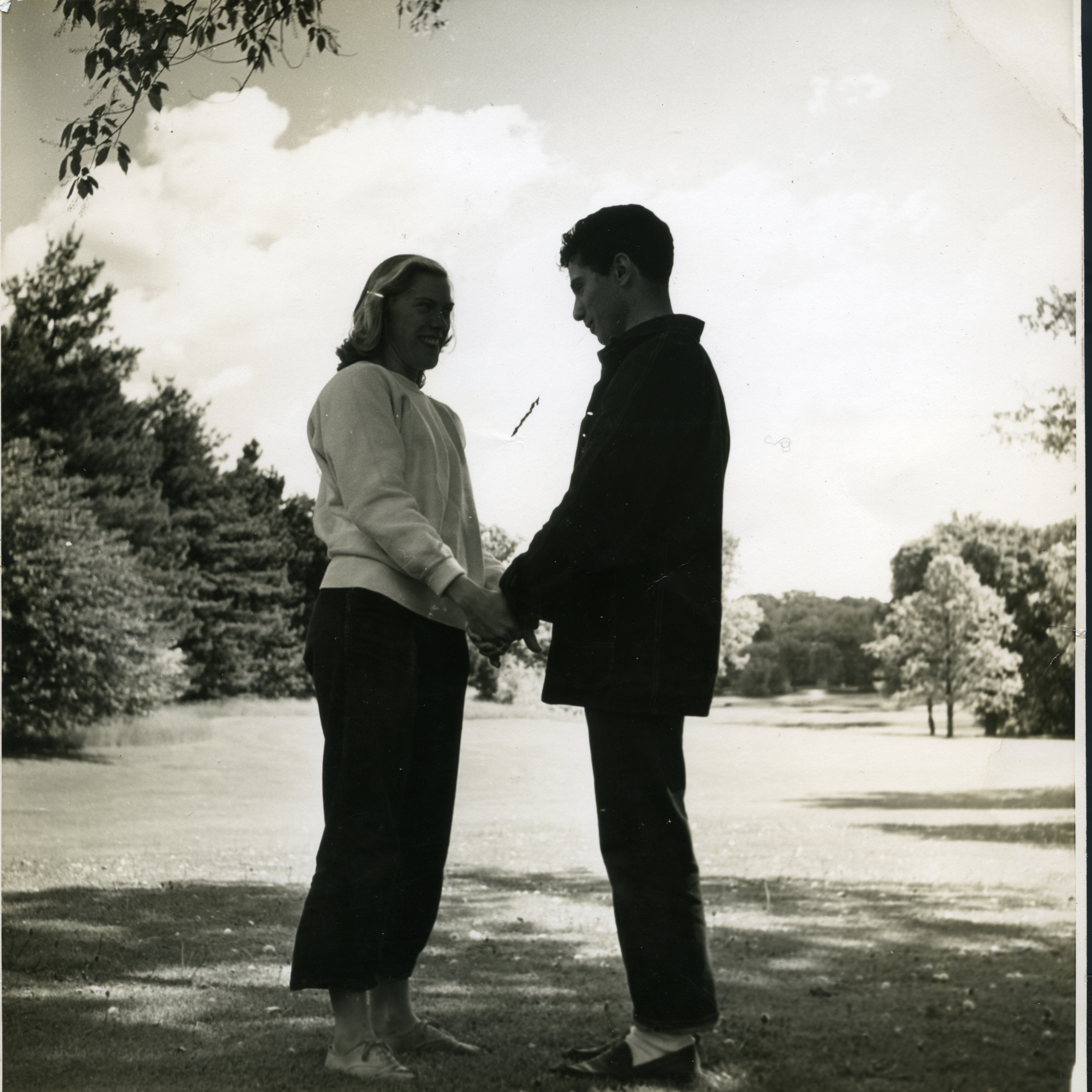
Eleanor Ann Middleton (Painting,1950) and Angelo Caravaglia (Sculpture, 1950) on Cranbrook grounds, circa 1950. Courtesy of Cranbrook Archives.
Eleanor Ann Middleton (Annie) received her BFA and MFA in Painting from Cranbrook Academy of Art in 1949 and 1950, respectfully. Her photo album, assembled at least in part post-graduation, contains photographs from Cranbrook staff photographer, Harvey Croze, who also managed the studio and darkroom in the basement of the Academy Administration Building. These images—class photos on the Art Museum peristyle or familiar shots of the Triton Pools— are copies of those already in the Cranbrook Photograph Collection. But the bulk of the album contains snapshots that are unique to the Archives.
Jack Kearney (Painting 1948) creates al fresco, circa 1947-1948. Courtesy of Cranbrook Archives.
While Middleton was herself a photographer, she appears in many of the images, so the snapshots are likely a mix of her work, fellow Academy students, and perhaps even Croze, in an unofficial capacity. While not Academy staff or student, Croze was a practicing artist (painting and photography) and was known to spend much of his free time with Academy students. Whatever the case, the result is an intimate glimpse into student life.
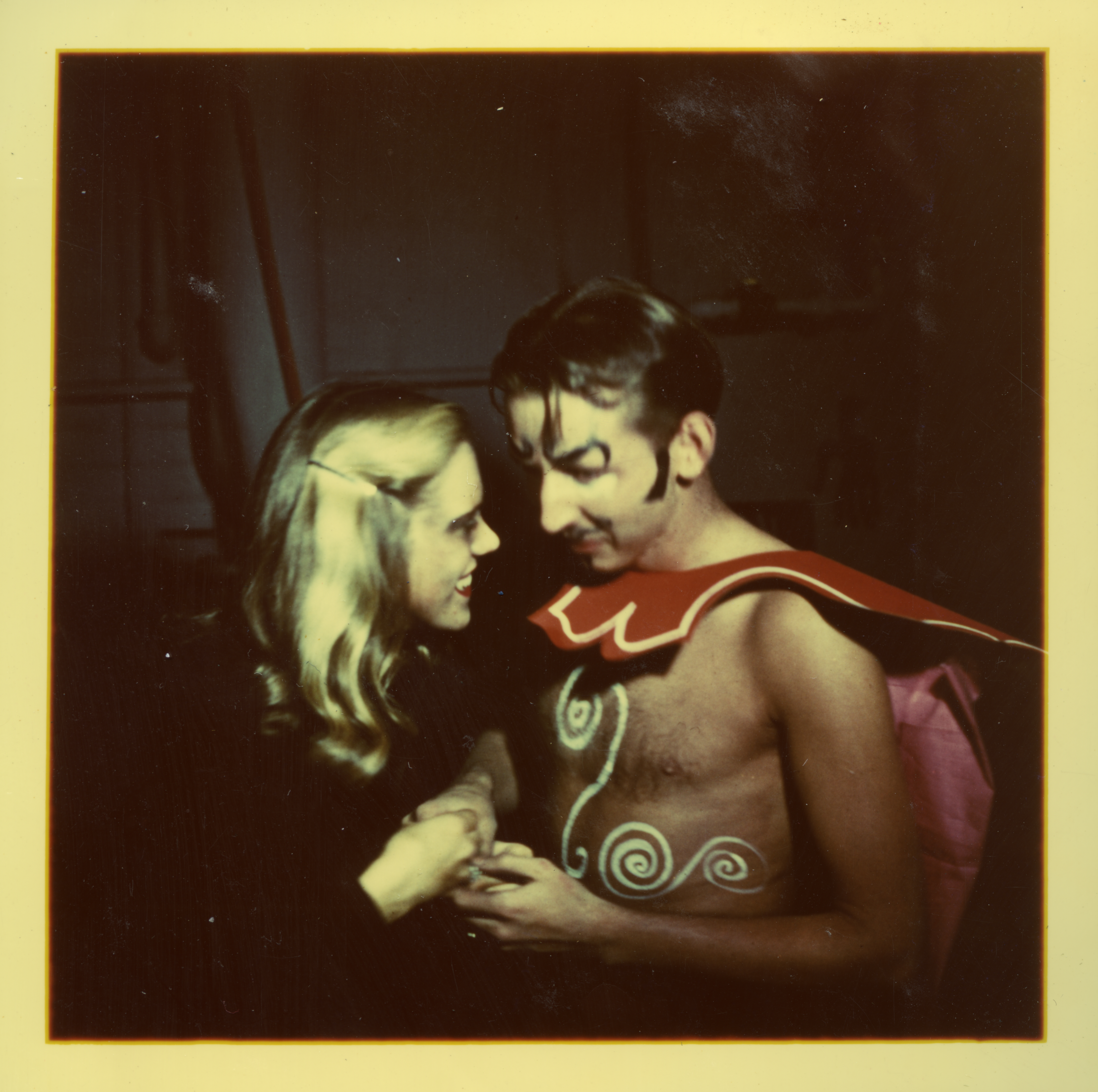
Annie Middleton and a fellow student at one of many costume parties featured in the album, circa 1947-1950. Courtesy of Cranbrook Archives.
The Center wishes all students at the Academy and Cranbrook Kingswood Schools a wonderful 2024-25 academic year!
—Deborah Rice, Head Archivist, Cranbrook Center for Collections and Research
Eric Perry photographs work from Megha Gupta (CAA Ceramics 2023) alongside collections from the Frank Lloyd Wright-designed Smith House and eggs from Cranbrook Institute of Science.
If you walked into Cranbrook House, Saarinen House, or Smith House this week, you might have noticed some surprising guests have arrived at the table. Your Center for Collections and Research team have been busy installing Brought to the Table, the fifth intervention of new work by Cranbrook Academy of Art students and Artists-in-Residence in our three historic homes.
This year’s virtual exhibition is a Cranbrook-wide collaboration that brings site-specific work from across the Academy’s eleven departments into conversation with objects from Cranbrook’s Cultural Properties, Art Museum, and Institute of Science collections.
Kiwi Nguyen (CAA Metals 2023), Iris Eichenberg (Metals Artist-in-Residence), and Kevin Adkisson (Center Curator) strategize in the Saarinen House studio.
Brought to the Table engages with the long tradition of functional art at Cranbrook and pairs new works of art with objects from the Cranbrook collections made for dining tables, coffee tables, desks, or side tables. Before the exhibition kicks off at the Virtual Opening and Lecture on March 27th, I’d like to give you a sneak peek at the exhibition process.
This was my first experience curating contemporary art and I was grateful to learn from my capable co-curators, Metalsmithing Artist-in-Residence (AIR) Iris Eichenberg and Center Curator Kevin Adkisson.
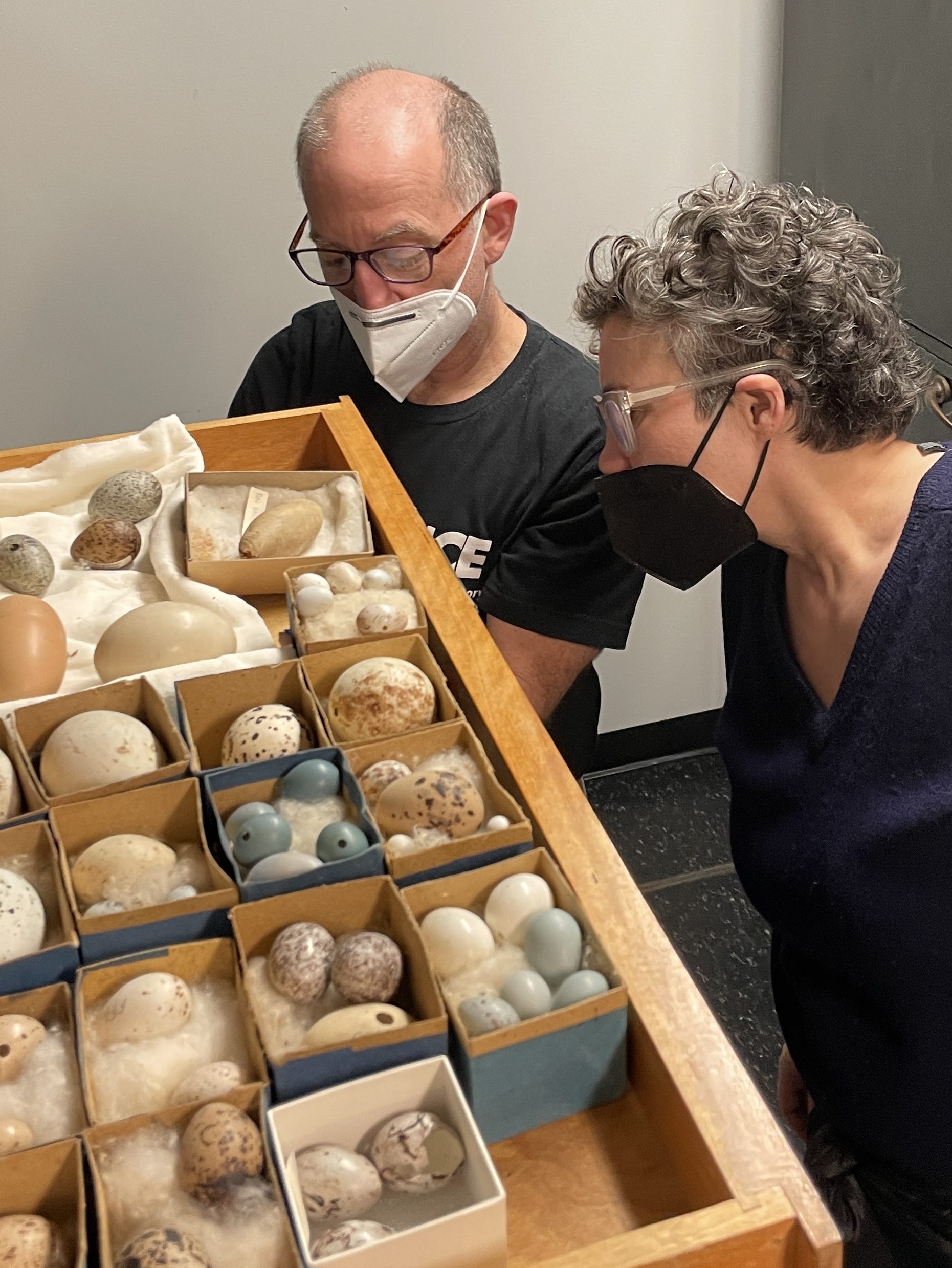
Cameron Wood (Cranbrook Institute of Science Curator for Collections) and Iris Eichenberg (Metalsmithing AIR) examine eggs from the Institute’s oological collection.Kiwi Nguyen (CAA Metalsmithing 2023) on the hunt for objects for our exhibition in the vault of Cranbrook Institute of Science.
From planning with Kevin and Iris; coordinating with our wonderful Academy artists; selecting objects with colleagues at the Institute of Science and Art Museum; installing with the help of students; and assisting with photography, this exhibition took me all over the Cranbrook campus.
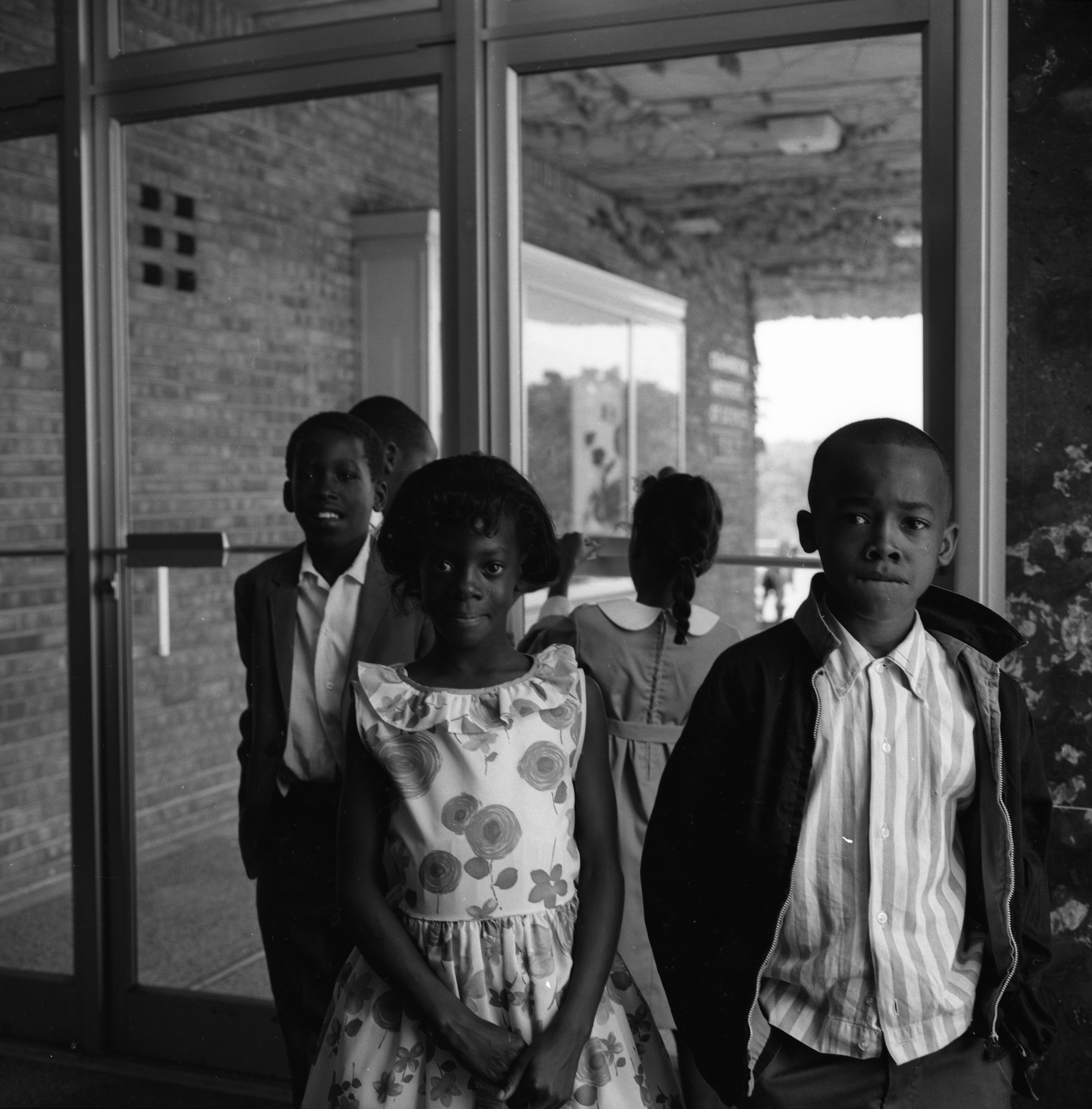
Cranbrook Institute of Science (CIS) has long held a special place in the hearts of many area schoolchildren. Field trips, weekend family outings, and onsite demonstrations in schools and community centers are a part of the fabric of the metro Detroit K-12 educational experience.
Elementary students visit the Cranbrook Institute of Science in 1935. Robert T. Hatt, photographer. Courtesy of Cranbrook Archives, Cranbrook Center for Collections and Research.
A recent discovery in our collections furthered my appreciation of the Institute’s educational outreach and its commitment to ensuring access to the world of science for all its surrounding communities. It all started with the folder titled “Pontiac Area Urban League, 1988” in the Institute of Science Director’s Records.
The Pontiac Area Urban League (PAUL), was founded in 1950 as an affiliate of the National Urban League. An integral part of PAUL’s mission was to improve educational opportunities for underserved residents. Through its Education Committee, they partnered with Pontiac Public Schools in the 1980s to empower students of color to seek equity in science and math education by providing real-world role models and encouraging parent involvement. In 1988 this effort took the form of a project that focused specifically on middle school students and lead PAUL to approach Cranbrook Institute of Science. The resulting partnership formed the basis of CIS’s relationship with students in the School District of the City of Pontiac that continues to this day.
A visiting school group, 1966. Robert T. Hatt, photographer. Courtesy of Cranbrook Archives, Cranbrook Center for Collections and Research.
Correspondence in the CIS Director’s Recordssuggests that CIS had already been considering educational outreach efforts to Pontiac residents. Janet M. Johnson, Director of Education, states in a 1988 memo to Director Robert M. West regarding the possible partnership with PAUL: “This may be another avenue for us to pursue interests with Pontiac.” West expresses his “delight” a few months later in a letter addressed to PAUL’s Interim Director, Jaqueline Washington:
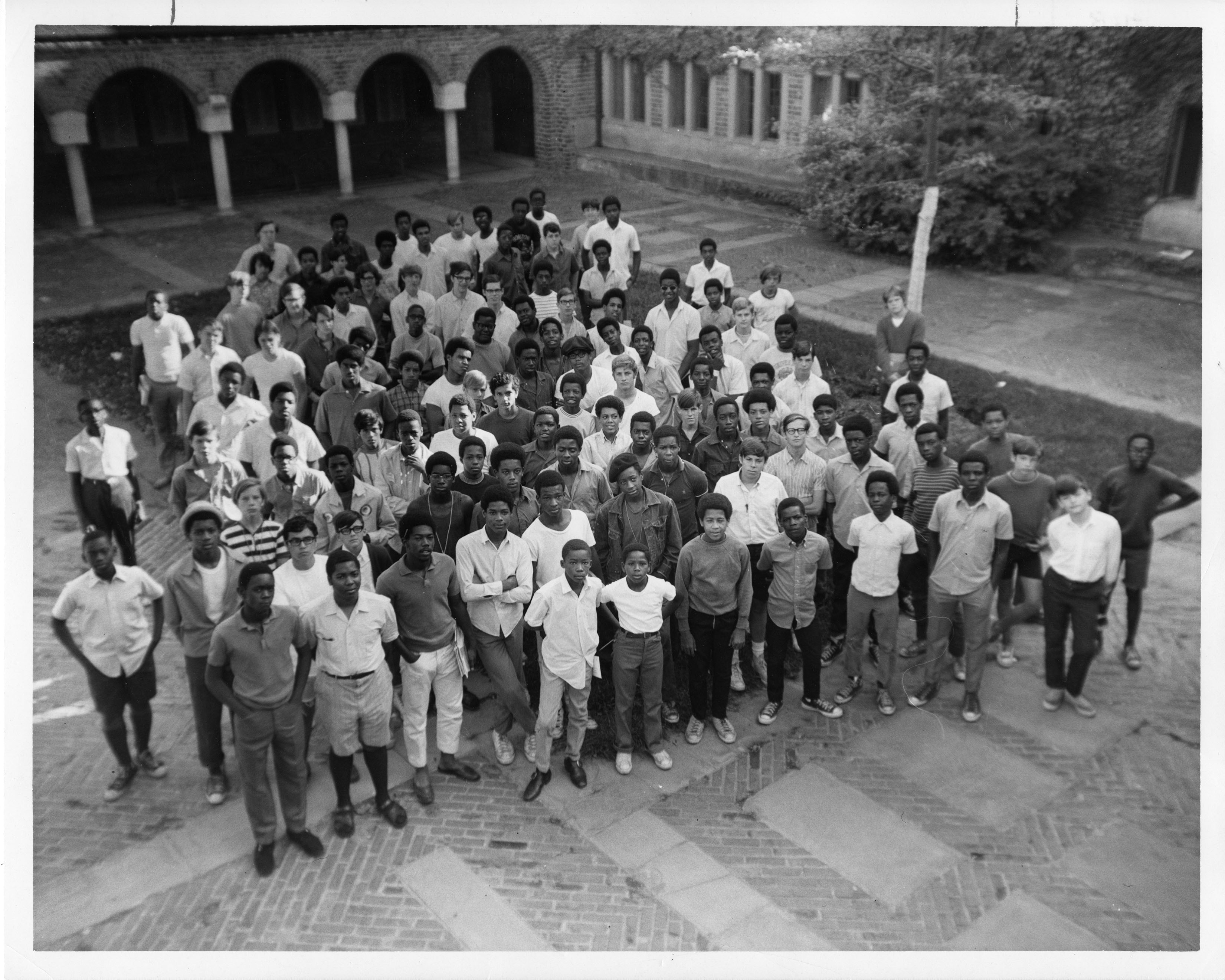
In commemoration of this significant day, Juneteenth, I thought we’d look back at one of many compelling stories in Cranbrook’s history. In the summer of 1970, Horizons-Upward Bound (HUB) offered four new electives that reflected the experimental nature of a project in its sixth year of operation. These electives allowed for innovation and creative thought around topics of particular relevancy to HUB students, investigating issues that still resonate fifty years later.
1969 HUB student photo used on the inside cover of the 1970-1971 annual report. Courtesy of Cranbrook Archives.
Black Creative Writing, taught by Highland Park Community College English instructor Stephen D. Chennault, involved readings, examinations of concepts, and self-directed writing. Students surveyed a Langston Hughes edited short story collection and works by the Black Arts Movement poet, Don L. Lee (later known as Haki Madhubuti). They also explored Black awareness, the role of the Black professional writer, and created skits centered on Black life, in what Chennault describes as a “careful observation of their niche in today’s America.”
The Black Contributions course was co-taught by Wayne State University interns, Ervin Brinker and Fred Massey, and grew out of the Black History course of the two previous summers. Refocused with a more contemporary slant, students studied organizations such as the Black Panther Party, the Student Non-Violent Coordination Committee, and the Southern Christian Leadership Conference. Reporting on the course, Brinker and Massey observed that “both instructors and students were sensitized to the realization that solutions to racial problems are imbedded in institutional living patterns of long standing, protected by mazes of barrier that must be recognized and understood if they are to be nullified.”
George W. Crockett Jr., 1968. Courtesy of Walter P. Reuther Library.
Law was team taught by Detroit attorney Michael Brady and University of Wisconsin law student Norman Prance. Half of class time focused on criminal law, which included examination of Yale Sociology Professor Albert J. Reiss’ 1967 study of police brutality and discussion of the Wayne County Juvenile Court. The subject culminated in a field trip to the Detroit Recorders Courtroom of Judge George Crockett Jr., a civil rights advocate known for confronting the practice of race-based sentencing.
Ben Snyder and Horizons scholarship students, 1968. Courtesy of Cranbrook Archives.
In the course, Power, developed by HUB founder and director Ben M. Snyder, students explored the idea of power through a combination of contemporary theory and current realities. Stemming from two works: Adolf Berle’s 1969 Power and Nathan Wright’s 1968 Black Power and Urban Unrest, the course addressed complicated regional situations, such as the redistricting of Detroit schools. When replying to a question regarding the value of the course to his future, one student remarked, “As long as I am more aware of the American way of working power, it should make me more alert.”
Cover illustration by David McMurray for The HUB 101 Literary Magazine, 4 (Summer 1970). Courtesy of Cranbrook Archives.
A tradition since 1967, the Literary Magazine, a sampling of writing and art produced by HUB students, is perhaps the most important summation of the student experience. Against the backdrop of the civil rights movement, national Vietnam War protests, and the beginnings of an economic downturn that would hit the Detroit metro area hard, the Summer 1970 issue reflects powerful emotions. It’s clear to see that these four thought-provoking electives left a profound effect on students’ views of American society and their role in it. With titles like Discrimination, Revolution, Black Power, Choice of Colors, The Man, The Militant, and Pride, the poignancy of their voices is striking and remarkably germane to events, both then and today.
–Deborah Rice, Head Archivist, Cranbrook Archives Cranbrook Center for Collections and Research
Sometimes, what appears to be a simple question doesn’t have an easy answer in the archives. By combining forces with colleagues, and looking in places you might not first suspect, you can ideally turn a boggling question into a rewarding quest. Provided, of course, you can solve the mystery! Happily, this was recently the case.
When contacted by a Kingswood School graduate about the origins of a certain sculpture that had graced the Green Lobby in the 1960s-1970s, I had two names to go on: Suki and Pam Stump Walsh. Was either of these the name of the sculptor and was the sculpture even still there? After checking several possible sources in the archives, it was time for a field trip to Kingswood. There she was opposite the green stairs, just as she had been described to me: a bronze sculpture of a girl, sitting cross-legged, head bowed, reading a book. I’d answered part of the question: she was still there.
And much to my delight there was also a plate tacked to the sculpture’s wooden pedestal. It read: “In Remembrance, Suzanne Anderson Stenglein, Class of 1947.”
Could this be Suki?
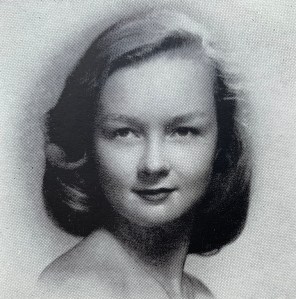
Back in Archives, I found a Suzanne Anderson in the 1947 Kingswood yearbook, Woodwinds. Next to her picture, this description: “That dashing station wagon, that’s always on the go, beautiful taste in clothes, and exciting vacations make Suki the ideal senior for every underclassman. Her pertness, her nose, and her spirit, that help to create her charm, match perfectly her conversational ability on all subjects from Broadway to baseball.”
I still didn’t know if this was the sculptor, or if it was Pam Stump, who is perhaps best known at Cranbrook for her work, Jane: Homage to Duchamp in the Kingswood courtyard. It certainly appeared to be Stump’s style. Associate Registrar Leslie Mio found a listing in Cranbrook Cultural Properties records for Suki, described as a patinated bronze sculpture attributed to Pam Stump.
Detroit native M. Pamela Stump graduated from Kingswood School in 1946. After attending the University of Michigan College of Architecture and Urban Planning for one year, she left to study sculpture under Marshall Fredericks in his Saginaw studio. Twenty-three years after leaving Kingswood, Stump, now Pamela Stump Walsh (she married Cranbrook School 1944 graduate, David E. Walsh), returned to teach sculpture. She retired in 1990, but continued creating and showing her own work throughout the state and internationally.
I appeared to have my answer, but I wanted definitive proof, and, ideally, a date. Back to Kingswood School. This time, with the help of Associate Archivist Laura MacNewman, I found the artist’s signature, and, a date!
End of story, right? Not quite. I still wondered about the sculpture’s origins. The Archives, thankfully, hold the M. Pamela Stump Papers. Consisting mainly of her Cranbrook Kingswood Chronicle, a memoir she titled, “Ubi Ignes Est or Where’s the Fire?” it provided the final details.
Stump made eighteen sculptures for Cranbrook while on the Kingswood faculty. Shortly after she started, in 1969, she was commissioned by the Class of 1947 to create a sculpture in memory of their classmate Suzanne Anderson Stenglein, who had died prematurely the year before. Stump refers to the bronze sculpture of Suzanne as Girl Reading or Suki. It was specifically designed to fit in the niche just outside the Headmistress’ office, directly opposite the staircase in the Green Lobby, and purposely placed on a revolving wooden pedestal so it could be turned 180-degrees to face the wall and enable examination of all the various textures and symbols on its surface. Stump writes, “On her body are many symbols of her life. This was easy because I had known her at Kingswood and in Saginaw.” Here you see this symbolism, along with the names of Suzanne’s schools before she came to Kingswood; her initials, S.A.; and her nickname, found on the crown of her head:
To bring things full circle: a close examination of negatives in the archives collections (identified only as “Kingswood Interiors”) found period images of the sculpture:
The Reading Girl by Pamela Stump, July 2, 1969. Bradford Herzog, photographer. Courtesy Cranbrook Archives, Cranbrook Photograph Collection.
I also learned from The Birmingham Eccentric, that Suki was the daughter of Goebel Brewing Company President Edwin John Anderson. She grew up in Saginaw, where she presumably met her husband, Harold Stenglein. The pair were married at Christ Church Cranbrook in 1955, and made their own home in Saginaw. At this juncture, little else is known about the girl behind the sculpture’s name.















 Cranbrook Kitchen Sink