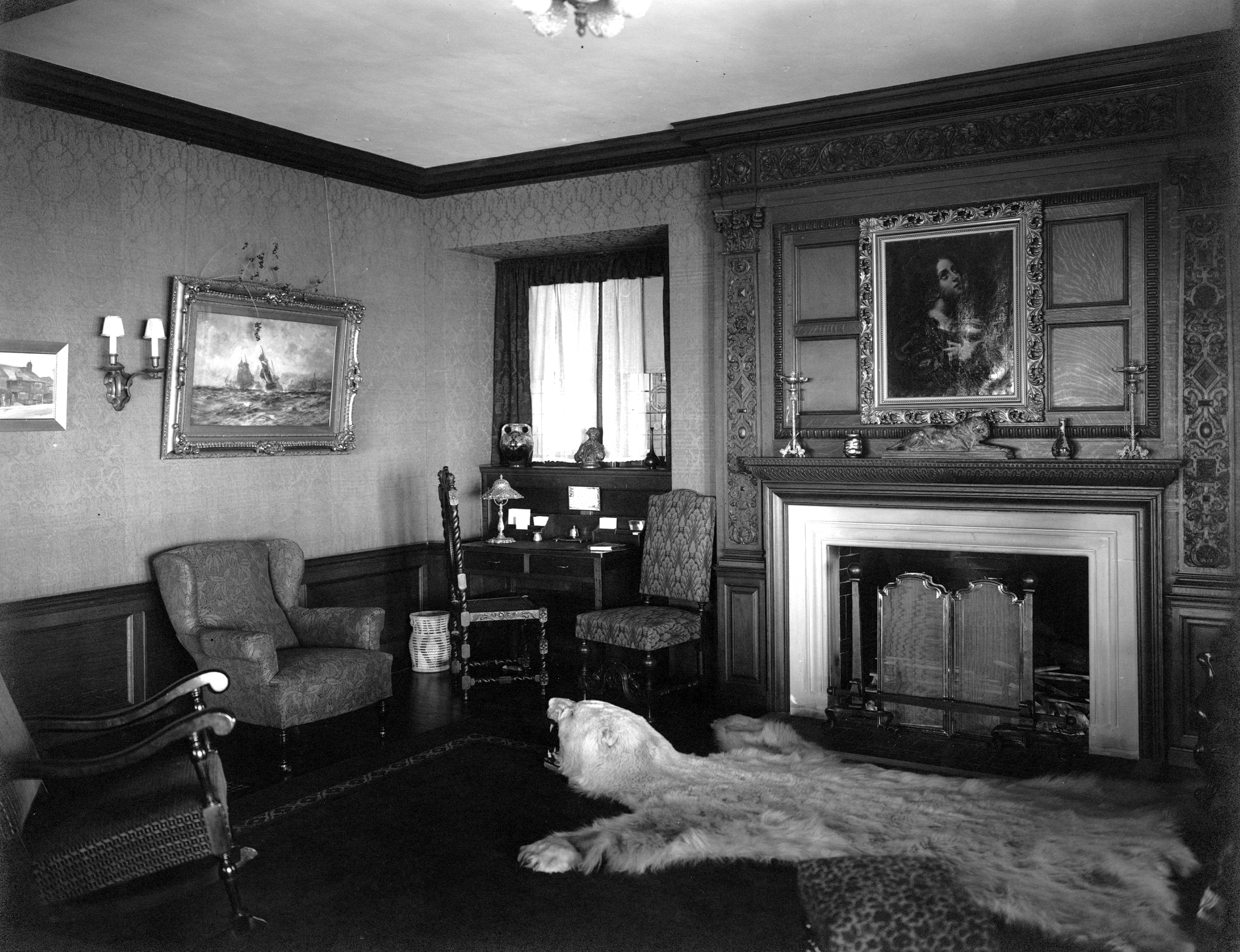
As the temperature dips and the days get shorter, it sure would be nice to end the week reading a book next to a roaring fire. The Booths likely had the same idea their second winter at Cranbrook House, where they could have curled up by the fire…on their new polar bear rug!?
Cranbrook House Living Room, ca. 1909, with one incredible rug. Photo from the collection of Carol Booth. Courtesy Cranbrook Archives, CCCR. Copyright Cranbrook Educational Community.
Elsewhere in the cozy Living Room of 1909, we see objects that are still in Cranbrook House today: the Ships at Sea painting by Robert Hopkin; the bust of Edgar Allen Poe (1898) by George Julian Zolnay; and even the mahogany desk chair, by W. & J. Sloane Company. Some objects are no longer at Cranbrook—the registrar and I can’t quite match the rocking chair, that exact easy chair, the lamp, or the candlesticks to things in the collection. The painting above the fireplace, The Penitent Magdalene after Carlo Dolci, is also no longer here in the house.
Where did these things go? Well, George and Ellen Booth lived in this house for another forty years after this photo was taken! They constantly added to, gifted away, and sold pieces from the collection.
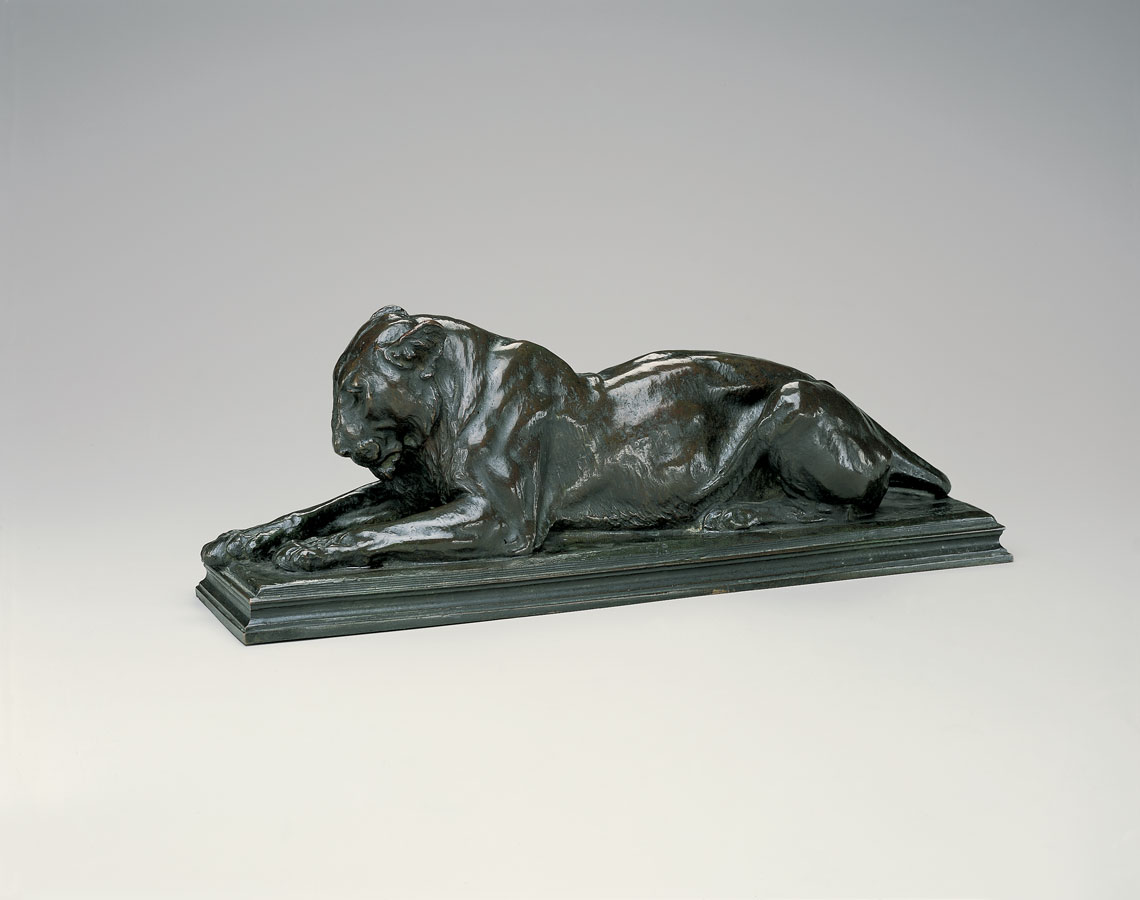
But not everything in this photograph that left the house went entirely off campus. You may notice one piece on the mantle: Recumbent Lioness by Eli Harvey. Booth purchased this sculpture in 1909 from Tiffany & Company in New York. In the 1930s, he gave this lioness to the new Cranbrook Art Museum, where it was assigned the first accession number in the collection: 1909.1. (It’s not actually on campus at the moment: it’s currently on display in Switzerland!)
Recumbent Lioness, Eli Harvey (born 1860, Ogden, Ohio; died 1957, Alhambra, California). Foundry: Pompeian Bronze Works, New York. Bronze; 7.5 x 5 x 21.5 inches. Gift of George Gough Booth and Ellen Scripps Booth, CAM 1909.1. Photograph by R. H. Hensleigh and Tim Thayer. Courtesy of Cranbrook Art Museum.
Using photographs like the one from 1909, as well as diary entries, books, and other records in Cranbrook Archives, I’ve spent the past week re-arranging Cranbrook House’s first floor back to this early aesthetic. On Sunday, the Center is partnering with Cranbrook House & Gardens Auxiliary to present a very special virtual tour: Home for the Holidays at Cranbrook House. I’ll be your host and guide, and will be joined (virtually) by volunteers from the Auxiliary to help share stories from holidays past. I think you’ll really enjoy this tour—there are lots of beautiful things I’ve placed back on display, and we are all very excited to share them with you!
—Kevin Adkisson, Associate Curator, Cranbrook Center for Collections and Research
PS: You’ll need to join our tour Sunday to see if the polar bear rug has made a reappearance!
With the holidays upon us and the observance of annual traditions in high gear it seems fitting to look back at one of Cranbrook’s most storied and festive occasions. Starting in 1950, every year at the beginning of December preparations would begin for the annual Twelfth Night Gala at Cranbrook House. Held on January 6th, the event was originally conceived as a small costume party in the 1920s by Cranbrook Founders’ son, Henry Scripps Booth. It eventually became an official Cranbrook gathering, with Henry at the helm.
The aim of Twelfth Night, as Henry stated, was “to recognize the contribution each employee and board member makes to Cranbrook by bringing them all together as participants in an enjoyable, annual, and ‘classless’ social event.” It was, in essence, a staff holiday party, but its magnificence was a far cry from the typical.
Joseph R. Scott Jr. practicing “piper’s piping” in Cranbrook House basement for the 1966 performance. Harvey Croze, photographer. Courtesy of Cranbrook Archives.
Not sure exactly what Twelfth Night signifies? Perhaps you know the classic carol Twelve Days of Christmas: “On the first day of Christmas, my true love gave to me ….” A medieval English observance, Twelfth Night, as defined by the Oxford English Dictionary, denotes “the twelfth and last day of Christmas festivities”—twelve days after Christmas, or January 6th. The Shakespeare playof the same name is thought to have been created as entertainment for a Twelfth Night celebration.
Inspired by his English heritage and impressed with a performance of the play at the Detroit Opera House when he was twelve years old, Henry Booth created a sixty-year tradition for Cranbrook staff, faculty, and supporters that revived the holiday’s twin themes of celebratory food and pageantry.
In Cranbrook Archives, theTwelfth Night Recordsmeticulously document the planning and execution of the gala as it took place at Cranbrook House, through programs, scripts, invitations, guest lists, receipts, budgets, meeting minutes, photographs and more. These items bring the party alive–and what a party it was!
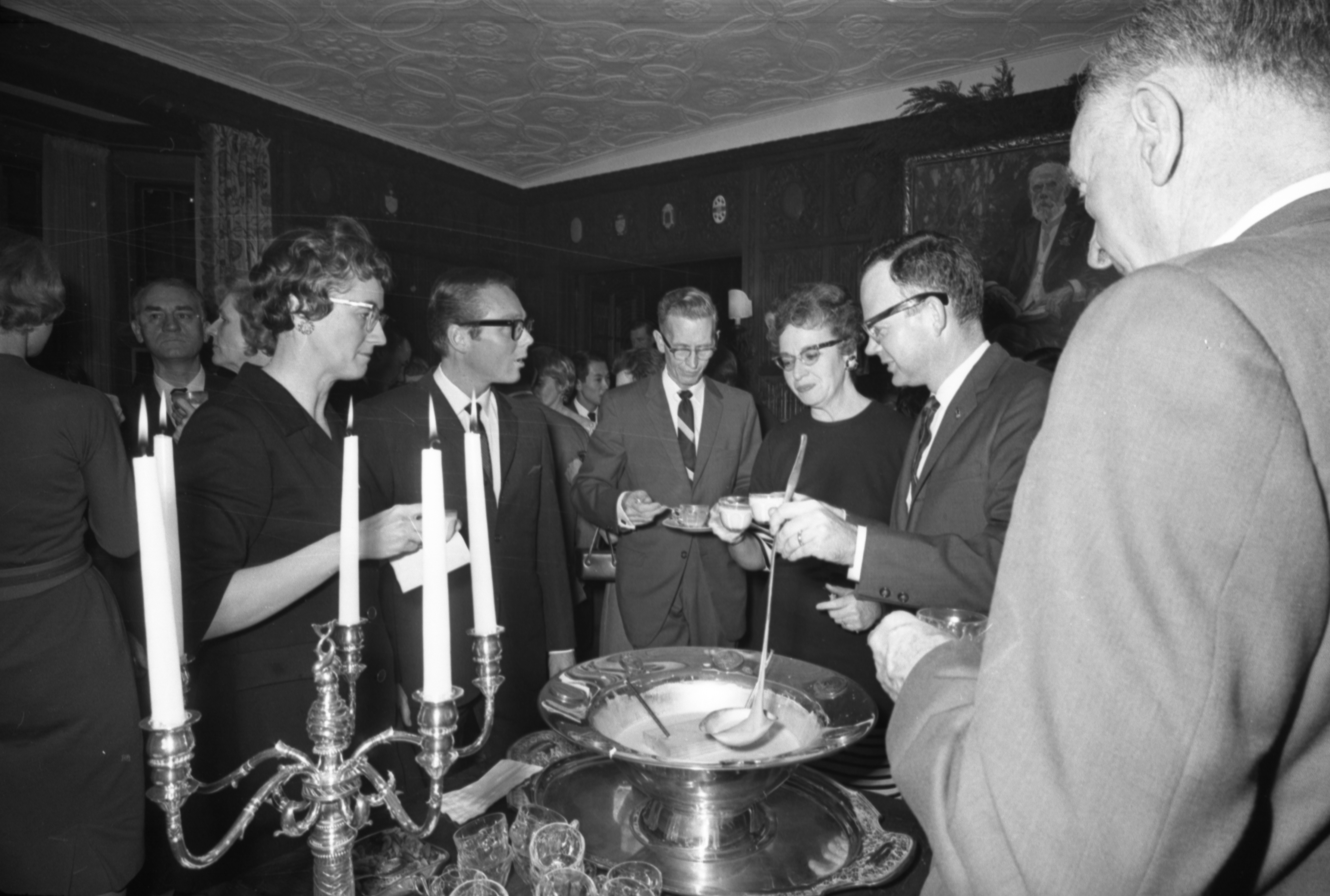
Eggnog in the Oak Room, 1967: (left to right) Helen Hays, Warren Hays, Chet Hard, Anita Hard, and Don Hays. Harvey Croze, photographer. Courtesy of Cranbrook Archives.
Choosing the decade of the 1960s to epitomize the revelry of the long-standing event, I give you the opening lines from the 1960 program, spoken by Cranbrook School Headmaster Harry Hoey:
We’ve all found a welcome in this mellow house Including, we trust, some young shivering mouse The wassail is heady The fellowship’s steady The mummers are ready So gay may this gala be in Cranbrook House On with the tom foolery!
With the Thanksgiving holiday almost upon us, it is time to begin planning and preparing one of the essential parts of any celebration: food. It seems timely, then, to highlight Flora Leslie, Brookside’s long-serving dietician and food director. I would like to introduce her to you in her own voice, recalling a memory of some precarious pumpkin pies:
Floral Leslie interview with Mark Coir, Archivist (OH1990.09.28), November 5, 1987. Courtesy of Cranbrook Archives.
Hearing this story in Flora’s voice brings the memory to life in a different way than simply reading it in written form. Cranbrook Archives’ Oral History Collection holds recordings of many voices that add dynamism and richness to their stories. Flora Leslie’s interview describes her life at Cranbrook and her experience of its people and places in the mid-twentieth century.
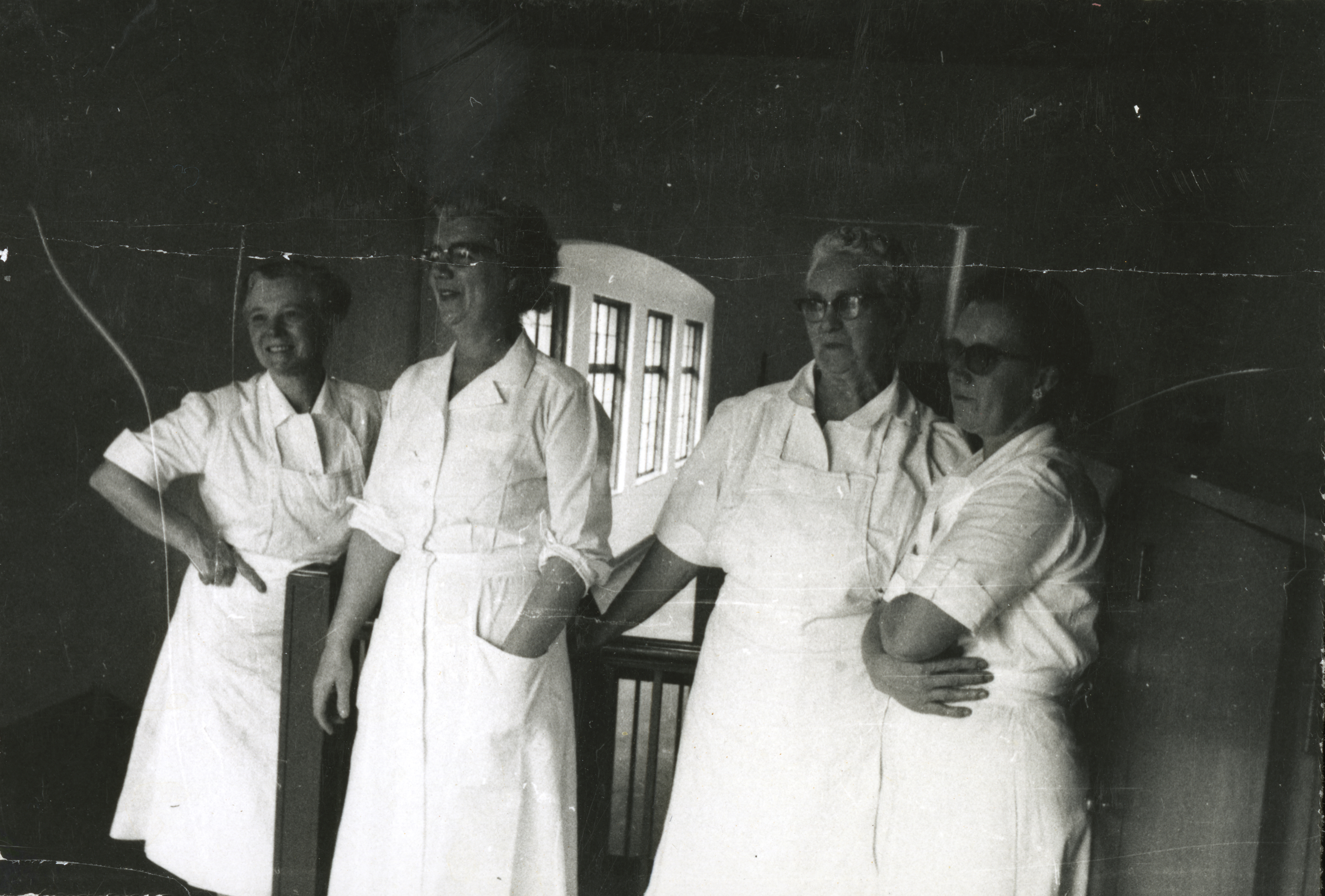
Flora Leslie (second from left) with cooking staff at Brookside School. Courtesy of Cranbrook Archives.
Born Flora MacFarlane in Alexandria, Scotland, in 1906, she made her way to the United States alone in December 1930. Journeying by ship on a very stormy sea, the passengers were required to stay below deck where they got to know each other more than they would have had they been able to wander on deck. Having worked in a photographer’s office in Scotland, Flora initially sought the same occupation in America.
But a fellow passenger Flora met aboard the ship told her that if she had no luck finding work, to contact her for employment. It is thus that Flora began to work for the Ward family in Pontiac, a family whose children were students at Cranbrook.
In 1932, Flora started working at Cranbrook, initially at Kingswood School. Flora married George Leslie in 1934, a landscaper and gardener, and later a superintendent of buildings at Cranbrook.
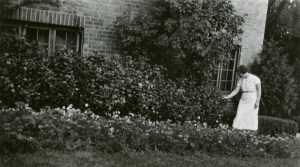
George Leslie (left) and Flora Leslie (right) in the garden of their apartment, the Ram’s House, at Brookside School, circa 1935. Courtesy of Cranbrook Archives.
After several invitations from Jessie Winter, Headmistress of Brookside School, Flora became the dietician and food director at Brookside School, a position she held from 1934-1975. The position came with an apartment, and though at first Flora preferred to stay at Kingswood, which she describes as “light and bright and lovely,” Winter asked Flora and George back to Brookside one further time and had arranged the apartment beautifully. Most importantly, there was a brand-new Frigidaire refrigerator, a novelty in those days. As Flora recalled, seeing this small luxury she told the headmistress, “We’ll come!” The apartment was in the part of Brookside known as the ‘Ram’s House’ and had previously been occupied by Jessie Winter and by J. Robert F. Swanson.
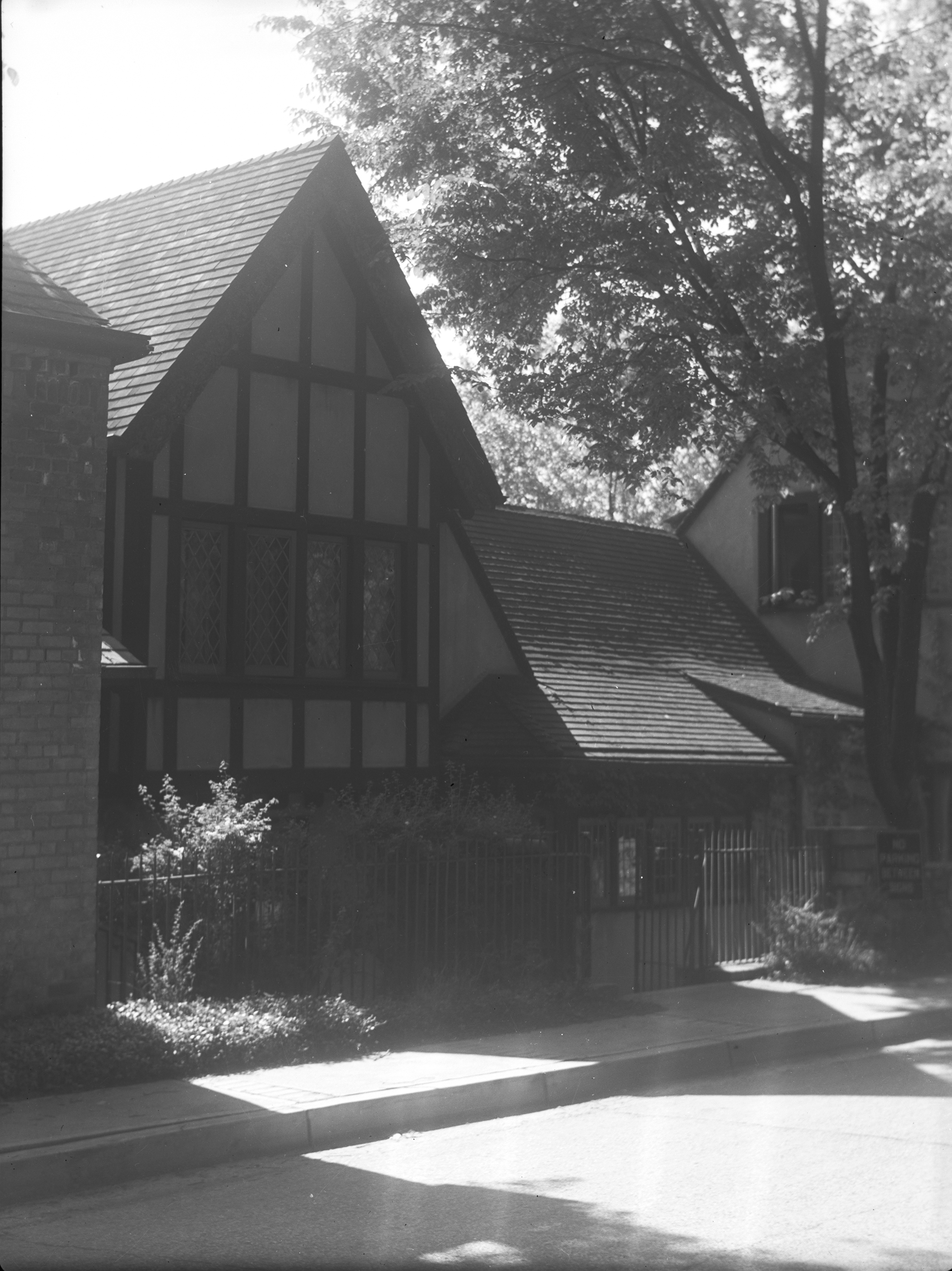
View of the front of George and Flora Leslie’s apartment, known as the Ram’s House, circa 1935-1938. Courtesy of Cranbrook Archives.
During the war years, when food was in short supply, George and Flora Leslie kept Brookside stocked with vegetables—he grew them and she canned them.
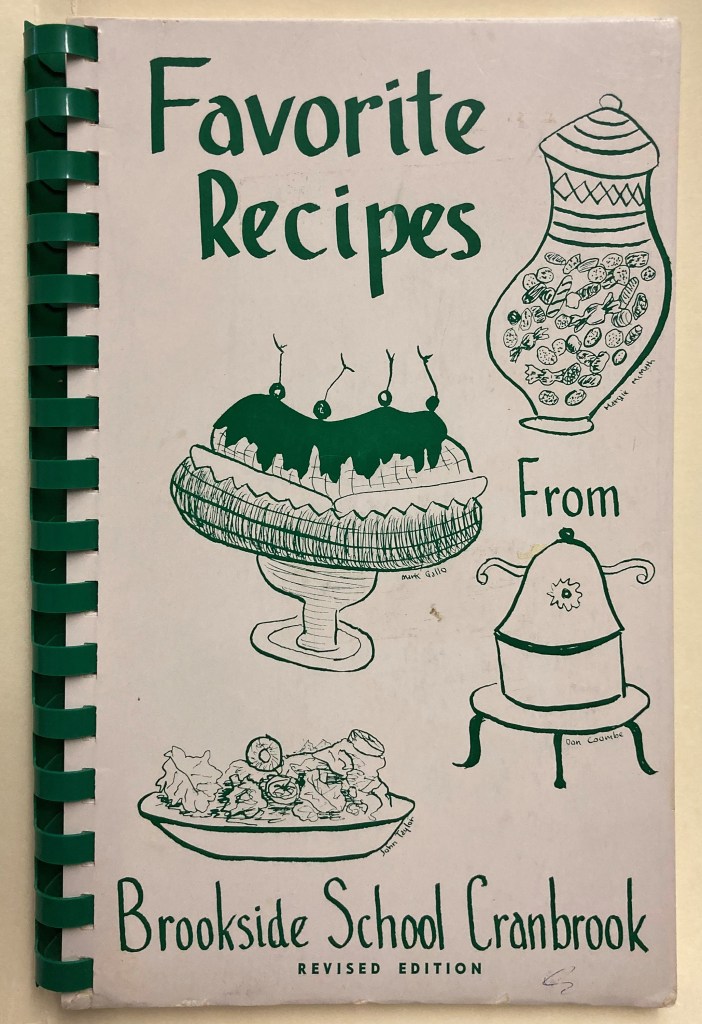
The Favorite Recipes cookbook from Brookside School, 1970.
View of original recipes from Flora Leslie in the Favorite Recipes cookbook from Brookside School, 1970.
View of dessert page from the Favorite Recipes cookbook from Brookside School, 1970.
Favorite Recipes, the Brookside cookbook, 1970. Courtesy of Cranbrook Archives.
After feeding generations of students, Flora published many of her favorite and original recipes in the Brookside cookbook, Favorite Recipes, which are still enjoyed by alumni far and wide. Perhaps you might like to try one of Flora’s original recipes this Thanksgiving, or a dessert recipe from one of the faculty families?
—Laura MacNewman, Associate Archivist, Cranbrook Center for Collections and Research
Did you know that Cranbrook Art Museum’s educational partnerships with surrounding communities date back over sixty years? Long before the current museum trend of interactive educational programs for youth audiences, the Academy of Art and theJunior League of Birmingham had an idea: the Young People’s Art Center (YPAC).
Young People’s Art Center logo, from the 1962 enrollment form. Courtesy of Cranbrook Archives.
The year was 1958, and the Museum had recently changed names to the Academy of Art Galleries, shifting focus to feature more contemporary art practices. With that, came the desire to encourage young visitors to express their own artistic voices—participatory education, rather than simply art appreciation. Documenting the program’s first year, a June 1959 Detroit News Pictorial Magazine feature noted that YPAC “is fast gaining a national reputation for its lively approach to art education.”
In particular, it was Henry Booth (Academy Board of Trustees Chairman), Wallace Mitchell (Head of Galleries), and Zoltan Sepeshy (Academy Director) that approached the Junior League with a plan. In a 1957 report by Mitchell during the Center’s development phase, he states, “ The personnel of the Cranbrook Academy of Art has become increasingly aware of the growing country-wide interest in the visual arts and has long wished to more directly participate in the fostering and guiding of this interest as expressed in our community.” Seeking support from the Junior League, this “unique opportunity to bring to the children of Oakland County an integrated program in art education which concerns itself with the totality of the art experience” was green-lighted for the following year.
Children watch a judo demonstrator as part of a class exercise. Erik Strylander, photographer. From the article “Sketching to Jazz and Judo,” Detroit News Pictorial Magazine, June 28, 1959.
A perfect partnership was formed. The Academy would provide leadership, through the support of its trustees, director, and faculty; the Junior League would provide the necessary finances. Naturally, with so many talented artists on campus, there was no lack of creativity or helping hands! Junior League members were also heavily involved, providing volunteer docents to conduct gallery tours and assist with classes, both of which were located on the ground level of the Museum below the Academy Library.
Actor Edward G. Robinson is often remembered for playing gangsters and wise guys, or, my person favorite role, as Dathan in Cecil B. DeMille’s epic film The Ten Commandments (1956). What most people do not know is that Robinson was an art collector.
Edward G. Robinson as a gangster in Little Caesar (1931). Unknown author, Public domain, via Wikimedia Commons.
That is not exactly true. According to Robinson, at the time of the exhibition Forty Paintings from the Edward G. Robinson Collection at the Museum of Modern Art in 1953, “I am not a collector. I’m just an innocent bystander who has been taken over by a collection . . . I am just a lover of paintings. I do what I do for the sheer joy of it!”
Robinson continues, “If I hadn’t become a movie gangster, it is highly probable that not one of my paintings would have had the chance to collect me. Here is a paradox: Turn killer and you have the means to satisfy your thirst for beauty . . . Crime, it seems, sometimes does pay.”
Edward G. Robinson’s home. View of living room, October 3, 1944. Dorothy Liebes papers, circa 1850-1973. Archives of American Art, Smithsonian Institution.
Unfortunately, in February 1957, Robison was forced to sell his art collection as part of the divorce settlement with his first wife Gladys Lloyd Cassell Robinson. Immediately after, he began to collect again. This second collection would be even bigger than the first.
Unlike film moguls or actors who pay experts to place a couple of easily recognizable masterpieces above their fireplaces, Robinson selected his artworks himself. He bought on instinct and impulse, guided by what he loved. As he said, “You don’t collect paintings – they collect you.”
You may say, this is all very interesting, but what is the Cranbrook connection?
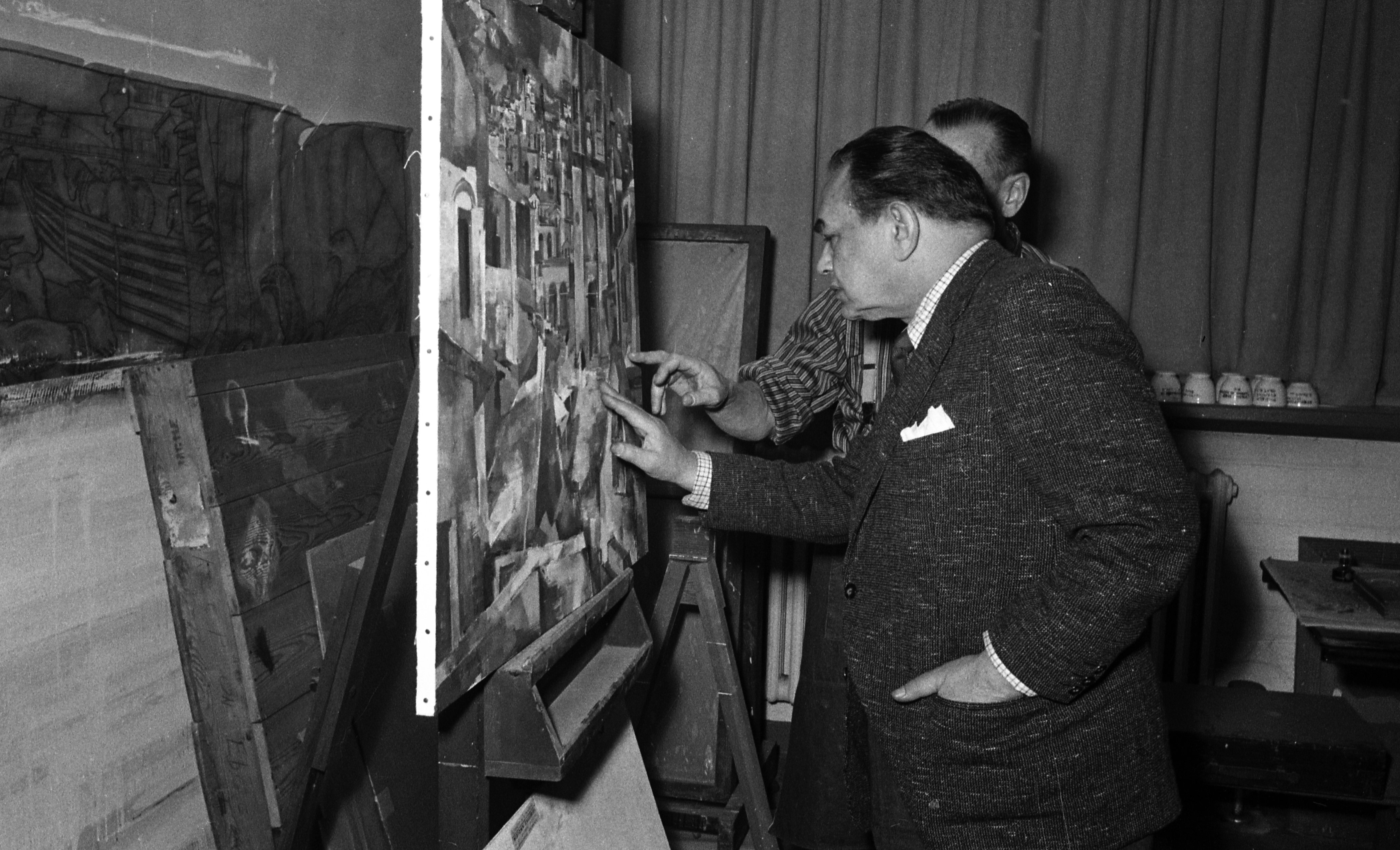
In December 1957, Robinson was in a play “Middle of the Night” at Cass Theatre in Detroit. According to the Sunday, December 15, 1957, Detroit Free Press, “A distinguished art lover, Edward G. Robinson, the actor, dropped in at Cranbrook Academy of Art Tuesday to chat with an old friend, Zolton (sic) Sepeshy, director of the Academy.”
Cranbrook Archives holds the “proof” of this visit, by way of wonderful images from our campus photographer, Harvey Croze.
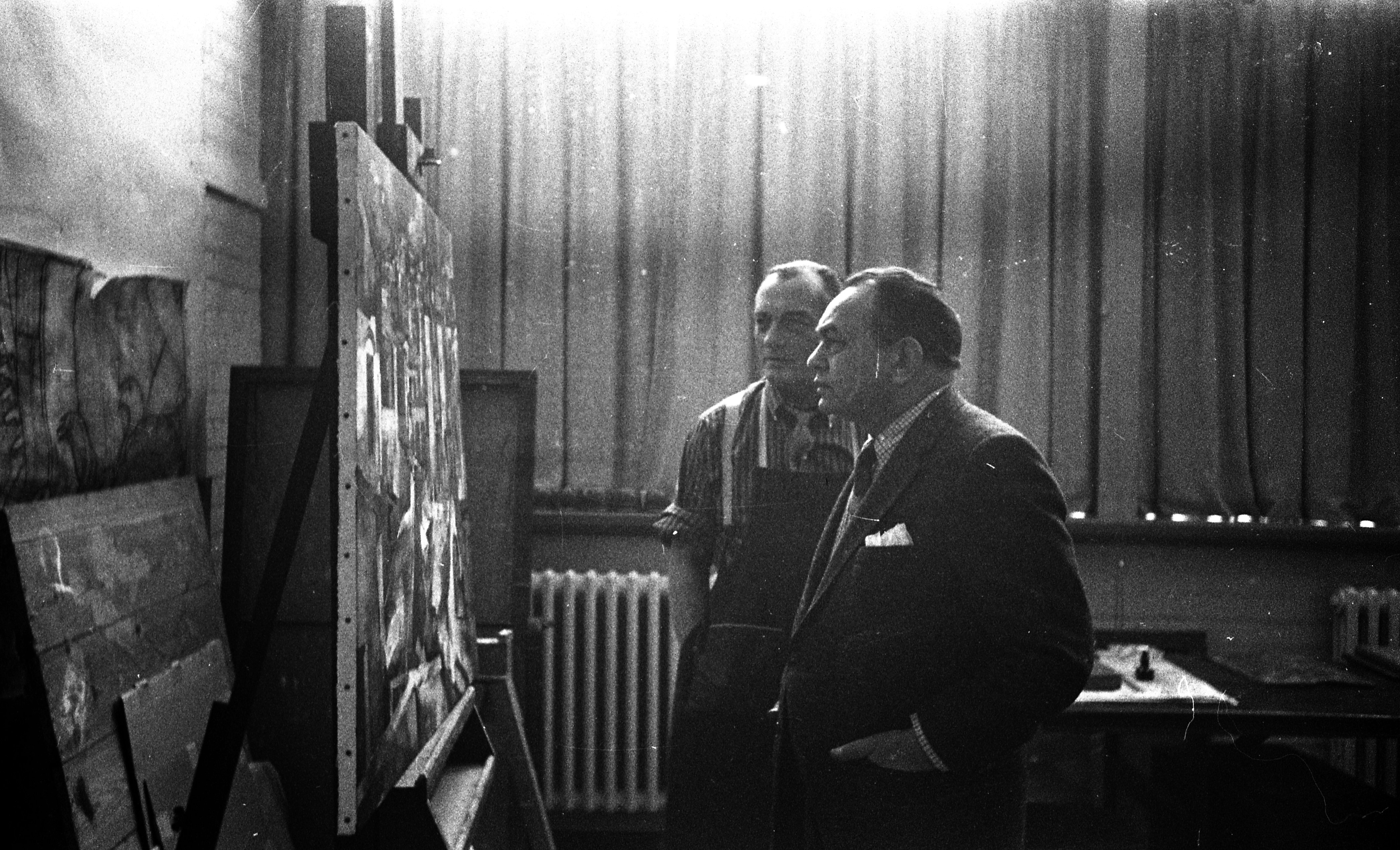
Edward G. Robinson in Zoltan Sepeshy’s art studio at the Cranbrook Academy of Art admiring the artist’ works, including City of Churches, in December 1957. Photography by Harvey Croze. Courtesy Cranbrook Archives.
I did some digging, and Robinson’s personal archives at Boston University have no mention of Cranbrook or Sepeshy. I also could not confirm if Robinson had any of Sepeshy’s art in his collection; none appear in the 1953 exhibition or in the coffee table book about his second collection, Edward G. Robinson’s World of Art (1971).
I imagine it was simply his love of art that brought Robinson out to Cranbrook in 1957, the same reason so many of us are drawn to campus today.
—Leslie S. Mio, Associate Registrar, Cranbrook Center for Collections and Research
Of the 5,000 plus architectural drawings in Cranbrook Archives, one of my favorite series is the work of Ralph Rapson. His drawings convey a seemingly endless stream of unique inspiration, and hisletters to his friends and colleagues are always wonderfully lively and convivial. Rapson’s work covers diverse projects including residences, embassies, businesses, and competitions.
Today, I want to share some examples from just one architectural competition to showcase this creativity: Rapson’s studies for his entry into the Jefferson National Expansion Memorial competition.
Ralph Rapson’s preliminary study for a submission to the Jefferson National Expansion Memorial competition in 1948. This is very similar to his final submission.
A decade before the Memorial competition, Rapson had been invited to study architecture and urban planning at Cranbrook Academy of Art by Eliel Saarinen. Saarinen had been much impressed by Rapson’s submission to the George G. Booth Traveling Fellowship at the University of Michigan in 1938. After studying at the Academy between 1938 and 1940, Rapson collaborated on various projects with Saarinen and his associates before moving to teaching positions in Chicago during the early 1940s and at MIT in 1946.
Ralph Rapson, January 1943. Cranbrook Archives
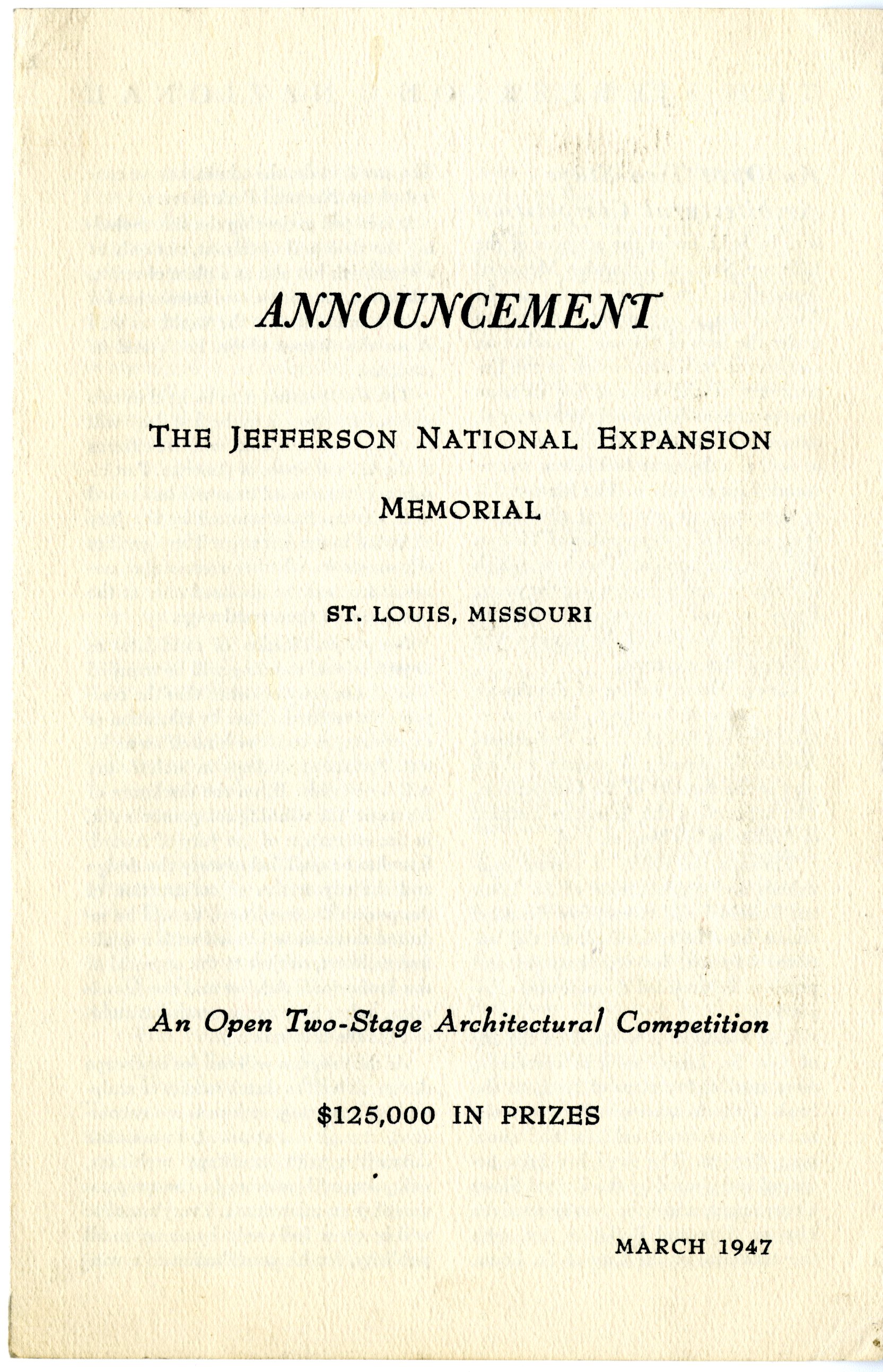
In March 1947, the Jefferson National Expansion Memorial Association announced an ‘Open Two-Stage Competition’ to design and execute a memorial located in St. Louis, Missouri. The first stage of the competition was open to all architects who were citizens of the United States and the second stage was limited to five competitors as selected by the jury in the first stage.
The competition brief was distributed to some 1,100 architects and students around the country. 172 entries were received by the September 1, 1947 deadline. Cranbrook Archives.
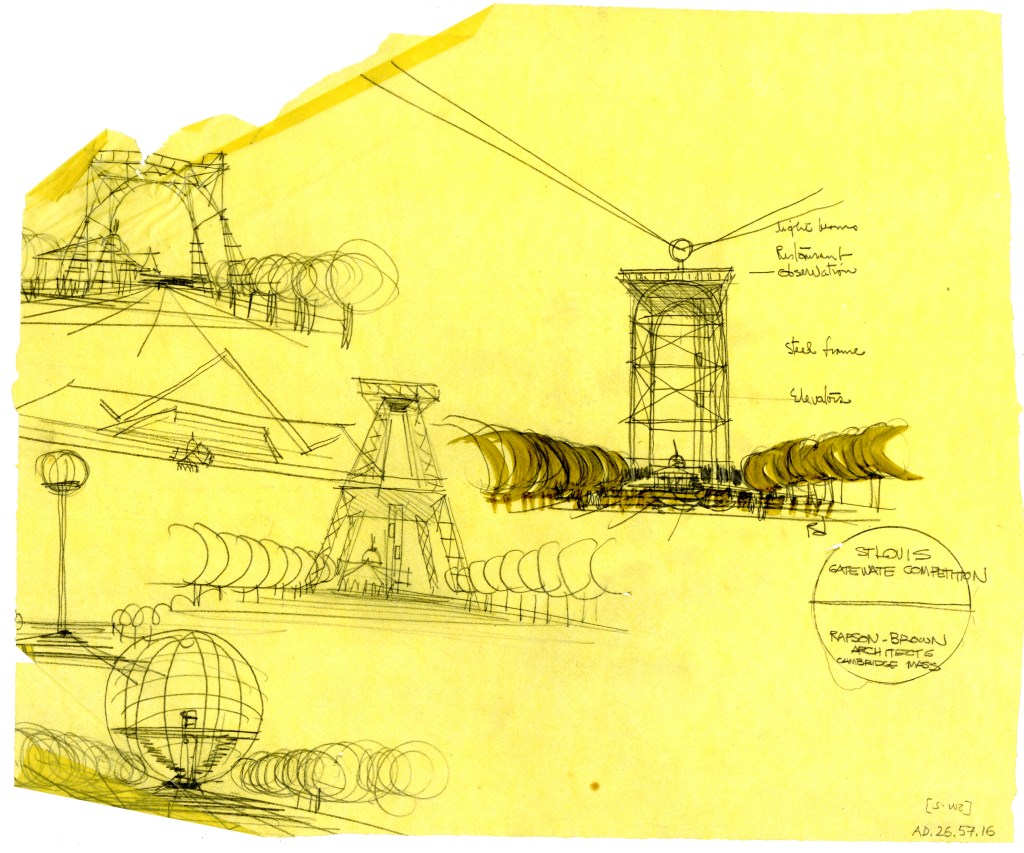
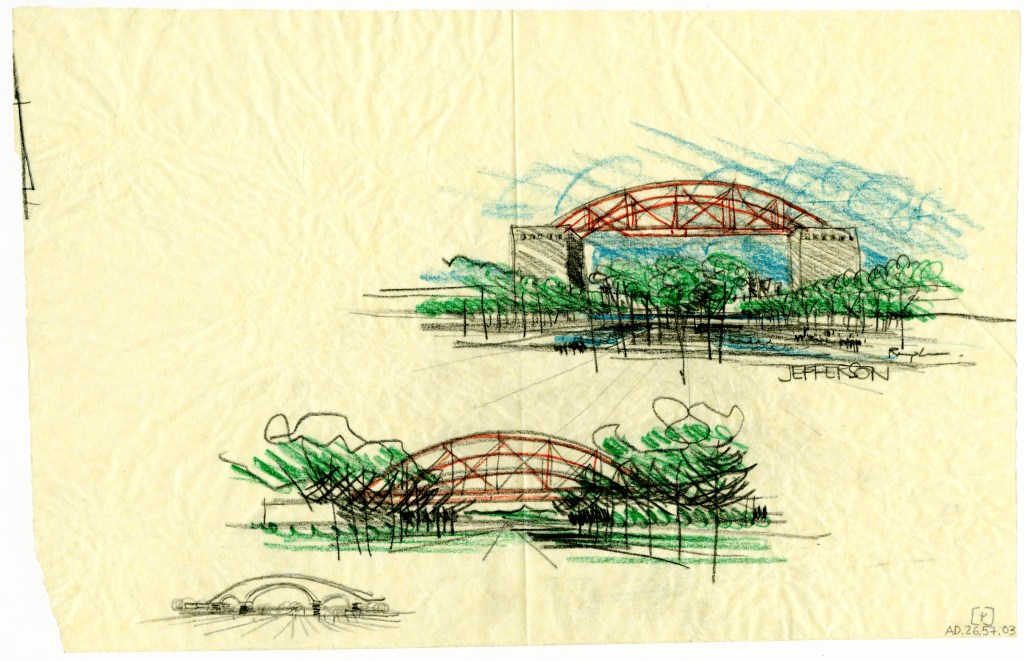
In the architectural drawing set for Rapson’s submission, there are nineteen conceptual studies. These have recently been digitized and added to the Ralph Rapson Projects in our Digital Collections online. Below is a selection of his studies that show the diversity and breadth of Rapson’s creative vision:
AD.26.57.016
AD.26.57.009
AD.26.57.020
AD.26.57.004
AD.26.57.001
AD.26.57.003
Rapson’s preliminary drawings for the Jefferson National Expansion Memorial Competition, 1948. Cranbrook Archives.
It is interesting to see Rapson work out his ideas in ink and colored pencil about what shape, materials, and structure might best serve as a memorial to Jefferson’s Louisiana Purchase and America’s westward expansion.
In addition to Rapson, Cranbrook alumni and faculty including Charles and Ray Eames, Harry Weese, Gyo Obata, and both Eliel and Eero Saarinen submitted designs. Of course, it was Eero’s monumental stainless steel arch that won the competition and remains an iconic landmark to this day.
There is much to see and learn from Rapson’s drawings for just this one project. As we hold sets of drawings for another 87 of his projects, stay tuned to the Kitchen Sink—there is so much more to see and say about Ralph Rapson.
—Laura MacNewman, Associate Archivist, Cranbrook Center for Collections and Research
Eds. Note: On Tuesday, October 27, 2020, Associate Curator Kevin Adkisson will deliver our next Uncovering Cranbrook virtual lecture. This month’s lecture, Eero Saarinen and Yale University: Education and Architecture, will examine the younger Saarinen’s time at Yale as both a student of architecture and designer of three important campus buildings. Tickets are available now for the 10:00am and 7:00pm EDT lectures.
But wait. Weren’t the schools opened in the 1920s and 1930s? If the Golden Anniversary milestone seems a little off to you, well, let me explain. 2020 does not mark the anniversary of the individual schools themselves—Brookside was established in 1922, Cranbrook School for Boys in 1927, and Kingswood School in 1931—but for the single entity, Cranbrook Schools.
Newly minted Cranbrook Schools students gather around a Dodge Charger, ca. 1972. Cranbrook Archives.
When the three schools were established by George and Ellen Booth, they were independent institutions loosely united by a shared estate and under the umbrella of the Cranbrook Foundation. But by and large, they were three distinct schools with three distinct heads, three distinct boards, and three distinct staffs.
In 1967, the Cranbrook Foundation centralized management of the three schools’ non-academic functions under the new Cranbrook Business Office. Each school head and the executive director of the Business Office met monthly to discuss mutual problems. New committees and professional staff began to work collaboratively between all three schools.
However, as reported in the Cranbrook Magazine (Summer 1970), this loose connection wasn’t much of an improvement from the old, independent model. There was a feeling that there was still too much redundancy, too little long-term financial planning, and too much untapped potential between Brookside, Cranbrook, and Kingswood.
In the twelve years before 1970, multiple solutions to what was, at its heart, an organizational problem had been put forward. Ultimately, the New York City-based management consultant firm of Heald, Hobson and Associates, Incorporated helped the Cranbrook Foundation develop the winning solution in late 1969: one Cranbrook Schools.
By the summer of 1970, the reorganization was complete. A single Board of Trustees replaced three separate boards and directors. The new board was responsible for the management of the properties and affairs, both academic and non-academic, of Brookside, Cranbrook, and Kingswood.
When students and staff returned in the fall of 1970, they were attending, for the first time, Cranbrook Schools. But very little of the student experience had changed. For instance, the upper school would not be made coeducational until 1985. Yet there was still worry about what this new “Cranbrook Schools” meant for the identity of three proud institutions.
The reorganization created the position of President of Cranbrook Schools. What was the president going to do? Who would fill this new, ambiguous but ambitious administrative role? Following a nationwide search by the new Board of Trustees, who narrowed down hundreds of applicants to thirty-two candidates, on July 1, 1971 Arthur H. Kiendl was installed as Cranbrook Schools President.
Arthur Kiendal, ca. 1970. Photographer: Benyas-Kaufman. Cranbrook Archives.
Art Kiendl (pronounced “Kendall”) came to Cranbrook Schools from the all-boys Mount Hermon School in Gill, Massachusetts, where, as headmaster, he coordinated its merger with the nearby girls school, Northfield. Prior to Mount Herman, Kiendl served as dean of students at the University of Colorado (1958-1963) and as an administrator and dean at Dartmouth College (1948-1958). He earned his bachelor’s degree from Dartmouth and a master’s in education administration from Columbia University.
On his installation, the heads and faculty of the new Cranbrook Schools gathered in the Cranbrook House Library. Kiendl told those gathered, “I think the whole concept is that the schools will merge in the sense of common purpose without loss of identity. They merge for strength and efficiency.” As he eloquently explained to his nervous audience,
I have lived through mergers, I know they are painful, I know they are traumatic, and I know that ultimately they are very exciting. We come together as a federation to be an exciting beacon, because such a beacon is needed, a beacon that believes in such things as humility, trust, honor, and humor for the freedom of the human spirit [. . .]
I hope I can leave you with a sense of rededication in the excitement that George and Ellen both brought to this place; the excitement that we can so trust each other that it can be said of us in the future, ‘they are not only people who dared and cared, but, you know, they loved each other.’
Interestingly, when Cranbrook Magazine reported on the union of the schools in 1970 it was careful to point out that “the reorganization program as evolved combines the strengths of three closely allied organizations. Yet it does not attempt to integrate dissimilar operations (the Institute of Science, Academy of Art, and Christ Church Cranbrook) into one large complex.” Those connections were still managed by the Foundation and the Business Office—until 1973, when, sans church, we became Cranbrook Educational Community. Kiendl was elected as the Community’s first president, a position he held until December 1978.
So, is it a little bit weedy to celebrate fifty years of Cranbrook Schools? Probably. Would it confuse our students and parents to launch a 50th birthday party now, when there’s already chatter about the 100th coming up? Maybe, but who doesn’t love an anniversary, even if it does take an asterisk and a seven-hundred-word blog post to explain!
—Kevin Adkisson, Associate Curator, Cranbrook Center for Collections and Research
Eds. Note: Speaking of 50th anniversaries! This Sunday, the Center is joining in a national celebration with Docomomo, a modernist architecture preservation organization, to mark “the ’70s turn 50.” Head to our website for tickets, and join us (via Zoom) at 4:00pm for a very groovy virtual tour of the Smith House and Bowlero lanes!
As performance venues prepare to reopen in Michigan today, I thought it timely to take a look at the storied history of a group that’s nearly as old as Cranbrook itself: St. Dunstan’s Theatre Guild of Cranbrook. With ties to Cranbrook’s founding family, staff, and the physical Cranbrook campus, combined with its enduring cultural role in the surrounding community, this nearly ninety-year-old institution has a rich history. Allow me to share with you a few fascinating details from its early years.
View of St. Dunstan’s Playhouse from Lone Pine Road looking east. Balthazar Korab, photographer. Copyright Korab and Cranbrook Archives.
“The worst thing about it, it’s named for a saint. But don’t think it’s holy, ‘cause it certainly ain’t.”
Sheldon Noble, an early and active Guild member
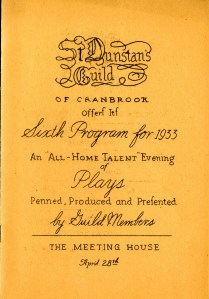
The Theatre Guild was indeed named after St. Dunstan, Archbishop of Canterbury in the ninth century and patron saint of the arts. As St. Dunstan lived in Kent, England, from where Cranbrook founder George Booth’s family hailed, the Guild’s name was fittingly suggested by his son and founding member, Henry Scripps Booth. Shortly after the Guild began in 1932, members were writing and producing their own one-act plays. In an April 1933 letter announcing an informal evening of a “Home Talent programme,” for the 100 Guild members and their guests, Jessie Winter, Guild Secretary and Brookside School Headmistress, implores them to “Be kind, be understanding, be generous . . . give the actors and authors the warm reception which such offerings warrant.” One such author was Henry Scripps Booth. Billed as Thistle, his play, Sedative Bed, was one of four being performed that April 28th evening at Brookside School for just $1. It was the tail end of the Great Depression, after all!
Front and back cover of the 1933 playbill. Courtesy of Cranbrook Archives, Cranbrook Center for Collections and Research.
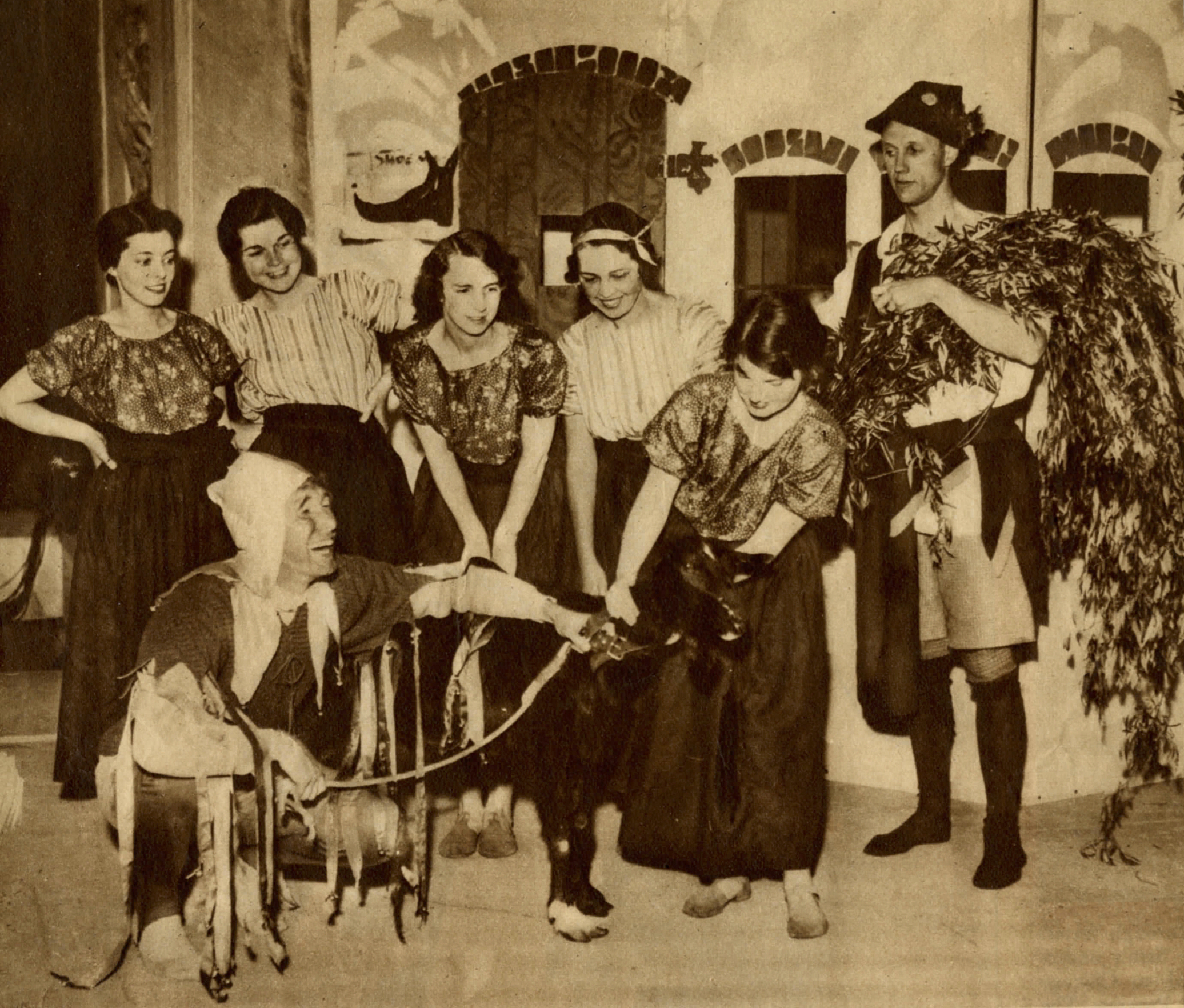
The first public performance of St. Dunstan’s Theatre Guild took place at the Greek Theatre with The King and the Commoner. Taking supporting roles were the likes of Annetta Wonnberger (Cranbrook Summer Theater School), Pipsan Saarinen Swanson (daughter of Cranbrook architect Eliel Saarinen), and Henry Scripps Booth, among others.
A scene from The King and the Commoner. Henry Booth on right. Detroit newspaper rotogravure clipping. Courtesy of Cranbrook Archives, Cranbrook Center for Collections and Research.
The cast and crew of the 1940 production of The Last of Mrs. Cheyney again reads like a who’s who of Cranbrook, including Harry Hoey (Cranbrook School Headmaster), Templin Licklider (Cranbrook School Faculty), Dorothy Sepeshy (wife of Cranbrook Academy of Art President, Zoltan Sepeshy), Rachel Raseman (wife of Richard Raseman, Cranbrook Academy of Art Executive Secretary and Vice President), the aforementioned Annetta Wonnberger, and various members of the Booth Family. Henry Scripps Booth, part of the Guild’s Scenic Design Committee, and his wife Carolyn, the production’s stage manager, created the sets.
As part of its efforts to maintain safe distancing during classes, Cranbrook Schools has spread out all over campus. This includes the use of the Edison House, former home of visiting scholars to Cranbrook Institute of Science.
The history of Edison House and a look at some of its unique features have been explored already (see earlier Kitchen Sink blogs Edison House a Modern Icon and Photo Friday: Modern inside and Out). But one particular object in the house has a special Cranbrook, and a magical, connection.
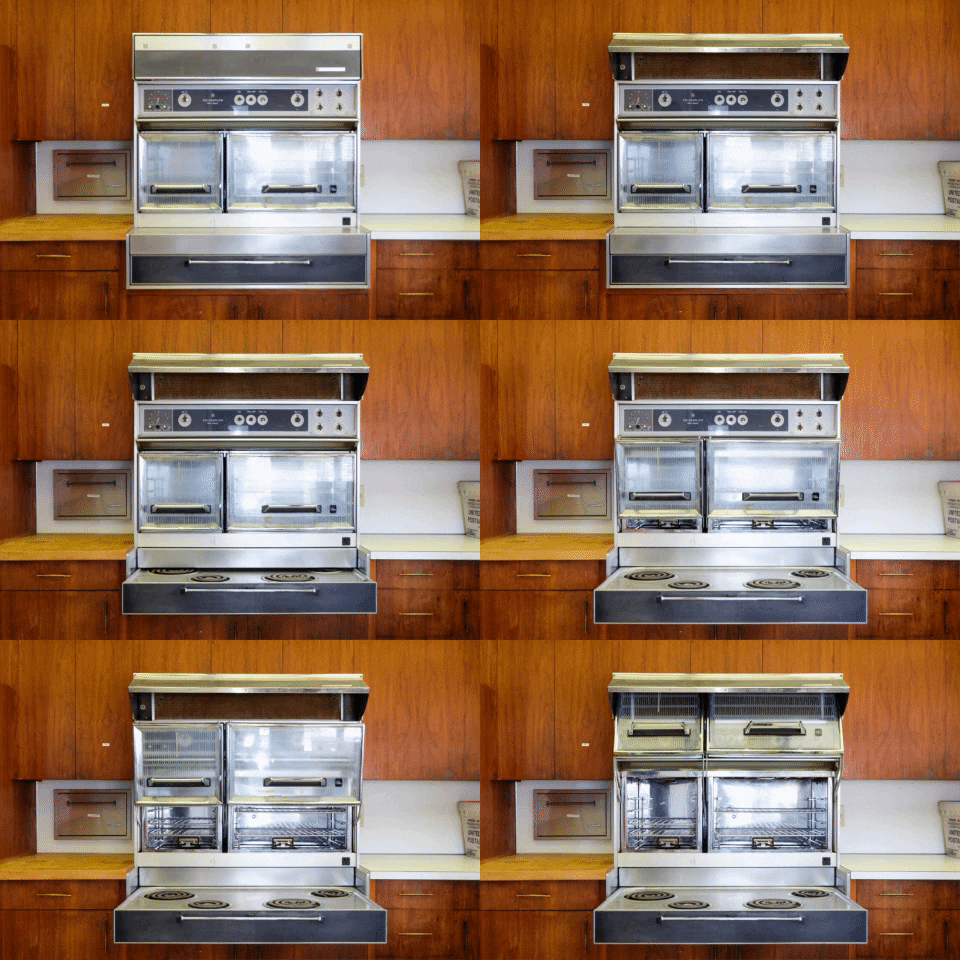
1965 Frigidaire Imperial Flair oven installed in Edison House. Photos by Daniel Smith, CAA ’22.
In the Edison House kitchen is installed a 1965 model Frigidaire Imperial Flair range and oven in Honey Beige. Frigidaire was owned by General Motors when the Flair was introduced to the market in 1962. An electric range, the Flair has burners that roll in and out much like a drawer, hidden from view when not in use. The double ovens sit right at counter height, and the oven doors lift up instead of swinging out. As a Frigidaire advisement in Cranbrook Archives proudly pronounced, “Flair has every automatic feature you’ve ever wanted!”
An image from “Ideas for Living,” 1960. Copyright General Motors. Courtesy Cranbrook Archives.
First, the Cranbrook connection: Many aspects of the oven, including the mechanics of the lifting oven doors, were designed by M. Jayne van Alstyne. Van Alstyne, whose papers are held in Cranbrook Archives, studied ceramics at Cranbrook Academy of Art in 1941 and 1942 before going on to study industrial design at Pratt Institute and Alfred University in New York. From 1955 to 1969, she worked for General Motors, first with GM Frigidaire and later as one of Harley Earl’s “Damsels of Design” in the automotive division.
As Studio Head for GM Frigidaire, she led the research and development of appliances and oversaw product exhibitions, including the “Ideas for Living” show where the Flair debuted in 1960. Her signature oven and range (as well as many other modern electric appliances detailed in the dedication booklet) was installed at Edison House in 1966.
Kitchen in Edison House, “Cranbrook’s New Idea Home,” May 1966. Harvey Croze, photographer. Copyright Cranbrook Archives.
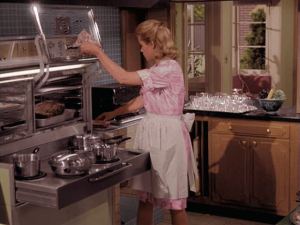
Second, the magical connection: From 1964 to 1972, Actress Elizabeth Montgomery starred in the television sitcom, Bewitched. It told the story of Samantha, a witch, who marries a mortal, Darrin Stephens (Dick York). Samantha agrees to live the life of an ordinary housewife. Of course, things don’t go as planned and hilarity ensues. In their kitchen, the Stephens had a Frigidaire Flair, which appeared in a number of episodes.
Actress Elizabeth Montgomery on the set of Bewitched with her Frigidaire Flair. Photo Courtesy of Grace Kelly, Kitchen Designs by Ken Kelly, Inc.
Anyone who sees the Flair in Edison House will agree it is a marvel of design. While they won’t be whipping up lunch on the appliance, I hope the kids taking classes in the house will take a moment appreciate it. As Frigidaire promised in 1962, the Flair is “The happiest thing that ever happened to cooking… OR YOU!”
– Leslie S. Mio, Associate Registrar, Cranbrook Center for Collections and Research
This is a story about a wonderful discovery and a trial of patience. A few years ago, I processed the F. Shirley Prouty Collection on Johannes Kirchmayer, which documents the life and work of her great uncle and contains many years of meticulous research. It was a wonderful collection to work with, and a trove of information on architects and craftsmen of the American gothic revival.
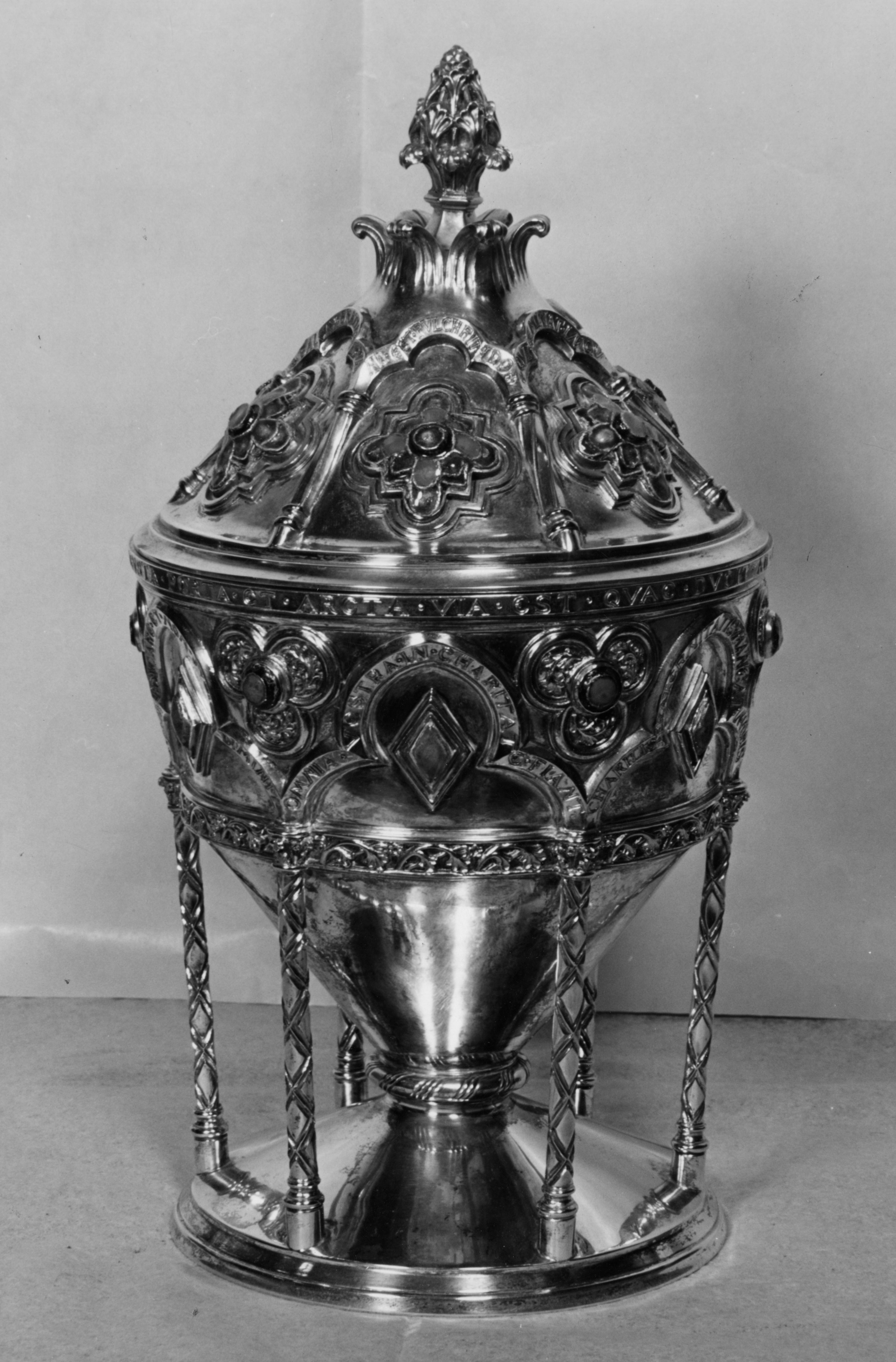
Two of the most outstanding of these are architect Ralph Adams Cram and woodcarver Johannes Kirchmayer, who worked together on many projects. This week I made a wonderful new discovery of another product of their hearts, minds, and hands: a silver and gilt portable font initially commissioned as a gift for the Detroit Museum of Art (now the Detroit Institute of Arts) by George Booth. Cram designed it and Kirchmayer created the sculpture models and chasings for it; then, the piece was executed by silversmithJames T. Woolley and decorated by enamellist Elizabeth Copeland.
Silver gilt font completed in 1920 for Detroit Museum of Art. Ralph Adams Cram, Johannes Kirchmayer, James T. Woolley, and Elizabeth Copeland. Cranbrook Archives.
In February 1918, Cram designed the font, which George Booth hoped to have ready for display at the General Convention of the Episcopal Church, to be held in Detroit for the first time in October of 1919.
The making of the font did not follow the anticipated timeline, but rather than a story of delay and disappointment, it becomes a story of patience and its reward.
During the spring, Booth visited Boston and left the Cram blueprint with Woolley. On May 1st, he enquired to know Woolley’s interest in executing the design and an estimate of cost, to which Woolley replied positively, quoting $450 excluding the enamel parts. Giving the commission to Woolley, Booth advised him to confer with Cram or his assistant, Mr. Cleveland, and that Copeland will complete the enameling work.














 Cranbrook Kitchen Sink