Eat, Greek, and Be Merry: the Greek Theatre Turns 100!

Drama and arts and crafts have been intertwined in Detroit history for more than 100 years. Under the auspices of the Detroit Society of Arts and Crafts (DSAC), on January 19th 1910, May Morris (daughter of William Morris) captivated a capacity crowd at the Detroit Museum of Art with her illustrated lecture “Pageantry and the Mask.” Morris’s presentation helped mark a turning point in propelling Detroit onto the national stage as an arts and crafts center. Almost immediately after May Morris left Detroit, Alexandrine McEwen, a bookplate artist and founding member of the DSAC, penned what was termed a “modern immorality play” called Everywoman with characters named “Suffrage” and “Art.” Less than a month later, she wrote The Masque of Arcadia, another outdoor play held on the grounds of Clairview, J.L. Hudson’s Grosse Pointe estate. These performances led to the DSAC being the first to foster a little theatre as part of their program.

By 1914, George Booth (the first president of the DSAC) already had plans in mind for a bathing pavilion and a theatre on the hill overlooking Cranbrook House. (My own suspicion is that he did not like the fact that the DSAC performances were not held on HIS estate!) In early 1915, Booth commissioned Canadian architect Marcus Burrowes to draw up the plans for an outdoor Greek Theatre. The open-air amphitheater, constructed of stone, seats nearly 300 people and was described in contemporary news articles as a “gem of architecture” and a “temple of art.” By May 1916, landscaping was underway and red tulips graced the front of the bathing pavilion.

Invitation Card, The Cranbrook Masque, June 1916. George Gough Booth Papers.

Invitation Card, The Cranbrook Masque, June 1916. George Gough Booth Papers.

Meanwhile, the DSAC was planning the production of The Cranbrook Masque which would also serve as the public dedication for the new Greek Theatre. The play showed the development of drama from ancient to modern times in five episodes, emulating May Morris’s lecture theme from 1910. For more on the play, see an earlier blog post.

Greek Theater masque, 1916

The Cranbrook Masque at the Greek Theatre, 1916. Hand-tinted glass slide.

Fast forward to 1991 and the 75th anniversary of the Greek Theatre. A team of dedicated Cranbrook staff, historians, and theater enthusiasts initiated the restoration of the Greek Theatre and a contemporary production, using the script from the original Masque, this time with cast members from St. Dunstan’s Guild and dancers from Jessie Sinclair’s Cranbrook Kingswood Dancers.

E465

Cranbrook House sunken garden (originally called the kitchen garden) with staked tomato plants, ca 1915.

This year marks the 100th anniversary of the Greek Theatre and a long-standing tradition of theater programs at Cranbrook. In honor of this memorable event, the Cranbrook Center for Collections and Research will be presenting “Edible Landscapes: A Midsummer Night’s Dinner.”

Leslie S. Edwards, Head Archivist
It’s a New Collection!

The Archives to Launch Our Poster Collection Online!

Over the coming summer, Cranbrook Archives will release a brand new collection into its online digital database! While building our digital archive is a perpetual process, we are working steadily to upload images and manuscripts so that you, our remote users, can browse and search through our collections no matter where you live. This summer we will be celebrating a new addition: the Cranbrook Poster Collection!

Over the past eight months, my colleague, Laura MacNewman, and I collaborated to upload this collection for online access. The posters date back to the early 1900s with topics covering the scope of the entire Cranbrook Educational Community, emphasizing exhibitions from the Academy of Art and the Institute of Science, and theatrical performances from Cranbrook Kingswood Schools, St. Dunstan’s Guild, and the Summer Theatre.

Cranbrook Institute of Science poster, n.d. Courtesy Cranbrook Archives.

Cranbrook Institute of Science poster, n.d. Courtesy Cranbrook Archives.

We created nineteen different series for the Poster Collection based on locations or departments on campus. We identified nearly 500 unique posters in our collection, and each one was given a distinct identifying number. Once the unique identifiers were established, we merged all the various poster inventories  into one master inventory spreadsheet, and arranged them in chronological order by series.

The next step was sorting through the physical posters folder by folder in order to take a reference photograph of each one for the database, record their dimensions, and describe them  in the master inventory spreadsheet. This was the longest stage of the process, lasting several weeks. After the data was entered into the spreadsheet, we renamed the individual images to match the posters’ unique identifiers in order to match the photograph.

Exhibition poster, 1973. Courtesy Cranbrook Archives.

Exhibition poster, 1973. Courtesy Cranbrook Archives.

While every step has been a learning process, my favorite part was working in Thornlea Studio and physically handling the poster collection for measurements and photographs. Laura and I were able to take a previously unorganized collection and make it discoverable online, which was rewarding and gave me a sense of accomplishment. I loved the huge diversity of the posters, too. Not only were they historically valuable, they were also aesthetically stunning. I can’t wait for the collection to be released for everyone to enjoy!

Danae Dracht, Archives Assistant

Editor’s Note: Thank you Danae and Laura for your hard work on this project! Congratulations also to Danae who recently graduated from Wayne State University’s School of Library Science! We wish you all the best as you embark on the next journey of your archival career.

Photo Friday: Teacher Appreciation Week

We appreciate all of our teachers at Cranbrook!

Cranbrook School Faculty, "Formal Portrait", May 1953.

Cranbrook School Faculty, “Formal Portrait,” May 1953. Courtesy Cranbrook Archives.

Back row (l-r): John House, Hubert Davis, Rev. Walter Young, Arthur Palmer, Floyd Bunt, Wayne Lawrence. Kneeling (l-r): James Rollier, Carl Wonnberger, James Kelly, Robert Kenny, Carleton McClain, Ben Snyder

Photo Friday: Archival Preservation

Since it is Preservation Week, today’s Photo Friday features an image from one of the collections we have been working to stabilize. For the past few weeks my colleague, Belinda Krencicki, and I have photographed and captured metadata for the watercolor paintings, pen and pencil drawings, and pastels in the James Scripps Booth and John McLaughlin Booth Papers. This information will be used to catalog the items in our Collections Management system. In addition to documenting the works, we re-housed all of the items–placing them in archival folders and interleaving each work to protect it.

Pencil and pastel sketch of the exterior of the Detroit News building, James Scripps Booth, 1917.

Pencil and pastel sketch of the exterior of the Detroit News building, James Scripps Booth, 1917.

The artwork ranges from pastel landscapes, to portrait studies, to automobile racing. The image above is one of my favorites – a sketch of the Detroit News building. I hope you enjoy it too!

Gina Tecos, Archivist

New Center Logo & A Fond Farewell

The Cranbrook Center for Collections and Research has officially launched our new logo! What follows is a description of where each of the letters comes from in the history of Cranbrook or the location on the campus!

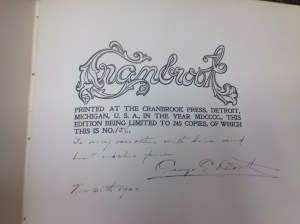
The (first) C in Cranbrook is from the logo George Gough Booth created for the Cranbrook Press in 1901, three years before he and his wife Ellen established their estate in Bloomfield Hills.

IMG_0361

The Cranbrook Press (1900-1902) was founded by George Booth in the attic of the Detroit Evening News Building.  Booth emulated the work of William Morris and his Kelmscott Press, not just in design but also in the level of hand-craftsmanship.

Continue reading

Tapestries – The Fabric of Society

As part of a module assignment for my MA in Archives Administration with Aberystwyth University (Wales), I have been researching a selection of tapestries that George Gough Booth purchased and commissioned from Morris & Co., Herter Looms, and Edgewater Tapestry Looms. I chose the theme of tapestry and time, inspired by Francis Thomson’s idea of tapestry as “mirror of history”. I was particularly interested in the Morris & Co. case study because I much admire William Morris as an artist and social reformer. Although the Morris & Co. tapestries that George Booth purchased were made after Morris’ death in 1896, they were made under the supervision of his former student, J.H. Dearle, who became Art Director in 1905.

Continue reading

Photo Friday: Diogenes’ Search for an Honest Man

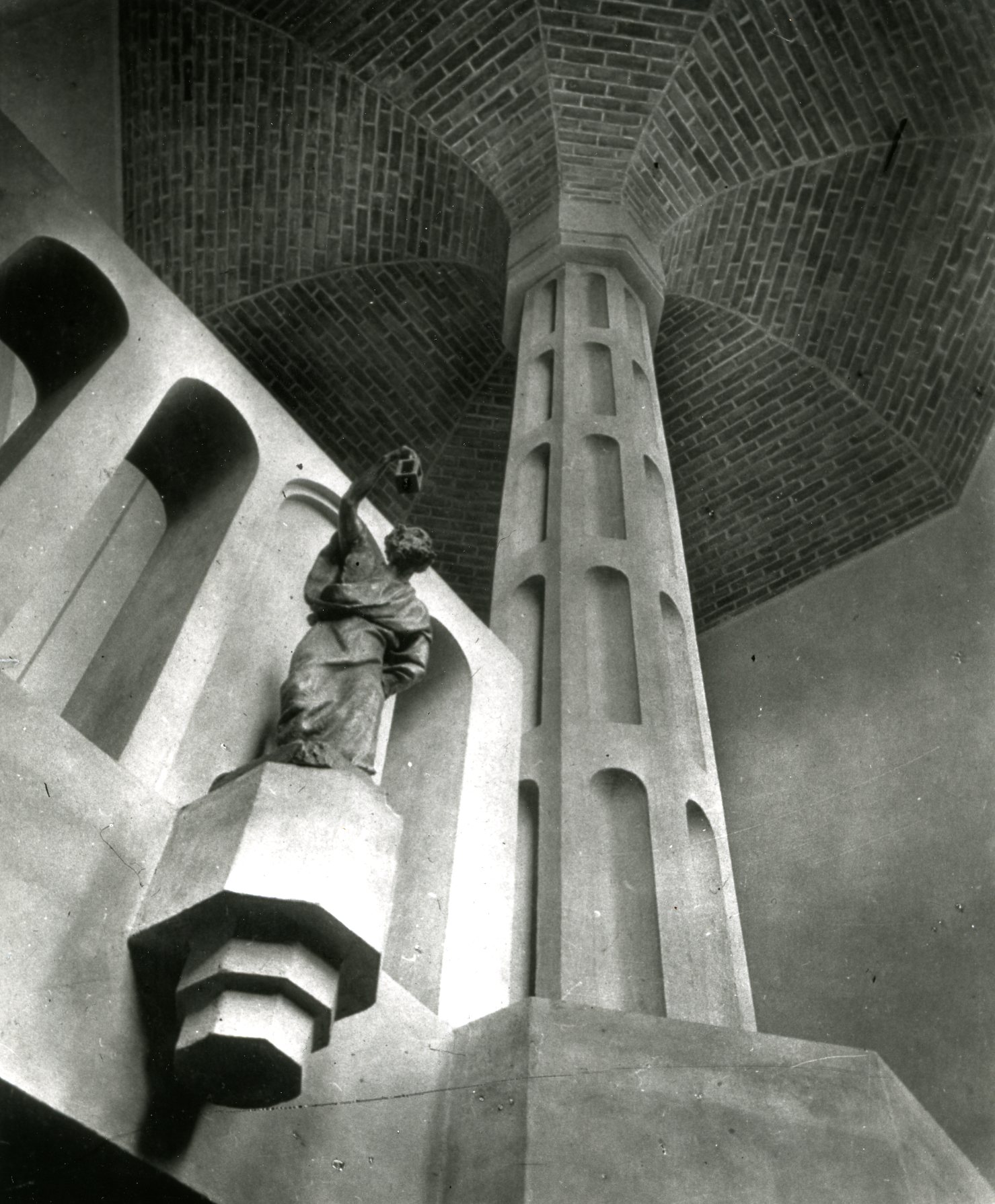
A view of Diogenes. Photographer, Harvey Croze, 1961.

A view of Diogenes. Photographer, Harvey Croze, 1961.

You might not immediately notice the small bronze statue that sits at the top of Hoey Tower’s stairwell at Cranbrook School. The statue is Diogenes – a Greek philosopher best known for holding a lantern and claiming to be on a quest for an honest man. Diogenes is considered to be one of the founders of Cynicism – a doctrine that supports a life in accordance with nature and rejects convention.

George Booth originally purchased Diogenes for Cranbrook House from the Gorham Silver Company in May 1914. One of the many statues he purchased during his lifetime, he bequeathed it to Cranbrook School upon his death.

Diogenes has been depicted throughout the centuries in paintings, drawings, and sculpture. Our sculpture was created by George Edwin Bissell (1839-1920) in 1906. Bissell, who was born in Connecticut, studied in Paris at the Academie Julian, the Academie Colarossi, the Ecole des Arts Decoratifs, and the Ecole des Beaux Arts. In 1876, he studied at the American Academy in Rome. He also served in the Civil War as a private in the 23rd Connecticut (1862-1863) and as assistant Postmaster for the U.S. Navy (1863, 1865).

Gina Tecos, Archivist

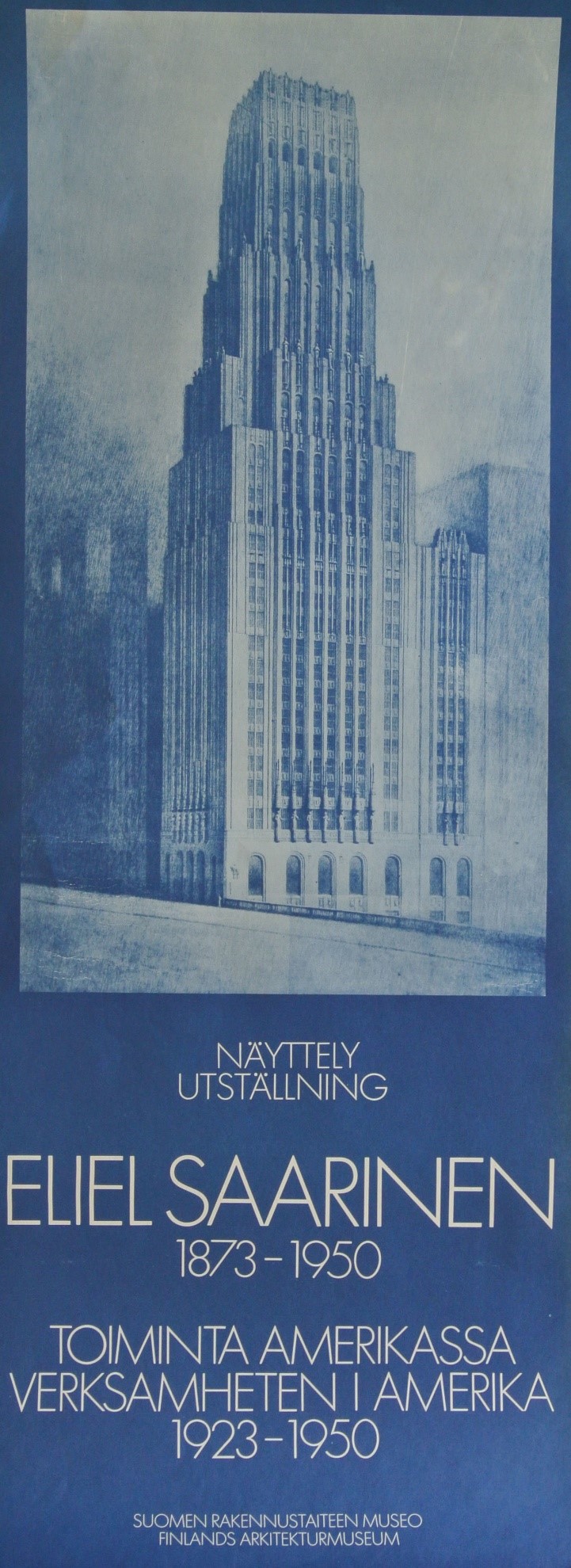
Photo Friday: “Things Architectural”

In November 1932, Cranbrook Academy of Art’s Executive Secretary, Richard Raseman, invited architects from the Detroit area to come to Cranbrook for “dinner and discussion of things Architectural.” The following Cranbrook School news article describes the evening.


Architectural

“Architects Gather Here for Forum,” The Crane, 20 Dec 1932

In addition to Raseman, Eliel Saarinen, Albert Kahn, and Emil Lorch, attendees included former Kahn associate Ernest Wilby and Ralph Hammett.

Leslie S. Edwards, Head Archivist


Photo Friday: Underlying Principles of Beauty

St. Paul Chapel reredos. Courtesy Cranbrook Archives.

St. Paul Chapel reredos. Courtesy Cranbrook Archives.

In a letter to George G. Booth ca 1931, Detroit News Art Critic Florence Davies, writes of artist Hildreth Meiere, “All over the place she discovered these refinements of line, these essential underlying principles of beauty. I have taken many people to Cranbrook, never anyone who saw it with so much understanding.”

Meiere (1892-1961) was a distinguished Art Deco muralist, painter, and decorative artist. Her commissions range from the medallions on the exterior of Radio City Music Hall to the dome in the National Academy of Sciences in Washington D.C. to the reredos panels in St. Paul’s Chapel in Christ Church Cranbrook. Educated at Manhattanville, the Art Students League, the California School of Fine Arts, the School of the Art Institute of Chicago, and in Florence, Italy, Meiere was a renowned muralist, as well as an important figure in the history of American Liturgical Art, and a preeminent mosaicist.

“It drives me wild to be spoken of as ‘one of the best women artists,” Meiere wrote to a friend in 1936, “I’ve worked as an equal with men and my rating as an equal is all that I value.” In 1956, she was the first woman honored with The Fine Arts Medal of the American Institute of Architects. Although it has taken years for her work to be discovered and viewed in its rich cultural context, we are grateful for her artistry here at Cranbrook.

Note: You can view more information and images of Hildreth Meiere’s work here.

Gina Tecos, Archivist

“A ship is safe in harbor, but that’s not what ships are built for.” — John A. Shedd

Marthe Le Loupp, 1930. Courtesy Cranbrook Archives.

Marthe Le Loupp, 1930. Courtesy Cranbrook Archives.

As the newest Cranbrook archivist it is my privilege to support our researcher’s investigations into the Cranbrook archival collections. On any given day we might review school yearbooks, catalog historic photographs, or learn about one of Cranbrook’s earliest scandals. After only two weeks, my husband has taken to assigning all credit for my cheerful and inquisitive demeanor to the adventuresome interactions I engage in at the archive. “You’re welcome!” is often my knee-jerk response.

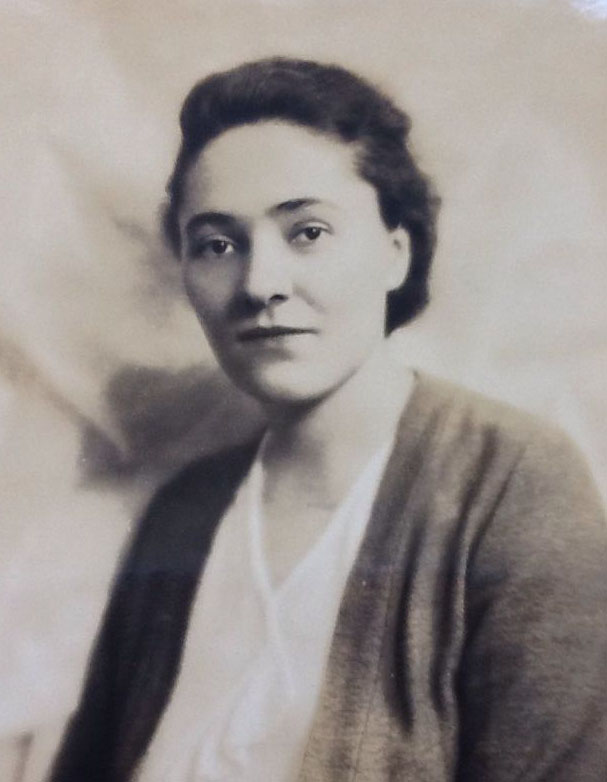
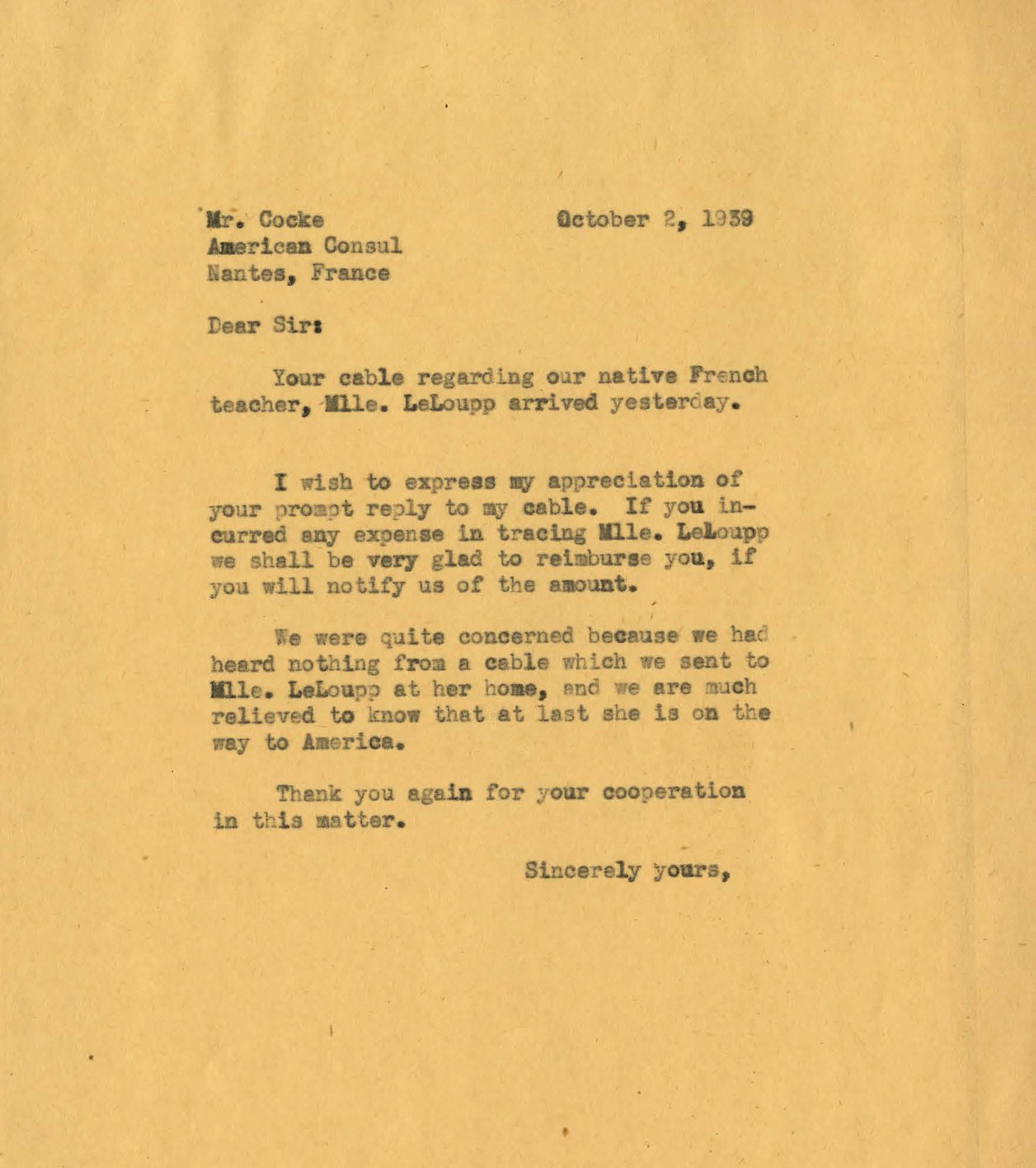
Paths are a funny sort of thing—laid out to direct us, guide us, and ensure we don’t run astray. Life’s paths (kind of like research in an archives) often lead us to places we never imagined. This was the scenario in which Mademoiselle Marthe Le Loupp (1898-1987) found herself when she embarked on her return to Cranbrook from her annual trip back home (Plogoff, France) in 1939.

Marthe Le Loupp taught French language at Kingswood School Cranbrook from 1930-1956. As one of the original seven faculty members (classes were actually taught the first year in Brookside School), Le Loupp came to Cranbrook after completing three quarters of graduate study in French at the University of Chicago. A stern but well-liked teacher, Le Loupp led many Kingswood girls to excellence awards from the Michigan Chapter of the American Association of Teachers of French.

Le Loupp remained close with her family while living abroad and returned to France every summer. In 1939, Le Loupp’s return vessel, the SS Normandie, was reassigned under the WWII war effort and she was unable to return to Cranbrook for the start of the fall semester. Ultimately, she was able to secure passage via alternative methods.

Correspondence from Kingswood School to the American Consul, 1939. Courtesy Cranbrook Archives.

Correspondence from Kingswood School to the American Consul, 1939. Courtesy Cranbrook Archives.

When people think about WWII they don’t usually think about a French schoolteacher in Bloomfield Hills, Michigan, but in reality, maybe we all should think about the effects that war has on common folk. Our daily lives may seem unaffected, but this is not the truth now, as it was not the truth for Mlle Le Loupp and countless other teachers and staff at Cranbrook.

Le Loupp retired from Cranbrook in 1956 due to poor health. She lived the remainder of her years in Bénode, Finistère, France until her passing in 1987.

The opportunity to rediscover countless histories, such as this, is among the many honors of working in the archive here at Cranbrook. An honor I look forward to sharing with students and scholars in my daily work.

Belinda Krencicki, Associate Archivist

Create a website or blog at WordPress.com