A World of Opportunity: Ellen Scripps Booth Memorial Scholarships

In preparation for the Center’s upcoming seminar, featuring research on weaver Nelly Sethna, I became curious about an Academy of Art scholarship established in honor of Cranbrook founder, Ellen Scripps Booth.

Sethna had been a recipient of this financial award, which had allowed her to study abroad (Sethna was a citizen of India) at Cranbrook for one year, 1958-1959. Though it was Sethna’s artistic ability, not financial need, that earned her the award, she would never have made it to Cranbrook without this assistance, as indicated in letters to Weaving Department Head, Marianne Strengell.

Nelly H. Sethna, circa 1958. Courtesy of Cranbrook Archives.

Sethna’s subsequent successful career in textile design demonstrated the value of providing assistance for artists to attend the Academy. I wondered how many other similar stories there were in the Archives. I did not need to look past the first decade of memorial scholarship awardees to find plenty.

While the scholarship was granted to deserving artists in metalsmithing, painting, ceramics, and weaving in the ten years between 1951-1961, it was two fellow weavers of Sethna’s that caught my eye. They, too, had proven themselves worthy of distinction through their artistic accomplishments, but they, too, had financial needs that would have prohibited their attending the Academy otherwise.

Dixie Roto Magazine article featuring Katherine Choy, Sept. 14, 1952. Copyright The Times-Picayune, New Orleans States. Courtesy of Cranbrook Archives.

The first recipient of the scholarship was Katherine P. Choy, a Chinese expatriate and graduate of Mills College in Oakland, California. Choy came to Cranbrook in 1951 to study ceramics for one year as a non-degree student. She would spend near equal time in both the ceramics and weaving departments, under the dual tutelage of Maija Grotell and Marianne Strengell.

Upon leaving Cranbrook, she would enjoy success in both fields, first heading up the legendary Newcomb College Ceramics Department at Tulane University and later joining the design team at Isabel Scott Fabrics in New York. With fellow artist Henry Okamoto, Choy also founded The Clay Art Center in Port Chester, New York, which still exists today. Choy’s ceramics can be found in the collections of the Cooper-Hewitt Smithsonian Design Museum, the Museum of Arts and Design in New York, as well as the New Orleans Museum of Art.

Tsuneko Yokota, circa 1955. Courtesy of Cranbrook Archives.

Another scholarship winner, and weaver, in the first decade of the award was Tsuneko Yokota (Fujimoto), for the academic year 1957-1958. A graduate of the Design Department at Tama College of Fine Arts in Tokyo, Yokota distinguished herself in fabric dying, winning several awards and a scholarship for an additional year at Tama as an honor graduate. At the suggestion of one of her instructors, and with a recommendation from Marianne Strengell, who knew her instructor, Yokota came to Cranbrook to further her studies in weaving and textile design. Unlike Sethna and Choy, though, Yokota stayed an additional year at the Academy and earned her MFA in Weaving.

By all accounts, Yokota lived up to Strengell’s confidence that she, “will most certainly have ample chance and desire to spread our particular brand of education and design in Japan,” working with celebrated modernist interior designers like Isamu Kenmochi.

Cranbrook Academy of Art scholarship announcement, 1960. Courtesy of Cranbrook Archives.

The Ellen Scripps Booth Memorial Scholarship was established in 1951 along with the George Gough Booth and Eliel Saarinen Memorial Scholarships by the Academy of Art Board of Trustees. Academy faculty, under the leadership of Director Zoltan Sepeshy, recommended these scholarships be granted based on unusual merit of work submitted rather than financial need. Academy administrative documents indicate that the Ellen Scripps Booth Scholarship Fund had wide support from not only Academy faculty and staff, but also many at the Foundation, Press, Central Committee, and House. Scholarship award amounts varied somewhat from year to year, (in 1953 they were evenly split between two awardees), but the scholarship continued to be granted until at least 1965. While these named scholarships are no longer awarded (and I was unable to deduce exactly why or when they stopped), scholarships and financial aid for talented students are still vital to the success of the Academy and its artists.

—Deborah Rice, Head Archivist, Cranbrook Center for Collections and Research

Editor’s Notes: On Tuesday, June 22 the Center broadcasts live from Cranbrook and India for scholar Vishal Khandelwal’s examination, using materials from Cranbrook Archives, of a fascinating connection between mid-century textile design in the United States and India, as seen through the work of Nelly Sethna. Register here for this illuminating virtual event. 

Along with Nelly Sethna (1958-59), find early scholarship winners, such as Paul R. Evans (1952-53) and Howard William Kottler (1956-57) featured in Cranbrook Art Musuem’s new exhibit and companion publication, With Eyes Opened. Find details and purchase advance tickets to the exhibit on the Museum’s website.

Read a recent exciting announcement about new scholarship and financial opportunities for students on the Academy’s website.

She Walks in Beauty: The Life and Work of Helen Plumb

Helen Plumb, co-founder of the Detroit Society of Arts and Crafts (DSAC) and its secretary from 1906 to 1928, was dedicated to the arts and crafts ideal of public service—encouraging an appreciation for beauty in everyday life and in the community. Surprisingly little is known of Plumb, but some evidence can be found in a few of the Archives’ collections.

During her tenure as DSAC secretary, Plumb saw the society through three distinct phases, each coinciding with a different physical location. The School of Design was established during the society’s first five years, when it was based at the Knowlson Building on Farmer Street (1906-1911). For the next five years, they were based at Witherell Street, during which time the society encouraged the production of theatrical masques, including the Masque of Arcadia, written by Alexandrine McEwen, and the Cranbrook Masque in 1916. The society moved to its third and final location at 47 Watson Street in October 1916. From then until 1922, they created the Little Theatre and expanded into Folk Handicraft and Lamp Departments. Once flourishing, by 1922 these programs were fading, causing Plumb to perceive a new era for the society and her future role in it.

Helen Plumb, secretary of the Detroit Society of Arts and Crafts (1906-1928). Courtesy of Cranbrook Archives.

In a letter to George Booth in 1922, Plumb alludes to a choice between two paths: either “to go forward in a much larger, showier way, or to move into a closer, more restricted field,” which she felt would entail abandoning DSAC’s public and civic work. In this letter, she makes it very clear that if the second route were chosen, she would have no part in it. Her vision for the society’s future was to nurture more international connections, following the success of the Exhibition of British Arts and Crafts Assembled by the Detroit Society of Arts and Crafts in 1920.

A miniature portrait of Helen Plumb of the Society of Arts & Crafts, Detroit, on ivory, by Alexandrine McEwen (1876 – 1955), in same outfit as above. Cultural Properties Collection, Founders Collection.

Plumb’s correspondence with Booth was always very professional and business-focused with a modest sprinkling of personal comment. Then, in October of 1924, she writes candidly, “I have not many friends in all that word means, and still fewer confidants. It so happens that you are one of those two or three who shares my deepest one.” Plumb is variously described as a tireless worker, but here she shares how much she has struggled with chronic health problems and that her vitality has diminished such that it has, “become a life and death struggle” for her to keep going at all. There is a chance that she will finally be well, but she is unable to negotiate a path to it with the society’s board and she is no longer able to endure as is. It is in this impasse that she turns to Booth to advise the best course.

Letter from Helen Plumb to George G. Booth, October 16, 1924. Courtesy of Cranbrook Archives.
Continue reading

Where in the World is Academy Graduation?

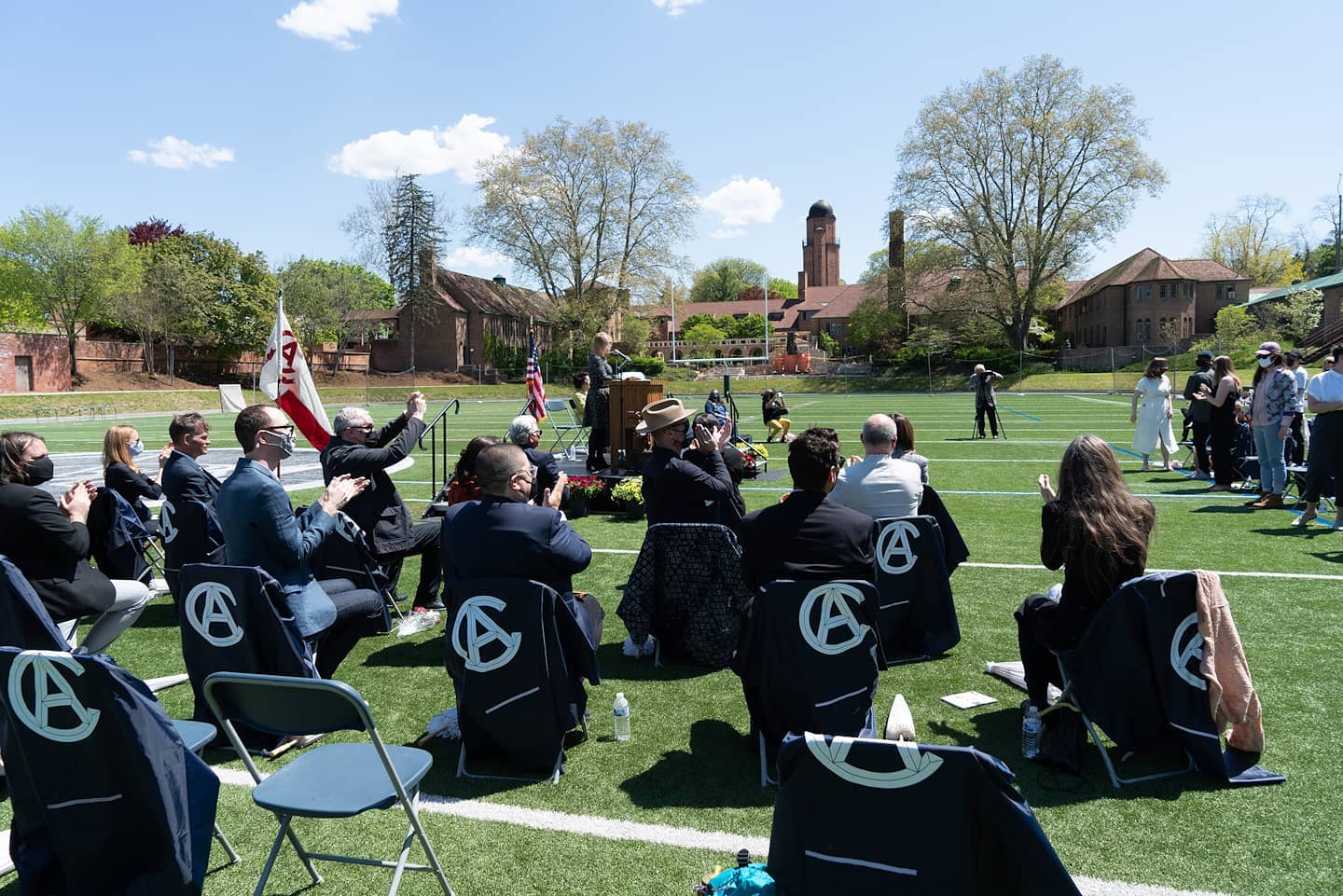
Today was a very exciting day at Cranbrook, with the Academy of Art Commencement taking place underneath a bright blue sky at Thompson Oval. Sixty-four students (now alumni!) were awarded their degrees. Artis Lane received an Honorary Master of Fine Arts and delivered an inspiring speech (on her 94th birthday, no less!), while Allie McGhee delivered a wonderful commencement address.

Susan Ewing, Director, speaking at the Cranbrook Academy of Art Class of 2021 Commencement, May 14, 2021 on the Thompson Oval at Cranbrook School. Photograph by Katie McGowan, CAA Photography ’22, Courtesy Cranbrook Academy of Art.

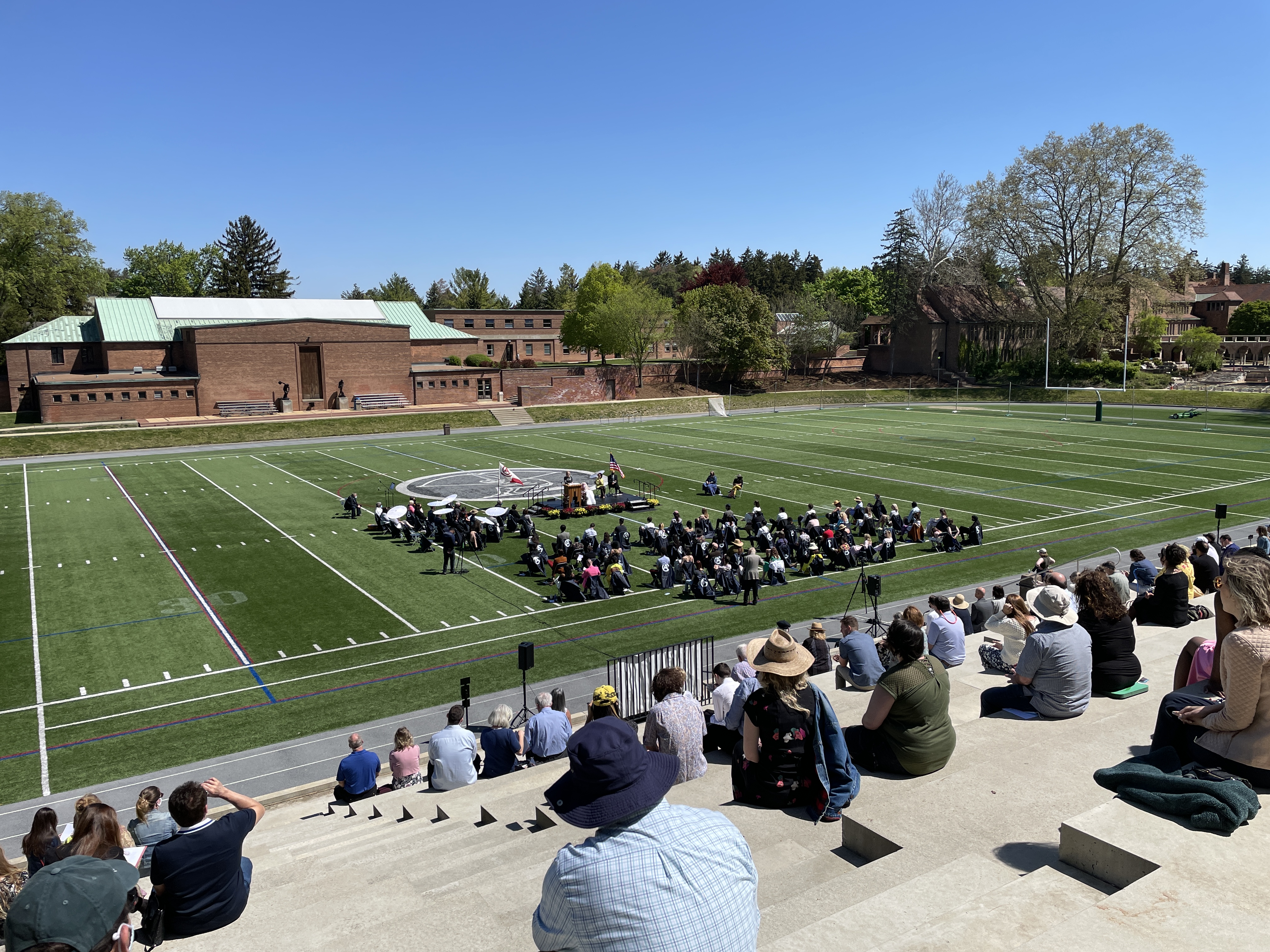
But as I sat in the newly restored bleachers of the Cranbrook School football stadium, I wondered: was this the first time the Academy’s commencement took place here, at the Thompson Oval?

A quick search in Archives revealed that, yes, it seemed to be. However, the same search revealed that graduation has taken place all around campus over the years.

The Academy dates back to 1932, but it first granted degrees in 1942. This was the same time Cranbrook Art Museum and Library opened. Early commencements took place in the Museum galleries, and, at least in the earliest years, the faculty and staff wore academic regalia.

Eliel Saarinen, President, confers degrees during the Cranbrook Academy of Art Class of 1943 Commencement, May 1943 at Cranbrook Art Museum. Courtesy Cranbrook Archives.

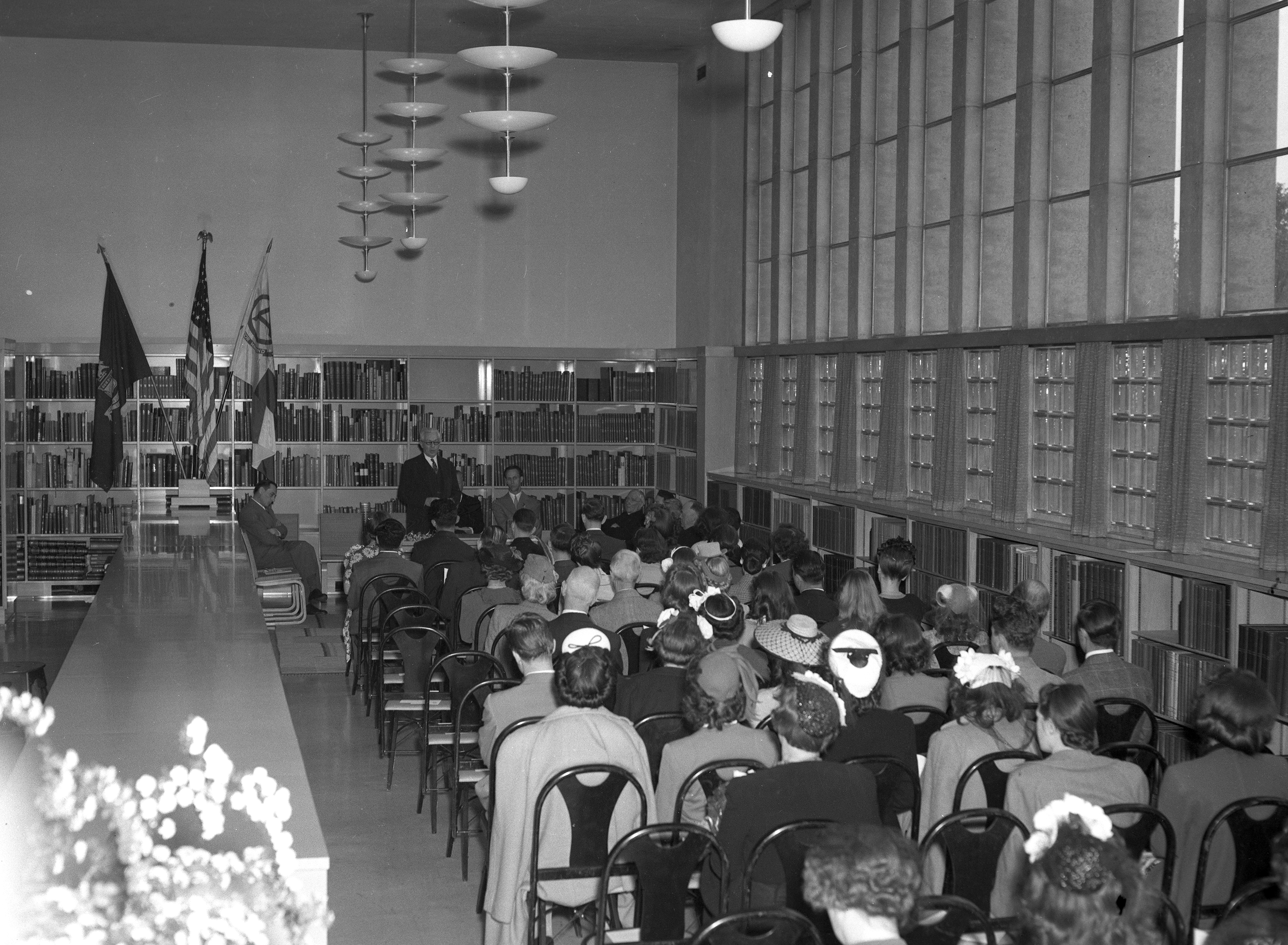
Other early commencement ceremonies took place in the Academy’s Library next door. The reading room tables and chairs were replaced with rows of seating for students and guests. By 1945, it appears academic regalia had been abandoned.

A rather sleepy Zoltan Sepeshy, Director, at Cranbrook Academy of Art Class of 1945 Commencement, May 26, 1945 in Cranbrook Academy of Art Library. Courtesy Cranbrook Archives.

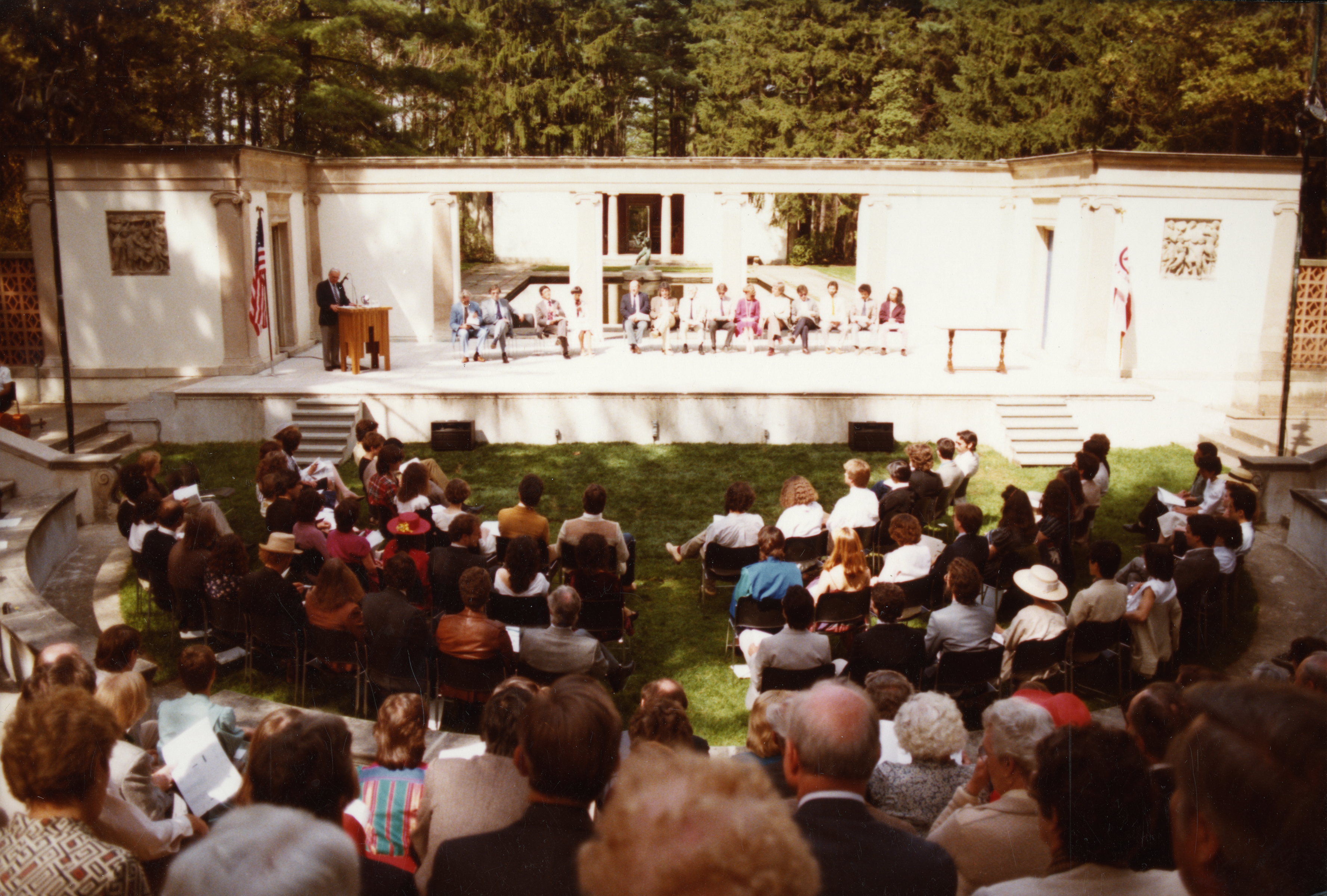
By midcentury, as the student body expanded, commencement moved to the Greek Theatre. This remained the location for many decades, and likely where commencement will return in a post-pandemic future.

Roy Slade, President, presides over a Cranbrook Academy of Art Commencement in the early 1990s at the Greek Theatre. Courtesy Cranbrook Archives.

And of course, what do you need if you’re planning an outdoor event in May in Michigan? A rain plan! Christ Church Cranbrook serves as the inclement weather site of commencement, as seen here in 2015.

Cranbrook Academy of Art Class of 2015 Commencement, May 8, 2015 at Christ Church Cranbrook. Photograph by Chris Schneider, Courtesy Cranbrook Academy of Art.

Fast forward to 2020, where commencement existed only in the virtual sphere: on Zoom. Not quite an architecturally interesting locale!

Susan Ewing, Director, presides over the Cranbrook Academy of Art Class of 2020 Commencement, May 8, 2020, on Zoom. Available here.

And then, today, commencement moved to the football field. It was a sunny day with perfect weather and high spirits as the community gathered, safely and in person, to celebrate the achievements of the Academy students.

Cranbrook Academy of Art Class of 2021 Commencement, May 14, 2021 on the Thompson Oval at Cranbrook School. Photograph by Kevin Adkisson.

Now, scroll back up and notice one thing that stayed the same across the years: the Academy Flag! It was behind President Eliel Saarinen in 1943, and behind Director Susan Ewing today.

Today’s ceremony will be uploaded to the Academy’s Vimeo page soon. Meanwhile, there are still a few days left to see the Class of 2021 Graduate Degree Exhibition at Cranbrook Art Museum, which closes on Sunday, May 16, and you can also see the (coronavirus delayed) Class of 2020 Graduate Degree Exhibition at Wasserman Projects in Detroit through June 19, 2021.

Congratulations from the Center to the Cranbrook Academy of Art Class of 2021!

Kevin Adkisson, Associate Curator, Cranbrook Center for Collections and Research

Carl Milles Gems from the Cutting Room Floor

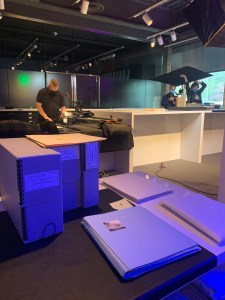
Cameras started rolling Monday for the Center’s new film celebrating Swedish American sculptor Carl Milles, premiering May 22nd at A Global House Party at Cranbrook and Millesgården. Centering on materials in the Archives, the day’s shoot featured handwritten correspondence, photographs, sketches, scrapbooks, and oral history recordings that help illuminate the story of the man behind the many iconic sculptures dotting Cranbrook’s campus.

The film production crew captures closeups of materials featured in the film.

In preparation for the day, I mined several collections in the Archives that document Milles’ twenty years as artist-in-residence at Cranbrook and his work in America during that time. In the process, I made a few delightful discoveries. While most of these treasures were expertly captured by the film production crew (Elkhorn Entertainment), there were a few that just could not be accommodated in Associate Curator Kevin Adkisson’s masterful, but already dense script.

One of these items is a notebook from the Nancy Leitch Papers. A student of Milles’ in the early 1940s, Leitch, like many of Milles’ students, became friends with both him and his wife Olga while at Cranbrook. The brief diary-like entries in Leitch’s pocket-sized book date from 1945, and are an intimate glimpse of daily activities, remembrances, and artist philosophies recounted from shared experiences and conversations with Carl and Olga. A loose paper tucked inside and titled “Carl” is a bonus, containing hasty notes recording his birthday, recommendations of where to visit in Italy (Café Greco in Rome, the cathedral in Orvieto), and words of wisdom, such as, “It is better to be an artist even though you are poor.”

Part of an entry made by Nancy Leitch in her notebook. Courtesy of Cranbrook Archives.
Continue reading

Photo Friday: A Working Honeymoon?!

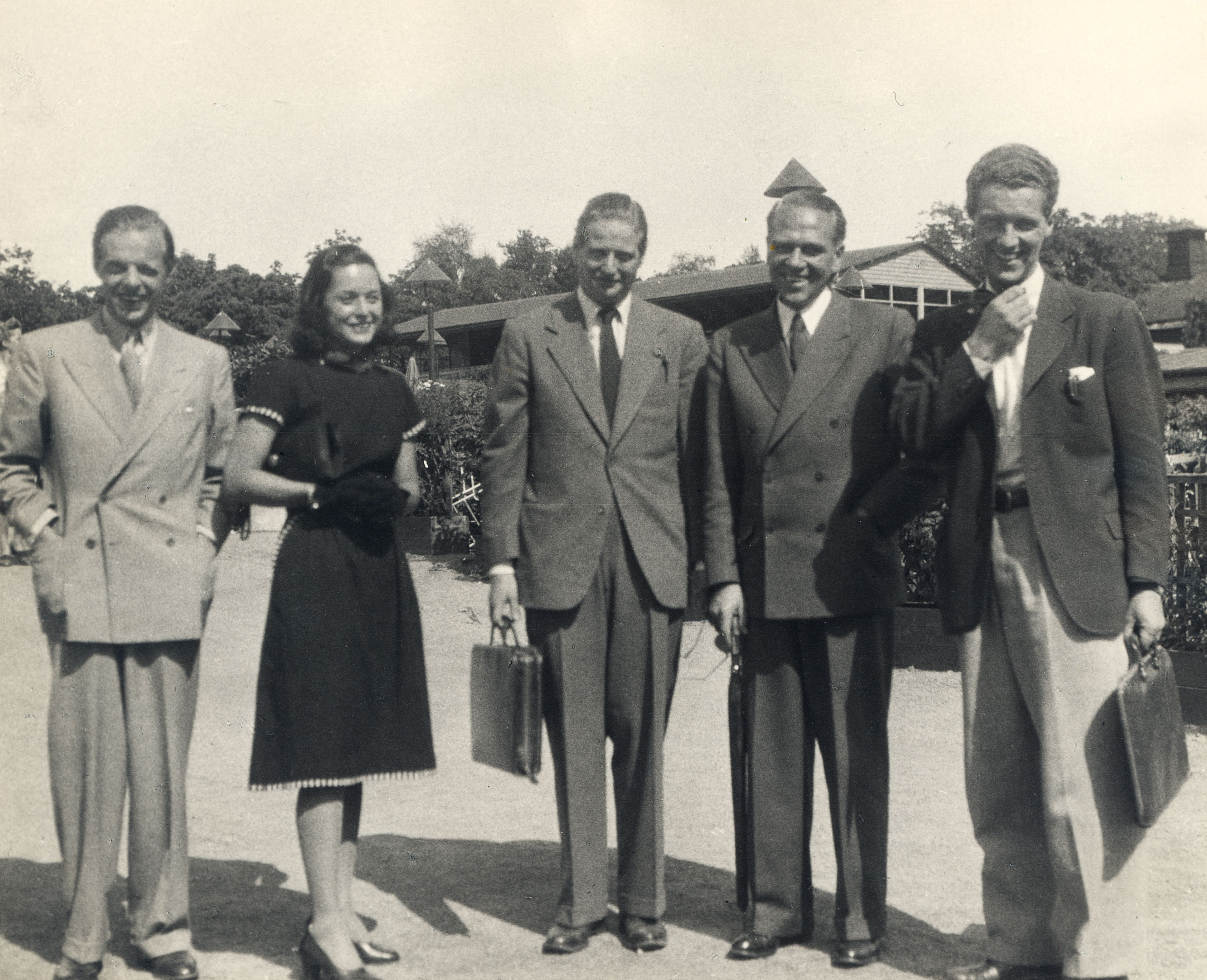
From left: Lars Eriksson, Florence Knoll, Hans Knoll, Tom Bjorklund, and Elias Svedberg, 1946. Courtesy Cranbrook Archives.

This photo was taken sometime in August or September 1946 during Florence and Hans Knolls’ honeymoon to Sweden. The newlyweds, who met in New York where Florence was an architect and Hans ran his eponymous furniture company, traveled throughout Sweden on a “working honeymoon.”

The Knolls were there to make arrangements and agreements with Nordiska Kompaniet (NK, or The Nordic Company), a large Stockholm-based department store, and other companies to import Swedish furniture and textiles into the United States.

Florence “Shu” Knoll, née Schust, (1917-2019) is, of course, one of Cranbrook’s most distinguished alumna (Kingswood School Cranbrook 1934, Cranbrook Academy of Art student 1934-1937, 1939), and Hans Knoll (1914-1955) was the son of a German furniture maker associated with the Bauhaus. While we couldn’t find much information on the Swedes the Knolls are pictured with here, Elias Svedberg (1913-1987), on the far right, was an architect and designer with a long career at NK, starting in the mid-1940s. His midcentury modern Swedish furniture certainly would have appealed to the fashionable and modern Knolls!

This week at the Center, we’ve had Knoll (the company) on our mind since Monday’s important announcement of the merger of Knoll, Inc. and Herman Miller, Inc. into one company; we’ve also had Sweden on our mind as we gear up for our grand Swedish-themed fundraiser coming up on May 22, 2021:  A Global House Party at Cranbrook and Millesgården. Of course, there’s a photo in Cranbrook Archives for every occasion!

Leslie Mio, Associate Registrar, and Kevin Adkisson, Associate Curator, Cranbrook Center for Collections and Research

PS: Don’t forget to purchase your tickets to House Party today so you don’t miss out on our special Carl Milles film premiere!

Observing Landscapes: Topography and Photogrammetry

One of my favorite items in the collections of Cranbrook Archives is George Booth’s hand drawn map of Cranbrook, which he created over a 24-year period between 1904 and 1928. It is the earliest topographical record of Cranbrook and visually documents his ideas and plans for developing the landscape. In 1951, George’s son, Henry, created annotations to accompany the map, which are useful both in deciphering the map and identifying locations. Henry’s notes on what was envisioned and what was implemented during those early years, are a good starting point from which to venture into the manuscript collections for verification.

Cranbrook Map drawn by George G. Booth between 1904 and 1928.
Courtesy of Cranbrook Archives

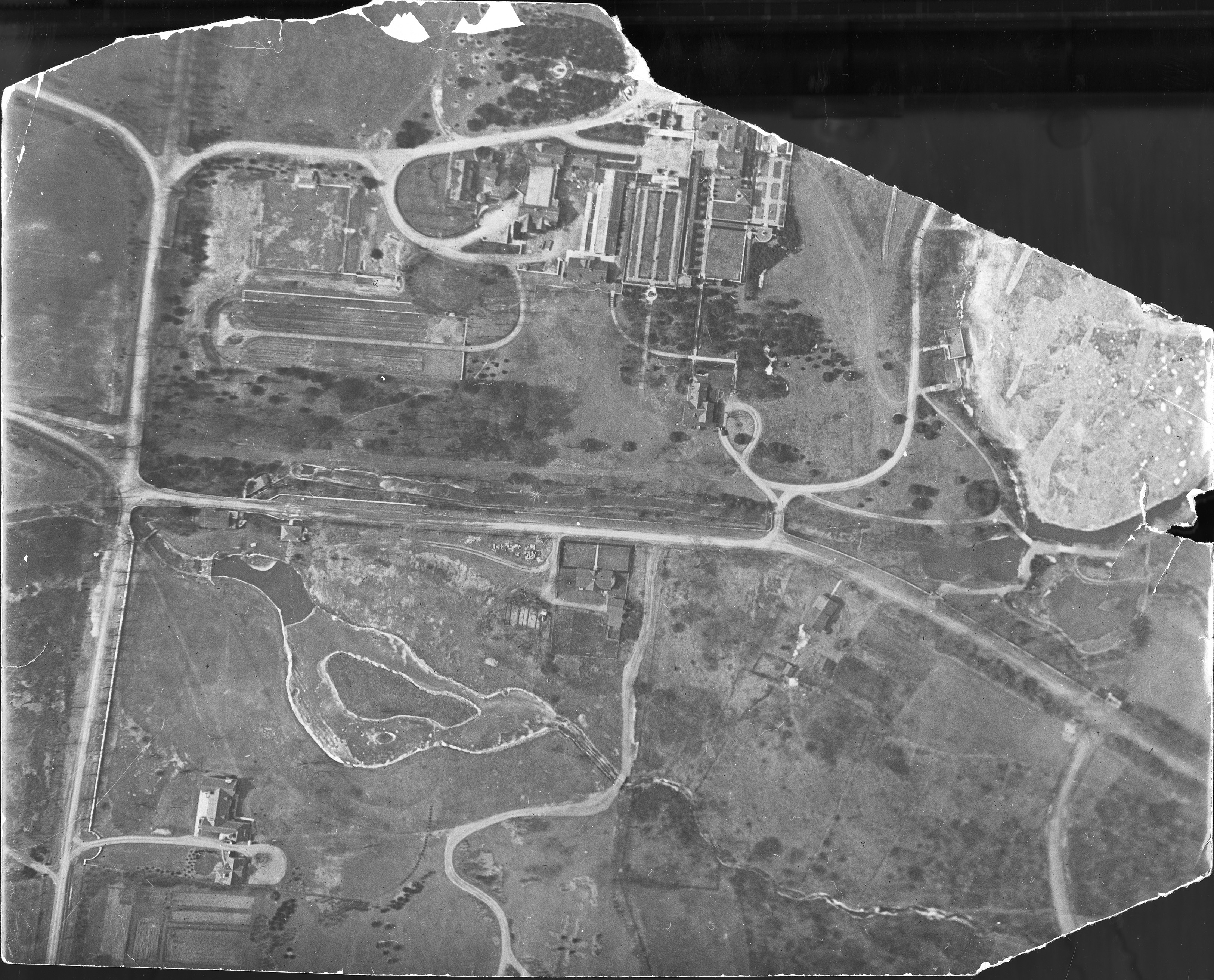
As Cranbrook’s landscape evolved from a family estate into a center for art and education, the means of recording and viewing the topography was assisted by developments in aerial photography, known as photogrammetry. Talbert Abrams, a native of Michigan, is regarded as a key contributor to this field of photography, as he founded the Abrams Aerial Survey Corporation in 1923. The earliest aerial photograph of Cranbrook I could locate is from circa 1918.

Aerial photograph of Cranbrook estate and environs, circa 1918.
Courtesy of Cranbrook Archives

In the Cranbrook Photograph Collection there are many aerial photographs taken by Abrams, as well as other photography firms, ranging from the 1920s through the 1990s. Since the purposes of aerial surveys are manifold, correspondence provides some insight into why they were commissioned and how they were specifically used, for example, as publicity and advertising. In 1932 Cranbrook’s public relations manager, Lee A. White, engaged Cranbrook School Headmaster William Stevens to select an image for the coming year’s brochure, and aerial views appear in all the early Cranbrook brochures. Aerial surveys have also been used to assess and understand the landscape prior to making a change to it. This was the case in 1961, when a topographic map and aerial photography were requested for the Off-Street Parking Study.

Letter from Keith A. Smith to Arthur B. Wittliff, November 1961.
Courtesy of Cranbrook Archives

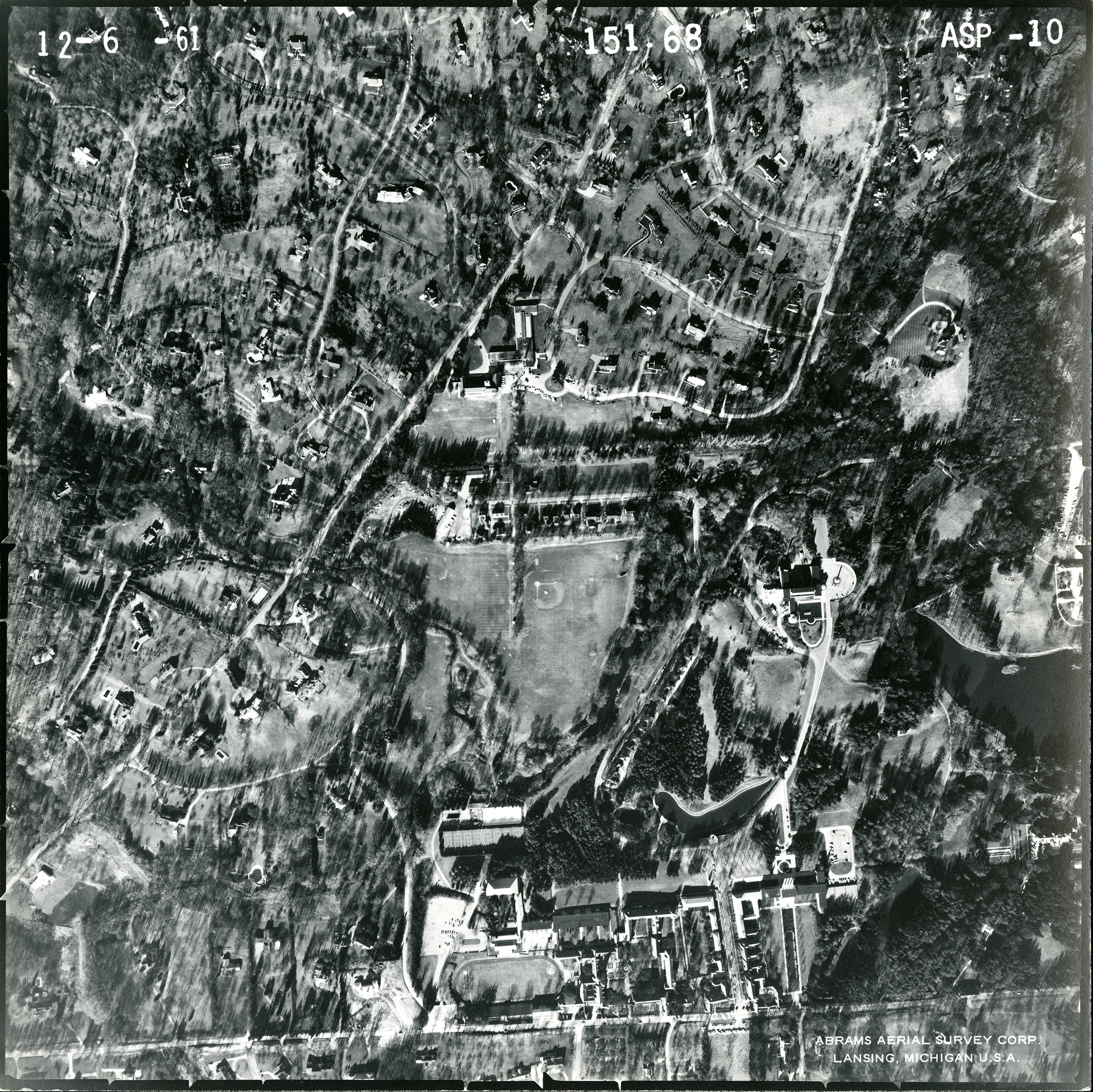
Correspondence between Arthur Wittliff, Secretary for the Cranbrook Foundation Board of Trustees, and Abrams Aerial Survey Corporation, provides intriguing details about the scale of the photography and the material base of the prints. The images below are from a December 6, 1961 set of 12 double weight velvet prints of aerials covering 1 square mile at a scale of 1 inch per 600 feet.

Aerial photograph ASP-5 taken by Abrams Aerial Survey Corporation on 6 December 1961.
Courtesy of Cranbrook Archives

ASP-5 (above) shows the intersection of Cranbrook Road and Lone Pine Road, and includes Kingswood School and Lake, the Institute of Science, Cranbrook House, Brookside School, Christ Church Cranbrook, and the Academy of Art and Academy Way. ASP-10 (below) shows another view of Cranbrook and its environs, encompassing the Institute of Science, Academy of Art, and Cranbrook School.

Aerial photograph ASP-10 taken by Abrams Aerial Survey Corporation on 6 December 1961.
Courtesy of Cranbrook Archives

When looking across the topographical history of Cranbrook from George’s map through aerial photographs, it is always fascinating to discern the changing landscape alongside the features that are unchanging. And, for me, the great inspiration of George’s map is that, although each individual project necessitated getting into the weeds and meticulous details, his ideas were always guided by situating them within a bigger picture.

Laura MacNewman, Associate Archivist, Cranbrook Center for Collections and Research

Cranbrook Gets the Royal Treatment

Not once, but twice, Cranbrook has pulled out the figurative red carpet and with appropriate fanfare welcomed Swedish royalty to its campus. Anyone who knows and loves Cranbrook might not be all that surprised by this revelation. After all, Cranbrook is a very special place—the home of dozens of sculptures by Sweden’s celebrated sculptor Carl Milles, who lived and worked at Cranbrook for twenty years, as well as many tapestries woven by Loja Saarinen’s renowned Swedish weavers. But the larger Detroit community has also boasted a significant Swedish cultural presence.

While most Michiganders might be familiar with the role that Swedish immigrants played in Michigan’s Upper Peninsula mining and lumber industries, Swedes also played major roles in Detroit’s development, from the auto industry to the fine and performing arts. Not least of all were the contributions made by Milles, including his sculpture The Hand of God, which has stood in front of the city’s Frank Murphy Hall of Justice since 1970. The founding in 1963 of the Detroit Swedish Council by Charles J. Koebel (who, decades earlier, had commissioned Eliel Saarinen to design his family home in Grosse Pointe Farms), saw a concerted effort to promote Swedish culture in the area. It was likely the unique combination of Cranbrook’s artistic works and Detroit’s vibrant Swedish community that attracted visits from Sweden’s royal family on two separate occasions.

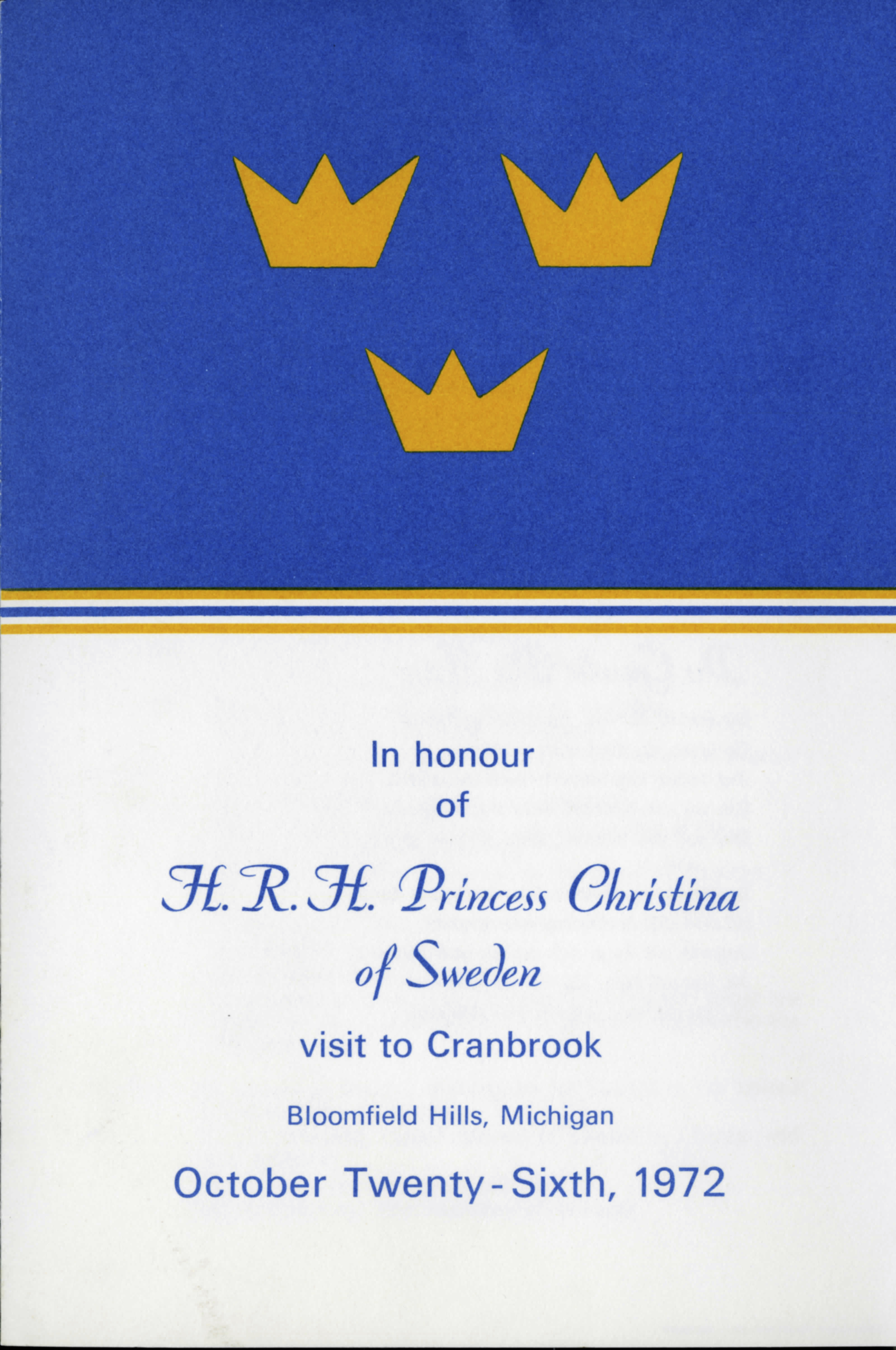
Program for the day’s activities. Courtesy of Cranbrook Archives.

So it was that on October 26, 1972, Princess Christina of Sweden set foot on Cranbrook grounds as part of her two-week tour of the States. And sixteen years later, her brother and his wife, King Carl XVI Gustaf and Queen Silvia, followed suit on April 18, 1988. Both visits focused largely on Carl Milles’ Cranbrook legacy, directly involved the Academy of Art and Art Museum, and were the result of collaborations between Cranbrook and the Detroit Swedish Council. Yet each visit had its own unique activities and sense of purpose.

Continue reading

Behind-the-Scenes of ‘Speculative Histories’

On a cold January evening, I crossed paths with Iris Eichenberg, Metalsmithing Artist-in-Residence, along Academy Way. Through our masks, we talked about how we might be able to do what has become an annual winter tradition: the special Academy of Art student show in Cranbrook House.

Three years ago, in February 2018, Iris and I worked together to place art from students and alumni of the Metalsmithing Department around the first floor of Cranbrook House. We did similar shows the next two years, inviting other departments as we went along. None of us could’ve guessed that the opening night of last year’s show would be one of the last large, maskless, worry-free gatherings for a while!

Standing Veil  by Sylvain Malfroy-Camine, Painting 2021, on display in the Cranbrook House Sunset Porch as part of Speculative Histories, March 2021. Eric Perry, photographer. Cranbrook Center for Collections and Research.

Knowing the 2021 student show in Cranbrook House would have to be totally different and without any public visitors, Iris and I wondered if we should do it at all. I talked with some of the other Artists-in-Residence (AIRs) and decided: if we don’t do the show this year, it’s just one more thing the current students won’t have a chance to experience due to the pandemic. There would be a show!

Without in-person visitors to the exhibition, one of our perennial logistical problems was solved. A wintertime event in Saarinen House or the Frank Lloyd Wright Smith House brings ice and salt and general weather-related nastiness—it’s why we close the houses for tours November to May. But if there aren’t any physical guests, why not expand the show to include all three of Cranbrook’s historic houses? If we expand to include more physical space, why not invite every department to participate?

Untitled/Studio Objects by Ian McDonald, Ceramics Artist-in-Residence, and Vase by Maija Grotell, Ceramics Artist-in-Residence 1938-1966, on display in Smith House as part of Speculative Histories, March 2021. Eric Perry, photographer. Cranbrook Center for Collections and Research.

In a meeting at Saarinen House with Martha Mysko (Painting AIR), Gretchen Wilkins (Architecture AIR and Interim Dean), Rebecca Ripple (Sculpture AIR), and Iris, we settled on a theme for the exhibition: Speculative Histories. We asked the students to think about the many stories within each of the three houses and to speculate about what other stories might be told through their art. Whether real or imagined, well known or totally obscure, nostalgic or futuristic, we hoped this theme would inspire the artists to engage directly with the context of Cranbrook’s house museums.

In a year spent in relative solitude within their studios and attending virtual critiques and lectures, I hoped giving the students space to be creative within the historic houses would be a welcome change of pace.

Continue reading

De Profundis: Olga Milles’ Drawings of the Soul

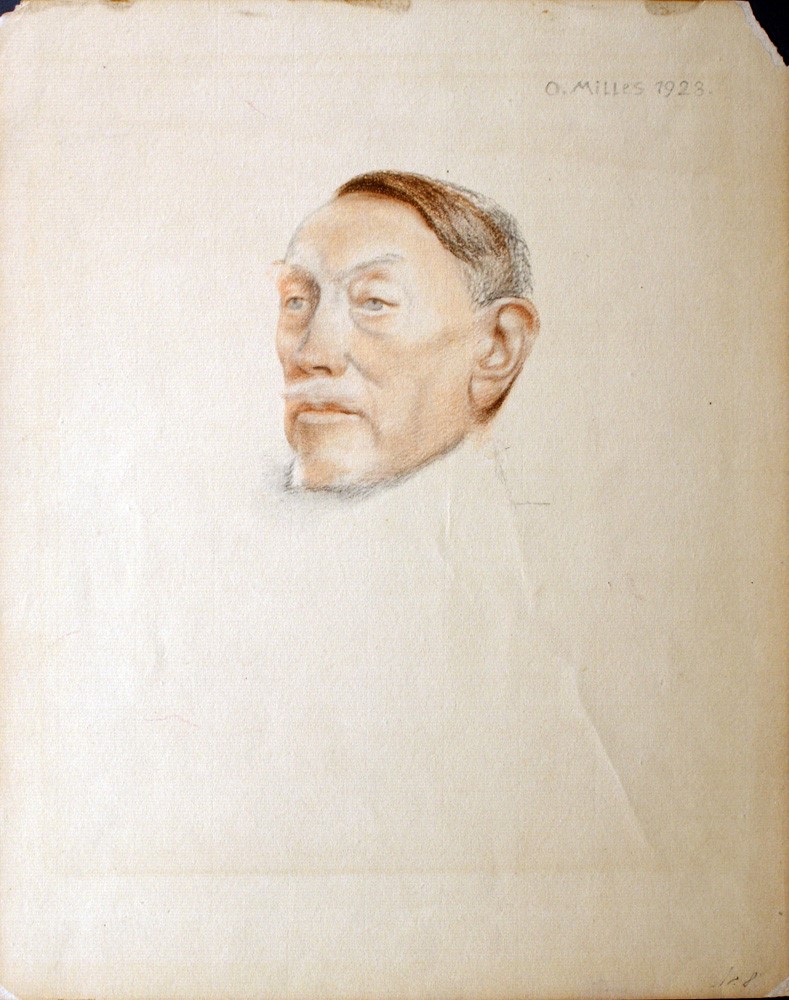
Olga Milles lived in the very depths. In her art, almost exclusively devoted to portrait painting, she sought to draw out the character from the depths of her models and to find the soul behind the façade. Using a variety of techniques including charcoal, crayon, pastel, watercolor, tempera, and oil in her work, Olga was considered an artistic prodigy and developed her talent from a young age, yet her art is largely unknown. In 1988, twenty-one years after her death, Cranbrook Art Museum hosted an exhibition in collaboration with Millesgården, Olga Milles Emerges, to exhibit examples of her art from both museums’ collections.

In the foreword to the exhibition catalog, Staffan Carlén, former Director of Millesgården, describes her as having an intuitive talent that produced factual character studies of extreme precision, with an “overwhelmingly melancholic” tone. In reading Inger Wahlöö’s account of Olga’s life, based on correspondence at Millesgården, Carlen’s interpretation of Olga’s artwork can almost be read as a profile of Olga herself:

“Sparseness of shadowed areas and stretched areas disrobe the faces and make them appear in a serious, introverted nakedness. Her efforts are primarily directed towards interpreting the character of the soul. This she did with great coloristic refinement, and with tenderness in the form. In her drawings, there is consistently a sensitive enlargement of the mouth, sometimes in interaction with the dreaming mood of the eyes, sometimes as a tension-filled contrast of unconscious sensuality.”

Staffan Carlen, Olga Milles Emerges
Print of Drawing of Carl Milles by Olga Milles, 1917. Courtesy of Cranbrook Archives.

Born Olga Granner in 1874 in Leibniz, Austria, she had two brothers and two sisters. She had a deep loyalty to her family, whom she visited for several months every year, except during World War II. Having been born and raised in the Catholic church, she initially aspired to become an art teacher in a convent. However, in early adulthood, Olga questioned what it meant to be disobedient to the church and broke away, while cultivating an increasingly ascetic life.

Continue reading

History Detective: Light Fixture Edition

Did you ever watch the show History Detectives on PBS? I loved the show; it is all about uncovering the story of an object.

As Associate Registrar for the Center, I am working with our Director Gregory Wittkopp and our Associate Curator Kevin Adkisson on an ambitious project. We are reviewing all fourteen of our cultural properties collections (over 9,000 objects), reviewing the data already on file and adding as much additional information about each object as we can. How do we do this, when the people who created, collected, or purchased the objects are no longer here? It requires being something of a history detective!

The collection we are currently working on is the Cultural Properties Collection at Thornlea. Thornlea was the home of George and Ellen Booth’s youngest son, Henry Scripps Booth, and his wife, Carolyn Farr Booth, from 1926 to 1988. It is filled with antiques, artwork, furnishings, and personal objects. In Cranbrook Archives, there are multiple helpful records about the home’s collections: insurance inventories, an index card file of objects created and maintained by Henry, and receipts for items purchased.

Light fixture over front door at Thornlea.

The one object I wanted to feature today is the unique light fixture over the front door to Thornlea. This custom and distinctive iron and glass fixture is important to the architectural character of the house, but I knew next to nothing about it. It appeared in early images of the house, so I knew it had been a part of the house from the earliest years, perhaps since the house was built.

Henry Scripps Booth peaks out the front door of Thornlea, circa 1935. Courtesy Cranbrook Archives.

To learn more about the fixture, I first looked at the insurance inventories and Henry’s index card file. Nothing there.

Next, I looked at the receipts under “Electrical” in the Henry Scripps and Carolyn Farr Booth Papers in Archives. Eureka!

Continue reading

Create a website or blog at WordPress.com