A World of Opportunity: Ellen Scripps Booth Memorial Scholarships

In preparation for the Center’s upcoming seminar, featuring research on weaver Nelly Sethna, I became curious about an Academy of Art scholarship established in honor of Cranbrook founder, Ellen Scripps Booth.

Sethna had been a recipient of this financial award, which had allowed her to study abroad (Sethna was a citizen of India) at Cranbrook for one year, 1958-1959. Though it was Sethna’s artistic ability, not financial need, that earned her the award, she would never have made it to Cranbrook without this assistance, as indicated in letters to Weaving Department Head, Marianne Strengell.

Nelly H. Sethna, circa 1958. Courtesy of Cranbrook Archives.

Sethna’s subsequent successful career in textile design demonstrated the value of providing assistance for artists to attend the Academy. I wondered how many other similar stories there were in the Archives. I did not need to look past the first decade of memorial scholarship awardees to find plenty.

While the scholarship was granted to deserving artists in metalsmithing, painting, ceramics, and weaving in the ten years between 1951-1961, it was two fellow weavers of Sethna’s that caught my eye. They, too, had proven themselves worthy of distinction through their artistic accomplishments, but they, too, had financial needs that would have prohibited their attending the Academy otherwise.

Dixie Roto Magazine article featuring Katherine Choy, Sept. 14, 1952. Copyright The Times-Picayune, New Orleans States. Courtesy of Cranbrook Archives.

The first recipient of the scholarship was Katherine P. Choy, a Chinese expatriate and graduate of Mills College in Oakland, California. Choy came to Cranbrook in 1951 to study ceramics for one year as a non-degree student. She would spend near equal time in both the ceramics and weaving departments, under the dual tutelage of Maija Grotell and Marianne Strengell.

Upon leaving Cranbrook, she would enjoy success in both fields, first heading up the legendary Newcomb College Ceramics Department at Tulane University and later joining the design team at Isabel Scott Fabrics in New York. With fellow artist Henry Okamoto, Choy also founded The Clay Art Center in Port Chester, New York, which still exists today. Choy’s ceramics can be found in the collections of the Cooper-Hewitt Smithsonian Design Museum, the Museum of Arts and Design in New York, as well as the New Orleans Museum of Art.

Tsuneko Yokota, circa 1955. Courtesy of Cranbrook Archives.

Another scholarship winner, and weaver, in the first decade of the award was Tsuneko Yokota (Fujimoto), for the academic year 1957-1958. A graduate of the Design Department at Tama College of Fine Arts in Tokyo, Yokota distinguished herself in fabric dying, winning several awards and a scholarship for an additional year at Tama as an honor graduate. At the suggestion of one of her instructors, and with a recommendation from Marianne Strengell, who knew her instructor, Yokota came to Cranbrook to further her studies in weaving and textile design. Unlike Sethna and Choy, though, Yokota stayed an additional year at the Academy and earned her MFA in Weaving.

By all accounts, Yokota lived up to Strengell’s confidence that she, “will most certainly have ample chance and desire to spread our particular brand of education and design in Japan,” working with celebrated modernist interior designers like Isamu Kenmochi.

Cranbrook Academy of Art scholarship announcement, 1960. Courtesy of Cranbrook Archives.

The Ellen Scripps Booth Memorial Scholarship was established in 1951 along with the George Gough Booth and Eliel Saarinen Memorial Scholarships by the Academy of Art Board of Trustees. Academy faculty, under the leadership of Director Zoltan Sepeshy, recommended these scholarships be granted based on unusual merit of work submitted rather than financial need. Academy administrative documents indicate that the Ellen Scripps Booth Scholarship Fund had wide support from not only Academy faculty and staff, but also many at the Foundation, Press, Central Committee, and House. Scholarship award amounts varied somewhat from year to year, (in 1953 they were evenly split between two awardees), but the scholarship continued to be granted until at least 1965. While these named scholarships are no longer awarded (and I was unable to deduce exactly why or when they stopped), scholarships and financial aid for talented students are still vital to the success of the Academy and its artists.

—Deborah Rice, Head Archivist, Cranbrook Center for Collections and Research

Editor’s Notes: On Tuesday, June 22 the Center broadcasts live from Cranbrook and India for scholar Vishal Khandelwal’s examination, using materials from Cranbrook Archives, of a fascinating connection between mid-century textile design in the United States and India, as seen through the work of Nelly Sethna. Register here for this illuminating virtual event. 

Along with Nelly Sethna (1958-59), find early scholarship winners, such as Paul R. Evans (1952-53) and Howard William Kottler (1956-57) featured in Cranbrook Art Musuem’s new exhibit and companion publication, With Eyes Opened. Find details and purchase advance tickets to the exhibit on the Museum’s website.

Read a recent exciting announcement about new scholarship and financial opportunities for students on the Academy’s website.
Where in the World is Academy Graduation?

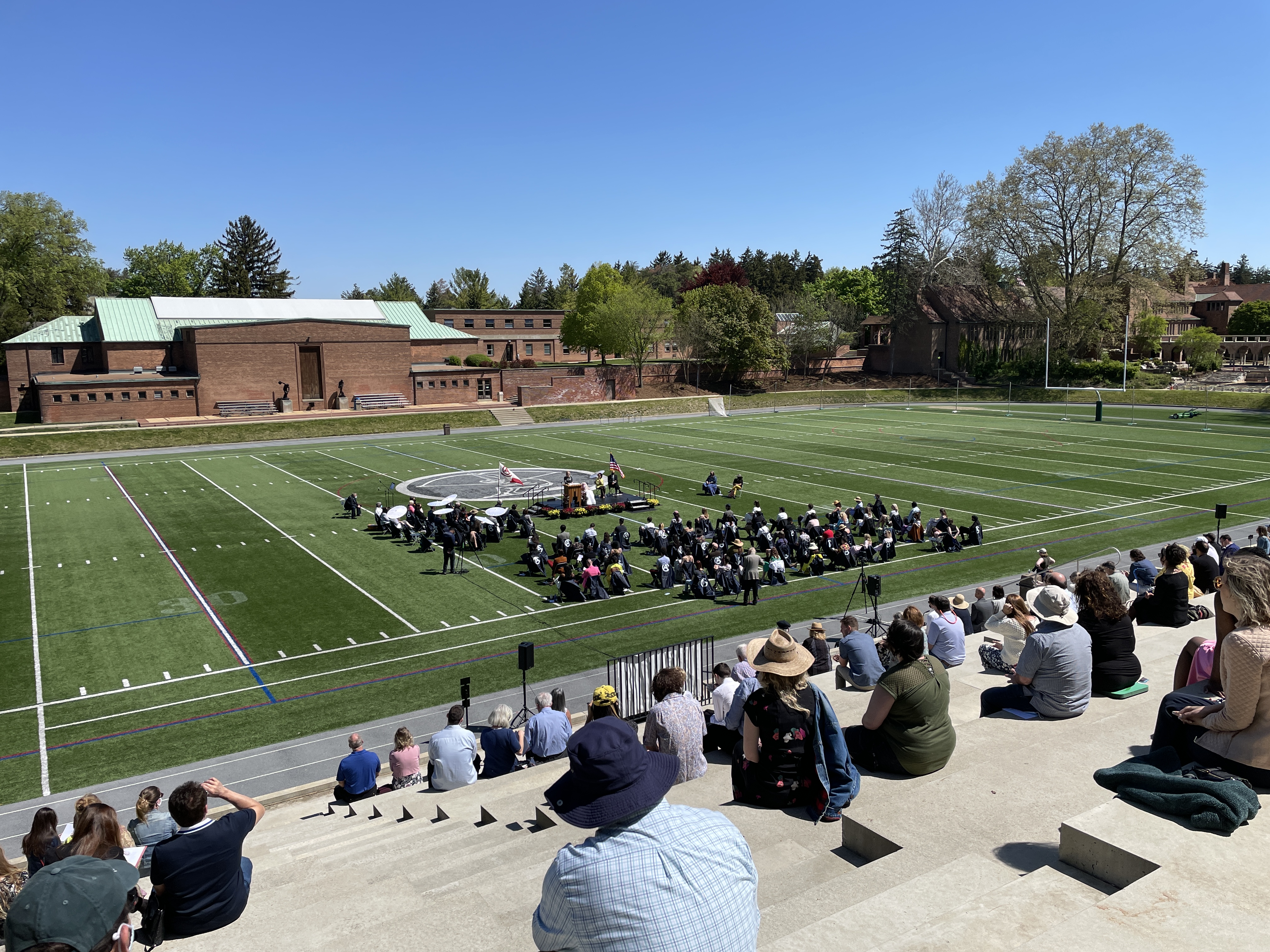
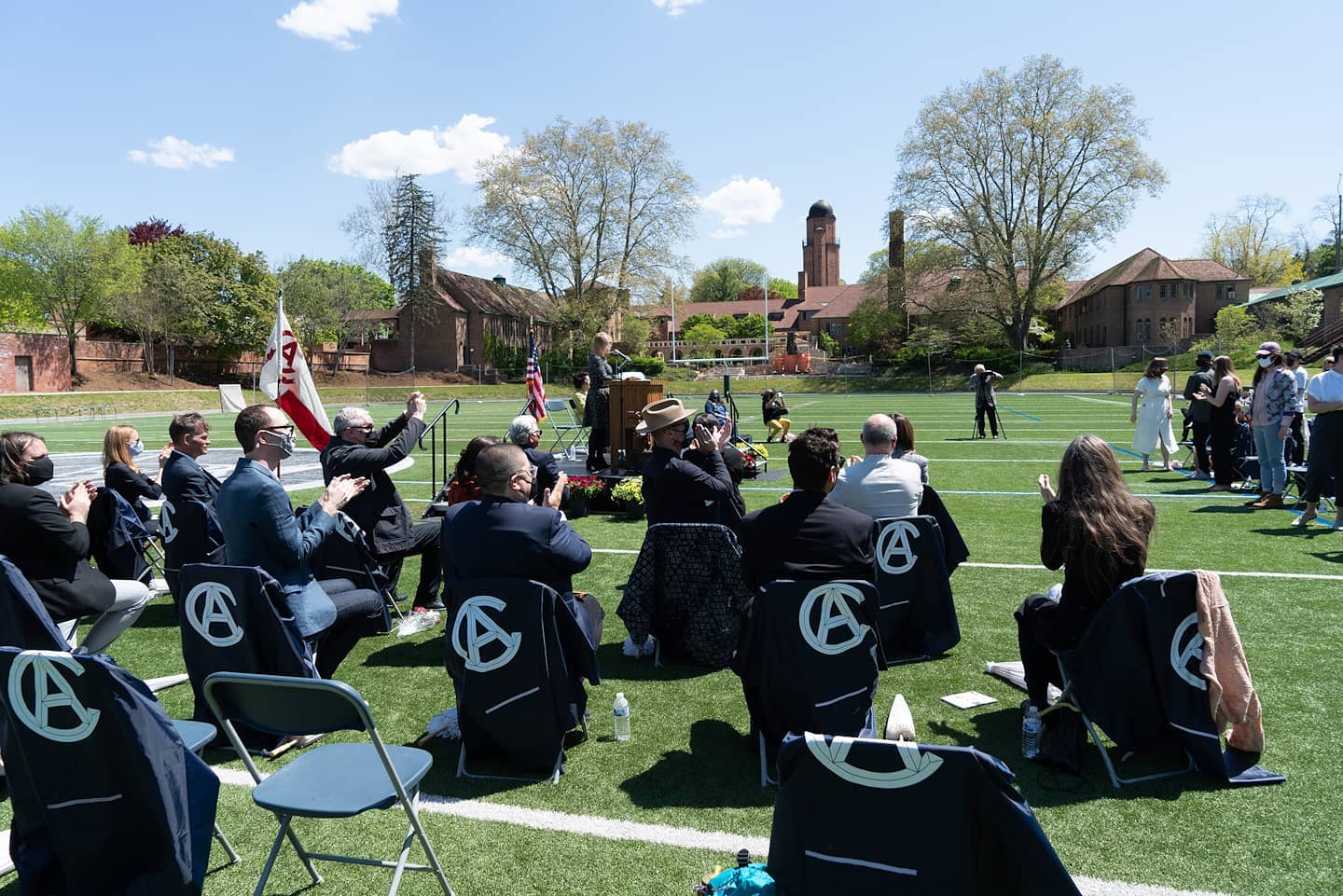
Today was a very exciting day at Cranbrook, with the Academy of Art Commencement taking place underneath a bright blue sky at Thompson Oval. Sixty-four students (now alumni!) were awarded their degrees. Artis Lane received an Honorary Master of Fine Arts and delivered an inspiring speech (on her 94th birthday, no less!), while Allie McGhee delivered a wonderful commencement address.

Susan Ewing, Director, speaking at the Cranbrook Academy of Art Class of 2021 Commencement, May 14, 2021 on the Thompson Oval at Cranbrook School. Photograph by Katie McGowan, CAA Photography ’22, Courtesy Cranbrook Academy of Art.

But as I sat in the newly restored bleachers of the Cranbrook School football stadium, I wondered: was this the first time the Academy’s commencement took place here, at the Thompson Oval?

A quick search in Archives revealed that, yes, it seemed to be. However, the same search revealed that graduation has taken place all around campus over the years.

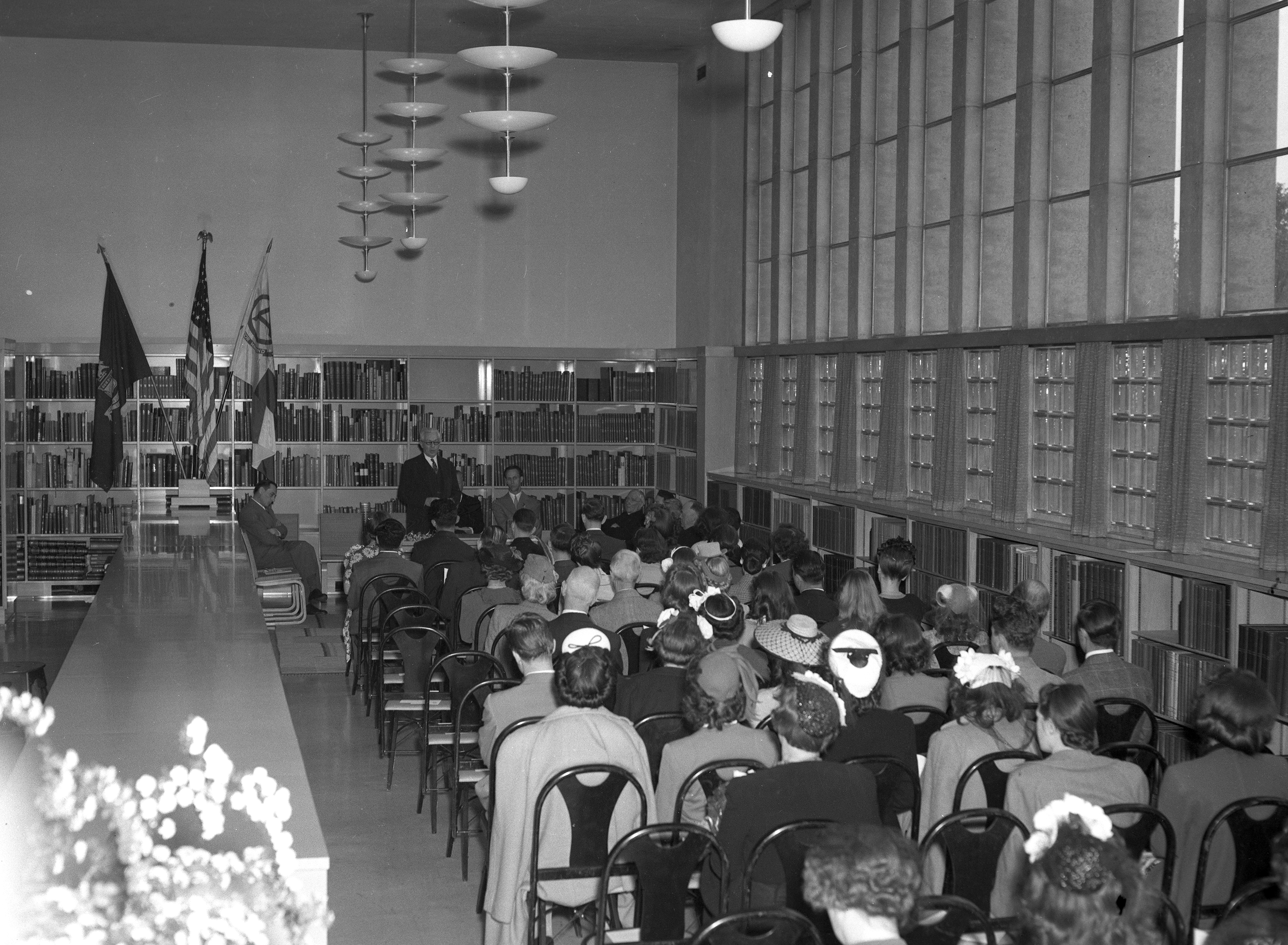
The Academy dates back to 1932, but it first granted degrees in 1942. This was the same time Cranbrook Art Museum and Library opened. Early commencements took place in the Museum galleries, and, at least in the earliest years, the faculty and staff wore academic regalia.

Eliel Saarinen, President, confers degrees during the Cranbrook Academy of Art Class of 1943 Commencement, May 1943 at Cranbrook Art Museum. Courtesy Cranbrook Archives.

Other early commencement ceremonies took place in the Academy’s Library next door. The reading room tables and chairs were replaced with rows of seating for students and guests. By 1945, it appears academic regalia had been abandoned.

A rather sleepy Zoltan Sepeshy, Director, at Cranbrook Academy of Art Class of 1945 Commencement, May 26, 1945 in Cranbrook Academy of Art Library. Courtesy Cranbrook Archives.

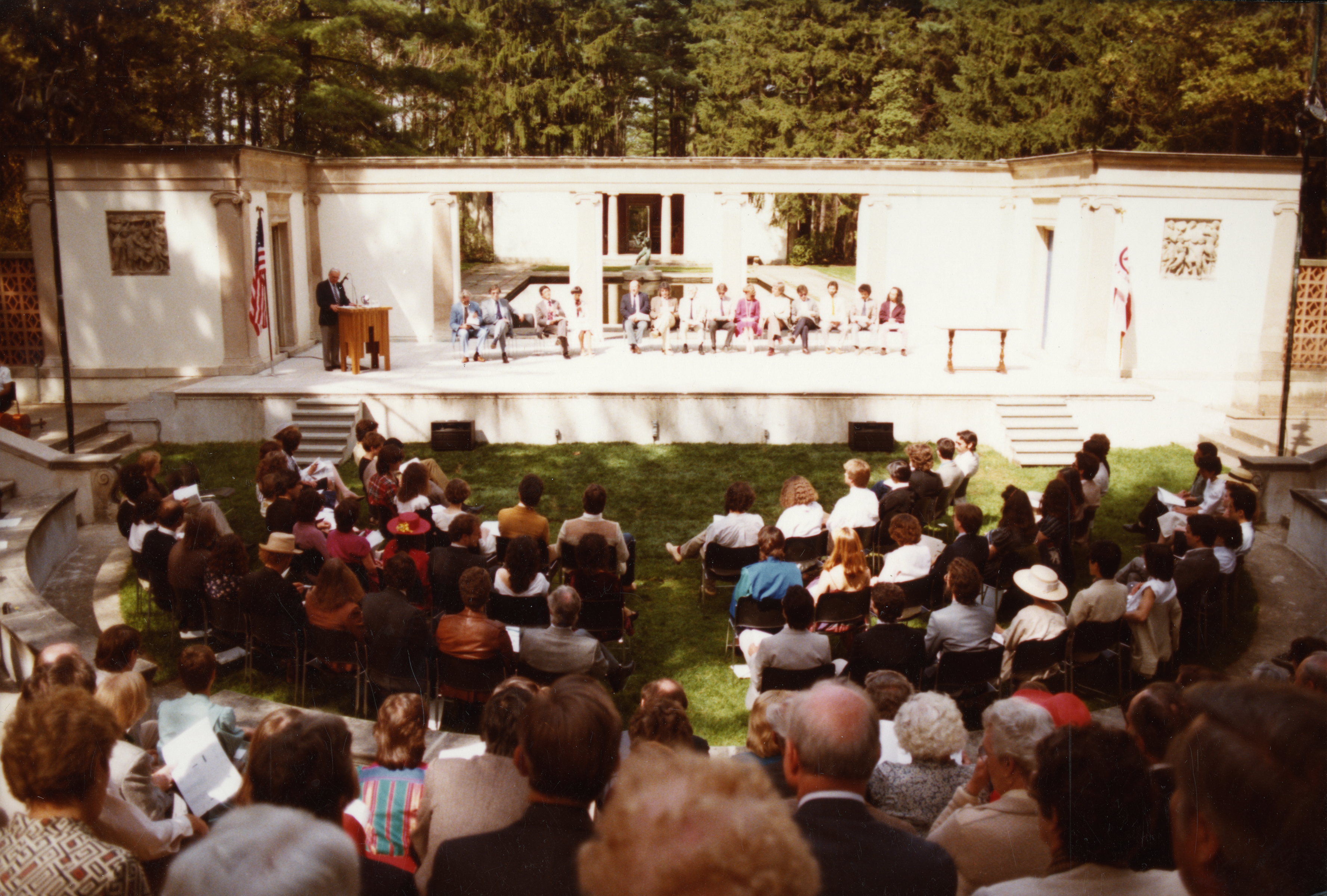
By midcentury, as the student body expanded, commencement moved to the Greek Theatre. This remained the location for many decades, and likely where commencement will return in a post-pandemic future.

Roy Slade, President, presides over a Cranbrook Academy of Art Commencement in the early 1990s at the Greek Theatre. Courtesy Cranbrook Archives.

And of course, what do you need if you’re planning an outdoor event in May in Michigan? A rain plan! Christ Church Cranbrook serves as the inclement weather site of commencement, as seen here in 2015.

Cranbrook Academy of Art Class of 2015 Commencement, May 8, 2015 at Christ Church Cranbrook. Photograph by Chris Schneider, Courtesy Cranbrook Academy of Art.

Fast forward to 2020, where commencement existed only in the virtual sphere: on Zoom. Not quite an architecturally interesting locale!

Susan Ewing, Director, presides over the Cranbrook Academy of Art Class of 2020 Commencement, May 8, 2020, on Zoom. Available here.

And then, today, commencement moved to the football field. It was a sunny day with perfect weather and high spirits as the community gathered, safely and in person, to celebrate the achievements of the Academy students.

Cranbrook Academy of Art Class of 2021 Commencement, May 14, 2021 on the Thompson Oval at Cranbrook School. Photograph by Kevin Adkisson.

Now, scroll back up and notice one thing that stayed the same across the years: the Academy Flag! It was behind President Eliel Saarinen in 1943, and behind Director Susan Ewing today.

Today’s ceremony will be uploaded to the Academy’s Vimeo page soon. Meanwhile, there are still a few days left to see the Class of 2021 Graduate Degree Exhibition at Cranbrook Art Museum, which closes on Sunday, May 16, and you can also see the (coronavirus delayed) Class of 2020 Graduate Degree Exhibition at Wasserman Projects in Detroit through June 19, 2021.

Congratulations from the Center to the Cranbrook Academy of Art Class of 2021!

Kevin Adkisson, Associate Curator, Cranbrook Center for Collections and Research

Carl Milles Gems from the Cutting Room Floor

Cameras started rolling Monday for the Center’s new film celebrating Swedish American sculptor Carl Milles, premiering May 22nd at A Global House Party at Cranbrook and Millesgården. Centering on materials in the Archives, the day’s shoot featured handwritten correspondence, photographs, sketches, scrapbooks, and oral history recordings that help illuminate the story of the man behind the many iconic sculptures dotting Cranbrook’s campus.

The film production crew captures closeups of materials featured in the film.

In preparation for the day, I mined several collections in the Archives that document Milles’ twenty years as artist-in-residence at Cranbrook and his work in America during that time. In the process, I made a few delightful discoveries. While most of these treasures were expertly captured by the film production crew (Elkhorn Entertainment), there were a few that just could not be accommodated in Associate Curator Kevin Adkisson’s masterful, but already dense script.

One of these items is a notebook from the Nancy Leitch Papers. A student of Milles’ in the early 1940s, Leitch, like many of Milles’ students, became friends with both him and his wife Olga while at Cranbrook. The brief diary-like entries in Leitch’s pocket-sized book date from 1945, and are an intimate glimpse of daily activities, remembrances, and artist philosophies recounted from shared experiences and conversations with Carl and Olga. A loose paper tucked inside and titled “Carl” is a bonus, containing hasty notes recording his birthday, recommendations of where to visit in Italy (Café Greco in Rome, the cathedral in Orvieto), and words of wisdom, such as, “It is better to be an artist even though you are poor.”

Part of an entry made by Nancy Leitch in her notebook. Courtesy of Cranbrook Archives.
Continue reading

Spring is Here, and so are our Tours!

Here at Cranbrook, the flowers are blooming, the pollen is swirling, and the fountains are flowing. That can only mean one thing: Tour Season is here!

With our reimagined, in-person 2021 Tour Season, we invite you to book your tour of Saarinen House or the Frank Lloyd Wright-designed Smith House today. Tours through these two distinguished landmarks will resume tomorrow, May 1, 2021, and continue through Thanksgiving.

Sara Smith and friends enjoy a dance in the Smith House dining room, circa 1970. Courtesy Melvyn Maxwell and Sara Evelyn Smith Papers, Cranbrook Archives.

Tours are now being offered of Smith House every weekend, taking place each Friday, Saturday, and Sunday at 1:00 pm and Saturday at 11:00 am. Saarinen House tours take place each Friday, Saturday, and Sunday at 3:00pm.

Of course, we’re taking lots of steps to ensure guest and staff safety, including shrinking tours to just six guests, requiring masks, and redesigning the route to ensure physical distancing between households. (You can read more about our safety policies on the tour website.)

Flying Teacups, 2021, Neva Gruver, CAA Metalsmithing 2021. Photography by Eric Perry, courtesy Cranbrook Center for Collections and Research. 

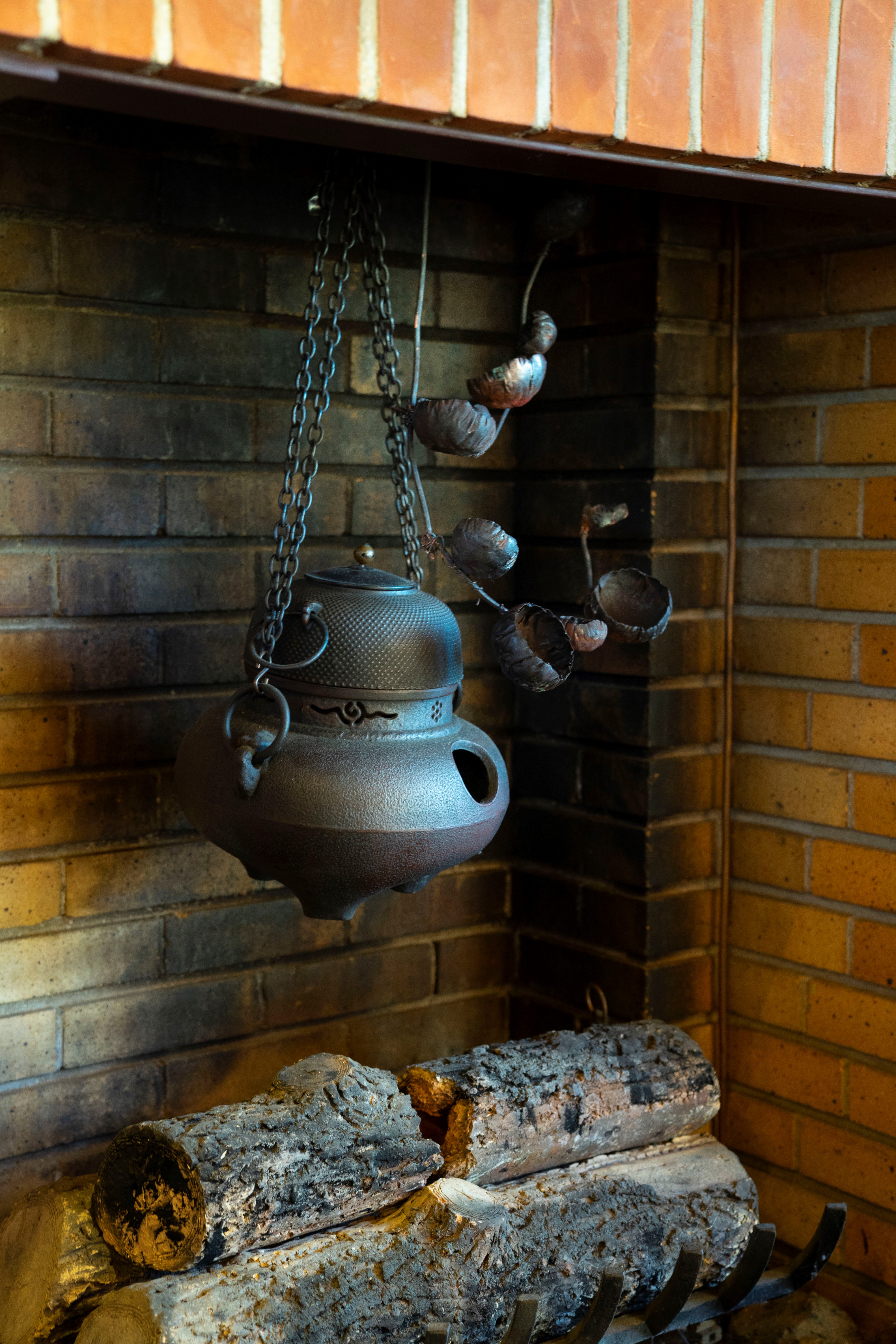
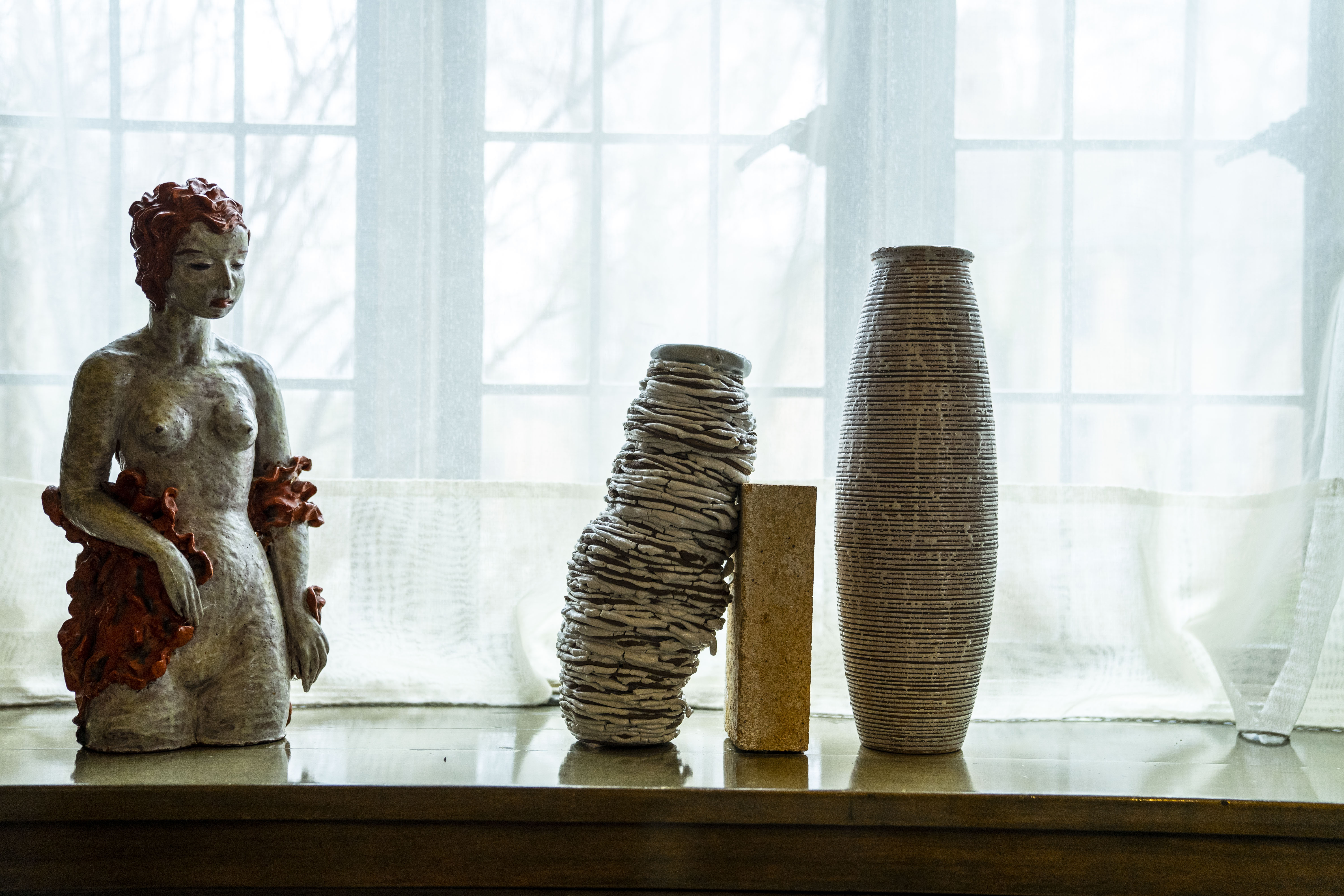
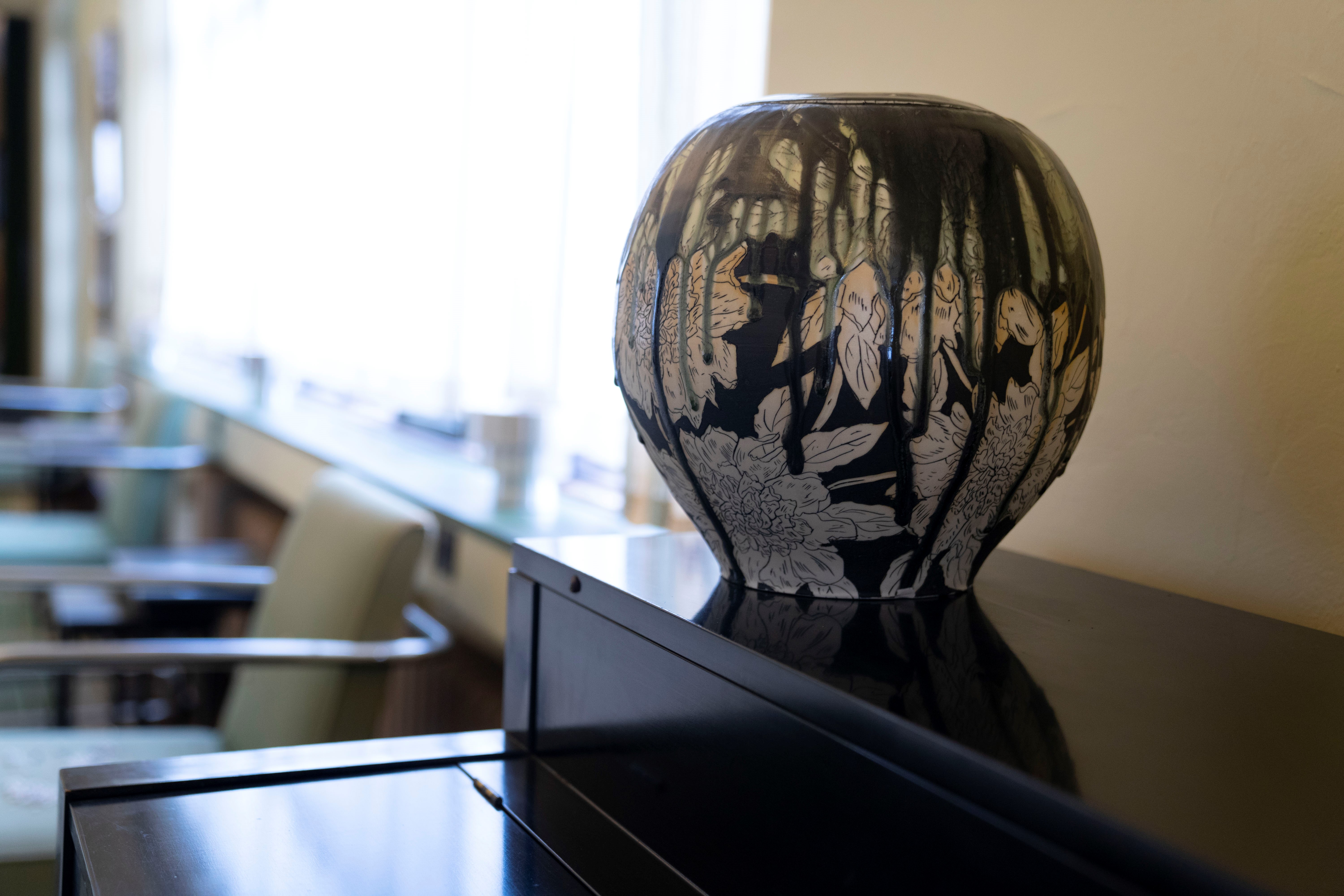
In addition to more tours and smaller group sizes, there’s also new art to see on your visit! As you may recall, in the spring, seventy-five Cranbrook Academy of Art students and artists-in-residence participated in the Center’s fourth intervention of new, site-specific work in our historic houses. The theme, Speculative Histories, encouraged the artists to produce objects and interventions that embrace, enlighten, uncover, or imagine histories for the Cranbrook, Saarinen, and Smith houses.

Atelier Primavera (Stressed), 2021, Cooper Siegel, CAA Ceramics 2022. Photography by Eric Perry, courtesy Cranbrook Center for Collections and Research. 

We are excited to continue to feature artwork from ten Cranbrook Academy of Art students and one artist-in-residence during the 2021 Tour Season. (To see all the art displayed during Speculative Histories, you can always visit the virtual exhibition on the Center’s website)

Peony Bush, Claire Thibodeau, Ceramics 2022. Photography by Eric Perry, courtesy Cranbrook Center for Collections and Research. 

Kevin and I have been busy cleaning the houses and getting everything set for a new tour season. We can’t wait for you to join the Center in experiencing these magical homes!

Leslie S. Mio, Associate Registrar, Cranbrook Center for Collections and Research

Photo Friday: A Working Honeymoon?!

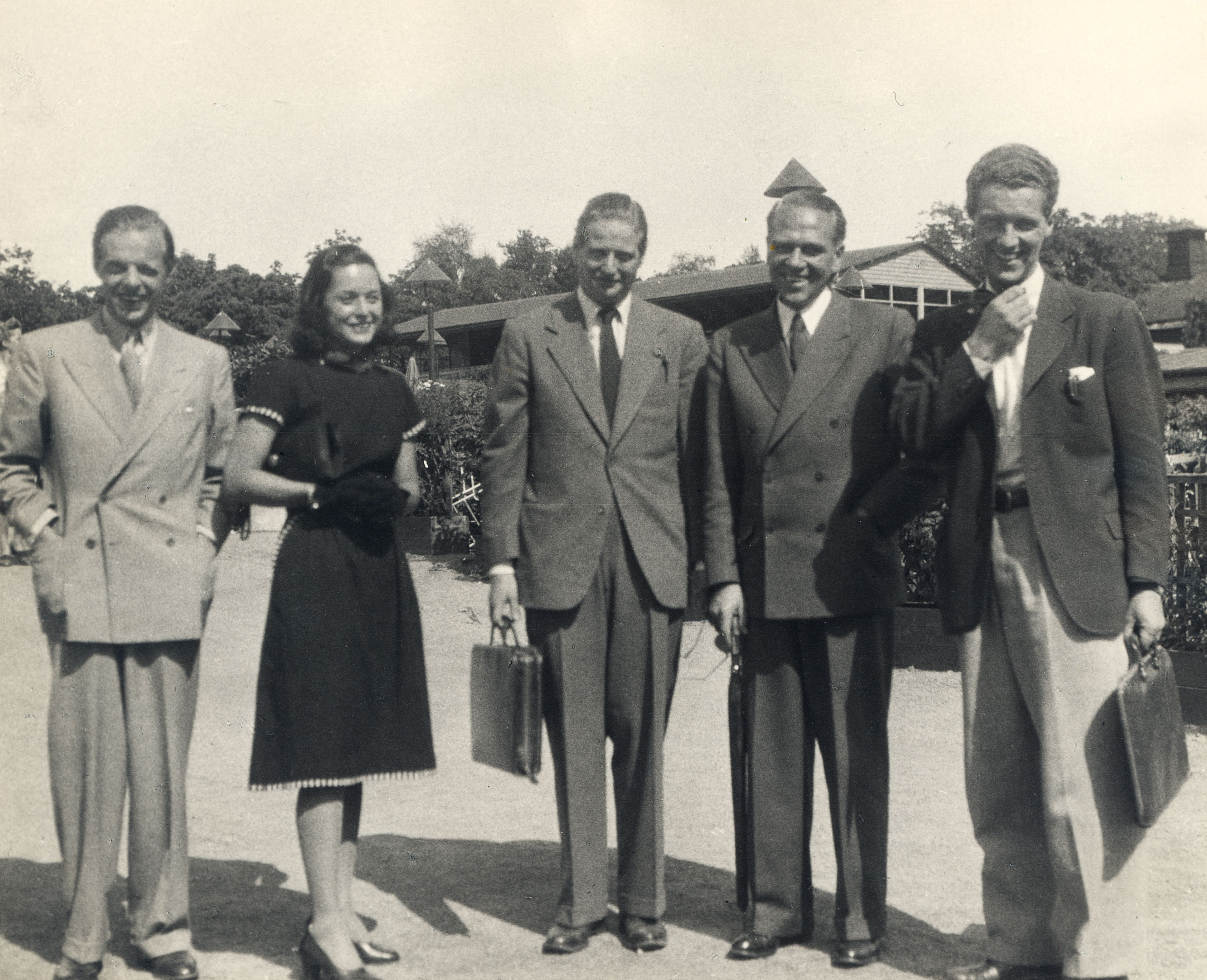
From left: Lars Eriksson, Florence Knoll, Hans Knoll, Tom Bjorklund, and Elias Svedberg, 1946. Courtesy Cranbrook Archives.

This photo was taken sometime in August or September 1946 during Florence and Hans Knolls’ honeymoon to Sweden. The newlyweds, who met in New York where Florence was an architect and Hans ran his eponymous furniture company, traveled throughout Sweden on a “working honeymoon.”

The Knolls were there to make arrangements and agreements with Nordiska Kompaniet (NK, or The Nordic Company), a large Stockholm-based department store, and other companies to import Swedish furniture and textiles into the United States.

Florence “Shu” Knoll, née Schust, (1917-2019) is, of course, one of Cranbrook’s most distinguished alumna (Kingswood School Cranbrook 1934, Cranbrook Academy of Art student 1934-1937, 1939), and Hans Knoll (1914-1955) was the son of a German furniture maker associated with the Bauhaus. While we couldn’t find much information on the Swedes the Knolls are pictured with here, Elias Svedberg (1913-1987), on the far right, was an architect and designer with a long career at NK, starting in the mid-1940s. His midcentury modern Swedish furniture certainly would have appealed to the fashionable and modern Knolls!

This week at the Center, we’ve had Knoll (the company) on our mind since Monday’s important announcement of the merger of Knoll, Inc. and Herman Miller, Inc. into one company; we’ve also had Sweden on our mind as we gear up for our grand Swedish-themed fundraiser coming up on May 22, 2021:  A Global House Party at Cranbrook and Millesgården. Of course, there’s a photo in Cranbrook Archives for every occasion!

Leslie Mio, Associate Registrar, and Kevin Adkisson, Associate Curator, Cranbrook Center for Collections and Research

PS: Don’t forget to purchase your tickets to House Party today so you don’t miss out on our special Carl Milles film premiere!

Observing Landscapes: Topography and Photogrammetry

One of my favorite items in the collections of Cranbrook Archives is George Booth’s hand drawn map of Cranbrook, which he created over a 24-year period between 1904 and 1928. It is the earliest topographical record of Cranbrook and visually documents his ideas and plans for developing the landscape. In 1951, George’s son, Henry, created annotations to accompany the map, which are useful both in deciphering the map and identifying locations. Henry’s notes on what was envisioned and what was implemented during those early years, are a good starting point from which to venture into the manuscript collections for verification.

Cranbrook Map drawn by George G. Booth between 1904 and 1928.
Courtesy of Cranbrook Archives

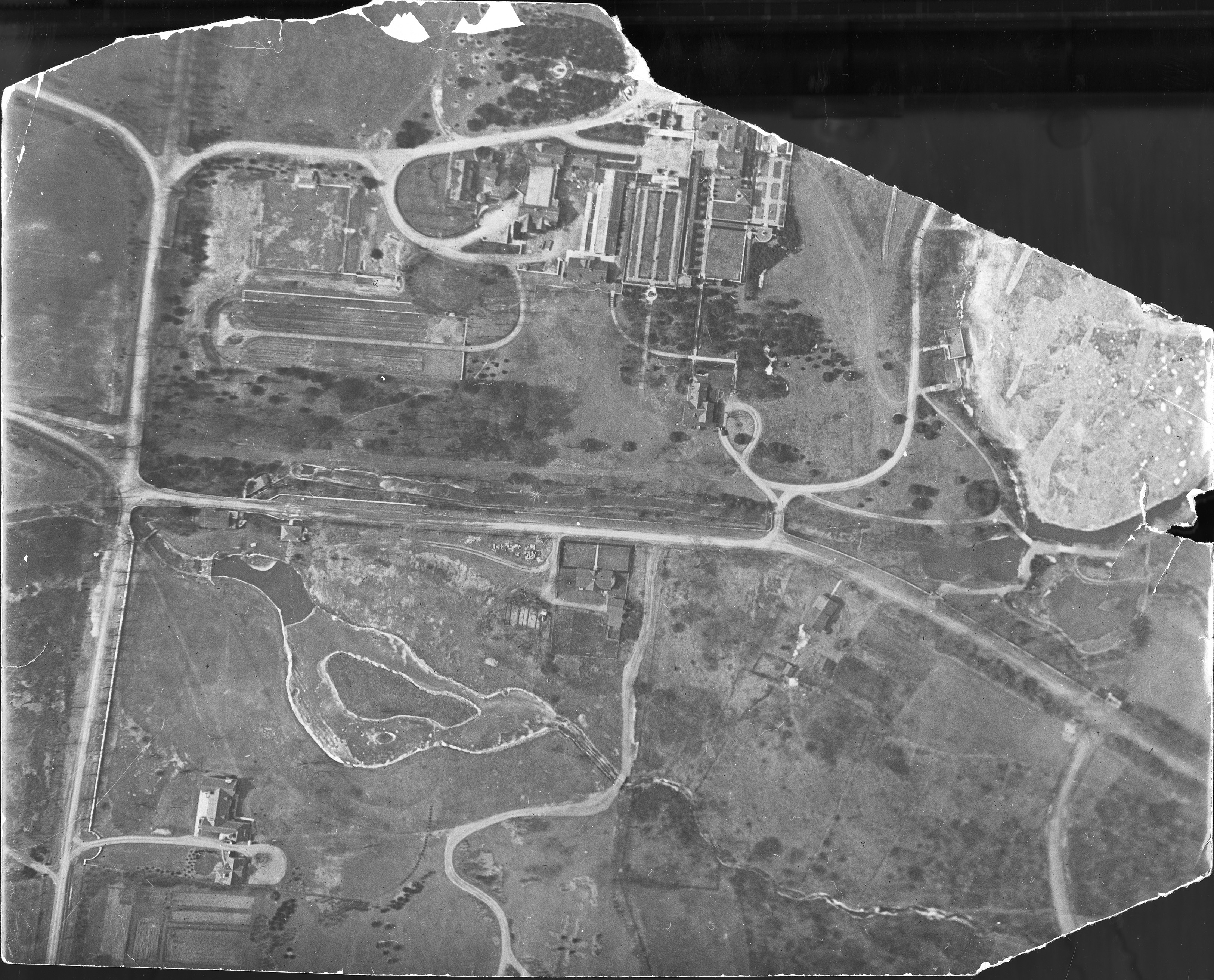
As Cranbrook’s landscape evolved from a family estate into a center for art and education, the means of recording and viewing the topography was assisted by developments in aerial photography, known as photogrammetry. Talbert Abrams, a native of Michigan, is regarded as a key contributor to this field of photography, as he founded the Abrams Aerial Survey Corporation in 1923. The earliest aerial photograph of Cranbrook I could locate is from circa 1918.

Aerial photograph of Cranbrook estate and environs, circa 1918.
Courtesy of Cranbrook Archives

In the Cranbrook Photograph Collection there are many aerial photographs taken by Abrams, as well as other photography firms, ranging from the 1920s through the 1990s. Since the purposes of aerial surveys are manifold, correspondence provides some insight into why they were commissioned and how they were specifically used, for example, as publicity and advertising. In 1932 Cranbrook’s public relations manager, Lee A. White, engaged Cranbrook School Headmaster William Stevens to select an image for the coming year’s brochure, and aerial views appear in all the early Cranbrook brochures. Aerial surveys have also been used to assess and understand the landscape prior to making a change to it. This was the case in 1961, when a topographic map and aerial photography were requested for the Off-Street Parking Study.

Letter from Keith A. Smith to Arthur B. Wittliff, November 1961.
Courtesy of Cranbrook Archives

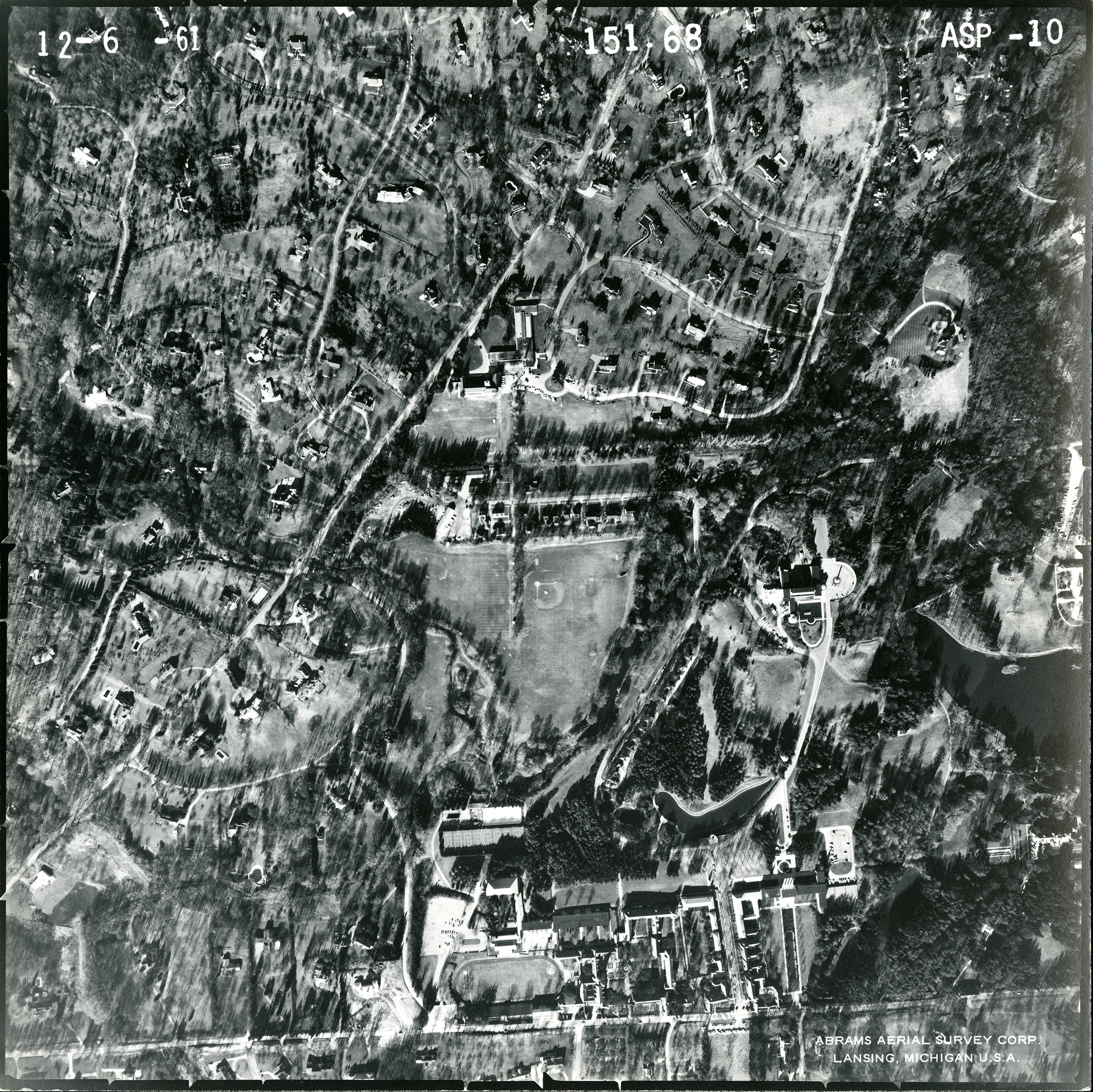
Correspondence between Arthur Wittliff, Secretary for the Cranbrook Foundation Board of Trustees, and Abrams Aerial Survey Corporation, provides intriguing details about the scale of the photography and the material base of the prints. The images below are from a December 6, 1961 set of 12 double weight velvet prints of aerials covering 1 square mile at a scale of 1 inch per 600 feet.

Aerial photograph ASP-5 taken by Abrams Aerial Survey Corporation on 6 December 1961.
Courtesy of Cranbrook Archives

ASP-5 (above) shows the intersection of Cranbrook Road and Lone Pine Road, and includes Kingswood School and Lake, the Institute of Science, Cranbrook House, Brookside School, Christ Church Cranbrook, and the Academy of Art and Academy Way. ASP-10 (below) shows another view of Cranbrook and its environs, encompassing the Institute of Science, Academy of Art, and Cranbrook School.

Aerial photograph ASP-10 taken by Abrams Aerial Survey Corporation on 6 December 1961.
Courtesy of Cranbrook Archives

When looking across the topographical history of Cranbrook from George’s map through aerial photographs, it is always fascinating to discern the changing landscape alongside the features that are unchanging. And, for me, the great inspiration of George’s map is that, although each individual project necessitated getting into the weeds and meticulous details, his ideas were always guided by situating them within a bigger picture.

Laura MacNewman, Associate Archivist, Cranbrook Center for Collections and Research

Cranbrook Gets the Royal Treatment

Not once, but twice, Cranbrook has pulled out the figurative red carpet and with appropriate fanfare welcomed Swedish royalty to its campus. Anyone who knows and loves Cranbrook might not be all that surprised by this revelation. After all, Cranbrook is a very special place—the home of dozens of sculptures by Sweden’s celebrated sculptor Carl Milles, who lived and worked at Cranbrook for twenty years, as well as many tapestries woven by Loja Saarinen’s renowned Swedish weavers. But the larger Detroit community has also boasted a significant Swedish cultural presence.

While most Michiganders might be familiar with the role that Swedish immigrants played in Michigan’s Upper Peninsula mining and lumber industries, Swedes also played major roles in Detroit’s development, from the auto industry to the fine and performing arts. Not least of all were the contributions made by Milles, including his sculpture The Hand of God, which has stood in front of the city’s Frank Murphy Hall of Justice since 1970. The founding in 1963 of the Detroit Swedish Council by Charles J. Koebel (who, decades earlier, had commissioned Eliel Saarinen to design his family home in Grosse Pointe Farms), saw a concerted effort to promote Swedish culture in the area. It was likely the unique combination of Cranbrook’s artistic works and Detroit’s vibrant Swedish community that attracted visits from Sweden’s royal family on two separate occasions.

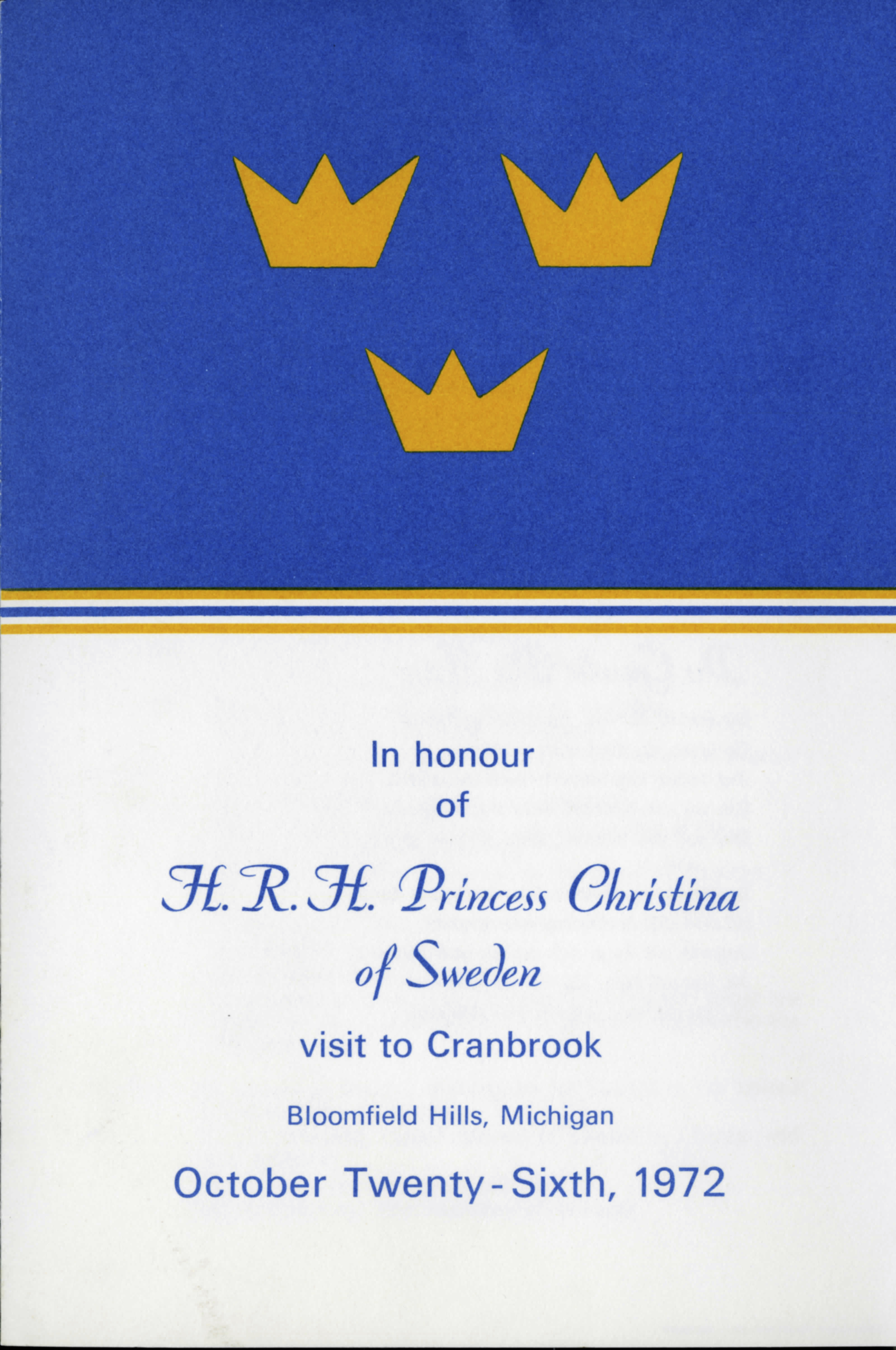
Program for the day’s activities. Courtesy of Cranbrook Archives.

So it was that on October 26, 1972, Princess Christina of Sweden set foot on Cranbrook grounds as part of her two-week tour of the States. And sixteen years later, her brother and his wife, King Carl XVI Gustaf and Queen Silvia, followed suit on April 18, 1988. Both visits focused largely on Carl Milles’ Cranbrook legacy, directly involved the Academy of Art and Art Museum, and were the result of collaborations between Cranbrook and the Detroit Swedish Council. Yet each visit had its own unique activities and sense of purpose.

Continue reading

Swedish Sculptors-in-Arms: Soderlind and Milles

The Nona Bymark Soderlind archival collection consists solely of one scrapbook, yet its contents provide an intriguing glimpse of the woman to which it is dedicated. In doing so, it also illuminates a brief but prolific period in the history of the Academy of Art and reveals a personal side to one of Cranbrook’s most celebrated Artists-in-Residence, the sculptor Carl Milles.

Nona Bymark Soderlind, circa February 1936. Courtesy of Cranbrook Archives.

Born Eleanora Maria Bymark on July 16, 1900 in a small Swedish immigrant community just outside of Minneapolis, Minnesota, Nona attended the Minneapolis School of Art (1920-1922) on a full scholarship, where she studied sculpture under Charles S. Wells. She later attended the University of Minnesota where she studied under the painter Samuel Chatwood Burton. In 1927 Nona returned for a semester at the School of Art, around the time she had her first child with husband Dr. Ragnar Soderlind. The Soderlinds had three young boys (two, eight, and nine years of age) when in 1936 Nona boarded a train to Detroit to study under Carl Milles.

Nona Bymark Soderlind works on a sculpture in Carl Milles Studio, 1936. Courtesy of Cranbrook Archives.

A February 13th letter from Richard Raseman, Academy of Art Executive Secretary, confirms Soderlind’s visit to campus and includes details of associated tuition and living costs required for the minimum period of study with Milles. Cross-referenced with items in her Academy student file, it is evident she had been invited by Milles to study for a month and arrived on the 18th. Perhaps it was Milles’ 1936 commission for Vision of Peace, in St. Paul, Minnesota that had first brought them in touch with each other?

Continue reading

The Fashions of Ruth Adler Schnee

Sometimes it seems there are infinite possible discoveries within a single archives collection. Such is the case with the Edward and Ruth Adler Schnee Papers. Just over a year ago I wrote about the Schnees’ long-running Detroit retail business, Adler/Schnee, but I knew then that story was only the tip of the iceberg.  

And so I was happy to find myself returning recently to one of my favorite collections in the Archives. Replacing materials that had been on loan to the Cranbrook Art Museum for their exhibit, Ruth Adler Schnee: Modern Designs for Living, I was once again struck by her achievements as a high school student at Cass Technical High School in Detroit from 1940-1942. In particular, her skill at fashion design. Maybe it was the months of hearing about sweatpants and Zoom shirts, but it was so refreshing to spend a few moments remembering what real fashion means. 

Ruth Adler Schnee illustration, circa 1941. Courtesy of Cranbrook Archives.

Before Ruth Adler Schnee made a name for herself in interior design, including her iconic textile designs, she was interested in becoming a fashion designer. Attending Cass Tech afforded Ruth the opportunity to nurture her natural artistic talents, which are clearly evident in drawings from her primary school days. And, she had already shown an affinity for fashion design—out of necessity, Ruth had already been designing her own clothes since she was a 13-year-old Jewish girl in Nazi Germany (her family emigrated in 1939).

Amongst other documents in her collection, the story of Ruth’s high school years and her passion for fashion are perhaps best captured in three notebooks. One of my favorite boxes in the collection holds nothing but pages from a notebook entitled Dress Design VI. Labeled “hours 1-4″ it is clearly a class project, and one for which Ruth received high marks. Divided into four parts (Machine Attachments, Illustrative Material, Drafting Problems, and Analysis of Dresses), the book includes drawings, pattern pieces (not to scale), paper mockups of mainly women’s sportswear designs, samples of sewing technique (actual fabric pinned to the page), textile identification pages (with real fabric samples), and an essay on silk. 

Sleeve Form page, in “Notes on the Draping of Garments,” Ruth Adler Schnee, circa 1942. Courtesy of Cranbrook Archives.
Continue reading

Le Corbusier Comes to Cranbrook

On November 21, 1935, celebrated French architect Le Corbusier arrived in Detroit and promptly demanded to be taken to Henry Ford’s River Rouge Complex. That one of the world’s leading modernist architects wanted to visit Ford’s factory shouldn’t have been too surprising, as for the previous two decades Le Corbusier—born Charles-Édouard Jeanneret—had been advocating for a revolution in architecture like Ford’s revolution in transportation.

In his groundbreaking 1923 book, Toward an Architecture (or, as it was titled in its first English translations, Towards a New Architecture,) Le Corbusier made the famous claim, “A house is a machine for living in.” As he believed, “Machines will lead to a new order both of work and of leisure.”

Le Corbusier told reporter Florence Davies of the Detroit News that “Detroit is the logical city for the production of the houses of tomorrow, the pre-fabricated efficient mass-production house.” He went on to claim that it would be automobile manufacturers, not architects, who would “undertake the production of the homes of tomorrow” because they understood the problems of mass production.

But while Ford may have attracted Le Corbusier to visit Detroit during the his one and only trip to America, it was Cranbrook Academy of Art and its president Eliel Saarinen that played host to the great architect.

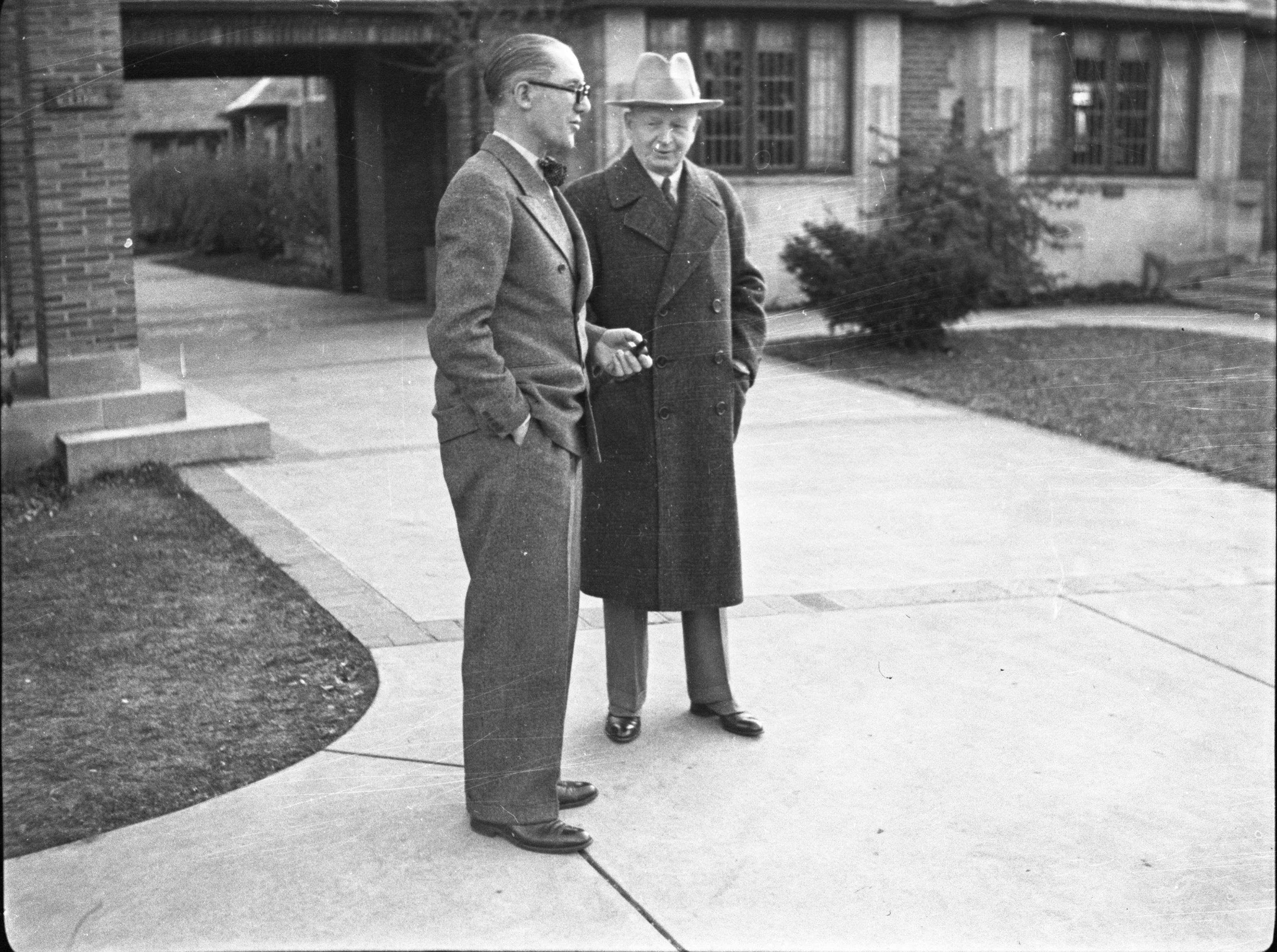
Le Corbusier, with pipe, and Eliel Saarinen at Cranbrook, November 1935. Richard G. Askew, photographer. Cranbrook Archives.

After seeing the Ford complex and a making a few stops downtown, Le Corbusier wound his way up to Bloomfield Hills. On display in the Cranbrook Pavilion (now St. Dunstan’s Theater) were twenty-four enlarged photographs, a selection of movies, fourteen building and city plans, and a single model documenting his work. These items were part of a small show on the architect open from November 19 to November 22. But the main event was Le Corbusier’s lecture at 8:00pm on November 21, 1935.

Delivered in French and translated by his American associate Robert Jacobs, Le Corbusier enthralled an at-capacity audience with his theories of architecture. He spoke of his work in Europe, including the recently completed Villa Savoye in Poissy. The focus, however, were his theories of city planning and mechanization. Le Corbusier used a sheet of tracing paper some 8- to 12-feet-long and pinned along the wall to execute large, colorful pastel sketches that illustrated his ideas of architecture and planning. This drawing was saved by the Academy, though it has since, sadly, been lost.

Installation view of Modern Architecture:
International Exhibition
at the Museum of Modern Art with Le Corbusier’s Villa Savoye at center and in photographs on left, February 9–March 23, 1932. While no photographs of Le Corbusier’s lecture or exhibition at Cranbrook survive, it was likely similar to this installation. MoMA Archives.

Le Corbusier lectured throughout most of his career as an architect. As he told an interviewer in 1951:

I never prepare my lectures…Improvisation is a wonderful thing: I draw, and when you draw and speak at the same time, you create something new. And all my theory—my introspection and retrospection on the phenomenon of architecture and urbanism—derives from my improvisation and drawings during these lectures.

After the Cranbrook lecture, Le Corbusier was the guest of the Academy of Art’s Executive Secretary Richard Raseman and Instructor in Interior Design Rachel DeWolfe Raseman. The couple had both studied architecture at Cornell (Rachel Raseman was Cornell’s first woman architecture graduate) and resided at Academy Residence #3 across Academy Way from Saarinen House. In the morning, Le Corbusier continued by train to the next stop on his cross-country journey.

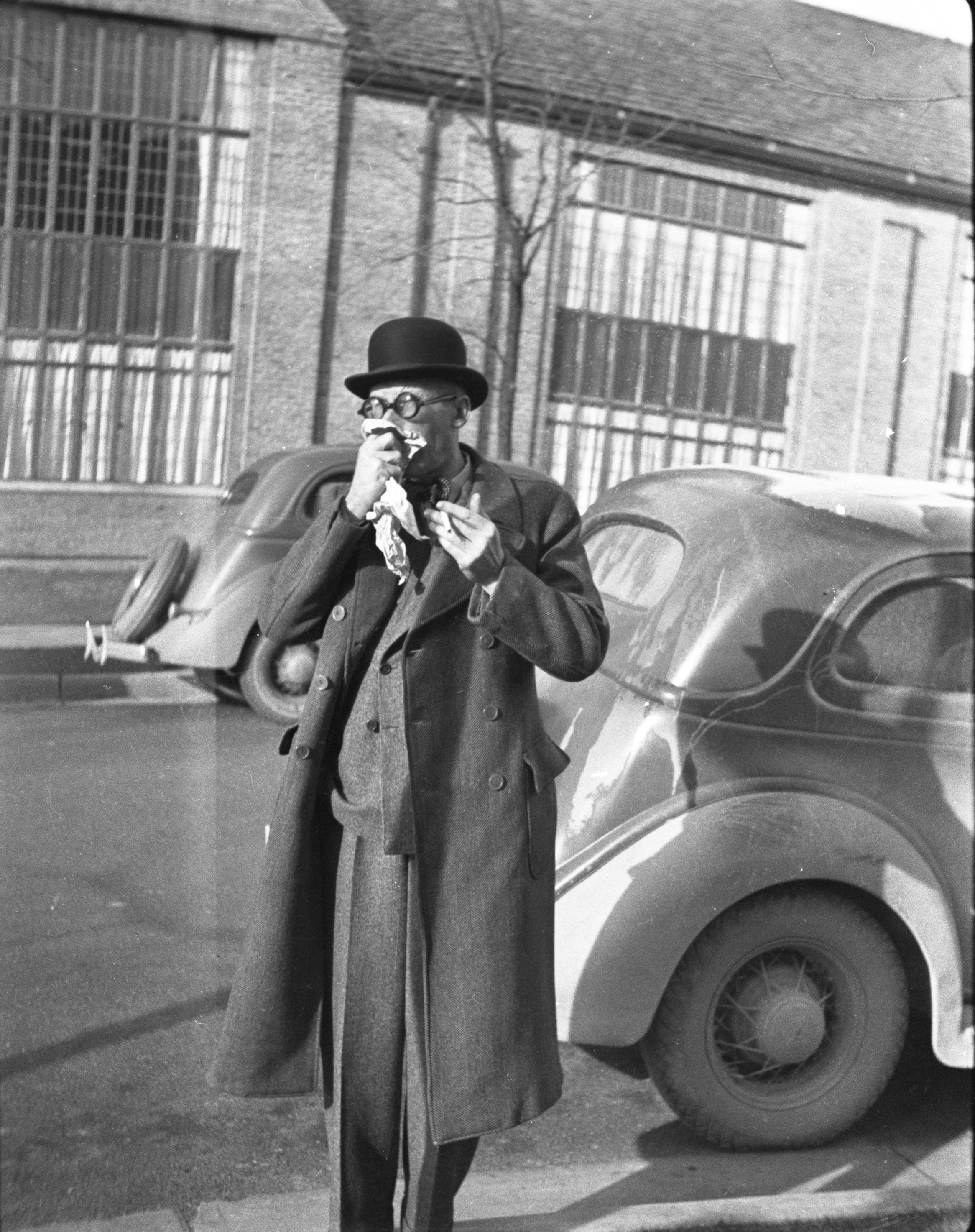
As the Detroit Free Press reported November 22, “With a few deft strokes Thursday, Le Corbusier, the famous French modernist-architect…sketched the vision that he sees through what is perhaps the most ponderous pair of eyeglasses ever fabricated.”

Le Corbusier in his famous eyeglasses at Cranbrook, November 1935. Richard G. Askew, photographer. Cranbrook Archives.

Alongside an earlier lecture in April 1935 by Frank Lloyd Wright, the visit to Cranbrook by Le Corbusier was one of the highlights of the Academy’s first decade. Reflecting in his Annual Report to the Cranbrook Foundation, Richard Raseman wrote that:

The Le Corbusier lecture, although delivered in French, was a good show, and as he is a world figure we were well satisfied…the public must have agreed with us as these lectures [by Wright and Le Corbusier] were by far the best attended of any of our functions…men of this caliber are rare indeed.

To learn more about Le Corbusier and his visit to Cranbrook, sign up for the Center’s History of American Architecture: Cranbrook Visitors Lecture Series! For the next five weeks, I will be discussing visitors, like Le Corbusier, who have lectured at Cranbrook since the Academy opened in 1932. From Le Corbusier, Wright, and Alvar Aalto in the 1930s through to Jeanne Gang, Greg Pasquarelli, and David Adjaye in the 2010s, I will tell the story of American design through architects who’ve spoken at Cranbrook. Learn more and sign up on our website. “See” you Monday at 11:00am or 7:00pm EST for our first virtual lecture!

Kevin Adkisson, Associate Curator, Cranbrook Center for Collections and Research

Create a website or blog at WordPress.com