Correspondence, including special occasion cards, are not uncommon in archival collections, but sometimes you find remarkable standouts such as the panoramic handmade masterpiece in the Marianne Strengell Papers. Measuring 5 x 24 inches, I invite you to click on the image below and zoom in to see all of the amazing details.
Titled, “This Way to the Strengell-Hammarstrom Gallery,” the card depicts a wall of portraits of Strengell family members, each complete with a short anecdote.
First portrait in the gallery. Courtesy of Cranbrook Archives.
At the end of the gallery is an abstract portrait of “Marianne Strengell Hammarstrom ‘Our Birthday Gal’” (curious, since she was born in May!). The card is signed, “love from your Weavers.”
Portrait and greeting detail. Courtesy of Cranbrook Archives.
Since no real names are used and the card is not dated, the origins and meaning behind the drawings and greeting remain as yet unknown. So far, research has not yielded any definitive answers. What we do know, however, is that Strengell enjoyed a wonderful relationship with her students and developed many deep friendships with both students and colleagues such as Wallace Mitchell and Zoltan Sepeshy. The wry, irreverent humor that imbues the card certainly suggests the close-knit, sociable atmosphere Marianne experienced at the Academy. “In all a very happy studio and many wonderful, now famous students. For me, 25 marvelous years.” (Marianne Strengell, 1989)
Last portrait in the gallery. Courtesy of Cranbrook Archives.
Strengell’s students included Nelly Mehta Sethna, Ed Rossbach, Robert Sailors and Jack Lenor Larsen, but she also had students from other departments study with her. These ‘Minors’ as Strengell dubbed them included Charles Eames, Benjamin Baldwin, Harry Bertoia, and Harry Weese.
Letter to Mark Coir, Archives Director, 1995. Courtesy of Cranbrook Archives.
Strengell, in fact, highly encouraged interaction between the departments, establishing Open House Days in the weaving studio, as well as Weavers Parties, which were very popular.
Revelers at a Weavers Party, 1959. Harvey Croze, photographer. Courtesy of Cranbrook Archives.
Marianne Strengell was a weaving instructor (1937-1942) and head of the Department of Weaving and Textile Design (1942-1961) at the Academy of Art. She often worked closely with her second husband, Olav Hammarstrom, architect and furniture designer, whom she married in 1948.
Farewell dinner for Marianne Strengell in the weaving studio, 1961. Strengell is shown middle left. Harvey Croze, photographer. Courtesy of Cranbrook Archives.
There are several other examples of holiday greetings in the Archives’ collections from Strengell’s contemporaries, but, in my opinion, none as witty as the one created by her Academy admirers.
May your holiday season be as merry and bright!
—Deborah Rice, Head Archivist, Cranbrook Center for Collections and Research
One of the most stunning examples of art-in-architecture at Cranbrook is the Pewabic Pottery fireplace in Saarinen House. This massive, shimmering display of handmade ceramic tiles is the focal point of the living room and perfectly completes Saarinen’s vision of the home as a Gesamtkunstwerk, or total work of art.
Yet the fireplace did not start at Cranbrook at all. It has a prestigious provenance one might not expect: The Metropolitan Museum of Art.
Eliel Saarinen’s 1929 fireplace, manufactured by Pewabic Pottery, installed in Saarinen House. James Haefner, photographer, 2015. Cranbrook Center for Collections and Research.
The Saarinen’s didn’t pick up the fireplace in The Met gift shop. Instead, it was designed and manufactured here in Michigan for a 1929 exhibition at the august New York museum: The Architect and the Industrial Arts—An Exhibition of Contemporary American Design. Under the direction of the Metropolitan’s Associate in Industrial Arts Richard F. Bach, Eliel Saarinen served as the principal designer for the exhibition.
The Met’s 1929 exhibition was a direct response to an earlier show: the 1925 Paris World’s fair, the Exposition Internationale des Arts Décoratifs et Industriels Modernes. This fair launched several international design trends that would later be known as the Art Deco style (an abbreviation of the exposition’s name). The United States, however, was not represented in Paris—U.S. Secretary of Commerce Herbert Hoover declined to participate because, as he (incorrectly) explained, there was no modern art this side of the Atlantic.
But American visitors to the 1925 fair, including Cranbrook founders George and Ellen Booth and the Saarinen family, were transfixed by the new style on display in Paris. The show pushed American designers, museums, department stores, and manufacturers toward a modern aesthetic.
The Architect and the Industrial Arts at the Met was conceived four years later, in part as an American response to the Paris show. It was also intended to further advance an appreciation for modern taste in this country.
Entrance to The Architect & the Industrial Arts exhibition designed by Joseph Urban. Exhibition poster by W. A. Dwiggins. Courtesy of The Metropolitan Museum of Art.
For the Met’s exhibition, architects created a series of modern rooms. In addition to Saarinen, leading architects like Raymond Hood, Ely Jacques Kahn, Ralph T. Walker, and Joseph Urban participated. While quite elaborate and sumptuous compared to later iterations of modernism, the 1929 vignettes at the Met helped to educate the public about modern taste and décor. Although one of the goals of the show was to have the objects on display mass produced, the rooms remained luxurious, singular constructions.
Dining Room designed by Eliel Saarinen, featuring the fireplace produced by Pewabic Pottery, for The Architect and the Industrial Arts at the Metropolitan Museum of Art, February 11 to September 2, 1929. Courtesy of The Metropolitan Museum of Art.
Saarinen’s dining room was considered by critics to be one of the most successful. Executed in shades of brown and tan, he created a dignified, formal dining room with furniture and objects of his own design produced by leading American manufacturers. In addition to furniture, silverware, glassware, rug, and lighting by Eliel, a hanging designed by Loja Saarinen (executed at Cranbrook by Studio Loja Saarinen) and wallpaper designed by their daughter Pipsan Saarinen Swanson helped finish the room.
The entire display was anchored by a massive fireplace, consisting of some 500 tiles stretching more than ten feet across the rear wall of the room. Designed by Eliel, this fireplace—which would eventually be installed at Cranbrook—was executed by the Pewabic Pottery in Detroit under the direction of Mary Chase Perry Stratton. Stratton co-founded the pottery in 1903, and by the time Saarinen’s fireplace was produced, she had already completed commissions at Cranbrook including the Rainbow Fountain (1916-1917) and Christ Church Cranbrook Baptistryand floor tiles (1926-1927). The Saarinen commission was unusual for Pewabic in that it was designed by an outside architect and not by Stratton herself.
The 1929 ceramic fireplace and bronze andirons in Saarinen House, installed in 1930. PD Rearick, photographer, 2016. Cranbrook Center for Collections and Research.
The pottery described the color of the tiles as “deep raisin” and “silver,” a moderne colorway quite different from the mottled and iridescent glazes Pewabic was known for. Eight different tile molds (or shapes) were used to create the fireplace.
Detail of the Saarinen-designed fireplace, manufactured by Pewabic Pottery, 1929. PD Rearick, photographer, 2016. Cranbrook Center for Collections and Research.
The main surface of the fireplace is created from three tile shapes. The dominant tile is a six-sided polygon in the form of a 7” wide by 2¾” high equilateral triangle with each point cut off. The second shape is one-half of the polygon, used to create the straight vertical edges of the fireplace. Between each polygon is a small rectangle, just ½” by ¾” high, finished in a darker and more iridescent glaze. By laying the tiles in alternating directions, Saarinen created a series of zig-zag grout lines moving rhythmically across the fireplace. This zig-zag was picked up in Pipsan’s wallpaper at the Met, and later, in the Saarinen House furniture.
Detail of the L-shaped corner tiles with square depressions on the Saarinen-designed fireplace, manufactured by Pewabic Pottery, 1929. Kevin Adkisson, photographer, 2020. Cranbrook Center for Collections and Research.
Two more tile types form a silvery border around the fireplace. Circling the perimeter of the fireplace are darker, almost bronze, iridescent tiles 8½” long by 1¾” high and 1¾” deep. Along the front surface of each tile are eight repeating rectangular depressions.
At each corner of the border sit 3½” L-shaped tiles with three square depressions. These geometric motifs recall the work of Charles Rennie Mackintosh in Glasgow or the Jugendstil designs popularized by designers like Josef Hoffmann. Similar square motifs are seen in the earlier 20th-century work of Saarinen in Finland. This L-shaped tile, with seven finished sides, is used for both the four outermost corners of the fireplace and the four inner corners around the firebox opening.
Detail of the Saarinen-designed fireplace showing all six of the front-facing tile shapes. Tiles manufactured by Pewabic Pottery, 1929. Kevin Adkisson, photographer, 2020. Cranbrook Center for Collections and Research.
The plinth of the fireplace is formed from six much larger Pewabic tiles, each 9¾” wide by 7¾” high and 2¾” deep. These tiles display the subtle color range, metallic iridescence, and richness of Stratton’s glaze recipe.
The last tile shapes are the most pragmatic: 7¾” by 3” tiles leading into to the roman brick firebox opening, and 7½” by 2¾” tiles that create a return running perpendicular to the fireplace face. These tiles allows the fireplace to project 5″ from the wall and negate the need of an overhanging mantlepiece.
If The Metropolitan Museum hoped its show would highlight the best of American production, Stratton succeeded in showcasing the power of handmade American ceramics. The entire exhibition turned out to be a blockbuster. Scheduled to be open for just six-weeks, from February 11 to March 24, 1929, its run was extended to September 2, 1929 due to popular demand. In the end some 186,000 visitors saw Saarinen’s dining room and Stratton’s fireplace as part of The Architect and the Industrial Arts, and the show became a defining moment in American Art Deco design.
At the same time as the show was on display in New York, Saarinen was busy back in Michigan developing designs for Kingswood School for Girls and continuing work on the nascent Cranbrook Academy of Art. This included designing his own residence, where Eliel planned to incorporate items from the Met exhibition into the interior.
Sometime between September 1929 and September 1930, the fireplace was dismantled in New York and shipped to Michigan. Like much of the work in the show, the tiles were paid for by the manufacturer, in this case, Mary Chase Perry Stratton and Pewabic Pottery. Instead of keeping or reselling the fireplace, Stratton donated the work to Cranbrook. As Florence Davies reported in The Detroit News at the time of the house’s completion, Stratton gave the tiles to Cranbrook out of an interest in furthering “the modern movement toward the creative design in the field of decorative art in America.”
The Saarinen fireplace installed at The Metropolitan Museum of Art in 1929 (left), and at Saarinen House at Cranbrook in 1931 (right). Courtesy of The Metropolitan Museum of Art/Courtesy of Cranbrook Archives.
As installed at Saarinen House, the fireplace is 8” narrower than it was at the Met, or one polygonal tile narrower. Perhaps some of the tiles broke in transit, or Saarinen thought the original size was too large for the wall at Cranbrook? In addition to the fireplace and its bronze peacock andirons, Saarinen repurposed the rug from the Met exhibition in the Saarinen House dining room, and Loja Saarinen’s wall hanging was purchased by Booth for the Kingswood Headmistress’s office.
From New York to Bloomfield Hills, and from museum to private residence and back to a museum, guests continue to admire and appreciate the beauty of this fireplace and the unique collaboration between Saarinen and Stratton.
—Kevin Adkisson, Associate Curator, Cranbrook Center for Collections and Research
Eds. Note: This Sunday, we’ll be offering a tour of Mary Chase Perry Stratton’s own house! Located in Grosse Pointe Park, this is the first of our new Virtual Day Away experiences. Join me to explore this incredible house and learn more about Stratton and her Pewabic Pottery. Tickets are on sale now until 1:00pm EST on November 15th. And if you want to see the Saarinen House fireplace in person, you still can: tours of Saarinen House run Friday, Saturday, and Sunday at 3:30pm EST through November 29!
Did you know that Cranbrook Art Museum’s educational partnerships with surrounding communities date back over sixty years? Long before the current museum trend of interactive educational programs for youth audiences, the Academy of Art and theJunior League of Birmingham had an idea: the Young People’s Art Center (YPAC).
Young People’s Art Center logo, from the 1962 enrollment form. Courtesy of Cranbrook Archives.
The year was 1958, and the Museum had recently changed names to the Academy of Art Galleries, shifting focus to feature more contemporary art practices. With that, came the desire to encourage young visitors to express their own artistic voices—participatory education, rather than simply art appreciation. Documenting the program’s first year, a June 1959 Detroit News Pictorial Magazine feature noted that YPAC “is fast gaining a national reputation for its lively approach to art education.”
In particular, it was Henry Booth (Academy Board of Trustees Chairman), Wallace Mitchell (Head of Galleries), and Zoltan Sepeshy (Academy Director) that approached the Junior League with a plan. In a 1957 report by Mitchell during the Center’s development phase, he states, “ The personnel of the Cranbrook Academy of Art has become increasingly aware of the growing country-wide interest in the visual arts and has long wished to more directly participate in the fostering and guiding of this interest as expressed in our community.” Seeking support from the Junior League, this “unique opportunity to bring to the children of Oakland County an integrated program in art education which concerns itself with the totality of the art experience” was green-lighted for the following year.
Children watch a judo demonstrator as part of a class exercise. Erik Strylander, photographer. From the article “Sketching to Jazz and Judo,” Detroit News Pictorial Magazine, June 28, 1959.
A perfect partnership was formed. The Academy would provide leadership, through the support of its trustees, director, and faculty; the Junior League would provide the necessary finances. Naturally, with so many talented artists on campus, there was no lack of creativity or helping hands! Junior League members were also heavily involved, providing volunteer docents to conduct gallery tours and assist with classes, both of which were located on the ground level of the Museum below the Academy Library.
Actor Edward G. Robinson is often remembered for playing gangsters and wise guys, or, my person favorite role, as Dathan in Cecil B. DeMille’s epic film The Ten Commandments (1956). What most people do not know is that Robinson was an art collector.
Edward G. Robinson as a gangster in Little Caesar (1931). Unknown author, Public domain, via Wikimedia Commons.
That is not exactly true. According to Robinson, at the time of the exhibition Forty Paintings from the Edward G. Robinson Collection at the Museum of Modern Art in 1953, “I am not a collector. I’m just an innocent bystander who has been taken over by a collection . . . I am just a lover of paintings. I do what I do for the sheer joy of it!”
Robinson continues, “If I hadn’t become a movie gangster, it is highly probable that not one of my paintings would have had the chance to collect me. Here is a paradox: Turn killer and you have the means to satisfy your thirst for beauty . . . Crime, it seems, sometimes does pay.”
Edward G. Robinson’s home. View of living room, October 3, 1944. Dorothy Liebes papers, circa 1850-1973. Archives of American Art, Smithsonian Institution.
Unfortunately, in February 1957, Robison was forced to sell his art collection as part of the divorce settlement with his first wife Gladys Lloyd Cassell Robinson. Immediately after, he began to collect again. This second collection would be even bigger than the first.
Unlike film moguls or actors who pay experts to place a couple of easily recognizable masterpieces above their fireplaces, Robinson selected his artworks himself. He bought on instinct and impulse, guided by what he loved. As he said, “You don’t collect paintings – they collect you.”
You may say, this is all very interesting, but what is the Cranbrook connection?
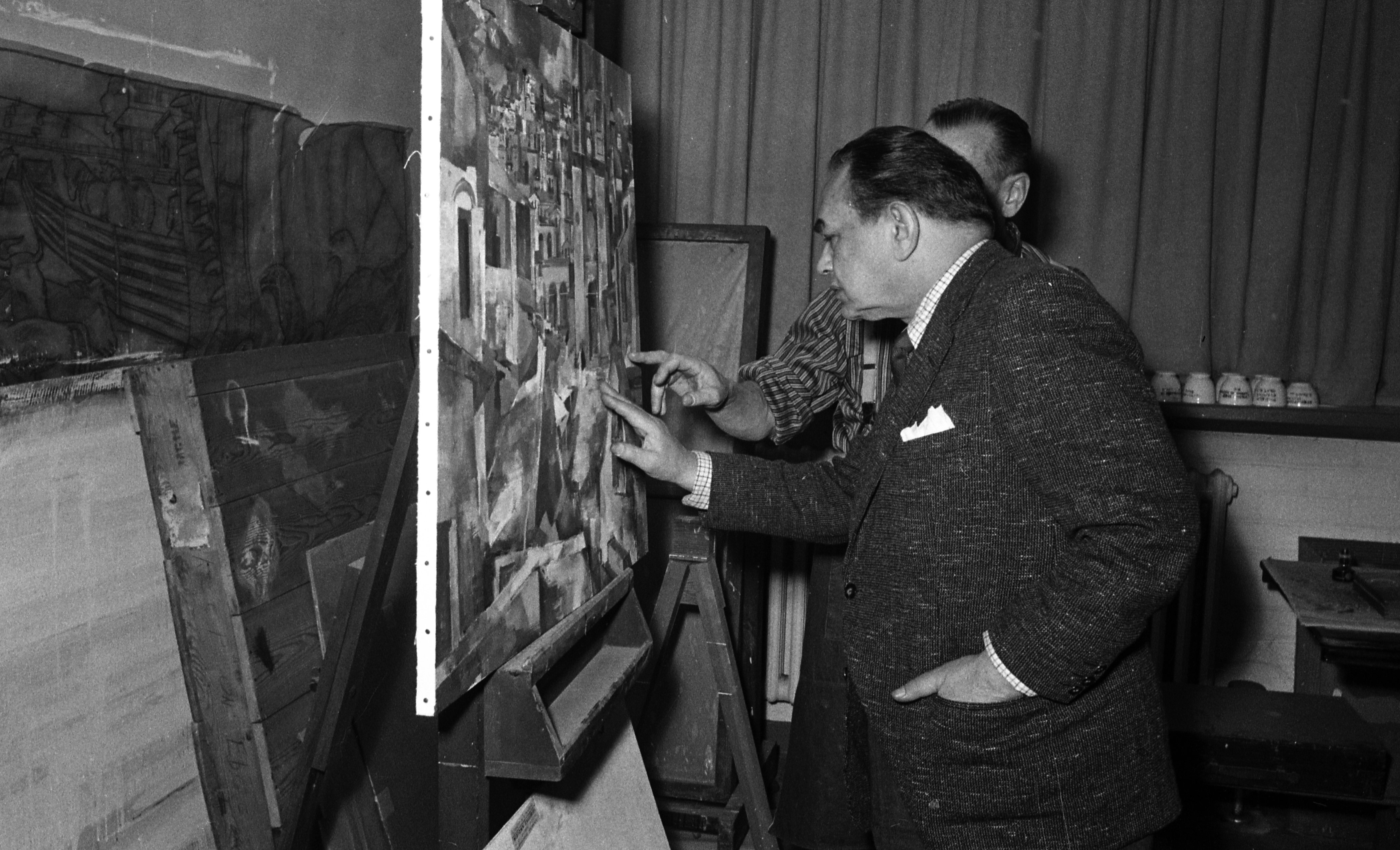
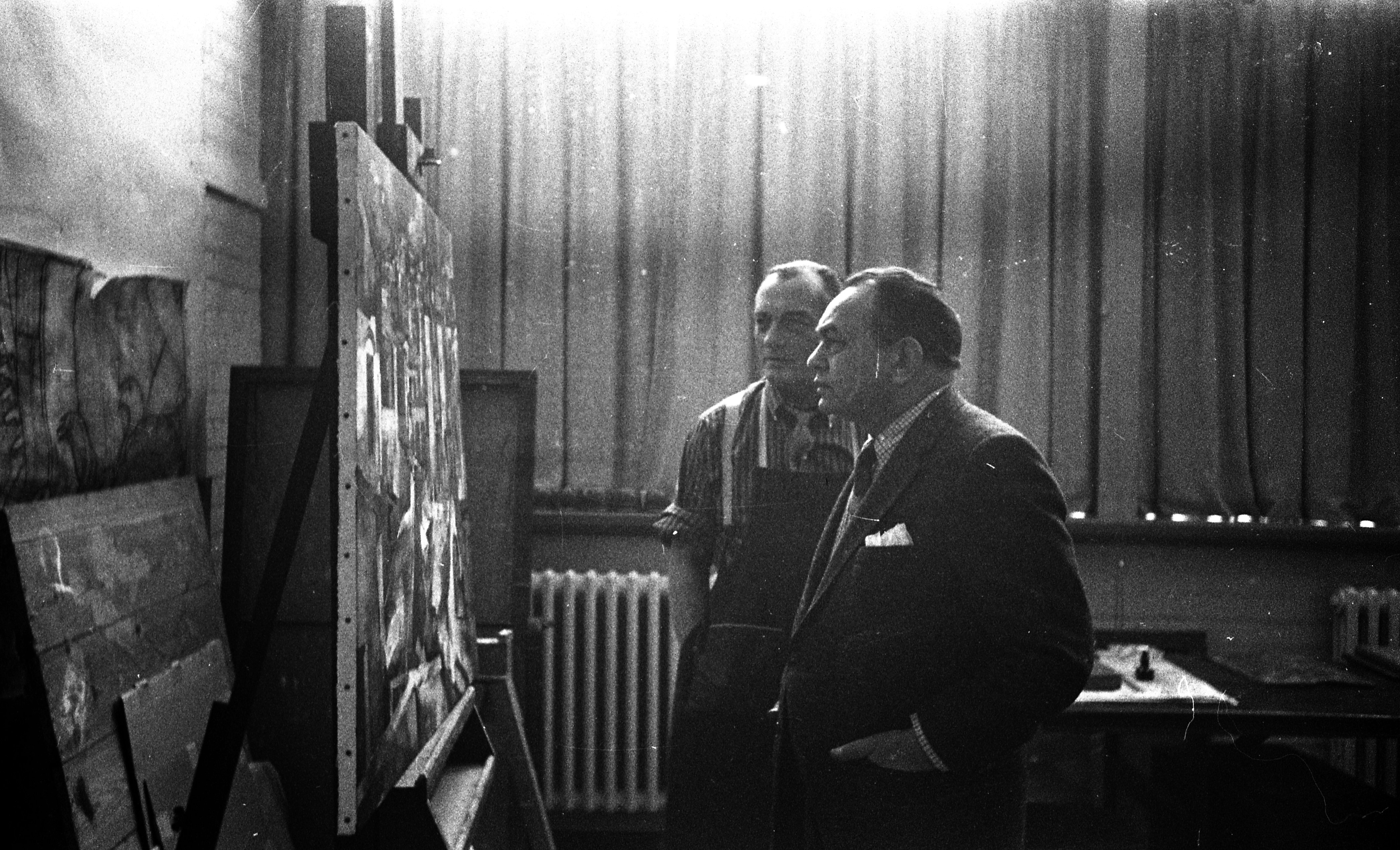
In December 1957, Robinson was in a play “Middle of the Night” at Cass Theatre in Detroit. According to the Sunday, December 15, 1957, Detroit Free Press, “A distinguished art lover, Edward G. Robinson, the actor, dropped in at Cranbrook Academy of Art Tuesday to chat with an old friend, Zolton (sic) Sepeshy, director of the Academy.”
Cranbrook Archives holds the “proof” of this visit, by way of wonderful images from our campus photographer, Harvey Croze.
Edward G. Robinson in Zoltan Sepeshy’s art studio at the Cranbrook Academy of Art admiring the artist’ works, including City of Churches, in December 1957. Photography by Harvey Croze. Courtesy Cranbrook Archives.
I did some digging, and Robinson’s personal archives at Boston University have no mention of Cranbrook or Sepeshy. I also could not confirm if Robinson had any of Sepeshy’s art in his collection; none appear in the 1953 exhibition or in the coffee table book about his second collection, Edward G. Robinson’s World of Art (1971).
I imagine it was simply his love of art that brought Robinson out to Cranbrook in 1957, the same reason so many of us are drawn to campus today.
—Leslie S. Mio, Associate Registrar, Cranbrook Center for Collections and Research
As performance venues prepare to reopen in Michigan today, I thought it timely to take a look at the storied history of a group that’s nearly as old as Cranbrook itself: St. Dunstan’s Theatre Guild of Cranbrook. With ties to Cranbrook’s founding family, staff, and the physical Cranbrook campus, combined with its enduring cultural role in the surrounding community, this nearly ninety-year-old institution has a rich history. Allow me to share with you a few fascinating details from its early years.
View of St. Dunstan’s Playhouse from Lone Pine Road looking east. Balthazar Korab, photographer. Copyright Korab and Cranbrook Archives.
“The worst thing about it, it’s named for a saint. But don’t think it’s holy, ‘cause it certainly ain’t.”
Sheldon Noble, an early and active Guild member
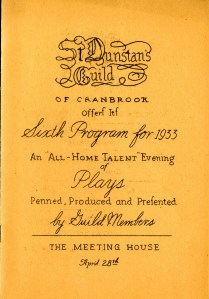
The Theatre Guild was indeed named after St. Dunstan, Archbishop of Canterbury in the ninth century and patron saint of the arts. As St. Dunstan lived in Kent, England, from where Cranbrook founder George Booth’s family hailed, the Guild’s name was fittingly suggested by his son and founding member, Henry Scripps Booth. Shortly after the Guild began in 1932, members were writing and producing their own one-act plays. In an April 1933 letter announcing an informal evening of a “Home Talent programme,” for the 100 Guild members and their guests, Jessie Winter, Guild Secretary and Brookside School Headmistress, implores them to “Be kind, be understanding, be generous . . . give the actors and authors the warm reception which such offerings warrant.” One such author was Henry Scripps Booth. Billed as Thistle, his play, Sedative Bed, was one of four being performed that April 28th evening at Brookside School for just $1. It was the tail end of the Great Depression, after all!
Front and back cover of the 1933 playbill. Courtesy of Cranbrook Archives, Cranbrook Center for Collections and Research.
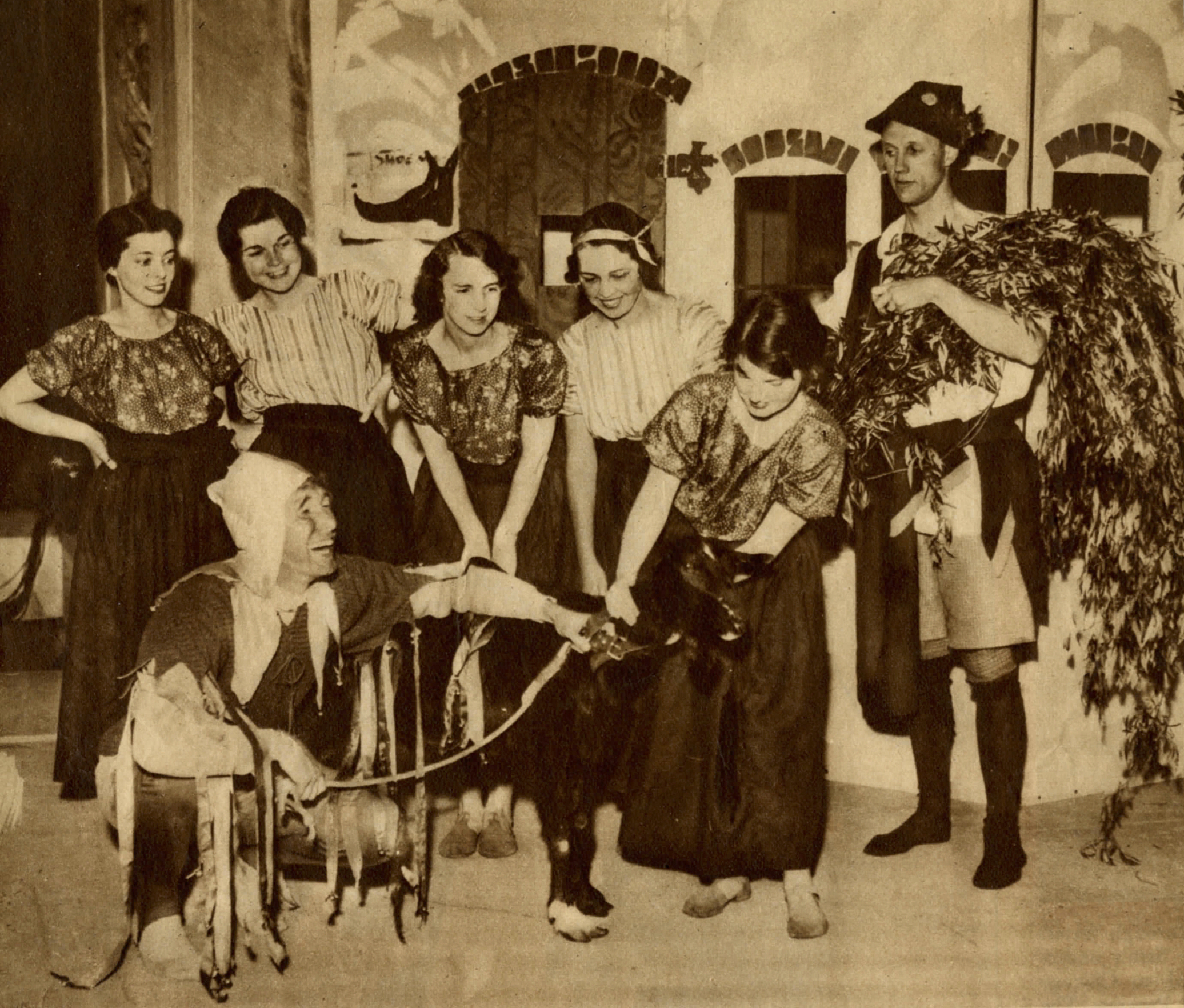
The first public performance of St. Dunstan’s Theatre Guild took place at the Greek Theatre with The King and the Commoner. Taking supporting roles were the likes of Annetta Wonnberger (Cranbrook Summer Theater School), Pipsan Saarinen Swanson (daughter of Cranbrook architect Eliel Saarinen), and Henry Scripps Booth, among others.
A scene from The King and the Commoner. Henry Booth on right. Detroit newspaper rotogravure clipping. Courtesy of Cranbrook Archives, Cranbrook Center for Collections and Research.
The cast and crew of the 1940 production of The Last of Mrs. Cheyney again reads like a who’s who of Cranbrook, including Harry Hoey (Cranbrook School Headmaster), Templin Licklider (Cranbrook School Faculty), Dorothy Sepeshy (wife of Cranbrook Academy of Art President, Zoltan Sepeshy), Rachel Raseman (wife of Richard Raseman, Cranbrook Academy of Art Executive Secretary and Vice President), the aforementioned Annetta Wonnberger, and various members of the Booth Family. Henry Scripps Booth, part of the Guild’s Scenic Design Committee, and his wife Carolyn, the production’s stage manager, created the sets.
On the eve of World War II, while Americans continued to suffer from the economic fallout of the Great Depression, the United States Treasury Department’s “Section of Fine Arts” commissioned Zoltan Sepeshy, the Head of the Painting Department at Cranbrook Academy of Art, to paint a mural for a new post office in downtown Caro. At the same time, one of his star students, David Fredenthal, was commissioned to paint a mural for the new post office in Lincoln Park. (Having trouble placing Caro, if not also Lincoln Park, on a map of Michigan? For your first geography lesson, place your right hand, palm side up, next to you. Caro is located in the middle of your thumb, while Lincoln Park is closer to your wrist.)
Zoltan Sepeshy with students, 1940. Cranbrook Archives.
David Fredenthal, June 1936. Cranbrook Archives.
Separate and distinct from the more extensive and influential WPA or Works Progress Administration’s “Federal Arts Project,” which essentially was a work-relief program for artists, the purpose of the Treasury Department’s “Section” program, as it came to be known, was “to secure for the Government the best art which this country is capable of producing, with merit as the only test.” Sepeshy and Fredenthal, with their recently minted Cranbrook credentials, fit the bill. Fredenthal even had some mural experience, having recently painted an octopus mural for the Academy’s now infamous Crandemonium Ball in 1936.
Octopus mural by David Fredenthal for Crandemonium Ball, March 1936. Cranbrook Archives.
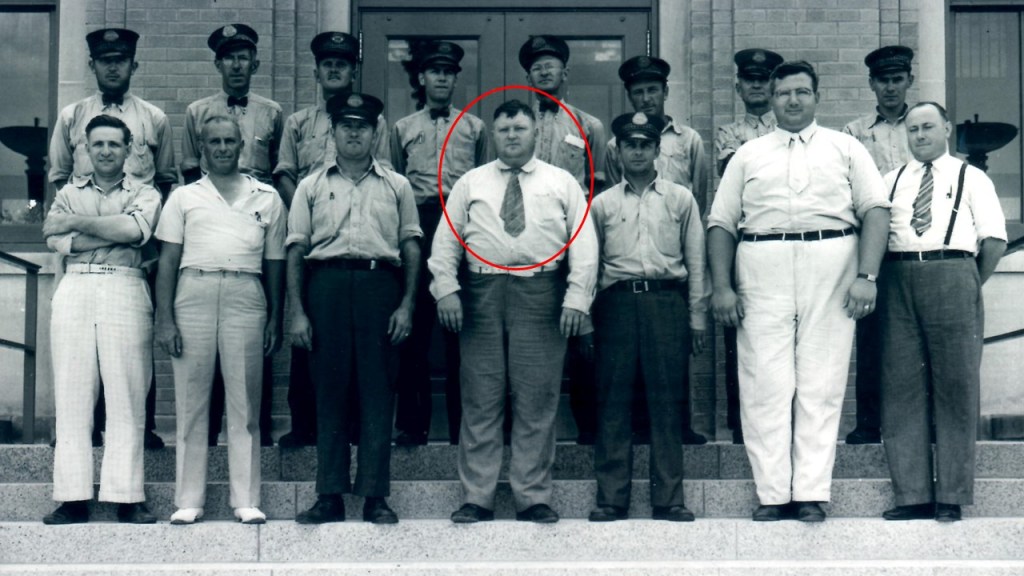
Meanwhile, Jimmy Southers, Lincoln Park’s postal superintendent, was more than a little perplexed and worried about the mural David Fredenthal was to paint for his post office. The week of September 25, 1939, Southers received a letter from Washington notifying him that Fredenthal, who the government described as a “sensational young artist” from Cranbrook Academy of Art, had been named to paint the mural—a fresco no less. Southers, who more than likely had not paid a visit to the seven-year-old Academy in Bloomfield Hills, not only had no idea what a fresco painting was but was intimidated by the government’s suggestion that he was to confer with the artist about the subject matter. His big idea? He thought a mural showing all of Lincoln Park’s postal superintendents (no doubt with him in a position of prominence) would do just fine.
Lincoln Park Post Office. Gregory Wittkopp, photographer. Cranbrook Center for Collections and Research.
Jimmy Southers and Lincoln Park Post Office Employees. Lincoln Park Historical Museum.
Fortunately for Southers, geography intervened. Pulling out his own map of Michigan, Sepeshy did some calculations (which I just repeated using Google Maps). Realizing that Caro was some seventy-two miles from his studio in Bloomfield Hills while Lincoln Park was just twenty-six, the Hungarian painter decided to pull rank. He had the commissions switched and assigned the Caro project to his student while he decided to paint the mural in Lincoln Park, a few miles south of Dearborn.
Among the treasures in Cranbrook Archives is a manuscript that, although I can’t read anything written inside, is one of my favorite things at Cranbrook. Bound in handwoven cloth by the author herself, the cover hints at what’s inside. This is Ruth Ingvarsson’s weaving book.
Ruth Ingvarsson’s weaving manuscript, hand-bound in a cloth cover of her own design and execution, ca. 1932-1935. Rigid Swedish-style counterbalanced loom depicted on the front, “R I” on reverse. Copyright Cranbrook Archives.
One of two manuscripts written in Swedish and assembled by Ingvarsson between 1932 and 1935, each of the more than 100 pages discuss different weave structures, materials, patterns, and techniques. Who was Ingvarsson, and how did these treasures end up at Cranbrook?
Weaving patterns, handwritten instructions, rug design, and handwoven samples by Ruth Ingvarsson, ca. 1932-1935. Copyright Cranbrook Archives.
Rut “Ruth” Elisabeth Ingvarsson was born on October 1, 1897 in Glemminge, Skäne, Sweden. Like many Scandinavian girls, she learned weaving first from her mother and then at school, graduating from the Glemminge Folkskola in 1918. In 1922, Ingvarsson began studies at the celebrated weaving studio of Märta Måås-Fjetterström in Båstad, Sweden.
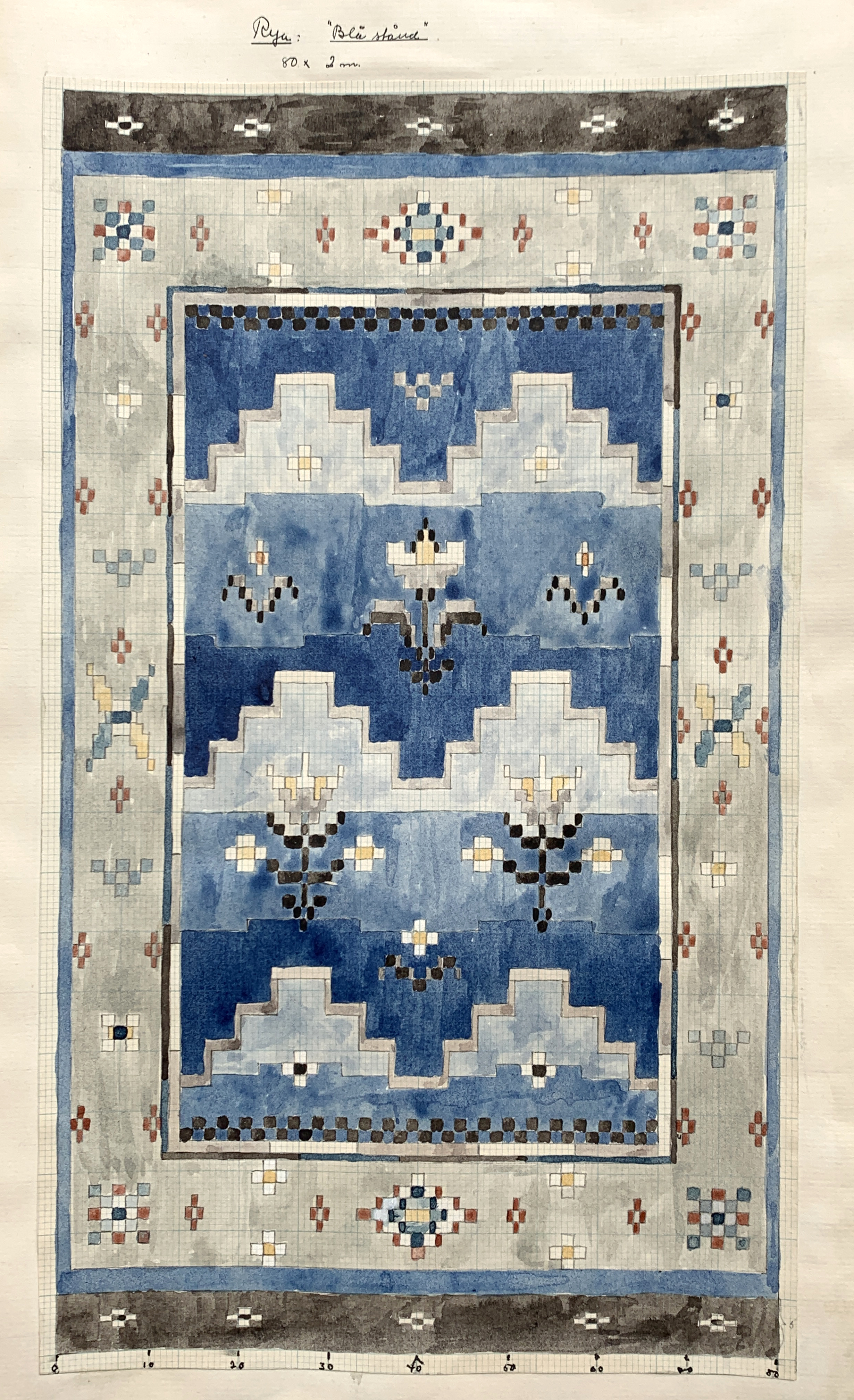
Ingvarsson continued working for Måås-Fjetterström until 1928, learning technical skills including knotted pile rya or flossa weaves, rölakan flatweave, and a discontinuous (or supplemental) weft style of tapestry weaving known as the MMF technique. Under Måås-Fjetterström, Ingvarsson developed great skill painting watercolor sketches on graph paper in the popular “Swedish Grace” (or “Swedish Modern”) style. She also befriended another young weaver, Lillian Holm, who entered into the Måås-Fjetterström studio in 1926.
Watercolor of a rug design in the “Swedish Grace” style by Ruth Ingvarsson in her untitled manuscript on weaving, ca. 1932-1935. Copyright Cranbrook Archives.
In late 1929, Ruth Ingvarsson and Lillian Holm immigrated to America to start work that December at Studio Loja Saarinen, Cranbrook’s weaving workshop. Here, Ingvarsson executed designs from Loja herself and other members of the Saarinen family, as well as designs by the Studio’s shop supervisor and prominent Swedish weaving expert Maja Andersson Wirde.
One was from Detroit; one was from Pittsburgh. One attended Kingswood School; the other attended the Academy of Art. One was a writer and women’s rights activist; the other was a sculptor, photographer, and social worker. Both were named Harriet Cooper. Both were on Cranbrook’s campus in 1940.
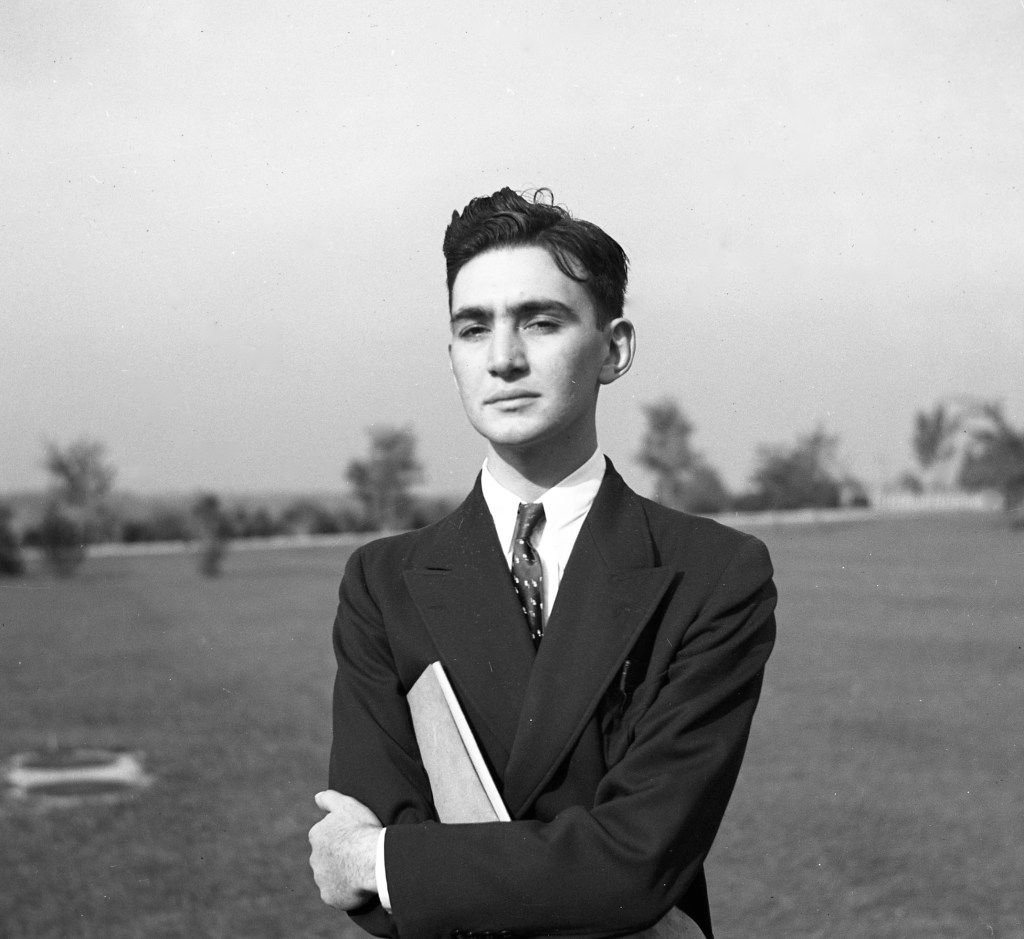
This was the unusual story I uncovered working recently with the Archives’ digital collections. While tagging images with the names of Cranbrook’s staff photographers, who were responsible for the majority of photographs taken at Cranbrook between the years 1931-1970, I came across the name Harriet Cooper. As one of only two female photographers, I attempted to find out more, and in the process discovered a second Harriet Cooper who was also at Cranbrook around the same time.
What were the odds? And more importantly, which was my Harriet? I had to find out, not only for the sake of photographic description, but to satisfy intellectual curiosity about the lives of two seemingly individual Cranbrook women, who shared the same name and once lived in close proximity (temporal and geographic) to each other.
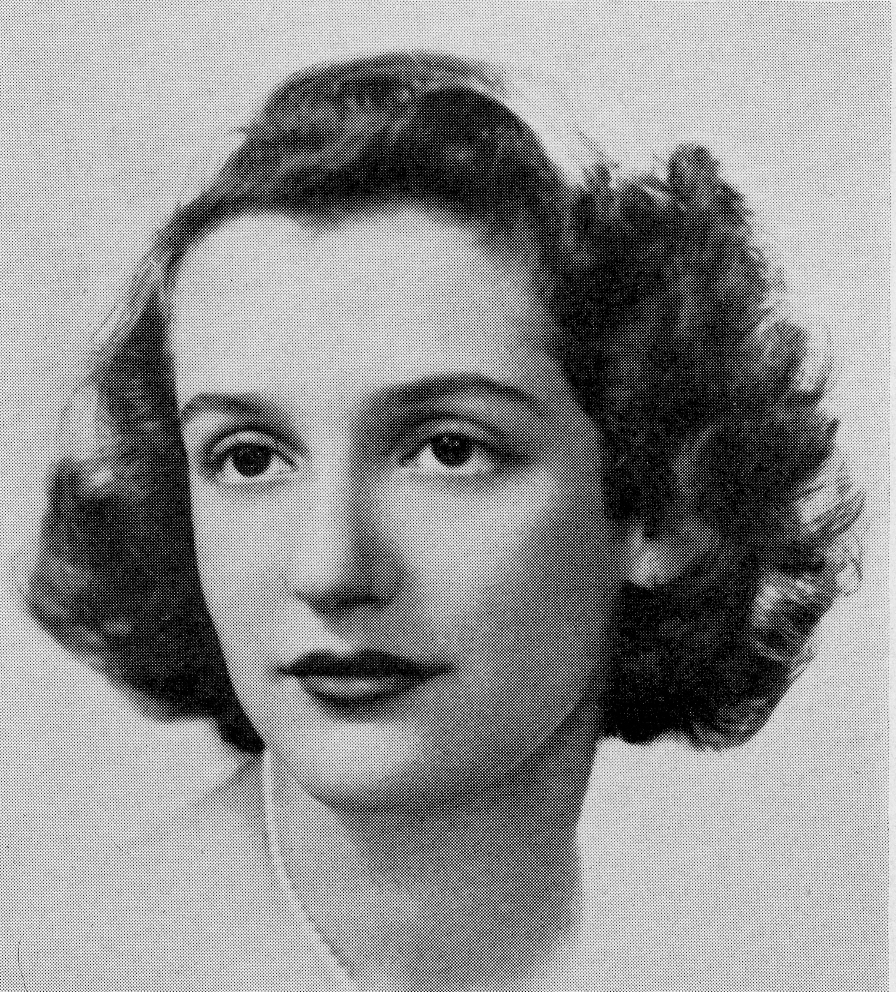
Senior picture of Harriet Cooper in the 1940 yearbook Woodwinds. Courtesy of Cranbrook Archives, Cranbrook Center for Collections and Research
Harriet Cooper Alpern was born in 1923. A Detroit native, she grew up on Chicago Boulevard in the Boston-Edison District. Attending Kingswood School (her twin brother attended Cranbrook School), she was active in theater and served as a reporter for The Clarion, graduating in 1940. According to the yearbook, Woodwinds, she was the senior voted for having the perfect speaking voice and known for splitting sides with her “unconscious humor.” After Kingswood, Harriet attended the University of Michigan, where her future husband E. Bryce Alpern also attended.
Poem appearing in the 1940 yearbook Woodwinds. Courtesy of Cranbrook Archives, Cranbrook Center for Collections and Research.
Harriet “Betty” Cooper, 1938. Courtesy of Cranbrook Archives, Cranbrook Center for Collections and Research.
Harriet Elizabeth (Betty) Cooper Lundquist was born in Valencia, Pennsylvania in 1916. She grew up in Pittsburgh, daughter of social workers and directors of Kingsley House, a settlement house. Betty attended both Antioch College and Yale University School of Fine Arts before coming to Cranbrook Academy of Art to study sculpture under Carl Milles from 1940 to 1942. While here, she also took classes in metalcraft, modeling, and design.
Untitled entry by CAA student Betty Cooper for the War Department Sculpture Competition, May 1, 1941. Courtesy of Cranbrook Archives, Cranbrook Center for Collections and Research.
And, she also took a job with Cranbrook Foundation as a photographer!
Although unknown whether she’d had any previous experience, Betty kept the Photography Department afloat on her own for several weeks during February and March 1942, and then stayed on for another seven months as assistant photographer. After graduation, Betty continued to work as a photographer for the Farm Security Administrationin Washington, D.C., where she met and married Oliver Lundquist.
Unattributed, this photograph of the interior of Milles House featuring Carl Milles’ sculpture collection was likely taken by Betty Cooper in February 1942. Courtesy of Cranbrook Archives, Cranbrook Center for Collections and Research.
While raising three children during the 1950s and 1960s, Betty was active in civil rights causes, including being a founding member of Women Strike for Peacein 1961. In the early 1970s, she went back to school and earned a graduate degree in social work, practicing her parents’ profession for the next thirty years until retirement.
It just goes to show that even while performing routine (but necessary!) archival tasks, fascinating stories reveal themselves, which provide new depth and understanding of Cranbrook’s people.
– Deborah Rice, Head Archivist, Cranbrook Center for Collections and Research
In the past, we have discussed how we cover our stone sculptures on campus to protect them in the winter. But what about the many bronze sculptures? Europe and the Bull? Persephone? The Centaurs?
These pieces are more robust and able to withstand what winter throws at them, but they still need some love each year.
Each spring since 1987, the Community has brought in Venus Bronze Works to recondition the bronzes across the campus. Venus Bronze Works is a member of the American Institute for Conservation of Historic and Artistic Works, which means all the cleaning they do is in accordance with AIC’s Code of Ethics and Guidelines for Practice.
All sculptures are inspected and cleaned by dusting them off with compressed air or wet down and washed with a mild detergent, sponges, soft bristle brushes, and fine cotton pads.
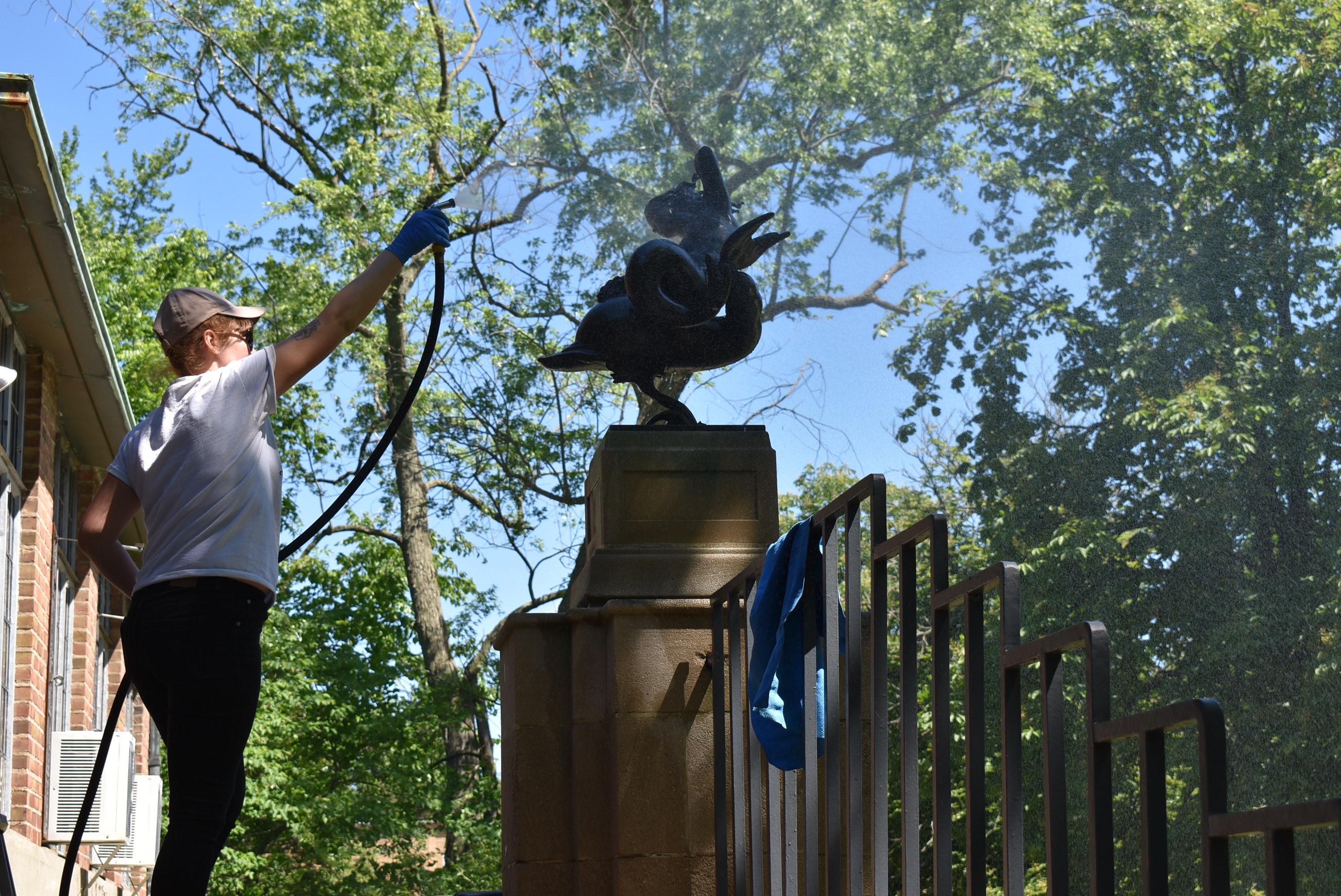
Terra Gillis of Venus Bronze Works gives Carl Milles’s Sunglitter (also know as Naiad and Dolphin, CAM 2002.1) a quick shower, 2020. Photo by Kevin Adkisson.Harlow Toland of Venus Bronze Works gives one of Carl Milles’s Running Deer (CAM 1934.30) a good scrub, 2020. Photo by Kevin Adkisson.
When the works are dried, one or two thin coats of wax are applied and the sculptures are buffed. This wax can be applied directly from the container or applied to a hot surface (by heating the sculpture with a propane-fed torch).
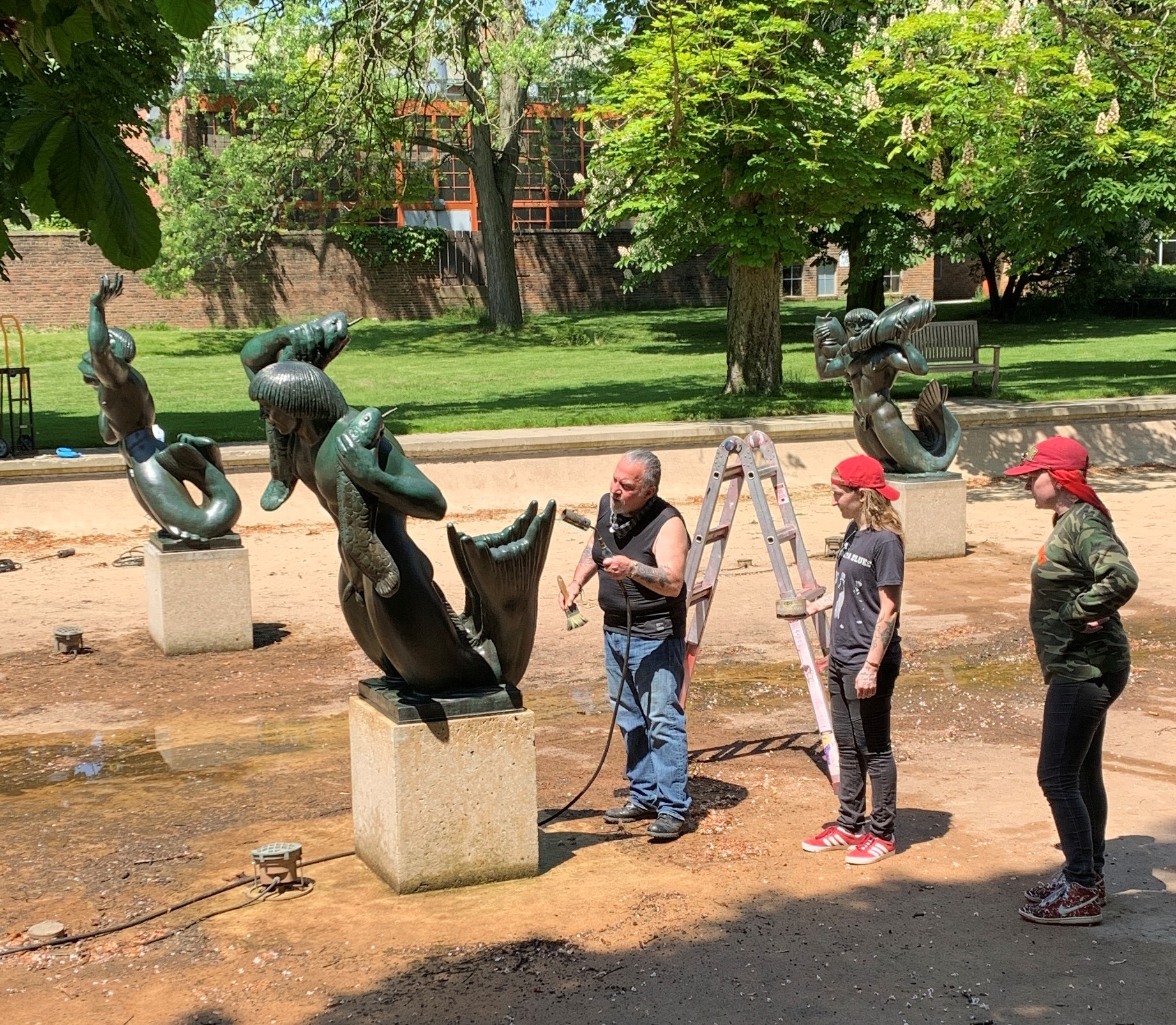
Giorgio Gikas, founder of Venus Bronze Works, holds the torch while his assistants Harlow Toland and Sara Myefski help prepare Triton with Fishes in the Triton Pools at Cranbrook Art Museum to receive a hot wax treatment, 2020. Photo by Kevin Adkisson.
This wax acts as a barrier to the air and humidity on the bronze surface and prevents damaging oxidization or corrosion from developing. When deciding how each individual work is cleaned, we look back to the artist’s intent for each sculpture (was it meant to be patinated green? dark bronze? polished? gilded?) and treat it accordingly.
Venus Bronze Works cleans and waxes all the Milles sculptures at the Cranbrook Art Museum and Cranbrook Academy of Art and the Cranbrook Institute of Science. They also work on such sculptures as Brookside’s Birds in Flight; Kingswood’s Dancing Girls and Diana; Cranbrook House and Gardens’ Fortuna delle Tartaruga (Turtle Fountain); and Cranbrook School’s athletic sculptures. Check out a recent Instagram post about the athletic sculptures below:
When I was asked, last summer, to make an impromptu display about Theodore (Ted) Luderowski, I found an inspiring story that begins in Hell’s Kitchen in New York City and continues with a lasting contribution to the landscape at Cranbrook and its educational, artistic, and cultural ethos.
Luderowski first arrived at Cranbrook as a student in1939after being awarded a competitive scholarship to study architecture under Eliel Saarinen while also “delving into the problems of metalwork and ceramics.” Born and raised in New York City, Luderowski left high school in 1927 at the age of 17, later graduating in 1932 after taking evening classes. He continued to take evening classes at Columbia University, where he studied design, shades and shadows, and perspective. He also studied for three years at the Mechanics Institute (General Society of Mechanics and Tradesmen of the City of New York), which was founded in 1785, where he was awarded the John E. Hoe Prize.
His initial instruction in architecture was through on-the-job training at firms, including the office of James Gamble Rogers. Luderowski was involved in designing schools, office buildings, residences, and institutional buildings, and in the planning of the 1939-1940 New York World’s Fair.
Theodore Luderowski, November 1950. Cranbrook Archives.
Arriving in 1939, Luderowski entered many external design competitions during his studentship at the Academy. The documents around these competitions are always a rich resource for researching and understanding the relationships between student artists, their peers, and mentors. The documents held at Cranbrook Archives that outline the problem of the competition, who entered and with whom, the photographs of thesubmissionsand participants, as well as personal letters, reveal the camaraderie between the participants—whether they were competing against each other or working on a submission together.
The competitions Luderowski participated in include the Radio Cabinet Competition (Fall 1939) with Edward Elliott and Vito Girone, in which Florence Schust and Christopher Chamales won 2nd prize; the Insulux Glass Brick Competition no. 4: A Newspaper Plant (with Elliott) (March 1939); and Insulux no. 3: A Dairy (August 1939), in which Ralph Rapson won 5th prize.
Aerial view of model for “A People’s Forum in Washington, D.C dedicated to the Bill of Rights.” February 1940. The team included Edward Elliott (architect), Theodore Luderowski (Landscape Architect), Tex Schiwetz (sculptor), and Margaret Garceau (Painter). This team won a second prize of $100. Richard G. Askew, photographer. Copyright Cranbrook Archives.
More notably, Luderowski, with Edward Elliott, Ted Schiwetz, and Margaret Garceau, won Second Prize in the 14th Annual Rome Collaborative Competitionof Spring 1940 (Jan 6 to Feb 10). The competition for students of architecture, landscape architecture, painting, and sculpture presented the problem of ‘A People’s Forum dedicated to the Bill of Rights’. It was hosted by the Association of the Alumni of the American Academy in Rome and the President was Paul Manship, whose work can be seen in the Quad at Cranbrook School, and the Secondary Vice President was Francis Scott Bradford, whose work can be seen at Christ Church Cranbrook.
After his studies, Luderowski worked as designer in the architectural offices of Eliel and Eero Saarinen before a period of service in the U.S. Navy as a Chief Petty Officer stationed in New York. He was stationed there with his wife, Ulla Ugglas, who had entered the Academy as a weaving student in 1940. Ulla, the daughter of Baron Gustaf Ugglas of Sweden, studied with Marianne Strengell and won first prize in rug design at the Fairchild Publications Weaving Competition in January 1941.
The newlyweds traveled in Scandinavia, Belgium, France, and England, where Luderowski studied architecture and design production methods, before returning to Cranbrook to work in the Saarinen offices again.
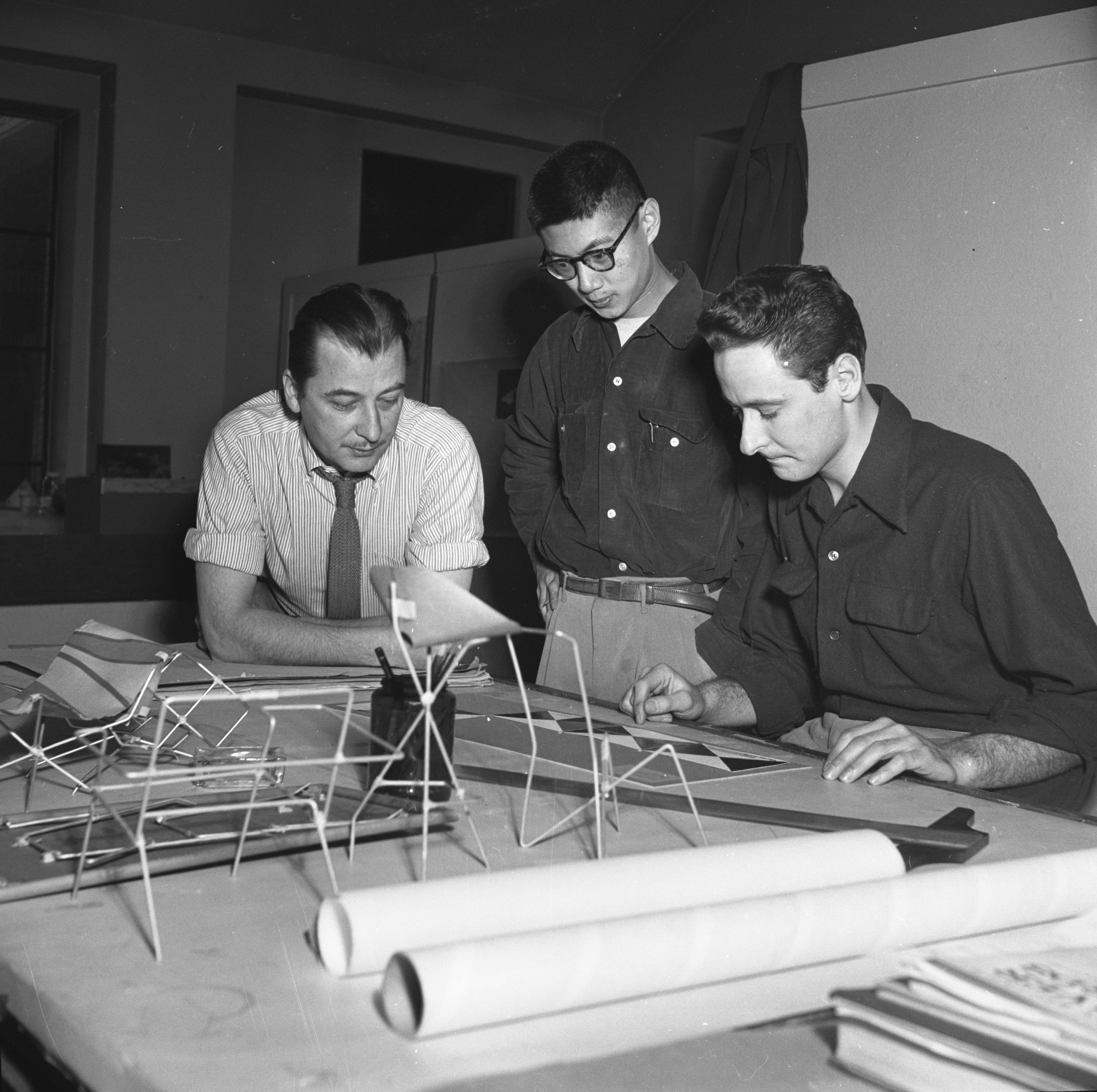
Ted Luderowski, left, with students in the design studio, February 1952. Cranbrook Archives.
In 1949, he became Head of the Department of Design at the Academy, which had been established in 1936 with instructor William W. Comstock under the supervision of Saarinen. While the initial emphasis was placed on design of interiors and their furnishings, after 1939, when Charles Eames was instructor, the courses became focused on “preliminary training in design for all branches of work.”
As an architect and furniture designer, a painter, and an exhibition designer, Luderowski brought a breadth of interests to the department which allowed the cultivation of a diversity of design problems, including his supervision of fifteen students in the redesign and mural decoration of the Academy recreation room.
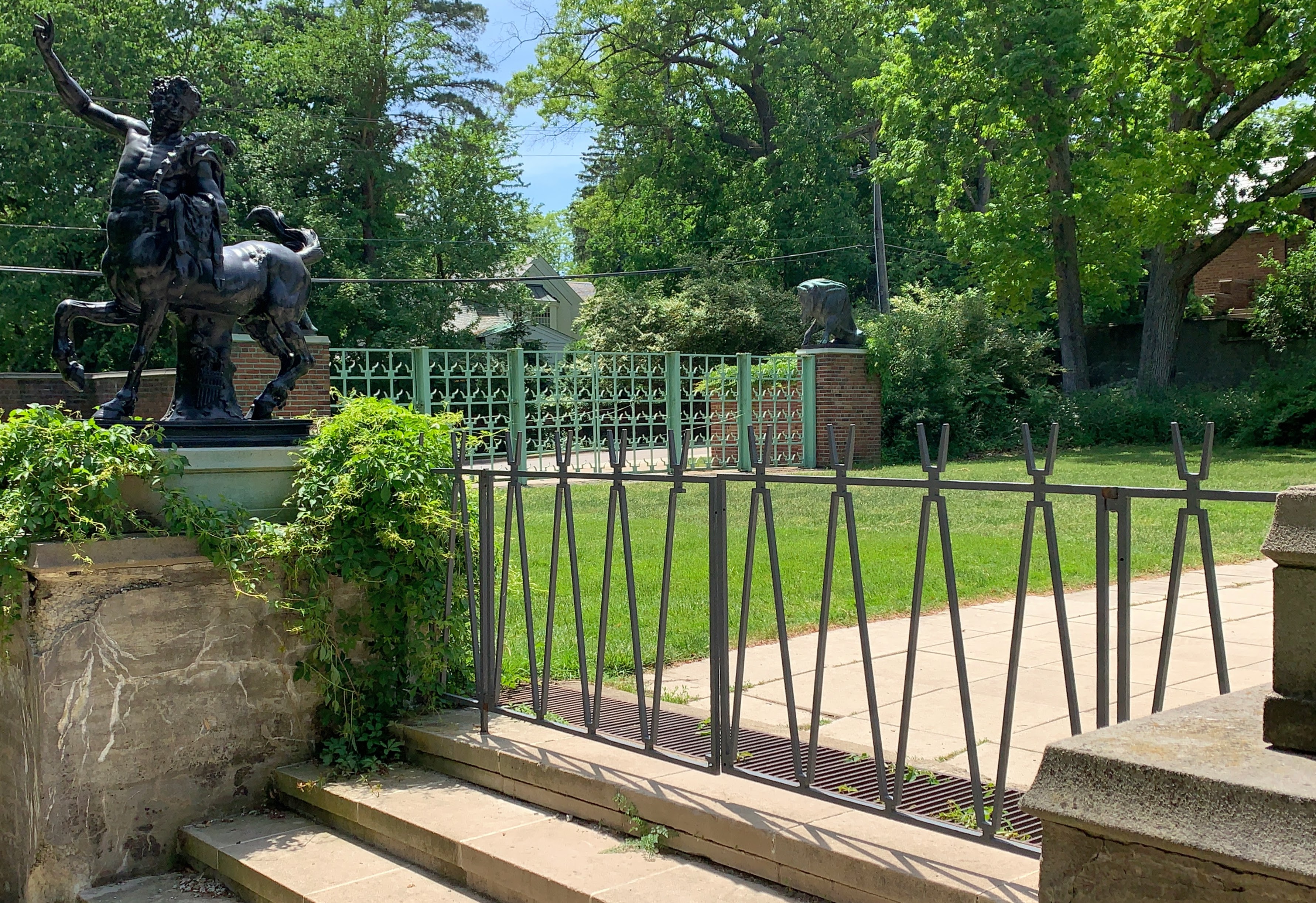
Gate designed by Ted Luderowski, 1952, with Eliel Saarinen’s Nichols Gate, 1941, behind. Kevin Adkisson, Courtesy Cranbrook Center for Collections and Research.
In 1952, he was asked to design and create wrought iron gates to be placed on the steps leading to Shoe Falls, which are at the far end of Triton Pools opposite the Arts and Crafts Courtyard. In a letter dated January 3, 1952, Henry Scripps Booth suggests that the design should, “be thoroughly practical and discourage youngsters from climbing over the gates, we should also make use of the opportunity to embellish the grounds with an interesting piece of iron work.” Luderowski’s design for the gates is held in our architectural drawing collection and the gates remain in situ on campus providing a wonderful continuance of the founding principle of beautiful and useful.
While within Cranbrook Archives we do not have a discrete collection for Luderowski, who passed away in 1967, he is heavily documented through photographic materials and with supporting information in the Cranbrook Academy of Art Records and Publications. It turned out the impromptu display I was asked to make about Theodore Luderowki last summer was for his son, who lived along Academy Way with his parents as a child and had returned, decades later, as part of a group tour.
—Laura MacNewman, Associate Archivist, Cranbrook Center for Collections and Research
[Editor’s Note: This post has been edited to add information on Luderowski’s study at the Mechanics Institute.]















 Cranbrook Kitchen Sink

