One of my favorite items in the collections of Cranbrook Archives is George Booth’s hand drawn map of Cranbrook, which he created over a 24-year period between 1904 and 1928. It is the earliest topographical record of Cranbrook and visually documents his ideas and plans for developing the landscape. In 1951, George’s son, Henry, created annotations to accompany the map, which are useful both in deciphering the map and identifying locations. Henry’s notes on what was envisioned and what was implemented during those early years, are a good starting point from which to venture into the manuscript collections for verification.
Cranbrook Map drawn by George G. Booth between 1904 and 1928. Courtesy of Cranbrook Archives
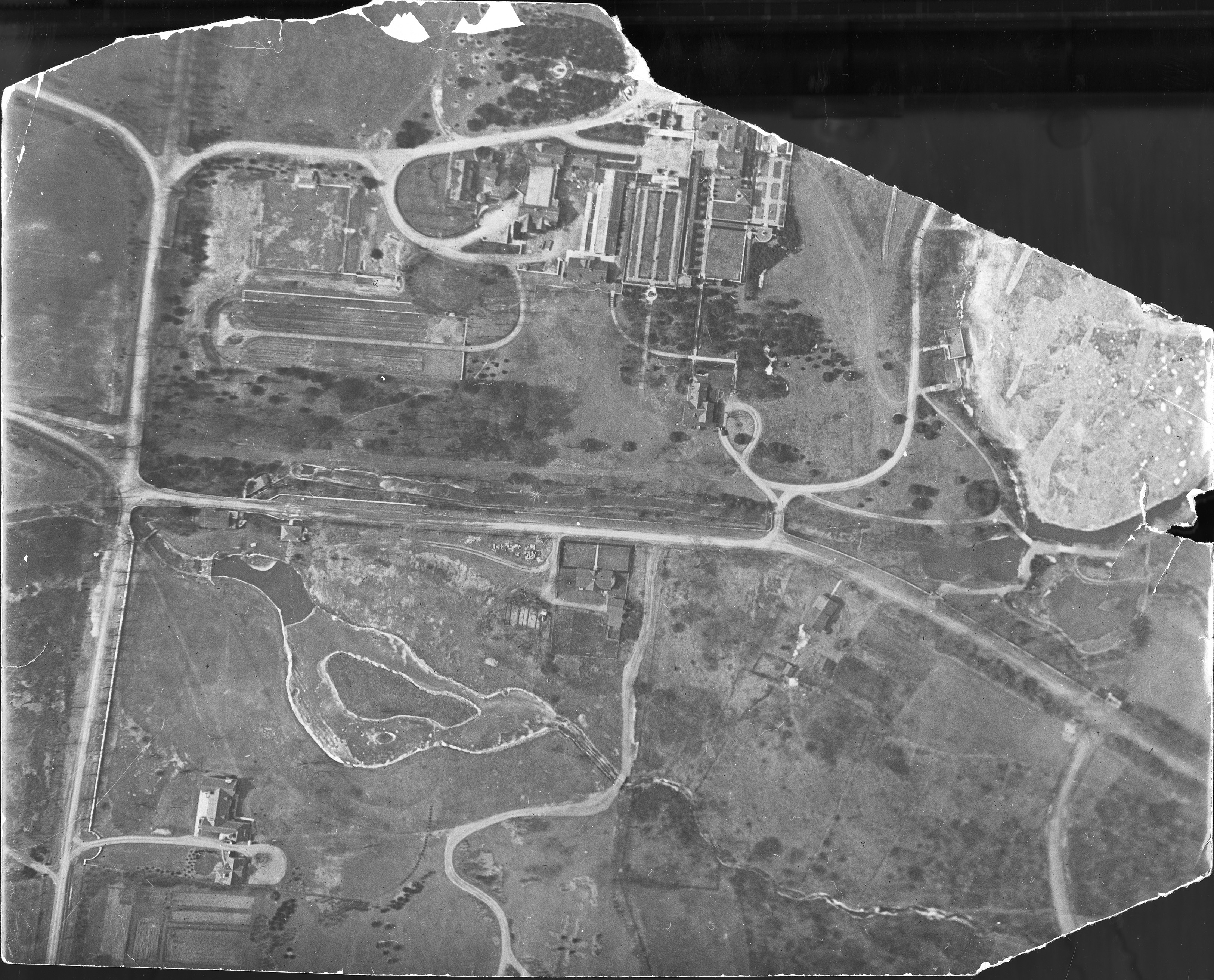
As Cranbrook’s landscape evolved from a family estate into a center for art and education, the means of recording and viewing the topography was assisted by developments in aerial photography, known as photogrammetry. Talbert Abrams, a native of Michigan, is regarded as a key contributor to this field of photography, as he founded the Abrams Aerial Survey Corporation in 1923. The earliest aerial photograph of Cranbrook I could locate is from circa 1918.
Aerial photograph of Cranbrook estate and environs, circa 1918. Courtesy of Cranbrook Archives
In the Cranbrook Photograph Collection there are many aerial photographs taken by Abrams, as well as other photography firms, ranging from the 1920s through the 1990s. Since the purposes of aerial surveys are manifold, correspondence provides some insight into why they were commissioned and how they were specifically used, for example, as publicity and advertising. In 1932 Cranbrook’s public relations manager, Lee A. White, engaged Cranbrook School Headmaster William Stevens to select an image for the coming year’s brochure, and aerial views appear in all the early Cranbrook brochures. Aerial surveys have also been used to assess and understand the landscape prior to making a change to it. This was the case in 1961, when a topographic map and aerial photography were requested for the Off-Street Parking Study.
Letter from Keith A. Smith to Arthur B. Wittliff, November 1961. Courtesy of Cranbrook Archives
Correspondence between Arthur Wittliff, Secretary for the Cranbrook Foundation Board of Trustees, and Abrams Aerial Survey Corporation, provides intriguing details about the scale of the photography and the material base of the prints. The images below are from a December 6, 1961 set of 12 double weight velvet prints of aerials covering 1 square mile at a scale of 1 inch per 600 feet.
Aerial photograph ASP-5 taken by Abrams Aerial Survey Corporation on 6 December 1961. Courtesy of Cranbrook Archives
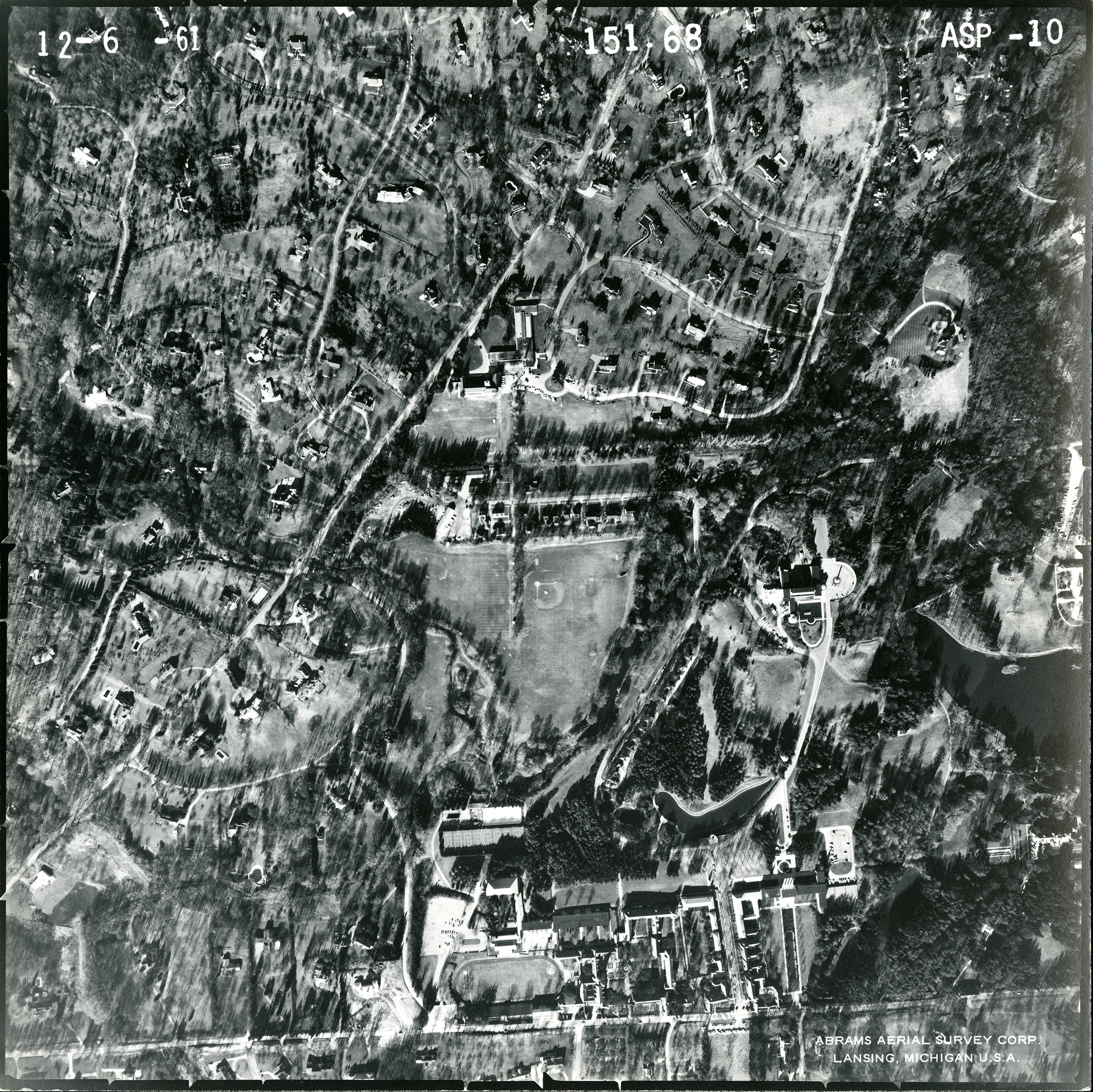
ASP-5 (above) shows the intersection of Cranbrook Road and Lone Pine Road, and includes Kingswood School and Lake, the Institute of Science, Cranbrook House, Brookside School, Christ Church Cranbrook, and the Academy of Art and Academy Way. ASP-10 (below) shows another view of Cranbrook and its environs, encompassing the Institute of Science, Academy of Art, and Cranbrook School.
Aerial photograph ASP-10 taken by Abrams Aerial Survey Corporation on 6 December 1961. Courtesy of Cranbrook Archives
When looking across the topographical history of Cranbrook from George’s map through aerial photographs, it is always fascinating to discern the changing landscape alongside the features that are unchanging. And, for me, the great inspiration of George’s map is that, although each individual project necessitated getting into the weeds and meticulous details, his ideas were always guided by situating them within a bigger picture.
—Laura MacNewman, Associate Archivist, Cranbrook Center for Collections and Research
Not once, but twice, Cranbrook has pulled out the figurative red carpet and with appropriate fanfare welcomed Swedish royalty to its campus. Anyone who knows and loves Cranbrook might not be all that surprised by this revelation. After all, Cranbrook is a very special place—the home of dozens of sculptures by Sweden’s celebrated sculptor Carl Milles, who lived and worked at Cranbrook for twenty years, as well as many tapestries woven by Loja Saarinen’s renowned Swedish weavers. But the larger Detroit community has also boasted a significant Swedish cultural presence.
While most Michiganders might be familiar with the role that Swedish immigrantsplayed in Michigan’s Upper Peninsula mining and lumber industries, Swedes also played major roles in Detroit’s development, from the auto industry to the fine and performing arts. Not least of all were the contributions made by Milles, including his sculpture The Hand of God, which has stood in front of the city’s Frank Murphy Hall of Justice since 1970. The founding in 1963 of the Detroit Swedish Councilby Charles J. Koebel (who, decades earlier, had commissioned Eliel Saarinen to design his family home in Grosse Pointe Farms), saw a concerted effort to promote Swedish culture in the area. It was likely the unique combination of Cranbrook’s artistic works and Detroit’s vibrant Swedish community that attracted visits from Sweden’s royal family on two separate occasions.
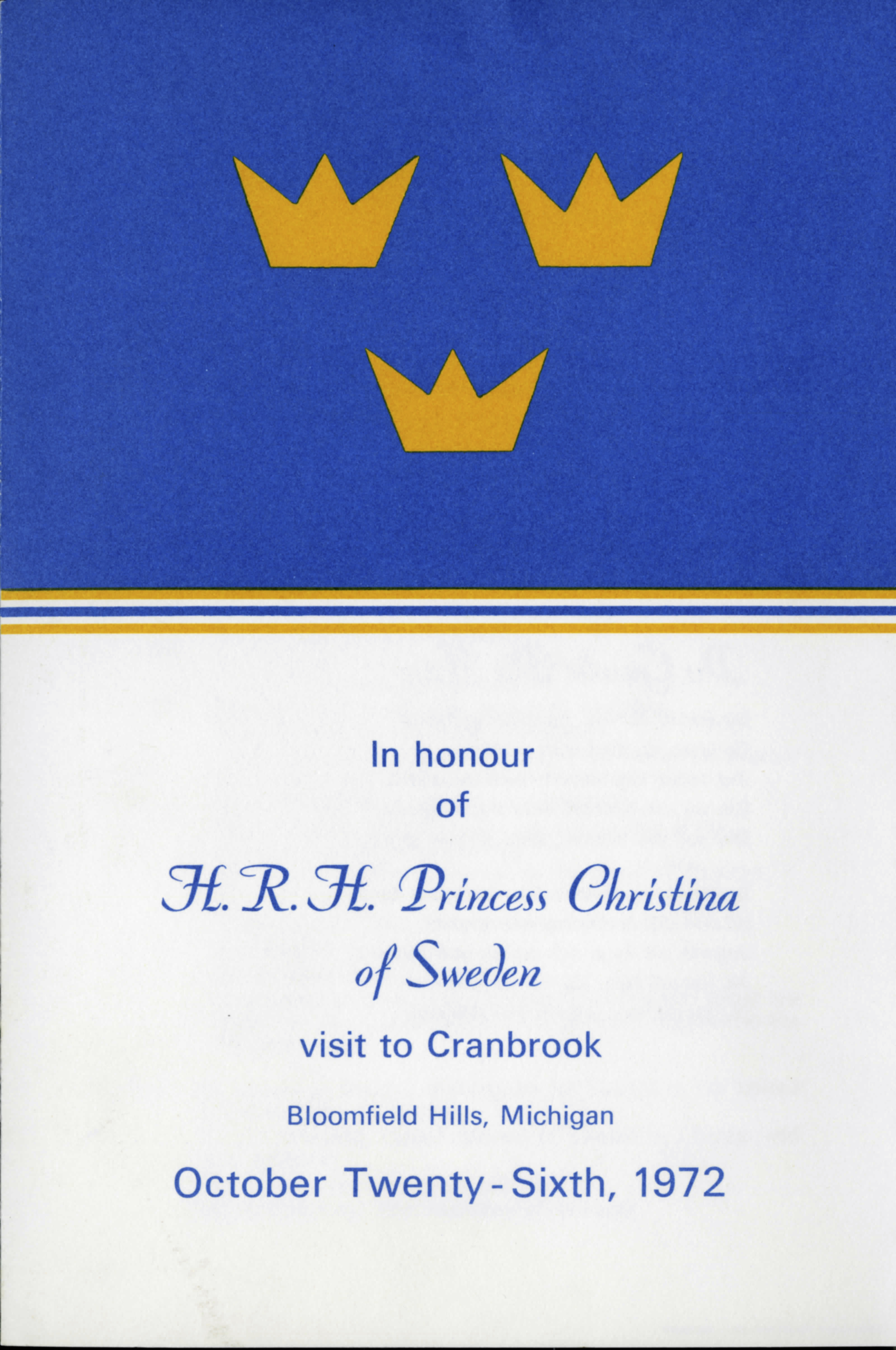
Program for the day’s activities. Courtesy of Cranbrook Archives.
So it was that on October 26, 1972, Princess Christina of Sweden set foot on Cranbrook grounds as part of her two-week tour of the States. And sixteen years later, her brother and his wife, King Carl XVI Gustaf and Queen Silvia, followed suit on April 18, 1988. Both visits focused largely on Carl Milles’ Cranbrook legacy, directly involved the Academy of Art and Art Museum, and were the result of collaborations between Cranbrook and the Detroit Swedish Council. Yet each visit had its own unique activities and sense of purpose.
On a cold January evening, I crossed paths with Iris Eichenberg, Metalsmithing Artist-in-Residence, along Academy Way. Through our masks, we talked about how we might be able to do what has become an annual winter tradition: the special Academy of Art student show in Cranbrook House.
Three years ago, in February 2018, Iris and I worked together to place art from students and alumni of the Metalsmithing Department around the first floor of Cranbrook House. We did similar shows the next two years, inviting other departments as we went along. None of us could’ve guessed that the opening night of last year’s show would be one of the last large, maskless, worry-free gatherings for a while!
Standing Veil by Sylvain Malfroy-Camine, Painting 2021, on display in the Cranbrook House Sunset Porch as part of Speculative Histories, March 2021. Eric Perry, photographer. Cranbrook Center for Collections and Research.
Knowing the 2021 student show in Cranbrook House would have to be totally different and without any public visitors, Iris and I wondered if we should do it at all. I talked with some of the other Artists-in-Residence (AIRs) and decided: if we don’t do the show this year, it’s just one more thing the current students won’t have a chance to experience due to the pandemic. There would be a show!
Without in-person visitors to the exhibition, one of our perennial logistical problems was solved. A wintertime event in Saarinen House or the Frank Lloyd Wright Smith House brings ice and salt and general weather-related nastiness—it’s why we close the houses for tours November to May. But if there aren’t any physical guests, why not expand the show to include all three of Cranbrook’s historic houses? If we expand to include more physical space, why not invite every department to participate?
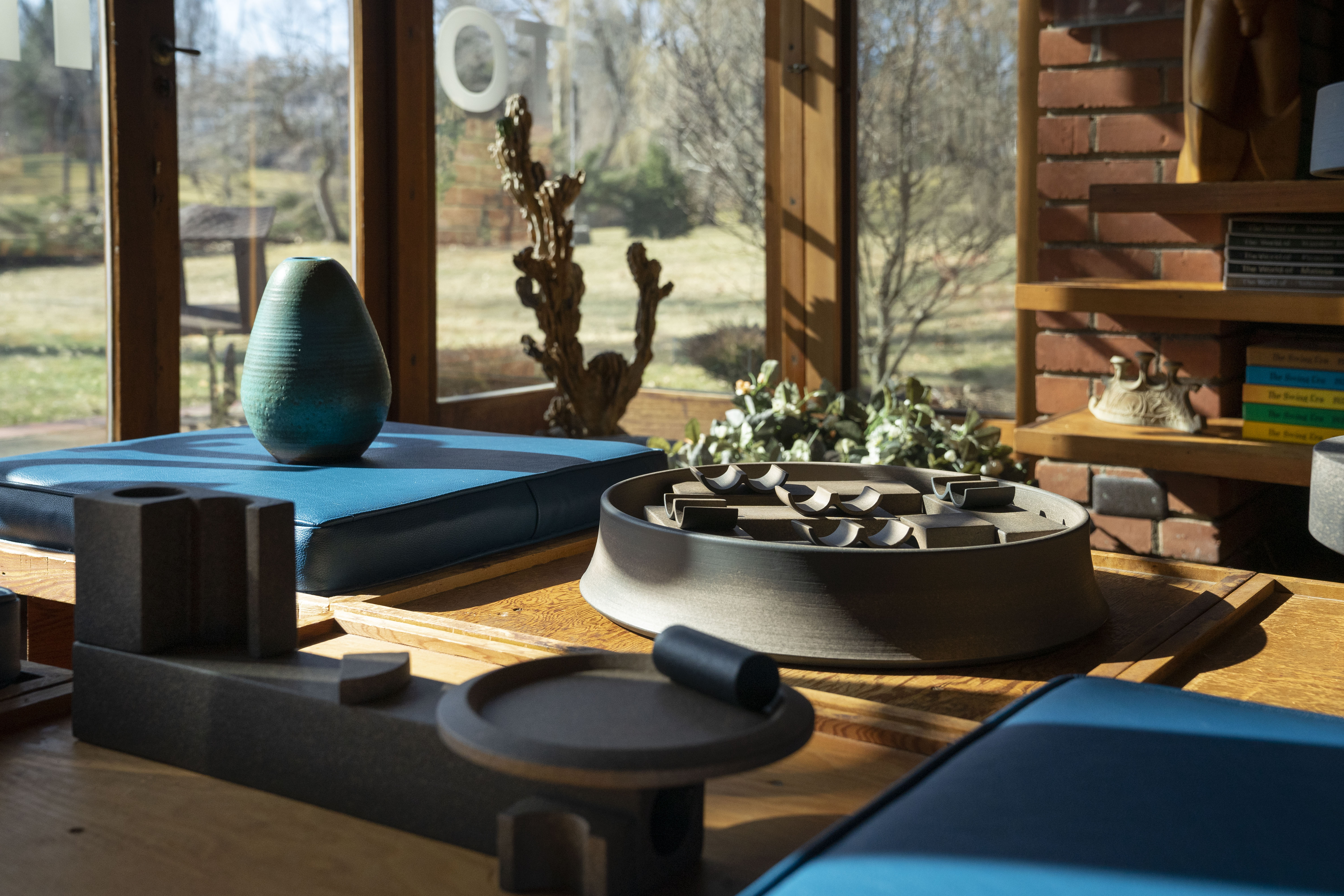
Untitled/Studio Objects by Ian McDonald, Ceramics Artist-in-Residence, and Vase by Maija Grotell, Ceramics Artist-in-Residence 1938-1966, on display in Smith House as part of Speculative Histories, March 2021. Eric Perry, photographer. Cranbrook Center for Collections and Research.
In a meeting at Saarinen House with Martha Mysko (Painting AIR), Gretchen Wilkins (Architecture AIR and Interim Dean), Rebecca Ripple (Sculpture AIR), and Iris, we settled on a theme for the exhibition: Speculative Histories. We asked the students to think about the many stories within each of the three houses and to speculate about what other stories might be told through their art. Whether real or imagined, well known or totally obscure, nostalgic or futuristic, we hoped this theme would inspire the artists to engage directly with the context of Cranbrook’s house museums.
In a year spent in relative solitude within their studios and attending virtual critiques and lectures, I hoped giving the students space to be creative within the historic houses would be a welcome change of pace.
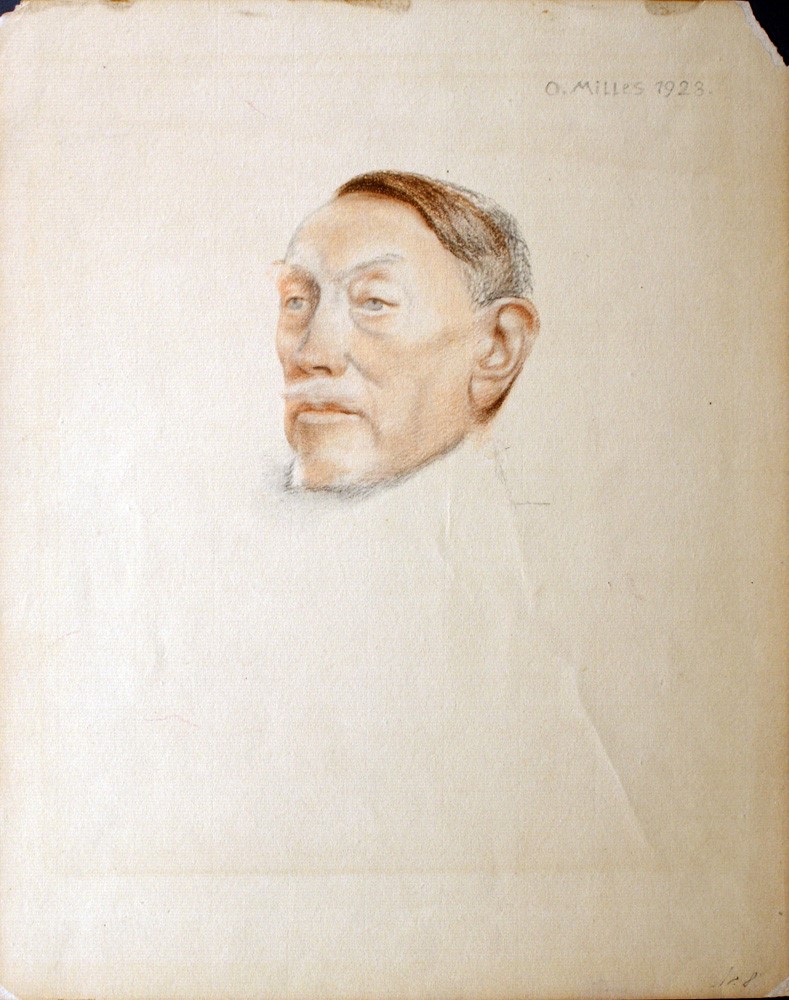
Olga Milles lived in the very depths. In her art, almost exclusively devoted to portrait painting, she sought to draw out the character from the depths of her models and to find the soul behind the façade. Using a variety of techniques including charcoal, crayon, pastel, watercolor, tempera, and oil in her work, Olga was considered an artistic prodigy and developed her talent from a young age, yet her art is largely unknown. In 1988, twenty-one years after her death, Cranbrook Art Museum hosted an exhibition in collaboration with Millesgården, Olga Milles Emerges, to exhibit examples of her art from both museums’ collections.
Portrait of a Young Girl, circa 1931-1951 (CAM1989.6). Gift of Margueritte Kimball. Collection of Cranbrook Art Museum
Portrait of Olga’s Brother, circa 1931-1951 (CAM1989.7). Gift of Margueritte Kimball. Collection of Cranbrook Art Museum
Portrait of Oskar Thorsen, circa 1931-1951 (CAM1989.8). Gift of Margueritte Kimball. Collection of Cranbrook Art Museum
Portrait of Kate Bromley, circa 1931-1951 (1989.9). Gift of Margueritte Kimball. Collection of Cranbrook Art Museum
Portrait of a Young Girl, circa 1931-1951 (1989.10). Gift of Margueritte Kimball. Collection of Cranbrook Art Museum
Study of Eyes and Lips, circa 1931-1951. (1989.11). Gift of Margueritte Kimball. Collection of Cranbrook Art Museum
Artwork by Olga Milles.
In the foreword to the exhibition catalog, Staffan Carlén, former Director of Millesgården, describes her as having an intuitive talent that produced factual character studies of extreme precision, with an “overwhelmingly melancholic” tone. In reading Inger Wahlöö’s account of Olga’s life, based on correspondence at Millesgården, Carlen’s interpretation of Olga’s artwork can almost be read as a profile of Olga herself:
“Sparseness of shadowed areas and stretched areas disrobe the faces and make them appear in a serious, introverted nakedness. Her efforts are primarily directed towards interpreting the character of the soul. This she did with great coloristic refinement, and with tenderness in the form. In her drawings, there is consistently a sensitive enlargement of the mouth, sometimes in interaction with the dreaming mood of the eyes, sometimes as a tension-filled contrast of unconscious sensuality.”
Staffan Carlen, Olga Milles Emerges
Print of Drawing of Carl Milles by Olga Milles, 1917. Courtesy of Cranbrook Archives.
Born Olga Granner in 1874 in Leibniz, Austria, she had two brothers and two sisters. She had a deep loyalty to her family, whom she visited for several months every year, except during World War II. Having been born and raised in the Catholic church, she initially aspired to become an art teacher in a convent. However, in early adulthood, Olga questioned what it meant to be disobedient to the church and broke away, while cultivating an increasingly ascetic life.
Did you ever watch the show History Detectives on PBS? I loved the show; it is all about uncovering the story of an object.
As Associate Registrar for the Center, I am working with our Director Gregory Wittkopp and our Associate Curator Kevin Adkisson on an ambitious project. We are reviewing all fourteen of our cultural properties collections (over 9,000 objects), reviewing the data already on file and adding as much additional information about each object as we can. How do we do this, when the people who created, collected, or purchased the objects are no longer here? It requires being something of a history detective!
The collection we are currently working on is the Cultural Properties Collection at Thornlea. Thornlea was the home of George and Ellen Booth’s youngest son, Henry Scripps Booth, and his wife, Carolyn Farr Booth, from 1926 to 1988. It is filled with antiques, artwork, furnishings, and personal objects. In Cranbrook Archives, there are multiple helpful records about the home’s collections: insurance inventories, an index card file of objects created and maintained by Henry, and receipts for items purchased.
Light fixture over front door at Thornlea.
The one object I wanted to feature today is the unique light fixture over the front door to Thornlea. This custom and distinctive iron and glass fixture is important to the architectural character of the house, but I knew next to nothing about it. It appeared in early images of the house, so I knew it had been a part of the house from the earliest years, perhaps since the house was built.
Henry Scripps Booth peaks out the front door of Thornlea, circa 1935. Courtesy Cranbrook Archives.
To learn more about the fixture, I first looked at the insurance inventories and Henry’s index card file. Nothing there.
Next, I looked at the receipts under “Electrical” in the Henry Scripps and Carolyn Farr Booth Papers in Archives. Eureka!
The Nona Bymark Soderlind archival collectionconsists solely of one scrapbook, yet its contents provide an intriguing glimpse of the woman to which it is dedicated. In doing so, it also illuminates a brief but prolific period in the history of the Academy of Art and reveals a personal side to one of Cranbrook’s most celebrated Artists-in-Residence, the sculptor Carl Milles.
Nona Bymark Soderlind, circa February 1936. Courtesy of Cranbrook Archives.
Born Eleanora Maria Bymark on July 16, 1900 in a small Swedish immigrant community just outside of Minneapolis, Minnesota, Nona attended the Minneapolis School of Art (1920-1922) on a full scholarship, where she studied sculpture under Charles S. Wells. She later attended the University of Minnesota where she studied under the painter Samuel Chatwood Burton. In 1927 Nona returned for a semester at the School of Art, around the time she had her first child with husband Dr. Ragnar Soderlind. The Soderlinds had three young boys (two, eight, and nine years of age) when in 1936 Nona boarded a train to Detroit to study under Carl Milles.
Nona Bymark Soderlind works on a sculpture in Carl Milles Studio, 1936. Courtesy of Cranbrook Archives.
A February 13th letter from Richard Raseman, Academy of Art Executive Secretary, confirms Soderlind’s visit to campus and includes details of associated tuition and living costs required for the minimum period of study with Milles. Cross-referenced with items in her Academy student file, it is evident she had been invited by Milles to study for a month and arrived on the 18th. Perhaps it was Milles’ 1936 commission for Vision of Peace, in St. Paul, Minnesota that had first brought them in touch with each other?
Loja Saarinen showing Eliel a cartoon of their hanging, The Sermon on the Mount, April 1941. Photograph by Betty Truxell. Courtesy of Cranbrook Archives, Cranbrook Center for Collections and Research.
In this iconic Cranbrook image, we see our two heroes, Eliel and Loja Saarinen, posed before a cartoon (or drawing on paper) of their Sermon on the Mount weaving. This image was taken in the studio of Saarinen House on Cranbrook’s Academy Way. I’ve always liked the commanding pose of Loja as she confidently points out a detail within the cartoon to her husband. Her beautifully curled hair, dress with piped detailing, likely of her own design and making, and practical dark lace-ups show a woman with an eye for detail and style who’s also ready to work. Eliel, nattily dressed, looks admiringly on. Both stand in anticipation of this paper drawing’s impending conversion by the weavers of Studio Loja Saarinen into a monumental hanging of wool and linen.
Almost eighty years after this staged photograph was taken by photojournalist Betty Truxell, Loja and Eliel Saarinen and their studio are again in the news. On February 10, 2021, the National Trust for Historic Preservation added Saarinen House, along with three other sites, to its prestigious Historic Artists’ Homes and Studios (HAHS) program. Forty-eight sites form this national coalition of independent museums, including the homes and studios of Georgia O’Keefe, Winslow Homer, Frederic Church, Donald Judd, Daniel Chester French, Edward Hopper, Thomas Cole, and other canonical American artists. We are thrilled to be a part of this august group.
While Saarinen House is often identified with architect Eliel Saarinen, our site’s recent acceptance into the HAHS network celebrates the life and career of weaver, designer, and entrepreneur Loja Saarinen. This makes sense, both because the Historic Artists‘ Homes and Studios program is focused on artists (not architects), and because Loja Saarinen is a force of design talent all her own. It’s high time she gets her national spotlight!
I’ve always enjoyed comparing the photograph above to a study for one of Eliel and Loja’s great collaborations, the Festival of the May Queen Tapestry, hanging at Kingswood. In this weaving sample, we see another woman with the same grace, strength, style, and dark lace-ups as Loja Saarinen:
Studio Loja Saarinen Showroom, September 13, 1933. Photograph attributed to Richard Askew. Courtesy of Cranbrook Archives, Cranbrook Center for Collections and Research.
It’s in this picture that we see the beauty and variety of products from Loja’s commercial weaving enterprise: rugs, upholstery, drapes, tapestry hangings, pillows and poofs. And although the ‘pillow’ at right is actually the Saarinen House bathmat, styled as a pillow for this photoshoot, we get a sense of the design and quality of work for which Studio Loja Saarinen was known. It is a well-deserved honor that her home and studio now join the sites of other great American creatives in the National Trust for Historic Preservation’s HAHS program.
While you can see a complete directory of Historic Artists’ Homes and Studios sites on the program’s website or in their guidebook (Saarinen House will be in the second edition, eventually!), you’re also invited to hear about the program from its founding director, Valerie Balint, in a special talk coming up next month. Sign up now for the Center’s next event, Genius Loci: A Tour of America’s Historic Artists’ Homes and Studioson Sunday, March 14th, 2021, at 3:00pm ET. You won’t want to miss Valerie’s presentation of the program, overview of its member sites, and discussion about why (Loja) Saarinen House is the perfect addition to this special group.
—Kevin Adkisson, Associate Curator, Cranbrook Center for Collections and Research
On a visit to Cranbrook House, Johannes Kirchmayer’s overmantel is one of the first things to catch your attention. Tours and blog posts have examined this chef d’œuvre and its iconography, and admirers tracing the quotation popping out from the carved eglantine find it a typical George Booth choice: art, nature, his love for both. The inscription reads:
“Nature I loved and next to nature art”
Cranbrook is the Booths’ creation, brimming with art and nature and George Booth quotes, but who wrote this line, and how did it end up in such a prominent spot?
Johannes Kirchmayer’s overmantel at Cranbrook House, 1918. The Walter Savage Landor quote is called out in gold leaf at the top of the overmantel. Photograph by PD Rearick, CAA ’10. Cranbrook Center for Collections and Research.
It comes from the pen of Walter Savage Landor.
Born into minor aristocratic wealth in Warwick, England, in 1775, Landor was a wild child, quite possibly because he was sent away to school at 4 ½ years old and was a wonderment to his parents who didn’t know what to do with a child who wrote Latin as well as he wrote English and showed remarkable talent for not obeying rules of any kind.
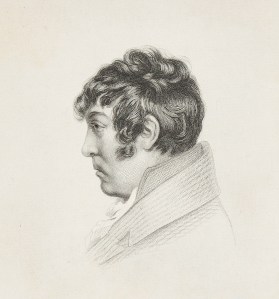
Walter Savage Landor in profile, from Walter Savage Landor: A Biography by John Forster, 1869. Courtesy Heritage Auctions.
Landor enjoyed such violent fights over political opinion that his parents banned him from the dinner table when guests were present. No school could hang onto him. Even Trinity College, Oxford had enough of his rebelliousness, his anti-government stance, his French Revolution republican garb. Landor fought back by writing nasty aphoristic poems about his critics in Latin and English, a practice he continued throughout his life. He was particularly vicious in Latin, partly because in England libel laws did not extend to texts in Latin. He was very clever and iconoclastic, favoring social reform and liberal nationalism. He felt himself superior to others and hated competition just in case it might prove him wrong. Hence his epigram, if not epitaph, written on his 74th birthday in 1849:
FINIS
I strove with none, for none was worth my strife:
Nature I loved, and, next to Nature, Art:
I warmed both hands before the fire of life;
It sinks; and I am ready to depart.
He may have been ready to depart, but it would be another fifteen years before he got around to it.
Much earlier, in 1805, Landor inherited a huge amount of money from his father and determined to set up an estate in Wales, restore an abandoned priory on the property, build a large mansion, and reform the peasantry. Impetuous as ever, he flew off to Spain in 1808 to fight in the Peninsular War against Napoleon’s generals, raising his own regiment. Unfortunately, Landor couldn’t stop himself from quarreling with hosts, commanding officers, and his own troops whereupon he fled back to Wales to find building materials for his hoped-for mansion had trickled away much as had his regiment.
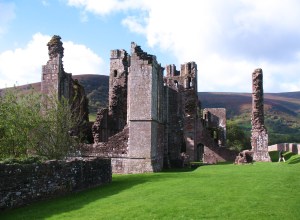
Ruins of Llanthony Priory. Photograph copyright Gordon Hatton, reused by CC BY-SA 2.0.
Here we enter into the realm of coincidence. Landor, an Englishman, building in Wales, found upon his return from Spain that the locals had run off with a lot of his bricks. In an 1809 letter to the local bishop, Landor cursed the Welsh in his inimitable manner insisting that they would demolish the tomb of famed poet Taliesin if they could get away with it. For those readers who are architecture buffs, the name Taliesin can only conjure up one image, not that of the 5th or 6th century Welsh bard, but that of Welsh-connected Frank Lloyd Wright who thus named his east and west architectural compounds, citing the translation as “shining brow.”
But, back to Landor. Once restored to the throne, the king of Spain sent Landor a flock of sheep in recognition for his services. When the sheep arrived at the English docks, they were assumed to be a gift for the king (George III), and try as he might, Landor could not get them back, and one couldn’t sue the king. He had to wait until George IV died before publishing his opinion, one of his most famous attacks:
George the First was always reckoned
Vile, but viler George the Second.
And what mortal ever heard
A good word of George the Third,
But when from earth the Fourth descended
God be praised the Georges ended.
Alas, even though Landor was able to persuade a lovely young woman, 16 years his junior, to marry him in 1811, all was not well. Quarrelsome as always and with no business sense, Landor fled again from Wales to Fiesole outside Florence in Italy where he fared slightly better. In spite of money troubles and a wife who loved to taunt him about his age, this was the period of his great creativity, writing the totally invented Imaginary Conversations between two famous historical people. Poets such as Byron and Robert Southey loved his work, Byron even doing Landor the honor of stealing the Greek name chosen for a young Landor love to apply to the principal lady in his Child Harold. Readers struggled through these long obscure works (or didn’t) and praised a beautifully succinct passage or two, and those are the excerpts along with his crusty aphorisms that made him famous.
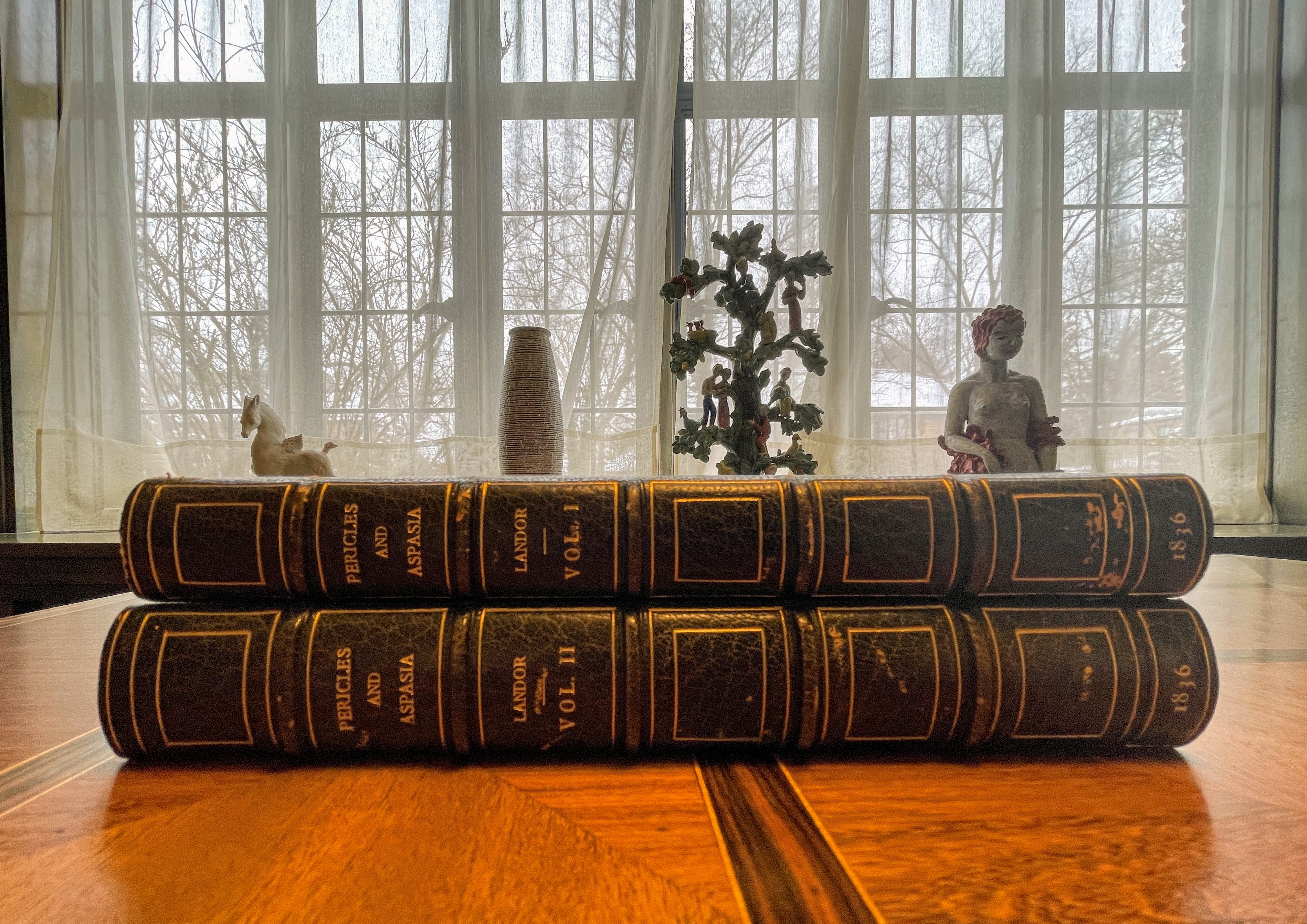
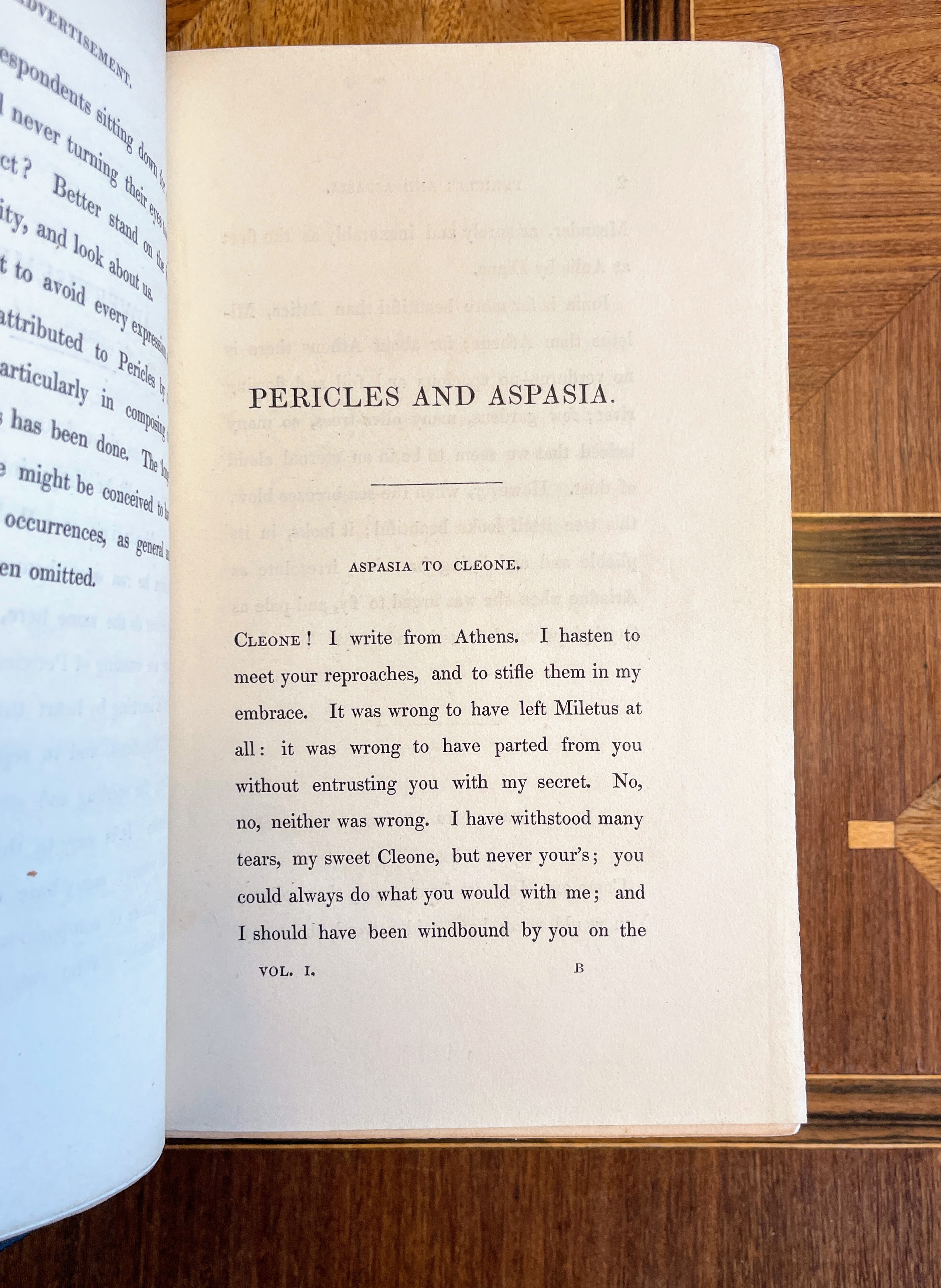
Walter Savage Landor’s two volume Pericles and Aspasia at Saarinen House, a gift from George G. Booth to Eliel Saarinen. Cranbrook Center for Collections and Research.
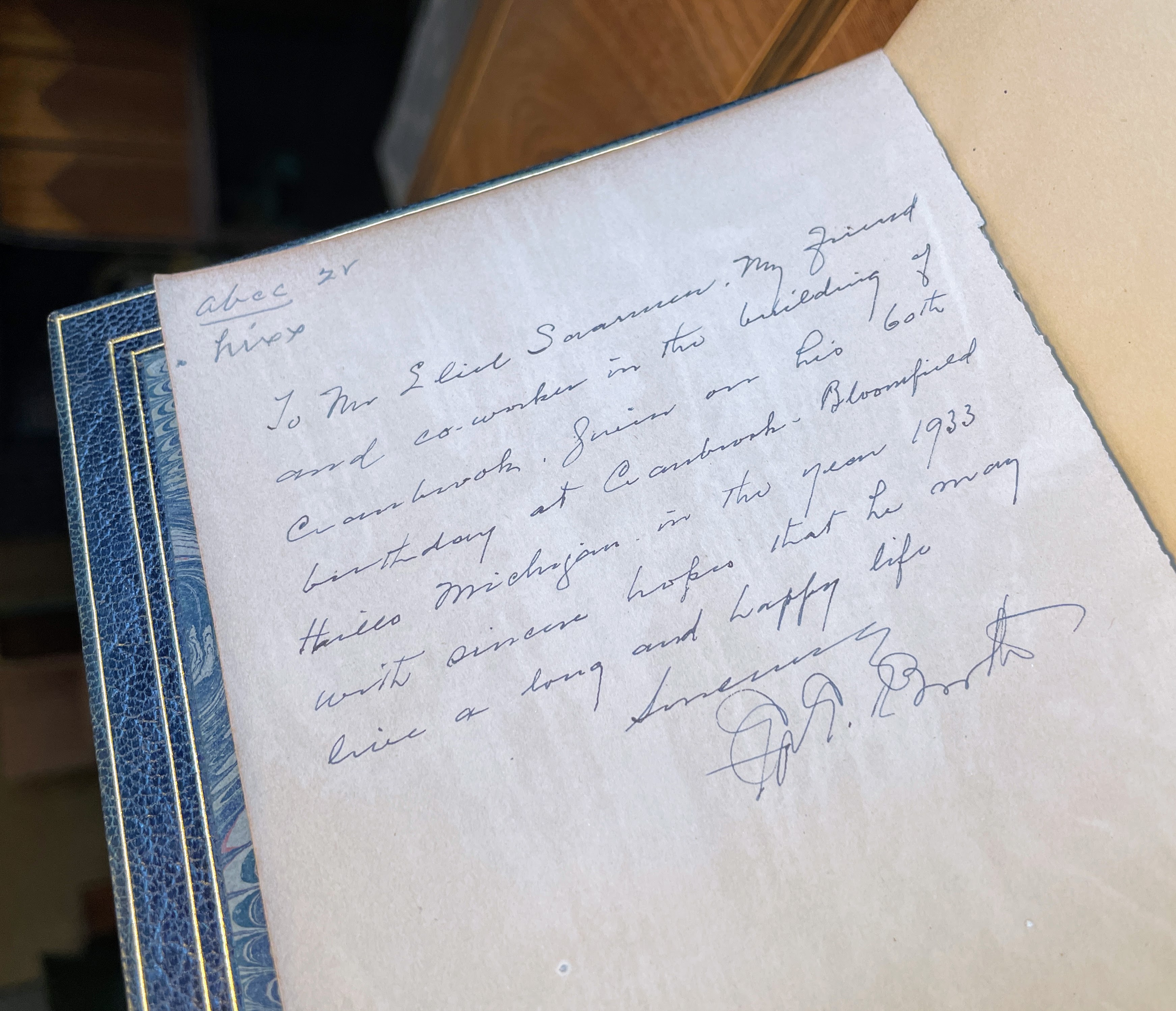
And here is the second coincidence. The inscription in Cranbrook House inspired this blog on Landor, who deserved some recognition. Yet it was while idling in Saarinen House waiting for a COVID-safe tour for Cranbrook students that I found myself looking at the beauty spots of the house. My eye fell on the table in the book room. Upon it lay a couple of tastefully placed little books from the Saarinen collection. I peered at the spine and saw in gold capitals the name LANDOR. They were volumes one and two of his Conversation Pericles and Aspasia, his best-known conversation, first published 1836. The flyleaf revealed the occasion for a gift to Saarinen upon his 60th birthday in 1933, wishing him a happy life, signed G. G. Booth.
Inscribed flyleaf of Pericles and Aspasia from Booth to Saarinen on the latter’s 60th birthday, August 20, 1933. Cranbrook Center for Collections and Research.
Pericles was the great Athenian general of the 5th century BCE Peloponnesian wars, and Aspasia his female companion. Their conversation by Landor is a series of letters between the lovers and their immediate companions with walk-on roles for Aeschylus, Pindar, Socrates, and Alcibiades.
First page of Landor’s Pericles and Aspasia. Cranbrook Center for Collections and Research.
The language is high-flown and not all that accessible; no wonder Landor is hardly known today.
He continued to quarrel with everyone, finally getting thrown out of his own house in 1835 at age 60 by wife, daughter and one son, and fled Italy after scurrilous Latin verses excited the authorities. Back in England, as irascible as ever, Landor continued to write conversations and poems and found himself the grand old man of letters as his fame grew. Carlyle, Tennyson, Browning, Trollope, and Dickens (Landor appears in Bleak House as Lawrence Boythorn) were admiring dinner companions when Landor wasn’t in too bad a temper.
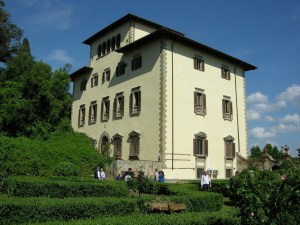
Villa La Torraccia, or Villa Landor, in Fiesole, Italy. Photograph by Sailko, reused by CC BY 3.0.
His last six years were spent back in Italy. He died, escaping as usual, in a hotel in Florence in 1864. The villa was later bought by explorer Willard Fiske and renamed Villa Landor. The villa, altered over the years, is now the Fiesole School of Music, echoing no doubt to the rages and laughter of its most prominent owner. Llanthony Priory continued to decay until protected by the Welsh government cultural group, Cadw.
Even though Landor’s life can hardly have met his approval, it is not surprising, perhaps, that George Booth found a quote from the grand old man of the previous century to adorn his own masterpiece, though one might find the use of the word “strife” ambiguous. Just as well Booth chose only the line that suited his purpose: “Nature I loved, and, next to Nature, Art.” The grand old man has come to rest.
The topic of Cranbrook visitors has been a regular one in the Archives this winter as my colleague, Kevin Adkisson, prepares for his History of American Architecture: Cranbrook Visitors lectures. There have been many famous visitors to Cranbrook over the years, and while Kevin is focused on architects who came to the Academy of Art, many other interesting guests were associated with the Institute of Science.
The Institute has frequently welcomed scholars from near and far to present on the latest research in their field. These include paleoanthropologists, Mary and Louis S. B. Leakey; primatologist, Dian Fossey; archaeologist, J. Eric S. Thompson; father of ecology, Pierre Dansereau; biologist, Joseph S. Weiner, and professor of electrical engineering, Harold Eugene “Doc” Edgerton. I thought it would be interesting to take a look at the work of Dr. Edgerton, dubbed “Papa Flash” by Jacques Cousteau.
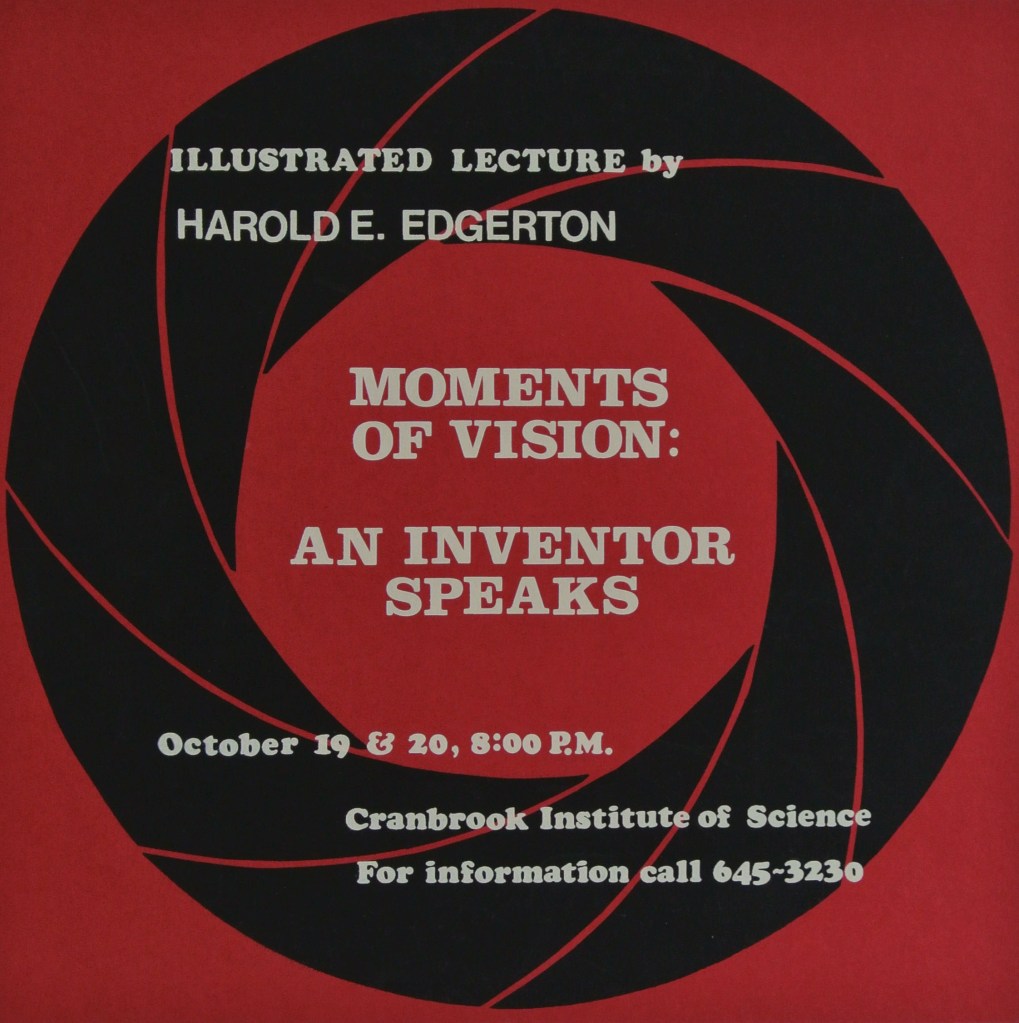
Poster for Harold E. Edgerton’s 1979 lecture Moments of Vision: An Inventor Speaks (P.19.011). Courtesy of Cranbrook Archives.
Edgerton, Professor of Electrical Engineering at Massachusetts Institute of Technology, presented his lecture Seeing the Unseen at the Institute in 1950, and returned in 1979 to present Moments of Vision: an Inventor Speaks. His work was also included in an exhibition, Flash! The Invisible World Revealed in 1960. The Newsletter – Cranbrook Institute of Science of October 1979 reports that Edgerton invented the stroboscope, which made stop-action and high-speed photography possible.
The December 1960 CIS newsletter tells us that, “’stroboscope’ literally means ’whirling viewer’ and employs very rapid flashes from a strobostron, a gas-filled tube, in which light can be produced repeatedly by electrical discharges from condensers. A camera synchronized with the light can make photographs at speeds of less than one millionth of a second, stopping action which is much too fast for the human eye to see.”
Edgerton’s system of photography, first introduced in 1931, has revolutionized the way we see the world–and the way we see the moon! Edgerton adapted his invention to specialized instruments in many fields, including underwater photography, aerial reconnaissance, and nuclear-test measurement.
The Newsletter – Cranbrook Institute of Science, Vol. 49, No. 2. October 1979. Courtesy of Cranbrook Archives.
The stroboscope helped enable underwater photography, allowing us to see this otherwise unseen world. The CIS newsletter describes how “aquanauts” used his equipment to resolve underwater mysteries, such as finding the iron-clad Civil War vessel, Monitor, which was discovered off the North Carolina coast near Cape Hatteras, as well as searching for the Loch Ness monster. Edgerton also made ten voyages with Jacques Cousteau on the Calypso, and the 1960 newsletter reports that he had previously been on four deep sea explorations with Cousteau, capturing images of sea life as deep as four miles.
Edgerton’s association with the MIT began in 1926, when he entered as a graduate student, being awarded a Master of Science degree in 1927 and a Doctor of Science degree in 1931. He was appointed Professor of Electrical Engineering in 1934 and continued beyond his official retirement in 1977. His first public association with Cranbrook came in the December 1949 CIS newsletter, where his camera equipment’s ability to create photographic records of hummingbirds and bats in flight, circus performers in mid-air, and stroboscopic analysis of tennis and golf players was documented. Many of these images were displayed at the December 1960 photographic exhibition, which featured thirty years of Edgerton’s work, and included enlargements from his original negatives of ultra high-speed photography of the splash of a milk drop.
Cranbrook’s institutions have long played host to national and international leaders in science, the arts, and many other fields. It is wonderful that Edgerton shared the progress of his fascinating research and discoveries with the Institute of Science.
—Laura MacNewman, Associate Archivist, Cranbrook Center for Collections and Research
Sources: The Newsletter, Cranbrook Institute of Science, Vol. 19, No. 4, December 1949. The Newsletter, Cranbrook Institute of Science, Vol. 30, No. 4, December 1960. The Newsletter, Cranbrook Institute of Science, Vol. 49, No. 2, October 1979.
In many of the posts we put up on Facebook or on the Kitchen Sink, the credit line “Photographer Jack Kausch” appears. Since he took so many iconic images of Cranbrook’s people and places in the second half of the twentieth century, I’d like to introduce you to Jack Kausch himself.
Jack Kausch at work developing photographs while at Cranbrook School, The Brook 1947. Courtesy Cranbrook Archives, Cranbrook Center for Collections and Research.
John William (Jack) Kausch was born in 1929, in Queens, New York. His family moved to Detroit shortly after he was born. Jack’s interest in photography began at age eight, when his mother gave him a camera and dark room set. He earned a scholarship to attend Cranbrook School for Boys, graduating in 1947. While a student at Cranbrook, he became a photographer for The Crane student newspaper and The Brook yearbook.
Jack Kausch’s Senior entry in The Brook, 1947. Courtesy Cranbrook Archives, Cranbrook Center for Collections and Research.
Jack went on to attend the University of Michigan. The Korean War interrupted his studies, and he joined the Air National Guard. Stationed on a base in New England, he serviced radar equipment and handled the base’s photography lab. When the war ended, the G.I. bill enabled him to return to the University of Michigan. He helped his mother run a construction firm while he attended night school, earning a bachelor’s degree in Physics in 1956.
In September 1957, Jack married Elizabeth (Betsy) Drake. He then took a job with General Motors Photographic in 1960, where he worked for the next seventeen years. During this time, he returned to the University of Michigan to earn a Master’s in Business Administration. He opened Jack Kausch Photography in 1976 in Birmingham, Michigan. It was around this time he returned to Cranbrook to again take photographs for various Cranbrook publications and events.
Shortly after his death in 2002, Jack was posthumously awarded the 2001-2002 Birmingham Bloomfield Cultural Arts Award’s Lifetime Achievement Award. In 2009, an exhibit about his life and work, Jack Kausch, A Photographer’s Retrospective, was presented by the Birmingham Museum.
I thought I would share some of my favorite Kausch photographs of Cranbrook’s people and places:









 Cranbrook Kitchen Sink