Christ Church Cranbrook Groundbreaking Centennial

July 5th, 2025, marks one hundred years since the groundbreaking for Christ Church Cranbrook. As we mark this milestone in Cranbrook’s history, I believe it is important to reflect on George Gough Booth’s long discernment of this generous gift to the community.

From the beginning, there were always places of worship at Cranbrook. The story that leads us through these spaces to the establishment of Christ Church Cranbrook is especially meaningful to me.

Rev. Dr. S. S. Marquis, D.D. with the first spade of earth, July 5, 1925. Courtesy of Cranbrook Archives, Cranbrook Center for Collections and Research.

After George and Ellen Booth purchased ‘The Farm’ in January 1904, his father, Henry Wood Booth, was the first family member to live on the country estate. The elder Booth stayed for the month of May with Frank Brose, the farmer, and his family. On May 15, 1904, the first worship service at Cranbrook took place under a tent, on the site upon which the Altar of Atonement now sits, with Henry as lay preacher. He continued in this ministry, also offering Sunday School, at the same spot until 1909. This was the first act of service offered to the Bloomfield Hills community at Cranbrook.

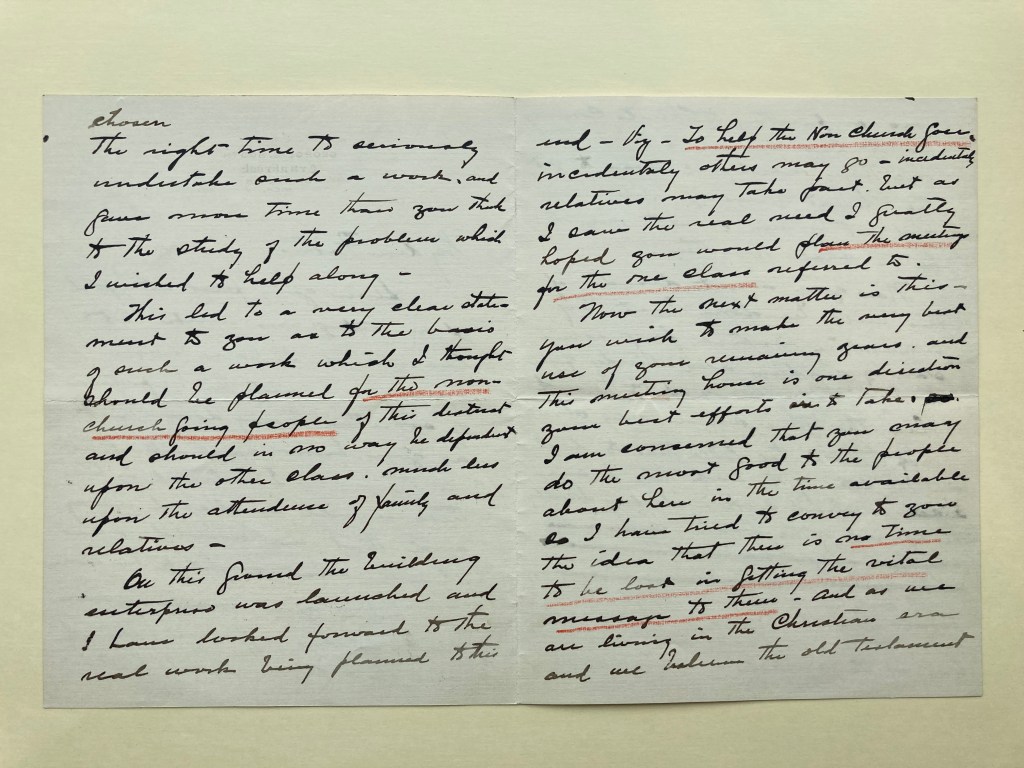
Letter from George Gough Booth to Henry Wood Booth, August 24, 1918. Courtesy of Cranbrook Archives, Cranbrook Center for Collections and Research.

In 1914, George and Ellen considered building a chapel at the site on which the Kingswood flagpole now sits, but the project was rejected, most likely due to the outbreak of World War I. As the war ended, a permanent place of worship and Sunday School was established with the building of the Meeting House.

The letter, above, preserves the dignity with which George writes of the Meeting House “building enterprise” to honor and give freedom to his father’s calling to share the Christ message with the non-church goers in the district. From this letter, we can learn and understand why George built the Meeting House for worship and Bible study through his father’s ministry.

Decoration of the Meeting House by Katherine McEwen, 1918. Laura MacNewman, photographer.

In the letter from George to his father, we also learn that he is prudent in observing the religious character of Bloomfield residents. During the years in which the Meeting House was used for religious services (1918-1926), Mr. Booth would reflect on the visiting clergy and service attendees (both of which came from diverse denominations), from which he would eventually discern the denomination of “Cranbrook church.”

Continue reading

Calling All Storytellers! Become a Cranbrook Center Collections Interpreter

Do you love sharing great stories? Are you the person who says “Did you know…?” at parties? When you discover something wonderful, do you instantly need to share it with friends? Do you love art, architecture, and design, and, have you ever mused to yourself, “Life without beauty is only half lived,’ and I want to be fully living!“?

Collections Interpreter Diane VanderBeke Mager welcoming guests to the Center’s gala fundraiser, A House Party at Cranbrook Celebrating Loja Saarinen, May 2022. Collections Interpreters are storytellers, teachers, hosts, and style icons! Photography by PD Rearick.

If you answered “yes!” to any of the above, the Cranbrook Center for Collections and Research has a place for you on our Collections Interpreter team! As tourism to Detroit grows—and with Cranbrook recently earning a three-star Michelin Guide rating—we are looking for more great storytellers to help us share the magic of Cranbrook’s art, architecture, and design. Read on to learn more, or go ahead and sign up for a Collections Interpreter information session with me (curator Kevin Adkisson) here!

Kevin Adkisson, then the Center Collections Fellow, learning the joy of teaching during a Summer Camp tour of Saarinen House, June 2017. Photography by Cranbrook Art Museum.

Each year from May to November, Collections Interpreters (CIs) lead public and private tours through Cranbrook’s architectural gems. Regularly scheduled public tours focus on two of our historic houses.

First is Saarinen House, the jewel-box Art Deco home of architect Eliel Saarinen and textile designer Loja Saarinen, filled with furniture, fabrics, and works of art made at Cranbrook to the Saarinen family’s own design. As you walk with visitors past the dancing fountains and verdant grounds, tours of Saarinen House also touch on the history of Cranbrook Academy of Art.

Just a short drive away, CI’s lead tours of the Frank Lloyd Wright-designed Smith House, a 1950 Usonian treasure tucked into the neighborhood. Built for two Detroit public school teachers, it is a masterpiece of modesty—proving that great architecture is not just for the wealthy. Tours talk about Wright’s architecture and its quirks, share the story of how the Smiths’ manifested their remarkable dream, and highlight objects of your choosing from the inspiring (and vast) collection of midcentury studio craft.

Collections Interpreter Lynette Mayman shares one of many tumultuous tales around cooking and dining with Sara Smith, October 2017. Photography by Kevin Adkisson.

Collections Interpreters also lead monthly Japanese Garden Tours, helping guests explore one of North America’s oldest Japanese-style gardens, and the Three Visions of Home Tour. A fascinating look at three famed architects ways of shaping home, this tour connects Cranbrook’s founders’ Albert Kahn-designed home, Saarinen House, and Smith House. The CI’s also help guide and share stories during other Center Behind-the-Scenes Tours or special events.

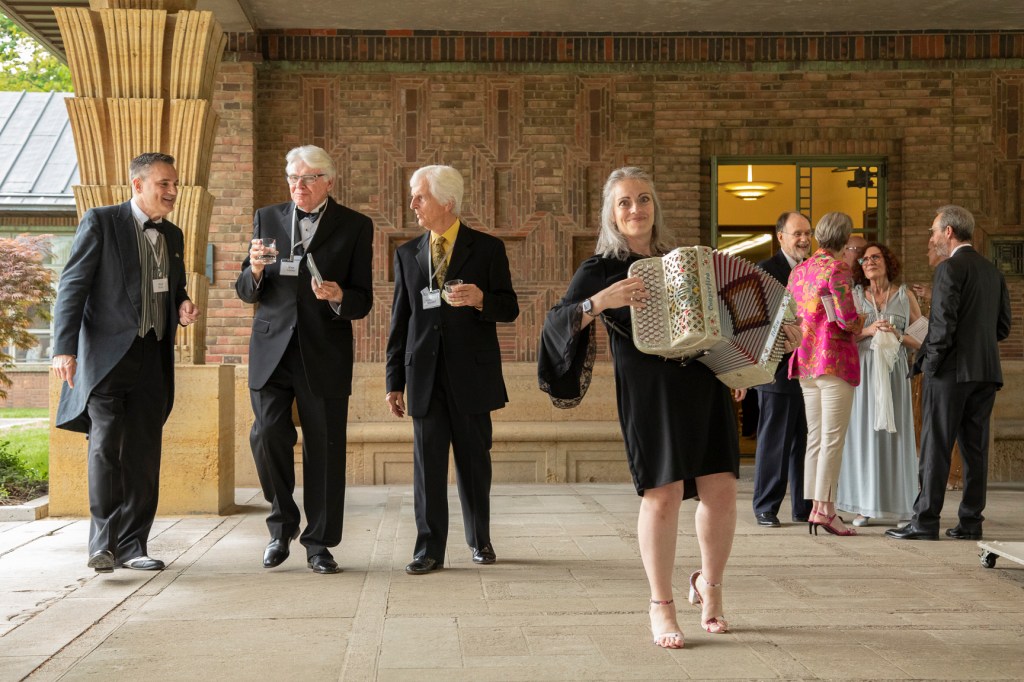
At A House Party Celebrating Loja Saarinen, Collections Interpreter Matt Horn shares stories of weaving at Kingswood School with Ken Gross and Academy Director Emeritus Gerhardt Knodel, while being serenaded from the accordion of Brookside music teacher Rosalia Schultz, May 2022. Photography by PD Rearick.

CIs may also help lead tours for Cranbrook Schools classes; Academy of Art students, artists-in-residence, and visiting artists; Horizons-Upward Bound scholars; and student groups of all ages and interests.

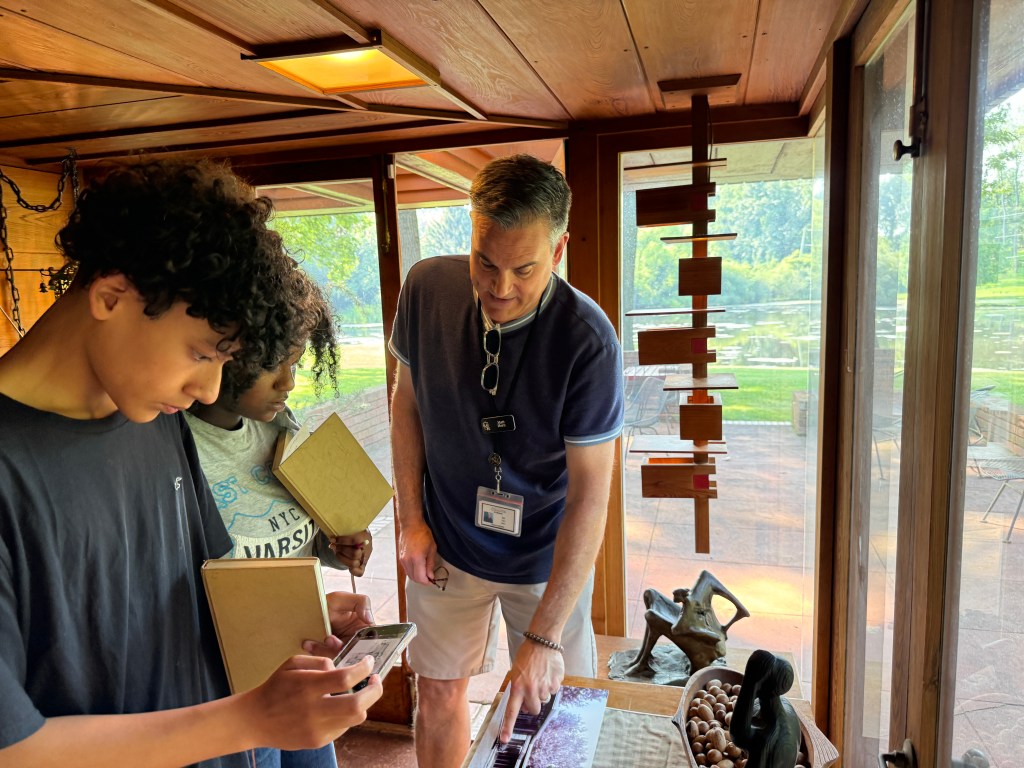
Matt Horn taught elementary music before retiring and joining the Center as a Collections Interpreter. Here, he teaches our summer Horizons-Upward Bound architecture elective in Smith House, July 2024. Photography by Kevin Adkisson.

You might be wondering: who comes to Cranbrook? People from Birmingham, Baltimore, Bangkok—and just about everywhere in between. As a Collections Interpreter, you help to welcome them all. It’s easy when your setting is Cranbrook, a place The New York Times Magazine famously called “the most enchanted and enchanting setting in America.”

No two tours—and no two visitors—are ever the same. It’s exciting!

Continue reading
Photo Friday: The Football Game

Friday, September 27, 2024, is Homecoming at Cranbrook Kingswood Upper School. The game will be held in the Thompson Oval, to the east of The Football Game by David Evans.

The Football Game by David Evans. Thompson Oval, Cranbrook Kingswood Upper School – Cranbrook Campus.

Sculptor David Evans (1895-1959) was hired by the Cranbrook Foundation (through George Booth) as Professor of Sculpture and Life Drawing at the Academy of Art for 1929-1930. During that time, Booth commissioned him to create this bas relief for the football field at Cranbrook School for Boys. It is not just a bunch of nameless faces on the relief; it actually features members of the first football squad at Cranbrook School for Boys.

The 1930 Football Team, from The Brook, 1931 (Cranbrook School’s yearbook). Courtesy Cranbrook Archives.
Cranbrook School Football Sweater, circa 1930. Photographed by P.D. Rearick, 2019. Cranbrook Center for Collections and Research | Cultural Properties Collection, Archives.

During the 1930 football season, thirteen boys posed for Evans.

Members of the 1930 Cranbrook Football Team featured on The Football Game. Photos taken from 1931 and 1932 copies of The Brook. Courtesy Cranbrook Archives

The bas relief is in its original location – mounted above the steps leading to Alumni Court and overlooking Thompson Oval. If you are on campus for Homecoming, pose for a photo in your CKU green and blue with the 1930 football squad.

Leslie Mio, Associate Registrar, Cranbrook Center for Collections and Research

Ed. Note: The Football Game was recently cleaned and waxed by our friends at McKay Lodge Conservation Laboratory. They also touched up other Upper School favorites: Hermes, Discus Thrower, The Wrestlers, Running Dogs, Masque Art, Diana, Dancing Girls, and Aim High.

Neighborly Relations: Cranbrook and Stonelea

In recent years, new residential development along the small strip of Cranbrook Road between Lone Pine Road and Woodward Avenue has given Cranbrook a few new neighbors. One of Cranbrook’s first neighbors on the street, however, dates back one hundred years!

As George and Ellen Booth began developing their country estate in the mid-1920s into what we know today as Cranbrook Educational Community, a new house was completed just north of what would soon become Kingswood School for Girls.

Picture of Stonelea from an ad in Afterglow: A Country Life Magazine, August-September 1925.

Ralph Stone, president of the Detroit Trust Company, with which George Booth did business, purchased this land around 1923. He quickly commissioned Albert Kahn to design a country residence for the site, which Stone named “Stonelea.” This was just a few years after Kahn had completed additions to Cranbrook House.

Residence for Mr. Ralph Stone. Albert Kahn Architect. November 17, 1923. Courtesy of Cranbrook Archives.

The close neighbors shared some correspondence regarding their properties that provides a glimpse of both men’s personalities, and highlights their shared affability and elegance of prose. Their letters, part of the George Gough Booth Papers, begin a year before Ralph Stone and his wife Mary would finalize construction of their home in 1925. It seems they could not wait to spend a summer of leisure in Bloomfield Hills, away from the hustle and bustle of Detroit. The Stones sought to rent the Booth’s Brookside Cottage–an impossibility due to occupancy by Booth family members.

But perhaps the most interesting exchange takes place in 1926 when Ralph writes regarding the shocking lack of water needed to preserve his lawn and garden in a green state in the middle of July (not a problem in 2024!). He proposes to pump water from Cranbrook, but George’s reply a week later masterfully circumnavigates the issue:

Opening lines of the George Booth letter, August 2, 1926. Courtesy of Cranbrook Archives.

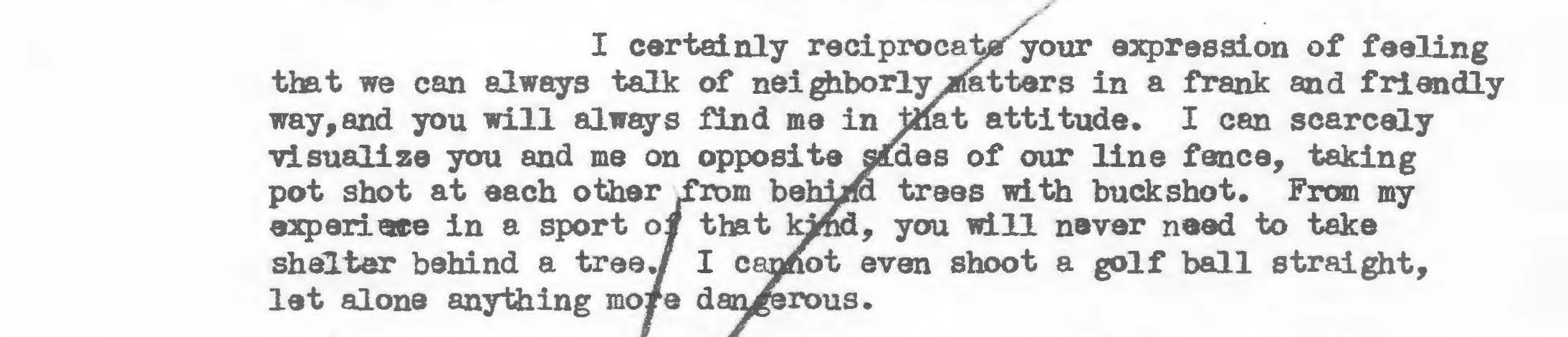
In Ralph’s reply he acquiesces with good humor:

Second paragraph of the Ralph Stone letter, August 3, 1926. Courtesy of Cranbrook Archives.

The sentiments expressed in these letters appear genuine as their families remained on neighborly terms. George and Ellen were occasional guests at Stonelea for dinner parties until the Stones sold their property in 1931.

In fact, Ralph Stone proved to be much more than just a friendly neighbor of George Booth, continuing his connection to Cranbrook long after he had moved from the area. He was an early and steadfast supporter of Cranbrook, serving on various boards for over twenty-five years as a Cranbrook School Trustee (1928-1951), Kingswood School Trustee (1930-1951), Brookside School Trustee (1945-1951), Academy of Art Trustee (1941-1946), and Foundation Trustee (1940-1952).

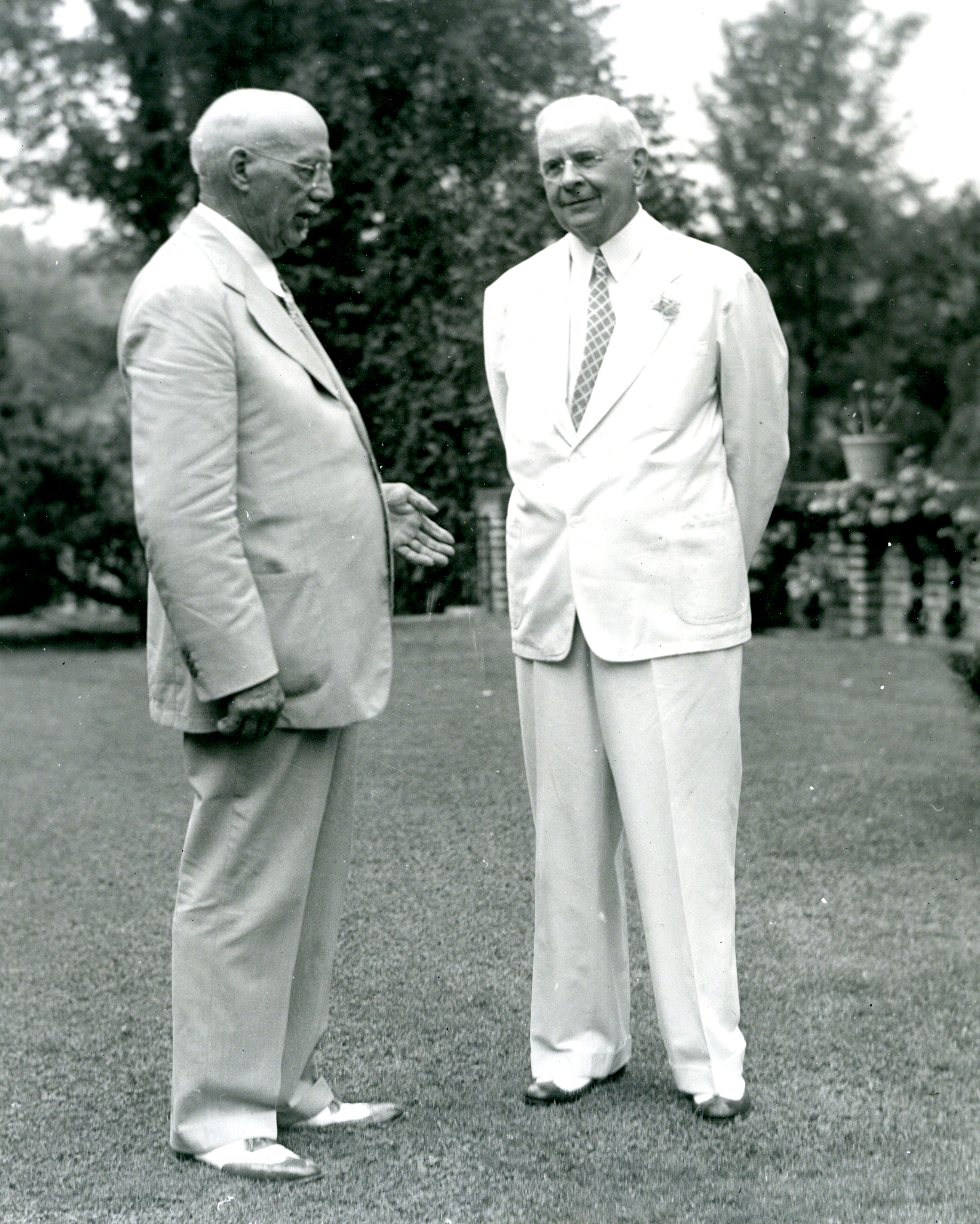
George Gough Booth and Ralph Stone attend the 80th birthday party of Ellen Scripps Booth at Cranbrook House, 1943. Courtesy of Cranbrook Archives.

Today, Stonelea is no longer just a neighbor: the property was acquired by Cranbrook Educational Community in 2003. In the coming years, Stonelea will become the future home of Cranbrook Center for Collections and Research!

Read the Ralph Stone letters in their entirety in the Archives’ Digital Collections, or, learn about a famous occupant of Stonelea: Anne Morrow Lindbergh: The Cranbrook Connection.

Deborah Rice, Head Archivist, Cranbrook Center for Collections and Research

The Gothic Grotesque: Have Confidence, Enter the Sanctuary

When I was asked to gather archival materials related to Cranbrook in Kent, England, a short series of correspondence in the Henry Scripps and Carolyn Farr Booth Papers particularly caught my notice. Written to Henry Scripps Booth, the letters discuss a stone from St. Dunstan’s Church in Cranbrook, Kent, and its overseas delivery to Christ Church Cranbrook. I became quite curious about it.

Carved coign from St. Dunstan’s Church, Cranbrook, Kent, at Christ Church Cranbrook. Laura MacNewman, photographer. Courtesy of Cranbrook Archives.

One handwritten letter in the correspondence was rather difficult to decipher, but once I got the pattern of it, it helped me begin to comprehend the story.

In July 1930, St. Dunstan’s Vicar, Rev. Swingler, acknowledged a request from Booth for a fragment of the church which could be placed in the chapel of the same name at Christ Church Cranbrook.

It was July 1931 before Rev. Swingler wrote again to inform Booth that the stone was ready for dispatch. He explained that the Church Council had welcomed the idea and directed the Fabric Committee to select a stone, which they had, but that the Secretary had forgotten to inform Booth until then, a year later, and it was already on its way!

The forgetfulness of the Secretary and finding appropriate shipping arrangements for such an unusual commodity had caused quite a delay, to which Rev. Swingler writes,

“I am sorry that the matter has not been dealt with more speedily but old Cranbrook has hardly yet learned modern methods of business, as perhaps you know.”

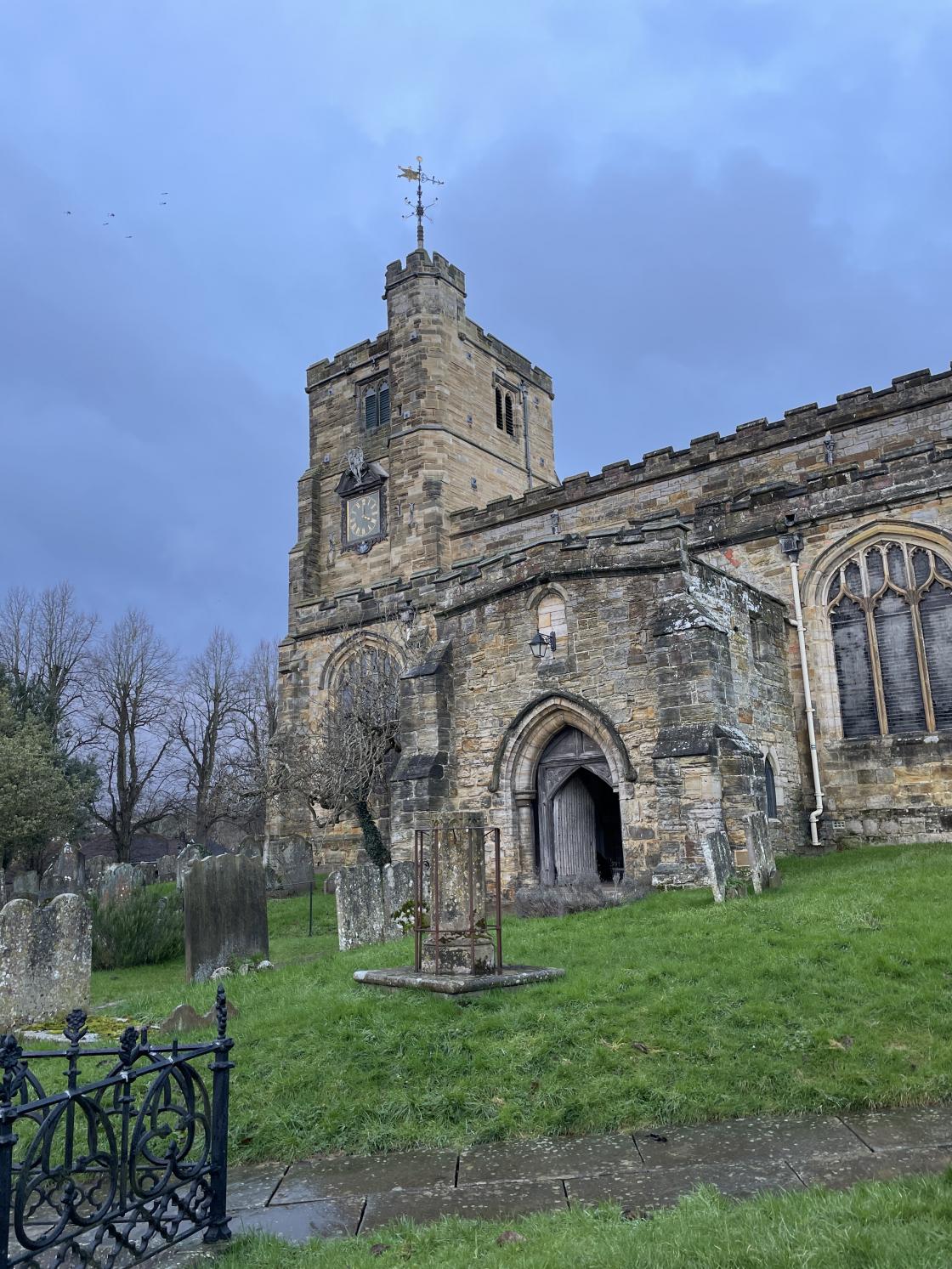
St. Dunstan’s Church, Cranbrook, Kent. Kevin Adkisson, photographer. Courtesy of the Center for Collections and Research.

He goes on to describe the provenance of the stone, at least as far as he could tell. A fifteenth century carved coign (an architectural term for a “projected corner”), it once formed part of the string course (a projected band of stone) which runs at the base of the battlements of the church nave. The course includes a series of grotesque heads, some of which were pierced for waterspouts. A grotesque, common in medieval church architecture, is a decoratively carved stone used to ward off evil spirits and to signify the sanctuary and safety of the church. On inspecting an historic photograph of the church, I could identify similar stones at the top of the drainpipes and around the tower battlements.

St. Dunstan’s Church, Cranbrook, Kent, July 1901, with grotesques in situ. Courtesy of Cranbrook Archives.

Rev. Swingler had first seen it laying in the churchyard and surmised that it had not been replaced during past repairs. He doesn’t mention why they selected that particular stone, but one could conjecture that it was because it was no longer part of the fabric of the church building and hence was available to be gifted to Christ Church. He notes that it is probably of Hartley stone, which was quarried in the Parish.

Henry Scripps Booth contributed great efforts to building relationships between the old and new Cranbrooks by establishing and maintaining connections between the two churches. The grotesque that arrived at Christ Church more than 90 years ago is an artifact that tells just one story of his efforts. From St. Dunstan’s of old Cranbrook, known as the “Cathedral of the Weald,” to St. Dunstan’s of Christ Church Cranbrook, the carved coign continues to herald sanctuary and give confidence to those who enter.

Laura MacNewman
Associate Archivist, Cranbrook Center for Collections and Research

Editor’s Note:
To learn more about Cranbrook in Kent and its part in the history of Cranbrook, Bloomfield Hills, register for Kevin Adkisson’s upcoming lecture, Uncovering Cranbrook: Two Pilgrimages to Kentish Cranbrook and join us for this year’s fundraiser: A House Party at Two Cranbrooks.

Behind-the-Scenes: Bringing Art, Science, and History to Cranbrook’s Tables

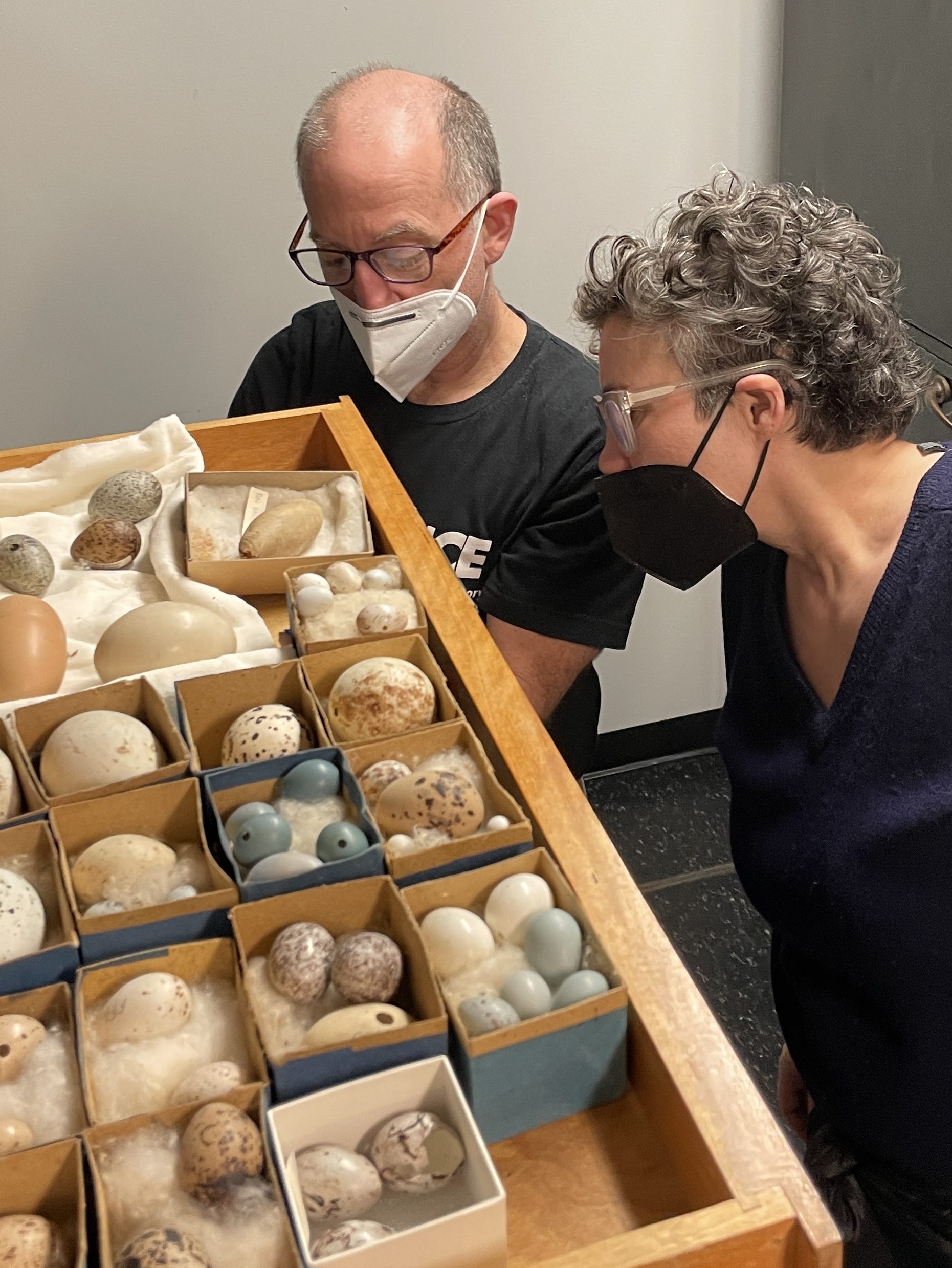
Eric Perry photographs work from Megha Gupta (CAA Ceramics 2023) alongside collections from the Frank Lloyd Wright-designed Smith House and eggs from Cranbrook Institute of Science.

If you walked into Cranbrook House, Saarinen House, or Smith House this week, you might have noticed some surprising guests have arrived at the table. Your Center for Collections and Research team have been busy installing Brought to the Table, the fifth intervention of new work by Cranbrook Academy of Art students and Artists-in-Residence in our three historic homes.

This year’s virtual exhibition is a Cranbrook-wide collaboration that brings site-specific work from across the Academy’s eleven departments into conversation with objects from Cranbrook’s Cultural Properties, Art Museum, and Institute of Science collections.

Kiwi Nguyen (CAA Metals 2023), Iris Eichenberg (Metals Artist-in-Residence), and Kevin Adkisson (Center Curator) strategize in the Saarinen House studio.

Brought to the Table engages with the long tradition of functional art at Cranbrook and pairs new works of art with objects from the Cranbrook collections made for dining tables, coffee tables, desks, or side tables. Before the exhibition kicks off at the Virtual Opening and Lecture on March 27th, I’d like to give you a sneak peek at the exhibition process.

This was my first experience curating contemporary art and I was grateful to learn from my capable co-curators, Metalsmithing Artist-in-Residence (AIR) Iris Eichenberg and Center Curator Kevin Adkisson.

From planning with Kevin and Iris; coordinating with our wonderful Academy artists; selecting objects with colleagues at the Institute of Science and Art Museum; installing with the help of students; and assisting with photography, this exhibition took me all over the Cranbrook campus.

Continue reading

Clothed in Light: The Love Letters of Carl and Annetta Wonnberger

My darling, You are wonderful! I start with that because now again you have covered yourself with a light that sets you off from every other person I have ever known!” (Carl to Annetta, August 25, 1928).

The love letters of Carl and Annetta Wonnberger are among the most beautiful expressions of love, longing, and devotion I have ever read. With Valentine’s Day coming soon, it’s a perfect time to share with you some of their words that convey something of life’s highest mystery as it can manifest between two people.

Carl and Annetta Wonnberger. September 7, 1929. Courtesy of Cranbrook Archives.

Carl George Wonnberger (1901-1980) and Annetta Bouton Wonnberger (1909-1997) arrived at Cranbrook in 1929. Carl taught English at Cranbrook School until 1967, and they both founded the Cranbrook Theatre School in 1942. Their life is a love story of manifold paths. Their letters provide us with an intimate glimpse into the couple’s hearts in the two years preceding their marriage and the beginning of their life together at Cranbrook.

Annetta first met Carl in the Spring of 1926, when she visited the Storm King School, New York, to take the college entrance exam, which she failed. Carl, a teacher there, was the administrator. Annetta attended Drew Seminary as a post-graduate student and retook the exam in the spring of 1927, and that is when they connected. If sparks didn’t fly at their first meeting, they did at the second, as shortly after, on June 23rd, Carl asked Annetta to marry him.

Writing in July 1927, Annetta recalled that early evening in June—their walk in the woods, the perfect quiet except for the frogs and locusts around Black Rock, the ride back and the thunder shower. Annetta’s candid style of writing offers us quite a vivid sense of her character as well as a discernible process of maturation over the two years:

Carl, ever since I was a small child I have lived in a sort of fairyland of dreams and ideals. It was only natural, of course, that the people whom I met in real life differed from the creatures of star-dust and moon-mist fashioned by my fancy. And it has always been hard to realize the truth. But you, dear, there is no disillusionment about you. You are all I have ever dreamed the man I would love would be – and more. I only hope that I may be able to follow the road you’ve shown me, and reach the goal you’ve set.”

Letter from Annetta to Carl, November 30, 1927.

From 1927-1929, Annetta attended Smith College in Massachusetts, while Carl remained a teacher at Storm King in New York. They would meet up periodically, but the rest of the time was spent in yearning, which is recorded in their letters (sometimes more than one a day!).

Letter from Annetta Bouton to Carl Wonnberger, January 7, 1928. Courtesy of Cranbrook Archives
Continue reading

Out of the Ordinary: Cranbrook and the Chair

Last week, I was happy to welcome a small group tour into the reading room to view archival materials about chairs. After the tour request appeared in my inbox, I learned a lot about chairs in a short time and found a new appreciation for this commonplace object. 

As I searched and gathered materials for the display, I began to see how imagination and inspiration can transform an ordinary thing from complete obscurity to one of curiosity and sometimes great celebrity.  

Florence Knoll in Eero Saarinen’s Grasshopper Chair in the Dallas Original Showroom, 1950. Courtesy of Cranbrook Archives

The chair has been creatively reinvented time and again according to the social context of its use, the cultural meaning imbued in it, or the inspiration from which its design sprang. Just think throne, pew, sofa, deck chair, chaise-lounge, and so on. 

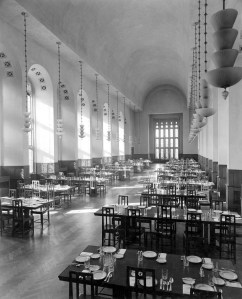
Take one of Cranbrook’s most iconic chairs – Eliel Saarinen Cranbrook School dining hall chair. Designed to withstand use by teenage boys, it combines durability with sophistication and has stood the test of time as they are still in use after 94 years. At the back of each chair is a bronze crane insert, a symbol that subtly gives identity to the community using the chair.

Cranbrook School Dining Hall, October 1936. Courtesy of Cranbrook Archives.

The 1940s and 1950s saw a flourishing of chair design from Academy of Art graduates, including Florence Schust Knoll BassettRalph Rapson (the first Cranbrook-trained designer to work for Knoll), Charles Eames, Benjamin Baldwin, Harry Weese, and Ruth Adler Schnee. The Organic Design in Home Furnishings competition at the Museum of Modern Art in 1941 generated many of these designs, including collaborative entries from Baldwin and Weese, as well as Eames and Eero Saarinen. 

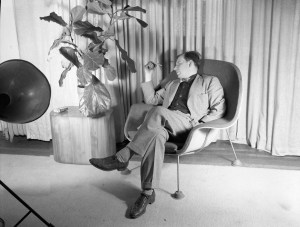
Interestingly, Eero’s later chair designs are all much inspired by nature—the Grasshopper chair, the Womb chair, and the Tulip Chair.  

Eero Saarinen sitting in the prototype of his Womb Chair at his Vaughn Road home. 18 June 1947. Photographer: Harvey Croze. Courtesy of Cranbrook Archives.

Inspired by nature in a different way, Finnish architect and furniture designer Olav Hammarstrom has a variety of designs that are born of the possibilities to which natural materials lend themselves. Hammarstrom worked with Alvar Aalto and Eero Saarinen and Associates, working on projects such as the Baker House dormitory at MIT and the furnishings at the GM Tech Center. Married to Head of the Weaving Department Marianne Strengell, he designed their house in Wellfleet on Cape Cod, as well as houses for friends and colleagues, along with chairs to go in them.

Bamboo Experimental “Basketchair” by Olav Hammarstrom. 10 February 1956. Courtesy of Cranbrook Archives.

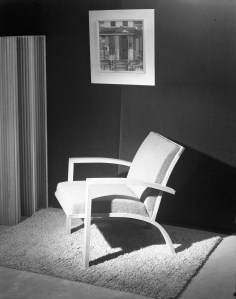
Furniture design was also the focus of another Academy affiliated designer, Pipsan Saarinen Swanson. Working in partnership with her husband, architect J. Robert F. Swanson, Pipsan typically designed the interiors while he designed the structure and exterior.

Chair designed by Pipsan Saarinen Swanson. December 8, 1945. Photographer: Harvey Croze. Courtesy of Cranbrook Archives.

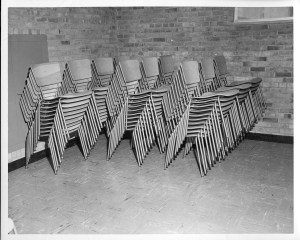
But Robert Swanson also designed furniture. Perhaps the most surprising thing I learned was that Swanson invented a ‘Stackable Chair,’ patented in 1957. A form we take for granted nowadays, these chairs can still be found in many buildings and classrooms on Cranbrook’s campus.

The “Stackable Chair” by J. Robert F. Swanson, 1957. Courtesy of Cranbrook Archives.

It was a great pleasure to share these archival stories with our guests and to explore Cranbrook’s part in the story of the chair. In the process I learned to see an everyday thing in a new light and how creativity can transform the ordinary into the extraordinary. 

Laura MacNewman, Associate Archivist, Cranbrook Center for Collections and Research

Observing Landscapes: Topography and Photogrammetry

One of my favorite items in the collections of Cranbrook Archives is George Booth’s hand drawn map of Cranbrook, which he created over a 24-year period between 1904 and 1928. It is the earliest topographical record of Cranbrook and visually documents his ideas and plans for developing the landscape. In 1951, George’s son, Henry, created annotations to accompany the map, which are useful both in deciphering the map and identifying locations. Henry’s notes on what was envisioned and what was implemented during those early years, are a good starting point from which to venture into the manuscript collections for verification.

Cranbrook Map drawn by George G. Booth between 1904 and 1928.
Courtesy of Cranbrook Archives

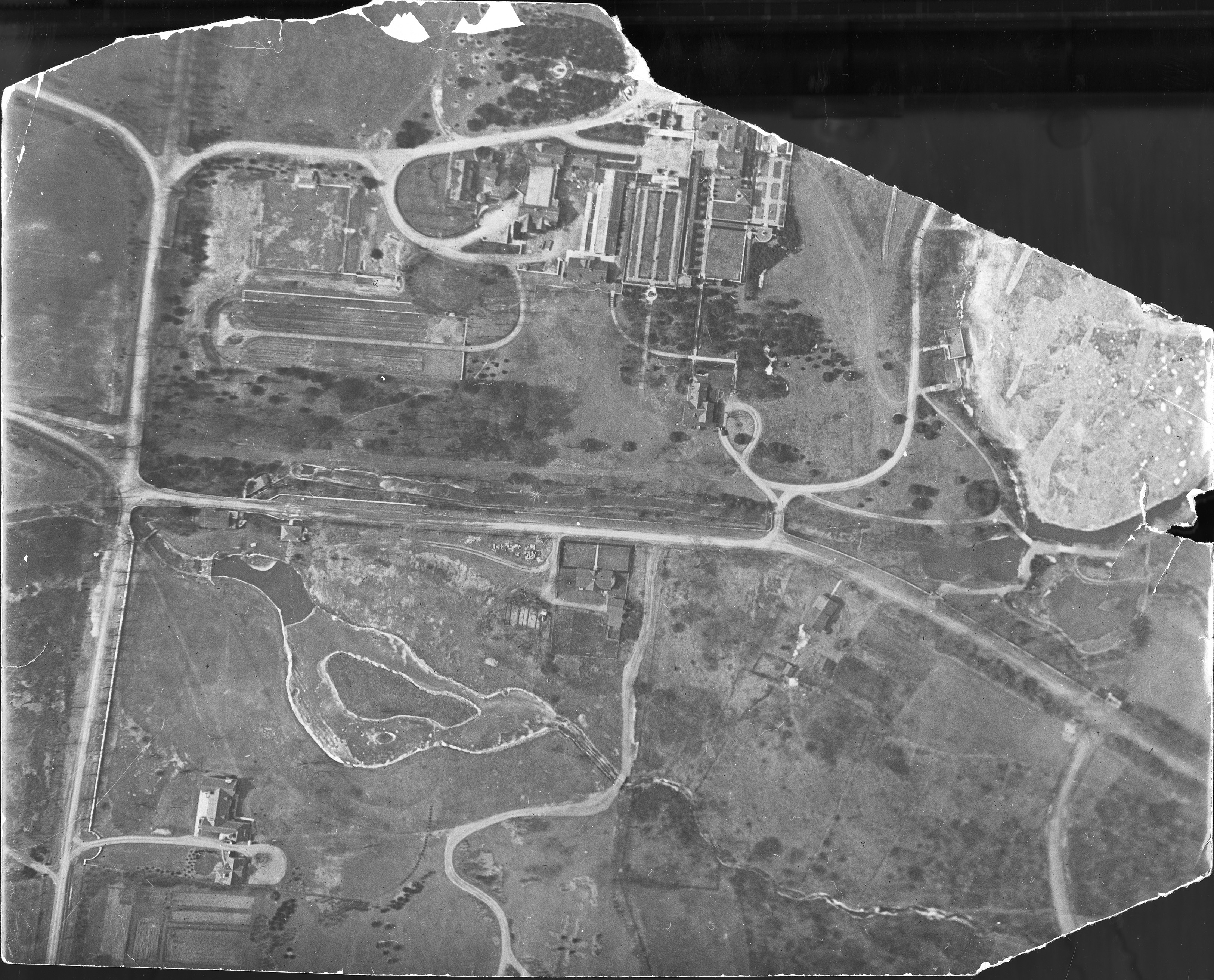
As Cranbrook’s landscape evolved from a family estate into a center for art and education, the means of recording and viewing the topography was assisted by developments in aerial photography, known as photogrammetry. Talbert Abrams, a native of Michigan, is regarded as a key contributor to this field of photography, as he founded the Abrams Aerial Survey Corporation in 1923. The earliest aerial photograph of Cranbrook I could locate is from circa 1918.

Aerial photograph of Cranbrook estate and environs, circa 1918.
Courtesy of Cranbrook Archives

In the Cranbrook Photograph Collection there are many aerial photographs taken by Abrams, as well as other photography firms, ranging from the 1920s through the 1990s. Since the purposes of aerial surveys are manifold, correspondence provides some insight into why they were commissioned and how they were specifically used, for example, as publicity and advertising. In 1932 Cranbrook’s public relations manager, Lee A. White, engaged Cranbrook School Headmaster William Stevens to select an image for the coming year’s brochure, and aerial views appear in all the early Cranbrook brochures. Aerial surveys have also been used to assess and understand the landscape prior to making a change to it. This was the case in 1961, when a topographic map and aerial photography were requested for the Off-Street Parking Study.

Letter from Keith A. Smith to Arthur B. Wittliff, November 1961.
Courtesy of Cranbrook Archives

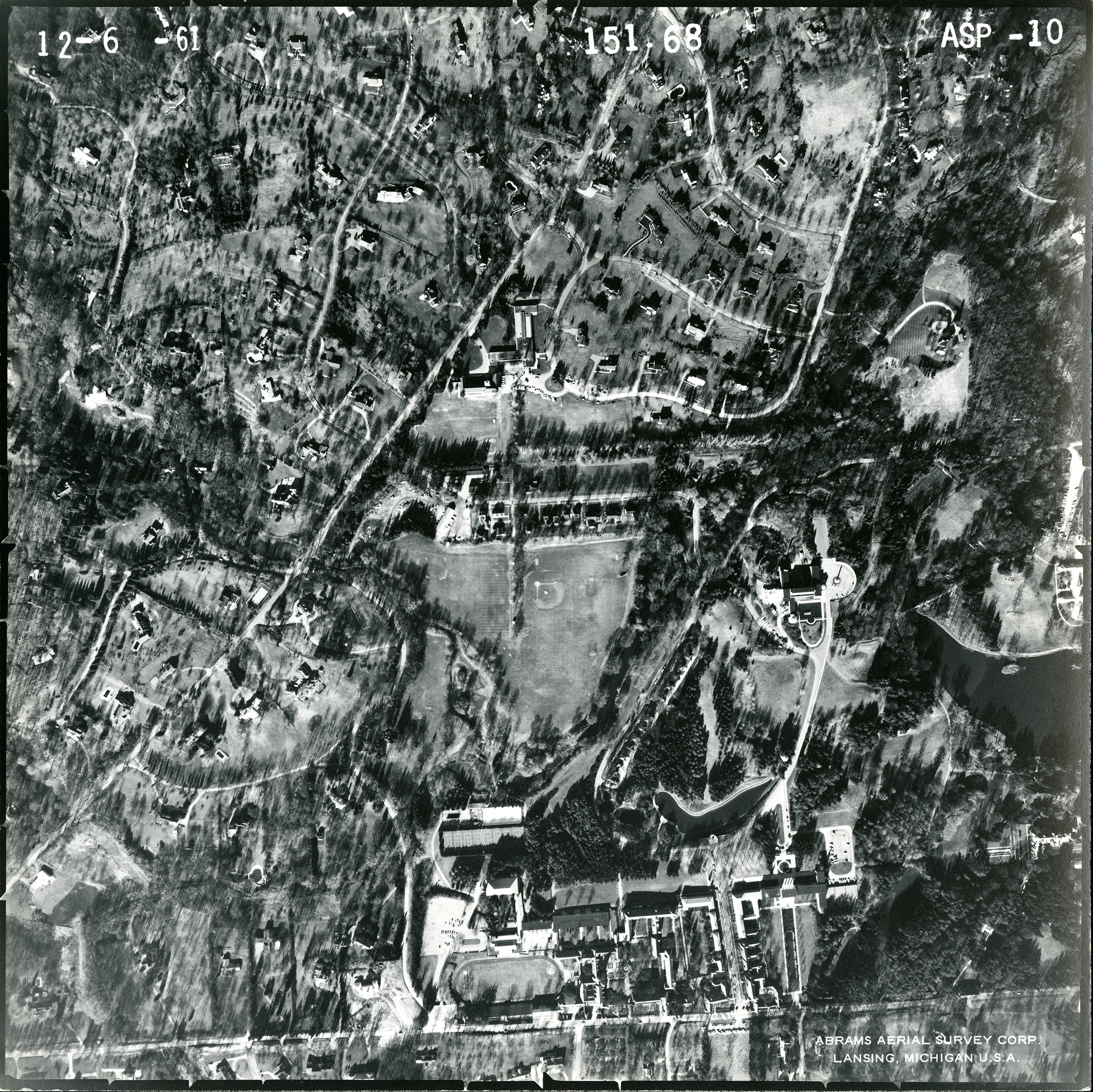
Correspondence between Arthur Wittliff, Secretary for the Cranbrook Foundation Board of Trustees, and Abrams Aerial Survey Corporation, provides intriguing details about the scale of the photography and the material base of the prints. The images below are from a December 6, 1961 set of 12 double weight velvet prints of aerials covering 1 square mile at a scale of 1 inch per 600 feet.

Aerial photograph ASP-5 taken by Abrams Aerial Survey Corporation on 6 December 1961.
Courtesy of Cranbrook Archives

ASP-5 (above) shows the intersection of Cranbrook Road and Lone Pine Road, and includes Kingswood School and Lake, the Institute of Science, Cranbrook House, Brookside School, Christ Church Cranbrook, and the Academy of Art and Academy Way. ASP-10 (below) shows another view of Cranbrook and its environs, encompassing the Institute of Science, Academy of Art, and Cranbrook School.

Aerial photograph ASP-10 taken by Abrams Aerial Survey Corporation on 6 December 1961.
Courtesy of Cranbrook Archives

When looking across the topographical history of Cranbrook from George’s map through aerial photographs, it is always fascinating to discern the changing landscape alongside the features that are unchanging. And, for me, the great inspiration of George’s map is that, although each individual project necessitated getting into the weeds and meticulous details, his ideas were always guided by situating them within a bigger picture.

Laura MacNewman, Associate Archivist, Cranbrook Center for Collections and Research

Photographer Jack Kausch and Cranbrook

In many of the posts we put up on Facebook or on the Kitchen Sink, the credit line “Photographer Jack Kausch” appears. Since he took so many iconic images of Cranbrook’s people and places in the second half of the twentieth century, I’d like to introduce you to Jack Kausch himself.

Jack Kausch at work developing photographs while at Cranbrook School, The Brook 1947. Courtesy Cranbrook Archives, Cranbrook Center for Collections and Research.

John William (Jack) Kausch was born in 1929, in Queens, New York. His family moved to Detroit shortly after he was born. Jack’s interest in photography began at age eight, when his mother gave him a camera and dark room set. He earned a scholarship to attend Cranbrook School for Boys, graduating in 1947. While a student at Cranbrook, he became a photographer for The Crane student newspaper and The Brook yearbook.

Jack Kausch’s Senior entry in The Brook, 1947. Courtesy Cranbrook Archives, Cranbrook Center for Collections and Research.

Jack went on to attend the University of Michigan. The Korean War interrupted his studies, and he joined the Air National Guard. Stationed on a base in New England, he serviced radar equipment and handled the base’s photography lab. When the war ended, the G.I. bill enabled him to return to the University of Michigan. He helped his mother run a construction firm while he attended night school, earning a bachelor’s degree in Physics in 1956.

In September 1957, Jack married Elizabeth (Betsy) Drake. He then took a job with General Motors Photographic in 1960, where he worked for the next seventeen years. During this time, he returned to the University of Michigan to earn a Master’s in Business Administration. He opened Jack Kausch Photography in 1976 in Birmingham, Michigan. It was around this time he returned to Cranbrook to again take photographs for various Cranbrook publications and events.

Shortly after his death in 2002, Jack was posthumously awarded the 2001-2002 Birmingham Bloomfield Cultural Arts Award’s Lifetime Achievement Award. In 2009, an exhibit about his life and work, Jack Kausch, A Photographer’s Retrospective, was presented by the Birmingham Museum.

I thought I would share some of my favorite Kausch photographs of Cranbrook’s people and places:

Continue reading

Create a website or blog at WordPress.com