Cranbrook, Kent: Then and Now

When George and Ellen Booth moved from Detroit to Bloomfield in 1904, they named their estate ‘Cranbrook’ after George’s ancestral home of Cranbrook, Kent, England. As the institutions and landscape developed, many of them were also named after places in and around the ancestral Cranbrook. George’s father, Henry Wood Booth, was born there in 1837, where his father, Henry Gough Booth, and grandfather, George Booth, were coppersmiths.

In 1901, Henry Wood Booth along with George and Ellen took a trip to England, and the photographs from this trip are held in the Henry Wood Booth Papers in Cranbrook Archives. I invite you on a virtual “walking” tour of Cranbrook, Kent, using these historical images alongside the same places in the present day.

Cranbrook is a small town situated on the River Crane with an industrial history in iron-making, that goes back to Roman times, and cloth-making, stimulated by the settlement of Flemish weavers in 1331. Cranbrook belongs to a group of towns known as the Weald, which comes from a West Saxon word for “forest”. During the middle ages, Kent was divided into seven “lathes” (an administrative unit peculiar to Kent), and Cranbrook was one of seven “hundreds” (the smallest administrative unit about the same size as a parish) belonging to the lathe of Scray.

The map below pinpoints the places that we will visit so that you can follow the route as we tour the town.

Map_of_walk

Walking tour directions. Google, 2020.

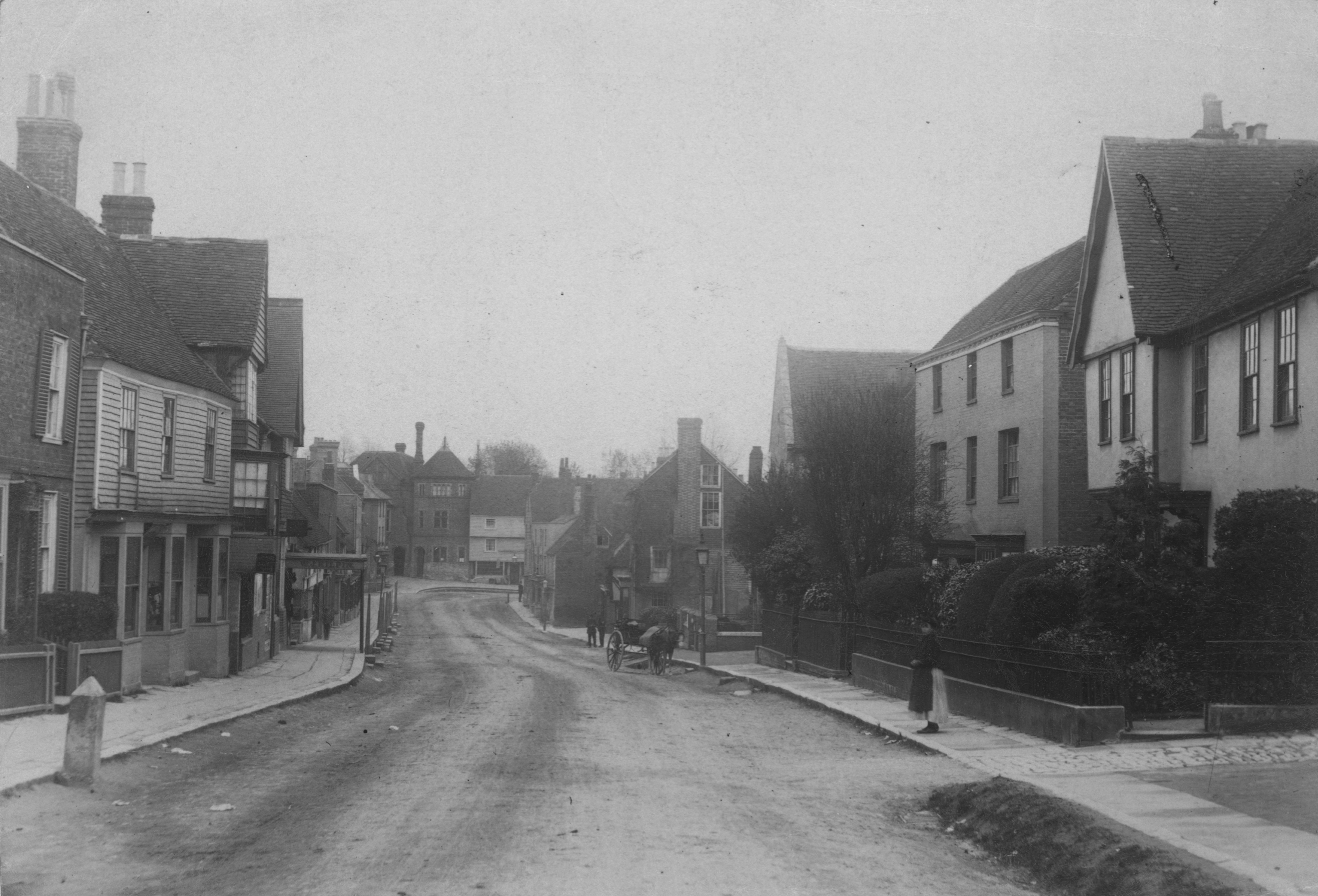
1. View down High Street towards Town Hall

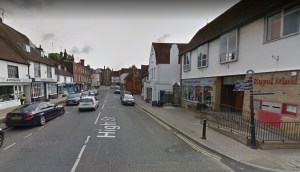
Cranbrook is comprised of one main road, the High Street, which intersects with another smaller road, Stone Street. Most English towns have a “High Street,” just like “Main Street” in the US, and we will begin our tour on the High Street that leads into the town center.
Cranbrook_15

View of the High Street looking down to the Town Hall, 1901. Cranbrook Archives.
Cranbrook_Kent_High_ Street

View of Cranbrook High Street. May 2019. Google.

2. Crane Lane

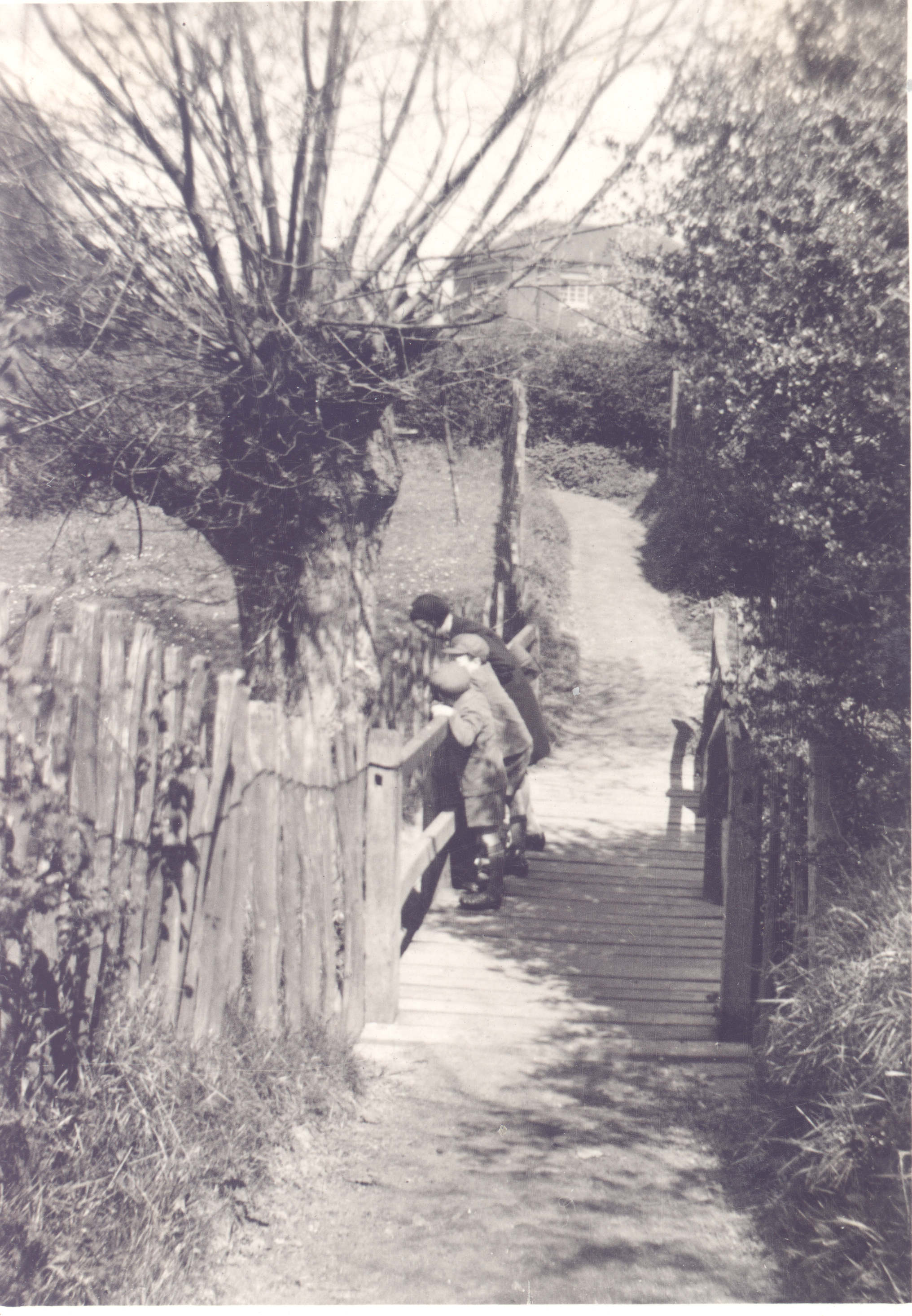
At the end of the High Street, there is a small lane called Crane Lane. The Booth family lived on the High Street nearby this lane. The symbolism of the Crane is well known on the Cranbrook campus and you can see its history rooted in the etymology of the ancestral Cranbrook, which is named for the gathering of cranes at the brook.
Cranbrook_3

View of Crane Lane, 1901. Cranbrook Archives.

This is a bird’s eye view of Crane Lane showing the brook. If you click and zoom out on the map you can see that it leads to a small unbuilt area and eventually to a road named “Brookside”.

Crane_Lane

Satellite map showing Crane Brook and Crane Lane. 2020. Google.

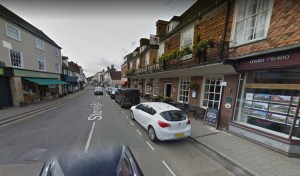
3. Turning right onto Stone Street – you can see the George Hotel on the right:

Cranbrook_9

View of Stone Street with the George Hotel on the right, 1901. Cranbrook Archives.

The George Hotel is still there today:
Stone Street

View of Stone Street. May 2019. Google.

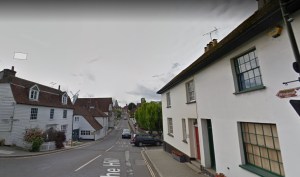
4. At the intersection of Stone Street and Hill Road, which leads to the Union Mill, there was a blacksmith’s shop on the corner. Henry Wood Booth’s birthplace is on the left on Hill Road:

Cranbrook_16

View of Hill Road leading to Union Mill, 1901. Cranbrook Archives.

The view today is quite similar:
The_Hill_to_Mill

View of Hill Road. May 2019. Google.

Union Mill is the last remaining of four smock mills in Cranbrook. It is still used to grind flour which you can see here.

5. Heading back to the center of town, you can see St. Dunstan’s in the distance:

Cranbrook_8

This is the view today:

Mill_to_St_Dunstans

View looking down Hill Road from the site of the mill. May 2019. Google.

7. St. Dunstan’s Church

You may be familiar with this name from St. Dunstan’s Theatre and St. Dunstan’s Chapel. St. Dunstan’s Church is the parish church of Cranbrook in the Diocese of Canterbury. It is known as the Cathedral in the Weald and, while records show that a church was there almost 1000 years ago, the present building is over 500 years old. St. Dunstan himself is the patron saint of metalsmiths.

Cranbrook_29

St. Dunstan’s Church, 1901. Cranbrook Archives.

In the surrounding area, there are other sites with names that you will recognize from Cranbrook campus, namely Angley Wood and Glassenbury Manor (Kingswood Lake was once called Glassenbury Lake).

I hope you have enjoyed the trip and discovered something new about Cranbrook past and present.

–Laura MacNewman, Associate Archivist
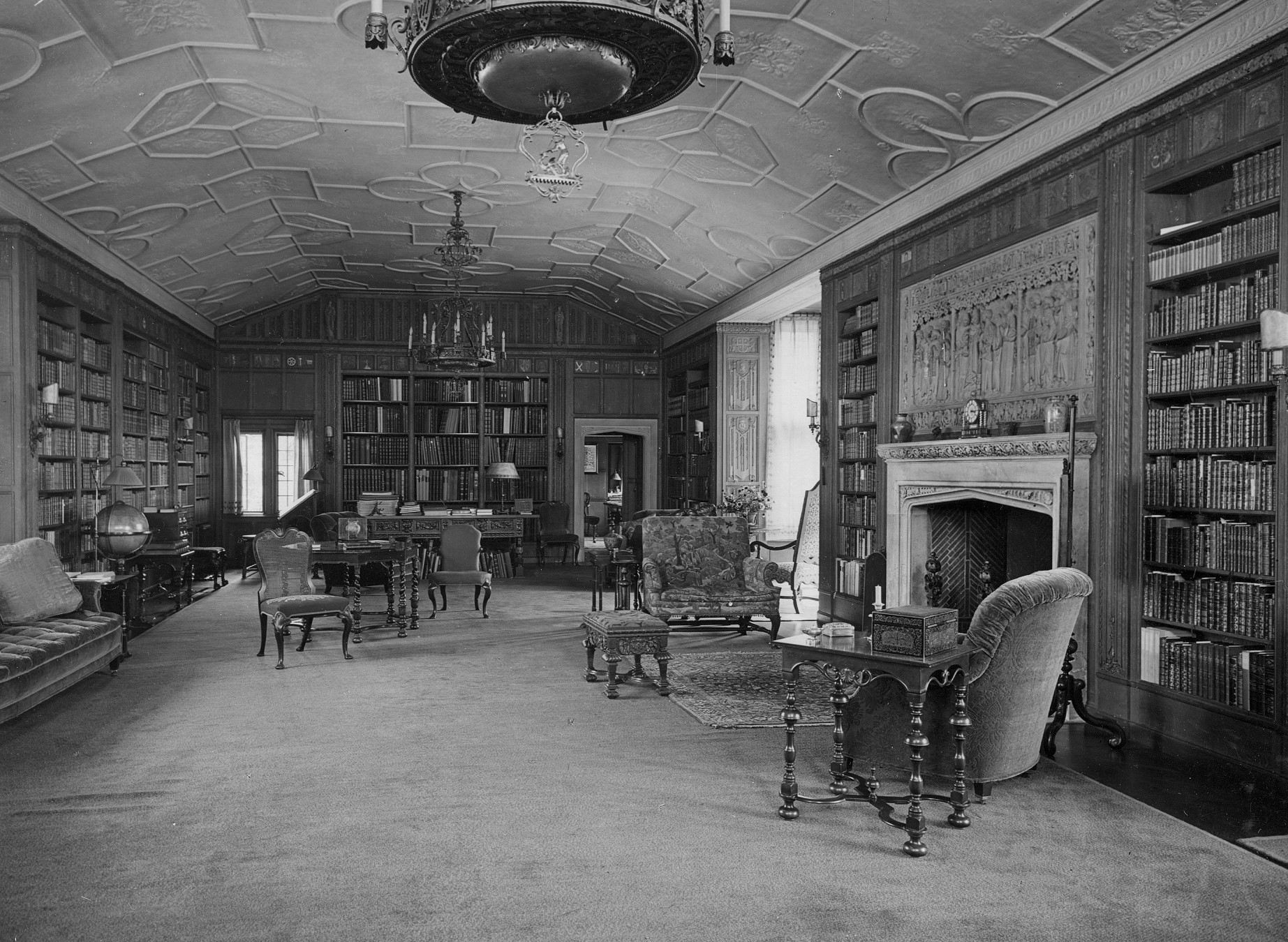
Inside the Booth Library

For all of us who are confined to quarters and find ourselves condemned to read from our own library, let me invite you into George and Ellen Booth’s ample domain. Those of you who know Cranbrook House, the Booths’ Albert Kahn mansion, will have visited the library or attended events there. Perhaps your attention was more taken up by the Herter tapestry or the Kirchmeyer overmantel than by what is on the actual shelves, but art aside, let’s look at the books.

George Booth may well have had a jobber buying books for him to fill those shelves, and he certainly would have been aware of the 1909 Collier’s Harvard Classics, consisting of all the books Harvard President Charles Eliot deemed essential background reading for an educated man of substance.

Cranbrook House library, 1920.

View of the south end of the Cranbrook House library, 1920. Photo by John Wallace Gillies. Courtesy Cranbrook Archives.

So, books to impress and accessorize, yes, but now we need to read: we want to be lost in a book that takes us away from this turbulent world. What’s on offer? We will skip Dante’s Inferno, however much we may feel it appropriate, and pick some things at random which you can read either through your e-reader or your library access to Hoopla! and which may do the trick.

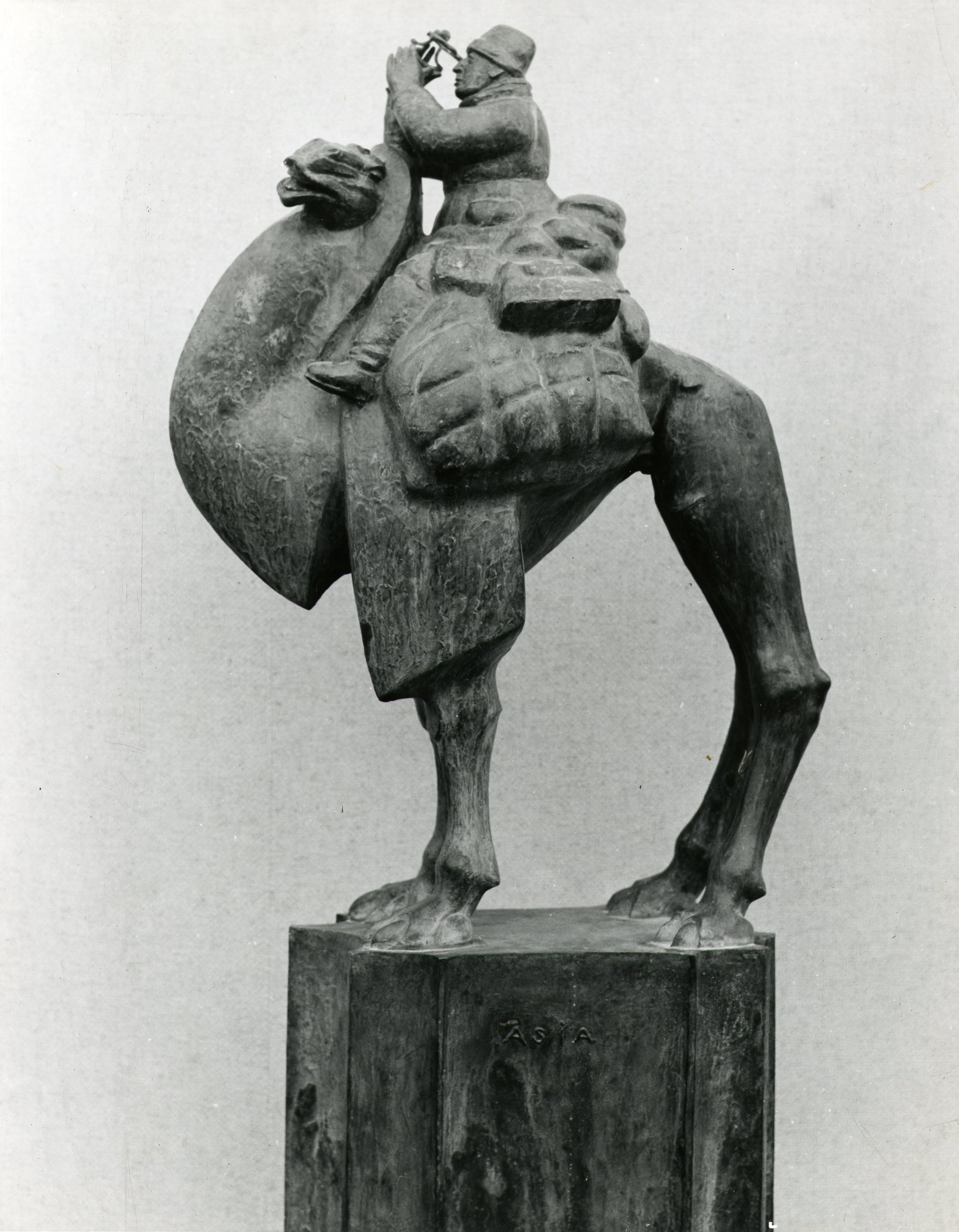
Nonfiction: Sven Hedin’s Through Asia. Remember Sven Hedin from Carl Milles’s sculpture at the Institute of Science?

Carl Milles's "Sven Hedin" sculpture, which sits beside the reflecting pool at the Cranbrook Institute of Science.

Carl Milles’s “Sven Hedin” (1932), which sits beside the reflecting pool at the Cranbrook Institute of Science. Courtesy Cranbrook Archives.

Hedin was a Swedish explorer of Central Asia in the 1920s. His accounts are absorbing and illustrated copiously by Hedin himself. Read Hedlin here.

Who doesn’t love the memoirs of a spy? Here comes Bruce Lockhart’s best-selling Memoirs of a British Agent, his 1932 account of diplomatic shenanigans in Moscow, trying to keep Russia in the war against Germany in 1918. This was the book to be reading in 1933. Purchase Lockhart here.

British Agent from Booth Library

Memoirs of a British Agent in the Booth Library, 11th Printing, 1933. Courtesy of Cranbrook Center for Collections and Research.

This next one is really quite a story and a book I knew nothing about. On the Booth shelves it is called A German Prince and His Victim, but in Google Play you will find it as Memoirs of a Young Greek Lady. This is no novel but the autobiographical account of a 14-year-old girl and her abduction by Prince Ernest of Saxe-Coburg. The Coburgs, though minor princelings in theory, ended up marrying into all the royal families of Europe including Russia. This good duke was the philandering father of Queen Victoria’s Albert, and not at all of the same character. If you have watched the PBS series, Victoria, you will remember that the brothers Ernest and Albert were embarrassed that their father was their father. The writing is histrionic, to say the least, but the story is riveting, the duke dreadful, the girl tenacious: the forerunner to reports you will find in newspapers today. I have to say I was mesmerized by this story and gobbled it up. Read the memoirs here.

Ernst_I,_Duke_of_Saxe-Coburg_and_Gotha_-_Dawe_1818-19

Portrait of Ernest I, Duke of Saxe-Coburg-Gotha, by George Dawe, 1819.  Courtesy of The Royal Collection.

And novels: I was glad to see that the Booths have a copy of Thackeray’s Vanity Fair.  I am told there is a great TV serialization of this comédie humaine, but the book contains everything you will ever need to know about human nature, told with humor and restraint. The writers of the TV serialization of Sanditon, the would-be adaptation of the Jane Austen tale, have certainly borrowed from this novel. Read Thackeray here.

Vanity Fair from Booth Library

Vanity Fair title page in the Booth Library, from The Works of William Makepeace Thackeray Vol. I, 1878. Courtesy of Cranbrook Center for Collections and Research.

If you have never read these books, you should; the stories are magnificent and the nineteenth century novelistic version of the action movie, and quite possibly the archetype of swashbuckling in movies or anywhere else: The Three Musketeers series by Alexandre Dumas. They are a great read for young adults too. Read Dumas here.

One of the twenty-one illustrations of "The Three Musketeers" by A. J. Lalauze in the Collection of the Cranbrook Art Museum (CAM 1955.360.15).

One of the twenty-one illustrations of “The Three Musketeers” by A. J. Lalauze in the Collection of the Cranbrook Art Museum (CAM 1955.360.15).

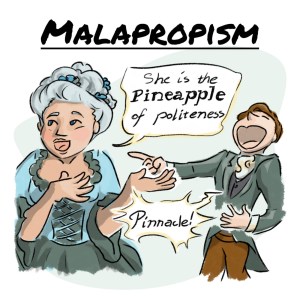
Family time. Try reading Sheridan’s The Rivals out loud. It’s a challenge but very funny. This play has the great Mrs. Malaprop who manages to misuse words in a most perplexing fashion. Your reading out loud will improve immeasurably, and you may even find that some of the expressions find their way in your life. Read Sheridan here.

Malapropism from GRE Word of the Day

A malapropism courtesy of GRE Word of the Day.

There are lots of great reads in the Booth library, whether intentionally collected or not.  We are just scratching the surface here!

Just a note: the books remaining on the library shelves today represent only a portion of the Booth collection, many of the more notable volumes being housed in the Academy of Art Library or Cranbrook Archives.

If you want to know what happened to the “victim” of the German prince after the period in question, reply in the comments and we can fill you in.

–Lynette Mayman, Collections Interpreter

Editor’s Note: Happy National Library Week, everyone!

A Michigan Mural

Metro Detroiters, out-of-town visitors, and architectural aficionados worldwide have long admired the Penobscot Building in Detroit’s Financial District. Like its close neighbor, the Guardian Building, and the Fisher Building further north in Midtown, it is one of the city’s finest examples of art deco architecture and one of the iconic structures that still make up Detroit’s skyline today. Designed by Wirt C. Rowland of Smith, Hinchman, & Grylls, when its 47 stories were built in 1928, it was the tallest building in the city and the fourth tallest in the nation.

The Penobscot, on the National Register of Historic Places, is perhaps best known architecturally for its tiered upper seventeen floors and the exterior ornament by sculptor Corrado Parducci, whose work can be seen on many other Detroit buildings. It’s also known to locals for the red-lit globe at the top (originally designed as an aviation beacon), the legendary Caucus Club (Barbara Streisand reportedly launched her singing career here), or the famed roof observation deck which offered an excellent panorama of the city.

But, what about the interior of the Penobscot? Well it just so happens there’s a Cranbrook connection!

penob-1

The original bank lobby. Courtesy Detroit Free Press Archives.

The Guardian Detroit Group was the first tenant of the two-story bank hall at 635 Griswold St. before they had their own skyscraper commissioned just a block away. A later occupant, Detroit City Bank, opened in the same space in February 1949. When they did, adorning one wall was a mural painted by Cranbrook Academy of Art graduate and Head of Kingswood School Art Department (1940-1956), Clifford B. West. Known as the “Mural of Michigan” the twenty-six-foot painting depicts scenes representing state commerce and industry. West, who studied under Zoltan Sepeshy, and with fellow muralist David Fredenthal, had already completed a bank mural in Alamosa, Colorado, as well as Detroit-area murals in the Rackham Building, Stockholm Restaurant, and Fox & Hounds Restaurant.

Following a meticulous process that involved a series of sketches at different scales, cartoons plotted to a numbered grid and traced on the wall, and painting in two steps (large blocks of color followed by detail work), the scenes were applied in casein tempera on canvas cemented to the wall. Joining in this process was West’s wife and fellow artist, Joy Griffin West, and several academy students. Fortuitously, each stage of work was captured in a series of photographs by Cranbrook photographer, Harvey Croze.

This slideshow requires JavaScript.

Upon completion of the mural, West mounted an exhibit at Cranbrook Art Museum titled, Progress of a Mural in April 1949, detailing his process for the Penobscot mural, and featuring many of the preliminary sketches and cartoons.

It’s largely unknown whether the Penobscot mural exists today, since a drop ceiling was installed many years ago, completely obscuring West’s creation.

Deborah Rice, Head Archivist

Cranbrook’s Crazy Clubs

Most high schools have a lot of clubs in order to foster the interests of their students. Since opening in 1927, Cranbrook School for Boys has had its fair share of extracurricular activities. There has been a Biology Club, a Pre-Med Club, and a club for the boys that had earned their Varsity letter (called the “C” Club). But, there have also been some clubs that were not so traditional.

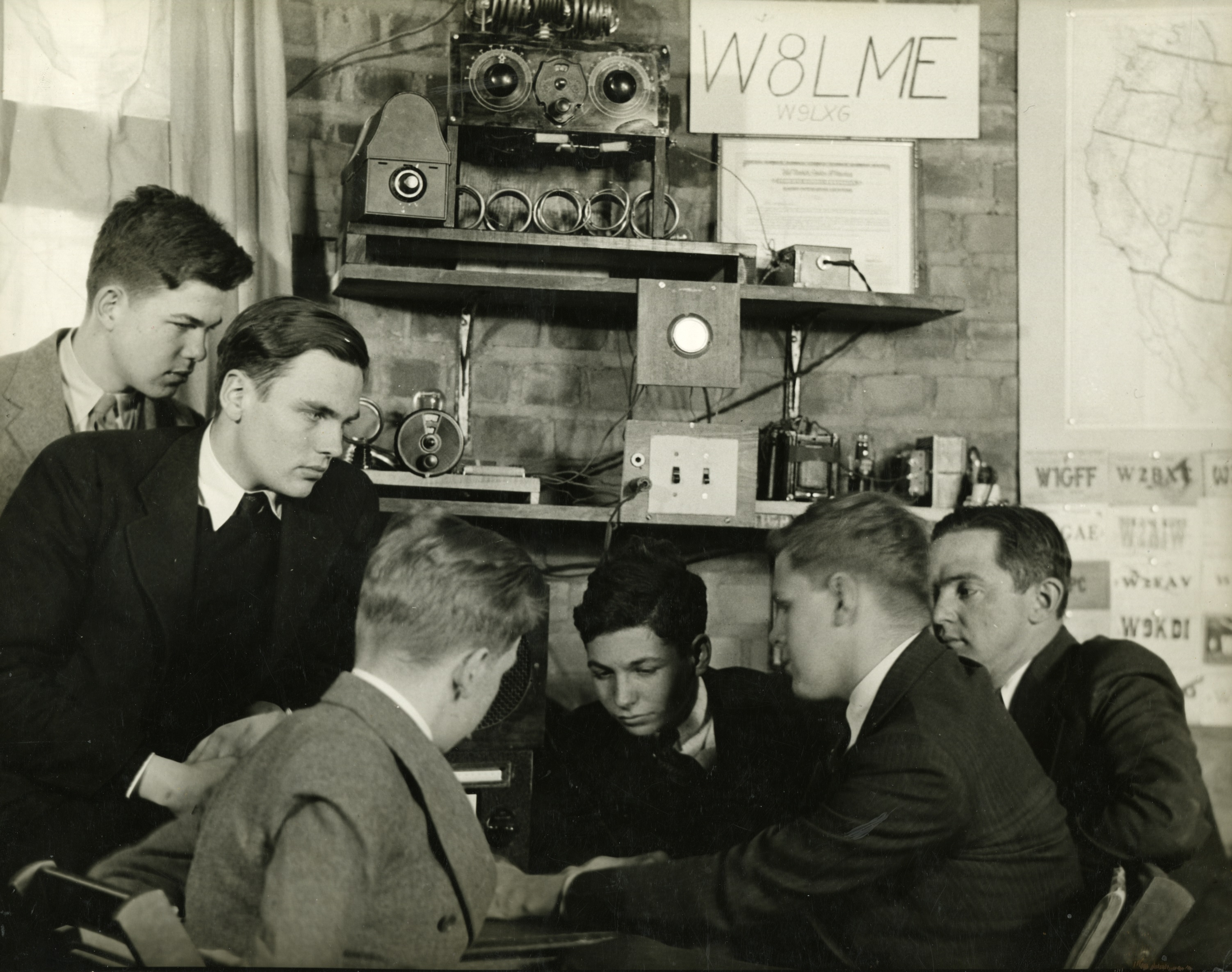
Amateur radio, also known as ham radio, was quite popular at one time. The boys at Cranbrook started their own Radio Club with the help of Science teacher William Schultz, Jr.

Boys sit around a ham radio.

Radio Club members listening to the radio, July 1935. You can see the station’s call sign on the wall: W8LME. Photograph by Harvey Croze. Courtesy Cranbrook Archives.

Then there was the Model Club, which was for boys who enjoyed making models, judging from the picture, mostly of airplanes.

A group of boys standing behind a table of model airplanes

The Model Club, 1952. From left: Faculty Advisor Richard Gregg, David Higbie, Don Young, David Morris, President Richard Gielow, Adams McHenry, Don Hart, Pete Dawkins, Dahmen Brown, Jerry Phillips. Photograph by Harvey Croze. Courtesy Cranbrook Archives.

A Drama Club is not an unusual thing to have at a school, but Cranbrook’s club has an interesting name: Ergasterion Club. Ergasterion is the Greek name for the workshop of craftsman.

Group of boys sitting on a stage.

The Ergasterion “Erg” Club is Cranbrook School’s dramatic society, April 1960. First row, left to right: Louis Beer, Templin Licklider, Jr.; second row: Rick Strong, Bill MacLachlan, Henry Weil, Mike Hilder, Phil Weisenbarger, Richard Foster; third row: Gregg Carr, Boris Nicoloff, Bill Thompson, George Roth, Mitchell Grayson. Photograph by Harvey Croze. Courtesy Cranbrook Archives.

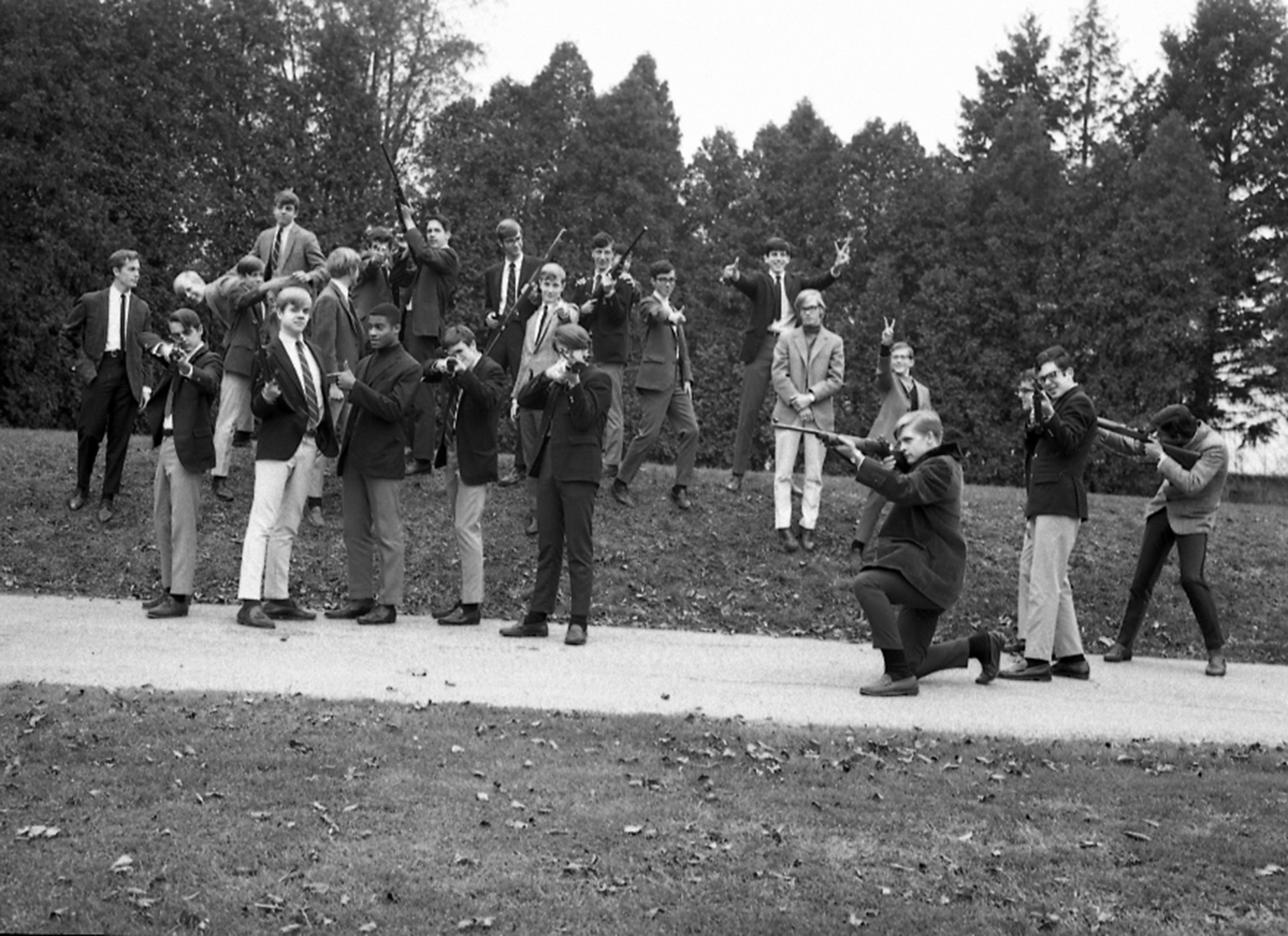
I guess a Rifle Club is not that unusual either, but their yearbook photo was just too great not to share!

A group of boys posing with rifles on a hill

Cranbrook Rifle Club, November 1968. Photograph by Harvey Croze. Courtesy Cranbrook Archives.

In the great state of Michigan, we have a lot of lakes. That is what must have inspired the creation of the SCUBA Club.

Group of boys in SCUBA gear standing in a fountain. of

Cranbrook School SCUBA Club, 1968. From left Thomas O’Hara 69′, Robert O’Hara 70′, Edward Soudeck (language instructor), Thomas Strickland 70′, Marlin Atkinson 70′, Donald Rosiello 70′, and Richard Genthe 70′. Photograph by Harvey Croze. Courtesy Cranbrook Archives.

Today, Cranbrook Schools (co-ed since 1984) continues to have a wide variety of extracurriculars; just ask the members of “The Beyond Earth Club (Space Club)” or the Namtenga Club.

– Leslie Mio, Associate Registrar

From Concept to Cover

The General Motors Technical Center is one of Eero Saarinen’s most acclaimed projects. Dedicated in 1956, the “Corporate Cranbrook” was years in development, starting with initial designs by Eliel Saarinen and J. Robert F. Swanson (with Eero consulting) in 1945.

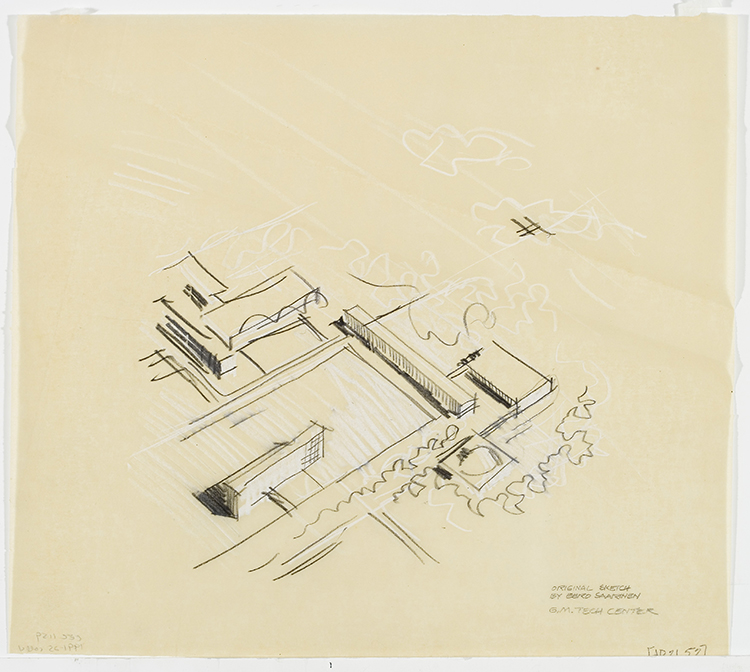
After a hiatus in the project by GM and reorganization of the Saarinen Swanson office, Eero completely redesigned the scheme in late 1948. The new design is high modernism at its finest: clean lines, experimental materials, and a lot of flat roofs. We can see Eero’s boxy proposal here, a treasured sketch from Cranbrook Archives:

Eero Saarinen GM Tech Center Sketch Small ad21-12

Eero Saarinen sketch of General Motors Technical Center, Warren, Michigan, 1949. Copyright Cranbrook Archives.

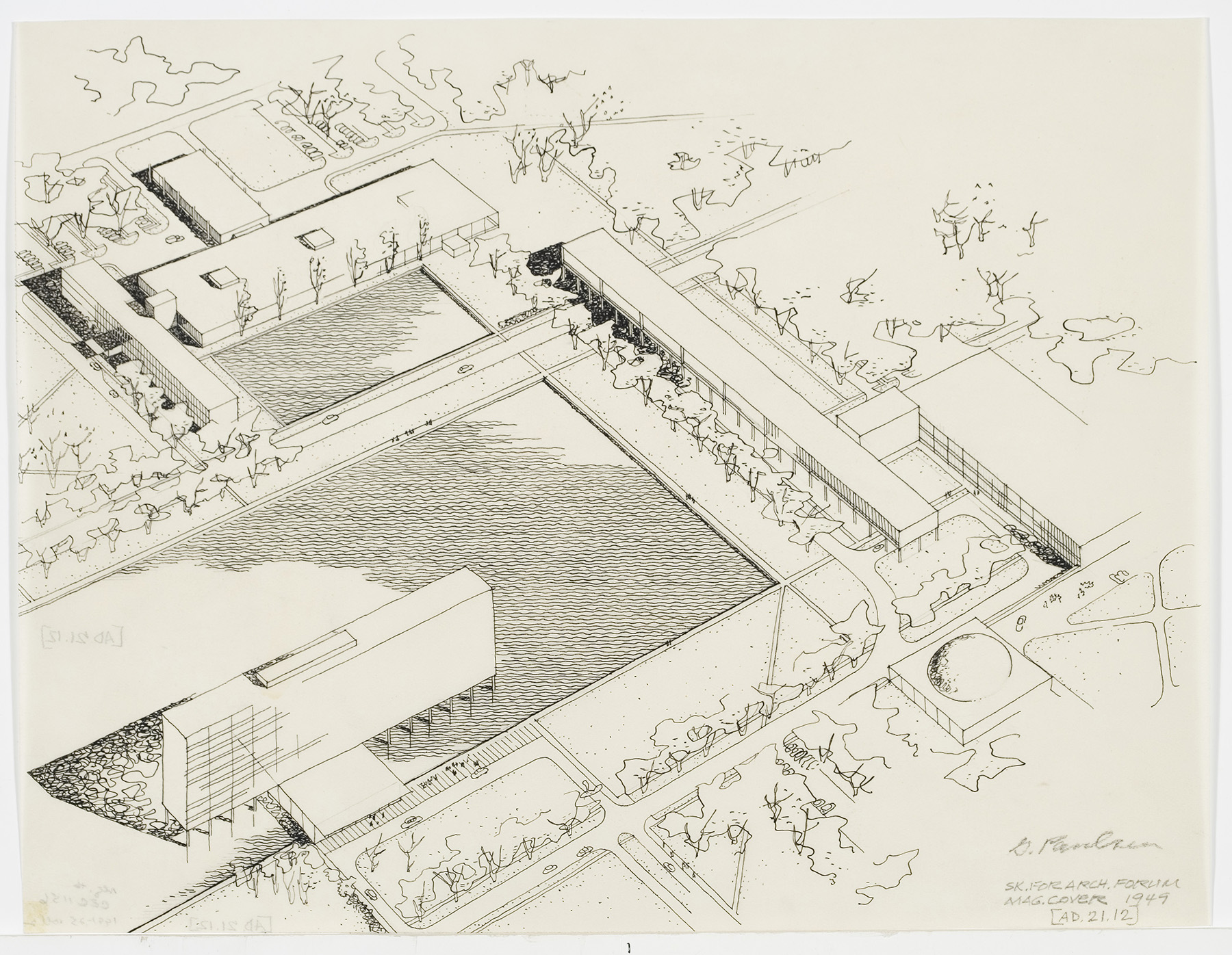
As the son of a world-famous architect building for one of America’s greatest companies, the project drew lots of attention well before it opened. Architectural Forum, in fact, featured the Tech Center as its cover story in July 1949. But what to show of the yet-constructed campus?

Glen Paulsen Eero Saarinen GM Tech Center Rendering ad21-12

Glen Paulsen drawing depicting Eero Saarinen’s proposed General Motors Technical Center, Saarinen Saarinen and Associates, 1949. Copyright Cranbrook Archives.

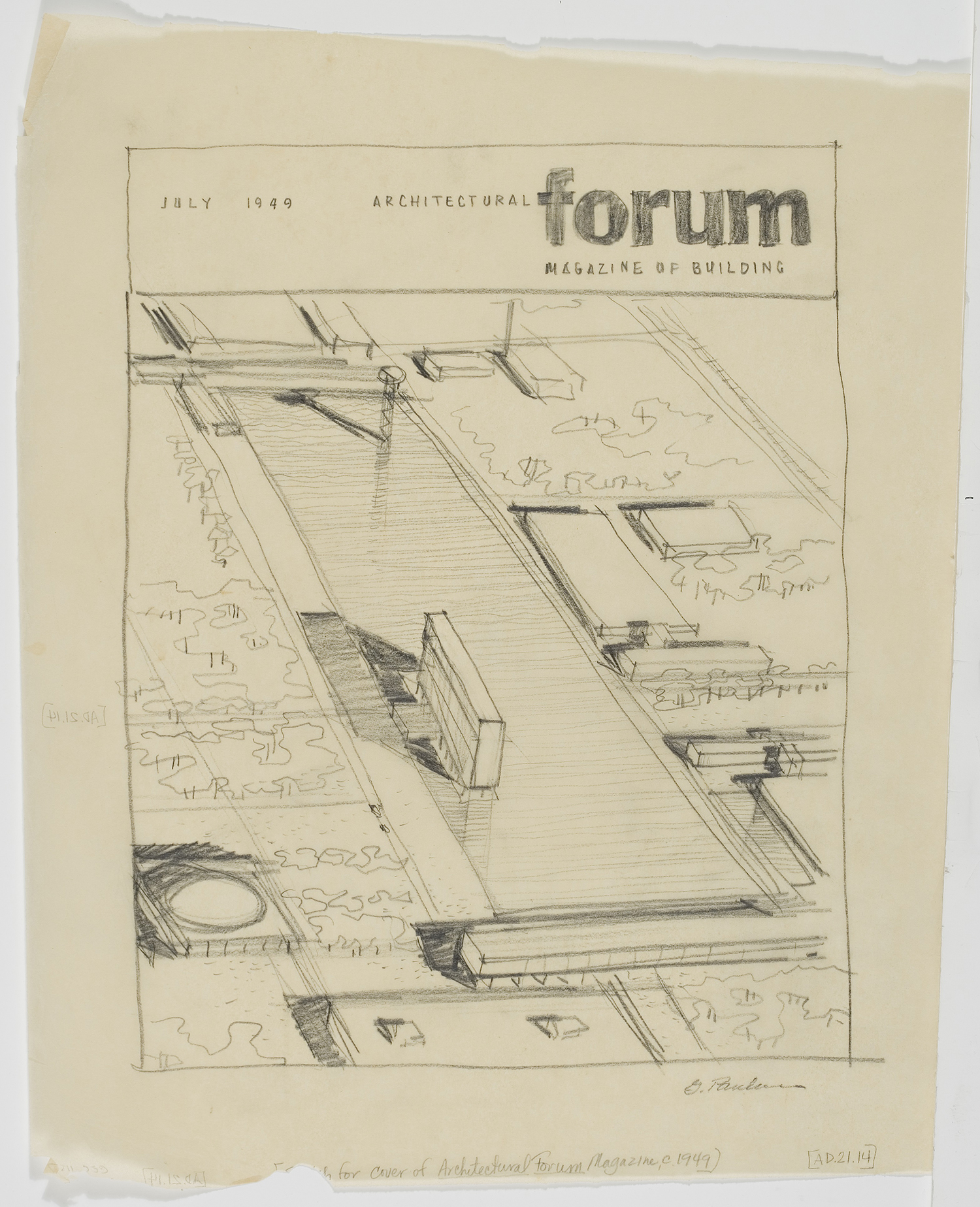
Eero turned to a talented young architect in his office, Glen Paulsen, to delineate the Tech Center for the magazine cover. Paulsen was known for his complex and sophisticated architectural renderings, and had worked for various firms as a renderer before coming to Saarinen’s office in 1949 as a design architect.  He sketched out several different options for Forum , and my favorite includes the entire layout of the cover, not just the buildings:

Arch Forum July 1949 Glen Paulsen rendering Eero Saarinen ad21-14

Concept art for cover of Architectural Forum by Glen Paulsen, depicting Eero Saarinen’s proposed General Motors Technical Center, Saarinen Saarinen and Associates, 1949. Copyright Cranbrook Archives.

Finally, in June 1949, the magazine hit the presses with a crisp, color drawing by Glen Paulsen depicting Eero’s General Motors Tech Center.

Architectural Forum July 1949 Glen Paulsen cover for Eero Saarinen

Architectural Forum 91, no. 1 (July 1949). Cover art by Glen Paulsen of Saarinen Saarinen and Associates. Courtesy of Cranbrook Academy of Art Library.

—Kevin Adkisson, Curatorial Associate

Of Provenance and Harmony

This is a story about the mistaken attribution of a quote, as told through the lens of archival provenance, that further deepened my own understanding and appreciation of the Cranbrook story. A researcher, referring to Cranbrook’s founder George Booth, once asked, “How did he do it? All of this! How do you motivate the finest artisans and craftsmen to come and help build a center for art and education?” It is a marvelous question, and surely one in which each inquirer may draw a different conclusion. When I get similar questions about how Cranbrook came to be, I always turn first to the words of George G. Booth himself, whether they be formalized in a trust document or business letter, crafted for a speech, or in the informal fluidity of a personal letter. Booth always acknowledged, in both his words and artistic compositions, the contributions of many, both contemporaneous and historic, in the building of Cranbrook . The image below shows a document included in the folders containing ‘Talks, 1902-1942’ in the Biographical series of the George G. Booth Papers. At some point during their administrative or archival custody, the talks were enumerated and this one is identified as number 21 with a circa date of 1936. Naturally, I have wondered exactly when and where he gave this talk.

1981-01 1-20 001

The Laying of a New Foundation for Cranbrook Institutions, a document included among the talks of George Gough Booth. Cranbrook Archives.

In my work at Cranbrook Archives, I have observed many times that the answers we find depend upon the phrasing or precision of the questions we ask. I have also learned to remain attentive to questions when I think I have exhausted the search, as oftentimes I have found an answer when I am no longer looking for it. I recently quoted from this talk to emphasize the trajectory from vision and ideal, through words, drawings, and activity to a tangible object or building:

“… the Cranbrook Foundation, dealing with things material and visible, rests in turn upon another foundation made up of things invisible – that is, of thought, vision, and ideals… No product of human hands exists which was not a thought before it became a thing.”

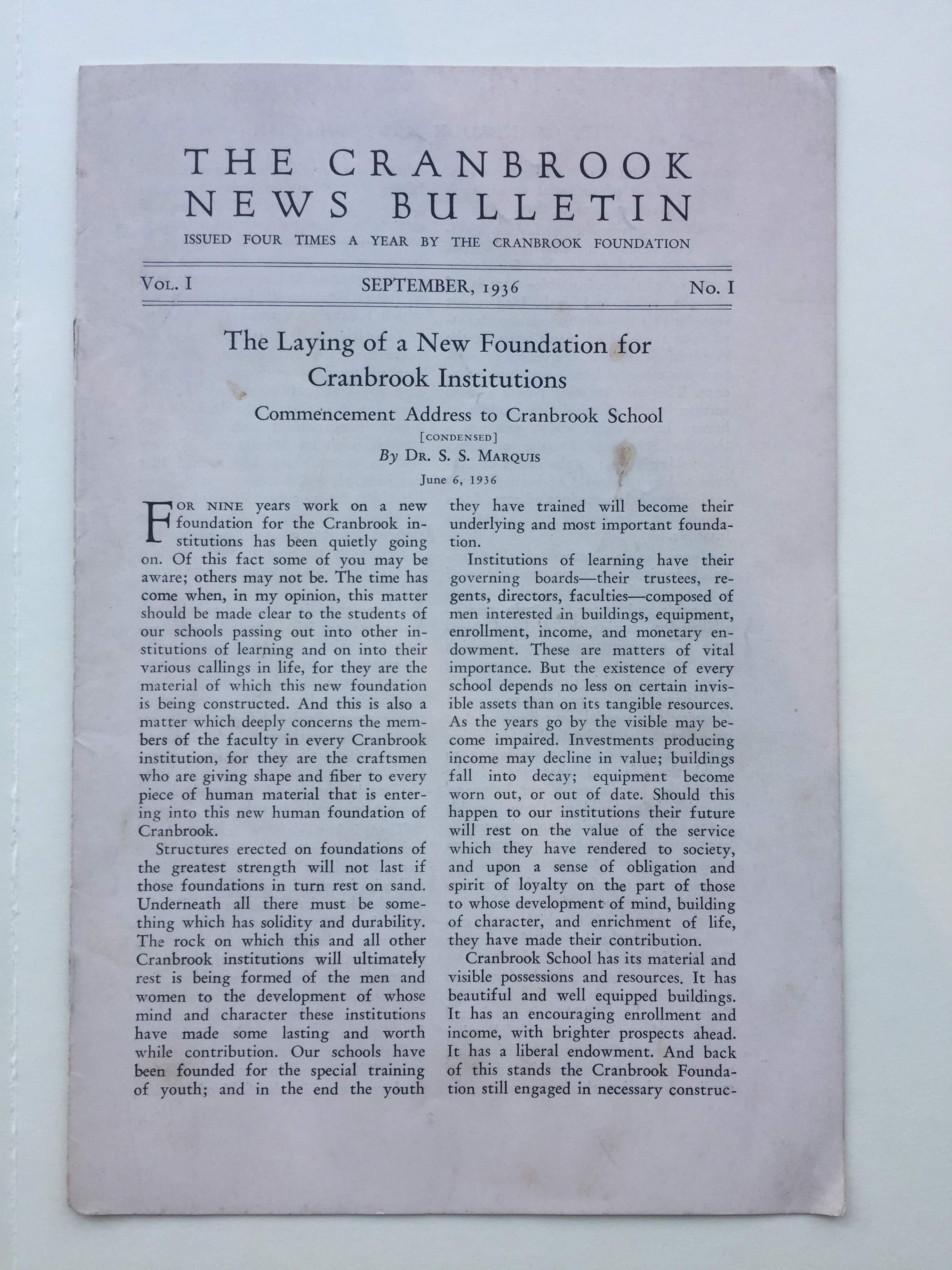
Shortly thereafter, I was researching two reference requests that took me into the Cranbrook series of the Samuel Simpson Marquis Papers, wherein I discovered the original version of the talk with pencil edits to truncate it for publication in The Cranbrook News Bulletin, September 1936. It was identified as a Commencement Address to Cranbrook School by Dr. S. S. Marquis on June 6, 1936. Along with it was a typescript version, the same as the one in Booth’s papers, and a letter from the Executive Secretary of the Cranbrook Foundation, William A. Frayer, which tells us that Marquis had encouraged Frayer to digest the talk for its publication.

1983-07 2-13 004

The Cranbrook News Bulletin, Vol. I, No. I, September 1936. Cranbrook Archives.

Although I had found my quote in a talk among those of George Booth, given to the Archives as part of his papers, here was definitive proof that it was actually part of an address given by Marquis! This discovery highlights the important, but sometimes misleading, concept of provenance of an archival collection, and how archivists continually refine understanding of their collections, even long after they are opened to researchers. In an archival setting, provenance relates to the administrative origin of a collection and ensures that the collection remains intact so that the records accumulated by one person or office are not intermingled with those of another. From an archival standpoint, the talk still belongs in Booth’s Papers, but will now be understood as something he collected rather than created. The principle of provenance dictates that it shall remain there, albeit with a note to advise future archivists and researchers of its authorship. We cannot know for certain how and when and by whose hand it came to be in his papers, but this new knowledge simply adds another layer to the relationship between Booth and Marquis, and the harmony of their thinking.

#1983-07.31

Rev. Dr. Samuel Simpson Marquis, circa 1906-1915. Cranbrook Archives.

Booth had first met Marquis as the Dean of St. Paul’s Cathedral and subsequently as visiting clergy when missionary services were conducted by Henry Wood Booth in the Meeting House (1918-1923). In October 1923, when the Meeting House began to be used for Bloomfield Hills School (later Brookside School Cranbrook), it was to Marquis that Booth turned with the idea of building a church and school. Moving to Bloomfield Hills the following year, Marquis remained part of the Cranbrook story as rector, teacher, trustee, and friend until his death in 1948.

Laura MacNewman, Associate Archivist


Welcome Nichole Manlove, Archives Assistant!

Nicole Full Size

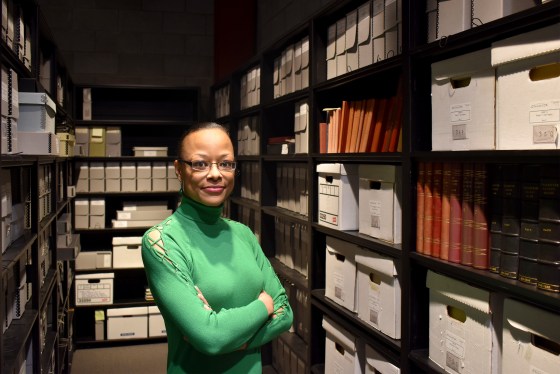
Cranbrook Archives welcomes our newest team member, Nichole Manlove, in the role of Archives Assistant. Nichole received her undergraduate degree in Advertising from Michigan State University and a Master of Library and Information Science degree and Graduate Certificate in Archival Administration  from Wayne State University. Prior to Cranbrook, Nichole most recently worked as a Project Archivist at the Bentley Historical Library, University of Michigan, where she helped preserve, arrange, describe, and make accessible a wide range of archival collections. Nichole has also held several interesting internships and volunteer positions with the Charles H. Wright Museum of African American History, the Detroit Institute of Arts Research Library and Archives, and the Detroit Historical Society Collections Resource Center.

From costume design sketches, 19th century correspondence, and papers of civil rights leaders to broadcast video recordings, student scrapbooks, and architectural drawings of major area firms, Nichole has pretty much seen it all. This wealth of experience will be invaluable in her role at Cranbrook Archives, where she’ll be assisting with the care, management, and discovery of our collections. Nichole is quickly absorbing Cranbrook’s history and our Archives operations in her first few weeks. She’s already deep into arranging and describing a complex collection, and is also working on populating our new collection management system to greatly improve patron access. We are happy to have her and look forward to great things!

Deborah Rice, Head Archivist

Carter for President

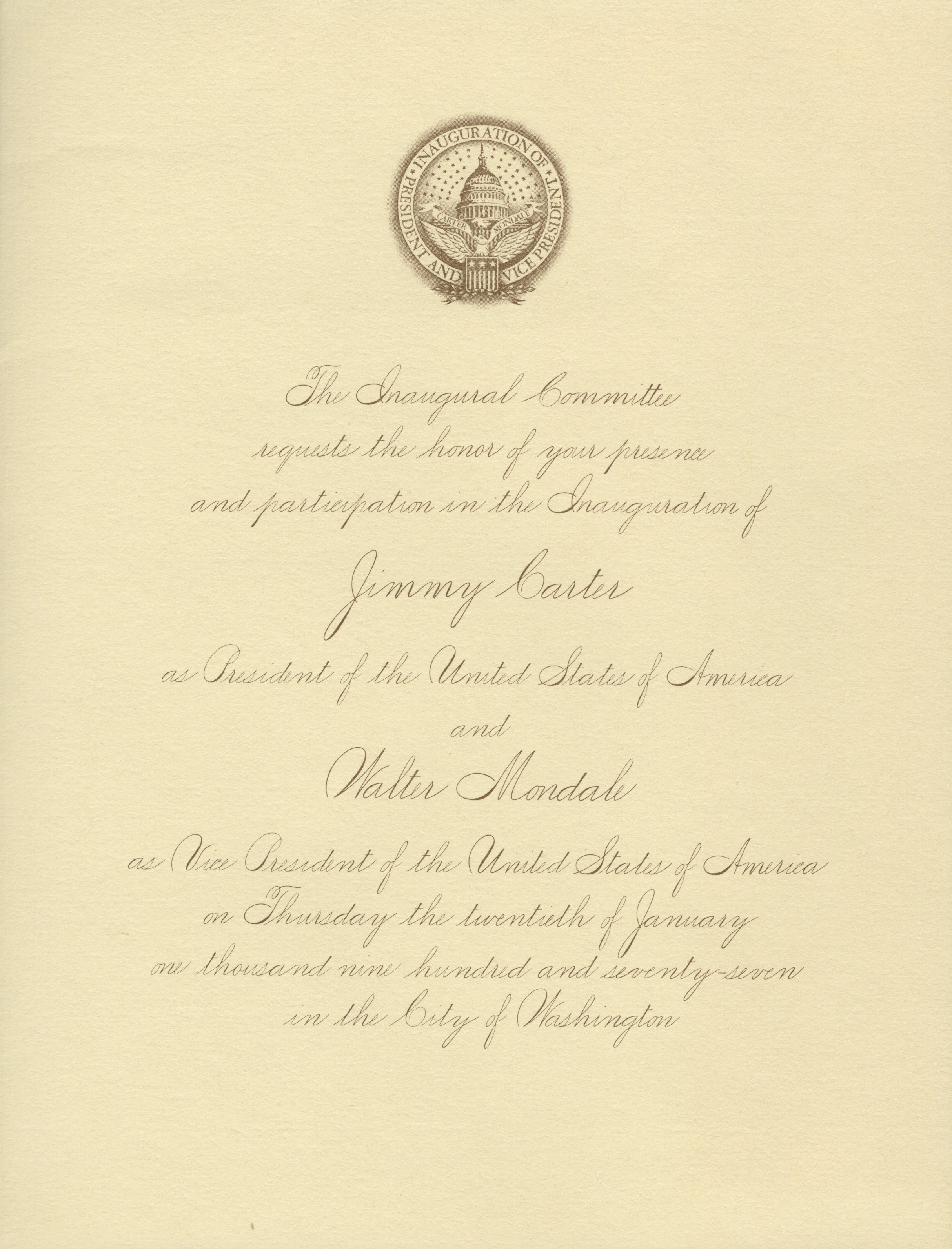
Recently, I discovered a few objects that had belonged to Melvyn or Sara Smith, the builders of our Frank Lloyd Wright Smith House. They were from 1976 — the year of the United States Bicentennial and a presidential election.

I discovered that the Smiths were supporters of soon-to-be President Jimmy Carter. Since we just had our presidential primary here in Michigan, I thought they were appropriate to share. 

So, why were the Smiths such big supporters of Carter? They were supporters of the Democratic Party in general.

Their son Robert Smith was the National Director of Youth Affairs for the Democratic Party in the 1970s. Melvyn and Sara held fundraisers at their home for Democratic candidates. Melvyn was a member of The President’s Club of the Democratic Party. And the Smiths attended the Inauguration of Jimmy Carter in 1977.

Melvyn and Sara Smith's invitation to the Inauguration of President Jimmy Carter and Walter Mondale, January 20, 1977. Melvyn Maxwell and Sara Evelyn Smith Papers, Cranbrook Archives.

Melvyn and Sara Smith’s invitation to the Inauguration of President Jimmy Carter and Vice President Walter Mondale, January 20, 1977. Melvyn Maxwell and Sara Evelyn Smith Papers, Cranbrook Archives.

Leslie S. Mio, Associate Registrar

Marthe Julia LeLoupp

Marthe Julia LeLoupp, born October 10, 1898, in Plogoff, Finistere, France, was an original faculty member of Kingswood School, where she taught French from 1930-1956. Having completed the Diplȏme de fin d’études at the Lysée Brizeaux, Quimper, Finistere, France in 1917, LeLoupp then completed her BA at Macalester College, St. Paul, Minnesota in 1920. She later completed graduate work at the University of Chicago (1929-1931) where she worked on an MA Thesis: Influence du Breton sur le français régional en Bretagne. With teaching experience in schools and colleges in Minnesota, South Dakota, New York, New Jersey, and Indiana, LeLoupp arrived at Cranbrook in 1930.

P1098

Marthe LeLoupp, 19 Feb 1952. Photographer, Harvey Croze. Cranbrook Archives.

Correspondence with LeLoupp in the Kingswood School Records is limited but suggests that she would return to France each summer. A letter from LeLoupp, written in Paris on September 17, 1939, tells how she left America in June with ticket safely tucked in her purse for a return September 6th on the Normandie. But, the declaration of war had made this impossible and her ticket had been passed, initially to the DeGrasse to sail on the 13th and then to the Shawnee, due to depart Bordeaux on the 22nd. The Shawnee, she explains, had been, “sent to the rescue of a few hundred thousand American citizens, who are anxiously waiting for transportation westward.”  On arriving to Bordeaux on September 22, 1939, Le Loupp writes that they were told, to their great dismay, that the Shawnee would not sail until the 26th. While LeLoupp’s letters were on their way to Cranbrook, Ms. Augur [Kingswood School Headmistress, 1934-1950] was searching for LeLoupp, first sending a telegram and then consulting the American Consul. LeLoupp’s mother returns Ms. Augur’s telegram with a letter explaining her daughter’s situation. Discovering this story recently, I wondered at the extraordinary resonance with current concerns for travelers, and for those unable to complete their journeys.

1980-01 9-14 (1)

Telegram, Ms. Augur to Mlle. LeLoupp, September 23, 1939. Cranbrook Archives.

Despite the harrowing circumstances, LeLoupp did eventually make it across the Atlantic. She continued to teach French at Kingswood School until July 1956, when she writes from Bénodet in France to request to be released from her 1956-57 contract due to poor health, ending the letter, “I find it impossible to express my regret in words.” Not much else is known about LeLoupp’s time at Cranbrook, except that she lived for twelve of her years at Cranbrook in the apartments above Kingswood School, which were converted in 1945 from the ballroom known as Heaven. In the KBC [Kingswood Brookside Cranbrook] Quarterly of May 1973, LeLoupp was remembered thus,

“a “beautiful person” with a “super smile”. She was “sweet and kind” and always beautifully dressed in classic tweeds. Peering over her bi-focals at her students and reciting in her strong French accent the terrible weekly dictes that no one could understand, she was one of those who inspired her girls to excellence or accomplishment in French that is still one of Kingswood’s greatest assets”.

Laura MacNewman — Associate Archivist


Cranbrook-LIFE

2020 marks ninety years of temporary traveling exhibitions at Cranbrook Art Museum. Perhaps one of the best examples that brings to life this aspect of the Museum’s programs is Cranbrook’s brief but wildly successful partnership with LIFE Magazine.

The Cranbrook-LIFE Exhibition of Contemporary American Painting opened in 1940, ten years after Cranbrook Art Museum hosted its first traveling exhibition, organized by the American Union of Decorative Artists and featuring contemporary interior design. The idea of temporary traveling exhibits at Cranbrook began the same year as the permanent collection was established by founder George G. Booth. It furthered Booth’s commitment to presenting contemporary art as foremost a learning tool for Academy of Art students. It was intended “to remind our students that art is a living thing and that the record of our times is being created from day to day by the artists of this age, and in so doing perhaps to stimulate the creative spirit among those who work here.”

LIFE_judging

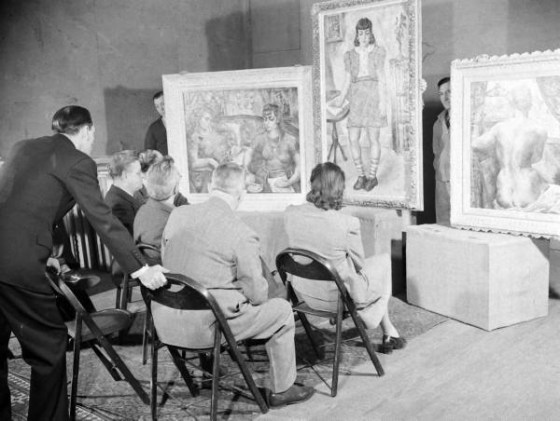
Judges examine paintings in New York, April 1940. Hansel Meith, photographer. Copyright Time Inc.

Cranbrook-LIFE was a celebration of contemporary U.S. art meant to symbolize “America’s increasing responsibility as a democratic world art center.” (Life, May 27, 1940) As such, LIFE invited sixty painters, living and working in America, to submit three paintings to be voted on by a jury of six. The painters included Edward Hopper, Charles Sheeler, and Cranbrook’s own Zoltan Sepeshy. The jury, comprised of Sepeshy, two leading art museum directors, an editor at LIFE Magazine, a representative from the Federal Works Agency Section of Fine Arts, and a well-respected American painter and educator, convened in a New York City warehouse where they spent four hours whittling down 180 submissions to the final sixty paintings shipped to Cranbrook for the show. One of these was Grant Wood’s American Gothic! Loaned by the Art Institute of Chicago, the already famous painting appears to be the only piece in the exhibition to come from another art museum.

5523-5

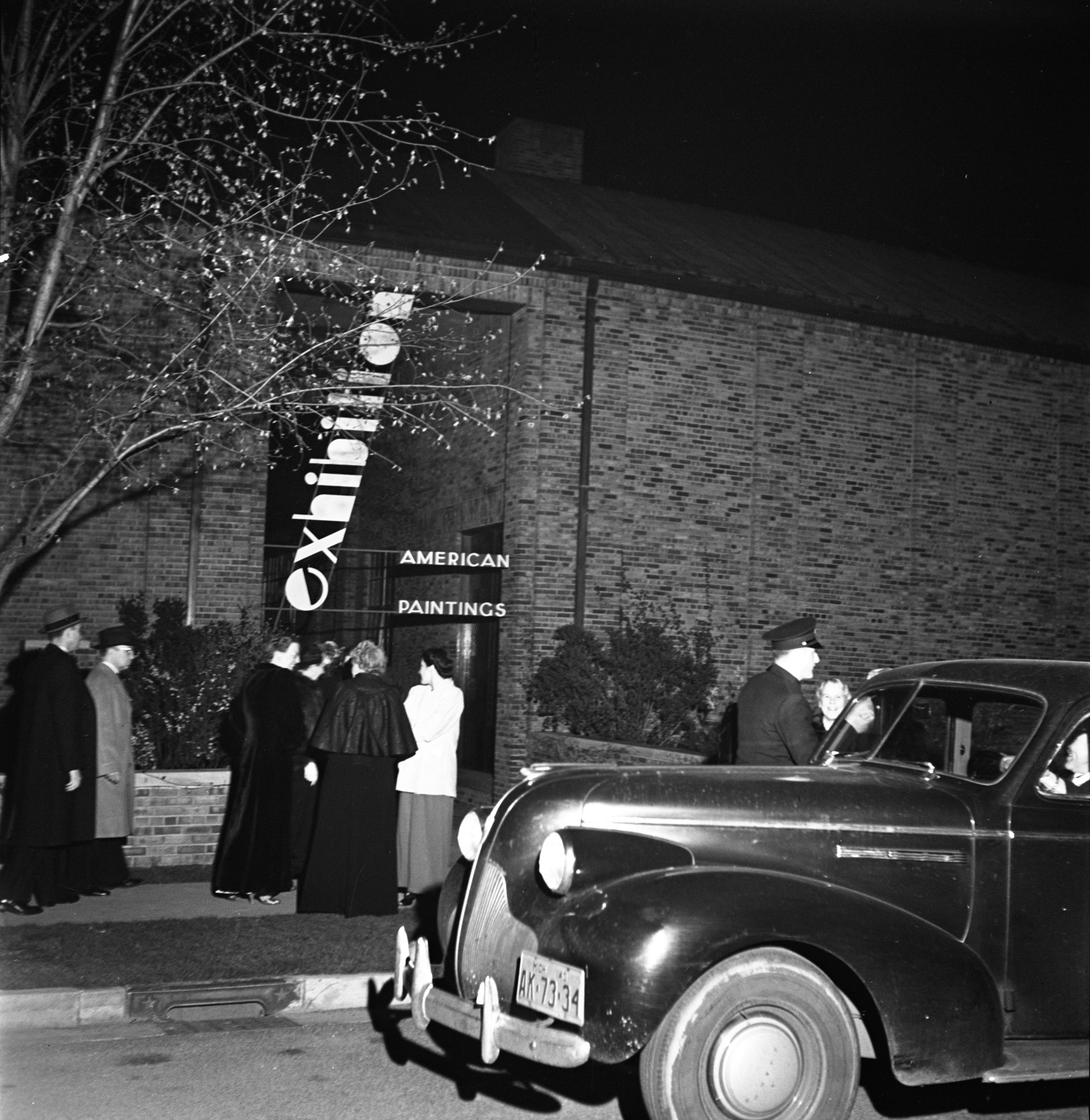
Opening night attendees arrive. Courtesy Cranbrook Archives.

If you’re at all familiar with LIFE, you may be asking yourself why a popular weekly magazine, known for its photographic general-interest stories, would make a foray like this into the art world? According to a 1940 TIME Magazine article, in the previous three years,  “the No. 1 U.S. source of popular knowledge of U.S. art has been LIFE, which has reproduced for the man-in-the-street’s weekly dime some 452 paintings (usually in full color) by U.S. artists.” Your next question might be why it was held at Cranbrook, as opposed to, say, the newly constructed Museum of Modern Art building in New York City? Florence Davies of the Detroit News may have answered that, when she wrote at the time: “Life Magazine picked Cranbrook not only because of the enchanting setting of the place as a whole, but more particularly because it found there ‘work in progress—an atmosphere of creative activity.’”

5523-11

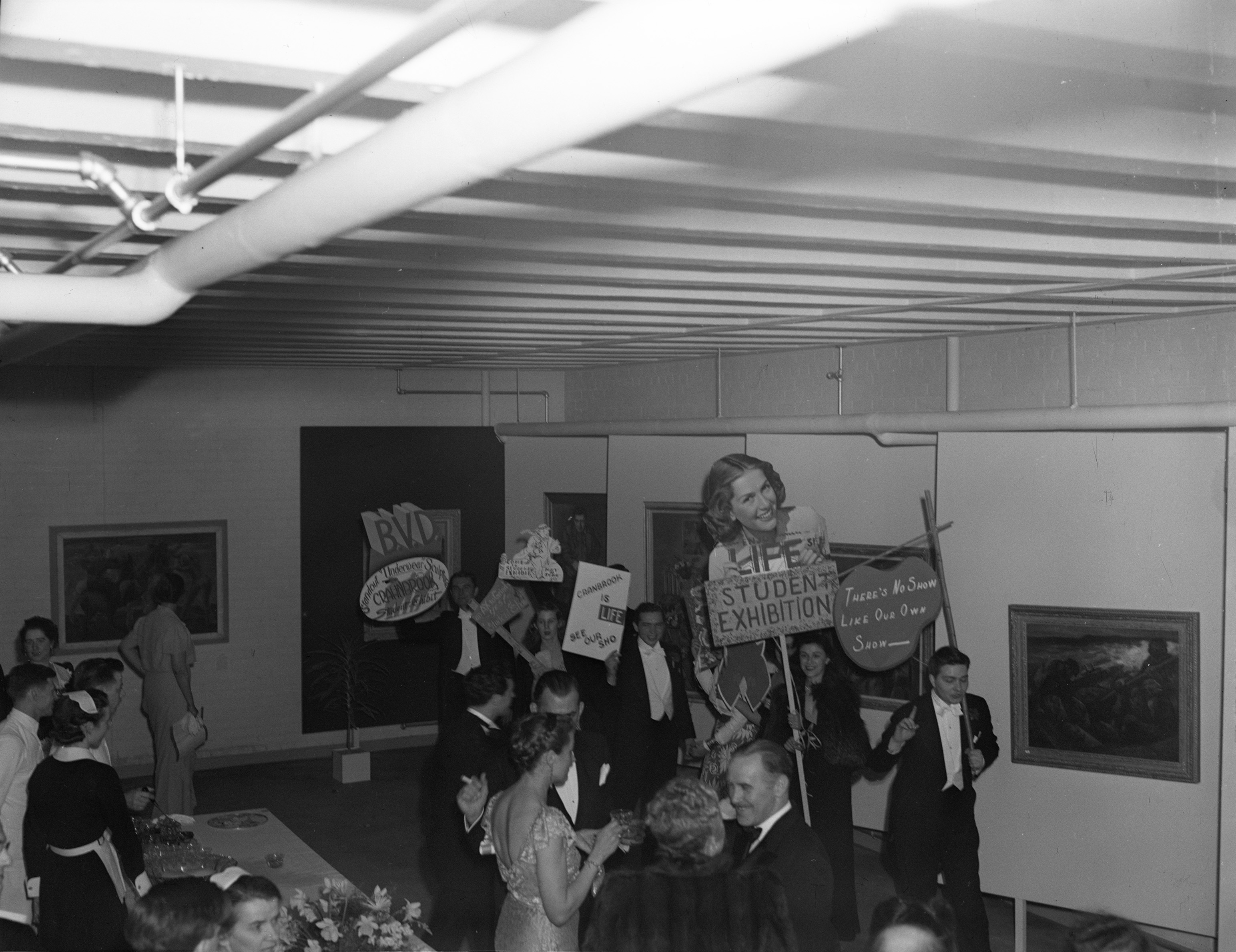
Academy of Art students parade through the opening night gala reminding attendees of the student exhibition simultaneously on display at the Cranbrook Pavilion. Courtesy Cranbrook Archives.

The exhibition drew an estimated 2,500 national and international visitors in the short two weeks it was on display from May 17-June 2, 1940. Because of the size of the show, it could not be held in the current museum building on Lone Pine Road and Academy Way (Eliel Saarinen’s museum building began construction during the exhibition). And, as the Academy student exhibition was currently occupying the Cranbrook Pavilion, the decision was made to utilize the Academy’s Painting Department Studios. Opening night was a festive gala. Attendees, including George and Ellen Booth, Loja and Eliel Saarinen, Edsel B. Ford, Albert Kahn, and “1,000 Detroit socialites braved wintry winds” in formal attire. (Time, June 3, 1940)

5533-1

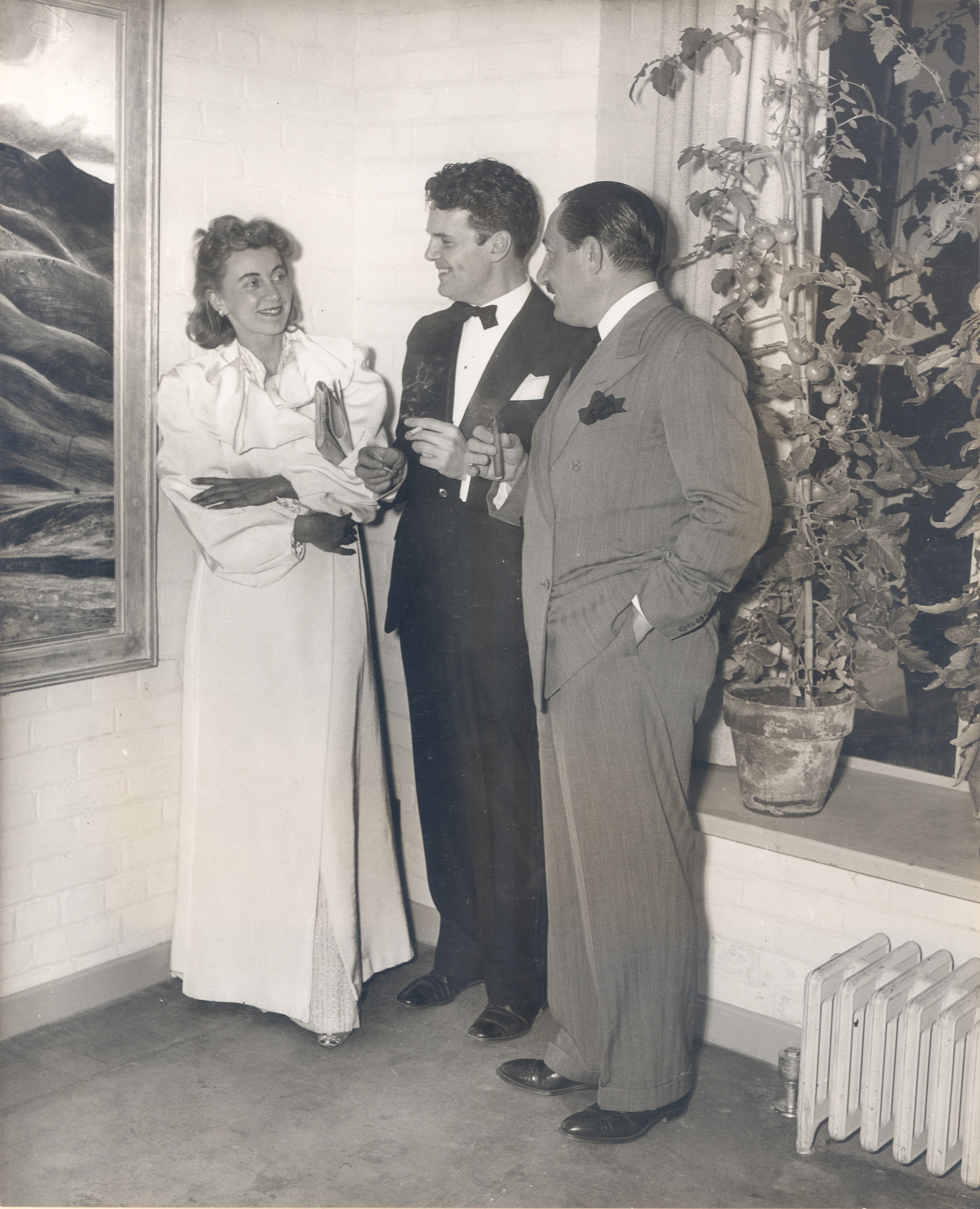
Marianne Strengell, Charles Eames, and Richard Reinhardt. Richard A. Askew, photographer. Courtesy Cranbrook Archives.

Coming on the heels of the Great Depression and during the beginning months of the War in Europe, pro-American sentiment was high, as evidenced by the placement of potted American-grown tomatoes in windowsills as decoration. According to TIME Magazine, the music for the evening was by U.S. composers and refreshments included “Rhine wine flavored to taste like U.S. new-mown hay.” (!?)

Cranbrook-LIFE marks the beginning of the Cranbrook Art Museum Exhibition Records, which illuminate thirty-six years of temporary traveling exhibits, and are rife with names of renowned artists that have exhibited at Cranbrook throughout its history.

It’s not all in the past, though! Don’t miss Cranbrook Art Museum’s current traveling exhibition,  In the Vanguard: Haystack Mountain School of Crafts, 1950-1969, on view until March 8, 2020.

Deborah Rice, Head Archivist

Create a website or blog at WordPress.com