The clerestory windows designed by G. Owen Bonawit in the nave of Christ Church seem to be one of the least described elements of the church’s artwork. The work was negotiated and subcontracted through architect Oscar H. Murray at Bertram Grosvenor Goodhue Associates rather than commissioned directly through George G. Booth. Consequently, there are few documentary vestiges of the artist’s process in our records.
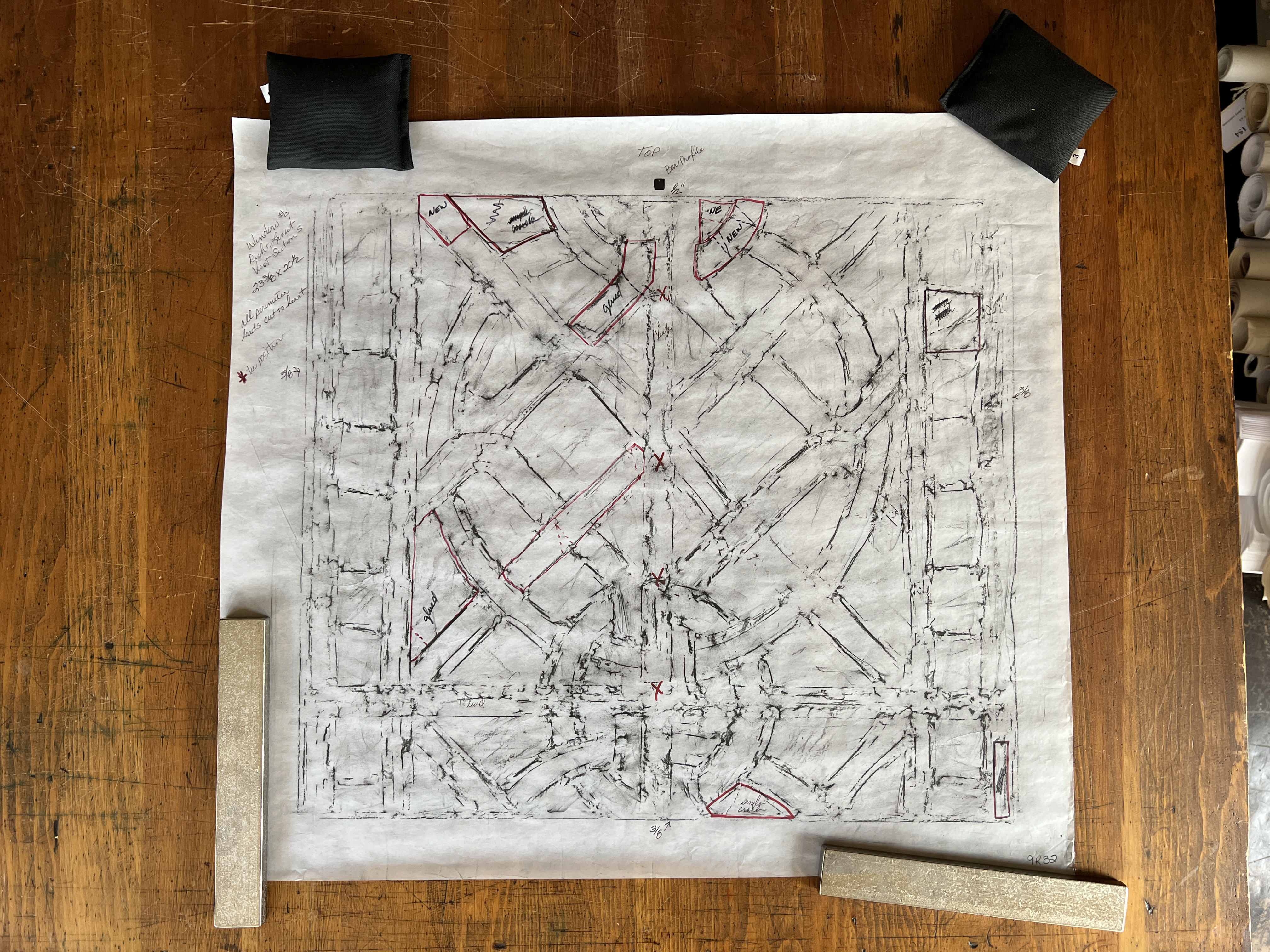
The windows can be studied through other materials held by the Archives, including architectural drawings, photographs, and the records of a window restoration project which commenced in 1993. In 1995, the Thompson Art Glass company made rubbings of the window for the purposes of identifying their care and preservation needs.
Window rubbings by Thompson Art Glass made June 19, 1995. Courtesy of Cranbrook Archives.
There are seventeen grisaille clerestory windows in the nave and chancel at Christ Church, which were analyzed as part of this stained-glass restoration project. They are made of clear antique glass upon which minute floral detail is painted and accentuated by the addition of small amounts of colored glass. In the chancel, there are two lancets and tracery of nine panels supported by T-bars including one ventilator panel. In the nave, they are comprised of three lancets and tracery with eight panels, with ventilator panels making up the bottom row.
Detail from Architectural drawing of Christ Church Cranbrook, North Elevation. April 30, 1925. Drawn by J.E.M./Oscar H. Murray, Bertram Grosvenor Goodhue Architects. [AD.10.33]. Courtesy of Cranbrook Archives.
Grisaille, literally meaning ‘to grey,’ is a type of stained glass that is mostly monochromatic, with a silver or grey tone being painted onto the finished glass. The purpose of the plainness of grisaille is twofold: they let more light into the space both literally and metaphorically in that they were intended to limit distraction from meditation.
The grisaille stained glass style is thought to have originated in French Cistercian abbeys after a prohibition on colored glass issued by St. Bernard of Clairvaux in 1134 in accordance with their charism of simplicity. St. Bernard, the master of paradox, also banned the use of figurative decoration according to the First Commandment of no graven images. Under his guidance, the Cistercians seek the face of God, a theological anomaly that produces an exquisite spiritual discipline and religious practice through which the monk contemplates holiness by virtue of continually recognizing the poverty of their thoughts and feelings when weighed down by seeking to satisfy worldly desire. The style often employs natural or geometric patterns, much like a labyrinth.
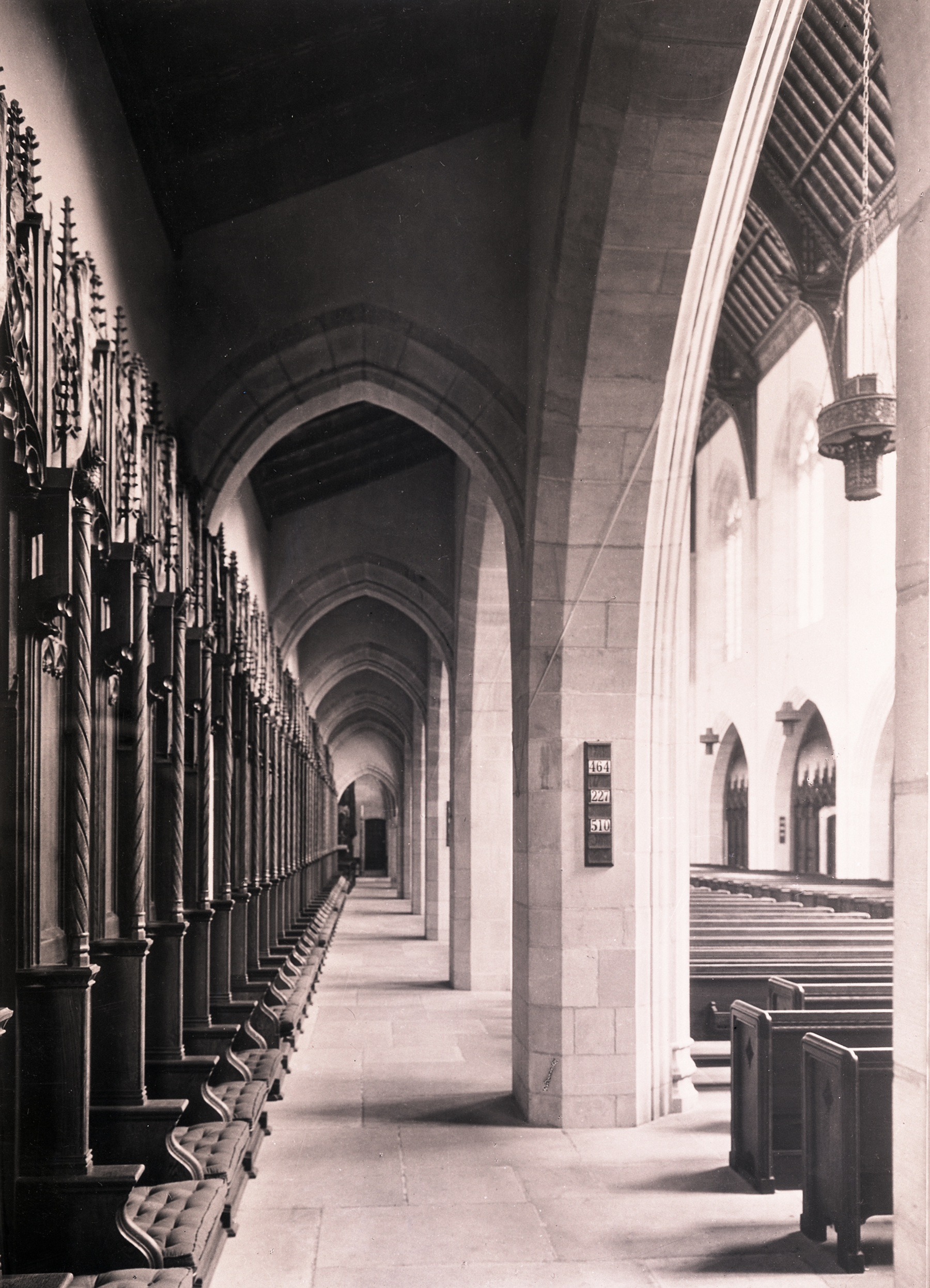
The windows can best be observed by sitting in the aisle stalls of the nave, which are in themselves an unusual feature otherwise only found in Oxford college chapels. The walls of the nave were originally intended to display memorials and artwork, but the latter idea was revised due to the objection that it would bring a museum feel to a house of worship.
Aisle stalls in left side of sanctuary. June 23, 1946. Photographer, Harvey Croze. Courtesy of Cranbrook Archives.
Added in 1930, the aisle stalls offer a fine perspective from which to observe the grisaille, and Bonawit’s elegant craftmanship brings with it a history of monastic inspired light. Since a life without beauty is only half lived, the artistic eclecticism of Christ Church offers all those who enter the opportunity to embrace the other half both in its resplendency and in its simplicity.
– Laura MacNewman, Associate Archivist, Cranbrook Center for Collections and Research
“My darling, You are wonderful! I start with that because now again you have covered yourself with a light that sets you off from every other person I have ever known!” (Carl to Annetta, August 25, 1928).
The love letters of Carl and Annetta Wonnberger are among the most beautiful expressions of love, longing, and devotion I have ever read. With Valentine’s Day coming soon, it’s a perfect time to share with you some of their words that convey something of life’s highest mystery as it can manifest between two people.
Carl and Annetta Wonnberger. September 7, 1929. Courtesy of Cranbrook Archives.
Carl George Wonnberger (1901-1980) and Annetta Bouton Wonnberger (1909-1997) arrived at Cranbrook in 1929. Carl taught English at Cranbrook School until 1967, and they both founded the Cranbrook Theatre School in 1942. Their life is a love story of manifold paths. Their letters provide us with an intimate glimpse into the couple’s hearts in the two years preceding their marriage and the beginning of their life together at Cranbrook.
Annetta first met Carl in the Spring of 1926, when she visited the Storm King School, New York, to take the college entrance exam, which she failed. Carl, a teacher there, was the administrator. Annetta attended Drew Seminary as a post-graduate student and retook the exam in the spring of 1927, and that is when they connected. If sparks didn’t fly at their first meeting, they did at the second, as shortly after, on June 23rd, Carl asked Annetta to marry him.
Writing in July 1927, Annetta recalled that early evening in June—their walk in the woods, the perfect quiet except for the frogs and locusts around Black Rock, the ride back and the thunder shower. Annetta’s candid style of writing offers us quite a vivid sense of her character as well as a discernible process of maturation over the two years:
Carl, ever since I was a small child I have lived in a sort of fairyland of dreams and ideals. It was only natural, of course, that the people whom I met in real life differed from the creatures of star-dust and moon-mist fashioned by my fancy. And it has always been hard to realize the truth. But you, dear, there is no disillusionment about you. You are all I have ever dreamed the man I would love would be – and more. I only hope that I may be able to follow the road you’ve shown me, and reach the goal you’ve set.”
Letter from Annetta to Carl, November 30, 1927.
From 1927-1929, Annetta attended Smith College in Massachusetts, while Carl remained a teacher at Storm King in New York. They would meet up periodically, but the rest of the time was spent in yearning, which is recorded in their letters (sometimes more than one a day!).
Letter from Annetta Bouton to Carl Wonnberger, January 7, 1928. Courtesy of Cranbrook Archives
‘A smooth sea never made a skilled mariner,’ says the English proverb. This lovely little saying is quite apt for a story that I discovered in the papers of Henry Scripps and Carolyn Farr Booth.
In a folder of correspondence, I came across two letters to Henry Booth from a man named Brad Storm, a Bloomfield teenager who had sailed around the world solo in a boat, a journey which took him four years to complete. While there is little documentation on the story, it’s possible to piece together an inspiring tale of challenge, adventure, tenacity, and discovery.
An article in The Detroit News on October 24, 1983 (p. 3) tells us that Storm had planned the trip since he was 13. After working jobs and saving throughout his high school years, he bought a 27-foot cruising sloop named Dream Weaver. The initial voyage started disastrously in a shipwreck only three days after setting sail, on Friday, October 13th, 1979. Storm, determined and wiser, set sail again and successfully voyaged through Pacific Islands, Oceana, Australia (where he stayed for a year), the Indian Ocean, Mauritius, South Africa, the Caribbean, and home via the Panama Canal.
In the article, Storm describes the marvels and the struggles of his voyage, and recounts that his only companionship was a supply of classic books. As he deliberates his future voyages, he is certain of one revision: “Man wasn’t meant to sail alone. I’ll always go with a crew now so there’s someone to share the experience with.”
From Booth’s diary and History for 1983, I learned that upon reading about Storm’s journey in the newspaper, Booth phoned him up and invited him to visit Cranbrook. A couple of days later, Storm came to talk about his experience to Dr. Jeffrey Welch’s English class at Cranbrook School. He also spent time with Alice and Warren Booth (third child and second son of George and Ellen).
The first letter to Booth is dated December 1983, and Storm had sailed again in search of a place to settle and look to the future. He was writing from the coast of New Zealand to thank Booth for a poem, Inspired by a Chap Named Storm, that he had sent to Storm’s parents. Storm was considering how he could help and inspire others from the lessons he had learned through his experience and said that it was meaningful to him to receive Booth’s poem.
Inspired by a Chap Named Storm, a poem by Henry Scripps Booth. November 2, 1983. Courtesy of Cranbrook Archives.
The second letter describes how Storm had arrived in Honolulu in June 1984 and planned to stay there to write about his journey and to pursue higher education. He writes,
“I’ve spent so much time at sea alone it’s terrific with friends all around me and other things I’ve denied myself for so long. Just walking to the shop and buying a pint of milk is still a pleasure. The sea showed me not to take things for granted so I’m not and enjoying life immensely… Writing is a very strange and new voyage to me with an unknown end, but I’m enjoying the challenge it’s bringing me. A lot of new challenges in a new life, I wake every morning enjoying the anticipation of the new day.”
Letter from Brad Storm to Henry Scripps Booth, July 2, 1984
Like Booth, I felt inspired by this chap named Storm, whose persistence in following his dream led to a great discovery. In searching the world for life, he discovered his relationship to it, giving him a most wonderful gift—the gift of taking pleasure in simple things.
–Laura MacNewman, Associate Archivist, Cranbrook Center for Collections and Research
Cranbrook Archives is pleased to announce a new collection available for research. An intriguing collection, it comprises the personal and professional papers, photographs, realia, and architectural drawings of Walter Preston Hickey, a student of Eliel Saarinen. Yet, while traces of key life events and relationships—birth, parentage, education, marriage, friends, and employers—can be found in the collection, Hickey’s life after Cranbrook remains largely a mystery.
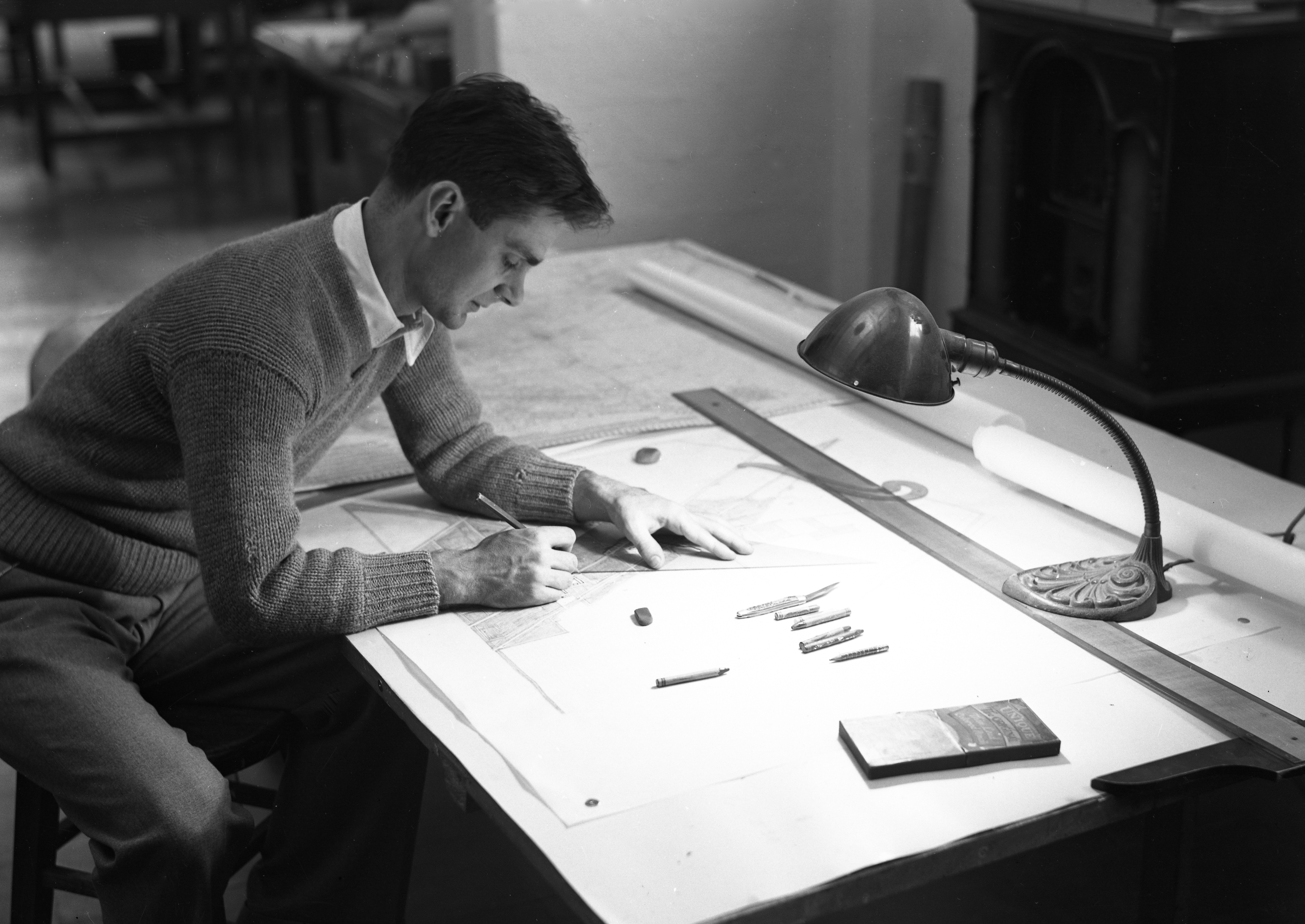
Walter Hickey working in the Architecture Studio, 1935. Courtesy of Cranbrook Archives, Cranbrook Center for Collections and Research.
A native of Detroit, Hickey attended the University of Michigan School of Architecture (1926-1930), during which time he worked with architects Albert Kahn (1928) and Thomas Tanner, as well as being one of the first staff members of the Cranbrook Architectural Office.
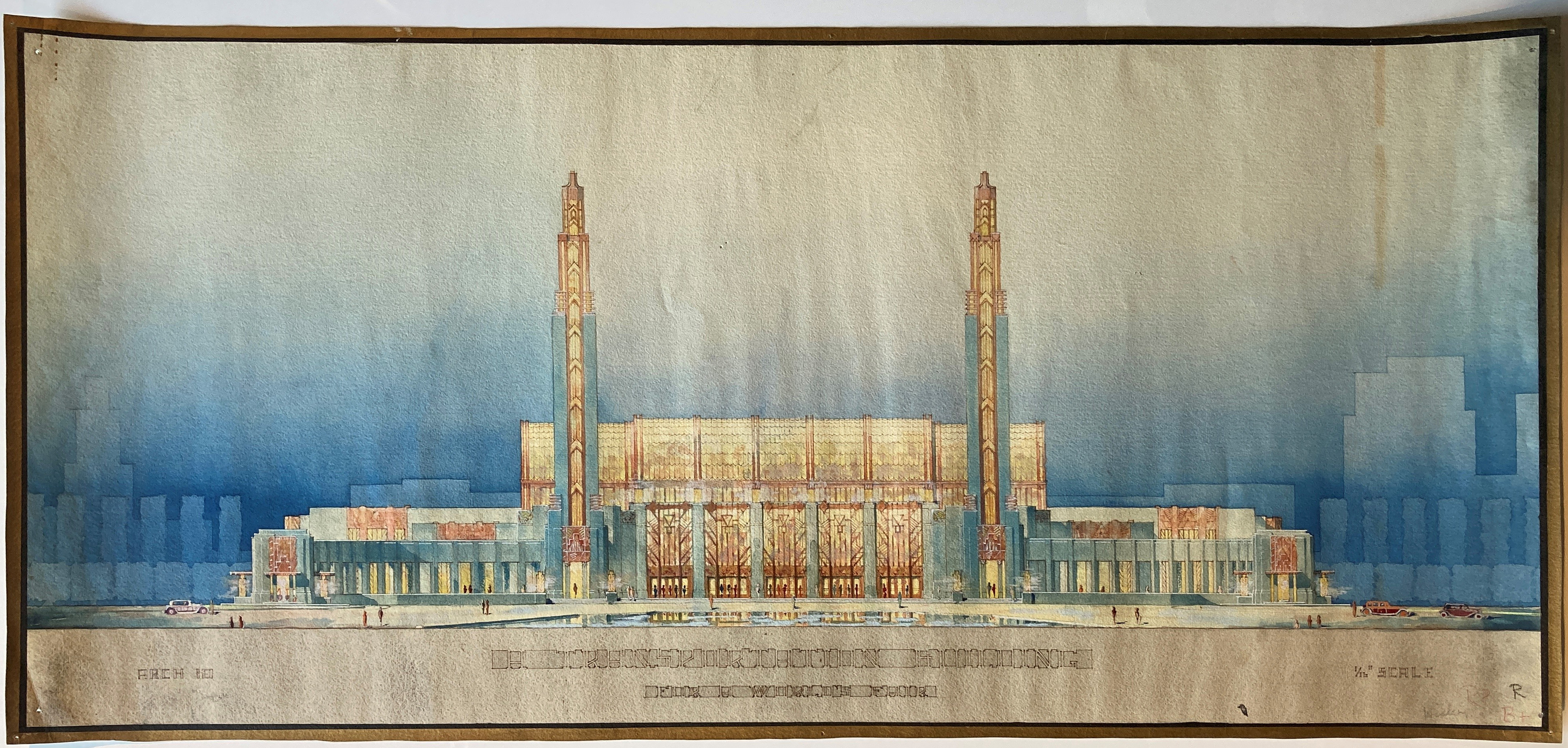
A Transportation Building for a World’s Fair, circa 1926-1930. A University of Michigan Class Project by Walter Hickey. Courtesy of Cranbrook Archives, Cranbrook Center for Collections and Research.
He applied to study architectural design with instruction in city planning at Cranbrook Academy of Art, starting in September of 1932. He became especially interested in highway traffic control, which formed the topic of his 1935 thesis on theWaterfront Development for the City of Detroit. Hickey submitted designs to various Academy competitions and won a $10 prize from Loja Saarinen for design No. 13 in the Cranbrook Academy of Art Rug Competition in 1934.
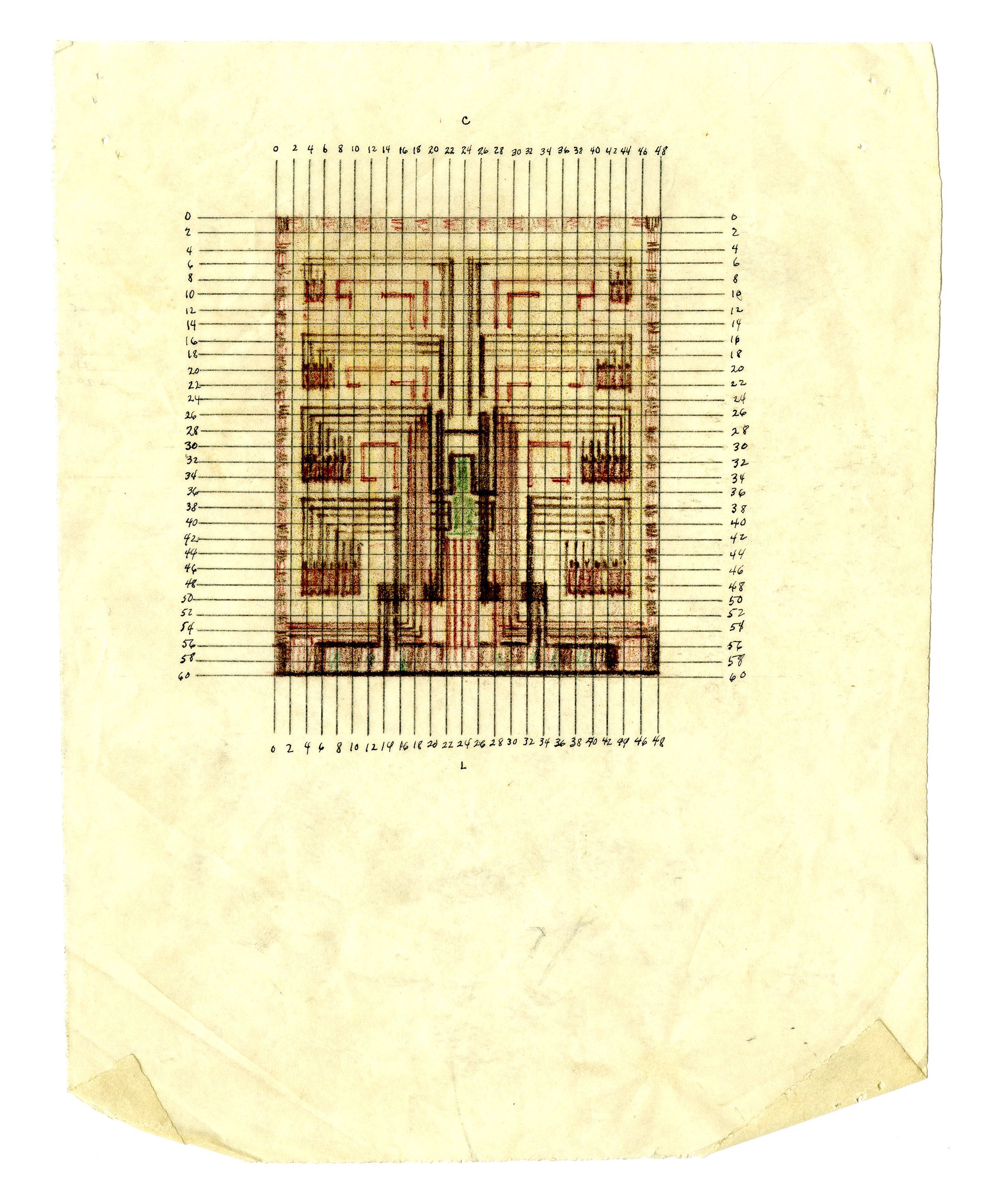
Drawing by Walter Hickey, undated. Courtesy of Cranbrook Archives, Cranbrook Center for Collections and Research.
After leaving Cranbrook, Hickey worked for various architecture firms, including Smith, Hinchman, and Grylls, and Clair W. Ditchy. After a short time with the Federal Housing Administration, he returned to work with Eliel and Eero Saarinen on the Kleinhans Music Hall project. He also completed private architectural designs for residences, including work on Ralph Rapson’s Hoey vacation home, Longshadows, in Metamora, MI. Around this time, he went to work at the General Motors Technical Center and continued to live in Birmingham, Michigan. And here is where his story ends in the collection.
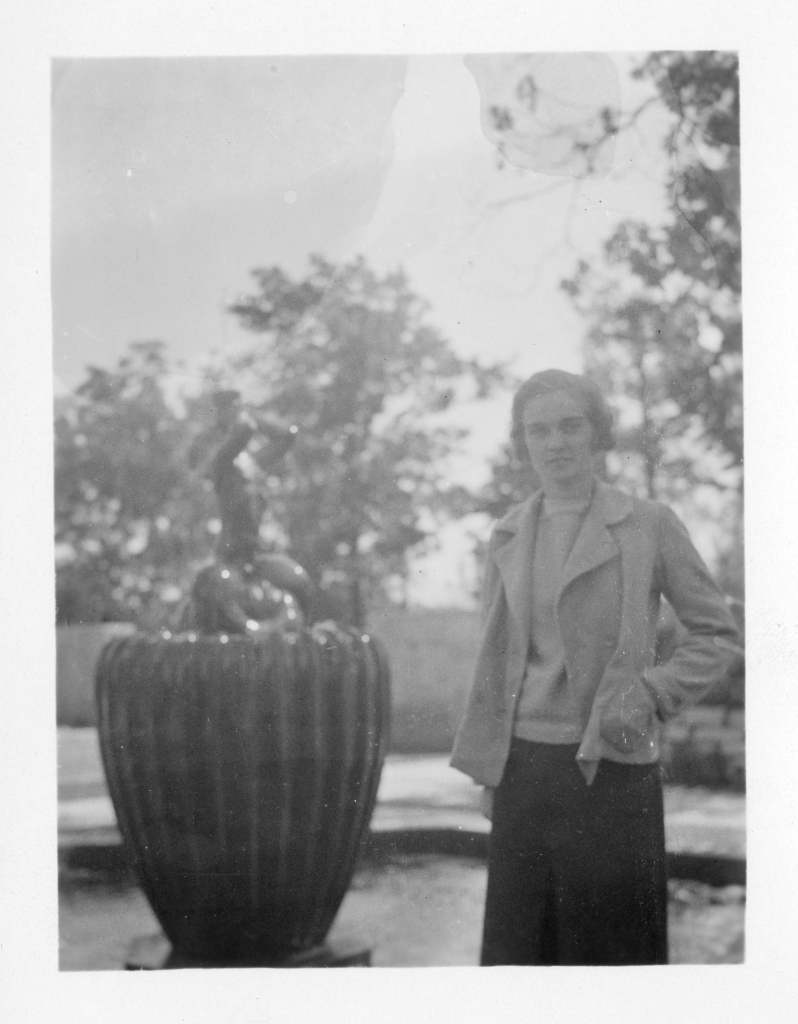
Jane Viola Shepherd. Courtesy of Cranbrook Archives, Cranbrook Center for Collections and Research.
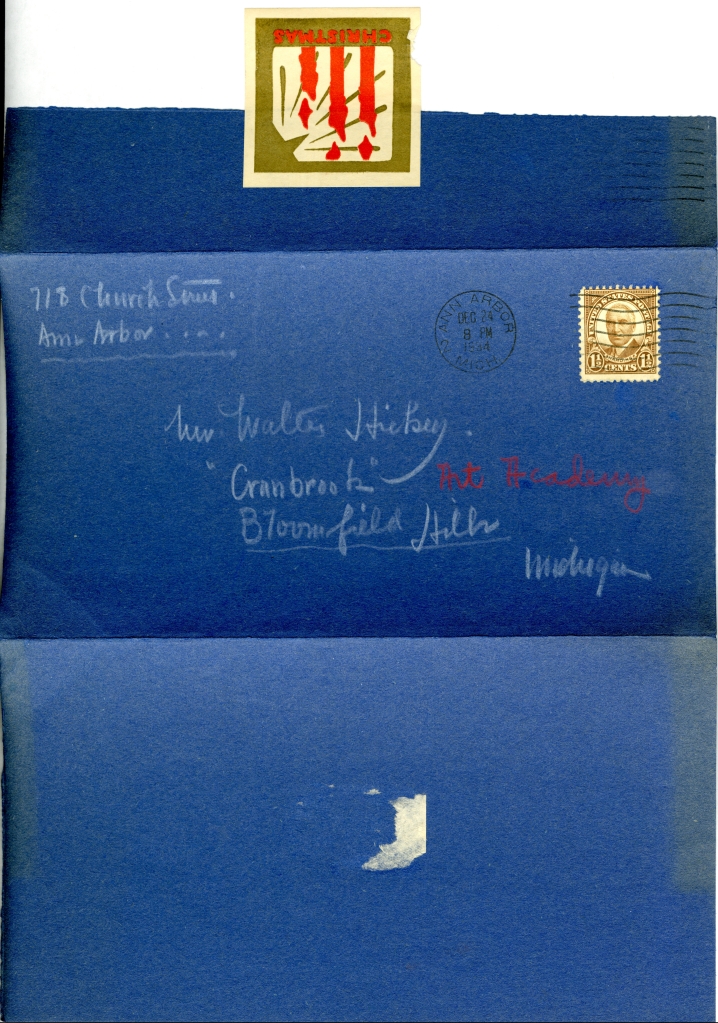
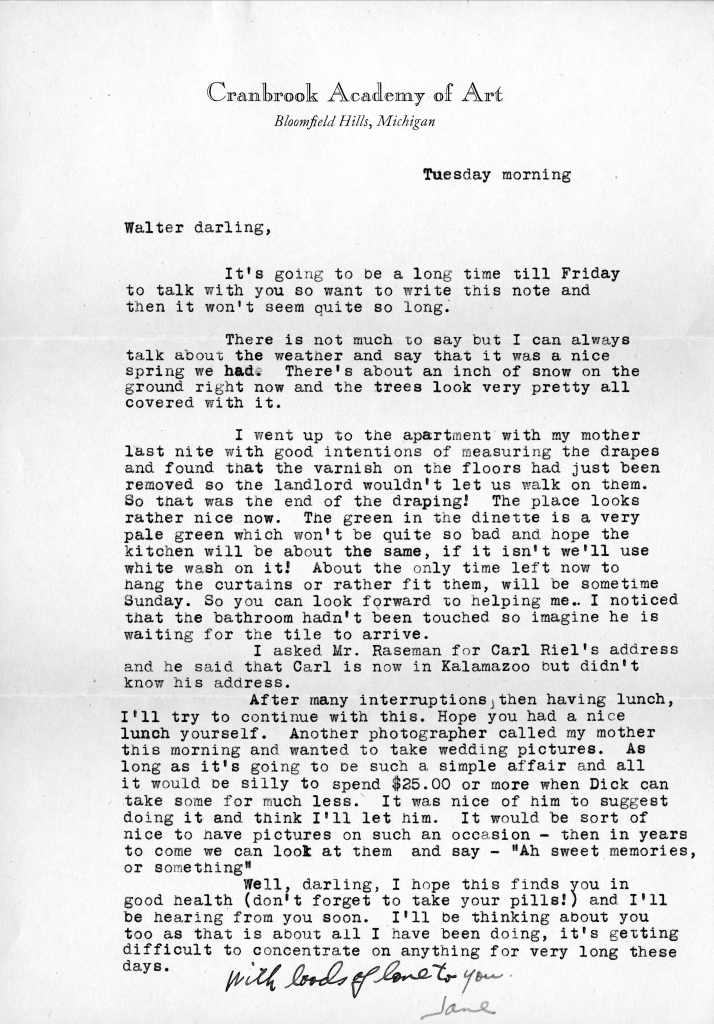
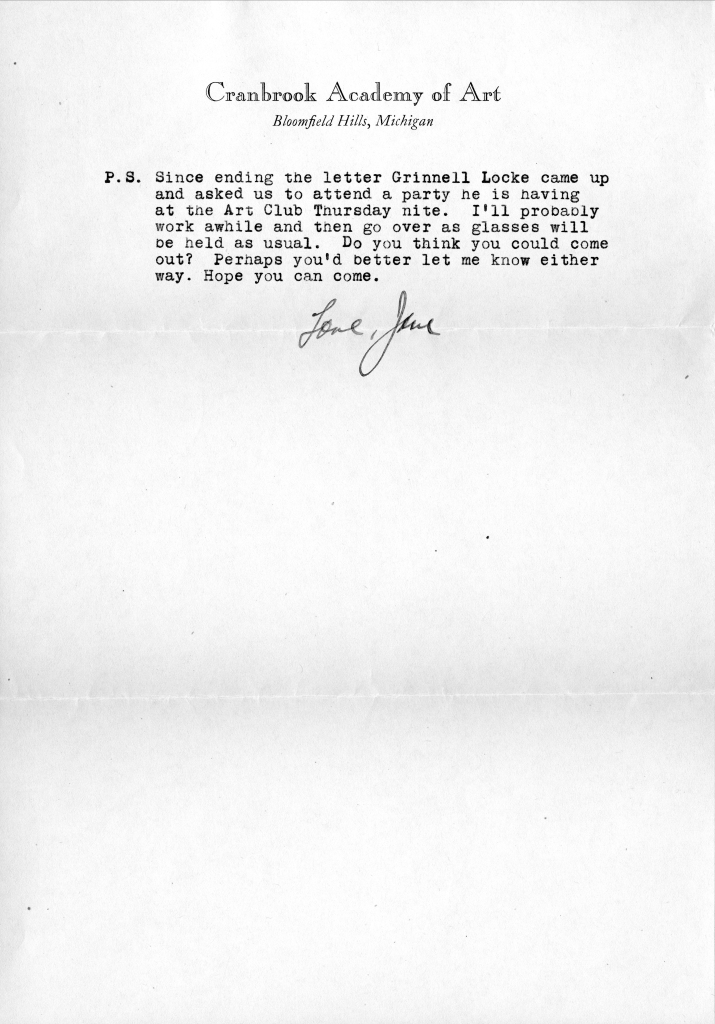
Although this is a very small collection, the diversity of content is rewarding for its ability to convey snapshots of his life in individual and unique items. It includes Christmas cards, such as one from “the Lorches” (Emil Lorch was the President of the University of Michigan Architecture School), a few letters from friends, and something of a typed love letter (on Cranbrook Academy of Art letterhead!) from Zoltan Sepeshy’s Secretary Jane Viola Shepherd to whom he was married on April 22, 1937.
Correspondence to Walter Hickey, 1934-1937. Courtesy of Cranbrook Archives, Cranbrook Center for Collections and Research.
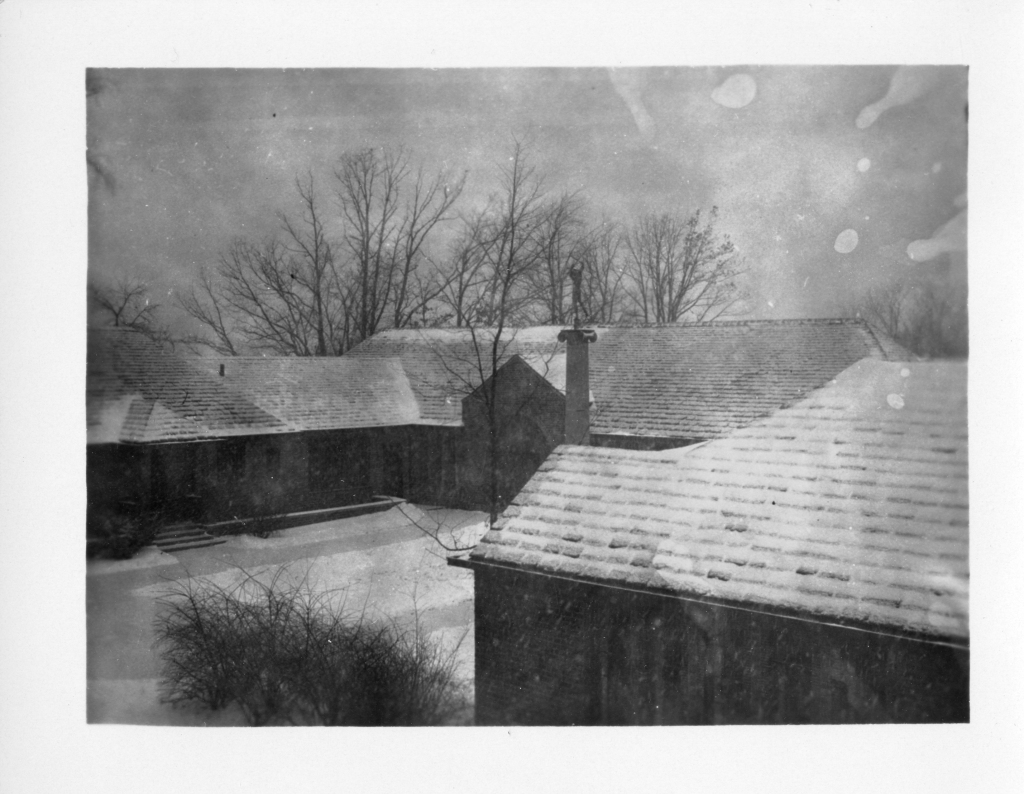
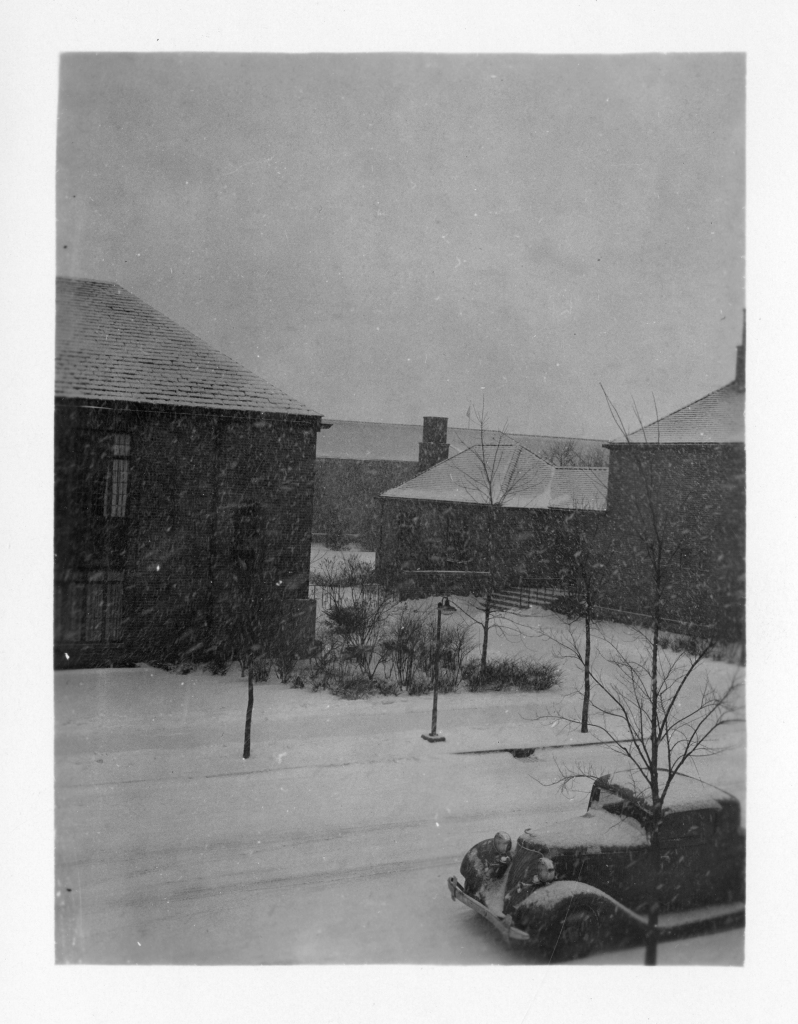
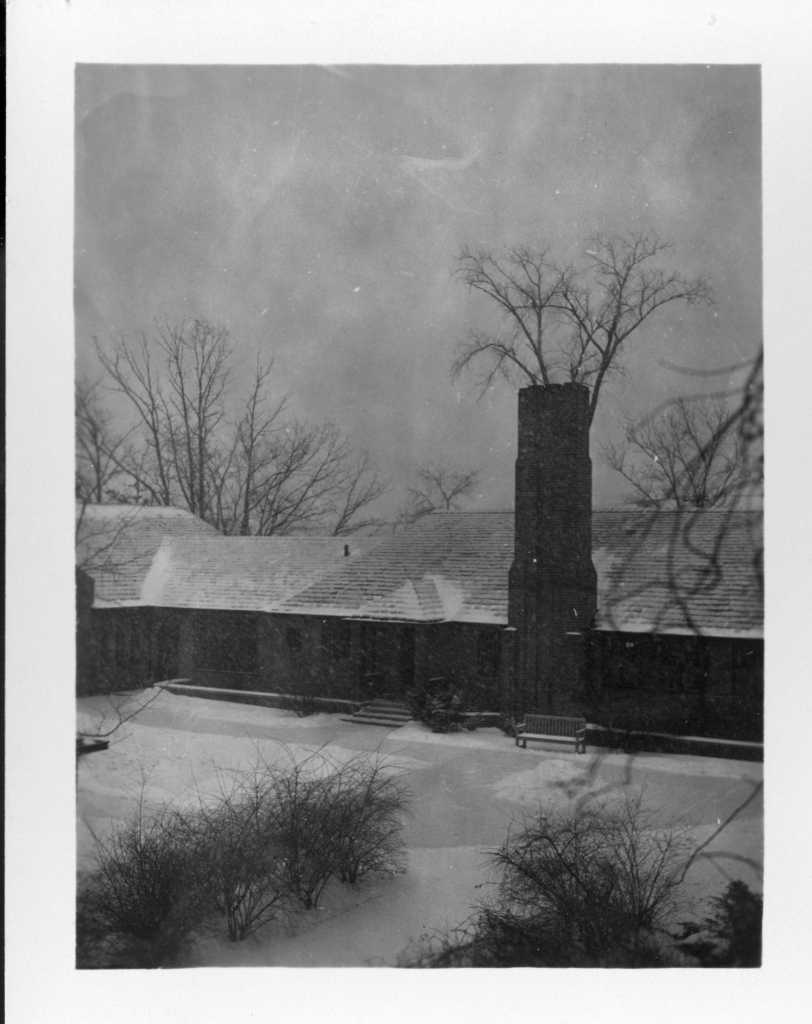
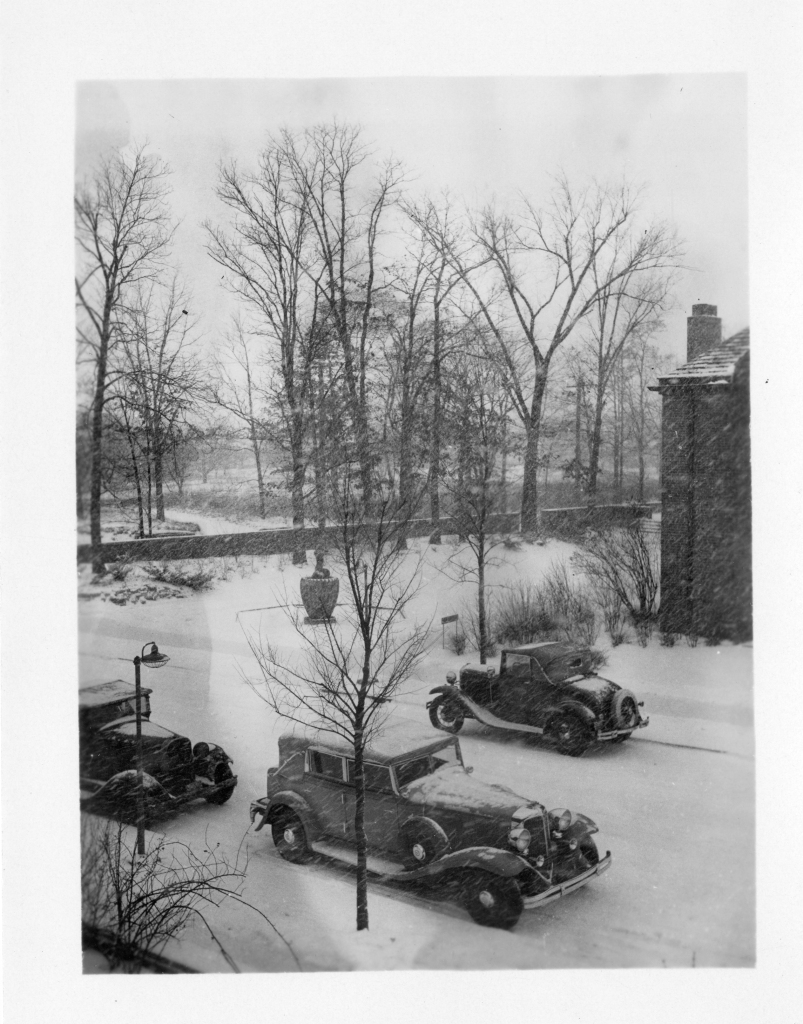
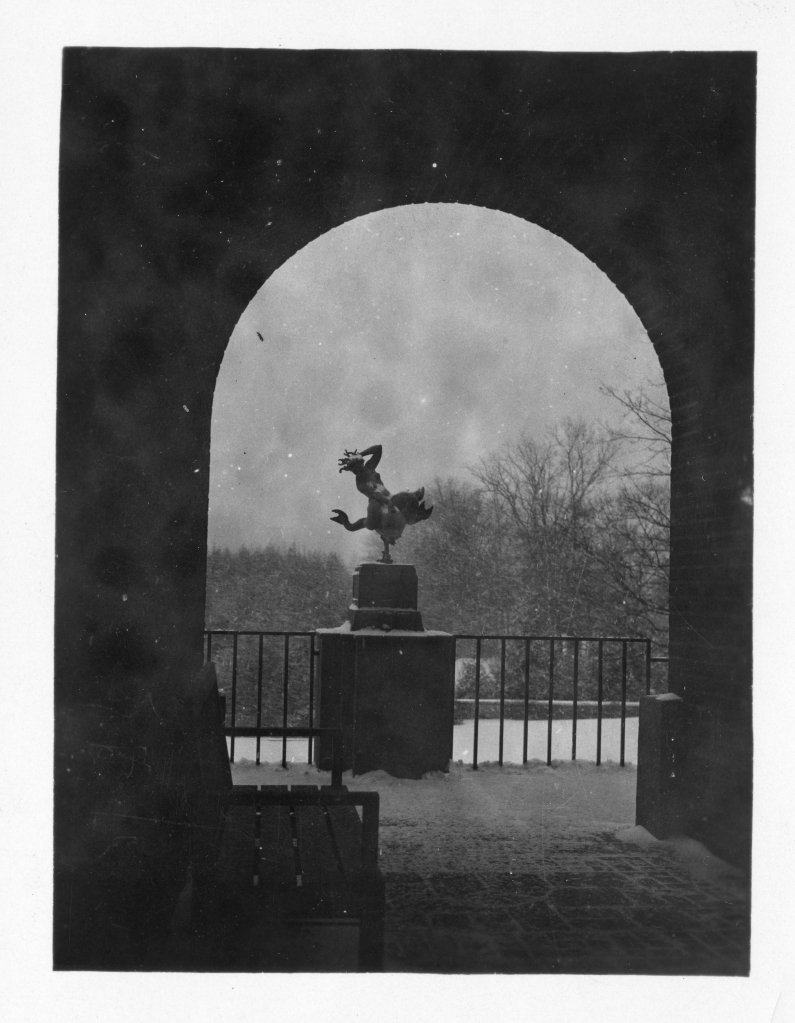
A small series of photographs hold moments of his life and some of the people with whom he shared it, including his father, eminent roentgenologist (radiography) Dr. Preston Hickey; his wife, Jane; his teacher, Eliel; and his fellow Academy students. A series of snowy scenes of Cranbrook campus beautifully capture the quietness of falling snow with hints of sunlight upon the architecture and sculptures that were then in their infancy and are now historic.
Cranbrook Academy of Art campus, circa 1932-1935. Courtesy of Cranbrook Archives, Cranbrook Center for Collections and Research.
The Walter Hickey Papers give insight into a short period in Hickey’s life and the Cranbrook of his time. It also gives us a lovely look into a life that was surely shaped by his experience at Cranbrook, but one that remains yet to be fully discovered.
–Laura MacNewman, Associate Archivist, Cranbrook Center for Collections and Research
In Cranbrook Archives’ Christ Church Cranbrook Records, there is a binder on two needlepoint projects undertaken between 1957 and 1964, the first of which focuses on replacing the cushions and kneelers in St. Dunstan’s Chapel. It gives insight into the design process, symbolism, and handwork, as well as providing much information that would be of interest to the sociology of gender roles and art.
St. Dunstan’s Chapel, Christ Church Cranbrook. The Chapel’s first service was Easter Sunday 1926; the current configuration of the Chapel dates to 1934. Photograph by Kevin Adkisson, August 2021. Cranbrook Center for Collections and Research.
The project, a collaboration of the Women’s Auxiliary and the Altar Guild, began in June 1957 when a Needlepoint Committee was convened to oversee the project through its planning, implementation, and dedication. The project was inspired by a similar project at Washington Cathedral where women across the nation contributed 461 pieces of needlepoint to the Cathedral, including altar pieces for Bethlehem Chapel which were worked by women of Michigan.
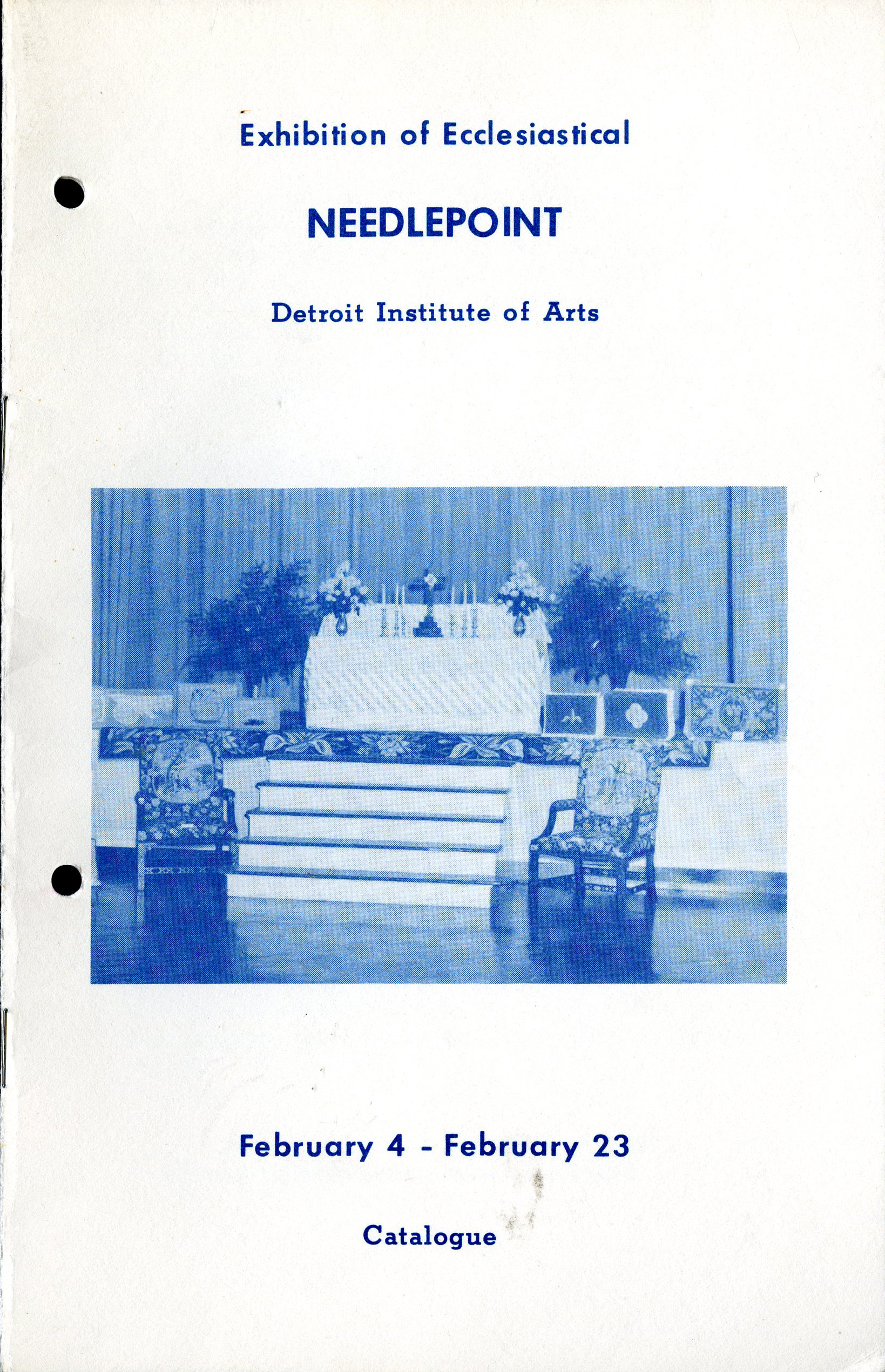
Twenty designs from the Washington Cathedral project were displayed in the Exhibition of Ecclesiastical Needlepoint at the Detroit Institute of Arts in February 1958 prior to their dedication at the Cathedral. Rt. Rev. Richard S. Emrich commended the idea to all churches in Michigan.
Catalog for the Exhibition of Ecclesiastical Needlepoint at the Detroit Institute of Arts, February 1958. Courtesy of Cranbrook Archives, Cranbrook Center for Collections and Research.
St. Dunstan’s Chapel was selected as the most appropriate place for the women of the church to use their handwork for its adornment, since St. Dunstan is the patron saint of Arts and Crafts. St. Dunstan, born in Glastonbury, Somerset, in the tenth century, is commemorated in St. Dunstan’s Chapel with a stone from Glastonbury Abbey where he served as abbot.
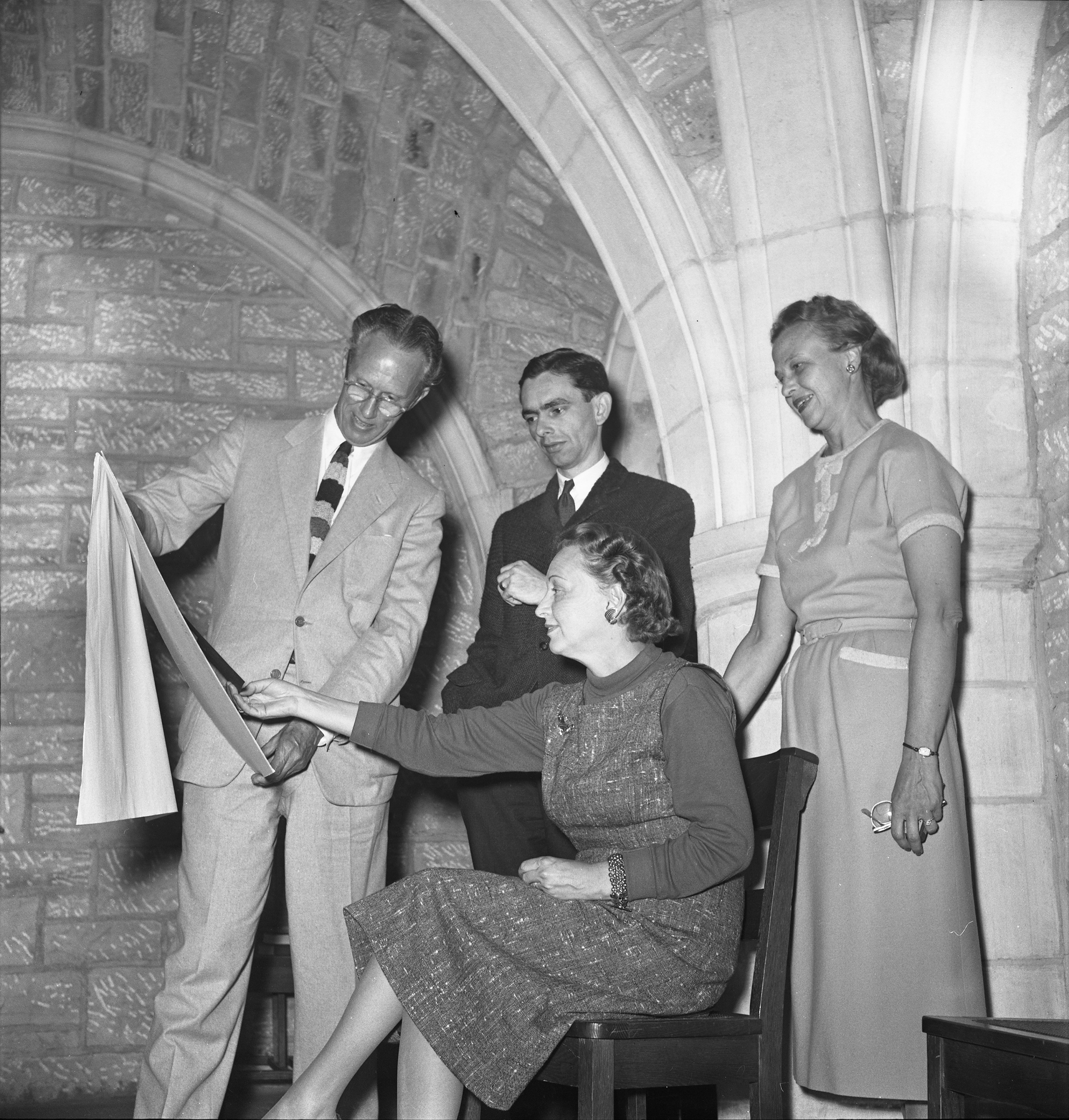
Initially, the Committee decided to seek designs for the project by opening a contest for Cranbrook Academy of Art students, with Henry Scripps Booth, Pipsan Saarinen Swanson, Ken Isaacs, and Marion Leader as judges. Harry Soviak (Painting 1957/MFA 1959) won the competition. However, there were problems in implementing the design in terms of types and quantities of wool, and the Committee sought to consider more traditional designs before making a final choice.
Henry Scripps Booth, Ken Isaacs, Pipsan Saarinen Swanson (seated), and Marion Leader judging entries from Academy of Art students to the needlepoint contest for St. Dunstan’s Chapel at Christ Church Cranbrook. April 19, 1957. Photograph by Harvey Croze. Cranbrook Archives, Cranbrook Center for Collections and Research.
Rachel T. Earnshaw of the Needlework Studio, Inc., of Bryn Mawr, Pennsylvania was contacted for information on how to proceed. Earnshaw had won first place for her designs for the Chapel of the Holy Spirit at Washington Cathedral. Having been sent some information and images of St. Dunstan’s Chapel, she advised on symbolism as well as offering guidance on canvas, wool, and stitches.
Last week, I was happy to welcome a small group tour into the reading room to view archival materials about chairs. After the tour request appeared in my inbox, I learned a lot about chairs in a short time and found a new appreciation for this commonplace object.
As I searched and gathered materials for the display, I began to see how imagination and inspiration can transform an ordinary thing from complete obscurity to one of curiosity and sometimes great celebrity.
Florence Knoll in Eero Saarinen’s Grasshopper Chair in the Dallas Original Showroom, 1950. Courtesy of Cranbrook Archives
The chair has been creatively reinvented time and again according to the social context of its use, the cultural meaning imbued in it, or the inspiration from which its design sprang. Just think throne, pew, sofa, deck chair, chaise-lounge, and so on.
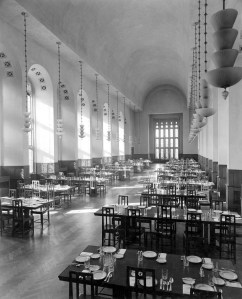
Take one of Cranbrook’s most iconic chairs – Eliel Saarinen Cranbrook School dining hall chair. Designed to withstand use by teenage boys, it combines durability with sophistication and has stood the test of time as they are still in use after 94 years. At the back of each chair is a bronze crane insert, a symbol that subtly gives identity to the community using the chair.
Cranbrook School Dining Hall, October 1936. Courtesy of Cranbrook Archives.
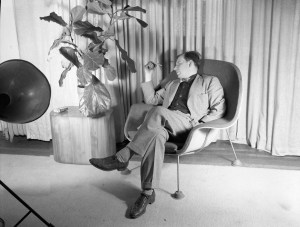
Interestingly, Eero’s later chair designs are all much inspired by nature—the Grasshopper chair, the Womb chair, and the Tulip Chair.
Eero Saarinen sitting in the prototype of his Womb Chair at his Vaughn Road home. 18 June 1947. Photographer: Harvey Croze. Courtesy of Cranbrook Archives.
Inspired by nature in a different way, Finnish architect and furniture designer Olav Hammarstrom has a variety of designs that are born of the possibilities to which natural materials lend themselves. Hammarstrom worked with Alvar Aalto and Eero Saarinen and Associates, working on projects such as the Baker House dormitory at MIT and the furnishings at the GM Tech Center. Married to Head of the Weaving Department Marianne Strengell, he designed their house in Wellfleet on Cape Cod, as well as houses for friends and colleagues, along with chairs to go in them.
Bamboo Experimental “Basketchair” by Olav Hammarstrom. 10 February 1956. Courtesy of Cranbrook Archives.
Furniture design was also the focus of another Academy affiliated designer, Pipsan Saarinen Swanson. Working in partnership with her husband, architect J. Robert F. Swanson, Pipsan typically designed the interiors while he designed the structure and exterior.
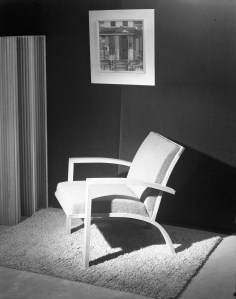
Chair designed by Pipsan Saarinen Swanson. December 8, 1945. Photographer: Harvey Croze. Courtesy of Cranbrook Archives.
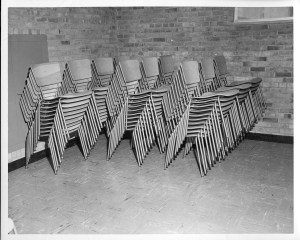
But Robert Swanson also designed furniture. Perhaps the most surprising thing I learned was that Swanson invented a ‘Stackable Chair,’ patented in 1957. A form we take for granted nowadays, these chairs can still be found in many buildings and classrooms on Cranbrook’s campus.
The “Stackable Chair” by J. Robert F. Swanson, 1957. Courtesy of Cranbrook Archives.
It was a great pleasure to share these archival stories with our guests and to explore Cranbrook’s part in the story of the chair. In the process I learned to see an everyday thing in a new light and how creativity can transform the ordinary into the extraordinary.
–Laura MacNewman, Associate Archivist, Cranbrook Center for Collections and Research
In the summer of 1961, Dr. Robert Hatt, Director of Cranbrook Institute of Science (CIS) from 1935 to 1967, took a field trip to Africa to study small mammals in South Rhodesia (now Zimbabwe). Using his travel journals, photographs, and his published articles, we can follow his field work, analysis, and conclusions quite closely.
On his trip he kept one scientific journal and one for general observations from region to region, which provides a rich source for social, political, geographical, and anthropological insights into the region’s society.
Dr. Hatt and his wife, Sue, set off for Africa on July 1, 1961, traveling from New York to Dakar then through Ghana, Nigeria, and the Congo, arriving at the Atlantica Ecological Research Station (AERS) in Salisbury, (now Harare, Zimbabwe) on July 21st.
Dr. Robert Hatt and his wife, Suzannah at the Atlantica Ecological Research Station in South Rhodesia, now Zimbabwe. August 1961. Courtesy of Cranbrook Archives.
Upon arriving at Salisbury airport, they were met by Rudyerd and Louise Boulton. Rudyerd, an American ornithologist and the Director of AERS, had invited Hatt to undertake the study with financial support from the New York Zoological Society. Hatt began his field study journal at this point, writing,
“The house is charming, stone walled, 1 storey, good garden beyond. The lab building attached still under construction but RB had my desk set up and equipped—a dozen volumes on mammals in a book shelf, ready to work. RB & I went out with my collector, Kenny, and made an incomplete circuit of the property, setting 15 Sherman traps out near stream.”
Journal #44, Africa. Robert T. Hatt Papers (1999-14)
Atlantica Ecological Research Station, South Rhodesia (now Zimbabwe). July 1961. Courtesy of Cranbrook Archives.
It is fascinating to see his research data in its raw form, which can be compared with his account in the CIS newsletter and a more formal and scientifically dense report in a published journal, later reproduced in Zoologica.
Hatt studied the small mammal population of Zimbabwe from July 21 until the beginning of September, similar to the research he conducted in Michigan and other regions (his doctoral dissertation was on a type of red squirrel). In Zimbabwe, he contributed to an understanding of the local fauna, which presents a nuisance to agriculture and animal husbandry.
With assistance from his wife, he captured mice, rats, shrews, and elephant shrews which were measured, weighed, and marked in the ears with a serial number to recognize them if recaptured. In the first three weeks of field work, they had marked and released over 150 animals with 65 recaptures, some recaptured 3 or 4 times.
Journal #44, Africa. Robert T. Hatt Papers (1999-14). Courtesy of Cranbrook Archives
Hatt variously notes these small mammals as generally uncooperative with the study, and remarks,
“This matter of ear marking is not to the animal’s liking and despite my use of rubber gloves and plastic handling boxes, rare is the morning in which I am not given some identifying perforation of my own by their sharp teeth.”
Cranbrook Institute of Science Newsletter, Vol. 31, No. 2, October 1961, p.13
Dr. Robert T. Hatt and his assistant, Kenny, handling mice. August 1961. Courtesy of Cranbrook Archives.
Hatt describes the landscape of the 150-acre Station as a combination of grassland and Brachystegia woodland, noting the prevalence of “picturesque kopjes” which provided good lookout sites and defensive structures for Bushmen and Bantu prior to the British colonial settlement of Salisbury in 1890. Most interesting are the “Bushmen paintings” that evidence early occupation of the area. One location, Somerby Farm, is recorded both photographically and in his manuscripts. This group of paintings indicates the presence of elephants, hippopotamus, buffalo, hartebeest, kudu, and reedbuck.
Somerby Farm Cave Paintings, South Rhodesia (now Zimbabwe). August 1961. Courtesy of Cranbrook Archives
The Hatts left Salisbury on September 4th, heading first to Arusha, Tanzania; then to Nairobi, Kenya; Uganda; Khartoum, Sudan; and finally to London.
Hatt’s small journal includes his observations along the way and his comments include the cockroaches in their first hotel bathroom, types of trees, cocoa tree disease, termites, religious missions, types of goats, museums, meetings, markets (and what was for sale in them), local people, anthropological marks of beauty, and signs on shops and wagons. The latter include “Aim High,” “Do Good,” “Still it makes me laugh,” “Give all to God,” and “Forget me Not.”
One comment on his journey from the Ivory Coast to Accra made me smile, as I could relate to the experience of plane food:
“Our plane, DC-3, was “First Class” and we were obliged to pay $50 extra for upgrading our ticket (Nigerian Airways). All we got for it was one whiskey and a sandwich which I wouldn’t eat.”
Journal #43, Africa. Robert T. Hatt Papers (1999-14)
Kiva Volcano and Travelers’ Rest in Kisora, Uganda. September 1961. Courtesy of Cranbrook Archives
Often archives hold information on individuals, institutions, and society that were not the original purpose of the document, and this is true with Hatt’s Papers. His field journals yield rich information not only on his process of data collection and analysis, but they also provide a lot of description of human geography and regions that he visited, as well as biographical insights into Hatt himself. The CIS collections are a wonderful resource for many avenues of study, and we would welcome researchers to come and explore these wonderful and valuable resources.
—Laura MacNewman, Associate Archivist, Cranbrook Center for Collections and Research
Editor’s Note: This Sunday, join the Center for a fascinating discussion with Elizabeth Rauh, Assistant Professor, Modern Art and Visual Cultures, American University in Cairo for her talk, “Iraq en Route: A Photographic Journey, 1952-1953.” Rauh has conducted a year-long study into the photographs Dr. Hatt took on his 1952 trip to Iraq, and her presentation will weave together Hatt’s images with the history of both ancient and mid-twentieth century Iraq.
References
Hatt, Robert Torrens. The Mammals of the Atlantica Ecological Research Station, Southern Rhodesia, reprinted in Zoologica, Scientific Contributions of the New York Zoological Society, vol.48, issue 2, Summer 1963
Hatt, Robert Torrens. ‘Hunting Africa’s Smallest Game,’ Cranbrook Institute of Science Newsletter, Vol. 31, No. 2, pp.10-14
One of my favorite items in the collections of Cranbrook Archives is George Booth’s hand drawn map of Cranbrook, which he created over a 24-year period between 1904 and 1928. It is the earliest topographical record of Cranbrook and visually documents his ideas and plans for developing the landscape. In 1951, George’s son, Henry, created annotations to accompany the map, which are useful both in deciphering the map and identifying locations. Henry’s notes on what was envisioned and what was implemented during those early years, are a good starting point from which to venture into the manuscript collections for verification.
Cranbrook Map drawn by George G. Booth between 1904 and 1928. Courtesy of Cranbrook Archives
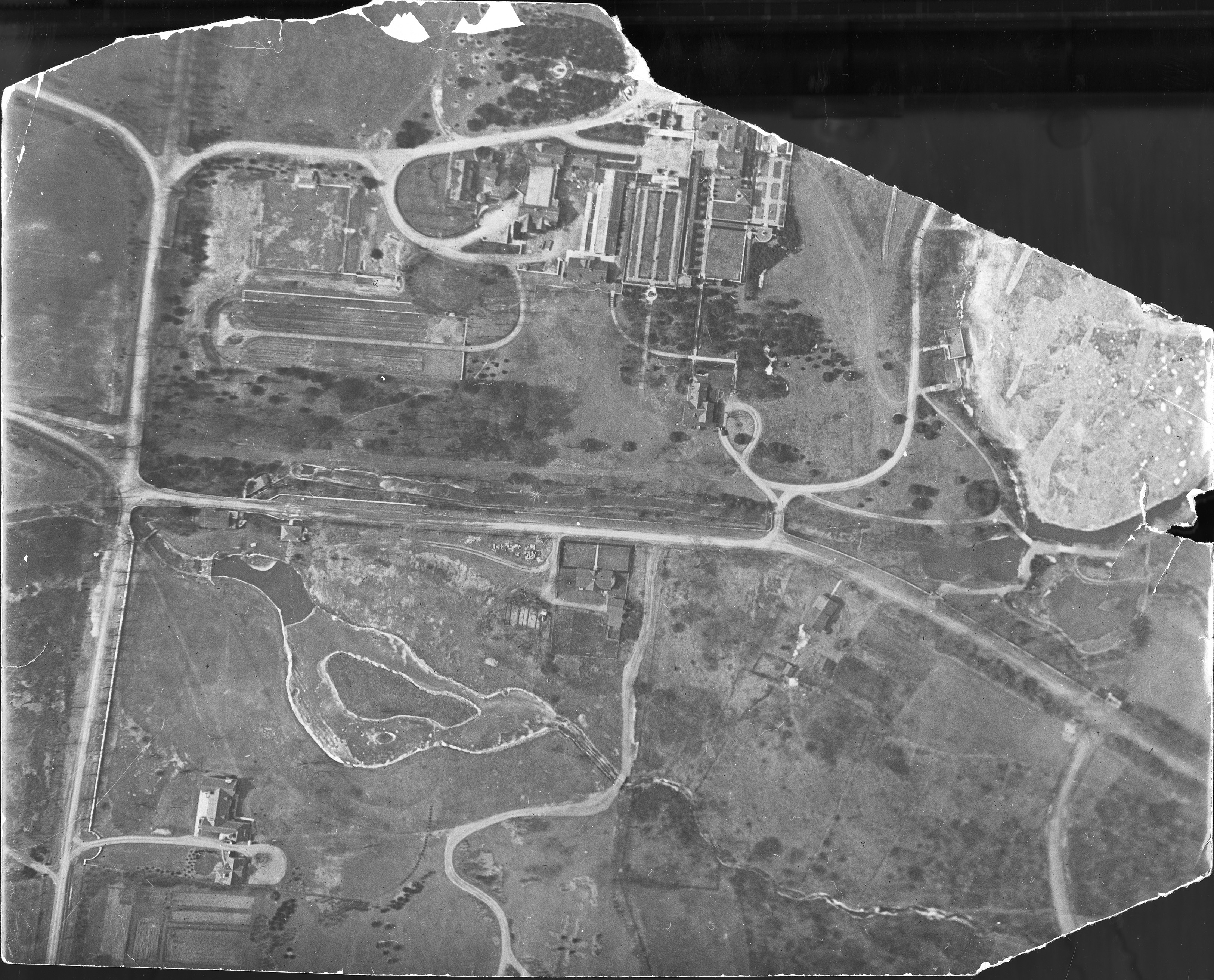
As Cranbrook’s landscape evolved from a family estate into a center for art and education, the means of recording and viewing the topography was assisted by developments in aerial photography, known as photogrammetry. Talbert Abrams, a native of Michigan, is regarded as a key contributor to this field of photography, as he founded the Abrams Aerial Survey Corporation in 1923. The earliest aerial photograph of Cranbrook I could locate is from circa 1918.
Aerial photograph of Cranbrook estate and environs, circa 1918. Courtesy of Cranbrook Archives
In the Cranbrook Photograph Collection there are many aerial photographs taken by Abrams, as well as other photography firms, ranging from the 1920s through the 1990s. Since the purposes of aerial surveys are manifold, correspondence provides some insight into why they were commissioned and how they were specifically used, for example, as publicity and advertising. In 1932 Cranbrook’s public relations manager, Lee A. White, engaged Cranbrook School Headmaster William Stevens to select an image for the coming year’s brochure, and aerial views appear in all the early Cranbrook brochures. Aerial surveys have also been used to assess and understand the landscape prior to making a change to it. This was the case in 1961, when a topographic map and aerial photography were requested for the Off-Street Parking Study.
Letter from Keith A. Smith to Arthur B. Wittliff, November 1961. Courtesy of Cranbrook Archives
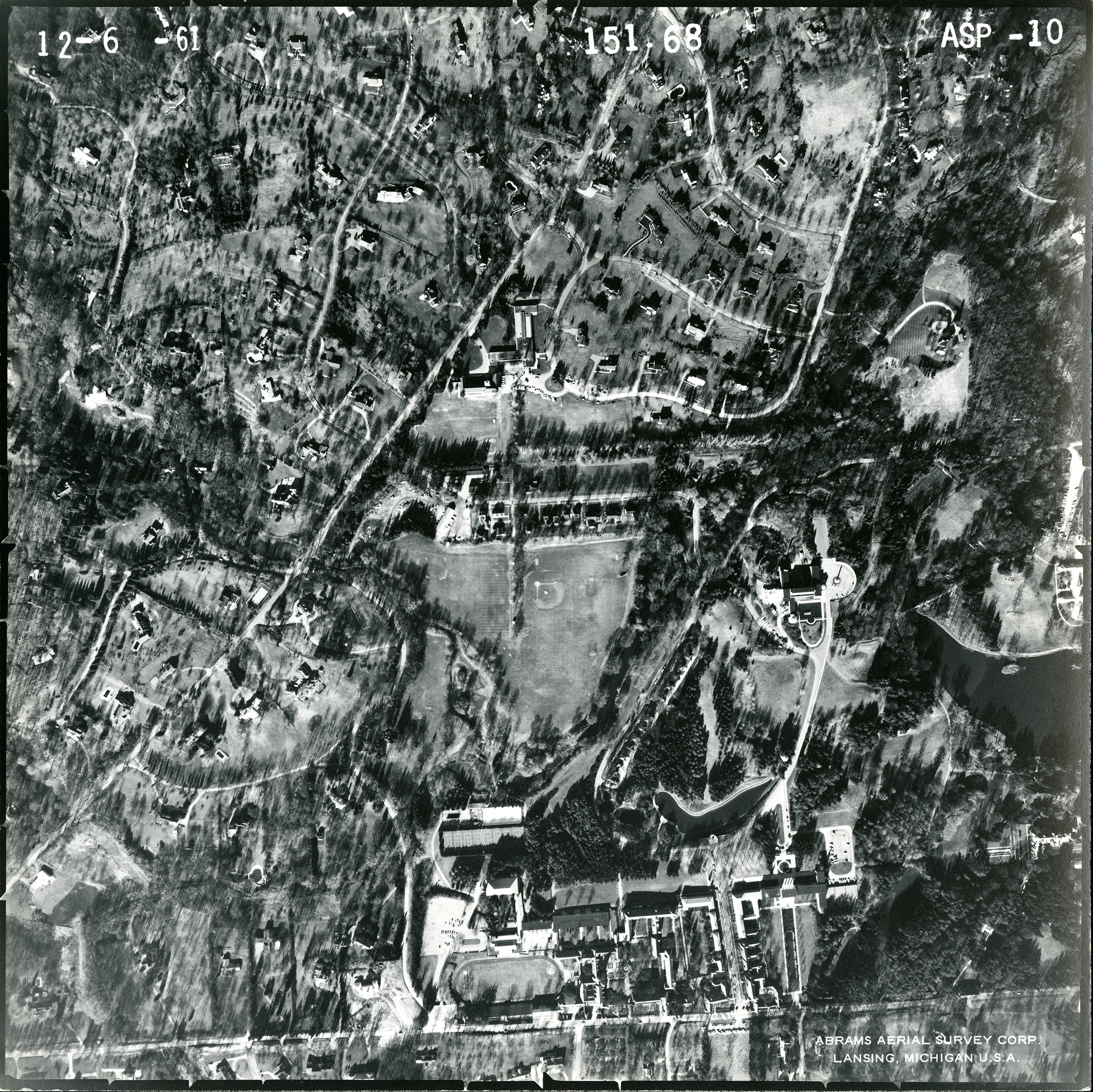
Correspondence between Arthur Wittliff, Secretary for the Cranbrook Foundation Board of Trustees, and Abrams Aerial Survey Corporation, provides intriguing details about the scale of the photography and the material base of the prints. The images below are from a December 6, 1961 set of 12 double weight velvet prints of aerials covering 1 square mile at a scale of 1 inch per 600 feet.
Aerial photograph ASP-5 taken by Abrams Aerial Survey Corporation on 6 December 1961. Courtesy of Cranbrook Archives
ASP-5 (above) shows the intersection of Cranbrook Road and Lone Pine Road, and includes Kingswood School and Lake, the Institute of Science, Cranbrook House, Brookside School, Christ Church Cranbrook, and the Academy of Art and Academy Way. ASP-10 (below) shows another view of Cranbrook and its environs, encompassing the Institute of Science, Academy of Art, and Cranbrook School.
Aerial photograph ASP-10 taken by Abrams Aerial Survey Corporation on 6 December 1961. Courtesy of Cranbrook Archives
When looking across the topographical history of Cranbrook from George’s map through aerial photographs, it is always fascinating to discern the changing landscape alongside the features that are unchanging. And, for me, the great inspiration of George’s map is that, although each individual project necessitated getting into the weeds and meticulous details, his ideas were always guided by situating them within a bigger picture.
—Laura MacNewman, Associate Archivist, Cranbrook Center for Collections and Research
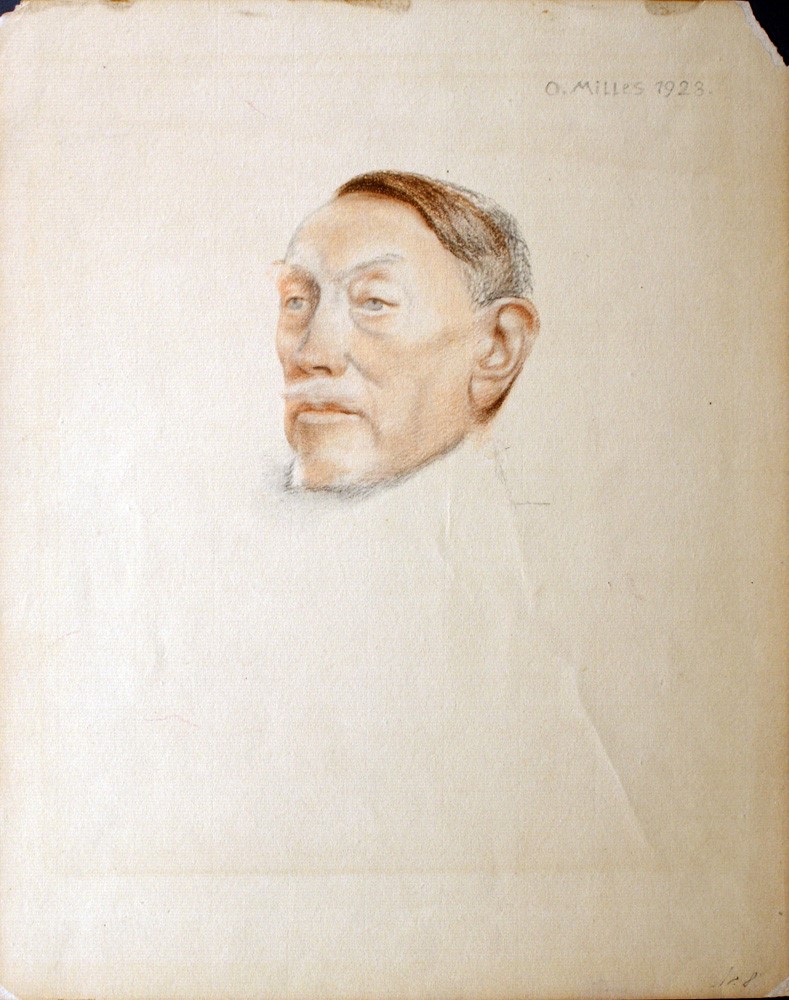
Olga Milles lived in the very depths. In her art, almost exclusively devoted to portrait painting, she sought to draw out the character from the depths of her models and to find the soul behind the façade. Using a variety of techniques including charcoal, crayon, pastel, watercolor, tempera, and oil in her work, Olga was considered an artistic prodigy and developed her talent from a young age, yet her art is largely unknown. In 1988, twenty-one years after her death, Cranbrook Art Museum hosted an exhibition in collaboration with Millesgården, Olga Milles Emerges, to exhibit examples of her art from both museums’ collections.
Portrait of a Young Girl, circa 1931-1951 (CAM1989.6). Gift of Margueritte Kimball. Collection of Cranbrook Art Museum
Portrait of Olga’s Brother, circa 1931-1951 (CAM1989.7). Gift of Margueritte Kimball. Collection of Cranbrook Art Museum
Portrait of Oskar Thorsen, circa 1931-1951 (CAM1989.8). Gift of Margueritte Kimball. Collection of Cranbrook Art Museum
Portrait of Kate Bromley, circa 1931-1951 (1989.9). Gift of Margueritte Kimball. Collection of Cranbrook Art Museum
Portrait of a Young Girl, circa 1931-1951 (1989.10). Gift of Margueritte Kimball. Collection of Cranbrook Art Museum
Study of Eyes and Lips, circa 1931-1951. (1989.11). Gift of Margueritte Kimball. Collection of Cranbrook Art Museum
Artwork by Olga Milles.
In the foreword to the exhibition catalog, Staffan Carlén, former Director of Millesgården, describes her as having an intuitive talent that produced factual character studies of extreme precision, with an “overwhelmingly melancholic” tone. In reading Inger Wahlöö’s account of Olga’s life, based on correspondence at Millesgården, Carlen’s interpretation of Olga’s artwork can almost be read as a profile of Olga herself:
“Sparseness of shadowed areas and stretched areas disrobe the faces and make them appear in a serious, introverted nakedness. Her efforts are primarily directed towards interpreting the character of the soul. This she did with great coloristic refinement, and with tenderness in the form. In her drawings, there is consistently a sensitive enlargement of the mouth, sometimes in interaction with the dreaming mood of the eyes, sometimes as a tension-filled contrast of unconscious sensuality.”
Staffan Carlen, Olga Milles Emerges
Print of Drawing of Carl Milles by Olga Milles, 1917. Courtesy of Cranbrook Archives.
Born Olga Granner in 1874 in Leibniz, Austria, she had two brothers and two sisters. She had a deep loyalty to her family, whom she visited for several months every year, except during World War II. Having been born and raised in the Catholic church, she initially aspired to become an art teacher in a convent. However, in early adulthood, Olga questioned what it meant to be disobedient to the church and broke away, while cultivating an increasingly ascetic life.
The topic of Cranbrook visitors has been a regular one in the Archives this winter as my colleague, Kevin Adkisson, prepares for his History of American Architecture: Cranbrook Visitors lectures. There have been many famous visitors to Cranbrook over the years, and while Kevin is focused on architects who came to the Academy of Art, many other interesting guests were associated with the Institute of Science.
The Institute has frequently welcomed scholars from near and far to present on the latest research in their field. These include paleoanthropologists, Mary and Louis S. B. Leakey; primatologist, Dian Fossey; archaeologist, J. Eric S. Thompson; father of ecology, Pierre Dansereau; biologist, Joseph S. Weiner, and professor of electrical engineering, Harold Eugene “Doc” Edgerton. I thought it would be interesting to take a look at the work of Dr. Edgerton, dubbed “Papa Flash” by Jacques Cousteau.
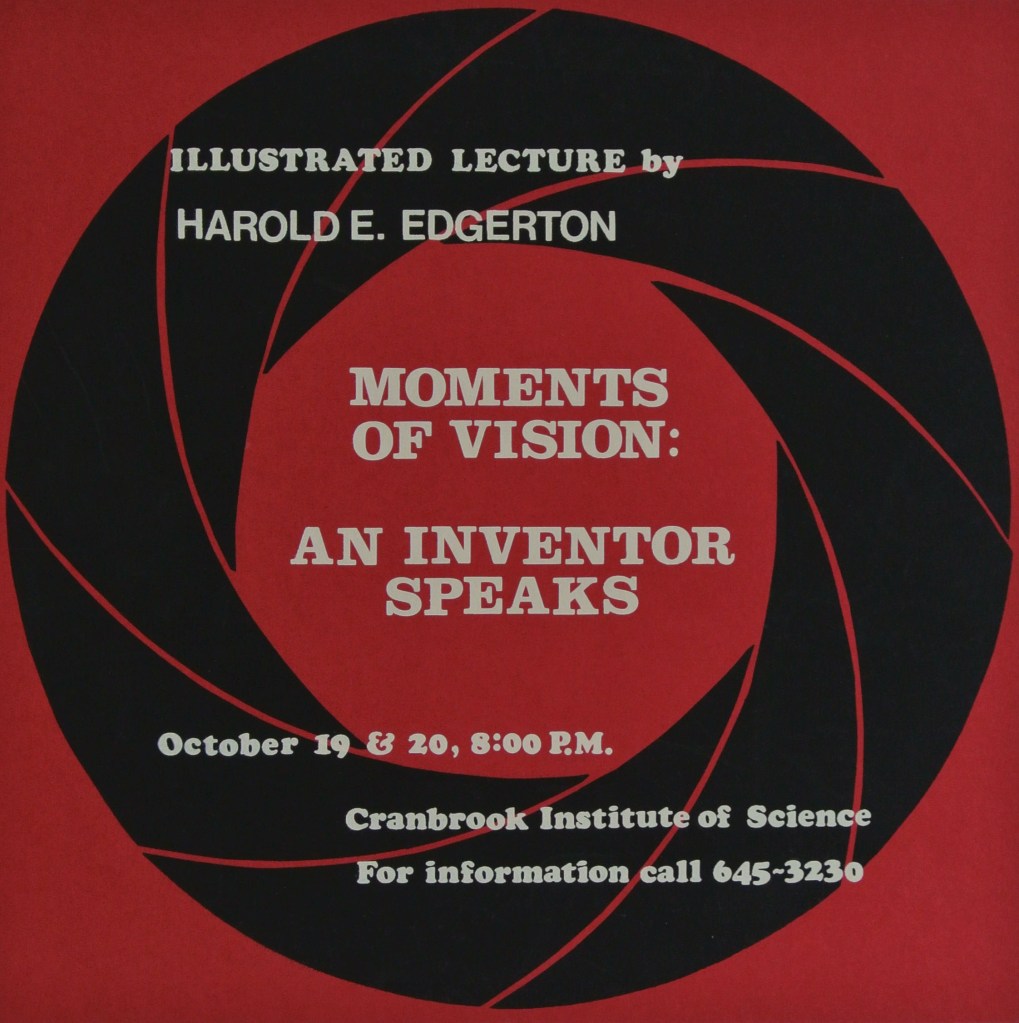
Poster for Harold E. Edgerton’s 1979 lecture Moments of Vision: An Inventor Speaks (P.19.011). Courtesy of Cranbrook Archives.
Edgerton, Professor of Electrical Engineering at Massachusetts Institute of Technology, presented his lecture Seeing the Unseen at the Institute in 1950, and returned in 1979 to present Moments of Vision: an Inventor Speaks. His work was also included in an exhibition, Flash! The Invisible World Revealed in 1960. The Newsletter – Cranbrook Institute of Science of October 1979 reports that Edgerton invented the stroboscope, which made stop-action and high-speed photography possible.
The December 1960 CIS newsletter tells us that, “’stroboscope’ literally means ’whirling viewer’ and employs very rapid flashes from a strobostron, a gas-filled tube, in which light can be produced repeatedly by electrical discharges from condensers. A camera synchronized with the light can make photographs at speeds of less than one millionth of a second, stopping action which is much too fast for the human eye to see.”
Edgerton’s system of photography, first introduced in 1931, has revolutionized the way we see the world–and the way we see the moon! Edgerton adapted his invention to specialized instruments in many fields, including underwater photography, aerial reconnaissance, and nuclear-test measurement.
The Newsletter – Cranbrook Institute of Science, Vol. 49, No. 2. October 1979. Courtesy of Cranbrook Archives.
The stroboscope helped enable underwater photography, allowing us to see this otherwise unseen world. The CIS newsletter describes how “aquanauts” used his equipment to resolve underwater mysteries, such as finding the iron-clad Civil War vessel, Monitor, which was discovered off the North Carolina coast near Cape Hatteras, as well as searching for the Loch Ness monster. Edgerton also made ten voyages with Jacques Cousteau on the Calypso, and the 1960 newsletter reports that he had previously been on four deep sea explorations with Cousteau, capturing images of sea life as deep as four miles.
Edgerton’s association with the MIT began in 1926, when he entered as a graduate student, being awarded a Master of Science degree in 1927 and a Doctor of Science degree in 1931. He was appointed Professor of Electrical Engineering in 1934 and continued beyond his official retirement in 1977. His first public association with Cranbrook came in the December 1949 CIS newsletter, where his camera equipment’s ability to create photographic records of hummingbirds and bats in flight, circus performers in mid-air, and stroboscopic analysis of tennis and golf players was documented. Many of these images were displayed at the December 1960 photographic exhibition, which featured thirty years of Edgerton’s work, and included enlargements from his original negatives of ultra high-speed photography of the splash of a milk drop.
Cranbrook’s institutions have long played host to national and international leaders in science, the arts, and many other fields. It is wonderful that Edgerton shared the progress of his fascinating research and discoveries with the Institute of Science.
—Laura MacNewman, Associate Archivist, Cranbrook Center for Collections and Research
Sources: The Newsletter, Cranbrook Institute of Science, Vol. 19, No. 4, December 1949. The Newsletter, Cranbrook Institute of Science, Vol. 30, No. 4, December 1960. The Newsletter, Cranbrook Institute of Science, Vol. 49, No. 2, October 1979.

![Window rubbing by Thompson Art Glass, June 19, 1995. [CCC4.] Window #9 [3 and 4 of 5].](https://cranbrookkitchensink.com/wp-content/uploads/2022/03/ccc4_3and4.jpg)














 Cranbrook Kitchen Sink