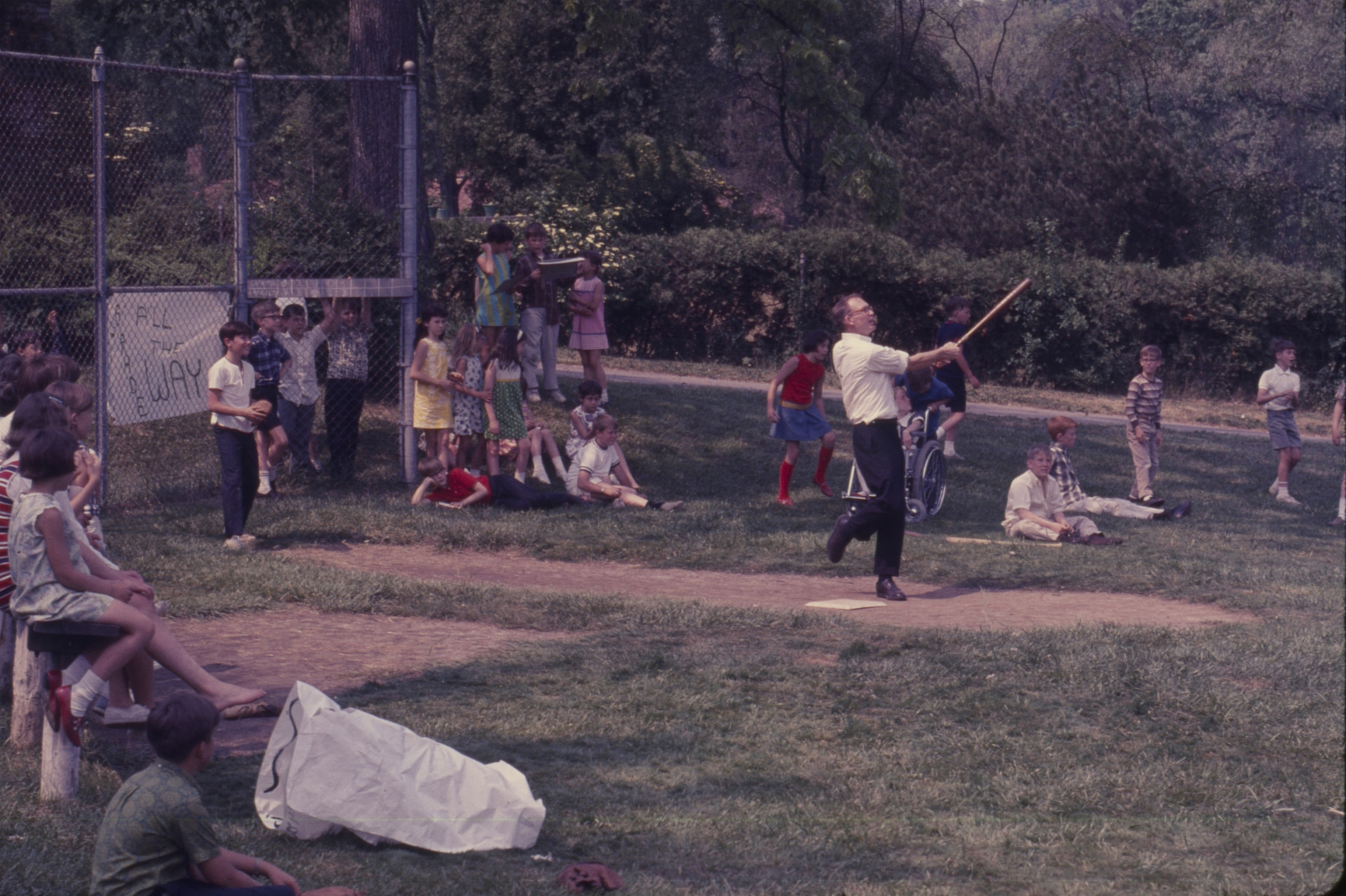
For many years, one of Brookside School’s highly anticipated end-of-year traditions was the Faculty/Sixth Grade Softball game. Every June, faculty and sixth graders would meet on the sandlot at Hedgegate, the faculty residence, to play against each other in friendly rivalry. It was a special day when students could play their favorite pastime with their teachers.
Brookside School Headmaster, Jock Denio, at bat, June 1967. Courtesy of Cranbrook Archives
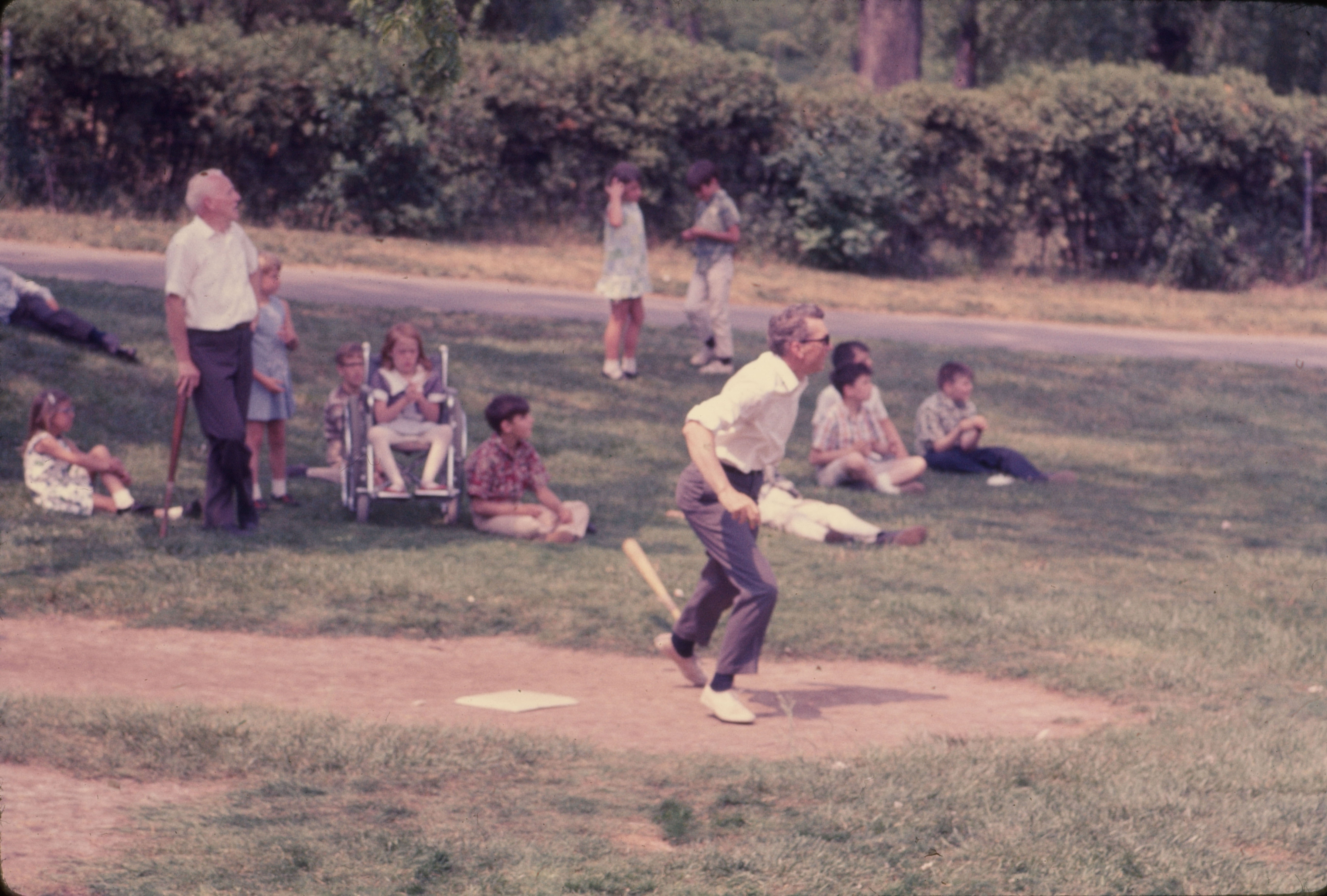
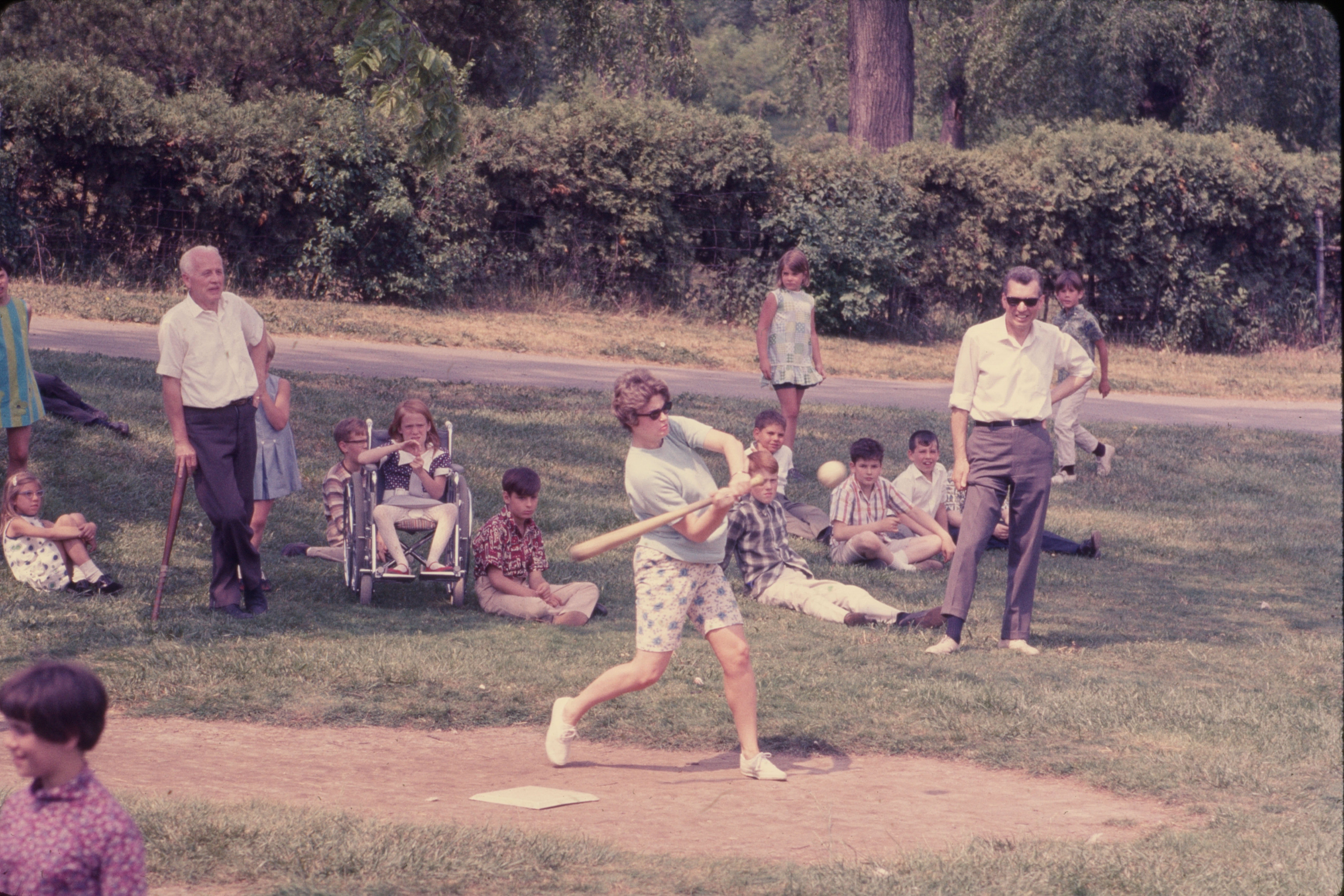
We recently received an addition to the James Carmel Papers from his son, which includes slides capturing the June 1967 softball game. The colorful images convey the camaraderie and joy of the event, with both faculty and students enthralled by the gameplay.
Brookside School students watch the softball game, June 1967Carolyn Tower and Paul Gerhardt, June 1967Louis Beer, June 1967Carolyn Tower at bat, with Paul Gerhardt, Louis Beer, and Brookside students looking on, June 1967. All images Courtesy of Cranbrook Archives
The sixth graders were up against Jock Denio, Brookside’s long-serving Headmaster; Carolyn Tower, music teacher; Louis Beer, third-grade teacher; and Paul Gerhardt, social studies teacher and director of testing and records.
In my work “fielding” research inquiries, I find that there is always a heartfelt nostalgia and tenderness in the memories and stories evoked by Brookside, a Cranbrook institution so deeply cherished by its alumni and former staff.
— Laura MacNewman, Associate Archivist Cranbrook Center for Collections and Research
This spring, Dawn Straith, Innovation & Technology Specialist at the Vlasic Early Childhood Center & Cranbrook Kingswood Lower School Brookside, used the bridges in the Japanese Garden as a tool in her Design Thinking Unit with the Senior Kindergarteners. I asked Mrs. Straith to explain the project.
The Senior Kindergarteners exploring the Cranbrook Japanese Bridge (aka Red Wood Bridge) in the Japanese Garden, 2025.
DS: In our design thinking and engineering unit, the Senior Kindergarten students became bridge investigators! They explored six different bridges in the Japanese Garden to see how safe and strong they are. While investigating, they discovered that bridges with beams and columns are much stronger than those without. They considered what goes over and under the bridges, who and what use the bridges, the materials the bridges are made from, and whether they had handrails. Some bridges didn’t have handrails at all, which we determined made them feel a bit less safe. They also noticed that the ground near a few of the bridges was eroding, which isn’t as safe either.
Side view of the Japanese Garden Round Island Footbridge.
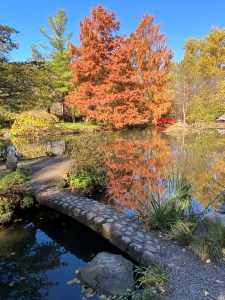
DS: The bridge to “Round Island” (a small island the children have affectionately named for themselves as “SK Island”) got the lowest safety score—it’s tilted, there are no support beams, the ground is eroding, the materials used aren’t the strongest and there are no handrails to hold onto!
Japanese Garden Round Island Footbridge from the eastern shore of the Lily Pond. Photo by Saida Malarney.
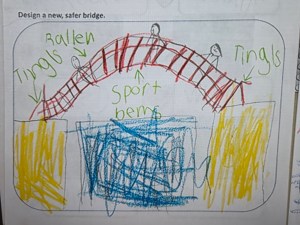
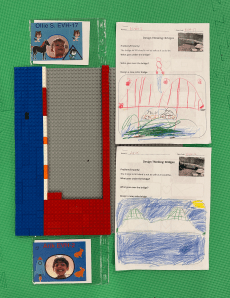
DS: After analyzing all this, the students got to work designing a safer bridge for “SK Island”. They learned that triangles are super strong shapes and that engineers use them all the time when building bridges. With their users in mind, the students carefully designed and built models of brand-new, safer bridges. Their final step is to share their ideas with the garden’s groundskeepers.
Round Island Bridge design, incorportating safety features like “rallens” and “sport beams.”
Enter the Center, the aforementioned “garden’s groundskeepers”!
I am the “Proud Museum Person” with some of our Japanese Garden volunteers working in the garden in April 2025.
As the Associate Registrar, and once-a-month “Gardener” in the Japanese Garden, I was invited to visit the SK classes as they presented their bridge models.
Most of my friends in SK had already helped cover garden sculptures for a number of seasons, so I knew they understood taking care of objects on the campus, but I was once again impressed by our students. They carefully considered what changes could be made to make our bridge safer for all visitors — kids, parents, guests with limitied mobility, and furry friends.
A very big THANKS! to our SK engineers.
Some of the students’ ideas even aligned with designs by our garden designer Sadafumi (Sada) Uchiyama, a third-generation Japanese gardener, registered landscape architect, and Curator Emeritus of Portland Japanese Garden.
Design for Round Island Bridge by Sadafumi Uchiyama.
Design for Round Island Bridge by Gretchen and Liam.
As we start the construction of the new Welcome Garden in the Japanese Garden this summer, we hope our future structural engineers will return in the fall to see how we are progressing.
– Leslie Mio, Associate Registrar, Cranbrook Center for Collections and Research
July 5th, 2025, marks one hundred years since the groundbreaking for Christ Church Cranbrook. As we mark this milestone in Cranbrook’s history, I believe it is important to reflect on George Gough Booth’s long discernment of this generous gift to the community.
From the beginning, there were always places of worship at Cranbrook. The story that leads us through these spaces to the establishment of Christ Church Cranbrook is especially meaningful to me.
Rev. Dr. S. S. Marquis, D.D. with the first spade of earth, July 5, 1925. Courtesy of Cranbrook Archives, Cranbrook Center for Collections and Research.
After George and Ellen Booth purchased ‘The Farm’ in January 1904, his father, Henry Wood Booth, was the first family member to live on the country estate. The elder Booth stayed for the month of May with Frank Brose, the farmer, and his family. On May 15, 1904, the first worship service at Cranbrook took place under a tent, on the site upon which the Altar of Atonement now sits, with Henry as lay preacher. He continued in this ministry, also offering Sunday School, at the same spot until 1909. This was the first act of service offered to the Bloomfield Hills community at Cranbrook.
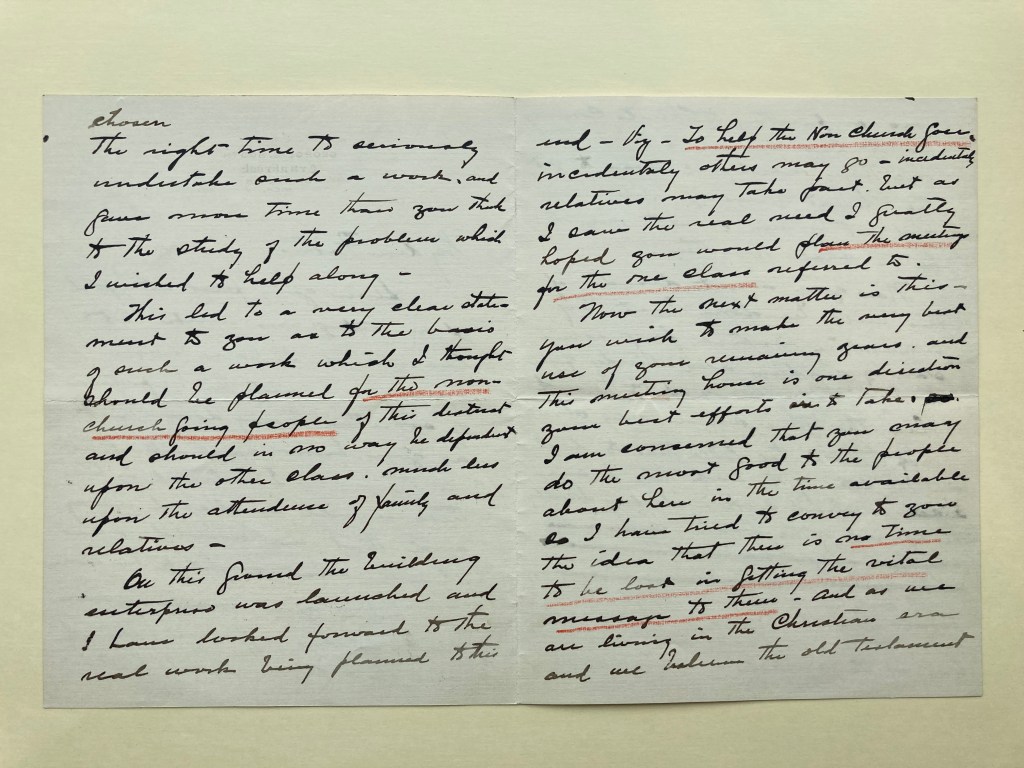
Letter from George Gough Booth to Henry Wood Booth, August 24, 1918. Courtesy of Cranbrook Archives, Cranbrook Center for Collections and Research.
In 1914, George and Ellen considered building a chapel at the site on which the Kingswood flagpole now sits, but the project was rejected, most likely due to the outbreak of World War I. As the war ended, a permanent place of worship and Sunday School was established with the building of the Meeting House.
The letter, above, preserves the dignity with which George writes of the Meeting House “building enterprise” to honor and give freedom to his father’s calling to share the Christ message with the non-church goers in the district. From this letter, we can learn and understand why George built the Meeting House for worship and Bible study through his father’s ministry.
Decoration of the Meeting House by Katherine McEwen, 1918. Laura MacNewman, photographer.
In the letter from George to his father, we also learn that he is prudent in observing the religious character of Bloomfield residents. During the years in which the Meeting House was used for religious services (1918-1926), Mr. Booth would reflect on the visiting clergy and service attendees (both of which came from diverse denominations), from which he would eventually discern the denomination of “Cranbrook church.”
Each year, the Center staff does spring cleaning around the Cranbrook Community’s campus.
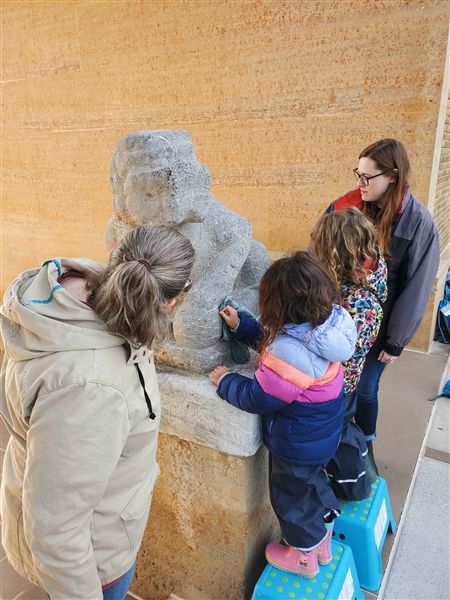
To kick off our spring cleaning this year, in collaboration with Meghan Morrow from Cranbrook Art Museum, Brookside’s Vlasic Early Childhood Center Pre K, JK, and multi-age classes helped us “awaken” the outdoor sculptures, covered for the winter, with a good-morning song. They helped remove the covers, check for any new cracks, and wipe and polish the sculptures.
Friends from the ECC help polish Marshall M. Fredericks’ TheThinker . . .
. . . and the ChineseLion at Cranbrook Art Museum. Both images are courtesy Cranbrook Schools.
We then needed to get the fountains and sculptures ready for our House Party fundraiser on May 20 (sorry, already sold out). Utilizing Graffiti Solutions’ “Elephant Snot,” we worked with Cranbrook House and Gardens Auxiliary volunteers to clean the Fountain on West Terrace and Mario Korbel’s Harmony.
Cranbrook House and Gardens Auxiliary volunteers Helen Maiman, Bruce Kasl, Cheryl Becker, and Joyce Harding assist me in cleaning the Fountain on West Terrace at Cranbrook House. Auxiliary volunteer Nancy Kulish, photographer.
Joyce and I giving Harmony her spring mani-pedi. Nina Blomfield, photographer.
Nina gives Harmony a quick rinse. Leslie Mio, photographer.
Below are the results. This was just one day after the cleaning, and, typically, the sculptures look better and better as the weeks go on.
Look for an upcoming post about our ECC friends working with the Elephant Snot to clean more stonework in the garden!
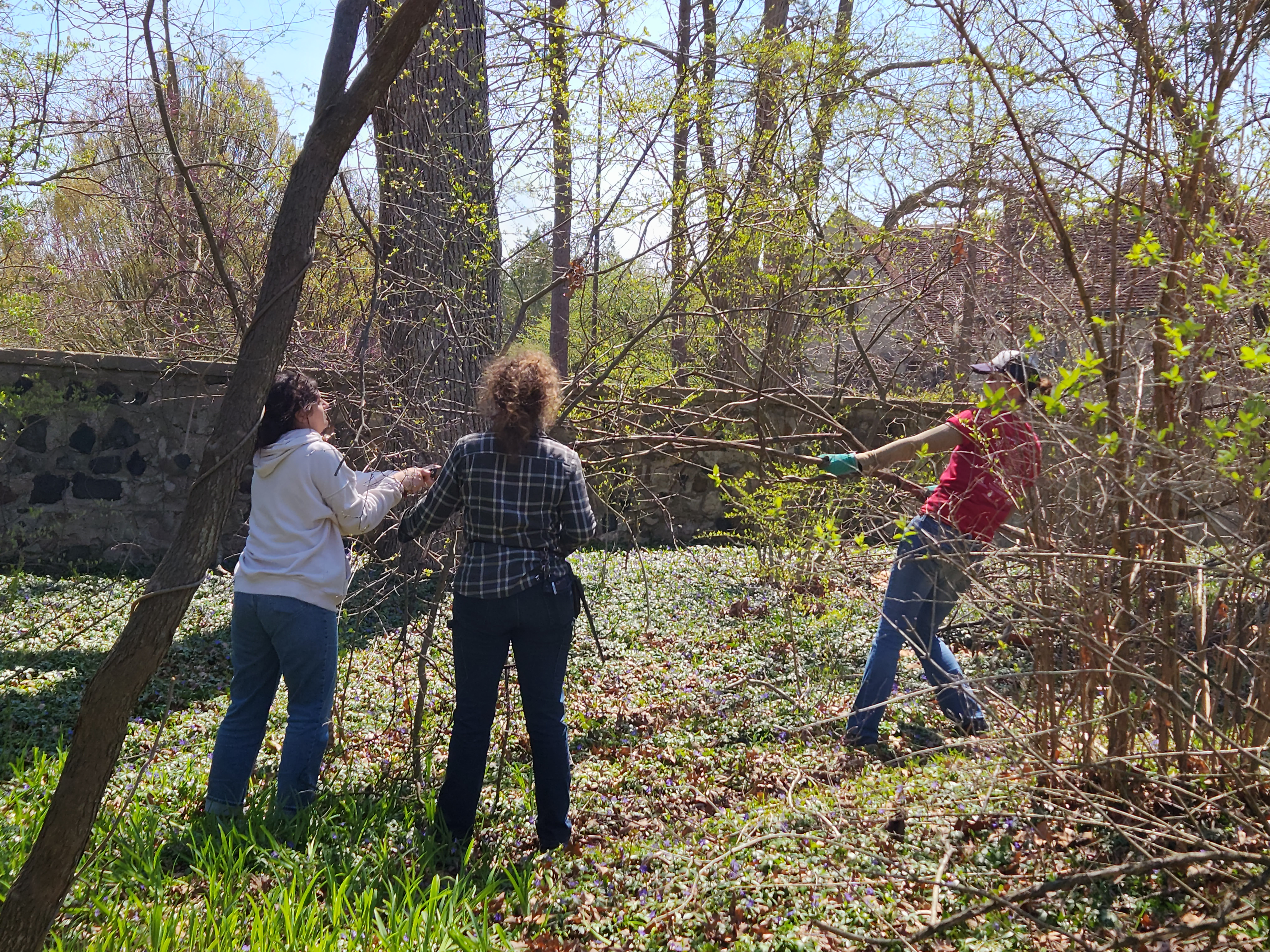
The spring also means a new season of work in the Japanese Garden. Pulling vines, before the poison ivy blooms, was a fun, end-of-the-day task for our volunteers this week.
Volunteers Lindsay Shimon and Melinda Krajniak assist Master Gardener Emily Fronckowiak with invasive vines around the Japanese Garden. Leslie Mio, photographer.
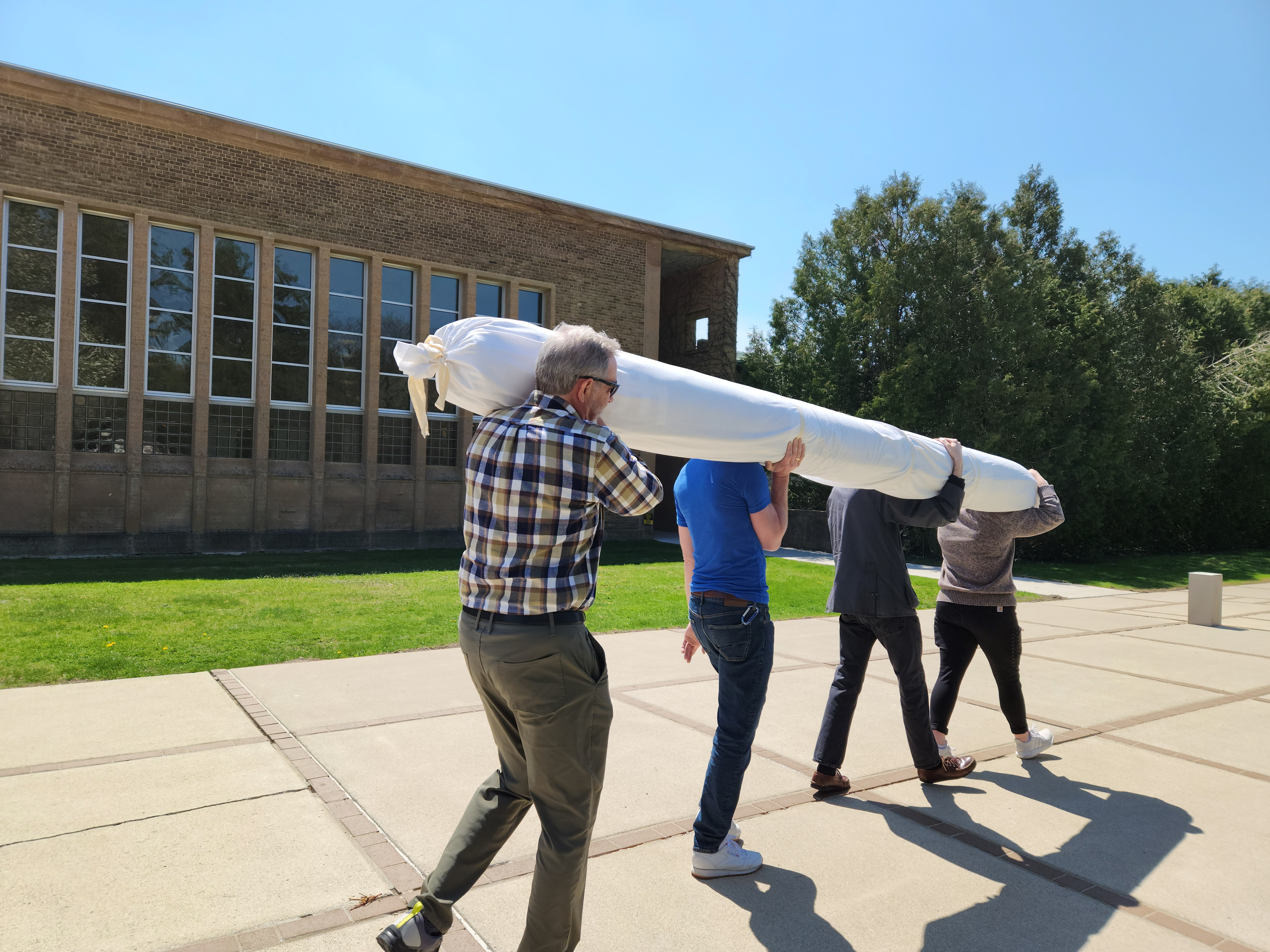
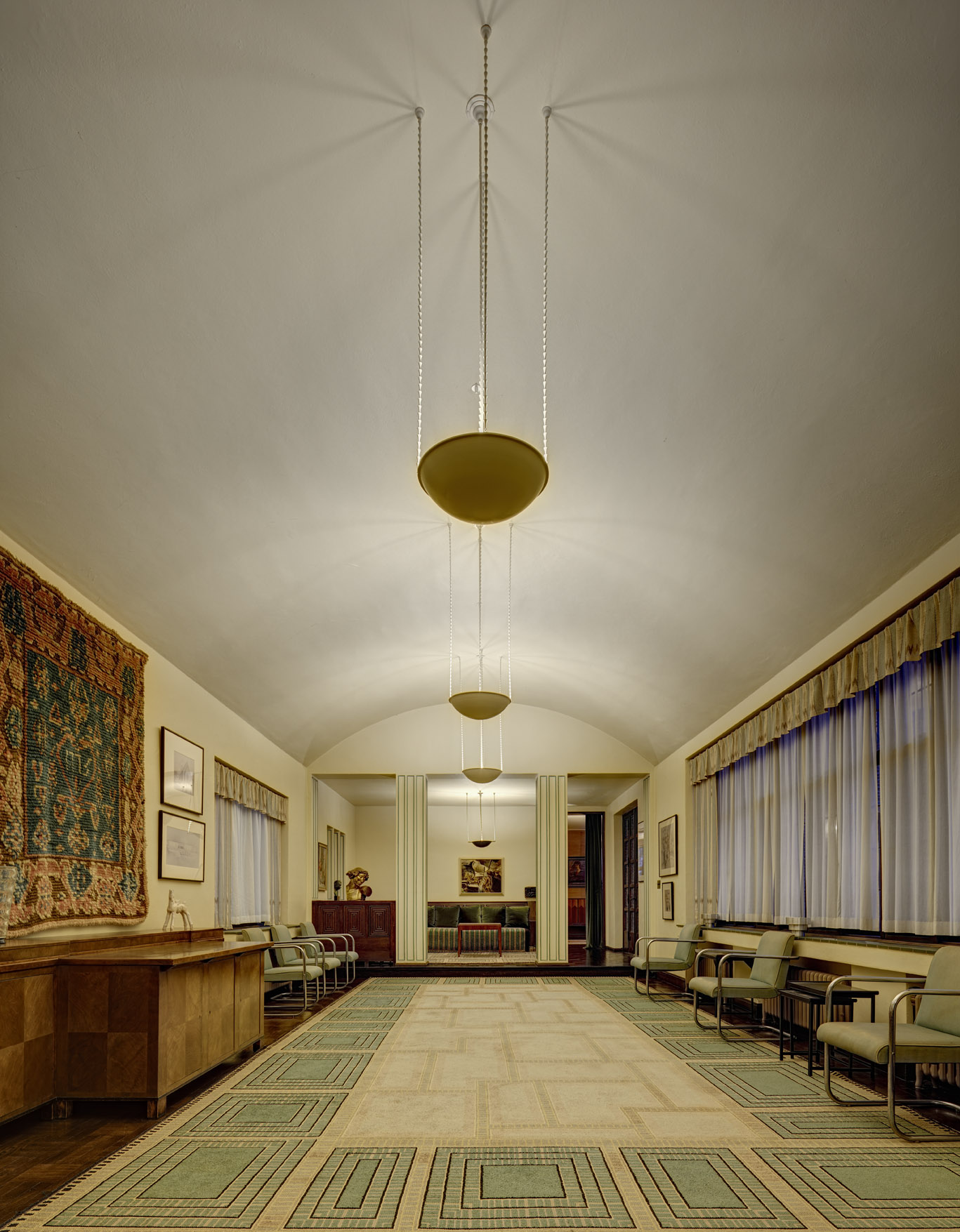
Not to be outdone, Saarinen House wanted to be part of spring cleaning as well. On location in the Art Museum vault for a photoshoot this past winter, the Saarinen House Studio rug was carried back to the house and reinstalled. As Greg Wittkopp, Center Director, said, “The room does look less Gesamtkunstwerk-ish without it.”
“I’m ready for my close-up, Mr. [Haefner].” The Saarinen House Studio rug gets the star treatment from photographer James Haefner as Center volunteer Jessica Majeski looks on. Kevin Adkisson, photographer.
Center staff and volunteers move the Studio rug back to Saarinen House. Leslie Mio, photographer.
Gesamtkunstwerk! James Haefner, photographer.
The best part about our spring cleaning is showing off the results. Come see Harmony in the Cranbrook House gardens on a warm day.
The Center’s 2023 Tour season is also beginning. In addition to our Saarinen House and Smith House tours, new tours have been added:
Japanese Garden Tours – Center staff-guided tours of the Japanese Garden have been added to the public tour calendar on one Sunday a month at 1:30pm, May through October.
Three Visions of Home tours – Join Cranbrook Center for Collections and Research as we take you inside three remarkable homes from across the twentieth century. There’s no tour quite like it, with a look into the distinct visions for American life from three internationally significant architects: Albert Kahn, Eliel Saarinen, and Frank Lloyd Wright. Your expert guide will take you through the architecture and innovations of each home, while also sharing the stories of the families who built and lived in these special places.
We hope to see you on campus this season!
– Leslie Mio, Associate Registrar, Cranbrook Center for Collections and Resarch
Summer school. Those two words usually make most children cringe—who wants to spend their summer vacation studying and attending classes? Sheer morbid curiosity made me explore further a few folders in Brookside School Records, a collection just opened for research last month. What I found was not the usual story.
The Brookside summer school program, AWAKE, had a different purpose than remedial education for elementary students. Developed in 1968 by Pontiac Elementary Principal Jim Hawkins and Brookside Headmaster John P. Denio, it was designed to promote harmony and understanding amongst young children who might not otherwise share life experiences due to racial, social, and economic segregation.
AWAKE followed on the heels of the “long hot summer” of 1967, which saw civil unrest in Detroit and cities across Michigan, including Pontiac, due to long-standing racial inequalities for Black Americans. Instituted in 1968, AWAKE’s purpose was to “bring together young children in essentially two segregated school areas,” in some ways foreshadowing the desegregation of Pontiac and Detroit schools in the early 1970s.
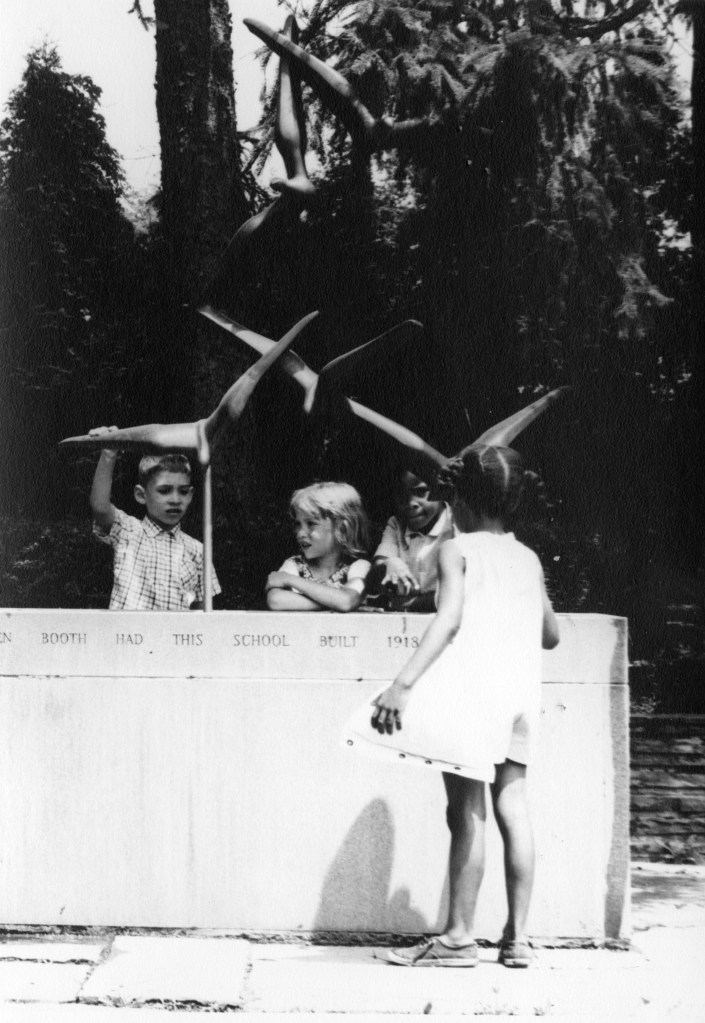
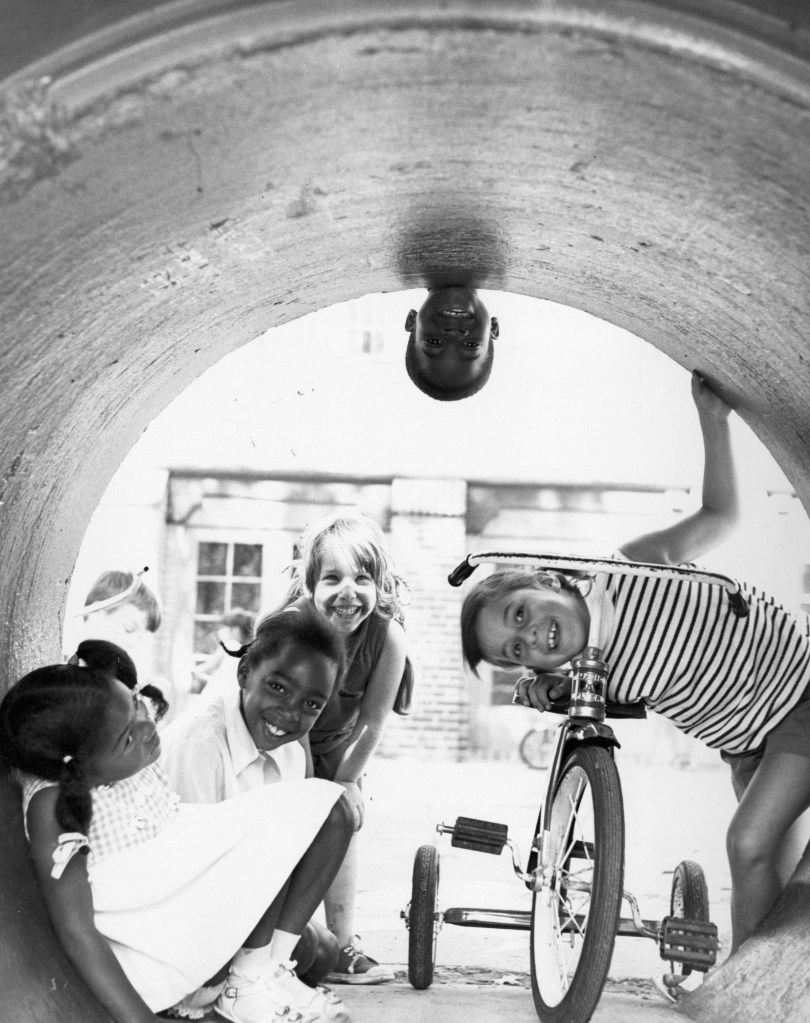
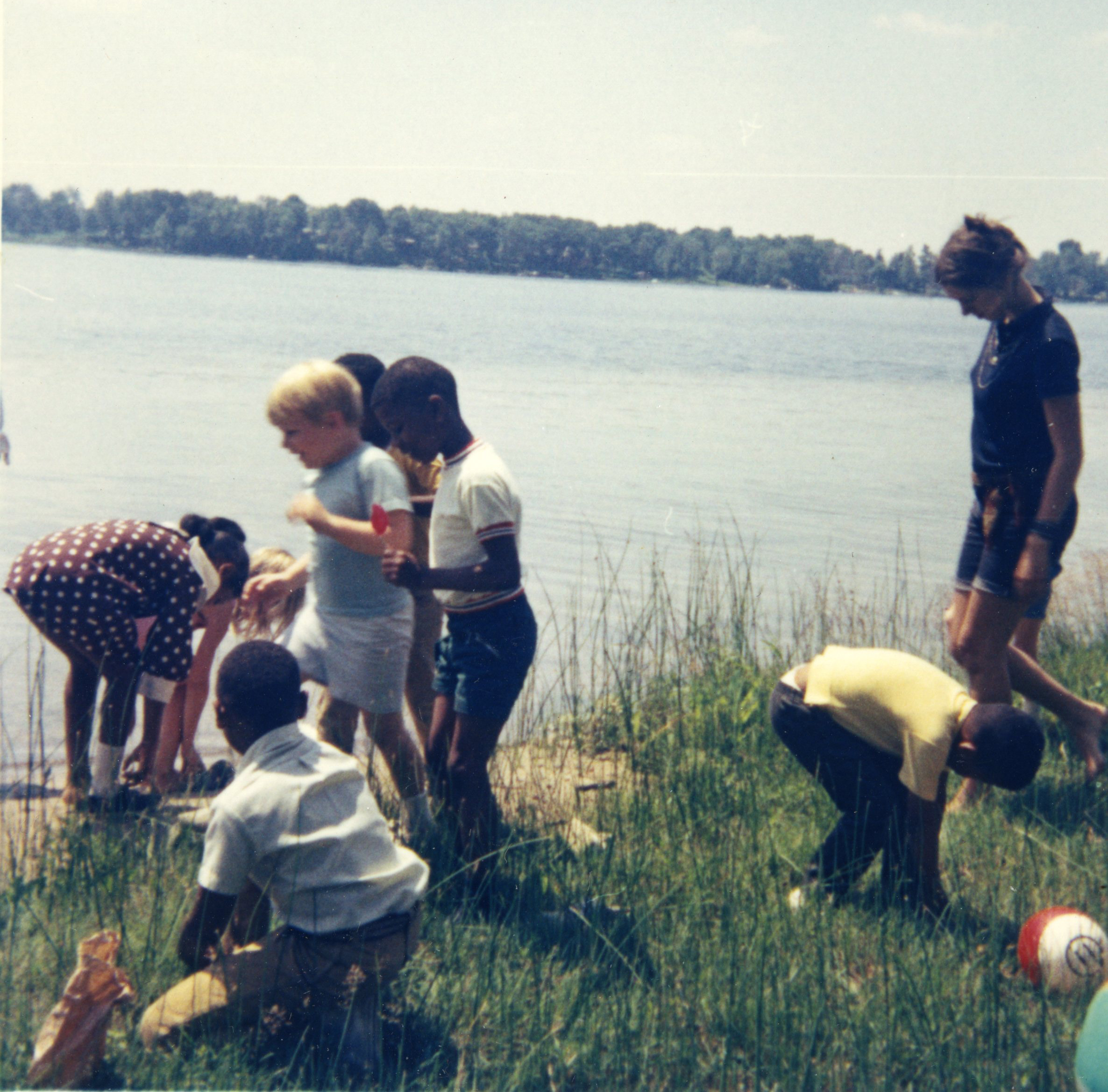
On the playgrounds of Brookside School and Bethune Elementary, circa 1968. Jack Kausch, photographer. Courtesy of Cranbrook Archives.
Roughly fifty children split their time equally between the Bloomfield Hills and Pontiac schools for five mornings a week, over a four-week period in July and August. Co-sponsored by Cranbrook’s Brookside School and Pontiac Public Schools’ Bethune and Whittier Elementary Schools, the program included art projects, field trips, swimming, reading, and other enrichment activities for kindergarten-age children in both communities. Directed at young children because of their natural receptiveness at that age, Denio believed that,
With AWAKE, children four through six, through work and play activities and through simple, open contact with each other may perhaps develop the knowledge and understanding necessary to reinforce their acceptance of each other as human beings.
Governed by a Board comprised of community members and Pontiac Public School administrators and teachers, the program was self-sustained through tuition fees (waived in cases of need), financial contributions, and community support. Christ Church Cranbrook, for example, played a significant role through both donations and parishioners’ participation in the program. Familiar Cranbrook names, such as Cranbrook School teacher and Horizons-Upward Bound founder, Ben Snyder, and his wife Margot were also regular advocates of the program.
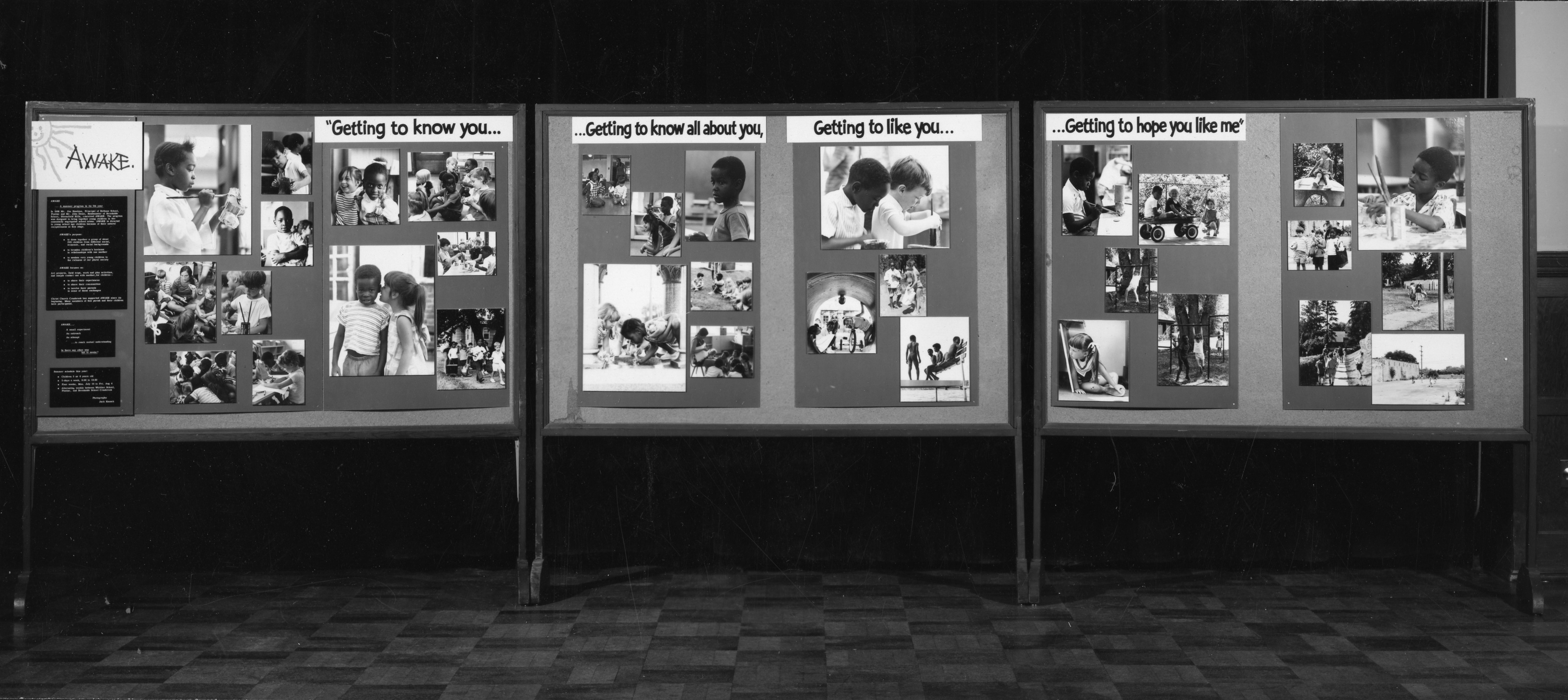
Borrowing lyrics from Rogers and Hammerstein and with photographs by Jack Kausch, poster displays sum up AWAKE’s ethos: “Getting to know you … Getting to know all about you … Getting to like you … Getting to hope you like me.” Courtesy of Cranbrook Archives.
A grass roots experiment in creative problem-solving of the urban crisis faced by cities across the country, AWAKE only lasted for five years (1968-1972). Because of its short duration, the effectiveness of the program was never fully appreciated, despite a 1969 study conducted by a University of Michigan Ph.D. student in education and social sciences and regular solicitation of teacher and parent feedback. Ultimately, rising costs and a lack of grant money; shortages of staff; and dwindling enrollment, undoubtedly due in part to the integration of Pontiac schools and the unsettling atmosphere of anti-busing protests, prohibited the continuation of the program.
—Deborah Rice, Head Archivist, Cranbrook Center for Collections and Research
One of my favorite items in the collections of Cranbrook Archives is George Booth’s hand drawn map of Cranbrook, which he created over a 24-year period between 1904 and 1928. It is the earliest topographical record of Cranbrook and visually documents his ideas and plans for developing the landscape. In 1951, George’s son, Henry, created annotations to accompany the map, which are useful both in deciphering the map and identifying locations. Henry’s notes on what was envisioned and what was implemented during those early years, are a good starting point from which to venture into the manuscript collections for verification.
Cranbrook Map drawn by George G. Booth between 1904 and 1928. Courtesy of Cranbrook Archives
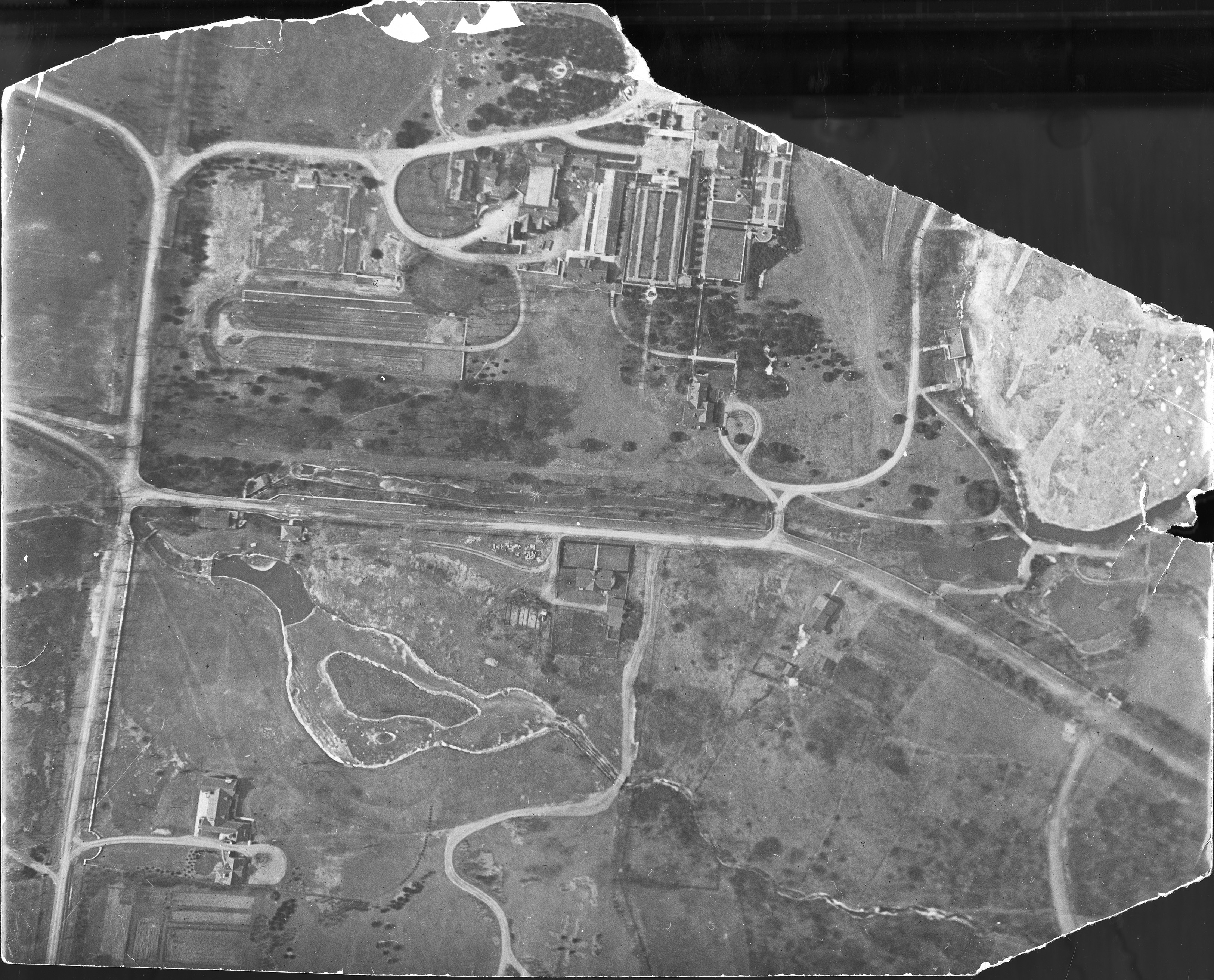
As Cranbrook’s landscape evolved from a family estate into a center for art and education, the means of recording and viewing the topography was assisted by developments in aerial photography, known as photogrammetry. Talbert Abrams, a native of Michigan, is regarded as a key contributor to this field of photography, as he founded the Abrams Aerial Survey Corporation in 1923. The earliest aerial photograph of Cranbrook I could locate is from circa 1918.
Aerial photograph of Cranbrook estate and environs, circa 1918. Courtesy of Cranbrook Archives
In the Cranbrook Photograph Collection there are many aerial photographs taken by Abrams, as well as other photography firms, ranging from the 1920s through the 1990s. Since the purposes of aerial surveys are manifold, correspondence provides some insight into why they were commissioned and how they were specifically used, for example, as publicity and advertising. In 1932 Cranbrook’s public relations manager, Lee A. White, engaged Cranbrook School Headmaster William Stevens to select an image for the coming year’s brochure, and aerial views appear in all the early Cranbrook brochures. Aerial surveys have also been used to assess and understand the landscape prior to making a change to it. This was the case in 1961, when a topographic map and aerial photography were requested for the Off-Street Parking Study.
Letter from Keith A. Smith to Arthur B. Wittliff, November 1961. Courtesy of Cranbrook Archives
Correspondence between Arthur Wittliff, Secretary for the Cranbrook Foundation Board of Trustees, and Abrams Aerial Survey Corporation, provides intriguing details about the scale of the photography and the material base of the prints. The images below are from a December 6, 1961 set of 12 double weight velvet prints of aerials covering 1 square mile at a scale of 1 inch per 600 feet.
Aerial photograph ASP-5 taken by Abrams Aerial Survey Corporation on 6 December 1961. Courtesy of Cranbrook Archives
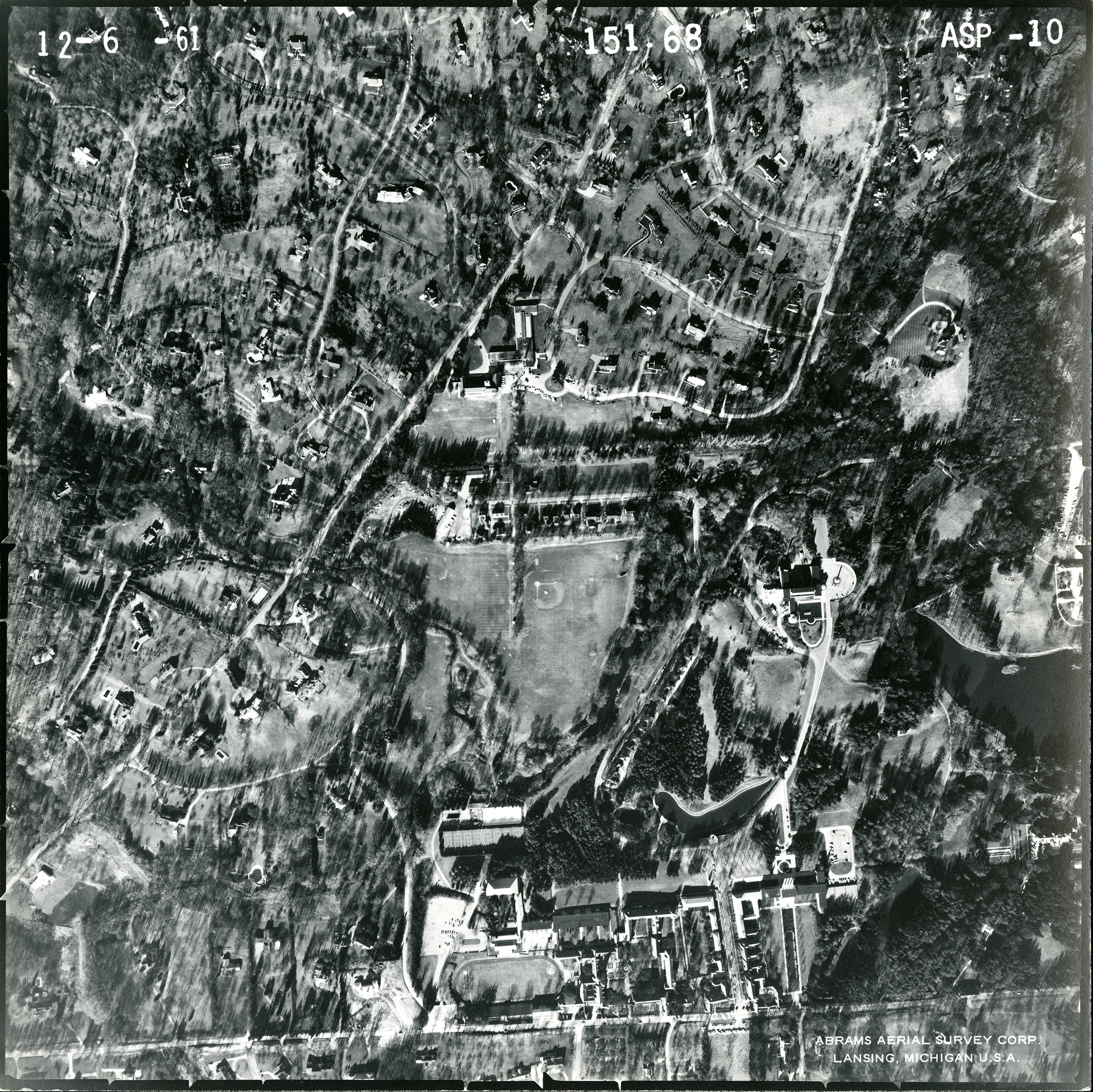
ASP-5 (above) shows the intersection of Cranbrook Road and Lone Pine Road, and includes Kingswood School and Lake, the Institute of Science, Cranbrook House, Brookside School, Christ Church Cranbrook, and the Academy of Art and Academy Way. ASP-10 (below) shows another view of Cranbrook and its environs, encompassing the Institute of Science, Academy of Art, and Cranbrook School.
Aerial photograph ASP-10 taken by Abrams Aerial Survey Corporation on 6 December 1961. Courtesy of Cranbrook Archives
When looking across the topographical history of Cranbrook from George’s map through aerial photographs, it is always fascinating to discern the changing landscape alongside the features that are unchanging. And, for me, the great inspiration of George’s map is that, although each individual project necessitated getting into the weeds and meticulous details, his ideas were always guided by situating them within a bigger picture.
—Laura MacNewman, Associate Archivist, Cranbrook Center for Collections and Research
With the Thanksgiving holiday almost upon us, it is time to begin planning and preparing one of the essential parts of any celebration: food. It seems timely, then, to highlight Flora Leslie, Brookside’s long-serving dietician and food director. I would like to introduce her to you in her own voice, recalling a memory of some precarious pumpkin pies:
Floral Leslie interview with Mark Coir, Archivist (OH1990.09.28), November 5, 1987. Courtesy of Cranbrook Archives.
Hearing this story in Flora’s voice brings the memory to life in a different way than simply reading it in written form. Cranbrook Archives’ Oral History Collection holds recordings of many voices that add dynamism and richness to their stories. Flora Leslie’s interview describes her life at Cranbrook and her experience of its people and places in the mid-twentieth century.
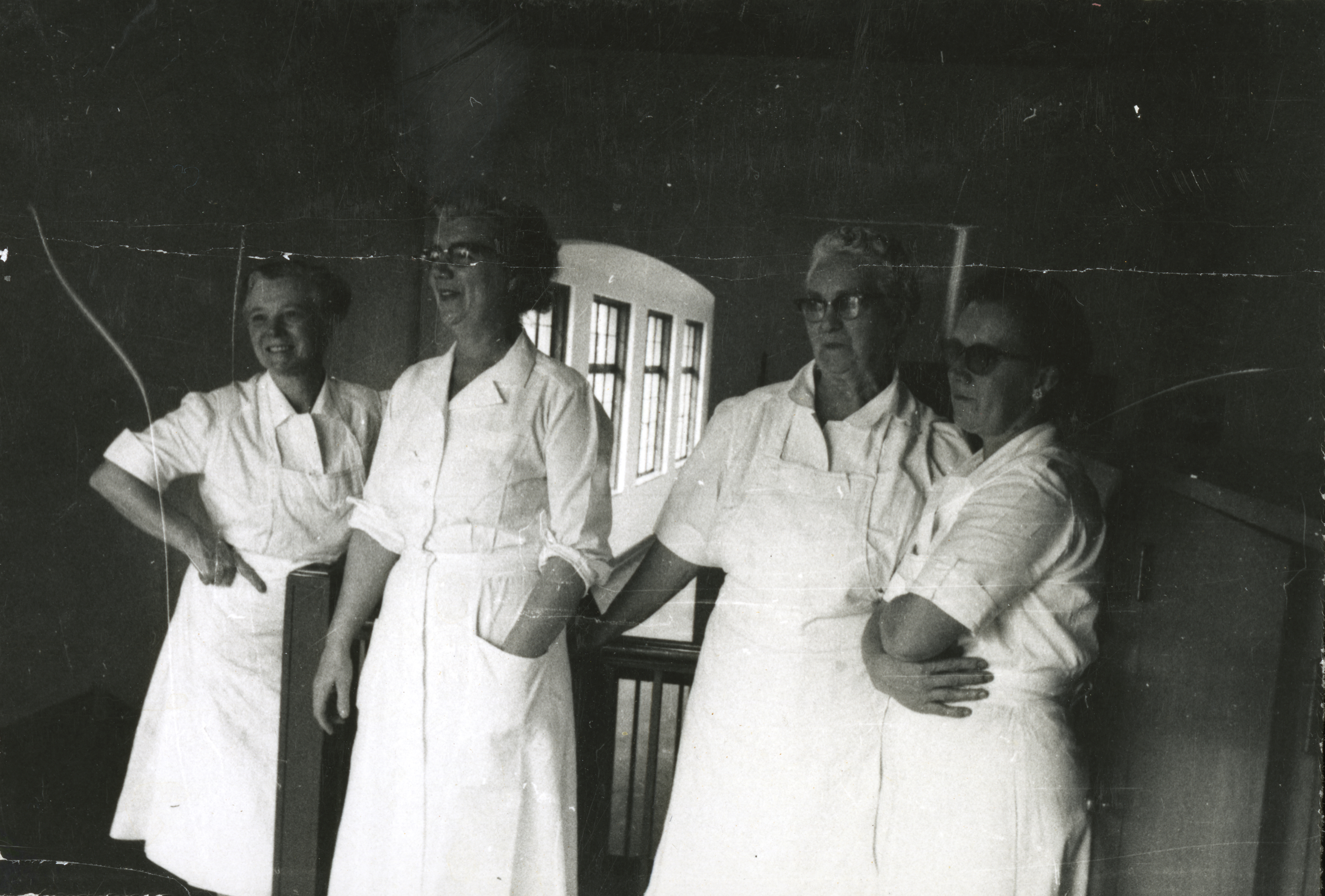
Flora Leslie (second from left) with cooking staff at Brookside School. Courtesy of Cranbrook Archives.
Born Flora MacFarlane in Alexandria, Scotland, in 1906, she made her way to the United States alone in December 1930. Journeying by ship on a very stormy sea, the passengers were required to stay below deck where they got to know each other more than they would have had they been able to wander on deck. Having worked in a photographer’s office in Scotland, Flora initially sought the same occupation in America.
But a fellow passenger Flora met aboard the ship told her that if she had no luck finding work, to contact her for employment. It is thus that Flora began to work for the Ward family in Pontiac, a family whose children were students at Cranbrook.
In 1932, Flora started working at Cranbrook, initially at Kingswood School. Flora married George Leslie in 1934, a landscaper and gardener, and later a superintendent of buildings at Cranbrook.
George Leslie (left) and Flora Leslie (right) in the garden of their apartment, the Ram’s House, at Brookside School, circa 1935. Courtesy of Cranbrook Archives.
After several invitations from Jessie Winter, Headmistress of Brookside School, Flora became the dietician and food director at Brookside School, a position she held from 1934-1975. The position came with an apartment, and though at first Flora preferred to stay at Kingswood, which she describes as “light and bright and lovely,” Winter asked Flora and George back to Brookside one further time and had arranged the apartment beautifully. Most importantly, there was a brand-new Frigidaire refrigerator, a novelty in those days. As Flora recalled, seeing this small luxury she told the headmistress, “We’ll come!” The apartment was in the part of Brookside known as the ‘Ram’s House’ and had previously been occupied by Jessie Winter and by J. Robert F. Swanson.
View of the front of George and Flora Leslie’s apartment, known as the Ram’s House, circa 1935-1938. Courtesy of Cranbrook Archives.
During the war years, when food was in short supply, George and Flora Leslie kept Brookside stocked with vegetables—he grew them and she canned them.
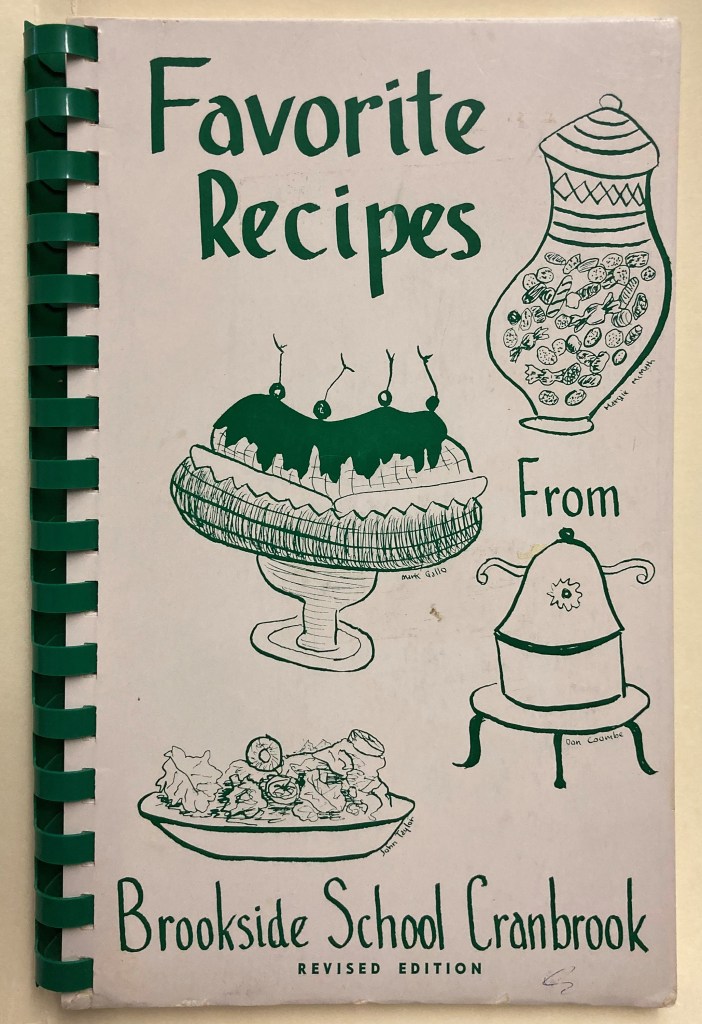
The Favorite Recipes cookbook from Brookside School, 1970.
View of original recipes from Flora Leslie in the Favorite Recipes cookbook from Brookside School, 1970.
View of dessert page from the Favorite Recipes cookbook from Brookside School, 1970.
Favorite Recipes, the Brookside cookbook, 1970. Courtesy of Cranbrook Archives.
After feeding generations of students, Flora published many of her favorite and original recipes in the Brookside cookbook, Favorite Recipes, which are still enjoyed by alumni far and wide. Perhaps you might like to try one of Flora’s original recipes this Thanksgiving, or a dessert recipe from one of the faculty families?
—Laura MacNewman, Associate Archivist, Cranbrook Center for Collections and Research
As performance venues prepare to reopen in Michigan today, I thought it timely to take a look at the storied history of a group that’s nearly as old as Cranbrook itself: St. Dunstan’s Theatre Guild of Cranbrook. With ties to Cranbrook’s founding family, staff, and the physical Cranbrook campus, combined with its enduring cultural role in the surrounding community, this nearly ninety-year-old institution has a rich history. Allow me to share with you a few fascinating details from its early years.
View of St. Dunstan’s Playhouse from Lone Pine Road looking east. Balthazar Korab, photographer. Copyright Korab and Cranbrook Archives.
“The worst thing about it, it’s named for a saint. But don’t think it’s holy, ‘cause it certainly ain’t.”
Sheldon Noble, an early and active Guild member
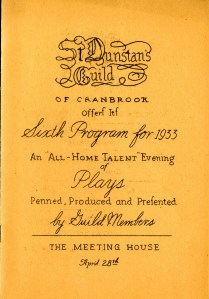
The Theatre Guild was indeed named after St. Dunstan, Archbishop of Canterbury in the ninth century and patron saint of the arts. As St. Dunstan lived in Kent, England, from where Cranbrook founder George Booth’s family hailed, the Guild’s name was fittingly suggested by his son and founding member, Henry Scripps Booth. Shortly after the Guild began in 1932, members were writing and producing their own one-act plays. In an April 1933 letter announcing an informal evening of a “Home Talent programme,” for the 100 Guild members and their guests, Jessie Winter, Guild Secretary and Brookside School Headmistress, implores them to “Be kind, be understanding, be generous . . . give the actors and authors the warm reception which such offerings warrant.” One such author was Henry Scripps Booth. Billed as Thistle, his play, Sedative Bed, was one of four being performed that April 28th evening at Brookside School for just $1. It was the tail end of the Great Depression, after all!
Front and back cover of the 1933 playbill. Courtesy of Cranbrook Archives, Cranbrook Center for Collections and Research.
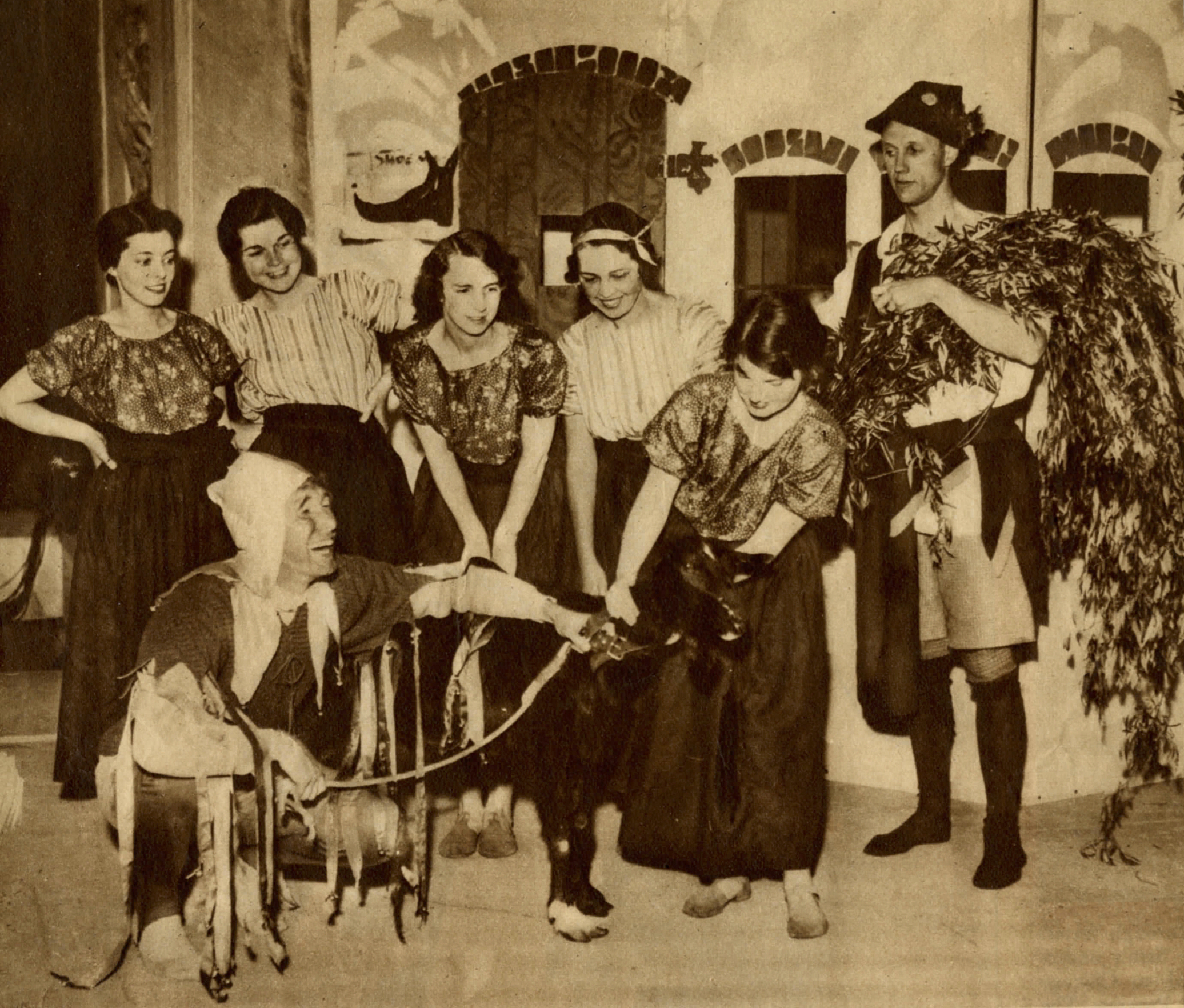
The first public performance of St. Dunstan’s Theatre Guild took place at the Greek Theatre with The King and the Commoner. Taking supporting roles were the likes of Annetta Wonnberger (Cranbrook Summer Theater School), Pipsan Saarinen Swanson (daughter of Cranbrook architect Eliel Saarinen), and Henry Scripps Booth, among others.
A scene from The King and the Commoner. Henry Booth on right. Detroit newspaper rotogravure clipping. Courtesy of Cranbrook Archives, Cranbrook Center for Collections and Research.
The cast and crew of the 1940 production of The Last of Mrs. Cheyney again reads like a who’s who of Cranbrook, including Harry Hoey (Cranbrook School Headmaster), Templin Licklider (Cranbrook School Faculty), Dorothy Sepeshy (wife of Cranbrook Academy of Art President, Zoltan Sepeshy), Rachel Raseman (wife of Richard Raseman, Cranbrook Academy of Art Executive Secretary and Vice President), the aforementioned Annetta Wonnberger, and various members of the Booth Family. Henry Scripps Booth, part of the Guild’s Scenic Design Committee, and his wife Carolyn, the production’s stage manager, created the sets.
Henry Scripps Booth designed his home near Cranbrook just north of the Meeting House and Brookside School(another building on which he served as architect) in a thorny meadow. He called it “Thornlea” after its hardscrabble site. Built from 1925-1926, the house and its grounds hosted over sixty years of family gatherings, large and small. As is evidenced in Henry’s photograph albums, he, his wife Carolyn, and their five children celebrated holidays and entertained friends often. Equally represented are images of everyday life, such as this one:
Henry Scripps Booth can be seen soaking up the rays alongside the pool at Thornlea House in the summer of 1964. To his right are son David and grandson Miles. Courtesy Cranbrook Archives, Henry Scripps Booth Papers.
With just ten official days left of summer, let’s take a moment to bask in similar memories of long hot sunny days.
See Thornlea for yourself and help us make new memories at the house on Saturday, September 21st, when you join us for A House Party at Cranbrook. Thornlea will be open for tours, live jazz at the piano, and cocktails on the patio prior to the evening’s live auction and dinner at Cranbrook House. Join us and support Cranbrook Archives and the Center for Collections and Research at our annual fundraiser, tickets and sponsorship opportunities are still available!
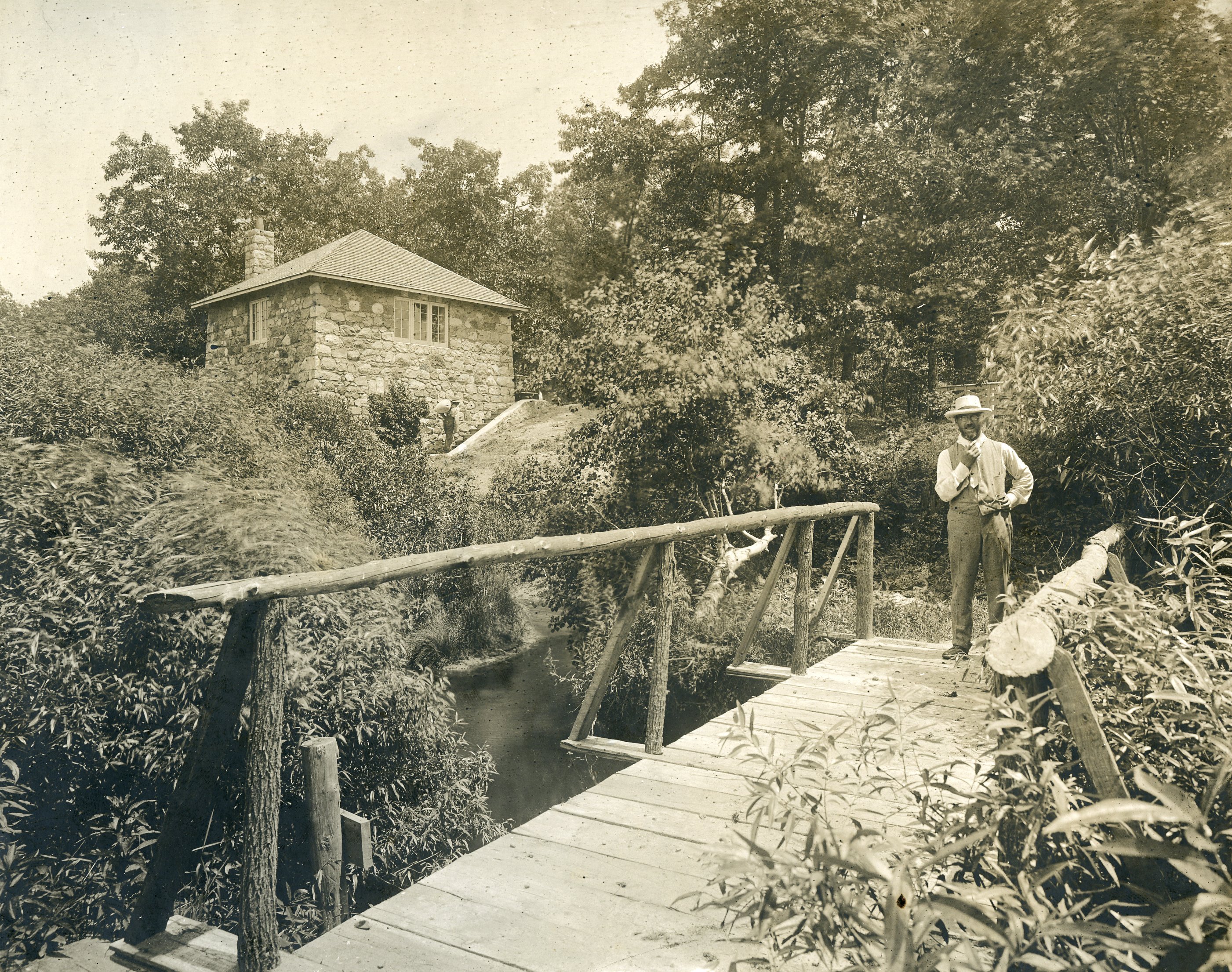
The “bananas went a-missing” and Kingswood School’s Chiquita Banana Scholarship. The thief who stole the (attributed to) Rembrant Peale portrait of George Washington and the mysterious return of Perseus on the porch of the Thornlea Studio Archives. Gates and andirons and architectural details like the lead conductors at Cranbrook House designed by New York metalsmith Oscar Bach.Cranbrook’s mid-century modern Edison House, the House of the Poet (never realized thank goodness!), Chanticleer Cottage (which used to be the chicken house), Walnut Cottage, Tower Cottage, and Brookside Cottage (also known as the Honeymoon Cottage or Stonybrook) which evolved from the original pump house.
Unidentified man on bridge (no, it is NOT George Booth) with the pump house in the background, ca 1915
And the people! The Italians who literally moved mountains of dirt and rocks, graded the roads, and built the stone walls and beautiful rock gardens that lined the campus.
Landscape architect Edward Eichstaedt, who designed the original planting plan around Jonah Pools and later worked on landscape design for Eero Saarinen’s General Motors Technical Center. The women who left their mark at Christ Church Cranbrook – Kathryn McEwen, Hildreth Meière, and silversmith Elizabeth Copeland. Cranbrook School’s art teacher John Cunningham and his mosaics (which can still be seen today) Kingswood School’s French teacher, Marthe Le Loupp, and Brookside’s dietician Flora Leslie.
Eichstaedt’s 1934 Planting Plan for the Lower basins
Notable national celebrities connected to Cranbrook: Leonard Bernstein, Dave Brubeck, Amelia Earhart, Henry Ford, Eleanor Roosevelt, and Anne Morrow Lindbergh to name just a few. But perhaps most interesting to me was learning the stories of those not so well known: Ebba Wicks Brown– the first registered female architect in the state of Oregon who came to Cranbrook to study architecture with Eliel Saarinen. Colonel Edwin S. George, a Detroit businessman and philanthropist who was affiliated with Cranbrook in a variety of ways – most notably for his contributions to the Institute of Science. Myrtle Hall – the first African American model at the Cranbrook Academy of Art and Cleo Dorman – another model who was infamous for collecting paintings of her done by famous artists. And so many, many more names still swirling around in my brain.
Curatorial scholars at work
Perhaps my greatest joy here has been to help researchers find the answer to their questions, and to guide them towards collections that they might not have thought of – which has often led to a change in the course of their research. I am very proud of the fact that Cranbrook Archives has an international reputation for exemplary service and for being so organized and easy to use. I will miss working with the many students, faculty, staff, researchers, and scholars as you have taught me as much, if not more, than I have taught you. Thank you for that.
And, thank you to the Cranbrook Kingswood Senior May students and the many archival graduate students who have worked on projects over the years, and a special thanks to the most amazing volunteers! We couldn’t have accomplished all that we have without you.
Graduate student (left) and dedicated volunteers at Thornlea Studio Archives
I will close my final Cranbrook blog post by doing what I have tried to do my entire 16 year career here – promote Cranbrook Archives. In the archival profession, one constant issue many of us face is how to demonstrate to our institutions and constituents the importance of an archives – why archives matter. I could wax on, but instead I leave you with this article in the hopes that all who read it will have a new appreciation for the work that archivists do every day to preserve institutional memory. History matters. Archives matter. I am proud that I played a small role in preserving Cranbrook’s rich history.


























 Cranbrook Kitchen Sink