What’s in a Name?

Sometimes, what appears to be a simple question doesn’t have an easy answer in the archives. By combining forces with colleagues, and looking in places you might not first suspect, you can ideally turn a boggling question into a rewarding quest. Provided, of course, you can solve the mystery! Happily, this was recently the case.

When contacted by a Kingswood School graduate about the origins of a certain sculpture that had graced the Green Lobby in the 1960s-1970s, I had two names to go on: Suki and Pam Stump Walsh. Was either of these the name of the sculptor and was the sculpture even still there? After checking several possible sources in the archives, it was time for a field trip to Kingswood. There she was opposite the green stairs, just as she had been described to me: a bronze sculpture of a girl, sitting cross-legged, head bowed, reading a book. I’d answered part of the question: she was still there.

IMG_0846

And much to my delight there was also a plate tacked to the sculpture’s wooden pedestal. It read: “In Remembrance, Suzanne Anderson Stenglein, Class of 1947.”

IMG_0848_close

Could this be Suki?

Back in Archives, I found a Suzanne Anderson in the 1947 Kingswood yearbook, Woodwinds. Next to her picture, this description: “That dashing station wagon, that’s always on the go, beautiful taste in clothes, and exciting vacations make Suki the ideal senior for every underclassman. Her pertness, her nose, and her spirit, that help to create her charm, match perfectly her conversational ability on all subjects from Broadway to baseball.”

IMG_0891

Suzanne Anderson, 1947. Copyright Cranbrook Archives.

I still didn’t know if this was the sculptor, or if it was Pam Stump, who is perhaps best known at Cranbrook for her work, Jane: Homage to Duchamp in the Kingswood courtyard. It certainly appeared to be Stump’s style. Associate Registrar Leslie Mio found a listing in Cranbrook Cultural Properties records for Suki, described as a patinated bronze sculpture attributed to Pam Stump.

Detroit native M. Pamela Stump graduated from Kingswood School in 1946. After attending the University of Michigan College of Architecture and Urban Planning for one year, she left to study sculpture under Marshall Fredericks in his Saginaw studio. Twenty-three years after leaving Kingswood, Stump, now Pamela Stump Walsh (she married Cranbrook School 1944 graduate, David E. Walsh), returned to teach sculpture. She retired in 1990, but continued creating and showing her own work throughout the state and internationally.

I appeared to have my answer, but I wanted definitive proof, and, ideally, a date. Back to Kingswood School. This time, with the help of Associate Archivist Laura MacNewman, I found the artist’s signature, and, a date!

IMG_0871

End of story, right? Not quite. I still wondered about the sculpture’s origins. The Archives, thankfully, hold the M. Pamela Stump Papers. Consisting mainly of her Cranbrook Kingswood Chronicle, a memoir she titled, “Ubi Ignes Est or Where’s the Fire?” it provided the final details.

Stump made eighteen sculptures for Cranbrook while on the Kingswood faculty. Shortly after she started, in 1969, she was commissioned by the Class of 1947 to create a sculpture in memory of their classmate Suzanne Anderson Stenglein, who had died prematurely the year before. Stump refers to the bronze sculpture of Suzanne as Girl Reading or Suki. It was specifically designed to fit in the niche just outside the Headmistress’ office, directly opposite the staircase in the Green Lobby, and purposely placed on a revolving wooden pedestal so it could be turned 180-degrees to face the wall and enable examination of all the various textures and symbols on its surface. Stump writes, “On her body are many symbols of her life. This was easy because I had known her at Kingswood and in Saginaw.” Here you see this symbolism, along with the names of Suzanne’s schools before she came to Kingswood; her initials, S.A.; and her nickname, found on the crown of her head:

To bring things full circle: a close examination of negatives in the archives collections (identified only as “Kingswood Interiors”) found period images of the sculpture:

suki012 The Reading Girl by Pamela Stump, July 2, 1969. Bradford Herzog, photographer. Courtesy Cranbrook Archives, Cranbrook Photograph Collection.

I also learned from The Birmingham Eccentric, that Suki was the daughter of Goebel Brewing Company President Edwin John Anderson. She grew up in Saginaw, where she presumably met her husband, Harold Stenglein. The pair were married at Christ Church Cranbrook in 1955, and made their own home in Saginaw. At this juncture, little else is known about the girl behind the sculpture’s name.

 – Deborah Rice, Head Archivist

There’s Always a Detroit Connection

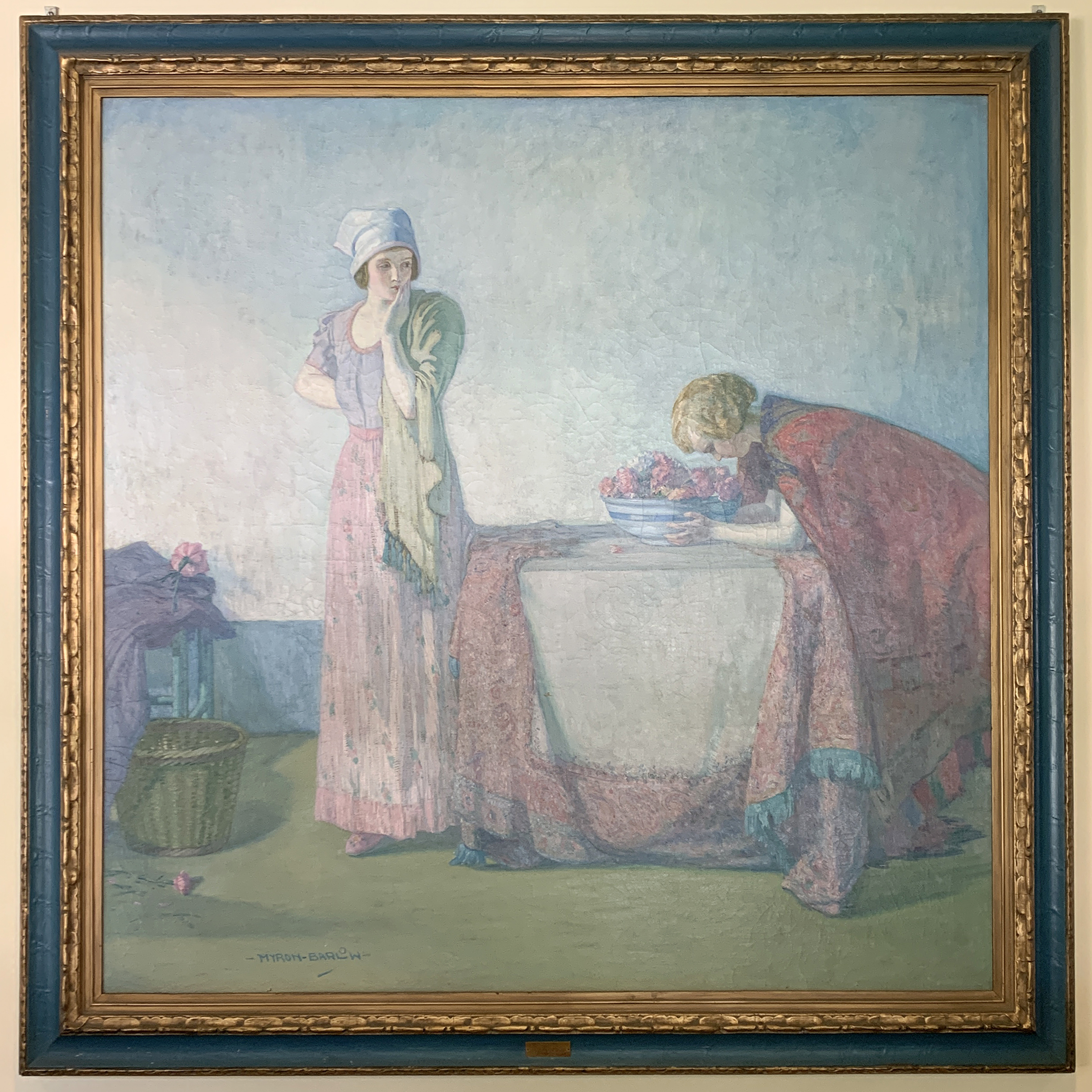
In the main hallway of Kingswood and in the living room of Thornlea, there are paintings by artist Myron G. Barlow (1873-1937). I love the look of these paintings and began to wonder about the artist. I’ve come to learn he was an internationally known Detroit-raised painter. As with all things Cranbrook, it seems, there is always a Detroit connection.

Two Women with a Bowl of Flowers on a Table, circa 1912 by Myron G. Barlow

Two Women with a Bowl of Flowers on a Table, circa 1912 by Myron G. Barlow.

The Kingswood painting Two Women with a Bowl of Flowers on a Table depicts two peasant girls, one standing and one bending over a bowl of flowers. It was donated to Kingswood around 1970 by Herbert Sott in memory of his wife Mignon Ginsburg Sott, who was Kingswood Class of 1943.

Young Girl Braiding Her Hair, circa 1912 by Myron G. Barlow

Young Girl Braiding Her Hair, circa 1912 by Myron G. Barlow

The other painting, Young Girl Braiding Her Hair, is of a girl looking in a mirror braiding her hair. It was purchased by James Scripps Booth from the artist in 1912. James attended the Ecole des Beaux-Arts in Paris and in 1911 had studied under Barlow; James’ painting “Onion Gatherer, Cote d’Azure” depicts Barlow’s cottage studio. James gave Young Girl Braiding Her Hair to his parents George and Ellen Booth. It originally hung in Cranbrook House’s main staircase. George and Ellen gifted the painting to Henry and Carolyn Booth, who hung it in their home, Thornlea.

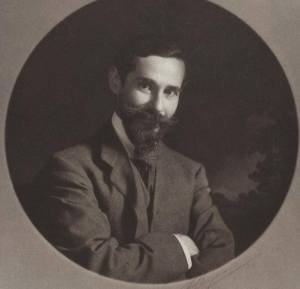
Myron Barlow (1873-1937). Son of Adolph and Fanny Barlow who were members of Temple Beth El. Courtesy Temple Beth El Facebook page.

Myron G. Barlow (1873-1937), son of Adolph and Fanny Barlow who were members of Temple Beth-El in Detroit. Courtesy Temple Beth El.

Myron G. Barlow was born in Ionia, Michigan in 1873 and raised in Detroit. As a teenager, he trained at the Detroit Museum School, where he studied under Joseph Gies, and then at the Art Institute of Chicago. He began his career as a newspaper artist. He eventually traveled to Paris and enrolled in the Ecole des Beaux-Arts where studied under Jean-Leon Gerome.

While copying paintings in the Rijksmuseum in Amsterdam, Barlow discovered Johannes Vermeer. As stated in William H. Gerdts’ Masterworks of American Impressionism from the Pfeil Collection, “Like Vermeer, one of Barlow’s favorite artistic themes became the depiction of figures, often female and usually set in an interior; frequently isolated and motionless, surrounded by a dream-like atmosphere rendered in a single, dominant tonality, often blue.”

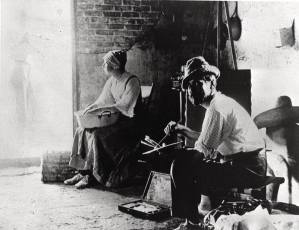
Barlow in his studio after 1900. Courtesy of Nancy Brett (Barlow's great-niece) on Temple Beth-El Facebook page.

Barlow in his studio after 1900. Courtesy of Nancy Brett (Barlow’s great-niece) via Temple Beth-El.

Around 1900, Barlow moved to the French village of Trepied. There he transformed a peasant’s house into his studio. He would, however, make frequent trips back to Detroit and kept a home there as well.

He served as the Chairman of the Scarab Club around 1918. According to his Detroit News obituary, “Among his major achievements in Detroit are six large murals which he painted for the main auditorium of Temple Beth-El, which were completed in 1925.”

In 1907, he was the only American elected to the Societe Nationale des Beaux-Arts and in 1932 was made a Knight of the Legion of Honor by the French Government. He was recognized for his work with gold medals at the St. Louis and Panama Pacific Exhibition, and by having his works purchased by many international museums, including the Musée Quentovic in France, Pennsylvania Academy of Fine Arts, and the Detroit Institute of Arts. The Detroit Club and the private collection of Baron Edmond de Rothschild also included works by Barlow.

In May 1937, he left Detroit with the intention of selling his studio in France and returning to the city for the remainder of his life. Unfortunately, he died in his home in Trepied that fall.

– Leslie S. Mio, Associate Registrar

A Sculpture So Nice They Named it Twice

One of my many duties here at the Center for Collections and Research is to maintain the sculptures on the campus. This can mean finding conservators to repair works, contractors to clean them, or, in some cases, clean them myself. Recently, I was working on a sculpture in the gardens at Cranbrook House. I had seen the sculpture before but wondered about its backstory. Turns out it was a tale of two names.

The sculpture is Mario Korbel’s statue Atalanta, the Greek goddess of the hunt, travel, and adventure. It was commissioned by George Gough Booth in 1927 for one of the gardens at Cranbrook House, part of a series of work Korbel completed for the Booth house and gardens — including Dawn and Harmony in the gardens and Andante and Nocturne in the house.

Letter from Mario Korbel to George G. Booth, referencing both his works Atalanta and Andante. George Gough Booth Papers, Cranbrook Archives.

July 12, 1927 letter from Mario Korbel to George G. Booth, referencing both his works Atalanta and Andante. George Gough Booth Papers, Cranbrook Archives.

Booth, admiring the beauty of the clear, white marble of Atalanta, transferred the work into the collection of the Art Museum. It was part of the original art museum exhibition in 1930.

CISB509L.jpg

Atalanta (left) in the first Art Museum exhibition in 1930. Courtesy Cranbrook Archives.

Later, Booth wrote: “We have finally concluded that the figure will make a very important and striking center art element in connection with the new School for Girls at Cranbrook.” When the Kingswood dormitory was built, the sculpture was transferred to Kingswood and installed on the terrace.

Atalanta.jpg

Atalanta (right) adorns the terrace at the Kingswood School for Girls dormitory in this undated photo. Courtesy Cranbrook Archives.

In 1969, the sculpture was vandalized and smashed into many pieces (no one was ever implicated in the crime–or at least, their name isn’t in my file!). Those pieces were put back together, but when Atalanta was finally repaired, she was not as pristine. Henry Scripps Booth decided to rename her Ecolo. He also wrote a verse to explain the new name:

Ecolo, Goddess of Earth 

Who is this sweet maid who stoops protectively to save the earth from man’s pernicious tread? 

It is the blithe spirit of Ecology by whom all life and natural things are fed.

CEC472 (2).jpg

Ecolo in her new home in the Herb Garden at Cranbrook House.

Ecolo, or the sculpture-formerly-known-as-Atalanta, now greets visitors in the Herb Garden at Cranbrook House.

– Leslie S. Mio, Associate Registrar

Vroom Vroom goes the Loom

In preparation for the Center’s upcoming show, Studio Loja Saarinen: The Art and Architecture of Weaving, 1928-42, we recently moved a historic Cranbrook Loom from the Kingswood Weaving Studio across campus to Saarinen House.

IMG_7359

The Cranbrook Loom at home in the Kingswood Weaving Studio.

I wanted a Cranbrook Loom to be a part of the exhibition as a teaching and demonstration tool, so guests can understand how the many beautiful rugs on display were produced. Studio Loja Saarinen started with just one loom in 1928, but grew to include thirty-five. The original looms used by the Studio were quite heavy and difficult to work with; Saarinen’s unhappiness with them eventually resulted in her demand for a loom built exactly to her specifications. She worked with John Bexell, a skilled cabinet maker and husband of one of the Studio’s weavers, Marie, to construct a loom that was lighter, sturdier, and easier to operate. The first Bexell loom was delivered in 1936.

Cranbrook Weaving Studio Loja Saarinen April 1936 Neg 3354

Bexell (or Cranbrook) looms in the Cranbrook Weaving Studio, April 1936. Cranbrook Archives.

John P. Bexell descended from a long line of woodworkers. Born in Korstrask, Sweden in April 1899, he emigrated to the U.S. and settled in Flint, Michigan in the 1920s. He had made looms back in Sweden, and when he made the first to Saarinen’s specifications he saw potential in the design and made others to sell.

Loja Saarinen and her weavers were so pleased with the new Bexell-made loom she immediately ordered more. Other weavers ordered the looms too, and Bexell also received a commission from the federal Farm Security Administration for several hundred looms. His career as a loom specialist took off. In 1945, at Loja Saarinen’s suggestion, Bexell named his now quite popular (and profitable) loom the “Cranbrook Loom.” He produced the looms with his son, Bert, in Flint until 1977, when he sold the business.

All that to say, I still needed to get a Cranbrook Loom across campus.

IMG_7745

Our first victory! Getting the loom out of the weaving studio and into the truck. Ed looks pleased.

Working with my colleagues Leslie Mio and Matt Horn, along with Matt’s husband Marc Meyers and game members of Cranbrook’s moving crew Ed and Trevor, we got the loom on the go. To exit the weaving studio, we each grabbed a leg of the loom and walked it above the others and out of the double doors, through the courtyard, and into the moving truck.

IMG_7749

Trevor, Marc, Matt, and Ed walking the loom toward increasingly smaller doors.

At Saarinen House, we had to remove the warp stick catcher to get the loom through the door. It then had to turn completely on its side to fit through the narrower interior doors. Nothing but our nerves were harmed in the process.

You might be thinking to yourself, don’t looms come apart? Well, yes. However, the loom had been partially prepped for weaving, and we didn’t want to have to reassemble it from scratch inside the studio. I am not, after all, a loom expert. So instead we twisted and turned until the loom was in place in the Saarinen House Studio!

A few days later, Lynn Bennett Carpenter, Academy alumna and instructor in weaving and fashion at Cranbrook Kingswood Upper School, came to finish setting up the loom for weaving a plaid. There was much tensioning, counting, tensioning, threading, twisting, and tying. It was fun, and quite stressful! One wrong heddle threaded, and our weave would be ruined.

Guests to Saarinen House will now be able to learn about the history of the Cranbrook Loom, see it in action, and even throw the shuttle back and forth to help us make our 12 foot plaid. Tours of Saarinen House start in May and run through December 1, 2019. The exhibition will open during Open(Studios) on April 28, 2019. Come and join us to explore the house and exhibition during our free Opening Reception from 1:00—5:00pm, with demonstrations and lessons from Cranbrook Kingswood Upper School weavers!

– Kevin Adkisson, 2016-2019 Collections Fellow, Cranbrook Center for Collections and Research

Special thanks to Lynn Bennett Carpenter for loaning us the loom, for her time prepping the loom, for volunteering her students to assist in our Open House, and for teaching me how to weave.

Katharine Rogers Adams, Kingswood School Headmistress 1931-1934

Katharine Rogers Adams was the Headmistress of Kingswood School from March 1931 through June 1934. The Announcement of Kingswood School brochure of 1931 tells us that she was born and educated in Philadelphia and later graduated from Wellesley College in Massachusetts. She taught in the high schools of New York and Connecticut for seven years and was awarded Master of Arts and Doctor of Philosophy at Cornell University. From 1926 until 1931, she was a professor of history and dean of the faculties of Mills College, California. In March 1931, she was selected as Headmistress of Kingswood School, following the resignation of Miss Gladys Adams Turnbach in December 1930.

1980-01 31-15

Katharine Rogers Adams Kingswood School Annual, 1932 1980-01 31:15 Copyright Cranbrook Archives, Cranbrook Center for Collections and Research.

Despite the financial crisis of the Depression during Adams’ Principalship, she was successful in leading the school through the financial challenges of those early years, as well as championing its extensive library and establishing traditions such as the Christmas play, Honors’ Day, and yearbooks (see Clark, 2006, pp.57-58). From delving into the records to find out more about Adams, the story that engaged me was her involvement in the development of fine arts education. Faculty of the Cranbrook Academy of Art were employed to provide art education, with Maja Andersson-Wirde teaching Arts and Crafts in 1932-1933, and during the 1933-1934 academic year, students began to be taught painting by Zoltan Sepeshy, sculpture and drawing by Marshall M. Fredericks, and weaving by Lilian Holm.

1980-01 13-3.jpg

Letter from Katharine Rogers Adams to Eliel Saarinen, May 24, 1934
Kingswood School Records (1980-01, 13:3)
Copyright Cranbrook Archives, Cranbrook Center for Collections and Research.

The discussion of art and science in education flourishes during Adams’ three years as Kingswood Headmistress and continues thereafter, with many drafts of statements to articulate the Cranbrook approach—the image below shows one version as edited by Eliel Saarinen in 1934. If the art of language is to clearly achieve understanding or to generate inspiration for thought, through words, I found this much accomplished in the following statement within a letter from Saarinen to the Cranbrook Foundation:

“To begin with this must be stated: the problem of “art” is to create new values, contrary to the problem of “science” which is the discovery of existing values” (Eliel Saarinen, Letter to the Cranbrook Foundation, Sept. 25, 1935).

1981-01 19-33.jpg

Precepts Governing the Cranbrook Educational Development, Eliel Saarinen, 1934
George Gough Booth Papers, (1981-01, 19:33)
Copyright Cranbrook Archives, Cranbrook Center for Collections and Research.

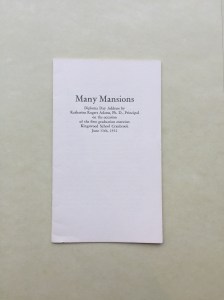
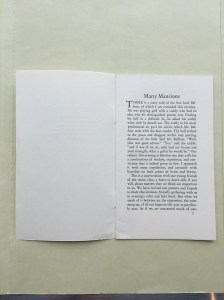
The founders’ wish for students to develop an appreciation of art, and a knowledge of its history, toward the betterment of human life, is embraced by Adams, who was also well-accomplished in the art of language. In her address, ‘Many Mansions,’ at the first graduation ceremony for Kingswood School held on June 13, 1932, she speaks of another form of architecture—a mansion of character that houses an independent mind and an active soul inspired by learning and beauty and courage:

“Do we ever stop to think, to realize that we are builders, whether of this or of that? That every mental and physical action of ours is building? We would build well, you say, but to build we must have power, and to have power we must have knowledge, and in the words of Dante—‘knowledge comes of learning, well retained.’”

Adams’ address is scattered with poetry and literature, including that of Alan Seeger, Robert Browning, and Oliver Wendell Holmes, Sr., as well as recollections of others from Lord Balfour to Leonardo da Vinci. But Adams is in harmony with the thoughts of George Gough Booth, that the words or stories of others are helpful insofar as they stimulate you to be “your own very best self” (see ‘Notes for an address not used’, late 1930s. George Gough Booth Papers, 1981-01, 1:20). Thus, she advises her graduands:

“Seek the one truth to your problem; there can be but one truth as there is but one sun. But build your mansion with many windows, the sun will shine through all.”

1981-01 22-9

Diploma Day Address, ‘Many Mansions,’ by KRA, Ph. D., Principal, on the occasion of the first graduation exercises Kingswood School Cranbrook, June 13, 1932, Kingswood School Records (1980-01 22:9) Copyright Cranbrook Archives, Cranbrook Center for Collections and Research.

1981-01 22-9 (2)

Although in February of 1934, Adams initially sought and gained an extended summer leave for rest and repose, she resigned on May 23, 1934, at her physician’s recommendation.

– Laura MacNewman, Associate Archivist

Sources:

Elizabeth C. Clark. (2006). Beside a Lake—A History of Kingswood School Cranbrook. Cranbrook Press. pp.57-58

George Gough Booth Papers, (1981-01, 19:33)

Kingswood School Records (1980-01, 1:2-3, 6; 12:4; 13:3; 15:2; 22:9; 24:8; 31:15)

Green Book, Don Shirley, and Henry Booth: Because There’s Always a Cranbrook Connection

It was the morning after New Year’s Day. No sooner had I reached my office and turned on my computer than I saw that I had just missed a call from long-time Cranbrook friend and Kingswood graduate, Jeanne Graham. Always eager to speak with Jeanne, I immediately returned her call. Jeanne, who had not even taken time to leave me a message, already was in the processing of dialing the Center’s archivists. She had a question and was eager for an answer.

Like Jeanne, one of the movies that I saw over the holidays (one of the best, I might add) was Green Book. Masterly cast with Mahershala Ali as the legendary African-American classical and jazz pianist Don Shirley and Viggo Mortensen as the Italian-American bouncer-cum-driver and bodyguard “Tony Lip” Vallelonga, the film tells the story of a road trip (a concert tour) through the Jim Crow South of the early 1960s and the unlikely friendship that develops along the way. While I was watching the movie, Cranbrook was the furthest thing from mind; while Jeanne was watching the movie, she could not get Cranbrook out of her mind. “Was it my imagination or did I attend a concert by Don Shirley in Kingswood Auditorium while I was a student at Cranbrook in the 1950s?” Jeanne asked.

Admittedly stumped, I did what any good director would do—I consulted my knowledgeable staff. Within minutes, tantalizing facts were speeding their way to me from Associate Archivist Laura MacNewman: articles in the Clarion and the Crane, Kingswood’s and Cranbrook’s student newspapers; a concert announcement in the Birmingham Eccentric; links to nineteen Kingswood negatives; and references to thirteen letters sent between Shirley and his agents and Henry Scripps Booth, the youngest son of Cranbrook’s founders. Finally, Laura calmly announced that she had found black and white photographs of Shirley swimming and riding a bike at Henry’s and his wife Carolyn’s home near Cranbrook, Thornlea. I, meanwhile, yelled out in excitement!

Who knew? Well actually, there are a few people that did know. Before I could even begin to sift through the materials in Cranbrook Archives, I received a call from Carolyn Scripps, Henry and Carolyn Booth’s granddaughter. Carolyn also had seen Green Book and wanted to make sure that I knew about the story of her progressive grandfather and Shirley.

Scene One. Shirley did, in fact, perform in Kingswood Auditorium on Wednesday, March 2, 1955 (and yes, it was while Jeanne Graham was a student). Shirley, who was twenty-seven years old at the time, was accompanied by bassist Richard Davis. They performed nine songs that evening, many of which the two musicians recorded on Shirley’s 1955 album Tonal Expressions, including one of my favorites, “No Two People Have Ever Been So in Love.” What does a rendition by Shirley of a popular song like “No Two People” sound like? In the words of Henry Booth: “While the concert was labeled ‘Jazz,’ the music was a subtle rendering of the contemporary, having a classical quality which should appeal to the devotees of classical music—that is if they will condescend to listen.” Five days after this classically inspired, popular jazz concert, Henry wrote his first letter to Shirley (at least the first one that survives in Cranbrook Archives). With regards from his wife Carolyn and their daughter Melinda (Carolyn Scripps’s aunt), Henry invited the pianist to consider a second performance at Cranbrook sponsored by the nascent Cranbrook Music Guild.

The Clarion, March 11, 1955. Collection of Cranbrook Archives.

Scene Two. While it took numerous letters from Henry to both Shirley and his agent—and some convincing of the Music Guild members who Henry described to Shirley as not very “’Jazz’ minded”—the pianist and bassist returned to Cranbrook in December. Thanks to clippings from the Birmingham Eccentric and the Crane, we know the concert took place on Saturday, December 3, 1955, and, like the first concert, it took place at Kingswood. And thanks to a page in the Thornlea Guest Book, now in the collection of Jeffrey Booth (Henry and Carolyn’s grandson), we also know that Henry and Carolyn hosted an Afterglow for the musicians that evening in their home on Cranbrook Road.

Thornlea Guest Book, Detail of Guest List for December 3, 1955. Collection of Jeffrey Booth.

Scene Three. Henry Booth was a documentarian. Included in the Henry Scripps Booth and Carolyn Farr Booth Papers, which are preserved—and accessible—in the Cranbrook Archives, are a series of photo albums that chronicle and illustrate Henry’s and Carolyn’s lives. The 1956 album includes seven black and white photographs of Shirley. While they were processed in July, another entry in the Thornlea Guest Book more precisely places both Shirley and Richard Davis at Cranbrook on June 20, 1956. Three of the photographs were taken by Henry at a night club, presumably Baker’s Keyboard Lounge in Detroit where the Don Shirley Duo performed no less than twelve times that June. One shows Shirley on stage, while the other two show Carolyn and Melinda Booth in the audience, including a photograph of Carolyn and Shirley sitting together at a table. The other four show Shirley relaxing at Thornlea—sitting in a wicker chair, swimming in the pool, riding a bike in the courtyard, and posing with the Booth’s youngest child, Melinda’s sister Martha (Carolyn Scripps’s mother). Henry, ever the Cranbrook publicist, dutifully followed up the visit by sending to Shirley “a selection of Cranbrook catalogs and booklets.”

Scene Four. There is where it gets interesting. While Green Book has Shirley and Tony Vallelonga departing from Shirley’s Carnegie Hall apartment and beginning their 1962 concert tour with a stop in Pittsburgh before immediately heading south, the actual route also brought them to Detroit. During the road trip, Vallelonga wrote letters to his wife Dolores. In an excerpt from one of the letters, published on Cinemabuzz.com, Vallelonga wrote:

Dr. Shirley decided to stop off in Detroit for a day to visit some people he knows, you remember I told you he knows people wherever he goes and he knows all big people (millionaires). We went over some guy’s house, I’m sorry I meant a mansion, it was really a castle. His name was Henry Booth, he lives in a place called Mich Hills, it’s like Riverdale Yonkers, but the place makes Riverdale look like the Bowery. Dolores, I never saw such beautiful and fabulous homes in all my life.

I’m guessing this visit to “Mich Hills” took place in April 1962. In a letter dated April 25, Henry wrote to Shirley, referencing a visit that took place “a week or so ago.” Eager for another concert at Cranbrook, Henry proposes that the Music Guild bring the Don Shirley Trio to Cranbrook that summer for a week of concerts in the Greek Theatre. But he also references “Carol’s original idea” (Henry referred to Carolyn as Carol): she wanted Shirley to be their guest at Thornlea on August 11, which would have been Henry’s sixty-fifth birthday. In his letter Henry was emphatic: “This is a definite date — put it down please!” In the only letter in the Archives from Shirley to Booth, Shirley references their telephone conversation and offers a very business-like reply to the concert requests: “Although our usual contract fee for an evening concert by the Trio is $2500.00, we would be delighted, for various reasons, to play at Cranbrook during the evening of 12 August 1962 for a special all-inclusive fee of $1250.00.” Alas, even the comprehensive records of Cranbrook Archives contain no evidence that the summer concerts or birthday party guest appearance transpired.
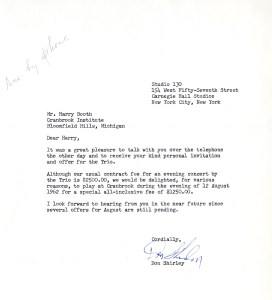
Letter from Don Shirley to Henry Booth, Summer 1962. Collection of Cranbrook Archives, Henry Scripps Booth and Carolyn Farr Booth Papers (Box 40: Folder 9).

Final Scene. In April 1986, as Henry Booth approached his eighty-ninth birthday (he would live to be ninety), Henry reached out to Shirley one more time. Reminiscing about the first concerts in Kingswood Auditorium, one of which Jeanne Graham attended, Henry wrote hopefully about one more concert:

I hope a concert by you can be arranged for next fall or winter, although a summer concert in Cranbrook’s Greek Theatre would be a fine location except for having a good, well-tuned piano at your disposal rather than rain or a shower! Will you put me in touch with your agent? Please do! Meanwhile a big hug for Don Shirley.

The trail in the Archives ends with Shirley sending Henry a flyer of his upcoming concert in Carnegie Hall (where Shirley still lived in an apartment). At the very bottom the pianist simply drew an arrow pointing to the contact for his agent noting, “It’s all here.”

It is, indeed, all preserved here in the Cranbrook Archives. Because there will always be a Cranbrook connection that needs to be researched and a Cranbrook story that needs to be shared.

Gregory WittkoppDirector
Cranbrook Center for Collections and Research


The Iconic Kitty Kingswood

A colleague recently inquired about a painting on the mezzanine wall leading to the music practice rooms at Kingswood School. The painting is of a girl, “Kitty Kingswood,” who is holding a pennant and is accompanied by a swan on the waves of Kingswood Lake. Eliel Saarinen painted the image in the 1930s to camouflage clay sewer pipes.

Painting by Eliel Saarinen in Kingswood School of Kitty Kingswood. Photo courtesy of Cassandra Nelson.

In 1950, Lillian Holm (Head of Weaving at Kingswood School from 1933-1965) copied the pattern of the gown from the painting and Louise Raisch hand-wove the first Kitty Kingswood doll. This doll was auctioned at the 1950 Autumn Festival.

The original Kitty Kingswood doll auctioned at the 1950 Autumn Festival. Photograph by Harvey Croze. Courtesy Cranbrook Archives.

Is there more to the Kitty Kingswood story? A recent trip over to the Girls Middle School, as well as a dive into our files here at the Archives, indicates that there is much more—and the iconic Kitty still plays an integral role.

Fast forward to 1964. The Kingswood Alumnae Association presents a new award to a seventh or eighth grade girl who has contributed to the spirit of Kingswood and is an outstanding citizen. The Association commissions Kingswood sculpture teacher, Pamela Stump Walsh, to create a statue of Kitty Kingswood for the award. The Birmingham Eccentric describes the sculpture as “a typical KSC girl who holds a hockey stick and a pennant and stands on the KSC seal.”

A sketch for the Kitty Kingswood award by Pamela Stump Walsh. Courtesy Cranbrook Archives.

Today, the statue resides at the Girls Middle School as does a plaque (also donated by Pamela Stump Walsh) with the award recipients’ names. An additional case at the middle school displays a Kitty Kingswood doll, which was reproduced and auctioned off for many years to raise funds for the school.

Kitty Kingswood sculpture by Pamela Stump Walsh at the Girls Middle School today.

The Kitty Kingswood Citizenship Award is still presented to an outstanding student each year at the Girls Middle School. The award is determined by vote of the faculty. Pamela Stump Walsh presented the award to the first recipient in 1964, and her words still inspire students today: “Good citizenship is more than simple obedience to a set of rules or laws. It is a loving obedience to just laws and the courage to change the unjust…but most of all, it is serious concern for the condition of others, even for the condition of our enemies.”

Gina Tecos, Archivist

Creativity and Experimentation: A Snapshot of the CKU Dance Department

A new collection that documents two decades of the Cranbrook Kingswood Upper School Dance Department is now open for research. The materials were donated to the Archives by the former Director of the Dance Department, Jessica Sinclair, and photographer Fred Olds.

Sinclair started teaching modern dance as part of Kingswood School’s physical education program in 1963. During her tenure, the program flourished, and Dance became its own department. Students performed throughout the year at the Performing Arts Winter Festival, the annual Evening of Dance concerts, and at events such as the Guy Fawkes Ball at Cranbrook Academy of Art (CAA).

Alexandra Ohanian in studio, ca 2000. Copyright Fred Olds/Courtesy Cranbrook Archives.

In 1982, Sinclair invited Fred Olds to photograph her dancers in collaboration with a fiber installation by Gerhardt Knodel, who was Head of the Fiber Department at CAA at that time. This event led to a twenty-year collaboration between Olds and Sinclair. Olds photographed students in performance, in the studio, and at local and international events.

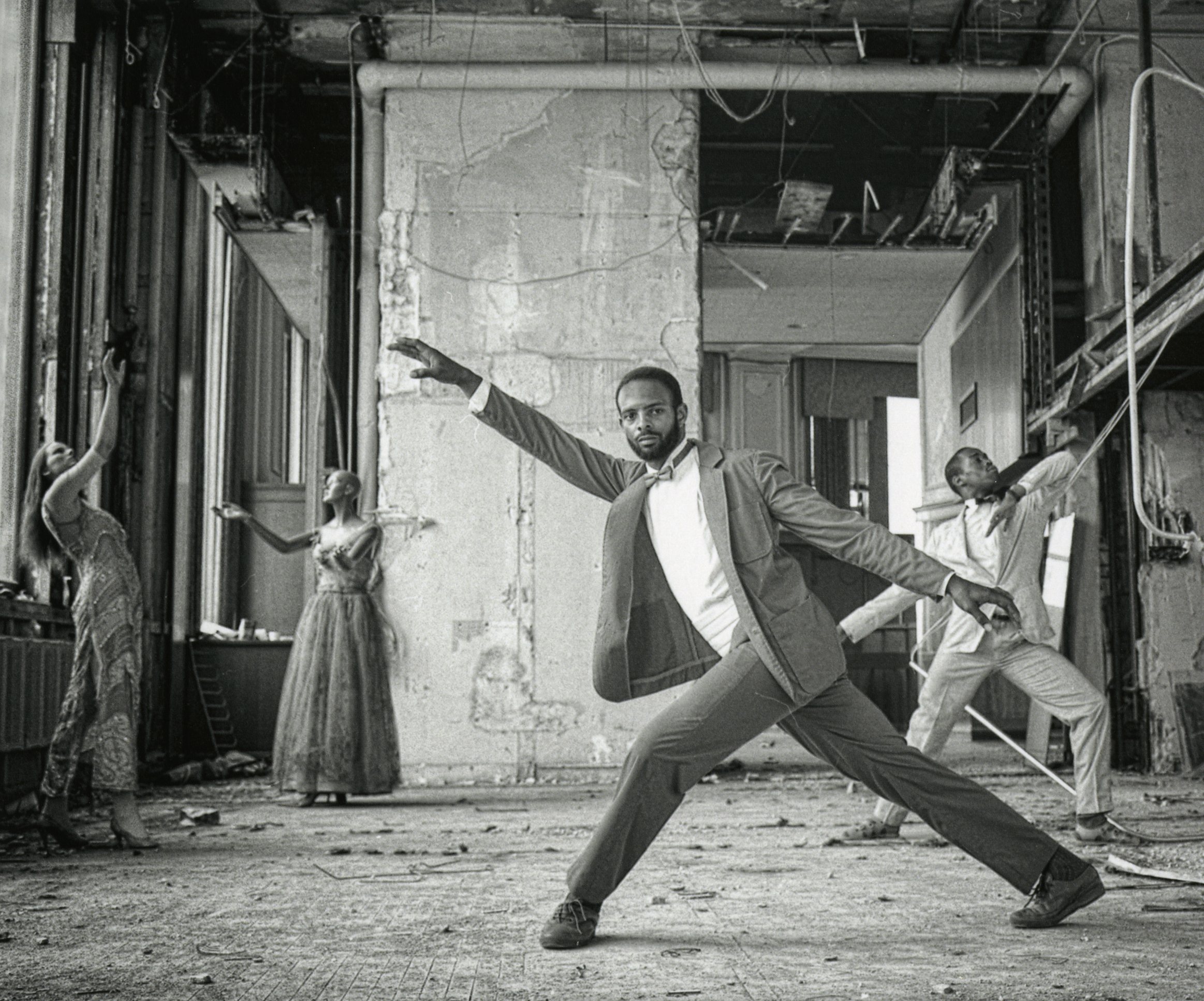
Dancers perform at the David Whitney Building in Detroit, 1985. Copyright Fred Olds/Courtesy Cranbrook Archives.

Between 1982 and 2002, the Dance department performed in Chicago, Toronto, and at the David Whitney Building in Detroit, where Sinclair choreographed “Dance in 4 Spaces,” with a grant awarded by the Michigan Council for the Arts. In 1989, Olds traveled with Sinclair and her dancers to the former Soviet Union to perform at the Children’s Palace in Moscow, the Choreographic Institute in Tblisi, and at the Rimsky-Korsakov Conservatory State Theatre in St. Petersburg. Olds remembers that the peak of applause at this concert came for a dancer in a 16-foot-tall dress designed by artist, Nick Cave (CAA ’89).

Susan Loveland in a costume designed by Nick Cave, 1989. Copyright Fred Olds/Courtesy Cranbrook Archives.

Throughout the years, Sinclair collaborated with a diverse group of fiber artists, sculptors, and architects to infuse creativity and experimentation into her work. The archival collection reflects this process in photographs, ephemera, and video.

– Gina Tecos, Archivist

A Final Reflection (2002-2018)

The “bananas went a-missing” and Kingswood School’s Chiquita Banana Scholarship. The thief who stole the (attributed to) Rembrant Peale portrait of George Washington and the mysterious return of Perseus on the porch of the Thornlea Studio Archives. Gates and andirons and architectural details like the lead conductors at Cranbrook House designed by New York metalsmith Oscar Bach. Cranbrook’s mid-century modern Edison House, the House of the Poet (never realized thank goodness!), Chanticleer Cottage (which used to be the chicken house), Walnut Cottage, Tower Cottage, and Brookside Cottage (also known as the Honeymoon Cottage or Stonybrook) which evolved from the original pump house.

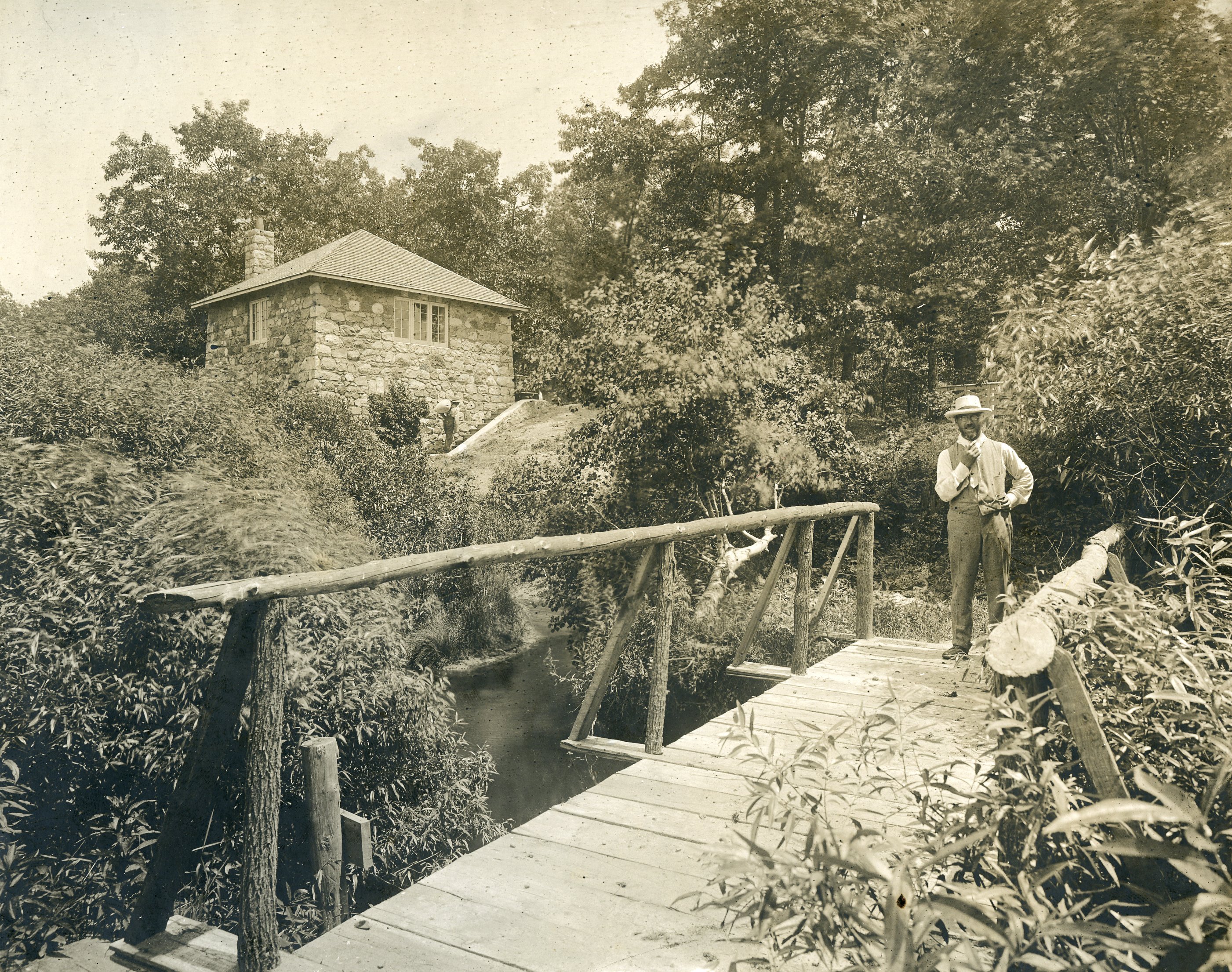
Unidentified man on bridge (no, it is NOT George Booth) with the pump house in the background, ca 1915

And the people! The Italians who literally moved mountains of dirt and rocks, graded the roads, and built the stone walls and beautiful rock gardens that lined the campus.

Landscape architect Edward Eichstaedt, who designed the original planting plan around Jonah Pools and later worked on landscape design for Eero Saarinen’s General Motors Technical Center. The women who left their mark at Christ Church Cranbrook – Kathryn McEwen, Hildreth Meière, and silversmith Elizabeth Copeland. Cranbrook School’s art teacher John Cunningham and his mosaics (which can still be seen today) Kingswood School’s French teacher, Marthe Le Loupp, and Brookside’s dietician Flora Leslie.

Eichstaedt’s 1934 Planting Plan for the Lower basins

Notable national celebrities connected to Cranbrook: Leonard Bernstein, Dave Brubeck, Amelia Earhart, Henry Ford, Eleanor Roosevelt, and Anne Morrow Lindbergh to name just a few. But perhaps most interesting to me was learning the stories of those not so well known: Ebba Wicks Brown – the first registered female architect in the state of Oregon who came to Cranbrook to study architecture with Eliel Saarinen. Colonel Edwin S. George, a Detroit businessman and philanthropist who was affiliated with Cranbrook in a variety of ways – most notably for his contributions to the Institute of Science. Myrtle Hall – the first African American model at the Cranbrook Academy of Art and Cleo Dorman – another model who was infamous for collecting paintings of her done by famous artists. And so many, many more names still swirling around in my brain.

Curatorial scholars at work

Perhaps my greatest joy here has been to help researchers find the answer to their questions, and to guide them towards collections that they might not have thought of – which has often led to a change in the course of their research. I am very proud of the fact that Cranbrook Archives has an international reputation for exemplary service and for being so organized and easy to use. I will miss working with the many students, faculty, staff, researchers, and scholars as you have taught me as much, if not more, than I have taught you. Thank you for that.

And, thank you to the Cranbrook Kingswood Senior May students and the many archival graduate students who have worked on projects over the years, and a special thanks to the most amazing volunteers! We couldn’t have accomplished all that we have without you.

Graduate student (left) and dedicated volunteers at Thornlea Studio Archives

I will close my final Cranbrook blog post by doing what I have tried to do my entire 16 year career here – promote Cranbrook Archives. In the archival profession, one constant issue many of us face is how to demonstrate to our institutions and constituents the importance of an archives – why archives matter. I could wax on, but instead I leave you with this article in the hopes that all who read it will have a new appreciation for the work that archivists do every day to preserve institutional memory. History matters. Archives matter. I am proud that I played a small role in preserving Cranbrook’s rich history.

And on that note, I bid adieu.

Leslie S. Edwards, Head Archivist (2002-2018)

“Smoking and Coking”: The Kingswood Senior Cabin

In March 1940, Kingswood girls were invited to party at Cranbook School’s senior cabin. (George Booth had given the boys the gift of the senior cabin in December 1927.) While the girls had known about the cabin, their visit really brought home the fact that they did not have one to enjoy for themselves. Spearheaded by then sophomore, Mary Adie ‘42, the Kingswood girls began to push for their own cabin.

Henry Scripps Booth supported the idea and was the architect. The cabin had an open floor plan with a fireplace, bathroom, and a small kitchenette. Bench seating lined the window wall that looked out over the brook. The Cranbrook Foundation paid for the structure which cost $2392. The Kingswood School Board of Directors felt that student involvement would help stimulate class and school spirit, and that the cabin would provide an informal respite from the rigors of the school day. The girls raised money and paid for furnishings themselves (from Sears), and even made curtains to decorate the space. Each successive senior class left their mark by adding something to the décor. Mr. Wentz made a wrought iron screen for the fireplace which featured the Kingswood seal. Mrs. Dow contributed a combination radio-Victrola which was very popular as it played twelve records simultaneously! And eventually, the girls even got a telephone.

View of the Senior Cabin (left) with the Western Playfield Shelter, 1963. Courtesy Cranbrook Archives

Once the plan was approved, a location was determined. Then Headmistress, Margaret Auger stated: “I thought I was very clever” when she sited the cabin on the edge of the Kingswood School grounds – close enough where there could be adult supervision, but far enough away so it did not seem as if the faculty was spying on the students. Ground was broken November 19, 1940, and the girls had a housewarming party May 9, 1941 with juniors and the outgoing seniors. The party became an annual “right of passage” which transferred the rights to use the cabin from one class to another. The cabin was so popular that initially there was a column in The Clarion called “Cabin Close-ups!”

Kingswood Seniors hanging out, Feb 1957. Notice the décor.

The cabin was used for a variety of leisure activities. Bridge club was held on Wednesdays, which was the only time that girls were allowed to smoke on campus. Auger’s smoking rule was that students could smoke cigarettes at the cabin, but only on Wednesdays, when faculty member Josephine Waldo was there to supervise. (She, by the way, was a smoker herself). The catch was that if Auger found out that the girls smoked on any other day of the week, she would close the cabin. By far, one of the best parts was that the girls could drink cokes – by the case full! During exam weeks, girls took study breaks at the cabin and revived themselves by “smoking and coking.” In 1964, smoking at the cabin ended when Michigan State law outlawed cigarette smoking for  minors under the age of eighteen.

Smoking and Coking, Dec 1952. Courtesy Cranbrook Archives.

As time went on, various updates and changes were made to the cabin. However, by 1966, the foundation of the building had begun to erode. In the early 1980s, the cabin was only used as a restroom facility for Kingswood School outdoor events, end of year parties for the Girls Middle School field hockey team, and by Academy of Art students as a space to build the models for the Design in America: The Cranbrook Vision 1925-1950 exhibition. The cabin faced increased neglect. There was not enough interest or funds to maintain or repair it and it in the mid 1990s it was demolished. The boys’ Senior Cabin still stands today.

Leslie S. Edwards, Head Archivist

Create a website or blog at WordPress.com