Taste, Grace, and Elegance: The Cannon Returns

Today, Cranbrook Art Museum opens its newest show, With Eyes Opened: Cranbrook Academy of Art Since 1932, surveying the history of the Academy since its founding. For the exhibition, the Center for Collections and Research worked closely with the Museum, researching in the Archives, contributing essays for the 600-plus page publication that chronicles the history of this storied institution, and coordinating the restoration and reinstallation of the Academy’s cannon.

Yes, I said cannon.

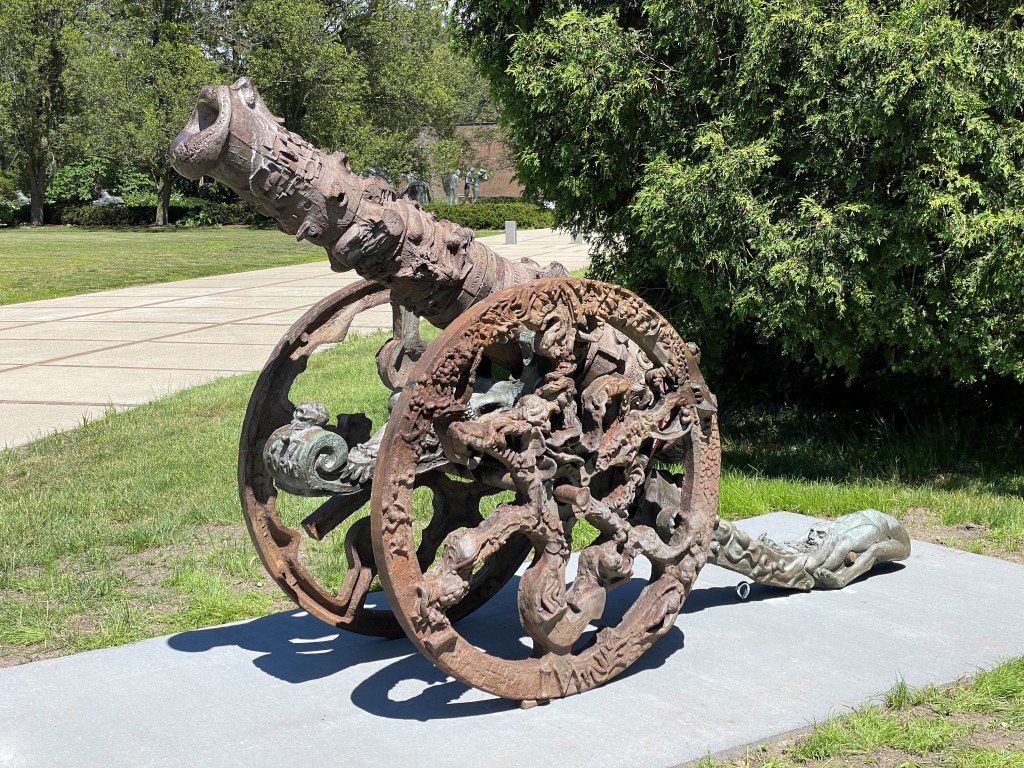
From 1966 to 1971, Julius Schmidt, Artist-in-Residence of the Sculpture Department (1964-1970), and his students, designed, sculpted, and cast a working cannon. Before Schmidt arrived at Cranbrook, there had not been a forge on campus for students to use. It was constructed in 1964, in the open space east of Carl Milles’s large studio. (You can read more about the forge in a previous Kitchen Sink blog: Photo Friday: Iron Pour.)

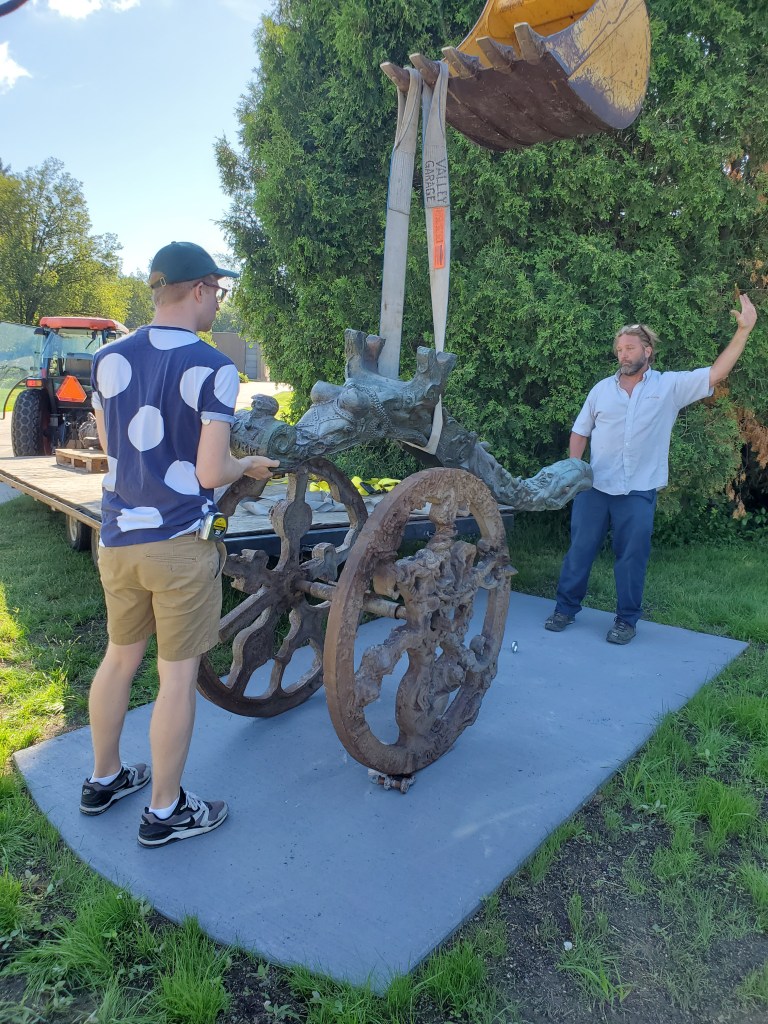
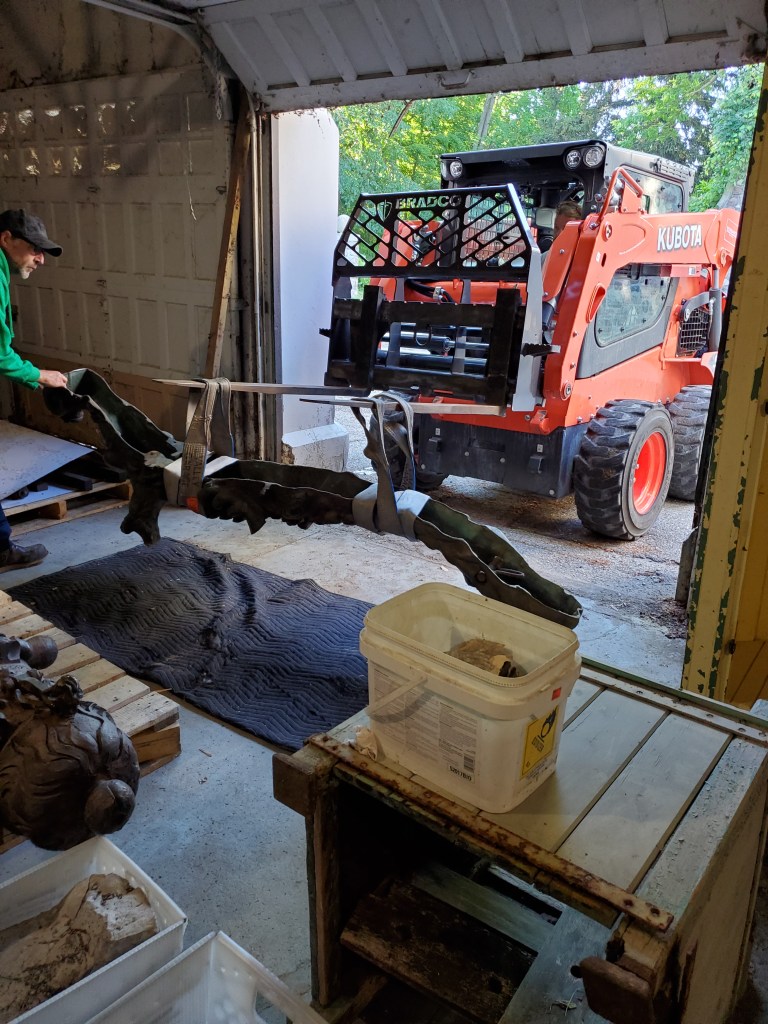
How do you move a cannon? Very carefully–and with a lot of assistance from a hydraulic arm! Steve Kerchoff, the Cranbrook Mechanic, hooks the cannon to the backhoe for placement. June 15, 2021. Photograph by Kevin Adkisson, Cranbrook Center for Collections and Research.

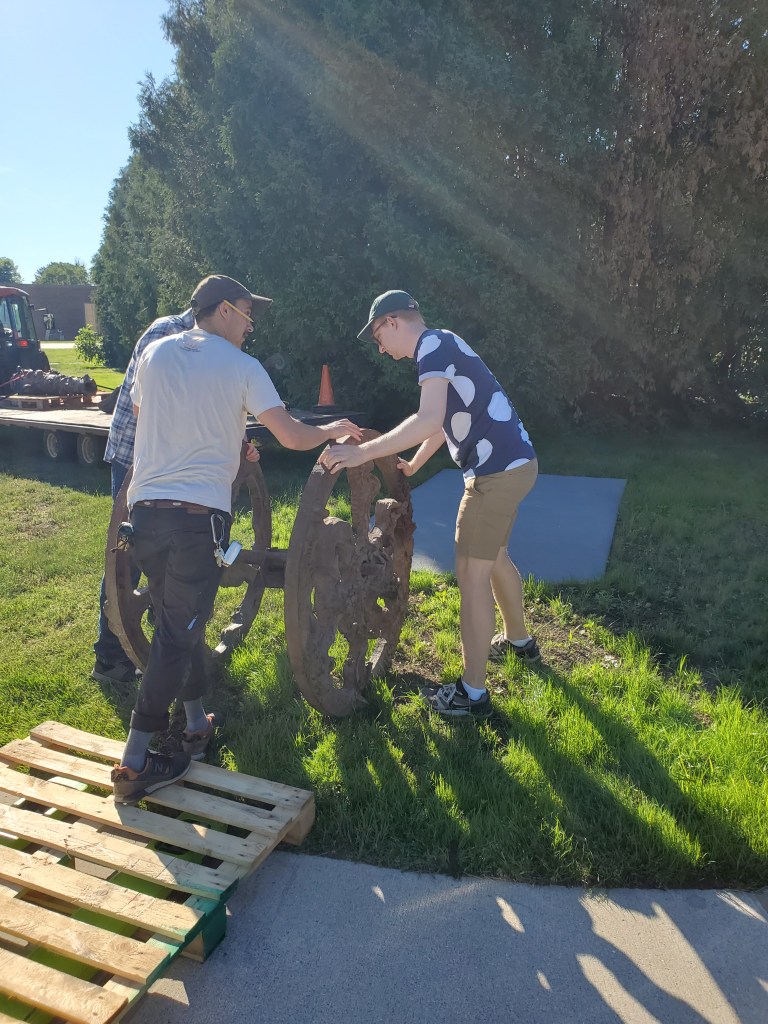
Titled simply Cannon, it is composed of a cast iron wheels, cast iron cannon body, and bronze field carriage. I should say, an extremely heavy carriage, cannon body, and wheels. It took a number of people to get Cannon reinstalled, including artist Scott Berels who restored the wheels with funds from Cranbrook Art Museum, Cranbrook Facilities, who helped move and install the piece, the Center’s Associate Curator Kevin Adkisson, and the Art Museum’s Head Preparator Jon Geiger and Registrar Corey Gross. Vital to the reinstallation was the heavy equipment and sturdy straps of the Facilities team—it isn’t often we use a John Deere backhoe to move art!
We are excited to have Cannon back on campus in time to celebrate the history of the Academy in the Art Museum exhibition. Associate Curator Kevin Adkisson marked the cannon’s its return in his most recent Live at Five presentation on Facebook:

Associate Curator Kevin Adkisson takes you on a tour of Cannon on June 16, 2021. Courtesy Cranbrook Center for Collections and Research.

Cannon features a lot of imagery, including a number of protest-related images, which is in keeping with the times in which it was forged. One line I especially like: beneath the cannon’s trunnions (where it connects to the carriage) is the (perhaps ironic) inscription: “TASTE GRACE AND ELEGANCE.” Indeed!
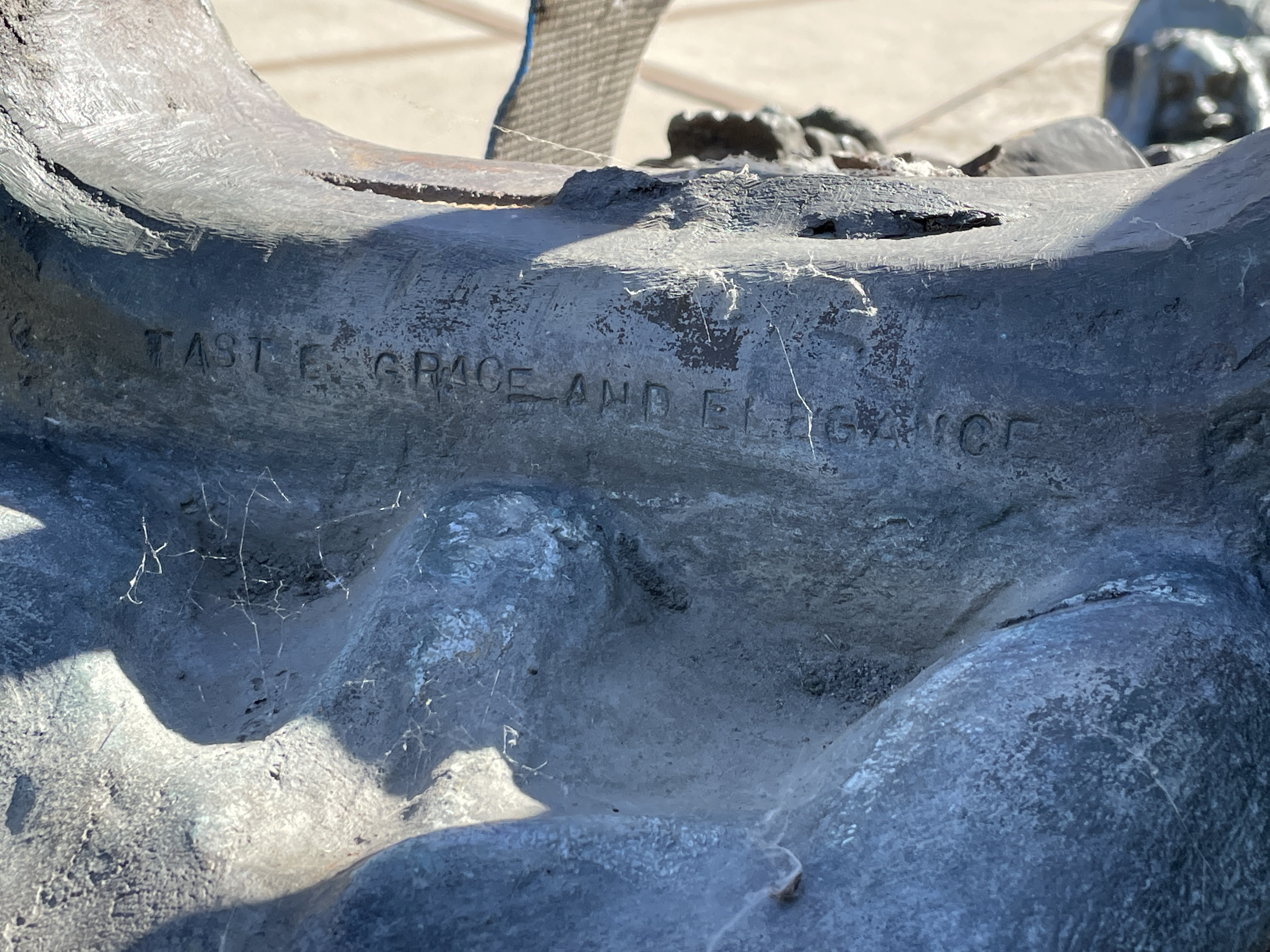
Inscription on the interior of the cannon carriage.

There is still so much to learn about Cannon. We are excited to look into the iconography on the piece, and research the many student artists whose names are seen on the cannon. If you have a cannon-related story, or were involved in its construction or casting, please let us know! Look for more blogs in the future about this heavy, heavy part of the Cranbrook campus.

Congratulations to the team at Cranbrook Art Museum on the opening of the new exhibition. Book your tickets today on the Museum’s website, and don’t forget to walk over to experience Cannon while you’re here!

Leslie S. Mio, Associate Registrar, Cranbrook Center for Collection and Research

Observing Landscapes: Topography and Photogrammetry

One of my favorite items in the collections of Cranbrook Archives is George Booth’s hand drawn map of Cranbrook, which he created over a 24-year period between 1904 and 1928. It is the earliest topographical record of Cranbrook and visually documents his ideas and plans for developing the landscape. In 1951, George’s son, Henry, created annotations to accompany the map, which are useful both in deciphering the map and identifying locations. Henry’s notes on what was envisioned and what was implemented during those early years, are a good starting point from which to venture into the manuscript collections for verification.

Cranbrook Map drawn by George G. Booth between 1904 and 1928.
Courtesy of Cranbrook Archives

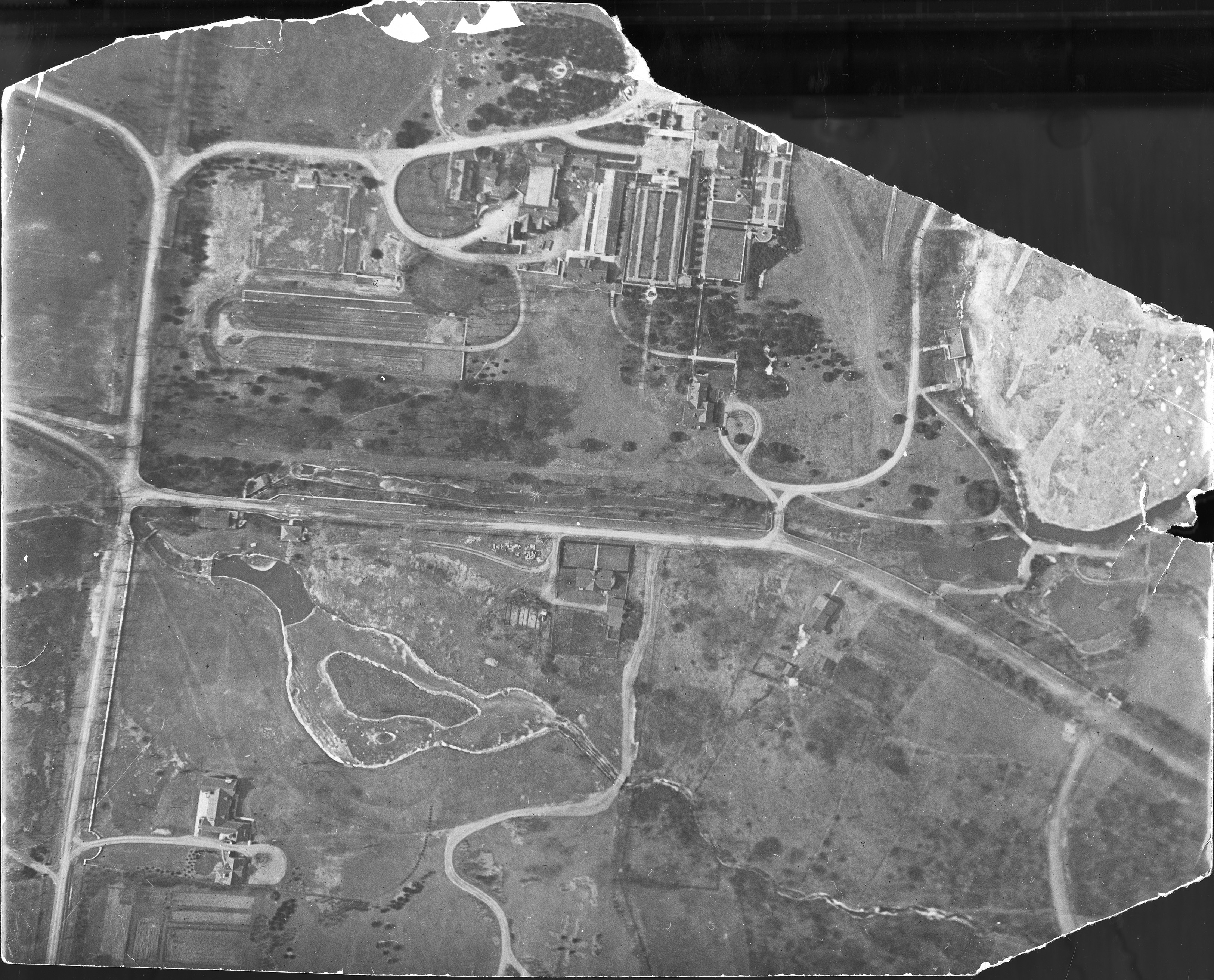
As Cranbrook’s landscape evolved from a family estate into a center for art and education, the means of recording and viewing the topography was assisted by developments in aerial photography, known as photogrammetry. Talbert Abrams, a native of Michigan, is regarded as a key contributor to this field of photography, as he founded the Abrams Aerial Survey Corporation in 1923. The earliest aerial photograph of Cranbrook I could locate is from circa 1918.

Aerial photograph of Cranbrook estate and environs, circa 1918.
Courtesy of Cranbrook Archives

In the Cranbrook Photograph Collection there are many aerial photographs taken by Abrams, as well as other photography firms, ranging from the 1920s through the 1990s. Since the purposes of aerial surveys are manifold, correspondence provides some insight into why they were commissioned and how they were specifically used, for example, as publicity and advertising. In 1932 Cranbrook’s public relations manager, Lee A. White, engaged Cranbrook School Headmaster William Stevens to select an image for the coming year’s brochure, and aerial views appear in all the early Cranbrook brochures. Aerial surveys have also been used to assess and understand the landscape prior to making a change to it. This was the case in 1961, when a topographic map and aerial photography were requested for the Off-Street Parking Study.

Letter from Keith A. Smith to Arthur B. Wittliff, November 1961.
Courtesy of Cranbrook Archives

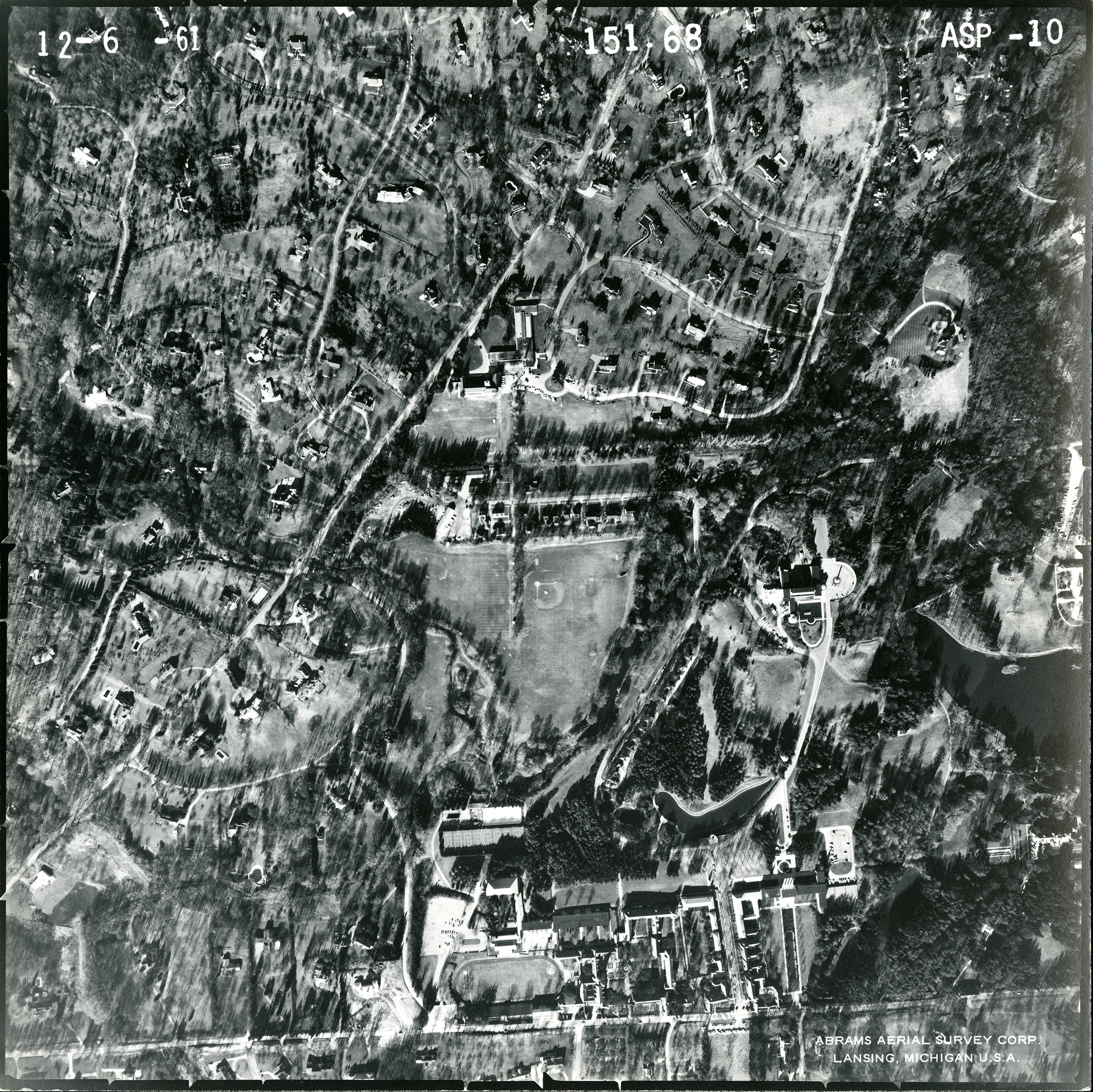
Correspondence between Arthur Wittliff, Secretary for the Cranbrook Foundation Board of Trustees, and Abrams Aerial Survey Corporation, provides intriguing details about the scale of the photography and the material base of the prints. The images below are from a December 6, 1961 set of 12 double weight velvet prints of aerials covering 1 square mile at a scale of 1 inch per 600 feet.

Aerial photograph ASP-5 taken by Abrams Aerial Survey Corporation on 6 December 1961.
Courtesy of Cranbrook Archives

ASP-5 (above) shows the intersection of Cranbrook Road and Lone Pine Road, and includes Kingswood School and Lake, the Institute of Science, Cranbrook House, Brookside School, Christ Church Cranbrook, and the Academy of Art and Academy Way. ASP-10 (below) shows another view of Cranbrook and its environs, encompassing the Institute of Science, Academy of Art, and Cranbrook School.

Aerial photograph ASP-10 taken by Abrams Aerial Survey Corporation on 6 December 1961.
Courtesy of Cranbrook Archives

When looking across the topographical history of Cranbrook from George’s map through aerial photographs, it is always fascinating to discern the changing landscape alongside the features that are unchanging. And, for me, the great inspiration of George’s map is that, although each individual project necessitated getting into the weeds and meticulous details, his ideas were always guided by situating them within a bigger picture.

Laura MacNewman, Associate Archivist, Cranbrook Center for Collections and Research
Cranbrook Gets the Royal Treatment

Not once, but twice, Cranbrook has pulled out the figurative red carpet and with appropriate fanfare welcomed Swedish royalty to its campus. Anyone who knows and loves Cranbrook might not be all that surprised by this revelation. After all, Cranbrook is a very special place—the home of dozens of sculptures by Sweden’s celebrated sculptor Carl Milles, who lived and worked at Cranbrook for twenty years, as well as many tapestries woven by Loja Saarinen’s renowned Swedish weavers. But the larger Detroit community has also boasted a significant Swedish cultural presence.

While most Michiganders might be familiar with the role that Swedish immigrants played in Michigan’s Upper Peninsula mining and lumber industries, Swedes also played major roles in Detroit’s development, from the auto industry to the fine and performing arts. Not least of all were the contributions made by Milles, including his sculpture The Hand of God, which has stood in front of the city’s Frank Murphy Hall of Justice since 1970. The founding in 1963 of the Detroit Swedish Council by Charles J. Koebel (who, decades earlier, had commissioned Eliel Saarinen to design his family home in Grosse Pointe Farms), saw a concerted effort to promote Swedish culture in the area. It was likely the unique combination of Cranbrook’s artistic works and Detroit’s vibrant Swedish community that attracted visits from Sweden’s royal family on two separate occasions.

Program for the day’s activities. Courtesy of Cranbrook Archives.

So it was that on October 26, 1972, Princess Christina of Sweden set foot on Cranbrook grounds as part of her two-week tour of the States. And sixteen years later, her brother and his wife, King Carl XVI Gustaf and Queen Silvia, followed suit on April 18, 1988. Both visits focused largely on Carl Milles’ Cranbrook legacy, directly involved the Academy of Art and Art Museum, and were the result of collaborations between Cranbrook and the Detroit Swedish Council. Yet each visit had its own unique activities and sense of purpose.

Continue reading

De Profundis: Olga Milles’ Drawings of the Soul

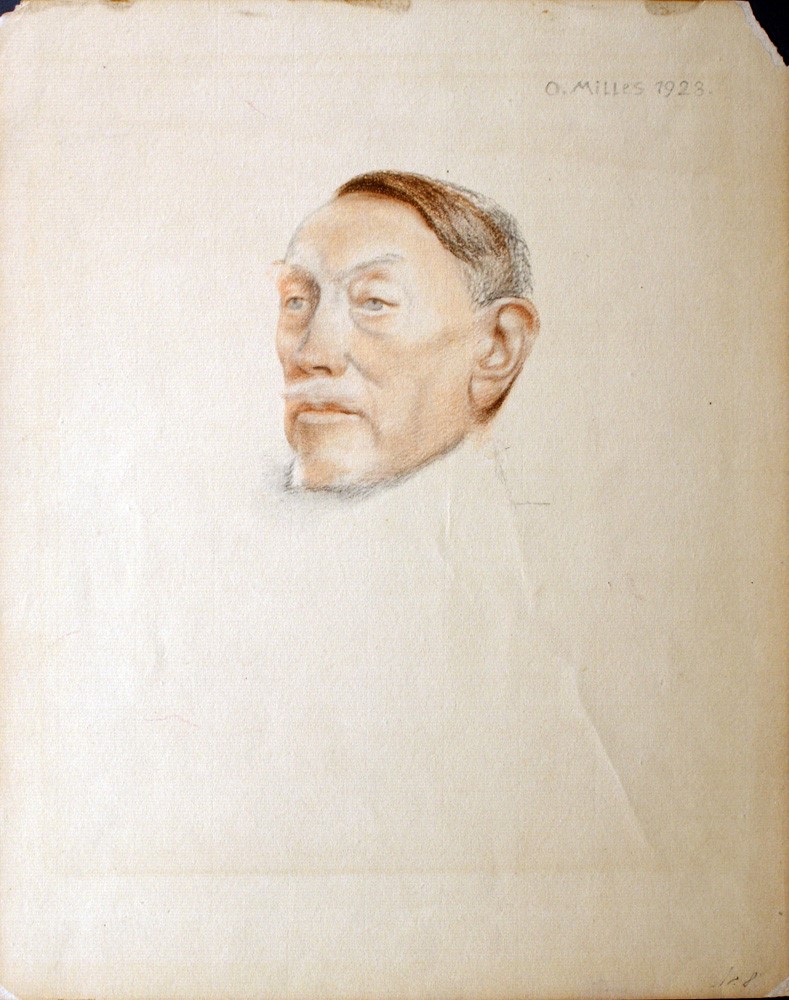
Olga Milles lived in the very depths. In her art, almost exclusively devoted to portrait painting, she sought to draw out the character from the depths of her models and to find the soul behind the façade. Using a variety of techniques including charcoal, crayon, pastel, watercolor, tempera, and oil in her work, Olga was considered an artistic prodigy and developed her talent from a young age, yet her art is largely unknown. In 1988, twenty-one years after her death, Cranbrook Art Museum hosted an exhibition in collaboration with Millesgården, Olga Milles Emerges, to exhibit examples of her art from both museums’ collections.

In the foreword to the exhibition catalog, Staffan Carlén, former Director of Millesgården, describes her as having an intuitive talent that produced factual character studies of extreme precision, with an “overwhelmingly melancholic” tone. In reading Inger Wahlöö’s account of Olga’s life, based on correspondence at Millesgården, Carlen’s interpretation of Olga’s artwork can almost be read as a profile of Olga herself:

“Sparseness of shadowed areas and stretched areas disrobe the faces and make them appear in a serious, introverted nakedness. Her efforts are primarily directed towards interpreting the character of the soul. This she did with great coloristic refinement, and with tenderness in the form. In her drawings, there is consistently a sensitive enlargement of the mouth, sometimes in interaction with the dreaming mood of the eyes, sometimes as a tension-filled contrast of unconscious sensuality.”

Staffan Carlen, Olga Milles Emerges
Print of Drawing of Carl Milles by Olga Milles, 1917. Courtesy of Cranbrook Archives.

Born Olga Granner in 1874 in Leibniz, Austria, she had two brothers and two sisters. She had a deep loyalty to her family, whom she visited for several months every year, except during World War II. Having been born and raised in the Catholic church, she initially aspired to become an art teacher in a convent. However, in early adulthood, Olga questioned what it meant to be disobedient to the church and broke away, while cultivating an increasingly ascetic life.

Continue reading

Sketching to Jazz and Judo: the Young People’s Art Center

Did you know that Cranbrook Art Museum’s educational partnerships with surrounding communities date back over sixty years? Long before the current museum trend of interactive educational programs for youth audiences, the Academy of Art and the Junior League of Birmingham had an idea:  the Young People’s Art Center (YPAC).

Young People’s Art Center logo, from the 1962 enrollment form. Courtesy of Cranbrook Archives.

The year was 1958, and the Museum had recently changed names to the Academy of Art Galleries, shifting focus to feature more contemporary art practices. With that, came the desire to encourage young visitors to express their own artistic voices—participatory education, rather than simply art appreciation. Documenting the program’s first year, a June 1959 Detroit News Pictorial Magazine feature noted that YPAC “is fast gaining a national reputation for its lively approach to art education.”

In particular, it was Henry Booth (Academy Board of Trustees Chairman), Wallace Mitchell (Head of Galleries), and Zoltan Sepeshy (Academy Director) that approached the Junior League with a plan. In a 1957 report by Mitchell during the Center’s development phase, he states, “ The personnel of the Cranbrook Academy of Art has become increasingly aware of the growing country-wide interest in the visual arts and has long wished to more directly participate in the fostering and guiding of this interest as expressed in our community.” Seeking support from the Junior League, this “unique opportunity to bring to the children of Oakland County an integrated program in art education which concerns itself with the totality of the art experience” was green-lighted for the following year.

Children watch a judo demonstrator as part of a class exercise. Erik Strylander, photographer. From the article “Sketching to Jazz and Judo,” Detroit News Pictorial Magazine, June 28, 1959.

A perfect partnership was formed. The Academy would provide leadership, through the support of its trustees, director, and faculty; the Junior League would provide the necessary finances. Naturally, with so many talented artists on campus, there was no lack of creativity or helping hands! Junior League members were also heavily involved, providing volunteer docents to conduct gallery tours and assist with classes, both of which were located on the ground level of the Museum below the Academy Library.

Continue reading

Clean as a Whistle

In the past, we have discussed how we cover our stone sculptures on campus to protect them in the winter. But what about the many bronze sculptures? Europe and the Bull? Persephone? The Centaurs?

These pieces are more robust and able to withstand what winter throws at them, but they still need some love each year.

Each spring since 1987, the Community has brought in Venus Bronze Works to recondition the bronzes across the campus. Venus Bronze Works is a member of the American Institute for Conservation of Historic and Artistic Works, which means all the cleaning they do is in accordance with AIC’s Code of Ethics and Guidelines for Practice.

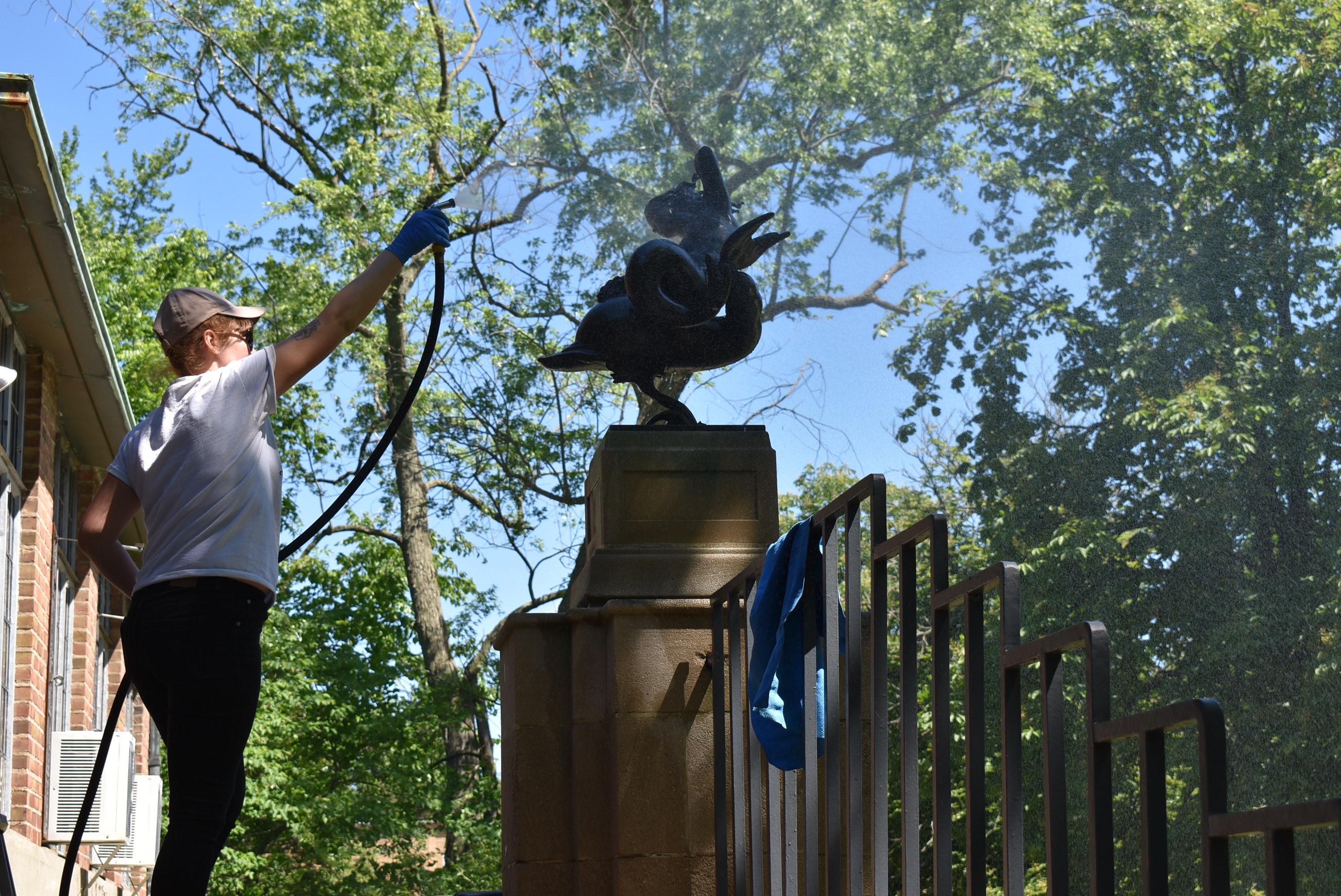
All sculptures are inspected and cleaned by dusting them off with compressed air or wet down and washed with a mild detergent, sponges, soft bristle brushes, and fine cotton pads.

Terra Gillis of Venus Bronze Works gives Carl Milles’s Sunglitter (also know as Naiad and Dolphin, CAM 2002.1) a quick shower, 2020. Photo by Kevin Adkisson.
Harlow Toland of Venus Bronze Works gives one of Carl Milles’s Running Deer (CAM 1934.30) a good scrub, 2020. Photo by Kevin Adkisson.

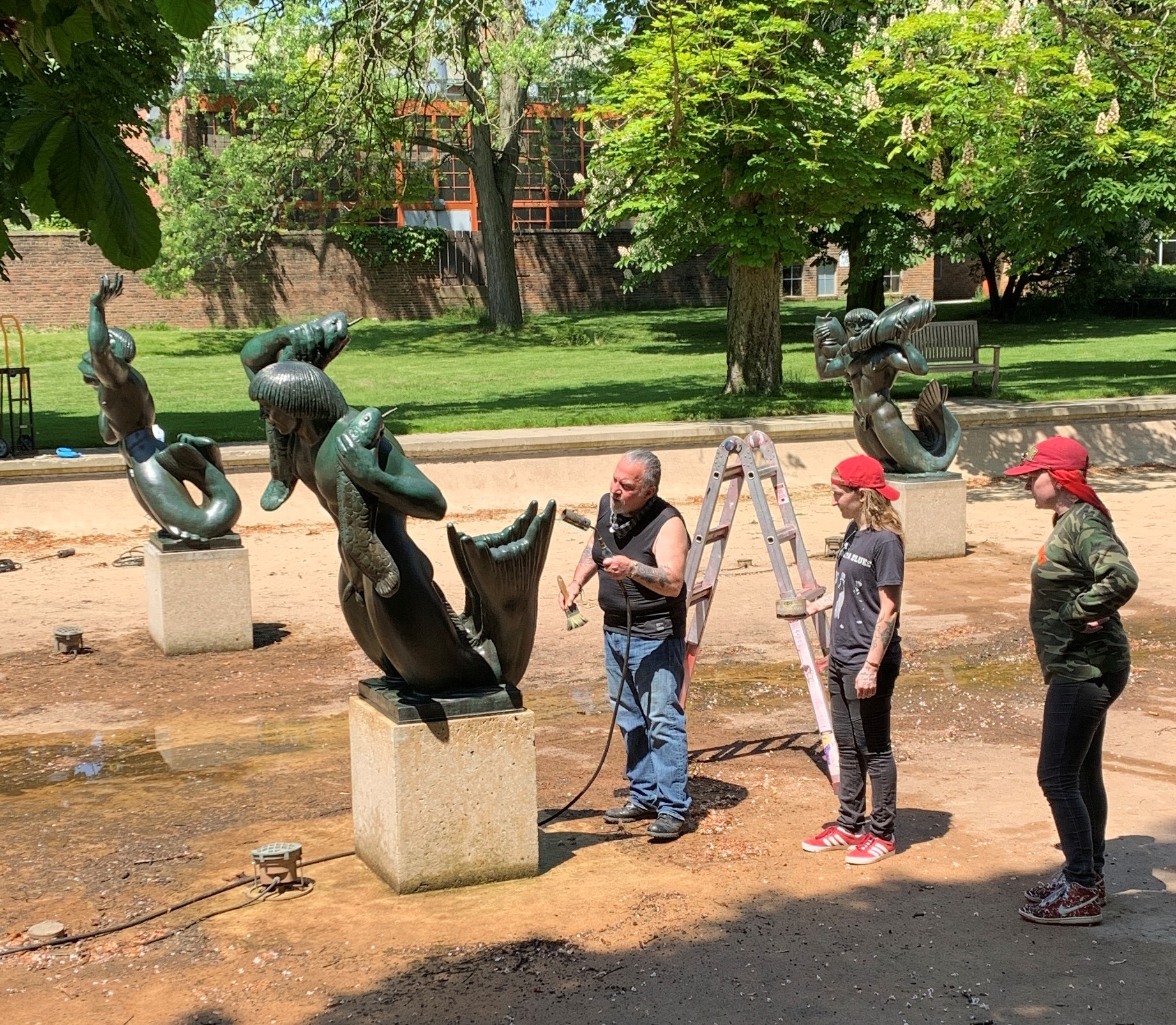
When the works are dried, one or two thin coats of wax are applied and the sculptures are buffed. This wax can be applied directly from the container or applied to a hot surface (by heating the sculpture with a propane-fed torch).

Giorgio Gikas, founder of Venus Bronze Works, holds the torch while his assistants Harlow Toland and Sara Myefski help prepare Triton with Fishes in the Triton Pools at Cranbrook Art Museum to receive a hot wax treatment, 2020. Photo by Kevin Adkisson.

This wax acts as a barrier to the air and humidity on the bronze surface and prevents damaging oxidization or corrosion from developing. When deciding how each individual work is cleaned, we look back to the artist’s intent for each sculpture (was it meant to be patinated green? dark bronze? polished? gilded?) and treat it accordingly.

Venus Bronze Works cleans and waxes all the Milles sculptures at the Cranbrook Art Museum and Cranbrook Academy of Art and the Cranbrook Institute of Science. They also work on such sculptures as Brookside’s Birds in Flight; Kingswood’s Dancing Girls and Diana; Cranbrook House and Gardens’ Fortuna delle Tartaruga (Turtle Fountain); and Cranbrook School’s athletic sculptures. Check out a recent Instagram post about the athletic sculptures below:

We are excited to start welcoming visitors back to our campus this summer, so you can all see the beautiful sculpture in their freshened-up glory.

Leslie S. Mio, Associate Registrar, Cranbrook Center for Collections and Research
Cranbrook, Way Back

When we consider historical records, even digital ones, our thoughts do not usually extend to websites. Yet, just like student newsletters or exhibition catalogs, Cranbrook’s website is a compendium of institutional information regarding the people, places, and things that make it unique.  As we ourselves shift evermore towards online existences, one focus of the Archives has been on how to ensure Cranbrook’s virtual legacy.

I’m sure everyone is familiar with the expression, “What goes on the internet, stays on the internet,” or some variation thereof. Cranbrook is no exception. Fortunately, there is the Internet Archive. A non-profit American digital library, it has been saving public websites since 1996. And, courtesy of its web archives, the Wayback Machine, Cranbrook’s evolving web presence has been captured over time from its beginnings in the mid to late 1990s to today. [Interesting aside: through the Internet Archives backup protocol, Cranbrook is a part of the Bibliotheca Alexandrina, the current incarnation of the famed ancient Library of Alexandria!]

Screen Shot 2020-05-21 at 3.15.30 PM

Cranbrook home page as it looked in 1997. Courtesy of the Internet Archive.

One of the quickest ways to get a snapshot of what was going on at Cranbrook in the last twenty-three years is through its website.  Get lost in Cranbrook 1997 by clicking on the above homepage image and navigating through the still active links.

How about exploring Cranbrook 2007?

Screen Shot 2020-05-21 at 2.35.49 PM

Cranbrook home page as it looked in 2007. Courtesy of the Internet Archive.

There are only 1,450 more site captures to delve into, if you’ve got the time! While the interactive websites of Cranbrook’s past can be accessed in this way, it is important to note that the information and files used in their creation form part of the over two million items at the Archives. For example, the main homepage image from the 1997 website, the Woodward Entrance Feature, can be found in the Archives’ Architecture Slide Collection.

S.22.268

View of the entrance feature from Woodward Avenue at sunset, 1996. Dan Hoffman, designer. Balthazar Korab, photographer. Copyright Balthazar Korab/Cranbrook Archives.

As increasingly digital files become the only documentation of Cranbrook activities or events, its websites are more integral to understanding the context of these records. The Archives continues to expand its digital capabilities to keep pace. In the near future, we hope to provide our own copies of Cranbrook’s various websites (with keyword search capability), side by side with the digital records from which they were created.

CCCR logo_horiz_color_no text_transparent background-1

Deborah Rice, Head Archivist, Cranbrook Archives Cranbrook Center for Collections and Research
A Michigan Mural

Metro Detroiters, out-of-town visitors, and architectural aficionados worldwide have long admired the Penobscot Building in Detroit’s Financial District. Like its close neighbor, the Guardian Building, and the Fisher Building further north in Midtown, it is one of the city’s finest examples of art deco architecture and one of the iconic structures that still make up Detroit’s skyline today. Designed by Wirt C. Rowland of Smith, Hinchman, & Grylls, when its 47 stories were built in 1928, it was the tallest building in the city and the fourth tallest in the nation.

The Penobscot, on the National Register of Historic Places, is perhaps best known architecturally for its tiered upper seventeen floors and the exterior ornament by sculptor Corrado Parducci, whose work can be seen on many other Detroit buildings. It’s also known to locals for the red-lit globe at the top (originally designed as an aviation beacon), the legendary Caucus Club (Barbara Streisand reportedly launched her singing career here), or the famed roof observation deck which offered an excellent panorama of the city.

But, what about the interior of the Penobscot? Well it just so happens there’s a Cranbrook connection!

penob-1

The original bank lobby. Courtesy Detroit Free Press Archives.

The Guardian Detroit Group was the first tenant of the two-story bank hall at 635 Griswold St. before they had their own skyscraper commissioned just a block away. A later occupant, Detroit City Bank, opened in the same space in February 1949. When they did, adorning one wall was a mural painted by Cranbrook Academy of Art graduate and Head of Kingswood School Art Department (1940-1956), Clifford B. West. Known as the “Mural of Michigan” the twenty-six-foot painting depicts scenes representing state commerce and industry. West, who studied under Zoltan Sepeshy, and with fellow muralist David Fredenthal, had already completed a bank mural in Alamosa, Colorado, as well as Detroit-area murals in the Rackham Building, Stockholm Restaurant, and Fox & Hounds Restaurant.

Following a meticulous process that involved a series of sketches at different scales, cartoons plotted to a numbered grid and traced on the wall, and painting in two steps (large blocks of color followed by detail work), the scenes were applied in casein tempera on canvas cemented to the wall. Joining in this process was West’s wife and fellow artist, Joy Griffin West, and several academy students. Fortuitously, each stage of work was captured in a series of photographs by Cranbrook photographer, Harvey Croze.

This slideshow requires JavaScript.

Upon completion of the mural, West mounted an exhibit at Cranbrook Art Museum titled, Progress of a Mural in April 1949, detailing his process for the Penobscot mural, and featuring many of the preliminary sketches and cartoons.

It’s largely unknown whether the Penobscot mural exists today, since a drop ceiling was installed many years ago, completely obscuring West’s creation.

Deborah Rice, Head Archivist

Cranbrook-LIFE

2020 marks ninety years of temporary traveling exhibitions at Cranbrook Art Museum. Perhaps one of the best examples that brings to life this aspect of the Museum’s programs is Cranbrook’s brief but wildly successful partnership with LIFE Magazine.

The Cranbrook-LIFE Exhibition of Contemporary American Painting opened in 1940, ten years after Cranbrook Art Museum hosted its first traveling exhibition, organized by the American Union of Decorative Artists and featuring contemporary interior design. The idea of temporary traveling exhibits at Cranbrook began the same year as the permanent collection was established by founder George G. Booth. It furthered Booth’s commitment to presenting contemporary art as foremost a learning tool for Academy of Art students. It was intended “to remind our students that art is a living thing and that the record of our times is being created from day to day by the artists of this age, and in so doing perhaps to stimulate the creative spirit among those who work here.”

LIFE_judging

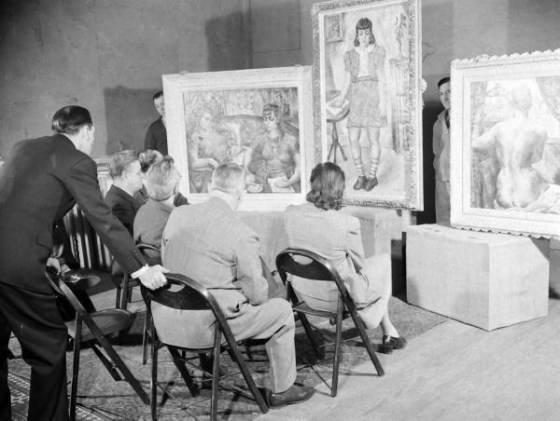
Judges examine paintings in New York, April 1940. Hansel Meith, photographer. Copyright Time Inc.

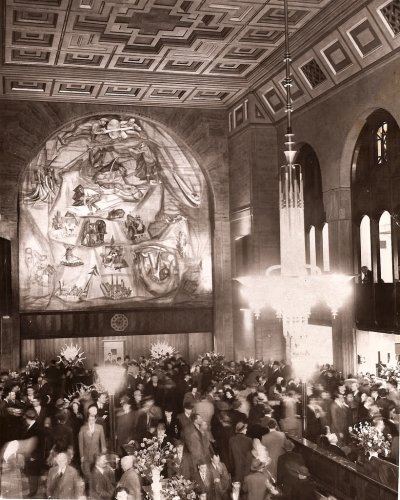
Cranbrook-LIFE was a celebration of contemporary U.S. art meant to symbolize “America’s increasing responsibility as a democratic world art center.” (Life, May 27, 1940) As such, LIFE invited sixty painters, living and working in America, to submit three paintings to be voted on by a jury of six. The painters included Edward Hopper, Charles Sheeler, and Cranbrook’s own Zoltan Sepeshy. The jury, comprised of Sepeshy, two leading art museum directors, an editor at LIFE Magazine, a representative from the Federal Works Agency Section of Fine Arts, and a well-respected American painter and educator, convened in a New York City warehouse where they spent four hours whittling down 180 submissions to the final sixty paintings shipped to Cranbrook for the show. One of these was Grant Wood’s American Gothic! Loaned by the Art Institute of Chicago, the already famous painting appears to be the only piece in the exhibition to come from another art museum.

5523-5

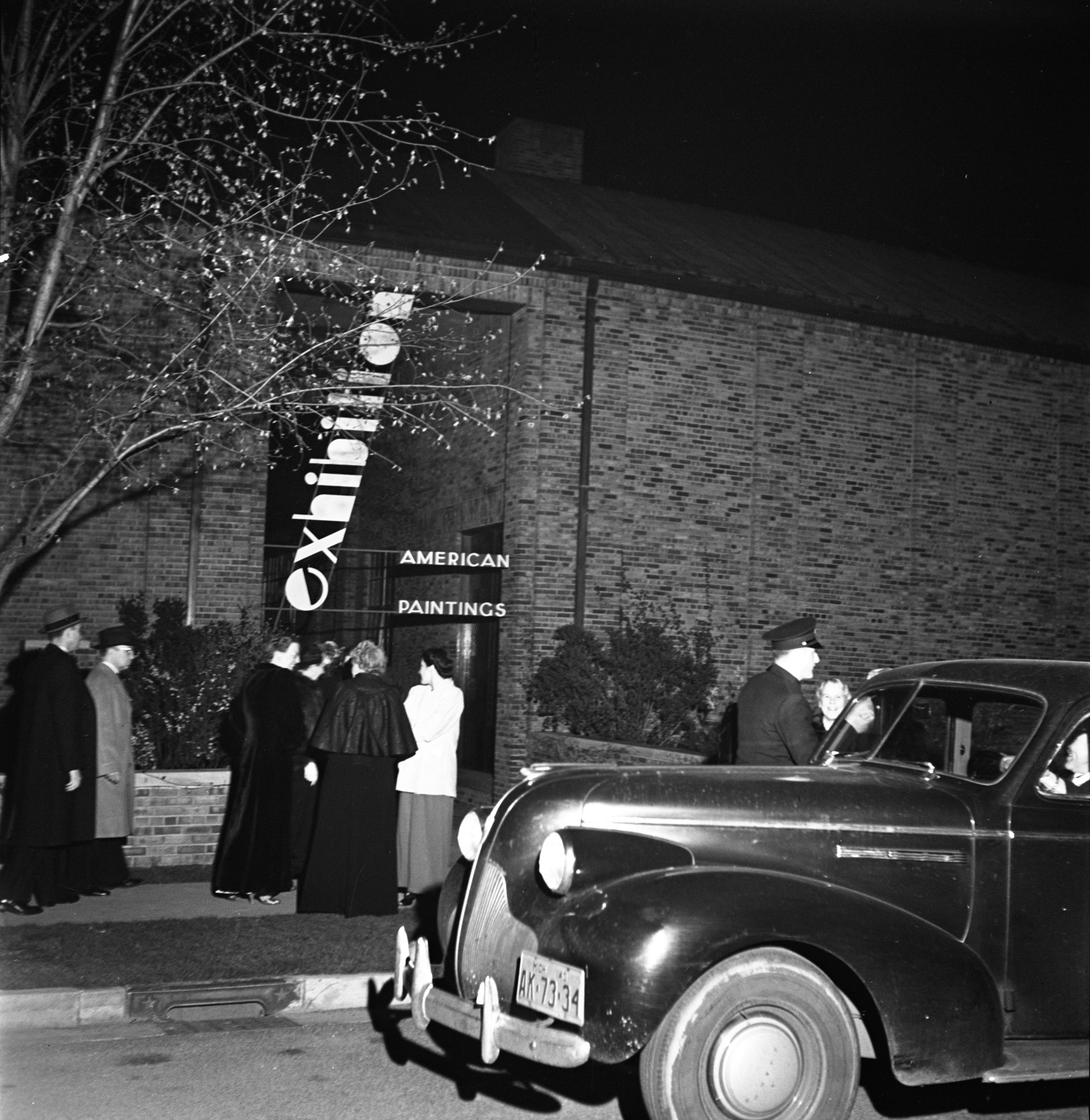
Opening night attendees arrive. Courtesy Cranbrook Archives.

If you’re at all familiar with LIFE, you may be asking yourself why a popular weekly magazine, known for its photographic general-interest stories, would make a foray like this into the art world? According to a 1940 TIME Magazine article, in the previous three years,  “the No. 1 U.S. source of popular knowledge of U.S. art has been LIFE, which has reproduced for the man-in-the-street’s weekly dime some 452 paintings (usually in full color) by U.S. artists.” Your next question might be why it was held at Cranbrook, as opposed to, say, the newly constructed Museum of Modern Art building in New York City? Florence Davies of the Detroit News may have answered that, when she wrote at the time: “Life Magazine picked Cranbrook not only because of the enchanting setting of the place as a whole, but more particularly because it found there ‘work in progress—an atmosphere of creative activity.’”

5523-11

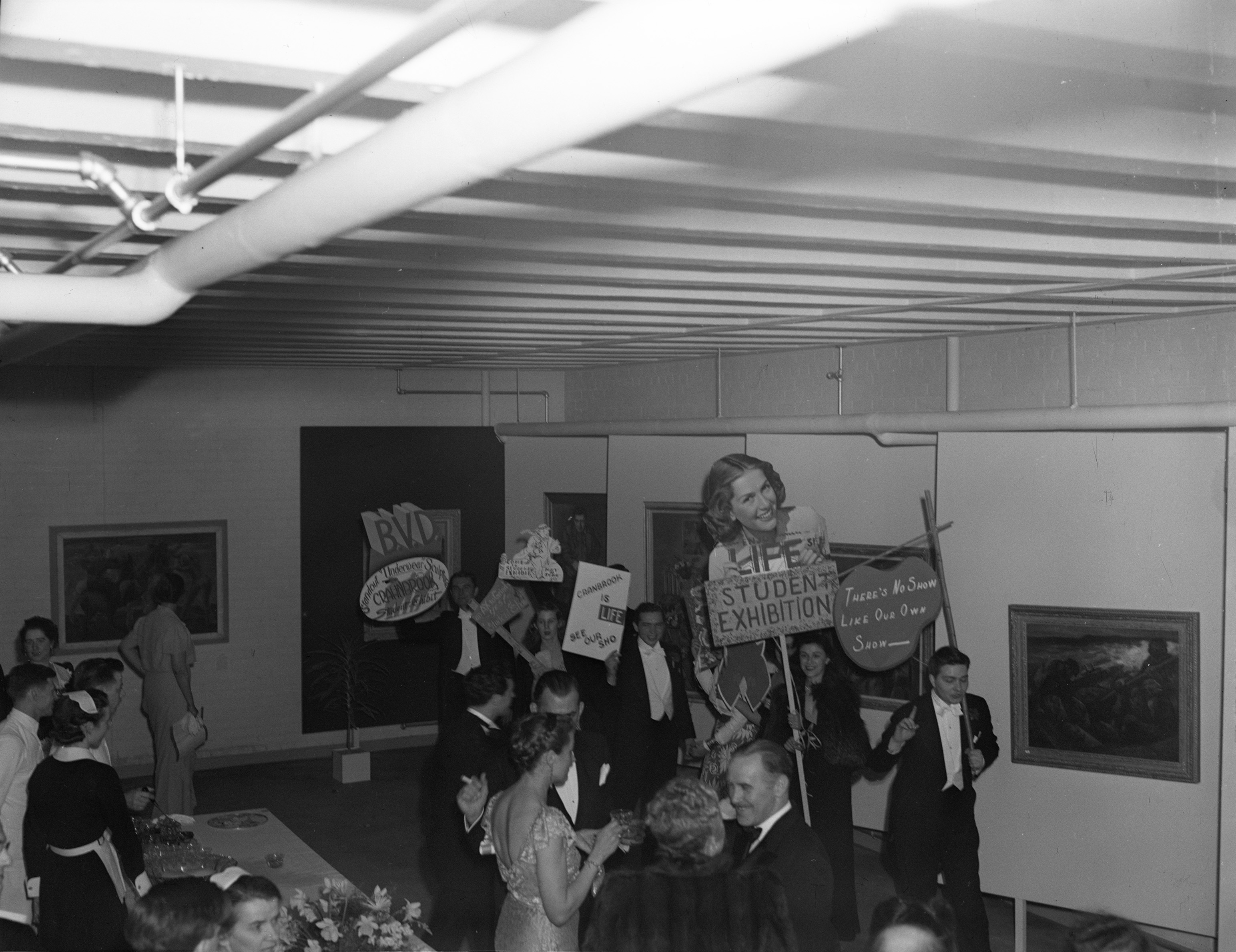
Academy of Art students parade through the opening night gala reminding attendees of the student exhibition simultaneously on display at the Cranbrook Pavilion. Courtesy Cranbrook Archives.

The exhibition drew an estimated 2,500 national and international visitors in the short two weeks it was on display from May 17-June 2, 1940. Because of the size of the show, it could not be held in the current museum building on Lone Pine Road and Academy Way (Eliel Saarinen’s museum building began construction during the exhibition). And, as the Academy student exhibition was currently occupying the Cranbrook Pavilion, the decision was made to utilize the Academy’s Painting Department Studios. Opening night was a festive gala. Attendees, including George and Ellen Booth, Loja and Eliel Saarinen, Edsel B. Ford, Albert Kahn, and “1,000 Detroit socialites braved wintry winds” in formal attire. (Time, June 3, 1940)

5533-1

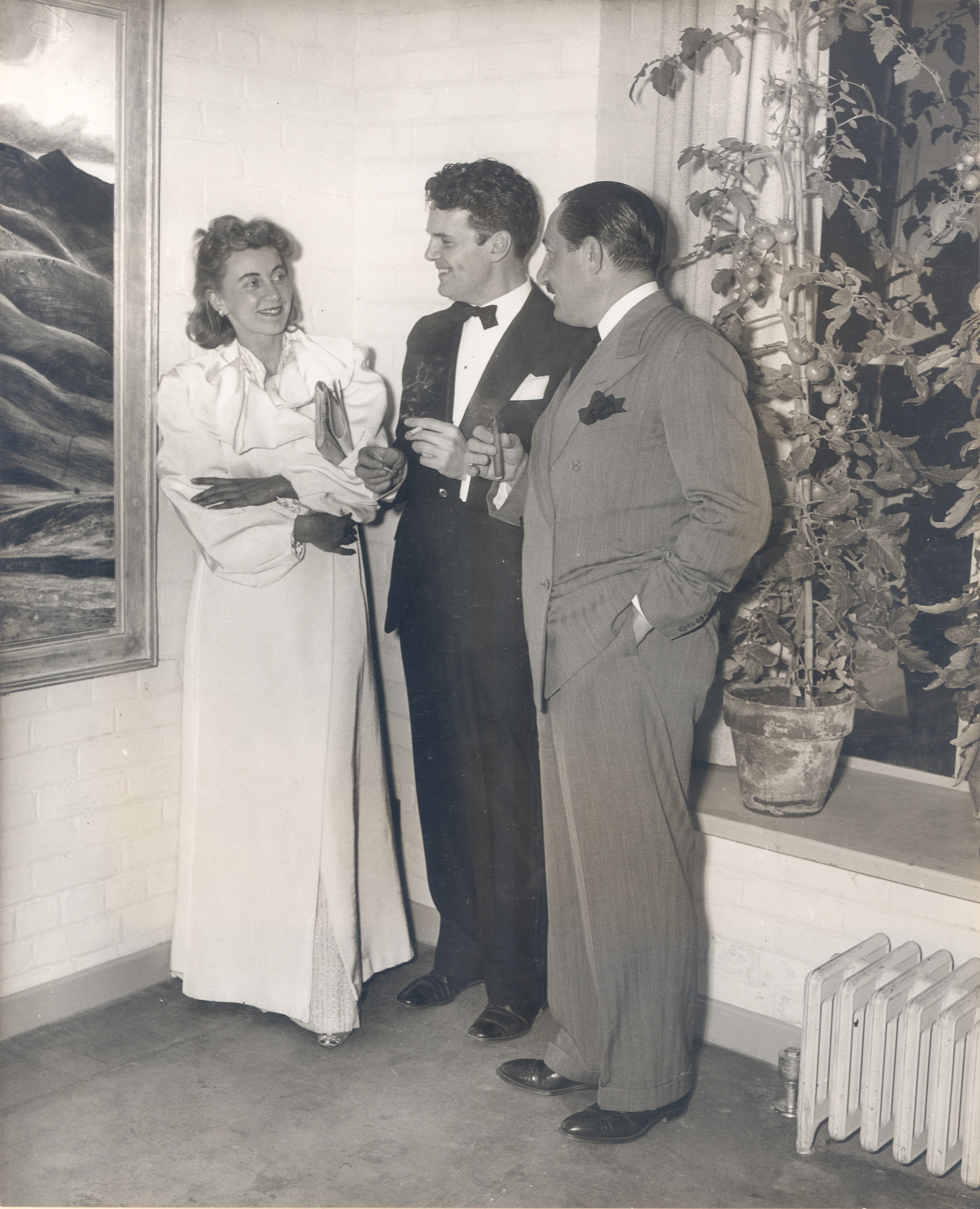
Marianne Strengell, Charles Eames, and Richard Reinhardt. Richard A. Askew, photographer. Courtesy Cranbrook Archives.

Coming on the heels of the Great Depression and during the beginning months of the War in Europe, pro-American sentiment was high, as evidenced by the placement of potted American-grown tomatoes in windowsills as decoration. According to TIME Magazine, the music for the evening was by U.S. composers and refreshments included “Rhine wine flavored to taste like U.S. new-mown hay.” (!?)

Cranbrook-LIFE marks the beginning of the Cranbrook Art Museum Exhibition Records, which illuminate thirty-six years of temporary traveling exhibits, and are rife with names of renowned artists that have exhibited at Cranbrook throughout its history.

It’s not all in the past, though! Don’t miss Cranbrook Art Museum’s current traveling exhibition,  In the Vanguard: Haystack Mountain School of Crafts, 1950-1969, on view until March 8, 2020.

Deborah Rice, Head Archivist

A Sculpture So Nice They Named it Twice

One of my many duties here at the Center for Collections and Research is to maintain the sculptures on the campus. This can mean finding conservators to repair works, contractors to clean them, or, in some cases, clean them myself. Recently, I was working on a sculpture in the gardens at Cranbrook House. I had seen the sculpture before but wondered about its backstory. Turns out it was a tale of two names.

The sculpture is Mario Korbel’s statue Atalanta, the Greek goddess of the hunt, travel, and adventure. It was commissioned by George Gough Booth in 1927 for one of the gardens at Cranbrook House, part of a series of work Korbel completed for the Booth house and gardens — including Dawn and Harmony in the gardens and Andante and Nocturne in the house.

Letter from Mario Korbel to George G. Booth, referencing both his works Atalanta and Andante. George Gough Booth Papers, Cranbrook Archives.

July 12, 1927 letter from Mario Korbel to George G. Booth, referencing both his works Atalanta and Andante. George Gough Booth Papers, Cranbrook Archives.

Booth, admiring the beauty of the clear, white marble of Atalanta, transferred the work into the collection of the Art Museum. It was part of the original art museum exhibition in 1930.

CISB509L.jpg

Atalanta (left) in the first Art Museum exhibition in 1930. Courtesy Cranbrook Archives.

Later, Booth wrote: “We have finally concluded that the figure will make a very important and striking center art element in connection with the new School for Girls at Cranbrook.” When the Kingswood dormitory was built, the sculpture was transferred to Kingswood and installed on the terrace.

Atalanta.jpg

Atalanta (right) adorns the terrace at the Kingswood School for Girls dormitory in this undated photo. Courtesy Cranbrook Archives.

In 1969, the sculpture was vandalized and smashed into many pieces (no one was ever implicated in the crime–or at least, their name isn’t in my file!). Those pieces were put back together, but when Atalanta was finally repaired, she was not as pristine. Henry Scripps Booth decided to rename her Ecolo. He also wrote a verse to explain the new name:

Ecolo, Goddess of Earth 

Who is this sweet maid who stoops protectively to save the earth from man’s pernicious tread? 

It is the blithe spirit of Ecology by whom all life and natural things are fed.

CEC472 (2).jpg

Ecolo in her new home in the Herb Garden at Cranbrook House.

Ecolo, or the sculpture-formerly-known-as-Atalanta, now greets visitors in the Herb Garden at Cranbrook House.

– Leslie S. Mio, Associate Registrar

Create a website or blog at WordPress.com